26:2 Expected Results and Observed Results Objectives: Discuss the purpose of the Punnett square Compare expected results and observed results Explain the importance of Gregor Mendel’s work
The Punnett square The  Punnett square  is a way to show which genes can combine when a sperm and egg joins. Letters  are used in place of genes A  capital  letter is used for the dominant gene A  lower  case letter is used for the recessive gene
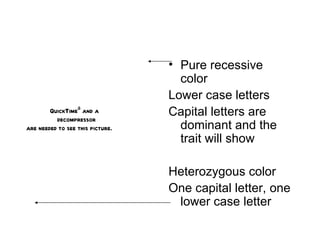
Pure recessive color Lower case letters Capital letters are dominant and the trait will show Heterozygous color One capital letter, one lower case letter
Expected Results Using the Punnett square you are able to  predict  traits in offspring.  The ratio is 1:4 that a  dominate  trait will show.
Observed Results You  can not  always see the expected results using a Punnett square. One parent can have a  heterozygous  trait while the other parent has a pure  recessive trait .
If that occurs then there is a  50%  chance that the trait will show. http://www.google.com/imgres?q=punnett+square+examples&hl=en&biw=1270&bih=683&gbv=2&tbm=isch&tbnid=6eR6nC9th1Q6QM:&imgrefurl=http://www.exploringnature.org/db/detail.php%3FdbID%3D22%26detID%3D2290&docid=4iunWTrHoOHeVM&imgurl=http://www.exploringnature.org/graphics/anatomy/Punnetts_square.jpg&w=538&h=720&ei=HCEvT4KOFJHpggfMs8TUDw&zoom=1&iact=hc&vpx=184&vpy=125&dur=3414&hovh=260&hovw=194&tx=87&ty=159&sig=110912335990059377268&page=1&tbnh=157&tbnw=122&start=0&ndsp=18&ved=1t:429,r:0,s:0
Mendel’s work Gregor Mendel was an Australian monk in 1805. He notices certain traits in garden  pea  plants Using the  scientific method  he experimented to find out which traits were recessive and which were dominant in pea plants.
One trait he noticed was  height . He observed that when a  tall  plant was mated with a  short  plant all of the offspring was always tall. He then took the tall offspring and mated them and found that  3/4  of the plants produced were  tall  and  1/4  were  short .
 
Mendel concluded that some traits were  present  in the tall plants,  but were  not  seen His experiments explained the  basic law  of genetics

26 2 expected observed results

  • 1.
    26:2 Expected Resultsand Observed Results Objectives: Discuss the purpose of the Punnett square Compare expected results and observed results Explain the importance of Gregor Mendel’s work
  • 2.
    The Punnett squareThe Punnett square is a way to show which genes can combine when a sperm and egg joins. Letters are used in place of genes A capital letter is used for the dominant gene A lower case letter is used for the recessive gene
  • 3.
    Pure recessive colorLower case letters Capital letters are dominant and the trait will show Heterozygous color One capital letter, one lower case letter
  • 4.
    Expected Results Usingthe Punnett square you are able to predict traits in offspring. The ratio is 1:4 that a dominate trait will show.
  • 5.
    Observed Results You can not always see the expected results using a Punnett square. One parent can have a heterozygous trait while the other parent has a pure recessive trait .
  • 6.
    If that occursthen there is a 50% chance that the trait will show. http://www.google.com/imgres?q=punnett+square+examples&hl=en&biw=1270&bih=683&gbv=2&tbm=isch&tbnid=6eR6nC9th1Q6QM:&imgrefurl=http://www.exploringnature.org/db/detail.php%3FdbID%3D22%26detID%3D2290&docid=4iunWTrHoOHeVM&imgurl=http://www.exploringnature.org/graphics/anatomy/Punnetts_square.jpg&w=538&h=720&ei=HCEvT4KOFJHpggfMs8TUDw&zoom=1&iact=hc&vpx=184&vpy=125&dur=3414&hovh=260&hovw=194&tx=87&ty=159&sig=110912335990059377268&page=1&tbnh=157&tbnw=122&start=0&ndsp=18&ved=1t:429,r:0,s:0
  • 7.
    Mendel’s work GregorMendel was an Australian monk in 1805. He notices certain traits in garden pea plants Using the scientific method he experimented to find out which traits were recessive and which were dominant in pea plants.
  • 8.
    One trait henoticed was height . He observed that when a tall plant was mated with a short plant all of the offspring was always tall. He then took the tall offspring and mated them and found that 3/4 of the plants produced were tall and 1/4 were short .
  • 9.
  • 10.
    Mendel concluded thatsome traits were present in the tall plants, but were not seen His experiments explained the basic law of genetics