GENETICS
Introduction to Genetics
• Gregor Mendel – Father of Modern Genetics
• An Australian monk, who grew peas in
a monastery garden, he sought
quantifiable data, and actually counted
the results of his crosses in garden
peas.
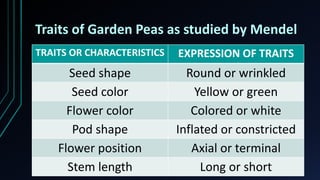
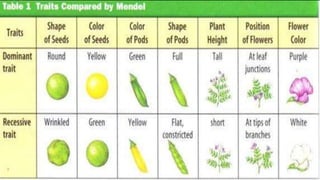
Traits of Garden Peas as studied by Mendel
TRAITS OR CHARACTERISTICS EXPRESSION OF TRAITS
Seed shape Round or wrinkled
Seed color Yellow or green
Flower color Colored or white
Pod shape Inflated or constricted
Flower position Axial or terminal
Stem length Long or short
Terms and Definitions
1. Genetics – the study of heredity
2. Heredity – the transmission of traits from parents to
offspring
3. Pollination – the transfer of pollen from another to stigma.
Self Pollination fertilization occurs within a single plant. Cross
Pollination transfer of pollen from one plant to another.
4. Alleles – are alternate forms for genes.
5. Multiple Alleles- three or more alleles control a trait. Allele
of blood type A and B are co-dominant and both are
dominant to O.
6. Dominant Allele – the one that’s fully expressed; symbolized by a
capital letter, often the first letter of the word which it stands TT.
7. Recessive Allele - the one that’s completely masked; symbolized by
the SAME letter but lower case tt (e.g., freckles, free earlobe, widow’s
peak, dimple)
8. Homozygote – an individual with a pair of two of the same allele (BB
or bb)
9. Heterozygote – an individual with a pair of two different alleles (Bb)
10. Genotype- the organism’s actual genetic make-up for example, is it
BB, Bb, or bb
11. Phenotype- the organism’s expressed traits, what it looks like, how
the genes are expressed: for example brown or blue eyes.
12. Gene – segment of DNA on chromosomes that controls
heredity traits.
13. Probability – the likelihood that specific event will occur.
14. Polygene – the color of skin, hair, eye color, foot size, nose
length, and height.
15. Single allele traits – refer to Huntington disease-
forgetfulness, dwarfism, cataracts, polydactyl-extra finger or
toes.
16. Antigen – substance causes body to produce antibody.
Blood type O contain antibody A and B.
Principles of Heredity
1. Principle of Dominant and Recessive
Dominant traits are traits that appear and Recessive traits are
traits that do not appear. In the first generation ratio occurs 100% of
dominant traits. This is known as the F1 first filial generation.
2. Principle of Segregation
Two factors for a characteristics segregate or separate during
formation of egg and sperm. Gamete will receive one allele or the
other. And in the second generation will appear 75% and 25% or 3:1
phenotypic ratios. F2 second filial generation
3. Principle of Independent Assortment
Factors for different characteristics are
distributed to reproductive cells independently.
Inheritance of one trait did not influence the
inheritance of the other. This is the F3 filial generation.
Monohybrid Cross- A cross of only one trait
Dihybrid Cross- A cross involves two traits
Punnett Square- the easiest way for crossing traits
Mutation
• Is the sudden change of genetic materials, a change
in molecular structure of gene or chromosomes.
• Monosomy has only one chromosome of a given
pair (e.g., Turner Syndrome with only one x
chromosome and no y chromosome).
• Trisomy has two or three chromosome of a given
pair like Klinefelter Syndrome with XXY
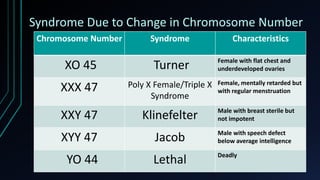
Syndrome Due to Change in Chromosome Number
Chromosome Number Syndrome Characteristics
XO 45 Turner Female with flat chest and
underdeveloped ovaries
XXX 47 Poly X Female/Triple X
Syndrome
Female, mentally retarded but
with regular menstruation
XXY 47 Klinefelter Male with breast sterile but
not impotent
XYY 47 Jacob Male with speech defect
below average intelligence
YO 44 Lethal Deadly
Some Autosomal Disorder
1. Albinism- lack pigment on skin from amino acid
phenylalanine, the production of enzyme tyrosinase is
controlled by dominant genes so phenylalanine cannot be
change into melanin.
2. Alzheimer’s Disease- mental disorder/forgetfulness
3. Cystic Fibrosis- excess mucus in lungs
4. Hyper Cholesterolemia- heart disease
5. Tay Sachs Disease- lipid accumulation in brain cells
Genetic Testing
The following are the techniques used to detect
abnormalities
Amniocentesis- carefully inserting needle into mother’s
uterus to test fetal cells and abnormalities.
Chorionic villus sampling- extract of sample chorionic villus
tissue
Ultrasound- high frequency sound scanner that produce
image monitor.
Newborn screening- blood cells used to detect disorder.
Genetic Patterns in Man
1. Sex Determination- XX – FEMALE, XY- MALE. If testosterone not
sustained male fetus may not be sufficient to develop brain
pattern resulting to gender identity.
2. Sex Limited Traits- are expressed in one sex. Example: beard in
male, milk in female
3. Sex Linkage or Sex Link Traits- traits associated with one sex
controlled by X chromosomes mostly males are affected and
females are carriers. (e.g., eyes, colorblindness, hemophilia – loss
of blood lack protein for clotting).
4. Sex Influence Traits- are expressed in both sexes (baldness,
presence of male or female sex hormones, harelip)

Genetics

  • 1.
  • 2.
    Introduction to Genetics •Gregor Mendel – Father of Modern Genetics • An Australian monk, who grew peas in a monastery garden, he sought quantifiable data, and actually counted the results of his crosses in garden peas.
  • 3.
    Traits of GardenPeas as studied by Mendel TRAITS OR CHARACTERISTICS EXPRESSION OF TRAITS Seed shape Round or wrinkled Seed color Yellow or green Flower color Colored or white Pod shape Inflated or constricted Flower position Axial or terminal Stem length Long or short
  • 5.
    Terms and Definitions 1.Genetics – the study of heredity 2. Heredity – the transmission of traits from parents to offspring 3. Pollination – the transfer of pollen from another to stigma. Self Pollination fertilization occurs within a single plant. Cross Pollination transfer of pollen from one plant to another. 4. Alleles – are alternate forms for genes. 5. Multiple Alleles- three or more alleles control a trait. Allele of blood type A and B are co-dominant and both are dominant to O.
  • 6.
    6. Dominant Allele– the one that’s fully expressed; symbolized by a capital letter, often the first letter of the word which it stands TT. 7. Recessive Allele - the one that’s completely masked; symbolized by the SAME letter but lower case tt (e.g., freckles, free earlobe, widow’s peak, dimple) 8. Homozygote – an individual with a pair of two of the same allele (BB or bb) 9. Heterozygote – an individual with a pair of two different alleles (Bb) 10. Genotype- the organism’s actual genetic make-up for example, is it BB, Bb, or bb 11. Phenotype- the organism’s expressed traits, what it looks like, how the genes are expressed: for example brown or blue eyes.
  • 7.
    12. Gene –segment of DNA on chromosomes that controls heredity traits. 13. Probability – the likelihood that specific event will occur. 14. Polygene – the color of skin, hair, eye color, foot size, nose length, and height. 15. Single allele traits – refer to Huntington disease- forgetfulness, dwarfism, cataracts, polydactyl-extra finger or toes. 16. Antigen – substance causes body to produce antibody. Blood type O contain antibody A and B.
  • 8.
    Principles of Heredity 1.Principle of Dominant and Recessive Dominant traits are traits that appear and Recessive traits are traits that do not appear. In the first generation ratio occurs 100% of dominant traits. This is known as the F1 first filial generation. 2. Principle of Segregation Two factors for a characteristics segregate or separate during formation of egg and sperm. Gamete will receive one allele or the other. And in the second generation will appear 75% and 25% or 3:1 phenotypic ratios. F2 second filial generation
  • 9.
    3. Principle ofIndependent Assortment Factors for different characteristics are distributed to reproductive cells independently. Inheritance of one trait did not influence the inheritance of the other. This is the F3 filial generation. Monohybrid Cross- A cross of only one trait Dihybrid Cross- A cross involves two traits Punnett Square- the easiest way for crossing traits
  • 10.
    Mutation • Is thesudden change of genetic materials, a change in molecular structure of gene or chromosomes. • Monosomy has only one chromosome of a given pair (e.g., Turner Syndrome with only one x chromosome and no y chromosome). • Trisomy has two or three chromosome of a given pair like Klinefelter Syndrome with XXY
  • 11.
    Syndrome Due toChange in Chromosome Number Chromosome Number Syndrome Characteristics XO 45 Turner Female with flat chest and underdeveloped ovaries XXX 47 Poly X Female/Triple X Syndrome Female, mentally retarded but with regular menstruation XXY 47 Klinefelter Male with breast sterile but not impotent XYY 47 Jacob Male with speech defect below average intelligence YO 44 Lethal Deadly
  • 12.
    Some Autosomal Disorder 1.Albinism- lack pigment on skin from amino acid phenylalanine, the production of enzyme tyrosinase is controlled by dominant genes so phenylalanine cannot be change into melanin. 2. Alzheimer’s Disease- mental disorder/forgetfulness 3. Cystic Fibrosis- excess mucus in lungs 4. Hyper Cholesterolemia- heart disease 5. Tay Sachs Disease- lipid accumulation in brain cells
  • 13.
    Genetic Testing The followingare the techniques used to detect abnormalities Amniocentesis- carefully inserting needle into mother’s uterus to test fetal cells and abnormalities. Chorionic villus sampling- extract of sample chorionic villus tissue Ultrasound- high frequency sound scanner that produce image monitor. Newborn screening- blood cells used to detect disorder.
  • 14.
    Genetic Patterns inMan 1. Sex Determination- XX – FEMALE, XY- MALE. If testosterone not sustained male fetus may not be sufficient to develop brain pattern resulting to gender identity. 2. Sex Limited Traits- are expressed in one sex. Example: beard in male, milk in female 3. Sex Linkage or Sex Link Traits- traits associated with one sex controlled by X chromosomes mostly males are affected and females are carriers. (e.g., eyes, colorblindness, hemophilia – loss of blood lack protein for clotting). 4. Sex Influence Traits- are expressed in both sexes (baldness, presence of male or female sex hormones, harelip)