MEIOSIS
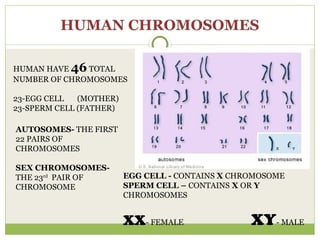
HUMAN CHROMOSOMES
HUMAN HAVE 46 TOTAL
NUMBER OF CHROMOSOMES
23-EGG CELL (MOTHER)
23-SPERM CELL (FATHER)
AUTOSOMES- THE FIRST
22 PAIRS OF
CHROMOSOMES
SEX CHROMOSOMES-
THE 23rd
PAIR OF
CHROMOSOME
EGG CELL - CONTAINS X CHROMOSOME
SPERM CELL – CONTAINS X OR Y
CHROMOSOMES
XX- FEMALE XY- MALE
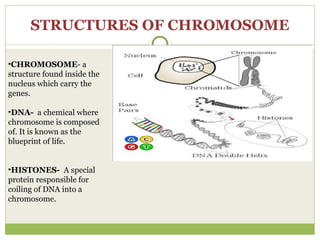
STRUCTURES OF CHROMOSOME
•CHROMOSOME- a
structure found inside the
nucleus which carry the
genes.
•DNA- a chemical where
chromosome is composed
of. It is known as the
blueprint of life.
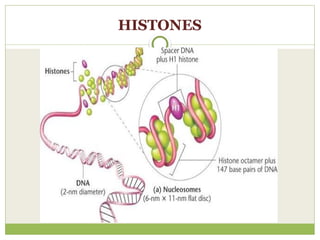
•HISTONES- A special
protein responsible for
coiling of DNA into a
chromosome.
HISTONES
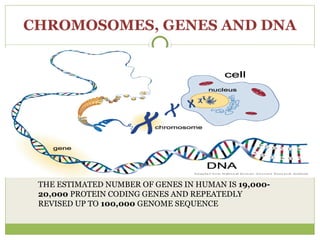
CHROMOSOMES, GENES AND DNA
THE ESTIMATED NUMBER OF GENES IN HUMAN IS 19,000-
20,000 PROTEIN CODING GENES AND REPEATEDLY
REVISED UP TO 100,000 GENOME SEQUENCE
FORMATION OF TWINS
 IDENTICAL TWINS- also known as
“monozygotic” , developed from a single fertilized
egg and split into two blastocysts or zygote.
 FRATERNAL TWINS- also known as “dizygotic” ,
developed from two egg cells fertilized by two
different sperm cell forming two blastocysts.
 Formation of Twins - YouTube.mp4
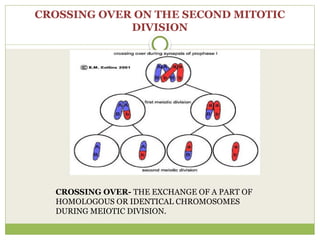
CROSSING OVER ON THE SECOND MITOTIC
DIVISION
CROSSING OVER- THE EXCHANGE OF A PART OF
HOMOLOGOUS OR IDENTICAL CHROMOSOMES
DURING MEIOTIC DIVISION.
A BRANCH OF SCIENCE
THAT DEALS WITH THE
STUDY OF GENES AND
HEREDITY.
GENETICS
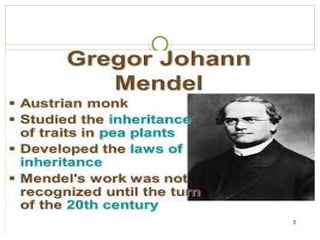
GREGOR MENDEL
 The Father of Modern Genetics
 The Austrian monk who made some experiments
using a pea plant (pisum sativum) and was able
to provide answers to the problems of inheritance.
 The results from these experiments explains both the
blending of parental characteristics of offspring as
well as the significant variations in them.
MENDEL’S PRINCIPLE
INDEPENDENT ASSORTMENT
- Traits are inherited independent of
each other.
 PRINCIPLE OF DOMINANCE AND
RECESSIVENESS
-States that one factor (gene) in a pair may mask the
expression of the other.
-When pure parents with opposite traits are mated,
the first generation shows only one trait (dominant).
The other trait (recessive) is hidden.
 SEGREGATION
-States that the pair of factors (genes) is segregated or
separated during the formation of the gametes (egg
and sperm cell) for it contains only one factor of a pair,
the other factor having gone to another gamete.
-When hybrids are crossed, the opposite traits are
separated into different offspring in a ratio of 3:1
(dominant : recessive)
Key Terms
 TRAITS - are observable characteristics
determined by specific segments of DNA.
 GENES- a distinct unit of hereditary material found
in chromosomes. These are the determiners of traits
or factors of inheritance. NUCLEUS(PART of cell)
 HEREDITY- the genetic transmission or the
passing of traits from parents to offspring.
NON-MENDELIAN INHERITANCE
 A term that refers to any pattern of inheritance in
which traits do not segregate in accordance with
Mendel’s principle, that is, each parent contributes
one of two possible alleles for a trait.
INCOMPLETE DOMINANCE
 This occurs when one allele is unable to express its
full phenotype in a heterozygous individual.
Key Terms
 ALLELE- an alternative form of a gene.
 DOMINANT- a trait or character that appears on an
individual.
 RECESSIVE – a trait or character that seemed to
disappear on an individual.
 GENOTYPE – The genetic make up or the
combination of genes of an organism. It is the
internal genetic constitution of an individual. The
actual set of genes by an organism.
Key Terms
 PHENOTYPE – This refers to the external
appearance of an individual as influenced by its
genetic make up. The expression or
manifestation of an organism’s genotype.
 HOMOZYGOUS – the alleles for a trait are identical
or are the same.
 HETEROZYGOUS – when the two inherited alleles
are different for a particular gene.
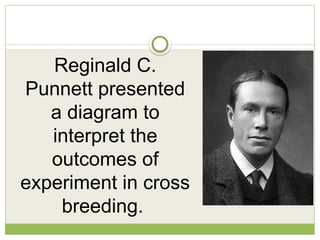
Reginald C.
Punnett presented
a diagram to
interpret the
outcomes of
experiment in cross
breeding.
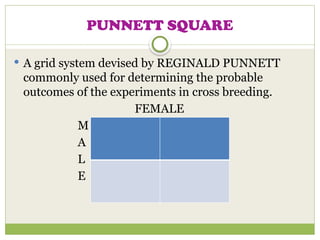
PUNNETT SQUARE
 A grid system devised by REGINALD PUNNETT
commonly used for determining the probable
outcomes of the experiments in cross breeding.
FEMALE
M
A
L
E
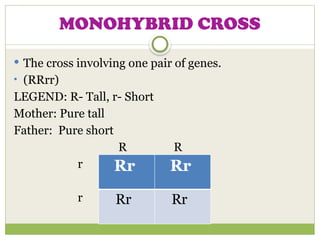
MONOHYBRID CROSS
 The cross involving one pair of genes.
• (RRrr)
LEGEND: R- Tall, r- Short
Mother: Pure tall
Father: Pure short
R R
r
r
Rr Rr
Rr Rr
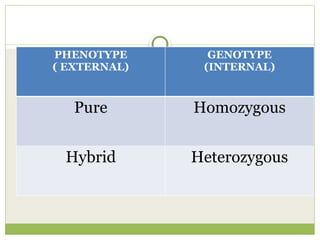
PHENOTYPE
( EXTERNAL)
GENOTYPE
(INTERNAL)
Pure Homozygous
Hybrid Heterozygous
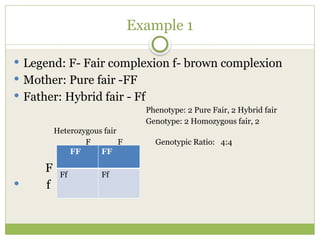
Example 1
 Legend: F- Fair complexion f- brown complexion
 Mother: Pure fair -FF
 Father: Hybrid fair - Ff
Phenotype: 2 Pure Fair, 2 Hybrid fair
Genotype: 2 Homozygous fair, 2
Heterozygous fair
F F Genotypic Ratio: 4:4
F
 f
FF FF
Ff Ff
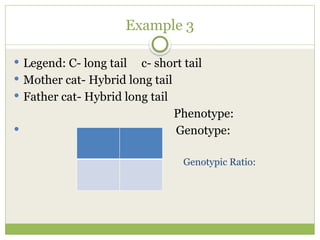
Example 3
 Legend: C- long tail c- short tail
 Mother cat- Hybrid long tail
 Father cat- Hybrid long tail
Phenotype:
 Genotype:
Genotypic Ratio:
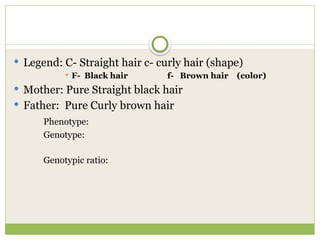
 Legend: C- Straight hair c- curly hair (shape)
 F- Black hair f- Brown hair (color)
 Mother: Pure Straight black hair
 Father: Pure Curly brown hair
Phenotype:
Genotype:
Genotypic ratio:
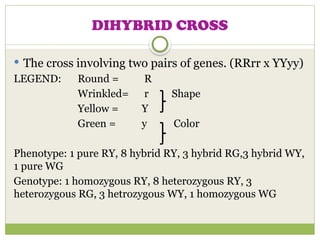
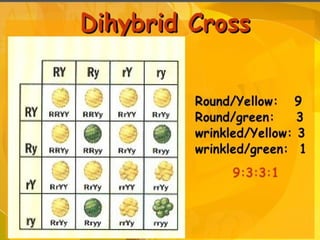
DIHYBRID CROSS
 The cross involving two pairs of genes. (RRrr x YYyy)
LEGEND: Round = R
Wrinkled= r Shape
Yellow = Y
Green = y Color
Phenotype: 1 pure RY, 8 hybrid RY, 3 hybrid RG,3 hybrid WY,
1 pure WG
Genotype: 1 homozygous RY, 8 heterozygous RY, 3
heterozygous RG, 3 hetrozygous WY, 1 homozygous WG
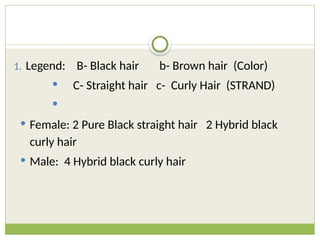
1. Legend: B- Black hair b- Brown hair (Color)
 C- Straight hair c- Curly Hair (STRAND)

 Female: 2 Pure Black straight hair 2 Hybrid black
curly hair
 Male: 4 Hybrid black curly hair
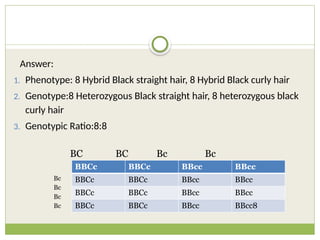
Answer:
1. Phenotype: 8 Hybrid Black straight hair, 8 Hybrid Black curly hair
2. Genotype:8 Heterozygous Black straight hair, 8 heterozygous black
curly hair
3. Genotypic Ratio:8:8
BC BC Bc Bc
Bc
Bc
Bc
Bc
BBCc BBCc BBcc BBcc
BBCc BBCc BBcc BBcc
BBCc BBCc BBcc BBcc
BBCc BBCc BBcc BBcc8
PUNNETT SQUARE
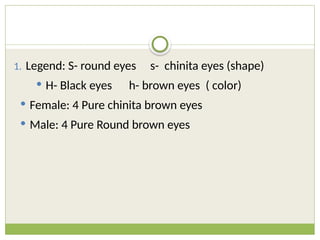
1. Legend: S- round eyes s- chinita eyes (shape)
 H- Black eyes h- brown eyes ( color)
 Female: 4 Pure chinita brown eyes
 Male: 4 Pure Round brown eyes
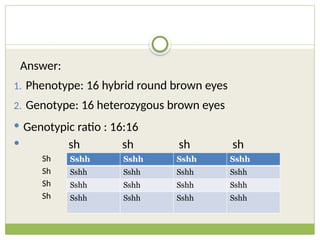
Answer:
1. Phenotype: 16 hybrid round brown eyes
2. Genotype: 16 heterozygous brown eyes
 Genotypic ratio : 16:16
 sh sh sh sh
Sh
Sh
Sh
Sh
Sshh Sshh Sshh Sshh
Sshh Sshh Sshh Sshh
Sshh Sshh Sshh Sshh
Sshh Sshh Sshh Sshh
PUNNETT SQUARE

INTRODUCTION TO GENETICS.pptx GREGOR MENDEL

  • 1.
  • 2.
    HUMAN CHROMOSOMES HUMAN HAVE46 TOTAL NUMBER OF CHROMOSOMES 23-EGG CELL (MOTHER) 23-SPERM CELL (FATHER) AUTOSOMES- THE FIRST 22 PAIRS OF CHROMOSOMES SEX CHROMOSOMES- THE 23rd PAIR OF CHROMOSOME EGG CELL - CONTAINS X CHROMOSOME SPERM CELL – CONTAINS X OR Y CHROMOSOMES XX- FEMALE XY- MALE
  • 3.
    STRUCTURES OF CHROMOSOME •CHROMOSOME-a structure found inside the nucleus which carry the genes. •DNA- a chemical where chromosome is composed of. It is known as the blueprint of life. •HISTONES- A special protein responsible for coiling of DNA into a chromosome.
  • 4.
  • 5.
    CHROMOSOMES, GENES ANDDNA THE ESTIMATED NUMBER OF GENES IN HUMAN IS 19,000- 20,000 PROTEIN CODING GENES AND REPEATEDLY REVISED UP TO 100,000 GENOME SEQUENCE
  • 6.
    FORMATION OF TWINS IDENTICAL TWINS- also known as “monozygotic” , developed from a single fertilized egg and split into two blastocysts or zygote.  FRATERNAL TWINS- also known as “dizygotic” , developed from two egg cells fertilized by two different sperm cell forming two blastocysts.  Formation of Twins - YouTube.mp4
  • 7.
    CROSSING OVER ONTHE SECOND MITOTIC DIVISION CROSSING OVER- THE EXCHANGE OF A PART OF HOMOLOGOUS OR IDENTICAL CHROMOSOMES DURING MEIOTIC DIVISION.
  • 8.
    A BRANCH OFSCIENCE THAT DEALS WITH THE STUDY OF GENES AND HEREDITY. GENETICS
  • 9.
    GREGOR MENDEL  TheFather of Modern Genetics  The Austrian monk who made some experiments using a pea plant (pisum sativum) and was able to provide answers to the problems of inheritance.  The results from these experiments explains both the blending of parental characteristics of offspring as well as the significant variations in them.
  • 11.
    MENDEL’S PRINCIPLE INDEPENDENT ASSORTMENT -Traits are inherited independent of each other.
  • 12.
     PRINCIPLE OFDOMINANCE AND RECESSIVENESS -States that one factor (gene) in a pair may mask the expression of the other. -When pure parents with opposite traits are mated, the first generation shows only one trait (dominant). The other trait (recessive) is hidden.
  • 13.
     SEGREGATION -States thatthe pair of factors (genes) is segregated or separated during the formation of the gametes (egg and sperm cell) for it contains only one factor of a pair, the other factor having gone to another gamete. -When hybrids are crossed, the opposite traits are separated into different offspring in a ratio of 3:1 (dominant : recessive)
  • 14.
    Key Terms  TRAITS- are observable characteristics determined by specific segments of DNA.  GENES- a distinct unit of hereditary material found in chromosomes. These are the determiners of traits or factors of inheritance. NUCLEUS(PART of cell)  HEREDITY- the genetic transmission or the passing of traits from parents to offspring.
  • 15.
    NON-MENDELIAN INHERITANCE  Aterm that refers to any pattern of inheritance in which traits do not segregate in accordance with Mendel’s principle, that is, each parent contributes one of two possible alleles for a trait.
  • 16.
    INCOMPLETE DOMINANCE  Thisoccurs when one allele is unable to express its full phenotype in a heterozygous individual.
  • 17.
    Key Terms  ALLELE-an alternative form of a gene.  DOMINANT- a trait or character that appears on an individual.  RECESSIVE – a trait or character that seemed to disappear on an individual.  GENOTYPE – The genetic make up or the combination of genes of an organism. It is the internal genetic constitution of an individual. The actual set of genes by an organism.
  • 18.
    Key Terms  PHENOTYPE– This refers to the external appearance of an individual as influenced by its genetic make up. The expression or manifestation of an organism’s genotype.  HOMOZYGOUS – the alleles for a trait are identical or are the same.  HETEROZYGOUS – when the two inherited alleles are different for a particular gene.
  • 19.
    Reginald C. Punnett presented adiagram to interpret the outcomes of experiment in cross breeding.
  • 20.
    PUNNETT SQUARE  Agrid system devised by REGINALD PUNNETT commonly used for determining the probable outcomes of the experiments in cross breeding. FEMALE M A L E
  • 21.
    MONOHYBRID CROSS  Thecross involving one pair of genes. • (RRrr) LEGEND: R- Tall, r- Short Mother: Pure tall Father: Pure short R R r r Rr Rr Rr Rr
  • 22.
  • 23.
    Example 1  Legend:F- Fair complexion f- brown complexion  Mother: Pure fair -FF  Father: Hybrid fair - Ff Phenotype: 2 Pure Fair, 2 Hybrid fair Genotype: 2 Homozygous fair, 2 Heterozygous fair F F Genotypic Ratio: 4:4 F  f FF FF Ff Ff
  • 24.
    Example 3  Legend:C- long tail c- short tail  Mother cat- Hybrid long tail  Father cat- Hybrid long tail Phenotype:  Genotype: Genotypic Ratio:
  • 25.
     Legend: C-Straight hair c- curly hair (shape)  F- Black hair f- Brown hair (color)  Mother: Pure Straight black hair  Father: Pure Curly brown hair Phenotype: Genotype: Genotypic ratio:
  • 27.
    DIHYBRID CROSS  Thecross involving two pairs of genes. (RRrr x YYyy) LEGEND: Round = R Wrinkled= r Shape Yellow = Y Green = y Color Phenotype: 1 pure RY, 8 hybrid RY, 3 hybrid RG,3 hybrid WY, 1 pure WG Genotype: 1 homozygous RY, 8 heterozygous RY, 3 heterozygous RG, 3 hetrozygous WY, 1 homozygous WG
  • 29.
    1. Legend: B-Black hair b- Brown hair (Color)  C- Straight hair c- Curly Hair (STRAND)   Female: 2 Pure Black straight hair 2 Hybrid black curly hair  Male: 4 Hybrid black curly hair
  • 30.
    Answer: 1. Phenotype: 8Hybrid Black straight hair, 8 Hybrid Black curly hair 2. Genotype:8 Heterozygous Black straight hair, 8 heterozygous black curly hair 3. Genotypic Ratio:8:8 BC BC Bc Bc Bc Bc Bc Bc BBCc BBCc BBcc BBcc BBCc BBCc BBcc BBcc BBCc BBCc BBcc BBcc BBCc BBCc BBcc BBcc8
  • 31.
  • 32.
    1. Legend: S-round eyes s- chinita eyes (shape)  H- Black eyes h- brown eyes ( color)  Female: 4 Pure chinita brown eyes  Male: 4 Pure Round brown eyes
  • 33.
    Answer: 1. Phenotype: 16hybrid round brown eyes 2. Genotype: 16 heterozygous brown eyes  Genotypic ratio : 16:16  sh sh sh sh Sh Sh Sh Sh Sshh Sshh Sshh Sshh Sshh Sshh Sshh Sshh Sshh Sshh Sshh Sshh Sshh Sshh Sshh Sshh
  • 34.