GENETICS &
HEREDITY
OUTLINE
 Introduction
 Definition of terms
 Medical genetics:
 human chromosomes
 Mendelian inheritance
 Modes of inheritance
 Chromosomal and genetic anomalies
 Genetic counseling
 Conclusion
INTRODUCTION 1/2
 An important section of biology
 Transmission of several pathologies follow a genetic
pattern (offspring gets disease condition because of
anomaly in parents’ genetic build-up
 In this chapter we will study the science of genetics and
discuss inheritance patterns using specific diseases as
examples
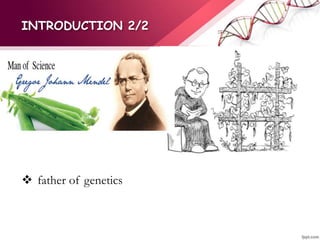
INTRODUCTION 2/2
 father of genetics
DEFINITION OF TERMS
1/4
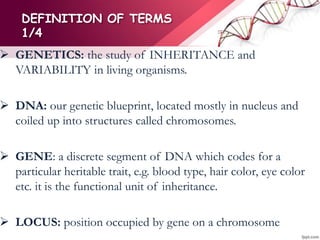
 GENETICS: the study of INHERITANCE and
VARIABILITY in living organisms.
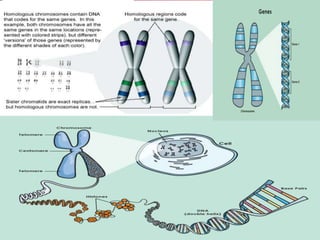
 DNA: our genetic blueprint, located mostly in nucleus and
coiled up into structures called chromosomes.
 GENE: a discrete segment of DNA which codes for a
particular heritable trait, e.g. blood type, hair color, eye color
etc. it is the functional unit of inheritance.
 LOCUS: position occupied by gene on a chromosome
DEFINITION OF TERMS
2/4
DEFINITION OF TERMS
3/4
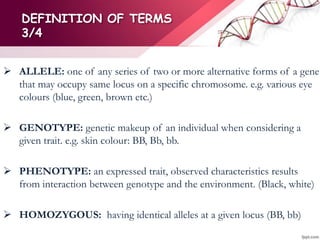
 ALLELE: one of any series of two or more alternative forms of a gene
that may occupy same locus on a specific chromosome. e.g. various eye
colours (blue, green, brown etc.)
 GENOTYPE: genetic makeup of an individual when considering a
given trait. e.g. skin colour: BB, Bb, bb.
 PHENOTYPE: an expressed trait, observed characteristics results
from interaction between genotype and the environment. (Black, white)
 HOMOZYGOUS: having identical alleles at a given locus (BB, bb)
DEFINITION OF TERMS
4/4
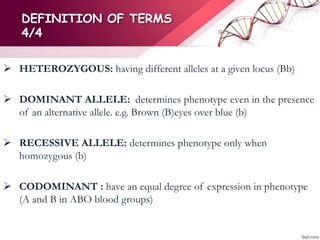
 HETEROZYGOUS: having different alleles at a given locus (Bb)
 DOMINANT ALLELE: determines phenotype even in the presence
of an alternative allele. e.g. Brown (B)eyes over blue (b)
 RECESSIVE ALLELE: determines phenotype only when
homozygous (b)
 CODOMINANT : have an equal degree of expression in phenotype
(A and B in ABO blood groups)
MEDICAL GENETICS
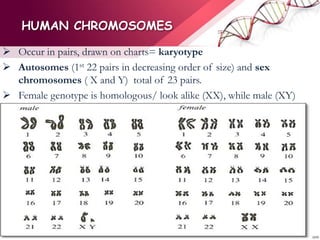
HUMAN CHROMOSOMES
 Occur in pairs, drawn on charts= karyotype
 Autosomes (1st 22 pairs in decreasing order of size) and sex
chromosomes ( X and Y) total of 23 pairs.
 Female genotype is homologous/ look alike (XX), while male (XY)
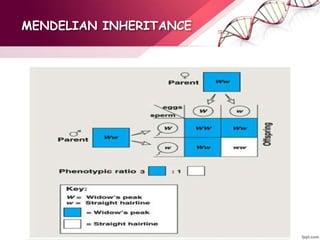
MENDELIAN INHERITANCE
 Follows Mendel’s laws which are based on the fact that traits are
controlled by a single gene.( not always the case with human)
 1st law/ of segregation: for any trait, the parent paring of genes (allele)
splits and one is passed to offspring by chance.
 2nd law/ of independent assortment: different allele pairs are passed
onto the offspring independently of each other (inheritance of one gene
does not influence that of another)
MENDELIAN INHERITANCE
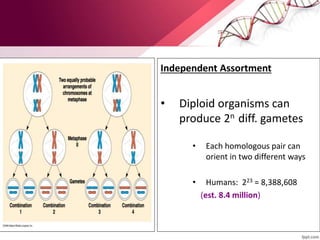
Independent Assortment
• Diploid organisms can
produce 2n diff. gametes
• Each homologous pair can
orient in two different ways
• Humans: 223 = 8,388,608
(est. 8.4 million)
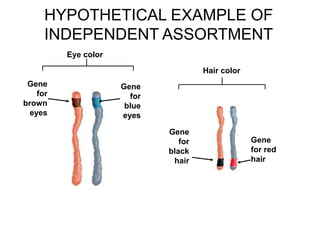
HYPOTHETICAL EXAMPLE OF
INDEPENDENT ASSORTMENT
Gene
for
brown
eyes
Eye color
Gene
for
blue
eyes
Gene
for
black
hair
Gene
for red
hair
Hair color
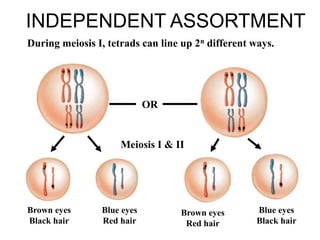
INDEPENDENT ASSORTMENT
OR
During meiosis I, tetrads can line up 2n different ways.
Brown eyes
Black hair
Blue eyes
Red hair
Brown eyes
Red hair
Blue eyes
Black hair
Meiosis I & II
MODE OF INHERITANCE
1/8
 Whether a trait is dominant or recessive, autosomal or sex-
linked is called its mode of inheritance.
 important consequences in predicting the chance that
offspring will inherit a trait/an illness
Three important rules:
1. Autosomal Conditions are equally likely to affect both sexes.
Sex-linked characteristics affect males much more often than
females.
MODES OF INHERITANCE
2/8
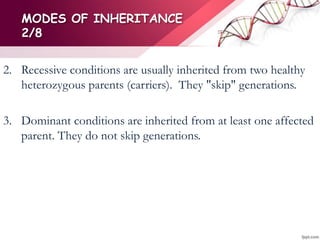
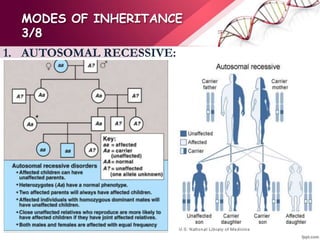
2. Recessive conditions are usually inherited from two healthy
heterozygous parents (carriers). They "skip" generations.
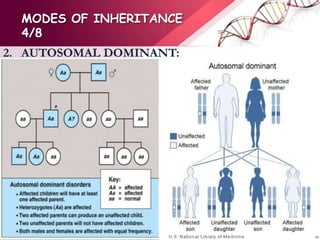
3. Dominant conditions are inherited from at least one affected
parent. They do not skip generations.
MODES OF INHERITANCE
3/8
1. AUTOSOMAL RECESSIVE:
MODES OF INHERITANCE
4/8
2. AUTOSOMAL DOMINANT:
MODES OF INHERITANCE
5/8
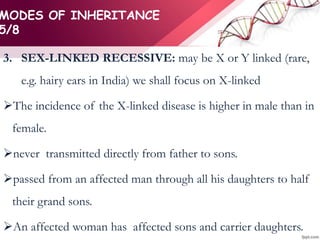
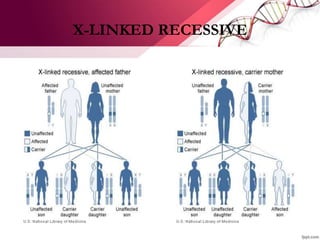
3. SEX-LINKED RECESSIVE: may be X or Y linked (rare,
e.g. hairy ears in India) we shall focus on X-linked
The incidence of the X-linked disease is higher in male than in
female.
never transmitted directly from father to sons.
passed from an affected man through all his daughters to half
their grand sons.
An affected woman has affected sons and carrier daughters.
X-LINKED RECESSIVE
MODES OF INHERITANCE 6/8
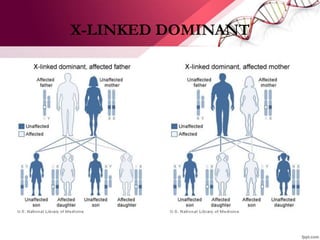
4. X-LINKED DOMINANT:
The gene is on X Chromosome and is dominant.
The trait occurs at the same frequency in both males
and females
Hemizygous males and heterozygous females express
the disease.
X-LINKED DOMINANT
MODES OF INHERITANCE 7/8
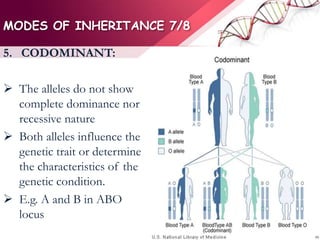
5. CODOMINANT:
 The alleles do not show
complete dominance nor
recessive nature
 Both alleles influence the
genetic trait or determine
the characteristics of the
genetic condition.
 E.g. A and B in ABO
locus
MODES OF INHERITANCE 8/8
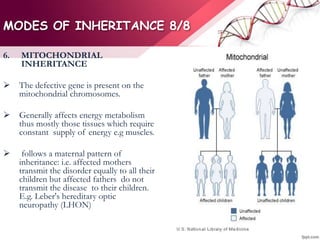
6. MITOCHONDRIAL
INHERITANCE
 The defective gene is present on the
mitochondrial chromosomes.
 Generally affects energy metabolism
thus mostly those tissues which require
constant supply of energy e.g muscles.
 follows a maternal pattern of
inheritance: i.e. affected mothers
transmit the disorder equally to all their
children but affected fathers do not
transmit the disease to their children.
E.g. Leber's hereditary optic
neuropathy (LHON)
CHROMOSOMAL AND GENETIC
ANOMALIES
GENE ANOMALIES
Mutation – sudden genetic change (change in base pair sequence of DNA)
Can be :
 Harmful mutations – organism less able to survive: genetic disorders,
cancer, death
 Beneficial mutations – allows organism to better survive: provides
genetic variation
 Neutral/Silent mutations – neither harmful nor helpful to organism
 A good number of gene mutations are point mutations
CHROMOSOMAL ANOMALIES
 Chromosomal anomalies may be numerical or structural
 Numerical anomalies: normal somatic cells are diploid (2n)
while gametes are haploid (n). Euploid cells have a
chromosome number which is an a whole number multiple of
n (e.g. diploid, triploid) if not they are Aneuploid (e.g.
trisomy, monosomy). Any extra set of haploid chromosomes
results in Polyploidy
CHROMOSOMAL ANOMALIES
Aneuploidy: Results from non-disjunction during meiosis
 Down Syndrome: extra copy, chromosome 21.
 Patau syndrome: extra copy, chromosome 13
 Edward syndrome: extra copy, chromosome 18
 Turner’s syndrome: one X chromosome missing in females
 Klinefelter syndrome: extra X chromosome in males
CHROMOSOMAL ANOMALIES
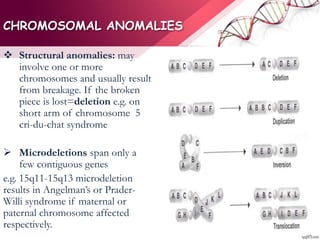
 Structural anomalies: may
involve one or more
chromosomes and usually result
from breakage. If the broken
piece is lost=deletion e.g. on
short arm of chromosome 5
cri-du-chat syndrome
 Microdeletions span only a
few contiguous genes
e.g. 15q11-15q13 microdeletion
results in Angelman’s or Prader-
Willi syndrome if maternal or
paternal chromosome affected
respectively.
GENETIC
TESTING/COUNSELING
PRENATAL GENETIC TESTING
 AMNIOCENTESIS performed after 14th week gestation
 CHORIONIC VILLUS SAMPLING:
performed as early as 8 weeks gestation
 FETAL CELL SORTING: involves obtaining and analyzing rare fetal
cells in maternal circulation.
GENETIC COUNSELING
CONCLUSION
Relate genetics to meiosis
For genetics problems—first try to
figure the genotype(s) of the gametes
THANKYOU!!!!

Genetics.pptx

  • 1.
  • 2.
    OUTLINE  Introduction  Definitionof terms  Medical genetics:  human chromosomes  Mendelian inheritance  Modes of inheritance  Chromosomal and genetic anomalies  Genetic counseling  Conclusion
  • 3.
    INTRODUCTION 1/2  Animportant section of biology  Transmission of several pathologies follow a genetic pattern (offspring gets disease condition because of anomaly in parents’ genetic build-up  In this chapter we will study the science of genetics and discuss inheritance patterns using specific diseases as examples
  • 4.
  • 5.
    DEFINITION OF TERMS 1/4 GENETICS: the study of INHERITANCE and VARIABILITY in living organisms.  DNA: our genetic blueprint, located mostly in nucleus and coiled up into structures called chromosomes.  GENE: a discrete segment of DNA which codes for a particular heritable trait, e.g. blood type, hair color, eye color etc. it is the functional unit of inheritance.  LOCUS: position occupied by gene on a chromosome
  • 6.
  • 7.
    DEFINITION OF TERMS 3/4 ALLELE: one of any series of two or more alternative forms of a gene that may occupy same locus on a specific chromosome. e.g. various eye colours (blue, green, brown etc.)  GENOTYPE: genetic makeup of an individual when considering a given trait. e.g. skin colour: BB, Bb, bb.  PHENOTYPE: an expressed trait, observed characteristics results from interaction between genotype and the environment. (Black, white)  HOMOZYGOUS: having identical alleles at a given locus (BB, bb)
  • 8.
    DEFINITION OF TERMS 4/4 HETEROZYGOUS: having different alleles at a given locus (Bb)  DOMINANT ALLELE: determines phenotype even in the presence of an alternative allele. e.g. Brown (B)eyes over blue (b)  RECESSIVE ALLELE: determines phenotype only when homozygous (b)  CODOMINANT : have an equal degree of expression in phenotype (A and B in ABO blood groups)
  • 9.
  • 10.
    HUMAN CHROMOSOMES  Occurin pairs, drawn on charts= karyotype  Autosomes (1st 22 pairs in decreasing order of size) and sex chromosomes ( X and Y) total of 23 pairs.  Female genotype is homologous/ look alike (XX), while male (XY)
  • 11.
    MENDELIAN INHERITANCE  FollowsMendel’s laws which are based on the fact that traits are controlled by a single gene.( not always the case with human)  1st law/ of segregation: for any trait, the parent paring of genes (allele) splits and one is passed to offspring by chance.  2nd law/ of independent assortment: different allele pairs are passed onto the offspring independently of each other (inheritance of one gene does not influence that of another)
  • 12.
  • 13.
    Independent Assortment • Diploidorganisms can produce 2n diff. gametes • Each homologous pair can orient in two different ways • Humans: 223 = 8,388,608 (est. 8.4 million)
  • 14.
    HYPOTHETICAL EXAMPLE OF INDEPENDENTASSORTMENT Gene for brown eyes Eye color Gene for blue eyes Gene for black hair Gene for red hair Hair color
  • 15.
    INDEPENDENT ASSORTMENT OR During meiosisI, tetrads can line up 2n different ways. Brown eyes Black hair Blue eyes Red hair Brown eyes Red hair Blue eyes Black hair Meiosis I & II
  • 16.
    MODE OF INHERITANCE 1/8 Whether a trait is dominant or recessive, autosomal or sex- linked is called its mode of inheritance.  important consequences in predicting the chance that offspring will inherit a trait/an illness Three important rules: 1. Autosomal Conditions are equally likely to affect both sexes. Sex-linked characteristics affect males much more often than females.
  • 17.
    MODES OF INHERITANCE 2/8 2.Recessive conditions are usually inherited from two healthy heterozygous parents (carriers). They "skip" generations. 3. Dominant conditions are inherited from at least one affected parent. They do not skip generations.
  • 18.
    MODES OF INHERITANCE 3/8 1.AUTOSOMAL RECESSIVE:
  • 19.
    MODES OF INHERITANCE 4/8 2.AUTOSOMAL DOMINANT:
  • 20.
    MODES OF INHERITANCE 5/8 3.SEX-LINKED RECESSIVE: may be X or Y linked (rare, e.g. hairy ears in India) we shall focus on X-linked The incidence of the X-linked disease is higher in male than in female. never transmitted directly from father to sons. passed from an affected man through all his daughters to half their grand sons. An affected woman has affected sons and carrier daughters.
  • 21.
  • 22.
    MODES OF INHERITANCE6/8 4. X-LINKED DOMINANT: The gene is on X Chromosome and is dominant. The trait occurs at the same frequency in both males and females Hemizygous males and heterozygous females express the disease.
  • 23.
  • 24.
    MODES OF INHERITANCE7/8 5. CODOMINANT:  The alleles do not show complete dominance nor recessive nature  Both alleles influence the genetic trait or determine the characteristics of the genetic condition.  E.g. A and B in ABO locus
  • 25.
    MODES OF INHERITANCE8/8 6. MITOCHONDRIAL INHERITANCE  The defective gene is present on the mitochondrial chromosomes.  Generally affects energy metabolism thus mostly those tissues which require constant supply of energy e.g muscles.  follows a maternal pattern of inheritance: i.e. affected mothers transmit the disorder equally to all their children but affected fathers do not transmit the disease to their children. E.g. Leber's hereditary optic neuropathy (LHON)
  • 26.
  • 27.
    GENE ANOMALIES Mutation –sudden genetic change (change in base pair sequence of DNA) Can be :  Harmful mutations – organism less able to survive: genetic disorders, cancer, death  Beneficial mutations – allows organism to better survive: provides genetic variation  Neutral/Silent mutations – neither harmful nor helpful to organism  A good number of gene mutations are point mutations
  • 28.
    CHROMOSOMAL ANOMALIES  Chromosomalanomalies may be numerical or structural  Numerical anomalies: normal somatic cells are diploid (2n) while gametes are haploid (n). Euploid cells have a chromosome number which is an a whole number multiple of n (e.g. diploid, triploid) if not they are Aneuploid (e.g. trisomy, monosomy). Any extra set of haploid chromosomes results in Polyploidy
  • 29.
    CHROMOSOMAL ANOMALIES Aneuploidy: Resultsfrom non-disjunction during meiosis  Down Syndrome: extra copy, chromosome 21.  Patau syndrome: extra copy, chromosome 13  Edward syndrome: extra copy, chromosome 18  Turner’s syndrome: one X chromosome missing in females  Klinefelter syndrome: extra X chromosome in males
  • 30.
    CHROMOSOMAL ANOMALIES  Structuralanomalies: may involve one or more chromosomes and usually result from breakage. If the broken piece is lost=deletion e.g. on short arm of chromosome 5 cri-du-chat syndrome  Microdeletions span only a few contiguous genes e.g. 15q11-15q13 microdeletion results in Angelman’s or Prader- Willi syndrome if maternal or paternal chromosome affected respectively.
  • 31.
    GENETIC TESTING/COUNSELING PRENATAL GENETIC TESTING AMNIOCENTESIS performed after 14th week gestation  CHORIONIC VILLUS SAMPLING: performed as early as 8 weeks gestation  FETAL CELL SORTING: involves obtaining and analyzing rare fetal cells in maternal circulation. GENETIC COUNSELING
  • 32.
    CONCLUSION Relate genetics tomeiosis For genetics problems—first try to figure the genotype(s) of the gametes
  • 33.