Lesson 9
GMO (Genetically Modified Organisms)
Learning Process
1. What are genetically modified (GM) organisms and GM foods?
A genetically modified organism contains DNA that has been
altered using genetic engineering. Genetically modified animals are
mainly used for research purposes, while genetically modified plants
are common in today’s food supply.
2. Why are GM foods produced?
Farmers need to deal with many problems, including how to:
1. Cope with climate change, soil erosion and biodiversity loss
2. Satisfy consumers’ changing tastes and expectations
3. Meet rising demand for more food of higher quality
4. Invest in farm productivity
5. Adopt and learn new technologies
6. Stay resilient against global economic factors
7. Inspire young people to stay in rural areas and become future farmers
In the Philippines, the lack of storage facilities, farm-to-market roads, and
equipment needed to prevent losses from exposure, pests, and natural
deterioration have been perennial issues for Filipino farmers.
2. Why are GM foods produced?
Most of the GMO crops grown today were developed to help farmers
prevent crop and food loss and control weeds. The three most common
traits found in GMO crops are: Resistance to certain damaging insects.
Tolerance of certain herbicides used to control weeds.
1. Resistance to certain damaging insects
2. Tolerance of certain herbicides used to control weeds
3. Resistance to certain plant viruses
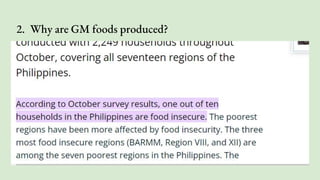
Though we apply many agri-techs, why are we food insecure?
2. Why are GM foods produced?
Most of the GMO crops grown today were developed to help farmers
prevent crop and food loss and control weeds. The three most common
traits found in GMO crops are: Resistance to certain damaging insects.
Tolerance of certain herbicides used to control weeds.
1. Resistance to certain damaging insects
2. Tolerance of certain herbicides used to control weeds
3. Resistance to certain plant viruses
Though we apply many agri-techs, why are we food insecure?
3. Name 5 genetically modified organisms?
1. BT Corn
Corn is the most commonly grown crop in the United States, and most
of it is GMO. Most GMO corn is created to resist insect pests or
tolerate herbicides. Bacillus thuringiensis (Bt) corn is a GMO corn that
produces proteins that are toxic to certain insect pests but not to
humans, pets, livestock, or other animals.
1. Soybean
Most soy grown in the United States is GMO soy. Most GMO soy is
used for food for animals, predominantly poultry and livestock, and
making soybean oil. It is also used as ingredients (lecithin, emulsifiers,
and proteins) in processed foods.
3. Name 5 genetically modified organisms?
3. GMO cotton
GMO cotton was created to be resistant to bollworms and helped revive the
Alabama cotton industry. GMO cotton not only provides a reliable source of
cotton for the textile industry, it is also used to make cottonseed oil, which is used
in packaged foods and in many restaurants for frying. GMO cottonseed meal and
hulls are also used in food for animals.
3. GMO potatoes
Some GMO potatoes were developed to resist insect pests and disease. In addition,
some GMO potato varieties have been developed to resist bruising and browning
that can occur when potatoes are packaged, stored, and transported, or even cut in
your kitchen. While browning does not change the quality of the potato, it often
leads to food being unnecessarily thrown away because people mistakenly believe
browned food is spoiled.
3. Name 5 genetically modified organisms?
5. Papaya
By the 1990s, ringspot virus disease had nearly wiped out Hawaii’s papaya
crop, and in the process almost destroyed the papaya industry in Hawaii. A
GMO papaya, named the Rainbow papaya, was created to resist ringspot virus.
This GMO saved papaya farming on the Hawaiian Islands.
5. Apple
A few varieties of GMO apples were developed to resist browning after being
cut. This helps cut down on food waste, as many consumers think brown
apples are spoiled.
5. Summer Squash
GMO summer squash is resistant to some plant viruses. Squash was one of the
first GMOs on the market, but it is not widely grown.
4. How do genetically modified organisms affect humans?
The studies show that GMOs do not affect you differently than
non-GMO foods.
GMO foods are as healthful and safe to eat as their non-GMO
counterparts. Some GMO plants have actually been modified to
improve their nutritional value.
Food and Drug Administration (.gov)
https://www.fda.gov › media › download PDF
The results of the study suggest that adopters of GMOs saw higher
average household income, yields, and gross margins after adoption.
Further, the introduction of genetically modified seeds led to a decrease in
inequality measured by the Gini score, and inequality among adopters was
lower than that of non-adopters.
2019
Economics Impacts of Genetically Modified
Organisms: An analysis of Bt Cotton in India
Joseph LaHorgue
Claremont McKenna College
5. What are the impacts of GMOs on the economy?
Your Essential Learning Outcome
After the learning process, be able to list
down five (5) benefits of GMOs and (5)
potential risks of GMOs.
End of Lesson 9
Lesson 10
Biotechnology
Learning Process
Biotechnology is a field that merges concepts from biology with ideas of
technology. It is broken down into four disciplines often represented by
specific colors: red, white, blue, and green. These colors represent medical,
industrial, marine, and agricultural processes, respectively.
Advancement is the primary benefit that biotechnology is able to provide.
Early pioneers in this field used information about various plant species to
create cross-breeding opportunities to improve the yield, flavor, size, and
color of their harvests. Today’s biotechnology specialists are doing the
same thing but on a much larger scale thanks to technological
improvements in the 20th and 21st centuries.
Abuse is the primary disadvantage that biotechnology can provide. When
the concepts of this field of study are misused, it can have a devastating
effect on people, society, the environment, and even our planet. For that
reason, certain areas of study in biotechnology, such as human cloning,
have been restricted or outlawed outright. In the wrong hands,
biotechnology can even create weapons of mass destruction.
1. In one or two sentences, define biotechnology.
2. Why is biotechnology so important?
Biotechnology plays a huge role in our everyday lives — from the
clothes we wear to how we wash them, the food we eat to how we
source them, the medicine we take to treat our bodies, and even the fuel
we use to move our vehicles.
Biotechnology is particularly important in the field of medicine, where
it facilitates the production of therapeutic proteins and other drugs.
Synthetic insulin and synthetic growth hormone and diagnostic tests to
detect various diseases are just some examples of how biotechnology is
impacting medicine.
3. Beyond increased yields, what are some of the benefits of biotech products?
The following are how biotechnology applies to our everyday lives.
➔ Biofuel. ...
➔ Vaccines. ...
➔ Bioremediation. ...
➔ Pest Resistant Crops. ...
➔ Environmental Engineers. ...
➔ Cheese Production. ...
➔ Alcoholic Drinks. ...
➔ Forensic science – DNA fingerprinting
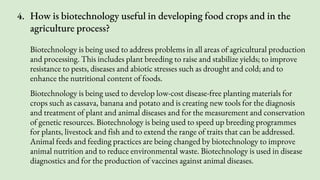
4. How is biotechnology useful in developing food crops and in the
agriculture process?
Biotechnology is being used to address problems in all areas of agricultural production
and processing. This includes plant breeding to raise and stabilize yields; to improve
resistance to pests, diseases and abiotic stresses such as drought and cold; and to
enhance the nutritional content of foods.
Biotechnology is being used to develop low-cost disease-free planting materials for
crops such as cassava, banana and potato and is creating new tools for the diagnosis
and treatment of plant and animal diseases and for the measurement and conservation
of genetic resources. Biotechnology is being used to speed up breeding programmes
for plants, livestock and fish and to extend the range of traits that can be addressed.
Animal feeds and feeding practices are being changed by biotechnology to improve
animal nutrition and to reduce environmental waste. Biotechnology is used in disease
diagnostics and for the production of vaccines against animal diseases.
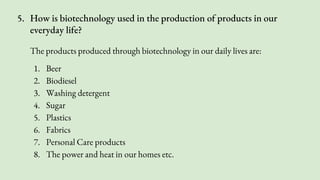
5. How is biotechnology used in the production of products in our
everyday life?
The products produced through biotechnology in our daily lives are:
1. Beer
2. Biodiesel
3. Washing detergent
4. Sugar
5. Plastics
6. Fabrics
7. Personal Care products
8. The power and heat in our homes etc.
Thank you!

Genetically Modified Organisms and Biotechnology

  • 1.
    Lesson 9 GMO (GeneticallyModified Organisms)
  • 2.
  • 3.
    1. What aregenetically modified (GM) organisms and GM foods? A genetically modified organism contains DNA that has been altered using genetic engineering. Genetically modified animals are mainly used for research purposes, while genetically modified plants are common in today’s food supply.
  • 4.
    2. Why areGM foods produced? Farmers need to deal with many problems, including how to: 1. Cope with climate change, soil erosion and biodiversity loss 2. Satisfy consumers’ changing tastes and expectations 3. Meet rising demand for more food of higher quality 4. Invest in farm productivity 5. Adopt and learn new technologies 6. Stay resilient against global economic factors 7. Inspire young people to stay in rural areas and become future farmers In the Philippines, the lack of storage facilities, farm-to-market roads, and equipment needed to prevent losses from exposure, pests, and natural deterioration have been perennial issues for Filipino farmers.
  • 5.
    2. Why areGM foods produced? Most of the GMO crops grown today were developed to help farmers prevent crop and food loss and control weeds. The three most common traits found in GMO crops are: Resistance to certain damaging insects. Tolerance of certain herbicides used to control weeds. 1. Resistance to certain damaging insects 2. Tolerance of certain herbicides used to control weeds 3. Resistance to certain plant viruses Though we apply many agri-techs, why are we food insecure?
  • 6.
    2. Why areGM foods produced? Most of the GMO crops grown today were developed to help farmers prevent crop and food loss and control weeds. The three most common traits found in GMO crops are: Resistance to certain damaging insects. Tolerance of certain herbicides used to control weeds. 1. Resistance to certain damaging insects 2. Tolerance of certain herbicides used to control weeds 3. Resistance to certain plant viruses Though we apply many agri-techs, why are we food insecure?
  • 7.
    3. Name 5genetically modified organisms? 1. BT Corn Corn is the most commonly grown crop in the United States, and most of it is GMO. Most GMO corn is created to resist insect pests or tolerate herbicides. Bacillus thuringiensis (Bt) corn is a GMO corn that produces proteins that are toxic to certain insect pests but not to humans, pets, livestock, or other animals. 1. Soybean Most soy grown in the United States is GMO soy. Most GMO soy is used for food for animals, predominantly poultry and livestock, and making soybean oil. It is also used as ingredients (lecithin, emulsifiers, and proteins) in processed foods.
  • 8.
    3. Name 5genetically modified organisms? 3. GMO cotton GMO cotton was created to be resistant to bollworms and helped revive the Alabama cotton industry. GMO cotton not only provides a reliable source of cotton for the textile industry, it is also used to make cottonseed oil, which is used in packaged foods and in many restaurants for frying. GMO cottonseed meal and hulls are also used in food for animals. 3. GMO potatoes Some GMO potatoes were developed to resist insect pests and disease. In addition, some GMO potato varieties have been developed to resist bruising and browning that can occur when potatoes are packaged, stored, and transported, or even cut in your kitchen. While browning does not change the quality of the potato, it often leads to food being unnecessarily thrown away because people mistakenly believe browned food is spoiled.
  • 9.
    3. Name 5genetically modified organisms? 5. Papaya By the 1990s, ringspot virus disease had nearly wiped out Hawaii’s papaya crop, and in the process almost destroyed the papaya industry in Hawaii. A GMO papaya, named the Rainbow papaya, was created to resist ringspot virus. This GMO saved papaya farming on the Hawaiian Islands. 5. Apple A few varieties of GMO apples were developed to resist browning after being cut. This helps cut down on food waste, as many consumers think brown apples are spoiled. 5. Summer Squash GMO summer squash is resistant to some plant viruses. Squash was one of the first GMOs on the market, but it is not widely grown.
  • 10.
    4. How dogenetically modified organisms affect humans? The studies show that GMOs do not affect you differently than non-GMO foods. GMO foods are as healthful and safe to eat as their non-GMO counterparts. Some GMO plants have actually been modified to improve their nutritional value. Food and Drug Administration (.gov) https://www.fda.gov › media › download PDF
  • 11.
    The results ofthe study suggest that adopters of GMOs saw higher average household income, yields, and gross margins after adoption. Further, the introduction of genetically modified seeds led to a decrease in inequality measured by the Gini score, and inequality among adopters was lower than that of non-adopters. 2019 Economics Impacts of Genetically Modified Organisms: An analysis of Bt Cotton in India Joseph LaHorgue Claremont McKenna College 5. What are the impacts of GMOs on the economy?
  • 12.
    Your Essential LearningOutcome After the learning process, be able to list down five (5) benefits of GMOs and (5) potential risks of GMOs.
  • 13.
  • 14.
  • 15.
  • 16.
    Biotechnology is afield that merges concepts from biology with ideas of technology. It is broken down into four disciplines often represented by specific colors: red, white, blue, and green. These colors represent medical, industrial, marine, and agricultural processes, respectively. Advancement is the primary benefit that biotechnology is able to provide. Early pioneers in this field used information about various plant species to create cross-breeding opportunities to improve the yield, flavor, size, and color of their harvests. Today’s biotechnology specialists are doing the same thing but on a much larger scale thanks to technological improvements in the 20th and 21st centuries.
  • 17.
    Abuse is theprimary disadvantage that biotechnology can provide. When the concepts of this field of study are misused, it can have a devastating effect on people, society, the environment, and even our planet. For that reason, certain areas of study in biotechnology, such as human cloning, have been restricted or outlawed outright. In the wrong hands, biotechnology can even create weapons of mass destruction.
  • 18.
    1. In oneor two sentences, define biotechnology.
  • 19.
    2. Why isbiotechnology so important? Biotechnology plays a huge role in our everyday lives — from the clothes we wear to how we wash them, the food we eat to how we source them, the medicine we take to treat our bodies, and even the fuel we use to move our vehicles. Biotechnology is particularly important in the field of medicine, where it facilitates the production of therapeutic proteins and other drugs. Synthetic insulin and synthetic growth hormone and diagnostic tests to detect various diseases are just some examples of how biotechnology is impacting medicine.
  • 20.
    3. Beyond increasedyields, what are some of the benefits of biotech products? The following are how biotechnology applies to our everyday lives. ➔ Biofuel. ... ➔ Vaccines. ... ➔ Bioremediation. ... ➔ Pest Resistant Crops. ... ➔ Environmental Engineers. ... ➔ Cheese Production. ... ➔ Alcoholic Drinks. ... ➔ Forensic science – DNA fingerprinting
  • 21.
    4. How isbiotechnology useful in developing food crops and in the agriculture process? Biotechnology is being used to address problems in all areas of agricultural production and processing. This includes plant breeding to raise and stabilize yields; to improve resistance to pests, diseases and abiotic stresses such as drought and cold; and to enhance the nutritional content of foods. Biotechnology is being used to develop low-cost disease-free planting materials for crops such as cassava, banana and potato and is creating new tools for the diagnosis and treatment of plant and animal diseases and for the measurement and conservation of genetic resources. Biotechnology is being used to speed up breeding programmes for plants, livestock and fish and to extend the range of traits that can be addressed. Animal feeds and feeding practices are being changed by biotechnology to improve animal nutrition and to reduce environmental waste. Biotechnology is used in disease diagnostics and for the production of vaccines against animal diseases.
  • 22.
    5. How isbiotechnology used in the production of products in our everyday life? The products produced through biotechnology in our daily lives are: 1. Beer 2. Biodiesel 3. Washing detergent 4. Sugar 5. Plastics 6. Fabrics 7. Personal Care products 8. The power and heat in our homes etc.
  • 23.

Editor's Notes

  • #8 Three of the most prominent figures in Western philosophy are Socrates (470 BCE–399 BCE), Plato (428–7 BCE–348-7 BCE), and Aristotle (384 BCE–322 BCE), and their contributions to Western civilization extend beyond philosophy. Plato is an ancient Greek philosopher and philosophical pillar considered to be one of the greatest and most influential minds in Western thought. Plato was a student of Socrates and a teacher to Aristotle. One philosophical concept Plato is best known for is idealism.
  • #9 Three of the most prominent figures in Western philosophy are Socrates (470 BCE–399 BCE), Plato (428–7 BCE–348-7 BCE), and Aristotle (384 BCE–322 BCE), and their contributions to Western civilization extend beyond philosophy. Plato is an ancient Greek philosopher and philosophical pillar considered to be one of the greatest and most influential minds in Western thought. Plato was a student of Socrates and a teacher to Aristotle. One philosophical concept Plato is best known for is idealism.
  • #10 Three of the most prominent figures in Western philosophy are Socrates (470 BCE–399 BCE), Plato (428–7 BCE–348-7 BCE), and Aristotle (384 BCE–322 BCE), and their contributions to Western civilization extend beyond philosophy. Plato is an ancient Greek philosopher and philosophical pillar considered to be one of the greatest and most influential minds in Western thought. Plato was a student of Socrates and a teacher to Aristotle. One philosophical concept Plato is best known for is idealism.
  • #11 Three of the most prominent figures in Western philosophy are Socrates (470 BCE–399 BCE), Plato (428–7 BCE–348-7 BCE), and Aristotle (384 BCE–322 BCE), and their contributions to Western civilization extend beyond philosophy. Plato is an ancient Greek philosopher and philosophical pillar considered to be one of the greatest and most influential minds in Western thought. Plato was a student of Socrates and a teacher to Aristotle. One philosophical concept Plato is best known for is idealism.