Genetically Modified Organisms GMOs
Found in Hunger Games
CC Literacy & Science ITQ
Essential Questions
• What is the value of creating genetically modified
organisms?
• What are some of the concerns surrounding GMOs?
• How is bioethics considered or not considered in
both the Hunger Games and in contemporary
society?
Science Content
• Traits
• Cell
• Genes
• Protein
• Chromosome
• Genetic information
• Heredity
• DNA
• Breeding
• Sex cell
• embryos
• Genetic engineering
• Natural selection
• Artificial selection
• Transgenic species
• Genetically Modified
Organism, GMO
• Recombinant DNA
Foundational Information Key Concepts
Literacy Content
Concepts
• Claim
• Counterclaim
• Argument
• Counterargument
• Refutation
• Text-based evidence
• Citation
Skills
• Analyze technical and information
texts
• Discriminate between fact and
opinion
• Cite relevant text-based evidence
• Employ argumentative
techniques and strategies
• Outline 5-paragraph
argumentative essays
Pre-Assessment Questions
• Plickers
• https://www.plickers.com/details
– Classroom polling system
– Each student gets a card that can be attached to back of
interactive notebook
– Teacher displays multiple choice questions. Ss hold card in
direction to indicate their answer.
– Student responses are recorded individually with an immediate
graph of the aggregate results.
– Teacher scans student cards using iPhone, iPad, or Android
device
Question 1
Which of the following is TRUE regarding most currently
genetically engineered (GE) plants?
A. Most GE plants are designed to have better flavor and
be more nutritious.
B. There are serious biological and environmental issues
regarding their use.
C. There has been worldwide acceptance of their use.
D. Only a few commercially available processed foods
contain GE plants in the US.
Question 2
Why is it more difficult to create transgenic animals
than transgenic plants?
A. Plants and animals use a different code.
B. It is more difficult to introduce foreign DNA into
animal cells.
C. Animal cells cannot replicate foreign DNA.
D. Animal cells cannot transcribe and translate foreign
DNA.
Question 3
Bacteria are the “workhorses” of genetic engineering
because they ___.
A. They provide the polymerase chain reaction.
B. Reproduce very slowly and accurately
C. Can readily take up plasmids containing human
genes and then produce the human proteins
encodes by those genes
D. Are always homozygous
Question 4
What best describes plasmids?
A. Plasmids are clones of bacteria or DNA segments.
B. Plasmids are enzymes used to cut DNA at specific
locations.
C. Plasmids are circular pieces of DNA that can be
used to carry foreign DNA into cells such as
bacterial.
D. Plasmids are transgenic bacteria.
Question 5
Organisms that have been genetically engineered to
carry one or more foreign genes are known as ___.
A. Ligated organisms
B. Homogeneous organisms
C. Plasmids
D. Transgenic organisms
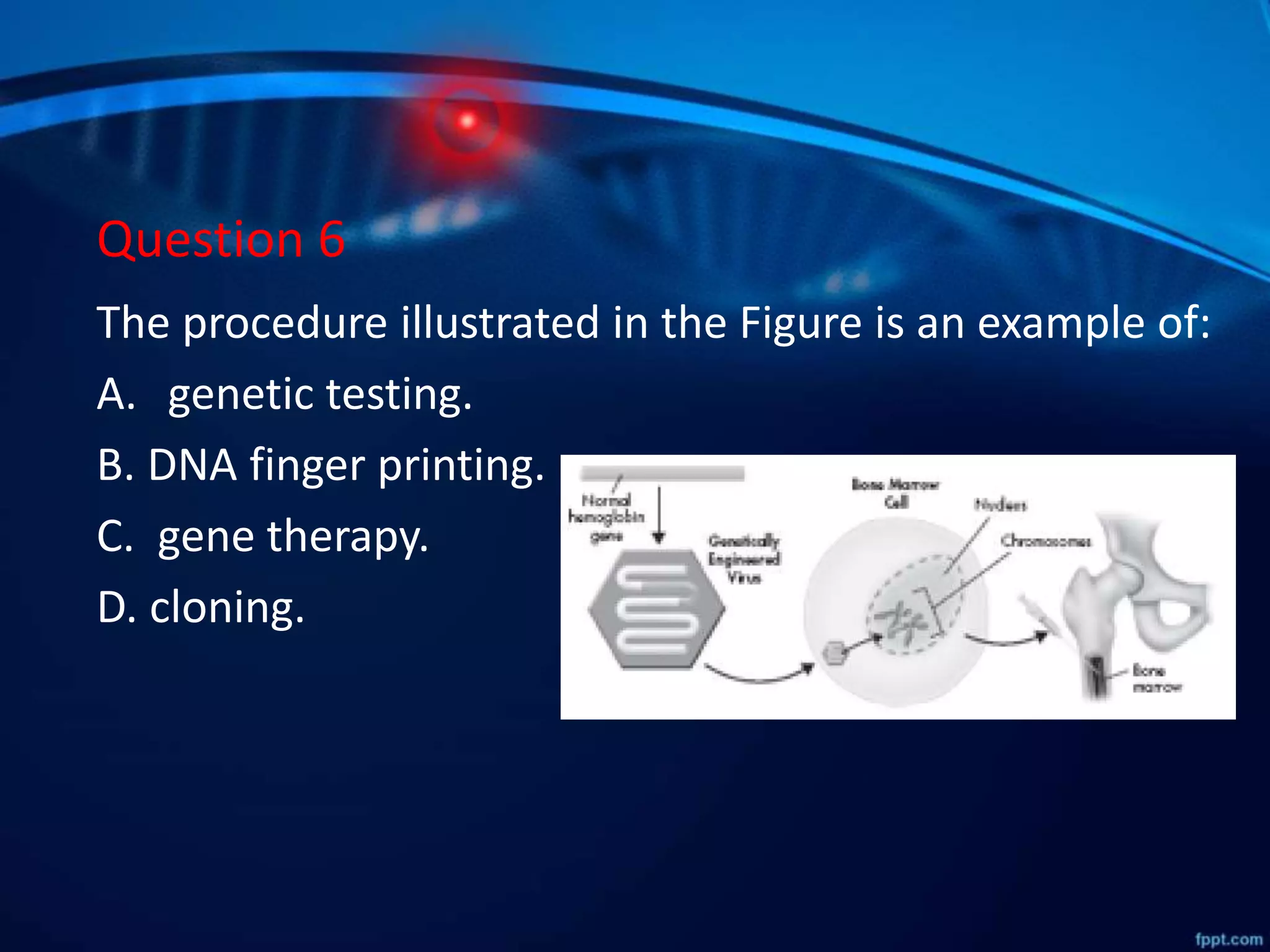
Question 6
The procedure illustrated in the Figure is an example of:
A. genetic testing.
B. DNA finger printing.
C. gene therapy.
D. cloning.
Question 7
Which of the following is true of patents in biotechnology?
A. Scientists are only allowed to patent genes; they cannot
patent techniques they use in the lab.
B. A scientist who holds a patent can demand high fees
that block others from doing certain research.
C. Human genes cannot be patented because they belong
to everyone.
D. Genetically modified foods cannot be patented.
Question 8
Which of the following findings, if true, would support an
argument IN FAVOR of GM foods?
A. Farmers using herbicide-resistant crops pollute groundwater
more than farmers growing non-GM crops.
B. The cost of using GM crops is prohibitively expensive for 75
percent of all farmers.
C. Farmers who grow GM crops have much higher yields than
farmers growing unmodified crops.
D. The populations of bees on farms growing insect-resistant
crops are half as large as bee populations on other farms.
Question 9
Which statement below might be used by someone who is
arguing against the use of GM crops?
A. GM crops reduce the amount of land and energy that need
to be devoted to agriculture because they have high yields.
B. GM crops need more insecticide to be used than other crops
because they grow faster.
C. The patents for the seeds of GM crops are held by big
companies, which may raise prices and force small farmers
out of business.
D. No studies have shown that GM crops are dangerous to
human health.
Question 10
In recombinant DNA technology, plasmids may be used
to:
A. Introduce foreign DNA into bacteria
B. Activate restriction enzymes
C. Cut DNA at a specific location
D. Introduce foreign DNA into human cells
Mockingjay/Jabberjay Excerpt Ch. 3
At the last minute, I remember Madge’s little
gold pin. For the first time, I get a good look at it.
It’s as if someone fashioned a small golden bird
and then attached a ring around it. The bird is
connected to the ring only by its wing tips. I
suddenly recognize it. A mockingjay.
Mockingjay/Jabberjay Continued
They’re funny birds and something of a slap in the face to the Capitol.
During the rebellion,the Capitol bred a series of genetically altered
animals as weapons. The common term for them was muttations,
or sometimes mutts for short. One was a special bird called a
jabberjay that had the ability to memorize and repeat whole human
conversations. They were homing birds, exclusively male, that were
released into regions where the Capitol’s enemies were known to
be hiding. After the birds gathered words, they’d fly back to centers
to be recorded. It took people awhile to realize what was going on
in the districts, how private conversations were being transmitted.
Then, of course, the rebels fed the Capitol endless lies, and the joke
was on it. So the centers were shut down and the birds were
abandoned to die off in the wild.
Mockingjay/Jabberjay Continued
Only they didn’t die off. Instead, the jabberjays mated with
female mockingbirds, creating a whole new species that
could replicate both bird whistles and human melodies.
They had lost the ability to enunciate words but could
still mimic a range of human vocal sounds, from a child’s
high-pitched warble to a man’s deep tones. And they
could re-create songs. Not just a few notes, but whole
songs with multiple verses, if you had the patience to
sing them and if they liked your voice.
Compare and contrast Muttation and Mutation
Muttation Mutation
Tracker Jackers Excerpt – Ch. 14
• At the end of chapter 13, Katniss is hiding up in a tree;
sees Rue hiding in another tree; Rue points to something
in the tree above her. Beginning of their alliance.
• Video Excerpt
• Read the passage from Hunger Games and the
accompanying information about Killer Bees aloud with a
partner.
• Highlight key information and think aloud by asking
relevant questions.
• Fill in a Venn diagram in your IN comparing/contrasting
the 2 organisms.
Compare and Contrast Tracker Jackers and Killer
Bees
Tracker
Jackers
Killer
Bees
Checking In
• Write a short response to a GMO Illustration
• This is part of baseline assessment – so you don’t
need to cite textual evidence.
Genetic Modification – The Basics!
• Formative Task
– Help name components and structure of DNA
– Explain how DNA makes a protein
– Define genetically modified organism and
recombinant DNA technology
– Use Page 7-11 of Genetically Modified Organisms:
PCR analysis of DNA (Grades 9-12) – linked to wiki
Genetically Modified Food
• The Debate over Genetically Modified Foods by
Kerryn Sakko – Close Read
– Complete a T-Chart for IN detailing the pros and
cons of Genetically Modified Food
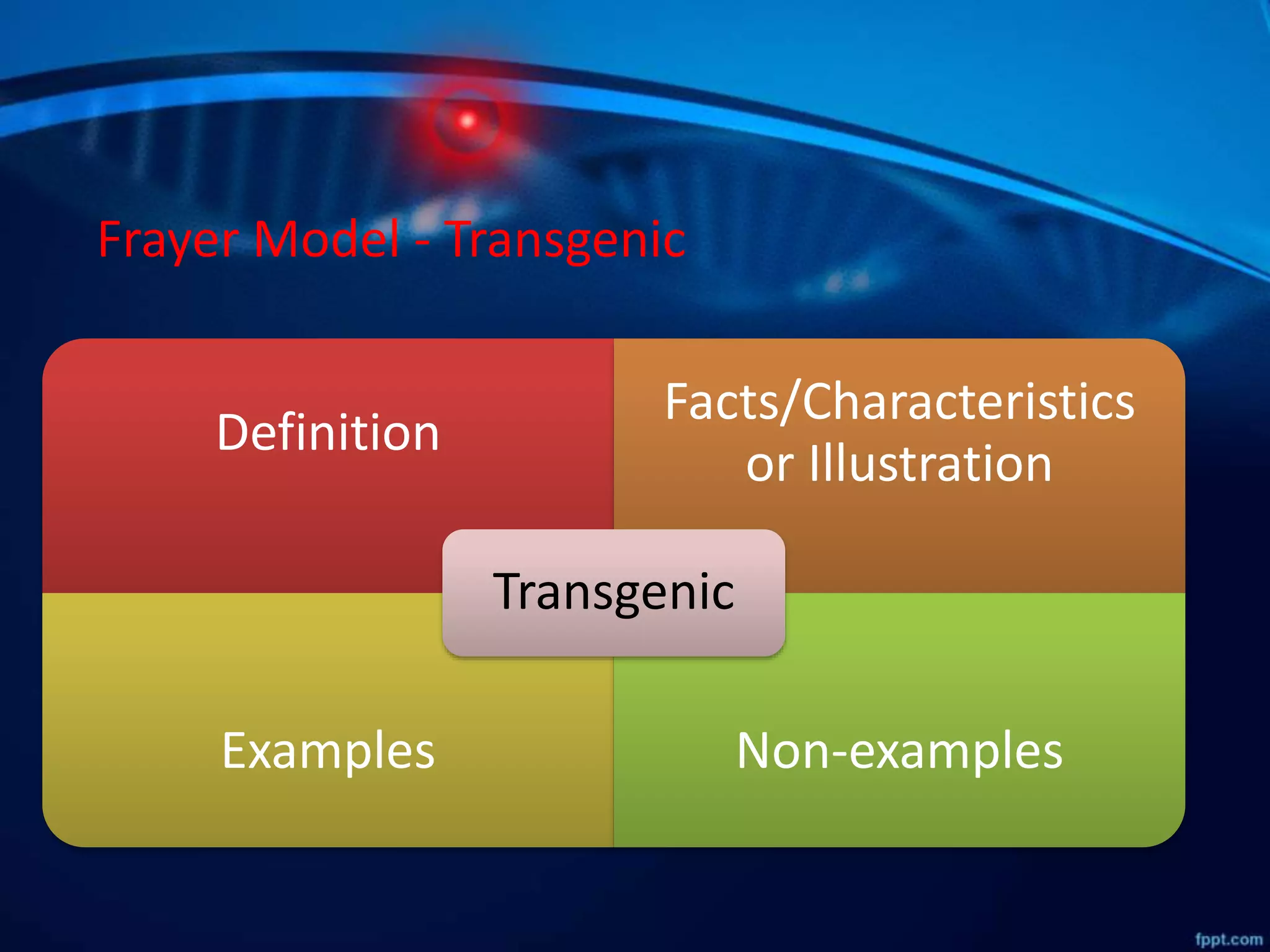
• Complete a Frayer model for the vocabulary word
transgenic for IN
T-Chart Pros and Cons of GM Foods
Pros Cons
Frayer Model - Transgenic
Definition
Facts/Characteristics
or Illustration
Examples Non-examples
Transgenic
Who Wants to be a Genetic Engineer?
• Simulated Lab Activity
• Task: Create both Cinna-apples and Bt-corn.
• Complete lab report handout for each and include in
IN.
• Website linked to wiki.
Claim and Counterclaim Organizer - Refutations
• The Pros and Cons of Designer Babies by Priya Johnson
(Linked to wiki)
– Use the Claim and Counterclaim Organizer to support
a claim regarding “designer babies”. (Tape to IN)
– Practice 4-Step refutation process to write an effective
refutation.
• Step 1: Restate (“They say…”)
• Step 2: Refute (“But…”)
• Step 3: Support (“Because…”)
• Step 4: Conclude (“Therefore…”)
Suicide Mosquitoes
• View the 4 articles rated at different Lexiles taken from
Newsela. (Linked to Wiki)
– Sending dengue mosquitoes into a dead end (760)
– A mosquito created to help fight a deadly disease
(830)
– Frankenskeeters to seek mosquito brides to curb
dengue disease (1020)
– Suicide mosquitoes a gene-altered weapon in war
against dengue fever (1170)
Annotated Drawing
• Draw a picture to describe what happens with the
suicide mosquitoes and why they were created.
Annotate your drawings with brief explanations.
Hunger Games Wolf-Mutt Excerpt – Chapter 25
• Set the scene… End of Chapter 24….Cato is running
away from something, but what?
• Read passage – describes the vicious dog-like
creature with features of human beings.
• Possible Formative TASK: Design a comic strip that
depicts in logical sequential order how these
creatures may have been created.
Additional Questions & Prompts
• What predictions can you make for what might
happen if the tools of biotechnology spread to
everyone, and lead to “an explosion of diversity of
new living creatures”?
• Consider how responsible Panem was in genetically
engineering the jabberjays and tracker jackers, as
well as how responsible real-life scientists have
been in engineering organisms. Defend and argue
your position on genetic engineering with regard to
bioethics.
• Formulate a plan the United States should have in
place to make sure the genetic engineering being
done or contemplated is ethical.
Final Performance Task
• Write a five-paragraph essay analyzing the
significance, ethics, and impact of GMO on
society, arguing whether it should be
continued or regulated.
– State a claim. Acknowledge and refute
counterclaims.
– Cite textual evidence.
– Avoid plagiarism and follow standard
citation format.
Resources
• Intro Pre-assessment
– http://wps.aw.com/bc_johnson_humanbio_6/17
6/45113/11548954.cw/index.html
– http://blogs.jefftwp.org/wordpress/psmith/files/
2010/09/Ch.-15-Genetic-Engineering.doc
• Using Hunger Games to get students ready for
Biology Test (linked to wiki)
• Bioethics in the Hunger Games, The Science
Teacher, January 2014
• NYCDOE – Grade 8 Genetic Modification of
Organisms (linked to wiki)

Genetically Modified Organisms

  • 1.
    Genetically Modified OrganismsGMOs Found in Hunger Games CC Literacy & Science ITQ
  • 2.
    Essential Questions • Whatis the value of creating genetically modified organisms? • What are some of the concerns surrounding GMOs? • How is bioethics considered or not considered in both the Hunger Games and in contemporary society?
  • 3.
    Science Content • Traits •Cell • Genes • Protein • Chromosome • Genetic information • Heredity • DNA • Breeding • Sex cell • embryos • Genetic engineering • Natural selection • Artificial selection • Transgenic species • Genetically Modified Organism, GMO • Recombinant DNA Foundational Information Key Concepts
  • 4.
    Literacy Content Concepts • Claim •Counterclaim • Argument • Counterargument • Refutation • Text-based evidence • Citation Skills • Analyze technical and information texts • Discriminate between fact and opinion • Cite relevant text-based evidence • Employ argumentative techniques and strategies • Outline 5-paragraph argumentative essays
  • 5.
    Pre-Assessment Questions • Plickers •https://www.plickers.com/details – Classroom polling system – Each student gets a card that can be attached to back of interactive notebook – Teacher displays multiple choice questions. Ss hold card in direction to indicate their answer. – Student responses are recorded individually with an immediate graph of the aggregate results. – Teacher scans student cards using iPhone, iPad, or Android device
  • 6.
    Question 1 Which ofthe following is TRUE regarding most currently genetically engineered (GE) plants? A. Most GE plants are designed to have better flavor and be more nutritious. B. There are serious biological and environmental issues regarding their use. C. There has been worldwide acceptance of their use. D. Only a few commercially available processed foods contain GE plants in the US.
  • 7.
    Question 2 Why isit more difficult to create transgenic animals than transgenic plants? A. Plants and animals use a different code. B. It is more difficult to introduce foreign DNA into animal cells. C. Animal cells cannot replicate foreign DNA. D. Animal cells cannot transcribe and translate foreign DNA.
  • 8.
    Question 3 Bacteria arethe “workhorses” of genetic engineering because they ___. A. They provide the polymerase chain reaction. B. Reproduce very slowly and accurately C. Can readily take up plasmids containing human genes and then produce the human proteins encodes by those genes D. Are always homozygous
  • 9.
    Question 4 What bestdescribes plasmids? A. Plasmids are clones of bacteria or DNA segments. B. Plasmids are enzymes used to cut DNA at specific locations. C. Plasmids are circular pieces of DNA that can be used to carry foreign DNA into cells such as bacterial. D. Plasmids are transgenic bacteria.
  • 10.
    Question 5 Organisms thathave been genetically engineered to carry one or more foreign genes are known as ___. A. Ligated organisms B. Homogeneous organisms C. Plasmids D. Transgenic organisms
  • 11.
    Question 6 The procedureillustrated in the Figure is an example of: A. genetic testing. B. DNA finger printing. C. gene therapy. D. cloning.
  • 12.
    Question 7 Which ofthe following is true of patents in biotechnology? A. Scientists are only allowed to patent genes; they cannot patent techniques they use in the lab. B. A scientist who holds a patent can demand high fees that block others from doing certain research. C. Human genes cannot be patented because they belong to everyone. D. Genetically modified foods cannot be patented.
  • 13.
    Question 8 Which ofthe following findings, if true, would support an argument IN FAVOR of GM foods? A. Farmers using herbicide-resistant crops pollute groundwater more than farmers growing non-GM crops. B. The cost of using GM crops is prohibitively expensive for 75 percent of all farmers. C. Farmers who grow GM crops have much higher yields than farmers growing unmodified crops. D. The populations of bees on farms growing insect-resistant crops are half as large as bee populations on other farms.
  • 14.
    Question 9 Which statementbelow might be used by someone who is arguing against the use of GM crops? A. GM crops reduce the amount of land and energy that need to be devoted to agriculture because they have high yields. B. GM crops need more insecticide to be used than other crops because they grow faster. C. The patents for the seeds of GM crops are held by big companies, which may raise prices and force small farmers out of business. D. No studies have shown that GM crops are dangerous to human health.
  • 15.
    Question 10 In recombinantDNA technology, plasmids may be used to: A. Introduce foreign DNA into bacteria B. Activate restriction enzymes C. Cut DNA at a specific location D. Introduce foreign DNA into human cells
  • 16.
    Mockingjay/Jabberjay Excerpt Ch.3 At the last minute, I remember Madge’s little gold pin. For the first time, I get a good look at it. It’s as if someone fashioned a small golden bird and then attached a ring around it. The bird is connected to the ring only by its wing tips. I suddenly recognize it. A mockingjay.
  • 17.
    Mockingjay/Jabberjay Continued They’re funnybirds and something of a slap in the face to the Capitol. During the rebellion,the Capitol bred a series of genetically altered animals as weapons. The common term for them was muttations, or sometimes mutts for short. One was a special bird called a jabberjay that had the ability to memorize and repeat whole human conversations. They were homing birds, exclusively male, that were released into regions where the Capitol’s enemies were known to be hiding. After the birds gathered words, they’d fly back to centers to be recorded. It took people awhile to realize what was going on in the districts, how private conversations were being transmitted. Then, of course, the rebels fed the Capitol endless lies, and the joke was on it. So the centers were shut down and the birds were abandoned to die off in the wild.
  • 18.
    Mockingjay/Jabberjay Continued Only theydidn’t die off. Instead, the jabberjays mated with female mockingbirds, creating a whole new species that could replicate both bird whistles and human melodies. They had lost the ability to enunciate words but could still mimic a range of human vocal sounds, from a child’s high-pitched warble to a man’s deep tones. And they could re-create songs. Not just a few notes, but whole songs with multiple verses, if you had the patience to sing them and if they liked your voice.
  • 19.
    Compare and contrastMuttation and Mutation Muttation Mutation
  • 20.
    Tracker Jackers Excerpt– Ch. 14 • At the end of chapter 13, Katniss is hiding up in a tree; sees Rue hiding in another tree; Rue points to something in the tree above her. Beginning of their alliance. • Video Excerpt • Read the passage from Hunger Games and the accompanying information about Killer Bees aloud with a partner. • Highlight key information and think aloud by asking relevant questions. • Fill in a Venn diagram in your IN comparing/contrasting the 2 organisms.
  • 21.
    Compare and ContrastTracker Jackers and Killer Bees Tracker Jackers Killer Bees
  • 22.
    Checking In • Writea short response to a GMO Illustration • This is part of baseline assessment – so you don’t need to cite textual evidence.
  • 23.
    Genetic Modification –The Basics! • Formative Task – Help name components and structure of DNA – Explain how DNA makes a protein – Define genetically modified organism and recombinant DNA technology – Use Page 7-11 of Genetically Modified Organisms: PCR analysis of DNA (Grades 9-12) – linked to wiki
  • 24.
    Genetically Modified Food •The Debate over Genetically Modified Foods by Kerryn Sakko – Close Read – Complete a T-Chart for IN detailing the pros and cons of Genetically Modified Food • Complete a Frayer model for the vocabulary word transgenic for IN
  • 25.
    T-Chart Pros andCons of GM Foods Pros Cons
  • 26.
    Frayer Model -Transgenic Definition Facts/Characteristics or Illustration Examples Non-examples Transgenic
  • 27.
    Who Wants tobe a Genetic Engineer? • Simulated Lab Activity • Task: Create both Cinna-apples and Bt-corn. • Complete lab report handout for each and include in IN. • Website linked to wiki.
  • 28.
    Claim and CounterclaimOrganizer - Refutations • The Pros and Cons of Designer Babies by Priya Johnson (Linked to wiki) – Use the Claim and Counterclaim Organizer to support a claim regarding “designer babies”. (Tape to IN) – Practice 4-Step refutation process to write an effective refutation. • Step 1: Restate (“They say…”) • Step 2: Refute (“But…”) • Step 3: Support (“Because…”) • Step 4: Conclude (“Therefore…”)
  • 29.
    Suicide Mosquitoes • Viewthe 4 articles rated at different Lexiles taken from Newsela. (Linked to Wiki) – Sending dengue mosquitoes into a dead end (760) – A mosquito created to help fight a deadly disease (830) – Frankenskeeters to seek mosquito brides to curb dengue disease (1020) – Suicide mosquitoes a gene-altered weapon in war against dengue fever (1170)
  • 30.
    Annotated Drawing • Drawa picture to describe what happens with the suicide mosquitoes and why they were created. Annotate your drawings with brief explanations.
  • 31.
    Hunger Games Wolf-MuttExcerpt – Chapter 25 • Set the scene… End of Chapter 24….Cato is running away from something, but what? • Read passage – describes the vicious dog-like creature with features of human beings. • Possible Formative TASK: Design a comic strip that depicts in logical sequential order how these creatures may have been created.
  • 32.
    Additional Questions &Prompts • What predictions can you make for what might happen if the tools of biotechnology spread to everyone, and lead to “an explosion of diversity of new living creatures”? • Consider how responsible Panem was in genetically engineering the jabberjays and tracker jackers, as well as how responsible real-life scientists have been in engineering organisms. Defend and argue your position on genetic engineering with regard to bioethics. • Formulate a plan the United States should have in place to make sure the genetic engineering being done or contemplated is ethical.
  • 33.
    Final Performance Task •Write a five-paragraph essay analyzing the significance, ethics, and impact of GMO on society, arguing whether it should be continued or regulated. – State a claim. Acknowledge and refute counterclaims. – Cite textual evidence. – Avoid plagiarism and follow standard citation format.
  • 34.
    Resources • Intro Pre-assessment –http://wps.aw.com/bc_johnson_humanbio_6/17 6/45113/11548954.cw/index.html – http://blogs.jefftwp.org/wordpress/psmith/files/ 2010/09/Ch.-15-Genetic-Engineering.doc • Using Hunger Games to get students ready for Biology Test (linked to wiki) • Bioethics in the Hunger Games, The Science Teacher, January 2014 • NYCDOE – Grade 8 Genetic Modification of Organisms (linked to wiki)

Editor's Notes

  • #6 I will print the cards on cardstock Monday morning. I set up a Plicker account and have created a class for the grant. The cards are numbered and I have assigned each teacher a number so that we can use them with the questions. Looking forward to testing this out! Great to use when they don’t have access to Clickers – can be used throughout a lesson to assess understanding and provide evidence at the end of the lesson to help determine if objectives have been addressed.
  • #7 B.
  • #8 B
  • #9 C
  • #10 C.
  • #11 D.
  • #12 C Picture is fuzzy but I’ll help translate it for them when we use it.
  • #13 B
  • #14 C
  • #15 C
  • #16 A
  • #17 Read-aloud and pause to ask questions – pause to highlight key scientific information on the SMART board.
  • #18 “Muttation” has the word “mutt” in it. What’s a mutt?
  • #19 Is the Mockingjay a Muttation or is it only a Jabberjay that is a muttation?
  • #20 Goal: activate prior knowledge of real-world mutations such as albino animals and comparing them with the diabolical muttations in the book. Share Compare N’Contrast app
  • #21 Set the scene, play video excerpt, ask them to read passages in pairs.
  • #22 Discuss findings as a group and compile responses on SMART board.
  • #23 Copy page 20 of NYCDOE plan.
  • #24 Copy activity sheet - page 23-25 from NYCDOE lesson plan Refer to Tracking author’s purpose to ID central ideas of text Deconstruct and reconstruct sentences to unpack concepts, knowledge, and ideas Chunk Info – pull out significant concepts to fill up organizers Word wall Journal entry – such as “describe the process initiated once a gene is “turned on” as describe in the text.
  • #25 Print article.
  • #27 Share Wait Wait Don’t Tell Me Segment on BrusselKale
  • #28 Print Lab reports – page 37 & 38 of packet
  • #29 Print page 39 of packet Link Four-Step Refutation handout to wiki – no need to copy.
  • #31 This is one of the FACTs Link with Think, Pair, Share Link with Give me 5 – ask 5 people to share their work.
  • #32 Need to highlight clues from passage and activate knowledge about DNA and genetic engineering to make the comic realistic.