Classroom Management in
Action
A data-driven training approach to
improve classroom climate and
student performance
Claudia Vincent, Ph.D., (cvincent@irised.com)
Brion Marquez (Bmarquez@irised.com)
Jessie Marquez (Jmarquez@irised.com)
IRIS Educational Media, Eugene, Oregon
This project was funded by a Grant from the Institute of Education Sciences, U.S.
Department of Education, Grant # R324A080150
The problem
Teachers are constantly challenged by correcting problem behavior, and spend
too much time on classroom management.
New Teachers Project Survey (2013)
 Which activities have improved the quality of your instruction or helped you
be a better teacher?
 Experience over time trying different things (78% strongly agree)
 Observations of other teachers in their own classrooms (61% strongly agree)
 Formal professional development courses (42% strongly agree)
 What has made it most challenging for you to teach effectively over the
course of your career?
 Insufficient time for planning and collaboration with other teachers (40%)
 Having students who are behind academically or behaviorally challenging (40%)
 Having students whose out-of-school lives distract from their focus in school (40%)
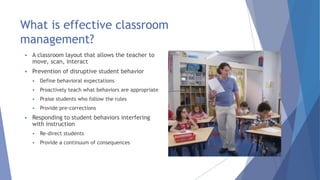
What is effective classroom
management?
 A classroom layout that allows the teacher to
move, scan, interact
 Prevention of disruptive student behavior
 Define behavioral expectations
 Proactively teach what behaviors are appropriate
 Praise students who follow the rules
 Provide pre-corrections
 Responding to student behaviors interfering
with instruction
 Re-direct students
 Provide a continuum of consequences
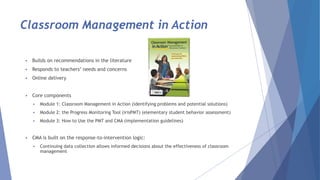
Classroom Management in Action
 Builds on recommendations in the literature
 Responds to teachers’ needs and concerns
 Online delivery
 Core components
 Module 1: Classroom Management in Action (identifying problems and potential solutions)
 Module 2: the Progress Monitoring Tool (irisPMT) (elementary student behavior assessment)
 Module 3: How to Use the PMT and CMA (implementation guidelines)
 CMA is built on the response-to-intervention logic:
 Continuing data collection allows informed decisions about the effectiveness of classroom
management
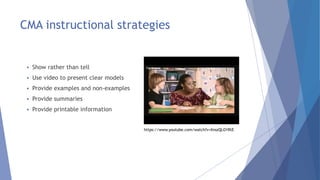
CMA instructional strategies
 Show rather than tell
 Use video to present clear models
 Provide examples and non-examples
 Provide summaries
 Provide printable information
https://www.youtube.com/watch?v=XnszQLO1RtE
Module 1: identifying problems &
potential solutions
Three sections:
 Planning and organization
 Proactive prevention of problem behavior
 Responding to problem behavior
Each section has these components:
 Coaches Corner
 Skill building videos
 My action plan
 Printable summary sheets/checklists
Module 2: Progress Monitoring
 An online universal screening and progress-monitoring tool comes with the
course.
 Currently houses the Elementary Social Behavior Assessment (ESBA)
 12 items assessing social behaviors necessary for academic success
 Derived from extensive research conducted by Hill Walker and colleagues
 Completion requires relatively little time
 Automatically generated data aggregations facilitate decision-making
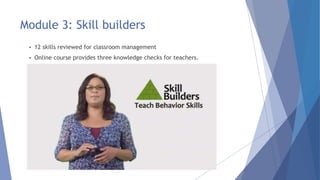
Module 3: Skill builders
 12 skills reviewed for classroom management
 Online course provides three knowledge checks for teachers.
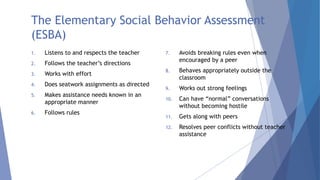
The Elementary Social Behavior Assessment
(ESBA)
1. Listens to and respects the teacher
2. Follows the teacher’s directions
3. Works with effort
4. Does seatwork assignments as directed
5. Makes assistance needs known in an
appropriate manner
6. Follows rules
7. Avoids breaking rules even when
encouraged by a peer
8. Behaves appropriately outside the
classroom
9. Works out strong feelings
10. Can have “normal” conversations
without becoming hostile
11. Gets along with peers
12. Resolves peer conflicts without teacher
assistance
Initial evaluation studies
Three evaluation studies were performed on Classroom Management in Action
For a full discussion of all three studies, see:
 Marquez, B., Vincent, C., Marquez, J., Pennefather, J, Smolkowski, K., &
Sprague, J.R. (in press). Opportunities and Challenges in Training
Elementary School Teachers in Classroom Management: Initial Results from
Classroom Management in Action, an Online Professional Development
Program. Journal of Technology and Teacher Education.
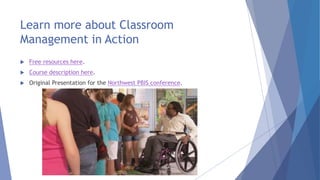
Learn more about Classroom
Management in Action
 Free resources here.
 Course description here.
 Original Presentation for the Northwest PBIS conference.

Classroom Management in Action

  • 1.
    Classroom Management in Action Adata-driven training approach to improve classroom climate and student performance Claudia Vincent, Ph.D., (cvincent@irised.com) Brion Marquez (Bmarquez@irised.com) Jessie Marquez (Jmarquez@irised.com) IRIS Educational Media, Eugene, Oregon This project was funded by a Grant from the Institute of Education Sciences, U.S. Department of Education, Grant # R324A080150
  • 2.
    The problem Teachers areconstantly challenged by correcting problem behavior, and spend too much time on classroom management.
  • 3.
    New Teachers ProjectSurvey (2013)  Which activities have improved the quality of your instruction or helped you be a better teacher?  Experience over time trying different things (78% strongly agree)  Observations of other teachers in their own classrooms (61% strongly agree)  Formal professional development courses (42% strongly agree)  What has made it most challenging for you to teach effectively over the course of your career?  Insufficient time for planning and collaboration with other teachers (40%)  Having students who are behind academically or behaviorally challenging (40%)  Having students whose out-of-school lives distract from their focus in school (40%)
  • 4.
    What is effectiveclassroom management?  A classroom layout that allows the teacher to move, scan, interact  Prevention of disruptive student behavior  Define behavioral expectations  Proactively teach what behaviors are appropriate  Praise students who follow the rules  Provide pre-corrections  Responding to student behaviors interfering with instruction  Re-direct students  Provide a continuum of consequences
  • 5.
    Classroom Management inAction  Builds on recommendations in the literature  Responds to teachers’ needs and concerns  Online delivery  Core components  Module 1: Classroom Management in Action (identifying problems and potential solutions)  Module 2: the Progress Monitoring Tool (irisPMT) (elementary student behavior assessment)  Module 3: How to Use the PMT and CMA (implementation guidelines)  CMA is built on the response-to-intervention logic:  Continuing data collection allows informed decisions about the effectiveness of classroom management
  • 6.
    CMA instructional strategies Show rather than tell  Use video to present clear models  Provide examples and non-examples  Provide summaries  Provide printable information https://www.youtube.com/watch?v=XnszQLO1RtE
  • 7.
    Module 1: identifyingproblems & potential solutions Three sections:  Planning and organization  Proactive prevention of problem behavior  Responding to problem behavior Each section has these components:  Coaches Corner  Skill building videos  My action plan  Printable summary sheets/checklists
  • 8.
    Module 2: ProgressMonitoring  An online universal screening and progress-monitoring tool comes with the course.  Currently houses the Elementary Social Behavior Assessment (ESBA)  12 items assessing social behaviors necessary for academic success  Derived from extensive research conducted by Hill Walker and colleagues  Completion requires relatively little time  Automatically generated data aggregations facilitate decision-making
  • 9.
    Module 3: Skillbuilders  12 skills reviewed for classroom management  Online course provides three knowledge checks for teachers.
  • 10.
    The Elementary SocialBehavior Assessment (ESBA) 1. Listens to and respects the teacher 2. Follows the teacher’s directions 3. Works with effort 4. Does seatwork assignments as directed 5. Makes assistance needs known in an appropriate manner 6. Follows rules 7. Avoids breaking rules even when encouraged by a peer 8. Behaves appropriately outside the classroom 9. Works out strong feelings 10. Can have “normal” conversations without becoming hostile 11. Gets along with peers 12. Resolves peer conflicts without teacher assistance
  • 11.
    Initial evaluation studies Threeevaluation studies were performed on Classroom Management in Action For a full discussion of all three studies, see:  Marquez, B., Vincent, C., Marquez, J., Pennefather, J, Smolkowski, K., & Sprague, J.R. (in press). Opportunities and Challenges in Training Elementary School Teachers in Classroom Management: Initial Results from Classroom Management in Action, an Online Professional Development Program. Journal of Technology and Teacher Education.
  • 12.
    Learn more aboutClassroom Management in Action  Free resources here.  Course description here.  Original Presentation for the Northwest PBIS conference.