Facilities Maintenance Course
(Operating & Maintenance)
40 Hours
Course Content
 CH 1: Introduction
 CH 2: Review of Engineering Basics
 CH 3: Mechanical Systems
 CH 4: Electrical Systems
 CH 5: Plumbing Systems
 CH 6: Water Treatment
 CH 7: Equipment (Laundry & Kitchen)
 CH 8: Civil Works
 CH 9: Maintenance Management
Facilities
Management
Soft Services Hard Services
House Keeping MEP
Landscape
Pest Control
Security
Civil
Water Treatment
Equipment
Recreation
Course Coverage
Hard Services
Civil MEP
Water
Treatment
Equipment
Painting
Polishing
Carpentry
Mason
Mechanical Electrical Plumbing
Power
Light Current
HVAC
Fire Fighting
Water Supply
Drainage
pools
Water Features
Refrigerators
Laundry
Lift & Escalator
Chute System
Kitchen
Fire Alarm
BMS
Public IP Address
CH 2: Review of Engineering Basics
Review of Mechanical & Electrical Basics
 SI and English Units
 Valves
 Pumps
 Compressors
 Heat Exchangers
 Refrigerationcycle
 IC Engines
 DC & AC
 Single Phase& three phase
 ElectricalFaults and Protection
 Power Factor
 Introductionto Classiccontrol
CH 3: Mechanical Systems
HVAC:
Air Conditioning
 Air Conditioning:a system or process for controllingthe temperature,
humidity, and sometimes the purity of the air in an interior, as of an office,
theater, laboratory, or house, especially one capableof cooling. an air-
conditioningsystem or unit.
Air Conditioning
Chilled Water
Compression
Chiller
Air Cooled
Water
Cooled
Absorption
Chiller
Direct Expansion
Package
Unit
Split Unit
Mini
High Wall Concealed
Free
Stand
Central
HVAC:
Ventilation
 Ventilation:Abalanced ventilation system usually has two fans and two duct
systems. Fresh air supply and exhaust vents can be installed in every room,
but a typical balanced ventilation system is designed to supply fresh air to
bedrooms and living rooms where occupantsspend the most time.
HVAC:
Heating System (Boiler)
 FireTube Boiler:Afire-tube boileris a type of boilerin which hot gases pass
from a fire through one or more tubes runningthrough a sealed containerof water.
Fire Fighting system:
 FireTriangle
Fire Fighting system:
Fire Fighting
Water Systems
Sprinklers Hazel cabinets Hydrants
Gas Systems
Co2 FM200 Extinguishers
Lift & Escalator
 TractionElevator:This elevator has ropes that pass over a wheel attached to an electric
motor located above the shaft. The main function of the ropes is to raise and lower the
elevator car. It can be used for both mid and high-rise applications and can travel much faster
than hydraulic elevators.
Lift & Escalator
 Escalator:An escalator is a moving staircase which carries peoplebetween floors
of a building or structure. It consists of a motor-driven chain of individually linked
steps on a track which cycle on a pair of tracks which keep them horizontal.
Chute System
 Chute: Chutes are in common use in tall buildings to allow the rapid transport of
items from the upper floors to a central location on one of the lower floors or
basement. Chutesmay be round, squareor rectangular at the top and/orthe bottom.
CH 4: Electrical Systems
Power Network:
Power Sources
Power
Sources
Normal
Source
Transformer
Backup
Source
Generator
Uninterrupted
Source
UPS
Power Network:
 CircuitBreakers: Acircuit breaker is an electrical switch designed to protect an
electrical circuit from damage caused by overcurrent/overloador short circuit. Its
basic function is to interrupt current flow after protective relays detect a fault.
Circuit
Breaker
MCB MCCB ACB
Power Network:
 ElectricalFaults:
1- Short circuit: referring to a situation where a hot wire touchesa neutral wire. A
“ground fault,” on the other hand, occurs when a hot wire touchesa grounded portion
of your electrical system, such as the metal wall box or an appliance.
Short Circuit Protection:
1- Fuse
2- Circuit Breaker
Light Current:
Fire Alarm system
 FireAlarm System Types:
Fire Alarm
System
Conventional Addressable Wireless
Light Current:
Fire Alarm system
 FireAlarm: Fire Alarm System is designed to alert us to an emergency so that we
can take action to protectourselves, staff and the general public.
Light Current:
Audio Video System
 PublicIP Address:
Light Current:
Building Management System (BMS)
 BMS: A BMS monitors, supervises, controlsand reportson smart building
technology systems. These systems may includeaccess control,video surveillance,
fire alarms, HVAC control, programmable lighting and electric power management.
CH 5: Plumbing Systems
Plumbing & Drainage system & Irrigation system
 WaterSupply Network:
Water Supply
System
Gravity
System
Booster
System
CH 6: Water Treatment
Water Treatment:
Swimming pools
 Skimmer Pool:
Water Treatment:
 WaterTreatment:
Water
Treatment
Mechanical
(80%)
Chemical
(20%)
CH 7: Equipment (Laundry & Kitchen)
Equipment:
Cold rooms & Refrigerator
 Refrigerator:an appliance or compartment which is artificially kept cool and used to
store food and drink. Modern refrigerators generally make use of the cooling effect
produced when a volatile liquid is forced to evaporate in a sealed system in which it can be
condensed back to liquid outside the refrigerator. (134a)
CH 8: Civil Works
Civil Works:
Carpentry, Polishing, Painting and Mason
 Carpentry:MaintenanceCarpentersare skilled tradespeoplewho carry out all
round maintenance. This includes tasks such as: refurbishments, fit out and de-fit
out projects, repairs to building façades and interiors, painting and patching,
replacing doorsand doorlocks, and related ad-hocmaintenanceduties.
Civil Works:
Carpentry, Polishing, Painting and Mason
 Polishing:Polishing is the process of creating a smooth and shiny surface by
rubbingit or by applying a chemical treatment, leaving a clean surface with a
significant specularreflection.
Civil Works:
Carpentry, Polishing, Painting and Mason
 Painting:Industrial maintenancepaints are specially producedpaints to protect
industrial structuresand components. These paints are commonly used to controlthe
corrosion of steel structuresof industrial plants; their roofs, platforms and
underground pipelines.
Civil Works:
Carpentry, Polishing, Painting and Mason
 Mason:MAINTENANCE WORKER (MASON) GENERAL STATEMENT OF DUTIES:
Performs masonry work; does related work as required. DISTINGUISHING FEATURES OF
THE CLASS: Under direct supervision, performs maintenance, repair and construction of
masonry work.
CH 9: Maintenance Management
Maintenance Management
 MaintenanceTypes:
Maintenance
Types
Corrective
maintenance
Preventive
Maintenance
Predictive
Maintenance
Maintenance Management
 MaintenanceTypes:
Maintenance Management
Assets Management
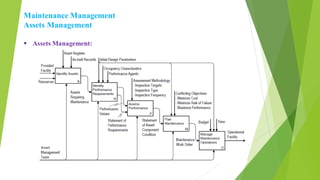
 Assets:An asset is a resourcewith economic value that an individual, corporation, or
countryowns or controlswith the expectation that it will provide a future benefit.
Assets are reported on a company's balance sheet. They're classified as current, fixed,
financial, and intangible.
Maintenance Management
Assets Management
 Assets Management:
Maintenance Management
Reports
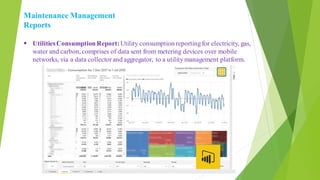
 UtilitiesConsumption Report:Utility consumption reportingfor electricity, gas,
water and carbon, comprises of data sent from metering devices over mobile
networks, via a data collectorand aggregator, to a utility management platform.
The End
Open discussion
 1- PurchasingCycle
 2-
 3-
 4-
 5-
 6-
 7-
 8-

Facility Maintenance Course (Operating & Maintenance)

  • 1.
  • 3.
    Course Content  CH1: Introduction  CH 2: Review of Engineering Basics  CH 3: Mechanical Systems  CH 4: Electrical Systems  CH 5: Plumbing Systems  CH 6: Water Treatment  CH 7: Equipment (Laundry & Kitchen)  CH 8: Civil Works  CH 9: Maintenance Management
  • 4.
    Facilities Management Soft Services HardServices House Keeping MEP Landscape Pest Control Security Civil Water Treatment Equipment Recreation Course Coverage
  • 5.
    Hard Services Civil MEP Water Treatment Equipment Painting Polishing Carpentry Mason MechanicalElectrical Plumbing Power Light Current HVAC Fire Fighting Water Supply Drainage pools Water Features Refrigerators Laundry Lift & Escalator Chute System Kitchen Fire Alarm BMS Public IP Address
  • 6.
    CH 2: Reviewof Engineering Basics
  • 7.
    Review of Mechanical& Electrical Basics  SI and English Units  Valves  Pumps  Compressors  Heat Exchangers  Refrigerationcycle  IC Engines  DC & AC  Single Phase& three phase  ElectricalFaults and Protection  Power Factor  Introductionto Classiccontrol
  • 8.
  • 9.
    HVAC: Air Conditioning  AirConditioning:a system or process for controllingthe temperature, humidity, and sometimes the purity of the air in an interior, as of an office, theater, laboratory, or house, especially one capableof cooling. an air- conditioningsystem or unit. Air Conditioning Chilled Water Compression Chiller Air Cooled Water Cooled Absorption Chiller Direct Expansion Package Unit Split Unit Mini High Wall Concealed Free Stand Central
  • 10.
    HVAC: Ventilation  Ventilation:Abalanced ventilationsystem usually has two fans and two duct systems. Fresh air supply and exhaust vents can be installed in every room, but a typical balanced ventilation system is designed to supply fresh air to bedrooms and living rooms where occupantsspend the most time.
  • 11.
    HVAC: Heating System (Boiler) FireTube Boiler:Afire-tube boileris a type of boilerin which hot gases pass from a fire through one or more tubes runningthrough a sealed containerof water.
  • 12.
  • 13.
    Fire Fighting system: FireFighting Water Systems Sprinklers Hazel cabinets Hydrants Gas Systems Co2 FM200 Extinguishers
  • 14.
    Lift & Escalator TractionElevator:This elevator has ropes that pass over a wheel attached to an electric motor located above the shaft. The main function of the ropes is to raise and lower the elevator car. It can be used for both mid and high-rise applications and can travel much faster than hydraulic elevators.
  • 15.
    Lift & Escalator Escalator:An escalator is a moving staircase which carries peoplebetween floors of a building or structure. It consists of a motor-driven chain of individually linked steps on a track which cycle on a pair of tracks which keep them horizontal.
  • 16.
    Chute System  Chute:Chutes are in common use in tall buildings to allow the rapid transport of items from the upper floors to a central location on one of the lower floors or basement. Chutesmay be round, squareor rectangular at the top and/orthe bottom.
  • 17.
  • 18.
  • 19.
    Power Network:  CircuitBreakers:Acircuit breaker is an electrical switch designed to protect an electrical circuit from damage caused by overcurrent/overloador short circuit. Its basic function is to interrupt current flow after protective relays detect a fault. Circuit Breaker MCB MCCB ACB
  • 20.
    Power Network:  ElectricalFaults: 1-Short circuit: referring to a situation where a hot wire touchesa neutral wire. A “ground fault,” on the other hand, occurs when a hot wire touchesa grounded portion of your electrical system, such as the metal wall box or an appliance. Short Circuit Protection: 1- Fuse 2- Circuit Breaker
  • 21.
    Light Current: Fire Alarmsystem  FireAlarm System Types: Fire Alarm System Conventional Addressable Wireless
  • 22.
    Light Current: Fire Alarmsystem  FireAlarm: Fire Alarm System is designed to alert us to an emergency so that we can take action to protectourselves, staff and the general public.
  • 23.
    Light Current: Audio VideoSystem  PublicIP Address:
  • 24.
    Light Current: Building ManagementSystem (BMS)  BMS: A BMS monitors, supervises, controlsand reportson smart building technology systems. These systems may includeaccess control,video surveillance, fire alarms, HVAC control, programmable lighting and electric power management.
  • 25.
  • 26.
    Plumbing & Drainagesystem & Irrigation system  WaterSupply Network: Water Supply System Gravity System Booster System
  • 27.
    CH 6: WaterTreatment
  • 28.
  • 29.
  • 30.
    CH 7: Equipment(Laundry & Kitchen)
  • 31.
    Equipment: Cold rooms &Refrigerator  Refrigerator:an appliance or compartment which is artificially kept cool and used to store food and drink. Modern refrigerators generally make use of the cooling effect produced when a volatile liquid is forced to evaporate in a sealed system in which it can be condensed back to liquid outside the refrigerator. (134a)
  • 32.
  • 33.
    Civil Works: Carpentry, Polishing,Painting and Mason  Carpentry:MaintenanceCarpentersare skilled tradespeoplewho carry out all round maintenance. This includes tasks such as: refurbishments, fit out and de-fit out projects, repairs to building façades and interiors, painting and patching, replacing doorsand doorlocks, and related ad-hocmaintenanceduties.
  • 34.
    Civil Works: Carpentry, Polishing,Painting and Mason  Polishing:Polishing is the process of creating a smooth and shiny surface by rubbingit or by applying a chemical treatment, leaving a clean surface with a significant specularreflection.
  • 35.
    Civil Works: Carpentry, Polishing,Painting and Mason  Painting:Industrial maintenancepaints are specially producedpaints to protect industrial structuresand components. These paints are commonly used to controlthe corrosion of steel structuresof industrial plants; their roofs, platforms and underground pipelines.
  • 36.
    Civil Works: Carpentry, Polishing,Painting and Mason  Mason:MAINTENANCE WORKER (MASON) GENERAL STATEMENT OF DUTIES: Performs masonry work; does related work as required. DISTINGUISHING FEATURES OF THE CLASS: Under direct supervision, performs maintenance, repair and construction of masonry work.
  • 37.
  • 38.
  • 39.
  • 40.
    Maintenance Management Assets Management Assets:An asset is a resourcewith economic value that an individual, corporation, or countryowns or controlswith the expectation that it will provide a future benefit. Assets are reported on a company's balance sheet. They're classified as current, fixed, financial, and intangible.
  • 41.
  • 42.
    Maintenance Management Reports  UtilitiesConsumptionReport:Utility consumption reportingfor electricity, gas, water and carbon, comprises of data sent from metering devices over mobile networks, via a data collectorand aggregator, to a utility management platform.
  • 43.
  • 44.
    Open discussion  1-PurchasingCycle  2-  3-  4-  5-  6-  7-  8-