Chapter 1 The Foundations of Chemistry HW27Qs: 3, 4, 6, 10, 14,18, 20, 26, 28, 30, 32, 34, 36, 38, 40, 44, 46, 50, 54, 56, 58, 60, 62, 64, 66, 68,70 Dr. Shiunchin C. Wang
1.1 Matter and Energy CHEMISTRY MATTER What is Chemistry? Chemistry is the science that  describe matter  regarding with its composition, structure, properties. matter is anything has  mass  and occupies  space . Mass Occupies  Space + Mass  is a measurement of the quantity of matter in a sample of any materials. Mass is different from weight.  Mass  does not vary in different place, but  weight  does. Weight : a measurement of the gravitational attraction of the earth for the body.  Volume: a 3-D space. Subdiscipline of chemistry: Analytical, Biological, Biophysical, Inorganic, Organic, Material, Physical, Polymer, Nanotechnology etc.
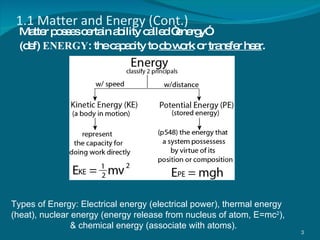
1.1 Matter and Energy (Cont.) Matter posses certain ability called “energy”.  (def)  ENERGY : the capacity to  do work  or  transfer hear . Types of Energy: Electrical energy (electrical power), thermal energy (heat), nuclear energy (energy release from nucleus of atom, E=mc 2 ),  & chemical energy (associate with atoms).
Natural Laws Scientific (natural) law A general statement based the observed behavior of matter to which no exceptions are known.  Law of Conservation :  neither created nor destroyed . Law of Conservation of Mass Law of Conservation of Energy Law of Conservation of Mass-Energy Einstein’s Relativity E=mc 2   Law of Conservation of Matter  : no observable change in the quantity of matter during “a chemical reaction” or “physical change”. E.g.. Magnesium burns in oxygen to from magnesium oxide.   2 Mg(s)  +  O 2 (g)     2MgO(s) mass of 2 Mg  +  mass of 1 O 2  = mass of 2 MgO
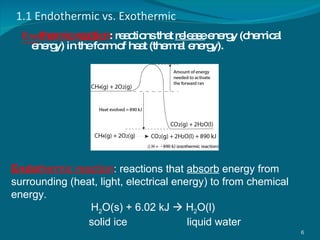
1.1 Matter and Energy (Cont.) Law of Conservation  of Energy : Energy  cannot be created or destroyed  in a chemical reaction or in a physical change. It  can only be converted from one form to another . Relationship between matter and energy by Albert Einstein in 1940: E= mc 2 Exothermic reaction : convert chemical energy into heat energy. Endothermic reaction : heat, light, and electrical energy can be converted into chemical energy
1.1 Endothermic vs. Exothermic Exo thermic reaction : reactions that  release  energy (chemical energy) in the form of heat (thermal energy). Endo thermic reaction : reactions that  absorb  energy from surrounding (heat, light, electrical energy) to from chemical energy.    H 2 O(s) + 6.02 kJ    H 2 O(l) solid ice  liquid water
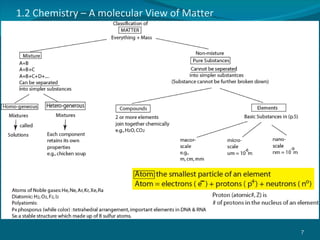
1.2 Chemistry – A molecular View of Matter
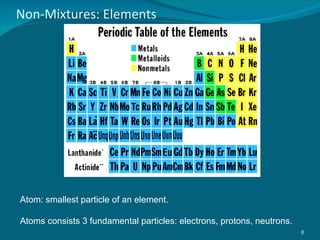
Non-Mixtures: Elements Atom: smallest particle of an element. Atoms consists 3 fundamental particles: electrons, protons, neutrons.
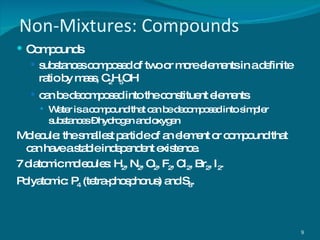
Non-Mixtures: Compounds Compounds substances composed of two or more elements in a definite ratio by mass, C 2 H 5 OH can be decomposed into the constituent elements Water is a compound that can be decomposed into simpler substances – hydrogen and oxygen Molecule: the smallest particle of an element or compound that can have a stable independent existence.  7 diatomic molecules: H 2 , N 2 , O 2 , F 2 , Cl 2 , Br 2 , I 2 . Polyatomic: P 4  (tetra-phosphorus) and S 8 .
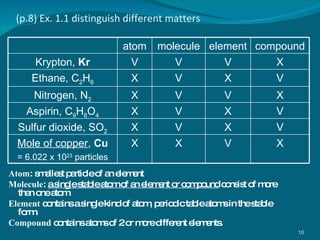
(p.8) Ex. 1.1 distinguish different matters Atom : smallest particle of an element Molecule :  a single stable atom of an element or compound  consist of more than one atom. Element  contains a single kind of atom, periodic table atoms in the stable form. Compound  contains atoms of 2 or more different elements. atom molecule element compound Krypton,  Kr V V V X Ethane, C 2 H 6 X V X V Nitrogen, N 2 X V V X Aspirin, C 9 H 8 O 4 X V X V Sulfur dioxide, SO 2 X V X V Mole of copper ,  Cu = 6.022 x 10 23  particles X X V X
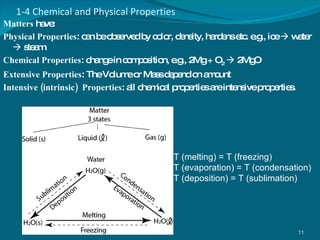
1-4 Chemical and Physical Properties Matters  have: Physical Properties : can be observed by color, density, hardens etc. e.g., ice    water    steam. Chemical Properties : change in composition, e.g., 2Mg + O 2     2MgO Extensive Properties : The Volume or Mass depend on amount Intensive (intrinsic)  Properties : all chemical properties are intensive properties. T (melting) = T (freezing) T (evaporation) = T (condensation) T (deposition) = T (sublimation)
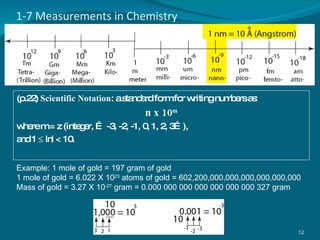
1-7 Measurements in Chemistry (p.22)  Scientific Notation : a standard form for writing numbers as: n x 10 m   where m = z (integer, … -3, -2, -1, 0, 1, 2, 3…),  and 1    |n| < 10. Example: 1 mole of gold = 197 gram of gold 1 mole of gold = 6.022 X 10 23  atoms of gold = 602,200,000,000,000,000,000,000 Mass of gold = 3.27 X 10 -27  gram = 0.000 000 000 000 000 000 000 327 gram
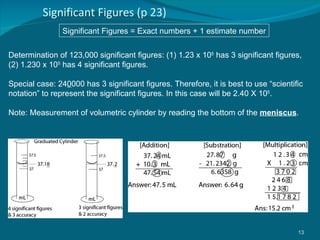
Significant Figures (p 23) Determination of 123,000 significant figures: (1) 1.23 x 10 5  has 3 significant figures, (2) 1.230 x 10 5  has 4 significant figures. Special case: 24 0 000 has 3 significant figures. Therefore, it is best to use “scientific notation” to represent the significant figures. In this case will be 2.40 X 10 5 .  Note: Measurement of volumetric cylinder by reading the bottom of the  meniscus . Significant Figures = Exact numbers + 1 estimate number
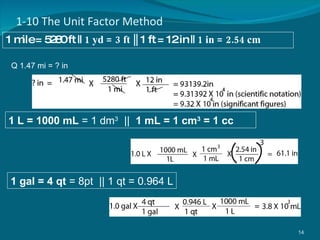
1-10 The Unit Factor Method 1 mile = 5280 ft ||  1 yd = 3 ft ||  1 ft = 12 in ||  1 in = 2.54 cm Q 1.47 mi = ? in 1 L = 1000 mL  = 1 dm 3   ||  1 mL = 1 cm 3  = 1 cc 1 gal = 4 qt  = 8pt  || 1 qt = 0.964 L
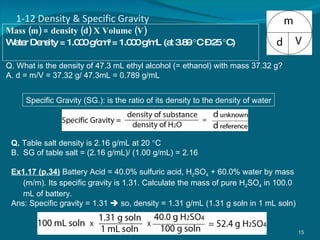
1-12 Density & Specific Gravity Mass (m) = density (d) X Volume (V) Water Density = 1.000 g/cm 3  = 1.000 g/mL (at 3.89   C – 25   C) Q. What is the density of 47.3 mL ethyl alcohol (= ethanol) with mass 37.32 g? A. d = m/V = 37.32 g/ 47.3mL = 0.789 g/mL Specific Gravity (SG.): is the ratio of its density to the density of water Q.  Table salt density is 2.16 g/mL at 20   C  SG of table salt = (2.16 g/mL)/ (1.00 g/mL) = 2.16 Ex1.17 (p.34)  Battery Acid = 40.0% sulfuric acid, H 2 SO 4  + 60.0% water by mass (m/m). Its specific gravity is 1.31. Calculate the mass of pure H 2 SO 4  in 100.0 mL of battery.  Ans: Specific gravity = 1.31    so, density = 1.31 g/mL (1.31 g soln in 1 mL soln)
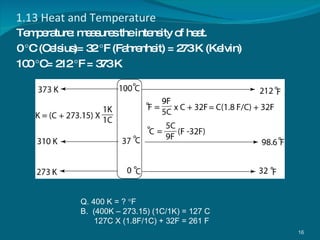
1.13 Heat and Temperature Temperature: measures the intensity of heat. 0   C (Celsius)= 32   F (Fahrenheit) = 273 K (Kelvin) 100   C= 212   F = 373 K Q. 400 K = ?   F (400K – 273.15) (1C/1K) = 127 C 127C X (1.8F/1C) + 32F = 261 F
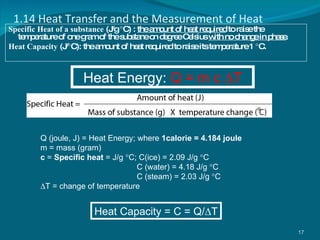
1.14 Heat Transfer and the Measurement of Heat Specific Heat of a substance  (J/g   C) :  the amount of heat required  to raise the temperature of one gram of the substane on degree Celsius  with no change in phase . Heat Capacity  (J/  C): the amount of heat required to raise its temperature 1   C. Heat Energy:  Q = m c   T Q (joule, J) = Heat Energy; where  1calorie = 4.184 joule m = mass (gram) c  =  Specific heat  = J/g   C; C(ice) = 2.09 J/g   C C (water) = 4.18 J/g   C C (steam) = 2.03 J/g   C  T = change of temperature Heat Capacity = C = Q/∆T
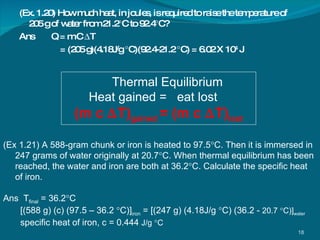
(Ex. 1.20) How much heat, in joules, is required to raise the temperature of 205 g of water from 21.2  C to 92.4  C? Ans Q = m C   T   = (205 g)(4.18J/g   C)(92.4-21.2   C) = 6.02 X 10 4  J (Ex 1.21) A 588-gram chunk or iron is heated to 97.5  C. Then it is immersed in 247 grams of water originally at 20.7  C. When thermal equilibrium has been reached, the water and iron are both at 36.2  C. Calculate the specific heat of iron. Ans  T final  = 36.2  C [(588 g) (c) (97.5 – 36.2   C)] iron  = [(247 g) (4.18J/g   C) (36.2 -  20.7   C)] water specific heat of iron, c = 0.444  J/g   C Thermal Equilibrium Heat gained =  eat lost (m c   T) gained  = (m c   T) lost

Editor's Notes