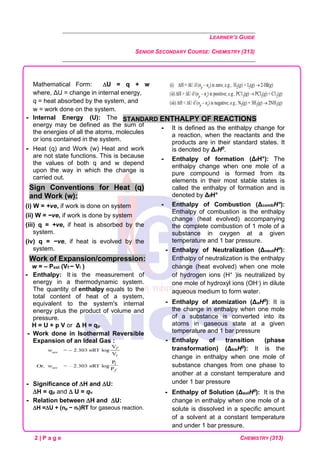
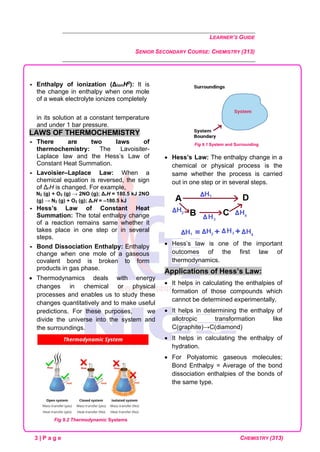
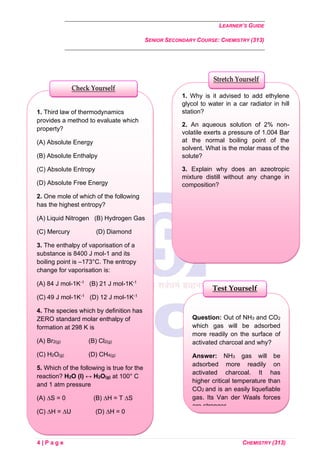
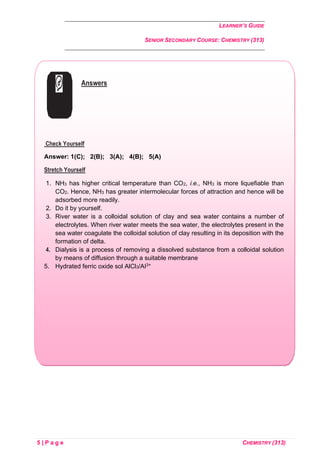
All Rights Reserved © Manish Verma, For More Visit
NIOS CLASS 1
Written by Manish Verma
Where every problem is solved of nios.
National Institute of Open Schooling (NIOS) was established in November,1989. World largest open schooling system.
https://www.nios.ac.in/
This is an official YouTube channel of Manish Verma ( Students support service
Our aim is to reach the unreached. I'm an educator of nios students and trying to guide through my youtube channel
more than 8 years ago.
This channel helps you to Dream, Achieve & Succeed.
Joined us by millions of students. We would like to appreciate
class 10th and 12th.
➛We provide all nios latest updates
➛We provide an educational services only.
➛Nios Admission
➛Public Examination
➛On Demand Examination
➛Nios Online Classes
➛Nios Practical
➛Nios TMA
➛Nios Study Materials
➛Nios Exam Updates
Subscribe our youtube channel : Manish Verma
☏ +91 8368259468, 9599279672, 8882104776
✉ Gmail – manishvermaofficial42@gmail.com
Ⓒ Manish Verma
©THE COPYRIGHT ACT 1957.
All rights reserved. No part of this publication may be reproduced,
distributed, or transmitted in any form or by any means, including
Photocopying, recording, or other electronic or mechanical methods,
without the prior written permission of the publisher, except in the case
noncommercial uses permitted by copyright law.
All Rights Reserved © Manish Verma, For More Visit – http://manishvermaoffical.com/
NIOS CLASS 12TH
Chemistry (313)
Written by Manish Verma
Short Notes
Where every problem is solved of nios.
National Institute of Open Schooling (NIOS) was established in November,1989. World largest open schooling system.
This is an official YouTube channel of Manish Verma ( Students support service )
Our aim is to reach the unreached. I'm an educator of nios students and trying to guide through my youtube channel
This channel helps you to Dream, Achieve & Succeed.
Joined us by millions of students. We would like to appreciate nios board to provide an opportunities to get pass
We provide an educational services only.
Subscribe our youtube channel : Manish Verma : NIOS
+91 8368259468, 9599279672, 8882104776
manishvermaofficial42@gmail.com
part of this publication may be reproduced,
distributed, or transmitted in any form or by any means, including
Photocopying, recording, or other electronic or mechanical methods,
without the prior written permission of the publisher, except in the case of brief quotations embodied in critical reviews and certain other
1
http://manishvermaoffical.com/ 9599279672
National Institute of Open Schooling (NIOS) was established in November,1989. World largest open schooling system.
Our aim is to reach the unreached. I'm an educator of nios students and trying to guide through my youtube channel
nios board to provide an opportunities to get pass
of brief quotations embodied in critical reviews and certain other
LEARNER’S GUIDE
SENIOR SECONDARY COURSE: CHEMISTRY (313)
1 | P a g e CHEMISTRY (313)
Scopeof Chemistry
• Chemistry is the study of matter and
the changes it undergoes and
considers both macroscopic and
microscopic information. Matter is
anything that has mass and occupies
space. The five main disciplines of
chemistry are physical chemistry,
organic chemistry, inorganic
chemistry, analytical chemistry and
biochemistry.
• Atom: It is the smallest particle of an
element that takes place in a chemical
reaction. It may or may not be capable
of free existence.
• Molecule: It is the smallest particle of
an element or a compound that is
capable of free existence.
(i) The term molecule was given by
Avogadro.
(ii) The term element was given by
Robert Boyle.
• Precision: If refers to the closeness of
various measurements for the same
quantity.
• Accuracy: It refers to the agreement of
a particular value to the true value of
the result
• Mass and weight: Mass of a
substance is the amount of matter
present in it while weight is the force
exerted by gravity on an object. The
mass of a substance is constant
whereas its weight may vary from one
place to another due to change in
gravity.
•
• Standard Temperature Pressure (STP):
0°C (273.15 K) temperature and 1
pressure.
• Normal Temperature Pressure (NTP):
20°C (293.15 K) temperature and 1 atm
pressure.
Scientific Notation
• Expressing a number in the form N × 10n,
and N can vary b/w 1 to 10.
• Mole: A mole is defined as that amount of
substance which has mass equal to gram
atomic mass if the substance is atomic or
gram molecular mass if the substance is
molecular. 1 mole of carbon atoms =12
grams.
Laws Of Chemical Combinations
• In every chemical reaction, total masses
of all the reactants are equal to the
masses of all the products. This law is
known as the law of conservation of
mass.
Dalton’s Atomic Theory
• Dalton’s Atomic Theory (1803): This
theory was based on laws of chemical
combinations. It’s basic postulates are:
• All matter is made up of tiny, indivisible
particles called atoms.
• Atoms can neither be created nor
destroyed.
• Atomic Mass: It is the average relative
atomic mass of an atom.
• Properties. However, atoms of different
element exhibit different.
• All atoms of a specific element are
identical in mass, size, and other
properties and vary in mass and size.
ATOMS, MOLECULES AND CHEMICAL ARITHMETIC’S
1
LEARNER’S GUIDE
SENIOR SECONDARY COURSE: CHEMISTRY (313)
2 | P a g e CHEMISTRY (313)
• Gram Atomic Mass (GAM): Atomic
mass of an element expressed in gram
is called its gram atomic mass or
gram-atom or mole-atom.
• Molecular Mass: It is the mass of a
molecule, i.e., number of times a
molecule is heavier than
• 1 / 12th mass of C-12 atom.
• Limiting reagent It is the reactant
which is completely consumed during
the reaction.
• Excess reagent It is the reactant
which is not completely consumed and
remains unreacted during the reaction.
• Empirical formula: is the simplest
formula of a compound giving simplest
whole number ratio of atoms
• Present in one molecule, e.g., CH is
empirical formula of benzene (C6H6).
• Molecular formula is the actual
formula of a compound showing the
total number of atoms of constituent
elements, e.g., C6H6 is molecular
formula of benzene.
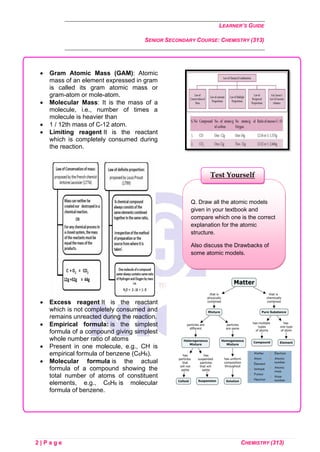
Q. Draw all the atomic models
given in your textbook and
compare which one is the correct
explanation for the atomic
structure.
Also discuss the Drawbacks of
some atomic models.
Test Yourself
LEARNER’S GUIDE
SENIOR SECONDARY COURSE: CHEMISTRY (313)
3 | P a g e CHEMISTRY (313)
1. C-O bond length is minimum in
(A) CO2 (B) CO3
2-
(C) HCOO–
(D) CO
2. Molecules are held together in a crystal
by
(A) Hydrogen bond
(B) Electrostatic attraction
(C) Van der Waal’s attraction
(D) Dipole-dipole attraction
3. Sp3
d2
hybridization is present in
[Co (NH3)6
3+
], find its geometry
(A) Octahedral geometry
(B) Square planar geometry
(C) Tetragonal geometry
(D) Tetrahedral geometry
4. Find the molecule with the maximum
dipole moment
(A) CH4 (B) NH3
(C) CO2 (D) NF3
5. MX6 is a molecule with octahedral
geometry. How many X – M – X bonds are
at 180°?
(A) Four (B) two
(C) Three (D) Six
Check Yourself
1. In SF4 molecule, the lp electrons
occupies an equatorial position in the
trigonal bipyramidal arrangement to an
axial position. Give reason.
2. Write electron dot structure (Lewis
structure) of Na, Ca, B, Br, Xe, As, Ge,
N3-
. Out of p-orbital and sp-hybrid orbital
which has greater directional character
and Why?
3. Explain the shape of BrF5.
4. Explain why PCl5 is trigonal bipyramidal
whereas IF5 is square pyramidal.
5. In both water and dimethyl ether
(CH3— Ö — CH3), oxygen atom is central
atom, and has the same hybridization, yet
they have different bond angles.
Stretch Yourself
LEARNER’S GUIDE
SENIOR SECONDARY COURSE: CHEMISTRY (313)
4 | P a g e CHEMISTRY (313)
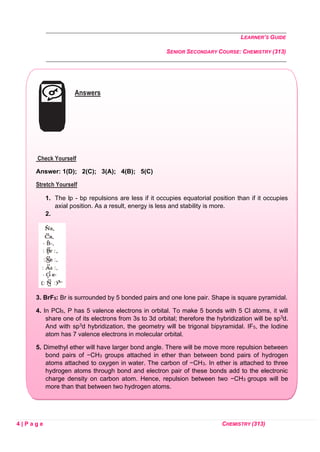
Answers
Check Yourself
Answer: 1(D); 2(C); 3(A); 4(B); 5(C)
Stretch Yourself
1. The lp - bp repulsions are less if it occupies equatorial position than if it occupies
axial position. As a result, energy is less and stability is more.
2.
3. BrF5: Br is surrounded by 5 bonded pairs and one lone pair. Shape is square pyramidal.
4. In PCl5, P has 5 valence electrons in orbital. To make 5 bonds with 5 Cl atoms, it will
share one of its electrons from 3s to 3d orbital; therefore the hybridization will be sp3d.
And with sp3d hybridization, the geometry will be trigonal bipyramidal. IF5, the Iodine
atom has 7 valence electrons in molecular orbital.
5. Dimethyl ether will have larger bond angle. There will be move more repulsion between
bond pairs of −CH3 groups attached in ether than between bond pairs of hydrogen
atoms attached to oxygen in water. The carbon of −CH3. In ether is attached to three
hydrogen atoms through bond and electron pair of these bonds add to the electronic
charge density on carbon atom. Hence, repulsion between two −CH3 groups will be
more than that between two hydrogen atoms.
NIOS/Acad./2021/313/01/E
National Institute of Open Schooling
Senior Secondary Course: Chemistry
Chapter- 1 (Atoms, Molecules and Chemical arithmetic)
Worksheet-1
1. The mass of a piece of phosphorus is 99.3 g. How many moles of phosphorus are present
in it? (The atomic mass of phosphorus is 31 amu).
2. Calculate the molar mass of each of the following in gmol-1
.
(i) Sodium Hydroxide, (NaOH)
(ii) Copper Sulphate, (CuSO4. 5H2O)
(iii) Sodium Carbonate, (Na2CO3. 10H2O)
(iv) Aluminium Sulphate, Al2(SO4)3
3. How many moles of CaCO3 will weigh 5 grams.
4. If you need 1.0x10²³
molecules of nitrogen for the reaction N2 + 3H2 → 2NH3 then:
(a) How many mass (in grm) of nitrogen is required?
(b) How many quantities of NH3 will be formed from 1.0x10²³
molecules in the
above mentioned process?
(c) What is the volume of NH3 gas at STP in (b)?
5. Write down the empirical formula for the following:
C2H6, C6H6, C4H10, H2O2, KCl
6. The empirical formula of glucose is CH2O. Whose Formula mass is 30 amu. If the
molecular mass of glucose is 150 amu then, what is the molecular formula of glucose?
7. Write down the percentage of Fe and O for F3O4 compounds.
8. A 2.4 gram compound of carbon, hydrogen and oxygen yields 3.52 grams of carbon
dioxide (CO2) and 1.44 grams of water (H2O). If the molecular mass of the compound is
found to be 60 amu then:
(a) What is the mass of carbon, hydrogen and oxygen in 2.4 g of the compound.
(b) What is the empirical and molecular formula of the compound?
9. In the following reaction:
CH4 (g)+2O2(g) → CO2(g)+2H2O(l)
(a) How much mass of oxygen will be required for the complete reaction of 24g CH4?
(b) How much mass of CH4 will be required to react 96 g of oxygen?
10. Industrially caustic soda (NaOH) can be prepared by reacting sodium carbonate
(Na2CO3) with slaked lime. How many grams of sodium hydroxide (NaOH) will be
obtained when 2.0 kg of sodium carbonate (Na2CO3)is reacted with calcium hydroxide
(Ca(OH)2).
LEARNER’S GUIDE
SENIOR SECONDARY COURSE: CHEMISTRY (313)
1 | P a g e CHEMISTRY (313)
• Atom (Given by Dalton): Matter is
made up of extremely small particles
which are indivisible in nature. It consists
of subatomic particles electron, proton
and neutrons knows as fundamental
particles.
1. Electron (Named by Stoney):
Discovered by Cathode Ray experiment
[In crook’s tubes]. A long glass tube
with two metal electrodes. At every low
pressure when high voltage is applied a
flow is produced due to flow of − ve
charge particle [known as electron],
cathode rays. Cathode rays have −ve
change, travel in straight lines has
electric and magnetic field have heating
effect more penetrating effect. Charge
on e- was found by Oil drop experiment
[Millikan].
2. Proton (Discovered by Goldstein in
anode ray experiment: In a perforated
cathode tube with gas at low pressure
high voltage was passed between
electrode rays from cathode produced
green fluorescence on ZnS all. These
were called as anode rays. They travel
in straight line, with + ve charge, get
defected in electric and magnetic field.
3. Neutron: Fundamental particle which
carries no charge but has mass equal to
N atom or Proton. Discovered by James
Chadwick.
Table 2.1 Fundamental particles of atom and their
characteristics
Atomic Number, Mass Number,
Isotopes and Isobars
• Atomic number (Z): The no. of protons or
electron in a neutral atom or No. of protons
in an atom (or ion).
• At mass no. (A): Total no. of protons and
neutron in an atom
• Isotopes: Atoms of same element with
different mass no.
• Isobars: Atoms of different element with
same mass no.
• Isotones: Atoms of different element with
same no. of neutron.
• Isoelectronic: Atoms, molecules or ions
with same no. of e-[Ne; O2-].
Earlier Models
Thomson’s Model
• J.J. Thomson: The sphere of +ve change
nucleus model of atom is 14 Chemistry
balanced by coulombic force of attraction
of e-. Like a Raisin Pudding Model
Fig. 2.1: A pictorial representation of Thomson’s plum-
pudding model
ATOMIC STRUCTURE
2
LEARNER’S GUIDE
SENIOR SECONDARY COURSE: CHEMISTRY (313)
2 | P a g e CHEMISTRY (313)
Rutherford’s Experiment
• Ruther Ford (Discovery of nucleus):
particles (+ve charge) bombarded on
gold foil.
a. 99.9% passed without deflection:
Most space inside the atom is empty.
(b) Only few deflected therefore mass
of atom centrally placed called
nucleus.
b. Very few deflected back therefore mass
of atom contains +ve charge particles
[Protons].
c. Atom is electrically neutral hence −ve
change particles placed outside the
nucleus and have very less mass.
• Limitations: No distribution and
energies of e-considered, could not
explain e- does not fall into the nucleus
or not; no details of line spectra of H
atom.
Electromagnetic Radiations
• Energy emitted from any source (in
forms of waves) in which electric and
magnetic fields oscillated perpendicular
to each other and travelling with a
velocity to light is known as EM
radiation.
Characteristic Parameters of
Electromagnetic Radiations
a. Wavelength: the distance of one crest
and one trough in a wave. Denoted by ‘’
b. Frequency:no. of waves
passing through a given point in one
second.
c. Amplitude: The height of crest or depth
of a trough denoted by ‘a’
d. Wave no.: No. of waves per unit length
denoted by
e. Velocity: Linear distance travelled by a
wave in one second.
Electromagnetic Spectrum
• Energy wise order for EM radiation.
Line Spectrum
• When the vapors of some volatile
substance are allowed to fall on the flame
of a Bunsen burner and then analyzed
with the help of a spectroscope. Some
specific-colored lines appear on the
photographic plate which is different for
different substances. For example, sodium
or its salts emit yellow light while
potassium or its salts give out violet light.
Line Spectrum of Hydrogen Atom
• Hydrogen spectrum: When e- in
hydrogen atom is provided energy it
gets excited to higher shell from ground
state, it comes back to ground state by
emitting energy in definite values.
• “Quanta”: The emission of light energy
is known as emission spectra. It
corresponds to each atom depending
upon which energy shell e-is excited. It
is discontinuousspectra as ‘’ of light
LEARNER’S GUIDE
SENIOR SECONDARY COURSE: CHEMISTRY (313)
3 | P a g e CHEMISTRY (313)
radiations do not merge with each other
like is VIBGYOR (Continuous Spectra).
When e- falls from any excited state to
a. Ist energy level nf = 1, ni= 2, 3, 4, ....
[Lyman series] (UV)
b. When e- to final state nf = 2, ni= 3, 4,
5, .... [Balmer series] (VIBGYOR)
c. When e- to falls to final state nf = 3
ni = 4, 5, 6 [Paschem series] IR.
d. When e- to falls to final state nf =4 ni
= 5, 6, 7 [Bracket series] IR.
e. When e- to falls to final state nf =5ni
= 6, 7, 8[Pfund series] IR.
Bohr’s Model
• Bohr’s theory for H [H like one e-
systems He+; Li2+]e-revolving round
the nucleus in circular path [stationery
state; [Shell]With a definite angular
momentum [n no. of shell of e-]
and with definite energy
• As n increases Z Decreases Energy of
e- becomesless -ve [Due to less,
force of Proton attraction]
• As n Decreases Z increases Energy of
e- becomes More -ve [Due to more
force of attraction by protons]
• In infinity shell e- has zero force of
attraction therefore zero energy.
• Electron energy only changes by
definite values E = Ef −Ei .
Wave – Particle Duality
• Debroglie equation: All material particles
possess both matter should also exhibit
wave like properties. Wave character as
well as wave character as well as wave
character.
• For microscopic particles mass is very less
therefore ‘’ more and more wave
character.
• For macroscopic particles mass is large 
is less therefore more particle character.
Heisenberg’s Uncertainty Principle
• It is impossible simultaneously to determine
the exact position and exact velocity of a
subatomic particle.
• For microscopic (mass very less) certainty
in position is less therefore x is more v is
less.
• For macroscopic (large mass) certainty in
position is more x is less v is more.
Wave Mechanical Model Of Atom
• Erwin Schrödinger proposed the quantum
mechanical model of the atom, which treats
electrons as matter waves. The wave
mechanical model proposed that the electrons
act like particles as well as waves of energy.
According to the fields around, the electrons
change their path and they move very fast,
LEARNER’S GUIDE
SENIOR SECONDARY COURSE: CHEMISTRY (313)
4 | P a g e CHEMISTRY (313)
hence they are not in one place during
any particular time. The wave
mechanical model was used for the
construction of an atom.
Significance of Quantum
Numbers
1. Principal Q. No. : It describes the
distance of e- from nucleus ‘n’ i.e.,
defines the shell no. It is denoted by
‘n’.
2. Azimutha Q. No. : It defines the path
of e- decided by angular momentum of
e-. Each angular momentum value
corresponds to one subshell. The no.
of subshells in a shell is 0 to n−1.
All subshells are wave functions for
locating e-In the same shell energy
wise S < P < d < f
3. Magnetic Q. No. : It gives the no. of
magnetic orientations an e- can have
in a subshell. The no. of magnetic
orientation an e- can have in a
subshell.
4. Spin Q. No. : An e- is continuously
spinning on its own axis. This Q. No.
describes e- can have clockwise spin
motion or e- can have
anticlockwise spin motion . An
orbital can have mximum two e- one
with clockwise and other with
anticlockwise spin.
Electronic Configuration of
Elements
Aufbau (or building up) Principle
a. e- are filled in increasing order of energy of
subshell.
b. As ‘n + l’ value increases energy of e-
increases in that subshell.
c. For two subshells with some ‘n + l’ value.
As ‘n’ value increases energy of e-
increases.
Pauli’s Exclusion Principle
• No two e- can have same set of 4
quantum nos. If two e- are present in
same shell, subshell, orbital they will have
different spin value.
Hund’s Rule
• The pairing of e- in degenerate orbitals
(different orbitals with same energy) will
get paired only once they have been
singly occupied. The no. of [Spherical
nodes or radical nodes] = n - l -1.
Shapes of Orbitals
Fig. 2.18: The boundary surface diagrams (shapes) of the s, p,
d-orbitals
Difference between psi and psi square:
Difference between Orbit and Orbitals:
LEARNER’S GUIDE
SENIOR SECONDARY COURSE: CHEMISTRY (313)
5 | P a g e CHEMISTRY (313)
Question: The Vividh Bharati
station of All India Radio, Delhi,
broadcasts on a frequency of 1,368
kHz (kilo hertz). Calculate the
wavelength of the electromagnetic
radiation emitted by transmitter.
Which part of the electromagnetic
spectrum does it belong to?
Answer: Wavelength =λ
Frequency = ν = 1,368 kHZ
c = speed of light =v×λ
λ=c/λ=3×108/1368×103=219
meters
It belongs the far infrared region
or radio wave region.
Test Yourself
1. How many orbital’s can have the
following set of quantum numbers,
n = 3, l = 1, m1 = 0?
(A) 3 (B) 1
(C) 4 (D) 2
2. Electronic configuration of the
outer shell of the element Gd with
atomic number 64 is
(A) 4f45d56s1 (B) 4f35d56s2
(C) 4f55d46s1 (D) 4f75d16s2
3. Maximum number of electrons in
a subshell can be
(A) 4l + 2 (B) 4l – 2
(C) 2n2 (D) 2l + 1
4. The orientation of atomic orbital’s
depends on their
(A) Spin quantum number
(B) Magnetic quantum number
(C) Azimuthal quantum number
(D) Principal quantum number
5. A gas X has Cp and CV ratio as
1.4, at NTP 11.2 L of gas X will
contain_______ number of atoms
(A) 1.2 × 10²³ (B) 3.01 × 10²³
(C) 2.01 × 10²³ (D) 6.02 × 10²³
Check Yourself
1. Calculate the mass and charge of
one mole of electrons.
2. Calculate the number of
electrons which will together
weigh one gram.
3. What is the value of the Bohr’s
radius for the first orbit of
hydrogen atom?
4. Distinguish between a photon
and a quantum
5. What type of metals is used in
photoelectric cell? Give one
example.
Stretch Yourself
LEARNER’S GUIDE
SENIOR SECONDARY COURSE: CHEMISTRY (313)
6 | P a g e CHEMISTRY (313)
Answers
Check Yourself
Answer: 1(D); 2(C); 3(A); 4(B); 5(C)
Stretch Yourself
1. Mass of one mole of electrons is 9.11×10−31×6.023×1023=5.486×10⁻⁷kg.
Charge of 1 mole of electrons is 1.602×10−19×6.023×1023=9.647×10⁴C.
2. The number of electrons which will weigh 1 g is 10−3 9.11×10−31=1.098×1027
Mass of one mole of electrons is 9.11×10−31×6.023×1023=5.486×10⁻⁷kg.
Charge of 1 mole of electrons is 1.602×10−19×6.023×1023=9.647×10⁴C.
3. Hint: We know that Neil Bohr was the first to explain the general features of hydrogen
atom structure and its spectrum. Bohr’s theory can be applied on the ions containing
only one electron similar to that of hydrogen atom like Li2+, Be3+ and He+, such
species are also called hydrogen like species.
Formula used: For hydrogen like species, the radii expression from bohr’s theory is
given as: rn=a∘(n2)Z pm
4. The smallest packet of energy of any radiation is called a quantum whereas that of light
is called photon.
5. When exposed to light, the alkali metals lose electrons. This is known as photoelectric
effect. Electrons of lithium are strongly held by nucleus as Li is smaller in size and
therefore, requires high energy to lose an electron. While on the other hand, Cs has
low ionization energy. Hence, it can easily lose electrons and cannot be utilized in
photoelectric cells.
Hence, the correct answer is 1.
NIOS/Acad./2021/313/02/E
National Institute of Open Schooling
Senior Secondary Course: Chemistry
Chapter-2 (Atomic Structure)
Worksheet-2
1. What experimental evidence shows the dual nature of light?
(a) Calculate the energy of the FM radio signal transmitted at a frequency of 100 MHz.
(b) What is the energy of the red colored wave with 670 mm wavelength?
2. How is the Bohr model superior to the Rutherford model?
3. Wavelength to green light is 335 millimeters. Calculate the energy of green photons.
4. How did the wave mechanics model of Atom develop?
5. Calculate the wavelength corresponding to the balmar line n=3.
6. If a 380 gram cricket ball is thrown at a speed of 140 kilometers per hour, calculate the de
Broglie wavelength.
7. Describe the hunds rule of maximum multiplicity with five examples.
8. Which oxidation state is more stable and why?
(a) Fe2+
or Fe3+
(b) Mn2+
or Mn3+
(c) Electronic configuration of Cr is [Ar] 3d5
, 4s1
and not 3d4
, 4s2
9. Which of the following class has the first storage and why?
(a) 2p or 3s (b) 3d or 4p (c) 4S or 3d
10. What is the significance of the azimuthal magnetic and spinning quantum numbers?
(a) Write all the four quantum numbers for, 3p3
(3rd electron), 4d5
(4th electron), 6S2
(2nd
electron).
(b) How many electrons are s=+1/2 and ml=0 for n=4
LEARNER’S GUIDE
SENIOR SECONDARY COURSE: CHEMISTRY (313)
1 | P a g e CHEMISTRY (313)
 The first classification of elements was
provided by Russian chemist D.I.
Mendeleev
 The physical and chemical properties of
elements are periodic functions of their
atomic weight.
 Modern Periodic law: The physical and
chemical properties of elements are
periodic functions of their atomic
numbers. It is the long form of periodic
table:
Periods→Horizontal rows
Group→Vertical columns
 The horizontal rows on the periodic
table are called periods. The periods are
numbered 1 through 7 on the left-hand
side of the table. Elements that are in the
same period have chemical properties
that are not all that similar.
 Period: There are total seven periods 1st
period 2 elements 2nd and 3rd period 8
elements 4th and 5th period 18 elements
6th and 7th period period 32 elements.
 The vertical columns on the periodic
table are called groups or families
because of their similar chemical
behavior. All the members of a family of
elements have the same number of
valence electrons and similar chemical
properties.
 Group: There are total eighteen Groups.
Groups 1 and 2 ‘s’ block elements last
electron entered in ‘s’ subshell [s1, s2] 3 to
12 ‘d’ block elements last electrons
entered in ‘d’ subshell [d1 to d10]. 13 to 18
‘p’ block elements last electrons enter in
‘p’ subshell [p1 to p6]. Group 18 Noble
gases.
 (A) In ‘s’ and ‘p’ block elements the
electrons enters outer most shell. In ‘d’
 block elements the electron enter the
penultimate shell (n-1). ‘f’ block elements
last electron enter the sub penultimate
shell (n-2).
 (B) ‘f’ block elements are placed in
between ‘d’ block elements. ‘f’ block
elements in 2 rows [4f lanthanides 5f
actinides]
 (C) Helium is placed ns2. But it has Noble
gas configuration.
 General electronic configuration :
 Screening effect is also known as the
shielding effect. The phenomenon which
occurs when the nucleus reduces its force
of attraction on the valence electrons due
to the presence of electrons in the inner-
shell. This is known as a screening
effect.
 Effective nuclear charge (Z*) = Nuclear
charge Shielding effect
 Trend Left to Right Z* Increases. Top to
Bottom Z* Decreases.
 Second period element Show different
behavior that I group element due to (a)
small size (b) High electron negativity (c)
High polarising power (d) absence of ‘d’
orbital in I member. Na3[Al(OH)6] exists
but Na[B(OH)4] not exists.
 A diagonal relationship is said to exist
between certain pairs
of diagonally adjacent elements in the
second and third periods of the periodic
table. Diagonal relationships occur
because of the directions in the trends of
various properties as you move across or
down the periodic table.
Periodic Table and Periodicity in Properties
3
LEARNER’S GUIDE
SENIOR SECONDARY COURSE: CHEMISTRY (313)
2 | P a g e CHEMISTRY (313)
• Elements with outer shell:
a. 1, 2, 3, e - metals
b. 4e - metalloids
c. 5, 6, 7, e - non-metals
d. 8e - noble gas
 Atomic radius: It is one-half the
distance between the nuclei of two
atoms
 Atomic radius decreases from left to
right within a period. This is caused by
the increase in the number of protons
and electrons across a period.
 Atomic radius increases from top to
bottom within a group. This is caused by
electron shielding.
 Noble gases large radius than group 17
due to complete filling of electron in
outer shell electron-electron repulsion
mildly increases.
 Ionization energy is the energy
required to remove an electron from a
neutral atom in its gaseous phase.
 The ionization energy of the elements
within a period generally increases from
left to right. This is due to valence shell
stability.
 The ionization energy of the elements
within a group generally decreases from
top to bottom. This is due to electron
shielding.
 The noble gases possess very high
ionization energies because of their full
valence shells as indicated in the graph.
Note that helium has the highest
ionization energy of all the elements.
 Metallic behavior: Decrease from left to
right due to increase in ionization
enthalpy.
 Non metallic behavior: Increase from left
to right due to more number of electrons in
outershell and added electron goes
towards nucleus.
 Ionic radius: Cation radius < Atomic
radius due to more no. of protons than
number of electron columbic force
increases size decreases. [Mg2+ < Mg+1 <
Mg]
 Anion radius > Atomic radius due to more
number of electron than number of
protons. [N3- > O2- > F-] Electron-Electron
repulsion increases, coloumbic force of
attraction decreases.
 For Isoelectronic species more is the
charge of cation lesser in the size.
 Electronegativity: It can be understood as
a chemical property describing an atom's
ability to attract and bind with electrons.
 From left to right across a period of
elements, electro negativity increases.
 From top to bottom down a group, electro
negativity decreases.
 Important exceptions of the above rules
include the noble gases, lanthanides, and
actinides.
 Electron Affinity: As the name suggests,
electron affinity is the ability of an atom to
accept an electron.
 Electron affinity increases from left to right
within a period. This is caused by the
decrease in atomic radius.
 Electron affinity decreases from top to
bottom within a group. This is caused by
the increase in atomic radius.
LEARNER’S GUIDE
SENIOR SECONDARY COURSE: CHEMISTRY (313)
3 | P a g e CHEMISTRY (313)
Q. Draw all the atomic models given
in your textbook and compare which
one is the correct explanation for the
atomic structure.
Also discuss the Drawbacks of
some atomic models.
Test Yourself
1. Both elements of 1st period contain
valence electrons in
(A) M shell (B) N shell
(C) K shell (D) S shell
2. In the periodic table, helium is
placed at
(A) Top left corner
(B) Bottom right corner
(C) Bottom left corner
(D) Top right corner
3. Across the period the atomic size
decreases due to
(A) Shielding effect
(B) Photoelectric effect
(C) Increase in nuclear force of
attraction
(D) Decrease in nuclear force of
attraction
4. The first three periods are
(A) Long periods (B) Short periods
(C) Moderate periods (D) all of above
5. On basis of electronic configuration
the group and period of 5B9 is
(A) 2 and IIIA (B) 3 and IIA
(C) 4 and VIA (D) 5 and VIIA
Check Yourself
1. What physical and chemical properties
of elements were used by Mendeleev in
creating his periodic table? List two
observations which posed a challenge to
Mendeleev’s Periodic Law.
2. Lithium, sodium and potassium form a
Dobereiner’s triad. The atomic masses of
lithium and potassium are 7 and 39
respectively. Predict the atomic mass of
sodium.
3. Give reason, why was the system of
classification of elements into triads not
found suitable?
4. (a) What is meant by periodicity in
properties of elements with reference to
the periodic table?
(b) Why do all the elements of the same
group have similar properties?
(c) How will the tendency to gain
electrons change as we go from left to
right across a period? Why?
5. What are ‘groups’ and ‘periods’ in the
‘periodic table’?
(b) Two elements M and N belong to
group I and II respectively and are in the
same period of the periodic table. How
do the following properties of M and N
vary?
Stretch Yourself
LEARNER’S GUIDE
SENIOR SECONDARY COURSE: CHEMISTRY (313)
4 | P a g e CHEMISTRY (313)
Answers
Check Yourself
Answer: 1(C); 2(D); 3(C); 4(B); 5(A)
Stretch Yourself
1. The physical property used was the atomic mass of an element. The chemical property
used was the nature of oxide and hydride formed (i.e. similarity in chemical properties
were used by Mendeleev). The two observations that posed challenge in Mendeleev
Periodic Law were:
(i) Arranging elements according to the increasing order of atomic mass could not be
maintained. Chemical properties do not depend on atomic mass.
(ii) Isotopes were not given any place in the table as they have different atomic mass but
same chemical properties.
2. Hint: Li=7, K=39 Atomic mass of Na = 7+39/2= 46/2=23
3. It is because all the elements discovered at that time could not be classified into triads.
4. (a) The repetition of same properties after definite interval is called periodicity in
properties.
(b) All elements in group have same number of valence electrons.
(c) Tendency to gain electrons increases from left to right in the period because the atomic
size goes on decreasing and nuclear charge increases, which can attract the nearby
electron.
5. The columns of the periodic table are called groups. Members of the same group in the
table have the same number of electrons in the outermost shells of their atoms and
form bonds of the same type. The horizontal rows are called periods.
NIOS/Acad./2021/313/03/E
National Institute of Open Schooling
Senior Secondary Course: Chemistry
Chapter- 3 (Periodic Table and Periodicity in Properties)
Worksheet-3
1. Refer the modern periodic table and answer the following questions.
(i) The elements placed in group number 18 are called...............
(ii) Alkali and alkaline earth metals are collectively called..............block metals.
(iii) The general configuration for halogens is...............
(iv) Name a p-block element which is a gas other than a noble gas or a hologen.
(v) Name the groups that comprise the‘s’ block of elements.
(vi) Element number 118 has not yet been established, to which block, will it belong?
(vii) How many elements should be there in total if all the 7s, 7p, 6d and 5f, blocks are tobe
full?
2. Describe the variation of electron gain enthalpy and ionization enthalpy in the periodic
table.
3. Which one have lower first ionization enthalpy and why?
i) Na or Ca ii) K or Ar iii) Na+
or Na
4. Which one have high electron gain enthalpy and why?
i) O- or O2- ii) O- or S iii) N- or P
5. Define the following:
(a) Electron gain enthalpy (b) Ionization enthalpy (c) Ionic radius (d) Electronegativity.
6. What is electronegativity? How is it related to the type of bond formed?
7. Why is the electron gain enthalpy of Cl more in negative value as compared to that of
F?
8. Define ionic radii. Arrange these ionic species in order of decreasing ionic radii.
i) Na+
, Mg2+
, K+
, Al3+
ii) N3- , O2- , F- , Br-
9. Explain Why
i) First ionization enthalpy of N is more than O.
ii) Second electron gain enthalpy of O is negative.
iii) All transition elements are d-block elements but all d-block elements are not
transition elements.
iv) N has positive electron gain enthalpy but O has negative electron gain enthalpy.
NIOS/Acad./2021/313/03/E
National Institute of Open Schooling
Senior Secondary Course: Chemistry
Chapter- 3 (Periodic Table and Periodicity in Properties)
Worksheet-3
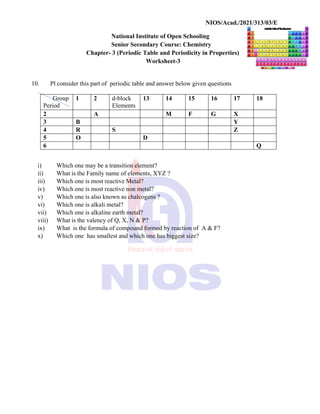
10. Pl consider this part of periodic table and answer below given questions
Group
Period
1 2 d-block
Elements
13 14 15 16 17 18
2 A M F G X
3 B Y
4 R S Z
5 O D
6 Q
i) Which one may be a transition element?
ii) What is the Family name of elements, XYZ ?
iii) Which one is most reactive Metal?
iv) Which one is most reactive non metal?
v) Which one is also known as chalcogens ?
vi) Which one is alkali metal?
vii) Which one is alkaline earth metal?
viii) What is the valency of Q, X, N & P?
ix) What is the formula of compound formed by reaction of A & F?
x) Which one has smallest and which one has biggest size?
LEARNER’S GUIDE
SENIOR SECONDARY COURSE: CHEMISTRY (313)
1 | P a g e CHEMISTRY (313)
 The interaction between two atoms which
holds them together within a molecule or
ions in known as chemical bond.
 The elements with one, two, three, four,
five, six or seven electrons is outer shell,
use these electrons to complete octet.
The electrons which take part in two or
more atoms to complete octet is known as
electrovalency.
 Lewis symbols or electron dot symbols
involve the presentation of valence
electrons (outer electrons) in an atom
 Electrovalent bond or ionic Bond: The
bond (chemical interaction) between two
atoms formed by complete transference of
electron from valence shell (outer shell) of
an atom to another to complete octet
(noble gas configuration) [2e- in H, Li] is
known as ionic bond.
 This ionic bond is favored by low
ionization enthalpy of metal high electron
gain enthalpy of non-metal atom and in
the resulting ionic compound more lattice
energy.
 Characteristics of ionic compound:
They are solids, a definite arrangement/
pattern of ion (to give crystalline solids),
high MP and BP, conductors in fused
state and in aqueous medium, soluble in
H2O [Hydration].
 Octate rule: During a chemical reaction
the atoms tend to adjust their electronic
arrangement in such a way that they
achieve 8 e- in their outermost electron.
 Chemical bond: the chemical force which
keeps the atoms in any molecule together
is called a chemical bond.
 Ionic bond: An ionic bond is formed by
the complete transfer of one or more
electrons from the atom of a metal to an
atom of non- metal.
 Lattice enthalpy: It is a measure of the
strength of the forces between the ions in an
ionic solid. The greater the lattice enthalpy,
the stronger is the forces.
 Electro valency: The number of electrons
lost or gain by an atom of an element is
called as electrovalency.
 Covalency: The number of electrons which
an atom contributes towards mutual sharing
during the formation of a chemical bond.
 Single covalent bond: A covalent bond
formed by the mutual sharing of one pair of
electrons is called a single covalent bond. It
is represented by a small line (−) between
the two atoms.
 Double covalent bond: A covalent bond
formed by the mutual sharing of two pair of
electrons is called a double covalent bond. It
is represented by two small horizontal lines
(=) between the two atoms. E.g. O=O,
O=C=O etc.
 Triple covalent bond: A covalent bond
formed by the mutual sharing of three pair of
electrons is called a triple covalent bond. It is
represented by three small horizontal lines
(≡) between the two atoms. E.g. N≡N, H-
C≡C-H etc.
 Polar covalent bond: The bond between
two unlike atoms which differ in their affinities
for electrons is said to be polar covalent
bond. E.g. H-Cl
 Coordinate bond: The bond formed
sided sharing of electrons take place is
called a coordinate bond. It is represented by
an arrow (→) pointing towards the acceptor
Chemical Bonding
4
LEARNER’S GUIDE
SENIOR SECONDARY COURSE: CHEMISTRY (313)
2 | P a g e CHEMISTRY (313)
atom. E.g. H3N→BF3
 Bond length: Bond length is defined as
the equilibrium distance between the
nuclei of two bonded atoms in a
molecule.
 Bond angle: It is defined as the angle
between the orbitals containing bonding
electron pairs around the central atom in
a molecule/complex.
 Bond enthalpy: It is defined as the
amount of energy required to break one
mole of bonds of a particular type
between two atoms in a gaseous state.
 Bond order: In the Lewis description of
covalent bond, the Bond Order is given
by the number of on between the two
atoms in a molecule.
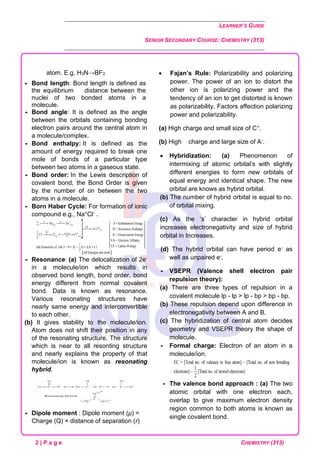
 Born Haber Cycle: For formation of ionic
compound e.g., Na+Cl- .
 Resonance: (a) The delocalization of 2e-
in a molecule/ion which results in
observed bond length, bond order, bond
energy different from normal covalent
bond. Data is known as resonance.
Various resonating structures have
nearly same energy and interconvertible
to each other.
(b) It gives stability to the molecule/ion.
Atom does not shift their position in any
of the resonating structure. The structure
which is near to all resonting structure
and nearly explains the property of that
molecule/ion is known as resonating
hybrid.
 Dipole moment : Dipole moment (μ) =
Charge (Q) × distance of separation (r)
• Fajan’s Rule: Polarizability and polarizing
power. The power of an ion to distort the
other ion is polarizing power and the
tendency of an ion to get distorted is known
as polarizability. Factors affection polarizing
power and polarizability.
(a) High charge and small size of C+.
(b) High charge and large size of A-.
• Hybridization: (a) Phenomenon of
intermixing of atomic orbital’s with slightly
different energies to form new orbitals of
equal energy and identical shape. The new
orbital are knows as hybrid orbital.
(b) The number of hybrid orbital is equal to no.
of orbital mixing.
(c) As the ‘s’ character in hybrid orbital
increases electronegativity and size of hybrid
orbital in Increases.
(d) The hybrid orbital can have period e- as
well as unpaired e-.
 VSEPR (Valence shell electron pair
repulsion theory):
(a) There are three types of repulsion in a
covalent molecule lp - lp > lp - bp > bp - bp.
(b) These repulsion depend upon difference in
electronegativity between A and B.
(c) The hybridization of central atom decides
geometry and VSEPR theory the shape of
molecule.
 Formal charge: Electron of an atom in a
molecule/ion.
 The valence bond approach : (a) The two
atomic orbital with one electron each,
overlap to give maximum electron density
region common to both atoms is known as
single covalent bond.
LEARNER’S GUIDE
SENIOR SECONDARY COURSE: CHEMISTRY (313)
3 | P a g e CHEMISTRY (313)
(b) The strength of covalent bond is
proportional to extent of overlapping
between the atomic orbitals of valence
shell.
• Sigma and Pi  bond: (a) The bond
formed by overlap of two atomic
orbitals along the internuclear axis of
two atoms is Sigma bonds.
Summary of the chapter
Fig.4.1: Formation of Sigma and Pi  bond
• Dipole moment: (a) For polar covalent
molecules (atoms with difference in
electronegativity] the product of charge
separation and distance b/w charges is
known as dipole moment.
(b) Being vector, if net resultant of all
vectors is zero the molecule has zero
DM and known as non polar otherwise.
• Hydrogen bonding: The dipole
interaction b/w molecules when H is
bounded wih highly electronegtive
atoms (F, O, N only).
(a) Intermolecular HB: When hydrogen
bonding is in between the same
molecule. Hence molecules are
independent and with less MP, BP. Due
to within hydrogen bonding notable to
make hydrogen bonding with H2O therefore
less soluble in water.
(b) Intermolecular hydrogen bonding: When
hydrogen bonding in between the different
molecules therefore close packing of
molecules therefore more MP and BP and
more soluble in water.
• Molecular orbital theory : (a) The overlap
of atomic orbitals of same symmetry of two
homonuclear atoms to give addition or
subtraction of wave functions and form
bonding MO and antibonding MO
respectively is known as MO theory.
(b) The e- is filled in molecule increasing energy
order of MO.
(c) Bond order: Bond order of molecule/ion.
(d) More is bond order more is bond energy
lesser is the bond length. Bond order zero
means no. possibility of that molecule. (e)
Increasing order of energy of MO for upto
14e-.
(e) This theory decides the magnetic behaviour
also. [Equal energy orbitals]
• Coordinate covalent bond: The sigma
bond formed by donation of lp into vacant by
drized orbital of other atom (acception atom)
is known as coordinte covalent bond or
donor acceptor or daive bond.
LEARNER’S GUIDE
SENIOR SECONDARY COURSE: CHEMISTRY (313)
4 | P a g e CHEMISTRY (313)
• Hybridisation (or hybridization) is a
proces of mathematically combining two
or more atomic orbitals from the same
atom to form an entirely new orbital
different from its components and hence
being called as a hybrid orbital.
• Valence shell electron pair
repulsion theory, or VSEPR theory),
is a model used in chemistry to predict
the geometry of individual molecules
from the of electron pairs surrounding
their central atoms.
• Molecular orbital theory (MO
theory or MOT): It is a method for
describing the electronic structure of
molecules using quantum mechanics. It
was proposed early in the 20th century.
Molecular orbital theory and valence
bond theory are the
foundational theories of quantum
chemistry.
• The Born-Haber cycle: It is a classic
approach to measure the reaction
energies. The cycle is mostly concerned
with the formation of an ionic solid from
the metals (Group I or Group II) when
reacted with a halogen or a non-metallic
element like oxygen.
• Valence bond theory: It is
a theory which describes chemical
bonding. VBT states that the overlap of
incompletely filled atomic orbitals
leads to the formation of a chemical bond
between two atoms. The unpaired
electrons are shared and a hybrid orbital
is forsmed.
• Bond order = [(Bonding molecules'
number of electrons) – (Antibonding
molecules' number of electrons)]/2.
I.e. Bond Order = ½ [Nb – Na] Where, Nb
is that the number of bonding electrons.
• Lewis Structure: Itis a very simplified
representation of the valence shell
electrons in a molecule. It is used to show
how the electrons are arranged around
individual atoms in a molecule. Electrons
are shown as "dots" or for bonding
electrons as a line between the two atoms
LEARNER’S GUIDE
SENIOR SECONDARY COURSE: CHEMISTRY (313)
5 | P a g e CHEMISTRY (313)
Q. Draw all the atomic models given
in your textbook and compare which
one is the correct explanation for the
atomic structure.
Also discuss the Drawbacks of
some atomic models.
Test Yourself
1. C-O bond length is minimum in
(A) CO2 (B) CO3
2-
(C) HCOO– (D) CO
2. Molecules are held together in a
crystal by
(A) Hydrogen bond
(B) Electrostatic attraction
(C) Van der Waal’s attraction
(D) Dipole-dipole attraction
3. Sp3d2 hybridization is present in
[Co (NH3)6
3+], find its geometry
(A) Octahedral geometry
(B) Square planar geometry
(C) Tetragonal geometry
(D) Tetrahedral geometry
4. Find the molecule with the
maximum dipole moment
(A) CH4 (B) NH3 (C) CO2 (D) NF3
5. MX6 is a molecule with octahedral
geometry. How many X – M – X bonds
are at 180°?
(A) Four (B) Two
(C) Three (D) Six
Check Yourself
1. Explain the non linear shape of H2S
and non planar shape of PCl3 using
valence shell electron pair repulsion
theory.
2. Using molecular orbital theory,
compare the bond energy and
magnetic character of O2+ and O2–
species.
3. Explain the shape of BrF5.
4. Explain why PCl5 is trigonal
bipyramidal whereas IF5 is square
pyramidal.
5. In both water and dimethyl ether
(CH3— Ö — CH3), oxygen atom is
central atom, and has the same
hybridization, yet they have different
bond angles.
Which one has greater bond angle?
Give reason.
Stretch Yourself
LEARNER’S GUIDE
SENIOR SECONDARY COURSE: CHEMISTRY (313)
6 | P a g e CHEMISTRY (313)
Answers
Check Yourself
Answer: 1(D); 2(C); 3(A); 4(B); 5(C)
Stretch Yourself
1. In both H2S and PCl3, lone pairs are present along with bond pairs around the central
atom. According to VSEPR, theory L.P-L.P > L.P-B.P > B.P.-B.P. Therefore, shapes
are different.
2. In O2
+, B.O = (10−5)/2=2.5 In O2
−, B.O = (10−7)/2=1.5 Bond dissociation energy is
directly proportional to bond order and paramagnetic character depends on unpaired
electrons. O2
+ has high dissociation energy and both are paramagnetic.
3. BrF5: Br is surrounded by 5 bonded pairs and one lone pair. Shape is square pyramidal.
4. In PCl5, P is surrounded by 5 bond pairs and no lone pairs, whereas in IF5, iodine atom
is surrounded by 5 bond pairs and one lone pair, therefore the shape is different.
5. Dimethyl ether will have larger bond angle. There will be move more repulsion between
bond pairs of −CH3 groups attached in ether than between bond pairs of hydorgen
atoms attached to oxygen in water. The carbon of −CH3 in ether is attached to three
hydrogen atoms through bond and electron pair of these bonds add to the electronic
charge density on carbon atom. Hence, repulsion between two −CH3 groups will be
more than that between two hydrogen atoms.
NIOS/Acad./2021/313/04/E
National Institute of Open Schooling
Senior Secondary Course: Chemistry
Chapter 4 : Chemical Bonding
Worksheet-4
1. Refer the modern periodic table and answer the following questions.
(i) The elements placed in group number 18 are called...............
(ii) Alkali and alkaline earth metals are collectively called..............block metals.
(iii) The general configuration for halogens is...............
(iv) Name a p-block element which is a gas other than a noble gas or a hologen.
(v) Name the groups that comprise the‘s’ block of elements.
(vi) Element number 118 has not yet been established, to which block, will it belong?
(vii) How many elements should be there in total if all the 7s, 7p, 6d and 5f, blocks are tobe
full?
2. Describe the variation of electron gain enthalpy and ionization enthalpy in the periodic
table.
3. Which one have lower first ionization enthalpy and why?
i) Na or Ca ii) K or Ar iii) Na+
or Na
4. Which one have high electron gain enthalpy and why?
i) O- or O2- ii) O- or S iii) N- or P
5. Define the following:
(a) Electron gain enthalpy (b) Ionization enthalpy (c) Ionic radius
(d) Electronegativity.
6. What is electronegativity? How is it related to the type of bond formed?
7. Why is the electron gain enthalpy of Cl more in negative value as compared to that of
F?
8. Define ionic radii. Arrange these ionic species in order of decreasing ionic radii.
i) Na+
, Mg2+
, K+
, Al3+
ii) N3- , O2- , F- , Br-
9. Explain Why
i) First ionization enthalpy of N is more than O.
ii) Second electron gain enthalpy of O is negative.
iii) All transition elements are d-block elements but all d-block elements are nottransition
elements.
iv) N has positive electron gain enthalpy but O has negative electron gain enthalpy.
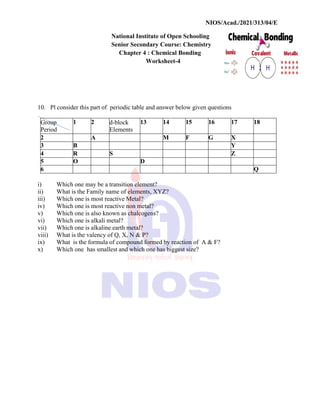
NIOS/Acad./2021/313/04/E
National Institute of Open Schooling
Senior Secondary Course: Chemistry
Chapter 4 : Chemical Bonding
Worksheet-4
10. Pl consider this part of periodic table and answer below given questions
Group
Period
1 2 d-block
Elements
13 14 15 16 17 18
2 A M F G X
3 B Y
4 R S Z
5 O D
6 Q
i) Which one may be a transition element?
ii) What is the Family name of elements, XYZ?
iii) Which one is most reactive Metal?
iv) Which one is most reactive non metal?
v) Which one is also known as chalcogens?
vi) Which one is alkali metal?
vii) Which one is alkaline earth metal?
viii) What is the valency of Q, X, N & P?
ix) What is the formula of compound formed by reaction of A & F?
x) Which one has smallest and which one has biggest size?
LEARNER’S GUIDE
SENIOR SECONDARY COURSE: CHEMISTRY (313)
1 | P a g e CHEMISTRY (313)
• Five states of matter are known, viz,
solid, liquid, gas, plasma and Bose-
Einstein condensate. Out of these solid,
liquid and gas are commonly found while
remaining two are found only under
specific conditions.
 Solid matter: It is composed of tightly
packed particles.
 Liquid matter: It is made of more loosely
packed particles.
 Gaseous matter: It is composed of
particles packed so loosely that it has
neither a defined shape nor a defined
volume.
 Plasma: It is a state of matter similar to
gas in which a certain portion of the
gaseous particles are ionized.
 Bose-Einstein Condensate: A Bose-
Einstein condensate is a gaseous super
fluid phase formed by atoms cooled to
temperature very near to absolute zero.
 Intermolecular forces are the forces of
attraction or repulsion between interacting
particles(atoms and molecules).Attractive
/repulsive, intermolecular forces are
known as van der Waal’s forces. Different
types of van der Waal’s forces are:
 Dispersion forces or London forces:
The interaction which is present between
two non polar molecules i.e., between
induced dipole and induces dipole is
called dispersion forces, for example:
noble gases.
 Dipole-dipole forces: The interaction
which is present between molecules
having permanent dipoles i.e., between
polar molecules, for example NH3, HCl
etc.
 Dipole-induced dipole forces: The
interaction which is present between a
polar and non polar molecule.

 STP (Standard Temperature and Pressure):
STP means 273.15 K (0°C) temperature and 1
bar (i.e., exactly 105 Pascal.) Volume occupied
by 1 mole gas at STP = 22.7 L.
 Compressibility factor: The extent of
deviation of a real gas from an ideal behavior is
expressed in terms of compressibility factor.
• Molar gas volume: The volume of one
mole of a gas, i.e., 224 Lat STP (0°C, 1
atm) is known as molar gas volume.
• Ideal gas: The gas which obeys the
equation
pV = nRT at every temperature and
pressure range strictly Is known as Ideal
gas.
• Real gases: Since none of the gases
present in universe strictly obey the
equation pV =nRT. Hence they are known
as real or non-ideal gases. Real gases
behave, ideally at low p and high T.
• Critical temperature (TC): It may be
defined as the temperature above which no
gas can be liquefied. Critical temperature of
CO2 is 31.1°C. TC = 8a / 27Rb
• Critical pressure (Pc): At critical
temperature, the pressure needed to liquefy
a gas is known as critical pressure. Pc = a /
27 b2
• Critical volume (Vc): The volume occupied
by one mole of a gas at critical temperature
and critical pressure is known as critical
volume. Vc = 3b
• Boyle’s temperature (Tb): Temperature at
which a real gas exhibits ideal behavior for
considerable range of pressure is called
Boyle’s temperature. Tb = a / bR
• Surface tension: It is the force acting
perunit length perpendicular to the
imaginary line drawn on the surface of
The Gaseous State and Liquid State
5
LEARNER’S GUIDE
SENIOR SECONDARY COURSE: CHEMISTRY (313)
2 | P a g e CHEMISTRY (313)
liquid. It is denoted γ (gamma); SI unit:
Nm-1 Dimensions: kgs-2
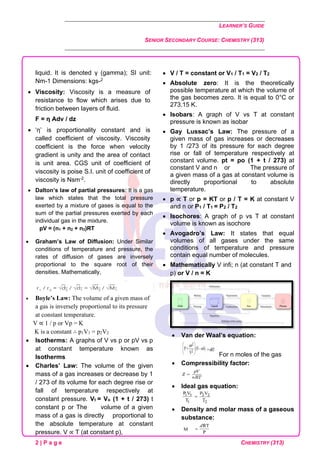
• Viscosity: Viscosity is a measure of
resistance to flow which arises due to
friction between layers of fluid.
F = η Adv / dz
• ‘η’ is proportionality constant and is
called coefficient of viscosity. Viscosity
coefficient is the force when velocity
gradient is unity and the area of contact
is unit area. CGS unit of coefficient of
viscosity is poise S.I. unit of coefficient of
viscosity is Nsm-2.
• Dalton’s law of partial pressures: It is a gas
law which states that the total pressure
exerted by a mixture of gases is equal to the
sum of the partial pressures exerted by each
individual gas in the mixture.
pV = (n1 + n2 + n3)RT
• Graham’s Law of Diffusion: Under Similar
conditions of temperature and pressure, the
rates of diffusion of gases are inversely
proportional to the square root of their
densities. Mathematically,
• Boyle’s Law: The volume of a given mass of
a gas is inversely proportional to its pressure
at constant temperature.
V ∝ 1 / p or Vp = K
K is a constant ∴ p1V1 = p2V2
• Isotherms: A graphs of V vs p or pV vs p
at constant temperature known as
Isotherms
• Charles’ Law: The volume of the given
mass of a gas increases or decrease by 1
/ 273 of its volume for each degree rise or
fall of temperature respectively at
constant pressure. Vt = Vo (1 + t / 273) t
constant p or The volume of a given
mass of a gas is directly proportional to
the absolute temperature at constant
pressure. V ∝ T (at constant p),
• V / T = constant or V1 / T1 = V2 / T2
• Absolute zero: It is the theoretically
possible temperature at which the volume of
the gas becomes zero. It is equal to 0°C or
273.15 K.
• Isobars: A graph of V vs T at constant
pressure is known as isobar
• Gay Lussac’s Law: The pressure of a
given mass of gas increases or decreases
by 1 /273 of its pressure for each degree
rise or fall of temperature respectively at
constant volume. pt = po (1 + t / 273) at
constant V and n or Guide The pressure of
a given mass of a gas at constant volume is
directly proportional to absolute
temperature.
• p ∝ T or p = KT or p / T = K at constant V
and n or P1 / T1 = P2 / T2
• Isochores: A graph of p vs T at constant
volume is known as isochore
• Avogadro’s Law: It states that equal
volumes of all gases under the same
conditions of temperature and pressure
contain equal number of molecules.
• Mathematically V infi; n (at constant T and
p) or V / n = K
• Van der Waal’s equation:
For n moles of the gas
• Compressibility factor:
• Ideal gas equation:
• Density and molar mass of a gaseous
substance:
LEARNER’S GUIDE
SENIOR SECONDARY COURSE: CHEMISTRY (313)
3 | P a g e CHEMISTRY (313)
Question: A balloon is filled with
hydrogen at room temperature. It
will burst if pressure exceeds 0.3
bar. If at 1 bar pressure the gas
occupies 3.27 L volume, upto what
volume can the balloon be
expanded?
Answer: According to Boyle’s Law
p1V1 = p2V2 If p1 is 1 bar, V1 will be
3.27 L If p2 = 0.3 bar, then V2=
p1V1/p2 or V2= 1bar×3.27L/0.3bar ⇒
= V2 =10.9 L Since balloon bursts at
0.2 bar pressure, the volume of
balloon should be less than 10.9 L.
Test Yourself
1. What are the conditions for gas like
Carbon monoxide to obey the ideal
gas laws?
(A) Low temperature and low pressure
(B) Low temperature and high
pressure
(C) High temperature and low
pressure
(D) High temperature and high
pressure
2. If the temperature is doubled, the
average velocity of a gaseous
molecule increases by
(A) 4 (B) 1.4 (C) 2 (D) 2.8
3. At the same temperature, the
average molar kinetic energy of N2
and CO is
(A) KE1 > KE2 (B) KE1 < KE2
(C) KE1 = KE2
(D) Insufficient information given
4. Find the temperature at which the
rate of effusion of N2 is 1.625 times to
that of SO2 at 500℃
(A) 620℃ (B) 173℃
(C) 110℃ (D) 373℃
5. Find the fraction of the total
pressure exerted by hydrogen if it is
mixed with ethane in an empty
container at 25℃
(A) 15/16 (B) 1/16 (C) 1/2 (D) 1
Check Yourself
1. Define the terms:
(i) Standard boiling point.
(ii) Vapor pressure of a liquid.
2. Drops of liquid are spherical in
nature. Explain. Mention the effect of
temperature on surface tension.
3. Write the S.I. units of:
(i) Surface tension.
(ii) Coefficient of viscosity.
4. 300 ml of oxygen gas at ñ 10°C are
heated to 10°C. Find the volume of
gas at 10°C if pressure remains
constant. [Ans. 322.8 mL]
5. A gas at a pressure of 5 atm is
heated from 0° to 546°C nd is
simultaneously compressed to one
third of its originl volume. Find the final
pressure f the gas.
Stretch Yourself
LEARNER’S GUIDE
SENIOR SECONDARY COURSE: CHEMISTRY (313)
4 | P a g e CHEMISTRY (313)
Answers
Check Yourself
Answer: 1(C); 2(B); 3(C); 4(A); 5(A)
Stretch Yourself
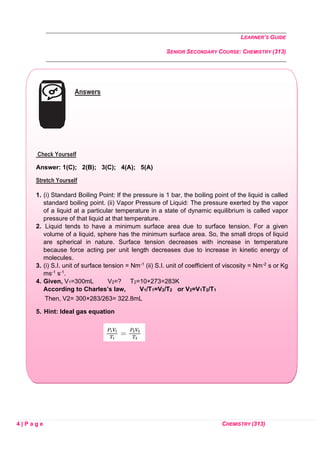
1. (i) Standard Boiling Point: If the pressure is 1 bar, the boiling point of the liquid is called
standard boiling point. (ii) Vapor Pressure of Liquid: The pressure exerted by the vapor
of a liquid at a particular temperature in a state of dynamic equilibrium is called vapor
pressure of that liquid at that temperature.
2. Liquid tends to have a minimum surface area due to surface tension. For a given
volume of a liquid, sphere has the minimum surface area. So, the small drops of liquid
are spherical in nature. Surface tension decreases with increase in temperature
because force acting per unit length decreases due to increase in kinetic energy of
molecules.
3. (i) S.I. unit of surface tension = Nm-1 (ii) S.I. unit of coefficient of viscosity = Nm-2 s or Kg
ms-1 s-1.
4. Given, V1=300mL V2=? T2=10+273=283K
According to Charles’s law, V1/T1=V2/T2 or V2=V1T2/T1
Then, V2= 300×283/263= 322.8mL
5. Hint: Ideal gas equation
NIOS/Acad./2021/313/05/E
National Institute of Open Schooling
Senior Secondary Course : Chemistry
Chapter 5 : The Gaseous State and Liquid State
Worksheet-5
1. In different cities atmospheric pressure are as follows:-
Cities Shimla Banglore Delhi Mumbai
P in N/m2
1.01 X 10⁶
1.2 X 10⁵
1.02 X 10⁵
1.21 X 10⁶
Consider the above data and mark the place at which liquid will boil first and why?
2. Can we apply Dalton’s law of partial pressure to a mixture of Carbon Monoxide and
Oxygen?
3. Which is heavier, dry air or wet air and why?
4. What would have happened to the molecular motion in a gas if the molecular collisions
were not elastic?
5. Gases like CO2 and CH4 shall more deviation from the ideal gas behavior as compared to
gases like H2 and He. Explain.
6. The level of mercury in a Capillary tube is lower than the level outside when the
Capillary is inserted in mercury. Explain.
7. Give reasons why liquids like ether and acetone are kept in cool places.
8. Explain the type of intermolecular forces exist among the following molecules? (i) H2S
molecules (ii) H2O molecules, (iii) Cl2 and CCL4 molecules, (iv) SiH4 molecules (v) He
atoms and Hcl molecules.
9. How do you convert (a) Pressure in atmospheres into S7 units? (b) Temperature in C to
temperature in F?
10. At a certain altitude, the density of air is 1/10th
of the density of the earth’s atmosphere
and temperature is -10C. What is the pressure at the altitude?. Assume that air behaves
like an ideal gas, like uniform composition and is at S.T.R at the earth’s surface.
LEARNER’S GUIDE
SENIOR SECONDARY COURSE: CHEMISTRY (313)
1 | P a g e CHEMISTRY (313)
 Solids: Solids are the chemical substances
which are characterized by define shape and
volume, rigidity, high density, low
compressibility. The constituent particles
(atoms, molecules or ions) are closely packed
and held together by strong interparticle forces.
 Types of Solids: The solids are of two types:
Crystalline solids and amorphous solids.
 Crystalline solids: consist of atoms, ions and
molecules arranged in definite and repeating
three-dimensional patterns in a highly ordered
microscopic structure, forming a crystal lattice
that extends in all directions. Ex. salt (sodium
chloride), diamond, and sodium nitrate.
 Amorphous solid, any noncrystalline solid in
which the atoms and molecules are not
organized in a definite lattice pattern.
Such solids include glass, plastic, and gel.
 Structure Determination by X-ray Diffraction
(Bragg’s Equation): The law states that when
the x-ray is incident onto a crystal surface,
its angle of incidence, θ, will reflect back with a
same angle of scattering, θ. And, when the
path difference, d is equal to a whole number,
n, of wavelength, a constructive interference
will occur.
 Unit Cell: The smallest geometrical portion of
the crystal lattice which can be used as
repetitive unit to build up the whole crystal is
called unit cell.
 Types of unit cell:
 Seven Crystal Systems: There are about 230
crystal forms, which have been grouped into 14
types of space lattices, called Bravais Lattices,
on the basis of their symmetry and seven
different crystal systems on the basis of
interfacial angles and axes.
They are cubic, tetragonal, hexagonal (trigonal),
orthorhombic, monoclinic, and triclinic.
 Packing Fraction: It is defined as the ratio of
the volume of the unit cell that is occupied by
the spheres to the volume of the unit cell.
 Packing fraction (P.F), is calculated by
volume occupied by the number of spheres in
the unit cell divided by volume of a unit cell.
 Coordination Number: It is defined as the
number of particles immediately adjacent to
each particle in the crystal lattice. [In simple
cubic lattice, CN is 6, in body centered lattice,
CN is 8 and in face centered cubic lattice, CN is
12]. High pressure increases CN and high
temperature decreases the CN.
 Close Packing in Crystals: Two Dimensional
Packing of Constituent Particles.
 (i) Square close packing Space occupied by
spheres is 52.4%.
 (ii) Hexagonal close packing Space occupied
by spheres is 60.4%.Hence. It is more efficient.
 Three Dimensional Packing of Constituent
Particles:
(i) ABAB arrangement gives hexagonal close
packing (hcp).
(ii) ABCABC arrangement gives cubic close
packing or face centred CUbIC packing (ccp
or fcc).
 In both these arrangements 740/0 space is
occupied
 Coordination number in hop and ccp
arrangement is 12 while in bcc arrangement, it
is 8.
 Close packing of atoms in cubic structure = fcc>
bcc > sc. All noble gases have ccp structure
except He (hcp structure).
The Gaseous State and Liquid State
6
LEARNER’S GUIDE
SENIOR SECONDARY COURSE: CHEMISTRY (313)
2 | P a g e CHEMISTRY (313)
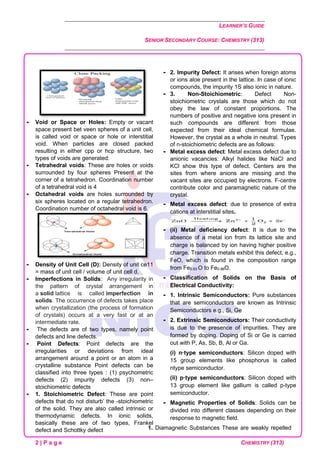
 Void or Space or Holes: Empty or vacant
space present bet veen spheres of a unit cell,
is called void or space or hole or interstitial
void. When particles are closed packed
resulting in either cpp or hcp structure, two
types of voids are generated:
 Tetrahedral voids: These are holes or voids
surrounded by four spheres Present at the
corner of a tetrahedron. Coordination number
of a tetrahedral void is 4
 Octahedral voids are holes surrounded by
six spheres located on a regular tetrahedron.
Coordination number of octahedral void is 6.
 Density of Unit Cell (D): Density of unit ce11
= mass of unit cell / volume of unit cell d.
 Imperfections in Solids: Any irregularity in
the pattern of crystal arrangement in
a solid lattice is called imperfection in
solids. The occurrence of defects takes place
when crystallization (the process of formation
of crystals) occurs at a very fast or at an
intermediate rate.
 The defects are of two types, namely point
defects and line defects.
 Point Defects: Point defects are the
irregularities or deviations from ideal
arrangement around a point or an atom in a
crystalline substance Point defects can be
classified into three types : (1) psychometric
defects (2) impurity defects (3) non–
stoichiometric defects
 1. Stoichiometric Defect: These are point
defects that do not disturb’ the -stoichiometric
of the solid. They are also called intrinsic or
thermodynamic defects. In ionic solids,
basically these are of two types, Frankel
defect and Schottky defect
 2. Impurity Defect: It arises when foreign atoms
or ions aloe present in the lattice. In case of ionic
compounds, the impurity 1S also ionic in nature.
 3. Non-Stoichiometric: Defect Non-
stoichiometric crystals are those which do not
obey the law of constant proportions. The
numbers of positive and negative ions present in
such compounds are different from those
expected from their ideal chemical formulae.
However, the crystal as a whole in neutral. Types
of n-stoichiometric defects are as follows:
 Metal excess defect: Metal excess defect due to
anionic vacancies: Alkyl halides like NaCl and
KCl show this type of defect. Centers are the
sites from where anions are missing and the
vacant sites are occupied by electrons. F-centre
contribute color and paramagnetic nature of the
crystal.
 Metal excess defect: due to presence of extra
cations at interstitial sites.
 (ii) Metal deficiency defect: It is due to the
absence of a metal ion from its lattice site and
charge is balanced by ion having higher positive
charge. Transition metals exhibit this defect, e.g.,
FeO, which is found in the composition range
from Fe0.93 O to Fe0.96O.
 Classification of Solids on the Basis of
Electrical Conductivity:
 1. Intrinsic Semiconductors: Pure substances
that are semiconductors are known as Intrinsic
Semiconductors e.g., Si, Ge
 2. Extrinsic Semiconductors: Their conductivity
is due to the presence of impurities. They are
formed by doping. Doping of Si or Ge is carried
out with P, As, Sb, B, Al or Ga.
(i) n·type semiconductors: Silicon doped with
15 group elements like phosphorus is called
ntype semiconductor.
(ii) p·type semiconductors: Silicon doped with
13 group element like gallium is called p-type
semiconductor.
 Magnetic Properties of Solids: Solids can be
divided into different classes depending on their
response to magnetic field.
1. Diamagnetic Substances These are weakly repelled
LEARNER’S GUIDE
SENIOR SECONDARY COURSE: CHEMISTRY (313)
3 | P a g e CHEMISTRY (313)
by the magnetic field and do not have any
unpaired electron, e.g., TiO2, V2O5 etc.
2. Paramagnetic Substances: These are
attracted by the magnetic field and have
unpaired electrons These lose magnetism in
the absence of magnetic field, e.g., O2,
Cu2+, Fe3+, etc.
3. Ferromagnetic Substances: These are
attracted by the magnetic field and show
permanent magnetism even ill the absence
of magnetic field e.g., Fe, Co and Ni.
4. Anti-ferromagnetic: Substances These
substances have net magnetic moment zero
due to compensatory alignment of magnetic
moments, e.g., MnO, MnO2, FeO, etc.
5. Ferromagnetic Substances: These
substances have a net dipole moment due to
unequal parallel and anti-parallel alignment
of magnetic moments, e.g., Fe3O4, ferrites,
etc.
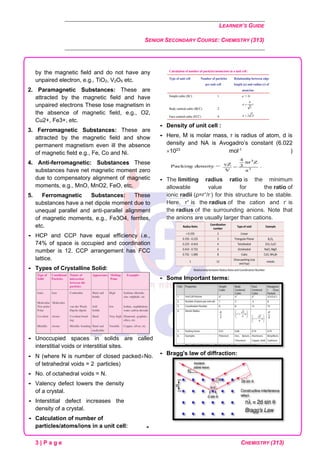
 HCP and CCP have equal efficiency i.e.,
74% of space is occupied and coordination
number is 12. CCP arrangement has FCC
lattice.
 Types of Crystalline Solid:
 Unoccupied spaces in solids are called
interstitial voids or interstitial sites.
 N (where N is number of closed packedNo.
of tetrahedral voids = 2 particles)
 No. of octahedral voids = N.
 Valency defect lowers the density
of a crystal.
 Interstitial defect increases the
density of a crystal.
 Calculation of number of
particles/atoms/ions in a unit cell:
 Density of unit cell :
 Here, M is molar mass, r is radius of atom, d is
density and NA is Avogadro’s constant (6.022
1023
mol-1
)
 The limiting radius ratio is the minimum
allowable value for the ratio of
ionic radii (ρ=r+
/r-
) for this structure to be stable.
Here, r+
is the radius of the cation and r-
is
the radius of the surrounding anions. Note that
the anions are usually larger than cations.
 Some Important terms:
 Bragg's law of diffraction:

LEARNER’S GUIDE
SENIOR SECONDARY COURSE: CHEMISTRY (313)
4 | P a g e CHEMISTRY (313)
Question: Classify the following as
amorphous or crystalline solids:
Polyurethane, naphthalene, benzoic
acid, Teflon, potassium nitrate,
cellophane, polyvinyl chloride,
fiberglass, copper
Answer: Crystalline solids: Benzoic
acid, potassium nitrate, copper
amorphous solids: Polyurethane,
Teflon, cellophane, polyvinyl
chloride, fiberglass
Test Yourself
1. The coordination number of atoms in a
cubic closed-packed is ________.
(A) 2 (B) 8 (C) 12 (D) 6
2. The type defect observed in ionic crystals
which large difference in the size of ions
is:
(A) Interstitial defect
(B) Frenkel defect
(C) Scotty Defect
(D) Stoichiometric Defect
3. A mixed oxide has ccp arrangement in
which the cations 'X' occupy 1/3rd of
octahedral voids and the cations 'Y'
occupy 1/3rd of tetrahedral voids. The
formula of oxide is:
(A) X2Y3O2 (B) XY3O
(C) X2YO3 (D) XY2O3
4. An element with molar mass 64 gmol -1
and density 6.6 g cm -3
forms a cubic unit
cell. The edge length of unit cell is 4 x 10⁻⁸
cm. The type of cubic unit cell formed is?
(A) fcc (B) ccp (C) bcc (D) hcp
5. A solid is made up of 2 elements P and
Q. Atoms Q are in ccp arrangement,
while P atoms occupy all the tetrahedral
sites. The formula of the compound is:
(A) PQ2 (B) P6Q4
(C) P2Q (D) PQ
Check Yourself
1. The density of lead is 11.35 g cm-3
and
the metal crystallizes with fee unit cell.
Estimate the radius of lead atom. (At
Mass of lead = 207g mol-1 and NA = 6.02
X 1023mol-1
2. Aluminum crystallizes in a cubic close-
packed structure. Radius of the atom in
the metal is 125 pm.
(i) What is the length of the side of the
unit cell?
(ii) How many unit cells are there in 1 cm3
of aluminium?
3. Name the type of crystal defect which is
produced when NaCl crystal is doped with
MgCl.
4. How are the following properties of
crystals affected by Schottky and Frenkel
defects?
(i) Density (ii) Electrical conductivity
5. Write a feature which will distinguish a
metallic solid from an ionic solid.
Stretch Yourself
LEARNER’S GUIDE
SENIOR SECONDARY COURSE: CHEMISTRY (313)
5 | P a g e CHEMISTRY (313)
Answers
Check Yourself
Answer: 1(C); 2(B); 3(D); 4(A); 5(C)
Stretch Yourself
1. Hint:
2. For the cubic close–packed structure Let a is the edge of the cube and r is the radius of
atom Given that r = 125 pm, a = 2√2 r Plug the value of r we get
= 2 x 1.414 x125 pm= 354 pm (approximately)
Volume of one unit cell = side3 = (354 pm)3
1 pm = 10–10 cm = (354 x 10–10 cm)3 = 4.4 × 10⁻²³ cm3
Total number of unit cells in 1.00 cm3= total volume / size of each cell
= (1.00cm3)/( 4.4 × 10⁻²³ cm3)
= 2.27 × 10²² unit cell
3. A cation vacancy is formed, so impurity defect is produced. A substitution solid
solution is formed (because 2Na+ ions are replaced by one Mg2+ ion at the lattice
site).
4. In Schottky defect density slightly decreases and electrical conductivity slightly
increases. In Frenkel defect density remains constant and conductivity slightly
increases.
5. Metals are malleable and ductile whereas ionic solids are hard and brittle.
NIOS/Acad./2021/313/06/E
National Institute of Open Schooling
Senior Secondary Course : Chemistry
Chapter 6 : Solid State
Worksheet-6
1. Calculate the wavelength of X-rays which produces a diffraction angle 2ɵ to 16.800
for a
crystal. Assume first order diffraction with inter pentacle diatomic in crystal of 0.2 mm.
2. If you know the mass density and the dimensions of unit cell of a crystal, than how you
can determine the atomic mass of an unknown metal. Explain.
3. Liquids of gases are categories as fluids. Why?
4. Give reasons why solids are incompressible?
5. Write the situations under which amorphous substance charge to crystalline form?
6 . A metallic element crystallizes into a lattice containing a sequence of layers of
ABABB…. Any parking of spheres leaves our voids in the lattice. What percentage by
volume of this lattice is empty space?
7. Comment on the given sentence stability of a crystal is reflected in the magnitude of its
melting point. Collect melting point of solid water, ethyl alcohol, diethyl ether and
methane from a data book. What can you say about the intermolecular forces between
these molecules.
8. A compound MPXq has cubic close parking (CCP) arrangement of X. It’s unit cell
structure is shown below:
NIOS/Acad./2021/313/06/E
National Institute of Open Schooling
NIOS/Acad./2021/313/06/E
National Institute of Open Schooling
Senior Secondary Course : Chemistry
Chapter 6 : Solid State
Worksheet-6
Determine the empirical formula of the compound.
9. AgCl is doped with 10-2
mol% of CdCl2 find the concentration of caption vacancies.
10. Magnetic oxide of iron i.e., Magnetite used on recording tapes, Crystallizes with iron
atoms occupying 1/8 of the tetrahedral holes and ½ of the octahedral holes in a closed
packed array of oxide irons. What is the formula of magnetite?
LEARNER’S GUIDE
SENIOR SECONDARY COURSE: CHEMISTRY (313)
1 | P a g e CHEMISTRY (313)
 Solution: A solution is a homogeneous
mixture of two or more substances.
 Solvent: It is that component of a solution
that has the same physical state as the
solution itself.
 Solute: It is the substance that is dissolved
in a solvent to form a solution.
 The Concentration of a Solution: Some
of the properties of solutions, e.g. the
sweetness of a sugar solution or the color
of a dye solution, depend on the amount of
solute compared to that of the solvent in it.
 This is called the solution concentration.
 Molarity: Molarity is defined as the
number of moles of solute dissolved per
litre of solution and is usually denoted by
M.
 Molality: It is defined as the number of
moles of solute dissolved per kilogram of
solvent.
 Normality: Normality is another
concentration unit. It is defined as the
number of gram equivalent weights of
solute dissolved per litre of the solution.
 Equivalent weight: The number of parts
by weight of a substance (element or
compound) that will combine with or
displace, directly or indirectly 1.008 parts
by weight of hydrogen, 8 parts by weight of
oxygen and 35.5 parts by weight of chlorine
is known as equivalent weight.
 Mole Fraction: The mole fraction of a
component in a solution is the ratio of its
number of moles to the total number of moles
of all the components in the solution.
 Mass Percentage: Mass percentage is the
mass of solute present in 100 g of solution.
 Types of solutions:
(1) Depending upon the dissolution of
the solute in the solvent:
(a) supersaturated solution, (b) unsaturated
solution and (c) saturated solution
(2) Depending on whether the solvent is
water or not: (a) Aqueous solution, (b) Non-
aqueous solution
(3) Depends on the amount of solute added
to the solvent:
(a) Dilute solution and (b) Concentrated
solution
(4) Based on appearances:
(a) Homogenous and (b) Heterogeneous
Solutions
 A solution may be classified as solid, liquid or
a gaseous solution.
 Solubility: It is defined as the amount of
solute in a saturated solution per 100g of a
solvent.
 The solubility of a gas in a liquid depends
upon:
(a) The nature of the gas and the nature of the
liquid,
(b) The temperature of the system, and
(c) The pressure of the gas.
 Henry’s Law: The effect of pressure on the
solubility of a gas in a liquid is governed by
Henry’s Law. It states that the solubility of a
gas in a liquid at a given temperature in
directly proportional to the partial pressure of
the gas Mathematically, P = KH.X where P is
the partial pressure of the gas; and X is the
mole fraction of the gas in the solution and KH
is Henry’s Law constant.
 The vapor pressure: Vapor pressure of a
liquid is the pressure exerted by its vapor
when it is in dynamic equilibrium with its
liquid, in a closed container.
 Raoults Law: According to Raoults Law, the
vapor pressure of a solution containing a non-
volatile solute is directly proportional to the
mole fraction of the solvent (XA). The
proportionality constant being the vapor
pressure of the pure solvent, i.e.,
P× XA or P = P° XA.
 Ideal solution: A solution which obeys
Raoult’s Law at all concentrations and
SOLUTIONS
7
LEARNER’S GUIDE
SENIOR SECONDARY COURSE: CHEMISTRY (313)
2 | P a g e CHEMISTRY (313)
temperature is known as an ideal solution.
 Characteristics of an ideal solution:
(a) ∆sol V = 0, i.e., there is no change in
volume when an ideal solution is formed.
(b) ∆sol H= 0; i.e., heat is neither evolved nor
absorbed during the formation of an ideal
solution.
 The solution shows positive deviation
from Raoult’s Law if its vapour pressure is
higher than that predicted by Raoult’s
Law.
 The solution shows negative deviation if
its vapour pressure is lower than that
predicted by Raoult’s Law.
 Non-ideal solution: Non-ideal solutions
are those solutions which do not obey
Raoult’s law and whose formation is
accompanied by changes of heat and
volume.
 Colligative properties: These properties
of solutions are those properties which
depend only upon the number of solute
particles in the solution and not on their
nature. Such properties are
 (a) Relative lowering in vapour pressure,
 (b) Elevation of boiling point,
 (c) Depression of freezing point and
 (d) Osmotic pressure.
 (a) Relative lowering in vapor pressure:
 Thus, according to Raoult’s Law, the
relative lowering of vapor pressure of a
solution is equal to the mole fraction of the
solute.
 (b) Elevation of boiling point: For a
dilute solution, the elevation in boiling
point is found to be proportional to the
molality of the
 where ∆Tb is the elevation in boiling point,
‘m’ is the molality and Kb is the Molal
elevation constant
 (c) Depression of freezing point: The
depression in freezing point (∆Tf) is
proportional to the molality of the solution.
Where Kf is molal depression constant
(freezing point depression constant).
 Osmosis: The spontaneous flow of solvent
molecules from a dilute solution into a
concentrated solution when the two are
separated by a perfect semipermeable
membrane is called osmosis.
 Osmotic pressure (π): It is the pressure
which must be applied to the solution side
(more concentrated solution) to just prevent
the passage of pure solvent into it through a
semi permeable membrane. Mathematically,
π = CRT= nB/V- RT
Where π is the osmotic pressure of the
solution, C is the concentration of solution
nB is the number of moles of solute, V is the
volume of the solution in liters, R is the gas
constant, and T is the temperature on the
Kelvin scale.
• In case of association, observed molar mass
being more than the normal, the factor ‘T
has a value less than one. But in case of
dissociation, the van’t Hoff factor is more
than one because the observed molar mass
has a less value.
• Isotonic solutions are those solutions which
have the same osmotic pressure. Also they
have same molar concentration. For isotonic
solutions, π1 = π2 Also, C1 = C2
• Van’t Hoff factor, ‘i’ is used to express the
extent of association or dissociation of
solutes in solution. It is die ratio of the
normal and observed molar masses of the
solute, i. e.,
LEARNER’S GUIDE
SENIOR SECONDARY COURSE: CHEMISTRY (313)
3 | P a g e CHEMISTRY (313)
• Mole fraction (X) is a unitless quantity.
• Molality (m) and mole fraction are
temperature independent quantities
whereas
• Molarity decreases with increase in
temperature.
• As the temperature increases Henry’s
law constant, KH increases so the lower
is the solubility of the gas in the liquid.
• 11.7% w/w Helium is added to air used
by scuba divers due to its low solubility in
the blood.
• Raoult’s law becomes a special case of
Henryís law in which KH becomes equal
to PA
0, i.e., vapor pressure of pure
solvent.
• Azeotropes having the same composition
in liquid and vapor phase and boil at a
constant temperature and therefore can’t
be distilled.
• Azeotropes arise due to very large
deviation from Raoult’s law. Maximum
boiling azeotropes form when solutions
exhibit negative deviation from Raoult’s
law whereas minimum boiling azeotropes
form when solutions exhibit positive
deviation from Raoult’s law.
• Relative lowering in vapour pressure is a
colligative property but lowering in
vapour pressure is not.
• Van’t Hoff factor (i) is the ratio of the
observed value of the colligative property
in solution to the theoretically calculated
value of the colligative property.
• (a) A non-volatile solute undergoes
dissociation, then i > 1.
• (b) A non-volatile solute undergoes
association, then i < 1
• Relationship between relative lowering in
vapour pressure elevation in b.p.-
• Mole fraction (X): If the number of moles
of A and B are nA and nB respectively, the
mole fractions of A and B will be:
•
•
•
• Equivalent weight:
LEARNER’S GUIDE
SENIOR SECONDARY COURSE: CHEMISTRY (313)
4 | P a g e CHEMISTRY (313)
Question: Classify the following as
amorphous or crystalline solids:
Polyurethane, naphthalene, benzoic
acid, Teflon, potassium nitrate,
cellophane, polyvinyl chloride,
fiberglass, copper
Answer: Crystalline solids: Benzoic
acid, potassium nitrate, copper
amorphous solids: Polyurethane,
Teflon, cellophane, polyvinyl
chloride, fiberglass
Test Yourself
1. Mole fraction of glycerin C3H5(OH)3
in solution containing 36g of water and
46 g of glycerin is
(A) 0.46 (B) 0.40
(C) 0.20 (D) 0.36
2. Out of molality (m), molarity (M),
formality (F) and mole fraction (x),
those which are independent of
temperature are
(A) M, m (B) F, x
(C) m, x (D) M, x
3. Which of the following condition is
not satisfied by an ideal solution?
(A) ΔHmixing = 0 (B) ΔVmixing = 0
(C) Raoult’s Law is obeyed
(D) Formation of an azeotropic mixture
4. The boiling point of an azeotropic
mixture of water and ethanol is less
than that of water and ethanol. The
mixture shows
(A) No deviation from Raoult’s Law.
(B) Positive deviation from Raoult’s
Law.
(C) Negative deviation from Raoult’s
Law.
(D) That the solution is unsaturated.
5. Which has the lowest boiling point
at 1 atm pressure?
(A) 0.1 M KCl (B) 0.1 M Urea
(C) 0.1 M CaCl2 (D) 0.1 M A1Cl3
Check Yourself
1. Why is it advised to add ethylene
glycol to water in a car radiator in hill
station?
2. An aqueous solution of 2% non-
volatile exerts a pressure of 1.004 Bar
at the normal boiling point of the
solvent. What is the molar mass of the
solute?
3. Give reasons, why does an
azeotropic mixture distills without any
change in composition?
4. Calculate the freezing point of an
aqueous solution containing 10.50 g
of MgBr2 in 200 g of water. (Molar
mass of MgBr2 = 184 g) (Kf for water =
1.86 K kg mol-1)
5. Which colligative property is
preferred for the molar mass
determination of macromolecules?
Stretch Yourself
LEARNER’S GUIDE
SENIOR SECONDARY COURSE: CHEMISTRY (313)
5 | P a g e CHEMISTRY (313)
Answers
Check Yourself
Answer: 1(C); 2(C); 3(D); 4(B); 5(B)
Stretch Yourself
1. Adding ethylene glycol to car reduces the freezing point of water. It is used as
antifreeze in car radiators during winters.
2. Hint:
3. This happens because when an azeotrope is boiled, the vapor has the same
proportions of constituents as the unboiled mixture. Because their composition is
unchanged by distillation, azeotropes are also called (especially in older texts) constant
boiling point mixtures.
4. Given data, W₂ = 10.5 g W₁ = 200 g Molar mass of MgBr, M₂ = 184 g
Kf of water = 1.86
Hence the change in freezing point is given by the relation,
ΔTf = (1000 x Kf x W₂)/(W₁ x M₂) = (1000 x 1.86 x 10.5)/(200 x 184)=> ΔTf = 0.53 K
Hence new freezing point, Tf = T₀ - ΔTf = 273 - 0.53 = 272.47 K
Hence the freezing point of the solution will be 272.47 K
5. Metals are malleable and ductile whereas ionic solids are hard and brittle.
NIOS/Acad./2021/313/07/E
National Institute of Open Schooling
Senior Secondary Course: Chemistry
Chapter-7 (Solutions)
Worksheet-7
1
1. Suggest the most important type of intermolecular attractive interaction in the following
pairs :
(a) n-hexane and n-octane.
(b) I2 and CCl4
(c) NaClO4 and water
2. Ram takes an open pan to cook vegetables at a hill station while Shyam cooked the same
in a pressure cooker at the same place.
(a) Define the normal boiling point of a liquid.
(b) Explain the reason who will cook vegetables faster.
(c) Mention the reason for the delay in cooking.
(d) Which value is learned by the student in the process of cooking food in a pressure
cooker?
3. Shalu’s grandmother lives in Manali. In winter, there is a lot of snow in front of the
house. She asked Shalu to clear the snow. Shalu added NaCl to the snow to clear it.
(a) Why Shalu does so?
(b) Is the addition of Ca(NO3)2 a better choice than NaCl? If yes, why?
(c) What is the value in Shalu’s thinking?
(d) Define molal freezing point, depression constant, Kf .
4. Ira Singh, a student of class XII Chemistry stated that normal saline solution having 0.9%
(mass/volume) NaCl is isotonic with the fluid inside the cell. Therefore, it is safe to inject
normal saline solution intravenously.
5. (a) Define isotonic solutions. What would happen if the concentration of the saline
solution is (a) more, (b) less than 0.9% (mass/volume) NaCl?
(b) What values are associated with the statement of Ira Singh?
6. Sunil’s friend is suffering from high blood pressure, Sunil advised him to take less
quantity of common salt. As a student of chemistry why he suggested that? What are the
values associated with it?
7. Vijay went to his grandfather’s house in winter this year. As usual, he went fishing. His
grandmother told him there will be no fish in the lake. He noticed that it was more
difficult to find fish in winter. The fishes were deep inside the river. Whereas in summer
they were on the surface and hence he was able to catch fish.
NIOS/Acad./2021/313/07/E
National Institute of Open Schooling
Senior Secondary Course: Chemistry
Chapter-7 (Solutions)
Worksheet-7
2
(a) Why are fish on the surface in water than in the depth in summer?
(b) What value can be derived from this?
8. Reena brought some flowers for the annual function but she observed it wilted. Ramu
suggested that wilted flowers revive when placed in freshwater. Why would he suggest
doing that? What value is associated with it?
9. Scuba divers when coming towards the surface, the pressure gradually decreases resulting
in the release of dissolved gases leading to the formation of bubbles of nitrogen gas in the
blood which blocks the capillaries and thus harmful effects are created. To avoid bends
and the toxic effects of high concentrations of nitrogen gas, the air is diluted with helium.
After reading the above passage, answer the following questions.
(a) Which law is associated with this?
(b) What is the condition of bends overcome by the use of helium?
(c) Mention the value associated with providing diverse air diluted with helium.
10. On the basis of the given diagram explain:
(a) Name the process observed when pressure on the solution side is more than osmotic
pressure.
(b) Write the main use of this process.
(c) Mention the values associated with the above process.
11. (a) The outer shells of the two eggs are removed. One of the eggs is placed in pure water
and the other is placed in a saturated solution of NaCl. What will be observed and why?
(b) A solution prepared by dissolving 8.95 mg of a gene fragment in 35.0 ml of water has
an osmotic pressure of 0.335 ton at 25ºC. Assuming the gene fragment is a non-
electrolyze, determine the molar mass.
LEARNER’S GUIDE
SENIOR SECONDARY COURSE: CHEMISTRY (313)
1 | P a g e CHEMISTRY (313)
DISTINCTION BETWEEN A TRUE
SOLUTION, COLLOIDAL
SOLUTION AND SUSPENSION
 True Solution: It is a homogeneous
mixture of two or more materials with a
particle size of less than 10-9 m or 1 nm
dissolved in the solvent. Example: Simple
sugar solution in water.
 Suspension: A suspension is defined as a
homogenous mixture of particles with a
diameter greater than 1000 nm such that
the particles are visible to naked eyes. Ex.
Muddy water and Milk of magnesia.
 Colloidal solution: Colloidal solutions are
intermediate between true solutions and
suspensions. Their size ranges in the order
1 nm to 1000 nm
PHASES OF COLLOIDS SOLUTION
• Colloids solutions are heterogeneous in
nature and always consist of at least two
phases: the dispersed phase and the
dispersion medium.
 Dispersed Phase: It is the substance
present in small proportion and consists of
particles of colloids size (1 to 100 nm).
 Dispersion Medium: It is the medium in
which the colloids particles are dispersed.
For example, in a colloidal solution of
sulphur in water, sulphur particles
constitute the ‘dispersed phase’ and water
is the ‘dispersion medium’.
CLASSIFICATION OF COLLOIDS
Colloidal solutions can be classified in
different ways: (a) On the basis of
interaction between the phases: Two
types: (i) Lyophilic colloids: There is
strong attraction between dispersed
phase and dispersion medium. These
are formed by organic substances like
gum, starch, protein etc. These are
reversible and more stable.
(ii) Lyophobic Colloids: There is very
little interaction between dispersed
phase and dispersion medium and are
formed by inorganic substances like
metals, their sulphides etc. These are
irreversible and less stable.
(b) On the basis of molecular size:
Three types:
(i) Macromolecular colloids: In this type
of colloids the size of the particles of the
dispersed phase is big enough to fall in
the colloidal dimension as discussed
earlier (i.e. 1–100 nm) Examples of
naturally occurring macromolecular
colloids are starch, cellulose, proteins
etc.
(ii) Multi molecular colloids: Here
individually the atoms are not of colloidal
size but they aggregate to join together
forming a molecule of colloidal
dimension. For example sulphur sol
contains aggregates of S8 molecules
which fall in colloidal dimension.
(iii) These are substances which behave
as normal electrolyte at low
concentration but get associated at
higher concentration to form miscelle
and behave as colloidal solution. Soap
is an example
PREPARATION OF COLLOIDA
SOLUTIONS
• Lyophilic sols are prepared simply by
the stirring dispersed phase with
COLLOIDS
8
LEARNER’S GUIDE
SENIOR SECONDARY COURSE: CHEMISTRY (313)
2 | P a g e CHEMISTRY (313)
dispersion medium. Examples include
sol of starch, gelatin, and egg albumin.
Methods of preparation of lyophobic sols
can be prepared by two types of
methods: (i) Condensation and (ii)
Dispersion
• Condensation methods: Condensation
methods are in turn of four different
types:
(i) Hydrolysis, (ii) Reduction, (iii) Oxidation
and (iv) Double decomposition method
• Dispersion method: It involves
breaking down of large particles of a
substance into particles of colloidal size.
There are three such methods:
• Mechanical dispersion
• Bredig's arc method (to prepare metal
sol)
• Peptisation method (to convert
precipitate into particles of colloidal size
using suitable peptizing agent). The
peptizing agent used is usually an
electrolyte.
PURIFICATION OF COLLOIDAL
SOLUTION
 Colloidal contains a number of
electrolytic impurities. The following
method are used to purify colloids:
 Dialysis (by using semi permeable
membrane)
 Ultra-filtration (by using ultra fine
quality filter papers)
 Ultra-centrifugation
PROPERTIES OF COLLOIDS
The colloidal solution shows the
following properties:
• Colligative properties: The properties of a
solution which depends on the number of
moles of solute particles present in the
solution are called colligative properties like
osmotic pressure, elevation in boiling point
etc.
• Tyndall effect: The scattering of light by
colloidal particles is known as Tyndall effect.
True solutions do not show Tyndall effect.
• Brownian movement: The zigzag motion of
the colloidal particles is termed as Brownian
movement. This is due to the impact of the
molecules of the dispersion medium on the
molecules of the dispersed phase.
• Electrophoresis: The movement of colloidal
particles towards their respective electrodes
in the presence of electric field is known as
electrophoresis. This is also known as
cataphoresis. This helps in determining the
charge present on the colloid.
COAGULATION OR PRECIPITATION
• Coagulation and Flocculation: The
process of forming aggregates from colloidal
particles by the addition of suitable
electrolyte is called coagulation.
• The addition of an electrolyte to a lyophobic
colloid results in its coagulation. At lower
concentration of electrolyte, the aggregation
of particles is called flocculation.
Flocculation is reversible while coagulation is
irreversible.
• Hardy-Schulze’s rules: The precipitation or
coagulating power of an electrolyte is
determined by using Hardy-Schulze’s rules.
• The effective ions of the electrolyte in
bringing about coagulation are those which
carry charge opposite to that of the colloidal
particles. These ions are called coagulating
ions.
• Emulsion: Emulsions are colloids in
which both the dispersed phase and the
dispersion medium are in the liquid
states.
• Types of Emulsion: (i) Oil in water For
example: Milk, vanishing cream and (ii)
LEARNER’S GUIDE
SENIOR SECONDARY COURSE: CHEMISTRY (313)
3 | P a g e CHEMISTRY (313)
Water in oil For example: Cold cream and
butter
• Emulsification: The process of making
emulsion is called emulsification.
• Emulsifier or Emulsifying agent: The
emulsions are generally prepared by
shaking strongly the mixture of two
colloids these emulsions are generally
unstable, e.g., oil and water are
immiscible and form unstable emulsions.
• Demulsification: The process of
converting the emulsion back into two
distinct components, oil and water is
called demulsification. This can be
carried out by Boiling, Freezing,
Changing pH, and by Electrostatic
precipitation.
APPLICATIONS OF COLLOIDAL
SOLUTIONS
• Sewage disposal: Colloidal particles
of the dirt, mud etc.
• Cleansing action of soap: Soap
solution is colloidal in nature.
• In rubber plating
• Medicines: Number of medicines are
emulsions.
• Artificial rain: Artificial rain can be
caused by spraying oppositely charged
colloidal dust or sand particles over a
cloud.
• Disinfectant: Certain disinfectants like
Dettol and Lysol are formed of oil-in-
water type emulsion.
TYPES OF COLLOIDAL
SOLUTIONS
• The stability of lyophilic sols is due to
their greater hydration in the solution.
• The colloidal systems show Brownian
movement, Tyndall effect and
electrophoresis.
CLASSIFICATION OF COLLOIDS
• The stability of lyophilic sols is due to
their greater hydration in the
solution.
• The colloidal systems show
Brownian movement, Tyndall effect
and electrophoresis.
Examples of Colloids
(1) Blood: A respiration pigment which has
albumin protein in water. Pigment part
contains albumin that acts as the
dispersed phase and the dispersion
medium is water. It is a hydrosol.
(2) Cloud: It contains air which is the
dispersion medium and droplets of water
as a dispersed phase. These are aerosol.
LEARNER’S GUIDE
SENIOR SECONDARY COURSE: CHEMISTRY (313)
4 | P a g e CHEMISTRY (313)
(3) Gold sol: It is a metallic sol in which gold
particles are dispersed in the water.
• Aggregate of ions in an associated
colloidal sol is called ionic micelle. The
concentration above which these are
formed is called critical micelle
concentration (CMC) and the
temperature above which these are
formed is called Kraft temperature (Tk ).
Fig. 8.1: Aggregation of RCOO-
ion to form a micelle
• The minimum number of milligrams of a
lyophilic sol needed to protect 10 mL of
gold sol by the addition of 1 mL of 10%
NaCl is called gol number. Protective
power is the reciprocal of gold number.
Fig. 8.1 Distinction between a True solution, Colloidal solution
and Suspension
• The potential difference between the fixed
layer and the diffused layer of opposite
charges in colloids is called electrokinetic
potential or zeta potential.
Fig. 8.2 Electro kinetic potential or zeta potential.
1. Which shape selective catalyst is
used to convert alcohol to gasoline?
(a) Trpsin (b) Calgon
(c) ZSM-5 (d) Zeigler-Natta catalyst
2. Lyophillic colloids are stable due to
(a) Charge on the particles.
(b) Large size of the particles.
(c) Small size of the particles.
(d) Layer of dispersion of medium on
the particles.
3. Cottrell precipitator is used to
(a) Precipitate mud from muddy
water.
(b) Precipitate carbon particles from
smoke.
(c) Purify the ordinary drinking water.
(d) Precipitate salts in qualitative
analysis.
4. In Freundlich adsorption isotherm
x/m = Kp1/n, the value of ‘n’ at low
pressure is
(a) More than one. (b) Less than one.
(c) Equal to one. (d) From zero to
one.
5. Peptization is a process of
(a) Precipitation of colloidal particles.
(b) Purification of colloids.
(c) Dispersing precipitate into colloidal
solution.
(d) Movement of colloidal particles in
the electric field.
Check Yourself
LEARNER’S GUIDE
SENIOR SECONDARY COURSE: CHEMISTRY (313)
5 | P a g e CHEMISTRY (313)
Question: Out of NH3 and CO2
which gas will be adsorbed more
readily on the surface of
activated charcoal and why?
Answer: NH3 gas will be
adsorbed more readily on
activated charcoal. It has higher
critical temperature than CO2 and
is an easily liquefiable gas. Its
Van der Waals forces are
stronger.
Test Yourself
1. Out of NH3 and CO2 which gas will
be adsorbed more readily on the
surface of activated charcoal and
why?
2. What are emulsions? Name an
emulsion in which water is a dispersed
phase.
3. A delta is formed at the melting
point of sea water and river water.
Why?
4. In reference to surface chemistry,
define dialysis.
5. Which of the following is most
effective in coagulating negatively
charged hydrated ferric oxide sol?
(i) NaN03 (ii) MgSO4 (iii) AlCl3
Stretch Yourself
Answers
Check Yourself
Answer: 1(C); 2(C); 3(B); 4(C); 5(C)
Stretch Yourself
1. NH3 has higher critical temperature
than CO2, i.e., NH3 is more liquefiable
than CO2. Hence, NH3 has greater
intermolecular forces of attraction and
hence will be adsorbed more readily.
2. Do it by yourself.
3. River water is a colloidal solution of clay
and sea water contains a number of
electrolytes. When river water meets
the sea water, the electrolytes present
in the sea water coagulate the colloidal
solution of clay resulting in its
deposition with the formation of delta.
4. Dialysis is a process of removing a
dissolved substance from a colloidal
solution by means of diffusion through a
suitable membrane
5. Hydrated ferric oxide sol AlCl3/AI3+
NIOS/Acad./2021/313/08/E
National Institute of Open Schooling
Senior Secondary Course : Chemistry
Chapter 8 : Colloidal
Worksheet-8
1. A delta is formed at the meeting point of sea water and river water. Why?
2. A factory was situated very close to the residential area where Sita lived. The smoke
coming out from the chimney was causing a lot of health problems to people living in the
area. Sita and few others decided to meet the top of commercials of factory and gave idea
of installing Cottrell’s smoke precipitator.
(a). Name the principle used in Cottrell precipitator.
(b). How does precipitator cause precipitation and settling of smoke particles ?
(c). What values do you attribute to Sita’s concern ?
(d). What happens when a strong beam of light is passed through the smoke ?
3. Ramesh, living in Ooty, was washing clothes in cold water during winter. He found that
the clothes were not getting clean properly. Geeta, his niece, suggested that he should wash
clothes in warm water because washing of clothes with soaps/detergents is easier in warm
water than cold water.
(a). Why is it so ?
(b). Why do we get lathers easily in warm water ?
(c). Define CMC.
(d). What values do you derive from this ?
4. Nandita observed that the barber applied alum on the face of his customer. He also
observed her mother dissolving alum to purify muddy water.
(a). Which concept of colloidal solutions is observed by Nandita ?
(b). How are deltas formed ?
(c). State Hardy Schulze Rule.
(d). Write the value associated with the observation
NIOS/Acad./2021/313/08/E
National Institute of Open Schooling
Senior Secondary Course : Chemistry
Chapter 8 : Colloidal
Worksheet-8
5. Explain how activated charcoal absorbs organic dye.
6. A colloidal solution of AgI is prepared by two different method as shown below:
(a). What is the charge of AgI colloidal particles in the two test tube (A) and (B)?
(b). Give reasons for origin of charge.
7. Explain why:
(a). At sunset an orange color develops in the sky.
(b). Bleeding due to a small cut can be stopped by rubbing alum.
(c). Activated charcoal is used in gas masks used by charcoal miners.
8. Explain what is observed when :
(i) a beam of light is passed through colloidal sol.
(ii) an electrolyte NaCl is added to ferric hydroxide sol.
(iii) electric current is passed through a colloidal sol ?
9. Give the factors governing color of tyndal solution.
10. Define weeping of gels? Give the other name of weeping.
LEARNER’S GUIDE
SENIOR SECONDARY COURSE: CHEMISTRY (313)
1 | P a g e CHEMISTRY (313)
 Equilibrium: It is a state in a process
when two opposing processes (forward
and reverse) occur simultaneously at the
same rate.
 The free energy change at equilibrium state
is zero i.e., G = 0.
 Types of the System: System are of
three types, which are as follows:
(i) Open System: Exchange both matter
and energy with the surroundings. For
example: Reactant in an open test tube.
(ii) Closed System: Exchange energy but
no matter with the surroundings. For
example: Reactants in a closed vessel.
(iii) Isolated System: Neither exchange
energy nor matter with the surroundings.
For example: Reactants in a thermos
flask.
 State of a System: The variables of
functions whose value depend only on
the state of a system or they are path
independent. For example : pressure (P),
volume (V), temperature (T), enthalpy
(H), free energy (G), internal energy (U),
entropy (S), amount (n) etc.
 Properties of a System: The
measurable properties of a system are
called state variables. They may be
further divided into two main types.
(i) Extensive property (variable): It is one
whose value depends upon the size of
the system. For example, volume, weight,
heat, etc.
(ii) Intensive property (variable): It is one
whose value is independent of the size of
the system. For example, temperature,
pressure, refractive index, viscosity,
density, surface tension, etc.
 Thermodynamic Processes :
(i) Isothermal process: When the
temperature of the system remains
constant during various operations, then
the process is said to be isothermal
(T = 0).
(ii) Adiabatic process: In an adiabatic
process there is no exchange of heat
between the system and the
surroundings (q = 0)
(iii) Isobaric process: When the pressure of
the system remains constant during various
operations, then the process is said to be
isobaric (P = 0).
(iv) Isochoric process: When the volume of
the system remains constant during various
operations, then the process is said to be
isochoric V = 0
(v) Cyclic process: When the total internal
energy of the system remains constant during
various operations, then the process is said
to be cyclic (U = 0)
(vi) Reversible process: Process which
proceeds infinitely slowly by a series of
equilibrium steps.
(vii) Irreversible process: Process which
proceeds rapidly and the system does not
have chance to achieve equilibrium.
EXOTHERMIC AND ENDOTHERMIC
REACTIONS
 Exothermic reactions are those reactions
which proceed with the evolution of heat.
 Endothermic reactions are those
reactions which proceed with the
absorption of heat from the surroundings.
THERMOCHEMICAL EQUATIONS
• Such an equation in which information
about heat change is included is called
a thermochemical equation. It is very
important in such a case to indicate the
physical state of the various species
involved.
Examples are:
(i) C(s) + O2(g) →CO2(g) ; ΔH = -393.5 kJ.
THE FIRST LAW OF
THERMODYNAMICS
• First Law of Thermodynamics: The
energy of an isolated system is constant.
9
LEARNER’S GUIDE
SENIOR SECONDARY COURSE: CHEMISTRY (313)
2 | P a g e CHEMISTRY (313)
Mathematical Form: U = q + w
where, ΔU = change in internal energy,
q = heat absorbed by the system, and
w = work done on the system.
 Internal Energy (U): The internal
energy may be defined as the sum of
the energies of all the atoms, molecules
or ions contained in the system.
 Heat (q) and Work (w) Heat and work
are not state functions. This is because
the values of both q and w depend
upon the way in which the change is
carried out.
Sign Conventions for Heat (q)
and Work (w):
(i) W = +ve, if work is done on system
(ii) W = −ve, if work is done by system
(iii) q = +ve, if heat is absorbed by the
system.
(iv) q = −ve, if heat is evolved by the
system.
Work of Expansion/compression:
w = – Pext (Vf − Vi )
 Enthalpy: It is the measurement of
energy in a thermodynamic system.
The quantity of enthalpy equals to the
total content of heat of a system,
equivalent to the system's internal
energy plus the product of volume and
pressure.
H = U + p V or Δ H = qp
 Work done in Isothermal Reversible
Expansion of an Ideal Gas :
 Significance of H and U:
H = qp and  U = qv
 Relation between H and U:
H =U + (np − nr)RT for gaseous reaction.
STANDARD ENTHALPY OF REACTIONS
 It is defined as the enthalpy change for
a reaction, when the reactants and the
products are in their standard states. It
is denoted by ΔrH0.
 Enthalpy of formation (ΔfH°): The
enthalpy change when one mole of a
pure compound is formed from its
elements in their most stable states is
called the enthalpy of formation and is
denoted by ΔfH°
 Enthalpy of Combustion (ΔcombH°):
Enthalpy of combustion is the enthalpy
change (heat evolved) accompanying
the complete combustion of 1 mole of a
substance in oxygen at a given
temperature and 1 bar pressure.
 Enthalpy of Neutralization (ΔneutHº):
Enthalpy of neutralization is the enthalpy
change (heat evolved) when one mole
of hydrogen ions (H+ )is neutralized by
one mole of hydroxyl ions (OH-) in dilute
aqueous medium to form water.
 Enthalpy of atomization (ΔaH0): It is
the change in enthalpy when one mole
of a substance is converted into its
atoms in gaseous state at a given
temperature and 1 bar pressure
 Enthalpy of transition (phase
transformation) (ΔtrsH0): It is the
change in enthalpy when one mole of
substance changes from one phase to
another at a constant temperature and
under 1 bar pressure
 Enthalpy of Solution (ΔsolH0): It is the
change in enthalpy when one mole of a
solute is dissolved in a specific amount
of a solvent at a constant temperature
and under 1 bar pressure.
LEARNER’S GUIDE
SENIOR SECONDARY COURSE: CHEMISTRY (313)
3 | P a g e CHEMISTRY (313)
 Enthalpy of ionization (ΔionH0): It is
the change in enthalpy when one mole
of a weak electrolyte ionizes completely
in its solution at a constant temperature
and under 1 bar pressure.
LAWS OF THERMOCHEMISTRY
 There are two laws of
thermochemistry: The Lavoisiter-
Laplace law and the Hess’s Law of
Constant Heat Summation.
 Lavoisier–Laplace Law: When a
chemical equation is reversed, the sign
of ΔrH is changed. For example,
N2 (g) + O2 (g) → 2NO (g); ΔrH = 180.5 kJ 2NO
(g) → N2 (g) + O2 (g); ΔrH = –180.5 kJ
 Hess’s Law of Constant Heat
Summation: The total enthalpy change
of a reaction remains same whether it
takes place in one step or in several
steps.
 Bond Dissociation Enthalpy: Enthalpy
change when one mole of a gaseous
covalent bond is broken to form
products in gas phase.
• Thermodynamics deals with energy
changes in chemical or physical
processes and enables us to study these
changes quantitatively and to make useful
predictions. For these purposes, we
divide the universe into the system and
the surroundings.
Fig 9.1 System and Surrounding
• Hess’s Law: The enthalpy change in a
chemical or physical process is the
same whether the process is carried
out in one step or in several steps.
• Hess’s law is one of the important
outcomes of the first law of
thermodynamics.
Applications of Hess’s Law:
• It helps in calculating the enthalpies of
formation of those compounds which
cannot be determined experimentally.
• It helps in determining the enthalpy of
allotropic transformation like
C(graphite)→C(diamond)
• It helps in calculating the enthalpy of
hydration.
• For Polyatomic gaseous molecules;
Bond Enthalpy = Average of the bond
dissociation enthalpies of the bonds of
the same type.
Fig 9.2 Thermodynamic Systems
LEARNER’S GUIDE
SENIOR SECONDARY COURSE: CHEMISTRY (313)
4 | P a g e CHEMISTRY (313)
Question: Out of NH3 and CO2
which gas will be adsorbed
more readily on the surface of
activated charcoal and why?
Answer: NH3 gas will be
adsorbed more readily on
activated charcoal. It has
higher critical temperature than
CO2 and is an easily liquefiable
gas. Its Van der Waals forces
are stronger.
Test Yourself
1. Why is it advised to add ethylene
glycol to water in a car radiator in hill
station?
2. An aqueous solution of 2% non-
volatile exerts a pressure of 1.004 Bar
at the normal boiling point of the
solvent. What is the molar mass of the
solute?
3. Explain why does an azeotropic
mixture distill without any change in
composition?
Stretch Yourself
1. Third law of thermodynamics
provides a method to evaluate which
property?
(A) Absolute Energy
(B) Absolute Enthalpy
(C) Absolute Entropy
(D) Absolute Free Energy
2. One mole of which of the following
has the highest entropy?
(A) Liquid Nitrogen (B) Hydrogen Gas
(C) Mercury (D) Diamond
3. The enthalpy of vaporisation of a
substance is 8400 J mol-1 and its
boiling point is –173°C. The entropy
change for vaporisation is:
(A) 84 J mol-1K-1 (B) 21 J mol-1K-1
(C) 49 J mol-1K-1 (D) 12 J mol-1K-1
4. The species which by definition has
ZERO standard molar enthalpy of
formation at 298 K is
(A) Br2(g) (B) Cl2(g)
(C) H2O(g) (D) CH4(g)
5. Which of the following is true for the
reaction? H2O (l) ↔ H2O(g) at 100° C
and 1 atm pressure
(A) ∆S = 0 (B) ∆H = T ∆S
(C) ∆H = ∆U (D) ∆H = 0
Check Yourself
LEARNER’S GUIDE
SENIOR SECONDARY COURSE: CHEMISTRY (313)
5 | P a g e CHEMISTRY (313)
Answers
Check Yourself
Answer: 1(C); 2(B); 3(A); 4(B); 5(A)
Stretch Yourself
1. NH3 has higher critical temperature than CO2, i.e., NH3 is more liquefiable than
CO2. Hence, NH3 has greater intermolecular forces of attraction and hence will be
adsorbed more readily.
2. Do it by yourself.
3. River water is a colloidal solution of clay and sea water contains a number of
electrolytes. When river water meets the sea water, the electrolytes present in the
sea water coagulate the colloidal solution of clay resulting in its deposition with the
formation of delta.
4. Dialysis is a process of removing a dissolved substance from a colloidal solution
by means of diffusion through a suitable membrane
5. Hydrated ferric oxide sol AlCl3/AI3+
NIOS/Acad./2021/313/09/E
National Institute of Open Schooling
Senior Secondary Course : Chemistry
Chapter 9 : Chemical Thermodynamics
Worksheet-9
1. Explain, why NaCl(s) dissolves in water although dissolution of NaCl(s) in water is
endothermic?
2. Give reason, when a piece of ice is placed on your hand, you get a cold sensation.
3. Which type of ideal gas will have the largest value for Cp – Cv?
(i) Monoatomic
(ii) Diatomic
(iii) Polyatomic
(iv) The value will be the same for all.
4. What happens to the internal energy of the system if, (i) Work is done on the system, (ii)
Work is done by the system?
5. If the polymerization of ethylene is a spontaneous process at room temperature, predict the
sign of enthalpy change during polymerization.
6. Which of the following are open, close or nearly isolated system?
(i). Human being
(ii) The earth
(iii) Cane of tomato soup
(iv) ice cube tray filled with water
(v) A satellite in orbit
(vi) Coffee in a thermos flask
(vii) Helium filled balloon
NIOS/Acad./2021/313/09/E
National Institute of Open Schooling
Senior Secondary Course : Chemistry
Chapter 9 : Chemical Thermodynamics
Worksheet-9
7. Why would you expect a decrease in entropy as a gas condenses into liquid? Compare it
with entropy decrease when a liquid sample is converted into a solid.
8. A Russian space vehicle developed a leak, which resulted in an internal pressure drop from
1 atm to 0.85 atm. Is this an example of a reversible expansion? Has work been done?
9. Which member of each pair do you expect to have a higher entropy? Why?
(i) solid phenol or liquid phenol
(ii) 1-butanols or butane
(iii) cyclohexane or cyclohexanol
(iv) 1 mol of N2 mixed with 2 mol of O2 or 2 mol of NO2
(vi) 1 mol of O2 or 1 mol of O3
(vii) 1 mol of propane at 1 atm or 1 mol of propane at 2 atm
10. Using the second law of thermodynamics, explain why heat flows from a hot body to a
cold body but not from a cold body to a hot body.
LEARNER’S GUIDE
SENIOR SECONDARY COURSE: CHEMISTRY (313)
1 | P a g e CHEMISTRY (313)
SPONTANEOUS AND NON-
SPONTANEOUS PROCESSES
 A spontaneous process is a process
that occurs in a system by itself; once
started, no action from outside the
system (outside agency) is necessary
to make the process continue.
 A non-spontaneous process will not
take place unless some external action
is continuously applied.
ENTROPY
• The entropy of an object is a measure
of the amount of energy which is
unavailable to do work. Entropy is
also a measure of the number of
possible arrangements the atoms in a
system can have. In this
sense, entropy is a measure of
uncertainty or randomness.
• Ice melting, salt or sugar dissolving,
making popcorn and boiling water for
tea are processes with increasing
entropy in your kitchen.
• Formula of entropy:
• Unit of Entropy = JK-1
mol-1
CRITERIA FOR SPONTANEOUS
CHANGE: THE SECOND LAW OF
THERMODYNAMICS
 For all the spontaneous processes
totally entropy change must positive.
ENTROPY CHANGE IN PHASE
TRANSITIONS
 During the phase transition, the
temperature remains constant
 At the temperature of phase transition,
the transfer of heat is reversible
 Since we know that
For P = const, qtransition = ∆Htransition
Ergo: ∆Stransition = ∆Htransition/Ttransition
∆S0
transition – standard entropy of transition
(J mol-1 K-1).
THIRD LAW OF
THERMODYNAMICS AND
ABSOLUTE ENTROPY
• The entropy of a perfectly crystalline solid
at absolute zero (0 K) is taken to be zero.
GIBBS ENERGY AND
SPONTANEITY
• Gibbs Helmholtz Equation for
determination of Spontaneity : G = H−
T.S
(i) If G = – ve, the process is spontaneous.
(ii) If G =+ve, the process is
nonspontaneous
(iii) If G = 0, the process is in equilibrium.
STANDARD GIBBS ENERGY
CHANGE (ΔGº) AND EQUILIBRIUM
CONSTANT (K)
• The standard Gibbs energy change is
defined as the change in Gibbs energy
for the process in which the reactants in
their standard states are converted into
the products in their standard states. It is
denoted by the symbol ΔrG°.
• The standard Gibbs energy change
(ΔrG°) is related to the equilibrium
constant (K) of the reaction by the
expression
ΔrGo = – RT ln K = – 2.303 RT log K
• Relation between Gibbs Energy
Change and Equilibrium Constant :
G0 = −2.303 RT log Kc .
• Heat capacity (C): Amount of heat
required to raise the temperature of a
substance by 1°C to 1 K.
• Specific heat capacity (Cs ): Amount of
heat required to raise the temperature of
1g of a substance by 1°C or 1K.
SPONTANEITY OF CHEMICAL REACTIONS
10
0
0
0
0
0
0
LEARNER’S GUIDE
SENIOR SECONDARY COURSE: CHEMISTRY (313)
2 | P a g e CHEMISTRY (313)
• Molar Heat Capacity (Cm): Amount of
heat required to raise the temperature
of 1 mole of a substance by 1°C or 1K.
• If a process is spontaneous, the
reverse process is non-spontaneous.
• All the spontaneous processes and
most of the non-spontaneous
processes are possible.
• Spontaneous processes occur
naturally whereas non-spontaneous
processes require the help of an
outside agency to occur.
• Entropy: The entropy is the measure
of disorder or randomness in a
system. The greater the disorder in a
system, the greater is the entropy of
the system.
Fig. 10.1. Entropy of any substance increases
on heating.
(i) The crystalline state is the most ordered
state; hence its entropy is the lowest.
(ii) The gaseous state is the most
disordered state, hence its entropy is
the maximum, and
(iii) The disorder in the liquid state is
intermediate between the solid and the
gaseous state.
• The second law of thermodynamics:
all spontaneous or natural processes
produce an increase in entropy of the
universe. Thus, for a spontaneous
process when a system is at equilibrium,
the entropy is maximum, and the change
in entropy is zero Δ S = 0 (at equilibrium)
• Entropy Change for a Reaction: The
absolute entropies can be used for
calculating standard entropies changes
accompanying chemical reaction. It can
be determined by subtracting the
standard entropies of reactants from
those of products. Thus, for a general
reaction
• Gibbs energy and spontaneity:
• Δ G < 0 (negative), the process is
spontaneous
• Δ G > 0 (positive), the process is non-
spontaneous
• Δ G = 0 (zero), the process is at
equilibrium
Table 10.2 Criterion for spontaneous
change: ΔG = ΔH –TΔS
• Four Laws of Thermodynamics:
LEARNER’S GUIDE
SENIOR SECONDARY COURSE: CHEMISTRY (313)
3 | P a g e CHEMISTRY (313)
Question: Out of NH3 and CO2
which gas will be adsorbed
more readily on the surface of
activated charcoal and why?
Answer: NH3 gas will be
adsorbed more readily on
activated charcoal. It has
higher critical temperature than
CO2 and is an easily liquefiable
gas. Its Van der Waals forces
are stronger.
Test Yourself
1. Why is it advised to add ethylene
glycol to water in a car radiator in hill
station?
2. An aqueous solution of 2% non-
volatile exerts a pressure of 1.004 Bar
at the normal boiling point of the
solvent. What is the molar mass of the
solute?
3. Explain why does an azeotropic
mixture distill without any change in
composition?
Stretch Yourself
1. Third law of thermodynamics
provides a method to evaluate which
property?
(A) Absolute Energy
(B) Absolute Enthalpy
(C) Absolute Entropy
(D) Absolute Free Energy
2. One mole of which of the following
has the highest entropy?
(A) Liquid Nitrogen (B) Hydrogen Gas
(C) Mercury (D) Diamond
3. The enthalpy of vaporisation of a
substance is 8400 J mol-1 and its
boiling point is –173°C. The entropy
change for vaporisation is:
(A) 84 J mol-1K-1 (B) 21 J mol-1K-1
(C) 49 J mol-1K-1 (D) 12 J mol-1K-1
4. The species which by definition has
ZERO standard molar enthalpy of
formation at 298 K is
(A) Br2(g) (B) Cl2(g)
(C) H2O(g) (D) CH4(g)
5. Which of the following is true for the
reaction? H2O (l) ↔ H2O(g) at 100° C
and 1 atm pressure
(A) ∆S = 0 (B) ∆H = T ∆S
(C) ∆H = ∆U (D) ∆H = 0
Check Yourself
LEARNER’S GUIDE
SENIOR SECONDARY COURSE: CHEMISTRY (313)
4 | P a g e CHEMISTRY (313)
Answers
Check Yourself
Answer: 1(C); 2(B); 3(A); 4(B); 5(A)
Stretch Yourself
1. NH3 has higher critical temperature than CO2, i.e., NH3 is more liquefiable than
CO2. Hence, NH3 has greater intermolecular forces of attraction and hence will be
adsorbed more readily.
2. Do it by yourself.
3. River water is a colloidal solution of clay and sea water contains a number of
electrolytes. When river water meets the sea water, the electrolytes present in the
sea water coagulate the colloidal solution of clay resulting in its deposition with the
formation of delta.
4. Dialysis is a process of removing a dissolved substance from a colloidal solution
by means of diffusion through a suitable membrane
5. Hydrated ferric oxide sol AlCl3/AI3+
NIOS/Acad./2021/313/10/E
National Institute of Open Schooling
Senior Secondary Course : Chemistry
Chapter 10 : Spontaneity Chemical Reactions
Worksheet-10
1. Give reason for the following:
(a) Neither q nor w is a state function but q + w is a state function.
(b) A real crystal has more entropy than an ideal crystal.
2. The equilibrium constant for a reaction is one or more if ∆Gɵ
for it is less than zero.
Explain.
3. Many thermodynamically feasible reactions do not occur under ordinary conditions. Why?
4. Predict in which of the following, entropy increases/decreases.
(i) A liquid crystallizes into a solid
(ii) Temperature of a crystallize solid is raised from 0 K to 115 K
(iii) 2NaHCO3 (s) Na2CO3 (s) + CO2 (g) + H2O (g)
(iv) H2(g) 2H(g
5. 1. When liquid benzene is oxidized at constant pressure at 300 K, the change in enthalpy is
-3728 kJ. What is the change in internal energy at the same temperature?
6. For an isolated system ∆U = 0; what will be ∆S?
7. What will be the work done on an ideal gas enclosed in a cylinder, when it is compressed
by a constant external pressure, pext in a single step as shown in Fig. 1.1. Explain
graphically.
Fig-1.1
NIOS/Acad./2021/313/10/E
National Institute of Open Schooling
Senior Secondary Course : Chemistry
Chapter 10 : Spontaneity Chemical Reactions
Worksheet-10
8. Graphically show the total work done in an expansion when the state of an ideal gas is
changed reversibly and isothermally from (Pi, Vi) to (Pf , Vf). With the help of a PV plot
compare the work done in the above case with that carried out against a constant external
pressure Pf.
9. The lattice enthalpy of an ionic compound is the enthalpy when one mole of an ionic
compound present in its gaseous state, dissociates into its ions. It is impossible to
determine it directly by experiment. Suggest and explain an indirect method to measure
lattice enthalpy of NaCl(s).
10. How will you calculate work done on an ideal gas in a compression, when change in
pressure is carried out in infinite steps?
LEARNER’S GUIDE
SENIOR SECONDARY COURSE: CHEMISTRY (313)
1 | P a g e CHEMISTRY (313)
 Equilibrium: It is a state in a process
when two opposing processes (forward
and reverse) occur simultaneously at the
same rate.
 The free energy change at equilibrium
state is zero i.e., ∆G = 0
STATIC AND DYNAMIC
EQUILIBRIUM
 Dynamic equilibrium is the steady state
of a reversible reaction where the rate of
the forward reaction is the same as the
reaction rate in the backward direction.
 Static equilibrium, also known as
mechanical equilibrium, means the
reaction has stopped.
REVERSIBLE AND IRREVERSIBLE
REACTIONS
 Reversible reaction: A reaction is said
to be reversible if under certain conditions
of temperature and pressure, the forward
and reverse reactions occur
simultaneously.
 Reversible reactions are indicated by
placing two half arrows pointing in
opposite directions (⇌) between the
reactants and products.
Ex. A+ B ⇌ C+ D
Fig. 11.1: Equilibrium in reversible reaction
 Irreversible Reaction: Most of the
reactions occur only in one direction.
They are called irreversible reactions.
Ex. C (s) + O2 (g) CO2 (g)
CHARACTERISTICS OF
EQUILIBRIUM STATE
(i) Chemical Equilibrium is dynamic in
nature
(ii) Equilibrium can be attained from either
side
(iii) Equilibrium can be attained from either
side
(iv) A catalyst cannot change the
equilibrium state
EQUILIBRIUM IN PHYSICAL
PROCESSES; PHASE
EQUILIBRIUM
(i) Solid-Liquid Equilibrium: The
equilibrium is represented as:
 Rate of melting of ice = Rate of
freezing of water.
(ii) Liquid-Vapour Equilibrium: The
equilibrium can be represented as
 Rate of evaporation = Rate of
condensation
(iii) Solid-Vapour Equilibrium: The
equilibrium can be represented as
 Rate of sublimation of liquid I2 = Rate
of condensation of I2 vapour to give
solid I2
(iv) Solute – Solution Equilibrium:
The equilibrium can be represented
as:
 Here dissolution and precipitation
takes place with the same speed.
 (v) Phase and Phase Equilibrium: A
phase is defined as a homogenous
part of a system which has uniform
CHEMICAL EQUILIBRIUM
11
0
0
0
0
0
0
LEARNER’S GUIDE
SENIOR SECONDARY COURSE: CHEMISTRY (313)
2 | P a g e CHEMISTRY (313)
composition and properties throughout.
EQUILIBRIUM IN HOMOGENEOUS
AND HETEROGENEOUS
SYSTEMS
 A system consisting of only one phase is
called a homogeneous system
 Any system consisting of two or more
phases is called heterogeneous system
 Homogeneous Equilibrium Systems:
Are of two types:
 (a) Gas – Phase homogeneous
systems: Such systems contain only
gaseous reactants and products. Ex.
(b) Liquid – Phase homogeneous
systems: These are the systems in
which both the reactants and products
are present in only one liquid phase (as a
solution). Ex
 Heterogeneous Chemical Equilibrium
Systems: The systems in which
reactants and products are present in
more than one phase belong to this type.
For example :
LAW OF MASS ACTION
 The law of mass action states that the
rate of a reaction is proportional to the
product of the concentrations of each
reactant.
QUANTITATIVE ASPECT OF
EQUILIBRIUM STATE
(i) Equilibrium constant : For a general
reaction : aA + bB ⇌ cC + dD
 Relationship between Kp and Kc :
 Units of Equilibrium Constant: Units
of equilibrium constant Kc or Kp
depend upon the fact whether during
the reactions there is any change in
the moles of substance or not.
 (a)The reactions in which there is no
change in moles of substance i.e. Δn =
0.
K p and Kc have no units in such cases.
 (b) The reaction where there is change
in the moles of substance i.e. Δn ≠ 0.
The equilibrium constant for such
reactions has units which depend upon
the change in moles of substances.
• Significance of the Magnitude of K:
Magnitude of equilibrium constant
depends upon the way in which a
reaction is written:
FACTORS AFFECTING
EQUILIBRIUM STATE
 Le-Chatelier’s Principle: When a
system of equilibrium is subjected to a
change in temperature, pressure or
concentration, the equilibrium shifts
itself in such a way so as to undo or
counter out the effect of change.
• Outcomes of Le-Chatelier’s Principle:
Applications of Le Chatelier’s
Principle:
 Le Chatelier's principle can be used
to predict the behavior of a system due
to changes in pressure, temperature,
LEARNER’S GUIDE
SENIOR SECONDARY COURSE: CHEMISTRY (313)
3 | P a g e CHEMISTRY (313)
or concentration. Le Chatelier's
principle implies that the addition of
heat to a reaction will favor the
endothermic direction of a reaction as
this reduces the amount of heat
produced in the system.
 The classic example of the practical
use of the Le Chatelier
principle is the Haber-Bosch process
for the synthesis of ammonia, in which
a balance between low temperature
and high pressure must be found.
Calculation of Equilibrium
Constants:
Equilibrium constants Kc and Kp can
be calculated if the equilibrium
concentrations or partial pressures are
known or can be obtained from the
given data.
• Reversible reactions do not reach
completion stage and result in a
state of equilibrium which is reached
when two opposite processes occur
at the same rate.
• The macroscopic properties of the
system do not change once the
equilibrium has been established.
• Irreversible reactions are in fact the
reversible reactions in which the
equilibrium is reached only when a
negligible amount of the reactants is
left unreacted.
• Chemical equilibrium is dynamic in
nature. It can be attained by starting
the reaction from any side and only
in a closed system.
• When equilibrium is reached as a
result of two opposite physical
changes, it is called physical
equilibrium and when as a result of
two opposite chemical changes it is
called chemical equilibrium.
• Chemical equilibrium can be
homogeneous or heterogeneous
while physical equilibrium is
always heterogeneous.
• For a general reaction
aA + bB ⇌ cC + dD
• According to the law of equilibrium, the
equilibrium constant K is given by the
expression:
• Concentration equilibrium constant Kc is
obtained when molar concentration are
used for calculating K. Concentrations
of pure solids and liquids are constant
and are not included in the expression
of Kc .
• In case of gaseous systems, the
concentrations of gases are expressed
in terms of their partial pressures. The
equilibrium constant thus obtained is
called the pressure equilibrium
constant, K p.
• A catalyst does not change the
equilibrium constant. It only helps in
reaching the equilibrium state quicker.
Predicting the Direction of the
Reaction:
• If Qc > Kc, the reaction will proceed in
the direction of reactants (reverse
reaction).
• If Qc < Kc, the reaction will proceed in
the direction of the products (forward
reaction).
• If Qc = Kc, the reaction mixture is
already at equilibrium.
• Le Chatelier’s Principle It can be
applied to physical as well as chemical
equilibrium
LEARNER’S GUIDE
SENIOR SECONDARY COURSE: CHEMISTRY (313)
4 | P a g e CHEMISTRY (313)
Question: Can a catalyst
change the position of
equilibrium in a reaction?
Answer: No, a catalyst cannot
change the position of
equilibrium in a chemical
reaction. A catalyst, however,
affects the rate of reaction.
Test Yourself
1. How does dilution with water
affect the pH of a buffer solution?
2. What conclusion is drawn from
the following –
Solid Liquid
H2O(s) H2O (l)
3. Write the expression for
equilibrium constant Kp for the
reaction
3Fe (s) + 4H2O (g) Fe3O4 (s)
+ 4H2(g)
4. The equilibrium constant for the
reaction H2O + CO H2 + CO2
Is 0.44 at 1260k. What will be the
value of the equilibrium constant
for the reaction :
2H2 (g) + 2CO (g) 2CO(g) +
2H2O (g) at 1260 K
5. If Qc > Kc, what would be the type
of reaction?
Stretch Yourself
1. The solubility of Ca3(PO4)2 in water is y
mol/L. Its solubility product is:
(A) 6y² (B) 36y4
(C) 64y5
(D) 108y5
2. Which of the following aqueous
solutions will have highest pH?
(A) NaCl (B) CH3COONa
(C) Na2CO3 (D) NH4Cl
3. What is the pH of a 0.10 M solution of
barium hydroxide, Ba(OH)2?
(A) 11.31 (B) 11.7
(C) 13.30 (D) None of these
4. Which of the following oxides is not
expected to react with sodium
hydroxide?
(A) CaO (B) SiO2
(C) BeO (D) B2O3
5. The pH of a 10-10
M NaOH solution is
nearest to
(A) 10 (B) 7
(C) 4 (D) -10
Check Yourself
LEARNER’S GUIDE
SENIOR SECONDARY COURSE: CHEMISTRY (313)
5 | P a g e CHEMISTRY (313)
Answers
Check Yourself
Answer: 1(D); 2(C); 3(C); 4(A); 5(C)
Stretch Yourself
1. Dilution with water has no effect on the pH of any buffer. This is because pH of a buffer depends on the
ratio of the salt, acid or salt base and dilution does not affect this ratio.
2. Melting point is fixed at constant pressure.
3.
4. The reaction is reversed and also doubled,
5. If Qc > Kc, the reaction will proceed in the direction of the reactants (reverse
reactions)
NIOS/Acad./2021/313/11/E
National Institute of Open Schooling
Senior Secondary Course : Chemistry
Chapter- 11 (Chemical Equilibrium)
Worksheet-11
1. The aqueous solution of sugar does not conduct electricity. However, when sodium chloride is
added to water, it conducts electricity. How will you explain this statement on the basis of
ionization and how it is affected by concentration of sodium chloride?
2. A sparingly soluble salt gets precipitated only when the product of concentration of its ions in
the solution (Qsp) becomes greater than it’s solubility product. If the solubility of BaSO4 in
water is 8×10⁻⁴
mol dm-3
. Calculate it’s solubility in 0.01 mol dm-3
of H2SO4.
3. How can you predict the following stages of a reaction by comparing the value of Kc and Q?
(i) Net reaction proceeds in the forward direction.
(ii) Net reaction proceeds in the backward direction.
(iii) No net reaction accurse.
4. Give reason:
(i) Equilibrium can be established only in closed system.
(ii) Chemical equilibrium is dynamic in nature.
5. Why pH of our blood remains almost constant at 7.4 though we quite often eat spicy food ?
6. When two reactants A and B are mixed to give product 'c' and 'p' the reaction quotient 'Q' at
the initial stages of the reaction will be?
7. Some sugar is added into a saturated solution of sugar in a beaker. What process or processes
if any, do you expect to happen with the passage of time? What is this state called?
8. Why is there a fizz when a soda water bottle is opened?
9. Can equilibrium be achieved between water and its vapours in an open vessel? Explain your
answer and say what happens eventually.
10. Would you expect equilibrium constant for the reaction
I2(g)⇌2I(g)
to increase or decrease as temperature increases. Assign reason.
LEARNER’S GUIDE
SENIOR SECONDARY COURSE: CHEMISTRY (313)
1 | P a g e CHEMISTRY (313)
 Ionic Equilibrium: The equilibrium
established between the unionised
molecules and the ions in the solution of
weak electrolytes is called ionic
equilibrium. e.g.,
CH3 COOH ⇔ CH3COO– + H–
Electrolytes.
 Chemical substances which can
conduct electricity in their aqueous state
or in molten state are called electrolytes.
STRONG AND WEAK
ELECTROLYTIES
 Many electrolytes, when dissolved in
water, are almost completely converted
into ions. Such electrolytes are called
strong electrolytes. Ex. all ionic
compounds like NaCl, KCl, KNO3,
NH4Cl.
 Many electrolytes ionize only partially.
Such electrolytes are called weak
electrolytes. Ex. many covalent
compounds like CH3COOH, NH4OH,
C6H5NH2 are weak electrolytes.
 Degree of ionization, (α): It is defined
as the fraction or percentage of the total
amount (or concentration) of the
electrolyte that is present in the form of
ions.
 Ostwald’s dilution law : Degree of
dissociation of weak electrolyte,
GENERAL CONCEPTS OF ACIDS
AND BASES
 Arrhenius Concept of Acids and
Bases: According to Arrhenius theory,
acids are substances that dissociates in
water to give hydrogen ions H+(aq).
Bases: Bases are substances that
produce OH–(aq) after dissociation in
water.
 The Bronsted-Lowry Acids and
Bases: According to Bronsted-Lowry,
an acid is a substance which is capable
of donating a hydrogen ion H+ and
bases are substances capable of
accepting a hydrogen ion H+.
 Lewis Concept of Acids and Bases:
According to Lewis, acid is a substance
which accepts electron pair and base is
a substance with donates an electron
pair.
 Electron deficient species like AlCl3,
BH3, H+ etc. can act as Lewis acids
while species like H2O, NH3 etc. can
donate a pair of electrons, can act as
Lewis bases.
Conjugate Acid or Base:
 Species − H+ = Conjugate base
 Species + H+ = Conjugate acid
 Ionization of Acids and Bases:
Strength of acid or base is determined
with the help of extent of ionization in
aqueous solution.
 pH Scale: Hydrogen-ion concentration
are measured as the number of gram
ions of hydrogen ions present per litre of
solution. Since these concentrations are
usually small, the concentration is
generally expressed as the pH of the
solution. pH being the logarithm of the
reciprocal of the hydrogen ion
concentration.
IONIC EQUILIBRIUM
12
0
0
0
0
0
0
LEARNER’S GUIDE
SENIOR SECONDARY COURSE: CHEMISTRY (313)
2 | P a g e CHEMISTRY (313)
• Di and Polybasic Acids: Acids which
contain more than one ionizable proton
per molecule are called Dibasic acids or
polybasic acids or polyprotic acids.
Common examples are oxalic acid,
sulphuric acid, phosphoric acid etc.
 Factors Affecting Acid Strength
When the strength of H-A bond
decreases
 The energy required to break the bond
decreases, H-A becomes a stronger
acid. As the size of A increases down
the group, H-A bond strength decreases
and so the acid strength increases. In a
period, as the electro negativity of A
increases the strength of the acid
increases.
 Common ion effect: The depression of
ionisation of weak electrolyte by the
presence of common ion from a strong
electrolyte is called common ion effect.
For example degree of dissociation of
NH4OH decreases in the presence of
strong electrolyte NH4CI.
 Hydrolysis of salts and pH of their
solutions: Hydrolysis of salt is defined
as the reaction of cation or anion with
water as a result of which the pH of
water changes.
 1. Salts of strong and strong bases (e.g.,
NaCI) do not hydrolyse. The solution pH
will be 7.
 2. Salts of weak acids and strong bases
(e.g., CH3COONa) hydrolyse, pH >7 (The
anion acts as a base).
 Salt of strong acids and weak bases (e.g.,
NH4Cl) hydrolyse, pH < 7. (The cation acts
as an acid).
 Salt of weak acids and weak base (e.g.,
CH3COONH4) hydrolyse. The cation acts
as an acid and anion as a base but
whether the solution is anodic or basic
depends upon the relative values of Ka
and Kb for these ions.
• Buffer solutions: The solutions, which
resist the change in pH on dilution or
addition of small amounts of acid or base,
are called buffer solutions.
• Basic buffer: Solution of weak base and
its salt with strong acid, For e.g., NH4OH +
NH4CI
• Acidic buffer: Solution of weak acid and
its salt with strong base, For e.g.,
CH3COOH + CH3COONa.
 Henderson’s Equation for the pH of Buffer
solution—
 Solubility Product (Ksp) : The equilibrium
constant that represent the equilibrium
between undissolved salt (solute) and its
ions in a saturated solution is called
solubility product constant (Ksp).
LEARNER’S GUIDE
SENIOR SECONDARY COURSE: CHEMISTRY (313)
3 | P a g e CHEMISTRY (313)
 Relationship between solubility (S)
and solubility product (Ksp):
• There are three different concepts of
acids and bases proposed by
Arrhenius, Brønsted and Lowry and
Lewis respectively.
• According to Arrhenius Concept an
acid is a substance capable of
producing hydrogen ions by
dissociating in aqueous solution while a
base is a substance capable of
providing a hydroxyl ion.
• Since a hydrogen ion H+ is very small
with high charge density it does not
exist free in a polar solvent like water. It
binds itself to a water molecule and
form a hydronium ion (H3O+)
• According to Brønsted and Lowry, an
acid is defined as a proton (H+ ) donor,
and a base is defined as a proton
acceptor.
• According to Brønsted and Lowry
definition the species in either side of
the acid-base equilibrium, differ by the
gain or loss of a proton. These are
called a conjugate acid-base pair. In
such a pair a strong acid has a weak
conjugate base while a weak acid has
a strong conjugate base.
• Lewis definition is quite broad, according to
him, an acid is defined as,‘any atom,
molecule or ion that can accept an electron
pair from any other atom, molecule or ion,
while a base is ‘any atom, molecule or ion
that can donate a pair of electron’. The
product of a reaction between an acid and a
base is called an adduct.
• Strong Arrhenius acids and bases dissociate
completely in aqueous solutions where
as the weak acids and bases undergo
partial ionisation. Higher the extent of
ionisation stronger the acid or the base.
• In Brønsted- Lowry concept, the relative
strength of an acid is defined as its
relative tendency to lose/donate a proton
to water.
• The ionisation equilibria of weak acids
and bases are characterized by
equilibrium constants called ionisation
constants. The values of these constants
are a measure of their relative strength.
• Water can act both as a weak acid as
well a weak base. In a sample of water a
small number of water molecules
undergo autoionisation, in which half the
ions act as an acid while the other half
acts as a base.
• The presences of common ions in a
solution of a weak acid or a weak base
suppress its dissociation. Such solutions
act as buffer solutions which resist a
change in their pH on addition of small
amount of an acid or a base. The pH of
buffer solutions depend on their
composition and can be found by using a
simple equation called Henderson
Hasselbalch equation.
• The aqueous solutions of certain salts also
behave as acids or bases due to the
hydrolysis of their cation or anion or both.
LEARNER’S GUIDE
SENIOR SECONDARY COURSE: CHEMISTRY (313)
4 | P a g e CHEMISTRY (313)
Question: The concentration
of hydrogen ions in a sample
of soft drink is 3.8 x 10⁻³ M.
What is the pH value?
Answer: The pH of a solution
is the negative logarithm of
hydrogen ion concentration.
pH=−log[H3O+]
pH=−log(3.8×10⁻³)
pH=2.42
Test Yourself
1. Explain why pure liquids and
solids can be ignored while writing
the value of equilibrium constants.
2. The value of Kc for the reaction
302(g) —>203(g) is 2.0 x 10-50 at
25°C. If equilibrium concentration of
O2 in air at 25°C is 1.6x10⁻², what is
the concentration of O3?
3. What is meant by conjugate acid-
base pair? Find the conjugate
acid/base for the following species:
HNO2, CH–, HClO4, OH–, CO3
2-, S2-
4. Which of the following are Lewis
Acids?
H2O, BF3, H+ and NH4+
5. What will be the conjugate bases
for the Bronsted acids? HF, H2SO4
and H2CO3?
Stretch Yourself
1. The solubility of Ca3(PO4)2 in water is
y mol/L. Its solubility product is:
(A) 6y² (B) 36 y4
(C) 64 y5 (D) 108 y5
2. Which of the following aqueous
solutions will have highest pH?
(A) NaCl (B) CH3COONa
(C) Na2CO3 (D) NH4Cl
3. What is the pH of a 0.10 M solution of
barium hydroxide, Ba(OH)2?
(A) 11.31 (B) 11.7
(C) 13.30 (D) None of these
4. Which of the following oxides is not
expected to react with sodium
hydroxide?
(A) CaO (B) SiO2
(C) BeO (D) B2O3
5. The pH of a 10-10 M NaOH solution is
nearest to
(A) 10 (B) 7
(C) 4 (D) -10
Check Yourself
LEARNER’S GUIDE
SENIOR SECONDARY COURSE: CHEMISTRY (313)
5 | P a g e CHEMISTRY (313)
Answers
Check Yourself
Answer: 1(D); 2(C); 3(C); 4(A); 5(C)
Stretch Yourself
1. Pure solids and liquids are not included in the equilibrium constant expression.
This is because they do not affect the reactant amount at equilibrium in the
reaction, so they are disregarded and kept at 1.
2. 3O2 (g)=2O3 (g)
Equilibrium constant (Kc) =[O3]2/[O2]3
2×10−50= [O3]2/(1.6)3×10−6
[O3]2=2×10−50× (1.6)3×10−6=8.192×10−56
[O3]=√8.192×10⁻²⁸
[O3]=2.86×10⁻²⁸M
3. Conjugate acid base pairs differ by a proton.
For example, HCl, Cl− represents conjugate acid base pair.
The conjugate acid/base for the species HNO2, CN−,HClO4, F−,OH−,CO3
2− and S2−
are NO2−,HCN,ClO4−,HF,H2O (acid) or O2−(base), HCO3− and HS− respectively.
4. BF3, H+ and NH4
+ are Lewis acids whereas H2O is a lewis base.
5. The conjugate bases for the Bronsted acids HF, H2SO4 and HCO3
− are F−,
HSO4
− and CO3
2− respectively.
NIOS/Acad./2021/313/12/E
National Institute of Open Schooling
Senior Secondary Course: Chemistry
Chapter- 12 (Ionic Equilibrium)
Worksheet-12
1. BF3 does not have a proton but still acts as an acid and reacts with
NH3. Why it is so? What type of bond is formed between the two?
2. On the basis of the equation pH= - log [H+
], the pH of 10-8
mol dm-3
solution of HCl
should be 8. However, it is observed to be less than 7.0. Explain the reason.
3. The ionization constant of an acid, Ka, is the measure of the strength of an acid. The Ka
values of acetic acid, hypochlorous acid and formic acid are 1.74 × 10⁻⁵
, 3.0 × 10⁻⁸
and
1.8 × 10⁻⁴
respectively. Which of the following orders of pH of 0.1 mol dm–3
solutions of
these acids is correct?
a) acetic acid > hypochlorous acid > formic acid
b) hypochlorous acid > acetic acid > formic acid
c) formic acid > hypochlorous acid > acetic acid
d) formic acid > acetic acid > hypochlorous acid
4. A sparingly soluble salt having the general formula Ap+
xBq-
y and molar solubility S is in
equilibrium with its saturated solution. Derive a relationship between the solubility and
solubility product for such salt.
5. A crystal of common salt of a given mass is kept in an aqueous solution. After 12 hours,
its mass remains the same. Is the crystal in equilibrium with the solution?
6. From the values of the equilibrium constants, indicate in which case, does the reaction go
farthest to completion:
K1=10−10
, K2=1010
, K3=105
7. Following equilibrium is set up when SCN−
ion is added to Fe3+
in aqueous solution :
a) Fe3+
(Pale yellow) + SCN−
(Colourless) [Fe(SCN)]2+
( Deep red)
b) When silver nitrate is added to the solution, AgSCN gets precipitate. What will
happen to the equilibrium?
8. How will you account for the following:
NIOS/Acad./2021/313/12/E
National Institute of Open Schooling
Senior Secondary Course: Chemistry
Chapter- 12 (Ionic Equilibrium)
Worksheet-12
(a) Clothes dry quicker on a windy day
(b) We sweat more on a humid day?
9. The solubility of CO2 in water decreases with an increase in temperature. Explain.
10. In a chemical reaction under equilibrium, there is no change in the molar concentration of
products and reactants. Does the reaction stop?
LEARNER’S GUIDE
SENIOR SECONDARY COURSE: CHEMISTRY (313)
1 | P a g e CHEMISTRY (313)
 Electrochemistry may be defined as the
branch of chemistry which deals with the
quantitative study of inter-relationship
between chemical energy and electrical
energy and inter-conversion of one form
into other relationships between electrical
energy taking place in redox reactions.
OXIDATION AND REDUCTION AS
ELECTRON TRANSFER PROCESS
 Process in which an atom or ion looses
one or more electron to the other is called
oxidation and the process in which an
atom or ion gains one or more electron is
termed as reduction. Example
OXIDATION NUMBER
• The oxidation number is basically the
count of electrons that atoms in a
molecule can share, lose or gain while
forming chemical bonds with other atoms
of a different element. Oxidation number
is also referred to as oxidation state.
BALANCING REDOX REACTION
• The redox reaction can be balanced by
any of the following methods: (a)
Oxidation number method. (b) Ion
electron method.
• Balancing redox reactions: first requires
splitting the equation into the two half-
reactions of reduction and oxidation. All
atoms except oxygen and hydrogen
should be balanced first. In acidic
conditions, the oxygen atoms should be
balanced with water, while hydrogen
atoms should be balanced with H+.
ELECTROLYTIC CONDUCTION
• When a voltage is applied to the
electrodes dipped into an electrolytic
solution, ions of the electrolyte move
and, therefore, electric current flows
through the electrolytic solution. The
power of the electrolytes to conduct
electric current is termed
conductance or conductivity.
• Conductivity (k) :
Where, R is Resistance, l/A = cell constant
(G*) and  is resistivity.
 Measurement of Conductance: The
conductance of an electrolyte is
measured with the help of a conductivity
cell. Conductivity cell is a device which
has two parallel platinum electrodes
coated with platinum black.
Fig. 13.1: Conductivity Cell
K (conductivity) = conductance × cell
constant
 Molar Conductivity: Molar conductivity
is the conducting power of all the ions
furnished by one mole of an electrolyte
in a solution of specified concentration.
It is denoted by λm and is related to K
by the relation.
Where M is the molarity of the solution. Its
units are S cm2 mol–1
• Kohlrausch’s Law: At infinite dilution,
the molar conductivity of an electrolyte
is the sum of the ionic conductivities of
the cations and anions, e.g., for AxBy.
ELECTRO CHEMICAL CELLS
• An electrochemical cell is a device used
for the interconversion of electrical and
ELECTROCHEMISTRY
13
0
0
0
0
0
0
LEARNER’S GUIDE
SENIOR SECONDARY COURSE: CHEMISTRY (313)
2 | P a g e CHEMISTRY (313)
chemical energy. An electrochemical
cell contains two electrodes (cathode
and anode) and an electrolyte. These
are of two types; based on the nature of
conversion of energies.
• (a) Electrolytic cell: (Faradaic cell) In
electrochemical cells, a battery is used
to carry out redox reactions on the
electrodes of the cell. Thus, these cells
convert electrical energy into chemical
energy.
• (b) Galvanic cell (Voltaic cell): In
galvanic cells an emf is developed as a
result of redox reaction occurring on the
electrodes. These cells convert
chemical energy into electrical energy.
FARADAY’S LAWS OF
ELECTROLYSIS
• Faraday’s First Law of Electrolysis: It
states that the mass of a substance
liberated during electrolysis is directly
proportional to the quantity of electricity
passed through the electrolyte taken as
a solution or as melt.
 Faraday's Second Law of
Electrolysis: It states that ''The masses
of different ions liberated at the
electrodes, when the same amount of
electricity is passed through different
electrolytes are directly proportional to
their chemical equivalents”.
 Salt Bridge: A salt bridge is a inverted
U tube filled with a concentrated solution
of an inert electrolyte like KCl or
NH4NO3 which does not take part in the
cell reaction.
 Electrode Potential: When an electrode is
in contact with the solution of its ions in a
half-cell, it has a tendency to lose or gain
electrons which is known as electrode
potential. It is expressed in volts. It is an
intensive property, i.e., independent of the
amount of species in the reaction.
 Standard electrode potential: The
potential difference developed between
metal electrode and solution of ions of unit
molarity (1M) at 1 atm pressure and 25°C
(298 K) is called standard electrode
potential. It is denoted by E°.
MEASUREMENT OF ELECTRODE
POTENTIAL
 It is not possible to measure single
electrode potential. It is because the
reaction taking place at the electrodes is
oxidation or reduction and these reactions
do not take place in isolation. It can be
measured with respect to a reference
electrode. The electrode used as reference
electrode is standard hydrogen electrode
(SHE).
 Electrochemical Series: Standard
potential of a large number of electrodes
have been measured and they have been
listed in the increasing order of electrode
potential in a series called electro chemical
series.
NERNST EQUATION FOR
ELECTRODE POTENTIAL
• Nernst equation relates electrode potential
to the concentration of ions in the
electrolyle. An electrode reaction is always
written as reduction reaction.
BATTERIES AND FUEL CELLS
• Dry cell :
LEARNER’S GUIDE
SENIOR SECONDARY COURSE: CHEMISTRY (313)
3 | P a g e CHEMISTRY (313)
• Mercury cell :
• Lead storage cell:
• Relation between k and m:
 Kohlrauschís law : (a) In general, if an
electrolyte on dissociation give v+
cations and anions −, then its limiting
molar conductivity (ºm) is given by
Here, º
+ and º
− are the limiting molar
conductivities of cation and anion
respectively and v+ and v− are the
number of cations and anions furnished
by one formula unit of the electrolyte.
• (b) Degree of dissociation () is given
by :
Here, c
m= is molar conductivity at the
concentration C, and º
m is limiting
molar conductivity of the electrolyte.
• (c) Dissociation constant (K) of weak
electrolyte
• Relation between Eq
cell and
equilibrium constant (Kc ) :
CELL EMF AND GIBBS ENERGY
Where, G0
= standard Gibbs energy change
and nF is the number of Faradays of
charge passed. Eq
cell is standard cell
potential.
• On dilution of a solution, its conductivity
decreases while molar conductivity
increases.
• Corrosion: Corrosion of metals is an
electrochemical phenomenon. In
corrosion, metal is oxidized by loss of
electrons to oxygen and formation of
oxides.
• The conductance is reciprocal of
resistance and the conductivity is
reciprocal of specific resistance.
FACTORS AFFECTING
CONDUCTIVITY
• There are three main factors that affect
the conductivity of a solution: the
concentrations of ions, the type of ions,
and the temperature of the solution.
• A galvanic cell can be written in
symbolic form as Anode |Electrolyte|
|Electrolyte| Cathode.
• The emf of a cell is the potential
difference between two electrodes in
the open circuit.
• When a metal is dipped in its own salt
solution then the potential of metal with
respect to solution is called electrode
potential.
LEARNER’S GUIDE
SENIOR SECONDARY COURSE: CHEMISTRY (313)
4 | P a g e CHEMISTRY (313)
Question: Express the
relation between
conductivity and molar
conductivity of a solution
held in a cell.
Answer:
Test Yourself
1. Express the relation among cell
constant, resistance of the solution
in the cell and conductivity of the
solution. How is molar conductivity
of a solution related to its
conductivity?
2. The molar conductivity of a 1.5 M
solution of an electrolyte is found to
be 138.9 S cm2 mol-1. Calculate the
conductivity of this solution.
3. A zinc rod is dipped in 0.1 M
solution of ZnSO4. The salt is 95%
dissociated at this dilution at 298 K.
calculate the electrode potential.
[ E°Zn2+ /Zn = – 0.76 V]
4. Write the reactions taking place at
cathode and anode in lead storage
battery when the battery is in use.
What happens on charging the
battery?
5. The conductivity of 0.20 M
solution of KCl at 298 K is 0.025 S
cm-1. Calculate its molar
conductivity.
1. The charge required for the reduction of
1 mol of MnO4
–
to MnO2 is
(A) 1 F (B) 3 F (C) 5 F (D) 6 F
2. NH4NC3 is used in salt bridge because
(A) It forms a jelly like material with agar-
agar.
(B) It is a weak electrolyte.
(C) It is a good conductor of electricity.
(D) The transport number of NH4+
and
NO3–
ions is almost equal.
3. The reaction, 3ClO–
(aq) → ClO3 (aq) +
2Cl–
(aq) is an example of
(A) Oxidation reaction
(B) Reduction reaction
(C) Disproportionation reaction
(D) Decomposition reaction
4. The emf of the cell:
Ni / Ni2+
(1.0 M) // Au3+
(1.0 M) / Au (E° = -
0.25 V for Ni2+/
Ni; E° = 1.5 V for Au3+/
Au)
is
(A) 1.25 V (B) -1.25 V
(C) 1.75 V (D) 2.0 V
5. If E°Fe2+/
Fe = -0.441 V and E°Fe2+/
Fe2+
= 0.771 V, the standard EMF of the
reaction,
Fe + 2Fe3+
→ 3Fe2+
will be
(A) 1.212 V (B) 0.111 V
(C) 0.330 V (D) 1.653 V
Check Yourself
Check Yourself
LEARNER’S GUIDE
SENIOR SECONDARY COURSE: CHEMISTRY (313)
5 | P a g e CHEMISTRY (313)
Answers
Check Yourself
Answer: 1(B); 2(D); 3(C); 4(C); 5(A)
Stretch Yourself
1. Do it by yourself.
2. Hint: Molar conductivity is the conductivity of one molar of electrolyte. Molar
conductivity is determined by dividing the conductivity of electrolytes with the
concentration of electrolyte.
Formula used: K= λm×1000
C
3.
4. The cell reactions when the battery is in use are given below:
On charging the battery, the electrode reactions are reverse of those that occur during
discharge.
5. Hint:
NIOS/Acad./2021/313/13/E
National Institute of Open Schooling
Senior Secondary Course: Chemistry
Chapter- 13 (Electrochemistry)
Worksheet-13
1. When acidulated water (dil. H2SO4 solution) is electrolyzed, will the pH of the solution
be affected? Justify your answer.
2. Solutions of two electrolytes ‘A’ and ‘B’ are diluted. The Λm of ‘B’ increases 1.5 times
while that of ‘A’ increases 2.5 times. Which of the two is a strong electrolyte? Justify
your answer.
3. Why is alternating current used for measuring the resistance of an electrolytic solution?
4. Unlike dry cells, the mercury cell has a constant cell potential throughout its useful life.
Why?
5. How will the pH of brine (aq. NaCl solution) be affected when it is electrolyzed?
6. In an aqueous solution how does the specific conductivity of electrolytes change with the
addition of Water?
7. What advantage do the fuel cells have over primary and secondary batteries?
8. Write the cell reaction of the lead storage battery when it is discharged? How does the
density of the electrolyte change when the battery is discharged?
9. During winters corrosion of motor cars is of a greater problem when salts are spread on
roads to Melt ice and snow. Why?
10. Consider the figure and answer the following questions.
(i). Cell ‘A’ has Ecell=2V and Cell ‘B’ has Ecell=1.1V which of the two cells ‘A’ or ‘B’
will act as an electrolytic cell. Which electrode reactions will occur in this cell?
(ii). If cell ‘A’ has Ecell=0.5V and cell ‘B’ has Ecell=1.1V then what will be the reactions
at the anode and cathode?
LEARNER’S GUIDE
SENIOR SECONDARY COURSE: CHEMISTRY (313)
1 | P a g e CHEMISTRY (313)
 Chemical Kinetics: The branch of
physical chemistry which deals with the
study of rate of reaction and factors
affecting rate.
RATE OF A CHEMICAL REACTION
 Rate of chemical reaction: The change in
concentration of any reactant or product
per unit time is called rate of reaction.
AVERAGE RATE AND
INSTANTANEOUS RATE
• Average rate of reaction: The rate of
reaction measured over the long time
interval is called average rate of reaction.
• Instantaneous rate of reaction: The
rate of reaction measured at a particular
time is called instantaneous rate of
reaction.
FACTORS AFFECTING RATE OF A
REACTION
1. The concentration of reactants:
Generally the rate of a reaction increases
as the concentration of the reactants is
increased.
2. Temperature: A reaction is faster
when the reaction temperature is
increased.
3. Presence of a catalyst: A catalyst
alters the reaction rate without being
consumed by the reaction.
DEPENDENCE OF REACTION
RATE UPON CONCENTRATION
• Rate law: The rate of reaction is directly
proportional to the product of
concentration of reactant and each
concentration is raised to some power
which may or may not be equal to
stereochemistry experimentally. For a
reaction, aA + bB → cC + dD
Where, powers p and q are determined
experimentally.
ORDER AND MOLECULARITY OF A
REACTION
• Molecularity: The total number of
reactants taking part in elementary
chemical reaction is called molecularity.
• Order of reaction: The sum of powers
to which the concentration terms are
raised in a rate law expression is called
order of reaction.
For above case, Order = P + Q
Orders of reaction are determined
experimentally.
UNITS OF RATE CONSTANT
• The units of the rate constant, k, depend
on the overall reaction order. The units of
k for a zero-order reaction are M/s, the
units of k for a first-order reaction are
1/s, and the units of k for a second-order
reaction are 1/(M·s).
 In general for any order n the unit for rate
constant k is given as k = (mol L–1)1-n s–
1
Zero Order Reactions
• Zero order reactions are those whose
rate is proportional to zeroth power of
concentration, that is, the rate is
independent of concentration of the
reactant.
• Integrated rate law equation for zero
order reaction is given as below :
CHEMICAL KINETICS
14
0
0
0
0
0
0
LEARNER’S GUIDE
SENIOR SECONDARY COURSE: CHEMISTRY (313)
2 | P a g e CHEMISTRY (313)
First Order Reaction
• A first-order reaction is a chemical
reaction in which the rate varies based
on the changes in the concentration of
only one of the reactants.
• Integrated rate law equation for first
order reaction :
Where, k is rate constant, [R]0 is
initial molar concentration and [R] is
final concentration at time 't'.
(b) Half-life period (t 1/2) for first order reaction:
• Pseudo chemical reaction: The
chemical reaction which looks like
higher order reaction but in real it
follows lower order reaction.
COLLISION THEORY OF
REACTION RATES
• According to this theory, the reactant
molecules are assumed to be hard
spheres and the reaction is postulated
to occur, when molecules collide with
each other.
• The number of collisions between the
reacting molecules taking place per
second per unit volume is known as
collision frequency (ZAB)·
• But only those collisions in which the
colliding species are associated with
certain minimum amount of energy and
collide in proper orientation result in the
product formation, such collisions are
called fruitful collisions or effective
collision.
• Here, rate = – (dv/dt) = collision
frequency x fraction of effective collision
= ZAB x f = ZAB x e-E a /RT
DEPENDENCE OF REACTION
RATE ON TEMPERATURE
 Arrhenius Equation: Arrhenius
equation is a mathematical expression
to give a quantitative relationship
between rate constant and temperature,
and the expression is:
Fig. 14.3 Graphical determination of Ea.
Where, A = frequency or Arrhenius factor.
It is also called pre-exponential factor, R
= gas constant and Ea = activation
energy
• Half-life period: The time during which
the concentration of the reactant is
reduced to half of its initial concentration
is called half-life period.
• Activated complex (or transition
state): Activated complex is the highest
energy unstable intermediate between
the reactants and products and gets
decomposed immediately (having very
short life), to give the products. In this
state, bonds of reactant are not
completely broken while the bonds of
products are not completely formed.
Fig. 14.2 Energy diagram for a reaction
LEARNER’S GUIDE
SENIOR SECONDARY COURSE: CHEMISTRY (313)
3 | P a g e CHEMISTRY (313)
 Threshold energy (ET): The minimum
amount of energy which the reactant
must possess in order to convert into
products is known as threshold
energy.
 Activation energy (Ea): The additional
amount of energy, required by the
reactant so that their energy becomes
equal to the threshold value is known as
activation energy.
 Activation energy = Threshold energy
ñ Kinetic energy
• Energy of activation can be evaluated
as:
• Temperature coefficient: The ratio of
rate constant at two temperatures
having difference of 10ºC is called
temperature coefficient. Temperature
coefficient = Rate constant at T +
10ºC/Rate constant at TºC
• Photochemical Reactions: Chemical
reactions that occur on exposure to
visible radiation are called
photochemical reactions. φ = (number of
reactant molecules reacting in a given
time / number of photons (quanta) of
light absorbed ill the same time).
• Chemical Reactions on the Basis of
Rate of Reaction:
1. Fast/instantaneous reactions:
Chemical reaction which completes in
less than Ips (10-12 s) time IS known as
fast reaction. It IS practically impossible
to measure the speed of such
reactions, e.g., ionic reactions. Organic
substitution reactions.
2. Slow reactions: Chemical reactions which
completes in a long time from some
minutes to some years are called slow
reactions. e.g., rusting of iron,
transformation of diamond etc.
3. Moderately slow reactions: Chemical
reactions which are intermediate between
slow and fast reactions are called
moderately slow reactions.
Factors affecting Rate of Reaction:
1. Concentration of reactant
2. Surface area
3. Temperature
4. Nature of reactant
5. Presence of catalyst
6. Radiation in photochemical reaction
• Examples of Zero Order Reactions:
Some reactions show zero order under
certain conditions.
(1) Decomposition of HI on the surface of
gold catalyst when the pressure of HI is
high.
(2) Photochemical combination of H2 and
Cl2 to form HCl when carried out over
water.
(3) Enzyme reactions when the substrate
concentration is high in comparison to
the enzyme concentration.
Methods to Determine Order of
Reaction
(i) Graphical method:
Half-life period (t1/2) method
LEARNER’S GUIDE
SENIOR SECONDARY COURSE: CHEMISTRY (313)
4 | P a g e CHEMISTRY (313)
Question: What do you
understand by the rate law and
rate constant of a reaction?
Identify the order of a reaction if
the units of its rate constant are:
(i) L-1 mol s-1 (ii) L mol-1 s-1
Answer: Rate=k [A]x [B]y
⇒ Order=x+y
The reaction order from each of
the following units of reaction rate
constant:
(i)L−1mols−1: Zero order
(ii)Lmol−1s−1: Second order
Test Yourself
1. If the rate constant of a reaction is
k = 3 × 10⁻⁴ s-1, then identify the
order of the reaction.
2. For a reaction R → P, half-life
(t1/2) is observed to be independent
of the initial concentration of
reactants. What is the order of
reaction?
3. A reaction is of second order with
respect to a reactant. How will the
rate of reaction be affected if the
concentration of this reactant is
(i) Doubled, (ii) Reduced to half?
4. The rate constant for a reaction of
zero order in A is 0.0030 mol L-1 s-1.
How long will it take for the initial
concentration of A to fall from 0.10
M to 0.075 M?
5. Distinguish between ‘rate
expression’ and ‘rate constant’ of a
reaction.
Stretch Yourself
1. What will be the fraction of
molecules having energy equal to or
greater than activation energy, Ea?
(A) K (B) A
(C) Ae-Ea/Rt (D) e-Ea/Rt
2. For a chemical reaction A→B, it is
found that the rate of reaction doubles
when the concentration of A is
increased four times. The order of
reaction is
(A) Two (B) One
(C) Half (D) Zero
3. The half life of the first order
reaction having rate constant K = 1.7 x
10-5s-1 is
(A) 12.1 h (B) 9.7 h
(C) 11.3 h (D) 1.8 h
4. The rate of a chemical reaction tells
us about
(A) The reactants taking part in the
reaction
(B) the products formed in the reaction
(C) How slow or fast the reaction is
taking place
(D) None of the above
5. The average rate and instantaneous
rate of a reaction are equal
(A) At the start (B) At the end
(C) In the middle
(D) When two rates have a time
interval equal to zero
Check Yourself
LEARNER’S GUIDE
SENIOR SECONDARY COURSE: CHEMISTRY (313)
5 | P a g e CHEMISTRY (313)
Answers
Check Yourself
Answer: 1(D); 2(C); 3(C); 4(C); 5(B)
Stretch Yourself
1. On the basis of unit of rate constant (s-1), the order of the reaction is first order.
2. Second Order
3. 1. A reaction is second order with respect to a reactant.
Rate =k[A]2
(i) If the concentration of the reactant is doubled, the rate of reaction becomes 4 times.
(ii) If the concentration of the reactant is reduced to half, the rate of reaction becomes one
fourth.
4. For a zero order reaction
5. Do it by yourself.
NIOS/Acad./2021/313/14/E
National Institute of Open Schooling
Senior Secondary Course: Chemistry
Chapter 14: Chemical Kinetics
Worksheet-14
1. For a certain reaction large fraction of molecules have energy more than the threshold
energy, yet the rate of reaction is very slow. Why?
2. All energetically effective collisions do not result in a chemical change. Explain with the
help of an example.
3. What happens to most probable kinetic energy and the energy of activation with increase
in temperature?
4. Describe how does the enthalpy of reaction remain unchanged when a catalyst is used in
the reaction.
5. Higher molecularity reactions (viz. molecularity, 4 and above) are very rare. Why?
6. A radioactive element gets spilled over the floor of a room. Its half-life period is 30 days.
If the initial activity is ten times the permissible value, after how many days will it be safe
to enter the room?
7. For a reaction 1/2A → 2B rate of disappearance of ‘A’ is related to the rate of appearance
of ‘B’ by the expression?
8. For Which type of reactions, order and molecularity have the same value and why?
9. A catalyst is a substance that enhances the rate of a reaction. There are two types of
catalysis i.e., homogeneous and heterogeneous. The heterogeneous catalysis is an
important application in automobile catalytic converters.
Answer the following questions:
(i) As a student of chemistry, what chemical process do you think occurs in the
heterogeneous catalysis in the converters?
(ii) Why the use of such catalytic converters in the vehicles is important?
(iii) What environmental values are associated with the use of such converters?
NIOS/Acad./2021/313/14/E
National Institute of Open Schooling
Senior Secondary Course: Chemistry
Chapter 14: Chemical Kinetics
Worksheet-14
10. On one winter morning Sudha’s mother received a phone call from a close relative stating
that three of them would be coming over for lunch. Sudha’s mother noticed that she did
not have enough curd to serve the guests. Sudha, a class XII student suggested that her
mother could warm the milk from the refrigerator or keep it under direct sunlight and curdle
it.
(i) Will it be helpful if her mother follows Sudha’s suggestion? How?
(ii) Why is curdling of milk slower during winter?
(iii) What values are associated with Sudha’s suggestion?
LEARNER’S GUIDE
SENIOR SECONDARY COURSE: CHEMISTRY (313)
1 | P a g e CHEMISTRY (313)
ADSORPTION
• The phenomenon of attracting and
retaining the molecules of a gas or a
dissolved substance by the surface of a
solid, resulting in their higher
concentration on the surface is called
adsorption.
• The substance which gets adsorbed is
called the adsorbate and the solid
substance which adsorbs is called the
adsorbent.
Adsorption and Absorption
• Absorption: It is the process in which a
fluid is dissolved by a liquid or a solid
(absorbent).
• Adsorption: It is the process in which
atoms, ions or molecules from a
substance (it could be gas, liquid or
dissolved solid) adhere to a surface of the
adsorbent.
Factors Affecting Adsorption
• Adsorption occurs on the surface of
almost all solids. However, the extent of
adsorption of a gas on the surface of a
solid depends upon the following factors:
(i) Nature and surface area of the adsorbent
(ii) Nature of the adsorbed gas
(iii) Temperature
(iv) Pressure of the gas
Physical and Chemical Adsorption
• In physical adsorption, adsorbate is
held to adsorbent by weak van der Waals
forces. In chemisorptions, adsorbate is
held to adsorbent by strong chemical
bond type of forces.
Adsorption Isotherms
 The extent of adsorption is measured in
terms of the quantity x m where, x is the
mass of the gas (adsorbate) adsorbed at
equilibrium on mass m of the adsorbent.
x m is the mass of the adsorbate
adsorbed per unit mass of the adsorbent.
The graph showing variation in x m with
pressure (p) at a constant temperature is
called adsorption isotherm.
 The variation in extent of adsorption
in case of gases and of solutes from
their solutions.
(i) Adsorption of Gases
 The adsorption isotherm of a gas shows
that the extent of adsorption of a gas on
a solid increases with the increase in the
pressure of the gas, p at three different
constant temperatures.
Fig. 15.1: Adsorption isotherm of a gas
• Freundlich Adsorption Isotherm:
Freundlich gave an empirical
mathematical relationship between the
extent of adsorption (x/m) and the
equilibrium pressure (p) of the gas as :
i.e.,
Fig. 15.2: Plot of log x /m against log p
This is an equation of a straight line and
a plot of log x/m against log p should be
a straight line with slope 1/n as depicted
in Fig. 15.2.
Langmuir Adsorption Isotherm
• The Langmuir adsorption isotherm is
used to describe the equilibrium between
adsorbate and adsorbent system, where
the adsorbate adsorption is limited to one
molecular layer at or before a relative
pressure of unity is reached.
ADSORPTION AND CATALYSIS
15
0
0
0
0
0
0
LEARNER’S GUIDE
SENIOR SECONDARY COURSE: CHEMISTRY (313)
2 | P a g e CHEMISTRY (313)
Fig. 15.3: Langmuir Adsorption isotherm.
A plot of m/x against 1/p gives a straight
line the slope and intercept equal to 1/a
and b/a, respectively. Thus, both
parameters can be determined.
(ii) Adsorption from Solutions: Adsorption
occurs from solutions also. The solute
gets adsorbed on the surface of a solid
adsorbent. Charcoal, a good adsorbent,
is often used to adsorb acetic acid, oxalic
acid and organic dyestuffs from their
aqueous solutions.
CATALYSIS
• The phenomenon of change of reaction
rate by addition of a substance which
itself remains unchanged chemically is
called catalysis. For Example: The
evolution of hydrogen by the reaction
between zinc and hydrochloric acid is
catalysed by Cu2+(aq) ions.
 Catalyst: A catalyst is a substance
which changes the rate of a reaction but
remains chemically unchanged at the
end of the reaction.
 Auto-catalysis: In autocatalysis, the
reaction is catalyzed by one of its
products and that catalyst is called
Autocatalyst. One of the simplest
examples of this is in the oxidation of a
solution of oxalic acid by an acidified
 Negative Catalysis: Some catalysts
retard a reaction rather than speed it up.
They are known as negative catalysts.
For example:
(i) Glycerol retards the decomposition of
hydrogen peroxide.
(ii) Phenol retards the oxidation of
sulphurous acid.
• Promoters and Poisons: The
substances which increase the activity
of a catalyst are called promoters and
those which decrease the activity of a
catalyst are called poisons. For
example: In Haber’s process for the
manufacture of ammonia, the catalytic
activity of iron is enhanced by
molybdenum which acts as promoter.
General Characteristics of a Catalyst
(i) A catalyst remains unchanged at the end
of the reaction.
(ii) A small quantity of the catalyst is
generally enough.
(iii) A catalyst does not alter the position of
equilibrium state of a reversible reaction
(iv) Catalysts are generally specific in their
action
(v) A catalyst cannot initiate a reaction.
Homogeneous and Heterogeneous Catalysis
 In homogeneous catalysis, the
catalyst is in the same phase as that of
reactants and in heterogeneous
catalysis, the catalyst is in the different
phase from the reactants.
Catalysis and Activation Energy
 A catalyst increases the rate of reaction
without being consumed in the reaction.
In addition, the catalyst lowers
the activation energy, but it does not
change the energies of the original
reactants or products, and so does not
change equilibrium.
Fig. 15.4: Graphical representation of the
effect of catalyst on a reaction.
LEARNER’S GUIDE
SENIOR SECONDARY COURSE: CHEMISTRY (313)
3 | P a g e CHEMISTRY (313)
Question: State the sign of
entropy change involved when the
molecules of a substance get
adsorbed on a solid surface.
Answer: when the molecules get
adsorbed on a solid surface their
RANDOMNESS decreases. This
implies there will NEGATIVE
entropy change. i.e., entropy
decreases.
Test Yourself
1. “Chemisorption is highly specific”
Illustrate with an example.
2. Mention one shape selective
catalyst used to convert alcohol
directly into gasoline.
3. Name the catalyst used in the
following process:
(a) Haber’s process for the
manufacture of NH3 gas.
(b) Ostwald process for the
manufacture of nitric acid.
4. Write the difference between:
(a) Catalysts and enzymes
(b) Promoters and poisons
5. Mention two important features of
solid catalysts and explain them with
the help of suitable examples.
Stretch Yourself
1. In Freundlich adsorption isotherm
x/m = Kp1/n, the value of ‘n’ at low
pressure is
(A) More than one. (B) Less than one.
(C) Equal to one. (D) From zero to one.
2. Which shape selective catalyst is
used to convert alcohol to gasoline?
(A) Tripsin (B) Calgon
(C) ZSM-5 (D) Zeigler-Natta catalysts
3. Which one of the following is an
example of adsorption?
(A) Ammonia in contact with water
(B) Anhydrous CaCl2 with water
(C) Silica gel in contact with water
vapours
(D) all of these
4. At 15oC out of H2, CH4, CO2, NH3,
which gas will be adsorbed maximum
by charcoal?
(A) H2 (B) CH4
(C) CO2 (D) NH3
5. Homogeneous catalysis does mean
(A) Reactants and goods have to be at
the same level
(B) Catalyst and reactants must be in
the same phase
(C)The reaction mixture must be
formed homogeneously during
(D) The reaction mixture distribution
must be homogeneous
Check Yourself
LEARNER’S GUIDE
SENIOR SECONDARY COURSE: CHEMISTRY (313)
4 | P a g e CHEMISTRY (313)
Answers
Check Yourself
Answer: 1(C); 2(C); 3(C); 4(D); 5(B)
Stretch Yourself
1. Do it by yourself.
2. ZSM-5 is the shape selective catalyst used to convert alcohol directly into gasoline.
3. Hint:
(a) Finely divided Fe/FeO, MO as a promoter.
(b) Pt (platinised asbestos)
4. Do it by yourself.
5. Heterogeneous catalyst involves the use of a catalyst in a different phase from the
reactants. Typical examples involve a solid catalyst with the reactants as either liquids or
gases. In heterogeneous catalyst the reactants are adsorbed on the to the surface of the
catalyst at active sites. There is interaction between the surface of the catalyst and the
reactant molecules are finally desorbed.
National
Senior
Lesson
1. Kala-azar is a disease caused
enlargement of spleen and
(i) What is the treatment of
(ii) Is colloidal antimony,
(iii) Is colloidal antimony,
(iv) How can we protect
2. Surface chemistry deals
Many important phenomenon
dissociation, adsorption, crystallisation
(i) Why do we use charcoal,
(ii) How is animal charcoal,
(iii) What is the use of silica
equipments?
(iv) There is a safety lamp
3. Hydrogenous of vegetables
Vegetable oil Vegetable
It is the most important industrial
(i) Which catalyst is commonly
(ii) Do you think we should
(iii) Is use of Nickel useful
(iv) Why should we avoid
(v) Why should excessive
4. Most of the substances we
cloths we wear, the wooden
read, our largely composed
also example of colloidal
(i) Why is sky blue in colour?
(ii) How can we stop bleeding?
(iii) How are deltas formed?
(iv) How should we decrease
NIOS/Acad./2021/313/15/E
National Institute of Open Schooling
Senior Secondary Course : Chemistry
Lesson 15 : Adsorption and Catalysis
Worksheet-15
caused by mosquitos (protozoa) that result in
and haemorrhages that are generally fatal.
of Kala-azar?
antimony, lyophilic or lyophobic colloid?
antimony, multi molecular, macromolecular or associated
ourselves from the fever caused by mosquitos?
with phenomenon that occurs at all the surface
phenomenon- corrosion, electrode process, heterogeneous
crystallisation occur at the interfaces.
charcoal, in gas marks, in coal mines?
charcoal, used in the de-colourisation of sugar?
silica gel which is given along with camera and
lamp in coal mines. What is its purpose?
vegetables oil in presence of catalyst, is used to prepare
Vegetable ghee
industrial process.
commonly used in hydrogenation process and in which
should use vegetable ghee instead of vegetable oils?
useful or harmful for our body?
avoid taking deep fried snacks?
excessive use of antacids be avoided?
we come across in our daily life are colloids. The
wooden furniture we use, the house we live in, the
composed of colloids. Dust particles in air, smoke, milk
lloidal solution.
colour?
bleeding?
formed?
decrease SPM (Suspended Particulate Matter) in atmosphere?
NIOS/Acad./2021/313/15/E
in irregular fever,
associated colloid?
surface or interfaces.
heterogeneous catalysis,
and other electronic
vegetable ghee.
which state?
oils?
The meals we eat,
the newspaper we
milk and blood are
atmosphere?
National
Senior
Lesson
5. Colloidal solutions are
because they have large surface
(i) Name a colloidal solution
(ii) What is the use of colloidal
(iii) What is milk of magnesia?
6. Describe the change observed:
(i)when a solution of NaCl
(ii)when a beam of light is
7. Define the following:
(i) Dialysis
(ii) Zeta potential
(iii) Kraft temperature
(iv) Brownian movement
8. Why does physisorption decrease
9. The resistance of a conductivity
What is the cell constant,
10-3
Scm-1
?
10. What happens when (i) a
amount of FeCl3 solution?
(iii)size of dispersed phase
NIOS/Acad./2021/313/15/E
National Institute of Open Schooling
Senior Secondary Course : Chemistry
Lesson 15 : Adsorption and Catalysis
Worksheet-15
used as medicines. Colloidal medicines, are
surface areas and are therefore, easily assimilated.
solution used in eye lotion.
colloidal gold?
magnesia? Give its uses.
observed:
NaCl is added to a sol. of hydrated ferric oxide.
is passed through a solution of NaCl and then through
movement
decrease with the increase of temperature?
conductivity cell containing 0.001 M KCl solution is
constant, if the conductivity of 0.001 M KCl solution at
a freshly prepared precipitate of Fe(OH)3 is shaken
solution? (ii) persistent dialysis of a colloidal solution
phase changes in gold sol.
NIOS/Acad./2021/313/15/E
re more effective
assimilated.
through a sol.
1500 Ω at 298K.
298K is 0.146 X
shaken with a small
solution is carried out?
LEARNER’S GUIDE
SENIOR SECONDARY COURSE: CHEMISTRY (313)
1 | P a g e CHEMISTRY (313)
• Metals play an extremely useful role
in day-to-day life.
• Most metals are found in nature in
combined form. Only a few noble
metals such as gold, silver, occur in
nature in free state,
• The process of extraction of metals
from their ores is called metallurgical
process.
Flow-sheet diagram of metallurgical
process is given below
OCCURRENCE OF METALS
• Earth crust is the source of many
elements. Out of these elements, 70%
are metals. Aluminium is the most
abundant metal of earth crust and iron
comes second. The percentage of
different elements in earth crust are O-
49%, Si-26%, Al-7.5%, Fe-4.2%, Ca-
3.2%, Na-2.4%, K-2.3%, Mg-2.3%, H-l%
Metals occur in two forms in nature
(i) In native state
(ii) In combined state, depending upon their
chemical reactivities.
• Native State: Elements which have low
chemical reactivity or noble metals having
least electropositive character are not
attacked by oxygen, moisture and CO2 of
the air. These elements, therefore, occur
in the Free State or in the native state,
e.g., Au, Ag, Pt, S, O, N, noble gases,
etc.
• Combined State: Highly reactive
elements such as F, CI, Na, K, etc., occur
in nature combined form as their
compounds such as oxides, carbonates
sulphides, halides, etc. Hydrogen is the
only non-metal which exists in oxidized
form only.
• Minerals and Ores: The naturally
occurring substances in the form of which
the metals occur in the earth crust are
called minerals. Every mineral is not
suitable for the extraction of the metal.
The mineral from which the metal is
economically and conveniently extracted
is called an ore. Thus, all ores are
minerals but all minerals are not ores.
• Gangue or Matrix: Impurities associated
with ores are called gangue or matrix.
GENERAL PRINCIPLES OF
EXTRACTION OF METALS
• Metallurgy: The entire scientific and
technological process used for isolation
of the metal from its ores is known as
metallurgy.
Types of Metallurgical Processes
1. Pyrometallurgy Extraction of metals
takes place at very high temperature. Cu,
OCCURRENCE AND EXTRACTION OF METALS
16
0
0
0
0
0
0
LEARNER’S GUIDE
SENIOR SECONDARY COURSE: CHEMISTRY (313)
2 | P a g e CHEMISTRY (313)
Fe, Zn, Sn, etc. are extracted by this
method.
2. Bydrometallurgical process In this
method, metals are extracted by the use
of their aqueous solution. Ag and Au are
extracted by this method.
3. Electrometallurgical process Na, K, Li,
Ca, etc., are extracted from their molten
salt solution through electrolytic method.
Steps Involved in Metallurgy
• Following steps are involved in the
metallurgy:
Crushing and Pulverization
• Crushing of the Ore: The big lumps of
ore are crushed into smaller pieces with
the help of jaw-crushers. The process of
grinding the crushed ore into fine
powder with the help of the stamp mills
is called pulverization.
Concentration or Dressing of the
Ore
• Concentration of Ores: Removal of
unwanted materials (e.g., sand. clays,
etc.) from the ore is known as ore
concentration, ore dressing or ore
benefaction. It can be carried out by
various ways depending upon the nature
of the ore.
(i) Hydraulic Washing/Gravity Separation
/Levigation: The process by which lighter
earthy impurities are removed from the
heavier ore particles by washing with
water is called levigation. The lighter
impurities are washed away. Thus this
method is based on the difference in the
densities (specific gravities) of ore and
gangue.
(ii) Electromagnetic Separation: This
method of concentration is employed
when either the ore or the impurities
associated with it are magnetic in nature.
e.g., chromite, FeCr2O4, containing
magnetic Silicious gangue and wolframite
FeWO4, Containing cassiterite, SnO4
(non-magnetic impurities) can be
separated by this method.
(iii) Froth Floatation: This method is used
for the concentration of sulphide ores.
This method is based on the preferential
wetting of ore particles by oil and that of
gangue by water. As a result the ore
particles become light and rise to the top
in the form of froth while the gangue
particles become heavy and settle down.
Thus adsorption is involved in this
method. The froth can be stabilised by
the addition of stabilisers (aniline or
cresols).
(iv) Chemical Method-Leaching: Leaching
is the process in which the ore is
concentrated by chemical reaction with a
suitable reagent which dissolves the ore
but not the impurities, e.g., bauxite is
leached with a hot concentrated solution
of NaOH which dissolves aluminium while
other oxides (Fe2O3, TiO2, SiO2), remain
undissolved and noble metals (Ag and
Au) are leached with a dilute aqueous
solution of NaCN or KCN in the presence
of air.
Calcination and Roasting of the
Ore
• The concentrated ore is converted into
metal oxide by calcination or roasting.
(i) Calcination: It is the process of
converting an ore into its oxides by
heating it strongly, below its melting
point in a limited supply of air or in
absence of air. During calcination,
volatile impurities as well as organic
LEARNER’S GUIDE
SENIOR SECONDARY COURSE: CHEMISTRY (313)
3 | P a g e CHEMISTRY (313)
matter and moisture are removed.
Calcination is used for metal carbonates
and hydroxides and is carried out in
reverberatory furnace.
(ii) Roasting: It is the process of converting
an ore into its metallic oxide by heating it
strongly below its melting point m
excess of air. This process is commonly
used for sulphide ores and is carried out
in blast furnace or reverberatory
furnace. Roasting helps to remove the
non-metallic impurities and moisture.
Reduction of the Metal Oxides to
Free Metal
• This process is carried out after
calcination or roasting of ores. In this
process called smelting, the oxide ores
are converted into the metallic state by
reduction
(A) Smelting (reduction with carbon): The
process of extracting the metal by fusion
of its oxide ore with carbon (C) or CO is
called smelting. It is carried out in a
reverberatory furnace. For Example:
 During smelting a substance called flux is
added which removes the non-fusible
impurities as fusible slag. This slag is
insoluble in the molten metal and is
lighter than the molten metal. So, it floats
over the molten metal and is skimmed off.
(i) By using carbon as a reducing agent:
This method is used for the isolation of
iron, tin and zinc metals from their
respective oxides.
 Acidic flux For basic impurities, acidic
flux is added.
 Basic flux For acidic impurities, basic
flux is added.
(ii) Other reducing agents: It is known as
alumino thermic reduction or Gold
Schmidt thermite process. Aluminium
powder is used for this purpose.
Mixture of the oxide and Al in the ratio of
3 : 1 is known as thermite and mixture of
BaO2 + Mg powder acts as ignition
powder.
(iii) Auto reduction: This is used for
reduction of sulphide ores of Pb, Hg, Cu,
etc. The sulphide ore is heated in a
supply of air at 770-970 K when the
metal sulphide is partially oxidised to
form its oxide or sulphate which then
reacts with the remaining sulphide to
give the metal.
(B) Reduction of concentrated ores by
other methods: Some metals cannot
be obtained from their ores by using
common reducing agents such as C,
CO, H2 etc. Other methods of reduction
are used for such cases.
(i) Reduction by precipitation: Noble metals
like silver and gold are extracted from
their concentrated ores by dissolving
LEARNER’S GUIDE
SENIOR SECONDARY COURSE: CHEMISTRY (313)
4 | P a g e CHEMISTRY (313)
metal ions in the form of their soluble
complexes.
This solution is decanted off and treated with
zinc to precipitate silver,
(ii) Electrolytic reduction or
electrometallurgy: It is the process of
extracting highly electropositive (active)
metals such as Na, K, Ca, Mg, Al, etc by
electrolysis of their oxides, hydroxides or
chlorides in fused state, e.g., Mg is
prepared by the electrolysis of fused salt
of MgCl2 (Dow’s process).
Refining or Purification of Crude
Metals
 Physical Methods (i) Liquation: This
method is used for refining the metals
having low melting points (such as Sn.
Pb, Hg, Bi) than the impurities; The
impure metal is placed on the sloping
hearth and is gently heated. The metal
melts and flows down leaving behind the
non-fusible impurities.
(ii) Poling: Poling involves stirring the impure
molten metal with green logs or bamboo.
The hydrocarbons contained in the pole
reduce any metal oxide present as
impurity. Copper and tin are refined by
this method.
(ii) Distillation: Volatile metals like zinc and
mercury are purified by distillation. The
pure metal distils over, leaving behind
non-volatile impurities.
(iv) Electrolytic Refining: In this method,
impure metal forms the anode while the
cathode is a rod or sheet of pure metal.
The electrolytic solution consists of a
soluble salt of the metal. On passing
electricity, the pure metal gets deposited
on the cathode while the insoluble
impurities settle down below the anode as
anode mud or anode sludge. Metals like
Cu, Ag, Au, Cr, Zn, Ni, etc are purified by
this method.
EXTRACTION OF Al, Fe, Cu, Ni
AND Zn
1. Metal Aluminium (AI): Electrolysis of
Al2O3 dissolved in molten Na3A1F6
(neutral flux). Neutral flux is the neutral
compound added to the ore to decrease
its melting point and to make it
conducting, e.g., CaF2, cryolite (Na3AlF6)
etc.
2. Metal Iron (Fe): Reduction of the oxide
with CO and coke in blast furnace. The
iron obtained from blast furnace contains
about 4% carbon and many impurities in
smaller amount (e.g., S, P, Si, Mn) and is
known as pig iron.
 Cast iron: It is different from pig iron and
is made by melting pig iron with scrap
iron and coke using hot air blast. It has
slightly lower carbon content (about 3%)
and is extremely hard and brittle.
3. Metal Copper (Cu): Roasting of sulphide
partially and reduction. Cu2S + FeS is
called matte. Blister copper contains 96-
98% copper with small amounts of Ag and
Au as impurity.
4. Metal Zinc (Zn): Roasting followed by
reduction with coke. The metal may be
purified by fractional distillation. 97-98%
pure zinc is called spelter.
5. Metal Nickel (Ni): Roasting followed by
Refining is done by Mond’s Process.
Water gas is used as a reducing agent for
nickel oxide.
LEARNER’S GUIDE
SENIOR SECONDARY COURSE: CHEMISTRY (313)
5 | P a g e CHEMISTRY (313)
Question: State the sign of
entropy change involved when the
molecules of a substance get
adsorbed on a solid surface.
Answer: when the molecules get
adsorbed on a solid surface their
RANDOMNESS decreases. This
implies there will NEGATIVE
entropy change. i.e., entropy
decreases.
Test Yourself
1. “Chemisorption is highly specific”
Illustrate with an example.
2. Mention one shape selective
catalyst used to convert alcohol
directly into gasoline.
3. Name the catalyst used in the
following process:
(a) Haber’s process for the
manufacture of NH3 gas.
(b) Ostwald process for the
manufacture of nitric acid.
4. Write the difference between:
(a) Catalysts and enzymes
(b) Promoters and poisons
5. Mention two important features of
solid catalysts and explain them with
the help of suitable examples.
Stretch Yourself
1. In Freundlich adsorption isotherm
x/m = Kp1/n, the value of ‘n’ at low
pressure is
(A) More than one. (B) Less than one.
(C) Equal to one. (D) From zero to one.
2. Which shape selective catalyst is
used to convert alcohol to gasoline?
(A) Tripsin (B) Calgon
(C) ZSM-5 (D) Zeigler-Natta catalysts
3. Which one of the following is an
example of adsorption?
(A) Ammonia in contact with water
(B) Anhydrous CaCl2 with water
(C) Silica gel in contact with water
vapours
(D) all of these
4. At 15oC out of H2, CH4, CO2, NH3,
which gas will be adsorbed maximum
by charcoal?
(A) H2 (B) CH4
(C) CO2 (D) NH3
5. Homogeneous catalysis does mean
(A) Reactants and goods have to be at
the same level
(B) Catalyst and reactants must be in
the same phase
(C)The reaction mixture must be
formed homogeneously during
(D) The reaction mixture distribution
must be homogeneous
Check Yourself
LEARNER’S GUIDE
SENIOR SECONDARY COURSE: CHEMISTRY (313)
6 | P a g e CHEMISTRY (313)
Answers
Check Yourself
Answer: 1(C); 2(C); 3(C); 4(D); 5(B)
Stretch Yourself
1. Do it by yourself.
2. ZSM-5 is the shape selective catalyst used to convert alcohol directly into gasoline.
3. Hint:
(a) Finely divided Fe/FeO, MO as a promoter.
(b) Pt (platinised asbestos)
4. Do it by yourself.
5. Heterogeneous catalyst involves the use of a catalyst in a different phase from the
reactants. Typical examples involve a solid catalyst with the reactants as either liquids or
gases. In heterogeneous catalyst the reactants are adsorbed on the to the surface of the
catalyst at active sites. There is interaction between the surface of the catalyst and the
reactant molecules are finally desorbed.
National
Senior
Lesson16
1. A washer woman, while
fell to the bottom of the wash
had come to the cloths from
One of her client was
experience to MrsGeeta
compounds from rocks and
born.
(a) Which method was invented
(b) What values were possessed
(c) What was the effect of
2. In roasting, the ore is heated
point of the metal. Metal
gas is formed which is an
which is harmful for crops
(a) Where should we have
(b) How can we use sulphur
(c) What are the uses of sulphuric
3. Gold occurs in free state
cyanide to form a soluble
compound as it is liquid
found it extra ordinary heavy
(a) How will chemistry find
(b) Should potassium cyanide
(c) How can you prevent
processed by smugglers?
NIOS/Acad./2021/313/16/E
National Institute of Open Schooling
Senior Secondary Course : Chemistry
16 :Occurrence and Extraction of Metals
Worksheet-16
washing a miner’s overalls, noticed that sand
wash tub. What was peculiar, the copper bearing
from mines were caught in soap suds and so they
chemistry teacher MrsGeeta. The washer woman
who thought that the idea could be used for separating
and Earth materials on large scale. This way an
invented by above experience?
possessed by washer women?
of the above invention?
heated in regular amount of air in a furnace at below
Metal sulphide gets converted into metal oxides and
an air pollutant. It also leads to the formation
crops and building made up of marble.
have industry using roasting process in metallurgy?
sulphur dioxide gas?
sulphuric acid? How can it help in national economy?
state in earth’s crust. It is leached with dilute solution
soluble complex. Gold is smuggled in the form
liquid like lime water and can’t be detected X-ray.
heavy liquid and sent into chemistry lab.
find that it contains potassium dicyanoaurate (I)?
cyanide be readily available?
prevent smuggling of gold by this process? What
smugglers?
NIOS/Acad./2021/313/16/E
sand and similar dirt
bearing compounds that
they come to the top.
woman told her
separating copper
an invention was
below the melting
and sulphur dioxide
formation of the acid rain
metallurgy? Give reason.
economy?
solution of potassium
of this complex
Custom officers
(I)?
What values are not
National
Senior
Lesson16
4. Magnesium is more electropositive
thermodynamically but in
and not chemical reduction.
(a) Under what conditions
(b) Although thermodynamically
reduce alumina. Explain.
5. Metals are very useful in
used as a reducing agent.
of aluminium are more
copper, zinc are very useful
(a) Which metal foils are
(b) Why are aluminium vessels
(c) What values are possessed
6. At a site, low grade copper
Which of the two scraps
why?
7. “The extraction of Ag by
Explain?
8. Explain the following
i. Carbon reduction process
ii Aqueous Solution chloride
reduction method.
iii Thermite process is quite
NIOS/Acad./2021/313/16/E
National Institute of Open Schooling
Senior Secondary Course : Chemistry
16 :Occurrence and Extraction of Metals
Worksheet-16
electropositive than aluminium, therefore, it can
in India aluminium is being extracted by electrolytic
reduction.
conditions magnesium can reduce alumina?
thermodynamically feasible, in practice, magnesium metals
Explain.
in our daily life. Aluminium power is used in white
agent. Alloys containing aluminium are light, are very
popular than utensils of brass. Metals like silver,
useful in our daily life.
used as wrappers for chocolates, medicines, chapatis,
vessels preferred over copper and bronze vessels?
possessed by people using aluminium instead of copper?
copper ores are available and zinc and iron scraps are
would be more suitable for reducing the leached
by leaching with NaCN involves both oxidation
process is not applied for reducing aluminium oxide
chloride cannot be used for the isolation of sodium
quite useful for repairing the broken parts of machine.
NIOS/Acad./2021/313/16/E
can reduce alumina
electrolytic reduction
metals is not used to
white paints. It is
very useful. Utensils
silver, gold, iron,
chapatis, etc.?
vessels?
copper?
are also available.
leached copper ore and
oxidation and reduction”.
to aluminium.
sodium by electrolytic
machine.
National
Senior
Lesson16
Note : In the following questions
reason is given. Choose
(i) Both assertion and reason
(ii) Both assertion and
assertion.
(iii) Assertion is true but
(iv) Assertion is false but
(v) Assertion and reason both
9. Assertion : Nickel can be
Reason : Ni (CO)4 is a volatile
10. Assertion : Zirconium can
Reason : ZrI4 is volatile and
NIOS/Acad./2021/313/16/E
National Institute of Open Schooling
Senior Secondary Course : Chemistry
16 :Occurrence and Extraction of Metals
Worksheet-16
questions a statement of assertion followed by
Choose the correct answer out of the following choices.
reason are true and reason is the correct explanation
reason are true but reason is not the correct
reason is false.
but reason is true.
both are wrong.
be purified by Mond process.
volatile compound which decomposes at 460K to
can be purified by Van Arkel method.
and decomposes at 1800K.
NIOS/Acad./2021/313/16/E
a statement of
choices.
explanation of assertion.
correct explanation of
to give pure Ni.
LEARNER’S GUIDE
SENIOR SECONDARY COURSE: CHEMISTRY (313)
1 | P a g e CHEMISTRY (313)
HYDROGEN
• Hydrogen is the first element of the
periodic table. Hydrogen has the simplest
atomic structure and consists of a nucleus
containing one proton with a charge +1
and one orbital electron. The electronic
structure may be written as 1s1.
History and Occurrence of
Hydrogen
• Turquet de Mayerne (1655) and Boyle
(1672) collected an inflammable gas by
reacting iron with sulphuric acid. A century
later Cavendish investigated the
properties of this gas and called it
‘inflammable air’, but it was Lavoisier who
called it by its present name, hydrogen.
• Hydrogen occurs in the free state in some
volcanic gases and in the outer
atmosphere of the sun; other stars are
composed almost entirely of hydrogen
Position in the Periodic Table
• Hydrogen is a nonmetal and is placed
above group in the periodic
table because it has ns1 electron
configuration like the alkali metals.
Isotopes of hydrogen
• Isotopes of hydrogen : Three isotopes of
Hydrogen
(i) Protium (1H1)
(ii) Deuterium
(1H2) or 1D2
(iii) Tritium (1H3) or 1T3
Properties of Dihydrogen
• The H-H bond dissociation enthalpy is
highest for a single bond dissociation
enthalpy between two toms of any
element. It is relatively inert at room
temperature due to the high H-H bond
enthalpy.
Preparation of Dihydrogen
(i) Laboratory preparation:
Zn + 2H+ →Zn2+ + H2
(ii) Commercial preparation: By electrolysis
of acidified water.
(iii) High purity dihydrogen is obtained by
electrolyzing warm aqueous barium
hydroxide.
Uses of Dihydrogen
• Hydrogen is used:
1. for conversion of coal into synthetic
petroleum.
2. In the manufacture of bulk organic
chemicals, particularly methanol.
3. as primary fuel for heavy rockets.
4. for filling balloons.
COMPOUNDS OF HYDROGEN
Water
• Hard water (H2O): Hard water contains
calcium and magnesium salts in the form
of hydrogencarbonate, chloride and
sulphate. Hard water does not give lathers
with soap.
• Soft water: Water free from soluble salts
of calcium and magnesium is soft water.
• Types of Hardness: Temporary
hardness is due to presence of calcium or
magnesium hydrogen carbonate in water.
• Temporary hardness can be removed by :
(i) Boiling
(ii) Clark’s Method
HYDROGEN AND S-BLOCK ELEMENTS
17
0
0
0
0
0
0
LEARNER’S GUIDE
SENIOR SECONDARY COURSE: CHEMISTRY (313)
2 | P a g e CHEMISTRY (313)
• Permanent hardness: Such hardness is
due to presence of calcium or magnesium
chlorides and sulphates.
• Permanent hardness can be removed
by :
(i) Calgon’s method
(ii) Ion exchange method.
• Demineralised or Deionised water:
Water free from all soluble mineral salts is
known as demineralised water.
Heavy water and its applications
• Water containing deuterium in place of
ordinary hydrogen (protium) is termed as
heavy water (D2O).
Uses: 1. Heavy water is used as a moderator
in nuclear reactors. In this process the
high speed neutrons are passed through
heavy water in order to slow down their
speed.
2. It is used in the study of mechanism of
chemical reactions involving hydrogen.
• Colour of oxidising flame (except Be and
Mg). Be and Mg do not show flame
colouration because they have small size
and very high ionisation enthalpy.
• Reducing character: Due to large
negative electrode potentials alkali
metals are stronger reducing agent than
alkaline earth metal.
17.3.1.4 Chemical Properties
• Reactivity towards air:
Alkaline earth metals being smaller in size
do not from superoxides.
• Reactivity towards H2O:
(Alkali metal)
(Alkaline earth metals)
• Reactivity towards Hydrogen:
• Reactivity towards Halogens:
Diagonal Relationship between
Lithium and Magnesium
(i) Both Li and Mg are hard.
(ii) Both react with N2 to form nitrides.
Anomalous behavior of Li and Be
• It is done to very small size, high I.E. and
high polarizing power (i.e., charge/radius).
(iii) Decomposition of carbonates:
(iv) Both LiCl and MgCl2 are deliquescent.
They form hydrates salts LiCl.2H2O and
MgCl2.6H2O.
(v) Decomposition of netrates:
Sodium Hydroxide
• Manufacturing of causing soda
(NaOH):Castner-Kellnerc
LEARNER’S GUIDE
SENIOR SECONDARY COURSE: CHEMISTRY (313)
3 | P a g e CHEMISTRY (313)
Sodium Carbonate
• Manufacturing of washing soda
(Na2CO3.10H2O) :
• Solvay process :
Sodium hydrogen carbonate
• This can be obtained by passing carbon
dioxide through a cold concentrated
solution of the corresponding carbonate,
e.g.
Calcium oxide (CaO)
• Manufacture of CaO: CaO (quick lime) is
manufactured in enormous quantities (126
million tonnes in 1988) by roasting CaCO3
in lime Kiln.
CaCO3 Calcium Carbonate
• CaCO3 occurs in two different crystalline
forms, calcite and aragonite. Both forms
occur naturally as minerals. Calcite is the
more stable: each Ca2+ is surrounded by
six oxygen atoms from CO32– ions.
Uses of Lime:
1. In steel making to remove phosphates and
silicates as slag.
2. By mixing with SiO2 and alumina or clay to
make cement.
Diagonal relationship (similarities)
between Be and Al:
i. Both are passive to acids due to formation
of oxide layer.
ii. Hydroxides of both dissolve in alkali to
form [Be(OH)4]2- and [Al(OH)4]-.
iii. Chloride of both has bridged structure.
iv. Both have tendency of form complexes
of BeF4
2-, AlF6
3-.
• Solution in liquid ammonia: The fresh
solution of alkali metals and alkaline
earth metals (except Be and Mg) is deep
blue, paramagnetic and highly reducing
due to presence of ammoniated
electrons.
• Solubility of alkaline earth metal
hydroxide in water :
Li2CO3 < Na2CO3 < K2CO3<RbCO3 < Cs2 CO3
• Solubility of alkaline earth metl
carbonates in water.
BaCO3 < SrCO3 < CaCO3 < MgCO3 < BeCO3
• Solubility of alkaline earth metal
sulphates in water :
BaSO4 < SrSO4 < CaSO4 < MgSO4 < BeSO4
• Thermal stability of alkali metal
carbonates:
Li2CO3 < Na2CO3 < K2CO3 < Rb2CO3 < Cs2CO3
• Thermal stability of alkaline earth metal
carbonates :
BeCO3 < MgCO3 < CaCO3 < SrCO3 < BaCO3
• Biological Role of Mg2+ and Ca2+
• Mg2+ ions are concentrated in animal
cells, and Ca2+ are concentrated in the
body fluids outside the cell.
• They are also essential for the
transmission of impulses along nerve
fibres. Mg2+ is important in chlorophyll,
in the green parts of plants.
• Ca2+ is important in bones and teeth as
apatite Ca3(PO4)2, and the enamel on
teeth as fluoroapatite [3(Ca3(PO4)2)•
CaF2].
• Ca2+ ions are important in blood clotting,
and to maintain the regular beating of
the heart.
LEARNER’S GUIDE
SENIOR SECONDARY COURSE: CHEMISTRY (313)
4 | P a g e CHEMISTRY (313)
Question: Arrange the first
group elements in the
decreasing order of Hydration
Enthalpy.
Answer: Li+, Na+, K+, Rb+, Cs+
Test Yourself
1. Give reason the compounds of
alkaline earth metals are less
ionic than alkali metals.
2. How is Calcium Hydroxide
(Slaked lime), Ca(OH)2 Prepared?
3. Which elements of s- block are
largely found in biological fluids
& what is its importance?
4. Name the most power full
reducing agent & give reason for
it.
5. Why Solvay process cannot be
extended for the manufacture of
potassium carbonate?
Stretch Yourself
1. CsOH is
(A) Strongly basic
(B) Weakly basic
(C) Slightly acidic
(D) Amphoteric.
2. Solvay’s process is used for the
manufacture of:
(A) NaOH (B) (Na2CO3. 10H2O)
(C) K2CO3 (D) Na2O2
3. Alkali metals give a
_________________when dissolved
in liquid ammonia
(A) Deep blue solution
(B) Colourless
(C) Red colour
(D) None of the Above
4. What are Oxo-Acids?
(A) Acid containing Oxygen
(B) Acid containing Sulphur
(C) Acid containing Carbon
(D) None of the Above
5. In curing cement plasters, water is
sprinkled from time to time. This
helps in
(A) Converting sand into silicic acid
(B) Keeping it cool
(C) Developing interlocking needle
like crystals of hydrated silicates
(D) Hydrating sand and gravel mixed
with cement.
Check Yourself
LEARNER’S GUIDE
SENIOR SECONDARY COURSE: CHEMISTRY (313)
5 | P a g e CHEMISTRY (313)
Answers
Check Yourself
Answer: 1(A); 2(B); 3(A); 4(A); 5(C)
Stretch Yourself
1. That is because Alkaline earth metals have smaller sizes of cation and more valence
electrons.
2. Calcium hydroxide, Ca(OH)2, colorless crystal or white powder. It is prepared by reacting
calcium oxide (lime) with water; a process called slaking, and is also known as hydrated
lime or slaked lime. When heated above 580°C it dehydrates, forming the oxide.
3. The Na+, K+, Mg2+, and Ca2+ ions are important components of intracellular and
extracellular fluids. Both Na+ and Ca2+ are found primarily in extracellular fluids, such as
blood plasma, whereas K+ and Mg2+ are found primarily in intracellular fluids.
4. Due to the smallest standard reduction potential, lithium is the strongest reduction agent.
It decreases another substance when something is oxidized, becoming a reduction agent.
Lithium is, therefore, the most powerful reducing agent.
5. Ammonium hydrogen carbonate does not react with potassium chloride.
NIOS/Acad./2021/313/17/E
National Institute of Open Schooling
Senior Secondary Course: Chemistry
Chapter- 17 (Hydrogen and s-Block Elements)
Worksheet-17
1. Om Prakash was studying the trend of solubility of alkaline earth hydroxides in water. By
doing actual experiments, he came to know that the solubility of hydroxides of alkaline earth
metals in water increases down the group i.e. Be(OH)2 is least soluble while Ba (OH)2 maximum
soluble in water. He discussed this problem with his classmate Anil. He explained the
phenomenon and Om Prakash got satisfied.
(a) What explanation did Anil give to Om Prakash?
(b) What values are attached to this explanation?
(c) Ba(OH)2 is soluble in water while BaSO4 is almost insoluble. Give reason.
2. During his experiments, Rajender found that sodium can be used to dry diethyl ether but not
ethyl alcohol. Rajender wanted to know the reason behind it. Therefore he asked his friend Annu
about this problem. Annu explained the chemistry behind it and Rajender got satisfied.
(a) What explanation did Annu gave to Rajender?
(b) Sodium is found to be more useful than potassium.
(c) What values are displayed by Annu?
3. Quicklime is an important compound. It is prepared by thermal decomposition of limestone in
tall furnaces called kiln. During such an operation the top of the Chimney of the kiln was closed.
After one week when the kiln was opened it was observed that very little lime was formed. The
workers reported the poor result to the Production engineer who suggested them to increase the
height of the chimney. After that there was no improvement in the production of lime. The
professor suggested him to keep the top of the chimney opened. This helped.
(a) Represent the thermal decomposition of lime stone by a chemical equation.
NIOS/Acad./2021/313/17/E
National Institute of Open Schooling
Senior Secondary Course: Chemistry
Chapter- 17 (Hydrogen and s-Block Elements)
Worksheet-17
(b) Why was the production of lime not satisfactory when the top of the chimney was closed?
(c) How did the suggestion of the professor help in the improvement of the production of lime?
(d) Mention the associated value with this incidence.
4. The hydroxides and carbonates of sodium and potassium are easily soluble in water while the
corresponding salts of magnesium and calcium are sparingly soluble in water. Explain.
5. Explain what happens when
(i) Sodium hydrogen carbonate is heated.
(ii) Sodium with mercury reacts with water.
(iii) Fused sodium metal reacts with ammonia.
6. State as to why
(a) An aqueous solution of sodium carbonate gives an alkaline test.
(b) Sodium is prepared by electrolytic method & not by chemical method.
(c) Lithium on being heated in the air mainly forms mono-oxide & not the peroxides.
7. Like Lithium in group-I, beryllium shows anomalous behavior in group II. Write three such
properties of beryllium which makes it anomalous in the group.
8. Complete the following equations:
(a) Ca + H2O →?
(b) Ca(OH)2 + Cl2 →?
(c) BeO + NaOH →?
NIOS/Acad./2021/313/17/E
National Institute of Open Schooling
Senior Secondary Course: Chemistry
Chapter- 17 (Hydrogen and s-Block Elements)
Worksheet-17
NOTE. In the following questions a statement of Assertion (A) followed by a statement of
Reason (R) is given. Choose the correct option out of the choices given below each question.
9. Assertion (A): The carbonate of lithium decomposes easily on heating to form lithium oxide
and CO2.
Reason (R) : Lithium being very small in size polarizes large carbonate ion leading to the
formation of more stable Li2O and CO2.
(i) Both A and R are correct and R is the correct explanation of A.
(ii) Both A and R are correct but R is not the correct explanation of A.
(iii) Both A and R are not correct
(iv) A is not correct but R is correct.
10. Assertion (A): Beryllium carbonate is kept in the atmosphere of carbon dioxide.
Reason (R): Beryllium carbonate is unstable and decomposes to give beryllium oxide and carbon
dioxide.
(i) Both A and R are correct and R is the correct explanation of A.
(ii) Both A and R are correct but R is not the correct explanation of A.
(iii) Both A and R are not correct.
(iv) A is not correct but R is correct.
LEARNER’S GUIDE
SENIOR SECONDARY COURSE: CHEMISTRY (313)
1 | P a g e CHEMISTRY (313)
• The p-block of the periodic table consists
of the elements of groups 13, 14, 15, 16,
17 and 18. These elements are
characterized by the filling up of
electrons in the outermost p-orbitals of
their atoms.
OCCURRENCE OF THE P-BLOCK
ELEMENTS IN NATURE
• The p-block elements do not follow any
set pattern of mode of occurrence in nature.
Some of them occur free as well as in the
combined state in nature. For example,
elements such as oxygen, nitrogen, carbon,
sulphur occur in both the forms. Noble
gases occur in Free State only.
ELECTRONIC CONFIGURATION
• Elements belonging to groups 13 to 18
of the periodic table are called p-block
elements. General electronic
configuration:
ns2np1-6 (except for He)
ATOMIC SIZE
• The atomic radius of the of p-block
elements generally decreases on moving
across a period from left to right in the
periodic table. It is because the addition
of electrons takes place in the same
valence shell and are subjected to an
increased pull of the nuclear charge at
each step.
IONIZATION ENTHALPY
• It is the amount of energy required to
remove the most loosely bound electron
from the outermost shell of a neutral
gaseous atom. It is measured in kJ mol–1
and is known as first ionization enthalpy.
• The first ionization enthalpy of the p-
block elements generally increases on
moving from left to right along a period. It
is because as we move from left to right
along a period, the atomic size
decreases. The larger the atom, the less
strongly the electrons are held by the
nucleus.
ELECTRON GAIN ENTHALPY
• When an electron is added to a neutral
gaseous atom, heat energy is either
released or absorbed. The amount of
heat energy released or absorbed when
an extra electron is added to a neutral
gaseous atom is termed as electron gain
enthalpy, i.e., energy change for the
process:
• Electron affinity generally becomes more
negative on moving from left to right
along a period. It is because on moving
across a period, the atomic size
decreases.
• On moving down a group, the electron
gain enthalpy becomes less negative.
This is due to the increase in atomic
GENERAL CHARACTERISTICS OF THE P-BLOCK ELEMENTS
18
0
0
0
0
0
0
LEARNER’S GUIDE
SENIOR SECONDARY COURSE: CHEMISTRY (313)
2 | P a g e CHEMISTRY (313)
size and thus, less attraction for the
electrons; the atom will have fewer
tendencies to gain an electron. Hence,
electron gain enthalpy becomes less
negative.
ELECTRO NEGATIVITY
• Electro negativity is defined as a
measure of the ability of an atom to
attract the shared electron pair in a
covalent bond to itself.
• Electro negativity increases along the
period and decreases down the group.
• Fluorine is the most electronegative of
all the elements. The second most
electronegative element is oxygen
followed by nitrogen in the third
position.
METALLIC AND NON-METALLIC
BEHAVIORS
• The metallic and non-metallic character
of p-block elements varies as follows:
Along the period the metallic character
decreases, whereas non-metallic
character increases. It is because on
moving across the period, the atomic
size decreases due to the increased
nuclear charge and hence, ionization
energy increases.
ANOMALOUS BEHAVIOR OF THE
FIRST ELEMENT IN EACH GROUP
OF THE p-BLOCK
• The anomalous behavior of first
element of s and p block
elements of each group as compared to
other group members is due to following
reasons: Small size of atom, large
charge/radius ratio, high electro negativity
and non availability of orbital in their
valence shell.
INERT PAIR EFFECT
• The pair of electrons in valence s-orbital
is reluctant to take part in bond formation
due to poor shielding effect of −d and f-
electron in heavier elements. It is
called inert pair effect due to which lower
oxidation state becomes more stable than
higher oxidation state in case of p-
block elements.
GENERAL TRENDS IN THE
CHEMISTRY OF THE P-BLOCK
ELEMENTS
• The p-block elements except noble gases
react with hydrogen, oxygen and
halogens to form various hydrides, oxides
and halides respectively. A more or less
regular trend is observed in the properties
of these compounds on increase in the
oxidation state of the element forming
halides moving down any particular group.
Hydrides
• They are covalent molecules and their bond
angles are consistent with VSEPR theory.
• These hydrides are volatile in nature.
Oxides
• p-Block elements form a number of oxides
on reacting with oxygen.
• The oxides E2On (n = 3, 5 or 7) are the
highest oxides formed by the elements in the
groups 13, 15 or 17 respectively.
• The oxides EOn (n = 2, 3 or 4) are formed by
the elements in groups 14, 16 or 18
respectively.
Halides
• A review of the properties of halides of p-
block elements reveals that most of them
are covalent halides. In a group the covalent
character of halides decreases down the
group.
LEARNER’S GUIDE
SENIOR SECONDARY COURSE: CHEMISTRY (313)
3 | P a g e CHEMISTRY (313)
Question: How does the covalent
character of halides of an element
change with oxidation state of the
element?
Answer: According to, Fajan's
rule, smaller the size of cation
greater is the covalent character
and so the halids of transition
metals becomes more covalent
with increasing oxidation state.
Test Yourself
1. Which groups of the ‘periodic
table’ constitute p-block?
2. How does the magnitude of
ionization energy of an atom vary
along the group in the periodic
table?
3. How does electronegativity
change along a row of elements in
the periodic table?
4. Explain ‘Metallic character
decreases along a period but
increases on moving down a group’.
5. Discuss the trends in the
chemistry of p-block elements with
respect to:
(i) Acidic and basic nature of the
oxides;
(ii) Ionic and covalent nature of the
hydrides.
Stretch Yourself
1. H2S is more acidic than H2O because
(A) Oxygen is more electronegative than
sulphur.
(B) Atomic number of sulphur is higher
than oxygen.
(C) H — S bond dissociation energy is
less as compared to H — O bond.
(D) H — O bond dissociation energy is
less also compared to H — S bond.
2. The boiling points of hydrides of group
16 are in the order
(A) H2O > H2Te > H2S > H2Se
(B) H2O > H2S > H2Se > H2Te
(C) H2O > H2Te > H2Se > H2S
(D) None of these
3. In the manufacture of sulphuric acid
by contact process Tyndall box is
used to
(A) Convert SO2 and SO3
(B) Test the presence of dust particles
(C) Filter dust particles
(D) Remove impurities
8. Partial hydrolysis of XeF4 gives
(A) XeO3 (B) XeOF2
(C) XeOF4 (D) XeF2
5. The set with correct order of acidity is
(A) HClO < HClO2 < HClO3 < HClO4
(B) HClO4 < HClO3 < HClO2 < HClO
(C) HClO < HClO4 < HClO3 < HClO2
(D) HClO4 < HClO2 < HClO3 < HClO
Check Yourself
LEARNER’S GUIDE
SENIOR SECONDARY COURSE: CHEMISTRY (313)
4 | P a g e CHEMISTRY (313)
Answers
Check Yourself
Answer: 1(B); 2(B); 3(B); 4(B); 5(B)
Stretch Yourself
1. Group number from 13 to 18 constitutes p-block in periodic table.
2. It is considered a measure of the tendency of an atom or ion to surrender an electron or
the strength of the electron binding. The greater the ionization energy, the more difficult it is
to remove an electron. Ionization energy increases from left to right in a period and
decreases from top to bottom in a group.
3. As moving along the rows the electronegativity increases as the elements are in need of
electrons and they pull the electrons to attain octet state from the electropositive elements
(group 1 elements)
4. Do it by yourself.
5. All the alkaline earth metals form oxides having the molecular formula MO. These oxides
are highly stable as they possess high lattice energy. All alkaline earth metal oxides are
ionic compound except BeO (covalent in nature due to high polarising power of Be).Their
stability decreases as the size of the cation increases. The oxides are basic in nature and
basicity decrease in the order BeO<MgO<CaO<SrO<BaO. BeO is amphoteric in nature and
dissolves in both acid and alkali. Metal oxides dissolve in water to form basic hydroxide.
MgO, CaO are insoluble n water due to very high lattice angry.
National
Senior
Lesson 18 :General
1. One of the elements of group
periodic table. This element
elements of this group.
Now answer the following
(i) Name the element which
(ii) Mention its interesting
(iii) Give its one use.
2. Kevlar is a nylon obtained
1,4- benzenedicarboxylic
used for making bullet- proof
used for making bullet-proof
Now answer the following
(i) Name the two compounds
prepared?
(ii) What are the advantages of
3. Ammonium nitrate is used
instant cold packs. It is mixed
its production cannot be banned.
(i) What are cold packs?
(ii) What steps Indian government
(iii) What values are needed
4. In recent years, the excessive
leted the ozone layer.
(i) Name two chemicals which
(ii) What is the importance
(iii) Suggest some measures
NIOS/Acad./2021/313/18/E
National Institute of Open Schooling
Senior Secondary Course : Chemistry
General Characteristics of the p-block Elements
Worksheet-18
group 13 was not known at that time when Mendeleev
element has some interesting properties much different
following questions:
which was not known at Mendeleev’s time.
interesting properties.
obtained by condensation polymerisation of 1,4- diaminobenze
benzenedicarboxylic acid. Its fibre is five times stronger than steel
proof vests. There are two compounds of boron
proof vests.
following questions:
compounds of boron used for making bullet-proof vests and
of using boron based compounds over Kevlar?
used as a high nitrogen fertilizer in agriculture. It
mixed with fuel oil and used as explosive. Due to
banned.
government has taken to avoid the misuse of ammonium
needed by an individual while handling such chemicals?
excessive uses of some aerosol propellants and refrigerants
which deplete the ozone layer in the stratosphere.
importance of ozone in the stratosphere?
measures for minimising global warming.
NIOS/Acad./2021/313/18/E
Elements
Mendeleev gave his
different from other
diaminobenzene and
steel and hence are
boron which are also
and how are they
It is also used in
to its various uses
ammonium nitrate.
chemicals?
refrigerants have dep-
stratosphere.
National
Senior
Lesson 18 :General
5. Student accidentally spills
know, his friend washed
tion on hand was still going
hand and then washed with
(i)Mention the values shown
(ii) Can you recommend
used instead of sodium bicarbonate?
6. India's top court ruled that
tacks on women. An acid
often used in the attacks,
the buyer of such acids should
tailer when they make a purchase.
buyer.
(i) Why are acid burns harmful?
(ii) What are the values associated
(iii) What are responsibilities
7. In a paper industry hydrogen
about using chlorine as bleaching
better.
(i) What is the disadvantage
8. Give reasons for the following:
(i) N2 is less reactive at room
(ii) H2Te is the strongest
(iii) Helium is used in diving
9. (a) Account for the following:
(i) Bond angle in NH4 is greater
(ii) Reducing character decreases
(iii) HClO4 is a stronger acid
NIOS/Acad./2021/313/18/E
National Institute of Open Schooling
Senior Secondary Course : Chemistry
General Characteristics of the p-block Elements
Worksheet-18
spills concentrated H2SO4 on his hand. Before the
his hands with water and also with soap but the
going on. The friend then rubs solid sodium bicarbonate
with water; finally the burning sensation is relieved.
shown by student’s friend.
recommend any other substance available in the laboratory
bicarbonate?
that authorities must regulate the sale of acid used
acid called "Tezaab", which is designed to clean rusted
attacks, can currently be bought across the counter. But
should in future have to provide a photo identity
purchase. The retailers must register the name and
harmful?
associated with the above discussion?
responsibilities of the citizens in this regard?
hydrogen peroxide is used bleaching agent. Satish
bleaching agent. His friend told that using hydrogen
of using chlorine as bleaching agent?
following:
room temperature.
reducing agent amongst all the hydrides of group
diving apparatus as a diluent for oxygen.
following:
greater than that in NH3.
decreases from SO2 to TeO2.
acid than HCIO.
NIOS/Acad./2021/313/18/E
Elements
the teacher gets to
the burning sensa-
bicarbonate on his
relieved.
laboratory which can be
used in a spate of at-
rusted tools but is
But the judges said
identity card to any re-
and address of the
asked his friend
hydrogen peroxide was
group 16-elements.
National
Senior
Lesson 18 :General
(b) Draw the structures of
(i) H2S2O8
(ii) XeOF4.
10. (a) Which poisonous gas
solution? Write the chemical
(b) Write the formula of
N. Bartlett to prepare this
(c) Fluorine is a stronger
(d)Write one use of chlorine
(e) Complete the following
CaF2 + H2SO4
NIOS/Acad./2021/313/18/E
National Institute of Open Schooling
Senior Secondary Course : Chemistry
General Characteristics of the p-block Elements
Worksheet-18
of the following:
gas is evolved when white phosphorus is heated with
chemical equation.
first noble gas compound prepared by N. Bartlett.
this compound?
oxidising agent than chlorine. Why?
chlorine gas.
following equation:
NIOS/Acad./2021/313/18/E
Elements
with Cone. NaOH
Bartlett. What inspired
LEARNER’S GUIDE
SENIOR SECONDARY COURSE: CHEMISTRY (313)
1 | P a g e CHEMISTRY (313)
p-Block Elements
Elements belonging to groups 13 to 18 of
the periodic table are called p-block
elements. General electronic
configuration: ns2 np1-6 (except for He)
Table: General Electronic Configuration and Oxidation
States of p-Block elements
Group 13 Elements:
The Boron Family Outer Electronic
Configuration: ns2np1
Atomic Radii: The atomic and ionic radii
of group 13 elements are smaller than
the corresponding elements of alkali and
alkaline earth metals.
Reason: On moving from left to right in a
period the effective nuclear charge
increases and the outer electrons are
pulled more strongly towards the
nucleus. This results in decrease in
atomicsize.
On moving down the group, both atomic
and ionic radii expected to increase due
to the addition of a new electron shell
with each succeeding element.
Exception: Atomic radius Ga is less
than that of Al due to the presence of
poor shedding 10d-electrons in gallium.
Ionisation enthalpies: First ionisation
enthalpies of the elements of group-13
are less than those of the elements
present in group-2 in the same period.
Reason: The removal of p-electron is
much easier than the s-electron and
therefore, the first ionisation enthalpies
(∆i H1) of the elements of group 13 are
lower as compared to the corresponding
elements of group 2.
On moving down the group 13 from B to Al
the first-ionization enthalpies (∆i H1)
decrease due to an increase in atomic
size and screening effect which outweigh
the effect of increased
nuclear charge.
There is discontinuity expected in the
ionisation enthalpy values between Al and
Ga and between In and Tl due to enability
of d- and f-electrons which have low
screening effect to compensate the
increase in nuclear charge.
Electronegativity:
Down the group, electronegativity first
decreases from B to Al and then
increases.
This is due to discrepancies in the atomic
size of the elements.
Physical Properties
(i) Due to strong crystalline lattice boron has
high melting point. Rest of the members of
this family have low melting point.
(ii) Boron is extremely hard and black
coloured solid and non metallic in nature.
(iii) Other members of this family are soft
metals with low melting point and high
electrical conductivity.
P-BLOCK ELEMENTS AND THEIR COMPOUNDS-I
19
0
0
0
0
0
0
LEARNER’S GUIDE
SENIOR SECONDARY COURSE: CHEMISTRY (313)
2 | P a g e CHEMISTRY (313)
Chemical Properties
Oxidation states: The first two
elements boron and aluminium show
only +3 oxidation state ~ in the
compounds but the other elements of
this group gallium, indium and thalium
also exhibit +1 oxidation state in
addition to +3 oxidation state i.e., they
show variable oxidation states.
As we move down the group, the
stability of +3 oxidation state decreases
while that of +1 oxidation state
progressively increases.
Some Compounds of Boron
Physical properties of boric acid
(i) It is a white crystalline solid.
(ii) It is soft soapy in touch.
(iii) It is sparingly soluble in cold water but
fairly soluble in hot water.
Uses:
(i) In the manufacture of heat resistant
borosilicate glazes.
(ii) In the manufacture of enamels and
glazes in pottery.
Structure of Boric acid
Fig: Structure of Boric acid
Diborane, (B2H6)
The series of compounds of boron with
hydrogen is known as boranes.
Diborane is prepared by the reduction of
boron trifluoride with LiAlH4 in diethyl ether.
4BF3 + 3LiAlH4 ——–> 2B2H6+ 3LiF +
3AlF3
Laboratory method of preparation. In
laboratory diborane is prepared by the
oxidation of sodium borohydride with iodine.
2NaBH4 + I2 ——-> B2H6 + 2NaI +H2
Industrial method of preparation. On
industrial scale, diborane is prepared by
reduction of BF3 with sodium hydride.
Physical Properties
(i) Diborane is a colourless, highly toxic gas
with a b.p. of 180 K.
(ii) Diborane catches fire spontaneously upon
exposure to air.
(iii) Higher boranes are spontaneously
flammable in air.
Chemical properties
(i) Boranes are readily hydrolysed by water to
form boric acid.
B2H6(g) + 6H20(Z) ——> 2B(OH)3(aq) +
6H2(g)
LEARNER’S GUIDE
SENIOR SECONDARY COURSE: CHEMISTRY (313)
3 | P a g e CHEMISTRY (313)
(ii) It burns in oxygen evolving an
enormous amount of heat
B2H6 + 302 —–> B203 + 3H20
(iii) Reaction with Lewis base:Diborane
on treatment with lewis bases undergo
cleavage reactions to form borane
which then reacts with Lewis bases to
form adducts.
B2H6 + 2NMe3 ——-> 2BH3.NMe3
B2H6 + 2CO ———> 2BH3 .CO
Group 14 Elements
The Carbon Family Group 14 includes
carbon (C), silicon (Si), Germanium
(Ge), tin (Sn) and lead (Pb).
General electronic configuration of
carbon family is ns2np1.
Carbon: Carbon is the seventeenth
most abundant element by weight in the
earth’s crust.
(i) It is available as coal, graphite and
diamond. In combined state it is present
in metal carbonates, hydrocarbons and
carbon dioxide gas (0.03%) in air.
(ii) Naturally occurring carbon contains two
stable iosotopes 12C and 13C and third
isotope 14C. 14C is a radioactive
isotope with half life 5770 years and is
used for radiocarbon dating.
Covalent radius
Covalent radius expected to increase
from C to Si. From Si to Pb small
increase is found.
Reason: Due to the addition of a new
energy shell in each succeeding
element. The increase in covalent radii
from Si to Pb is small due to ineffective
shielding of the valence electrons by
the intervening d- and f orbitals.
Ionization Enthalpy: The first
ionization enthalpies of group 14
elements are higher than those of the
corresponding group 13 elements.
Reason: Because effective nuclear
charge increases and size of the atoms
becomes smaller. First ionization enthalpy
decreases on moving down the group
from carbon to tin.
The decrease is very sharp from carbon to
silicon while there is slight increase in the
first ionization enthalpy of lead as
compared to that of tin.
Electronegativity: Group 14 elements are
smaller in size as compared to group 13
elements that’s why this group are slightly
more electronegative than group 13. From
Si to Pb it is almost same. Small increase
in ionization enthalpy from Sn to Pb is due
to the effect of increased nuclear charge
outweighs the shielding effect due to the
presence of additional 4f- and 5d-
electrons.
Physical properties
(i) All the elements of group 14 elements are
solids. They are less metallic than group
13.
(ii) M.P. and boiling points of group 14
elements are generally high.
Chemical properties
Carbon and silicon mostly show +4
oxidation states. Germanium forms stable
compounds in +4 state and only few
compounds in +2 state.
Tin forms compounds in both oxidation
states. Lead forms compounds in +2 state
are stable and in +4 state are strong
oxidising agents.
Anomalous Behaviour of Carbon
Carbon differs from the rest of the member
of its family. The main reason for the
anomalous behaviour is:
(i) Exceptionally small atomic and ionic size.
(ii) Higher ionization enthalpy.
LEARNER’S GUIDE
SENIOR SECONDARY COURSE: CHEMISTRY (313)
4 | P a g e CHEMISTRY (313)
(iii) Absence of d-orbitals in the valence
shell.
(iv) Higher electronagativity.
It can be explained as follows:
Since carbon has only s and p-orbitals it
can accommodate only four pairs of
electrons; other member can expand
their covalence due to the presence of d-
orbitals.
Carbon can form Pπ-Pπ multiple bonds
with itself and other atoms having small
size and high electronegativity.
Heavier elements do not form Pπ-Pπ
bonds because their atomic orbitals are
too large and diffuse to have effective
overlapping.
Carbon atoms have the tendency to link
with one another through covalent bonds
to form chains and rings. This property is
called catenation. Down the group
property to show catenation decreases.
Lead does not show catenation.
Allotropes of Carbon:The property of
an element to exist in two or more forms
which have different physical properties
but identical chemical properties is called
allotropy and different forms are called
allotropes. Carbon exists in two allotropic
forms:
(i) Crystalline (ii) Amorphous
Crystalline form of carbon: Diamond,
Graphite, Fullerenes Diamond: In
diamond each carbon atom undergoes
sp3 hybridisation. Each carbon is
tetrahedrally linked to four other carbon
atoms. The C—C bond length is 154 pm.
Properties:
(i) It is the hardest substance on earth.
(ii) It is used as an abrasive for
sharpening hard tools in making dyes and
in manufacture of tungsten filaments.
Graphite: In graphite, carbon is sp2-
hybridized. Graphite has a two-dimensional
sheet like structure consisting of a number
of hexagonal rings fused together. Layers
are held by van der Waals forces and
distance between two layers is 340 pm.
Properties:
(i) Graphite conducts electricity along the
sheet.
(ii) It is very soft and slippery.
(iii) Used as a dry lubricant in machines
running at high temperature, where oil
cannot be used as a lubricant.
Fullerenes: Fullerenes was discovered
collectively by three scientists namely E.
Smalley, R.F. Curl and H.W. Kroto.
Preparation: Fullerenes is prepared by
heating of graphite in an electric arc in the
presence of inert gas such as helium or
argon. The sooty material formed by the
condensation of vapourised Cn small
molecules consists of mainly with smaller
quantity of C70 and traces of other
LEARNER’S GUIDE
SENIOR SECONDARY COURSE: CHEMISTRY (313)
5 | P a g e CHEMISTRY (313)
fullerenes consisting of even number of
carbon atoms up to 350 or above.
Fullerenes are cage like molecules.
C60 molecule has a shape like soccer ball
and called Buckminsterfullerenes. It is
the most stable. It contains 20 six-
membered rings and 12 five-membered
rings. Six-membered rings are fused to
both the other six-membered rings and
five-membered rings but the five-
membered rings are connected only to
six-membered rings. All the carbon
atoms are equal and they undergo sp2-
Kybridization.
Properties:
(i) Fullerenes being covalent are soluble in
organic solvents.
(ii) It also forms platinum complexes.
Amorphous allotropic forms of carbon
coke: It is a greyish black hard solid and
is obtained by destructive distillation.
Wood charcoal: It is obtained by strong
heating of wood in a limited supply of air.
Animal charcoal: It is obtained by the
destructive distillation of bones.
Uses of carbon:
(i) Graphite fibre are used for making
superior sports goods such as tennis and
badminton rackets, fishing rods.
(ii) Being good conductor graphite is used
for making electrodes for batteries and
industrial electrolysis.
(iii) Being highly porous, activated charcoal
is used for absorbing poisonous gases in
gas masks. It is used to decolourize
sugar.
(iv) Carbon black is used as black pigment in
black ink and as filler in automibile tyres.
(v) Coke is extensively used as reducing agent
in metallurgy.
(vi) Diamond is a precious stone.
Some Important Compounds of
Carbon and Silicon Carbon Monoxide
Preparation: It is prepared by direct
oxidation of C in limited supply of oxygen.
Properties:
(i) Carbon monoxide is a colourless and
odourless gas.
(ii) It is almost insoluble in water.
(iii) It is powerful reducing agent and reduces
almost all metal oxides except alkali and
alkaline earth metal oxides.
(iv) In CO molecule there are one σ (sigma)
and two π bonds between carbon and
oxygen: C=O
(v) It is highly porous in nature. It forms a
complex with haemoglobin which is about
300 times more stable than the oxygen-
haemoglobin complex. This prevents
haemoglobin in the red blood corpuscles
from carrying oxygen round the body, there
by causing suffocation ultimately leading to
death.
Carbon Dioxide
Preparation: It is prepared by complete
combustion of carbon and carbon
containing fuels in
Properties:
LEARNER’S GUIDE
SENIOR SECONDARY COURSE: CHEMISTRY (313)
6 | P a g e CHEMISTRY (313)
(i) It is a colourless and odourless gas.
(ii) It is slightly soluble in water. When
C02 dissolves in water only some of the
molecules react with water to form
carbonic acid.
(iii) It is not poisonous like CO.
But increase in combustion of fossil fuels
and decomposition of limestone for
cement manufacture increase of C02 in
the atomosphere is one of the main
reasons of green house effect.
Silicon dioxide (Si02) Silicon dioxide,
commonly known as silica, occurs in
various crystallographic forms. For
example, Quartz, Cristobalite and
thermite are some of the crystalline
forms of silica.
Structure: Silicon dioxide is a covalent
three dimensional network solid.
Each silicon atom is covalently bonded in
a tetrahedral manner to four oxygen
atoms. Each oxygen atom in turn
covalently bonded to another silicon
atoms as shown below:
Properties:
(i) In normal form silica is very less reactive.
(ii) At elevated temperature it does not
reacts with halogens, dihydrogen and
most of the acids and metals. But it
reacts with HF and NaOH.
SiO2 + 2NaOH —–> Na2SiO3 + H2O
SiO2+ 4HF ——–> SiF4+ 2H2O
Uses:
(i) Quartz is extensively used as a
piezoelectric material.
(ii) Silica gel is used as adsorbent in
chromatography.
(iii) An amorphous form of silica, kieselghur is
used in filtration plants.
Group 15 Elements
Physical Properties
Electronic configuration of group 15
members: general electronic configuration
is ns2np3.
o Nitrogen (N) [He]2s2,2p3
o Phosphorous (P) [Ne]3s2,3p3
o Arsenic(As) [Ar]3d10,4s2,4p3
o Antimony (Sb) [Kr]4d10,5s2,5p3
o Bismuth (Bi) [Xe]4f14,5d10,6s2,6p3
Atomic size: As compared to group 14
they are smaller in size due to increased
nuclear charge. Along group, size increases
as every time a new shell is being added
due to which nuclear charge decreases.
Ionization energy: The group 15 has high
ionization energy than group 14 because of
smaller size. Along group, ionization energy
decreases as size increases
Electro negativity: Because of smaller size
the group 15 members re more
electronegative than group 14. Out of them
the increasing order of electro negativity is:
N>P>As>Sb>Bi
Metallic character: They are less metallic
than group 14 because of small size and
increased nuclear charge. Along group
metallic character increases as size
increases and ionization energy decreases.
The order of their metallic character is:
N<P<As<Sb<Bi
Melting point and boiling point: The
melting point depends upon the type and
number of bonds formed whereas boiling
point depends upon Vander wall force
which increases in magnitude with increase
in size.
o Boiling points: It increases down the group
as size increases. The order is –
N<P<As<Sb<Bi
o Melting point: It first increases then
decreases. The order is: N<P<As>Sb>Bi
LEARNER’S GUIDE
SENIOR SECONDARY COURSE: CHEMISTRY (313)
7 | P a g e CHEMISTRY (313)
The reason for this decrease in case of
antimony and bismuth is due to use of
only three electrons out of 5 in bond
formation because of inert pair effect.
Catenation: They show only up to small
extent like P exist as P4 Nitrogen as N2.
Oxidation states: They have
configuration ns2np3. Their common
oxidation states are +5 and +3.
The oxidation states shown by them are:
o Nitrogen shows:-
o -3 (Ca3N2) Calcium Nitride
o -2 (NH2NH2) pyridine. Also show +3.
o Phosphorous shows:-
-3 (Ca3P2) Calcium Phoshide
o Bismuth: as +3 due to inert pair effect. It
has only one compound in +5 oxidation
state that is BiF5 (Bismuth pentafluoride).
Please note: Nitrogen do not form
compounds in +5 oxidation states
because:
o It has no vacant d orbital therefore no
excitation can occur. So, maximum
covalence shown by it is 4.
Anomalous behavior of nitrogen:
o It has small size
o It has high ionization energy
o It is most electronegative
o It has no vacant d orbital
o In it no dπ-pπ bonding can occur.
Question: What happens when
PCl5 is heated?
Answer:
Test Yourself
1. What is the maximum covalency of the
nitrogen atom?
(A) One (B) Two (C) Three (D) Four
2. What is the primary product of Haber-Bosch
process?
(A) Ammonia (B) Nitric acid (C) Nitrous acid
(D) Pyridine
3. What shape is the HNO3 molecule in its
gaseous state?
(A) Bent (B) Linear (C) Planar (D) See Saw
4. What is the oxidation state of nitrogen in di-
nitrogen trioxide?
(A) +1 (B) +2 (C) +3 (D) +4
5. What catalyst is used for oxidation of
ammonia to produce nitric acid?
(A) Palladium hydride
(B) Sodium amalgam
(C) Platinum-Rhodium gauze
(D) Vanadium (V) oxide
Check Yourself
LEARNER’S GUIDE
SENIOR SECONDARY COURSE: CHEMISTRY (313)
8 | P a g e CHEMISTRY (313)
1. Why are pentahalides more
covalent than trihalids?
2. Why is BiH3 the strongest
reducing agent amongst all the
hydrides of group 15 elements?
3. What happens when white
phosphorus is heated with
concentrated NaOH solution in an
inert atmosphere of CO2?
4. What is the covalence of nitrogen
in N2O5?
5. Why is bond angle in PH+4 ion
higher than in PH3?
Stretch Yourself
Answers
Check Yourself
Answer: 1(B); 2(A); 3(C); 4(C); 5(C)
Stretch Yourself
1. Do it by yourself.
2. Do it by yourself.
3.
4. In N2O5 , each N-atom has four shared pairs of
e-1 s as shown:
5. Do it by yourself.
NIOS/Acad./2021/313/19/E
National Institute of Open Schooling
Senior Secondary Course: Chemistry
Chapter- 19: p-block Elements and their Compounds-I
Worksheet-19
1. An organic compound A gives a brick red flame on performing flame test. The
compound gives the following tests.
I. It gives smell of chlorine when placed in moist air.
II. If KI and CH3COOH are added to the solution of the compound a violet color is
observed. Identify the compound and write the chemical reactions for the steps (I) and
(II).
III. The electron gain enthalpy value of F2 is less negative than chlorine.
2. Give reasons for each of the following observations
I. Only higher members of the group 18 of the periodic table are expected to form
compounds.
II. NO2 readily forms a dimer whereas ClO2 doesn’t.
3. Give reasons for the following observations
I. SF6 is used as gaseous electrical insulators.
II. Sulphur exhibit greater tendency for catenation than selenium.
III. The electron gain enthalpy value of F2 is less negative than chlorine.
4. An element ‘A’ exists as a yellow solid in standard state. It forms a volatile hydride ‘B’
which is a foul smelling gas and is extensively used in qualitative analysis of salts. When
treated with oxygen, ‘B’ forms an oxide ‘C’ which is colorless, pungent smelling gas.
This gas when passed through acidified KMnO4 solution decolorizes it. ‘C’ gets oxidized
to another oxide ‘D’ in the presence of a Heterogeneous catalyst. Identify A, B, C, D and
also give the chemical equation of reaction of ‘C’ with acidified KmnO4 solution and for
conversion of ‘C’ to ‘D’.
5. Concentrated sulphuric acid is added followed by heating to each of the following test
tubes labelled (i) to (v)
Fig. Identify in which of the above test tube the following change will be observed Support
your answer with the help of a chemical equation
NIOS/Acad./2021/313/19/E
National Institute of Open Schooling
Senior Secondary Course: Chemistry
Chapter- 19: p-block Elements and their Compounds-I
Worksheet-19
(a) Formation of black substance.
(b) Evolution of brown gas.
(c) Evolution of colorless gas.
(d) Formation of brown substance which on dilution becomes blue.
(e) Disappearance of yellow powder along with evolution of colorless gas.
7. When conc. sulphuric acid was added to an unknown salt present in a test tube, a brown
gas (A) was evolved. This gas intensified when copper turnings were also added into this
tube. On cooling, the gas ‘A’ changed into a colourless gas ‘B’.
(a) Identify the gases A and B.
(b) Write the equations for the reactions involved.
8. A translucent white waxy solid ‘A’ on heating in an inert atmosphere is converted in to
its allotropic form (B). Allotrope ‘A’ on reaction with very dilute aqueous KOH liberates
a highly poisonous gas ‘C’ having rotten fish smell. With excess of chlorine ‘A’ forms
‘D’ which hydrolysis to compound ‘E’. Identify compounds ‘A’ to ‘E’
9. A colorless inorganic salt (A) decomposes completely at about 250
C to give only two
products, (B) and (C), leaving no residue. The oxide (C) is a liquid at room temperature
and neutral to moist litmus paper while the gas (B) is a neutral oxide. White phosphorus
burns in excess of (B) to produce a strong white dehydrating agent. Write balanced
equations for the reactions involved in the above process. Gradual addition of KI to
Bi(NO3)3 solution initially produces a dark brown precipitate which dissolves in excess
of KI to give a clear yellow solution. Write chemical equations for the a.
10. Oxides of Nitrogen have open chain structure while those of phosphorous have closed
chain or cage structure. Why is it so? Illustrate with one structural example for each type
of oxide or the oxides of phosphorous have cage structure but not open ones.
LEARNER’S GUIDE
SENIOR SECONDARY COURSE: CHEMISTRY (313)
1 | P a g e CHEMISTRY (313)
SOME CHARACTERISTIC
PROPERTIES OF THE ELEMENTS
OF GROUP 16
• This group consists of O, S, Se, Te and
Po.
• The Group 16 elements show the usual
gradation from non metallic to metallic
properties with increasing atomic
number that occurs in any periodic
group. Oxygen and sulphur are non-
metals, selenium and tellurium are
semiconductors and polonium is
metallic.
Table 20.1: Properties of Group 16 elements
Occurrence and Abundance
• The group 16 elements of modern
periodic table consist of 5 elements
oxygen, sulphur, selenium, tellurium and
polonium. The elements in this group are
also known as the chalcogens or the
ore-forming elements because many
elements can be extracted from the
sulphide or oxide ores. Oxygen is
abundantly found on the earth.
Preparation of dioxygen
• In the laboratory, dioxygen is
prepared by heating a mixture of
potassium chlorate (4 parts) and
manganese dioxide (1 part) in a hard
glass tube to about 420 K. The
manganese dioxide acts as a
catalyst. The gas is collected by the
downward displacement of water.
Physical Properties
• Oxygen usually exists in the form of
dioxygen. Properties: Oxygen is a
colourless, odourless and is a highly
reactive tasteless gas. Due to the
presence of pπ‒ pπ bonding, O2 is a
discrete molecule and intermolecular
forces are weak van der Waals
forces, hence, O2 is a gas.
Chemical Properties
• Phosphorus is slowly oxidised in
oxygen to form its pentoxide at room
temperature.
• At higher temperatures it combines
with almost all the elements to form
compounds with the evolution of
much energy.
OXYGEN AND SULPHUR
• Oxygen and sulphur are the first two
members of the 16th group of the
periodic table.
P-BLOCK ELEMENTS AND THEIR COMPOUNDS-II
20
0
0
0
0
0
0
LEARNER’S GUIDE
SENIOR SECONDARY COURSE: CHEMISTRY (313)
2 | P a g e CHEMISTRY (313)
Classification of Oxides
• The binary compounds of oxygen with
other elements (metals or non-metals)
are called oxides. Acidic oxides, Basic
oxides, Amphoteric oxides and Neutral
oxides.
OZONE
• Ozone or trioxygen, is an inorganic
molecule with the chemical formula O. 3.
It is a pale blue gas with a distinctively
pungent smell. It is an allotrope of oxygen
that is much less stable than the diatomic
allotrope O2, breaking down in the lower
atmosphere to O.
Structure of Ozone: Ozone forms a V-
shaped molecule. The central O atom
uses sp2 hybrid orbitals for bonding.
Physical Properties of Ozone: Ozone is
a pale blue gas which turns into blue liquid
at 161K. At 80K it freezes to a violet black
solid. It is ten times as soluble in water as
oxygen.
Chemical Properties of Ozone:
(i) Catalytic decomposition: Ozone in
aqueous solution decomposes on
standing.
(ii) Oxidizing properties: In the presence of
reducing agents ozone furnishes active
atom of oxygen according to the equation.
Uses of Ozone: Ozone is used for water
purification, air purification, refining oils,
dry bleach, in industry and in the
laboratory.
ALLOTROPIC FORMS OF
SULPHUR
Sulphur Dioxide, SO2
It can be produced by the reduction of
sulphuric acid.
Physical properties of SO2: It is a
colourless gas with an odour well
known as that of burning sulphur. It is
times as heavy as air. It is easily
liquified by compression (2.5 atm at
15°C) or by cooling in a freezing
mixture.
Chemical properties of SO2 :
(i) Incombustible and non-supporter of
combustion:
(ii) It is highly soluble in water forming
unstable sulphurous acid.
SO2 + H2O → H2SO3
(iii) In presence of moisture, it acts as a
fairly strong reducing agent.
LEARNER’S GUIDE
SENIOR SECONDARY COURSE: CHEMISTRY (313)
3 | P a g e CHEMISTRY (313)
SULPHURIC ACID
Sulfuric acid (American spelling) or
sulphuric acid (Commonwealth spelling),
also known as oil of vitriol, is a mineral
acid composed of the elements sulfur,
oxygen and hydrogen, with molecular
formula H2SO4. It is a colorless, odorless
and viscous liquid that is miscible with
water.
Properties of sulphuric acid:
(i) It shows oxidizing character.
(ii) Conc. H2SO4 is a strong dehydrating
agent.
SOME GENERAL
CHARACTERISTICS PROPERTIES
OF ELEMENTS OF GROUP 17
The group 17 elements include
fluorine(F), chlorine(Cl), bromine(Br),
iodine(I) and astatine(At) from the top to
the bottom. They are called “halogens”
because they give salts when they react
with metals.
Occurrence of Halogens
Bromine compounds occur in the Dead
Sea and underground brines. Iodine
compounds are found in small quantities
in Chile saltpeter, underground
brines, and sea kelp. Iodine is
essential to the function of the
thyroid gland. The best sources of
halogens (except iodine) are halide
salts.
Table 20.2: Physical properties of Group 17
elements
FLUORINE AND CHLORINE
Fluorine and chlorine are the first two
members of Group-17. Fluorine is the
most electronegative element.
Fluorine: The major method for
preparing fluorine is electrolytic
oxidation. The most common
electrolysis procedure is to use a
molten mixture of potassium hydrogen
fluoride, KHF2, and anhydrous
hydrogen fluoride. Electrolysis causes
HF to decompose, forming fluorine gas
at the anode and hydrogen at the
cathode.
Chlorine: It is usually prepared by the
oxidation of chlorides by strong
oxidizing agents, such as MnO2,
KMnO4.
LEARNER’S GUIDE
SENIOR SECONDARY COURSE: CHEMISTRY (313)
4 | P a g e CHEMISTRY (313)
Hydrogen Halides and Hydrohalic
Acids
Hydrohalic acids are commonly termed
as Hydrogen Halides when they
dissolve in water to give acids. They are
diatomic organic compounds with a
formula HX, X represents any of the
halogens. Hydrogen chloride forms a
primary component of gastric acid when
present in the form of hydrochloric acid.
Preparation of Hydrogen Halides
Industrially HF is made by heating CaF2
with strong H2SO4
Properties of the Halogen Halides
HF is a liquid at room temperature (b.p.
293 K), whereas HCl, HBr and HI are
gases.
The boiling point of HF is unexpectedly
high as compared to HCl (189K), HBr
(206K) and HI (238K). This is due to the
formation of hydrogen bonds.
Oxides and Oxoacids of Halogens
Halogens generally form four series of
oxoacids namely hypohalous acids (+1
oxidation state), halous acids (+3
oxidation state), halic acids (+5
oxidation state) and perhalic acids (+7
oxidation state).
Chlorine forms four types of oxoacids.
That is HOCl (hypochlorous acid),
HOClO (chlorous acid), HOClO2(chloric
acid) and lastly HOClO3 (perchloric
acid).
Bromine forms HOBr (hypobromous
acid), HOBrO2(bromic acid) and
HOBrO3 (perbromic acid). Iodine forms
HOI (hypoiodous acid), HOIO2 (iodic
acid) and HOIO3 (periodic acid).
Chlorofluorocarbons (CFC)
Chlorofluorocarbons (CFCs) are
nontoxic, nonflammable chemicals
containing atoms of carbon, chlorine,
and fluorine. They are used in the
manufacture of aerosol sprays, blowing
agents for foams and packing
materials, as solvents, and as
refrigerants. Individual CFC molecules
are labeled with a unique numbering
system.
THE NOBLE GASES
The gaseous elements helium, neon,
argon, krypton, xenon and radon
constitute the 18 group of the periodic
table. Because of their low, abundance
on the earth, they have been called
rare gases, and due to their chemical
inertness, they have been called inert
or noble gases.
Occurrence
All the noble gases, except radon, are
present in atmosphere.
COMPOUNDS OF NOBLE GASES
The first compound of noble gases was
made by Neil Bartlett in 1962 by the
reaction of xenon with PtF6. Since then
several other xenon compounds,
mainly with the most electronegative
elements (fluorine and oxygen), have
been prepared. He, Ne and Ar do not
form any compounds whereas Kr does
form KrF2. Radon is a radioactive
element and all its isotopes have very
short half lives.
LEARNER’S GUIDE
SENIOR SECONDARY COURSE: CHEMISTRY (313)
5 | P a g e CHEMISTRY (313)
Allotropic Forms of Sulphur:
Structures of Oxyacids of Sulphur
The boiling point of HF is unexpectedly
high as compared to HCl (189K), HBr
(206K) and HI (238K). This is due to the
formation of hydrogen bonds between
the F atom of one molecule and the H
atom of another molecule.
Fig. 20.2: Hydrogen bonded chain in HF
The bond dissociation energy of the
hydrogen halides follow the order
HF>HCl>HBr>HI
The stability of hydrogen halides to
thermal decomposition therefore
decreases in the order
HF > HCl > HBr > HI.
The acid strength of the acids increases
in the order.
HF < HCl < HBr < HI.
Hydrogen fluoride is used to prepare
certain fluorides mainly fluorocarbons or
freons.
Fig. 20.3: The structures of XeF2, XeF4, XeF6,
XeO3 and XeOF4
1. H2S is more acidic than H2O
because
(A) Oxygen is more electronegative
than sulphur.
(B) Atomic number of sulphur is higher
than oxygen.
(C) H — S bond dissociation energy is
less as compared to H — O bond.
(D) H — O bond dissociation energy is
less also compared to H — S bond.
2. The boiling points of hydrides of
group 16 are in the order
(A) H2O > H2Te > H2S > H2Se
(B) H2O > H2S > H2Se > H2Te
(C) H2O > H2Te > H2Se > H2S
(D) None of these
Check Yourself
LEARNER’S GUIDE
SENIOR SECONDARY COURSE: CHEMISTRY (313)
6 | P a g e CHEMISTRY (313)
Question: Though nitrogen
exhibits +5 oxidation state, it does
not form pentahalide. Why?
Answer: Due to lack of empty d-
orbitals in nitrogen, it does not
form pentahalide.
Test Yourself
1. Fluorine does not exhibit any
positive oxidation state. Why?
2. Nitrogen is relatively inert as
compared to phosphorus. Why?
3. Draw the structure of XeF4
molecule.
4. Of PH3 and H2S which is more
acidic and why?
5. Bond enthalpy of fluorine is
lower than that of chlorine.
Why?
3. In the manufacture of sulphuric acid by
contact process Tyndall box is used to
(A) Convert SO2 and SO3
(B) Test the presence of dust particles
(C) Filter dust particles
(D) Remove impurities
4. Fluorine differs from rest of the
halogens in some of its properties. This is
due to
(A) Its smaller size and high
electronegativity.
(B) Lack of d-orbitals.
(C) Low bond dissociation energy.
(D) All of these.
5. The set with correct order of acidity is
(A) HClO < HClO2 < HClO3 < HClO4
(B) HClO4 < HClO3 < HClO2 < HClO
(C) HClO < HClO4 < HClO3 < HClO2
(D) HClO4 < HClO2 < HClO3 < HClO
Stretch Yourself
Check Yourself
LEARNER’S GUIDE
SENIOR SECONDARY COURSE: CHEMISTRY (313)
7 | P a g e CHEMISTRY (313)
Answers
Check Yourself
Answer: 1(C); 2(C); 3(C); 4(D); 5(B)
Stretch Yourself
1. This is because fluorine is the most electronegative element and is does not have d orbitals..
2. Since P-P single bond is much weaker than N≡N triple bond. Therefore phosphorus is much
more reactive than nitrogen i.e. nitrogen is relatively inert as compared to phosphorus.
3. The structure of XeF4 is shown below. The central Xe atom has 2 lone pairs and 4 bond pairs
of electrons. The electron pair geometry is octahedral and molecular geometry is square
planar. Xe atom undergoes sp3d2 hybridisation.
4. The electronegative of phosphorus is 2.2 and sulphur is 2.6. So, the electronegativity of
sulphur is more than phosphorus and thus sulphur-hydrogen bond is more polar than
phosphorus-hydrogen bond. So, the acidity of hydrogen sulphide is more than the acidity of
phosphorus hydride.
5. Flourine is smaller as compared to Chlorine. So, there is a large electron - electron repulsion
in flourine which is less in case chlorine as in chlorine the last electron enters into 3rd shell.
So, Bond enthalpy of flourine is more than chlorine.
National
Senior
Lesson 20 :p
1. Give reasons for the following:
(i) N2 is less reactive at room
(ii) H2Te is the strongest
(iii) Helium is used in diving
2. (a) Account for the following:
(i) Bond angle in NH4 is greater
(ii) Reducing character decreases
(iii) HClO4 is a stronger acid
(b)Draw the structures of
(i) H2S2O8
(ii) XeOF4.
3. Give reasons for the following:
(i) NH3 has a higher boiling
(ii) H2Te is more acidic than
(iii) Chlorine water on standing
4. (a) Account for the following:
(i)Bi(V) is stronger oxidising
(ii) H—O—I is a weaker
(iii) Bond angle decreases
NIOS/Acad./2021/313/20/E
National Institute of Open Schooling
Senior Secondary Course : Chemistry
p-block Elements and their Compounds-II
Worksheet-20
following:
room temperature.
reducing agent amongst all the hydrides of group
diving apparatus as a diluent for oxygen.
following:
greater than that in NH3.
decreases from SO2 to TeO2.
acid than HCIO.
of the following:
following:
boiling point than PH3.
than H2S.
standing loses its yellow colour.
following:
oxidising agent than Sb(V).
acid than H—O—Cl.
decreases from H2O to H2S.
NIOS/Acad./2021/313/20/E
group 16-elements.
National
Senior
Lesson 20 :p
(b) Draw the structures of the
(i) SF4
(ii)XeF2
5. (i) Why does PCl5 fume in
(ii) Write the name of the
(iii) Chlorine water on standing
(iv) Write the disproportionation
(v) Complete the following
6. Why does NO2 dimerise?
7. Complete these chemical
(i) P4 (s) + NaOH (aq) + H
(ii) I–
(aq) + H2O (l) + O3
(iii)XeF2 (s) + H2O (l) →
(iv) PH3 + HgCl2 →
(v) I2 + HNO3(Conc.) →
(vi) HgCl2 + PH3 →
(vii)NaOH (Cold & dilute)
(viii)XeF6 (excess) + H2O
NIOS/Acad./2021/313/20/E
National Institute of Open Schooling
Senior Secondary Course : Chemistry
p-block Elements and their Compounds-II
Worksheet-20
the following:
in moisture?
the allotrope of sulphur which is stable at room temperature.
standing loses its yellow colour. Why?
disproportionation reaction of H3PO3.
following equation: F2 + H2O
dimerise?
reaction equations :
H2O (l) →
3 (g) →
→
dilute) + Cl2 →
O →
NIOS/Acad./2021/313/20/E
temperature.
National
Senior
Lesson 20 :p
8. Draw the structures of white
reactive and why?
9. State the reasons:
(a)The N-O bond in NO2
-
(b) SF6 is kinetically an inert
(c) All the P-Cl bonds in
(d)Sulphur has a greater tendency
10. What happens when:
(i)PCl5 is heated
(ii) H3PO3 is heated
NIOS/Acad./2021/313/20/E
National Institute of Open Schooling
Senior Secondary Course : Chemistry
p-block Elements and their Compounds-II
Worksheet-20
white phosphorus and red phosphorus. Which phosphorus
-
is shorter than the N-O bond in NO3
-
inert substance.
PCl5 molecules are not equivalent.
tendency for catenation than oxygen.
NIOS/Acad./2021/313/20/E
phosphorus is more
LEARNER’S GUIDE
SENIOR SECONDARY COURSE: CHEMISTRY (313)
1 | P a g e CHEMISTRY (313)
d-Block Elements
The elements lying in the middle of
Periodic Table between s-block and p-
block elements (i.e between group 2
and 13) are known as d-block or
transition elements.
There are three transition series each
of 10 elements:
1. First transition series: It involves filling
of 3d-orbitals. It starts from scandium
(Z = 21) and goes upto zinc (Z = 30).
2. Second transition series: It involves
filling of 4d-orbitals. It starts from
yittrium (Z=39) to cadmium (Z = 48).
3. Third transition series: It involves filling
of 5d-orbitals. The first element of this
series is lanthanum (Z = 57). It is
followed by 14 elements called
lanthanides which involve the filling of
4f-orbitals. The next nine elements
from hafnium (Z = 72) to mercury (Z =
80) belong to third transition series.
The f-block elements are called inner-
transition elements.
4. All the transition elements are
metallic in nature, good conductors, of
heat and electricity; show a gradual
decrease in electropositive character in
moving across a period. Due to strong
metallic bonds, these metals are hard,
possess high densities, high enthalpies of
atomisation, high melting and boiling
points and form alloys with other metals.
The melting point of these first increases
to maximum and then gradually
decreases towards the end of the series.
The strength of metallic bonds is roughly
related to number of half-filled d-orbitals.
The radii of ions, having the same charge
and magnitude, in a given series
decreases progressively with increase in
atomic number. This is because of poor
shielding effect of d-electrons.
Ionisation energies of transition elements
are higher than those of s-block elements
but lower than p-block elements. It
generally increases from left to right in the
series.
Transition metals exhibit a variety of
oxidation states. The variable oxidation
states of transition metals are due to
involvement of ns and (n – 1) d- electrons
in bonding.
Most of the transition metals are
sufficiently electropositive. They react with
mineral acids liberating H2 gas.
Transition elements and many of their
compounds are paramagnetic.
Formation of coloured compounds (both
in solid state as well as in aqueous
solution) is another very common
characteristic of transition metals. This is
due to absorption of some radiation from
visible light to cause d-d transition of
electrons in transition metal atom.
d AND f BLOCK ELEMENTS
21
0
0
0
0
0
0
LEARNER’S GUIDE
SENIOR SECONDARY COURSE: CHEMISTRY (313)
2 | P a g e CHEMISTRY (313)
In contrast to s-and p-block elements,
the transition elements have the ability
to form complexes. This is because
these elements
(a) Have small highly charged ions, and
(b) Contain vacant d-orbitals.
Many of transition metals and their
compounds act as catalyst in variety of
reactions.
Transition metals form large number of
interstitial compounds.
A large number of alloys are formed by
transition metals. It is due to their
atoms mutually substitute their
positions easily in their metal crystal
lattices.
The oxides of transition metals in lower
oxidation states are generally basic in
nature and those in higher oxidation
states are amphoteric or acidic in
nature.
f-Block Elements
The f -block elements have been
divided in two series depending upon
the fact whether the last electron
(differentiating electron) enters 4f-
orbitals or 5f-orbitals and accordingly
called lanthanides or actinides
respectively.
Actinides show several oxidation states
but + 3 oxidation state is most
common. The highest oxidation state
shown by actinides is + 7.
Properties of the lanthanides:
(a) General electronic configuration is [Xe]
4f1-14 5d0-1 6s2.
(b) The metals are silvery-white in colour.
They are malleable, ductile, have low
tensile strength and are good
conductors of heat and electricity.
(c) They have relatively high density and
possess high melting points.
(d) The lanthanides exhibit a principle oxidation
state of +3. However, some elements also
exhibit +2 (Eu2+) and +4 (Ce4+) oxidation
states.
(e) Many of the lanthanide ions are coloured
due to the electronic transition between
different 4f levels.
(f) The majority of the lanthanide ions exhibit
paramagnetism due to the presence of
unpaired electrons. The lanthanoid ions
that do not exhibit paramagnetism are
those with either no 4f-electrons, e. g.,
La3+ and Ce4+ or with a completed 4f-level,
e.g., Yb2+ and Lu3+.
(g) The lanthanides readily tarnish in air and
bum to give trioxides (except cesium, which
forms Ce02).
(h) The oxides and hydroxides of the
lanthanides are basic in character.
(i) The lanthanoid compounds are generally
predominantly ionic.
This gradual decrease in atomic size
across the first f- transition element series
is called lanthanoid contraction.
Properties of actinides:
General electronic configuration is [Rn] 5f0-
14 6ds0-1 7s2.
LEARNER’S GUIDE
SENIOR SECONDARY COURSE: CHEMISTRY (313)
3 | P a g e CHEMISTRY (313)
The elements are all silvery-white
metals.
The melting points of the actinides are
moderately high.
The ionic size of the actinides
decreases gradually along the series.
The actinides have the ability to exhibit
several oxidation states. However, +4
oxidation state is preferred in actinides.
Some actinoid elements can exist in +
6 oxidation state, e.g., uranium,
neptunium and plutonium.
Many actinoid elements are
radioactive. The elements beyond
uranium are man-made.
The actinides have a much greater
tendency to form complexes than
lanthanides.
Question: Write down the
electronic configuration of Cr3+
Answer: Chromium has atomic
number 24. So, nearest noble gas
element is Argon (Ar) So electronic
configuration of Cr3+ = [Ar]183d34s0
Test Yourself
1. Which of the following has magnetic
moment value of 5.9?
(A) Fe2+ (B) Fe3+
(C) Ni2+ (D) Cu2+
2. Anomalous electronic configuration in
the 3d series are of
(A) Cr and Fe (B) Cu and Zn
(C) Fe and Cu (D) Cr and Cu
3. Which of the following are d-block
elements but not regarded as
transistion elements?
(A) Cu, Ag, Au (B) Zn, Cd, Hg
(C) Fe, Co, Ni (D) Ru, Rh, Pd
4. Which of the following has the
maximum number of unpaired
electrons?
(A) Mg2+ (B) Ti3+
(C) V3+ (D) Fe2+
5. The property which is not
characteristic of transistion metals is
(A) Variable oxidation states.
(B) Tendency to form complexes.
(C) Formation of coloured compounds.
(D) Natural radioactivity.
Check Yourself
LEARNER’S GUIDE
SENIOR SECONDARY COURSE: CHEMISTRY (313)
4 | P a g e CHEMISTRY (313)
1. Why are Mn2+ compounds more
stable than Fe2+ towards oxidation
to their +3 state?
2. Explain briefly how +2 state
becomes more and more stable in
the first half of the first row
transition elements with increasing
atomic number?
3. To what extent do the electronic
configurations decide the stability
of oxidation states in the first series
of the transition elements?
Illustrate your answer with
examples.
4. Why is the highest oxidation state
of a metal exhibited in its oxide or
fluoride only?
5. In the series Sc (z=21) to Zn
(z=30), the enthalpy of atomisation
of zinc is the lowest, i.e., 126 kJ
mol-1. Why?
Stretch Yourself Answers
Check Yourself
Answer: 1(D); 2(D); 3(B); 4(D); 5(B)
Stretch Yourself
1. Do it by yourself.
2. Do it by yourself.
3. Do it by yourself.
4. Oxygen and fluorine are strong
oxidising agents and both of their
oxides and fluorides are highly
electronegative in nature and also
small in size. Because of these
properties, they can oxidise the metal
to its highest oxidation states.
5. The enthalpy of atomisation of zinc is
lowest due to the absence of an
unpaired electron, which is
responsible for metallic bonding in the
elements. Therefore, the inter-atomic
bonding is weak in zinc (Zn). Hence it
has a low enthalpy of atomisation.
National
Senior
Lesson
1. People residing near villages
person was disposing mercury
so.
(i) What are the harmful effects
(ii) What values are associated
2. KMnO4 is commercially
crystals. It is moderately
with the rise in temperature.
acidic and basic conditions.
(i) What happens when KMnO
(ii) What is Baeyer’s reagent?
(iii) How does it act as a test
(iv) What is value associated
3. Nickel is the second most
provides us high purity of
and non ferrous alloys. Nickel
chemical attack. Nickel is
catalyst especially in hydrogenation
used in Ni-Cd cell?
(i) What is the use of
(ii) How is Nickel of
(iii) Why is Ni-Cd cell
(iv) Why is vegetable
people, taking vegetable
(v) Why is nickel used
4. Why do transition elements
oxidation states of d-block
5. Why do transition elements
element shows the maximum
NIOS/Acad./2021/313/21/E
National Institute of Open Schooling
Senior Secondary Course : Chemistry
Lesson 21 : d-Block and f-Block Elements
Worksheet-21
villages have a tendency to dispose waste in water
mercury cells in water. A student Raju, asked the
effects of mercury?
associated with the above discussion?
obtained from ore Pyrolusite. It exists in the form
soluble in water at room temperature and its solubility
temperature. KMnO4 is useful oxidising agent and oxidises
conditions.
KMnO4 is heated?
reagent?
test for unsaturation?
associated with the use of KMnO4in our daily life?
most abundant element by weight in earth crust. The
of nickel. Most of the nickel produced is used
Nickel provides both the strength of steel and
is used in making alloys for coins in USA. It is
hydrogenation of vegetable oils to get vegetable ghee.
of Nickel steel and why?
high purity, obtained by Mond’s process?
cell preferred over lead storage cell?
vegetable oil better than vegetable ghee? What values
vegetable oils?
used for alloys used in making coins?
elements show variable oxidation states? How is the
block different from that of the p-block elements?
elements show variable oxidation states? In 3d series (Sc
maximum number of oxidation states and why?
NIOS/Acad./2021/313/21/E
A
person not to do
form of dark purple
solubility increases
oxidises under neutral,
The Mond’s process
used to make ferrous
and its resistance to
widely used as a
ghee. Nickel is also
are possessed by
the variability in
(Sc to Zn), which
National
Senior
Lesson
6. (i)MnO is basic whereas Mn
(ii) Transition metals form
(iii) Complete the following
2MnO4 + 4KOH + O2
7. (a) How would you account
(i)Actinoid contraction is
(ii) Transition metals form
(b) Complete the following
2MnO4 + 6H+ + 5NO2
8. Explain the following observations
(i) Generally there is an increase
(Z = 29) in the first series
(ii) Transition elements and
chemical reactions.
9. Assign reasons for the following
(i) Copper (I) ion is not known
(ii)Actinoids exhibit greater
10. An aqueous solution of
about 3000
C. (A) on
compound (B) and on treatment
compound (C). (A) on heating
H2SO4 evolves deep red
NaOH and d then adding
of compound (E) is obtained.
NIOS/Acad./2021/313/21/E
National Institute of Open Schooling
Senior Secondary Course : Chemistry
Lesson 21 : d-Block and f-Block Elements
Worksheet-21
Mn2O7 is acidic in nature. Why?
form alloys. Why?
following equation:
account for the following:
is greater than lanthanoid contraction.
form coloured compounds.
following equation:
observations :
increase in density of elements from titanium (Z
series of transition elements.
and their compounds are generally found to be
following :
known in aqueous solution.
greater range of oxidation states than lanthanoids.
a compound (A) is acidic towards litmus and
treatment with an excess of NH4SCN gives
treatment with a solution of K4(Fe(CN)6) gives
heating with excess of K2Cr2O7 in the presence
vapour of (D). On passing the vapours of (D) into
adding the solutions of acetic acid and lead acetate a yellow
obtained. Identify A to E and give chemical equations
NIOS/Acad./2021/313/21/E
(Z = 22) to copper
good catalysts in
and (A) sublimes at
gives a red coloured
gives a blue coloured
presence of concentrated
into a solution of
yellow precipitate
equations involved.
LEARNER’S GUIDE
SENIOR SECONDARY COURSE: CHEMISTRY (313)
1 | P a g e CHEMISTRY (313)
Introduction: Complex compounds or
coordination compounds are those
molecular compounds which retain their
identity in solid as well as in solution
are known as complex compounds. In
these compounds metal atoms are
bound to a number of anions.
WERNER’S COORDINATION
THEORY
i. In complex compounds, metal atom
exhibit two types of valencies ñ primary
valency and secondary valency.
ii. Primary valencies are satis ed by
anions only while secondary valencies
are satis ed by ligands. Primary valency
depends upon oxidation number of
central metal atom while secondary
valency represents coordination
number of central metal atom.
iii. Primary valencies are ionisable and are
non-directional while secondary
valencies are non-ionisable and
directional. Therefore, geometry of
complex is decided by secondary
valencies.
DEFINITION OF SOME IMPORTANT
TERMS
Ligands: The ions or molecules bound to
the central atom/ion in the coordination
entity are called ligands.
Types of Ligands: (i) Unidentate, a
ligand which is bound to a metal ion
through a single donor atom.
o
(ii) Didentate, a ligand which is bound to a
metal ion through a two donor atoms.
(iii) Polydentate, a ligand which is bound to a
metal ion through a several donor atoms.
(iv) Ambidentate ligands, which can ligate
through two different atoms.
(v) Chelate ligands, these may be a di- or
polydentate ligand which form closed ring
with central metal ion. Closed ring is
known as chelate ring. Number of more
chelate ring in complex, complex will be
more stable. The number of such ligating
groups is called the denticity
Coordination number: The coordination
number in coordination compounds is
COORDINATION COMPOUNDS
22
0
0
0
0
0
0
LEARNER’S GUIDE
SENIOR SECONDARY COURSE: CHEMISTRY (313)
2 | P a g e CHEMISTRY (313)
defined as the number of ligand
(donor) atoms/ions surrounding the
central metal atom in a complex ion.
For example, the coordination number
of cobalt in [Co(NH3)6]3+ is six.
Coordination sphere: The central
metal atom and the ligands which are
directly attached to it are enclosed in
a square bracket and are collectively
termed as coordination sphere.
o
Oxidation number: The net charge
on a complex ion is the sum of the
charges on the central atom and its
surrounding ligands. In the [PtCl6]2-
ion for example, each chloride ion has
an oxidation number of –1, so the
oxidation number of Pt must be +4.
Paramagnetism due to presence of
unpaired electrons, each such
electron having a magnetic moment
associated with its spin angular
momentum.
RULES OF NOMENCLATURE OF
COORDINATION COMPOUNDS
Cationic Complex:
i. Prefixes mono, di, tri, etc. are used to
indicate the number of the individual
ligands and ligands are named in an
alphabetical order.
ii. Central metal atom and oxidation
state indicated by Roman numeral in
parenthesis.
iii. Name of ionisable anion
Anionic Complex:
(i) Name of ionisable metal and oxidation
state.
(ii) Name of ligand in an alphabetical order
(iii) Central metal atom + ate and oxidation
state
1. Name of ligands in an alphabetical order
2. Central metal atom and oxidation state
VALENCE BOND THEORY
According to this theory, the metal atom
or ion under the influence of ligands form
inner orbital and outer orbital complex.
These hybridized orbitals are allowed to
overlap with ligand orbitals that can
donate electron pairs for bonding.
(i) Six ligands (unidentate) (octahedral entity)
Generally central atom belongs 3d series
and ligands can be monodentate or
didentate but coordination number
should be six and shape of complexes
will be octahedral and form two types of
complexes.
(a) Inner orbital complexes, which are
formed due to participation of (n-1)d
orbitals in hybridisation is (d2sp3) and
shape of complex will be octahedral.
(b) Outer orbital complexes, which are
formed due to participation of nd orbitals
in hybridisation is (sp3d2). Generally
halides (F −, Cl −, Br −, I −), SCN −, S2−
form outer orbital complexes and other
ligands form inner orbital complexes.
LEARNER’S GUIDE
SENIOR SECONDARY COURSE: CHEMISTRY (313)
3 | P a g e CHEMISTRY (313)
All electrons are paired therefore,
complex will be diamagnetic in nature.
Complex has unpaired electrons;
therefore, complex will be
paramagnetic in nature.
Generally halides (F−, Cl−, Br−, I− )
ligands, [Ni(CO)4], [Co(CO)4],
[Zn(NH3)4]2+ complexes form outer
orbital complexes and other form inner
orbital complexes. For example,
1. Inner orbital complex, [Ni(CN)4]−2
2. Outer orbital complex, [CoCl4]−
CRYSTAL FIELD THEORY
The five d-orbitals are split into lower and
higher energy level due to approach of
ligands is known as crystal field theory.
The five d-orbitals in a gaseous metal
atom/ion have same energy.
(i) Crystal field splitting in octahedral
coordination entities.
Energy separation is denoted by o (the
subscript o is for octahedral).
The energy of the two eg orbitals (higher
energy orbitals) will increase by (3/5)o
and that of the three t2g (lower energy
orbitals) will decrease by (2/5)o.
If o<p, the fourth electron enters one of
the eg, orbitals giving the configuration
Ligands for which o<p are known
as weak field ligands and form high spin
complexes.
If o>p, it becomes more energetically
favorable for the fourth electron to
occupy a t2g orbital with configuration
Ligands which produce this effect
LEARNER’S GUIDE
SENIOR SECONDARY COURSE: CHEMISTRY (313)
4 | P a g e CHEMISTRY (313)
are known as strong field ligands and
form low spin complexes, where p
represents the energy required for
electron pairing in a single orbital.
(ii) Crystal field splitting in tetrahedral
coordination entities.
In tetrahedral coordination entities,
consequently the orbital
splitting energies are not sufficiently
large for forcing pairing and, therefore,
low spin configurations are rarely
observed.
Due to less crystal field stabilization
energy, it is not possible to pair
electrons and so all the tetrahedral
complexes are high spin.
ISOMERISM
Compounds which have the same
molecular formula, but different
structural formulae are said to be
isomers. There are many types of
isomerism possible The isomerism
can be classified as:
APPLICATIONS OF COORDINATION
COMPOUNDS
A major application of coordination
compounds is their use as catalysts, which
serve to alter the rate of chemical reactions.
Certain complex metal catalysts, for
example, play a key role in the production
of polyethylene and polypropylene.
They are used in estimation of hardness of
water as calcium and, magnesium ions
form complexes with EDTA.
It is used in estimation and detection of
metal ions.
It is used in medicines like cis platin is used
in treatment of cancer.
Some examples of coordination complex
metalloenzymes are: Zinc-complex
enzymes like carbonic anhydrase,
important to buffering reactions in blood.
Copper-complex enzymes important to iron
storage and producing pigments in hair,
skin, and eyes.
Colour in Coordination Compounds
In complex compounds d-orbitals split in
two sets t2g and eg . These have different
energies. The difference in energies lies in
visible region and electron jump from
ground state t2g level to higher state eg
level. This is known as d-d transition and it
is responsible for colour of coordination
compounds.
Types of Complex
LEARNER’S GUIDE
SENIOR SECONDARY COURSE: CHEMISTRY (313)
5 | P a g e CHEMISTRY (313)
Question: Using IUPAC norms
write the formulae for the following
coordination compounds:
(i) Tetracarbonylnickel(O)
(ii)Potassium tetracyanidoferrate(Il)
Answer:
(i) [Ni(CO)4]
(ii) K2[Fe(CN)4]
Test Yourself
1. Trunbull’s blue is
(A) Ferricyanide (B) Ferrous ferricyanide
(C) Ferrous cyanide (D) Fe3[Fe(CN)6]4
2. Primary and secondary valency of Pt in
[Pt(en)2Cl2] are
(A) 4, 4 (B) 4, 6
(C) 6, 4 (D) 2, 6
3. The complex ions [Co(NH3)5(NO2)]2+ and
[Co(NH3)5 (ONO)]2+ are called
(A) Ionization isomers
(B) Linkage isomers
(C) Co-ordination isomers
(D) Geometrical isomers
4. Which of the following has square planar
structure?
(A) [NiCl4]2- (B) [Ni(CO)4]
(C) [Ni(CN)4]2- (D) None of these
6. Which of the following has magnesium?
(A) Chlorophll
(B) Haemocyanin
(C) Carbonic anhydrate
(D) Vitamin B12
Check Yourself
LEARNER’S GUIDE
SENIOR SECONDARY COURSE: CHEMISTRY (313)
6 | P a g e CHEMISTRY (313)
1. Why tetrahedral complexes
high are spin?
2. Write down the IUPAC
name of the complex
[Co(en)2Cl2]+. What type of
isomerism is shown by this
complex?
3. Predict the number of
unpaired electrons in
hexaaquamanganese(II)
ion. [Atomic number of Mn
= 25]
4. Write the chemical formula
and shape of hexa-
amminecobalt(III) sulphate.
5. A CuSO4 solution is mixed
with (NH4)2SO4 solution in
the ratio of 1:4 does not
give test for Cu2+ ion, why?
Stretch Yourself Answers
Check Yourself
Answer: 1(A); 2(C); 3(B); 4(D); 5(B)
Stretch Yourself
1. It is because of small splitting energy gap,
electrons are not forced to pair; therefore,
there is large number of unpaired electrons,
i.e. high spin.
2. Dichloro Bis-(ethane-l,2 diamine) Cobalt (III).
It will show geometrical as well as optical
isomerism.
3. It has 5 unpaired electrons.
4. [CO(NH3)6]2(SO4)3, octahedral.
5. [Cu(NH3)4]SO4 is formed which does not
have free Cu2+ ions.
NIOS/Acad./2021/313/22/E
National Institute of Open Schooling
Senior Secondary Course: Chemistry
Chapter 22: Coordination Compounds
Worksheet-22
(1) Nowadays peoples are interested in wearing ornaments made up of platinum
(i) Name the drug prepared from platinum which saves our life.
(ii) Will you save platinum by not wearing it as a Jeweler or ornaments or you are interested
in wearing ornaments made of platinum? Why?
(iii) Which disease can be cured by Platinum complex? What is the complex name?
2. What is the role of coordination in society that you learn from the chemistry of coordina-
tion?
3. Shalu is a poor girl. She never brings tiffin box to school. Asha is her friend and Asha
shares her tiffin box with Shalu.
(i) Seeing this condition which type of chemical bond do you recall?
(ii) Which type of value Asha has?
(iii) Can you give a complex name and formula with this type of bond?
4. A person is suffering from anemia which coordination compound will you suggest for
recovery of anemia?
5. When cobalt (III) chloride and ammonia are combined we get yellow, purple, green, vio-
let colored coordination complexes. Likewise when people make friendship with differ-
ent type of people their personality changes.
(i) Which type of friends are you?
(ii) Write any two complexes formed by the combination CoCl3 and NH3.
(iii) Write any one good character of your friend.
NIOS/Acad./2021/313/22/E
National Institute of Open Schooling
Senior Secondary Course: Chemistry
Chapter 22: Coordination Compounds
Worksheet-22
6. Hard water does not form leathers with soap. Shalu uses a washing powder containing
sodium metapolyphosphate and ethylenediamine tetracetate (EDTA) while Komal is us-
ing ordinary washing power. Give your Suggestions.
(a) Which washing powder is move effective for washing clothes in hard water and why?
(b) Name the values associated with the above passage.
7. A lots of children, working in a lead industry were rescued by NGO’s activists. The chil-
dren were sent to the hospital and found to be excess exposure to lead so called lead poi-
soning. Give your Suggestions.
8. Write the IUPAC name for the following coordination compounds:
(i) [Co(NH3)4 (H2O)Cl]Cl2
(ii) [CrCl2(en)2]Cl,
(en = ethane – 1, 2 – diamine)
9. Describe the shape and magnetic behaviour of following complexes :
(i) [CO(NH3)6]3+
(ii) [Ni(CN)4]2-
(At. No. Co = 27, Ni = 28)
10. How is the stability of a co-ordination compound in solution decided?
How is the dissociation constant of a complex defined?
LEARNER’S GUIDE
SENIOR SECONDARY COURSE: CHEMISTRY (313)
1 | P a g e CHEMISTRY (313)
The branch of chemistry which deals
with hydrocarbons and their derivatives
is called organic chemistry.
The basic organic compounds are
hydrocarbons (compounds of carbon
and hydrogen) which can be converted
to different types of organic compounds
by performing different reactions.
Carbon forms large number of organic
compound because of its properties of
catention and tetravalency.
CLASSIFICATION OF
HYDROCARBONS
IUPAC Nomenclature of Acyclic
Hydrocarbons
IUPAC Nomenclature of Organic
Compounds: Following rules are used
to write the IUPAC name of an organic
compound.
Rule 1. Longest chain rule: The chain
containing the principal functional
group, secondary functional group and
multiple bonds as many as possible is
the longest possible chain. In the
absence of functional group, secondary
group and multiple bonds, the chain
Containing the maximum number of C-
atoms will be the longest possible chain
e.g.,
Choose the word root from the table given
below for the longest possible chain.
Word Root for Carbon Chain
Rule 2 Lowest number rule : Numbering
is done in such a way so that :
(1) Branching if present gets the lowest
number.
(2) The sum of numbers of side chain is
lowest.
(3) Principal functional group gets the lowest
number. Select the principal functional
group from the preference series:
Functional group other than the principal
functional group is called substituents.
Rule 3. Naming the prefixes and
suffixes: Prefix represents the substituent
and suffix is used for principal functional
NOMENCLATURE AND GENERAL PRINCIPLES
23
0
0
0
0
0
0
LEARNER’S GUIDE
SENIOR SECONDARY COURSE: CHEMISTRY (313)
2 | P a g e CHEMISTRY (313)
group. Primary prefixes are cyclo,
bicyclo, di, tri, tetra, tetrakis etc.
Secondary prefixes are tabulated
below:
Primary suffix are ene, ane or yne used
for double, singe and triple bonds
respectively.
Secondary suffixes are tabulated
below:
Here according to the rules, given
above, the IUPAC name of a compound
can be written as Prefixes + Word root +
Suffixes.
Primary prefix + secondary prefix +
Word root + primary suffix +
secondary suffix
If more than two similar functional
groups are present, all the groups are
considered as substituent, for e.g.,
Nomenclature of Cyclic
Hydrocarbons
A cyclic (ring) hydrocarbon is
designated by the prefix cyclo- which
appears directly in front of the base
name. In summary, the name of the
compound is written out with the
substituents in alphabetical order
followed by the base name (derived
from the number of carbons in the
parent chain).
IUPAC accepted their common trivial
names e.g.,
TYPES OF REACTIONS IN
ORGANIC COMPOUNDS
Breaking of a Covalent Bond - Types of
Bond Fission
(a) Homolytic cleavage: In this cleavage,
one of the electrons of the shared pair
in a covalent bond goes with each of
the bonded atoms.
(b) Heterolytic cleavage: In heterolytic
cleavage the bond breaks in such a
fashion that the shared pair of electrons
remains with one of the fragment.
LEARNER’S GUIDE
SENIOR SECONDARY COURSE: CHEMISTRY (313)
3 | P a g e CHEMISTRY (313)
Electron Displacements in a
Covalent Bond
Inductive effect (I): Polarisation of a
bond caused by the polarisation of
adjacent bond is referred to as the
inductive effect.
It is a permanent effect and decrease
with the increase in distance.
Electromeric effect: The complete
transfer of the shared pair of 
electrons of a multiple bound to one of
the atoms in the presence of the
attacking reagent is called electromeric
effect.
If the transference of e- towards
attacking reagent + E effect.
If the transference of e- takes place
away from attacking reagent ñ E effect.
Resonance effect (+R effect): The
polarity produced in the molecule -bond
and lone pair of electrons present on an
 by the interaction of two adjacent
atom.
Hyperconjugation: It is special kind of
resonance in which delocalization of e-
takes place through overlap between. 
bond orbital and - orbital. It is also
called no bond resonance.
Steric Hinderance
Steric hindrance is when the large size
of groups within a molecule prevents
chemical reactions which can take place
in related molecules with smaller groups.
Substitution Reactions
A substitution reaction involves the
displacement of one atom or group in a
molecule by another atom or group.
Aliphatic compounds undergo
nucleophilic substitution reactions. For
example:
Addition Reactions
Unsaturated hydrogen combines with
another substance to form a single
product. This reaction takes place only
in unsaturated compounds where there
are double or triple bonds. Example:
ethane + bromine → 1,2-dibromoethane.
Elimination Reactions
An elimination reaction is characterized
by the removal of a small molecule from
LEARNER’S GUIDE
SENIOR SECONDARY COURSE: CHEMISTRY (313)
4 | P a g e CHEMISTRY (313)
adjacent carbon atoms and the
formation of a double bond. For
example:
Molecular Rearrangements
• A molecular rearrangement proceeds with a
fundamental change in the hydrocarbon
skeleton of the molecule. During this reaction,
an atom or group migrates from one position
to another.
Qualitative Analysis Of Organic
Compounds
ISOMERISM
LEARNER’S GUIDE
SENIOR SECONDARY COURSE: CHEMISTRY (313)
5 | P a g e CHEMISTRY (313)
Question: Will CCl4 give white
precipitate of AgCl on heating it
with silver nitrate? Give reason
for your answer.
Answer: No. CCl4 is a completely
non-polar covalent compound
whereas AgNO3 is ionic in nature.
Therefore they are not expected
to react and thus a white ppt. of
silver chloride will not be formed.
Test Yourself
1. What are hybridisation states of each
carbon atom in the following
compounds?
CH2=C=O, CH3CH=CH2, (CH3)2CO,
CH2=CHCN, C6H6.
2. Indicate the σ- and π-bonds in the
following molecules:
C6H6, C6H12, CH2Cl2, CH=C=CH2,
CH3NO2, HCONHCH3
3. Write bond-line formulas for:
Isopropyl alcohol, 2, 3-Dimethyl-
butanal, Heptan-4-one.
4. Give the TUPAC names of the
following compounds:
5. Draw formulas for the first five
members of each homologous series
beginning with the following
compounds,
(a) H—COOH (b) CH3COCH3 (c) H—
CH=CH2
Stretch Yourself
1. Identify the chiral molecule among the
following:
(A) Isopropyl alcohol (B) 2-pentanol
(C) 1-bromo 3-butene (D) Isobutyl alcohol
2. The displacement of electrons in a
multiple bond in the presence of
attacking reagent is called
(A) Inductive effect (B) Electromeric effect
(C) Resonance (D) Hyper conjugation.
3. Which of the following cannot be
represented by resonance structures?
(A) Dimethyl ether (B) Nitrate anion
(C) Carboxylate anion (D) Toluene
4. An organic compound which produces a
bluish green coloured flame on heating
in presence of copper is
(A) Chlorobenzene (B) Benzaldehyde
(C) Aniline (D) Benzoic acid
5. Which one is strongest acid among
following options?
(A) CH2FCOOH (B) CH2ClCOOH
(C) CHCl2COOH (D) CHF2COOH
Check Yourself
LEARNER’S GUIDE
SENIOR SECONDARY COURSE: CHEMISTRY (313)
6 | P a g e CHEMISTRY (313)
Answers
Check Yourself
Answer: 1(B); 2(D); 3(A); 4(B); 5(D)
Stretch Yourself
1.
2.
3.
4. (a) Propylbenzene (b) 3-Methylpentanenitrite (c) 2, 5-Dimethylheptane
(d) 3-Bromo- 3-chloroheptane (e) 3-Chloropropanal (f) 2, 2-Dichloroethanol
5. Do it by yourself
NIOS/Acad./2021/313/23/E
National Institute of Open Schooling
Senior Secondary Course: Chemistry
Chapter-23 (Nomenclature and General Principles)
Worksheet-23
1. Three students Vaibhav,Vishal and Vikas were determining the elements present in a
given organic compound by Lassaigne’s test. Vaibhav added FeSO4 and dil. H2SO4 acid
to Na- extract and observed Prussian blue colour. Vishal was keeping some pieces of
sodium metal in his pocket, Vikas asked him not to do so. Now answer the following
questions.
(a) Name the element present in the organic compound.
(b) Write the test for chlorine
(c) Write the value associated.
2. An organic compound on heating changes directly into vapours without undergoing into
liquid state, it is insoluble in water and is commonly used to prevent clothes against
moths. It is contaminated with cinnamaldehyde. Naresh, a student of class XI was asked
by his teacher how to purify it. Now answer the following questions
(a) Which method of purification would Naresh apply?
(b) Name the compound and write it’s another use.
(c) Write the value associated with this.
3. Carbon shows a unique property to form a large number of organic compounds. Even
towards the end of 19th
century the number of organic compounds known was difficult to
remember by their common names. In order to systematise the naming of organic
compounds IUPAC system of nomenclature was first introduced in 1947 and is modified
from time to time. Based on these facts now answer the following questions:
(a) Name the property of carbon to link itself to form a large number of compounds.
(b) Write the IUPAC name of CH3CH=CH-CH-(Br)CH3 and trivial name of
CH3–C(CH3)2–CH3.
(c) Write the value associated with property of carbon.
NIOS/Acad./2021/313/23/E
National Institute of Open Schooling
Senior Secondary Course: Chemistry
Chapter-23 (Nomenclature and General Principles)
Worksheet-23
4. What is meant by hybridisation? Compound CH2 = C = CH2 contains
sp or sp2
hybridised carbon atoms. Will it be a planar molecule?
5. Benzoic acid is an organic compound. Its crude sample can be purified by crystallization
from hot water. What characteristic differences in the properties of benzoic acid and the
impurity make this process of purification suitable?
6. Two liquids (A) and (B) can be separated by the method of fractional distillation. The
boiling point of liquid (A) is less than boiling point of liquid (B). Which of the liquids do
you expect to come out first in the distillate? Explain.
7. You have a mixture of three liquids A, B and C. There is a large difference in the boiling
points of A and rest of the two liquids i.e., B and C. Boiling point of liquids B and C are
quite close. Liquid A boils at a higher temperature than B and C and boiling point of B is
lower than C. How will you separate the components of the mixture? Draw a diagram
showing set up of the apparatus for the process.
8. Draw a diagram of bubble plate type fractionating column. When do we require such type
of a column for separating two liquids? Explain the principle involved in the separation
of components of a mixture of liquids by using fractionating column. What industrial
applications does this process have?
9. A liquid X with high boiling point decomposes on simple distillation but it can be steam
distilled for its purification. Explain how Steam distillation of this liquid can be done?
10. By mistake, an alcohol (boiling point 97°C) was mixed with a hydrocarbon (boiling point
68°C). Suggest a suitable method to separate the two compounds. Explain the reason for
your choice.
LEARNER’S GUIDE
SENIOR SECONDARY COURSE: CHEMISTRY (313)
1 | P a g e CHEMISTRY (313)
ALKANES (PARAFFINS)
Alkanes are saturated hydrocarbons.
They are very less reactive towards
various reagents; hence, they are also
referred to as paraffins (parum means
little, affins means affinity).
Methods of Preparation
(1) From unsaturated hydrocarbons:
(2) Wurtz reaction:
(3) Sodalime decarboxylation method:
Koble’s electrolytic method:
Physical Properties of Alkanes
Alkanes are colourless and odourless.
They possess weak Van Der Waals
forces of attraction.
Alkanes having 1-4 carbon atoms are
gases, then from 5-17 carbon atoms they
are liquid and alkanes having 18 or more
carbon atoms are solid at 298K.
Conformations of Ethane
The conformational isomers can be
represented in the following two ways: (i)
Sawhorse representations (ii) Newman
projections
Fig: Sawhorse representations and Newman projections
Chemical Properties of Alkanes
(1) Halogenation: One (H) atm is replaced by
halogen at a time.
(2) Aromatisation:
(3) Oxidation: Alkanes undergo oxidation
(combustion) in excess of oxygen and
produce carbon dioxide and water.
HYDROCARBONS
24
0
0
0
0
0
0
LEARNER’S GUIDE
SENIOR SECONDARY COURSE: CHEMISTRY (313)
2 | P a g e CHEMISTRY (313)
(4) Cracking or Pyrolysis: At very high
temperature and in the absence of air,
the alkanes break apart into smaller
fragments.
(5) Isomerisation: n-Alkanes, in the
presence of aluminium halide and HCl, are
converted to their branched isomers.
Uses of Alkanes
Alkanes are important raw materials of
the chemical industry and the principal
constituent of gasoline and lubricating
oils. Natural gas mainly contains
methane and ethane and is used for
heating and cooking purposes and for
power utilities (gas turbines).
Alkenes
These are unsaturated hydrocarbons
containing at least one double bond
between two carbon atoms. The
hydrocarbons of this class are also
called olefines (olefiant = oil forming)
Methods of Preparation
(1) From alkynes [Alkyne + H2O →
Alkene]
(2) From alkyl halide by
(dehydrohalognation)
Carbon attached with halogen is  -carbons
Carbon attached with  -carbons is -
carbons
Halogen is removed and ‘H’-atom is
removed from -  carbon to form (C = C)
double bond.
(3) By Dehydration of alcohols (Ion of water
molecule):
Carbon attached to alcohoic group is -
carbon.
Carbon attached to is  -carbon - carbon
(4) From vicinal dihalides [Compounds in
which halogen atom are attached with
adjacent carbons]
Physical Properties of Alkenes
The boiling point of each alkene is very
similar to that of the alkane with the same
number of carbon atoms. Ethene, propene
and the various butenes are gases at room
temperature. All the rest that you are likely to
come across are liquids. Boiling points of
alkenes depends on more molecular mass
(chain length).
Chemical Properties of Alkenes
(1) Addition of Halogens:
LEARNER’S GUIDE
SENIOR SECONDARY COURSE: CHEMISTRY (313)
3 | P a g e CHEMISTRY (313)
(2) Addition of H-X:
(A) Markownikoff’s rule (M.R.): During
electrophillic addition of hydrogen halide,
the electron deficient electrophile (E+)
always attack on that doubly/triply
bounded carbon atom. This already has
greater number of hydrogen atoms.
(B)Peroxide/Kharasch effect (Anti M.
Rule): This effect takes place in
presence of peroxides when the
hydrogen free radical attacks on that
doubly bonded carbon which has lesser
number of hydrogen atoms.
In this reaction all those carbons which
form double bonds get finely converted
into carbonyl carbons. If alkenes are
symmetrical then both carbonyl
compounds are same. If more than two
double bonds are present then we get
atleast one compound which has two
carbonyl groups at the end. Such
bifunctional compounds are formed from
that part of alkene which is in between
the double bonds.
(D) With potassium paramagnate: (i) Cold
dilutealkaline KMnO4 = Baeyer’s
reagent.
ALKYNES
These are also unsaturated
hydrocarbons which contain atleast one
triple bond between two carbon atoms.
Some examples are as follows :
Preparation of Ethyne (Acetylene)
Physical Properties of Alkynes
Alkynes are nonpolar, unsaturated
LEARNER’S GUIDE
SENIOR SECONDARY COURSE: CHEMISTRY (313)
4 | P a g e CHEMISTRY (313)
hydrocarbons with physical properties
similar to alkanes and alkenes.
Alkynes dissolve in organic solvents,
have slight solubility in polar solvents,
and are insoluble in water. Compared
to alkanes and alkenes, alkynes have
slightly higher boiling points.
Chemical Properties of Alkynes
AROMATIC HYDROCARBONS
Preparation:
Chemical Properties
Huckel’s Rule:
Preparation of Aromatic Compounds
Fig. 24.1: Destructive Distillation of coal
Resonance: The phenomenon by virtue
of which a single molecule can be Compounds
represented in two or more structures is called
resonance.
Derivatives of Benzenes :
LEARNER’S GUIDE
SENIOR SECONDARY COURSE: CHEMISTRY (313)
5 | P a g e CHEMISTRY (313)
Question: What effect does
branching of an alkane chain has
on its boiling point?
Answer: Branching of carbon
atom chain decreases the boiling
point of alkane.
Test Yourself
1. How will you convert benzene
into (i)p-nitrobromobenzene (ii)
m-nitrochlorobenzene (iii) p-
nitrotoluene (iv) acetophenone?
2. Explain why the following
systems are not aromatic?
3. What are the necessary
conditions for any system to be
aromatic? Draw the cis- and
trans-structures for hex-2-ene.
Which iosmer will have higher
b.p. and why?
4. Draw the cis- and trans-
structures for hex-2-ene. Which
iosmer will have higher b.p. and
why?
5. Write chemical equations for
the combustion reaction of the
following hydrocarbons,
(i) Butane (ii) Pentene
(iii) Hexyne (iv) Toluene
Stretch Yourself
1. The position of double bond in alkenes can
be located by:
(A) Hydrogenation of oil (B) Ozonolysis
(C) Photolysis (D) Hydration
2. Some meta-directing substituent’s in
aromatic substitution are given. Which one
is most deactivating?
(A) –C≡N (B) -SO3H
(C) –COOH (D) -NO2
3. Which of the following compounds will
exhibit geometrical isomerism?
(A) 1 – Phenyl – 2 – butene
(B) 3 – Phenyl – 1 – butene
(C) 2 – Phenyl – 1 butene
(D) 1, 1 – Diphenyl – propene.
4. Pure methane can be prepared by
(A) Soda lime decarboxylation
(B) Kolbes electrolytic method
(C) Wurtz reaction
(D) Reduction with H2
5. Hydrocarbon containing following bond is
most reactive
(A) C ≡ C (B) C = C
(C) C-C (D) All of these
Check Yourself
LEARNER’S GUIDE
SENIOR SECONDARY COURSE: CHEMISTRY (313)
6 | P a g e CHEMISTRY (313)
Answers
Check Yourself
Answer: 1(B); 2(D); 3(A); 4(A); 5(A)
Stretch Yourself
1. Do it by yourself.
2. Do it by yourself.
3. The necessary conditions for a molecule to be aromatic are:
I. It should have a single cyclic cloud of delocalised n-electrons above and below the plane of the
molecule.
II. It should be planar. This is because complete delocalization of n-electrons is possible only if
the ring is planar to allow cyclic overlap of p-orbitals.
III. It should contain Huckel number of electrons, i.e., (4n + 2) n-electrons where n = 0, 1, 2, 3 etc.
IV. A molecule which does not satisfy any one or more of the above conditions is said to be non-
aromatic.
4. The structures of cis- and trans-isomer of hex-2-ene are:
The boiling point of a molecule depends upon dipole-dipole interactions. Since cis-isomer has
higher dipole moment, therefore, it has higher boiling point.
5.
National
Senior
1. Benzene is the one of the
compound. It is mainly used
phenol, aniline, biphenyl
drugs, explosives, pesticides,
cause cancer). Explain the
(a) Why benzene is used
(b) Mention 3 uses of benzene
(c) Comment on the bad effects
(d) In view of toxicity and
Give your suggestions.
2. Saturated aliphatic hydrocarbons
Depending upon their physical
have many other uses. Now
(a)Which alkane is used in
(b) What is mineral oil? Give
(c) Out of propane and butane
(d) What are the uses of solid
(e) What is Vaseline? What
3. Amit and Saumya are best
her in the kitchen. She saw
was getting deposited on
the gas and helped her in
and they found that the burner
(a) What was the purpose
(b) Why was the burner emitting
(c) What value is expressed
4. Identify the products X and
Y Na +NH3, heat
NIOS/Acad./2021/313/24/E
National Institute of Open Schooling
Senior Secondary Course : Chemistry
Lesson24 : Hydrocarbons
Worksheet-24
the most basic petrochemicals. It is the simplest and
used to prepare a number of important chemicals
biphenyl etc which are used in the manufacture of dyes,
pesticides, rubbers and lubricants. But it is carcinogenic
the following questions.
as additive in gasoline?
benzene in petrochemical industry.
effects and carcinogenicity of benzene.
and carcinogenicity of benzene, should its production
hydrocarbons are called alkanes. They are mainly
physical properties such as boiling point, density,
Now answer the following questions.
in cigarette lighters?
Give its uses.
butane why is propane used as fuel for barbecue grill?
solid alkanes?
What are its uses?
best friends. One evening Amit went to Saumya’s
saw that the burner was emitting yellow flame
on the bottom of the cooking vessel .She advised
in cleaning the holes of the burner. The gas was
burner was now emitting clean blue flame.
purpose of cleaning the holes of the burner?
emitting yellow flame?
expressed by Amit?
and Y of the following reactions:
but-2-yne H2/ Pd/BaSO4, Heat
NIOS/Acad./2021/313/24/E
and ideal aromatic
chemicals such as toluene,
dyes, detergents,
carcinogenic (likely to
production be banned?
mainly used as fuels.
density, solubility, they
grill?
umya’s house and found
and a black soot
advised Amit to put off
then switched on
Heat X
National
Senior
5. Write IUPAC names of the
6. Which is more acidic among
Arrange them in the decreasing
behaviour.
7. An alkene ‘A’ on ozonlysis
structure and IUPAC name
8. Out of benzene, m–dinitrobenzene
and why? 3
9. (a) Why is Wurtz reaction
number of carbon atoms?
(b) State Huckel’s rule. Draw
10. Explain whether the following
NIOS/Acad./2021/313/24/E
National Institute of Open Schooling
Senior Secondary Course : Chemistry
Lesson24 : Hydrocarbons
Worksheet-24
the following compounds:
among the following compounds, benzene, n-hexane
decreasing order of acidic behaviour. Also give
ozonlysis gives a mixture of ethanal and pentan-3-one.
name of alkene ‘A’.
dinitrobenzene and toluene which will undergo nitration
reaction not preferred for the preparation of alkanes containing
atoms? Illustrate your answer by taking one example.
Draw the structure of Pyridine and Furan. Are these
following systems are aromatic or not?
NIOS/Acad./2021/313/24/E
hexane or ethyne.
give reason for this
Write the
nitration most easily
containing odd
these aromatic?
LEARNER’S GUIDE
SENIOR SECONDARY COURSE: CHEMISTRY (313)
1 | P a g e CHEMISTRY (313)
The replacement of hydrogen atom(s)
in hydrocarbon, aliphatic or aromatic,
by halogen atom(s) results in the
formation of alkyl halide (haloalkane)
and aryl halide (haloarene),
respectively.
Haloalkanes (Alkyl halides) are
halogen derivatives of alkanes with
general formula
Haloarenes (Aryl halides) are halogen
derivatives of arenes with general
formula Ar-X.
Since halogen is more electronegative
than C, hence C ñ X bond is polar.
NOMENCLATURE OF
HALOALKANES AND
HALOARENES
Nomenclature of Haloalkanes
• Select the longest chain of carbon
atoms containing the halogen atom.
• Number the chain to give the minimum
number to the carbon carrying halogen
atom.
Table 25.1: Names of Some Haloalkanes
If multiple bonds (double or triple bond) is
present, then it is given the preference in
numbering the carbon chain.
The IUPAC name of any halogen derivative
is always written as one word.
Nomenclature of Haloarenes
Aryl halides are named by prefixing “halo” to
the name of the parent aromatic
hydrocarbon.
If there is more than one substituent on the
ring then the relative positions of the
substituents are indicated by mathematical
numerals.
In the common system, the relative position
of two groups is shown by prefixes ortho,
meta or para.
PREPARATION OF HALOALKANES
AND HALOARENES
Preparation of Haloalkanes
COMPOUNDS OF CARBON CONTAINING HALOGENS
(HALOALKANES
25
0
0
0
0
0
0
LEARNER’S GUIDE
SENIOR SECONDARY COURSE: CHEMISTRY (313)
2 | P a g e CHEMISTRY (313)
Preparation of Haloarenes
PROPERTIES OF HALOALKANES
AND HALOARENES
Physical Properties of
Haloalkanes
1. Boiling point orders
2. Bond strength of haloalkanes
decreases as the size of the halogen
atom increases. Thus, the order of bond
strength is:
3. Dipole moment decreases as the
electronegativity of the halogen
decreases.
4. Haloalkanes though polar but are
insoluble in water as they do not form
hydrogen bonding with water.
5. Density order is
Physical Properties of Aryl Halides
1. Aryl halides are colourless liquids or
colourless solids with characteristic
odour.
2. Boiling point generally increases with
increase in the size of aryl group or
halogen atom. Boiling point order is:
3. The melting point of p -isomer is more
than o- and m- isomer. This is because
of more symmetrical nature of p-isomer.
4. Due to resonance in chlorobenzene, C-
CI bond is shorter and hence, its dipole
moment is less than that of
cyclohexylchloride.
Chemical Properties of Haloalkanes
and Haloarenes
Nucleophilic Substitution Reactions
Named Reactions
LEARNER’S GUIDE
SENIOR SECONDARY COURSE: CHEMISTRY (313)
3 | P a g e CHEMISTRY (313)
1. 1º haloalkane
2. Bimolecular, 2nd order
3. One step Order of reactivity : 1º > 2º >
3º
4. Deciding factor: Steric hindrance
(a) Substitution nucleophilic
unimolecular (SN1):
1. 3º haloalkane
2. Unimolecular, 1st order
3. Two steps Order of reactivity : 3º > 2º >
1º
4. Deciding factor: Stability of
carbocation.
5. Allylic and benzylic
halides undergo reaction
via SN1 mechanism as the
corresponding carbo cations are
resonance stabilized.Aryl halides are
much less reactive towards nucleophilic
substitution reactions than haloalkanes.
7. Halogen is deactivating but o, p-
directing in electrophilic substitution
reaction of haloarenes.
8. CHCl3 is stored in dark bottles upto
brim so that formation of poisonous
gas phosgene in presence of air and
light can be avoided.
Reaction of Haloalkanes
Electrophilic Substitution Reaction
of Haloarenes
LEARNER’S GUIDE
SENIOR SECONDARY COURSE: CHEMISTRY (313)
4 | P a g e CHEMISTRY (313)
Distinguishing test for alkyl
chlorides, bromides and iodide
Alkyl chlorides react with AgNO3 to give
white precipitate which is soluble in
alcoholic ammonium hydroxide. Alkyl
bromides react with AgNO3 to give a
yellow precipitate which is sparingly
soluble in alcoholic ammonium
hydroxide. Alkyl iodides react with
AgNO3 to give dirty yellow precipitate,
which is insoluble in alcoholic
ammonium hydroxide.
Vinyl and aryl halides do not yield silver
halide under these conditions.
SOME USEFUL POLY HALOGEN
COMPOUNDS
Chloroform
Chlorofom is a derivative of the
simplest hydrocarbon, methane. Its
IUPAC name is trichloromethane.
Preparation
Iodoform
Iodoform is a pale yellow solid with a
distinct smell. Its IUPAC name is
triiodomethane.
Preparation
Dichlorodiphenyltrichloroethane
(DDT)
It is available in several different forms :
powder, aerosols, granules, etc.
Uses: It is used mainly to control
mosquito-borne malaria. It is also used as
an argicultural insecticide. The use of
DDT has been banned in many countries
because being non-biodegradable, it
accumulates in environment. It is toxic to
other living organisms such as: mammals,
birds, fishes, etc.
Question: Show the polarization
of carbon-magnesium bond in the
following structure.
Answer:
Test Yourself
LEARNER’S GUIDE
SENIOR SECONDARY COURSE: CHEMISTRY (313)
5 | P a g e CHEMISTRY (313)
1. Why is sulphuric acid not used
during the reaction of alcohols
with KI?
2. Write structures of different
dihalogen derivatives of
propane.
3. Identify A, B, C, D, E, R and
R1 in the following:
4. Which one of the following has
the highest dipole moment?
(i)CH3CI2 (ii) CHCl3 (iii) CCI4
5. What are ambident
nucleophiles? Explain with an
example.
Stretch Yourself
1. Which of the following molecules have
the highest dipole moment?
(A) CH3Cl (B) CH2Cl2
(C) CHCl3 (D) CCl4
2. Which of the following have the highest
boiling point?
(A) 1-chloropentane
(B) 2-chloropentane
(C) 3-chloropentane
(D) All have equal boiling point
3. Which of the following cannot be prepared
by Sandmeyer’s reaction?
(A) Chlorobenzene (B) Bromobenzene
(C) Iodobenzene (D) All of these
4. Which of the following reagent is used in
the conversion of benzene diazonium
chloride to chlorobenzene?
(A) CuCl2 (B) Cu2Cl2
(C) FeCl2 (D) FeCl3
5. At normal temperature iodoform is
(A) Thick viscous liquid (B) Gas
(C) Volatile liquid (D) Solid
Check Yourself
LEARNER’S GUIDE
SENIOR SECONDARY COURSE: CHEMISTRY (313)
6 | P a g e CHEMISTRY (313)
Answers
Check Yourself
Answer: 1(B); 2(A); 3(C); 4(B); 5(D)
Stretch Yourself
1. Do it by yourself.
2. Four isomers are possible. These are:
3.
4. Do it by yourself.
5. Nucleophiles which can attack through two different sites are called ambident
nucleophiles. For example, cyanide ion is a resonance hybrid of the following
two structures:
It can attack through carbon to form cyanide and through N to form is O cyanide.
National
Senior
Lesson 25
Halogens
1. Rupa regularly cleans her
father due to this regular
losses vision in one of her
sunlight on methane? (b)
with the above problem.
2. Tincture of iodine is a
antimicrobial applied on
appreciable antiseptic property.
with it.
3. Sushil Kumar a farmer has
his crops. He called his friend
Kumar preferred to use dry
why Sushil Kumar prefer
decision? (c) Write values
4. A sweet smelling organic
to a highly poisonous gas.
is also used to make metallic
associated to use the reagent
5. A farmer used insecticide
cultivating his land near
Over a period of time his
aquatic life. (a) Give the
pesticide. (b) Contrast the
value got expressed in student’s
6. Among the following pairs
reasons.
NIOS/Acad./2021/313/25/E
National Institute of Open Schooling
Senior Secondary Course : Chemistry
25 : Compounds of Carbon Containing
Halogens (Haloalkanes and Haloarene)
Worksheet-25
her artist father’s metal table with an organic liquid
activity she had eye irritation. After few months
her eye. (a) What is the effect of chlorination in
(b) Why did Rupa lose her eye sight? (c) List values
common example of antiseptic is antimicrobial.
living tissues. Shalu had read that iodoform also
property. How will you explain this? Identify the
has 10 acres of land. He noticed some infection
friend Sambhu, who advised him to use DDT.
dry powder of neem leaves as an insecticide. (a)
prefer using neem powder? (b) In your opinion,
values associated with above decision?
organic compound ‘A’ is slowly oxidized by air in the
gas. On warming with silver powder, it carbides on
metallic objects reusable. Identify A and B. Write
reagent as minimum possible to conduct this chemical
insecticide excessively to protect his crops and improve
the village pond was also drawing water from
his agricultural growth improved vastly. But the
IUPAC name of the compound used as an insecticide
the activity in plants and aquatic life with insecticides.
student’s suggestions?
pairs which one undergoes SN2 substitution reaction
NIOS/Acad./2021/313/25/E
liquid given by her
months she eventually
in the presence of
values associated
antimicrobial. Antiseptic is
also possesses an
value associated
infection on the leaves of
However, Sushil
Mention reasons
opinion, who took right
presence of light
on water. Gas ’B’
Write the values
chemical reaction.
improve the harvest. He
from it for irrigation.
the pond lost its
insecticide but not a
insecticides. (c) What
reaction faster.State
National
Senior
Lesson 25
Halogens
7. How can the following conversions
(i) Methyl magnesium bromide
(ii) Benzyl chloride to benzyl
(iii) 2-Bromopropane to 1
(iv) Benzene to p-chloronitrobenzene
8. State reasons for:
(i) p-dichlorobenzene has
(ii) (±)-Butan-2-ol is optically
(iii) The C–Cl bond length
(iv) Chloroform is stored
(v) Alkyl halides, though
9. Identify chiral and achiral
10. Somesh a student of class
took him to the doctor and
What is the name and
preparation. (c) What values
NIOS/Acad./2021/313/25/E
National Institute of Open Schooling
Senior Secondary Course : Chemistry
25 : Compounds of Carbon Containing
Halogens (Haloalkanes and Haloarene)
Worksheet-25
conversions be carried out?
bromide to 2-methyl- propan-2-ol
benzyl alcohol
1-bromopropane
chloronitrobenzene
has a higher melting point than its o- and m-isomers.
optically inactive.
length in chlorobenzene is shorter than that in CH3–Cl.
in closed dark brown bottles.
polar, are immiscible with water.
achiral molecules in each of the following pair of compounds:
class IX fell down and got hurt. Nitin a boy ofclass
and the doctor dressed the wound with the halogen
formula of the compounds? (b) Write any
values can you find in Somesh?
NIOS/Acad./2021/313/25/E
isomers.
Cl.
compounds:
class XI immediately
halogen compound. (a)
one method of
LEARNER’S GUIDE
SENIOR SECONDARY COURSE: CHEMISTRY (313)
1 | P a g e CHEMISTRY (313)
ALCOHOLS
Hydroxyl (−OH) derivatives of alkane
are called alcohols.
Alcohols are classified as 1º, 2º and 3º
−OH group is attached to sp3
hybridized carbon. Alcohols further
may be monohydric, dihydric and
polyhydric on the basis of OH group.
General Methods of Preparation
(i) Acid catalysed hydration of alkenes:
(ii) Hydroboration oxidation:
(iii) From carbonyl compounds with
Grignard’s reagent:
Formaldehyde gives 1º alcohol and
ketones gives tertiary alcohol.
(iv) By reduction of carbonyl compounds:
(v) By reduction of esters with LiAlH4 or
Na/C2H5OH:
(vi) By hydrolysis of esters:
(vii) From alkyl halides:
(viii) By reduction of acids and their
derivatives:
Structure and Physical Properties
Most of the common alcohols are
colourless liquids at room temperature.
Methyl alcohol, ethyl alcohol, and
isopropyl alcohol are free-flowing liquids
with fruity odours. The boiling points of
alcohols are much higher than those of
alkanes with similar molecular weights.
The structure of alcohols is similar to that
of water.
Fig. 26.1: Water and Methanol molecule
ALCOHOLS, PHENOLS AND ETHERS
26
0
0
0
0
0
0
LEARNER’S GUIDE
SENIOR SECONDARY COURSE: CHEMISTRY (313)
2 | P a g e CHEMISTRY (313)
Reactions of Alcohols
1. Acidic and Basic behavior
Alcohol behaves both as acids and
bases. They are weakly acidic. A strong
base such as a hydride ion (H–) in
sodium hydride (NaH), can remove the
proton from the alcohol molecule and an
alkoxide ion results.
2. Formation of Alkoxides
3. Conversion to Alkyl Halides
Lucas Test: Lucas test is used to
differentiate and categorize primary,
secondary and tertiary alcohols using a
solution of anhydrous zinc chloride in
concentrated hydrochloric acid.
4. Formation of Alkenes
Alcohols can be dehydrated to alkenes.
This reaction requires an acidic catalyst
and is favoured at higher tempratures.
The ease of dehydration follows the
followingorder amongst alcohols.
Tertiary alcohols > secondary alcohols
> primary alcohols
5. Dehydration to form Ethers
6. Oxidation
7. Formation of Esters
PHENOLS
The name phenol is specifically used for
the following compound (hydroxybenzene)
in which one hydroxyl group is attached to
the benzene ring.
Nomenclature of Phenols
Some representative examples of
phenolic compounds are given below:
LEARNER’S GUIDE
SENIOR SECONDARY COURSE: CHEMISTRY (313)
3 | P a g e CHEMISTRY (313)
Fig: 1 Nomenclature of Phenols
General Methods of Preparation
A. Laboratory Synthesis of Phenols
1. From Arenediazonium Salts
2. Alkali Fusion of Sodium
Benzenesulphonate
B. Industrial Synthesis of Phenols
1. Dow Process
2. From Cumene Hydroperoxide
Physical Properties
These are colourless liquids or crystalline
solids but become coloured due to slow
oxidation with air.
Phenol is also called carbolic acid.
Because of the presence of polar -OH
bond, phenols form intermolecular H-
bonding with other phenol molecules and
with water.
Reactions of Phenols
1. Acidic and Basic Nature
Aqueous solutions of phenol are weakly
acidic and turn blue litmus slightly to red.
Phenol is neutralized by sodium hydroxide
forming sodium phenate or phenolate,
but being weaker than carbonic acid, it
cannot be neutralized by sodium
bicarbonate or sodium carbonate to
liberate carbon dioxide.
2. Electrophilic Substitution Reactions
(i) Halogenation:
(ii) Nitration:
LEARNER’S GUIDE
SENIOR SECONDARY COURSE: CHEMISTRY (313)
4 | P a g e CHEMISTRY (313)
3. Kolbe Reaction:
4. Oxidation
5. Reimer Tiemann Reaction
6. Esterification
7. Coupling Reaction
ETHERS
Ethers are organic compounds in which
an oxygen atom is bonded to two alkyl
groups or aryl groups.
The oxygen atom of the ether can also
be part of a ring, in which case the ether
is known as cyclic ether.
Nomenclature of Ethers
General Methods of Preparation
Williamson Synthesis:
Structure and Properties of Ethers
Ethers have geometry similar to water and
alcohols. The oxygen atom is 3 sp
hybridised.
Fig. 26.7: Polar ether molecule
Reactions of Ethers
1. Reaction with Oxygen:
2. Reaction wtih Acids
3. Acidic Cleavage
LEARNER’S GUIDE
SENIOR SECONDARY COURSE: CHEMISTRY (313)
5 | P a g e CHEMISTRY (313)
Question: Give the IUPAC name
of the following compound:
Answer:
IUPAC name: 2-Bromo-3-methyl-
but-2-ene-1-ol
Test Yourself
1. Write the structure of the
molecule of a compound whose
IUPAC name is:
1-phenylpropan-2-ol
2. How would you convert ethanol
to ethene?
3. Draw the structure of 2, 6-
Dimethylphenol.
4. Ortho nitrophenol has lower
boiling point than p-nitrophenol.
Why?
5. The C-O bond is much shorter
in phenol than in ethanol. Give
reason.
Stretch Yourself
1. Among the following compounds,
strongest acid is
(A) H-C = C-H (B) C6H6
(C) C2H6 (D) CH3OH
2. The compound which gives the most
stable carbonium ion on dehydration is
(A) (CH3)2CHCH2OH
(B) (CH3)3COH
(C) CH3CH2CH2CH2OH
(D) CH3CHOHCH2CH3
3. In CH3CH2OH, the bond that undergoes
heterolytical change most readily is
(A) C-C (B) C-O
(C) C-H (D) O-H
4. Phenol reacts with Br2 in CS2 at low
temperature to give
(A) o-Bromophenol
(B) o-and p-promophenols
(C) p-Bromophenol
(D) 2, 4, 6 Tribromophenol
5. In the reaction of phenol with CHCl3 and
aqueous NaOH at 343 K, the electrophile
attacking the ring is:
(A) CHCl3 (B) CHCl2
(C) CCl2 (D) COCl2
Check Yourself
LEARNER’S GUIDE
SENIOR SECONDARY COURSE: CHEMISTRY (313)
6 | P a g e CHEMISTRY (313)
Answers
Check Yourself
Answer: 1(D); 2(B); 3(D); 4(B); 5(C)
Stretch Yourself
1. 1-phenylpropan-2-ol
2.
3.
4. Ortho-nitrophenol has lower boiling point due to formation of intramolecular H-
bonding whereas p-nitrophenol forms intermoleeular H-bonding.
5. Carbon of C-O bond of phenol is Sp2 hybridised, so it acquires a partial double
bond character but in ethanol it is Sp3 hybridised and a single bond. Double
bond is shorter than a single bond.
NIOS/Acad./2021/313/26/E
National Institute of Open Schooling
Senior Secondary Course: Chemistry
Chapter 26: (Alcohols, Phenols and Ethers)
Worksheet-26
1. Raj was asked to synthesize alcohol by acidic hydration of 1-butane. He was unaware of
the fact that the vessel he used had some coating of metal, and in addition to alcohol
(bp.373 K), compound A (b.p.353K) was also isolated. Compound A forms bisulphite
compound as well as 2, 4-dinitrophenyl hydrazone. Separation of alcohol could be made
by physical as well as chemical methods. (a) How is alcohol acid Compound A formed?
(b) Can alcohol acid Compound A give iodoform test? (c) Give the different methods of
separation.
2. Ethyl alcohol is an excellent solvent and is used in medicines and synthesis of many
chemical compounds. However in spite of its benefits to man, its impact on social
behavior has always been questioned. It is considered as a curse in the lives of those who
are addicted to alcohol called alcoholic people because it not only affects their own lives
but they are also a threat to the lives of others. Anger and rude behavior are some of its ill
effects. Answer the following:
(a) As a student of chemistry what initiative would you take in the common concern of ‘save
life, do not drink ‘. Give suggestion.
(b) Comment on the statements ‘should production of alcohol be banned’. Give three valid
reasons to justify
3. Write the reaction showing the conversion of molasses to ethyl alcohol using yeast.
4. State Reasons:
(i) Alcohol is more soluble in water than the hydrocarbons of comparable molecular
masses.
(ii) Ortho-nitrophenol is more acidic than ortho-methoxyphenol.
(iii) The boiling point of ethanol is higher than that of methoxymethane.
(iv) Phenol is more acidic than ethanol.
5. Explain the mechanism of :
(i)
(ii) acid dehydration of ethanol to yield ethene.
6. Arrange the following in the increasing order of their acidic strength:
(i) p-cresol, p-nitrophenol, phenol
(ii) Propan-1-ol, 2, 4, 6-trinitrophenol, 3-nitrophenol, 3,5-dinitrophenol, phenol, 4-
methylphenol.
NIOS/Acad./2021/313/26/E
National Institute of Open Schooling
Senior Secondary Course: Chemistry
Chapter 26: (Alcohols, Phenols and Ethers)
Worksheet-26
7. Give simple chemical tests to distinguish between the following
pairs of compounds:
(i) Ethanol and Phenol
(ii) Propanol and 2-methylpropan-2-ol
8. Write IUPAC names along with the structures of the products:
(i) Catalytic reduction of butanal.
(ii) Hydration of propene in the presence of dilute sulphuric acid.
(iii) The reaction of propanone with methylmagnesium bromide followed by hydrolysis.
9. An aldehyde reacts with Grignards reagent forming an inter immediate product which on
hydrolysis gives primary alcohol. Name the aldehyde and write the chemical equation.
10. How do you convert the following?
(i) Aniline to phenol
(ii) Prop-l-ene to Propan- l-ol
(iii) Anisole to 2-methoxytoluene
LEARNER’S GUIDE
SENIOR SECONDARY COURSE: CHEMISTRY (313)
1 | P a g e CHEMISTRY (313)
Aldehydes, ketones, carboxylic acids
and their derivatives are commonly
called as carbonyl compounds.
Nature of Carbonyl Group
The carbon and oxygen of the carbonyl
group are Sp2 hybridised and the
carbonyl double bond contains one o-
bond and one π-bond.
Nomenclature of Aldehydes and
Ketones
Ketones are named as alkanones in the
IUPAC namenclature. Their names are
obtained by replacing final -e in the name
of alkane by -one.
Preparation of Aldehydes and
Ketones
1. Oxidation of Primary and Secondary
Alcohols
2. Ozonolysis of Alkenes
3. Hydration of Alkynes
4. Friedal-Crafts Acylation
Aromatic ketones can be prepared by
Friedel-Crafts acylation (alkanoylation)
reaction.
Physical Properties
Lower members have unpleasent smell
and up to 11 members they are liquids.
Solubility: Aldehydes are more polar in
nature.As we know, in ketones two alkyl
ALDEHYDES, KETONES AND CARBOXYLIC ACIDS
27
0
0
0
0
0
0
LEARNER’S GUIDE
SENIOR SECONDARY COURSE: CHEMISTRY (313)
2 | P a g e CHEMISTRY (313)
groups are present.
Boiling points: Boiling point is always
more for polar compounds. ketones have
higher boiling points than aldehyde
because of more polarity .
Reactions of Aldehydes and
Ketones
Aldehydes and ketones undergo
nucleophilic addition reactions with
monohydric alcohols to yield hemiacetals.
In this reaction, the carbonyl oxygen is
protonated before the nucleophilic attack
is carried out by the alcohol. The
nucleophilic alcohol is now deprotonated
to form the hemiacetal.
1. Formation of Cyanohydrins
Carbonyl compounds react with hydrogen
cyanide to yield cyanohydrins.
2. Formation of Hemiacetals
3. Formation of Alcohols
Grignard reagents (RMgX) react with
aldehydes and ketones to give alcohols.
B. Addition-Elimination or
Condensation Reactions
1. Reaction with Ammonia and its
Derivatives
Z = Alkyl, aryl, OH, NH2, C6H5NH,
NHCONH2, etc.
C. De-oxygenation Reactions
1. Wolff-Kishner Reduction
2. Clemmensen Reduction
D. Oxidation of Aldehydes
Unlike ketones, aldehydes can be
easily oxidised to carboxylic acids
using a variety of oxidising agents.
1. Tollens’ test
2. Fehling’s test
E. Reactions at α-Hydrogen
LEARNER’S GUIDE
SENIOR SECONDARY COURSE: CHEMISTRY (313)
3 | P a g e CHEMISTRY (313)
1. Halogenation
2. Aldol Condensation
Aldehydes having α − hydrogen atom on
reaction with dil. NaOH give aldols.
The aldol addition product on heating
undergoes dehydration to give an α, β–
unsaturated aldehyde which is a
condensation product.
3. Cannizzaro Reaction
CARBOXYLIC ACIDS
Carbon compounds containing a
carboxyl functional group, –COOH are
called carboxylic acids. The carboxyl
group consists of a carbonyl group
attached to a hydroxyl group, hence its
name carboxyl. Carboxylic acids may
be aliphatic (RCOOH) or aromatic
(ArCOOH) depending on the group,
alkyl or aryl, attached to carboxylic
carbon.
Nomenclature
Their IUPAC names have been derived
from the corresponding alkanes by
replacing the letter ‘li of the alkane with
‘oic’ and adding suffix ‘acid’ at the end,
thus, monocarboxylic acids are called
alkanoic acids.
Preparation of Carboxylic Acids
1. Oxidation of Alkenes
2. Oxidation of Alcohols and Aldehydes
3. Oxidation of Alkylbenzenes
4. Carbonation of Grignard Reagents
5. Hydrolysis of Nitriles and
Cyanohydrins
LEARNER’S GUIDE
SENIOR SECONDARY COURSE: CHEMISTRY (313)
4 | P a g e CHEMISTRY (313)
Structure and Physical Properties
Similar to the aldehydes and ketones,
the carboxyl carbon atom is sp2
hybridised.
Fig. 27.3: Structure of the carboxyl group
1. Solubility: As the size of the alkyl group
increases, the solubility of the acid
decreases and polarity is reduced.
2. Boiling points: Due to intramolecular
hydrogen bonding dimerization of acid
takes place and boiling point of
carboxylic acid is higher than expected.
3. The melting points of aliphatic
carboxylic acids do not show a regular
pattern. The first ten members show
an alteration effect, i.e. the melting
point of an acid containing even
number of carbon atoms is higher than
the next lower and next higher
homologues containing odd number of
carbon atoms.
Acidity of Carboxylic Acids
Carboxylic acids are acidic in nature.
They dissociate in water according to
following equilibrium to give a proton
and the carboxylate ion.
Reactions of Carboxylic Acids
2. Reduction of Carboxylic Acids
3. Hell-Volhard-Zelinski Reaction
4. Synthesis of Acid Derivatives
(i) Formation of Acid Chlorides
(ii) Formation of Acid Anhydrides
(iii) Formation of Esters
(iv) Formation of Amides
1. Formation of Salts
Question: Draw the structure of
4-chloropentan-2-one.
Answer:
Test Yourself
LEARNER’S GUIDE
SENIOR SECONDARY COURSE: CHEMISTRY (313)
5 | P a g e CHEMISTRY (313)
1. Give a chemical test to
distinguish between Benzoic
acid and Phenol.
2. Formaldehyde does not take
part in Aldol condensation.
Why?
3. Aldehydes and Ketones have
lower boiling points than
corresponding alcohols. Why ?
4. Give the structure and IUPAC
name of the product formed
when propanone is reacted with
methylmagnesium bromide
followed by hydrolysis.
5. Rearrange the following
compounds in the increasing
order of their boiling points:
1. The oxidation of toluene to benzal-
dehyde by chromyl, chloride is called
(A) Etard reaction
(B) Riemer-Tiemann reaction
(C) Wurtz reaction
(D) Cannizzaro’s reaction
2. Which of the following will not give aldol
condensation?
(A) Phenyl acetaldehyde
(B) 2-Methylpentanal
(C) Benzaldehyde
(D) 1-Phenylpropanone
3. Which of the following compounds does
not react with NaHSO3?
(A) HCHO (B) C6H5COCH3
(C) CH3COCH3 (D) CH3CHO
4. The product of hydrolysis of ozonide of
1-butene are
(A) ethanol only
(B) ethanal and methanal
(C) propanal and methanal
(D) methanal only
5. Benzoyl Chloride on reduction with
H2/Pd-BaSO4 produces
(A) benzoic acid
(B) benzyl alochol
(C) benzoyl sulphate
(D) benzaldehyde
Check Yourself Stretch Yourself
LEARNER’S GUIDE
SENIOR SECONDARY COURSE: CHEMISTRY (313)
6 | P a g e CHEMISTRY (313)
Answers
Check Yourself
Answer: 1(A); 2(C); 3(B); 4(C); 5(D)
Stretch Yourself
1. Benzoic acid forms a brisk effervescence with NaHCO3 solution but phenol does
not respond to this test.
2. Formaldehyde does not contain a-hydrogen atom. Therefore it does not take part
in aldol condensation.
3. It is due to weak molecular association in aldehydes and ketones arising out of the
dipole- dipole interactions.
4.
IUPAC name: 2-methylpropan-2-ol.
5.
NIOS/Acad./2021/313/27/E
National Institute of Open Schooling
Senior Secondary Course: Chemistry
Chapter- 27 (Aldehydes, Ketones and Carboxylic Acids)
Worksheet-27
1. Methanal (Formaldehyde) is gas at room temperature. It is soluble in water because it is polar. It
has pungent smell.
(i) What is formalin? Give its use.
(ii) Which thermoplastics can be made from formalin? Give their uses also.
(iii) Name a medicine prepared from formaldehyde? Give chemical equation and its use.
(iv) What is the problem in using formalin?
2. Arrange the following compounds in an increasing order of their reactivity in nucleophilic
addition reactions: ethanal, propanal, propanone, butanone.
3. Give a chemical test to distinguish between Benzoic acid and Phenol.
4. Give the structure and IUPAC name of the product formed when propanone is reacted with
methyl magnesium bromide followed by hydrolysis.
5. Write the reactions involved in the following:
(i) Hell-Volhard Zelinsky reaction
(ii) Decarboxylation reaction
6. Predict the products of the following reactions :
7. Write structures of compounds A, B and C in each of the following reactions:
NIOS/Acad./2021/313/27/E
National Institute of Open Schooling
Senior Secondary Course: Chemistry
Chapter- 27 (Aldehydes, Ketones and Carboxylic Acids)
Worksheet-27
8. Do the following conversions in not more than two steps:
(i) Benzoic acid to benzaldehyde
(ii) Ethyl benzene to Benzoic acid
(iii) Propanone to Propene
9. (a) How are the following obtained?
(i) Benzoic acid from ethyl benzene,
(ii) Benzaldehyde from toluene.
(b) Complete each synthesis by giving the missing material, reagent or products:
10. Illustrate the following reactions giving a suitable example for each.
(i) Cross aldol condensation (ii) Decarboxylation
(b) Give simple tests to distinguish between the following pairs of compounds:
(i) Pentan-2-one and Pentan-3-one (ii) Benzaldehyde and Acetophenone
(iii) Phenol and Benzoic acid
LEARNER’S GUIDE
SENIOR SECONDARY COURSE: CHEMISTRY (313)
1 | P a g e CHEMISTRY (313)
AMINES
Amines constitute an important class of
organic compounds derived by replacing
one or more hydrogen atoms of NH3
molecule by alkyl/aryl group(s).
If four alkyl groups are attached to the
nitrogen atom, then the quaternary
ammonium ion or salt is formed.
Structure of Amines
The nitrogen atom in amine is spa-
hybridised. The three hybrid orbitals are
involved in bond formation and one hybrid
atomic orbital contains the lone pair of
electrons, giving the pyramidal geometry
of amines.
IUPAC Nomenclature of Amines
The ending –e in the name of the
corresponding alkane is changed to
amine.
Secondary and tertiary amines are named
by using the prefix N for each substituent
on the nitrogen atom.
Preparation of Amines
(i) From alkyl halides
Alkyl halides react with ammonia to
form primary amines.
(ii) By reduction of nitriles (cyanides),
amides and nitro compounds
(iii) By Hofmann bromamide reaction
Physical Properties of Amines
The lower aliphatic amines are
gaseous in nature. They have a fishy
smell.
Primary amines with three or four
carbon atoms are liquids at room
temperature whereas higher ones are
solids.
Aniline and other arylamines are
generally colorless. However, they get
Compounds of Carbon Containing Nitrogen
28
0
0
0
0
0
0
LEARNER’S GUIDE
SENIOR SECONDARY COURSE: CHEMISTRY (313)
2 | P a g e CHEMISTRY (313)
coloured when we store them in open due
to atmospheric oxidation.
Lower aliphatic amines can form
hydrogen bonds with water molecules.
Therefore, such amines are soluble in
water.
Increase in the size of hydrophobic alkyl
part increases the molar mass of amines.
This usually results in a decrease in its
solubility in water.
Chemical Properties of Amines
(i) Basic Character
Amines act as Lewis bases due to the
presence of lone pair of electrons on the
nitrogen atom. More the Kb (dissociation
constant of base), higher is the basicity of
amines. Lesser the pKb‘higher is the
basicity of amines.
Aliphatic amines (CH3NH2) are stronger
bases than NH3 due to the electron
releasing +I effect of the alkyl group.
Among aliphatic methyl amines, the
order of basic strength in aqueous
solution is as follows (C2H5NH > (C2H5)3N >
C2H5NH2 > NH3(CH3)2NH > CH3NH2 > (CH3)3N >
NH3
(ii) Alkylation
Primary amines react with alkyl halides to
give secondary amines.
(iii) Acylation
Primary amines on reaction with acid
chlorides or acid anhydrides give N-
substituted amides.
(iv) Carbylamine reaction
(v) Reaction with nitrous acid
Primary aromatic amines react with
nitrous acid to give diazonium salts and
this reaction is known as diazotisation.
Primary amines undergo condesnsation
with aldehydes or ketones to form
imines. These products are also called
Schiff’s bases.
(vii) Ring substitution in aromatic amines:
-NH2 group is a strong activating and
ortho-, para- directing group for
electrophilic aromatic substitution
reactions.
LEARNER’S GUIDE
SENIOR SECONDARY COURSE: CHEMISTRY (313)
3 | P a g e CHEMISTRY (313)
(a) Halogenation: Aniline on treatment with
an aqueous solution of bromine gives
2,4,6 - tribromoaniline.
(b) Nitration: Nitration Direct nitration of
aniline is not possible as it is susceptible
to oxidation, thus amino group is first
protected by acetylation.
(c) Sulphonation: Sulphonation is carried
out in the presence of sulphuric acid.
Uses of Amines
Amines are used in making azo-dyes and
nylon apart from medicines and drugs.
They are widely used in developing
chemicals for crop protection, medication
and water purification.
They also find use in products of personal
care.
Ethanol amines are the most common
type of amine used in the global market.
Identification of Primary,
Secondary and Tertiary amines
DIAZONIUM SALTS: REACTIONS
AND IMPORTANCE IN SYNTHETIC
CHEMISTRY
(i) The Sandmeyer reaction
In this reaction, the arene diazonium
salts are reacted with cuprous bromide,
cuprous chloride and cuprous cyanide in
the presence of HBr, HCl and HCN,
respectively.
Replacement of diazonium group by a
hydrogen atom
Coupling Reactions of Arenediazonium Salts
Arene diazonium salts react with phenols
and tertiary aryl amines to give azo
compounds which are known azo dyes.
NITRO COMPOUNDS
Nitro compounds are those derivatives of
hydrocarbons in which a hydrogen atom
LEARNER’S GUIDE
SENIOR SECONDARY COURSE: CHEMISTRY (313)
4 | P a g e CHEMISTRY (313)
is replaced by a nitro (–NO2)
group.
IUPAC Nomenclature of Nitro
Compounds
Nitro compounds are named by prefixing
the word nitro before the name of the
parent hydrocarbon.
Preparation of Nitro Compounds
(i) From alkyl halides
(ii) By nitration of alkanes
Physical Properties of Nitro
Compounds
Physical state, color, odour:
Nitroalkanes are colorless, pleasant
smelling liquids.
Boiling point: Both nitroalkanes and
nitroarenes are highly polar compounds
and thus have strong dipole-dipole
interactions.
Chemical Properties of Nitro Compounds
(i) Reduction
(ii) Hydrolysis
(iii)Ring substitution in aromatic nitro
compounds
Question: Why is an alkylamine
more basic than ammonia?
Answer: Due to electron
releasing inductive effect (+1) of
alkyl group, the electron density
on the nitrogen atom increases
and thus, it can donate the lone
pair of electrons more easily
than ammonia.
Test Yourself
LEARNER’S GUIDE
SENIOR SECONDARY COURSE: CHEMISTRY (313)
5 | P a g e CHEMISTRY (313)
1. Arrange the following
compounds in an increasing
order of basic strengths in their
aqueous solutions: NH3,
CH3NH2, (CH3)2NH, (CH3)3N
2. Give the IUPAC name of
H2N — CH2—CH2—CH = CH2.
3. Give a chemical test to
distinguish between ethylamine
and aniline.
4. How may methyl bromide be
preferentially converted to methyl
isocyanide?
5. The conversion of primary
aromatic amines into diazonium
salts is known as?
1. Nitrogen atom of amino group is
………. hybridised.
(A) sp (B) sp2 (C) sp3 (D) sp3d
2. C3H8N cannot represent
(A) 1° ammine
(B) 2° ammine
(C) 3° ammine
(D) quartemary ammonium salt
3. When excess of ethyl iodide is treated
with ammonia, the product is
(A) Ethylamine
(B) Diethylamine
(C) Triethylamine
(D) Tetrathylammonium iodide
4. Amides may be converted into amines
by a reaction named after
(A) Hofmann Bromide
(B) Claisen
(C) Perkin
(D) Kekule
5. Reduction of CH3CH2NC with hydrogen
in presence of Ni or Pt as catalyst gives
(A) CH3CH2NH2
(B) CH3CH2NHCH3
(C) CH3CH2NHCH2CH3
(D) (CH3)3N
Check Yourself Stretch Yourself
LEARNER’S GUIDE
SENIOR SECONDARY COURSE: CHEMISTRY (313)
6 | P a g e CHEMISTRY (313)
Answers
Check Yourself
Answer: 1(C); 2(D); 3(D); 4(A); 5(B)
Stretch Yourself
1.
2. IUPAC name: But-3-ene-1-amine.
3. Ethylamine and aniline:
By Azo dye test: It involves the reaction of any aromatic primary amine with HNO2
(NaNO2 + dil. HCl) at 273-278 K followed by treatment with an alkaline solution of
2-naphthol when a brilliant yellow, orange or red coloured dye is obtained.
4. Bit carbylamine reaction:
5. Diazotization.
NIOS/Acad./2021/313/28/E
National Institute of Open Schooling
Senior Secondary Course: Chemistry
Chapter- 28 (Compounds of Carbon Containing Nitrogen)
1. Raam and Shyam took organic compound synthesis as their chemistry project. They first mix
benzene with nitric acid in the presence of sulfuric acid, which forms nitrobenzene. Nitrobenzene
can then be transformed into aniline and aniline can be mixed with nitrous acid in the presence of
hydrochloric acid to form the benzenediazonium chloride molecule. Raam wanted to store it and
synthesize dye from it next day but Shyam said we can store it and need to use immediately after
preparation. Write the chemical equation for the given reaction. Whom do you think is right and
why?
2. A 10
amine RNH2 can be reacted with CH3-X to get secondary amine R- NHCH3 but the only
disadvantage is that 3⁰ amine and 40
ammonium salts are also obtained as side products. Can you
suggest a method where RNH2 forms only 2⁰ amine?
3. Dyes are an important class of organic compounds. A class of organic compounds containing
nitrogen are used as a starting material for the manufacture of azo dyes. It reacts with nitrous acid to
form diazonium salt, which can undergo coupling reaction to form azo compound. Low molecular
weight compounds are toxic, and some are easily absorbed through the skin. Many higher molecular
weight compounds are, biologically, highly active. Identify the the compounds and write the value
associated with it.
4. A solution contains 1 g mol each of p-toluenediazonium chloride and pnitrophinyldiazonium
chloride. To this 1 g mol of alkaline solution of phenol is added. Predict the major product. Explain
your answer. While performing this chemical reaction Seeta utilized resources as minimum as
possible. Why did She do so, justify your answer.
5. Creatinine (a chemical waste molecule that is generated from muscle metabolism) is a break-down
product of creatine phosphate in muscle, and is usually produced at a fairly constant rate by the
body. It belong to amine group. Its presence can be tested in our blood and urine. Does this test help
us to be aware of our health? Explain.
6. Arrange the following in increasing order of basic strength :
C6H5NH2, C6H5NHCH3, C6H5N(CH3)2
7. Give the chemical tests to distinguish between the following pairs of compounds :
(i) Ethyl amine and Aniline
NIOS/Acad./2021/313/28/E
National Institute of Open Schooling
Senior Secondary Course: Chemistry
Chapter- 28 (Compounds of Carbon Containing Nitrogen)
(ii) Aniline and Benzylamine
8. Identify A and B in each of the following processes :
9. Describe the following giving the relevant chemical equation in each case :
(i) Carbylamine reaction
(ii) Hofmann’s bromamide reaction
10. Complete the following reaction equations :
(i) C6H5N2Cl + H3PO2 + H2O →
(ii) C6H5NH2 + Br2 (aq) →
LEARNER’S GUIDE
SENIOR SECONDARY COURSE: CHEMISTRY (313)
1 | P a g e CHEMISTRY (313)
Biomolecules are the organic compounds
which form the basis of life, i.e., they build
up the living system and responsible for
their growth and maintenance. The
sequence that relates biomolecules to
living organism is:
Biomolecules → Organelles → Cells →
Tissues → Organs → Living organism
CARBOHYDRATES
These are optically active polyhydroxy
aldehydes or ketones or the compounds
which produce these on hydrolysis.
Classification of Carbohydrates
(i) Monosaccharides: Those carbohydrates
which cannot be hydrolysed into further
simpler carbohydrates. E.g., glucose,
fructose, galactose etc.
(ii) Disaccharides: Those carbohydrates
which produces two monosaccharides on
hydrolysis. E.g., sucrose, maltose and
lactose.
(iii) Oligosaccharides: Those carbohydr-
ates which give two to ten
monosaccharides on hydrolysis.
(iv) Polysaccharides: Those carbohydrates
which on hydrolysis give large number
of monosaccharides hydrolysis. E.g.,
starch, cellulose, glycogen.
Structure of Monosaccharides
Fischer structure: (+) glucose has ‘D’
configuration as shown:
‘D’- means ñ OH group on first chiral ‘C’
from the bottom is on right hand and (+)
means it is dextrorotatory i.e., it rotates
plane polarized light towards right.
Sugar: Carbohydrates which are sweet
in taste.
(i) Reducing sugars: Those which
reduce Fehlingís or Tollen’s reagent
due to availability of free aldehydic
groups. E.g., glucose, fructose,
galactose.
(ii) Non-reducing sugars: Those which
do not reduce Fehlingís or Tollenís
reagent. They do not have free
aldehydic group. E.g., sucrose.
• Glucose: It is a monosaccharide with
molecular formula C6H12O6.
Preparation:
(i) From sucrose:
(ii) From starch:
BIOMOLECULES
29
0
0
0
0
0
0
LEARNER’S GUIDE
SENIOR SECONDARY COURSE: CHEMISTRY (313)
2 | P a g e CHEMISTRY (313)
Reactions of glucose:
Objections against open chain structure
of glucose
The open chain structure was unable
to explain the following reactions :
(a) It does not give the 2, 4-DNP test,
Schiffís test and does not form the
hydrogensulphide product with
NaHSO3.
(b) The pentacetate of glucose does not
react with NH2OH, indicating the
absence of free aldehydic group.
(c) Glucose exists in 2 different crystalline
forms  and  forms These are
called anomers. They differ in optical
rotation; they also differ in melting
point.
After which a close chain (cyclic)
structure of glucose was proposed by
Haworth.
Anomers are isomers which have a
different configuration at C-1 functional
group C-atom
Glycosidic linkage: The linkage
between two monosaccharide units
through oxygen is called the glycosidic
linkage.
PROTEINS
These are macro molecules made up of
amino acids joined by amide linkage
is here called as peptide
linkage. These are required for growth
and development of the body.
Amino acids: These contain an amino
(-NH2) and an acidic (-COOH) group and
are therefore amphoteric in nature. In
solution they exist in the form of zwitter
ion (a dipolar ion).
Classification of Proteins
Structure of Proteins
Table: Difference between Primary, Secondary, Tertiary
and Quaternary Protein Structure
LEARNER’S GUIDE
SENIOR SECONDARY COURSE: CHEMISTRY (313)
3 | P a g e CHEMISTRY (313)
Native state of protein: The parental
state or the natural state in which the
protein is found.
Denaturation of protein: Destruction of
the native state of protein is
denaturation. It can be brought by
physical and chemical methods. The 2º
and 3º structures are destroyed; only 1º
structure is retained.
Enzymes: These are biocatalyst and
generally globular proteins e.g.,
invertase, zymase, phenyl,
alaninehydroxylase, urease etc.
Main characteristics of enzymes:
(i) It speeds up the biological reaction upto
million times.
(ii) It is highly speci c and work on lock and
key theory.
(iii) It is highly sensitive to pH and
temperature.
Enzymes
These are biocatalyst and generally
globular proteins e.g., invertase,
zymase, phenyl, alaninehydroxylase,
urease etc.
(ii) It is highly specific and work on lock and
key theory.
(iii) It is highly sensitive to pH and
temperature.
Vitamins
They are organic compounds required in
the diet in small amounts to perform
speci c biological functions for
maintenance of optimum growth and
health of the organism. They are
classified as follows :
(i) Fat soluble vitamins: Vitamin A, D, E
and K. They are stored in liver and
adipose tissues.
(ii) Water soluble vitamins: B group
vitamins and vitamin C. They need to
supplied regularly in diet as they are
excreted in urine and cannot be stored
(except vitamin B12) in our body.
Their deficiency causes diseases. Biotin
(Vit H) is however neither fat nor water
soluble. Its deficiency leads to loss of
hair.
Nucleic acids
These are biomolecules which are long
chain polymers of nucleotides. They are
of two types :
(i) Deoxyribonucleic acid (DNA)
(ii) Ribonucleic acid (RNA)
• Nuceloside = Base + Sugar
• Nucleotide = Base + Sugar + Phosphate
LEARNER’S GUIDE
SENIOR SECONDARY COURSE: CHEMISTRY (313)
4 | P a g e CHEMISTRY (313)
LIPIDS: A lipid is any of various organic
compounds that are insoluble in water.
They include fats, waxes, oils, hormones,
and certain components of membranes
and function as energy-storage
molecules and chemical messengers.
HORMONES
Hormones are chemical messengers
which are secreted by endocrine glands.
They are carried through the blood
stream to the target tissues.
Majority of the hormones in humans are
steroids. The two important classes of
steroid hormones are sex hormones
and adrenocortical hormones.
Proteins are very important to us and
perform many functions in a cell that are
absolutely necessary for our survival.
Fig. 29.1: The structure of protein
Chief sources of proteins are pulses,
milk, meat, eggs, etc.
Enzymes are biocatalysts which speed
up the reactions in biosystems.
Chemically all enzymes are proteins.
They are very specific and selective in
their action on substrates.
Fig. 29.6: Lock and Key arrangement of enzyme action
Biological Importance of Proteins
are:
(i) Proteins are structural components of
cells.
(ii) The biochemical catalysts known as
enzymes are proteins.
(iii) The proteins known as
immunoglobins serve in defence
against infections. Compounds
(iv) Many hormones, such as insulin and
glucagon are proteins.
Question: Name a water soluble
vitamin which is a powerful
antioxidant. Give its one natural
source.
Answer: Water soluble vitamin:
Vitamin C
Natural source: Amla
Test Yourself
LEARNER’S GUIDE
SENIOR SECONDARY COURSE: CHEMISTRY (313)
5 | P a g e CHEMISTRY (313)
1. What are the expected products
of hydrolysis of lactose?
2. Write a reaction which shows
that all the carbon atoms in
glucose are linked in a straight
chain.
3. What is meant by ‘reducing
sugars’?
4. Name the only vitamin which
can be synthesized in our body.
Name the disease caused due
to the deficiency of this vitamin.
5. Mention one important function
of nucleic acids in our body.
1. During acetylation of glucose it needs, v
moles of acetic anhydride. The value of
x would be
(A) 3 (B) 5 (C) 4 (D) 1
2. On oxidation with a mild oxidising agent
like Br2/H2O, the glucose is oxidized to
(A) Saccharic acid (B) Glucaric acid
(C) Gluconic acid (D) Valeric acid
3. Invert sugar is
(A) A type of cane sugar
(B) Optically inactive form of sugar
(C) Mixture of glucose and galactose
(D) Mixture of glucose and fructose in
equimolar quantities
4. Which of the following compounds is
found abundatly in nature?
(A) Fructose (B) Starch
(C) Glucose (D) Cellulose
5. Glycosidic linkage is an
(A) Amide linkage
(B) Ester linkage
(C) Ether linkage
(D) Acetyl linkage
Check Yourself
Stretch Yourself
LEARNER’S GUIDE
SENIOR SECONDARY COURSE: CHEMISTRY (313)
6 | P a g e CHEMISTRY (313)
Answers
Check Yourself
Answer: 1(B); 2(C); 3(D); 4(B); 5(C)
Stretch Yourself
1. On hydrolysis, lactose gives P-D-galactose and p-D-glucose.
2. On prolonged heating with HI, it forms n-hexane, shows that all the six carbon
atoms are linked in a straight chain:
3. Reducing sugar contains aldehydic or ketonic group in the hemiacetal and
hemiketal forms and can reduce Tollen’s reagent or Fehlmg’s solution.
4. Vitamin which can be synthesized in our body: Vitamin A Its deficiency causes
Xerophthalmia.
5. Function of nucleic acid: Nucleic acids control the transmission of hereditary
characters from one generation to another.
NIOS/Acad./2021/313/29/E
National Institute of Open Schooling
Senior Secondary Course: Chemistry
Chapter- 29 (Biomolecules)
Worksheet-29
1. DNA and RNA are the two important nucleic acids present in our body. They are very
important in our life. Study of DNA is very useful in investigation of criminal cases and
finding. In what ways study of DNA is useful to us? Explain.
2. On medical checkup Raam got to know that his vision is getting poor slowly. As soon his
younger brother came to know the fact he rushed to the market to bring some mangoes,
carrot and papaya, Why Raam doing this? Give your suggestions.
3. In our diet we include good amount of plant products rich in cellulose but such diet is not
nourishing. Explain the value you have learned about biomolecules.
4. Glucose or sucrose are soluble in water but cyclohexane and benzene (simple six
membered ring compounds) are insoluble in water Explain.
5. When RNA is hydrolysed, there is no relationship among the quantities of different bases
obtained. What does this fact suggest about the structure of RNA?
6. Classify the following into monosaccharides and disaccharides. Ribose, 2-deoxyribose,
maltose, galactose, fructose and lactose.
7. What do you understand by the term glycosidic linkage?
8. What happens when D-glucose is treated with . the following reagents.
(i) HI
(ii) Bromine water
(iii) HNO3
9. Define the following as related to proteins:
(i) Peptide linkage
NIOS/Acad./2021/313/29/E
National Institute of Open Schooling
Senior Secondary Course: Chemistry
Chapter- 29 (Biomolecules)
Worksheet-29
(ii) Primary structure
(iii) Denaturation
10. Enumerate the reactions of D-glucose which cannot be explained with open chain structure.
LEARNER’S GUIDE
SENIOR SECONDARY COURSE: CHEMISTRY (313)
1 | P a g e CHEMISTRY (313)
DRUGS AND MEDICINES
Drugs are chemicals of low molecular
masses (~100 – 500u). These interact
with macromolecular targets and produce
a biological response. When the
biological response is therapeutic and
useful, these chemicals are called
medicines and are used in diagnosis,
prevention and treatment of diseases.
Drugs are classified as:
CLASSIFICATION OF MEDICINES
The number of medicines is very large
therefore medicines are classified
according to their action or use. Table
30.1 provides a list of some important
classes of medicines.
Table 30.1: Some Important Classes of Medicines and
their Action
(i) On the basis of pharmacological
effect: Drugs for a particular type of
problem as analgesics for pain relieving.
(ii) On the basis of drug action: Action of
drug on a particular biochemical process.
(iii) On the basis of chemical action: Drugs
having similar structure, e.g., sulpha
drugs.
(iv) On the basis of molecular targets:
Drugs interacting with biomolecules as
lipids, proteins.
Enzymes as Drug Targets:
(i) Catalytic action of enzymes:
(a) Enzymes have active sites which hold the
substrate molecule. It can be attracted by
reacting molecules.
(b) Substrate is bonded to active sites
through hydrogen bonds, ionic bonds,
van der Waal or dipole-dipole
interactions.
(ii) Drug-enzyme interactions:
(a) Drug complete with natural substrate for
their attachments on the active sites of
enzymes. They are called competitive
inhibitors.
(b) Some drugs binds to a different site of the
enzyme called allosteric sites which
changes the shape of active sites.
Antagonists: The drugs that bind to the
receptor site and inhibit its natural
function.
Agonists: Drugs mimic the natural
messenger by switching on the receptor.
Antacids: These are compounds which
neutralize excess acid of stomach. E.g.,
Aluminium hydroxide, magnesium
hydroxide.
Anti Histamines: The drugs which
interfare with the natural action of
histamines and prevent the allergic
reaction. E.g., Rantidine, tegarnet, avil.
Tranquilizers: The class of chemical
compounds used for the treatment of
stress, mild or even severe mental
diseases. E.g., Idardil, iproniagid,
luminal, seconil equanil.
DRUGS AND MEDICINES
30
0
0
0
0
0
0
LEARNER’S GUIDE
SENIOR SECONDARY COURSE: CHEMISTRY (313)
2 | P a g e CHEMISTRY (313)
Analgesics: They reduce pain without
causing impairment of consciousness,
mental confusion or some other
disturbance of the nervous system. E.g.,
Aspirin, seridon, phenacetin.
Antimicrobials: They tend to
prevent/destroy or inhibit the pathogenic
action of microbes as bacteria, virus,
fungi etc. They are classified as :
Antibiotics: Those are the chemical
substances which are produced by micro-
organisms. E.g., Penicillin, Ofloxacin.
Narrow spectrum antibiotics: These are
effective mainly against gram positive or
gram negative bacteria. E.g., Penicillin,
streptomycin.
Broad spectrum antibiotics: They kill or
inhibit a wide range of micro- organisms.
E.g., Chloramphenicol, tetracydine.
Antiseptics or Disinfectant: These are
which either kill/inhibit the growth of
micro-organisms. Antiseptics are applied
to the living tissues such as wounds, cuts,
ulcers etc. E.g., Furacine, chloroxylenol
and terpinol (dettol). Disinfectant are
applied to inanimate objects such as oors,
drainage system. E.g., 0.2% solution of
phenol is an antiseptic while 1% solution
is an disinfectant.
Antifertility drugs: These are the
chemical substances used to control the
pregnancy.They are also called oral
contraceptives or birth control pills. E.g.,
Mifepristone, norethindrone.
Artificial Sweetening Agents: These
are the chemical compounds which give
sweetening effect to the food without
adding calorie. They are good for diabetic
people. E.g., Aspartame, saccharin,
alitame, sucrolose.
Food Preservatives: They prevent
spoilage of food to microbial growth. E.g.,
Salt, sugar and sodium benzoate.
Cleansing Agents:
(i) Soaps: They are sodium or potassium
salts of long chain fatty acids. They are
obtained by the soapni cation reaction,
when fatty acids are heated with
aqueous sodium hydroxide. They do not
work well in hard water.
(ii) Toilet soaps: That are prepared by using
better grade of fatty acids and excess of
alkali needs to be removed. Colour and
perfumes are added to make them
attractive.
(iii) Medicated soaps: Substances or
medicinal value are added. E.g.,
Buthional, dettol.
• Synthetic Detergents: They are
cleaning agents having properties of
soaps, but actually contain no soap.
They can be used in both soft and hard
water. They are :
(i) Anionic detergents: They are sodium
salts of sulphonated long chain alcohols
or hydrocarbons. E.g., Sodium lauryl
sulphonate. They are effective in acidic
solution.
(ii) Cationic detergents: They are
quarternary ammonium salts of amines
with acetates, chlorides or bromides.
They are expensive used to limited
extent. E.g., Cytyltrimethylammonium
bromide.
(iii) Non-ionic detergents: They do not
contain any ions. Some liquid
dishwashing detergents are of non-ionic
type.
Biodegradable Detergents: The
detergents which are linear and can be
attacked by micro-organisms are
biodegradable. E.g., Sodium 4-(1-
LEARNER’S GUIDE
SENIOR SECONDARY COURSE: CHEMISTRY (313)
3 | P a g e CHEMISTRY (313)
dodecyl) benzene/sulphonate.
Non-biodegradable Detergents: The
detergents which are branched and
cannot be decomposed by micro-
organisms are called non-
biodegradable.
E.g., Sodium 4-(1, 3, 5, 7
tetramethyloctl)-benzene sulphonate.
It creates water pollution.
HAZARDS OF SELF MEDICATION
When medicines are taken by a patient
without the advice of a qualified doctor, it
is called self-mediation. Self-medication
is very harmful and a dangerous
practice. One should never try self-
medication. Some of the harmful effects
are:
1. A medicine, which has worked well for
someone, may not be good for you and
can even cause some serious harm.
2. You may take a medicine in quantity
more than necessary. It may be harmful
for you.
3. You may take quantity less than
necessary. The disease-causing
microorganisms may gain resistance to
the medicine and the medicine may
become ineffective.
Is Phenol Antiseptic or Disinfectant?
It is interesting to note that 0.2 percent
aqueous solution of phenol is used as
antiseptic by making. It is safe to be
used on living tissues in low
concentrations (less than 0.2 percent). If
concentration of phenol is high then it
can damage tissues. Therefore, at
higher concentration (1 percent or more)
phenol is used as disinfectant.
Most antiseptics and disinfectaints are
powerful poisons. They are able to kill
microorganisms as they interfere with
their metabolism.
1. The use of chemicals for therapeutic
effect is called
(A) Chemotherapy (B)
Physiotherapy
(C) Angiotherapy (D) Polytherapy
2. Drugs that bind to the receptor site
and inhibit its natural function are
called
(A) Agonistic drugs
(B) Antagonists drugs
(C) Antimicrobial drugs
(D) Allosteric drugs
3. Barbituric acid and its derivatives are
well known as
(A) Tranquilizers (B) Antiseptics
(C) Analgesics (D) Antipyretics
4. A drug which acts as antipyretic as
analgesic is
(A) Chloroquin
(B) Penicillin
(C) Chlorodiazeposide
(D) 4-acetamidophenol
5. Which of the following can be used
as an analgesic without causing
addiction?
(A) Morphine
(B) Aspirin
(C) Heroin
(D) Codeine
Check Yourself
LEARNER’S GUIDE
SENIOR SECONDARY COURSE: CHEMISTRY (313)
4 | P a g e CHEMISTRY (313)
Question: Name the macro
molecules that are chosen as
drug targets.
Answer: Proteins, carbohy-
drates, lipids and nucleic
acids are chosen as drug
targets.
1. Sleeping pills are recommended
by doctors to the patients
suffering from sleeplessness but
it is not advisable to take its
doses without consultation with
the doctor. Why?
2. “Ranitidine is an antacid” With
reference to which classification,
has this statement been given?
3. Why do we require artificial
sweetening agents?
4. Why do we need to classify
drugs in different ways?
5. Explain the following as used in
medicinal chemistry
(a) Lead compounds
(b)Target molecules or drug targets.
Stretch Yourself
Test Yourself
Answers
Check Yourself
Answer: 1(A); 2(B); 3(A); 4(D); 5(B)
Stretch Yourself
1. Most of drugs taken in doses
higher than recommended may
produce harmful effects and act as
poison and cause even death.
Therefore, a doctor must always be
consulted before taking the drug.
2. Ranitidine is labelled as antacid
since it is quite effective in
neutralising the excess of acidity in
the stomach. It is sold in the market
under the trade name Zintac.
3. To reduce calorie intake and to
protect teeth from decaying, we
need artificial sweeteners.
4. Do it by yourself.
5. Do it by yourself.
NIOS/Acad./2021/313/30/E
National Institute of Open Schooling
Senior Secondary Course: Chemistry
Chapter- 30 (Drugs and Medicines)
Worksheet-30
1. Sania is 60 years old and has diabetes. She uses saccharine as sweetening agent in tea and
coffee and sugar free in sweets. Tara too is diabetic. She controls her sugar level in diet by
using less sugar and by exercising.
(i) Who is able to handle diabetes more efficiently and why?
(ii) What value do you derive from this?
(iii) What are the harmful effects of artificial sweeteners?
2. Shyam observed that his friend Raju was showing a change in behaviour from past couple
weeks. Raju stayed aloof, did not play and mingle with friends and became easily irritable.
He avoided going in any function and parties. Shyam shares his concerns with his Uncle.
The Uncle calls Raju’s parents and advises them to consult a doctor. Doctor prescribes
antidepressant drugs for him
(i) Name some antidepressant drugs
(ii) Mention the values shown by Shyam
(iii) How should Raju’s family help him other than medicines?
3. Antiallergics and antacids are antihistamines. Can antiallergics be used to reduce the acidity
of the stomach? Give plausible reason for your answer.
4. Pick out the odd one amongst the following on the basis of their medicinal properties. Give
suitable reason. (i) Luminal, Seconal, terfenadine, equanil. (ii) Chloroxylenol, phenol,
chloamphenicol, bithional. (iii) Sucralose, aspartame, alitame, sodium benzoate.
5. Give the main function of following in the body of human beings. (i) Enzymes (ii) Receptor
proteins (iii) Neurotransmitter
6. Identify the class of drug: (i) Phenelzine (Nardin) (ii) Aspirin (iii) Cimetidine
NIOS/Acad./2021/313/30/E
National Institute of Open Schooling
Senior Secondary Course: Chemistry
Chapter- 30 (Drugs and Medicines)
Worksheet-30
7. Give the pharmacological function of the following type of drugs: (i) Analgesics (ii)
Tranquilizers (iii) Antifertility drugs
8. Give the name of medicine used in the treatments of following diseases: (i) Typhoid (ii) Joint
pain (in Arthritis) (iii) Hypertension
9. How are antiseptics different from disinfectants? How does an antibiotic different from these
two? Give one example of each of them.
10. Explain the following terms with suitable examples: (i) Cationic detergents (ii) Anionic
detergents (iii) Nonionic detergents
LEARNER’S GUIDE
SENIOR SECONDARY COURSE: CHEMISTRY (313)
1 | P a g e CHEMISTRY (313)
Polymers are made from monomers
linked by chemical bonds. They are
produced by polymerization, and occur
either naturally or synthetically.
Examples of natural polymers are
cellulose, shellac and amber.
Biopolymers such as proteins and
nucleic acids play crucial roles in
biological processes.
CLEANSING AGENTS (SOAPS
AND DETERGENTS)
Soap and detergent, substances that,
when dissolved in water, possess the
ability to remove dirt from surfaces such
as human skin, textiles, and other solids.
Hydrophilic and Lipophilic Parts
Hydrophilic group makes soaps and
detergents soluble in water. The other
part of the soap or detergent molecule is
non polar (nonionic) that is lipophilic. The
lipophilic part (a long chain alkyl or a long
chain substituted aryl group) makes the
molecule oil soluble.
Soaps: Soap are cleansing and
emulsifying agent made usually by action
of alkali on fat or fatty acids and
consisting essentially of sodium or
potassium salts.
Saponification: Saponification is the
process of making soap. Saponification
is done by hydrolysis of oils or fats (of
vegetable or animal origin) with the help
of alkali like sodium hydroxide (NaOH) or
potassium hydroxide (KOH).
Synthetic Detergents: Synthetic
detergents are composed by surfactants
that mobilize organic particles in water by
forming micelles, builders that facilitate the
action of the surfactant by sequestering
Ca2+ and Mg2+, and different softeners
and fragrances.
Cleansing action of soap and
detergents
Most of the dirt is oily in nature and oil does
not dissolve in water. The molecule of soap
constitutes sodium or potassium salts of
long-chain carboxylic acids. In the case of
soaps, the carbon chain dissolves in oil and
the ionic end dissolves in water.
Advantages and Disadvantages of
Synthetic Detergents
Unlike soaps, detergent can work in hard
water.
They also have a stronger cleansing action
than soap.
Detergents may be used in saline or acidic
water.
Detergent is most soluble in water than
soap.
WHAT ARE POLYMERS
It is a very large molecule having molecular
mass 103 -107 g mol−1. They are formed by
joining together repeating structural units,
called monomers.
SOAP, DETERGENTS AND POLYMERS
31
0
0
0
0
0
0
LEARNER’S GUIDE
SENIOR SECONDARY COURSE: CHEMISTRY (313)
2 | P a g e CHEMISTRY (313)
Types of Polymers
POLYMERIZATION
The process by which the monomers get
linked up is called polymerization.
Polymerization is represented as:
Where M stands for the monomer
Types of Polymerization
Depending upon the mode of reaction,
polymerisation is classified as:
(a) Addition polymerization and
(b) Condensation polymerization.
(a) Addition Polymerization: This process
involves the addition of monomer units
to themselves to form a growing chain
by a chain reaction mechanism. It is for
this reason that the process is also
known as chain growth polymerization.
(b) Condensation Polymerization: In this,
the monomers combine with the
elimination of a small molecule like
H2O, ROH or NH3 etc. The reaction is
called (step growth) condensation
polymerization and the product formed
is called condensation polymer.
CLASSIFICATION OF POLYMERS
(a) Based on Source : (i) Natural: Found in
plants and animals, e.g., Proteins,
cellulose, natural rubber, silk, wool.
(ii) Synthetic: Man-made, e.g., Nylon,
polyster, neoprene, bakelite, te on, PVC,
polystyrene.
(b) Based on Structure: (i) Linear
polymers: This consist of long and
straight chain repeating units, e.g.,
Polythene (HDPE), PVC, nylon,
polyester.
(ii) Branched polymers: This contain linear
chains having some branches, e.g.,
amylopectin, glycogen etc.
(iii) Cross-linked polymers: Strong
covalent bonds are present between
various linear polymer chains, e.g.,
Bakelite, urea-formaldehyde polymer,
melamine, formaldehyde polymer etc.
(c) Based on mode of polymerization:
(i) Addition polymers: These are formed by
the repeated addition of monomer
molecules possessing multiple bonds,
e.g., polythene, polypropene,
polystyrene, PMMA (polymethyl metha
crylate).
(ii) Condensation polymers: These are
formed by the repeated condensation
reaction of different bifunctional or
trifunctional monomers with the
elimination of small molecules like water
LEARNER’S GUIDE
SENIOR SECONDARY COURSE: CHEMISTRY (313)
3 | P a g e CHEMISTRY (313)
HCl, NH3, alcohol, etc., e.g., Bakelite,
nylon, polyster, urea-formaldehyde resin.
(d) Based on molecular forces:
(i) Elastomers: Forces of interaction
between polymer chains is weakest, e.g.,
natural rubber, neoprene, vulcanized
rubber.
(ii) Fibers: Strong hydrogen bonds are
present between the polymer chains. They
have high tensie strength, e.g., Nylon,
polyster, silk, wool, orlon, rayon etc.
(iii) Thermoplastics: They are linear/slightly
branched chains molecules capable of
repeated softening on heating and
hardening on cooling, e.g., Polythene,
PVC, polystyrene, polypropene.
(iv) Thermosetting plastics: They are
cross-linked or heavily branched
molecules, which on heating undergo
extensive cross-linkages and become
infusible, e.g., Bakelite, urea-
formaldehyde resin.
SOME COMMERCIALLY
IMPORTANT POLYMERS
Polydiens
(1) Natural Rubber:
(2) Synthetic Rubbers
(a) Neiprene:
(c) Buna – S:
(d) Buna – N:
(e) Butyl Rubber: This is obtained as a result
of co-polymerization of butadiene and
isobutylene.
Polyolefins
Polyolefins are a family of polyethylene
and polypropylene thermoplastics. They
are produced mainly from oil and natural
gas by a process of polymerisation of
ethylene and propylene respectively.
Their versatility has made them one of
the most popular plastics in use today.
(1) Polyethylene or polyethene: It is formed
by polymerization of ethylene (CH2 =
CH2). It is manufactured in large
quantities and is the most common
polymer which you find almost
everywhere.
(2) Polypropylene: The monomer units are
propylene molecules. It is generally
Chemistry in Everyday Life manufactured
by passing propylene through n-hexane
LEARNER’S GUIDE
SENIOR SECONDARY COURSE: CHEMISTRY (313)
4 | P a g e CHEMISTRY (313)
(inert solvent) containing Ziegler-Natta
catalyst (a mixture of triethyl aluminium
and titanium chloride)
(3)Teflon or Polytetrafluoro ethylene
(PTFE): The monomer unit is
terafluoroethylene molecule. Teflon is
prepared by heating tetra fluoroethylene
under pressure in the presence of
ammonium peroxosulphate.
[(NH4)2S2O8].
(4) Polyvinylchloride (PVC): The
monomer units are vinyl chloride
molecules. PVC is prepared by heating
vinyl chloride in an inert solvent in the
presence of dibenzoyl peroxide.
(5) Polymethyl Methacrylate (PMMA): Its
monomer unit is methyl methacrylate.
Polyester
Some synthetic polymers have ester
group in them. These are
condensation polymers. The important
members of this class are polyester
and glyptal resins.
(a) Terelene: It is a polymer obtained by the
condensation reaction between ethylene
glycol and terephthalic acid.
(b) Glyptal or Alkyl resin: Glyptal is a general
name of all polymers obtained by
condensation of di-basic acids, and
polyhydroxy alcohols. The simplest glyptal is
(poly ethelene glycol phthalate) which is
obtained by a condensation reaction
between ethylene glycol and ortho-phthalic
acid.
Question: Name the important by-
products of soap industry.
Answer: Glycerol is the important
by-product of soap industry.
Test Yourself
LEARNER’S GUIDE
SENIOR SECONDARY COURSE: CHEMISTRY (313)
5 | P a g e CHEMISTRY (313)
1. What are limited spectrum
antibiotics? Give one example.
2. What are food preservatives?
Name two such substances.
3. Explain the cleaning action of
soap. Why do soaps not work in
hard water?
4. Explain the following terms with
suitable examples:
(a) Cationic detergents
(b) Anionic detergents
5. What are the following
substances? Give one example
of each type.
(i) Antacid
(ii) Non-ionic detergents
(iii) Antiseptics
1. Bakelite is an example of
(A) Elastomer (B) Fibre
(C) Thermoplastic (D) Thermosetting
2. The S in buna-S refers to
(A) Sulphur (B) Styrene
(C) Sodium (D) Salicylate
3. Identify the type of polymer
(i) -A-A-A-A-A-A-
(ii) -A-B-B-A-A-A-B-A-
(A) (i) Homopolymer, (ii) Copolymer
(B) (i) Natural polymer, (ii) Synthetic
polymer
(C) (i) Linear polymer, (ii) Branched
polymer
(D) (i) Fibre, (ii) Elastomer
4. Which of the following are thermoplastic
polymers?
(A) Polythene, urea-formaldehyde,
polyvinyls
(B) Bakelite, polythene, polystyrene
(C) Polythene, polystyrene, polyvinyls
(D) Urea-formaldehyde, polystyrene,
bakelite
5. Which of the following is a condensation
polymer?
(A) Teflon (B) PVC
(C) Polyester (D) Neoprene
Check Yourself
Stretch Yourself
LEARNER’S GUIDE
SENIOR SECONDARY COURSE: CHEMISTRY (313)
6 | P a g e CHEMISTRY (313)
Answers
Check Yourself
Answer: 1(D); 2(B); 3(A); 4(C); 5(C)
Stretch Yourself
1. Those antibiotics which are specific for certain diseases are called limited
spectrum antibiotics. Example: Streptomycin for tuberculosis.
2. Food preservatives: Food preservatives are the compounds which prevent
spoilage of food due to microbial growth.
Two substances: Example: Sodium benzoate, vinegar.
3. Do it by yourself.
4. Do it by yourself.
5. Do it by yourself.
National
Senior
Chapter
1. At a vegetable shop in Noida,
put the vegetables in a polythene
vegetable in a paper bag.
questions.
(i) Why did the sales boy
(ii) As a student of chemistry,
polythene bags? Which value
(iii) Suggest some activities
2. Explain the cleaning action
3. Explain the following terms
(i) Cationic detergents
(ii) Anionic detergents
4. How do antiseptics differ
5. What are the following substances?
(i) Enzymes
(ii) Sweetening agents
6. Name the important by-products
7. What is the primary structural
condensation polymerization
8. Draw the structures of the
(i) Teflon
(ii) Polyethene
9. What is the repeating
HO2CCH2CH2CO2H (succinic
10. Differentiate between molecular
thermosetting polymers. Give
NIOS/Acad./2021/313/31/E
National Institute of Open Schooling
Senior Secondary Course : Chemistry
Chapter- 31 (Soaps, Detergents and Polymers)
Worksheet-31
Noida, Raj bought some vegetable. He requested
polythene bag. The sales boy refused to do so, instead
bag. After reading the above passage, answer
boy refuse to put the vegetables in a polythene bag?
chemistry, why would you advocate the use paper
value is promoted through the use of paper bag?
activities to promote these values
action of soap. Why do soaps not work in hard water?
terms with suitable examples :
differ from disinfectants? Give one example of each type.
substances? Give one example for each of them.
products of soap industry.
structural feature necessary for a molecule to make
polymerization reaction?
the monomers of the following polymers :
unit in the condensation polymer obtained
(succinic acid) and H2NCH2CH2NH2 (ethylene diamine)?
molecular structures and behaviours of thermoplastic
Give one example of each type.
NIOS/Acad./2021/313/31/E
requested the sales boy to
instead he kept the
answer the following
bag?
paper bags instead of
water?
type.
make it useful in a
obtained by combining
diamine)?
thermoplastic and
LEARNER’S GUIDE
SENIOR SECONDARY COURSE: CHEMISTRY (313)
1 | P a g e CHEMISTRY (313)
Chemistry deals with the study of the
origin, transport, reactions, effects, fates
of chemical species in the environment.
COMPONENTS OF ENVIRONMENT
Environment has two components
(i) Physical or abiotic (non-living)
components and
(ii) Living or biotic components: Abiotic
components of environment are air,
water, soil, energy radiation, etc. Biotic
components of environment are
microbes (such as bacteria, algae and
fungi), plants, animals, etc.
Environment is the sum total of living and
non living components surrounding an
organism.
Environment consists of four segments
such as (i) Biosphere (ii) Atmosphere
(iii) Hydrosphere, and (iv) Lithosphere
The part of earth on which organisms
can survive and reproduce is called
biosphere.
Atmosphere is a thin layer of air
(mixture of gases) around the earth
which is a great source to all living
organisms.
Hydrosphere is the part of earth on
which all types of water resources exists,
viz., oceans, seas, rivers, lakes, glaciers,
ice caps, ground water, etc.
Lithosphere is the part of the earth
where all types of minerals, metals,
organic matters, rocks, soils, etc. exists.
Global Environmental Damages
Global climate change, the depletion of
the ozone layer, desertification,
deforestation, the loss of the planet's
biological diversity and the
transboundary movements of hazardous
wastes and chemicals are all
environmental problems that touch every
nation and adversely affect the lives and
health of their populations.
POLLUTION
Environmental pollution is the effect of
undesirable changes in our surroundings
that have harmful effects on plants,
animals and human beings.
POLLUTANTS
Pollutants can be:
(i) Gaseous air pollutants (e.g., SO2, NO2,
CO2, H2S, O3 hydrocarbons etc. and
(ii) Particular pollutants (e.g., dust, mist,
fumes, smoke, smog etc.)
Gaseous air pollutants: SO2 can cause
acute irritation to the membranes of the
eyes resulting in tears and reducers. It is
also responsible for acid rain. NO2 is
extremely toxic to living tissues, textiles
and in the production of photochemical
smog.
Particulate pollutants : They are of two
types
(i) Visible particulate or viable
particulates: There are the minute living
organisms that are disposed in
atmosphere. Ex. Bacteria, fungi, moulds
etc.
(ii) Non-viable particulates: These are
formed either by the breakdown of larger
materials or by the condensation of
minute particles and droplets. For Ex.
mists, smoke, fumes and dust.
ENVIRONMENTAL CHEMISTRY
32
0
0
0
0
0
0
LEARNER’S GUIDE
SENIOR SECONDARY COURSE: CHEMISTRY (313)
2 | P a g e CHEMISTRY (313)
SOURCES OF POLLUTANTS
Mobile sources – such as cars, buses,
planes, trucks, and trains.
Stationary sources – such as power
plants, oil refineries, industrial facilities,
and factories.
Area sources – such as agricultural
areas, cities, and wood burning
fireplaces.
Natural sources – such as wind-blown
dust, wildfires, and volcanoes.
AIR POLLUTION
Air pollution is a mixture of solid particles
and gases in the air. Car emissions,
chemicals from factories, dust, and
pollen and mold spores may be
suspended as particles. Ozone, a gas, is
a major part of air pollution in cities.
When ozone forms air pollution, it's also
called smog. Some air pollutants are
poisonous.
Table 32.3: Common air pollutants, their sources
and contribution of Natural and Anthropogenic
pollution
TEMPERATURE INVERSION AND
PHOTOCHEMICAL SMOG
Pollutants like sulphur dioxide which is
released while burning sulphur
containing fuels (fossil fuels) and
particulate matter like soot present in
stagnant air masses, get modified in
sunlight and form a sheet called
photochemical smog.
Smog is a combination of fog, smoke
and fumes released by mills and
factories, homes and automobiles.
Exposure to smog causes respiratory
problems, bronchitis, sore throat, cold,
headache and irritation to eyes (red shot
eyes). Smog also damages crops and
reduces crop yield.
EFFECTS OF EXCESSIVE
ATMOSPHERIC POLLUTANTS ON
NATURE (OUTDOOR POLLUTION)
Fig. 32.3: Four Major Effects of Atmospheric
Pollutants
ACID RAIN
When the pH of the rain water drops
below 5.6, it is called acid rain. It
damages monuments and structures
made of firm marble, corrode articles
made from metals, destroy plants and
trees and it is also harmful to the aquatic
life in lakes and rivers.
GREEN HOUSE EFFECT AND
GLOBAL WARMING
Global warming is defined as the
increase in the average global
temperature of the atmosphere near
earth’s surface.
LEARNER’S GUIDE
SENIOR SECONDARY COURSE: CHEMISTRY (313)
3 | P a g e CHEMISTRY (313)
Green House Effect is the phenomenon
of warming of earth by absorption and re-
emission of solar radiations.
Green house gases are CO2, CH4, O3
water vapours, chlorofluoro carbons etc.
Fig. 32.6: Green House Effect
Electromeric effect: The complete
transfer of the shared pair of  electrons
of a multiple bound to one of the atoms
in the presence of the attacking reagent
is called electromeric effect.
DEPLETION OF OZONE LAYER
Ozone hole is formed over South Pole
due to depletion of ozone layer. CFCs
and NO are responsible for ozone layer
depletion.
Effects of depletion of ozone layer:
With the depletion of ozone layer, more
UV radiation Æ lters into troposphere.
UV radiations lead to ageing of skin,
cataract, sunburn, skin cancer, killing of
many phytoplanktons, damage to fish
productivity etc.
CONTROL OF AIR POLLUTION
Reduce the number of trips you take in
your car.
Reduce or eliminate fireplace and wood
stove use.
Avoid burning leaves, trash, and other
materials.
Avoid using gas-powered lawn and
garden equipment.
WATER POLLUTANTS
Sewage Pollutants (Domestic and
Municipal Waste)
Industrial Pollutants
Agricultural Pollutants
Radioactive and Thermal Pollutants
WATER POLLUTION –
PARAMETERS
WATER POLLUTION – SOURCES
WATER POLLUTION AND SOME
BIOLOGICAL EFFECTS
Eutrophication
Eutrophication of a water body results
due to the release of large amount of
nutrients by the action of aerobic bacteria
on organic wastes entering a water body
naturally or by human activity.
Biological Oxygen Demand (BOD)
The quality of oxygen used up by
microorganisms at 27ºC and in darkness
during 3 days in breaking down organic
LEARNER’S GUIDE
SENIOR SECONDARY COURSE: CHEMISTRY (313)
4 | P a g e CHEMISTRY (313)
wastes in a water body is called its
biological oxygen demand (BOD).
Biomagnification
Biomagnification is the accumulation of a
chemical by an organism from water and
food exposure that results in a
concentration that is greater than would
have resulted from water exposure only
and thus greater than expected from
equilibrium.
WATER POLLUTION – SOME
CONTROL MEASURES
Fig. 32.8: Treatment process of sewage
SOIL POLLUTION
Soil pollution is defined as the presence
of toxic chemicals (pollutants or
contaminants) in soil, in high enough
concentrations to pose a risk to human
health and/or the ecosystem.
GREEN CHEMISTRY AS AN
ALTERNATIVE TOOL FOR
REDUCING POLLUTION
Green Chemistry is a way of thinking
and is about utilizing the existing
knowledge and principles of chemistry
and other science to reduce the
adverse impact on environment.
Green Chemistry in Day to Day life : Dry
cleaning of clothes by using liquefied
CO2 along with detergent instead of
tetrachloroethene, Bleaching of paper
and clothes by using H2O2 a better
bleaching agent as compared to Cl2.
STRATEGIES TO CONTROL
ENVIRONMENTAL POLLUTIONS
Effects of deplection of ozone layer:
Question: Which gases are
responsible for greenhouse effect?
List some of them.
Answer: CO2 is mainly
responsible for greenhouse effect.
Other greenhouse gases are
methane, nitrous oxide, water
vapours, CFCs and Ozone.
Test Yourself
LEARNER’S GUIDE
SENIOR SECONDARY COURSE: CHEMISTRY (313)
5 | P a g e CHEMISTRY (313)
1. Carbon monoxide gas is more
dangerous than carbon dioxide
gas. Why?
2. Statues and monuments in India
are affected by acid rain. How?
3. What is smog? How is classical
smog different from
photochemical smog?
4. What are the harmful effects of
photochemical smog and how
can they be controlled?
5. What are the major causes of
water pollution? Explain.
1. The agricultural field that produces
maximum methane gas into
atmosphere is
(A) Wheat field (B) Paddy field
(C) Cotton field (D) Groundnut field
2. Fluorosis, the bone disease, is caused
by the presence of
(A) Pesticides in water
(B) Fluorides in water
(C) Carbon monoxide in air
(D) Sulphur dioxide in air.
3. The most harmful air pollutant
produced by automobiles is
(A) HNO3 (B) NO
(C) SO2 (D) CO.
4. Photochemical smog is related to
pollution if
(A) Air (B) Water
(C) Soil (D) None of these
5. Which of the following acts as a sink for
CO?
(A) Plants
(B) Haemoglobin
(C) Microorganisms present in the soil
(D) Oceans
Check Yourself
Stretch Yourself
LEARNER’S GUIDE
SENIOR SECONDARY COURSE: CHEMISTRY (313)
6 | P a g e CHEMISTRY (313)
Answers
Check Yourself
Answer: 1(B); 2(C); 3(D); 4(C); 5(C)
Stretch Yourself
1. Carbon monoxide combines with haemoglobin to form a very stable compound
known as carboxyhaemoglobin when its concentration in blood reaches 3-4%, the
oxygen carrying capacity of the blood is greatly reduced. This results into
headache, nervousness and sometimes death of the person. On the other hand
CO2 does not combine with haemoglobin and hence is less harmful than CO.
2. CO2 is mainly responsible for greenhouse effect. Other greenhouse gases are
methane, nitrous oxide, water vapours, CFCs and Ozone.
3. The word smog is a combination of smoke and fog. It is a type of air pollution that
occurs in many cities throughout the world. Classical smog occurs in cool humid
climate. It is also called as reducing smog. Whereas photochemical smog occurs
in warm and dry sunny climate. It has high concentration of oxidising agents and
therefore, it is also called as oxidising smog.
4. Do it by yourself.
5. Do it by yourself.
National
Senior
Lesson
1. Ozone is a toxic gas and
stratosphere is very important.
completely removed?
2. During an educational trip,
collected many plants from
around the lake and at some
After few years, she visited
was covered with algae,
unusable. Can you explain
3. A factory was started near
irritating vapours in the
throat and breathing problems
chimney of the factory
chemical reactions for the
4. Oxidation of sulphur dioxide
process but this oxidation
Give chemical reactions for
5. Carbon monoxide gas is more
6. Write down the reactions
7. What would have happened
atmosphere? Discuss.
8. A large number of fish are
of toxic dumping but you
fish kill.
9. For your agricultural field
Discuss the process in the
produce.
10. How can domestic waste
NIOS/Acad./2021/313/32/E
National Institute of Open Schooling
Senior Secondary Course : Chemistry
Lesson 32 : Environmental Chemistry
Worksheet- 32
and is a strong oxidizing agent even then its
important. Explain what would happen if ozone from
trip, a student of botany saw a beautiful lake in
from that area. She noticed that villagers were
some places waste material from houses was destroying
visited the same lake again. She was surprised to find
algae, stinking smell was coming out and its water
explain the reason for this condition of the lake?
near a village. Suddenly villagers started feeling
village and cases of headache, chest pain, cough,
problems increased. Villagers blamed the emissions
for such problems. Explain what could have
the support of your explanation.
dioxide into sulphur trioxide in the absence of a catalyst
oxidation occurs easily in the atmosphere. Explain how does
for the conversion of SO2 into SO3 .
more dangerous than carbon dioxide gas. Why?
reactions involved during the formation of photochemical
happened if the greenhouse gases were totally missing
are suddenly found floating dead on a lake. There
you find an abundance of phytoplankton. Suggest
field or garden you have developed a compost
the light of bad odour, flies and recycling of wastes
waste be used as manure?
NIOS/Acad./2021/313/32/E
presence in the
from this region is
in a village. She
washing clothes
destroying its beauty.
find that the lake
water had become
feeling the presence of
cough, dryness of
emissions from the
happened. Give
catalyst is a slow
does this happen.
photochemical smog.
missing in the earth’s
There is no evidence
Suggest a reason for the
compost producing pit.
wastes for a good

NIOS Class 12th Chemistry Notes || Class 12th || NIOS

  • 1.
    All Rights Reserved© Manish Verma, For More Visit NIOS CLASS 1 Written by Manish Verma Where every problem is solved of nios. National Institute of Open Schooling (NIOS) was established in November,1989. World largest open schooling system. https://www.nios.ac.in/ This is an official YouTube channel of Manish Verma ( Students support service Our aim is to reach the unreached. I'm an educator of nios students and trying to guide through my youtube channel more than 8 years ago. This channel helps you to Dream, Achieve & Succeed. Joined us by millions of students. We would like to appreciate class 10th and 12th. ➛We provide all nios latest updates ➛We provide an educational services only. ➛Nios Admission ➛Public Examination ➛On Demand Examination ➛Nios Online Classes ➛Nios Practical ➛Nios TMA ➛Nios Study Materials ➛Nios Exam Updates Subscribe our youtube channel : Manish Verma ☏ +91 8368259468, 9599279672, 8882104776 ✉ Gmail – manishvermaofficial42@gmail.com Ⓒ Manish Verma ©THE COPYRIGHT ACT 1957. All rights reserved. No part of this publication may be reproduced, distributed, or transmitted in any form or by any means, including Photocopying, recording, or other electronic or mechanical methods, without the prior written permission of the publisher, except in the case noncommercial uses permitted by copyright law. All Rights Reserved © Manish Verma, For More Visit – http://manishvermaoffical.com/ NIOS CLASS 12TH Chemistry (313) Written by Manish Verma Short Notes Where every problem is solved of nios. National Institute of Open Schooling (NIOS) was established in November,1989. World largest open schooling system. This is an official YouTube channel of Manish Verma ( Students support service ) Our aim is to reach the unreached. I'm an educator of nios students and trying to guide through my youtube channel This channel helps you to Dream, Achieve & Succeed. Joined us by millions of students. We would like to appreciate nios board to provide an opportunities to get pass We provide an educational services only. Subscribe our youtube channel : Manish Verma : NIOS +91 8368259468, 9599279672, 8882104776 manishvermaofficial42@gmail.com part of this publication may be reproduced, distributed, or transmitted in any form or by any means, including Photocopying, recording, or other electronic or mechanical methods, without the prior written permission of the publisher, except in the case of brief quotations embodied in critical reviews and certain other 1 http://manishvermaoffical.com/ 9599279672 National Institute of Open Schooling (NIOS) was established in November,1989. World largest open schooling system. Our aim is to reach the unreached. I'm an educator of nios students and trying to guide through my youtube channel nios board to provide an opportunities to get pass of brief quotations embodied in critical reviews and certain other
  • 2.
    LEARNER’S GUIDE SENIOR SECONDARYCOURSE: CHEMISTRY (313) 1 | P a g e CHEMISTRY (313) Scopeof Chemistry • Chemistry is the study of matter and the changes it undergoes and considers both macroscopic and microscopic information. Matter is anything that has mass and occupies space. The five main disciplines of chemistry are physical chemistry, organic chemistry, inorganic chemistry, analytical chemistry and biochemistry. • Atom: It is the smallest particle of an element that takes place in a chemical reaction. It may or may not be capable of free existence. • Molecule: It is the smallest particle of an element or a compound that is capable of free existence. (i) The term molecule was given by Avogadro. (ii) The term element was given by Robert Boyle. • Precision: If refers to the closeness of various measurements for the same quantity. • Accuracy: It refers to the agreement of a particular value to the true value of the result • Mass and weight: Mass of a substance is the amount of matter present in it while weight is the force exerted by gravity on an object. The mass of a substance is constant whereas its weight may vary from one place to another due to change in gravity. • • Standard Temperature Pressure (STP): 0°C (273.15 K) temperature and 1 pressure. • Normal Temperature Pressure (NTP): 20°C (293.15 K) temperature and 1 atm pressure. Scientific Notation • Expressing a number in the form N × 10n, and N can vary b/w 1 to 10. • Mole: A mole is defined as that amount of substance which has mass equal to gram atomic mass if the substance is atomic or gram molecular mass if the substance is molecular. 1 mole of carbon atoms =12 grams. Laws Of Chemical Combinations • In every chemical reaction, total masses of all the reactants are equal to the masses of all the products. This law is known as the law of conservation of mass. Dalton’s Atomic Theory • Dalton’s Atomic Theory (1803): This theory was based on laws of chemical combinations. It’s basic postulates are: • All matter is made up of tiny, indivisible particles called atoms. • Atoms can neither be created nor destroyed. • Atomic Mass: It is the average relative atomic mass of an atom. • Properties. However, atoms of different element exhibit different. • All atoms of a specific element are identical in mass, size, and other properties and vary in mass and size. ATOMS, MOLECULES AND CHEMICAL ARITHMETIC’S 1
  • 3.
    LEARNER’S GUIDE SENIOR SECONDARYCOURSE: CHEMISTRY (313) 2 | P a g e CHEMISTRY (313) • Gram Atomic Mass (GAM): Atomic mass of an element expressed in gram is called its gram atomic mass or gram-atom or mole-atom. • Molecular Mass: It is the mass of a molecule, i.e., number of times a molecule is heavier than • 1 / 12th mass of C-12 atom. • Limiting reagent It is the reactant which is completely consumed during the reaction. • Excess reagent It is the reactant which is not completely consumed and remains unreacted during the reaction. • Empirical formula: is the simplest formula of a compound giving simplest whole number ratio of atoms • Present in one molecule, e.g., CH is empirical formula of benzene (C6H6). • Molecular formula is the actual formula of a compound showing the total number of atoms of constituent elements, e.g., C6H6 is molecular formula of benzene. Q. Draw all the atomic models given in your textbook and compare which one is the correct explanation for the atomic structure. Also discuss the Drawbacks of some atomic models. Test Yourself
  • 4.
    LEARNER’S GUIDE SENIOR SECONDARYCOURSE: CHEMISTRY (313) 3 | P a g e CHEMISTRY (313) 1. C-O bond length is minimum in (A) CO2 (B) CO3 2- (C) HCOO– (D) CO 2. Molecules are held together in a crystal by (A) Hydrogen bond (B) Electrostatic attraction (C) Van der Waal’s attraction (D) Dipole-dipole attraction 3. Sp3 d2 hybridization is present in [Co (NH3)6 3+ ], find its geometry (A) Octahedral geometry (B) Square planar geometry (C) Tetragonal geometry (D) Tetrahedral geometry 4. Find the molecule with the maximum dipole moment (A) CH4 (B) NH3 (C) CO2 (D) NF3 5. MX6 is a molecule with octahedral geometry. How many X – M – X bonds are at 180°? (A) Four (B) two (C) Three (D) Six Check Yourself 1. In SF4 molecule, the lp electrons occupies an equatorial position in the trigonal bipyramidal arrangement to an axial position. Give reason. 2. Write electron dot structure (Lewis structure) of Na, Ca, B, Br, Xe, As, Ge, N3- . Out of p-orbital and sp-hybrid orbital which has greater directional character and Why? 3. Explain the shape of BrF5. 4. Explain why PCl5 is trigonal bipyramidal whereas IF5 is square pyramidal. 5. In both water and dimethyl ether (CH3— Ö — CH3), oxygen atom is central atom, and has the same hybridization, yet they have different bond angles. Stretch Yourself
  • 5.
    LEARNER’S GUIDE SENIOR SECONDARYCOURSE: CHEMISTRY (313) 4 | P a g e CHEMISTRY (313) Answers Check Yourself Answer: 1(D); 2(C); 3(A); 4(B); 5(C) Stretch Yourself 1. The lp - bp repulsions are less if it occupies equatorial position than if it occupies axial position. As a result, energy is less and stability is more. 2. 3. BrF5: Br is surrounded by 5 bonded pairs and one lone pair. Shape is square pyramidal. 4. In PCl5, P has 5 valence electrons in orbital. To make 5 bonds with 5 Cl atoms, it will share one of its electrons from 3s to 3d orbital; therefore the hybridization will be sp3d. And with sp3d hybridization, the geometry will be trigonal bipyramidal. IF5, the Iodine atom has 7 valence electrons in molecular orbital. 5. Dimethyl ether will have larger bond angle. There will be move more repulsion between bond pairs of −CH3 groups attached in ether than between bond pairs of hydrogen atoms attached to oxygen in water. The carbon of −CH3. In ether is attached to three hydrogen atoms through bond and electron pair of these bonds add to the electronic charge density on carbon atom. Hence, repulsion between two −CH3 groups will be more than that between two hydrogen atoms.
  • 6.
    NIOS/Acad./2021/313/01/E National Institute ofOpen Schooling Senior Secondary Course: Chemistry Chapter- 1 (Atoms, Molecules and Chemical arithmetic) Worksheet-1 1. The mass of a piece of phosphorus is 99.3 g. How many moles of phosphorus are present in it? (The atomic mass of phosphorus is 31 amu). 2. Calculate the molar mass of each of the following in gmol-1 . (i) Sodium Hydroxide, (NaOH) (ii) Copper Sulphate, (CuSO4. 5H2O) (iii) Sodium Carbonate, (Na2CO3. 10H2O) (iv) Aluminium Sulphate, Al2(SO4)3 3. How many moles of CaCO3 will weigh 5 grams. 4. If you need 1.0x10²³ molecules of nitrogen for the reaction N2 + 3H2 → 2NH3 then: (a) How many mass (in grm) of nitrogen is required? (b) How many quantities of NH3 will be formed from 1.0x10²³ molecules in the above mentioned process? (c) What is the volume of NH3 gas at STP in (b)? 5. Write down the empirical formula for the following: C2H6, C6H6, C4H10, H2O2, KCl 6. The empirical formula of glucose is CH2O. Whose Formula mass is 30 amu. If the molecular mass of glucose is 150 amu then, what is the molecular formula of glucose? 7. Write down the percentage of Fe and O for F3O4 compounds. 8. A 2.4 gram compound of carbon, hydrogen and oxygen yields 3.52 grams of carbon dioxide (CO2) and 1.44 grams of water (H2O). If the molecular mass of the compound is found to be 60 amu then: (a) What is the mass of carbon, hydrogen and oxygen in 2.4 g of the compound. (b) What is the empirical and molecular formula of the compound? 9. In the following reaction: CH4 (g)+2O2(g) → CO2(g)+2H2O(l) (a) How much mass of oxygen will be required for the complete reaction of 24g CH4? (b) How much mass of CH4 will be required to react 96 g of oxygen? 10. Industrially caustic soda (NaOH) can be prepared by reacting sodium carbonate (Na2CO3) with slaked lime. How many grams of sodium hydroxide (NaOH) will be obtained when 2.0 kg of sodium carbonate (Na2CO3)is reacted with calcium hydroxide (Ca(OH)2).
  • 7.
    LEARNER’S GUIDE SENIOR SECONDARYCOURSE: CHEMISTRY (313) 1 | P a g e CHEMISTRY (313) • Atom (Given by Dalton): Matter is made up of extremely small particles which are indivisible in nature. It consists of subatomic particles electron, proton and neutrons knows as fundamental particles. 1. Electron (Named by Stoney): Discovered by Cathode Ray experiment [In crook’s tubes]. A long glass tube with two metal electrodes. At every low pressure when high voltage is applied a flow is produced due to flow of − ve charge particle [known as electron], cathode rays. Cathode rays have −ve change, travel in straight lines has electric and magnetic field have heating effect more penetrating effect. Charge on e- was found by Oil drop experiment [Millikan]. 2. Proton (Discovered by Goldstein in anode ray experiment: In a perforated cathode tube with gas at low pressure high voltage was passed between electrode rays from cathode produced green fluorescence on ZnS all. These were called as anode rays. They travel in straight line, with + ve charge, get defected in electric and magnetic field. 3. Neutron: Fundamental particle which carries no charge but has mass equal to N atom or Proton. Discovered by James Chadwick. Table 2.1 Fundamental particles of atom and their characteristics Atomic Number, Mass Number, Isotopes and Isobars • Atomic number (Z): The no. of protons or electron in a neutral atom or No. of protons in an atom (or ion). • At mass no. (A): Total no. of protons and neutron in an atom • Isotopes: Atoms of same element with different mass no. • Isobars: Atoms of different element with same mass no. • Isotones: Atoms of different element with same no. of neutron. • Isoelectronic: Atoms, molecules or ions with same no. of e-[Ne; O2-]. Earlier Models Thomson’s Model • J.J. Thomson: The sphere of +ve change nucleus model of atom is 14 Chemistry balanced by coulombic force of attraction of e-. Like a Raisin Pudding Model Fig. 2.1: A pictorial representation of Thomson’s plum- pudding model ATOMIC STRUCTURE 2
  • 8.
    LEARNER’S GUIDE SENIOR SECONDARYCOURSE: CHEMISTRY (313) 2 | P a g e CHEMISTRY (313) Rutherford’s Experiment • Ruther Ford (Discovery of nucleus): particles (+ve charge) bombarded on gold foil. a. 99.9% passed without deflection: Most space inside the atom is empty. (b) Only few deflected therefore mass of atom centrally placed called nucleus. b. Very few deflected back therefore mass of atom contains +ve charge particles [Protons]. c. Atom is electrically neutral hence −ve change particles placed outside the nucleus and have very less mass. • Limitations: No distribution and energies of e-considered, could not explain e- does not fall into the nucleus or not; no details of line spectra of H atom. Electromagnetic Radiations • Energy emitted from any source (in forms of waves) in which electric and magnetic fields oscillated perpendicular to each other and travelling with a velocity to light is known as EM radiation. Characteristic Parameters of Electromagnetic Radiations a. Wavelength: the distance of one crest and one trough in a wave. Denoted by ‘’ b. Frequency:no. of waves passing through a given point in one second. c. Amplitude: The height of crest or depth of a trough denoted by ‘a’ d. Wave no.: No. of waves per unit length denoted by e. Velocity: Linear distance travelled by a wave in one second. Electromagnetic Spectrum • Energy wise order for EM radiation. Line Spectrum • When the vapors of some volatile substance are allowed to fall on the flame of a Bunsen burner and then analyzed with the help of a spectroscope. Some specific-colored lines appear on the photographic plate which is different for different substances. For example, sodium or its salts emit yellow light while potassium or its salts give out violet light. Line Spectrum of Hydrogen Atom • Hydrogen spectrum: When e- in hydrogen atom is provided energy it gets excited to higher shell from ground state, it comes back to ground state by emitting energy in definite values. • “Quanta”: The emission of light energy is known as emission spectra. It corresponds to each atom depending upon which energy shell e-is excited. It is discontinuousspectra as ‘’ of light
  • 9.
    LEARNER’S GUIDE SENIOR SECONDARYCOURSE: CHEMISTRY (313) 3 | P a g e CHEMISTRY (313) radiations do not merge with each other like is VIBGYOR (Continuous Spectra). When e- falls from any excited state to a. Ist energy level nf = 1, ni= 2, 3, 4, .... [Lyman series] (UV) b. When e- to final state nf = 2, ni= 3, 4, 5, .... [Balmer series] (VIBGYOR) c. When e- to falls to final state nf = 3 ni = 4, 5, 6 [Paschem series] IR. d. When e- to falls to final state nf =4 ni = 5, 6, 7 [Bracket series] IR. e. When e- to falls to final state nf =5ni = 6, 7, 8[Pfund series] IR. Bohr’s Model • Bohr’s theory for H [H like one e- systems He+; Li2+]e-revolving round the nucleus in circular path [stationery state; [Shell]With a definite angular momentum [n no. of shell of e-] and with definite energy • As n increases Z Decreases Energy of e- becomesless -ve [Due to less, force of Proton attraction] • As n Decreases Z increases Energy of e- becomes More -ve [Due to more force of attraction by protons] • In infinity shell e- has zero force of attraction therefore zero energy. • Electron energy only changes by definite values E = Ef −Ei . Wave – Particle Duality • Debroglie equation: All material particles possess both matter should also exhibit wave like properties. Wave character as well as wave character as well as wave character. • For microscopic particles mass is very less therefore ‘’ more and more wave character. • For macroscopic particles mass is large  is less therefore more particle character. Heisenberg’s Uncertainty Principle • It is impossible simultaneously to determine the exact position and exact velocity of a subatomic particle. • For microscopic (mass very less) certainty in position is less therefore x is more v is less. • For macroscopic (large mass) certainty in position is more x is less v is more. Wave Mechanical Model Of Atom • Erwin Schrödinger proposed the quantum mechanical model of the atom, which treats electrons as matter waves. The wave mechanical model proposed that the electrons act like particles as well as waves of energy. According to the fields around, the electrons change their path and they move very fast,
  • 10.
    LEARNER’S GUIDE SENIOR SECONDARYCOURSE: CHEMISTRY (313) 4 | P a g e CHEMISTRY (313) hence they are not in one place during any particular time. The wave mechanical model was used for the construction of an atom. Significance of Quantum Numbers 1. Principal Q. No. : It describes the distance of e- from nucleus ‘n’ i.e., defines the shell no. It is denoted by ‘n’. 2. Azimutha Q. No. : It defines the path of e- decided by angular momentum of e-. Each angular momentum value corresponds to one subshell. The no. of subshells in a shell is 0 to n−1. All subshells are wave functions for locating e-In the same shell energy wise S < P < d < f 3. Magnetic Q. No. : It gives the no. of magnetic orientations an e- can have in a subshell. The no. of magnetic orientation an e- can have in a subshell. 4. Spin Q. No. : An e- is continuously spinning on its own axis. This Q. No. describes e- can have clockwise spin motion or e- can have anticlockwise spin motion . An orbital can have mximum two e- one with clockwise and other with anticlockwise spin. Electronic Configuration of Elements Aufbau (or building up) Principle a. e- are filled in increasing order of energy of subshell. b. As ‘n + l’ value increases energy of e- increases in that subshell. c. For two subshells with some ‘n + l’ value. As ‘n’ value increases energy of e- increases. Pauli’s Exclusion Principle • No two e- can have same set of 4 quantum nos. If two e- are present in same shell, subshell, orbital they will have different spin value. Hund’s Rule • The pairing of e- in degenerate orbitals (different orbitals with same energy) will get paired only once they have been singly occupied. The no. of [Spherical nodes or radical nodes] = n - l -1. Shapes of Orbitals Fig. 2.18: The boundary surface diagrams (shapes) of the s, p, d-orbitals Difference between psi and psi square: Difference between Orbit and Orbitals:
  • 11.
    LEARNER’S GUIDE SENIOR SECONDARYCOURSE: CHEMISTRY (313) 5 | P a g e CHEMISTRY (313) Question: The Vividh Bharati station of All India Radio, Delhi, broadcasts on a frequency of 1,368 kHz (kilo hertz). Calculate the wavelength of the electromagnetic radiation emitted by transmitter. Which part of the electromagnetic spectrum does it belong to? Answer: Wavelength =λ Frequency = ν = 1,368 kHZ c = speed of light =v×λ λ=c/λ=3×108/1368×103=219 meters It belongs the far infrared region or radio wave region. Test Yourself 1. How many orbital’s can have the following set of quantum numbers, n = 3, l = 1, m1 = 0? (A) 3 (B) 1 (C) 4 (D) 2 2. Electronic configuration of the outer shell of the element Gd with atomic number 64 is (A) 4f45d56s1 (B) 4f35d56s2 (C) 4f55d46s1 (D) 4f75d16s2 3. Maximum number of electrons in a subshell can be (A) 4l + 2 (B) 4l – 2 (C) 2n2 (D) 2l + 1 4. The orientation of atomic orbital’s depends on their (A) Spin quantum number (B) Magnetic quantum number (C) Azimuthal quantum number (D) Principal quantum number 5. A gas X has Cp and CV ratio as 1.4, at NTP 11.2 L of gas X will contain_______ number of atoms (A) 1.2 × 10²³ (B) 3.01 × 10²³ (C) 2.01 × 10²³ (D) 6.02 × 10²³ Check Yourself 1. Calculate the mass and charge of one mole of electrons. 2. Calculate the number of electrons which will together weigh one gram. 3. What is the value of the Bohr’s radius for the first orbit of hydrogen atom? 4. Distinguish between a photon and a quantum 5. What type of metals is used in photoelectric cell? Give one example. Stretch Yourself
  • 12.
    LEARNER’S GUIDE SENIOR SECONDARYCOURSE: CHEMISTRY (313) 6 | P a g e CHEMISTRY (313) Answers Check Yourself Answer: 1(D); 2(C); 3(A); 4(B); 5(C) Stretch Yourself 1. Mass of one mole of electrons is 9.11×10−31×6.023×1023=5.486×10⁻⁷kg. Charge of 1 mole of electrons is 1.602×10−19×6.023×1023=9.647×10⁴C. 2. The number of electrons which will weigh 1 g is 10−3 9.11×10−31=1.098×1027 Mass of one mole of electrons is 9.11×10−31×6.023×1023=5.486×10⁻⁷kg. Charge of 1 mole of electrons is 1.602×10−19×6.023×1023=9.647×10⁴C. 3. Hint: We know that Neil Bohr was the first to explain the general features of hydrogen atom structure and its spectrum. Bohr’s theory can be applied on the ions containing only one electron similar to that of hydrogen atom like Li2+, Be3+ and He+, such species are also called hydrogen like species. Formula used: For hydrogen like species, the radii expression from bohr’s theory is given as: rn=a∘(n2)Z pm 4. The smallest packet of energy of any radiation is called a quantum whereas that of light is called photon. 5. When exposed to light, the alkali metals lose electrons. This is known as photoelectric effect. Electrons of lithium are strongly held by nucleus as Li is smaller in size and therefore, requires high energy to lose an electron. While on the other hand, Cs has low ionization energy. Hence, it can easily lose electrons and cannot be utilized in photoelectric cells. Hence, the correct answer is 1.
  • 13.
    NIOS/Acad./2021/313/02/E National Institute ofOpen Schooling Senior Secondary Course: Chemistry Chapter-2 (Atomic Structure) Worksheet-2 1. What experimental evidence shows the dual nature of light? (a) Calculate the energy of the FM radio signal transmitted at a frequency of 100 MHz. (b) What is the energy of the red colored wave with 670 mm wavelength? 2. How is the Bohr model superior to the Rutherford model? 3. Wavelength to green light is 335 millimeters. Calculate the energy of green photons. 4. How did the wave mechanics model of Atom develop? 5. Calculate the wavelength corresponding to the balmar line n=3. 6. If a 380 gram cricket ball is thrown at a speed of 140 kilometers per hour, calculate the de Broglie wavelength. 7. Describe the hunds rule of maximum multiplicity with five examples. 8. Which oxidation state is more stable and why? (a) Fe2+ or Fe3+ (b) Mn2+ or Mn3+ (c) Electronic configuration of Cr is [Ar] 3d5 , 4s1 and not 3d4 , 4s2 9. Which of the following class has the first storage and why? (a) 2p or 3s (b) 3d or 4p (c) 4S or 3d 10. What is the significance of the azimuthal magnetic and spinning quantum numbers? (a) Write all the four quantum numbers for, 3p3 (3rd electron), 4d5 (4th electron), 6S2 (2nd electron). (b) How many electrons are s=+1/2 and ml=0 for n=4
  • 14.
    LEARNER’S GUIDE SENIOR SECONDARYCOURSE: CHEMISTRY (313) 1 | P a g e CHEMISTRY (313)  The first classification of elements was provided by Russian chemist D.I. Mendeleev  The physical and chemical properties of elements are periodic functions of their atomic weight.  Modern Periodic law: The physical and chemical properties of elements are periodic functions of their atomic numbers. It is the long form of periodic table: Periods→Horizontal rows Group→Vertical columns  The horizontal rows on the periodic table are called periods. The periods are numbered 1 through 7 on the left-hand side of the table. Elements that are in the same period have chemical properties that are not all that similar.  Period: There are total seven periods 1st period 2 elements 2nd and 3rd period 8 elements 4th and 5th period 18 elements 6th and 7th period period 32 elements.  The vertical columns on the periodic table are called groups or families because of their similar chemical behavior. All the members of a family of elements have the same number of valence electrons and similar chemical properties.  Group: There are total eighteen Groups. Groups 1 and 2 ‘s’ block elements last electron entered in ‘s’ subshell [s1, s2] 3 to 12 ‘d’ block elements last electrons entered in ‘d’ subshell [d1 to d10]. 13 to 18 ‘p’ block elements last electrons enter in ‘p’ subshell [p1 to p6]. Group 18 Noble gases.  (A) In ‘s’ and ‘p’ block elements the electrons enters outer most shell. In ‘d’  block elements the electron enter the penultimate shell (n-1). ‘f’ block elements last electron enter the sub penultimate shell (n-2).  (B) ‘f’ block elements are placed in between ‘d’ block elements. ‘f’ block elements in 2 rows [4f lanthanides 5f actinides]  (C) Helium is placed ns2. But it has Noble gas configuration.  General electronic configuration :  Screening effect is also known as the shielding effect. The phenomenon which occurs when the nucleus reduces its force of attraction on the valence electrons due to the presence of electrons in the inner- shell. This is known as a screening effect.  Effective nuclear charge (Z*) = Nuclear charge Shielding effect  Trend Left to Right Z* Increases. Top to Bottom Z* Decreases.  Second period element Show different behavior that I group element due to (a) small size (b) High electron negativity (c) High polarising power (d) absence of ‘d’ orbital in I member. Na3[Al(OH)6] exists but Na[B(OH)4] not exists.  A diagonal relationship is said to exist between certain pairs of diagonally adjacent elements in the second and third periods of the periodic table. Diagonal relationships occur because of the directions in the trends of various properties as you move across or down the periodic table. Periodic Table and Periodicity in Properties 3
  • 15.
    LEARNER’S GUIDE SENIOR SECONDARYCOURSE: CHEMISTRY (313) 2 | P a g e CHEMISTRY (313) • Elements with outer shell: a. 1, 2, 3, e - metals b. 4e - metalloids c. 5, 6, 7, e - non-metals d. 8e - noble gas  Atomic radius: It is one-half the distance between the nuclei of two atoms  Atomic radius decreases from left to right within a period. This is caused by the increase in the number of protons and electrons across a period.  Atomic radius increases from top to bottom within a group. This is caused by electron shielding.  Noble gases large radius than group 17 due to complete filling of electron in outer shell electron-electron repulsion mildly increases.  Ionization energy is the energy required to remove an electron from a neutral atom in its gaseous phase.  The ionization energy of the elements within a period generally increases from left to right. This is due to valence shell stability.  The ionization energy of the elements within a group generally decreases from top to bottom. This is due to electron shielding.  The noble gases possess very high ionization energies because of their full valence shells as indicated in the graph. Note that helium has the highest ionization energy of all the elements.  Metallic behavior: Decrease from left to right due to increase in ionization enthalpy.  Non metallic behavior: Increase from left to right due to more number of electrons in outershell and added electron goes towards nucleus.  Ionic radius: Cation radius < Atomic radius due to more no. of protons than number of electron columbic force increases size decreases. [Mg2+ < Mg+1 < Mg]  Anion radius > Atomic radius due to more number of electron than number of protons. [N3- > O2- > F-] Electron-Electron repulsion increases, coloumbic force of attraction decreases.  For Isoelectronic species more is the charge of cation lesser in the size.  Electronegativity: It can be understood as a chemical property describing an atom's ability to attract and bind with electrons.  From left to right across a period of elements, electro negativity increases.  From top to bottom down a group, electro negativity decreases.  Important exceptions of the above rules include the noble gases, lanthanides, and actinides.  Electron Affinity: As the name suggests, electron affinity is the ability of an atom to accept an electron.  Electron affinity increases from left to right within a period. This is caused by the decrease in atomic radius.  Electron affinity decreases from top to bottom within a group. This is caused by the increase in atomic radius.
  • 16.
    LEARNER’S GUIDE SENIOR SECONDARYCOURSE: CHEMISTRY (313) 3 | P a g e CHEMISTRY (313) Q. Draw all the atomic models given in your textbook and compare which one is the correct explanation for the atomic structure. Also discuss the Drawbacks of some atomic models. Test Yourself 1. Both elements of 1st period contain valence electrons in (A) M shell (B) N shell (C) K shell (D) S shell 2. In the periodic table, helium is placed at (A) Top left corner (B) Bottom right corner (C) Bottom left corner (D) Top right corner 3. Across the period the atomic size decreases due to (A) Shielding effect (B) Photoelectric effect (C) Increase in nuclear force of attraction (D) Decrease in nuclear force of attraction 4. The first three periods are (A) Long periods (B) Short periods (C) Moderate periods (D) all of above 5. On basis of electronic configuration the group and period of 5B9 is (A) 2 and IIIA (B) 3 and IIA (C) 4 and VIA (D) 5 and VIIA Check Yourself 1. What physical and chemical properties of elements were used by Mendeleev in creating his periodic table? List two observations which posed a challenge to Mendeleev’s Periodic Law. 2. Lithium, sodium and potassium form a Dobereiner’s triad. The atomic masses of lithium and potassium are 7 and 39 respectively. Predict the atomic mass of sodium. 3. Give reason, why was the system of classification of elements into triads not found suitable? 4. (a) What is meant by periodicity in properties of elements with reference to the periodic table? (b) Why do all the elements of the same group have similar properties? (c) How will the tendency to gain electrons change as we go from left to right across a period? Why? 5. What are ‘groups’ and ‘periods’ in the ‘periodic table’? (b) Two elements M and N belong to group I and II respectively and are in the same period of the periodic table. How do the following properties of M and N vary? Stretch Yourself
  • 17.
    LEARNER’S GUIDE SENIOR SECONDARYCOURSE: CHEMISTRY (313) 4 | P a g e CHEMISTRY (313) Answers Check Yourself Answer: 1(C); 2(D); 3(C); 4(B); 5(A) Stretch Yourself 1. The physical property used was the atomic mass of an element. The chemical property used was the nature of oxide and hydride formed (i.e. similarity in chemical properties were used by Mendeleev). The two observations that posed challenge in Mendeleev Periodic Law were: (i) Arranging elements according to the increasing order of atomic mass could not be maintained. Chemical properties do not depend on atomic mass. (ii) Isotopes were not given any place in the table as they have different atomic mass but same chemical properties. 2. Hint: Li=7, K=39 Atomic mass of Na = 7+39/2= 46/2=23 3. It is because all the elements discovered at that time could not be classified into triads. 4. (a) The repetition of same properties after definite interval is called periodicity in properties. (b) All elements in group have same number of valence electrons. (c) Tendency to gain electrons increases from left to right in the period because the atomic size goes on decreasing and nuclear charge increases, which can attract the nearby electron. 5. The columns of the periodic table are called groups. Members of the same group in the table have the same number of electrons in the outermost shells of their atoms and form bonds of the same type. The horizontal rows are called periods.
  • 18.
    NIOS/Acad./2021/313/03/E National Institute ofOpen Schooling Senior Secondary Course: Chemistry Chapter- 3 (Periodic Table and Periodicity in Properties) Worksheet-3 1. Refer the modern periodic table and answer the following questions. (i) The elements placed in group number 18 are called............... (ii) Alkali and alkaline earth metals are collectively called..............block metals. (iii) The general configuration for halogens is............... (iv) Name a p-block element which is a gas other than a noble gas or a hologen. (v) Name the groups that comprise the‘s’ block of elements. (vi) Element number 118 has not yet been established, to which block, will it belong? (vii) How many elements should be there in total if all the 7s, 7p, 6d and 5f, blocks are tobe full? 2. Describe the variation of electron gain enthalpy and ionization enthalpy in the periodic table. 3. Which one have lower first ionization enthalpy and why? i) Na or Ca ii) K or Ar iii) Na+ or Na 4. Which one have high electron gain enthalpy and why? i) O- or O2- ii) O- or S iii) N- or P 5. Define the following: (a) Electron gain enthalpy (b) Ionization enthalpy (c) Ionic radius (d) Electronegativity. 6. What is electronegativity? How is it related to the type of bond formed? 7. Why is the electron gain enthalpy of Cl more in negative value as compared to that of F? 8. Define ionic radii. Arrange these ionic species in order of decreasing ionic radii. i) Na+ , Mg2+ , K+ , Al3+ ii) N3- , O2- , F- , Br- 9. Explain Why i) First ionization enthalpy of N is more than O. ii) Second electron gain enthalpy of O is negative. iii) All transition elements are d-block elements but all d-block elements are not transition elements. iv) N has positive electron gain enthalpy but O has negative electron gain enthalpy.
  • 19.
    NIOS/Acad./2021/313/03/E National Institute ofOpen Schooling Senior Secondary Course: Chemistry Chapter- 3 (Periodic Table and Periodicity in Properties) Worksheet-3 10. Pl consider this part of periodic table and answer below given questions Group Period 1 2 d-block Elements 13 14 15 16 17 18 2 A M F G X 3 B Y 4 R S Z 5 O D 6 Q i) Which one may be a transition element? ii) What is the Family name of elements, XYZ ? iii) Which one is most reactive Metal? iv) Which one is most reactive non metal? v) Which one is also known as chalcogens ? vi) Which one is alkali metal? vii) Which one is alkaline earth metal? viii) What is the valency of Q, X, N & P? ix) What is the formula of compound formed by reaction of A & F? x) Which one has smallest and which one has biggest size?
  • 20.
    LEARNER’S GUIDE SENIOR SECONDARYCOURSE: CHEMISTRY (313) 1 | P a g e CHEMISTRY (313)  The interaction between two atoms which holds them together within a molecule or ions in known as chemical bond.  The elements with one, two, three, four, five, six or seven electrons is outer shell, use these electrons to complete octet. The electrons which take part in two or more atoms to complete octet is known as electrovalency.  Lewis symbols or electron dot symbols involve the presentation of valence electrons (outer electrons) in an atom  Electrovalent bond or ionic Bond: The bond (chemical interaction) between two atoms formed by complete transference of electron from valence shell (outer shell) of an atom to another to complete octet (noble gas configuration) [2e- in H, Li] is known as ionic bond.  This ionic bond is favored by low ionization enthalpy of metal high electron gain enthalpy of non-metal atom and in the resulting ionic compound more lattice energy.  Characteristics of ionic compound: They are solids, a definite arrangement/ pattern of ion (to give crystalline solids), high MP and BP, conductors in fused state and in aqueous medium, soluble in H2O [Hydration].  Octate rule: During a chemical reaction the atoms tend to adjust their electronic arrangement in such a way that they achieve 8 e- in their outermost electron.  Chemical bond: the chemical force which keeps the atoms in any molecule together is called a chemical bond.  Ionic bond: An ionic bond is formed by the complete transfer of one or more electrons from the atom of a metal to an atom of non- metal.  Lattice enthalpy: It is a measure of the strength of the forces between the ions in an ionic solid. The greater the lattice enthalpy, the stronger is the forces.  Electro valency: The number of electrons lost or gain by an atom of an element is called as electrovalency.  Covalency: The number of electrons which an atom contributes towards mutual sharing during the formation of a chemical bond.  Single covalent bond: A covalent bond formed by the mutual sharing of one pair of electrons is called a single covalent bond. It is represented by a small line (−) between the two atoms.  Double covalent bond: A covalent bond formed by the mutual sharing of two pair of electrons is called a double covalent bond. It is represented by two small horizontal lines (=) between the two atoms. E.g. O=O, O=C=O etc.  Triple covalent bond: A covalent bond formed by the mutual sharing of three pair of electrons is called a triple covalent bond. It is represented by three small horizontal lines (≡) between the two atoms. E.g. N≡N, H- C≡C-H etc.  Polar covalent bond: The bond between two unlike atoms which differ in their affinities for electrons is said to be polar covalent bond. E.g. H-Cl  Coordinate bond: The bond formed sided sharing of electrons take place is called a coordinate bond. It is represented by an arrow (→) pointing towards the acceptor Chemical Bonding 4
  • 21.
    LEARNER’S GUIDE SENIOR SECONDARYCOURSE: CHEMISTRY (313) 2 | P a g e CHEMISTRY (313) atom. E.g. H3N→BF3  Bond length: Bond length is defined as the equilibrium distance between the nuclei of two bonded atoms in a molecule.  Bond angle: It is defined as the angle between the orbitals containing bonding electron pairs around the central atom in a molecule/complex.  Bond enthalpy: It is defined as the amount of energy required to break one mole of bonds of a particular type between two atoms in a gaseous state.  Bond order: In the Lewis description of covalent bond, the Bond Order is given by the number of on between the two atoms in a molecule.  Born Haber Cycle: For formation of ionic compound e.g., Na+Cl- .  Resonance: (a) The delocalization of 2e- in a molecule/ion which results in observed bond length, bond order, bond energy different from normal covalent bond. Data is known as resonance. Various resonating structures have nearly same energy and interconvertible to each other. (b) It gives stability to the molecule/ion. Atom does not shift their position in any of the resonating structure. The structure which is near to all resonting structure and nearly explains the property of that molecule/ion is known as resonating hybrid.  Dipole moment : Dipole moment (μ) = Charge (Q) × distance of separation (r) • Fajan’s Rule: Polarizability and polarizing power. The power of an ion to distort the other ion is polarizing power and the tendency of an ion to get distorted is known as polarizability. Factors affection polarizing power and polarizability. (a) High charge and small size of C+. (b) High charge and large size of A-. • Hybridization: (a) Phenomenon of intermixing of atomic orbital’s with slightly different energies to form new orbitals of equal energy and identical shape. The new orbital are knows as hybrid orbital. (b) The number of hybrid orbital is equal to no. of orbital mixing. (c) As the ‘s’ character in hybrid orbital increases electronegativity and size of hybrid orbital in Increases. (d) The hybrid orbital can have period e- as well as unpaired e-.  VSEPR (Valence shell electron pair repulsion theory): (a) There are three types of repulsion in a covalent molecule lp - lp > lp - bp > bp - bp. (b) These repulsion depend upon difference in electronegativity between A and B. (c) The hybridization of central atom decides geometry and VSEPR theory the shape of molecule.  Formal charge: Electron of an atom in a molecule/ion.  The valence bond approach : (a) The two atomic orbital with one electron each, overlap to give maximum electron density region common to both atoms is known as single covalent bond.
  • 22.
    LEARNER’S GUIDE SENIOR SECONDARYCOURSE: CHEMISTRY (313) 3 | P a g e CHEMISTRY (313) (b) The strength of covalent bond is proportional to extent of overlapping between the atomic orbitals of valence shell. • Sigma and Pi  bond: (a) The bond formed by overlap of two atomic orbitals along the internuclear axis of two atoms is Sigma bonds. Summary of the chapter Fig.4.1: Formation of Sigma and Pi  bond • Dipole moment: (a) For polar covalent molecules (atoms with difference in electronegativity] the product of charge separation and distance b/w charges is known as dipole moment. (b) Being vector, if net resultant of all vectors is zero the molecule has zero DM and known as non polar otherwise. • Hydrogen bonding: The dipole interaction b/w molecules when H is bounded wih highly electronegtive atoms (F, O, N only). (a) Intermolecular HB: When hydrogen bonding is in between the same molecule. Hence molecules are independent and with less MP, BP. Due to within hydrogen bonding notable to make hydrogen bonding with H2O therefore less soluble in water. (b) Intermolecular hydrogen bonding: When hydrogen bonding in between the different molecules therefore close packing of molecules therefore more MP and BP and more soluble in water. • Molecular orbital theory : (a) The overlap of atomic orbitals of same symmetry of two homonuclear atoms to give addition or subtraction of wave functions and form bonding MO and antibonding MO respectively is known as MO theory. (b) The e- is filled in molecule increasing energy order of MO. (c) Bond order: Bond order of molecule/ion. (d) More is bond order more is bond energy lesser is the bond length. Bond order zero means no. possibility of that molecule. (e) Increasing order of energy of MO for upto 14e-. (e) This theory decides the magnetic behaviour also. [Equal energy orbitals] • Coordinate covalent bond: The sigma bond formed by donation of lp into vacant by drized orbital of other atom (acception atom) is known as coordinte covalent bond or donor acceptor or daive bond.
  • 23.
    LEARNER’S GUIDE SENIOR SECONDARYCOURSE: CHEMISTRY (313) 4 | P a g e CHEMISTRY (313) • Hybridisation (or hybridization) is a proces of mathematically combining two or more atomic orbitals from the same atom to form an entirely new orbital different from its components and hence being called as a hybrid orbital. • Valence shell electron pair repulsion theory, or VSEPR theory), is a model used in chemistry to predict the geometry of individual molecules from the of electron pairs surrounding their central atoms. • Molecular orbital theory (MO theory or MOT): It is a method for describing the electronic structure of molecules using quantum mechanics. It was proposed early in the 20th century. Molecular orbital theory and valence bond theory are the foundational theories of quantum chemistry. • The Born-Haber cycle: It is a classic approach to measure the reaction energies. The cycle is mostly concerned with the formation of an ionic solid from the metals (Group I or Group II) when reacted with a halogen or a non-metallic element like oxygen. • Valence bond theory: It is a theory which describes chemical bonding. VBT states that the overlap of incompletely filled atomic orbitals leads to the formation of a chemical bond between two atoms. The unpaired electrons are shared and a hybrid orbital is forsmed. • Bond order = [(Bonding molecules' number of electrons) – (Antibonding molecules' number of electrons)]/2. I.e. Bond Order = ½ [Nb – Na] Where, Nb is that the number of bonding electrons. • Lewis Structure: Itis a very simplified representation of the valence shell electrons in a molecule. It is used to show how the electrons are arranged around individual atoms in a molecule. Electrons are shown as "dots" or for bonding electrons as a line between the two atoms
  • 24.
    LEARNER’S GUIDE SENIOR SECONDARYCOURSE: CHEMISTRY (313) 5 | P a g e CHEMISTRY (313) Q. Draw all the atomic models given in your textbook and compare which one is the correct explanation for the atomic structure. Also discuss the Drawbacks of some atomic models. Test Yourself 1. C-O bond length is minimum in (A) CO2 (B) CO3 2- (C) HCOO– (D) CO 2. Molecules are held together in a crystal by (A) Hydrogen bond (B) Electrostatic attraction (C) Van der Waal’s attraction (D) Dipole-dipole attraction 3. Sp3d2 hybridization is present in [Co (NH3)6 3+], find its geometry (A) Octahedral geometry (B) Square planar geometry (C) Tetragonal geometry (D) Tetrahedral geometry 4. Find the molecule with the maximum dipole moment (A) CH4 (B) NH3 (C) CO2 (D) NF3 5. MX6 is a molecule with octahedral geometry. How many X – M – X bonds are at 180°? (A) Four (B) Two (C) Three (D) Six Check Yourself 1. Explain the non linear shape of H2S and non planar shape of PCl3 using valence shell electron pair repulsion theory. 2. Using molecular orbital theory, compare the bond energy and magnetic character of O2+ and O2– species. 3. Explain the shape of BrF5. 4. Explain why PCl5 is trigonal bipyramidal whereas IF5 is square pyramidal. 5. In both water and dimethyl ether (CH3— Ö — CH3), oxygen atom is central atom, and has the same hybridization, yet they have different bond angles. Which one has greater bond angle? Give reason. Stretch Yourself
  • 25.
    LEARNER’S GUIDE SENIOR SECONDARYCOURSE: CHEMISTRY (313) 6 | P a g e CHEMISTRY (313) Answers Check Yourself Answer: 1(D); 2(C); 3(A); 4(B); 5(C) Stretch Yourself 1. In both H2S and PCl3, lone pairs are present along with bond pairs around the central atom. According to VSEPR, theory L.P-L.P > L.P-B.P > B.P.-B.P. Therefore, shapes are different. 2. In O2 +, B.O = (10−5)/2=2.5 In O2 −, B.O = (10−7)/2=1.5 Bond dissociation energy is directly proportional to bond order and paramagnetic character depends on unpaired electrons. O2 + has high dissociation energy and both are paramagnetic. 3. BrF5: Br is surrounded by 5 bonded pairs and one lone pair. Shape is square pyramidal. 4. In PCl5, P is surrounded by 5 bond pairs and no lone pairs, whereas in IF5, iodine atom is surrounded by 5 bond pairs and one lone pair, therefore the shape is different. 5. Dimethyl ether will have larger bond angle. There will be move more repulsion between bond pairs of −CH3 groups attached in ether than between bond pairs of hydorgen atoms attached to oxygen in water. The carbon of −CH3 in ether is attached to three hydrogen atoms through bond and electron pair of these bonds add to the electronic charge density on carbon atom. Hence, repulsion between two −CH3 groups will be more than that between two hydrogen atoms.
  • 26.
    NIOS/Acad./2021/313/04/E National Institute ofOpen Schooling Senior Secondary Course: Chemistry Chapter 4 : Chemical Bonding Worksheet-4 1. Refer the modern periodic table and answer the following questions. (i) The elements placed in group number 18 are called............... (ii) Alkali and alkaline earth metals are collectively called..............block metals. (iii) The general configuration for halogens is............... (iv) Name a p-block element which is a gas other than a noble gas or a hologen. (v) Name the groups that comprise the‘s’ block of elements. (vi) Element number 118 has not yet been established, to which block, will it belong? (vii) How many elements should be there in total if all the 7s, 7p, 6d and 5f, blocks are tobe full? 2. Describe the variation of electron gain enthalpy and ionization enthalpy in the periodic table. 3. Which one have lower first ionization enthalpy and why? i) Na or Ca ii) K or Ar iii) Na+ or Na 4. Which one have high electron gain enthalpy and why? i) O- or O2- ii) O- or S iii) N- or P 5. Define the following: (a) Electron gain enthalpy (b) Ionization enthalpy (c) Ionic radius (d) Electronegativity. 6. What is electronegativity? How is it related to the type of bond formed? 7. Why is the electron gain enthalpy of Cl more in negative value as compared to that of F? 8. Define ionic radii. Arrange these ionic species in order of decreasing ionic radii. i) Na+ , Mg2+ , K+ , Al3+ ii) N3- , O2- , F- , Br- 9. Explain Why i) First ionization enthalpy of N is more than O. ii) Second electron gain enthalpy of O is negative. iii) All transition elements are d-block elements but all d-block elements are nottransition elements. iv) N has positive electron gain enthalpy but O has negative electron gain enthalpy.
  • 27.
    NIOS/Acad./2021/313/04/E National Institute ofOpen Schooling Senior Secondary Course: Chemistry Chapter 4 : Chemical Bonding Worksheet-4 10. Pl consider this part of periodic table and answer below given questions Group Period 1 2 d-block Elements 13 14 15 16 17 18 2 A M F G X 3 B Y 4 R S Z 5 O D 6 Q i) Which one may be a transition element? ii) What is the Family name of elements, XYZ? iii) Which one is most reactive Metal? iv) Which one is most reactive non metal? v) Which one is also known as chalcogens? vi) Which one is alkali metal? vii) Which one is alkaline earth metal? viii) What is the valency of Q, X, N & P? ix) What is the formula of compound formed by reaction of A & F? x) Which one has smallest and which one has biggest size?
  • 28.
    LEARNER’S GUIDE SENIOR SECONDARYCOURSE: CHEMISTRY (313) 1 | P a g e CHEMISTRY (313) • Five states of matter are known, viz, solid, liquid, gas, plasma and Bose- Einstein condensate. Out of these solid, liquid and gas are commonly found while remaining two are found only under specific conditions.  Solid matter: It is composed of tightly packed particles.  Liquid matter: It is made of more loosely packed particles.  Gaseous matter: It is composed of particles packed so loosely that it has neither a defined shape nor a defined volume.  Plasma: It is a state of matter similar to gas in which a certain portion of the gaseous particles are ionized.  Bose-Einstein Condensate: A Bose- Einstein condensate is a gaseous super fluid phase formed by atoms cooled to temperature very near to absolute zero.  Intermolecular forces are the forces of attraction or repulsion between interacting particles(atoms and molecules).Attractive /repulsive, intermolecular forces are known as van der Waal’s forces. Different types of van der Waal’s forces are:  Dispersion forces or London forces: The interaction which is present between two non polar molecules i.e., between induced dipole and induces dipole is called dispersion forces, for example: noble gases.  Dipole-dipole forces: The interaction which is present between molecules having permanent dipoles i.e., between polar molecules, for example NH3, HCl etc.  Dipole-induced dipole forces: The interaction which is present between a polar and non polar molecule.   STP (Standard Temperature and Pressure): STP means 273.15 K (0°C) temperature and 1 bar (i.e., exactly 105 Pascal.) Volume occupied by 1 mole gas at STP = 22.7 L.  Compressibility factor: The extent of deviation of a real gas from an ideal behavior is expressed in terms of compressibility factor. • Molar gas volume: The volume of one mole of a gas, i.e., 224 Lat STP (0°C, 1 atm) is known as molar gas volume. • Ideal gas: The gas which obeys the equation pV = nRT at every temperature and pressure range strictly Is known as Ideal gas. • Real gases: Since none of the gases present in universe strictly obey the equation pV =nRT. Hence they are known as real or non-ideal gases. Real gases behave, ideally at low p and high T. • Critical temperature (TC): It may be defined as the temperature above which no gas can be liquefied. Critical temperature of CO2 is 31.1°C. TC = 8a / 27Rb • Critical pressure (Pc): At critical temperature, the pressure needed to liquefy a gas is known as critical pressure. Pc = a / 27 b2 • Critical volume (Vc): The volume occupied by one mole of a gas at critical temperature and critical pressure is known as critical volume. Vc = 3b • Boyle’s temperature (Tb): Temperature at which a real gas exhibits ideal behavior for considerable range of pressure is called Boyle’s temperature. Tb = a / bR • Surface tension: It is the force acting perunit length perpendicular to the imaginary line drawn on the surface of The Gaseous State and Liquid State 5
  • 29.
    LEARNER’S GUIDE SENIOR SECONDARYCOURSE: CHEMISTRY (313) 2 | P a g e CHEMISTRY (313) liquid. It is denoted γ (gamma); SI unit: Nm-1 Dimensions: kgs-2 • Viscosity: Viscosity is a measure of resistance to flow which arises due to friction between layers of fluid. F = η Adv / dz • ‘η’ is proportionality constant and is called coefficient of viscosity. Viscosity coefficient is the force when velocity gradient is unity and the area of contact is unit area. CGS unit of coefficient of viscosity is poise S.I. unit of coefficient of viscosity is Nsm-2. • Dalton’s law of partial pressures: It is a gas law which states that the total pressure exerted by a mixture of gases is equal to the sum of the partial pressures exerted by each individual gas in the mixture. pV = (n1 + n2 + n3)RT • Graham’s Law of Diffusion: Under Similar conditions of temperature and pressure, the rates of diffusion of gases are inversely proportional to the square root of their densities. Mathematically, • Boyle’s Law: The volume of a given mass of a gas is inversely proportional to its pressure at constant temperature. V ∝ 1 / p or Vp = K K is a constant ∴ p1V1 = p2V2 • Isotherms: A graphs of V vs p or pV vs p at constant temperature known as Isotherms • Charles’ Law: The volume of the given mass of a gas increases or decrease by 1 / 273 of its volume for each degree rise or fall of temperature respectively at constant pressure. Vt = Vo (1 + t / 273) t constant p or The volume of a given mass of a gas is directly proportional to the absolute temperature at constant pressure. V ∝ T (at constant p), • V / T = constant or V1 / T1 = V2 / T2 • Absolute zero: It is the theoretically possible temperature at which the volume of the gas becomes zero. It is equal to 0°C or 273.15 K. • Isobars: A graph of V vs T at constant pressure is known as isobar • Gay Lussac’s Law: The pressure of a given mass of gas increases or decreases by 1 /273 of its pressure for each degree rise or fall of temperature respectively at constant volume. pt = po (1 + t / 273) at constant V and n or Guide The pressure of a given mass of a gas at constant volume is directly proportional to absolute temperature. • p ∝ T or p = KT or p / T = K at constant V and n or P1 / T1 = P2 / T2 • Isochores: A graph of p vs T at constant volume is known as isochore • Avogadro’s Law: It states that equal volumes of all gases under the same conditions of temperature and pressure contain equal number of molecules. • Mathematically V infi; n (at constant T and p) or V / n = K • Van der Waal’s equation: For n moles of the gas • Compressibility factor: • Ideal gas equation: • Density and molar mass of a gaseous substance:
  • 30.
    LEARNER’S GUIDE SENIOR SECONDARYCOURSE: CHEMISTRY (313) 3 | P a g e CHEMISTRY (313) Question: A balloon is filled with hydrogen at room temperature. It will burst if pressure exceeds 0.3 bar. If at 1 bar pressure the gas occupies 3.27 L volume, upto what volume can the balloon be expanded? Answer: According to Boyle’s Law p1V1 = p2V2 If p1 is 1 bar, V1 will be 3.27 L If p2 = 0.3 bar, then V2= p1V1/p2 or V2= 1bar×3.27L/0.3bar ⇒ = V2 =10.9 L Since balloon bursts at 0.2 bar pressure, the volume of balloon should be less than 10.9 L. Test Yourself 1. What are the conditions for gas like Carbon monoxide to obey the ideal gas laws? (A) Low temperature and low pressure (B) Low temperature and high pressure (C) High temperature and low pressure (D) High temperature and high pressure 2. If the temperature is doubled, the average velocity of a gaseous molecule increases by (A) 4 (B) 1.4 (C) 2 (D) 2.8 3. At the same temperature, the average molar kinetic energy of N2 and CO is (A) KE1 > KE2 (B) KE1 < KE2 (C) KE1 = KE2 (D) Insufficient information given 4. Find the temperature at which the rate of effusion of N2 is 1.625 times to that of SO2 at 500℃ (A) 620℃ (B) 173℃ (C) 110℃ (D) 373℃ 5. Find the fraction of the total pressure exerted by hydrogen if it is mixed with ethane in an empty container at 25℃ (A) 15/16 (B) 1/16 (C) 1/2 (D) 1 Check Yourself 1. Define the terms: (i) Standard boiling point. (ii) Vapor pressure of a liquid. 2. Drops of liquid are spherical in nature. Explain. Mention the effect of temperature on surface tension. 3. Write the S.I. units of: (i) Surface tension. (ii) Coefficient of viscosity. 4. 300 ml of oxygen gas at ñ 10°C are heated to 10°C. Find the volume of gas at 10°C if pressure remains constant. [Ans. 322.8 mL] 5. A gas at a pressure of 5 atm is heated from 0° to 546°C nd is simultaneously compressed to one third of its originl volume. Find the final pressure f the gas. Stretch Yourself
  • 31.
    LEARNER’S GUIDE SENIOR SECONDARYCOURSE: CHEMISTRY (313) 4 | P a g e CHEMISTRY (313) Answers Check Yourself Answer: 1(C); 2(B); 3(C); 4(A); 5(A) Stretch Yourself 1. (i) Standard Boiling Point: If the pressure is 1 bar, the boiling point of the liquid is called standard boiling point. (ii) Vapor Pressure of Liquid: The pressure exerted by the vapor of a liquid at a particular temperature in a state of dynamic equilibrium is called vapor pressure of that liquid at that temperature. 2. Liquid tends to have a minimum surface area due to surface tension. For a given volume of a liquid, sphere has the minimum surface area. So, the small drops of liquid are spherical in nature. Surface tension decreases with increase in temperature because force acting per unit length decreases due to increase in kinetic energy of molecules. 3. (i) S.I. unit of surface tension = Nm-1 (ii) S.I. unit of coefficient of viscosity = Nm-2 s or Kg ms-1 s-1. 4. Given, V1=300mL V2=? T2=10+273=283K According to Charles’s law, V1/T1=V2/T2 or V2=V1T2/T1 Then, V2= 300×283/263= 322.8mL 5. Hint: Ideal gas equation
  • 32.
    NIOS/Acad./2021/313/05/E National Institute ofOpen Schooling Senior Secondary Course : Chemistry Chapter 5 : The Gaseous State and Liquid State Worksheet-5 1. In different cities atmospheric pressure are as follows:- Cities Shimla Banglore Delhi Mumbai P in N/m2 1.01 X 10⁶ 1.2 X 10⁵ 1.02 X 10⁵ 1.21 X 10⁶ Consider the above data and mark the place at which liquid will boil first and why? 2. Can we apply Dalton’s law of partial pressure to a mixture of Carbon Monoxide and Oxygen? 3. Which is heavier, dry air or wet air and why? 4. What would have happened to the molecular motion in a gas if the molecular collisions were not elastic? 5. Gases like CO2 and CH4 shall more deviation from the ideal gas behavior as compared to gases like H2 and He. Explain. 6. The level of mercury in a Capillary tube is lower than the level outside when the Capillary is inserted in mercury. Explain. 7. Give reasons why liquids like ether and acetone are kept in cool places. 8. Explain the type of intermolecular forces exist among the following molecules? (i) H2S molecules (ii) H2O molecules, (iii) Cl2 and CCL4 molecules, (iv) SiH4 molecules (v) He atoms and Hcl molecules. 9. How do you convert (a) Pressure in atmospheres into S7 units? (b) Temperature in C to temperature in F? 10. At a certain altitude, the density of air is 1/10th of the density of the earth’s atmosphere and temperature is -10C. What is the pressure at the altitude?. Assume that air behaves like an ideal gas, like uniform composition and is at S.T.R at the earth’s surface.
  • 33.
    LEARNER’S GUIDE SENIOR SECONDARYCOURSE: CHEMISTRY (313) 1 | P a g e CHEMISTRY (313)  Solids: Solids are the chemical substances which are characterized by define shape and volume, rigidity, high density, low compressibility. The constituent particles (atoms, molecules or ions) are closely packed and held together by strong interparticle forces.  Types of Solids: The solids are of two types: Crystalline solids and amorphous solids.  Crystalline solids: consist of atoms, ions and molecules arranged in definite and repeating three-dimensional patterns in a highly ordered microscopic structure, forming a crystal lattice that extends in all directions. Ex. salt (sodium chloride), diamond, and sodium nitrate.  Amorphous solid, any noncrystalline solid in which the atoms and molecules are not organized in a definite lattice pattern. Such solids include glass, plastic, and gel.  Structure Determination by X-ray Diffraction (Bragg’s Equation): The law states that when the x-ray is incident onto a crystal surface, its angle of incidence, θ, will reflect back with a same angle of scattering, θ. And, when the path difference, d is equal to a whole number, n, of wavelength, a constructive interference will occur.  Unit Cell: The smallest geometrical portion of the crystal lattice which can be used as repetitive unit to build up the whole crystal is called unit cell.  Types of unit cell:  Seven Crystal Systems: There are about 230 crystal forms, which have been grouped into 14 types of space lattices, called Bravais Lattices, on the basis of their symmetry and seven different crystal systems on the basis of interfacial angles and axes. They are cubic, tetragonal, hexagonal (trigonal), orthorhombic, monoclinic, and triclinic.  Packing Fraction: It is defined as the ratio of the volume of the unit cell that is occupied by the spheres to the volume of the unit cell.  Packing fraction (P.F), is calculated by volume occupied by the number of spheres in the unit cell divided by volume of a unit cell.  Coordination Number: It is defined as the number of particles immediately adjacent to each particle in the crystal lattice. [In simple cubic lattice, CN is 6, in body centered lattice, CN is 8 and in face centered cubic lattice, CN is 12]. High pressure increases CN and high temperature decreases the CN.  Close Packing in Crystals: Two Dimensional Packing of Constituent Particles.  (i) Square close packing Space occupied by spheres is 52.4%.  (ii) Hexagonal close packing Space occupied by spheres is 60.4%.Hence. It is more efficient.  Three Dimensional Packing of Constituent Particles: (i) ABAB arrangement gives hexagonal close packing (hcp). (ii) ABCABC arrangement gives cubic close packing or face centred CUbIC packing (ccp or fcc).  In both these arrangements 740/0 space is occupied  Coordination number in hop and ccp arrangement is 12 while in bcc arrangement, it is 8.  Close packing of atoms in cubic structure = fcc> bcc > sc. All noble gases have ccp structure except He (hcp structure). The Gaseous State and Liquid State 6
  • 34.
    LEARNER’S GUIDE SENIOR SECONDARYCOURSE: CHEMISTRY (313) 2 | P a g e CHEMISTRY (313)  Void or Space or Holes: Empty or vacant space present bet veen spheres of a unit cell, is called void or space or hole or interstitial void. When particles are closed packed resulting in either cpp or hcp structure, two types of voids are generated:  Tetrahedral voids: These are holes or voids surrounded by four spheres Present at the corner of a tetrahedron. Coordination number of a tetrahedral void is 4  Octahedral voids are holes surrounded by six spheres located on a regular tetrahedron. Coordination number of octahedral void is 6.  Density of Unit Cell (D): Density of unit ce11 = mass of unit cell / volume of unit cell d.  Imperfections in Solids: Any irregularity in the pattern of crystal arrangement in a solid lattice is called imperfection in solids. The occurrence of defects takes place when crystallization (the process of formation of crystals) occurs at a very fast or at an intermediate rate.  The defects are of two types, namely point defects and line defects.  Point Defects: Point defects are the irregularities or deviations from ideal arrangement around a point or an atom in a crystalline substance Point defects can be classified into three types : (1) psychometric defects (2) impurity defects (3) non– stoichiometric defects  1. Stoichiometric Defect: These are point defects that do not disturb’ the -stoichiometric of the solid. They are also called intrinsic or thermodynamic defects. In ionic solids, basically these are of two types, Frankel defect and Schottky defect  2. Impurity Defect: It arises when foreign atoms or ions aloe present in the lattice. In case of ionic compounds, the impurity 1S also ionic in nature.  3. Non-Stoichiometric: Defect Non- stoichiometric crystals are those which do not obey the law of constant proportions. The numbers of positive and negative ions present in such compounds are different from those expected from their ideal chemical formulae. However, the crystal as a whole in neutral. Types of n-stoichiometric defects are as follows:  Metal excess defect: Metal excess defect due to anionic vacancies: Alkyl halides like NaCl and KCl show this type of defect. Centers are the sites from where anions are missing and the vacant sites are occupied by electrons. F-centre contribute color and paramagnetic nature of the crystal.  Metal excess defect: due to presence of extra cations at interstitial sites.  (ii) Metal deficiency defect: It is due to the absence of a metal ion from its lattice site and charge is balanced by ion having higher positive charge. Transition metals exhibit this defect, e.g., FeO, which is found in the composition range from Fe0.93 O to Fe0.96O.  Classification of Solids on the Basis of Electrical Conductivity:  1. Intrinsic Semiconductors: Pure substances that are semiconductors are known as Intrinsic Semiconductors e.g., Si, Ge  2. Extrinsic Semiconductors: Their conductivity is due to the presence of impurities. They are formed by doping. Doping of Si or Ge is carried out with P, As, Sb, B, Al or Ga. (i) n·type semiconductors: Silicon doped with 15 group elements like phosphorus is called ntype semiconductor. (ii) p·type semiconductors: Silicon doped with 13 group element like gallium is called p-type semiconductor.  Magnetic Properties of Solids: Solids can be divided into different classes depending on their response to magnetic field. 1. Diamagnetic Substances These are weakly repelled
  • 35.
    LEARNER’S GUIDE SENIOR SECONDARYCOURSE: CHEMISTRY (313) 3 | P a g e CHEMISTRY (313) by the magnetic field and do not have any unpaired electron, e.g., TiO2, V2O5 etc. 2. Paramagnetic Substances: These are attracted by the magnetic field and have unpaired electrons These lose magnetism in the absence of magnetic field, e.g., O2, Cu2+, Fe3+, etc. 3. Ferromagnetic Substances: These are attracted by the magnetic field and show permanent magnetism even ill the absence of magnetic field e.g., Fe, Co and Ni. 4. Anti-ferromagnetic: Substances These substances have net magnetic moment zero due to compensatory alignment of magnetic moments, e.g., MnO, MnO2, FeO, etc. 5. Ferromagnetic Substances: These substances have a net dipole moment due to unequal parallel and anti-parallel alignment of magnetic moments, e.g., Fe3O4, ferrites, etc.  HCP and CCP have equal efficiency i.e., 74% of space is occupied and coordination number is 12. CCP arrangement has FCC lattice.  Types of Crystalline Solid:  Unoccupied spaces in solids are called interstitial voids or interstitial sites.  N (where N is number of closed packedNo. of tetrahedral voids = 2 particles)  No. of octahedral voids = N.  Valency defect lowers the density of a crystal.  Interstitial defect increases the density of a crystal.  Calculation of number of particles/atoms/ions in a unit cell:  Density of unit cell :  Here, M is molar mass, r is radius of atom, d is density and NA is Avogadro’s constant (6.022 1023 mol-1 )  The limiting radius ratio is the minimum allowable value for the ratio of ionic radii (ρ=r+ /r- ) for this structure to be stable. Here, r+ is the radius of the cation and r- is the radius of the surrounding anions. Note that the anions are usually larger than cations.  Some Important terms:  Bragg's law of diffraction: 
  • 36.
    LEARNER’S GUIDE SENIOR SECONDARYCOURSE: CHEMISTRY (313) 4 | P a g e CHEMISTRY (313) Question: Classify the following as amorphous or crystalline solids: Polyurethane, naphthalene, benzoic acid, Teflon, potassium nitrate, cellophane, polyvinyl chloride, fiberglass, copper Answer: Crystalline solids: Benzoic acid, potassium nitrate, copper amorphous solids: Polyurethane, Teflon, cellophane, polyvinyl chloride, fiberglass Test Yourself 1. The coordination number of atoms in a cubic closed-packed is ________. (A) 2 (B) 8 (C) 12 (D) 6 2. The type defect observed in ionic crystals which large difference in the size of ions is: (A) Interstitial defect (B) Frenkel defect (C) Scotty Defect (D) Stoichiometric Defect 3. A mixed oxide has ccp arrangement in which the cations 'X' occupy 1/3rd of octahedral voids and the cations 'Y' occupy 1/3rd of tetrahedral voids. The formula of oxide is: (A) X2Y3O2 (B) XY3O (C) X2YO3 (D) XY2O3 4. An element with molar mass 64 gmol -1 and density 6.6 g cm -3 forms a cubic unit cell. The edge length of unit cell is 4 x 10⁻⁸ cm. The type of cubic unit cell formed is? (A) fcc (B) ccp (C) bcc (D) hcp 5. A solid is made up of 2 elements P and Q. Atoms Q are in ccp arrangement, while P atoms occupy all the tetrahedral sites. The formula of the compound is: (A) PQ2 (B) P6Q4 (C) P2Q (D) PQ Check Yourself 1. The density of lead is 11.35 g cm-3 and the metal crystallizes with fee unit cell. Estimate the radius of lead atom. (At Mass of lead = 207g mol-1 and NA = 6.02 X 10²³mol-1 2. Aluminum crystallizes in a cubic close- packed structure. Radius of the atom in the metal is 125 pm. (i) What is the length of the side of the unit cell? (ii) How many unit cells are there in 1 cm3 of aluminium? 3. Name the type of crystal defect which is produced when NaCl crystal is doped with MgCl. 4. How are the following properties of crystals affected by Schottky and Frenkel defects? (i) Density (ii) Electrical conductivity 5. Write a feature which will distinguish a metallic solid from an ionic solid. Stretch Yourself
  • 37.
    LEARNER’S GUIDE SENIOR SECONDARYCOURSE: CHEMISTRY (313) 5 | P a g e CHEMISTRY (313) Answers Check Yourself Answer: 1(C); 2(B); 3(D); 4(A); 5(C) Stretch Yourself 1. Hint: 2. For the cubic close–packed structure Let a is the edge of the cube and r is the radius of atom Given that r = 125 pm, a = 2√2 r Plug the value of r we get = 2 x 1.414 x125 pm= 354 pm (approximately) Volume of one unit cell = side3 = (354 pm)3 1 pm = 10–10 cm = (354 x 10–10 cm)3 = 4.4 × 10⁻²³ cm3 Total number of unit cells in 1.00 cm3= total volume / size of each cell = (1.00cm3)/( 4.4 × 10⁻²³ cm3) = 2.27 × 10²² unit cell 3. A cation vacancy is formed, so impurity defect is produced. A substitution solid solution is formed (because 2Na+ ions are replaced by one Mg2+ ion at the lattice site). 4. In Schottky defect density slightly decreases and electrical conductivity slightly increases. In Frenkel defect density remains constant and conductivity slightly increases. 5. Metals are malleable and ductile whereas ionic solids are hard and brittle.
  • 38.
    NIOS/Acad./2021/313/06/E National Institute ofOpen Schooling Senior Secondary Course : Chemistry Chapter 6 : Solid State Worksheet-6 1. Calculate the wavelength of X-rays which produces a diffraction angle 2ɵ to 16.800 for a crystal. Assume first order diffraction with inter pentacle diatomic in crystal of 0.2 mm. 2. If you know the mass density and the dimensions of unit cell of a crystal, than how you can determine the atomic mass of an unknown metal. Explain. 3. Liquids of gases are categories as fluids. Why? 4. Give reasons why solids are incompressible? 5. Write the situations under which amorphous substance charge to crystalline form? 6 . A metallic element crystallizes into a lattice containing a sequence of layers of ABABB…. Any parking of spheres leaves our voids in the lattice. What percentage by volume of this lattice is empty space? 7. Comment on the given sentence stability of a crystal is reflected in the magnitude of its melting point. Collect melting point of solid water, ethyl alcohol, diethyl ether and methane from a data book. What can you say about the intermolecular forces between these molecules. 8. A compound MPXq has cubic close parking (CCP) arrangement of X. It’s unit cell structure is shown below: NIOS/Acad./2021/313/06/E National Institute of Open Schooling
  • 39.
    NIOS/Acad./2021/313/06/E National Institute ofOpen Schooling Senior Secondary Course : Chemistry Chapter 6 : Solid State Worksheet-6 Determine the empirical formula of the compound. 9. AgCl is doped with 10-2 mol% of CdCl2 find the concentration of caption vacancies. 10. Magnetic oxide of iron i.e., Magnetite used on recording tapes, Crystallizes with iron atoms occupying 1/8 of the tetrahedral holes and ½ of the octahedral holes in a closed packed array of oxide irons. What is the formula of magnetite?
  • 40.
    LEARNER’S GUIDE SENIOR SECONDARYCOURSE: CHEMISTRY (313) 1 | P a g e CHEMISTRY (313)  Solution: A solution is a homogeneous mixture of two or more substances.  Solvent: It is that component of a solution that has the same physical state as the solution itself.  Solute: It is the substance that is dissolved in a solvent to form a solution.  The Concentration of a Solution: Some of the properties of solutions, e.g. the sweetness of a sugar solution or the color of a dye solution, depend on the amount of solute compared to that of the solvent in it.  This is called the solution concentration.  Molarity: Molarity is defined as the number of moles of solute dissolved per litre of solution and is usually denoted by M.  Molality: It is defined as the number of moles of solute dissolved per kilogram of solvent.  Normality: Normality is another concentration unit. It is defined as the number of gram equivalent weights of solute dissolved per litre of the solution.  Equivalent weight: The number of parts by weight of a substance (element or compound) that will combine with or displace, directly or indirectly 1.008 parts by weight of hydrogen, 8 parts by weight of oxygen and 35.5 parts by weight of chlorine is known as equivalent weight.  Mole Fraction: The mole fraction of a component in a solution is the ratio of its number of moles to the total number of moles of all the components in the solution.  Mass Percentage: Mass percentage is the mass of solute present in 100 g of solution.  Types of solutions: (1) Depending upon the dissolution of the solute in the solvent: (a) supersaturated solution, (b) unsaturated solution and (c) saturated solution (2) Depending on whether the solvent is water or not: (a) Aqueous solution, (b) Non- aqueous solution (3) Depends on the amount of solute added to the solvent: (a) Dilute solution and (b) Concentrated solution (4) Based on appearances: (a) Homogenous and (b) Heterogeneous Solutions  A solution may be classified as solid, liquid or a gaseous solution.  Solubility: It is defined as the amount of solute in a saturated solution per 100g of a solvent.  The solubility of a gas in a liquid depends upon: (a) The nature of the gas and the nature of the liquid, (b) The temperature of the system, and (c) The pressure of the gas.  Henry’s Law: The effect of pressure on the solubility of a gas in a liquid is governed by Henry’s Law. It states that the solubility of a gas in a liquid at a given temperature in directly proportional to the partial pressure of the gas Mathematically, P = KH.X where P is the partial pressure of the gas; and X is the mole fraction of the gas in the solution and KH is Henry’s Law constant.  The vapor pressure: Vapor pressure of a liquid is the pressure exerted by its vapor when it is in dynamic equilibrium with its liquid, in a closed container.  Raoults Law: According to Raoults Law, the vapor pressure of a solution containing a non- volatile solute is directly proportional to the mole fraction of the solvent (XA). The proportionality constant being the vapor pressure of the pure solvent, i.e., P× XA or P = P° XA.  Ideal solution: A solution which obeys Raoult’s Law at all concentrations and SOLUTIONS 7
  • 41.
    LEARNER’S GUIDE SENIOR SECONDARYCOURSE: CHEMISTRY (313) 2 | P a g e CHEMISTRY (313) temperature is known as an ideal solution.  Characteristics of an ideal solution: (a) ∆sol V = 0, i.e., there is no change in volume when an ideal solution is formed. (b) ∆sol H= 0; i.e., heat is neither evolved nor absorbed during the formation of an ideal solution.  The solution shows positive deviation from Raoult’s Law if its vapour pressure is higher than that predicted by Raoult’s Law.  The solution shows negative deviation if its vapour pressure is lower than that predicted by Raoult’s Law.  Non-ideal solution: Non-ideal solutions are those solutions which do not obey Raoult’s law and whose formation is accompanied by changes of heat and volume.  Colligative properties: These properties of solutions are those properties which depend only upon the number of solute particles in the solution and not on their nature. Such properties are  (a) Relative lowering in vapour pressure,  (b) Elevation of boiling point,  (c) Depression of freezing point and  (d) Osmotic pressure.  (a) Relative lowering in vapor pressure:  Thus, according to Raoult’s Law, the relative lowering of vapor pressure of a solution is equal to the mole fraction of the solute.  (b) Elevation of boiling point: For a dilute solution, the elevation in boiling point is found to be proportional to the molality of the  where ∆Tb is the elevation in boiling point, ‘m’ is the molality and Kb is the Molal elevation constant  (c) Depression of freezing point: The depression in freezing point (∆Tf) is proportional to the molality of the solution. Where Kf is molal depression constant (freezing point depression constant).  Osmosis: The spontaneous flow of solvent molecules from a dilute solution into a concentrated solution when the two are separated by a perfect semipermeable membrane is called osmosis.  Osmotic pressure (π): It is the pressure which must be applied to the solution side (more concentrated solution) to just prevent the passage of pure solvent into it through a semi permeable membrane. Mathematically, π = CRT= nB/V- RT Where π is the osmotic pressure of the solution, C is the concentration of solution nB is the number of moles of solute, V is the volume of the solution in liters, R is the gas constant, and T is the temperature on the Kelvin scale. • In case of association, observed molar mass being more than the normal, the factor ‘T has a value less than one. But in case of dissociation, the van’t Hoff factor is more than one because the observed molar mass has a less value. • Isotonic solutions are those solutions which have the same osmotic pressure. Also they have same molar concentration. For isotonic solutions, π1 = π2 Also, C1 = C2 • Van’t Hoff factor, ‘i’ is used to express the extent of association or dissociation of solutes in solution. It is die ratio of the normal and observed molar masses of the solute, i. e.,
  • 42.
    LEARNER’S GUIDE SENIOR SECONDARYCOURSE: CHEMISTRY (313) 3 | P a g e CHEMISTRY (313) • Mole fraction (X) is a unitless quantity. • Molality (m) and mole fraction are temperature independent quantities whereas • Molarity decreases with increase in temperature. • As the temperature increases Henry’s law constant, KH increases so the lower is the solubility of the gas in the liquid. • 11.7% w/w Helium is added to air used by scuba divers due to its low solubility in the blood. • Raoult’s law becomes a special case of Henryís law in which KH becomes equal to PA 0, i.e., vapor pressure of pure solvent. • Azeotropes having the same composition in liquid and vapor phase and boil at a constant temperature and therefore can’t be distilled. • Azeotropes arise due to very large deviation from Raoult’s law. Maximum boiling azeotropes form when solutions exhibit negative deviation from Raoult’s law whereas minimum boiling azeotropes form when solutions exhibit positive deviation from Raoult’s law. • Relative lowering in vapour pressure is a colligative property but lowering in vapour pressure is not. • Van’t Hoff factor (i) is the ratio of the observed value of the colligative property in solution to the theoretically calculated value of the colligative property. • (a) A non-volatile solute undergoes dissociation, then i > 1. • (b) A non-volatile solute undergoes association, then i < 1 • Relationship between relative lowering in vapour pressure elevation in b.p.- • Mole fraction (X): If the number of moles of A and B are nA and nB respectively, the mole fractions of A and B will be: • • • • Equivalent weight:
  • 43.
    LEARNER’S GUIDE SENIOR SECONDARYCOURSE: CHEMISTRY (313) 4 | P a g e CHEMISTRY (313) Question: Classify the following as amorphous or crystalline solids: Polyurethane, naphthalene, benzoic acid, Teflon, potassium nitrate, cellophane, polyvinyl chloride, fiberglass, copper Answer: Crystalline solids: Benzoic acid, potassium nitrate, copper amorphous solids: Polyurethane, Teflon, cellophane, polyvinyl chloride, fiberglass Test Yourself 1. Mole fraction of glycerin C3H5(OH)3 in solution containing 36g of water and 46 g of glycerin is (A) 0.46 (B) 0.40 (C) 0.20 (D) 0.36 2. Out of molality (m), molarity (M), formality (F) and mole fraction (x), those which are independent of temperature are (A) M, m (B) F, x (C) m, x (D) M, x 3. Which of the following condition is not satisfied by an ideal solution? (A) ΔHmixing = 0 (B) ΔVmixing = 0 (C) Raoult’s Law is obeyed (D) Formation of an azeotropic mixture 4. The boiling point of an azeotropic mixture of water and ethanol is less than that of water and ethanol. The mixture shows (A) No deviation from Raoult’s Law. (B) Positive deviation from Raoult’s Law. (C) Negative deviation from Raoult’s Law. (D) That the solution is unsaturated. 5. Which has the lowest boiling point at 1 atm pressure? (A) 0.1 M KCl (B) 0.1 M Urea (C) 0.1 M CaCl2 (D) 0.1 M A1Cl3 Check Yourself 1. Why is it advised to add ethylene glycol to water in a car radiator in hill station? 2. An aqueous solution of 2% non- volatile exerts a pressure of 1.004 Bar at the normal boiling point of the solvent. What is the molar mass of the solute? 3. Give reasons, why does an azeotropic mixture distills without any change in composition? 4. Calculate the freezing point of an aqueous solution containing 10.50 g of MgBr2 in 200 g of water. (Molar mass of MgBr2 = 184 g) (Kf for water = 1.86 K kg mol-1) 5. Which colligative property is preferred for the molar mass determination of macromolecules? Stretch Yourself
  • 44.
    LEARNER’S GUIDE SENIOR SECONDARYCOURSE: CHEMISTRY (313) 5 | P a g e CHEMISTRY (313) Answers Check Yourself Answer: 1(C); 2(C); 3(D); 4(B); 5(B) Stretch Yourself 1. Adding ethylene glycol to car reduces the freezing point of water. It is used as antifreeze in car radiators during winters. 2. Hint: 3. This happens because when an azeotrope is boiled, the vapor has the same proportions of constituents as the unboiled mixture. Because their composition is unchanged by distillation, azeotropes are also called (especially in older texts) constant boiling point mixtures. 4. Given data, W₂ = 10.5 g W₁ = 200 g Molar mass of MgBr, M₂ = 184 g Kf of water = 1.86 Hence the change in freezing point is given by the relation, ΔTf = (1000 x Kf x W₂)/(W₁ x M₂) = (1000 x 1.86 x 10.5)/(200 x 184)=> ΔTf = 0.53 K Hence new freezing point, Tf = T₀ - ΔTf = 273 - 0.53 = 272.47 K Hence the freezing point of the solution will be 272.47 K 5. Metals are malleable and ductile whereas ionic solids are hard and brittle.
  • 45.
    NIOS/Acad./2021/313/07/E National Institute ofOpen Schooling Senior Secondary Course: Chemistry Chapter-7 (Solutions) Worksheet-7 1 1. Suggest the most important type of intermolecular attractive interaction in the following pairs : (a) n-hexane and n-octane. (b) I2 and CCl4 (c) NaClO4 and water 2. Ram takes an open pan to cook vegetables at a hill station while Shyam cooked the same in a pressure cooker at the same place. (a) Define the normal boiling point of a liquid. (b) Explain the reason who will cook vegetables faster. (c) Mention the reason for the delay in cooking. (d) Which value is learned by the student in the process of cooking food in a pressure cooker? 3. Shalu’s grandmother lives in Manali. In winter, there is a lot of snow in front of the house. She asked Shalu to clear the snow. Shalu added NaCl to the snow to clear it. (a) Why Shalu does so? (b) Is the addition of Ca(NO3)2 a better choice than NaCl? If yes, why? (c) What is the value in Shalu’s thinking? (d) Define molal freezing point, depression constant, Kf . 4. Ira Singh, a student of class XII Chemistry stated that normal saline solution having 0.9% (mass/volume) NaCl is isotonic with the fluid inside the cell. Therefore, it is safe to inject normal saline solution intravenously. 5. (a) Define isotonic solutions. What would happen if the concentration of the saline solution is (a) more, (b) less than 0.9% (mass/volume) NaCl? (b) What values are associated with the statement of Ira Singh? 6. Sunil’s friend is suffering from high blood pressure, Sunil advised him to take less quantity of common salt. As a student of chemistry why he suggested that? What are the values associated with it? 7. Vijay went to his grandfather’s house in winter this year. As usual, he went fishing. His grandmother told him there will be no fish in the lake. He noticed that it was more difficult to find fish in winter. The fishes were deep inside the river. Whereas in summer they were on the surface and hence he was able to catch fish.
  • 46.
    NIOS/Acad./2021/313/07/E National Institute ofOpen Schooling Senior Secondary Course: Chemistry Chapter-7 (Solutions) Worksheet-7 2 (a) Why are fish on the surface in water than in the depth in summer? (b) What value can be derived from this? 8. Reena brought some flowers for the annual function but she observed it wilted. Ramu suggested that wilted flowers revive when placed in freshwater. Why would he suggest doing that? What value is associated with it? 9. Scuba divers when coming towards the surface, the pressure gradually decreases resulting in the release of dissolved gases leading to the formation of bubbles of nitrogen gas in the blood which blocks the capillaries and thus harmful effects are created. To avoid bends and the toxic effects of high concentrations of nitrogen gas, the air is diluted with helium. After reading the above passage, answer the following questions. (a) Which law is associated with this? (b) What is the condition of bends overcome by the use of helium? (c) Mention the value associated with providing diverse air diluted with helium. 10. On the basis of the given diagram explain: (a) Name the process observed when pressure on the solution side is more than osmotic pressure. (b) Write the main use of this process. (c) Mention the values associated with the above process. 11. (a) The outer shells of the two eggs are removed. One of the eggs is placed in pure water and the other is placed in a saturated solution of NaCl. What will be observed and why? (b) A solution prepared by dissolving 8.95 mg of a gene fragment in 35.0 ml of water has an osmotic pressure of 0.335 ton at 25ºC. Assuming the gene fragment is a non- electrolyze, determine the molar mass.
  • 47.
    LEARNER’S GUIDE SENIOR SECONDARYCOURSE: CHEMISTRY (313) 1 | P a g e CHEMISTRY (313) DISTINCTION BETWEEN A TRUE SOLUTION, COLLOIDAL SOLUTION AND SUSPENSION  True Solution: It is a homogeneous mixture of two or more materials with a particle size of less than 10-9 m or 1 nm dissolved in the solvent. Example: Simple sugar solution in water.  Suspension: A suspension is defined as a homogenous mixture of particles with a diameter greater than 1000 nm such that the particles are visible to naked eyes. Ex. Muddy water and Milk of magnesia.  Colloidal solution: Colloidal solutions are intermediate between true solutions and suspensions. Their size ranges in the order 1 nm to 1000 nm PHASES OF COLLOIDS SOLUTION • Colloids solutions are heterogeneous in nature and always consist of at least two phases: the dispersed phase and the dispersion medium.  Dispersed Phase: It is the substance present in small proportion and consists of particles of colloids size (1 to 100 nm).  Dispersion Medium: It is the medium in which the colloids particles are dispersed. For example, in a colloidal solution of sulphur in water, sulphur particles constitute the ‘dispersed phase’ and water is the ‘dispersion medium’. CLASSIFICATION OF COLLOIDS Colloidal solutions can be classified in different ways: (a) On the basis of interaction between the phases: Two types: (i) Lyophilic colloids: There is strong attraction between dispersed phase and dispersion medium. These are formed by organic substances like gum, starch, protein etc. These are reversible and more stable. (ii) Lyophobic Colloids: There is very little interaction between dispersed phase and dispersion medium and are formed by inorganic substances like metals, their sulphides etc. These are irreversible and less stable. (b) On the basis of molecular size: Three types: (i) Macromolecular colloids: In this type of colloids the size of the particles of the dispersed phase is big enough to fall in the colloidal dimension as discussed earlier (i.e. 1–100 nm) Examples of naturally occurring macromolecular colloids are starch, cellulose, proteins etc. (ii) Multi molecular colloids: Here individually the atoms are not of colloidal size but they aggregate to join together forming a molecule of colloidal dimension. For example sulphur sol contains aggregates of S8 molecules which fall in colloidal dimension. (iii) These are substances which behave as normal electrolyte at low concentration but get associated at higher concentration to form miscelle and behave as colloidal solution. Soap is an example PREPARATION OF COLLOIDA SOLUTIONS • Lyophilic sols are prepared simply by the stirring dispersed phase with COLLOIDS 8
  • 48.
    LEARNER’S GUIDE SENIOR SECONDARYCOURSE: CHEMISTRY (313) 2 | P a g e CHEMISTRY (313) dispersion medium. Examples include sol of starch, gelatin, and egg albumin. Methods of preparation of lyophobic sols can be prepared by two types of methods: (i) Condensation and (ii) Dispersion • Condensation methods: Condensation methods are in turn of four different types: (i) Hydrolysis, (ii) Reduction, (iii) Oxidation and (iv) Double decomposition method • Dispersion method: It involves breaking down of large particles of a substance into particles of colloidal size. There are three such methods: • Mechanical dispersion • Bredig's arc method (to prepare metal sol) • Peptisation method (to convert precipitate into particles of colloidal size using suitable peptizing agent). The peptizing agent used is usually an electrolyte. PURIFICATION OF COLLOIDAL SOLUTION  Colloidal contains a number of electrolytic impurities. The following method are used to purify colloids:  Dialysis (by using semi permeable membrane)  Ultra-filtration (by using ultra fine quality filter papers)  Ultra-centrifugation PROPERTIES OF COLLOIDS The colloidal solution shows the following properties: • Colligative properties: The properties of a solution which depends on the number of moles of solute particles present in the solution are called colligative properties like osmotic pressure, elevation in boiling point etc. • Tyndall effect: The scattering of light by colloidal particles is known as Tyndall effect. True solutions do not show Tyndall effect. • Brownian movement: The zigzag motion of the colloidal particles is termed as Brownian movement. This is due to the impact of the molecules of the dispersion medium on the molecules of the dispersed phase. • Electrophoresis: The movement of colloidal particles towards their respective electrodes in the presence of electric field is known as electrophoresis. This is also known as cataphoresis. This helps in determining the charge present on the colloid. COAGULATION OR PRECIPITATION • Coagulation and Flocculation: The process of forming aggregates from colloidal particles by the addition of suitable electrolyte is called coagulation. • The addition of an electrolyte to a lyophobic colloid results in its coagulation. At lower concentration of electrolyte, the aggregation of particles is called flocculation. Flocculation is reversible while coagulation is irreversible. • Hardy-Schulze’s rules: The precipitation or coagulating power of an electrolyte is determined by using Hardy-Schulze’s rules. • The effective ions of the electrolyte in bringing about coagulation are those which carry charge opposite to that of the colloidal particles. These ions are called coagulating ions. • Emulsion: Emulsions are colloids in which both the dispersed phase and the dispersion medium are in the liquid states. • Types of Emulsion: (i) Oil in water For example: Milk, vanishing cream and (ii)
  • 49.
    LEARNER’S GUIDE SENIOR SECONDARYCOURSE: CHEMISTRY (313) 3 | P a g e CHEMISTRY (313) Water in oil For example: Cold cream and butter • Emulsification: The process of making emulsion is called emulsification. • Emulsifier or Emulsifying agent: The emulsions are generally prepared by shaking strongly the mixture of two colloids these emulsions are generally unstable, e.g., oil and water are immiscible and form unstable emulsions. • Demulsification: The process of converting the emulsion back into two distinct components, oil and water is called demulsification. This can be carried out by Boiling, Freezing, Changing pH, and by Electrostatic precipitation. APPLICATIONS OF COLLOIDAL SOLUTIONS • Sewage disposal: Colloidal particles of the dirt, mud etc. • Cleansing action of soap: Soap solution is colloidal in nature. • In rubber plating • Medicines: Number of medicines are emulsions. • Artificial rain: Artificial rain can be caused by spraying oppositely charged colloidal dust or sand particles over a cloud. • Disinfectant: Certain disinfectants like Dettol and Lysol are formed of oil-in- water type emulsion. TYPES OF COLLOIDAL SOLUTIONS • The stability of lyophilic sols is due to their greater hydration in the solution. • The colloidal systems show Brownian movement, Tyndall effect and electrophoresis. CLASSIFICATION OF COLLOIDS • The stability of lyophilic sols is due to their greater hydration in the solution. • The colloidal systems show Brownian movement, Tyndall effect and electrophoresis. Examples of Colloids (1) Blood: A respiration pigment which has albumin protein in water. Pigment part contains albumin that acts as the dispersed phase and the dispersion medium is water. It is a hydrosol. (2) Cloud: It contains air which is the dispersion medium and droplets of water as a dispersed phase. These are aerosol.
  • 50.
    LEARNER’S GUIDE SENIOR SECONDARYCOURSE: CHEMISTRY (313) 4 | P a g e CHEMISTRY (313) (3) Gold sol: It is a metallic sol in which gold particles are dispersed in the water. • Aggregate of ions in an associated colloidal sol is called ionic micelle. The concentration above which these are formed is called critical micelle concentration (CMC) and the temperature above which these are formed is called Kraft temperature (Tk ). Fig. 8.1: Aggregation of RCOO- ion to form a micelle • The minimum number of milligrams of a lyophilic sol needed to protect 10 mL of gold sol by the addition of 1 mL of 10% NaCl is called gol number. Protective power is the reciprocal of gold number. Fig. 8.1 Distinction between a True solution, Colloidal solution and Suspension • The potential difference between the fixed layer and the diffused layer of opposite charges in colloids is called electrokinetic potential or zeta potential. Fig. 8.2 Electro kinetic potential or zeta potential. 1. Which shape selective catalyst is used to convert alcohol to gasoline? (a) Trpsin (b) Calgon (c) ZSM-5 (d) Zeigler-Natta catalyst 2. Lyophillic colloids are stable due to (a) Charge on the particles. (b) Large size of the particles. (c) Small size of the particles. (d) Layer of dispersion of medium on the particles. 3. Cottrell precipitator is used to (a) Precipitate mud from muddy water. (b) Precipitate carbon particles from smoke. (c) Purify the ordinary drinking water. (d) Precipitate salts in qualitative analysis. 4. In Freundlich adsorption isotherm x/m = Kp1/n, the value of ‘n’ at low pressure is (a) More than one. (b) Less than one. (c) Equal to one. (d) From zero to one. 5. Peptization is a process of (a) Precipitation of colloidal particles. (b) Purification of colloids. (c) Dispersing precipitate into colloidal solution. (d) Movement of colloidal particles in the electric field. Check Yourself
  • 51.
    LEARNER’S GUIDE SENIOR SECONDARYCOURSE: CHEMISTRY (313) 5 | P a g e CHEMISTRY (313) Question: Out of NH3 and CO2 which gas will be adsorbed more readily on the surface of activated charcoal and why? Answer: NH3 gas will be adsorbed more readily on activated charcoal. It has higher critical temperature than CO2 and is an easily liquefiable gas. Its Van der Waals forces are stronger. Test Yourself 1. Out of NH3 and CO2 which gas will be adsorbed more readily on the surface of activated charcoal and why? 2. What are emulsions? Name an emulsion in which water is a dispersed phase. 3. A delta is formed at the melting point of sea water and river water. Why? 4. In reference to surface chemistry, define dialysis. 5. Which of the following is most effective in coagulating negatively charged hydrated ferric oxide sol? (i) NaN03 (ii) MgSO4 (iii) AlCl3 Stretch Yourself Answers Check Yourself Answer: 1(C); 2(C); 3(B); 4(C); 5(C) Stretch Yourself 1. NH3 has higher critical temperature than CO2, i.e., NH3 is more liquefiable than CO2. Hence, NH3 has greater intermolecular forces of attraction and hence will be adsorbed more readily. 2. Do it by yourself. 3. River water is a colloidal solution of clay and sea water contains a number of electrolytes. When river water meets the sea water, the electrolytes present in the sea water coagulate the colloidal solution of clay resulting in its deposition with the formation of delta. 4. Dialysis is a process of removing a dissolved substance from a colloidal solution by means of diffusion through a suitable membrane 5. Hydrated ferric oxide sol AlCl3/AI3+
  • 52.
    NIOS/Acad./2021/313/08/E National Institute ofOpen Schooling Senior Secondary Course : Chemistry Chapter 8 : Colloidal Worksheet-8 1. A delta is formed at the meeting point of sea water and river water. Why? 2. A factory was situated very close to the residential area where Sita lived. The smoke coming out from the chimney was causing a lot of health problems to people living in the area. Sita and few others decided to meet the top of commercials of factory and gave idea of installing Cottrell’s smoke precipitator. (a). Name the principle used in Cottrell precipitator. (b). How does precipitator cause precipitation and settling of smoke particles ? (c). What values do you attribute to Sita’s concern ? (d). What happens when a strong beam of light is passed through the smoke ? 3. Ramesh, living in Ooty, was washing clothes in cold water during winter. He found that the clothes were not getting clean properly. Geeta, his niece, suggested that he should wash clothes in warm water because washing of clothes with soaps/detergents is easier in warm water than cold water. (a). Why is it so ? (b). Why do we get lathers easily in warm water ? (c). Define CMC. (d). What values do you derive from this ? 4. Nandita observed that the barber applied alum on the face of his customer. He also observed her mother dissolving alum to purify muddy water. (a). Which concept of colloidal solutions is observed by Nandita ? (b). How are deltas formed ? (c). State Hardy Schulze Rule. (d). Write the value associated with the observation
  • 53.
    NIOS/Acad./2021/313/08/E National Institute ofOpen Schooling Senior Secondary Course : Chemistry Chapter 8 : Colloidal Worksheet-8 5. Explain how activated charcoal absorbs organic dye. 6. A colloidal solution of AgI is prepared by two different method as shown below: (a). What is the charge of AgI colloidal particles in the two test tube (A) and (B)? (b). Give reasons for origin of charge. 7. Explain why: (a). At sunset an orange color develops in the sky. (b). Bleeding due to a small cut can be stopped by rubbing alum. (c). Activated charcoal is used in gas masks used by charcoal miners. 8. Explain what is observed when : (i) a beam of light is passed through colloidal sol. (ii) an electrolyte NaCl is added to ferric hydroxide sol. (iii) electric current is passed through a colloidal sol ? 9. Give the factors governing color of tyndal solution. 10. Define weeping of gels? Give the other name of weeping.
  • 54.
    LEARNER’S GUIDE SENIOR SECONDARYCOURSE: CHEMISTRY (313) 1 | P a g e CHEMISTRY (313)  Equilibrium: It is a state in a process when two opposing processes (forward and reverse) occur simultaneously at the same rate.  The free energy change at equilibrium state is zero i.e., G = 0.  Types of the System: System are of three types, which are as follows: (i) Open System: Exchange both matter and energy with the surroundings. For example: Reactant in an open test tube. (ii) Closed System: Exchange energy but no matter with the surroundings. For example: Reactants in a closed vessel. (iii) Isolated System: Neither exchange energy nor matter with the surroundings. For example: Reactants in a thermos flask.  State of a System: The variables of functions whose value depend only on the state of a system or they are path independent. For example : pressure (P), volume (V), temperature (T), enthalpy (H), free energy (G), internal energy (U), entropy (S), amount (n) etc.  Properties of a System: The measurable properties of a system are called state variables. They may be further divided into two main types. (i) Extensive property (variable): It is one whose value depends upon the size of the system. For example, volume, weight, heat, etc. (ii) Intensive property (variable): It is one whose value is independent of the size of the system. For example, temperature, pressure, refractive index, viscosity, density, surface tension, etc.  Thermodynamic Processes : (i) Isothermal process: When the temperature of the system remains constant during various operations, then the process is said to be isothermal (T = 0). (ii) Adiabatic process: In an adiabatic process there is no exchange of heat between the system and the surroundings (q = 0) (iii) Isobaric process: When the pressure of the system remains constant during various operations, then the process is said to be isobaric (P = 0). (iv) Isochoric process: When the volume of the system remains constant during various operations, then the process is said to be isochoric V = 0 (v) Cyclic process: When the total internal energy of the system remains constant during various operations, then the process is said to be cyclic (U = 0) (vi) Reversible process: Process which proceeds infinitely slowly by a series of equilibrium steps. (vii) Irreversible process: Process which proceeds rapidly and the system does not have chance to achieve equilibrium. EXOTHERMIC AND ENDOTHERMIC REACTIONS  Exothermic reactions are those reactions which proceed with the evolution of heat.  Endothermic reactions are those reactions which proceed with the absorption of heat from the surroundings. THERMOCHEMICAL EQUATIONS • Such an equation in which information about heat change is included is called a thermochemical equation. It is very important in such a case to indicate the physical state of the various species involved. Examples are: (i) C(s) + O2(g) →CO2(g) ; ΔH = -393.5 kJ. THE FIRST LAW OF THERMODYNAMICS • First Law of Thermodynamics: The energy of an isolated system is constant. 9
  • 55.
    LEARNER’S GUIDE SENIOR SECONDARYCOURSE: CHEMISTRY (313) 2 | P a g e CHEMISTRY (313) Mathematical Form: U = q + w where, ΔU = change in internal energy, q = heat absorbed by the system, and w = work done on the system.  Internal Energy (U): The internal energy may be defined as the sum of the energies of all the atoms, molecules or ions contained in the system.  Heat (q) and Work (w) Heat and work are not state functions. This is because the values of both q and w depend upon the way in which the change is carried out. Sign Conventions for Heat (q) and Work (w): (i) W = +ve, if work is done on system (ii) W = −ve, if work is done by system (iii) q = +ve, if heat is absorbed by the system. (iv) q = −ve, if heat is evolved by the system. Work of Expansion/compression: w = – Pext (Vf − Vi )  Enthalpy: It is the measurement of energy in a thermodynamic system. The quantity of enthalpy equals to the total content of heat of a system, equivalent to the system's internal energy plus the product of volume and pressure. H = U + p V or Δ H = qp  Work done in Isothermal Reversible Expansion of an Ideal Gas :  Significance of H and U: H = qp and  U = qv  Relation between H and U: H =U + (np − nr)RT for gaseous reaction. STANDARD ENTHALPY OF REACTIONS  It is defined as the enthalpy change for a reaction, when the reactants and the products are in their standard states. It is denoted by ΔrH0.  Enthalpy of formation (ΔfH°): The enthalpy change when one mole of a pure compound is formed from its elements in their most stable states is called the enthalpy of formation and is denoted by ΔfH°  Enthalpy of Combustion (ΔcombH°): Enthalpy of combustion is the enthalpy change (heat evolved) accompanying the complete combustion of 1 mole of a substance in oxygen at a given temperature and 1 bar pressure.  Enthalpy of Neutralization (ΔneutHº): Enthalpy of neutralization is the enthalpy change (heat evolved) when one mole of hydrogen ions (H+ )is neutralized by one mole of hydroxyl ions (OH-) in dilute aqueous medium to form water.  Enthalpy of atomization (ΔaH0): It is the change in enthalpy when one mole of a substance is converted into its atoms in gaseous state at a given temperature and 1 bar pressure  Enthalpy of transition (phase transformation) (ΔtrsH0): It is the change in enthalpy when one mole of substance changes from one phase to another at a constant temperature and under 1 bar pressure  Enthalpy of Solution (ΔsolH0): It is the change in enthalpy when one mole of a solute is dissolved in a specific amount of a solvent at a constant temperature and under 1 bar pressure.
  • 56.
    LEARNER’S GUIDE SENIOR SECONDARYCOURSE: CHEMISTRY (313) 3 | P a g e CHEMISTRY (313)  Enthalpy of ionization (ΔionH0): It is the change in enthalpy when one mole of a weak electrolyte ionizes completely in its solution at a constant temperature and under 1 bar pressure. LAWS OF THERMOCHEMISTRY  There are two laws of thermochemistry: The Lavoisiter- Laplace law and the Hess’s Law of Constant Heat Summation.  Lavoisier–Laplace Law: When a chemical equation is reversed, the sign of ΔrH is changed. For example, N2 (g) + O2 (g) → 2NO (g); ΔrH = 180.5 kJ 2NO (g) → N2 (g) + O2 (g); ΔrH = –180.5 kJ  Hess’s Law of Constant Heat Summation: The total enthalpy change of a reaction remains same whether it takes place in one step or in several steps.  Bond Dissociation Enthalpy: Enthalpy change when one mole of a gaseous covalent bond is broken to form products in gas phase. • Thermodynamics deals with energy changes in chemical or physical processes and enables us to study these changes quantitatively and to make useful predictions. For these purposes, we divide the universe into the system and the surroundings. Fig 9.1 System and Surrounding • Hess’s Law: The enthalpy change in a chemical or physical process is the same whether the process is carried out in one step or in several steps. • Hess’s law is one of the important outcomes of the first law of thermodynamics. Applications of Hess’s Law: • It helps in calculating the enthalpies of formation of those compounds which cannot be determined experimentally. • It helps in determining the enthalpy of allotropic transformation like C(graphite)→C(diamond) • It helps in calculating the enthalpy of hydration. • For Polyatomic gaseous molecules; Bond Enthalpy = Average of the bond dissociation enthalpies of the bonds of the same type. Fig 9.2 Thermodynamic Systems
  • 57.
    LEARNER’S GUIDE SENIOR SECONDARYCOURSE: CHEMISTRY (313) 4 | P a g e CHEMISTRY (313) Question: Out of NH3 and CO2 which gas will be adsorbed more readily on the surface of activated charcoal and why? Answer: NH3 gas will be adsorbed more readily on activated charcoal. It has higher critical temperature than CO2 and is an easily liquefiable gas. Its Van der Waals forces are stronger. Test Yourself 1. Why is it advised to add ethylene glycol to water in a car radiator in hill station? 2. An aqueous solution of 2% non- volatile exerts a pressure of 1.004 Bar at the normal boiling point of the solvent. What is the molar mass of the solute? 3. Explain why does an azeotropic mixture distill without any change in composition? Stretch Yourself 1. Third law of thermodynamics provides a method to evaluate which property? (A) Absolute Energy (B) Absolute Enthalpy (C) Absolute Entropy (D) Absolute Free Energy 2. One mole of which of the following has the highest entropy? (A) Liquid Nitrogen (B) Hydrogen Gas (C) Mercury (D) Diamond 3. The enthalpy of vaporisation of a substance is 8400 J mol-1 and its boiling point is –173°C. The entropy change for vaporisation is: (A) 84 J mol-1K-1 (B) 21 J mol-1K-1 (C) 49 J mol-1K-1 (D) 12 J mol-1K-1 4. The species which by definition has ZERO standard molar enthalpy of formation at 298 K is (A) Br2(g) (B) Cl2(g) (C) H2O(g) (D) CH4(g) 5. Which of the following is true for the reaction? H2O (l) ↔ H2O(g) at 100° C and 1 atm pressure (A) ∆S = 0 (B) ∆H = T ∆S (C) ∆H = ∆U (D) ∆H = 0 Check Yourself
  • 58.
    LEARNER’S GUIDE SENIOR SECONDARYCOURSE: CHEMISTRY (313) 5 | P a g e CHEMISTRY (313) Answers Check Yourself Answer: 1(C); 2(B); 3(A); 4(B); 5(A) Stretch Yourself 1. NH3 has higher critical temperature than CO2, i.e., NH3 is more liquefiable than CO2. Hence, NH3 has greater intermolecular forces of attraction and hence will be adsorbed more readily. 2. Do it by yourself. 3. River water is a colloidal solution of clay and sea water contains a number of electrolytes. When river water meets the sea water, the electrolytes present in the sea water coagulate the colloidal solution of clay resulting in its deposition with the formation of delta. 4. Dialysis is a process of removing a dissolved substance from a colloidal solution by means of diffusion through a suitable membrane 5. Hydrated ferric oxide sol AlCl3/AI3+
  • 59.
    NIOS/Acad./2021/313/09/E National Institute ofOpen Schooling Senior Secondary Course : Chemistry Chapter 9 : Chemical Thermodynamics Worksheet-9 1. Explain, why NaCl(s) dissolves in water although dissolution of NaCl(s) in water is endothermic? 2. Give reason, when a piece of ice is placed on your hand, you get a cold sensation. 3. Which type of ideal gas will have the largest value for Cp – Cv? (i) Monoatomic (ii) Diatomic (iii) Polyatomic (iv) The value will be the same for all. 4. What happens to the internal energy of the system if, (i) Work is done on the system, (ii) Work is done by the system? 5. If the polymerization of ethylene is a spontaneous process at room temperature, predict the sign of enthalpy change during polymerization. 6. Which of the following are open, close or nearly isolated system? (i). Human being (ii) The earth (iii) Cane of tomato soup (iv) ice cube tray filled with water (v) A satellite in orbit (vi) Coffee in a thermos flask (vii) Helium filled balloon NIOS/Acad./2021/313/09/E
  • 60.
    NIOS/Acad./2021/313/09/E National Institute ofOpen Schooling Senior Secondary Course : Chemistry Chapter 9 : Chemical Thermodynamics Worksheet-9 7. Why would you expect a decrease in entropy as a gas condenses into liquid? Compare it with entropy decrease when a liquid sample is converted into a solid. 8. A Russian space vehicle developed a leak, which resulted in an internal pressure drop from 1 atm to 0.85 atm. Is this an example of a reversible expansion? Has work been done? 9. Which member of each pair do you expect to have a higher entropy? Why? (i) solid phenol or liquid phenol (ii) 1-butanols or butane (iii) cyclohexane or cyclohexanol (iv) 1 mol of N2 mixed with 2 mol of O2 or 2 mol of NO2 (vi) 1 mol of O2 or 1 mol of O3 (vii) 1 mol of propane at 1 atm or 1 mol of propane at 2 atm 10. Using the second law of thermodynamics, explain why heat flows from a hot body to a cold body but not from a cold body to a hot body.
  • 61.
    LEARNER’S GUIDE SENIOR SECONDARYCOURSE: CHEMISTRY (313) 1 | P a g e CHEMISTRY (313) SPONTANEOUS AND NON- SPONTANEOUS PROCESSES  A spontaneous process is a process that occurs in a system by itself; once started, no action from outside the system (outside agency) is necessary to make the process continue.  A non-spontaneous process will not take place unless some external action is continuously applied. ENTROPY • The entropy of an object is a measure of the amount of energy which is unavailable to do work. Entropy is also a measure of the number of possible arrangements the atoms in a system can have. In this sense, entropy is a measure of uncertainty or randomness. • Ice melting, salt or sugar dissolving, making popcorn and boiling water for tea are processes with increasing entropy in your kitchen. • Formula of entropy: • Unit of Entropy = JK-1 mol-1 CRITERIA FOR SPONTANEOUS CHANGE: THE SECOND LAW OF THERMODYNAMICS  For all the spontaneous processes totally entropy change must positive. ENTROPY CHANGE IN PHASE TRANSITIONS  During the phase transition, the temperature remains constant  At the temperature of phase transition, the transfer of heat is reversible  Since we know that For P = const, qtransition = ∆Htransition Ergo: ∆Stransition = ∆Htransition/Ttransition ∆S0 transition – standard entropy of transition (J mol-1 K-1). THIRD LAW OF THERMODYNAMICS AND ABSOLUTE ENTROPY • The entropy of a perfectly crystalline solid at absolute zero (0 K) is taken to be zero. GIBBS ENERGY AND SPONTANEITY • Gibbs Helmholtz Equation for determination of Spontaneity : G = H− T.S (i) If G = – ve, the process is spontaneous. (ii) If G =+ve, the process is nonspontaneous (iii) If G = 0, the process is in equilibrium. STANDARD GIBBS ENERGY CHANGE (ΔGº) AND EQUILIBRIUM CONSTANT (K) • The standard Gibbs energy change is defined as the change in Gibbs energy for the process in which the reactants in their standard states are converted into the products in their standard states. It is denoted by the symbol ΔrG°. • The standard Gibbs energy change (ΔrG°) is related to the equilibrium constant (K) of the reaction by the expression ΔrGo = – RT ln K = – 2.303 RT log K • Relation between Gibbs Energy Change and Equilibrium Constant : G0 = −2.303 RT log Kc . • Heat capacity (C): Amount of heat required to raise the temperature of a substance by 1°C to 1 K. • Specific heat capacity (Cs ): Amount of heat required to raise the temperature of 1g of a substance by 1°C or 1K. SPONTANEITY OF CHEMICAL REACTIONS 10 0 0 0 0 0 0
  • 62.
    LEARNER’S GUIDE SENIOR SECONDARYCOURSE: CHEMISTRY (313) 2 | P a g e CHEMISTRY (313) • Molar Heat Capacity (Cm): Amount of heat required to raise the temperature of 1 mole of a substance by 1°C or 1K. • If a process is spontaneous, the reverse process is non-spontaneous. • All the spontaneous processes and most of the non-spontaneous processes are possible. • Spontaneous processes occur naturally whereas non-spontaneous processes require the help of an outside agency to occur. • Entropy: The entropy is the measure of disorder or randomness in a system. The greater the disorder in a system, the greater is the entropy of the system. Fig. 10.1. Entropy of any substance increases on heating. (i) The crystalline state is the most ordered state; hence its entropy is the lowest. (ii) The gaseous state is the most disordered state, hence its entropy is the maximum, and (iii) The disorder in the liquid state is intermediate between the solid and the gaseous state. • The second law of thermodynamics: all spontaneous or natural processes produce an increase in entropy of the universe. Thus, for a spontaneous process when a system is at equilibrium, the entropy is maximum, and the change in entropy is zero Δ S = 0 (at equilibrium) • Entropy Change for a Reaction: The absolute entropies can be used for calculating standard entropies changes accompanying chemical reaction. It can be determined by subtracting the standard entropies of reactants from those of products. Thus, for a general reaction • Gibbs energy and spontaneity: • Δ G < 0 (negative), the process is spontaneous • Δ G > 0 (positive), the process is non- spontaneous • Δ G = 0 (zero), the process is at equilibrium Table 10.2 Criterion for spontaneous change: ΔG = ΔH –TΔS • Four Laws of Thermodynamics:
  • 63.
    LEARNER’S GUIDE SENIOR SECONDARYCOURSE: CHEMISTRY (313) 3 | P a g e CHEMISTRY (313) Question: Out of NH3 and CO2 which gas will be adsorbed more readily on the surface of activated charcoal and why? Answer: NH3 gas will be adsorbed more readily on activated charcoal. It has higher critical temperature than CO2 and is an easily liquefiable gas. Its Van der Waals forces are stronger. Test Yourself 1. Why is it advised to add ethylene glycol to water in a car radiator in hill station? 2. An aqueous solution of 2% non- volatile exerts a pressure of 1.004 Bar at the normal boiling point of the solvent. What is the molar mass of the solute? 3. Explain why does an azeotropic mixture distill without any change in composition? Stretch Yourself 1. Third law of thermodynamics provides a method to evaluate which property? (A) Absolute Energy (B) Absolute Enthalpy (C) Absolute Entropy (D) Absolute Free Energy 2. One mole of which of the following has the highest entropy? (A) Liquid Nitrogen (B) Hydrogen Gas (C) Mercury (D) Diamond 3. The enthalpy of vaporisation of a substance is 8400 J mol-1 and its boiling point is –173°C. The entropy change for vaporisation is: (A) 84 J mol-1K-1 (B) 21 J mol-1K-1 (C) 49 J mol-1K-1 (D) 12 J mol-1K-1 4. The species which by definition has ZERO standard molar enthalpy of formation at 298 K is (A) Br2(g) (B) Cl2(g) (C) H2O(g) (D) CH4(g) 5. Which of the following is true for the reaction? H2O (l) ↔ H2O(g) at 100° C and 1 atm pressure (A) ∆S = 0 (B) ∆H = T ∆S (C) ∆H = ∆U (D) ∆H = 0 Check Yourself
  • 64.
    LEARNER’S GUIDE SENIOR SECONDARYCOURSE: CHEMISTRY (313) 4 | P a g e CHEMISTRY (313) Answers Check Yourself Answer: 1(C); 2(B); 3(A); 4(B); 5(A) Stretch Yourself 1. NH3 has higher critical temperature than CO2, i.e., NH3 is more liquefiable than CO2. Hence, NH3 has greater intermolecular forces of attraction and hence will be adsorbed more readily. 2. Do it by yourself. 3. River water is a colloidal solution of clay and sea water contains a number of electrolytes. When river water meets the sea water, the electrolytes present in the sea water coagulate the colloidal solution of clay resulting in its deposition with the formation of delta. 4. Dialysis is a process of removing a dissolved substance from a colloidal solution by means of diffusion through a suitable membrane 5. Hydrated ferric oxide sol AlCl3/AI3+
  • 65.
    NIOS/Acad./2021/313/10/E National Institute ofOpen Schooling Senior Secondary Course : Chemistry Chapter 10 : Spontaneity Chemical Reactions Worksheet-10 1. Give reason for the following: (a) Neither q nor w is a state function but q + w is a state function. (b) A real crystal has more entropy than an ideal crystal. 2. The equilibrium constant for a reaction is one or more if ∆Gɵ for it is less than zero. Explain. 3. Many thermodynamically feasible reactions do not occur under ordinary conditions. Why? 4. Predict in which of the following, entropy increases/decreases. (i) A liquid crystallizes into a solid (ii) Temperature of a crystallize solid is raised from 0 K to 115 K (iii) 2NaHCO3 (s) Na2CO3 (s) + CO2 (g) + H2O (g) (iv) H2(g) 2H(g 5. 1. When liquid benzene is oxidized at constant pressure at 300 K, the change in enthalpy is -3728 kJ. What is the change in internal energy at the same temperature? 6. For an isolated system ∆U = 0; what will be ∆S? 7. What will be the work done on an ideal gas enclosed in a cylinder, when it is compressed by a constant external pressure, pext in a single step as shown in Fig. 1.1. Explain graphically. Fig-1.1
  • 66.
    NIOS/Acad./2021/313/10/E National Institute ofOpen Schooling Senior Secondary Course : Chemistry Chapter 10 : Spontaneity Chemical Reactions Worksheet-10 8. Graphically show the total work done in an expansion when the state of an ideal gas is changed reversibly and isothermally from (Pi, Vi) to (Pf , Vf). With the help of a PV plot compare the work done in the above case with that carried out against a constant external pressure Pf. 9. The lattice enthalpy of an ionic compound is the enthalpy when one mole of an ionic compound present in its gaseous state, dissociates into its ions. It is impossible to determine it directly by experiment. Suggest and explain an indirect method to measure lattice enthalpy of NaCl(s). 10. How will you calculate work done on an ideal gas in a compression, when change in pressure is carried out in infinite steps?
  • 67.
    LEARNER’S GUIDE SENIOR SECONDARYCOURSE: CHEMISTRY (313) 1 | P a g e CHEMISTRY (313)  Equilibrium: It is a state in a process when two opposing processes (forward and reverse) occur simultaneously at the same rate.  The free energy change at equilibrium state is zero i.e., ∆G = 0 STATIC AND DYNAMIC EQUILIBRIUM  Dynamic equilibrium is the steady state of a reversible reaction where the rate of the forward reaction is the same as the reaction rate in the backward direction.  Static equilibrium, also known as mechanical equilibrium, means the reaction has stopped. REVERSIBLE AND IRREVERSIBLE REACTIONS  Reversible reaction: A reaction is said to be reversible if under certain conditions of temperature and pressure, the forward and reverse reactions occur simultaneously.  Reversible reactions are indicated by placing two half arrows pointing in opposite directions (⇌) between the reactants and products. Ex. A+ B ⇌ C+ D Fig. 11.1: Equilibrium in reversible reaction  Irreversible Reaction: Most of the reactions occur only in one direction. They are called irreversible reactions. Ex. C (s) + O2 (g) CO2 (g) CHARACTERISTICS OF EQUILIBRIUM STATE (i) Chemical Equilibrium is dynamic in nature (ii) Equilibrium can be attained from either side (iii) Equilibrium can be attained from either side (iv) A catalyst cannot change the equilibrium state EQUILIBRIUM IN PHYSICAL PROCESSES; PHASE EQUILIBRIUM (i) Solid-Liquid Equilibrium: The equilibrium is represented as:  Rate of melting of ice = Rate of freezing of water. (ii) Liquid-Vapour Equilibrium: The equilibrium can be represented as  Rate of evaporation = Rate of condensation (iii) Solid-Vapour Equilibrium: The equilibrium can be represented as  Rate of sublimation of liquid I2 = Rate of condensation of I2 vapour to give solid I2 (iv) Solute – Solution Equilibrium: The equilibrium can be represented as:  Here dissolution and precipitation takes place with the same speed.  (v) Phase and Phase Equilibrium: A phase is defined as a homogenous part of a system which has uniform CHEMICAL EQUILIBRIUM 11 0 0 0 0 0 0
  • 68.
    LEARNER’S GUIDE SENIOR SECONDARYCOURSE: CHEMISTRY (313) 2 | P a g e CHEMISTRY (313) composition and properties throughout. EQUILIBRIUM IN HOMOGENEOUS AND HETEROGENEOUS SYSTEMS  A system consisting of only one phase is called a homogeneous system  Any system consisting of two or more phases is called heterogeneous system  Homogeneous Equilibrium Systems: Are of two types:  (a) Gas – Phase homogeneous systems: Such systems contain only gaseous reactants and products. Ex. (b) Liquid – Phase homogeneous systems: These are the systems in which both the reactants and products are present in only one liquid phase (as a solution). Ex  Heterogeneous Chemical Equilibrium Systems: The systems in which reactants and products are present in more than one phase belong to this type. For example : LAW OF MASS ACTION  The law of mass action states that the rate of a reaction is proportional to the product of the concentrations of each reactant. QUANTITATIVE ASPECT OF EQUILIBRIUM STATE (i) Equilibrium constant : For a general reaction : aA + bB ⇌ cC + dD  Relationship between Kp and Kc :  Units of Equilibrium Constant: Units of equilibrium constant Kc or Kp depend upon the fact whether during the reactions there is any change in the moles of substance or not.  (a)The reactions in which there is no change in moles of substance i.e. Δn = 0. K p and Kc have no units in such cases.  (b) The reaction where there is change in the moles of substance i.e. Δn ≠ 0. The equilibrium constant for such reactions has units which depend upon the change in moles of substances. • Significance of the Magnitude of K: Magnitude of equilibrium constant depends upon the way in which a reaction is written: FACTORS AFFECTING EQUILIBRIUM STATE  Le-Chatelier’s Principle: When a system of equilibrium is subjected to a change in temperature, pressure or concentration, the equilibrium shifts itself in such a way so as to undo or counter out the effect of change. • Outcomes of Le-Chatelier’s Principle: Applications of Le Chatelier’s Principle:  Le Chatelier's principle can be used to predict the behavior of a system due to changes in pressure, temperature,
  • 69.
    LEARNER’S GUIDE SENIOR SECONDARYCOURSE: CHEMISTRY (313) 3 | P a g e CHEMISTRY (313) or concentration. Le Chatelier's principle implies that the addition of heat to a reaction will favor the endothermic direction of a reaction as this reduces the amount of heat produced in the system.  The classic example of the practical use of the Le Chatelier principle is the Haber-Bosch process for the synthesis of ammonia, in which a balance between low temperature and high pressure must be found. Calculation of Equilibrium Constants: Equilibrium constants Kc and Kp can be calculated if the equilibrium concentrations or partial pressures are known or can be obtained from the given data. • Reversible reactions do not reach completion stage and result in a state of equilibrium which is reached when two opposite processes occur at the same rate. • The macroscopic properties of the system do not change once the equilibrium has been established. • Irreversible reactions are in fact the reversible reactions in which the equilibrium is reached only when a negligible amount of the reactants is left unreacted. • Chemical equilibrium is dynamic in nature. It can be attained by starting the reaction from any side and only in a closed system. • When equilibrium is reached as a result of two opposite physical changes, it is called physical equilibrium and when as a result of two opposite chemical changes it is called chemical equilibrium. • Chemical equilibrium can be homogeneous or heterogeneous while physical equilibrium is always heterogeneous. • For a general reaction aA + bB ⇌ cC + dD • According to the law of equilibrium, the equilibrium constant K is given by the expression: • Concentration equilibrium constant Kc is obtained when molar concentration are used for calculating K. Concentrations of pure solids and liquids are constant and are not included in the expression of Kc . • In case of gaseous systems, the concentrations of gases are expressed in terms of their partial pressures. The equilibrium constant thus obtained is called the pressure equilibrium constant, K p. • A catalyst does not change the equilibrium constant. It only helps in reaching the equilibrium state quicker. Predicting the Direction of the Reaction: • If Qc > Kc, the reaction will proceed in the direction of reactants (reverse reaction). • If Qc < Kc, the reaction will proceed in the direction of the products (forward reaction). • If Qc = Kc, the reaction mixture is already at equilibrium. • Le Chatelier’s Principle It can be applied to physical as well as chemical equilibrium
  • 70.
    LEARNER’S GUIDE SENIOR SECONDARYCOURSE: CHEMISTRY (313) 4 | P a g e CHEMISTRY (313) Question: Can a catalyst change the position of equilibrium in a reaction? Answer: No, a catalyst cannot change the position of equilibrium in a chemical reaction. A catalyst, however, affects the rate of reaction. Test Yourself 1. How does dilution with water affect the pH of a buffer solution? 2. What conclusion is drawn from the following – Solid Liquid H2O(s) H2O (l) 3. Write the expression for equilibrium constant Kp for the reaction 3Fe (s) + 4H2O (g) Fe3O4 (s) + 4H2(g) 4. The equilibrium constant for the reaction H2O + CO H2 + CO2 Is 0.44 at 1260k. What will be the value of the equilibrium constant for the reaction : 2H2 (g) + 2CO (g) 2CO(g) + 2H2O (g) at 1260 K 5. If Qc > Kc, what would be the type of reaction? Stretch Yourself 1. The solubility of Ca3(PO4)2 in water is y mol/L. Its solubility product is: (A) 6y² (B) 36y4 (C) 64y5 (D) 108y5 2. Which of the following aqueous solutions will have highest pH? (A) NaCl (B) CH3COONa (C) Na2CO3 (D) NH4Cl 3. What is the pH of a 0.10 M solution of barium hydroxide, Ba(OH)2? (A) 11.31 (B) 11.7 (C) 13.30 (D) None of these 4. Which of the following oxides is not expected to react with sodium hydroxide? (A) CaO (B) SiO2 (C) BeO (D) B2O3 5. The pH of a 10-10 M NaOH solution is nearest to (A) 10 (B) 7 (C) 4 (D) -10 Check Yourself
  • 71.
    LEARNER’S GUIDE SENIOR SECONDARYCOURSE: CHEMISTRY (313) 5 | P a g e CHEMISTRY (313) Answers Check Yourself Answer: 1(D); 2(C); 3(C); 4(A); 5(C) Stretch Yourself 1. Dilution with water has no effect on the pH of any buffer. This is because pH of a buffer depends on the ratio of the salt, acid or salt base and dilution does not affect this ratio. 2. Melting point is fixed at constant pressure. 3. 4. The reaction is reversed and also doubled, 5. If Qc > Kc, the reaction will proceed in the direction of the reactants (reverse reactions)
  • 72.
    NIOS/Acad./2021/313/11/E National Institute ofOpen Schooling Senior Secondary Course : Chemistry Chapter- 11 (Chemical Equilibrium) Worksheet-11 1. The aqueous solution of sugar does not conduct electricity. However, when sodium chloride is added to water, it conducts electricity. How will you explain this statement on the basis of ionization and how it is affected by concentration of sodium chloride? 2. A sparingly soluble salt gets precipitated only when the product of concentration of its ions in the solution (Qsp) becomes greater than it’s solubility product. If the solubility of BaSO4 in water is 8×10⁻⁴ mol dm-3 . Calculate it’s solubility in 0.01 mol dm-3 of H2SO4. 3. How can you predict the following stages of a reaction by comparing the value of Kc and Q? (i) Net reaction proceeds in the forward direction. (ii) Net reaction proceeds in the backward direction. (iii) No net reaction accurse. 4. Give reason: (i) Equilibrium can be established only in closed system. (ii) Chemical equilibrium is dynamic in nature. 5. Why pH of our blood remains almost constant at 7.4 though we quite often eat spicy food ? 6. When two reactants A and B are mixed to give product 'c' and 'p' the reaction quotient 'Q' at the initial stages of the reaction will be? 7. Some sugar is added into a saturated solution of sugar in a beaker. What process or processes if any, do you expect to happen with the passage of time? What is this state called? 8. Why is there a fizz when a soda water bottle is opened? 9. Can equilibrium be achieved between water and its vapours in an open vessel? Explain your answer and say what happens eventually. 10. Would you expect equilibrium constant for the reaction I2(g)⇌2I(g) to increase or decrease as temperature increases. Assign reason.
  • 73.
    LEARNER’S GUIDE SENIOR SECONDARYCOURSE: CHEMISTRY (313) 1 | P a g e CHEMISTRY (313)  Ionic Equilibrium: The equilibrium established between the unionised molecules and the ions in the solution of weak electrolytes is called ionic equilibrium. e.g., CH3 COOH ⇔ CH3COO– + H– Electrolytes.  Chemical substances which can conduct electricity in their aqueous state or in molten state are called electrolytes. STRONG AND WEAK ELECTROLYTIES  Many electrolytes, when dissolved in water, are almost completely converted into ions. Such electrolytes are called strong electrolytes. Ex. all ionic compounds like NaCl, KCl, KNO3, NH4Cl.  Many electrolytes ionize only partially. Such electrolytes are called weak electrolytes. Ex. many covalent compounds like CH3COOH, NH4OH, C6H5NH2 are weak electrolytes.  Degree of ionization, (α): It is defined as the fraction or percentage of the total amount (or concentration) of the electrolyte that is present in the form of ions.  Ostwald’s dilution law : Degree of dissociation of weak electrolyte, GENERAL CONCEPTS OF ACIDS AND BASES  Arrhenius Concept of Acids and Bases: According to Arrhenius theory, acids are substances that dissociates in water to give hydrogen ions H+(aq). Bases: Bases are substances that produce OH–(aq) after dissociation in water.  The Bronsted-Lowry Acids and Bases: According to Bronsted-Lowry, an acid is a substance which is capable of donating a hydrogen ion H+ and bases are substances capable of accepting a hydrogen ion H+.  Lewis Concept of Acids and Bases: According to Lewis, acid is a substance which accepts electron pair and base is a substance with donates an electron pair.  Electron deficient species like AlCl3, BH3, H+ etc. can act as Lewis acids while species like H2O, NH3 etc. can donate a pair of electrons, can act as Lewis bases. Conjugate Acid or Base:  Species − H+ = Conjugate base  Species + H+ = Conjugate acid  Ionization of Acids and Bases: Strength of acid or base is determined with the help of extent of ionization in aqueous solution.  pH Scale: Hydrogen-ion concentration are measured as the number of gram ions of hydrogen ions present per litre of solution. Since these concentrations are usually small, the concentration is generally expressed as the pH of the solution. pH being the logarithm of the reciprocal of the hydrogen ion concentration. IONIC EQUILIBRIUM 12 0 0 0 0 0 0
  • 74.
    LEARNER’S GUIDE SENIOR SECONDARYCOURSE: CHEMISTRY (313) 2 | P a g e CHEMISTRY (313) • Di and Polybasic Acids: Acids which contain more than one ionizable proton per molecule are called Dibasic acids or polybasic acids or polyprotic acids. Common examples are oxalic acid, sulphuric acid, phosphoric acid etc.  Factors Affecting Acid Strength When the strength of H-A bond decreases  The energy required to break the bond decreases, H-A becomes a stronger acid. As the size of A increases down the group, H-A bond strength decreases and so the acid strength increases. In a period, as the electro negativity of A increases the strength of the acid increases.  Common ion effect: The depression of ionisation of weak electrolyte by the presence of common ion from a strong electrolyte is called common ion effect. For example degree of dissociation of NH4OH decreases in the presence of strong electrolyte NH4CI.  Hydrolysis of salts and pH of their solutions: Hydrolysis of salt is defined as the reaction of cation or anion with water as a result of which the pH of water changes.  1. Salts of strong and strong bases (e.g., NaCI) do not hydrolyse. The solution pH will be 7.  2. Salts of weak acids and strong bases (e.g., CH3COONa) hydrolyse, pH >7 (The anion acts as a base).  Salt of strong acids and weak bases (e.g., NH4Cl) hydrolyse, pH < 7. (The cation acts as an acid).  Salt of weak acids and weak base (e.g., CH3COONH4) hydrolyse. The cation acts as an acid and anion as a base but whether the solution is anodic or basic depends upon the relative values of Ka and Kb for these ions. • Buffer solutions: The solutions, which resist the change in pH on dilution or addition of small amounts of acid or base, are called buffer solutions. • Basic buffer: Solution of weak base and its salt with strong acid, For e.g., NH4OH + NH4CI • Acidic buffer: Solution of weak acid and its salt with strong base, For e.g., CH3COOH + CH3COONa.  Henderson’s Equation for the pH of Buffer solution—  Solubility Product (Ksp) : The equilibrium constant that represent the equilibrium between undissolved salt (solute) and its ions in a saturated solution is called solubility product constant (Ksp).
  • 75.
    LEARNER’S GUIDE SENIOR SECONDARYCOURSE: CHEMISTRY (313) 3 | P a g e CHEMISTRY (313)  Relationship between solubility (S) and solubility product (Ksp): • There are three different concepts of acids and bases proposed by Arrhenius, Brønsted and Lowry and Lewis respectively. • According to Arrhenius Concept an acid is a substance capable of producing hydrogen ions by dissociating in aqueous solution while a base is a substance capable of providing a hydroxyl ion. • Since a hydrogen ion H+ is very small with high charge density it does not exist free in a polar solvent like water. It binds itself to a water molecule and form a hydronium ion (H3O+) • According to Brønsted and Lowry, an acid is defined as a proton (H+ ) donor, and a base is defined as a proton acceptor. • According to Brønsted and Lowry definition the species in either side of the acid-base equilibrium, differ by the gain or loss of a proton. These are called a conjugate acid-base pair. In such a pair a strong acid has a weak conjugate base while a weak acid has a strong conjugate base. • Lewis definition is quite broad, according to him, an acid is defined as,‘any atom, molecule or ion that can accept an electron pair from any other atom, molecule or ion, while a base is ‘any atom, molecule or ion that can donate a pair of electron’. The product of a reaction between an acid and a base is called an adduct. • Strong Arrhenius acids and bases dissociate completely in aqueous solutions where as the weak acids and bases undergo partial ionisation. Higher the extent of ionisation stronger the acid or the base. • In Brønsted- Lowry concept, the relative strength of an acid is defined as its relative tendency to lose/donate a proton to water. • The ionisation equilibria of weak acids and bases are characterized by equilibrium constants called ionisation constants. The values of these constants are a measure of their relative strength. • Water can act both as a weak acid as well a weak base. In a sample of water a small number of water molecules undergo autoionisation, in which half the ions act as an acid while the other half acts as a base. • The presences of common ions in a solution of a weak acid or a weak base suppress its dissociation. Such solutions act as buffer solutions which resist a change in their pH on addition of small amount of an acid or a base. The pH of buffer solutions depend on their composition and can be found by using a simple equation called Henderson Hasselbalch equation. • The aqueous solutions of certain salts also behave as acids or bases due to the hydrolysis of their cation or anion or both.
  • 76.
    LEARNER’S GUIDE SENIOR SECONDARYCOURSE: CHEMISTRY (313) 4 | P a g e CHEMISTRY (313) Question: The concentration of hydrogen ions in a sample of soft drink is 3.8 x 10⁻³ M. What is the pH value? Answer: The pH of a solution is the negative logarithm of hydrogen ion concentration. pH=−log[H3O+] pH=−log(3.8×10⁻³) pH=2.42 Test Yourself 1. Explain why pure liquids and solids can be ignored while writing the value of equilibrium constants. 2. The value of Kc for the reaction 302(g) —>203(g) is 2.0 x 10-50 at 25°C. If equilibrium concentration of O2 in air at 25°C is 1.6x10⁻², what is the concentration of O3? 3. What is meant by conjugate acid- base pair? Find the conjugate acid/base for the following species: HNO2, CH–, HClO4, OH–, CO3 2-, S2- 4. Which of the following are Lewis Acids? H2O, BF3, H+ and NH4+ 5. What will be the conjugate bases for the Bronsted acids? HF, H2SO4 and H2CO3? Stretch Yourself 1. The solubility of Ca3(PO4)2 in water is y mol/L. Its solubility product is: (A) 6y² (B) 36 y4 (C) 64 y5 (D) 108 y5 2. Which of the following aqueous solutions will have highest pH? (A) NaCl (B) CH3COONa (C) Na2CO3 (D) NH4Cl 3. What is the pH of a 0.10 M solution of barium hydroxide, Ba(OH)2? (A) 11.31 (B) 11.7 (C) 13.30 (D) None of these 4. Which of the following oxides is not expected to react with sodium hydroxide? (A) CaO (B) SiO2 (C) BeO (D) B2O3 5. The pH of a 10-10 M NaOH solution is nearest to (A) 10 (B) 7 (C) 4 (D) -10 Check Yourself
  • 77.
    LEARNER’S GUIDE SENIOR SECONDARYCOURSE: CHEMISTRY (313) 5 | P a g e CHEMISTRY (313) Answers Check Yourself Answer: 1(D); 2(C); 3(C); 4(A); 5(C) Stretch Yourself 1. Pure solids and liquids are not included in the equilibrium constant expression. This is because they do not affect the reactant amount at equilibrium in the reaction, so they are disregarded and kept at 1. 2. 3O2 (g)=2O3 (g) Equilibrium constant (Kc) =[O3]2/[O2]3 2×10−50= [O3]2/(1.6)3×10−6 [O3]2=2×10−50× (1.6)3×10−6=8.192×10−56 [O3]=√8.192×10⁻²⁸ [O3]=2.86×10⁻²⁸M 3. Conjugate acid base pairs differ by a proton. For example, HCl, Cl− represents conjugate acid base pair. The conjugate acid/base for the species HNO2, CN−,HClO4, F−,OH−,CO3 2− and S2− are NO2−,HCN,ClO4−,HF,H2O (acid) or O2−(base), HCO3− and HS− respectively. 4. BF3, H+ and NH4 + are Lewis acids whereas H2O is a lewis base. 5. The conjugate bases for the Bronsted acids HF, H2SO4 and HCO3 − are F−, HSO4 − and CO3 2− respectively.
  • 78.
    NIOS/Acad./2021/313/12/E National Institute ofOpen Schooling Senior Secondary Course: Chemistry Chapter- 12 (Ionic Equilibrium) Worksheet-12 1. BF3 does not have a proton but still acts as an acid and reacts with NH3. Why it is so? What type of bond is formed between the two? 2. On the basis of the equation pH= - log [H+ ], the pH of 10-8 mol dm-3 solution of HCl should be 8. However, it is observed to be less than 7.0. Explain the reason. 3. The ionization constant of an acid, Ka, is the measure of the strength of an acid. The Ka values of acetic acid, hypochlorous acid and formic acid are 1.74 × 10⁻⁵ , 3.0 × 10⁻⁸ and 1.8 × 10⁻⁴ respectively. Which of the following orders of pH of 0.1 mol dm–3 solutions of these acids is correct? a) acetic acid > hypochlorous acid > formic acid b) hypochlorous acid > acetic acid > formic acid c) formic acid > hypochlorous acid > acetic acid d) formic acid > acetic acid > hypochlorous acid 4. A sparingly soluble salt having the general formula Ap+ xBq- y and molar solubility S is in equilibrium with its saturated solution. Derive a relationship between the solubility and solubility product for such salt. 5. A crystal of common salt of a given mass is kept in an aqueous solution. After 12 hours, its mass remains the same. Is the crystal in equilibrium with the solution? 6. From the values of the equilibrium constants, indicate in which case, does the reaction go farthest to completion: K1=10−10 , K2=1010 , K3=105 7. Following equilibrium is set up when SCN− ion is added to Fe3+ in aqueous solution : a) Fe3+ (Pale yellow) + SCN− (Colourless) [Fe(SCN)]2+ ( Deep red) b) When silver nitrate is added to the solution, AgSCN gets precipitate. What will happen to the equilibrium? 8. How will you account for the following:
  • 79.
    NIOS/Acad./2021/313/12/E National Institute ofOpen Schooling Senior Secondary Course: Chemistry Chapter- 12 (Ionic Equilibrium) Worksheet-12 (a) Clothes dry quicker on a windy day (b) We sweat more on a humid day? 9. The solubility of CO2 in water decreases with an increase in temperature. Explain. 10. In a chemical reaction under equilibrium, there is no change in the molar concentration of products and reactants. Does the reaction stop?
  • 80.
    LEARNER’S GUIDE SENIOR SECONDARYCOURSE: CHEMISTRY (313) 1 | P a g e CHEMISTRY (313)  Electrochemistry may be defined as the branch of chemistry which deals with the quantitative study of inter-relationship between chemical energy and electrical energy and inter-conversion of one form into other relationships between electrical energy taking place in redox reactions. OXIDATION AND REDUCTION AS ELECTRON TRANSFER PROCESS  Process in which an atom or ion looses one or more electron to the other is called oxidation and the process in which an atom or ion gains one or more electron is termed as reduction. Example OXIDATION NUMBER • The oxidation number is basically the count of electrons that atoms in a molecule can share, lose or gain while forming chemical bonds with other atoms of a different element. Oxidation number is also referred to as oxidation state. BALANCING REDOX REACTION • The redox reaction can be balanced by any of the following methods: (a) Oxidation number method. (b) Ion electron method. • Balancing redox reactions: first requires splitting the equation into the two half- reactions of reduction and oxidation. All atoms except oxygen and hydrogen should be balanced first. In acidic conditions, the oxygen atoms should be balanced with water, while hydrogen atoms should be balanced with H+. ELECTROLYTIC CONDUCTION • When a voltage is applied to the electrodes dipped into an electrolytic solution, ions of the electrolyte move and, therefore, electric current flows through the electrolytic solution. The power of the electrolytes to conduct electric current is termed conductance or conductivity. • Conductivity (k) : Where, R is Resistance, l/A = cell constant (G*) and  is resistivity.  Measurement of Conductance: The conductance of an electrolyte is measured with the help of a conductivity cell. Conductivity cell is a device which has two parallel platinum electrodes coated with platinum black. Fig. 13.1: Conductivity Cell K (conductivity) = conductance × cell constant  Molar Conductivity: Molar conductivity is the conducting power of all the ions furnished by one mole of an electrolyte in a solution of specified concentration. It is denoted by λm and is related to K by the relation. Where M is the molarity of the solution. Its units are S cm2 mol–1 • Kohlrausch’s Law: At infinite dilution, the molar conductivity of an electrolyte is the sum of the ionic conductivities of the cations and anions, e.g., for AxBy. ELECTRO CHEMICAL CELLS • An electrochemical cell is a device used for the interconversion of electrical and ELECTROCHEMISTRY 13 0 0 0 0 0 0
  • 81.
    LEARNER’S GUIDE SENIOR SECONDARYCOURSE: CHEMISTRY (313) 2 | P a g e CHEMISTRY (313) chemical energy. An electrochemical cell contains two electrodes (cathode and anode) and an electrolyte. These are of two types; based on the nature of conversion of energies. • (a) Electrolytic cell: (Faradaic cell) In electrochemical cells, a battery is used to carry out redox reactions on the electrodes of the cell. Thus, these cells convert electrical energy into chemical energy. • (b) Galvanic cell (Voltaic cell): In galvanic cells an emf is developed as a result of redox reaction occurring on the electrodes. These cells convert chemical energy into electrical energy. FARADAY’S LAWS OF ELECTROLYSIS • Faraday’s First Law of Electrolysis: It states that the mass of a substance liberated during electrolysis is directly proportional to the quantity of electricity passed through the electrolyte taken as a solution or as melt.  Faraday's Second Law of Electrolysis: It states that ''The masses of different ions liberated at the electrodes, when the same amount of electricity is passed through different electrolytes are directly proportional to their chemical equivalents”.  Salt Bridge: A salt bridge is a inverted U tube filled with a concentrated solution of an inert electrolyte like KCl or NH4NO3 which does not take part in the cell reaction.  Electrode Potential: When an electrode is in contact with the solution of its ions in a half-cell, it has a tendency to lose or gain electrons which is known as electrode potential. It is expressed in volts. It is an intensive property, i.e., independent of the amount of species in the reaction.  Standard electrode potential: The potential difference developed between metal electrode and solution of ions of unit molarity (1M) at 1 atm pressure and 25°C (298 K) is called standard electrode potential. It is denoted by E°. MEASUREMENT OF ELECTRODE POTENTIAL  It is not possible to measure single electrode potential. It is because the reaction taking place at the electrodes is oxidation or reduction and these reactions do not take place in isolation. It can be measured with respect to a reference electrode. The electrode used as reference electrode is standard hydrogen electrode (SHE).  Electrochemical Series: Standard potential of a large number of electrodes have been measured and they have been listed in the increasing order of electrode potential in a series called electro chemical series. NERNST EQUATION FOR ELECTRODE POTENTIAL • Nernst equation relates electrode potential to the concentration of ions in the electrolyle. An electrode reaction is always written as reduction reaction. BATTERIES AND FUEL CELLS • Dry cell :
  • 82.
    LEARNER’S GUIDE SENIOR SECONDARYCOURSE: CHEMISTRY (313) 3 | P a g e CHEMISTRY (313) • Mercury cell : • Lead storage cell: • Relation between k and m:  Kohlrauschís law : (a) In general, if an electrolyte on dissociation give v+ cations and anions −, then its limiting molar conductivity (ºm) is given by Here, º + and º − are the limiting molar conductivities of cation and anion respectively and v+ and v− are the number of cations and anions furnished by one formula unit of the electrolyte. • (b) Degree of dissociation () is given by : Here, c m= is molar conductivity at the concentration C, and º m is limiting molar conductivity of the electrolyte. • (c) Dissociation constant (K) of weak electrolyte • Relation between Eq cell and equilibrium constant (Kc ) : CELL EMF AND GIBBS ENERGY Where, G0 = standard Gibbs energy change and nF is the number of Faradays of charge passed. Eq cell is standard cell potential. • On dilution of a solution, its conductivity decreases while molar conductivity increases. • Corrosion: Corrosion of metals is an electrochemical phenomenon. In corrosion, metal is oxidized by loss of electrons to oxygen and formation of oxides. • The conductance is reciprocal of resistance and the conductivity is reciprocal of specific resistance. FACTORS AFFECTING CONDUCTIVITY • There are three main factors that affect the conductivity of a solution: the concentrations of ions, the type of ions, and the temperature of the solution. • A galvanic cell can be written in symbolic form as Anode |Electrolyte| |Electrolyte| Cathode. • The emf of a cell is the potential difference between two electrodes in the open circuit. • When a metal is dipped in its own salt solution then the potential of metal with respect to solution is called electrode potential.
  • 83.
    LEARNER’S GUIDE SENIOR SECONDARYCOURSE: CHEMISTRY (313) 4 | P a g e CHEMISTRY (313) Question: Express the relation between conductivity and molar conductivity of a solution held in a cell. Answer: Test Yourself 1. Express the relation among cell constant, resistance of the solution in the cell and conductivity of the solution. How is molar conductivity of a solution related to its conductivity? 2. The molar conductivity of a 1.5 M solution of an electrolyte is found to be 138.9 S cm2 mol-1. Calculate the conductivity of this solution. 3. A zinc rod is dipped in 0.1 M solution of ZnSO4. The salt is 95% dissociated at this dilution at 298 K. calculate the electrode potential. [ E°Zn2+ /Zn = – 0.76 V] 4. Write the reactions taking place at cathode and anode in lead storage battery when the battery is in use. What happens on charging the battery? 5. The conductivity of 0.20 M solution of KCl at 298 K is 0.025 S cm-1. Calculate its molar conductivity. 1. The charge required for the reduction of 1 mol of MnO4 – to MnO2 is (A) 1 F (B) 3 F (C) 5 F (D) 6 F 2. NH4NC3 is used in salt bridge because (A) It forms a jelly like material with agar- agar. (B) It is a weak electrolyte. (C) It is a good conductor of electricity. (D) The transport number of NH4+ and NO3– ions is almost equal. 3. The reaction, 3ClO– (aq) → ClO3 (aq) + 2Cl– (aq) is an example of (A) Oxidation reaction (B) Reduction reaction (C) Disproportionation reaction (D) Decomposition reaction 4. The emf of the cell: Ni / Ni2+ (1.0 M) // Au3+ (1.0 M) / Au (E° = - 0.25 V for Ni2+/ Ni; E° = 1.5 V for Au3+/ Au) is (A) 1.25 V (B) -1.25 V (C) 1.75 V (D) 2.0 V 5. If E°Fe2+/ Fe = -0.441 V and E°Fe2+/ Fe2+ = 0.771 V, the standard EMF of the reaction, Fe + 2Fe3+ → 3Fe2+ will be (A) 1.212 V (B) 0.111 V (C) 0.330 V (D) 1.653 V Check Yourself Check Yourself
  • 84.
    LEARNER’S GUIDE SENIOR SECONDARYCOURSE: CHEMISTRY (313) 5 | P a g e CHEMISTRY (313) Answers Check Yourself Answer: 1(B); 2(D); 3(C); 4(C); 5(A) Stretch Yourself 1. Do it by yourself. 2. Hint: Molar conductivity is the conductivity of one molar of electrolyte. Molar conductivity is determined by dividing the conductivity of electrolytes with the concentration of electrolyte. Formula used: K= λm×1000 C 3. 4. The cell reactions when the battery is in use are given below: On charging the battery, the electrode reactions are reverse of those that occur during discharge. 5. Hint:
  • 85.
    NIOS/Acad./2021/313/13/E National Institute ofOpen Schooling Senior Secondary Course: Chemistry Chapter- 13 (Electrochemistry) Worksheet-13 1. When acidulated water (dil. H2SO4 solution) is electrolyzed, will the pH of the solution be affected? Justify your answer. 2. Solutions of two electrolytes ‘A’ and ‘B’ are diluted. The Λm of ‘B’ increases 1.5 times while that of ‘A’ increases 2.5 times. Which of the two is a strong electrolyte? Justify your answer. 3. Why is alternating current used for measuring the resistance of an electrolytic solution? 4. Unlike dry cells, the mercury cell has a constant cell potential throughout its useful life. Why? 5. How will the pH of brine (aq. NaCl solution) be affected when it is electrolyzed? 6. In an aqueous solution how does the specific conductivity of electrolytes change with the addition of Water? 7. What advantage do the fuel cells have over primary and secondary batteries? 8. Write the cell reaction of the lead storage battery when it is discharged? How does the density of the electrolyte change when the battery is discharged? 9. During winters corrosion of motor cars is of a greater problem when salts are spread on roads to Melt ice and snow. Why? 10. Consider the figure and answer the following questions. (i). Cell ‘A’ has Ecell=2V and Cell ‘B’ has Ecell=1.1V which of the two cells ‘A’ or ‘B’ will act as an electrolytic cell. Which electrode reactions will occur in this cell? (ii). If cell ‘A’ has Ecell=0.5V and cell ‘B’ has Ecell=1.1V then what will be the reactions at the anode and cathode?
  • 86.
    LEARNER’S GUIDE SENIOR SECONDARYCOURSE: CHEMISTRY (313) 1 | P a g e CHEMISTRY (313)  Chemical Kinetics: The branch of physical chemistry which deals with the study of rate of reaction and factors affecting rate. RATE OF A CHEMICAL REACTION  Rate of chemical reaction: The change in concentration of any reactant or product per unit time is called rate of reaction. AVERAGE RATE AND INSTANTANEOUS RATE • Average rate of reaction: The rate of reaction measured over the long time interval is called average rate of reaction. • Instantaneous rate of reaction: The rate of reaction measured at a particular time is called instantaneous rate of reaction. FACTORS AFFECTING RATE OF A REACTION 1. The concentration of reactants: Generally the rate of a reaction increases as the concentration of the reactants is increased. 2. Temperature: A reaction is faster when the reaction temperature is increased. 3. Presence of a catalyst: A catalyst alters the reaction rate without being consumed by the reaction. DEPENDENCE OF REACTION RATE UPON CONCENTRATION • Rate law: The rate of reaction is directly proportional to the product of concentration of reactant and each concentration is raised to some power which may or may not be equal to stereochemistry experimentally. For a reaction, aA + bB → cC + dD Where, powers p and q are determined experimentally. ORDER AND MOLECULARITY OF A REACTION • Molecularity: The total number of reactants taking part in elementary chemical reaction is called molecularity. • Order of reaction: The sum of powers to which the concentration terms are raised in a rate law expression is called order of reaction. For above case, Order = P + Q Orders of reaction are determined experimentally. UNITS OF RATE CONSTANT • The units of the rate constant, k, depend on the overall reaction order. The units of k for a zero-order reaction are M/s, the units of k for a first-order reaction are 1/s, and the units of k for a second-order reaction are 1/(M·s).  In general for any order n the unit for rate constant k is given as k = (mol L–1)1-n s– 1 Zero Order Reactions • Zero order reactions are those whose rate is proportional to zeroth power of concentration, that is, the rate is independent of concentration of the reactant. • Integrated rate law equation for zero order reaction is given as below : CHEMICAL KINETICS 14 0 0 0 0 0 0
  • 87.
    LEARNER’S GUIDE SENIOR SECONDARYCOURSE: CHEMISTRY (313) 2 | P a g e CHEMISTRY (313) First Order Reaction • A first-order reaction is a chemical reaction in which the rate varies based on the changes in the concentration of only one of the reactants. • Integrated rate law equation for first order reaction : Where, k is rate constant, [R]0 is initial molar concentration and [R] is final concentration at time 't'. (b) Half-life period (t 1/2) for first order reaction: • Pseudo chemical reaction: The chemical reaction which looks like higher order reaction but in real it follows lower order reaction. COLLISION THEORY OF REACTION RATES • According to this theory, the reactant molecules are assumed to be hard spheres and the reaction is postulated to occur, when molecules collide with each other. • The number of collisions between the reacting molecules taking place per second per unit volume is known as collision frequency (ZAB)· • But only those collisions in which the colliding species are associated with certain minimum amount of energy and collide in proper orientation result in the product formation, such collisions are called fruitful collisions or effective collision. • Here, rate = – (dv/dt) = collision frequency x fraction of effective collision = ZAB x f = ZAB x e-E a /RT DEPENDENCE OF REACTION RATE ON TEMPERATURE  Arrhenius Equation: Arrhenius equation is a mathematical expression to give a quantitative relationship between rate constant and temperature, and the expression is: Fig. 14.3 Graphical determination of Ea. Where, A = frequency or Arrhenius factor. It is also called pre-exponential factor, R = gas constant and Ea = activation energy • Half-life period: The time during which the concentration of the reactant is reduced to half of its initial concentration is called half-life period. • Activated complex (or transition state): Activated complex is the highest energy unstable intermediate between the reactants and products and gets decomposed immediately (having very short life), to give the products. In this state, bonds of reactant are not completely broken while the bonds of products are not completely formed. Fig. 14.2 Energy diagram for a reaction
  • 88.
    LEARNER’S GUIDE SENIOR SECONDARYCOURSE: CHEMISTRY (313) 3 | P a g e CHEMISTRY (313)  Threshold energy (ET): The minimum amount of energy which the reactant must possess in order to convert into products is known as threshold energy.  Activation energy (Ea): The additional amount of energy, required by the reactant so that their energy becomes equal to the threshold value is known as activation energy.  Activation energy = Threshold energy ñ Kinetic energy • Energy of activation can be evaluated as: • Temperature coefficient: The ratio of rate constant at two temperatures having difference of 10ºC is called temperature coefficient. Temperature coefficient = Rate constant at T + 10ºC/Rate constant at TºC • Photochemical Reactions: Chemical reactions that occur on exposure to visible radiation are called photochemical reactions. φ = (number of reactant molecules reacting in a given time / number of photons (quanta) of light absorbed ill the same time). • Chemical Reactions on the Basis of Rate of Reaction: 1. Fast/instantaneous reactions: Chemical reaction which completes in less than Ips (10-12 s) time IS known as fast reaction. It IS practically impossible to measure the speed of such reactions, e.g., ionic reactions. Organic substitution reactions. 2. Slow reactions: Chemical reactions which completes in a long time from some minutes to some years are called slow reactions. e.g., rusting of iron, transformation of diamond etc. 3. Moderately slow reactions: Chemical reactions which are intermediate between slow and fast reactions are called moderately slow reactions. Factors affecting Rate of Reaction: 1. Concentration of reactant 2. Surface area 3. Temperature 4. Nature of reactant 5. Presence of catalyst 6. Radiation in photochemical reaction • Examples of Zero Order Reactions: Some reactions show zero order under certain conditions. (1) Decomposition of HI on the surface of gold catalyst when the pressure of HI is high. (2) Photochemical combination of H2 and Cl2 to form HCl when carried out over water. (3) Enzyme reactions when the substrate concentration is high in comparison to the enzyme concentration. Methods to Determine Order of Reaction (i) Graphical method: Half-life period (t1/2) method
  • 89.
    LEARNER’S GUIDE SENIOR SECONDARYCOURSE: CHEMISTRY (313) 4 | P a g e CHEMISTRY (313) Question: What do you understand by the rate law and rate constant of a reaction? Identify the order of a reaction if the units of its rate constant are: (i) L-1 mol s-1 (ii) L mol-1 s-1 Answer: Rate=k [A]x [B]y ⇒ Order=x+y The reaction order from each of the following units of reaction rate constant: (i)L−1mols−1: Zero order (ii)Lmol−1s−1: Second order Test Yourself 1. If the rate constant of a reaction is k = 3 × 10⁻⁴ s-1, then identify the order of the reaction. 2. For a reaction R → P, half-life (t1/2) is observed to be independent of the initial concentration of reactants. What is the order of reaction? 3. A reaction is of second order with respect to a reactant. How will the rate of reaction be affected if the concentration of this reactant is (i) Doubled, (ii) Reduced to half? 4. The rate constant for a reaction of zero order in A is 0.0030 mol L-1 s-1. How long will it take for the initial concentration of A to fall from 0.10 M to 0.075 M? 5. Distinguish between ‘rate expression’ and ‘rate constant’ of a reaction. Stretch Yourself 1. What will be the fraction of molecules having energy equal to or greater than activation energy, Ea? (A) K (B) A (C) Ae-Ea/Rt (D) e-Ea/Rt 2. For a chemical reaction A→B, it is found that the rate of reaction doubles when the concentration of A is increased four times. The order of reaction is (A) Two (B) One (C) Half (D) Zero 3. The half life of the first order reaction having rate constant K = 1.7 x 10⁻⁵s-1 is (A) 12.1 h (B) 9.7 h (C) 11.3 h (D) 1.8 h 4. The rate of a chemical reaction tells us about (A) The reactants taking part in the reaction (B) the products formed in the reaction (C) How slow or fast the reaction is taking place (D) None of the above 5. The average rate and instantaneous rate of a reaction are equal (A) At the start (B) At the end (C) In the middle (D) When two rates have a time interval equal to zero Check Yourself
  • 90.
    LEARNER’S GUIDE SENIOR SECONDARYCOURSE: CHEMISTRY (313) 5 | P a g e CHEMISTRY (313) Answers Check Yourself Answer: 1(D); 2(C); 3(C); 4(C); 5(B) Stretch Yourself 1. On the basis of unit of rate constant (s-1), the order of the reaction is first order. 2. Second Order 3. 1. A reaction is second order with respect to a reactant. Rate =k[A]2 (i) If the concentration of the reactant is doubled, the rate of reaction becomes 4 times. (ii) If the concentration of the reactant is reduced to half, the rate of reaction becomes one fourth. 4. For a zero order reaction 5. Do it by yourself.
  • 91.
    NIOS/Acad./2021/313/14/E National Institute ofOpen Schooling Senior Secondary Course: Chemistry Chapter 14: Chemical Kinetics Worksheet-14 1. For a certain reaction large fraction of molecules have energy more than the threshold energy, yet the rate of reaction is very slow. Why? 2. All energetically effective collisions do not result in a chemical change. Explain with the help of an example. 3. What happens to most probable kinetic energy and the energy of activation with increase in temperature? 4. Describe how does the enthalpy of reaction remain unchanged when a catalyst is used in the reaction. 5. Higher molecularity reactions (viz. molecularity, 4 and above) are very rare. Why? 6. A radioactive element gets spilled over the floor of a room. Its half-life period is 30 days. If the initial activity is ten times the permissible value, after how many days will it be safe to enter the room? 7. For a reaction 1/2A → 2B rate of disappearance of ‘A’ is related to the rate of appearance of ‘B’ by the expression? 8. For Which type of reactions, order and molecularity have the same value and why? 9. A catalyst is a substance that enhances the rate of a reaction. There are two types of catalysis i.e., homogeneous and heterogeneous. The heterogeneous catalysis is an important application in automobile catalytic converters. Answer the following questions: (i) As a student of chemistry, what chemical process do you think occurs in the heterogeneous catalysis in the converters? (ii) Why the use of such catalytic converters in the vehicles is important? (iii) What environmental values are associated with the use of such converters?
  • 92.
    NIOS/Acad./2021/313/14/E National Institute ofOpen Schooling Senior Secondary Course: Chemistry Chapter 14: Chemical Kinetics Worksheet-14 10. On one winter morning Sudha’s mother received a phone call from a close relative stating that three of them would be coming over for lunch. Sudha’s mother noticed that she did not have enough curd to serve the guests. Sudha, a class XII student suggested that her mother could warm the milk from the refrigerator or keep it under direct sunlight and curdle it. (i) Will it be helpful if her mother follows Sudha’s suggestion? How? (ii) Why is curdling of milk slower during winter? (iii) What values are associated with Sudha’s suggestion?
  • 93.
    LEARNER’S GUIDE SENIOR SECONDARYCOURSE: CHEMISTRY (313) 1 | P a g e CHEMISTRY (313) ADSORPTION • The phenomenon of attracting and retaining the molecules of a gas or a dissolved substance by the surface of a solid, resulting in their higher concentration on the surface is called adsorption. • The substance which gets adsorbed is called the adsorbate and the solid substance which adsorbs is called the adsorbent. Adsorption and Absorption • Absorption: It is the process in which a fluid is dissolved by a liquid or a solid (absorbent). • Adsorption: It is the process in which atoms, ions or molecules from a substance (it could be gas, liquid or dissolved solid) adhere to a surface of the adsorbent. Factors Affecting Adsorption • Adsorption occurs on the surface of almost all solids. However, the extent of adsorption of a gas on the surface of a solid depends upon the following factors: (i) Nature and surface area of the adsorbent (ii) Nature of the adsorbed gas (iii) Temperature (iv) Pressure of the gas Physical and Chemical Adsorption • In physical adsorption, adsorbate is held to adsorbent by weak van der Waals forces. In chemisorptions, adsorbate is held to adsorbent by strong chemical bond type of forces. Adsorption Isotherms  The extent of adsorption is measured in terms of the quantity x m where, x is the mass of the gas (adsorbate) adsorbed at equilibrium on mass m of the adsorbent. x m is the mass of the adsorbate adsorbed per unit mass of the adsorbent. The graph showing variation in x m with pressure (p) at a constant temperature is called adsorption isotherm.  The variation in extent of adsorption in case of gases and of solutes from their solutions. (i) Adsorption of Gases  The adsorption isotherm of a gas shows that the extent of adsorption of a gas on a solid increases with the increase in the pressure of the gas, p at three different constant temperatures. Fig. 15.1: Adsorption isotherm of a gas • Freundlich Adsorption Isotherm: Freundlich gave an empirical mathematical relationship between the extent of adsorption (x/m) and the equilibrium pressure (p) of the gas as : i.e., Fig. 15.2: Plot of log x /m against log p This is an equation of a straight line and a plot of log x/m against log p should be a straight line with slope 1/n as depicted in Fig. 15.2. Langmuir Adsorption Isotherm • The Langmuir adsorption isotherm is used to describe the equilibrium between adsorbate and adsorbent system, where the adsorbate adsorption is limited to one molecular layer at or before a relative pressure of unity is reached. ADSORPTION AND CATALYSIS 15 0 0 0 0 0 0
  • 94.
    LEARNER’S GUIDE SENIOR SECONDARYCOURSE: CHEMISTRY (313) 2 | P a g e CHEMISTRY (313) Fig. 15.3: Langmuir Adsorption isotherm. A plot of m/x against 1/p gives a straight line the slope and intercept equal to 1/a and b/a, respectively. Thus, both parameters can be determined. (ii) Adsorption from Solutions: Adsorption occurs from solutions also. The solute gets adsorbed on the surface of a solid adsorbent. Charcoal, a good adsorbent, is often used to adsorb acetic acid, oxalic acid and organic dyestuffs from their aqueous solutions. CATALYSIS • The phenomenon of change of reaction rate by addition of a substance which itself remains unchanged chemically is called catalysis. For Example: The evolution of hydrogen by the reaction between zinc and hydrochloric acid is catalysed by Cu2+(aq) ions.  Catalyst: A catalyst is a substance which changes the rate of a reaction but remains chemically unchanged at the end of the reaction.  Auto-catalysis: In autocatalysis, the reaction is catalyzed by one of its products and that catalyst is called Autocatalyst. One of the simplest examples of this is in the oxidation of a solution of oxalic acid by an acidified  Negative Catalysis: Some catalysts retard a reaction rather than speed it up. They are known as negative catalysts. For example: (i) Glycerol retards the decomposition of hydrogen peroxide. (ii) Phenol retards the oxidation of sulphurous acid. • Promoters and Poisons: The substances which increase the activity of a catalyst are called promoters and those which decrease the activity of a catalyst are called poisons. For example: In Haber’s process for the manufacture of ammonia, the catalytic activity of iron is enhanced by molybdenum which acts as promoter. General Characteristics of a Catalyst (i) A catalyst remains unchanged at the end of the reaction. (ii) A small quantity of the catalyst is generally enough. (iii) A catalyst does not alter the position of equilibrium state of a reversible reaction (iv) Catalysts are generally specific in their action (v) A catalyst cannot initiate a reaction. Homogeneous and Heterogeneous Catalysis  In homogeneous catalysis, the catalyst is in the same phase as that of reactants and in heterogeneous catalysis, the catalyst is in the different phase from the reactants. Catalysis and Activation Energy  A catalyst increases the rate of reaction without being consumed in the reaction. In addition, the catalyst lowers the activation energy, but it does not change the energies of the original reactants or products, and so does not change equilibrium. Fig. 15.4: Graphical representation of the effect of catalyst on a reaction.
  • 95.
    LEARNER’S GUIDE SENIOR SECONDARYCOURSE: CHEMISTRY (313) 3 | P a g e CHEMISTRY (313) Question: State the sign of entropy change involved when the molecules of a substance get adsorbed on a solid surface. Answer: when the molecules get adsorbed on a solid surface their RANDOMNESS decreases. This implies there will NEGATIVE entropy change. i.e., entropy decreases. Test Yourself 1. “Chemisorption is highly specific” Illustrate with an example. 2. Mention one shape selective catalyst used to convert alcohol directly into gasoline. 3. Name the catalyst used in the following process: (a) Haber’s process for the manufacture of NH3 gas. (b) Ostwald process for the manufacture of nitric acid. 4. Write the difference between: (a) Catalysts and enzymes (b) Promoters and poisons 5. Mention two important features of solid catalysts and explain them with the help of suitable examples. Stretch Yourself 1. In Freundlich adsorption isotherm x/m = Kp1/n, the value of ‘n’ at low pressure is (A) More than one. (B) Less than one. (C) Equal to one. (D) From zero to one. 2. Which shape selective catalyst is used to convert alcohol to gasoline? (A) Tripsin (B) Calgon (C) ZSM-5 (D) Zeigler-Natta catalysts 3. Which one of the following is an example of adsorption? (A) Ammonia in contact with water (B) Anhydrous CaCl2 with water (C) Silica gel in contact with water vapours (D) all of these 4. At 15oC out of H2, CH4, CO2, NH3, which gas will be adsorbed maximum by charcoal? (A) H2 (B) CH4 (C) CO2 (D) NH3 5. Homogeneous catalysis does mean (A) Reactants and goods have to be at the same level (B) Catalyst and reactants must be in the same phase (C)The reaction mixture must be formed homogeneously during (D) The reaction mixture distribution must be homogeneous Check Yourself
  • 96.
    LEARNER’S GUIDE SENIOR SECONDARYCOURSE: CHEMISTRY (313) 4 | P a g e CHEMISTRY (313) Answers Check Yourself Answer: 1(C); 2(C); 3(C); 4(D); 5(B) Stretch Yourself 1. Do it by yourself. 2. ZSM-5 is the shape selective catalyst used to convert alcohol directly into gasoline. 3. Hint: (a) Finely divided Fe/FeO, MO as a promoter. (b) Pt (platinised asbestos) 4. Do it by yourself. 5. Heterogeneous catalyst involves the use of a catalyst in a different phase from the reactants. Typical examples involve a solid catalyst with the reactants as either liquids or gases. In heterogeneous catalyst the reactants are adsorbed on the to the surface of the catalyst at active sites. There is interaction between the surface of the catalyst and the reactant molecules are finally desorbed.
  • 97.
    National Senior Lesson 1. Kala-azar isa disease caused enlargement of spleen and (i) What is the treatment of (ii) Is colloidal antimony, (iii) Is colloidal antimony, (iv) How can we protect 2. Surface chemistry deals Many important phenomenon dissociation, adsorption, crystallisation (i) Why do we use charcoal, (ii) How is animal charcoal, (iii) What is the use of silica equipments? (iv) There is a safety lamp 3. Hydrogenous of vegetables Vegetable oil Vegetable It is the most important industrial (i) Which catalyst is commonly (ii) Do you think we should (iii) Is use of Nickel useful (iv) Why should we avoid (v) Why should excessive 4. Most of the substances we cloths we wear, the wooden read, our largely composed also example of colloidal (i) Why is sky blue in colour? (ii) How can we stop bleeding? (iii) How are deltas formed? (iv) How should we decrease NIOS/Acad./2021/313/15/E National Institute of Open Schooling Senior Secondary Course : Chemistry Lesson 15 : Adsorption and Catalysis Worksheet-15 caused by mosquitos (protozoa) that result in and haemorrhages that are generally fatal. of Kala-azar? antimony, lyophilic or lyophobic colloid? antimony, multi molecular, macromolecular or associated ourselves from the fever caused by mosquitos? with phenomenon that occurs at all the surface phenomenon- corrosion, electrode process, heterogeneous crystallisation occur at the interfaces. charcoal, in gas marks, in coal mines? charcoal, used in the de-colourisation of sugar? silica gel which is given along with camera and lamp in coal mines. What is its purpose? vegetables oil in presence of catalyst, is used to prepare Vegetable ghee industrial process. commonly used in hydrogenation process and in which should use vegetable ghee instead of vegetable oils? useful or harmful for our body? avoid taking deep fried snacks? excessive use of antacids be avoided? we come across in our daily life are colloids. The wooden furniture we use, the house we live in, the composed of colloids. Dust particles in air, smoke, milk lloidal solution. colour? bleeding? formed? decrease SPM (Suspended Particulate Matter) in atmosphere? NIOS/Acad./2021/313/15/E in irregular fever, associated colloid? surface or interfaces. heterogeneous catalysis, and other electronic vegetable ghee. which state? oils? The meals we eat, the newspaper we milk and blood are atmosphere?
  • 98.
    National Senior Lesson 5. Colloidal solutionsare because they have large surface (i) Name a colloidal solution (ii) What is the use of colloidal (iii) What is milk of magnesia? 6. Describe the change observed: (i)when a solution of NaCl (ii)when a beam of light is 7. Define the following: (i) Dialysis (ii) Zeta potential (iii) Kraft temperature (iv) Brownian movement 8. Why does physisorption decrease 9. The resistance of a conductivity What is the cell constant, 10-3 Scm-1 ? 10. What happens when (i) a amount of FeCl3 solution? (iii)size of dispersed phase NIOS/Acad./2021/313/15/E National Institute of Open Schooling Senior Secondary Course : Chemistry Lesson 15 : Adsorption and Catalysis Worksheet-15 used as medicines. Colloidal medicines, are surface areas and are therefore, easily assimilated. solution used in eye lotion. colloidal gold? magnesia? Give its uses. observed: NaCl is added to a sol. of hydrated ferric oxide. is passed through a solution of NaCl and then through movement decrease with the increase of temperature? conductivity cell containing 0.001 M KCl solution is constant, if the conductivity of 0.001 M KCl solution at a freshly prepared precipitate of Fe(OH)3 is shaken solution? (ii) persistent dialysis of a colloidal solution phase changes in gold sol. NIOS/Acad./2021/313/15/E re more effective assimilated. through a sol. 1500 Ω at 298K. 298K is 0.146 X shaken with a small solution is carried out?
  • 99.
    LEARNER’S GUIDE SENIOR SECONDARYCOURSE: CHEMISTRY (313) 1 | P a g e CHEMISTRY (313) • Metals play an extremely useful role in day-to-day life. • Most metals are found in nature in combined form. Only a few noble metals such as gold, silver, occur in nature in free state, • The process of extraction of metals from their ores is called metallurgical process. Flow-sheet diagram of metallurgical process is given below OCCURRENCE OF METALS • Earth crust is the source of many elements. Out of these elements, 70% are metals. Aluminium is the most abundant metal of earth crust and iron comes second. The percentage of different elements in earth crust are O- 49%, Si-26%, Al-7.5%, Fe-4.2%, Ca- 3.2%, Na-2.4%, K-2.3%, Mg-2.3%, H-l% Metals occur in two forms in nature (i) In native state (ii) In combined state, depending upon their chemical reactivities. • Native State: Elements which have low chemical reactivity or noble metals having least electropositive character are not attacked by oxygen, moisture and CO2 of the air. These elements, therefore, occur in the Free State or in the native state, e.g., Au, Ag, Pt, S, O, N, noble gases, etc. • Combined State: Highly reactive elements such as F, CI, Na, K, etc., occur in nature combined form as their compounds such as oxides, carbonates sulphides, halides, etc. Hydrogen is the only non-metal which exists in oxidized form only. • Minerals and Ores: The naturally occurring substances in the form of which the metals occur in the earth crust are called minerals. Every mineral is not suitable for the extraction of the metal. The mineral from which the metal is economically and conveniently extracted is called an ore. Thus, all ores are minerals but all minerals are not ores. • Gangue or Matrix: Impurities associated with ores are called gangue or matrix. GENERAL PRINCIPLES OF EXTRACTION OF METALS • Metallurgy: The entire scientific and technological process used for isolation of the metal from its ores is known as metallurgy. Types of Metallurgical Processes 1. Pyrometallurgy Extraction of metals takes place at very high temperature. Cu, OCCURRENCE AND EXTRACTION OF METALS 16 0 0 0 0 0 0
  • 100.
    LEARNER’S GUIDE SENIOR SECONDARYCOURSE: CHEMISTRY (313) 2 | P a g e CHEMISTRY (313) Fe, Zn, Sn, etc. are extracted by this method. 2. Bydrometallurgical process In this method, metals are extracted by the use of their aqueous solution. Ag and Au are extracted by this method. 3. Electrometallurgical process Na, K, Li, Ca, etc., are extracted from their molten salt solution through electrolytic method. Steps Involved in Metallurgy • Following steps are involved in the metallurgy: Crushing and Pulverization • Crushing of the Ore: The big lumps of ore are crushed into smaller pieces with the help of jaw-crushers. The process of grinding the crushed ore into fine powder with the help of the stamp mills is called pulverization. Concentration or Dressing of the Ore • Concentration of Ores: Removal of unwanted materials (e.g., sand. clays, etc.) from the ore is known as ore concentration, ore dressing or ore benefaction. It can be carried out by various ways depending upon the nature of the ore. (i) Hydraulic Washing/Gravity Separation /Levigation: The process by which lighter earthy impurities are removed from the heavier ore particles by washing with water is called levigation. The lighter impurities are washed away. Thus this method is based on the difference in the densities (specific gravities) of ore and gangue. (ii) Electromagnetic Separation: This method of concentration is employed when either the ore or the impurities associated with it are magnetic in nature. e.g., chromite, FeCr2O4, containing magnetic Silicious gangue and wolframite FeWO4, Containing cassiterite, SnO4 (non-magnetic impurities) can be separated by this method. (iii) Froth Floatation: This method is used for the concentration of sulphide ores. This method is based on the preferential wetting of ore particles by oil and that of gangue by water. As a result the ore particles become light and rise to the top in the form of froth while the gangue particles become heavy and settle down. Thus adsorption is involved in this method. The froth can be stabilised by the addition of stabilisers (aniline or cresols). (iv) Chemical Method-Leaching: Leaching is the process in which the ore is concentrated by chemical reaction with a suitable reagent which dissolves the ore but not the impurities, e.g., bauxite is leached with a hot concentrated solution of NaOH which dissolves aluminium while other oxides (Fe2O3, TiO2, SiO2), remain undissolved and noble metals (Ag and Au) are leached with a dilute aqueous solution of NaCN or KCN in the presence of air. Calcination and Roasting of the Ore • The concentrated ore is converted into metal oxide by calcination or roasting. (i) Calcination: It is the process of converting an ore into its oxides by heating it strongly, below its melting point in a limited supply of air or in absence of air. During calcination, volatile impurities as well as organic
  • 101.
    LEARNER’S GUIDE SENIOR SECONDARYCOURSE: CHEMISTRY (313) 3 | P a g e CHEMISTRY (313) matter and moisture are removed. Calcination is used for metal carbonates and hydroxides and is carried out in reverberatory furnace. (ii) Roasting: It is the process of converting an ore into its metallic oxide by heating it strongly below its melting point m excess of air. This process is commonly used for sulphide ores and is carried out in blast furnace or reverberatory furnace. Roasting helps to remove the non-metallic impurities and moisture. Reduction of the Metal Oxides to Free Metal • This process is carried out after calcination or roasting of ores. In this process called smelting, the oxide ores are converted into the metallic state by reduction (A) Smelting (reduction with carbon): The process of extracting the metal by fusion of its oxide ore with carbon (C) or CO is called smelting. It is carried out in a reverberatory furnace. For Example:  During smelting a substance called flux is added which removes the non-fusible impurities as fusible slag. This slag is insoluble in the molten metal and is lighter than the molten metal. So, it floats over the molten metal and is skimmed off. (i) By using carbon as a reducing agent: This method is used for the isolation of iron, tin and zinc metals from their respective oxides.  Acidic flux For basic impurities, acidic flux is added.  Basic flux For acidic impurities, basic flux is added. (ii) Other reducing agents: It is known as alumino thermic reduction or Gold Schmidt thermite process. Aluminium powder is used for this purpose. Mixture of the oxide and Al in the ratio of 3 : 1 is known as thermite and mixture of BaO2 + Mg powder acts as ignition powder. (iii) Auto reduction: This is used for reduction of sulphide ores of Pb, Hg, Cu, etc. The sulphide ore is heated in a supply of air at 770-970 K when the metal sulphide is partially oxidised to form its oxide or sulphate which then reacts with the remaining sulphide to give the metal. (B) Reduction of concentrated ores by other methods: Some metals cannot be obtained from their ores by using common reducing agents such as C, CO, H2 etc. Other methods of reduction are used for such cases. (i) Reduction by precipitation: Noble metals like silver and gold are extracted from their concentrated ores by dissolving
  • 102.
    LEARNER’S GUIDE SENIOR SECONDARYCOURSE: CHEMISTRY (313) 4 | P a g e CHEMISTRY (313) metal ions in the form of their soluble complexes. This solution is decanted off and treated with zinc to precipitate silver, (ii) Electrolytic reduction or electrometallurgy: It is the process of extracting highly electropositive (active) metals such as Na, K, Ca, Mg, Al, etc by electrolysis of their oxides, hydroxides or chlorides in fused state, e.g., Mg is prepared by the electrolysis of fused salt of MgCl2 (Dow’s process). Refining or Purification of Crude Metals  Physical Methods (i) Liquation: This method is used for refining the metals having low melting points (such as Sn. Pb, Hg, Bi) than the impurities; The impure metal is placed on the sloping hearth and is gently heated. The metal melts and flows down leaving behind the non-fusible impurities. (ii) Poling: Poling involves stirring the impure molten metal with green logs or bamboo. The hydrocarbons contained in the pole reduce any metal oxide present as impurity. Copper and tin are refined by this method. (ii) Distillation: Volatile metals like zinc and mercury are purified by distillation. The pure metal distils over, leaving behind non-volatile impurities. (iv) Electrolytic Refining: In this method, impure metal forms the anode while the cathode is a rod or sheet of pure metal. The electrolytic solution consists of a soluble salt of the metal. On passing electricity, the pure metal gets deposited on the cathode while the insoluble impurities settle down below the anode as anode mud or anode sludge. Metals like Cu, Ag, Au, Cr, Zn, Ni, etc are purified by this method. EXTRACTION OF Al, Fe, Cu, Ni AND Zn 1. Metal Aluminium (AI): Electrolysis of Al2O3 dissolved in molten Na3A1F6 (neutral flux). Neutral flux is the neutral compound added to the ore to decrease its melting point and to make it conducting, e.g., CaF2, cryolite (Na3AlF6) etc. 2. Metal Iron (Fe): Reduction of the oxide with CO and coke in blast furnace. The iron obtained from blast furnace contains about 4% carbon and many impurities in smaller amount (e.g., S, P, Si, Mn) and is known as pig iron.  Cast iron: It is different from pig iron and is made by melting pig iron with scrap iron and coke using hot air blast. It has slightly lower carbon content (about 3%) and is extremely hard and brittle. 3. Metal Copper (Cu): Roasting of sulphide partially and reduction. Cu2S + FeS is called matte. Blister copper contains 96- 98% copper with small amounts of Ag and Au as impurity. 4. Metal Zinc (Zn): Roasting followed by reduction with coke. The metal may be purified by fractional distillation. 97-98% pure zinc is called spelter. 5. Metal Nickel (Ni): Roasting followed by Refining is done by Mond’s Process. Water gas is used as a reducing agent for nickel oxide.
  • 103.
    LEARNER’S GUIDE SENIOR SECONDARYCOURSE: CHEMISTRY (313) 5 | P a g e CHEMISTRY (313) Question: State the sign of entropy change involved when the molecules of a substance get adsorbed on a solid surface. Answer: when the molecules get adsorbed on a solid surface their RANDOMNESS decreases. This implies there will NEGATIVE entropy change. i.e., entropy decreases. Test Yourself 1. “Chemisorption is highly specific” Illustrate with an example. 2. Mention one shape selective catalyst used to convert alcohol directly into gasoline. 3. Name the catalyst used in the following process: (a) Haber’s process for the manufacture of NH3 gas. (b) Ostwald process for the manufacture of nitric acid. 4. Write the difference between: (a) Catalysts and enzymes (b) Promoters and poisons 5. Mention two important features of solid catalysts and explain them with the help of suitable examples. Stretch Yourself 1. In Freundlich adsorption isotherm x/m = Kp1/n, the value of ‘n’ at low pressure is (A) More than one. (B) Less than one. (C) Equal to one. (D) From zero to one. 2. Which shape selective catalyst is used to convert alcohol to gasoline? (A) Tripsin (B) Calgon (C) ZSM-5 (D) Zeigler-Natta catalysts 3. Which one of the following is an example of adsorption? (A) Ammonia in contact with water (B) Anhydrous CaCl2 with water (C) Silica gel in contact with water vapours (D) all of these 4. At 15oC out of H2, CH4, CO2, NH3, which gas will be adsorbed maximum by charcoal? (A) H2 (B) CH4 (C) CO2 (D) NH3 5. Homogeneous catalysis does mean (A) Reactants and goods have to be at the same level (B) Catalyst and reactants must be in the same phase (C)The reaction mixture must be formed homogeneously during (D) The reaction mixture distribution must be homogeneous Check Yourself
  • 104.
    LEARNER’S GUIDE SENIOR SECONDARYCOURSE: CHEMISTRY (313) 6 | P a g e CHEMISTRY (313) Answers Check Yourself Answer: 1(C); 2(C); 3(C); 4(D); 5(B) Stretch Yourself 1. Do it by yourself. 2. ZSM-5 is the shape selective catalyst used to convert alcohol directly into gasoline. 3. Hint: (a) Finely divided Fe/FeO, MO as a promoter. (b) Pt (platinised asbestos) 4. Do it by yourself. 5. Heterogeneous catalyst involves the use of a catalyst in a different phase from the reactants. Typical examples involve a solid catalyst with the reactants as either liquids or gases. In heterogeneous catalyst the reactants are adsorbed on the to the surface of the catalyst at active sites. There is interaction between the surface of the catalyst and the reactant molecules are finally desorbed.
  • 105.
    National Senior Lesson16 1. A washerwoman, while fell to the bottom of the wash had come to the cloths from One of her client was experience to MrsGeeta compounds from rocks and born. (a) Which method was invented (b) What values were possessed (c) What was the effect of 2. In roasting, the ore is heated point of the metal. Metal gas is formed which is an which is harmful for crops (a) Where should we have (b) How can we use sulphur (c) What are the uses of sulphuric 3. Gold occurs in free state cyanide to form a soluble compound as it is liquid found it extra ordinary heavy (a) How will chemistry find (b) Should potassium cyanide (c) How can you prevent processed by smugglers? NIOS/Acad./2021/313/16/E National Institute of Open Schooling Senior Secondary Course : Chemistry 16 :Occurrence and Extraction of Metals Worksheet-16 washing a miner’s overalls, noticed that sand wash tub. What was peculiar, the copper bearing from mines were caught in soap suds and so they chemistry teacher MrsGeeta. The washer woman who thought that the idea could be used for separating and Earth materials on large scale. This way an invented by above experience? possessed by washer women? of the above invention? heated in regular amount of air in a furnace at below Metal sulphide gets converted into metal oxides and an air pollutant. It also leads to the formation crops and building made up of marble. have industry using roasting process in metallurgy? sulphur dioxide gas? sulphuric acid? How can it help in national economy? state in earth’s crust. It is leached with dilute solution soluble complex. Gold is smuggled in the form liquid like lime water and can’t be detected X-ray. heavy liquid and sent into chemistry lab. find that it contains potassium dicyanoaurate (I)? cyanide be readily available? prevent smuggling of gold by this process? What smugglers? NIOS/Acad./2021/313/16/E sand and similar dirt bearing compounds that they come to the top. woman told her separating copper an invention was below the melting and sulphur dioxide formation of the acid rain metallurgy? Give reason. economy? solution of potassium of this complex Custom officers (I)? What values are not
  • 106.
    National Senior Lesson16 4. Magnesium ismore electropositive thermodynamically but in and not chemical reduction. (a) Under what conditions (b) Although thermodynamically reduce alumina. Explain. 5. Metals are very useful in used as a reducing agent. of aluminium are more copper, zinc are very useful (a) Which metal foils are (b) Why are aluminium vessels (c) What values are possessed 6. At a site, low grade copper Which of the two scraps why? 7. “The extraction of Ag by Explain? 8. Explain the following i. Carbon reduction process ii Aqueous Solution chloride reduction method. iii Thermite process is quite NIOS/Acad./2021/313/16/E National Institute of Open Schooling Senior Secondary Course : Chemistry 16 :Occurrence and Extraction of Metals Worksheet-16 electropositive than aluminium, therefore, it can in India aluminium is being extracted by electrolytic reduction. conditions magnesium can reduce alumina? thermodynamically feasible, in practice, magnesium metals Explain. in our daily life. Aluminium power is used in white agent. Alloys containing aluminium are light, are very popular than utensils of brass. Metals like silver, useful in our daily life. used as wrappers for chocolates, medicines, chapatis, vessels preferred over copper and bronze vessels? possessed by people using aluminium instead of copper? copper ores are available and zinc and iron scraps are would be more suitable for reducing the leached by leaching with NaCN involves both oxidation process is not applied for reducing aluminium oxide chloride cannot be used for the isolation of sodium quite useful for repairing the broken parts of machine. NIOS/Acad./2021/313/16/E can reduce alumina electrolytic reduction metals is not used to white paints. It is very useful. Utensils silver, gold, iron, chapatis, etc.? vessels? copper? are also available. leached copper ore and oxidation and reduction”. to aluminium. sodium by electrolytic machine.
  • 107.
    National Senior Lesson16 Note : Inthe following questions reason is given. Choose (i) Both assertion and reason (ii) Both assertion and assertion. (iii) Assertion is true but (iv) Assertion is false but (v) Assertion and reason both 9. Assertion : Nickel can be Reason : Ni (CO)4 is a volatile 10. Assertion : Zirconium can Reason : ZrI4 is volatile and NIOS/Acad./2021/313/16/E National Institute of Open Schooling Senior Secondary Course : Chemistry 16 :Occurrence and Extraction of Metals Worksheet-16 questions a statement of assertion followed by Choose the correct answer out of the following choices. reason are true and reason is the correct explanation reason are true but reason is not the correct reason is false. but reason is true. both are wrong. be purified by Mond process. volatile compound which decomposes at 460K to can be purified by Van Arkel method. and decomposes at 1800K. NIOS/Acad./2021/313/16/E a statement of choices. explanation of assertion. correct explanation of to give pure Ni.
  • 108.
    LEARNER’S GUIDE SENIOR SECONDARYCOURSE: CHEMISTRY (313) 1 | P a g e CHEMISTRY (313) HYDROGEN • Hydrogen is the first element of the periodic table. Hydrogen has the simplest atomic structure and consists of a nucleus containing one proton with a charge +1 and one orbital electron. The electronic structure may be written as 1s1. History and Occurrence of Hydrogen • Turquet de Mayerne (1655) and Boyle (1672) collected an inflammable gas by reacting iron with sulphuric acid. A century later Cavendish investigated the properties of this gas and called it ‘inflammable air’, but it was Lavoisier who called it by its present name, hydrogen. • Hydrogen occurs in the free state in some volcanic gases and in the outer atmosphere of the sun; other stars are composed almost entirely of hydrogen Position in the Periodic Table • Hydrogen is a nonmetal and is placed above group in the periodic table because it has ns1 electron configuration like the alkali metals. Isotopes of hydrogen • Isotopes of hydrogen : Three isotopes of Hydrogen (i) Protium (1H1) (ii) Deuterium (1H2) or 1D2 (iii) Tritium (1H3) or 1T3 Properties of Dihydrogen • The H-H bond dissociation enthalpy is highest for a single bond dissociation enthalpy between two toms of any element. It is relatively inert at room temperature due to the high H-H bond enthalpy. Preparation of Dihydrogen (i) Laboratory preparation: Zn + 2H+ →Zn2+ + H2 (ii) Commercial preparation: By electrolysis of acidified water. (iii) High purity dihydrogen is obtained by electrolyzing warm aqueous barium hydroxide. Uses of Dihydrogen • Hydrogen is used: 1. for conversion of coal into synthetic petroleum. 2. In the manufacture of bulk organic chemicals, particularly methanol. 3. as primary fuel for heavy rockets. 4. for filling balloons. COMPOUNDS OF HYDROGEN Water • Hard water (H2O): Hard water contains calcium and magnesium salts in the form of hydrogencarbonate, chloride and sulphate. Hard water does not give lathers with soap. • Soft water: Water free from soluble salts of calcium and magnesium is soft water. • Types of Hardness: Temporary hardness is due to presence of calcium or magnesium hydrogen carbonate in water. • Temporary hardness can be removed by : (i) Boiling (ii) Clark’s Method HYDROGEN AND S-BLOCK ELEMENTS 17 0 0 0 0 0 0
  • 109.
    LEARNER’S GUIDE SENIOR SECONDARYCOURSE: CHEMISTRY (313) 2 | P a g e CHEMISTRY (313) • Permanent hardness: Such hardness is due to presence of calcium or magnesium chlorides and sulphates. • Permanent hardness can be removed by : (i) Calgon’s method (ii) Ion exchange method. • Demineralised or Deionised water: Water free from all soluble mineral salts is known as demineralised water. Heavy water and its applications • Water containing deuterium in place of ordinary hydrogen (protium) is termed as heavy water (D2O). Uses: 1. Heavy water is used as a moderator in nuclear reactors. In this process the high speed neutrons are passed through heavy water in order to slow down their speed. 2. It is used in the study of mechanism of chemical reactions involving hydrogen. • Colour of oxidising flame (except Be and Mg). Be and Mg do not show flame colouration because they have small size and very high ionisation enthalpy. • Reducing character: Due to large negative electrode potentials alkali metals are stronger reducing agent than alkaline earth metal. 17.3.1.4 Chemical Properties • Reactivity towards air: Alkaline earth metals being smaller in size do not from superoxides. • Reactivity towards H2O: (Alkali metal) (Alkaline earth metals) • Reactivity towards Hydrogen: • Reactivity towards Halogens: Diagonal Relationship between Lithium and Magnesium (i) Both Li and Mg are hard. (ii) Both react with N2 to form nitrides. Anomalous behavior of Li and Be • It is done to very small size, high I.E. and high polarizing power (i.e., charge/radius). (iii) Decomposition of carbonates: (iv) Both LiCl and MgCl2 are deliquescent. They form hydrates salts LiCl.2H2O and MgCl2.6H2O. (v) Decomposition of netrates: Sodium Hydroxide • Manufacturing of causing soda (NaOH):Castner-Kellnerc
  • 110.
    LEARNER’S GUIDE SENIOR SECONDARYCOURSE: CHEMISTRY (313) 3 | P a g e CHEMISTRY (313) Sodium Carbonate • Manufacturing of washing soda (Na2CO3.10H2O) : • Solvay process : Sodium hydrogen carbonate • This can be obtained by passing carbon dioxide through a cold concentrated solution of the corresponding carbonate, e.g. Calcium oxide (CaO) • Manufacture of CaO: CaO (quick lime) is manufactured in enormous quantities (126 million tonnes in 1988) by roasting CaCO3 in lime Kiln. CaCO3 Calcium Carbonate • CaCO3 occurs in two different crystalline forms, calcite and aragonite. Both forms occur naturally as minerals. Calcite is the more stable: each Ca2+ is surrounded by six oxygen atoms from CO32– ions. Uses of Lime: 1. In steel making to remove phosphates and silicates as slag. 2. By mixing with SiO2 and alumina or clay to make cement. Diagonal relationship (similarities) between Be and Al: i. Both are passive to acids due to formation of oxide layer. ii. Hydroxides of both dissolve in alkali to form [Be(OH)4]2- and [Al(OH)4]-. iii. Chloride of both has bridged structure. iv. Both have tendency of form complexes of BeF4 2-, AlF6 3-. • Solution in liquid ammonia: The fresh solution of alkali metals and alkaline earth metals (except Be and Mg) is deep blue, paramagnetic and highly reducing due to presence of ammoniated electrons. • Solubility of alkaline earth metal hydroxide in water : Li2CO3 < Na2CO3 < K2CO3<RbCO3 < Cs2 CO3 • Solubility of alkaline earth metl carbonates in water. BaCO3 < SrCO3 < CaCO3 < MgCO3 < BeCO3 • Solubility of alkaline earth metal sulphates in water : BaSO4 < SrSO4 < CaSO4 < MgSO4 < BeSO4 • Thermal stability of alkali metal carbonates: Li2CO3 < Na2CO3 < K2CO3 < Rb2CO3 < Cs2CO3 • Thermal stability of alkaline earth metal carbonates : BeCO3 < MgCO3 < CaCO3 < SrCO3 < BaCO3 • Biological Role of Mg2+ and Ca2+ • Mg2+ ions are concentrated in animal cells, and Ca2+ are concentrated in the body fluids outside the cell. • They are also essential for the transmission of impulses along nerve fibres. Mg2+ is important in chlorophyll, in the green parts of plants. • Ca2+ is important in bones and teeth as apatite Ca3(PO4)2, and the enamel on teeth as fluoroapatite [3(Ca3(PO4)2)• CaF2]. • Ca2+ ions are important in blood clotting, and to maintain the regular beating of the heart.
  • 111.
    LEARNER’S GUIDE SENIOR SECONDARYCOURSE: CHEMISTRY (313) 4 | P a g e CHEMISTRY (313) Question: Arrange the first group elements in the decreasing order of Hydration Enthalpy. Answer: Li+, Na+, K+, Rb+, Cs+ Test Yourself 1. Give reason the compounds of alkaline earth metals are less ionic than alkali metals. 2. How is Calcium Hydroxide (Slaked lime), Ca(OH)2 Prepared? 3. Which elements of s- block are largely found in biological fluids & what is its importance? 4. Name the most power full reducing agent & give reason for it. 5. Why Solvay process cannot be extended for the manufacture of potassium carbonate? Stretch Yourself 1. CsOH is (A) Strongly basic (B) Weakly basic (C) Slightly acidic (D) Amphoteric. 2. Solvay’s process is used for the manufacture of: (A) NaOH (B) (Na2CO3. 10H2O) (C) K2CO3 (D) Na2O2 3. Alkali metals give a _________________when dissolved in liquid ammonia (A) Deep blue solution (B) Colourless (C) Red colour (D) None of the Above 4. What are Oxo-Acids? (A) Acid containing Oxygen (B) Acid containing Sulphur (C) Acid containing Carbon (D) None of the Above 5. In curing cement plasters, water is sprinkled from time to time. This helps in (A) Converting sand into silicic acid (B) Keeping it cool (C) Developing interlocking needle like crystals of hydrated silicates (D) Hydrating sand and gravel mixed with cement. Check Yourself
  • 112.
    LEARNER’S GUIDE SENIOR SECONDARYCOURSE: CHEMISTRY (313) 5 | P a g e CHEMISTRY (313) Answers Check Yourself Answer: 1(A); 2(B); 3(A); 4(A); 5(C) Stretch Yourself 1. That is because Alkaline earth metals have smaller sizes of cation and more valence electrons. 2. Calcium hydroxide, Ca(OH)2, colorless crystal or white powder. It is prepared by reacting calcium oxide (lime) with water; a process called slaking, and is also known as hydrated lime or slaked lime. When heated above 580°C it dehydrates, forming the oxide. 3. The Na+, K+, Mg2+, and Ca2+ ions are important components of intracellular and extracellular fluids. Both Na+ and Ca2+ are found primarily in extracellular fluids, such as blood plasma, whereas K+ and Mg2+ are found primarily in intracellular fluids. 4. Due to the smallest standard reduction potential, lithium is the strongest reduction agent. It decreases another substance when something is oxidized, becoming a reduction agent. Lithium is, therefore, the most powerful reducing agent. 5. Ammonium hydrogen carbonate does not react with potassium chloride.
  • 113.
    NIOS/Acad./2021/313/17/E National Institute ofOpen Schooling Senior Secondary Course: Chemistry Chapter- 17 (Hydrogen and s-Block Elements) Worksheet-17 1. Om Prakash was studying the trend of solubility of alkaline earth hydroxides in water. By doing actual experiments, he came to know that the solubility of hydroxides of alkaline earth metals in water increases down the group i.e. Be(OH)2 is least soluble while Ba (OH)2 maximum soluble in water. He discussed this problem with his classmate Anil. He explained the phenomenon and Om Prakash got satisfied. (a) What explanation did Anil give to Om Prakash? (b) What values are attached to this explanation? (c) Ba(OH)2 is soluble in water while BaSO4 is almost insoluble. Give reason. 2. During his experiments, Rajender found that sodium can be used to dry diethyl ether but not ethyl alcohol. Rajender wanted to know the reason behind it. Therefore he asked his friend Annu about this problem. Annu explained the chemistry behind it and Rajender got satisfied. (a) What explanation did Annu gave to Rajender? (b) Sodium is found to be more useful than potassium. (c) What values are displayed by Annu? 3. Quicklime is an important compound. It is prepared by thermal decomposition of limestone in tall furnaces called kiln. During such an operation the top of the Chimney of the kiln was closed. After one week when the kiln was opened it was observed that very little lime was formed. The workers reported the poor result to the Production engineer who suggested them to increase the height of the chimney. After that there was no improvement in the production of lime. The professor suggested him to keep the top of the chimney opened. This helped. (a) Represent the thermal decomposition of lime stone by a chemical equation. NIOS/Acad./2021/313/17/E
  • 114.
    NIOS/Acad./2021/313/17/E National Institute ofOpen Schooling Senior Secondary Course: Chemistry Chapter- 17 (Hydrogen and s-Block Elements) Worksheet-17 (b) Why was the production of lime not satisfactory when the top of the chimney was closed? (c) How did the suggestion of the professor help in the improvement of the production of lime? (d) Mention the associated value with this incidence. 4. The hydroxides and carbonates of sodium and potassium are easily soluble in water while the corresponding salts of magnesium and calcium are sparingly soluble in water. Explain. 5. Explain what happens when (i) Sodium hydrogen carbonate is heated. (ii) Sodium with mercury reacts with water. (iii) Fused sodium metal reacts with ammonia. 6. State as to why (a) An aqueous solution of sodium carbonate gives an alkaline test. (b) Sodium is prepared by electrolytic method & not by chemical method. (c) Lithium on being heated in the air mainly forms mono-oxide & not the peroxides. 7. Like Lithium in group-I, beryllium shows anomalous behavior in group II. Write three such properties of beryllium which makes it anomalous in the group. 8. Complete the following equations: (a) Ca + H2O →? (b) Ca(OH)2 + Cl2 →? (c) BeO + NaOH →?
  • 115.
    NIOS/Acad./2021/313/17/E National Institute ofOpen Schooling Senior Secondary Course: Chemistry Chapter- 17 (Hydrogen and s-Block Elements) Worksheet-17 NOTE. In the following questions a statement of Assertion (A) followed by a statement of Reason (R) is given. Choose the correct option out of the choices given below each question. 9. Assertion (A): The carbonate of lithium decomposes easily on heating to form lithium oxide and CO2. Reason (R) : Lithium being very small in size polarizes large carbonate ion leading to the formation of more stable Li2O and CO2. (i) Both A and R are correct and R is the correct explanation of A. (ii) Both A and R are correct but R is not the correct explanation of A. (iii) Both A and R are not correct (iv) A is not correct but R is correct. 10. Assertion (A): Beryllium carbonate is kept in the atmosphere of carbon dioxide. Reason (R): Beryllium carbonate is unstable and decomposes to give beryllium oxide and carbon dioxide. (i) Both A and R are correct and R is the correct explanation of A. (ii) Both A and R are correct but R is not the correct explanation of A. (iii) Both A and R are not correct. (iv) A is not correct but R is correct.
  • 116.
    LEARNER’S GUIDE SENIOR SECONDARYCOURSE: CHEMISTRY (313) 1 | P a g e CHEMISTRY (313) • The p-block of the periodic table consists of the elements of groups 13, 14, 15, 16, 17 and 18. These elements are characterized by the filling up of electrons in the outermost p-orbitals of their atoms. OCCURRENCE OF THE P-BLOCK ELEMENTS IN NATURE • The p-block elements do not follow any set pattern of mode of occurrence in nature. Some of them occur free as well as in the combined state in nature. For example, elements such as oxygen, nitrogen, carbon, sulphur occur in both the forms. Noble gases occur in Free State only. ELECTRONIC CONFIGURATION • Elements belonging to groups 13 to 18 of the periodic table are called p-block elements. General electronic configuration: ns2np1-6 (except for He) ATOMIC SIZE • The atomic radius of the of p-block elements generally decreases on moving across a period from left to right in the periodic table. It is because the addition of electrons takes place in the same valence shell and are subjected to an increased pull of the nuclear charge at each step. IONIZATION ENTHALPY • It is the amount of energy required to remove the most loosely bound electron from the outermost shell of a neutral gaseous atom. It is measured in kJ mol–1 and is known as first ionization enthalpy. • The first ionization enthalpy of the p- block elements generally increases on moving from left to right along a period. It is because as we move from left to right along a period, the atomic size decreases. The larger the atom, the less strongly the electrons are held by the nucleus. ELECTRON GAIN ENTHALPY • When an electron is added to a neutral gaseous atom, heat energy is either released or absorbed. The amount of heat energy released or absorbed when an extra electron is added to a neutral gaseous atom is termed as electron gain enthalpy, i.e., energy change for the process: • Electron affinity generally becomes more negative on moving from left to right along a period. It is because on moving across a period, the atomic size decreases. • On moving down a group, the electron gain enthalpy becomes less negative. This is due to the increase in atomic GENERAL CHARACTERISTICS OF THE P-BLOCK ELEMENTS 18 0 0 0 0 0 0
  • 117.
    LEARNER’S GUIDE SENIOR SECONDARYCOURSE: CHEMISTRY (313) 2 | P a g e CHEMISTRY (313) size and thus, less attraction for the electrons; the atom will have fewer tendencies to gain an electron. Hence, electron gain enthalpy becomes less negative. ELECTRO NEGATIVITY • Electro negativity is defined as a measure of the ability of an atom to attract the shared electron pair in a covalent bond to itself. • Electro negativity increases along the period and decreases down the group. • Fluorine is the most electronegative of all the elements. The second most electronegative element is oxygen followed by nitrogen in the third position. METALLIC AND NON-METALLIC BEHAVIORS • The metallic and non-metallic character of p-block elements varies as follows: Along the period the metallic character decreases, whereas non-metallic character increases. It is because on moving across the period, the atomic size decreases due to the increased nuclear charge and hence, ionization energy increases. ANOMALOUS BEHAVIOR OF THE FIRST ELEMENT IN EACH GROUP OF THE p-BLOCK • The anomalous behavior of first element of s and p block elements of each group as compared to other group members is due to following reasons: Small size of atom, large charge/radius ratio, high electro negativity and non availability of orbital in their valence shell. INERT PAIR EFFECT • The pair of electrons in valence s-orbital is reluctant to take part in bond formation due to poor shielding effect of −d and f- electron in heavier elements. It is called inert pair effect due to which lower oxidation state becomes more stable than higher oxidation state in case of p- block elements. GENERAL TRENDS IN THE CHEMISTRY OF THE P-BLOCK ELEMENTS • The p-block elements except noble gases react with hydrogen, oxygen and halogens to form various hydrides, oxides and halides respectively. A more or less regular trend is observed in the properties of these compounds on increase in the oxidation state of the element forming halides moving down any particular group. Hydrides • They are covalent molecules and their bond angles are consistent with VSEPR theory. • These hydrides are volatile in nature. Oxides • p-Block elements form a number of oxides on reacting with oxygen. • The oxides E2On (n = 3, 5 or 7) are the highest oxides formed by the elements in the groups 13, 15 or 17 respectively. • The oxides EOn (n = 2, 3 or 4) are formed by the elements in groups 14, 16 or 18 respectively. Halides • A review of the properties of halides of p- block elements reveals that most of them are covalent halides. In a group the covalent character of halides decreases down the group.
  • 118.
    LEARNER’S GUIDE SENIOR SECONDARYCOURSE: CHEMISTRY (313) 3 | P a g e CHEMISTRY (313) Question: How does the covalent character of halides of an element change with oxidation state of the element? Answer: According to, Fajan's rule, smaller the size of cation greater is the covalent character and so the halids of transition metals becomes more covalent with increasing oxidation state. Test Yourself 1. Which groups of the ‘periodic table’ constitute p-block? 2. How does the magnitude of ionization energy of an atom vary along the group in the periodic table? 3. How does electronegativity change along a row of elements in the periodic table? 4. Explain ‘Metallic character decreases along a period but increases on moving down a group’. 5. Discuss the trends in the chemistry of p-block elements with respect to: (i) Acidic and basic nature of the oxides; (ii) Ionic and covalent nature of the hydrides. Stretch Yourself 1. H2S is more acidic than H2O because (A) Oxygen is more electronegative than sulphur. (B) Atomic number of sulphur is higher than oxygen. (C) H — S bond dissociation energy is less as compared to H — O bond. (D) H — O bond dissociation energy is less also compared to H — S bond. 2. The boiling points of hydrides of group 16 are in the order (A) H2O > H2Te > H2S > H2Se (B) H2O > H2S > H2Se > H2Te (C) H2O > H2Te > H2Se > H2S (D) None of these 3. In the manufacture of sulphuric acid by contact process Tyndall box is used to (A) Convert SO2 and SO3 (B) Test the presence of dust particles (C) Filter dust particles (D) Remove impurities 8. Partial hydrolysis of XeF4 gives (A) XeO3 (B) XeOF2 (C) XeOF4 (D) XeF2 5. The set with correct order of acidity is (A) HClO < HClO2 < HClO3 < HClO4 (B) HClO4 < HClO3 < HClO2 < HClO (C) HClO < HClO4 < HClO3 < HClO2 (D) HClO4 < HClO2 < HClO3 < HClO Check Yourself
  • 119.
    LEARNER’S GUIDE SENIOR SECONDARYCOURSE: CHEMISTRY (313) 4 | P a g e CHEMISTRY (313) Answers Check Yourself Answer: 1(B); 2(B); 3(B); 4(B); 5(B) Stretch Yourself 1. Group number from 13 to 18 constitutes p-block in periodic table. 2. It is considered a measure of the tendency of an atom or ion to surrender an electron or the strength of the electron binding. The greater the ionization energy, the more difficult it is to remove an electron. Ionization energy increases from left to right in a period and decreases from top to bottom in a group. 3. As moving along the rows the electronegativity increases as the elements are in need of electrons and they pull the electrons to attain octet state from the electropositive elements (group 1 elements) 4. Do it by yourself. 5. All the alkaline earth metals form oxides having the molecular formula MO. These oxides are highly stable as they possess high lattice energy. All alkaline earth metal oxides are ionic compound except BeO (covalent in nature due to high polarising power of Be).Their stability decreases as the size of the cation increases. The oxides are basic in nature and basicity decrease in the order BeO<MgO<CaO<SrO<BaO. BeO is amphoteric in nature and dissolves in both acid and alkali. Metal oxides dissolve in water to form basic hydroxide. MgO, CaO are insoluble n water due to very high lattice angry.
  • 120.
    National Senior Lesson 18 :General 1.One of the elements of group periodic table. This element elements of this group. Now answer the following (i) Name the element which (ii) Mention its interesting (iii) Give its one use. 2. Kevlar is a nylon obtained 1,4- benzenedicarboxylic used for making bullet- proof used for making bullet-proof Now answer the following (i) Name the two compounds prepared? (ii) What are the advantages of 3. Ammonium nitrate is used instant cold packs. It is mixed its production cannot be banned. (i) What are cold packs? (ii) What steps Indian government (iii) What values are needed 4. In recent years, the excessive leted the ozone layer. (i) Name two chemicals which (ii) What is the importance (iii) Suggest some measures NIOS/Acad./2021/313/18/E National Institute of Open Schooling Senior Secondary Course : Chemistry General Characteristics of the p-block Elements Worksheet-18 group 13 was not known at that time when Mendeleev element has some interesting properties much different following questions: which was not known at Mendeleev’s time. interesting properties. obtained by condensation polymerisation of 1,4- diaminobenze benzenedicarboxylic acid. Its fibre is five times stronger than steel proof vests. There are two compounds of boron proof vests. following questions: compounds of boron used for making bullet-proof vests and of using boron based compounds over Kevlar? used as a high nitrogen fertilizer in agriculture. It mixed with fuel oil and used as explosive. Due to banned. government has taken to avoid the misuse of ammonium needed by an individual while handling such chemicals? excessive uses of some aerosol propellants and refrigerants which deplete the ozone layer in the stratosphere. importance of ozone in the stratosphere? measures for minimising global warming. NIOS/Acad./2021/313/18/E Elements Mendeleev gave his different from other diaminobenzene and steel and hence are boron which are also and how are they It is also used in to its various uses ammonium nitrate. chemicals? refrigerants have dep- stratosphere.
  • 121.
    National Senior Lesson 18 :General 5.Student accidentally spills know, his friend washed tion on hand was still going hand and then washed with (i)Mention the values shown (ii) Can you recommend used instead of sodium bicarbonate? 6. India's top court ruled that tacks on women. An acid often used in the attacks, the buyer of such acids should tailer when they make a purchase. buyer. (i) Why are acid burns harmful? (ii) What are the values associated (iii) What are responsibilities 7. In a paper industry hydrogen about using chlorine as bleaching better. (i) What is the disadvantage 8. Give reasons for the following: (i) N2 is less reactive at room (ii) H2Te is the strongest (iii) Helium is used in diving 9. (a) Account for the following: (i) Bond angle in NH4 is greater (ii) Reducing character decreases (iii) HClO4 is a stronger acid NIOS/Acad./2021/313/18/E National Institute of Open Schooling Senior Secondary Course : Chemistry General Characteristics of the p-block Elements Worksheet-18 spills concentrated H2SO4 on his hand. Before the his hands with water and also with soap but the going on. The friend then rubs solid sodium bicarbonate with water; finally the burning sensation is relieved. shown by student’s friend. recommend any other substance available in the laboratory bicarbonate? that authorities must regulate the sale of acid used acid called "Tezaab", which is designed to clean rusted attacks, can currently be bought across the counter. But should in future have to provide a photo identity purchase. The retailers must register the name and harmful? associated with the above discussion? responsibilities of the citizens in this regard? hydrogen peroxide is used bleaching agent. Satish bleaching agent. His friend told that using hydrogen of using chlorine as bleaching agent? following: room temperature. reducing agent amongst all the hydrides of group diving apparatus as a diluent for oxygen. following: greater than that in NH3. decreases from SO2 to TeO2. acid than HCIO. NIOS/Acad./2021/313/18/E Elements the teacher gets to the burning sensa- bicarbonate on his relieved. laboratory which can be used in a spate of at- rusted tools but is But the judges said identity card to any re- and address of the asked his friend hydrogen peroxide was group 16-elements.
  • 122.
    National Senior Lesson 18 :General (b)Draw the structures of (i) H2S2O8 (ii) XeOF4. 10. (a) Which poisonous gas solution? Write the chemical (b) Write the formula of N. Bartlett to prepare this (c) Fluorine is a stronger (d)Write one use of chlorine (e) Complete the following CaF2 + H2SO4 NIOS/Acad./2021/313/18/E National Institute of Open Schooling Senior Secondary Course : Chemistry General Characteristics of the p-block Elements Worksheet-18 of the following: gas is evolved when white phosphorus is heated with chemical equation. first noble gas compound prepared by N. Bartlett. this compound? oxidising agent than chlorine. Why? chlorine gas. following equation: NIOS/Acad./2021/313/18/E Elements with Cone. NaOH Bartlett. What inspired
  • 123.
    LEARNER’S GUIDE SENIOR SECONDARYCOURSE: CHEMISTRY (313) 1 | P a g e CHEMISTRY (313) p-Block Elements Elements belonging to groups 13 to 18 of the periodic table are called p-block elements. General electronic configuration: ns2 np1-6 (except for He) Table: General Electronic Configuration and Oxidation States of p-Block elements Group 13 Elements: The Boron Family Outer Electronic Configuration: ns2np1 Atomic Radii: The atomic and ionic radii of group 13 elements are smaller than the corresponding elements of alkali and alkaline earth metals. Reason: On moving from left to right in a period the effective nuclear charge increases and the outer electrons are pulled more strongly towards the nucleus. This results in decrease in atomicsize. On moving down the group, both atomic and ionic radii expected to increase due to the addition of a new electron shell with each succeeding element. Exception: Atomic radius Ga is less than that of Al due to the presence of poor shedding 10d-electrons in gallium. Ionisation enthalpies: First ionisation enthalpies of the elements of group-13 are less than those of the elements present in group-2 in the same period. Reason: The removal of p-electron is much easier than the s-electron and therefore, the first ionisation enthalpies (∆i H1) of the elements of group 13 are lower as compared to the corresponding elements of group 2. On moving down the group 13 from B to Al the first-ionization enthalpies (∆i H1) decrease due to an increase in atomic size and screening effect which outweigh the effect of increased nuclear charge. There is discontinuity expected in the ionisation enthalpy values between Al and Ga and between In and Tl due to enability of d- and f-electrons which have low screening effect to compensate the increase in nuclear charge. Electronegativity: Down the group, electronegativity first decreases from B to Al and then increases. This is due to discrepancies in the atomic size of the elements. Physical Properties (i) Due to strong crystalline lattice boron has high melting point. Rest of the members of this family have low melting point. (ii) Boron is extremely hard and black coloured solid and non metallic in nature. (iii) Other members of this family are soft metals with low melting point and high electrical conductivity. P-BLOCK ELEMENTS AND THEIR COMPOUNDS-I 19 0 0 0 0 0 0
  • 124.
    LEARNER’S GUIDE SENIOR SECONDARYCOURSE: CHEMISTRY (313) 2 | P a g e CHEMISTRY (313) Chemical Properties Oxidation states: The first two elements boron and aluminium show only +3 oxidation state ~ in the compounds but the other elements of this group gallium, indium and thalium also exhibit +1 oxidation state in addition to +3 oxidation state i.e., they show variable oxidation states. As we move down the group, the stability of +3 oxidation state decreases while that of +1 oxidation state progressively increases. Some Compounds of Boron Some Compounds of Boron Physical properties of boric acid (i) It is a white crystalline solid. (ii) It is soft soapy in touch. (iii) It is sparingly soluble in cold water but fairly soluble in hot water. Uses: (i) In the manufacture of heat resistant borosilicate glazes. (ii) In the manufacture of enamels and glazes in pottery. Structure of Boric acid Fig: Structure of Boric acid Diborane, (B2H6) The series of compounds of boron with hydrogen is known as boranes. Diborane is prepared by the reduction of boron trifluoride with LiAlH4 in diethyl ether. 4BF3 + 3LiAlH4 ——–> 2B2H6+ 3LiF + 3AlF3 Laboratory method of preparation. In laboratory diborane is prepared by the oxidation of sodium borohydride with iodine. 2NaBH4 + I2 ——-> B2H6 + 2NaI +H2 Industrial method of preparation. On industrial scale, diborane is prepared by reduction of BF3 with sodium hydride. Physical Properties (i) Diborane is a colourless, highly toxic gas with a b.p. of 180 K. (ii) Diborane catches fire spontaneously upon exposure to air. (iii) Higher boranes are spontaneously flammable in air. Chemical properties (i) Boranes are readily hydrolysed by water to form boric acid. B2H6(g) + 6H20(Z) ——> 2B(OH)3(aq) + 6H2(g)
  • 125.
    LEARNER’S GUIDE SENIOR SECONDARYCOURSE: CHEMISTRY (313) 3 | P a g e CHEMISTRY (313) (ii) It burns in oxygen evolving an enormous amount of heat B2H6 + 302 —–> B203 + 3H20 (iii) Reaction with Lewis base:Diborane on treatment with lewis bases undergo cleavage reactions to form borane which then reacts with Lewis bases to form adducts. B2H6 + 2NMe3 ——-> 2BH3.NMe3 B2H6 + 2CO ———> 2BH3 .CO Group 14 Elements The Carbon Family Group 14 includes carbon (C), silicon (Si), Germanium (Ge), tin (Sn) and lead (Pb). General electronic configuration of carbon family is ns2np1. Carbon: Carbon is the seventeenth most abundant element by weight in the earth’s crust. (i) It is available as coal, graphite and diamond. In combined state it is present in metal carbonates, hydrocarbons and carbon dioxide gas (0.03%) in air. (ii) Naturally occurring carbon contains two stable iosotopes 12C and 13C and third isotope 14C. 14C is a radioactive isotope with half life 5770 years and is used for radiocarbon dating. Covalent radius Covalent radius expected to increase from C to Si. From Si to Pb small increase is found. Reason: Due to the addition of a new energy shell in each succeeding element. The increase in covalent radii from Si to Pb is small due to ineffective shielding of the valence electrons by the intervening d- and f orbitals. Ionization Enthalpy: The first ionization enthalpies of group 14 elements are higher than those of the corresponding group 13 elements. Reason: Because effective nuclear charge increases and size of the atoms becomes smaller. First ionization enthalpy decreases on moving down the group from carbon to tin. The decrease is very sharp from carbon to silicon while there is slight increase in the first ionization enthalpy of lead as compared to that of tin. Electronegativity: Group 14 elements are smaller in size as compared to group 13 elements that’s why this group are slightly more electronegative than group 13. From Si to Pb it is almost same. Small increase in ionization enthalpy from Sn to Pb is due to the effect of increased nuclear charge outweighs the shielding effect due to the presence of additional 4f- and 5d- electrons. Physical properties (i) All the elements of group 14 elements are solids. They are less metallic than group 13. (ii) M.P. and boiling points of group 14 elements are generally high. Chemical properties Carbon and silicon mostly show +4 oxidation states. Germanium forms stable compounds in +4 state and only few compounds in +2 state. Tin forms compounds in both oxidation states. Lead forms compounds in +2 state are stable and in +4 state are strong oxidising agents. Anomalous Behaviour of Carbon Carbon differs from the rest of the member of its family. The main reason for the anomalous behaviour is: (i) Exceptionally small atomic and ionic size. (ii) Higher ionization enthalpy.
  • 126.
    LEARNER’S GUIDE SENIOR SECONDARYCOURSE: CHEMISTRY (313) 4 | P a g e CHEMISTRY (313) (iii) Absence of d-orbitals in the valence shell. (iv) Higher electronagativity. It can be explained as follows: Since carbon has only s and p-orbitals it can accommodate only four pairs of electrons; other member can expand their covalence due to the presence of d- orbitals. Carbon can form Pπ-Pπ multiple bonds with itself and other atoms having small size and high electronegativity. Heavier elements do not form Pπ-Pπ bonds because their atomic orbitals are too large and diffuse to have effective overlapping. Carbon atoms have the tendency to link with one another through covalent bonds to form chains and rings. This property is called catenation. Down the group property to show catenation decreases. Lead does not show catenation. Allotropes of Carbon:The property of an element to exist in two or more forms which have different physical properties but identical chemical properties is called allotropy and different forms are called allotropes. Carbon exists in two allotropic forms: (i) Crystalline (ii) Amorphous Crystalline form of carbon: Diamond, Graphite, Fullerenes Diamond: In diamond each carbon atom undergoes sp3 hybridisation. Each carbon is tetrahedrally linked to four other carbon atoms. The C—C bond length is 154 pm. Properties: (i) It is the hardest substance on earth. (ii) It is used as an abrasive for sharpening hard tools in making dyes and in manufacture of tungsten filaments. Graphite: In graphite, carbon is sp2- hybridized. Graphite has a two-dimensional sheet like structure consisting of a number of hexagonal rings fused together. Layers are held by van der Waals forces and distance between two layers is 340 pm. Properties: (i) Graphite conducts electricity along the sheet. (ii) It is very soft and slippery. (iii) Used as a dry lubricant in machines running at high temperature, where oil cannot be used as a lubricant. Fullerenes: Fullerenes was discovered collectively by three scientists namely E. Smalley, R.F. Curl and H.W. Kroto. Preparation: Fullerenes is prepared by heating of graphite in an electric arc in the presence of inert gas such as helium or argon. The sooty material formed by the condensation of vapourised Cn small molecules consists of mainly with smaller quantity of C70 and traces of other
  • 127.
    LEARNER’S GUIDE SENIOR SECONDARYCOURSE: CHEMISTRY (313) 5 | P a g e CHEMISTRY (313) fullerenes consisting of even number of carbon atoms up to 350 or above. Fullerenes are cage like molecules. C60 molecule has a shape like soccer ball and called Buckminsterfullerenes. It is the most stable. It contains 20 six- membered rings and 12 five-membered rings. Six-membered rings are fused to both the other six-membered rings and five-membered rings but the five- membered rings are connected only to six-membered rings. All the carbon atoms are equal and they undergo sp2- Kybridization. Properties: (i) Fullerenes being covalent are soluble in organic solvents. (ii) It also forms platinum complexes. Amorphous allotropic forms of carbon coke: It is a greyish black hard solid and is obtained by destructive distillation. Wood charcoal: It is obtained by strong heating of wood in a limited supply of air. Animal charcoal: It is obtained by the destructive distillation of bones. Uses of carbon: (i) Graphite fibre are used for making superior sports goods such as tennis and badminton rackets, fishing rods. (ii) Being good conductor graphite is used for making electrodes for batteries and industrial electrolysis. (iii) Being highly porous, activated charcoal is used for absorbing poisonous gases in gas masks. It is used to decolourize sugar. (iv) Carbon black is used as black pigment in black ink and as filler in automibile tyres. (v) Coke is extensively used as reducing agent in metallurgy. (vi) Diamond is a precious stone. Some Important Compounds of Carbon and Silicon Carbon Monoxide Preparation: It is prepared by direct oxidation of C in limited supply of oxygen. Properties: (i) Carbon monoxide is a colourless and odourless gas. (ii) It is almost insoluble in water. (iii) It is powerful reducing agent and reduces almost all metal oxides except alkali and alkaline earth metal oxides. (iv) In CO molecule there are one σ (sigma) and two π bonds between carbon and oxygen: C=O (v) It is highly porous in nature. It forms a complex with haemoglobin which is about 300 times more stable than the oxygen- haemoglobin complex. This prevents haemoglobin in the red blood corpuscles from carrying oxygen round the body, there by causing suffocation ultimately leading to death. Carbon Dioxide Preparation: It is prepared by complete combustion of carbon and carbon containing fuels in Properties:
  • 128.
    LEARNER’S GUIDE SENIOR SECONDARYCOURSE: CHEMISTRY (313) 6 | P a g e CHEMISTRY (313) (i) It is a colourless and odourless gas. (ii) It is slightly soluble in water. When C02 dissolves in water only some of the molecules react with water to form carbonic acid. (iii) It is not poisonous like CO. But increase in combustion of fossil fuels and decomposition of limestone for cement manufacture increase of C02 in the atomosphere is one of the main reasons of green house effect. Silicon dioxide (Si02) Silicon dioxide, commonly known as silica, occurs in various crystallographic forms. For example, Quartz, Cristobalite and thermite are some of the crystalline forms of silica. Structure: Silicon dioxide is a covalent three dimensional network solid. Each silicon atom is covalently bonded in a tetrahedral manner to four oxygen atoms. Each oxygen atom in turn covalently bonded to another silicon atoms as shown below: Properties: (i) In normal form silica is very less reactive. (ii) At elevated temperature it does not reacts with halogens, dihydrogen and most of the acids and metals. But it reacts with HF and NaOH. SiO2 + 2NaOH —–> Na2SiO3 + H2O SiO2+ 4HF ——–> SiF4+ 2H2O Uses: (i) Quartz is extensively used as a piezoelectric material. (ii) Silica gel is used as adsorbent in chromatography. (iii) An amorphous form of silica, kieselghur is used in filtration plants. Group 15 Elements Physical Properties Electronic configuration of group 15 members: general electronic configuration is ns2np3. o Nitrogen (N) [He]2s2,2p3 o Phosphorous (P) [Ne]3s2,3p3 o Arsenic(As) [Ar]3d10,4s2,4p3 o Antimony (Sb) [Kr]4d10,5s2,5p3 o Bismuth (Bi) [Xe]4f14,5d10,6s2,6p3 Atomic size: As compared to group 14 they are smaller in size due to increased nuclear charge. Along group, size increases as every time a new shell is being added due to which nuclear charge decreases. Ionization energy: The group 15 has high ionization energy than group 14 because of smaller size. Along group, ionization energy decreases as size increases Electro negativity: Because of smaller size the group 15 members re more electronegative than group 14. Out of them the increasing order of electro negativity is: N>P>As>Sb>Bi Metallic character: They are less metallic than group 14 because of small size and increased nuclear charge. Along group metallic character increases as size increases and ionization energy decreases. The order of their metallic character is: N<P<As<Sb<Bi Melting point and boiling point: The melting point depends upon the type and number of bonds formed whereas boiling point depends upon Vander wall force which increases in magnitude with increase in size. o Boiling points: It increases down the group as size increases. The order is – N<P<As<Sb<Bi o Melting point: It first increases then decreases. The order is: N<P<As>Sb>Bi
  • 129.
    LEARNER’S GUIDE SENIOR SECONDARYCOURSE: CHEMISTRY (313) 7 | P a g e CHEMISTRY (313) The reason for this decrease in case of antimony and bismuth is due to use of only three electrons out of 5 in bond formation because of inert pair effect. Catenation: They show only up to small extent like P exist as P4 Nitrogen as N2. Oxidation states: They have configuration ns2np3. Their common oxidation states are +5 and +3. The oxidation states shown by them are: o Nitrogen shows:- o -3 (Ca3N2) Calcium Nitride o -2 (NH2NH2) pyridine. Also show +3. o Phosphorous shows:- -3 (Ca3P2) Calcium Phoshide o Bismuth: as +3 due to inert pair effect. It has only one compound in +5 oxidation state that is BiF5 (Bismuth pentafluoride). Please note: Nitrogen do not form compounds in +5 oxidation states because: o It has no vacant d orbital therefore no excitation can occur. So, maximum covalence shown by it is 4. Anomalous behavior of nitrogen: o It has small size o It has high ionization energy o It is most electronegative o It has no vacant d orbital o In it no dπ-pπ bonding can occur. Question: What happens when PCl5 is heated? Answer: Test Yourself 1. What is the maximum covalency of the nitrogen atom? (A) One (B) Two (C) Three (D) Four 2. What is the primary product of Haber-Bosch process? (A) Ammonia (B) Nitric acid (C) Nitrous acid (D) Pyridine 3. What shape is the HNO3 molecule in its gaseous state? (A) Bent (B) Linear (C) Planar (D) See Saw 4. What is the oxidation state of nitrogen in di- nitrogen trioxide? (A) +1 (B) +2 (C) +3 (D) +4 5. What catalyst is used for oxidation of ammonia to produce nitric acid? (A) Palladium hydride (B) Sodium amalgam (C) Platinum-Rhodium gauze (D) Vanadium (V) oxide Check Yourself
  • 130.
    LEARNER’S GUIDE SENIOR SECONDARYCOURSE: CHEMISTRY (313) 8 | P a g e CHEMISTRY (313) 1. Why are pentahalides more covalent than trihalids? 2. Why is BiH3 the strongest reducing agent amongst all the hydrides of group 15 elements? 3. What happens when white phosphorus is heated with concentrated NaOH solution in an inert atmosphere of CO2? 4. What is the covalence of nitrogen in N2O5? 5. Why is bond angle in PH+4 ion higher than in PH3? Stretch Yourself Answers Check Yourself Answer: 1(B); 2(A); 3(C); 4(C); 5(C) Stretch Yourself 1. Do it by yourself. 2. Do it by yourself. 3. 4. In N2O5 , each N-atom has four shared pairs of e-1 s as shown: 5. Do it by yourself.
  • 131.
    NIOS/Acad./2021/313/19/E National Institute ofOpen Schooling Senior Secondary Course: Chemistry Chapter- 19: p-block Elements and their Compounds-I Worksheet-19 1. An organic compound A gives a brick red flame on performing flame test. The compound gives the following tests. I. It gives smell of chlorine when placed in moist air. II. If KI and CH3COOH are added to the solution of the compound a violet color is observed. Identify the compound and write the chemical reactions for the steps (I) and (II). III. The electron gain enthalpy value of F2 is less negative than chlorine. 2. Give reasons for each of the following observations I. Only higher members of the group 18 of the periodic table are expected to form compounds. II. NO2 readily forms a dimer whereas ClO2 doesn’t. 3. Give reasons for the following observations I. SF6 is used as gaseous electrical insulators. II. Sulphur exhibit greater tendency for catenation than selenium. III. The electron gain enthalpy value of F2 is less negative than chlorine. 4. An element ‘A’ exists as a yellow solid in standard state. It forms a volatile hydride ‘B’ which is a foul smelling gas and is extensively used in qualitative analysis of salts. When treated with oxygen, ‘B’ forms an oxide ‘C’ which is colorless, pungent smelling gas. This gas when passed through acidified KMnO4 solution decolorizes it. ‘C’ gets oxidized to another oxide ‘D’ in the presence of a Heterogeneous catalyst. Identify A, B, C, D and also give the chemical equation of reaction of ‘C’ with acidified KmnO4 solution and for conversion of ‘C’ to ‘D’. 5. Concentrated sulphuric acid is added followed by heating to each of the following test tubes labelled (i) to (v) Fig. Identify in which of the above test tube the following change will be observed Support your answer with the help of a chemical equation
  • 132.
    NIOS/Acad./2021/313/19/E National Institute ofOpen Schooling Senior Secondary Course: Chemistry Chapter- 19: p-block Elements and their Compounds-I Worksheet-19 (a) Formation of black substance. (b) Evolution of brown gas. (c) Evolution of colorless gas. (d) Formation of brown substance which on dilution becomes blue. (e) Disappearance of yellow powder along with evolution of colorless gas. 7. When conc. sulphuric acid was added to an unknown salt present in a test tube, a brown gas (A) was evolved. This gas intensified when copper turnings were also added into this tube. On cooling, the gas ‘A’ changed into a colourless gas ‘B’. (a) Identify the gases A and B. (b) Write the equations for the reactions involved. 8. A translucent white waxy solid ‘A’ on heating in an inert atmosphere is converted in to its allotropic form (B). Allotrope ‘A’ on reaction with very dilute aqueous KOH liberates a highly poisonous gas ‘C’ having rotten fish smell. With excess of chlorine ‘A’ forms ‘D’ which hydrolysis to compound ‘E’. Identify compounds ‘A’ to ‘E’ 9. A colorless inorganic salt (A) decomposes completely at about 250 C to give only two products, (B) and (C), leaving no residue. The oxide (C) is a liquid at room temperature and neutral to moist litmus paper while the gas (B) is a neutral oxide. White phosphorus burns in excess of (B) to produce a strong white dehydrating agent. Write balanced equations for the reactions involved in the above process. Gradual addition of KI to Bi(NO3)3 solution initially produces a dark brown precipitate which dissolves in excess of KI to give a clear yellow solution. Write chemical equations for the a. 10. Oxides of Nitrogen have open chain structure while those of phosphorous have closed chain or cage structure. Why is it so? Illustrate with one structural example for each type of oxide or the oxides of phosphorous have cage structure but not open ones.
  • 133.
    LEARNER’S GUIDE SENIOR SECONDARYCOURSE: CHEMISTRY (313) 1 | P a g e CHEMISTRY (313) SOME CHARACTERISTIC PROPERTIES OF THE ELEMENTS OF GROUP 16 • This group consists of O, S, Se, Te and Po. • The Group 16 elements show the usual gradation from non metallic to metallic properties with increasing atomic number that occurs in any periodic group. Oxygen and sulphur are non- metals, selenium and tellurium are semiconductors and polonium is metallic. Table 20.1: Properties of Group 16 elements Occurrence and Abundance • The group 16 elements of modern periodic table consist of 5 elements oxygen, sulphur, selenium, tellurium and polonium. The elements in this group are also known as the chalcogens or the ore-forming elements because many elements can be extracted from the sulphide or oxide ores. Oxygen is abundantly found on the earth. Preparation of dioxygen • In the laboratory, dioxygen is prepared by heating a mixture of potassium chlorate (4 parts) and manganese dioxide (1 part) in a hard glass tube to about 420 K. The manganese dioxide acts as a catalyst. The gas is collected by the downward displacement of water. Physical Properties • Oxygen usually exists in the form of dioxygen. Properties: Oxygen is a colourless, odourless and is a highly reactive tasteless gas. Due to the presence of pπ‒ pπ bonding, O2 is a discrete molecule and intermolecular forces are weak van der Waals forces, hence, O2 is a gas. Chemical Properties • Phosphorus is slowly oxidised in oxygen to form its pentoxide at room temperature. • At higher temperatures it combines with almost all the elements to form compounds with the evolution of much energy. OXYGEN AND SULPHUR • Oxygen and sulphur are the first two members of the 16th group of the periodic table. P-BLOCK ELEMENTS AND THEIR COMPOUNDS-II 20 0 0 0 0 0 0
  • 134.
    LEARNER’S GUIDE SENIOR SECONDARYCOURSE: CHEMISTRY (313) 2 | P a g e CHEMISTRY (313) Classification of Oxides • The binary compounds of oxygen with other elements (metals or non-metals) are called oxides. Acidic oxides, Basic oxides, Amphoteric oxides and Neutral oxides. OZONE • Ozone or trioxygen, is an inorganic molecule with the chemical formula O. 3. It is a pale blue gas with a distinctively pungent smell. It is an allotrope of oxygen that is much less stable than the diatomic allotrope O2, breaking down in the lower atmosphere to O. Structure of Ozone: Ozone forms a V- shaped molecule. The central O atom uses sp2 hybrid orbitals for bonding. Physical Properties of Ozone: Ozone is a pale blue gas which turns into blue liquid at 161K. At 80K it freezes to a violet black solid. It is ten times as soluble in water as oxygen. Chemical Properties of Ozone: (i) Catalytic decomposition: Ozone in aqueous solution decomposes on standing. (ii) Oxidizing properties: In the presence of reducing agents ozone furnishes active atom of oxygen according to the equation. Uses of Ozone: Ozone is used for water purification, air purification, refining oils, dry bleach, in industry and in the laboratory. ALLOTROPIC FORMS OF SULPHUR Sulphur Dioxide, SO2 It can be produced by the reduction of sulphuric acid. Physical properties of SO2: It is a colourless gas with an odour well known as that of burning sulphur. It is times as heavy as air. It is easily liquified by compression (2.5 atm at 15°C) or by cooling in a freezing mixture. Chemical properties of SO2 : (i) Incombustible and non-supporter of combustion: (ii) It is highly soluble in water forming unstable sulphurous acid. SO2 + H2O → H2SO3 (iii) In presence of moisture, it acts as a fairly strong reducing agent.
  • 135.
    LEARNER’S GUIDE SENIOR SECONDARYCOURSE: CHEMISTRY (313) 3 | P a g e CHEMISTRY (313) SULPHURIC ACID Sulfuric acid (American spelling) or sulphuric acid (Commonwealth spelling), also known as oil of vitriol, is a mineral acid composed of the elements sulfur, oxygen and hydrogen, with molecular formula H2SO4. It is a colorless, odorless and viscous liquid that is miscible with water. Properties of sulphuric acid: (i) It shows oxidizing character. (ii) Conc. H2SO4 is a strong dehydrating agent. SOME GENERAL CHARACTERISTICS PROPERTIES OF ELEMENTS OF GROUP 17 The group 17 elements include fluorine(F), chlorine(Cl), bromine(Br), iodine(I) and astatine(At) from the top to the bottom. They are called “halogens” because they give salts when they react with metals. Occurrence of Halogens Bromine compounds occur in the Dead Sea and underground brines. Iodine compounds are found in small quantities in Chile saltpeter, underground brines, and sea kelp. Iodine is essential to the function of the thyroid gland. The best sources of halogens (except iodine) are halide salts. Table 20.2: Physical properties of Group 17 elements FLUORINE AND CHLORINE Fluorine and chlorine are the first two members of Group-17. Fluorine is the most electronegative element. Fluorine: The major method for preparing fluorine is electrolytic oxidation. The most common electrolysis procedure is to use a molten mixture of potassium hydrogen fluoride, KHF2, and anhydrous hydrogen fluoride. Electrolysis causes HF to decompose, forming fluorine gas at the anode and hydrogen at the cathode. Chlorine: It is usually prepared by the oxidation of chlorides by strong oxidizing agents, such as MnO2, KMnO4.
  • 136.
    LEARNER’S GUIDE SENIOR SECONDARYCOURSE: CHEMISTRY (313) 4 | P a g e CHEMISTRY (313) Hydrogen Halides and Hydrohalic Acids Hydrohalic acids are commonly termed as Hydrogen Halides when they dissolve in water to give acids. They are diatomic organic compounds with a formula HX, X represents any of the halogens. Hydrogen chloride forms a primary component of gastric acid when present in the form of hydrochloric acid. Preparation of Hydrogen Halides Industrially HF is made by heating CaF2 with strong H2SO4 Properties of the Halogen Halides HF is a liquid at room temperature (b.p. 293 K), whereas HCl, HBr and HI are gases. The boiling point of HF is unexpectedly high as compared to HCl (189K), HBr (206K) and HI (238K). This is due to the formation of hydrogen bonds. Oxides and Oxoacids of Halogens Halogens generally form four series of oxoacids namely hypohalous acids (+1 oxidation state), halous acids (+3 oxidation state), halic acids (+5 oxidation state) and perhalic acids (+7 oxidation state). Chlorine forms four types of oxoacids. That is HOCl (hypochlorous acid), HOClO (chlorous acid), HOClO2(chloric acid) and lastly HOClO3 (perchloric acid). Bromine forms HOBr (hypobromous acid), HOBrO2(bromic acid) and HOBrO3 (perbromic acid). Iodine forms HOI (hypoiodous acid), HOIO2 (iodic acid) and HOIO3 (periodic acid). Chlorofluorocarbons (CFC) Chlorofluorocarbons (CFCs) are nontoxic, nonflammable chemicals containing atoms of carbon, chlorine, and fluorine. They are used in the manufacture of aerosol sprays, blowing agents for foams and packing materials, as solvents, and as refrigerants. Individual CFC molecules are labeled with a unique numbering system. THE NOBLE GASES The gaseous elements helium, neon, argon, krypton, xenon and radon constitute the 18 group of the periodic table. Because of their low, abundance on the earth, they have been called rare gases, and due to their chemical inertness, they have been called inert or noble gases. Occurrence All the noble gases, except radon, are present in atmosphere. COMPOUNDS OF NOBLE GASES The first compound of noble gases was made by Neil Bartlett in 1962 by the reaction of xenon with PtF6. Since then several other xenon compounds, mainly with the most electronegative elements (fluorine and oxygen), have been prepared. He, Ne and Ar do not form any compounds whereas Kr does form KrF2. Radon is a radioactive element and all its isotopes have very short half lives.
  • 137.
    LEARNER’S GUIDE SENIOR SECONDARYCOURSE: CHEMISTRY (313) 5 | P a g e CHEMISTRY (313) Allotropic Forms of Sulphur: Structures of Oxyacids of Sulphur The boiling point of HF is unexpectedly high as compared to HCl (189K), HBr (206K) and HI (238K). This is due to the formation of hydrogen bonds between the F atom of one molecule and the H atom of another molecule. Fig. 20.2: Hydrogen bonded chain in HF The bond dissociation energy of the hydrogen halides follow the order HF>HCl>HBr>HI The stability of hydrogen halides to thermal decomposition therefore decreases in the order HF > HCl > HBr > HI. The acid strength of the acids increases in the order. HF < HCl < HBr < HI. Hydrogen fluoride is used to prepare certain fluorides mainly fluorocarbons or freons. Fig. 20.3: The structures of XeF2, XeF4, XeF6, XeO3 and XeOF4 1. H2S is more acidic than H2O because (A) Oxygen is more electronegative than sulphur. (B) Atomic number of sulphur is higher than oxygen. (C) H — S bond dissociation energy is less as compared to H — O bond. (D) H — O bond dissociation energy is less also compared to H — S bond. 2. The boiling points of hydrides of group 16 are in the order (A) H2O > H2Te > H2S > H2Se (B) H2O > H2S > H2Se > H2Te (C) H2O > H2Te > H2Se > H2S (D) None of these Check Yourself
  • 138.
    LEARNER’S GUIDE SENIOR SECONDARYCOURSE: CHEMISTRY (313) 6 | P a g e CHEMISTRY (313) Question: Though nitrogen exhibits +5 oxidation state, it does not form pentahalide. Why? Answer: Due to lack of empty d- orbitals in nitrogen, it does not form pentahalide. Test Yourself 1. Fluorine does not exhibit any positive oxidation state. Why? 2. Nitrogen is relatively inert as compared to phosphorus. Why? 3. Draw the structure of XeF4 molecule. 4. Of PH3 and H2S which is more acidic and why? 5. Bond enthalpy of fluorine is lower than that of chlorine. Why? 3. In the manufacture of sulphuric acid by contact process Tyndall box is used to (A) Convert SO2 and SO3 (B) Test the presence of dust particles (C) Filter dust particles (D) Remove impurities 4. Fluorine differs from rest of the halogens in some of its properties. This is due to (A) Its smaller size and high electronegativity. (B) Lack of d-orbitals. (C) Low bond dissociation energy. (D) All of these. 5. The set with correct order of acidity is (A) HClO < HClO2 < HClO3 < HClO4 (B) HClO4 < HClO3 < HClO2 < HClO (C) HClO < HClO4 < HClO3 < HClO2 (D) HClO4 < HClO2 < HClO3 < HClO Stretch Yourself Check Yourself
  • 139.
    LEARNER’S GUIDE SENIOR SECONDARYCOURSE: CHEMISTRY (313) 7 | P a g e CHEMISTRY (313) Answers Check Yourself Answer: 1(C); 2(C); 3(C); 4(D); 5(B) Stretch Yourself 1. This is because fluorine is the most electronegative element and is does not have d orbitals.. 2. Since P-P single bond is much weaker than N≡N triple bond. Therefore phosphorus is much more reactive than nitrogen i.e. nitrogen is relatively inert as compared to phosphorus. 3. The structure of XeF4 is shown below. The central Xe atom has 2 lone pairs and 4 bond pairs of electrons. The electron pair geometry is octahedral and molecular geometry is square planar. Xe atom undergoes sp3d2 hybridisation. 4. The electronegative of phosphorus is 2.2 and sulphur is 2.6. So, the electronegativity of sulphur is more than phosphorus and thus sulphur-hydrogen bond is more polar than phosphorus-hydrogen bond. So, the acidity of hydrogen sulphide is more than the acidity of phosphorus hydride. 5. Flourine is smaller as compared to Chlorine. So, there is a large electron - electron repulsion in flourine which is less in case chlorine as in chlorine the last electron enters into 3rd shell. So, Bond enthalpy of flourine is more than chlorine.
  • 140.
    National Senior Lesson 20 :p 1.Give reasons for the following: (i) N2 is less reactive at room (ii) H2Te is the strongest (iii) Helium is used in diving 2. (a) Account for the following: (i) Bond angle in NH4 is greater (ii) Reducing character decreases (iii) HClO4 is a stronger acid (b)Draw the structures of (i) H2S2O8 (ii) XeOF4. 3. Give reasons for the following: (i) NH3 has a higher boiling (ii) H2Te is more acidic than (iii) Chlorine water on standing 4. (a) Account for the following: (i)Bi(V) is stronger oxidising (ii) H—O—I is a weaker (iii) Bond angle decreases NIOS/Acad./2021/313/20/E National Institute of Open Schooling Senior Secondary Course : Chemistry p-block Elements and their Compounds-II Worksheet-20 following: room temperature. reducing agent amongst all the hydrides of group diving apparatus as a diluent for oxygen. following: greater than that in NH3. decreases from SO2 to TeO2. acid than HCIO. of the following: following: boiling point than PH3. than H2S. standing loses its yellow colour. following: oxidising agent than Sb(V). acid than H—O—Cl. decreases from H2O to H2S. NIOS/Acad./2021/313/20/E group 16-elements.
  • 141.
    National Senior Lesson 20 :p (b)Draw the structures of the (i) SF4 (ii)XeF2 5. (i) Why does PCl5 fume in (ii) Write the name of the (iii) Chlorine water on standing (iv) Write the disproportionation (v) Complete the following 6. Why does NO2 dimerise? 7. Complete these chemical (i) P4 (s) + NaOH (aq) + H (ii) I– (aq) + H2O (l) + O3 (iii)XeF2 (s) + H2O (l) → (iv) PH3 + HgCl2 → (v) I2 + HNO3(Conc.) → (vi) HgCl2 + PH3 → (vii)NaOH (Cold & dilute) (viii)XeF6 (excess) + H2O NIOS/Acad./2021/313/20/E National Institute of Open Schooling Senior Secondary Course : Chemistry p-block Elements and their Compounds-II Worksheet-20 the following: in moisture? the allotrope of sulphur which is stable at room temperature. standing loses its yellow colour. Why? disproportionation reaction of H3PO3. following equation: F2 + H2O dimerise? reaction equations : H2O (l) → 3 (g) → → dilute) + Cl2 → O → NIOS/Acad./2021/313/20/E temperature.
  • 142.
    National Senior Lesson 20 :p 8.Draw the structures of white reactive and why? 9. State the reasons: (a)The N-O bond in NO2 - (b) SF6 is kinetically an inert (c) All the P-Cl bonds in (d)Sulphur has a greater tendency 10. What happens when: (i)PCl5 is heated (ii) H3PO3 is heated NIOS/Acad./2021/313/20/E National Institute of Open Schooling Senior Secondary Course : Chemistry p-block Elements and their Compounds-II Worksheet-20 white phosphorus and red phosphorus. Which phosphorus - is shorter than the N-O bond in NO3 - inert substance. PCl5 molecules are not equivalent. tendency for catenation than oxygen. NIOS/Acad./2021/313/20/E phosphorus is more
  • 143.
    LEARNER’S GUIDE SENIOR SECONDARYCOURSE: CHEMISTRY (313) 1 | P a g e CHEMISTRY (313) d-Block Elements The elements lying in the middle of Periodic Table between s-block and p- block elements (i.e between group 2 and 13) are known as d-block or transition elements. There are three transition series each of 10 elements: 1. First transition series: It involves filling of 3d-orbitals. It starts from scandium (Z = 21) and goes upto zinc (Z = 30). 2. Second transition series: It involves filling of 4d-orbitals. It starts from yittrium (Z=39) to cadmium (Z = 48). 3. Third transition series: It involves filling of 5d-orbitals. The first element of this series is lanthanum (Z = 57). It is followed by 14 elements called lanthanides which involve the filling of 4f-orbitals. The next nine elements from hafnium (Z = 72) to mercury (Z = 80) belong to third transition series. The f-block elements are called inner- transition elements. 4. All the transition elements are metallic in nature, good conductors, of heat and electricity; show a gradual decrease in electropositive character in moving across a period. Due to strong metallic bonds, these metals are hard, possess high densities, high enthalpies of atomisation, high melting and boiling points and form alloys with other metals. The melting point of these first increases to maximum and then gradually decreases towards the end of the series. The strength of metallic bonds is roughly related to number of half-filled d-orbitals. The radii of ions, having the same charge and magnitude, in a given series decreases progressively with increase in atomic number. This is because of poor shielding effect of d-electrons. Ionisation energies of transition elements are higher than those of s-block elements but lower than p-block elements. It generally increases from left to right in the series. Transition metals exhibit a variety of oxidation states. The variable oxidation states of transition metals are due to involvement of ns and (n – 1) d- electrons in bonding. Most of the transition metals are sufficiently electropositive. They react with mineral acids liberating H2 gas. Transition elements and many of their compounds are paramagnetic. Formation of coloured compounds (both in solid state as well as in aqueous solution) is another very common characteristic of transition metals. This is due to absorption of some radiation from visible light to cause d-d transition of electrons in transition metal atom. d AND f BLOCK ELEMENTS 21 0 0 0 0 0 0
  • 144.
    LEARNER’S GUIDE SENIOR SECONDARYCOURSE: CHEMISTRY (313) 2 | P a g e CHEMISTRY (313) In contrast to s-and p-block elements, the transition elements have the ability to form complexes. This is because these elements (a) Have small highly charged ions, and (b) Contain vacant d-orbitals. Many of transition metals and their compounds act as catalyst in variety of reactions. Transition metals form large number of interstitial compounds. A large number of alloys are formed by transition metals. It is due to their atoms mutually substitute their positions easily in their metal crystal lattices. The oxides of transition metals in lower oxidation states are generally basic in nature and those in higher oxidation states are amphoteric or acidic in nature. f-Block Elements The f -block elements have been divided in two series depending upon the fact whether the last electron (differentiating electron) enters 4f- orbitals or 5f-orbitals and accordingly called lanthanides or actinides respectively. Actinides show several oxidation states but + 3 oxidation state is most common. The highest oxidation state shown by actinides is + 7. Properties of the lanthanides: (a) General electronic configuration is [Xe] 4f1-14 5d0-1 6s2. (b) The metals are silvery-white in colour. They are malleable, ductile, have low tensile strength and are good conductors of heat and electricity. (c) They have relatively high density and possess high melting points. (d) The lanthanides exhibit a principle oxidation state of +3. However, some elements also exhibit +2 (Eu2+) and +4 (Ce4+) oxidation states. (e) Many of the lanthanide ions are coloured due to the electronic transition between different 4f levels. (f) The majority of the lanthanide ions exhibit paramagnetism due to the presence of unpaired electrons. The lanthanoid ions that do not exhibit paramagnetism are those with either no 4f-electrons, e. g., La3+ and Ce4+ or with a completed 4f-level, e.g., Yb2+ and Lu3+. (g) The lanthanides readily tarnish in air and bum to give trioxides (except cesium, which forms Ce02). (h) The oxides and hydroxides of the lanthanides are basic in character. (i) The lanthanoid compounds are generally predominantly ionic. This gradual decrease in atomic size across the first f- transition element series is called lanthanoid contraction. Properties of actinides: General electronic configuration is [Rn] 5f0- 14 6ds0-1 7s2.
  • 145.
    LEARNER’S GUIDE SENIOR SECONDARYCOURSE: CHEMISTRY (313) 3 | P a g e CHEMISTRY (313) The elements are all silvery-white metals. The melting points of the actinides are moderately high. The ionic size of the actinides decreases gradually along the series. The actinides have the ability to exhibit several oxidation states. However, +4 oxidation state is preferred in actinides. Some actinoid elements can exist in + 6 oxidation state, e.g., uranium, neptunium and plutonium. Many actinoid elements are radioactive. The elements beyond uranium are man-made. The actinides have a much greater tendency to form complexes than lanthanides. Question: Write down the electronic configuration of Cr3+ Answer: Chromium has atomic number 24. So, nearest noble gas element is Argon (Ar) So electronic configuration of Cr3+ = [Ar]183d34s0 Test Yourself 1. Which of the following has magnetic moment value of 5.9? (A) Fe2+ (B) Fe3+ (C) Ni2+ (D) Cu2+ 2. Anomalous electronic configuration in the 3d series are of (A) Cr and Fe (B) Cu and Zn (C) Fe and Cu (D) Cr and Cu 3. Which of the following are d-block elements but not regarded as transistion elements? (A) Cu, Ag, Au (B) Zn, Cd, Hg (C) Fe, Co, Ni (D) Ru, Rh, Pd 4. Which of the following has the maximum number of unpaired electrons? (A) Mg2+ (B) Ti3+ (C) V3+ (D) Fe2+ 5. The property which is not characteristic of transistion metals is (A) Variable oxidation states. (B) Tendency to form complexes. (C) Formation of coloured compounds. (D) Natural radioactivity. Check Yourself
  • 146.
    LEARNER’S GUIDE SENIOR SECONDARYCOURSE: CHEMISTRY (313) 4 | P a g e CHEMISTRY (313) 1. Why are Mn2+ compounds more stable than Fe2+ towards oxidation to their +3 state? 2. Explain briefly how +2 state becomes more and more stable in the first half of the first row transition elements with increasing atomic number? 3. To what extent do the electronic configurations decide the stability of oxidation states in the first series of the transition elements? Illustrate your answer with examples. 4. Why is the highest oxidation state of a metal exhibited in its oxide or fluoride only? 5. In the series Sc (z=21) to Zn (z=30), the enthalpy of atomisation of zinc is the lowest, i.e., 126 kJ mol-1. Why? Stretch Yourself Answers Check Yourself Answer: 1(D); 2(D); 3(B); 4(D); 5(B) Stretch Yourself 1. Do it by yourself. 2. Do it by yourself. 3. Do it by yourself. 4. Oxygen and fluorine are strong oxidising agents and both of their oxides and fluorides are highly electronegative in nature and also small in size. Because of these properties, they can oxidise the metal to its highest oxidation states. 5. The enthalpy of atomisation of zinc is lowest due to the absence of an unpaired electron, which is responsible for metallic bonding in the elements. Therefore, the inter-atomic bonding is weak in zinc (Zn). Hence it has a low enthalpy of atomisation.
  • 147.
    National Senior Lesson 1. People residingnear villages person was disposing mercury so. (i) What are the harmful effects (ii) What values are associated 2. KMnO4 is commercially crystals. It is moderately with the rise in temperature. acidic and basic conditions. (i) What happens when KMnO (ii) What is Baeyer’s reagent? (iii) How does it act as a test (iv) What is value associated 3. Nickel is the second most provides us high purity of and non ferrous alloys. Nickel chemical attack. Nickel is catalyst especially in hydrogenation used in Ni-Cd cell? (i) What is the use of (ii) How is Nickel of (iii) Why is Ni-Cd cell (iv) Why is vegetable people, taking vegetable (v) Why is nickel used 4. Why do transition elements oxidation states of d-block 5. Why do transition elements element shows the maximum NIOS/Acad./2021/313/21/E National Institute of Open Schooling Senior Secondary Course : Chemistry Lesson 21 : d-Block and f-Block Elements Worksheet-21 villages have a tendency to dispose waste in water mercury cells in water. A student Raju, asked the effects of mercury? associated with the above discussion? obtained from ore Pyrolusite. It exists in the form soluble in water at room temperature and its solubility temperature. KMnO4 is useful oxidising agent and oxidises conditions. KMnO4 is heated? reagent? test for unsaturation? associated with the use of KMnO4in our daily life? most abundant element by weight in earth crust. The of nickel. Most of the nickel produced is used Nickel provides both the strength of steel and is used in making alloys for coins in USA. It is hydrogenation of vegetable oils to get vegetable ghee. of Nickel steel and why? high purity, obtained by Mond’s process? cell preferred over lead storage cell? vegetable oil better than vegetable ghee? What values vegetable oils? used for alloys used in making coins? elements show variable oxidation states? How is the block different from that of the p-block elements? elements show variable oxidation states? In 3d series (Sc maximum number of oxidation states and why? NIOS/Acad./2021/313/21/E A person not to do form of dark purple solubility increases oxidises under neutral, The Mond’s process used to make ferrous and its resistance to widely used as a ghee. Nickel is also are possessed by the variability in (Sc to Zn), which
  • 148.
    National Senior Lesson 6. (i)MnO isbasic whereas Mn (ii) Transition metals form (iii) Complete the following 2MnO4 + 4KOH + O2 7. (a) How would you account (i)Actinoid contraction is (ii) Transition metals form (b) Complete the following 2MnO4 + 6H+ + 5NO2 8. Explain the following observations (i) Generally there is an increase (Z = 29) in the first series (ii) Transition elements and chemical reactions. 9. Assign reasons for the following (i) Copper (I) ion is not known (ii)Actinoids exhibit greater 10. An aqueous solution of about 3000 C. (A) on compound (B) and on treatment compound (C). (A) on heating H2SO4 evolves deep red NaOH and d then adding of compound (E) is obtained. NIOS/Acad./2021/313/21/E National Institute of Open Schooling Senior Secondary Course : Chemistry Lesson 21 : d-Block and f-Block Elements Worksheet-21 Mn2O7 is acidic in nature. Why? form alloys. Why? following equation: account for the following: is greater than lanthanoid contraction. form coloured compounds. following equation: observations : increase in density of elements from titanium (Z series of transition elements. and their compounds are generally found to be following : known in aqueous solution. greater range of oxidation states than lanthanoids. a compound (A) is acidic towards litmus and treatment with an excess of NH4SCN gives treatment with a solution of K4(Fe(CN)6) gives heating with excess of K2Cr2O7 in the presence vapour of (D). On passing the vapours of (D) into adding the solutions of acetic acid and lead acetate a yellow obtained. Identify A to E and give chemical equations NIOS/Acad./2021/313/21/E (Z = 22) to copper good catalysts in and (A) sublimes at gives a red coloured gives a blue coloured presence of concentrated into a solution of yellow precipitate equations involved.
  • 149.
    LEARNER’S GUIDE SENIOR SECONDARYCOURSE: CHEMISTRY (313) 1 | P a g e CHEMISTRY (313) Introduction: Complex compounds or coordination compounds are those molecular compounds which retain their identity in solid as well as in solution are known as complex compounds. In these compounds metal atoms are bound to a number of anions. WERNER’S COORDINATION THEORY i. In complex compounds, metal atom exhibit two types of valencies ñ primary valency and secondary valency. ii. Primary valencies are satis ed by anions only while secondary valencies are satis ed by ligands. Primary valency depends upon oxidation number of central metal atom while secondary valency represents coordination number of central metal atom. iii. Primary valencies are ionisable and are non-directional while secondary valencies are non-ionisable and directional. Therefore, geometry of complex is decided by secondary valencies. DEFINITION OF SOME IMPORTANT TERMS Ligands: The ions or molecules bound to the central atom/ion in the coordination entity are called ligands. Types of Ligands: (i) Unidentate, a ligand which is bound to a metal ion through a single donor atom. o (ii) Didentate, a ligand which is bound to a metal ion through a two donor atoms. (iii) Polydentate, a ligand which is bound to a metal ion through a several donor atoms. (iv) Ambidentate ligands, which can ligate through two different atoms. (v) Chelate ligands, these may be a di- or polydentate ligand which form closed ring with central metal ion. Closed ring is known as chelate ring. Number of more chelate ring in complex, complex will be more stable. The number of such ligating groups is called the denticity Coordination number: The coordination number in coordination compounds is COORDINATION COMPOUNDS 22 0 0 0 0 0 0
  • 150.
    LEARNER’S GUIDE SENIOR SECONDARYCOURSE: CHEMISTRY (313) 2 | P a g e CHEMISTRY (313) defined as the number of ligand (donor) atoms/ions surrounding the central metal atom in a complex ion. For example, the coordination number of cobalt in [Co(NH3)6]3+ is six. Coordination sphere: The central metal atom and the ligands which are directly attached to it are enclosed in a square bracket and are collectively termed as coordination sphere. o Oxidation number: The net charge on a complex ion is the sum of the charges on the central atom and its surrounding ligands. In the [PtCl6]2- ion for example, each chloride ion has an oxidation number of –1, so the oxidation number of Pt must be +4. Paramagnetism due to presence of unpaired electrons, each such electron having a magnetic moment associated with its spin angular momentum. RULES OF NOMENCLATURE OF COORDINATION COMPOUNDS Cationic Complex: i. Prefixes mono, di, tri, etc. are used to indicate the number of the individual ligands and ligands are named in an alphabetical order. ii. Central metal atom and oxidation state indicated by Roman numeral in parenthesis. iii. Name of ionisable anion Anionic Complex: (i) Name of ionisable metal and oxidation state. (ii) Name of ligand in an alphabetical order (iii) Central metal atom + ate and oxidation state 1. Name of ligands in an alphabetical order 2. Central metal atom and oxidation state VALENCE BOND THEORY According to this theory, the metal atom or ion under the influence of ligands form inner orbital and outer orbital complex. These hybridized orbitals are allowed to overlap with ligand orbitals that can donate electron pairs for bonding. (i) Six ligands (unidentate) (octahedral entity) Generally central atom belongs 3d series and ligands can be monodentate or didentate but coordination number should be six and shape of complexes will be octahedral and form two types of complexes. (a) Inner orbital complexes, which are formed due to participation of (n-1)d orbitals in hybridisation is (d2sp3) and shape of complex will be octahedral. (b) Outer orbital complexes, which are formed due to participation of nd orbitals in hybridisation is (sp3d2). Generally halides (F −, Cl −, Br −, I −), SCN −, S2− form outer orbital complexes and other ligands form inner orbital complexes.
  • 151.
    LEARNER’S GUIDE SENIOR SECONDARYCOURSE: CHEMISTRY (313) 3 | P a g e CHEMISTRY (313) All electrons are paired therefore, complex will be diamagnetic in nature. Complex has unpaired electrons; therefore, complex will be paramagnetic in nature. Generally halides (F−, Cl−, Br−, I− ) ligands, [Ni(CO)4], [Co(CO)4], [Zn(NH3)4]2+ complexes form outer orbital complexes and other form inner orbital complexes. For example, 1. Inner orbital complex, [Ni(CN)4]−2 2. Outer orbital complex, [CoCl4]− CRYSTAL FIELD THEORY The five d-orbitals are split into lower and higher energy level due to approach of ligands is known as crystal field theory. The five d-orbitals in a gaseous metal atom/ion have same energy. (i) Crystal field splitting in octahedral coordination entities. Energy separation is denoted by o (the subscript o is for octahedral). The energy of the two eg orbitals (higher energy orbitals) will increase by (3/5)o and that of the three t2g (lower energy orbitals) will decrease by (2/5)o. If o<p, the fourth electron enters one of the eg, orbitals giving the configuration Ligands for which o<p are known as weak field ligands and form high spin complexes. If o>p, it becomes more energetically favorable for the fourth electron to occupy a t2g orbital with configuration Ligands which produce this effect
  • 152.
    LEARNER’S GUIDE SENIOR SECONDARYCOURSE: CHEMISTRY (313) 4 | P a g e CHEMISTRY (313) are known as strong field ligands and form low spin complexes, where p represents the energy required for electron pairing in a single orbital. (ii) Crystal field splitting in tetrahedral coordination entities. In tetrahedral coordination entities, consequently the orbital splitting energies are not sufficiently large for forcing pairing and, therefore, low spin configurations are rarely observed. Due to less crystal field stabilization energy, it is not possible to pair electrons and so all the tetrahedral complexes are high spin. ISOMERISM Compounds which have the same molecular formula, but different structural formulae are said to be isomers. There are many types of isomerism possible The isomerism can be classified as: APPLICATIONS OF COORDINATION COMPOUNDS A major application of coordination compounds is their use as catalysts, which serve to alter the rate of chemical reactions. Certain complex metal catalysts, for example, play a key role in the production of polyethylene and polypropylene. They are used in estimation of hardness of water as calcium and, magnesium ions form complexes with EDTA. It is used in estimation and detection of metal ions. It is used in medicines like cis platin is used in treatment of cancer. Some examples of coordination complex metalloenzymes are: Zinc-complex enzymes like carbonic anhydrase, important to buffering reactions in blood. Copper-complex enzymes important to iron storage and producing pigments in hair, skin, and eyes. Colour in Coordination Compounds In complex compounds d-orbitals split in two sets t2g and eg . These have different energies. The difference in energies lies in visible region and electron jump from ground state t2g level to higher state eg level. This is known as d-d transition and it is responsible for colour of coordination compounds. Types of Complex
  • 153.
    LEARNER’S GUIDE SENIOR SECONDARYCOURSE: CHEMISTRY (313) 5 | P a g e CHEMISTRY (313) Question: Using IUPAC norms write the formulae for the following coordination compounds: (i) Tetracarbonylnickel(O) (ii)Potassium tetracyanidoferrate(Il) Answer: (i) [Ni(CO)4] (ii) K2[Fe(CN)4] Test Yourself 1. Trunbull’s blue is (A) Ferricyanide (B) Ferrous ferricyanide (C) Ferrous cyanide (D) Fe3[Fe(CN)6]4 2. Primary and secondary valency of Pt in [Pt(en)2Cl2] are (A) 4, 4 (B) 4, 6 (C) 6, 4 (D) 2, 6 3. The complex ions [Co(NH3)5(NO2)]2+ and [Co(NH3)5 (ONO)]2+ are called (A) Ionization isomers (B) Linkage isomers (C) Co-ordination isomers (D) Geometrical isomers 4. Which of the following has square planar structure? (A) [NiCl4]2- (B) [Ni(CO)4] (C) [Ni(CN)4]2- (D) None of these 6. Which of the following has magnesium? (A) Chlorophll (B) Haemocyanin (C) Carbonic anhydrate (D) Vitamin B12 Check Yourself
  • 154.
    LEARNER’S GUIDE SENIOR SECONDARYCOURSE: CHEMISTRY (313) 6 | P a g e CHEMISTRY (313) 1. Why tetrahedral complexes high are spin? 2. Write down the IUPAC name of the complex [Co(en)2Cl2]+. What type of isomerism is shown by this complex? 3. Predict the number of unpaired electrons in hexaaquamanganese(II) ion. [Atomic number of Mn = 25] 4. Write the chemical formula and shape of hexa- amminecobalt(III) sulphate. 5. A CuSO4 solution is mixed with (NH4)2SO4 solution in the ratio of 1:4 does not give test for Cu2+ ion, why? Stretch Yourself Answers Check Yourself Answer: 1(A); 2(C); 3(B); 4(D); 5(B) Stretch Yourself 1. It is because of small splitting energy gap, electrons are not forced to pair; therefore, there is large number of unpaired electrons, i.e. high spin. 2. Dichloro Bis-(ethane-l,2 diamine) Cobalt (III). It will show geometrical as well as optical isomerism. 3. It has 5 unpaired electrons. 4. [CO(NH3)6]2(SO4)3, octahedral. 5. [Cu(NH3)4]SO4 is formed which does not have free Cu2+ ions.
  • 155.
    NIOS/Acad./2021/313/22/E National Institute ofOpen Schooling Senior Secondary Course: Chemistry Chapter 22: Coordination Compounds Worksheet-22 (1) Nowadays peoples are interested in wearing ornaments made up of platinum (i) Name the drug prepared from platinum which saves our life. (ii) Will you save platinum by not wearing it as a Jeweler or ornaments or you are interested in wearing ornaments made of platinum? Why? (iii) Which disease can be cured by Platinum complex? What is the complex name? 2. What is the role of coordination in society that you learn from the chemistry of coordina- tion? 3. Shalu is a poor girl. She never brings tiffin box to school. Asha is her friend and Asha shares her tiffin box with Shalu. (i) Seeing this condition which type of chemical bond do you recall? (ii) Which type of value Asha has? (iii) Can you give a complex name and formula with this type of bond? 4. A person is suffering from anemia which coordination compound will you suggest for recovery of anemia? 5. When cobalt (III) chloride and ammonia are combined we get yellow, purple, green, vio- let colored coordination complexes. Likewise when people make friendship with differ- ent type of people their personality changes. (i) Which type of friends are you? (ii) Write any two complexes formed by the combination CoCl3 and NH3. (iii) Write any one good character of your friend.
  • 156.
    NIOS/Acad./2021/313/22/E National Institute ofOpen Schooling Senior Secondary Course: Chemistry Chapter 22: Coordination Compounds Worksheet-22 6. Hard water does not form leathers with soap. Shalu uses a washing powder containing sodium metapolyphosphate and ethylenediamine tetracetate (EDTA) while Komal is us- ing ordinary washing power. Give your Suggestions. (a) Which washing powder is move effective for washing clothes in hard water and why? (b) Name the values associated with the above passage. 7. A lots of children, working in a lead industry were rescued by NGO’s activists. The chil- dren were sent to the hospital and found to be excess exposure to lead so called lead poi- soning. Give your Suggestions. 8. Write the IUPAC name for the following coordination compounds: (i) [Co(NH3)4 (H2O)Cl]Cl2 (ii) [CrCl2(en)2]Cl, (en = ethane – 1, 2 – diamine) 9. Describe the shape and magnetic behaviour of following complexes : (i) [CO(NH3)6]3+ (ii) [Ni(CN)4]2- (At. No. Co = 27, Ni = 28) 10. How is the stability of a co-ordination compound in solution decided? How is the dissociation constant of a complex defined?
  • 157.
    LEARNER’S GUIDE SENIOR SECONDARYCOURSE: CHEMISTRY (313) 1 | P a g e CHEMISTRY (313) The branch of chemistry which deals with hydrocarbons and their derivatives is called organic chemistry. The basic organic compounds are hydrocarbons (compounds of carbon and hydrogen) which can be converted to different types of organic compounds by performing different reactions. Carbon forms large number of organic compound because of its properties of catention and tetravalency. CLASSIFICATION OF HYDROCARBONS IUPAC Nomenclature of Acyclic Hydrocarbons IUPAC Nomenclature of Organic Compounds: Following rules are used to write the IUPAC name of an organic compound. Rule 1. Longest chain rule: The chain containing the principal functional group, secondary functional group and multiple bonds as many as possible is the longest possible chain. In the absence of functional group, secondary group and multiple bonds, the chain Containing the maximum number of C- atoms will be the longest possible chain e.g., Choose the word root from the table given below for the longest possible chain. Word Root for Carbon Chain Rule 2 Lowest number rule : Numbering is done in such a way so that : (1) Branching if present gets the lowest number. (2) The sum of numbers of side chain is lowest. (3) Principal functional group gets the lowest number. Select the principal functional group from the preference series: Functional group other than the principal functional group is called substituents. Rule 3. Naming the prefixes and suffixes: Prefix represents the substituent and suffix is used for principal functional NOMENCLATURE AND GENERAL PRINCIPLES 23 0 0 0 0 0 0
  • 158.
    LEARNER’S GUIDE SENIOR SECONDARYCOURSE: CHEMISTRY (313) 2 | P a g e CHEMISTRY (313) group. Primary prefixes are cyclo, bicyclo, di, tri, tetra, tetrakis etc. Secondary prefixes are tabulated below: Primary suffix are ene, ane or yne used for double, singe and triple bonds respectively. Secondary suffixes are tabulated below: Here according to the rules, given above, the IUPAC name of a compound can be written as Prefixes + Word root + Suffixes. Primary prefix + secondary prefix + Word root + primary suffix + secondary suffix If more than two similar functional groups are present, all the groups are considered as substituent, for e.g., Nomenclature of Cyclic Hydrocarbons A cyclic (ring) hydrocarbon is designated by the prefix cyclo- which appears directly in front of the base name. In summary, the name of the compound is written out with the substituents in alphabetical order followed by the base name (derived from the number of carbons in the parent chain). IUPAC accepted their common trivial names e.g., TYPES OF REACTIONS IN ORGANIC COMPOUNDS Breaking of a Covalent Bond - Types of Bond Fission (a) Homolytic cleavage: In this cleavage, one of the electrons of the shared pair in a covalent bond goes with each of the bonded atoms. (b) Heterolytic cleavage: In heterolytic cleavage the bond breaks in such a fashion that the shared pair of electrons remains with one of the fragment.
  • 159.
    LEARNER’S GUIDE SENIOR SECONDARYCOURSE: CHEMISTRY (313) 3 | P a g e CHEMISTRY (313) Electron Displacements in a Covalent Bond Inductive effect (I): Polarisation of a bond caused by the polarisation of adjacent bond is referred to as the inductive effect. It is a permanent effect and decrease with the increase in distance. Electromeric effect: The complete transfer of the shared pair of  electrons of a multiple bound to one of the atoms in the presence of the attacking reagent is called electromeric effect. If the transference of e- towards attacking reagent + E effect. If the transference of e- takes place away from attacking reagent ñ E effect. Resonance effect (+R effect): The polarity produced in the molecule -bond and lone pair of electrons present on an  by the interaction of two adjacent atom. Hyperconjugation: It is special kind of resonance in which delocalization of e- takes place through overlap between.  bond orbital and - orbital. It is also called no bond resonance. Steric Hinderance Steric hindrance is when the large size of groups within a molecule prevents chemical reactions which can take place in related molecules with smaller groups. Substitution Reactions A substitution reaction involves the displacement of one atom or group in a molecule by another atom or group. Aliphatic compounds undergo nucleophilic substitution reactions. For example: Addition Reactions Unsaturated hydrogen combines with another substance to form a single product. This reaction takes place only in unsaturated compounds where there are double or triple bonds. Example: ethane + bromine → 1,2-dibromoethane. Elimination Reactions An elimination reaction is characterized by the removal of a small molecule from
  • 160.
    LEARNER’S GUIDE SENIOR SECONDARYCOURSE: CHEMISTRY (313) 4 | P a g e CHEMISTRY (313) adjacent carbon atoms and the formation of a double bond. For example: Molecular Rearrangements • A molecular rearrangement proceeds with a fundamental change in the hydrocarbon skeleton of the molecule. During this reaction, an atom or group migrates from one position to another. Qualitative Analysis Of Organic Compounds ISOMERISM
  • 161.
    LEARNER’S GUIDE SENIOR SECONDARYCOURSE: CHEMISTRY (313) 5 | P a g e CHEMISTRY (313) Question: Will CCl4 give white precipitate of AgCl on heating it with silver nitrate? Give reason for your answer. Answer: No. CCl4 is a completely non-polar covalent compound whereas AgNO3 is ionic in nature. Therefore they are not expected to react and thus a white ppt. of silver chloride will not be formed. Test Yourself 1. What are hybridisation states of each carbon atom in the following compounds? CH2=C=O, CH3CH=CH2, (CH3)2CO, CH2=CHCN, C6H6. 2. Indicate the σ- and π-bonds in the following molecules: C6H6, C6H12, CH2Cl2, CH=C=CH2, CH3NO2, HCONHCH3 3. Write bond-line formulas for: Isopropyl alcohol, 2, 3-Dimethyl- butanal, Heptan-4-one. 4. Give the TUPAC names of the following compounds: 5. Draw formulas for the first five members of each homologous series beginning with the following compounds, (a) H—COOH (b) CH3COCH3 (c) H— CH=CH2 Stretch Yourself 1. Identify the chiral molecule among the following: (A) Isopropyl alcohol (B) 2-pentanol (C) 1-bromo 3-butene (D) Isobutyl alcohol 2. The displacement of electrons in a multiple bond in the presence of attacking reagent is called (A) Inductive effect (B) Electromeric effect (C) Resonance (D) Hyper conjugation. 3. Which of the following cannot be represented by resonance structures? (A) Dimethyl ether (B) Nitrate anion (C) Carboxylate anion (D) Toluene 4. An organic compound which produces a bluish green coloured flame on heating in presence of copper is (A) Chlorobenzene (B) Benzaldehyde (C) Aniline (D) Benzoic acid 5. Which one is strongest acid among following options? (A) CH2FCOOH (B) CH2ClCOOH (C) CHCl2COOH (D) CHF2COOH Check Yourself
  • 162.
    LEARNER’S GUIDE SENIOR SECONDARYCOURSE: CHEMISTRY (313) 6 | P a g e CHEMISTRY (313) Answers Check Yourself Answer: 1(B); 2(D); 3(A); 4(B); 5(D) Stretch Yourself 1. 2. 3. 4. (a) Propylbenzene (b) 3-Methylpentanenitrite (c) 2, 5-Dimethylheptane (d) 3-Bromo- 3-chloroheptane (e) 3-Chloropropanal (f) 2, 2-Dichloroethanol 5. Do it by yourself
  • 163.
    NIOS/Acad./2021/313/23/E National Institute ofOpen Schooling Senior Secondary Course: Chemistry Chapter-23 (Nomenclature and General Principles) Worksheet-23 1. Three students Vaibhav,Vishal and Vikas were determining the elements present in a given organic compound by Lassaigne’s test. Vaibhav added FeSO4 and dil. H2SO4 acid to Na- extract and observed Prussian blue colour. Vishal was keeping some pieces of sodium metal in his pocket, Vikas asked him not to do so. Now answer the following questions. (a) Name the element present in the organic compound. (b) Write the test for chlorine (c) Write the value associated. 2. An organic compound on heating changes directly into vapours without undergoing into liquid state, it is insoluble in water and is commonly used to prevent clothes against moths. It is contaminated with cinnamaldehyde. Naresh, a student of class XI was asked by his teacher how to purify it. Now answer the following questions (a) Which method of purification would Naresh apply? (b) Name the compound and write it’s another use. (c) Write the value associated with this. 3. Carbon shows a unique property to form a large number of organic compounds. Even towards the end of 19th century the number of organic compounds known was difficult to remember by their common names. In order to systematise the naming of organic compounds IUPAC system of nomenclature was first introduced in 1947 and is modified from time to time. Based on these facts now answer the following questions: (a) Name the property of carbon to link itself to form a large number of compounds. (b) Write the IUPAC name of CH3CH=CH-CH-(Br)CH3 and trivial name of CH3–C(CH3)2–CH3. (c) Write the value associated with property of carbon.
  • 164.
    NIOS/Acad./2021/313/23/E National Institute ofOpen Schooling Senior Secondary Course: Chemistry Chapter-23 (Nomenclature and General Principles) Worksheet-23 4. What is meant by hybridisation? Compound CH2 = C = CH2 contains sp or sp2 hybridised carbon atoms. Will it be a planar molecule? 5. Benzoic acid is an organic compound. Its crude sample can be purified by crystallization from hot water. What characteristic differences in the properties of benzoic acid and the impurity make this process of purification suitable? 6. Two liquids (A) and (B) can be separated by the method of fractional distillation. The boiling point of liquid (A) is less than boiling point of liquid (B). Which of the liquids do you expect to come out first in the distillate? Explain. 7. You have a mixture of three liquids A, B and C. There is a large difference in the boiling points of A and rest of the two liquids i.e., B and C. Boiling point of liquids B and C are quite close. Liquid A boils at a higher temperature than B and C and boiling point of B is lower than C. How will you separate the components of the mixture? Draw a diagram showing set up of the apparatus for the process. 8. Draw a diagram of bubble plate type fractionating column. When do we require such type of a column for separating two liquids? Explain the principle involved in the separation of components of a mixture of liquids by using fractionating column. What industrial applications does this process have? 9. A liquid X with high boiling point decomposes on simple distillation but it can be steam distilled for its purification. Explain how Steam distillation of this liquid can be done? 10. By mistake, an alcohol (boiling point 97°C) was mixed with a hydrocarbon (boiling point 68°C). Suggest a suitable method to separate the two compounds. Explain the reason for your choice.
  • 165.
    LEARNER’S GUIDE SENIOR SECONDARYCOURSE: CHEMISTRY (313) 1 | P a g e CHEMISTRY (313) ALKANES (PARAFFINS) Alkanes are saturated hydrocarbons. They are very less reactive towards various reagents; hence, they are also referred to as paraffins (parum means little, affins means affinity). Methods of Preparation (1) From unsaturated hydrocarbons: (2) Wurtz reaction: (3) Sodalime decarboxylation method: Koble’s electrolytic method: Physical Properties of Alkanes Alkanes are colourless and odourless. They possess weak Van Der Waals forces of attraction. Alkanes having 1-4 carbon atoms are gases, then from 5-17 carbon atoms they are liquid and alkanes having 18 or more carbon atoms are solid at 298K. Conformations of Ethane The conformational isomers can be represented in the following two ways: (i) Sawhorse representations (ii) Newman projections Fig: Sawhorse representations and Newman projections Chemical Properties of Alkanes (1) Halogenation: One (H) atm is replaced by halogen at a time. (2) Aromatisation: (3) Oxidation: Alkanes undergo oxidation (combustion) in excess of oxygen and produce carbon dioxide and water. HYDROCARBONS 24 0 0 0 0 0 0
  • 166.
    LEARNER’S GUIDE SENIOR SECONDARYCOURSE: CHEMISTRY (313) 2 | P a g e CHEMISTRY (313) (4) Cracking or Pyrolysis: At very high temperature and in the absence of air, the alkanes break apart into smaller fragments. (5) Isomerisation: n-Alkanes, in the presence of aluminium halide and HCl, are converted to their branched isomers. Uses of Alkanes Alkanes are important raw materials of the chemical industry and the principal constituent of gasoline and lubricating oils. Natural gas mainly contains methane and ethane and is used for heating and cooking purposes and for power utilities (gas turbines). Alkenes These are unsaturated hydrocarbons containing at least one double bond between two carbon atoms. The hydrocarbons of this class are also called olefines (olefiant = oil forming) Methods of Preparation (1) From alkynes [Alkyne + H2O → Alkene] (2) From alkyl halide by (dehydrohalognation) Carbon attached with halogen is  -carbons Carbon attached with  -carbons is - carbons Halogen is removed and ‘H’-atom is removed from -  carbon to form (C = C) double bond. (3) By Dehydration of alcohols (Ion of water molecule): Carbon attached to alcohoic group is - carbon. Carbon attached to is  -carbon - carbon (4) From vicinal dihalides [Compounds in which halogen atom are attached with adjacent carbons] Physical Properties of Alkenes The boiling point of each alkene is very similar to that of the alkane with the same number of carbon atoms. Ethene, propene and the various butenes are gases at room temperature. All the rest that you are likely to come across are liquids. Boiling points of alkenes depends on more molecular mass (chain length). Chemical Properties of Alkenes (1) Addition of Halogens:
  • 167.
    LEARNER’S GUIDE SENIOR SECONDARYCOURSE: CHEMISTRY (313) 3 | P a g e CHEMISTRY (313) (2) Addition of H-X: (A) Markownikoff’s rule (M.R.): During electrophillic addition of hydrogen halide, the electron deficient electrophile (E+) always attack on that doubly/triply bounded carbon atom. This already has greater number of hydrogen atoms. (B)Peroxide/Kharasch effect (Anti M. Rule): This effect takes place in presence of peroxides when the hydrogen free radical attacks on that doubly bonded carbon which has lesser number of hydrogen atoms. In this reaction all those carbons which form double bonds get finely converted into carbonyl carbons. If alkenes are symmetrical then both carbonyl compounds are same. If more than two double bonds are present then we get atleast one compound which has two carbonyl groups at the end. Such bifunctional compounds are formed from that part of alkene which is in between the double bonds. (D) With potassium paramagnate: (i) Cold dilutealkaline KMnO4 = Baeyer’s reagent. ALKYNES These are also unsaturated hydrocarbons which contain atleast one triple bond between two carbon atoms. Some examples are as follows : Preparation of Ethyne (Acetylene) Physical Properties of Alkynes Alkynes are nonpolar, unsaturated
  • 168.
    LEARNER’S GUIDE SENIOR SECONDARYCOURSE: CHEMISTRY (313) 4 | P a g e CHEMISTRY (313) hydrocarbons with physical properties similar to alkanes and alkenes. Alkynes dissolve in organic solvents, have slight solubility in polar solvents, and are insoluble in water. Compared to alkanes and alkenes, alkynes have slightly higher boiling points. Chemical Properties of Alkynes AROMATIC HYDROCARBONS Preparation: Chemical Properties Huckel’s Rule: Preparation of Aromatic Compounds Fig. 24.1: Destructive Distillation of coal Resonance: The phenomenon by virtue of which a single molecule can be Compounds represented in two or more structures is called resonance. Derivatives of Benzenes :
  • 169.
    LEARNER’S GUIDE SENIOR SECONDARYCOURSE: CHEMISTRY (313) 5 | P a g e CHEMISTRY (313) Question: What effect does branching of an alkane chain has on its boiling point? Answer: Branching of carbon atom chain decreases the boiling point of alkane. Test Yourself 1. How will you convert benzene into (i)p-nitrobromobenzene (ii) m-nitrochlorobenzene (iii) p- nitrotoluene (iv) acetophenone? 2. Explain why the following systems are not aromatic? 3. What are the necessary conditions for any system to be aromatic? Draw the cis- and trans-structures for hex-2-ene. Which iosmer will have higher b.p. and why? 4. Draw the cis- and trans- structures for hex-2-ene. Which iosmer will have higher b.p. and why? 5. Write chemical equations for the combustion reaction of the following hydrocarbons, (i) Butane (ii) Pentene (iii) Hexyne (iv) Toluene Stretch Yourself 1. The position of double bond in alkenes can be located by: (A) Hydrogenation of oil (B) Ozonolysis (C) Photolysis (D) Hydration 2. Some meta-directing substituent’s in aromatic substitution are given. Which one is most deactivating? (A) –C≡N (B) -SO3H (C) –COOH (D) -NO2 3. Which of the following compounds will exhibit geometrical isomerism? (A) 1 – Phenyl – 2 – butene (B) 3 – Phenyl – 1 – butene (C) 2 – Phenyl – 1 butene (D) 1, 1 – Diphenyl – propene. 4. Pure methane can be prepared by (A) Soda lime decarboxylation (B) Kolbes electrolytic method (C) Wurtz reaction (D) Reduction with H2 5. Hydrocarbon containing following bond is most reactive (A) C ≡ C (B) C = C (C) C-C (D) All of these Check Yourself
  • 170.
    LEARNER’S GUIDE SENIOR SECONDARYCOURSE: CHEMISTRY (313) 6 | P a g e CHEMISTRY (313) Answers Check Yourself Answer: 1(B); 2(D); 3(A); 4(A); 5(A) Stretch Yourself 1. Do it by yourself. 2. Do it by yourself. 3. The necessary conditions for a molecule to be aromatic are: I. It should have a single cyclic cloud of delocalised n-electrons above and below the plane of the molecule. II. It should be planar. This is because complete delocalization of n-electrons is possible only if the ring is planar to allow cyclic overlap of p-orbitals. III. It should contain Huckel number of electrons, i.e., (4n + 2) n-electrons where n = 0, 1, 2, 3 etc. IV. A molecule which does not satisfy any one or more of the above conditions is said to be non- aromatic. 4. The structures of cis- and trans-isomer of hex-2-ene are: The boiling point of a molecule depends upon dipole-dipole interactions. Since cis-isomer has higher dipole moment, therefore, it has higher boiling point. 5.
  • 171.
    National Senior 1. Benzene isthe one of the compound. It is mainly used phenol, aniline, biphenyl drugs, explosives, pesticides, cause cancer). Explain the (a) Why benzene is used (b) Mention 3 uses of benzene (c) Comment on the bad effects (d) In view of toxicity and Give your suggestions. 2. Saturated aliphatic hydrocarbons Depending upon their physical have many other uses. Now (a)Which alkane is used in (b) What is mineral oil? Give (c) Out of propane and butane (d) What are the uses of solid (e) What is Vaseline? What 3. Amit and Saumya are best her in the kitchen. She saw was getting deposited on the gas and helped her in and they found that the burner (a) What was the purpose (b) Why was the burner emitting (c) What value is expressed 4. Identify the products X and Y Na +NH3, heat NIOS/Acad./2021/313/24/E National Institute of Open Schooling Senior Secondary Course : Chemistry Lesson24 : Hydrocarbons Worksheet-24 the most basic petrochemicals. It is the simplest and used to prepare a number of important chemicals biphenyl etc which are used in the manufacture of dyes, pesticides, rubbers and lubricants. But it is carcinogenic the following questions. as additive in gasoline? benzene in petrochemical industry. effects and carcinogenicity of benzene. and carcinogenicity of benzene, should its production hydrocarbons are called alkanes. They are mainly physical properties such as boiling point, density, Now answer the following questions. in cigarette lighters? Give its uses. butane why is propane used as fuel for barbecue grill? solid alkanes? What are its uses? best friends. One evening Amit went to Saumya’s saw that the burner was emitting yellow flame on the bottom of the cooking vessel .She advised in cleaning the holes of the burner. The gas was burner was now emitting clean blue flame. purpose of cleaning the holes of the burner? emitting yellow flame? expressed by Amit? and Y of the following reactions: but-2-yne H2/ Pd/BaSO4, Heat NIOS/Acad./2021/313/24/E and ideal aromatic chemicals such as toluene, dyes, detergents, carcinogenic (likely to production be banned? mainly used as fuels. density, solubility, they grill? umya’s house and found and a black soot advised Amit to put off then switched on Heat X
  • 172.
    National Senior 5. Write IUPACnames of the 6. Which is more acidic among Arrange them in the decreasing behaviour. 7. An alkene ‘A’ on ozonlysis structure and IUPAC name 8. Out of benzene, m–dinitrobenzene and why? 3 9. (a) Why is Wurtz reaction number of carbon atoms? (b) State Huckel’s rule. Draw 10. Explain whether the following NIOS/Acad./2021/313/24/E National Institute of Open Schooling Senior Secondary Course : Chemistry Lesson24 : Hydrocarbons Worksheet-24 the following compounds: among the following compounds, benzene, n-hexane decreasing order of acidic behaviour. Also give ozonlysis gives a mixture of ethanal and pentan-3-one. name of alkene ‘A’. dinitrobenzene and toluene which will undergo nitration reaction not preferred for the preparation of alkanes containing atoms? Illustrate your answer by taking one example. Draw the structure of Pyridine and Furan. Are these following systems are aromatic or not? NIOS/Acad./2021/313/24/E hexane or ethyne. give reason for this Write the nitration most easily containing odd these aromatic?
  • 173.
    LEARNER’S GUIDE SENIOR SECONDARYCOURSE: CHEMISTRY (313) 1 | P a g e CHEMISTRY (313) The replacement of hydrogen atom(s) in hydrocarbon, aliphatic or aromatic, by halogen atom(s) results in the formation of alkyl halide (haloalkane) and aryl halide (haloarene), respectively. Haloalkanes (Alkyl halides) are halogen derivatives of alkanes with general formula Haloarenes (Aryl halides) are halogen derivatives of arenes with general formula Ar-X. Since halogen is more electronegative than C, hence C ñ X bond is polar. NOMENCLATURE OF HALOALKANES AND HALOARENES Nomenclature of Haloalkanes • Select the longest chain of carbon atoms containing the halogen atom. • Number the chain to give the minimum number to the carbon carrying halogen atom. Table 25.1: Names of Some Haloalkanes If multiple bonds (double or triple bond) is present, then it is given the preference in numbering the carbon chain. The IUPAC name of any halogen derivative is always written as one word. Nomenclature of Haloarenes Aryl halides are named by prefixing “halo” to the name of the parent aromatic hydrocarbon. If there is more than one substituent on the ring then the relative positions of the substituents are indicated by mathematical numerals. In the common system, the relative position of two groups is shown by prefixes ortho, meta or para. PREPARATION OF HALOALKANES AND HALOARENES Preparation of Haloalkanes COMPOUNDS OF CARBON CONTAINING HALOGENS (HALOALKANES 25 0 0 0 0 0 0
  • 174.
    LEARNER’S GUIDE SENIOR SECONDARYCOURSE: CHEMISTRY (313) 2 | P a g e CHEMISTRY (313) Preparation of Haloarenes PROPERTIES OF HALOALKANES AND HALOARENES Physical Properties of Haloalkanes 1. Boiling point orders 2. Bond strength of haloalkanes decreases as the size of the halogen atom increases. Thus, the order of bond strength is: 3. Dipole moment decreases as the electronegativity of the halogen decreases. 4. Haloalkanes though polar but are insoluble in water as they do not form hydrogen bonding with water. 5. Density order is Physical Properties of Aryl Halides 1. Aryl halides are colourless liquids or colourless solids with characteristic odour. 2. Boiling point generally increases with increase in the size of aryl group or halogen atom. Boiling point order is: 3. The melting point of p -isomer is more than o- and m- isomer. This is because of more symmetrical nature of p-isomer. 4. Due to resonance in chlorobenzene, C- CI bond is shorter and hence, its dipole moment is less than that of cyclohexylchloride. Chemical Properties of Haloalkanes and Haloarenes Nucleophilic Substitution Reactions Named Reactions
  • 175.
    LEARNER’S GUIDE SENIOR SECONDARYCOURSE: CHEMISTRY (313) 3 | P a g e CHEMISTRY (313) 1. 1º haloalkane 2. Bimolecular, 2nd order 3. One step Order of reactivity : 1º > 2º > 3º 4. Deciding factor: Steric hindrance (a) Substitution nucleophilic unimolecular (SN1): 1. 3º haloalkane 2. Unimolecular, 1st order 3. Two steps Order of reactivity : 3º > 2º > 1º 4. Deciding factor: Stability of carbocation. 5. Allylic and benzylic halides undergo reaction via SN1 mechanism as the corresponding carbo cations are resonance stabilized.Aryl halides are much less reactive towards nucleophilic substitution reactions than haloalkanes. 7. Halogen is deactivating but o, p- directing in electrophilic substitution reaction of haloarenes. 8. CHCl3 is stored in dark bottles upto brim so that formation of poisonous gas phosgene in presence of air and light can be avoided. Reaction of Haloalkanes Electrophilic Substitution Reaction of Haloarenes
  • 176.
    LEARNER’S GUIDE SENIOR SECONDARYCOURSE: CHEMISTRY (313) 4 | P a g e CHEMISTRY (313) Distinguishing test for alkyl chlorides, bromides and iodide Alkyl chlorides react with AgNO3 to give white precipitate which is soluble in alcoholic ammonium hydroxide. Alkyl bromides react with AgNO3 to give a yellow precipitate which is sparingly soluble in alcoholic ammonium hydroxide. Alkyl iodides react with AgNO3 to give dirty yellow precipitate, which is insoluble in alcoholic ammonium hydroxide. Vinyl and aryl halides do not yield silver halide under these conditions. SOME USEFUL POLY HALOGEN COMPOUNDS Chloroform Chlorofom is a derivative of the simplest hydrocarbon, methane. Its IUPAC name is trichloromethane. Preparation Iodoform Iodoform is a pale yellow solid with a distinct smell. Its IUPAC name is triiodomethane. Preparation Dichlorodiphenyltrichloroethane (DDT) It is available in several different forms : powder, aerosols, granules, etc. Uses: It is used mainly to control mosquito-borne malaria. It is also used as an argicultural insecticide. The use of DDT has been banned in many countries because being non-biodegradable, it accumulates in environment. It is toxic to other living organisms such as: mammals, birds, fishes, etc. Question: Show the polarization of carbon-magnesium bond in the following structure. Answer: Test Yourself
  • 177.
    LEARNER’S GUIDE SENIOR SECONDARYCOURSE: CHEMISTRY (313) 5 | P a g e CHEMISTRY (313) 1. Why is sulphuric acid not used during the reaction of alcohols with KI? 2. Write structures of different dihalogen derivatives of propane. 3. Identify A, B, C, D, E, R and R1 in the following: 4. Which one of the following has the highest dipole moment? (i)CH3CI2 (ii) CHCl3 (iii) CCI4 5. What are ambident nucleophiles? Explain with an example. Stretch Yourself 1. Which of the following molecules have the highest dipole moment? (A) CH3Cl (B) CH2Cl2 (C) CHCl3 (D) CCl4 2. Which of the following have the highest boiling point? (A) 1-chloropentane (B) 2-chloropentane (C) 3-chloropentane (D) All have equal boiling point 3. Which of the following cannot be prepared by Sandmeyer’s reaction? (A) Chlorobenzene (B) Bromobenzene (C) Iodobenzene (D) All of these 4. Which of the following reagent is used in the conversion of benzene diazonium chloride to chlorobenzene? (A) CuCl2 (B) Cu2Cl2 (C) FeCl2 (D) FeCl3 5. At normal temperature iodoform is (A) Thick viscous liquid (B) Gas (C) Volatile liquid (D) Solid Check Yourself
  • 178.
    LEARNER’S GUIDE SENIOR SECONDARYCOURSE: CHEMISTRY (313) 6 | P a g e CHEMISTRY (313) Answers Check Yourself Answer: 1(B); 2(A); 3(C); 4(B); 5(D) Stretch Yourself 1. Do it by yourself. 2. Four isomers are possible. These are: 3. 4. Do it by yourself. 5. Nucleophiles which can attack through two different sites are called ambident nucleophiles. For example, cyanide ion is a resonance hybrid of the following two structures: It can attack through carbon to form cyanide and through N to form is O cyanide.
  • 179.
    National Senior Lesson 25 Halogens 1. Ruparegularly cleans her father due to this regular losses vision in one of her sunlight on methane? (b) with the above problem. 2. Tincture of iodine is a antimicrobial applied on appreciable antiseptic property. with it. 3. Sushil Kumar a farmer has his crops. He called his friend Kumar preferred to use dry why Sushil Kumar prefer decision? (c) Write values 4. A sweet smelling organic to a highly poisonous gas. is also used to make metallic associated to use the reagent 5. A farmer used insecticide cultivating his land near Over a period of time his aquatic life. (a) Give the pesticide. (b) Contrast the value got expressed in student’s 6. Among the following pairs reasons. NIOS/Acad./2021/313/25/E National Institute of Open Schooling Senior Secondary Course : Chemistry 25 : Compounds of Carbon Containing Halogens (Haloalkanes and Haloarene) Worksheet-25 her artist father’s metal table with an organic liquid activity she had eye irritation. After few months her eye. (a) What is the effect of chlorination in (b) Why did Rupa lose her eye sight? (c) List values common example of antiseptic is antimicrobial. living tissues. Shalu had read that iodoform also property. How will you explain this? Identify the has 10 acres of land. He noticed some infection friend Sambhu, who advised him to use DDT. dry powder of neem leaves as an insecticide. (a) prefer using neem powder? (b) In your opinion, values associated with above decision? organic compound ‘A’ is slowly oxidized by air in the gas. On warming with silver powder, it carbides on metallic objects reusable. Identify A and B. Write reagent as minimum possible to conduct this chemical insecticide excessively to protect his crops and improve the village pond was also drawing water from his agricultural growth improved vastly. But the IUPAC name of the compound used as an insecticide the activity in plants and aquatic life with insecticides. student’s suggestions? pairs which one undergoes SN2 substitution reaction NIOS/Acad./2021/313/25/E liquid given by her months she eventually in the presence of values associated antimicrobial. Antiseptic is also possesses an value associated infection on the leaves of However, Sushil Mention reasons opinion, who took right presence of light on water. Gas ’B’ Write the values chemical reaction. improve the harvest. He from it for irrigation. the pond lost its insecticide but not a insecticides. (c) What reaction faster.State
  • 180.
    National Senior Lesson 25 Halogens 7. Howcan the following conversions (i) Methyl magnesium bromide (ii) Benzyl chloride to benzyl (iii) 2-Bromopropane to 1 (iv) Benzene to p-chloronitrobenzene 8. State reasons for: (i) p-dichlorobenzene has (ii) (±)-Butan-2-ol is optically (iii) The C–Cl bond length (iv) Chloroform is stored (v) Alkyl halides, though 9. Identify chiral and achiral 10. Somesh a student of class took him to the doctor and What is the name and preparation. (c) What values NIOS/Acad./2021/313/25/E National Institute of Open Schooling Senior Secondary Course : Chemistry 25 : Compounds of Carbon Containing Halogens (Haloalkanes and Haloarene) Worksheet-25 conversions be carried out? bromide to 2-methyl- propan-2-ol benzyl alcohol 1-bromopropane chloronitrobenzene has a higher melting point than its o- and m-isomers. optically inactive. length in chlorobenzene is shorter than that in CH3–Cl. in closed dark brown bottles. polar, are immiscible with water. achiral molecules in each of the following pair of compounds: class IX fell down and got hurt. Nitin a boy ofclass and the doctor dressed the wound with the halogen formula of the compounds? (b) Write any values can you find in Somesh? NIOS/Acad./2021/313/25/E isomers. Cl. compounds: class XI immediately halogen compound. (a) one method of
  • 181.
    LEARNER’S GUIDE SENIOR SECONDARYCOURSE: CHEMISTRY (313) 1 | P a g e CHEMISTRY (313) ALCOHOLS Hydroxyl (−OH) derivatives of alkane are called alcohols. Alcohols are classified as 1º, 2º and 3º −OH group is attached to sp3 hybridized carbon. Alcohols further may be monohydric, dihydric and polyhydric on the basis of OH group. General Methods of Preparation (i) Acid catalysed hydration of alkenes: (ii) Hydroboration oxidation: (iii) From carbonyl compounds with Grignard’s reagent: Formaldehyde gives 1º alcohol and ketones gives tertiary alcohol. (iv) By reduction of carbonyl compounds: (v) By reduction of esters with LiAlH4 or Na/C2H5OH: (vi) By hydrolysis of esters: (vii) From alkyl halides: (viii) By reduction of acids and their derivatives: Structure and Physical Properties Most of the common alcohols are colourless liquids at room temperature. Methyl alcohol, ethyl alcohol, and isopropyl alcohol are free-flowing liquids with fruity odours. The boiling points of alcohols are much higher than those of alkanes with similar molecular weights. The structure of alcohols is similar to that of water. Fig. 26.1: Water and Methanol molecule ALCOHOLS, PHENOLS AND ETHERS 26 0 0 0 0 0 0
  • 182.
    LEARNER’S GUIDE SENIOR SECONDARYCOURSE: CHEMISTRY (313) 2 | P a g e CHEMISTRY (313) Reactions of Alcohols 1. Acidic and Basic behavior Alcohol behaves both as acids and bases. They are weakly acidic. A strong base such as a hydride ion (H–) in sodium hydride (NaH), can remove the proton from the alcohol molecule and an alkoxide ion results. 2. Formation of Alkoxides 3. Conversion to Alkyl Halides Lucas Test: Lucas test is used to differentiate and categorize primary, secondary and tertiary alcohols using a solution of anhydrous zinc chloride in concentrated hydrochloric acid. 4. Formation of Alkenes Alcohols can be dehydrated to alkenes. This reaction requires an acidic catalyst and is favoured at higher tempratures. The ease of dehydration follows the followingorder amongst alcohols. Tertiary alcohols > secondary alcohols > primary alcohols 5. Dehydration to form Ethers 6. Oxidation 7. Formation of Esters PHENOLS The name phenol is specifically used for the following compound (hydroxybenzene) in which one hydroxyl group is attached to the benzene ring. Nomenclature of Phenols Some representative examples of phenolic compounds are given below:
  • 183.
    LEARNER’S GUIDE SENIOR SECONDARYCOURSE: CHEMISTRY (313) 3 | P a g e CHEMISTRY (313) Fig: 1 Nomenclature of Phenols General Methods of Preparation A. Laboratory Synthesis of Phenols 1. From Arenediazonium Salts 2. Alkali Fusion of Sodium Benzenesulphonate B. Industrial Synthesis of Phenols 1. Dow Process 2. From Cumene Hydroperoxide Physical Properties These are colourless liquids or crystalline solids but become coloured due to slow oxidation with air. Phenol is also called carbolic acid. Because of the presence of polar -OH bond, phenols form intermolecular H- bonding with other phenol molecules and with water. Reactions of Phenols 1. Acidic and Basic Nature Aqueous solutions of phenol are weakly acidic and turn blue litmus slightly to red. Phenol is neutralized by sodium hydroxide forming sodium phenate or phenolate, but being weaker than carbonic acid, it cannot be neutralized by sodium bicarbonate or sodium carbonate to liberate carbon dioxide. 2. Electrophilic Substitution Reactions (i) Halogenation: (ii) Nitration:
  • 184.
    LEARNER’S GUIDE SENIOR SECONDARYCOURSE: CHEMISTRY (313) 4 | P a g e CHEMISTRY (313) 3. Kolbe Reaction: 4. Oxidation 5. Reimer Tiemann Reaction 6. Esterification 7. Coupling Reaction ETHERS Ethers are organic compounds in which an oxygen atom is bonded to two alkyl groups or aryl groups. The oxygen atom of the ether can also be part of a ring, in which case the ether is known as cyclic ether. Nomenclature of Ethers General Methods of Preparation Williamson Synthesis: Structure and Properties of Ethers Ethers have geometry similar to water and alcohols. The oxygen atom is 3 sp hybridised. Fig. 26.7: Polar ether molecule Reactions of Ethers 1. Reaction with Oxygen: 2. Reaction wtih Acids 3. Acidic Cleavage
  • 185.
    LEARNER’S GUIDE SENIOR SECONDARYCOURSE: CHEMISTRY (313) 5 | P a g e CHEMISTRY (313) Question: Give the IUPAC name of the following compound: Answer: IUPAC name: 2-Bromo-3-methyl- but-2-ene-1-ol Test Yourself 1. Write the structure of the molecule of a compound whose IUPAC name is: 1-phenylpropan-2-ol 2. How would you convert ethanol to ethene? 3. Draw the structure of 2, 6- Dimethylphenol. 4. Ortho nitrophenol has lower boiling point than p-nitrophenol. Why? 5. The C-O bond is much shorter in phenol than in ethanol. Give reason. Stretch Yourself 1. Among the following compounds, strongest acid is (A) H-C = C-H (B) C6H6 (C) C2H6 (D) CH3OH 2. The compound which gives the most stable carbonium ion on dehydration is (A) (CH3)2CHCH2OH (B) (CH3)3COH (C) CH3CH2CH2CH2OH (D) CH3CHOHCH2CH3 3. In CH3CH2OH, the bond that undergoes heterolytical change most readily is (A) C-C (B) C-O (C) C-H (D) O-H 4. Phenol reacts with Br2 in CS2 at low temperature to give (A) o-Bromophenol (B) o-and p-promophenols (C) p-Bromophenol (D) 2, 4, 6 Tribromophenol 5. In the reaction of phenol with CHCl3 and aqueous NaOH at 343 K, the electrophile attacking the ring is: (A) CHCl3 (B) CHCl2 (C) CCl2 (D) COCl2 Check Yourself
  • 186.
    LEARNER’S GUIDE SENIOR SECONDARYCOURSE: CHEMISTRY (313) 6 | P a g e CHEMISTRY (313) Answers Check Yourself Answer: 1(D); 2(B); 3(D); 4(B); 5(C) Stretch Yourself 1. 1-phenylpropan-2-ol 2. 3. 4. Ortho-nitrophenol has lower boiling point due to formation of intramolecular H- bonding whereas p-nitrophenol forms intermoleeular H-bonding. 5. Carbon of C-O bond of phenol is Sp2 hybridised, so it acquires a partial double bond character but in ethanol it is Sp3 hybridised and a single bond. Double bond is shorter than a single bond.
  • 187.
    NIOS/Acad./2021/313/26/E National Institute ofOpen Schooling Senior Secondary Course: Chemistry Chapter 26: (Alcohols, Phenols and Ethers) Worksheet-26 1. Raj was asked to synthesize alcohol by acidic hydration of 1-butane. He was unaware of the fact that the vessel he used had some coating of metal, and in addition to alcohol (bp.373 K), compound A (b.p.353K) was also isolated. Compound A forms bisulphite compound as well as 2, 4-dinitrophenyl hydrazone. Separation of alcohol could be made by physical as well as chemical methods. (a) How is alcohol acid Compound A formed? (b) Can alcohol acid Compound A give iodoform test? (c) Give the different methods of separation. 2. Ethyl alcohol is an excellent solvent and is used in medicines and synthesis of many chemical compounds. However in spite of its benefits to man, its impact on social behavior has always been questioned. It is considered as a curse in the lives of those who are addicted to alcohol called alcoholic people because it not only affects their own lives but they are also a threat to the lives of others. Anger and rude behavior are some of its ill effects. Answer the following: (a) As a student of chemistry what initiative would you take in the common concern of ‘save life, do not drink ‘. Give suggestion. (b) Comment on the statements ‘should production of alcohol be banned’. Give three valid reasons to justify 3. Write the reaction showing the conversion of molasses to ethyl alcohol using yeast. 4. State Reasons: (i) Alcohol is more soluble in water than the hydrocarbons of comparable molecular masses. (ii) Ortho-nitrophenol is more acidic than ortho-methoxyphenol. (iii) The boiling point of ethanol is higher than that of methoxymethane. (iv) Phenol is more acidic than ethanol. 5. Explain the mechanism of : (i) (ii) acid dehydration of ethanol to yield ethene. 6. Arrange the following in the increasing order of their acidic strength: (i) p-cresol, p-nitrophenol, phenol (ii) Propan-1-ol, 2, 4, 6-trinitrophenol, 3-nitrophenol, 3,5-dinitrophenol, phenol, 4- methylphenol.
  • 188.
    NIOS/Acad./2021/313/26/E National Institute ofOpen Schooling Senior Secondary Course: Chemistry Chapter 26: (Alcohols, Phenols and Ethers) Worksheet-26 7. Give simple chemical tests to distinguish between the following pairs of compounds: (i) Ethanol and Phenol (ii) Propanol and 2-methylpropan-2-ol 8. Write IUPAC names along with the structures of the products: (i) Catalytic reduction of butanal. (ii) Hydration of propene in the presence of dilute sulphuric acid. (iii) The reaction of propanone with methylmagnesium bromide followed by hydrolysis. 9. An aldehyde reacts with Grignards reagent forming an inter immediate product which on hydrolysis gives primary alcohol. Name the aldehyde and write the chemical equation. 10. How do you convert the following? (i) Aniline to phenol (ii) Prop-l-ene to Propan- l-ol (iii) Anisole to 2-methoxytoluene
  • 189.
    LEARNER’S GUIDE SENIOR SECONDARYCOURSE: CHEMISTRY (313) 1 | P a g e CHEMISTRY (313) Aldehydes, ketones, carboxylic acids and their derivatives are commonly called as carbonyl compounds. Nature of Carbonyl Group The carbon and oxygen of the carbonyl group are Sp2 hybridised and the carbonyl double bond contains one o- bond and one π-bond. Nomenclature of Aldehydes and Ketones Ketones are named as alkanones in the IUPAC namenclature. Their names are obtained by replacing final -e in the name of alkane by -one. Preparation of Aldehydes and Ketones 1. Oxidation of Primary and Secondary Alcohols 2. Ozonolysis of Alkenes 3. Hydration of Alkynes 4. Friedal-Crafts Acylation Aromatic ketones can be prepared by Friedel-Crafts acylation (alkanoylation) reaction. Physical Properties Lower members have unpleasent smell and up to 11 members they are liquids. Solubility: Aldehydes are more polar in nature.As we know, in ketones two alkyl ALDEHYDES, KETONES AND CARBOXYLIC ACIDS 27 0 0 0 0 0 0
  • 190.
    LEARNER’S GUIDE SENIOR SECONDARYCOURSE: CHEMISTRY (313) 2 | P a g e CHEMISTRY (313) groups are present. Boiling points: Boiling point is always more for polar compounds. ketones have higher boiling points than aldehyde because of more polarity . Reactions of Aldehydes and Ketones Aldehydes and ketones undergo nucleophilic addition reactions with monohydric alcohols to yield hemiacetals. In this reaction, the carbonyl oxygen is protonated before the nucleophilic attack is carried out by the alcohol. The nucleophilic alcohol is now deprotonated to form the hemiacetal. 1. Formation of Cyanohydrins Carbonyl compounds react with hydrogen cyanide to yield cyanohydrins. 2. Formation of Hemiacetals 3. Formation of Alcohols Grignard reagents (RMgX) react with aldehydes and ketones to give alcohols. B. Addition-Elimination or Condensation Reactions 1. Reaction with Ammonia and its Derivatives Z = Alkyl, aryl, OH, NH2, C6H5NH, NHCONH2, etc. C. De-oxygenation Reactions 1. Wolff-Kishner Reduction 2. Clemmensen Reduction D. Oxidation of Aldehydes Unlike ketones, aldehydes can be easily oxidised to carboxylic acids using a variety of oxidising agents. 1. Tollens’ test 2. Fehling’s test E. Reactions at α-Hydrogen
  • 191.
    LEARNER’S GUIDE SENIOR SECONDARYCOURSE: CHEMISTRY (313) 3 | P a g e CHEMISTRY (313) 1. Halogenation 2. Aldol Condensation Aldehydes having α − hydrogen atom on reaction with dil. NaOH give aldols. The aldol addition product on heating undergoes dehydration to give an α, β– unsaturated aldehyde which is a condensation product. 3. Cannizzaro Reaction CARBOXYLIC ACIDS Carbon compounds containing a carboxyl functional group, –COOH are called carboxylic acids. The carboxyl group consists of a carbonyl group attached to a hydroxyl group, hence its name carboxyl. Carboxylic acids may be aliphatic (RCOOH) or aromatic (ArCOOH) depending on the group, alkyl or aryl, attached to carboxylic carbon. Nomenclature Their IUPAC names have been derived from the corresponding alkanes by replacing the letter ‘li of the alkane with ‘oic’ and adding suffix ‘acid’ at the end, thus, monocarboxylic acids are called alkanoic acids. Preparation of Carboxylic Acids 1. Oxidation of Alkenes 2. Oxidation of Alcohols and Aldehydes 3. Oxidation of Alkylbenzenes 4. Carbonation of Grignard Reagents 5. Hydrolysis of Nitriles and Cyanohydrins
  • 192.
    LEARNER’S GUIDE SENIOR SECONDARYCOURSE: CHEMISTRY (313) 4 | P a g e CHEMISTRY (313) Structure and Physical Properties Similar to the aldehydes and ketones, the carboxyl carbon atom is sp2 hybridised. Fig. 27.3: Structure of the carboxyl group 1. Solubility: As the size of the alkyl group increases, the solubility of the acid decreases and polarity is reduced. 2. Boiling points: Due to intramolecular hydrogen bonding dimerization of acid takes place and boiling point of carboxylic acid is higher than expected. 3. The melting points of aliphatic carboxylic acids do not show a regular pattern. The first ten members show an alteration effect, i.e. the melting point of an acid containing even number of carbon atoms is higher than the next lower and next higher homologues containing odd number of carbon atoms. Acidity of Carboxylic Acids Carboxylic acids are acidic in nature. They dissociate in water according to following equilibrium to give a proton and the carboxylate ion. Reactions of Carboxylic Acids 2. Reduction of Carboxylic Acids 3. Hell-Volhard-Zelinski Reaction 4. Synthesis of Acid Derivatives (i) Formation of Acid Chlorides (ii) Formation of Acid Anhydrides (iii) Formation of Esters (iv) Formation of Amides 1. Formation of Salts Question: Draw the structure of 4-chloropentan-2-one. Answer: Test Yourself
  • 193.
    LEARNER’S GUIDE SENIOR SECONDARYCOURSE: CHEMISTRY (313) 5 | P a g e CHEMISTRY (313) 1. Give a chemical test to distinguish between Benzoic acid and Phenol. 2. Formaldehyde does not take part in Aldol condensation. Why? 3. Aldehydes and Ketones have lower boiling points than corresponding alcohols. Why ? 4. Give the structure and IUPAC name of the product formed when propanone is reacted with methylmagnesium bromide followed by hydrolysis. 5. Rearrange the following compounds in the increasing order of their boiling points: 1. The oxidation of toluene to benzal- dehyde by chromyl, chloride is called (A) Etard reaction (B) Riemer-Tiemann reaction (C) Wurtz reaction (D) Cannizzaro’s reaction 2. Which of the following will not give aldol condensation? (A) Phenyl acetaldehyde (B) 2-Methylpentanal (C) Benzaldehyde (D) 1-Phenylpropanone 3. Which of the following compounds does not react with NaHSO3? (A) HCHO (B) C6H5COCH3 (C) CH3COCH3 (D) CH3CHO 4. The product of hydrolysis of ozonide of 1-butene are (A) ethanol only (B) ethanal and methanal (C) propanal and methanal (D) methanal only 5. Benzoyl Chloride on reduction with H2/Pd-BaSO4 produces (A) benzoic acid (B) benzyl alochol (C) benzoyl sulphate (D) benzaldehyde Check Yourself Stretch Yourself
  • 194.
    LEARNER’S GUIDE SENIOR SECONDARYCOURSE: CHEMISTRY (313) 6 | P a g e CHEMISTRY (313) Answers Check Yourself Answer: 1(A); 2(C); 3(B); 4(C); 5(D) Stretch Yourself 1. Benzoic acid forms a brisk effervescence with NaHCO3 solution but phenol does not respond to this test. 2. Formaldehyde does not contain a-hydrogen atom. Therefore it does not take part in aldol condensation. 3. It is due to weak molecular association in aldehydes and ketones arising out of the dipole- dipole interactions. 4. IUPAC name: 2-methylpropan-2-ol. 5.
  • 195.
    NIOS/Acad./2021/313/27/E National Institute ofOpen Schooling Senior Secondary Course: Chemistry Chapter- 27 (Aldehydes, Ketones and Carboxylic Acids) Worksheet-27 1. Methanal (Formaldehyde) is gas at room temperature. It is soluble in water because it is polar. It has pungent smell. (i) What is formalin? Give its use. (ii) Which thermoplastics can be made from formalin? Give their uses also. (iii) Name a medicine prepared from formaldehyde? Give chemical equation and its use. (iv) What is the problem in using formalin? 2. Arrange the following compounds in an increasing order of their reactivity in nucleophilic addition reactions: ethanal, propanal, propanone, butanone. 3. Give a chemical test to distinguish between Benzoic acid and Phenol. 4. Give the structure and IUPAC name of the product formed when propanone is reacted with methyl magnesium bromide followed by hydrolysis. 5. Write the reactions involved in the following: (i) Hell-Volhard Zelinsky reaction (ii) Decarboxylation reaction 6. Predict the products of the following reactions : 7. Write structures of compounds A, B and C in each of the following reactions:
  • 196.
    NIOS/Acad./2021/313/27/E National Institute ofOpen Schooling Senior Secondary Course: Chemistry Chapter- 27 (Aldehydes, Ketones and Carboxylic Acids) Worksheet-27 8. Do the following conversions in not more than two steps: (i) Benzoic acid to benzaldehyde (ii) Ethyl benzene to Benzoic acid (iii) Propanone to Propene 9. (a) How are the following obtained? (i) Benzoic acid from ethyl benzene, (ii) Benzaldehyde from toluene. (b) Complete each synthesis by giving the missing material, reagent or products: 10. Illustrate the following reactions giving a suitable example for each. (i) Cross aldol condensation (ii) Decarboxylation (b) Give simple tests to distinguish between the following pairs of compounds: (i) Pentan-2-one and Pentan-3-one (ii) Benzaldehyde and Acetophenone (iii) Phenol and Benzoic acid
  • 197.
    LEARNER’S GUIDE SENIOR SECONDARYCOURSE: CHEMISTRY (313) 1 | P a g e CHEMISTRY (313) AMINES Amines constitute an important class of organic compounds derived by replacing one or more hydrogen atoms of NH3 molecule by alkyl/aryl group(s). If four alkyl groups are attached to the nitrogen atom, then the quaternary ammonium ion or salt is formed. Structure of Amines The nitrogen atom in amine is spa- hybridised. The three hybrid orbitals are involved in bond formation and one hybrid atomic orbital contains the lone pair of electrons, giving the pyramidal geometry of amines. IUPAC Nomenclature of Amines The ending –e in the name of the corresponding alkane is changed to amine. Secondary and tertiary amines are named by using the prefix N for each substituent on the nitrogen atom. Preparation of Amines (i) From alkyl halides Alkyl halides react with ammonia to form primary amines. (ii) By reduction of nitriles (cyanides), amides and nitro compounds (iii) By Hofmann bromamide reaction Physical Properties of Amines The lower aliphatic amines are gaseous in nature. They have a fishy smell. Primary amines with three or four carbon atoms are liquids at room temperature whereas higher ones are solids. Aniline and other arylamines are generally colorless. However, they get Compounds of Carbon Containing Nitrogen 28 0 0 0 0 0 0
  • 198.
    LEARNER’S GUIDE SENIOR SECONDARYCOURSE: CHEMISTRY (313) 2 | P a g e CHEMISTRY (313) coloured when we store them in open due to atmospheric oxidation. Lower aliphatic amines can form hydrogen bonds with water molecules. Therefore, such amines are soluble in water. Increase in the size of hydrophobic alkyl part increases the molar mass of amines. This usually results in a decrease in its solubility in water. Chemical Properties of Amines (i) Basic Character Amines act as Lewis bases due to the presence of lone pair of electrons on the nitrogen atom. More the Kb (dissociation constant of base), higher is the basicity of amines. Lesser the pKb‘higher is the basicity of amines. Aliphatic amines (CH3NH2) are stronger bases than NH3 due to the electron releasing +I effect of the alkyl group. Among aliphatic methyl amines, the order of basic strength in aqueous solution is as follows (C2H5NH > (C2H5)3N > C2H5NH2 > NH3(CH3)2NH > CH3NH2 > (CH3)3N > NH3 (ii) Alkylation Primary amines react with alkyl halides to give secondary amines. (iii) Acylation Primary amines on reaction with acid chlorides or acid anhydrides give N- substituted amides. (iv) Carbylamine reaction (v) Reaction with nitrous acid Primary aromatic amines react with nitrous acid to give diazonium salts and this reaction is known as diazotisation. Primary amines undergo condesnsation with aldehydes or ketones to form imines. These products are also called Schiff’s bases. (vii) Ring substitution in aromatic amines: -NH2 group is a strong activating and ortho-, para- directing group for electrophilic aromatic substitution reactions.
  • 199.
    LEARNER’S GUIDE SENIOR SECONDARYCOURSE: CHEMISTRY (313) 3 | P a g e CHEMISTRY (313) (a) Halogenation: Aniline on treatment with an aqueous solution of bromine gives 2,4,6 - tribromoaniline. (b) Nitration: Nitration Direct nitration of aniline is not possible as it is susceptible to oxidation, thus amino group is first protected by acetylation. (c) Sulphonation: Sulphonation is carried out in the presence of sulphuric acid. Uses of Amines Amines are used in making azo-dyes and nylon apart from medicines and drugs. They are widely used in developing chemicals for crop protection, medication and water purification. They also find use in products of personal care. Ethanol amines are the most common type of amine used in the global market. Identification of Primary, Secondary and Tertiary amines DIAZONIUM SALTS: REACTIONS AND IMPORTANCE IN SYNTHETIC CHEMISTRY (i) The Sandmeyer reaction In this reaction, the arene diazonium salts are reacted with cuprous bromide, cuprous chloride and cuprous cyanide in the presence of HBr, HCl and HCN, respectively. Replacement of diazonium group by a hydrogen atom Coupling Reactions of Arenediazonium Salts Arene diazonium salts react with phenols and tertiary aryl amines to give azo compounds which are known azo dyes. NITRO COMPOUNDS Nitro compounds are those derivatives of hydrocarbons in which a hydrogen atom
  • 200.
    LEARNER’S GUIDE SENIOR SECONDARYCOURSE: CHEMISTRY (313) 4 | P a g e CHEMISTRY (313) is replaced by a nitro (–NO2) group. IUPAC Nomenclature of Nitro Compounds Nitro compounds are named by prefixing the word nitro before the name of the parent hydrocarbon. Preparation of Nitro Compounds (i) From alkyl halides (ii) By nitration of alkanes Physical Properties of Nitro Compounds Physical state, color, odour: Nitroalkanes are colorless, pleasant smelling liquids. Boiling point: Both nitroalkanes and nitroarenes are highly polar compounds and thus have strong dipole-dipole interactions. Chemical Properties of Nitro Compounds (i) Reduction (ii) Hydrolysis (iii)Ring substitution in aromatic nitro compounds Question: Why is an alkylamine more basic than ammonia? Answer: Due to electron releasing inductive effect (+1) of alkyl group, the electron density on the nitrogen atom increases and thus, it can donate the lone pair of electrons more easily than ammonia. Test Yourself
  • 201.
    LEARNER’S GUIDE SENIOR SECONDARYCOURSE: CHEMISTRY (313) 5 | P a g e CHEMISTRY (313) 1. Arrange the following compounds in an increasing order of basic strengths in their aqueous solutions: NH3, CH3NH2, (CH3)2NH, (CH3)3N 2. Give the IUPAC name of H2N — CH2—CH2—CH = CH2. 3. Give a chemical test to distinguish between ethylamine and aniline. 4. How may methyl bromide be preferentially converted to methyl isocyanide? 5. The conversion of primary aromatic amines into diazonium salts is known as? 1. Nitrogen atom of amino group is ………. hybridised. (A) sp (B) sp2 (C) sp3 (D) sp3d 2. C3H8N cannot represent (A) 1° ammine (B) 2° ammine (C) 3° ammine (D) quartemary ammonium salt 3. When excess of ethyl iodide is treated with ammonia, the product is (A) Ethylamine (B) Diethylamine (C) Triethylamine (D) Tetrathylammonium iodide 4. Amides may be converted into amines by a reaction named after (A) Hofmann Bromide (B) Claisen (C) Perkin (D) Kekule 5. Reduction of CH3CH2NC with hydrogen in presence of Ni or Pt as catalyst gives (A) CH3CH2NH2 (B) CH3CH2NHCH3 (C) CH3CH2NHCH2CH3 (D) (CH3)3N Check Yourself Stretch Yourself
  • 202.
    LEARNER’S GUIDE SENIOR SECONDARYCOURSE: CHEMISTRY (313) 6 | P a g e CHEMISTRY (313) Answers Check Yourself Answer: 1(C); 2(D); 3(D); 4(A); 5(B) Stretch Yourself 1. 2. IUPAC name: But-3-ene-1-amine. 3. Ethylamine and aniline: By Azo dye test: It involves the reaction of any aromatic primary amine with HNO2 (NaNO2 + dil. HCl) at 273-278 K followed by treatment with an alkaline solution of 2-naphthol when a brilliant yellow, orange or red coloured dye is obtained. 4. Bit carbylamine reaction: 5. Diazotization.
  • 203.
    NIOS/Acad./2021/313/28/E National Institute ofOpen Schooling Senior Secondary Course: Chemistry Chapter- 28 (Compounds of Carbon Containing Nitrogen) 1. Raam and Shyam took organic compound synthesis as their chemistry project. They first mix benzene with nitric acid in the presence of sulfuric acid, which forms nitrobenzene. Nitrobenzene can then be transformed into aniline and aniline can be mixed with nitrous acid in the presence of hydrochloric acid to form the benzenediazonium chloride molecule. Raam wanted to store it and synthesize dye from it next day but Shyam said we can store it and need to use immediately after preparation. Write the chemical equation for the given reaction. Whom do you think is right and why? 2. A 10 amine RNH2 can be reacted with CH3-X to get secondary amine R- NHCH3 but the only disadvantage is that 3⁰ amine and 40 ammonium salts are also obtained as side products. Can you suggest a method where RNH2 forms only 2⁰ amine? 3. Dyes are an important class of organic compounds. A class of organic compounds containing nitrogen are used as a starting material for the manufacture of azo dyes. It reacts with nitrous acid to form diazonium salt, which can undergo coupling reaction to form azo compound. Low molecular weight compounds are toxic, and some are easily absorbed through the skin. Many higher molecular weight compounds are, biologically, highly active. Identify the the compounds and write the value associated with it. 4. A solution contains 1 g mol each of p-toluenediazonium chloride and pnitrophinyldiazonium chloride. To this 1 g mol of alkaline solution of phenol is added. Predict the major product. Explain your answer. While performing this chemical reaction Seeta utilized resources as minimum as possible. Why did She do so, justify your answer. 5. Creatinine (a chemical waste molecule that is generated from muscle metabolism) is a break-down product of creatine phosphate in muscle, and is usually produced at a fairly constant rate by the body. It belong to amine group. Its presence can be tested in our blood and urine. Does this test help us to be aware of our health? Explain. 6. Arrange the following in increasing order of basic strength : C6H5NH2, C6H5NHCH3, C6H5N(CH3)2 7. Give the chemical tests to distinguish between the following pairs of compounds : (i) Ethyl amine and Aniline
  • 204.
    NIOS/Acad./2021/313/28/E National Institute ofOpen Schooling Senior Secondary Course: Chemistry Chapter- 28 (Compounds of Carbon Containing Nitrogen) (ii) Aniline and Benzylamine 8. Identify A and B in each of the following processes : 9. Describe the following giving the relevant chemical equation in each case : (i) Carbylamine reaction (ii) Hofmann’s bromamide reaction 10. Complete the following reaction equations : (i) C6H5N2Cl + H3PO2 + H2O → (ii) C6H5NH2 + Br2 (aq) →
  • 205.
    LEARNER’S GUIDE SENIOR SECONDARYCOURSE: CHEMISTRY (313) 1 | P a g e CHEMISTRY (313) Biomolecules are the organic compounds which form the basis of life, i.e., they build up the living system and responsible for their growth and maintenance. The sequence that relates biomolecules to living organism is: Biomolecules → Organelles → Cells → Tissues → Organs → Living organism CARBOHYDRATES These are optically active polyhydroxy aldehydes or ketones or the compounds which produce these on hydrolysis. Classification of Carbohydrates (i) Monosaccharides: Those carbohydrates which cannot be hydrolysed into further simpler carbohydrates. E.g., glucose, fructose, galactose etc. (ii) Disaccharides: Those carbohydrates which produces two monosaccharides on hydrolysis. E.g., sucrose, maltose and lactose. (iii) Oligosaccharides: Those carbohydr- ates which give two to ten monosaccharides on hydrolysis. (iv) Polysaccharides: Those carbohydrates which on hydrolysis give large number of monosaccharides hydrolysis. E.g., starch, cellulose, glycogen. Structure of Monosaccharides Fischer structure: (+) glucose has ‘D’ configuration as shown: ‘D’- means ñ OH group on first chiral ‘C’ from the bottom is on right hand and (+) means it is dextrorotatory i.e., it rotates plane polarized light towards right. Sugar: Carbohydrates which are sweet in taste. (i) Reducing sugars: Those which reduce Fehlingís or Tollen’s reagent due to availability of free aldehydic groups. E.g., glucose, fructose, galactose. (ii) Non-reducing sugars: Those which do not reduce Fehlingís or Tollenís reagent. They do not have free aldehydic group. E.g., sucrose. • Glucose: It is a monosaccharide with molecular formula C6H12O6. Preparation: (i) From sucrose: (ii) From starch: BIOMOLECULES 29 0 0 0 0 0 0
  • 206.
    LEARNER’S GUIDE SENIOR SECONDARYCOURSE: CHEMISTRY (313) 2 | P a g e CHEMISTRY (313) Reactions of glucose: Objections against open chain structure of glucose The open chain structure was unable to explain the following reactions : (a) It does not give the 2, 4-DNP test, Schiffís test and does not form the hydrogensulphide product with NaHSO3. (b) The pentacetate of glucose does not react with NH2OH, indicating the absence of free aldehydic group. (c) Glucose exists in 2 different crystalline forms  and  forms These are called anomers. They differ in optical rotation; they also differ in melting point. After which a close chain (cyclic) structure of glucose was proposed by Haworth. Anomers are isomers which have a different configuration at C-1 functional group C-atom Glycosidic linkage: The linkage between two monosaccharide units through oxygen is called the glycosidic linkage. PROTEINS These are macro molecules made up of amino acids joined by amide linkage is here called as peptide linkage. These are required for growth and development of the body. Amino acids: These contain an amino (-NH2) and an acidic (-COOH) group and are therefore amphoteric in nature. In solution they exist in the form of zwitter ion (a dipolar ion). Classification of Proteins Structure of Proteins Table: Difference between Primary, Secondary, Tertiary and Quaternary Protein Structure
  • 207.
    LEARNER’S GUIDE SENIOR SECONDARYCOURSE: CHEMISTRY (313) 3 | P a g e CHEMISTRY (313) Native state of protein: The parental state or the natural state in which the protein is found. Denaturation of protein: Destruction of the native state of protein is denaturation. It can be brought by physical and chemical methods. The 2º and 3º structures are destroyed; only 1º structure is retained. Enzymes: These are biocatalyst and generally globular proteins e.g., invertase, zymase, phenyl, alaninehydroxylase, urease etc. Main characteristics of enzymes: (i) It speeds up the biological reaction upto million times. (ii) It is highly speci c and work on lock and key theory. (iii) It is highly sensitive to pH and temperature. Enzymes These are biocatalyst and generally globular proteins e.g., invertase, zymase, phenyl, alaninehydroxylase, urease etc. (ii) It is highly specific and work on lock and key theory. (iii) It is highly sensitive to pH and temperature. Vitamins They are organic compounds required in the diet in small amounts to perform speci c biological functions for maintenance of optimum growth and health of the organism. They are classified as follows : (i) Fat soluble vitamins: Vitamin A, D, E and K. They are stored in liver and adipose tissues. (ii) Water soluble vitamins: B group vitamins and vitamin C. They need to supplied regularly in diet as they are excreted in urine and cannot be stored (except vitamin B12) in our body. Their deficiency causes diseases. Biotin (Vit H) is however neither fat nor water soluble. Its deficiency leads to loss of hair. Nucleic acids These are biomolecules which are long chain polymers of nucleotides. They are of two types : (i) Deoxyribonucleic acid (DNA) (ii) Ribonucleic acid (RNA) • Nuceloside = Base + Sugar • Nucleotide = Base + Sugar + Phosphate
  • 208.
    LEARNER’S GUIDE SENIOR SECONDARYCOURSE: CHEMISTRY (313) 4 | P a g e CHEMISTRY (313) LIPIDS: A lipid is any of various organic compounds that are insoluble in water. They include fats, waxes, oils, hormones, and certain components of membranes and function as energy-storage molecules and chemical messengers. HORMONES Hormones are chemical messengers which are secreted by endocrine glands. They are carried through the blood stream to the target tissues. Majority of the hormones in humans are steroids. The two important classes of steroid hormones are sex hormones and adrenocortical hormones. Proteins are very important to us and perform many functions in a cell that are absolutely necessary for our survival. Fig. 29.1: The structure of protein Chief sources of proteins are pulses, milk, meat, eggs, etc. Enzymes are biocatalysts which speed up the reactions in biosystems. Chemically all enzymes are proteins. They are very specific and selective in their action on substrates. Fig. 29.6: Lock and Key arrangement of enzyme action Biological Importance of Proteins are: (i) Proteins are structural components of cells. (ii) The biochemical catalysts known as enzymes are proteins. (iii) The proteins known as immunoglobins serve in defence against infections. Compounds (iv) Many hormones, such as insulin and glucagon are proteins. Question: Name a water soluble vitamin which is a powerful antioxidant. Give its one natural source. Answer: Water soluble vitamin: Vitamin C Natural source: Amla Test Yourself
  • 209.
    LEARNER’S GUIDE SENIOR SECONDARYCOURSE: CHEMISTRY (313) 5 | P a g e CHEMISTRY (313) 1. What are the expected products of hydrolysis of lactose? 2. Write a reaction which shows that all the carbon atoms in glucose are linked in a straight chain. 3. What is meant by ‘reducing sugars’? 4. Name the only vitamin which can be synthesized in our body. Name the disease caused due to the deficiency of this vitamin. 5. Mention one important function of nucleic acids in our body. 1. During acetylation of glucose it needs, v moles of acetic anhydride. The value of x would be (A) 3 (B) 5 (C) 4 (D) 1 2. On oxidation with a mild oxidising agent like Br2/H2O, the glucose is oxidized to (A) Saccharic acid (B) Glucaric acid (C) Gluconic acid (D) Valeric acid 3. Invert sugar is (A) A type of cane sugar (B) Optically inactive form of sugar (C) Mixture of glucose and galactose (D) Mixture of glucose and fructose in equimolar quantities 4. Which of the following compounds is found abundatly in nature? (A) Fructose (B) Starch (C) Glucose (D) Cellulose 5. Glycosidic linkage is an (A) Amide linkage (B) Ester linkage (C) Ether linkage (D) Acetyl linkage Check Yourself Stretch Yourself
  • 210.
    LEARNER’S GUIDE SENIOR SECONDARYCOURSE: CHEMISTRY (313) 6 | P a g e CHEMISTRY (313) Answers Check Yourself Answer: 1(B); 2(C); 3(D); 4(B); 5(C) Stretch Yourself 1. On hydrolysis, lactose gives P-D-galactose and p-D-glucose. 2. On prolonged heating with HI, it forms n-hexane, shows that all the six carbon atoms are linked in a straight chain: 3. Reducing sugar contains aldehydic or ketonic group in the hemiacetal and hemiketal forms and can reduce Tollen’s reagent or Fehlmg’s solution. 4. Vitamin which can be synthesized in our body: Vitamin A Its deficiency causes Xerophthalmia. 5. Function of nucleic acid: Nucleic acids control the transmission of hereditary characters from one generation to another.
  • 211.
    NIOS/Acad./2021/313/29/E National Institute ofOpen Schooling Senior Secondary Course: Chemistry Chapter- 29 (Biomolecules) Worksheet-29 1. DNA and RNA are the two important nucleic acids present in our body. They are very important in our life. Study of DNA is very useful in investigation of criminal cases and finding. In what ways study of DNA is useful to us? Explain. 2. On medical checkup Raam got to know that his vision is getting poor slowly. As soon his younger brother came to know the fact he rushed to the market to bring some mangoes, carrot and papaya, Why Raam doing this? Give your suggestions. 3. In our diet we include good amount of plant products rich in cellulose but such diet is not nourishing. Explain the value you have learned about biomolecules. 4. Glucose or sucrose are soluble in water but cyclohexane and benzene (simple six membered ring compounds) are insoluble in water Explain. 5. When RNA is hydrolysed, there is no relationship among the quantities of different bases obtained. What does this fact suggest about the structure of RNA? 6. Classify the following into monosaccharides and disaccharides. Ribose, 2-deoxyribose, maltose, galactose, fructose and lactose. 7. What do you understand by the term glycosidic linkage? 8. What happens when D-glucose is treated with . the following reagents. (i) HI (ii) Bromine water (iii) HNO3 9. Define the following as related to proteins: (i) Peptide linkage
  • 212.
    NIOS/Acad./2021/313/29/E National Institute ofOpen Schooling Senior Secondary Course: Chemistry Chapter- 29 (Biomolecules) Worksheet-29 (ii) Primary structure (iii) Denaturation 10. Enumerate the reactions of D-glucose which cannot be explained with open chain structure.
  • 213.
    LEARNER’S GUIDE SENIOR SECONDARYCOURSE: CHEMISTRY (313) 1 | P a g e CHEMISTRY (313) DRUGS AND MEDICINES Drugs are chemicals of low molecular masses (~100 – 500u). These interact with macromolecular targets and produce a biological response. When the biological response is therapeutic and useful, these chemicals are called medicines and are used in diagnosis, prevention and treatment of diseases. Drugs are classified as: CLASSIFICATION OF MEDICINES The number of medicines is very large therefore medicines are classified according to their action or use. Table 30.1 provides a list of some important classes of medicines. Table 30.1: Some Important Classes of Medicines and their Action (i) On the basis of pharmacological effect: Drugs for a particular type of problem as analgesics for pain relieving. (ii) On the basis of drug action: Action of drug on a particular biochemical process. (iii) On the basis of chemical action: Drugs having similar structure, e.g., sulpha drugs. (iv) On the basis of molecular targets: Drugs interacting with biomolecules as lipids, proteins. Enzymes as Drug Targets: (i) Catalytic action of enzymes: (a) Enzymes have active sites which hold the substrate molecule. It can be attracted by reacting molecules. (b) Substrate is bonded to active sites through hydrogen bonds, ionic bonds, van der Waal or dipole-dipole interactions. (ii) Drug-enzyme interactions: (a) Drug complete with natural substrate for their attachments on the active sites of enzymes. They are called competitive inhibitors. (b) Some drugs binds to a different site of the enzyme called allosteric sites which changes the shape of active sites. Antagonists: The drugs that bind to the receptor site and inhibit its natural function. Agonists: Drugs mimic the natural messenger by switching on the receptor. Antacids: These are compounds which neutralize excess acid of stomach. E.g., Aluminium hydroxide, magnesium hydroxide. Anti Histamines: The drugs which interfare with the natural action of histamines and prevent the allergic reaction. E.g., Rantidine, tegarnet, avil. Tranquilizers: The class of chemical compounds used for the treatment of stress, mild or even severe mental diseases. E.g., Idardil, iproniagid, luminal, seconil equanil. DRUGS AND MEDICINES 30 0 0 0 0 0 0
  • 214.
    LEARNER’S GUIDE SENIOR SECONDARYCOURSE: CHEMISTRY (313) 2 | P a g e CHEMISTRY (313) Analgesics: They reduce pain without causing impairment of consciousness, mental confusion or some other disturbance of the nervous system. E.g., Aspirin, seridon, phenacetin. Antimicrobials: They tend to prevent/destroy or inhibit the pathogenic action of microbes as bacteria, virus, fungi etc. They are classified as : Antibiotics: Those are the chemical substances which are produced by micro- organisms. E.g., Penicillin, Ofloxacin. Narrow spectrum antibiotics: These are effective mainly against gram positive or gram negative bacteria. E.g., Penicillin, streptomycin. Broad spectrum antibiotics: They kill or inhibit a wide range of micro- organisms. E.g., Chloramphenicol, tetracydine. Antiseptics or Disinfectant: These are which either kill/inhibit the growth of micro-organisms. Antiseptics are applied to the living tissues such as wounds, cuts, ulcers etc. E.g., Furacine, chloroxylenol and terpinol (dettol). Disinfectant are applied to inanimate objects such as oors, drainage system. E.g., 0.2% solution of phenol is an antiseptic while 1% solution is an disinfectant. Antifertility drugs: These are the chemical substances used to control the pregnancy.They are also called oral contraceptives or birth control pills. E.g., Mifepristone, norethindrone. Artificial Sweetening Agents: These are the chemical compounds which give sweetening effect to the food without adding calorie. They are good for diabetic people. E.g., Aspartame, saccharin, alitame, sucrolose. Food Preservatives: They prevent spoilage of food to microbial growth. E.g., Salt, sugar and sodium benzoate. Cleansing Agents: (i) Soaps: They are sodium or potassium salts of long chain fatty acids. They are obtained by the soapni cation reaction, when fatty acids are heated with aqueous sodium hydroxide. They do not work well in hard water. (ii) Toilet soaps: That are prepared by using better grade of fatty acids and excess of alkali needs to be removed. Colour and perfumes are added to make them attractive. (iii) Medicated soaps: Substances or medicinal value are added. E.g., Buthional, dettol. • Synthetic Detergents: They are cleaning agents having properties of soaps, but actually contain no soap. They can be used in both soft and hard water. They are : (i) Anionic detergents: They are sodium salts of sulphonated long chain alcohols or hydrocarbons. E.g., Sodium lauryl sulphonate. They are effective in acidic solution. (ii) Cationic detergents: They are quarternary ammonium salts of amines with acetates, chlorides or bromides. They are expensive used to limited extent. E.g., Cytyltrimethylammonium bromide. (iii) Non-ionic detergents: They do not contain any ions. Some liquid dishwashing detergents are of non-ionic type. Biodegradable Detergents: The detergents which are linear and can be attacked by micro-organisms are biodegradable. E.g., Sodium 4-(1-
  • 215.
    LEARNER’S GUIDE SENIOR SECONDARYCOURSE: CHEMISTRY (313) 3 | P a g e CHEMISTRY (313) dodecyl) benzene/sulphonate. Non-biodegradable Detergents: The detergents which are branched and cannot be decomposed by micro- organisms are called non- biodegradable. E.g., Sodium 4-(1, 3, 5, 7 tetramethyloctl)-benzene sulphonate. It creates water pollution. HAZARDS OF SELF MEDICATION When medicines are taken by a patient without the advice of a qualified doctor, it is called self-mediation. Self-medication is very harmful and a dangerous practice. One should never try self- medication. Some of the harmful effects are: 1. A medicine, which has worked well for someone, may not be good for you and can even cause some serious harm. 2. You may take a medicine in quantity more than necessary. It may be harmful for you. 3. You may take quantity less than necessary. The disease-causing microorganisms may gain resistance to the medicine and the medicine may become ineffective. Is Phenol Antiseptic or Disinfectant? It is interesting to note that 0.2 percent aqueous solution of phenol is used as antiseptic by making. It is safe to be used on living tissues in low concentrations (less than 0.2 percent). If concentration of phenol is high then it can damage tissues. Therefore, at higher concentration (1 percent or more) phenol is used as disinfectant. Most antiseptics and disinfectaints are powerful poisons. They are able to kill microorganisms as they interfere with their metabolism. 1. The use of chemicals for therapeutic effect is called (A) Chemotherapy (B) Physiotherapy (C) Angiotherapy (D) Polytherapy 2. Drugs that bind to the receptor site and inhibit its natural function are called (A) Agonistic drugs (B) Antagonists drugs (C) Antimicrobial drugs (D) Allosteric drugs 3. Barbituric acid and its derivatives are well known as (A) Tranquilizers (B) Antiseptics (C) Analgesics (D) Antipyretics 4. A drug which acts as antipyretic as analgesic is (A) Chloroquin (B) Penicillin (C) Chlorodiazeposide (D) 4-acetamidophenol 5. Which of the following can be used as an analgesic without causing addiction? (A) Morphine (B) Aspirin (C) Heroin (D) Codeine Check Yourself
  • 216.
    LEARNER’S GUIDE SENIOR SECONDARYCOURSE: CHEMISTRY (313) 4 | P a g e CHEMISTRY (313) Question: Name the macro molecules that are chosen as drug targets. Answer: Proteins, carbohy- drates, lipids and nucleic acids are chosen as drug targets. 1. Sleeping pills are recommended by doctors to the patients suffering from sleeplessness but it is not advisable to take its doses without consultation with the doctor. Why? 2. “Ranitidine is an antacid” With reference to which classification, has this statement been given? 3. Why do we require artificial sweetening agents? 4. Why do we need to classify drugs in different ways? 5. Explain the following as used in medicinal chemistry (a) Lead compounds (b)Target molecules or drug targets. Stretch Yourself Test Yourself Answers Check Yourself Answer: 1(A); 2(B); 3(A); 4(D); 5(B) Stretch Yourself 1. Most of drugs taken in doses higher than recommended may produce harmful effects and act as poison and cause even death. Therefore, a doctor must always be consulted before taking the drug. 2. Ranitidine is labelled as antacid since it is quite effective in neutralising the excess of acidity in the stomach. It is sold in the market under the trade name Zintac. 3. To reduce calorie intake and to protect teeth from decaying, we need artificial sweeteners. 4. Do it by yourself. 5. Do it by yourself.
  • 217.
    NIOS/Acad./2021/313/30/E National Institute ofOpen Schooling Senior Secondary Course: Chemistry Chapter- 30 (Drugs and Medicines) Worksheet-30 1. Sania is 60 years old and has diabetes. She uses saccharine as sweetening agent in tea and coffee and sugar free in sweets. Tara too is diabetic. She controls her sugar level in diet by using less sugar and by exercising. (i) Who is able to handle diabetes more efficiently and why? (ii) What value do you derive from this? (iii) What are the harmful effects of artificial sweeteners? 2. Shyam observed that his friend Raju was showing a change in behaviour from past couple weeks. Raju stayed aloof, did not play and mingle with friends and became easily irritable. He avoided going in any function and parties. Shyam shares his concerns with his Uncle. The Uncle calls Raju’s parents and advises them to consult a doctor. Doctor prescribes antidepressant drugs for him (i) Name some antidepressant drugs (ii) Mention the values shown by Shyam (iii) How should Raju’s family help him other than medicines? 3. Antiallergics and antacids are antihistamines. Can antiallergics be used to reduce the acidity of the stomach? Give plausible reason for your answer. 4. Pick out the odd one amongst the following on the basis of their medicinal properties. Give suitable reason. (i) Luminal, Seconal, terfenadine, equanil. (ii) Chloroxylenol, phenol, chloamphenicol, bithional. (iii) Sucralose, aspartame, alitame, sodium benzoate. 5. Give the main function of following in the body of human beings. (i) Enzymes (ii) Receptor proteins (iii) Neurotransmitter 6. Identify the class of drug: (i) Phenelzine (Nardin) (ii) Aspirin (iii) Cimetidine
  • 218.
    NIOS/Acad./2021/313/30/E National Institute ofOpen Schooling Senior Secondary Course: Chemistry Chapter- 30 (Drugs and Medicines) Worksheet-30 7. Give the pharmacological function of the following type of drugs: (i) Analgesics (ii) Tranquilizers (iii) Antifertility drugs 8. Give the name of medicine used in the treatments of following diseases: (i) Typhoid (ii) Joint pain (in Arthritis) (iii) Hypertension 9. How are antiseptics different from disinfectants? How does an antibiotic different from these two? Give one example of each of them. 10. Explain the following terms with suitable examples: (i) Cationic detergents (ii) Anionic detergents (iii) Nonionic detergents
  • 219.
    LEARNER’S GUIDE SENIOR SECONDARYCOURSE: CHEMISTRY (313) 1 | P a g e CHEMISTRY (313) Polymers are made from monomers linked by chemical bonds. They are produced by polymerization, and occur either naturally or synthetically. Examples of natural polymers are cellulose, shellac and amber. Biopolymers such as proteins and nucleic acids play crucial roles in biological processes. CLEANSING AGENTS (SOAPS AND DETERGENTS) Soap and detergent, substances that, when dissolved in water, possess the ability to remove dirt from surfaces such as human skin, textiles, and other solids. Hydrophilic and Lipophilic Parts Hydrophilic group makes soaps and detergents soluble in water. The other part of the soap or detergent molecule is non polar (nonionic) that is lipophilic. The lipophilic part (a long chain alkyl or a long chain substituted aryl group) makes the molecule oil soluble. Soaps: Soap are cleansing and emulsifying agent made usually by action of alkali on fat or fatty acids and consisting essentially of sodium or potassium salts. Saponification: Saponification is the process of making soap. Saponification is done by hydrolysis of oils or fats (of vegetable or animal origin) with the help of alkali like sodium hydroxide (NaOH) or potassium hydroxide (KOH). Synthetic Detergents: Synthetic detergents are composed by surfactants that mobilize organic particles in water by forming micelles, builders that facilitate the action of the surfactant by sequestering Ca2+ and Mg2+, and different softeners and fragrances. Cleansing action of soap and detergents Most of the dirt is oily in nature and oil does not dissolve in water. The molecule of soap constitutes sodium or potassium salts of long-chain carboxylic acids. In the case of soaps, the carbon chain dissolves in oil and the ionic end dissolves in water. Advantages and Disadvantages of Synthetic Detergents Unlike soaps, detergent can work in hard water. They also have a stronger cleansing action than soap. Detergents may be used in saline or acidic water. Detergent is most soluble in water than soap. WHAT ARE POLYMERS It is a very large molecule having molecular mass 103 -107 g mol−1. They are formed by joining together repeating structural units, called monomers. SOAP, DETERGENTS AND POLYMERS 31 0 0 0 0 0 0
  • 220.
    LEARNER’S GUIDE SENIOR SECONDARYCOURSE: CHEMISTRY (313) 2 | P a g e CHEMISTRY (313) Types of Polymers POLYMERIZATION The process by which the monomers get linked up is called polymerization. Polymerization is represented as: Where M stands for the monomer Types of Polymerization Depending upon the mode of reaction, polymerisation is classified as: (a) Addition polymerization and (b) Condensation polymerization. (a) Addition Polymerization: This process involves the addition of monomer units to themselves to form a growing chain by a chain reaction mechanism. It is for this reason that the process is also known as chain growth polymerization. (b) Condensation Polymerization: In this, the monomers combine with the elimination of a small molecule like H2O, ROH or NH3 etc. The reaction is called (step growth) condensation polymerization and the product formed is called condensation polymer. CLASSIFICATION OF POLYMERS (a) Based on Source : (i) Natural: Found in plants and animals, e.g., Proteins, cellulose, natural rubber, silk, wool. (ii) Synthetic: Man-made, e.g., Nylon, polyster, neoprene, bakelite, te on, PVC, polystyrene. (b) Based on Structure: (i) Linear polymers: This consist of long and straight chain repeating units, e.g., Polythene (HDPE), PVC, nylon, polyester. (ii) Branched polymers: This contain linear chains having some branches, e.g., amylopectin, glycogen etc. (iii) Cross-linked polymers: Strong covalent bonds are present between various linear polymer chains, e.g., Bakelite, urea-formaldehyde polymer, melamine, formaldehyde polymer etc. (c) Based on mode of polymerization: (i) Addition polymers: These are formed by the repeated addition of monomer molecules possessing multiple bonds, e.g., polythene, polypropene, polystyrene, PMMA (polymethyl metha crylate). (ii) Condensation polymers: These are formed by the repeated condensation reaction of different bifunctional or trifunctional monomers with the elimination of small molecules like water
  • 221.
    LEARNER’S GUIDE SENIOR SECONDARYCOURSE: CHEMISTRY (313) 3 | P a g e CHEMISTRY (313) HCl, NH3, alcohol, etc., e.g., Bakelite, nylon, polyster, urea-formaldehyde resin. (d) Based on molecular forces: (i) Elastomers: Forces of interaction between polymer chains is weakest, e.g., natural rubber, neoprene, vulcanized rubber. (ii) Fibers: Strong hydrogen bonds are present between the polymer chains. They have high tensie strength, e.g., Nylon, polyster, silk, wool, orlon, rayon etc. (iii) Thermoplastics: They are linear/slightly branched chains molecules capable of repeated softening on heating and hardening on cooling, e.g., Polythene, PVC, polystyrene, polypropene. (iv) Thermosetting plastics: They are cross-linked or heavily branched molecules, which on heating undergo extensive cross-linkages and become infusible, e.g., Bakelite, urea- formaldehyde resin. SOME COMMERCIALLY IMPORTANT POLYMERS Polydiens (1) Natural Rubber: (2) Synthetic Rubbers (a) Neiprene: (c) Buna – S: (d) Buna – N: (e) Butyl Rubber: This is obtained as a result of co-polymerization of butadiene and isobutylene. Polyolefins Polyolefins are a family of polyethylene and polypropylene thermoplastics. They are produced mainly from oil and natural gas by a process of polymerisation of ethylene and propylene respectively. Their versatility has made them one of the most popular plastics in use today. (1) Polyethylene or polyethene: It is formed by polymerization of ethylene (CH2 = CH2). It is manufactured in large quantities and is the most common polymer which you find almost everywhere. (2) Polypropylene: The monomer units are propylene molecules. It is generally Chemistry in Everyday Life manufactured by passing propylene through n-hexane
  • 222.
    LEARNER’S GUIDE SENIOR SECONDARYCOURSE: CHEMISTRY (313) 4 | P a g e CHEMISTRY (313) (inert solvent) containing Ziegler-Natta catalyst (a mixture of triethyl aluminium and titanium chloride) (3)Teflon or Polytetrafluoro ethylene (PTFE): The monomer unit is terafluoroethylene molecule. Teflon is prepared by heating tetra fluoroethylene under pressure in the presence of ammonium peroxosulphate. [(NH4)2S2O8]. (4) Polyvinylchloride (PVC): The monomer units are vinyl chloride molecules. PVC is prepared by heating vinyl chloride in an inert solvent in the presence of dibenzoyl peroxide. (5) Polymethyl Methacrylate (PMMA): Its monomer unit is methyl methacrylate. Polyester Some synthetic polymers have ester group in them. These are condensation polymers. The important members of this class are polyester and glyptal resins. (a) Terelene: It is a polymer obtained by the condensation reaction between ethylene glycol and terephthalic acid. (b) Glyptal or Alkyl resin: Glyptal is a general name of all polymers obtained by condensation of di-basic acids, and polyhydroxy alcohols. The simplest glyptal is (poly ethelene glycol phthalate) which is obtained by a condensation reaction between ethylene glycol and ortho-phthalic acid. Question: Name the important by- products of soap industry. Answer: Glycerol is the important by-product of soap industry. Test Yourself
  • 223.
    LEARNER’S GUIDE SENIOR SECONDARYCOURSE: CHEMISTRY (313) 5 | P a g e CHEMISTRY (313) 1. What are limited spectrum antibiotics? Give one example. 2. What are food preservatives? Name two such substances. 3. Explain the cleaning action of soap. Why do soaps not work in hard water? 4. Explain the following terms with suitable examples: (a) Cationic detergents (b) Anionic detergents 5. What are the following substances? Give one example of each type. (i) Antacid (ii) Non-ionic detergents (iii) Antiseptics 1. Bakelite is an example of (A) Elastomer (B) Fibre (C) Thermoplastic (D) Thermosetting 2. The S in buna-S refers to (A) Sulphur (B) Styrene (C) Sodium (D) Salicylate 3. Identify the type of polymer (i) -A-A-A-A-A-A- (ii) -A-B-B-A-A-A-B-A- (A) (i) Homopolymer, (ii) Copolymer (B) (i) Natural polymer, (ii) Synthetic polymer (C) (i) Linear polymer, (ii) Branched polymer (D) (i) Fibre, (ii) Elastomer 4. Which of the following are thermoplastic polymers? (A) Polythene, urea-formaldehyde, polyvinyls (B) Bakelite, polythene, polystyrene (C) Polythene, polystyrene, polyvinyls (D) Urea-formaldehyde, polystyrene, bakelite 5. Which of the following is a condensation polymer? (A) Teflon (B) PVC (C) Polyester (D) Neoprene Check Yourself Stretch Yourself
  • 224.
    LEARNER’S GUIDE SENIOR SECONDARYCOURSE: CHEMISTRY (313) 6 | P a g e CHEMISTRY (313) Answers Check Yourself Answer: 1(D); 2(B); 3(A); 4(C); 5(C) Stretch Yourself 1. Those antibiotics which are specific for certain diseases are called limited spectrum antibiotics. Example: Streptomycin for tuberculosis. 2. Food preservatives: Food preservatives are the compounds which prevent spoilage of food due to microbial growth. Two substances: Example: Sodium benzoate, vinegar. 3. Do it by yourself. 4. Do it by yourself. 5. Do it by yourself.
  • 225.
    National Senior Chapter 1. At avegetable shop in Noida, put the vegetables in a polythene vegetable in a paper bag. questions. (i) Why did the sales boy (ii) As a student of chemistry, polythene bags? Which value (iii) Suggest some activities 2. Explain the cleaning action 3. Explain the following terms (i) Cationic detergents (ii) Anionic detergents 4. How do antiseptics differ 5. What are the following substances? (i) Enzymes (ii) Sweetening agents 6. Name the important by-products 7. What is the primary structural condensation polymerization 8. Draw the structures of the (i) Teflon (ii) Polyethene 9. What is the repeating HO2CCH2CH2CO2H (succinic 10. Differentiate between molecular thermosetting polymers. Give NIOS/Acad./2021/313/31/E National Institute of Open Schooling Senior Secondary Course : Chemistry Chapter- 31 (Soaps, Detergents and Polymers) Worksheet-31 Noida, Raj bought some vegetable. He requested polythene bag. The sales boy refused to do so, instead bag. After reading the above passage, answer boy refuse to put the vegetables in a polythene bag? chemistry, why would you advocate the use paper value is promoted through the use of paper bag? activities to promote these values action of soap. Why do soaps not work in hard water? terms with suitable examples : differ from disinfectants? Give one example of each type. substances? Give one example for each of them. products of soap industry. structural feature necessary for a molecule to make polymerization reaction? the monomers of the following polymers : unit in the condensation polymer obtained (succinic acid) and H2NCH2CH2NH2 (ethylene diamine)? molecular structures and behaviours of thermoplastic Give one example of each type. NIOS/Acad./2021/313/31/E requested the sales boy to instead he kept the answer the following bag? paper bags instead of water? type. make it useful in a obtained by combining diamine)? thermoplastic and
  • 226.
    LEARNER’S GUIDE SENIOR SECONDARYCOURSE: CHEMISTRY (313) 1 | P a g e CHEMISTRY (313) Chemistry deals with the study of the origin, transport, reactions, effects, fates of chemical species in the environment. COMPONENTS OF ENVIRONMENT Environment has two components (i) Physical or abiotic (non-living) components and (ii) Living or biotic components: Abiotic components of environment are air, water, soil, energy radiation, etc. Biotic components of environment are microbes (such as bacteria, algae and fungi), plants, animals, etc. Environment is the sum total of living and non living components surrounding an organism. Environment consists of four segments such as (i) Biosphere (ii) Atmosphere (iii) Hydrosphere, and (iv) Lithosphere The part of earth on which organisms can survive and reproduce is called biosphere. Atmosphere is a thin layer of air (mixture of gases) around the earth which is a great source to all living organisms. Hydrosphere is the part of earth on which all types of water resources exists, viz., oceans, seas, rivers, lakes, glaciers, ice caps, ground water, etc. Lithosphere is the part of the earth where all types of minerals, metals, organic matters, rocks, soils, etc. exists. Global Environmental Damages Global climate change, the depletion of the ozone layer, desertification, deforestation, the loss of the planet's biological diversity and the transboundary movements of hazardous wastes and chemicals are all environmental problems that touch every nation and adversely affect the lives and health of their populations. POLLUTION Environmental pollution is the effect of undesirable changes in our surroundings that have harmful effects on plants, animals and human beings. POLLUTANTS Pollutants can be: (i) Gaseous air pollutants (e.g., SO2, NO2, CO2, H2S, O3 hydrocarbons etc. and (ii) Particular pollutants (e.g., dust, mist, fumes, smoke, smog etc.) Gaseous air pollutants: SO2 can cause acute irritation to the membranes of the eyes resulting in tears and reducers. It is also responsible for acid rain. NO2 is extremely toxic to living tissues, textiles and in the production of photochemical smog. Particulate pollutants : They are of two types (i) Visible particulate or viable particulates: There are the minute living organisms that are disposed in atmosphere. Ex. Bacteria, fungi, moulds etc. (ii) Non-viable particulates: These are formed either by the breakdown of larger materials or by the condensation of minute particles and droplets. For Ex. mists, smoke, fumes and dust. ENVIRONMENTAL CHEMISTRY 32 0 0 0 0 0 0
  • 227.
    LEARNER’S GUIDE SENIOR SECONDARYCOURSE: CHEMISTRY (313) 2 | P a g e CHEMISTRY (313) SOURCES OF POLLUTANTS Mobile sources – such as cars, buses, planes, trucks, and trains. Stationary sources – such as power plants, oil refineries, industrial facilities, and factories. Area sources – such as agricultural areas, cities, and wood burning fireplaces. Natural sources – such as wind-blown dust, wildfires, and volcanoes. AIR POLLUTION Air pollution is a mixture of solid particles and gases in the air. Car emissions, chemicals from factories, dust, and pollen and mold spores may be suspended as particles. Ozone, a gas, is a major part of air pollution in cities. When ozone forms air pollution, it's also called smog. Some air pollutants are poisonous. Table 32.3: Common air pollutants, their sources and contribution of Natural and Anthropogenic pollution TEMPERATURE INVERSION AND PHOTOCHEMICAL SMOG Pollutants like sulphur dioxide which is released while burning sulphur containing fuels (fossil fuels) and particulate matter like soot present in stagnant air masses, get modified in sunlight and form a sheet called photochemical smog. Smog is a combination of fog, smoke and fumes released by mills and factories, homes and automobiles. Exposure to smog causes respiratory problems, bronchitis, sore throat, cold, headache and irritation to eyes (red shot eyes). Smog also damages crops and reduces crop yield. EFFECTS OF EXCESSIVE ATMOSPHERIC POLLUTANTS ON NATURE (OUTDOOR POLLUTION) Fig. 32.3: Four Major Effects of Atmospheric Pollutants ACID RAIN When the pH of the rain water drops below 5.6, it is called acid rain. It damages monuments and structures made of firm marble, corrode articles made from metals, destroy plants and trees and it is also harmful to the aquatic life in lakes and rivers. GREEN HOUSE EFFECT AND GLOBAL WARMING Global warming is defined as the increase in the average global temperature of the atmosphere near earth’s surface.
  • 228.
    LEARNER’S GUIDE SENIOR SECONDARYCOURSE: CHEMISTRY (313) 3 | P a g e CHEMISTRY (313) Green House Effect is the phenomenon of warming of earth by absorption and re- emission of solar radiations. Green house gases are CO2, CH4, O3 water vapours, chlorofluoro carbons etc. Fig. 32.6: Green House Effect Electromeric effect: The complete transfer of the shared pair of  electrons of a multiple bound to one of the atoms in the presence of the attacking reagent is called electromeric effect. DEPLETION OF OZONE LAYER Ozone hole is formed over South Pole due to depletion of ozone layer. CFCs and NO are responsible for ozone layer depletion. Effects of depletion of ozone layer: With the depletion of ozone layer, more UV radiation Æ lters into troposphere. UV radiations lead to ageing of skin, cataract, sunburn, skin cancer, killing of many phytoplanktons, damage to fish productivity etc. CONTROL OF AIR POLLUTION Reduce the number of trips you take in your car. Reduce or eliminate fireplace and wood stove use. Avoid burning leaves, trash, and other materials. Avoid using gas-powered lawn and garden equipment. WATER POLLUTANTS Sewage Pollutants (Domestic and Municipal Waste) Industrial Pollutants Agricultural Pollutants Radioactive and Thermal Pollutants WATER POLLUTION – PARAMETERS WATER POLLUTION – SOURCES WATER POLLUTION AND SOME BIOLOGICAL EFFECTS Eutrophication Eutrophication of a water body results due to the release of large amount of nutrients by the action of aerobic bacteria on organic wastes entering a water body naturally or by human activity. Biological Oxygen Demand (BOD) The quality of oxygen used up by microorganisms at 27ºC and in darkness during 3 days in breaking down organic
  • 229.
    LEARNER’S GUIDE SENIOR SECONDARYCOURSE: CHEMISTRY (313) 4 | P a g e CHEMISTRY (313) wastes in a water body is called its biological oxygen demand (BOD). Biomagnification Biomagnification is the accumulation of a chemical by an organism from water and food exposure that results in a concentration that is greater than would have resulted from water exposure only and thus greater than expected from equilibrium. WATER POLLUTION – SOME CONTROL MEASURES Fig. 32.8: Treatment process of sewage SOIL POLLUTION Soil pollution is defined as the presence of toxic chemicals (pollutants or contaminants) in soil, in high enough concentrations to pose a risk to human health and/or the ecosystem. GREEN CHEMISTRY AS AN ALTERNATIVE TOOL FOR REDUCING POLLUTION Green Chemistry is a way of thinking and is about utilizing the existing knowledge and principles of chemistry and other science to reduce the adverse impact on environment. Green Chemistry in Day to Day life : Dry cleaning of clothes by using liquefied CO2 along with detergent instead of tetrachloroethene, Bleaching of paper and clothes by using H2O2 a better bleaching agent as compared to Cl2. STRATEGIES TO CONTROL ENVIRONMENTAL POLLUTIONS Effects of deplection of ozone layer: Question: Which gases are responsible for greenhouse effect? List some of them. Answer: CO2 is mainly responsible for greenhouse effect. Other greenhouse gases are methane, nitrous oxide, water vapours, CFCs and Ozone. Test Yourself
  • 230.
    LEARNER’S GUIDE SENIOR SECONDARYCOURSE: CHEMISTRY (313) 5 | P a g e CHEMISTRY (313) 1. Carbon monoxide gas is more dangerous than carbon dioxide gas. Why? 2. Statues and monuments in India are affected by acid rain. How? 3. What is smog? How is classical smog different from photochemical smog? 4. What are the harmful effects of photochemical smog and how can they be controlled? 5. What are the major causes of water pollution? Explain. 1. The agricultural field that produces maximum methane gas into atmosphere is (A) Wheat field (B) Paddy field (C) Cotton field (D) Groundnut field 2. Fluorosis, the bone disease, is caused by the presence of (A) Pesticides in water (B) Fluorides in water (C) Carbon monoxide in air (D) Sulphur dioxide in air. 3. The most harmful air pollutant produced by automobiles is (A) HNO3 (B) NO (C) SO2 (D) CO. 4. Photochemical smog is related to pollution if (A) Air (B) Water (C) Soil (D) None of these 5. Which of the following acts as a sink for CO? (A) Plants (B) Haemoglobin (C) Microorganisms present in the soil (D) Oceans Check Yourself Stretch Yourself
  • 231.
    LEARNER’S GUIDE SENIOR SECONDARYCOURSE: CHEMISTRY (313) 6 | P a g e CHEMISTRY (313) Answers Check Yourself Answer: 1(B); 2(C); 3(D); 4(C); 5(C) Stretch Yourself 1. Carbon monoxide combines with haemoglobin to form a very stable compound known as carboxyhaemoglobin when its concentration in blood reaches 3-4%, the oxygen carrying capacity of the blood is greatly reduced. This results into headache, nervousness and sometimes death of the person. On the other hand CO2 does not combine with haemoglobin and hence is less harmful than CO. 2. CO2 is mainly responsible for greenhouse effect. Other greenhouse gases are methane, nitrous oxide, water vapours, CFCs and Ozone. 3. The word smog is a combination of smoke and fog. It is a type of air pollution that occurs in many cities throughout the world. Classical smog occurs in cool humid climate. It is also called as reducing smog. Whereas photochemical smog occurs in warm and dry sunny climate. It has high concentration of oxidising agents and therefore, it is also called as oxidising smog. 4. Do it by yourself. 5. Do it by yourself.
  • 232.
    National Senior Lesson 1. Ozone isa toxic gas and stratosphere is very important. completely removed? 2. During an educational trip, collected many plants from around the lake and at some After few years, she visited was covered with algae, unusable. Can you explain 3. A factory was started near irritating vapours in the throat and breathing problems chimney of the factory chemical reactions for the 4. Oxidation of sulphur dioxide process but this oxidation Give chemical reactions for 5. Carbon monoxide gas is more 6. Write down the reactions 7. What would have happened atmosphere? Discuss. 8. A large number of fish are of toxic dumping but you fish kill. 9. For your agricultural field Discuss the process in the produce. 10. How can domestic waste NIOS/Acad./2021/313/32/E National Institute of Open Schooling Senior Secondary Course : Chemistry Lesson 32 : Environmental Chemistry Worksheet- 32 and is a strong oxidizing agent even then its important. Explain what would happen if ozone from trip, a student of botany saw a beautiful lake in from that area. She noticed that villagers were some places waste material from houses was destroying visited the same lake again. She was surprised to find algae, stinking smell was coming out and its water explain the reason for this condition of the lake? near a village. Suddenly villagers started feeling village and cases of headache, chest pain, cough, problems increased. Villagers blamed the emissions for such problems. Explain what could have the support of your explanation. dioxide into sulphur trioxide in the absence of a catalyst oxidation occurs easily in the atmosphere. Explain how does for the conversion of SO2 into SO3 . more dangerous than carbon dioxide gas. Why? reactions involved during the formation of photochemical happened if the greenhouse gases were totally missing are suddenly found floating dead on a lake. There you find an abundance of phytoplankton. Suggest field or garden you have developed a compost the light of bad odour, flies and recycling of wastes waste be used as manure? NIOS/Acad./2021/313/32/E presence in the from this region is in a village. She washing clothes destroying its beauty. find that the lake water had become feeling the presence of cough, dryness of emissions from the happened. Give catalyst is a slow does this happen. photochemical smog. missing in the earth’s There is no evidence Suggest a reason for the compost producing pit. wastes for a good