HOW DOES CAR WORKS
IT IS PREPARED BY:-
• BALASAHEB DIGAMBAR CHAVAN.
• GAURAV RAGHUTTAM NAIKWADE .
• OMKAR RAJKUMAR KAMLE .
CLASS :-ME3G.
ROLL NO:-08, 26, 18.
COLLEGE:- V.A.P.M, ALMALA.
• HISTORY .
• ABOUT ENGINE.
• ABOUT TORQUE.
• ABOUT FOUR STROKES OF STARTING ENGINE.
• ABOUT TRANSMISSION SYSTEM.
• EXAMPLES ON OTHER MODELS IN CAR DESIGN.
• MODEL OF THE CAR BODY.
INTRODUCTION
Learn more about cars
• The graphical material in this lecture is copied from
www.howstuffworks.com
• You can find much additional information at this web-site
HISTORY
In the late 1770s Nicolas-Joseph Cugnot, a
French engineer, built a car that ran on steam.
Many American companies also started
producing them but they were very expensive
to make and cost a lot of money.
As time went on, engineers started
experimenting with petrol-driven cars. They
could travel faster and over longer distances.
They were also safer than steam-
powered models which ran with petrol
Towards the end of the 19 th century Germany
became the centre of car-making. Nikolaus
Otto built the first internal combustion
engine, Gottlieb Daimler and Karl Benz also
began building petrol-driven engines
Car Sub-Systems of
Interest
Torque Converter
Engine
Transmission
Differential
Tires
Car
Body
The engine
The heart of every car is its engine. It produces
the power that turns the wheels
and electricity for lights and other systems.
Most automobiles are powered by an internal
combustion engine. Fuel, usually gasoline or
petrol, is burned with air to create gases
that expand. A spark plug creates
a spark that ignites the gas and makes it burn.
This energy moves through cylinders in
which pistons slide up and down. They
are attached to rodsthat move a crankshaft.
Normal car engines have four to six cylinders
but there are also models with eight and sixteen
cylinders. The turning movement is passed
through the drivetrain to the drive wheels.
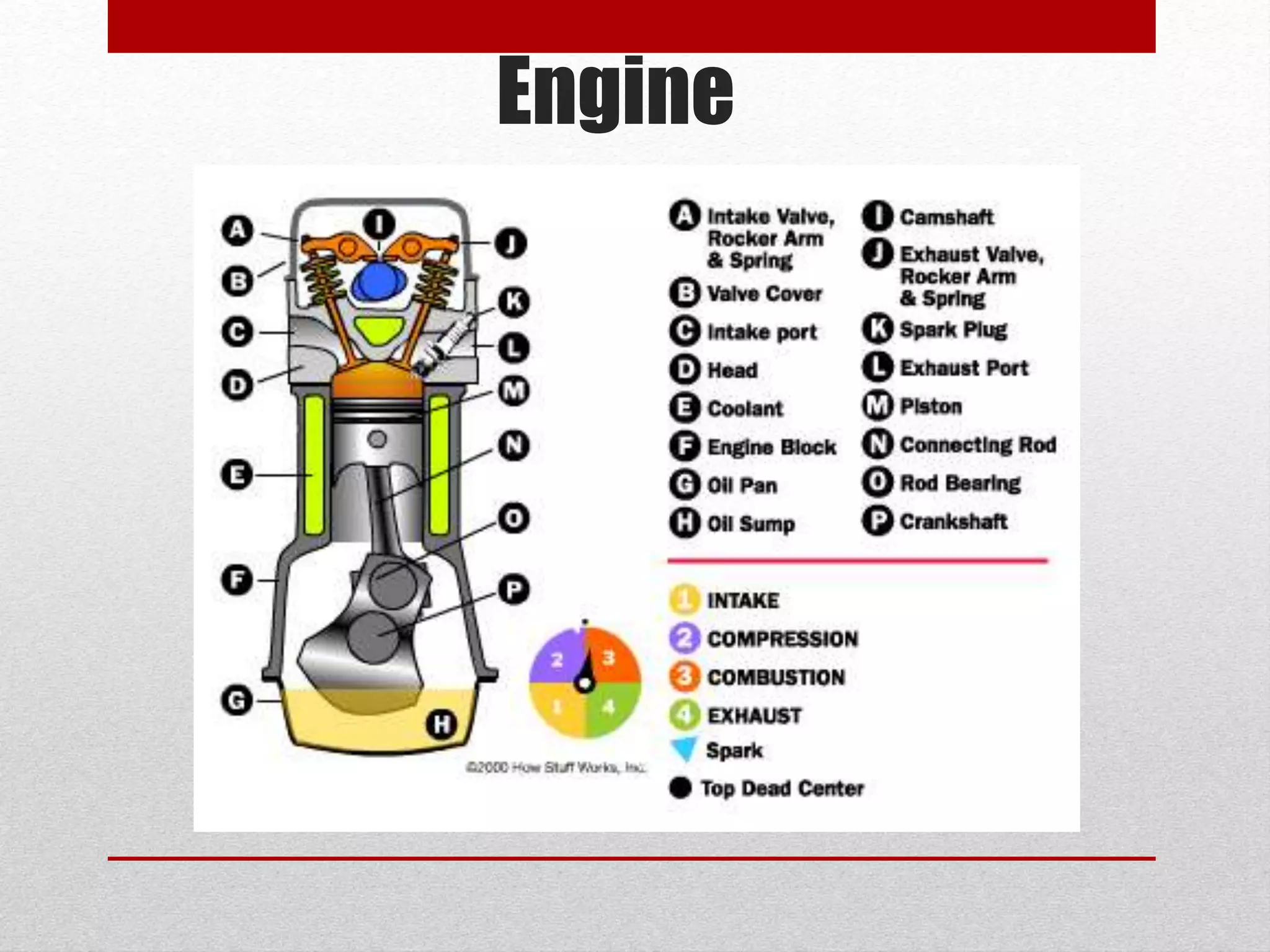
Engine
Intake stroke - intake valve opens and the piston
moves down allowing the fuel-air mix to enter the
open space.
Compression stroke - the piston moves upwards.
This compresses the fuel-air mix by forcing it into
a smaller space. Compression makes the fuel-air
mix explode with greater force.
Power cycle - spark from a spark plug ignites
the fuel-air mix. The explosion forces the piston
down the cylinder.
Exhaust cycle - the exhaust valve opens and
the piston moves back to the top of the
cylinder which forces the exhaust fumes out.
Torque Converter
Torque Converter
The model of a torque converter is fairly complex and highly nonlinear
We will not consider it in this class.
If you need it, it will be provided to you as a Matlab function.
APPLICATIONS.
•Automatic transmissions on automobiles,
such as car, buses, and on/off highway
trucks.
•Other heavy duty vehicle.
•Marine propulsion systems.
•Industrial power transmission such as
conveyor drives.
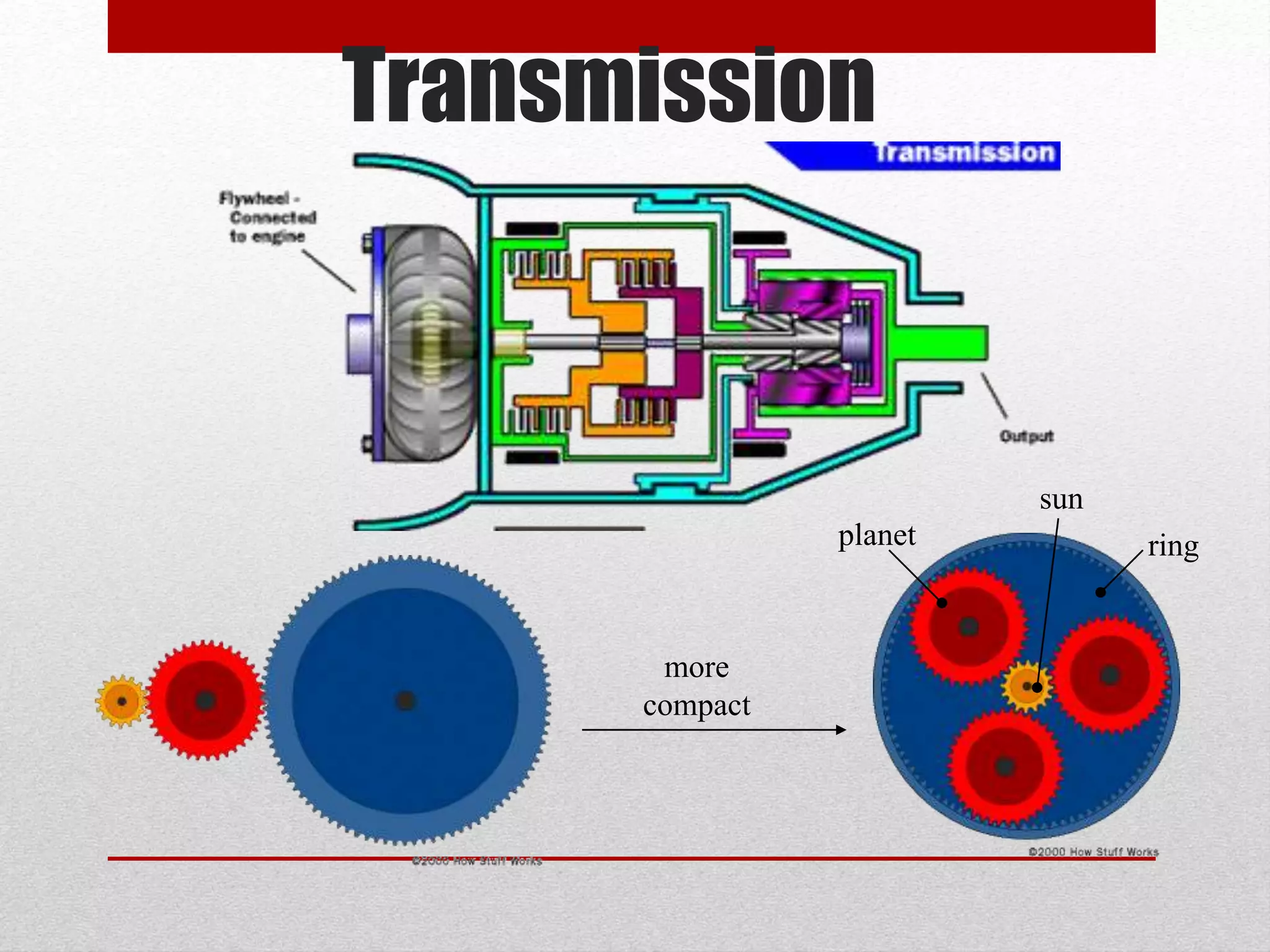
Transmission
more
compact
sun
planet ring
Examples of Other Models
in Vehicle Design
Computational Fluid Dynamics
Noise, Vibration,
and Harshness
Crash TestingThermal
Stress Analysis
Thanks to Mr. Bidve sir
&
To all staff & My Friends.
No more ???? Please…
• Thanks for listening us & supporting us.

GENERAL FUNCTIONING OF THE CAR

  • 1.
  • 2.
    IT IS PREPAREDBY:- • BALASAHEB DIGAMBAR CHAVAN. • GAURAV RAGHUTTAM NAIKWADE . • OMKAR RAJKUMAR KAMLE . CLASS :-ME3G. ROLL NO:-08, 26, 18. COLLEGE:- V.A.P.M, ALMALA.
  • 3.
    • HISTORY . •ABOUT ENGINE. • ABOUT TORQUE. • ABOUT FOUR STROKES OF STARTING ENGINE. • ABOUT TRANSMISSION SYSTEM. • EXAMPLES ON OTHER MODELS IN CAR DESIGN. • MODEL OF THE CAR BODY. INTRODUCTION
  • 4.
    Learn more aboutcars • The graphical material in this lecture is copied from www.howstuffworks.com • You can find much additional information at this web-site
  • 5.
    HISTORY In the late1770s Nicolas-Joseph Cugnot, a French engineer, built a car that ran on steam. Many American companies also started producing them but they were very expensive to make and cost a lot of money. As time went on, engineers started experimenting with petrol-driven cars. They could travel faster and over longer distances. They were also safer than steam- powered models which ran with petrol Towards the end of the 19 th century Germany became the centre of car-making. Nikolaus Otto built the first internal combustion engine, Gottlieb Daimler and Karl Benz also began building petrol-driven engines
  • 6.
    Car Sub-Systems of Interest TorqueConverter Engine Transmission Differential Tires Car Body
  • 7.
    The engine The heartof every car is its engine. It produces the power that turns the wheels and electricity for lights and other systems. Most automobiles are powered by an internal combustion engine. Fuel, usually gasoline or petrol, is burned with air to create gases that expand. A spark plug creates a spark that ignites the gas and makes it burn. This energy moves through cylinders in which pistons slide up and down. They are attached to rodsthat move a crankshaft. Normal car engines have four to six cylinders but there are also models with eight and sixteen cylinders. The turning movement is passed through the drivetrain to the drive wheels.
  • 8.
  • 9.
    Intake stroke -intake valve opens and the piston moves down allowing the fuel-air mix to enter the open space.
  • 10.
    Compression stroke -the piston moves upwards. This compresses the fuel-air mix by forcing it into a smaller space. Compression makes the fuel-air mix explode with greater force.
  • 11.
    Power cycle -spark from a spark plug ignites the fuel-air mix. The explosion forces the piston down the cylinder.
  • 12.
    Exhaust cycle -the exhaust valve opens and the piston moves back to the top of the cylinder which forces the exhaust fumes out.
  • 13.
  • 14.
    Torque Converter The modelof a torque converter is fairly complex and highly nonlinear We will not consider it in this class. If you need it, it will be provided to you as a Matlab function.
  • 15.
    APPLICATIONS. •Automatic transmissions onautomobiles, such as car, buses, and on/off highway trucks. •Other heavy duty vehicle. •Marine propulsion systems. •Industrial power transmission such as conveyor drives.
  • 16.
  • 17.
    Examples of OtherModels in Vehicle Design Computational Fluid Dynamics Noise, Vibration, and Harshness Crash TestingThermal Stress Analysis
  • 18.
    Thanks to Mr.Bidve sir & To all staff & My Friends.
  • 19.
    No more ????Please… • Thanks for listening us & supporting us.