IC-1
GENDER, SCHOOL
AND SOCIETY
Dr. Rakhi Sawlani
Devi Ahilya Vishwavidyalaya
INDORE
A++
CONCEPT OF SEX
• Sex is natural
• Sex is biological and it refers to visible differences in
genitalia and related differences in procreative functions
• Sex is constant, it remains the same everywhere.
• Sex cannot be changed without complex medical
intervention.
• sex refers to the biological & physiological characteristics
that define men & women.
• Example of sex characteristics -women menstruate while
men do not -men have testicles while women do not -
women developed breasts that are capable of lactating
while men have not -men generally have more massive
bones than women
CONCEPT OF GENDER
• Gender is socio-cultural construct
• It refers to the masculine and feminine qualities, behaviour, roles
and responsibilities that society upholds
• Gender is variable; it changes from time to time, culture to
culture, even family to family.
• Gender can be changed/ re-oriented.
• Gender refers to the socially constructed roles, behaviours,
activities & attributes that a given society considers appropriate for
men & women.
• Examples of gender characteristics -most of the countries women
earn significant less money than men of similar work -in most of
the countries women do more house work than men
Difference between Sex and Gender
SEX
• Meaning - Physiological
characteristics
• Definition - Biological
difference.
• Aspect of Change- Difficult to
change the sex when born as
male or female.
• Aspect of role- Throughout
history and across cultures,
sex differences exist.
• Aspect of policy - Policies
respond to sex differences in
areas to do with the physical
body.
GENDER
social, cultural expectations and
actions.
Social differences (Roles and
Responsibilities).
Can be changed since gender
identity is determined by
society.
At different times in history and in
different societies, gender
roles are different.
Policies can respond to gender
stereotype and traditional gender
roles.
Introduction: Gender
• ‘The relations between men and women, both perceptual and
material. Gender is not determined biologically, as a result of
sexual characteristics of either women or men, but is
constructed socially. It is a central organizing principle of
societies, and often governs the processes of production and
reproduction, consumption and distribution’ (FAO, 1997).
• "The commonly shared expectations and norms within a
society about appropriate male and female behavior,
characteristics and roles.
Gender can be considered a social and cultural construct that
differentiates females from males and thus defines the ways in
which females and males interact with each other. These roles
and expectations are learned and they can change over time as
well as vary within and between cultures."
Definition of Gender
Gender refers to the roles and responsibilities of men and women
that are created in our families, our societies and our cultures.
The concept of gender also includes the expectations held about
the characteristics, aptitudes and likely behaviours of both
women and men (femininity and masculinity).
• Gender roles and expectations are learned. They can change over
time and they vary within and between cultures.
• Systems of social differentiation such as political status, class,
ethnicity, physical and mental disability, age and more, modify gender
roles.
• The concept of gender is vital because, applied to social analysis, it
reveals how women’s subordination (or men’s domination) is socially
constructed. As such, the subordination can be changed or ended.
• It is not biologically predetermined nor is it fixed forever.
Characteristics of Gender
• Gender is a socially constructed dynamic concept that changes over time due to the influence of
education and culture.
• Gender involves an array of rights, roles, responsibilities and relationships of men and women.
• Gender is a learned or an acquired behavior.
• Gender includes personality traits, attitudes, values and behaviors that society gives to men and
women differently.
• Power relationships are influenced by gender.
• Access to resources is determined by one’s gender.
• Gender roles and norms can change over time.
• Gender roles vary across culture.
• Gender manifests itself in the form of roles, relations and identity.
• Gender differences are due to nurture.
• Some examples of gender characteristics (WHO)
• a) In the United States (and most other countries), women earn significantly less money than men
for similar work
• b) In Viet Nam, many more men than women smoke, as female smoking has not traditionally been
• considered appropriate
• c) In Saudi Arabia men are allowed to drive cars while women are not
• d) In most of the world, women do more housework than men
Terminologies associated with
gender
• Gender roles
• Gender Discrimination
• Gender equality/Inequality
• Gender equity
• Gender awareness
• Gender Sensitivity
• Gender analysis
• Gender Mainstreaming
• Gender Parity
• Gender Dynamics
• Gender Bias
• Gender identity
• Concept of transgender with some emphasis on
condition of transgender persons in India
• Conditions of transgender at in Educational
sphere in India
• Conditions of transgender at Vocational sphere
in India
• Conditions of transgender at Political sphere in
India
• Health Conditions of transgender
• Legal provisions for the transgenders
in India
Concept of Transgender
• An umbrella term to describe a person whose gender
identity, behaviour or expression does not match with the
typically associated behaviour of that sex.
• Earlier referred as transsexuals, transvestites.
• It encompasses anyone whose identity or behaviour falls
outside of stereotypical gender norms.
• Transgender differs from gay or lesbian (Gay women).
• Transgender could be a male at birth who
identifies being a female OR It could be a
female at birth who identifies being a male.
They feel different from their physical
appearances.
Issues of Transgender
• Exclusion from social life
• Denial (services, public accommodation)
• Harassment, mistreatment, Discrimination, violence,
homelessness, poverty
• employment, education
• Lack of facilities, health and hygiene
• Depression, tobacco/alcohol abuse
• Marriage and adoption
• Restricted rights
• Forced into sex, physical abuse, life threat
Laws of Transgender
• In April 2014, SC Created third gender status.
• Equal opportunity, to treat transgender as socially and
economically backward and include them in OBC quota.
• Medical care, public toilets, other facilities.
• Social welfare schemes, public awareness campaigns
• The Rights of Transgender Persons Bill, 2015 -
- Comprehensive national policy for ensuring
overall development of transgender persons.
- provisions for health, education and employment.
- establishment of employment exchange,
national and state commissions, special courts.
- no separation from their parent., no hate speeches.
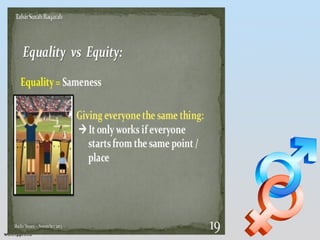
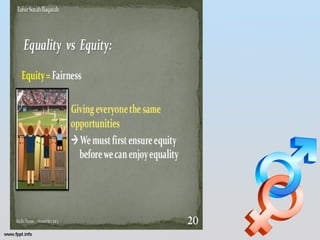
Equality vs Equity
Equality denotes that
everyone is at the same level.
Equality ensures quantity
Gender quality implies that
men and women receive
equal treatment.
Gender equality does not
recognise that a woman
experience are different from
that of man.
Absolute
It only removes the barrier.
Equity refers to qualities of
justness, fairness, impartiality.
Equity ensures quality.
Gender equity implies that men
and women if necessary
receive different/special
treatment.
Gender equity recognises that
men and women have different
needs and interests.
Process based
It provides transformational
change.
Gender Equality and Education
• School, Curriculum ( curricular and co-curricular), Textbook and other resources
• Subjects and learning experiences
• 3 Gender specific goals-
i) free and compulsory education,
ii) achieving adult literacy,
iii) eliminate gender disparities in primary and secondary education.
Need for Gender Equity
• To maximise potential
• To empower marginalised
• To give a fair and level playing ground
• For a sound, healthy, just, equitable society
• To bridge the gender gap
Promoting gender equity in schools
• More female faculties
• Avoid references to stereotypes
• Counselling stereotyped notions
• Carefully monitor situation of girls
• Using gender neutral language
• Equally high expectations from both
• Breaking the stereotypes
• Reservation for both gender
Government policies on
Gender Equality
• Pre-natal Diagnostic act, 1994
• National policy for women empowerment,
2011
• Domestic Violence Act, 2005
• Child marriage act
• Dowry act, 1961
• Immoral traffic prevention act, 1986
• POCSO Act
Sexuality
• Sexuality is more than genital physical activity.
• Sexuality encompasses our whole being. It includes our sense of femaleness and maleness.
• Sexuality includes biological, sociological, psychological, spiritual, and cultural dimensions
of each person’s being. In addition, sexuality influenced by values, attitudes, behaviours,
relationships with others and the need to establish emotional closeness with others.
• Sex ( Sexual orientation, eroticism, pleasure, intimacy, reproduction)
• Gender (identity, roles, relationships)
Definition- Sexuality includes all the dimensions which are/aren’t
expressed or experienced in thoughts, fantasies, desires, beliefs,
attitudes, values. It is influenced by various factors (Physical,
psychological, cultural, social, economic, political, legal, religious, spiritual)
TYPES OF SEXUALITY
• HETEROSEXUAL
• HOMOSEXUAL
• BISEXUAL
• ASEXUAL
Sexual orientation – term used to describe patterns of romantic,
emotional and sexual attraction. Sexual orientation ; it is the organization
of an individual’s eroticism &/or emotional attachment with reference to
the sex & gender of the partner involved in sexual activity
Sexual Identity
 refers to anatomical,
physiological, genetic
characteristics)
 It is about who you want to be
with
 sexual identity is the overall
sexual self identity which
includes how the individual
identifies as male, female,
masculine, feminine, or some
combination & the individual’s
sexual
Gender
identity
• refers to psychological sense
of being male or female)
• It is about who you are.
• gender identity defines the
degree to which each person
identifies as male, female, or
some combination.
Sociological Perspectives of
Gender
• To understand connection between
society and Gender.
• Society contributes to gender identity.
• Family, peers, school, religious
organisations, media forms society which
leads to gender socialisation.
• Gender socialisation- strengthening of
gender roles.
1. Functional perspective of gender
Each individual performs its functions in the society. Gender maximise social
efficiency and maintains balance in the society.
2. Conflict Theory
• Social order is maintained when
individual/class exercises power over another
individual/class.
• Society is a stage on which struggle for
power and dominance acted out.
• Similarly in family, exploiter-exploited
relationship exists.
• More powerful performs lesser amount of
work.
3. Symbolic Interaction Theory
• Symbolic means meaning making through
interaction in the society.
• People meet, act, understand, respond, interpret
the situation, make meaning, evolve slightly,
change radically, modify their behaviour.
• Our interaction in the society and the way we
perceive it mould us into gender role.
• More powerful gender becomes the dominant
gender.
4. Feminist Sociological Theory
• Giving a voice to women in the society and highlighting contribution
of women.
• Liberal Feminist- gender inequality has a past tradition equal rights
and responsibilities.
• Radical Feminist - due to patriarchy women are oppressed.
• Socialist Feminist – women oppression has its root in the
capitalism.
Gender oppression theory
• Women are considered different, unequal, inferior, secondary. They
are actively oppressed and subordinated by men leading to violence
against women.
PSYCHOLOGICAL PERSPECTIVES OF
GENDER
• The Evolutionary Theory (Genes hold
the key to our behavior) - The division of
gender roles emerged due to minds’
instinct to survive and reproduce. Hence
the gender differences occurred with the
man becoming aggressive and competitive
(traits necessary for survival) and woman
becoming nurturing and caring (traits
necessary to reproduce and bring up
family).
Biosocial theory of Gender
Role development
Nature and nurture determine gender
roles- This theory suggests that nature
and nurture plays a vital role in gender
development. Children are gender neutral
at birth. Assigning gender identity and role
starts after the age of 3. Labeling,
treatment and expectations of society
influence the gender identity of child.
Social learning theory
• Gender roles are determined by observation and
modeling - This theory explains that gender roles are
learned through observation and modeling. The child
observes behavior of same sex and imitates. When such
a behavior is reinforced through reward or punishment
by parents or peers, the behavior becomes part of the
personality of an individual.
• Eg. Girls watch their mothers cooking and imitate the
behavior. Boys are impressed by the way their father
rides the bike and imitates the behavior.
Gender Schema theory
• Gender schema are gender related beliefs that determine
gender roles –
• This theory recognizes the importance of cognition in the
development of gender identity and roles. Children learn what it
means to be a male or a female from their interaction with society.
The children first form a gender identity and then form gender
schemas. A gender schema is an organized set of gender related
beliefs that influence one’s behavior. These schemas organize and
regulate our behavior. The child makes meaning of new social
information based on schemas formed.
• Eg. The child has observed how males and females dress
differently. This translates into gender schema. Now if he is given
clothes of opposite sex, he would refuse

Gender sensitivity, gender-based discri

  • 1.
    IC-1 GENDER, SCHOOL AND SOCIETY Dr.Rakhi Sawlani Devi Ahilya Vishwavidyalaya INDORE A++
  • 2.
    CONCEPT OF SEX •Sex is natural • Sex is biological and it refers to visible differences in genitalia and related differences in procreative functions • Sex is constant, it remains the same everywhere. • Sex cannot be changed without complex medical intervention. • sex refers to the biological & physiological characteristics that define men & women. • Example of sex characteristics -women menstruate while men do not -men have testicles while women do not - women developed breasts that are capable of lactating while men have not -men generally have more massive bones than women
  • 3.
    CONCEPT OF GENDER •Gender is socio-cultural construct • It refers to the masculine and feminine qualities, behaviour, roles and responsibilities that society upholds • Gender is variable; it changes from time to time, culture to culture, even family to family. • Gender can be changed/ re-oriented. • Gender refers to the socially constructed roles, behaviours, activities & attributes that a given society considers appropriate for men & women. • Examples of gender characteristics -most of the countries women earn significant less money than men of similar work -in most of the countries women do more house work than men
  • 4.
    Difference between Sexand Gender SEX • Meaning - Physiological characteristics • Definition - Biological difference. • Aspect of Change- Difficult to change the sex when born as male or female. • Aspect of role- Throughout history and across cultures, sex differences exist. • Aspect of policy - Policies respond to sex differences in areas to do with the physical body. GENDER social, cultural expectations and actions. Social differences (Roles and Responsibilities). Can be changed since gender identity is determined by society. At different times in history and in different societies, gender roles are different. Policies can respond to gender stereotype and traditional gender roles.
  • 5.
    Introduction: Gender • ‘Therelations between men and women, both perceptual and material. Gender is not determined biologically, as a result of sexual characteristics of either women or men, but is constructed socially. It is a central organizing principle of societies, and often governs the processes of production and reproduction, consumption and distribution’ (FAO, 1997). • "The commonly shared expectations and norms within a society about appropriate male and female behavior, characteristics and roles. Gender can be considered a social and cultural construct that differentiates females from males and thus defines the ways in which females and males interact with each other. These roles and expectations are learned and they can change over time as well as vary within and between cultures."
  • 6.
    Definition of Gender Genderrefers to the roles and responsibilities of men and women that are created in our families, our societies and our cultures. The concept of gender also includes the expectations held about the characteristics, aptitudes and likely behaviours of both women and men (femininity and masculinity). • Gender roles and expectations are learned. They can change over time and they vary within and between cultures. • Systems of social differentiation such as political status, class, ethnicity, physical and mental disability, age and more, modify gender roles. • The concept of gender is vital because, applied to social analysis, it reveals how women’s subordination (or men’s domination) is socially constructed. As such, the subordination can be changed or ended. • It is not biologically predetermined nor is it fixed forever.
  • 7.
    Characteristics of Gender •Gender is a socially constructed dynamic concept that changes over time due to the influence of education and culture. • Gender involves an array of rights, roles, responsibilities and relationships of men and women. • Gender is a learned or an acquired behavior. • Gender includes personality traits, attitudes, values and behaviors that society gives to men and women differently. • Power relationships are influenced by gender. • Access to resources is determined by one’s gender. • Gender roles and norms can change over time. • Gender roles vary across culture. • Gender manifests itself in the form of roles, relations and identity. • Gender differences are due to nurture. • Some examples of gender characteristics (WHO) • a) In the United States (and most other countries), women earn significantly less money than men for similar work • b) In Viet Nam, many more men than women smoke, as female smoking has not traditionally been • considered appropriate • c) In Saudi Arabia men are allowed to drive cars while women are not • d) In most of the world, women do more housework than men
  • 8.
    Terminologies associated with gender •Gender roles • Gender Discrimination • Gender equality/Inequality • Gender equity • Gender awareness • Gender Sensitivity • Gender analysis • Gender Mainstreaming • Gender Parity • Gender Dynamics • Gender Bias • Gender identity
  • 9.
    • Concept oftransgender with some emphasis on condition of transgender persons in India • Conditions of transgender at in Educational sphere in India • Conditions of transgender at Vocational sphere in India • Conditions of transgender at Political sphere in India • Health Conditions of transgender • Legal provisions for the transgenders in India
  • 10.
    Concept of Transgender •An umbrella term to describe a person whose gender identity, behaviour or expression does not match with the typically associated behaviour of that sex. • Earlier referred as transsexuals, transvestites. • It encompasses anyone whose identity or behaviour falls outside of stereotypical gender norms. • Transgender differs from gay or lesbian (Gay women). • Transgender could be a male at birth who identifies being a female OR It could be a female at birth who identifies being a male. They feel different from their physical appearances.
  • 11.
    Issues of Transgender •Exclusion from social life • Denial (services, public accommodation) • Harassment, mistreatment, Discrimination, violence, homelessness, poverty • employment, education • Lack of facilities, health and hygiene • Depression, tobacco/alcohol abuse • Marriage and adoption • Restricted rights • Forced into sex, physical abuse, life threat
  • 12.
    Laws of Transgender •In April 2014, SC Created third gender status. • Equal opportunity, to treat transgender as socially and economically backward and include them in OBC quota. • Medical care, public toilets, other facilities. • Social welfare schemes, public awareness campaigns • The Rights of Transgender Persons Bill, 2015 - - Comprehensive national policy for ensuring overall development of transgender persons. - provisions for health, education and employment. - establishment of employment exchange, national and state commissions, special courts. - no separation from their parent., no hate speeches.
  • 15.
    Equality vs Equity Equalitydenotes that everyone is at the same level. Equality ensures quantity Gender quality implies that men and women receive equal treatment. Gender equality does not recognise that a woman experience are different from that of man. Absolute It only removes the barrier. Equity refers to qualities of justness, fairness, impartiality. Equity ensures quality. Gender equity implies that men and women if necessary receive different/special treatment. Gender equity recognises that men and women have different needs and interests. Process based It provides transformational change.
  • 17.
    Gender Equality andEducation • School, Curriculum ( curricular and co-curricular), Textbook and other resources • Subjects and learning experiences • 3 Gender specific goals- i) free and compulsory education, ii) achieving adult literacy, iii) eliminate gender disparities in primary and secondary education. Need for Gender Equity • To maximise potential • To empower marginalised • To give a fair and level playing ground • For a sound, healthy, just, equitable society • To bridge the gender gap Promoting gender equity in schools • More female faculties • Avoid references to stereotypes • Counselling stereotyped notions • Carefully monitor situation of girls • Using gender neutral language • Equally high expectations from both • Breaking the stereotypes • Reservation for both gender
  • 18.
    Government policies on GenderEquality • Pre-natal Diagnostic act, 1994 • National policy for women empowerment, 2011 • Domestic Violence Act, 2005 • Child marriage act • Dowry act, 1961 • Immoral traffic prevention act, 1986 • POCSO Act
  • 19.
    Sexuality • Sexuality ismore than genital physical activity. • Sexuality encompasses our whole being. It includes our sense of femaleness and maleness. • Sexuality includes biological, sociological, psychological, spiritual, and cultural dimensions of each person’s being. In addition, sexuality influenced by values, attitudes, behaviours, relationships with others and the need to establish emotional closeness with others. • Sex ( Sexual orientation, eroticism, pleasure, intimacy, reproduction) • Gender (identity, roles, relationships) Definition- Sexuality includes all the dimensions which are/aren’t expressed or experienced in thoughts, fantasies, desires, beliefs, attitudes, values. It is influenced by various factors (Physical, psychological, cultural, social, economic, political, legal, religious, spiritual) TYPES OF SEXUALITY • HETEROSEXUAL • HOMOSEXUAL • BISEXUAL • ASEXUAL
  • 20.
    Sexual orientation –term used to describe patterns of romantic, emotional and sexual attraction. Sexual orientation ; it is the organization of an individual’s eroticism &/or emotional attachment with reference to the sex & gender of the partner involved in sexual activity Sexual Identity  refers to anatomical, physiological, genetic characteristics)  It is about who you want to be with  sexual identity is the overall sexual self identity which includes how the individual identifies as male, female, masculine, feminine, or some combination & the individual’s sexual Gender identity • refers to psychological sense of being male or female) • It is about who you are. • gender identity defines the degree to which each person identifies as male, female, or some combination.
  • 21.
    Sociological Perspectives of Gender •To understand connection between society and Gender. • Society contributes to gender identity. • Family, peers, school, religious organisations, media forms society which leads to gender socialisation. • Gender socialisation- strengthening of gender roles.
  • 22.
    1. Functional perspectiveof gender Each individual performs its functions in the society. Gender maximise social efficiency and maintains balance in the society.
  • 23.
    2. Conflict Theory •Social order is maintained when individual/class exercises power over another individual/class. • Society is a stage on which struggle for power and dominance acted out. • Similarly in family, exploiter-exploited relationship exists. • More powerful performs lesser amount of work.
  • 24.
    3. Symbolic InteractionTheory • Symbolic means meaning making through interaction in the society. • People meet, act, understand, respond, interpret the situation, make meaning, evolve slightly, change radically, modify their behaviour. • Our interaction in the society and the way we perceive it mould us into gender role. • More powerful gender becomes the dominant gender.
  • 25.
    4. Feminist SociologicalTheory • Giving a voice to women in the society and highlighting contribution of women. • Liberal Feminist- gender inequality has a past tradition equal rights and responsibilities. • Radical Feminist - due to patriarchy women are oppressed. • Socialist Feminist – women oppression has its root in the capitalism. Gender oppression theory • Women are considered different, unequal, inferior, secondary. They are actively oppressed and subordinated by men leading to violence against women.
  • 26.
    PSYCHOLOGICAL PERSPECTIVES OF GENDER •The Evolutionary Theory (Genes hold the key to our behavior) - The division of gender roles emerged due to minds’ instinct to survive and reproduce. Hence the gender differences occurred with the man becoming aggressive and competitive (traits necessary for survival) and woman becoming nurturing and caring (traits necessary to reproduce and bring up family).
  • 27.
    Biosocial theory ofGender Role development Nature and nurture determine gender roles- This theory suggests that nature and nurture plays a vital role in gender development. Children are gender neutral at birth. Assigning gender identity and role starts after the age of 3. Labeling, treatment and expectations of society influence the gender identity of child.
  • 28.
    Social learning theory •Gender roles are determined by observation and modeling - This theory explains that gender roles are learned through observation and modeling. The child observes behavior of same sex and imitates. When such a behavior is reinforced through reward or punishment by parents or peers, the behavior becomes part of the personality of an individual. • Eg. Girls watch their mothers cooking and imitate the behavior. Boys are impressed by the way their father rides the bike and imitates the behavior.
  • 29.
    Gender Schema theory •Gender schema are gender related beliefs that determine gender roles – • This theory recognizes the importance of cognition in the development of gender identity and roles. Children learn what it means to be a male or a female from their interaction with society. The children first form a gender identity and then form gender schemas. A gender schema is an organized set of gender related beliefs that influence one’s behavior. These schemas organize and regulate our behavior. The child makes meaning of new social information based on schemas formed. • Eg. The child has observed how males and females dress differently. This translates into gender schema. Now if he is given clothes of opposite sex, he would refuse