The Pay Gap between
Male and Female
Employees
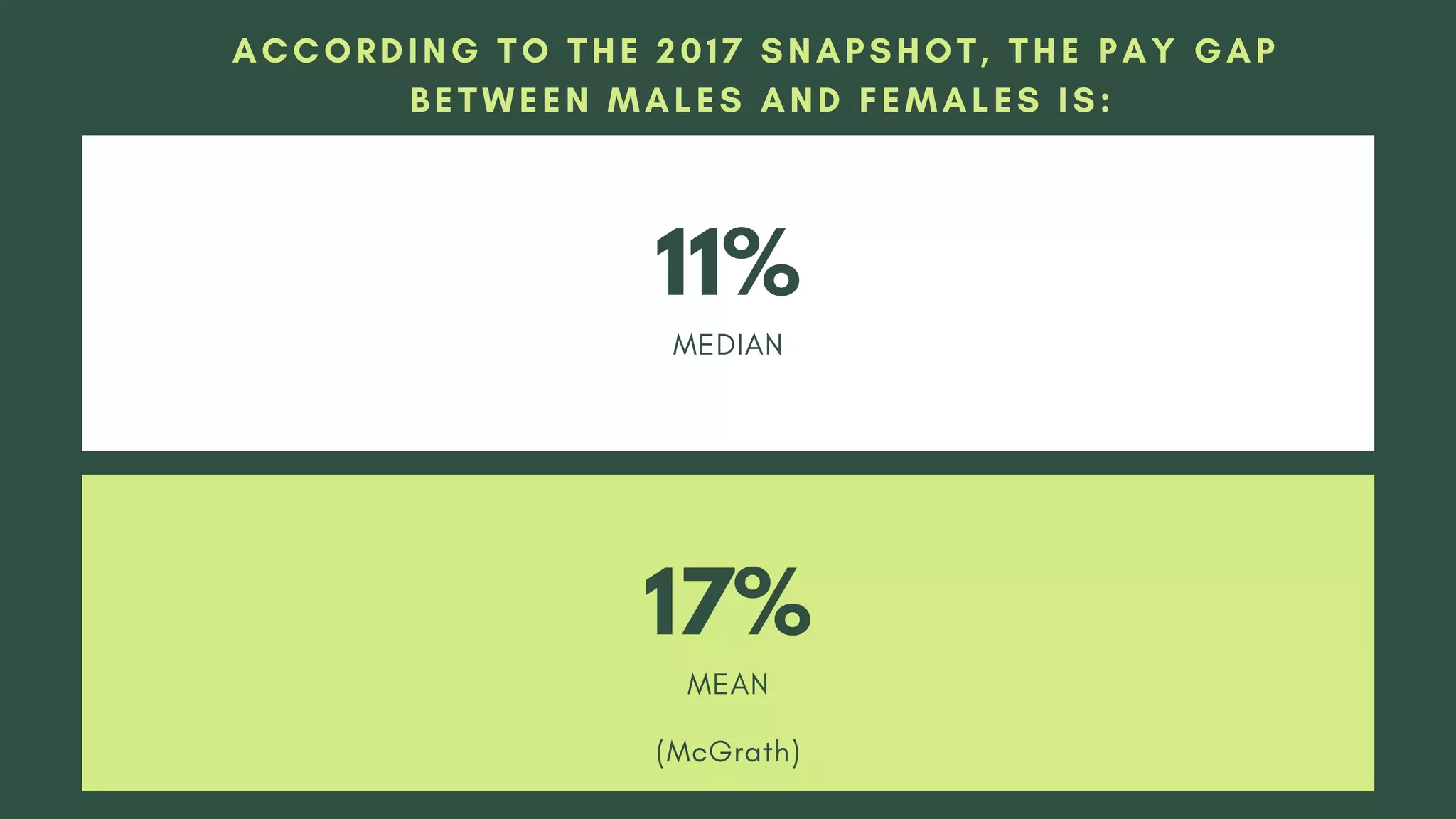
11%
MEDIAN
17%
MEAN
(McGrath)
ACCORDING TO THE 2017 SNAPSHOT, THE PAY GAP
BETWEEN MALES AND FEMALES IS:
THE GENDER PAY
GAP
The difference in pay in the world of work is a well-
established global phenomenon. When it comes to
rewards or salaries, women usually earn less than
men. This principle is called the gender pay gap,
which refers to the average payment disparity
between working males and females (Blau and
Kahn).
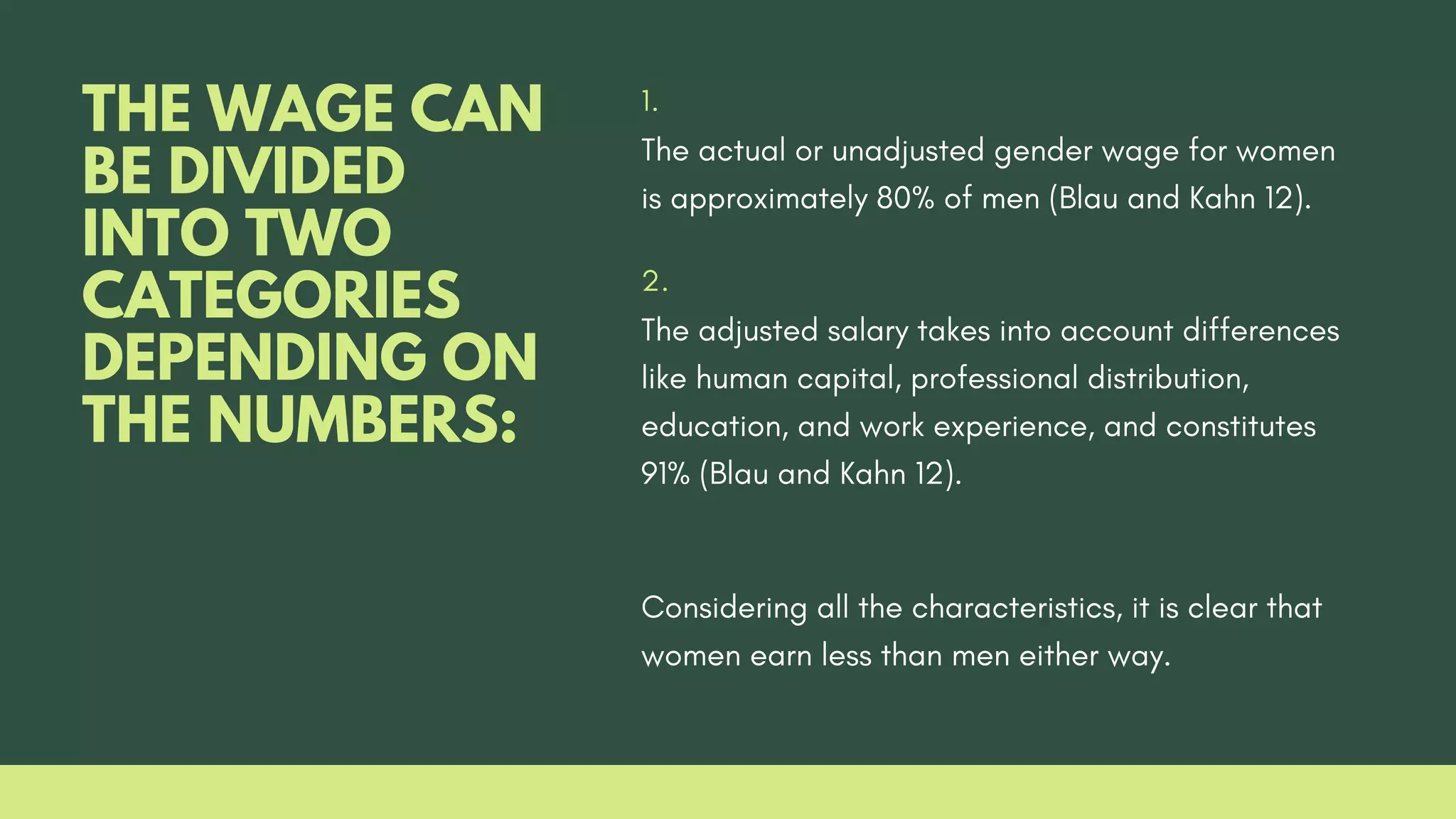
THE WAGE CAN
BE DIVIDED
INTO TWO
CATEGORIES
DEPENDING ON
THE NUMBERS:
The actual or unadjusted gender wage for women
is approximately 80% of men (Blau and Kahn 12).
1.
The adjusted salary takes into account differences
like human capital, professional distribution,
education, and work experience, and constitutes
91% (Blau and Kahn 12).
2.
Considering all the characteristics, it is clear that
women earn less than men either way.
Causes of Gender Pay Gap
On average, men have gained a little more potential work experience
since graduation.
Women are more likely to work in low-paying occupations and
industries.
Men are more likely to take the positions of managers and high-paying
jobs.
Traditionally, women depend on the needs of their families and more often enter and
leave the labor force, which reduces their work experience.
Male workers are more often white than female workers, which links it to one of the
discriminatory reasons for wage differentials where white people earn more (Blau and
Kahn 2-3).
The economic analysis of the gender pay gap shows that some differences are
due to these variations in the characteristics of men and women:
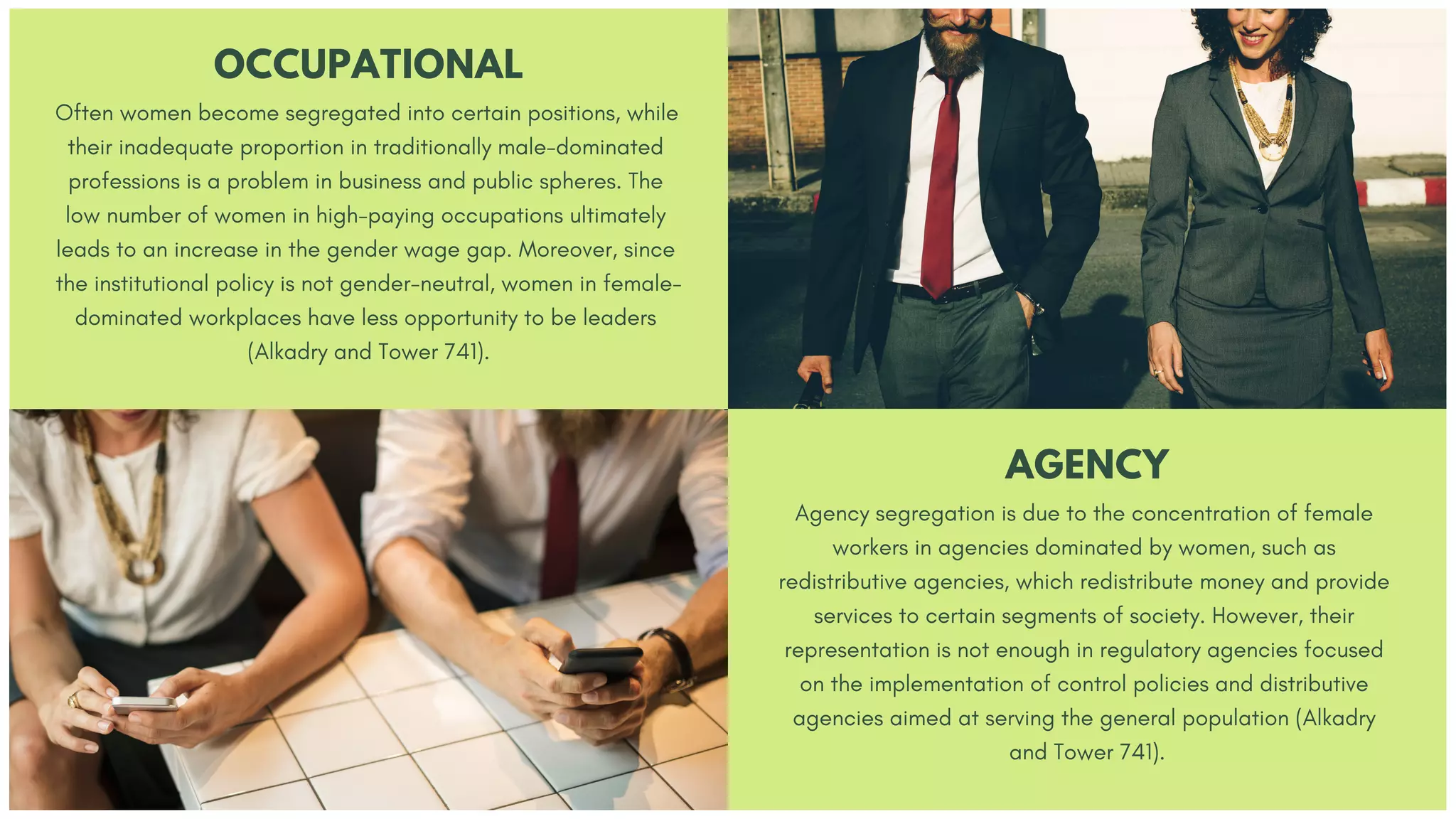
Often women become segregated into certain positions, while
their inadequate proportion in traditionally male-dominated
professions is a problem in business and public spheres. The
low number of women in high-paying occupations ultimately
leads to an increase in the gender wage gap. Moreover, since
the institutional policy is not gender-neutral, women in female-
dominated workplaces have less opportunity to be leaders
(Alkadry and Tower 741).
OCCUPATIONAL
Agency segregation is due to the concentration of female
workers in agencies dominated by women, such as
redistributive agencies, which redistribute money and provide
services to certain segments of society. However, their
representation is not enough in regulatory agencies focused
on the implementation of control policies and distributive
agencies aimed at serving the general population (Alkadry
and Tower 741).
AGENCY
GLASS
CEILING
One more type of disparity relates to position segregation, which is the difference in
wages earned due to the inability of women to occupy the upper levels of
organizations with raised salaries. This concept is called the “glass ceiling,” as it is a
systematic barrier that hinders the process of transition to a higher position. Women
usually concentrate on lower levels of organizations without upward mobility within
the organization (Alkadry and Tower 741).
DISPARITIES LINKED WITH
AGE AND RACE
A clear relationship between
age and difference in
payments has not yet been
identified in the research.
However, age is an important
determinant regarding the
length of service required to
earn higher wages and
bonuses (Alkadry and Tower
743).
AGE
In turn, race is an essential
predictor of wages, because
it plays a role in wage
differentials, even in such
areas of labor as the federal
(Alkadry and Tower 743).
RACE
GENDER
IMAGE
Women often have to choose between a family and a
career, which results in additional social costs for them.
FAMILY
Marriage reduces the chances of being promoted for
women, while, on the contrary, it helps men get promotions
and bonuses.
MARRIAGE
Married working women have more responsibilities at
home, are more likely to be single or divorced, and have
fewer children if they decide to move in their careers
(Alkadry and Tower 741)
RESPONSIBILITIES
WOMEN IN THE WORKPLACE ARE
ALSO AFFECTED BY SOCIAL
ROLES, FAMILY RESPONSIBILITY,
AND ORGANIZATIONAL
IDEOLOGY, WHICH LEADS TO
SUCH CONSEQUENCES:
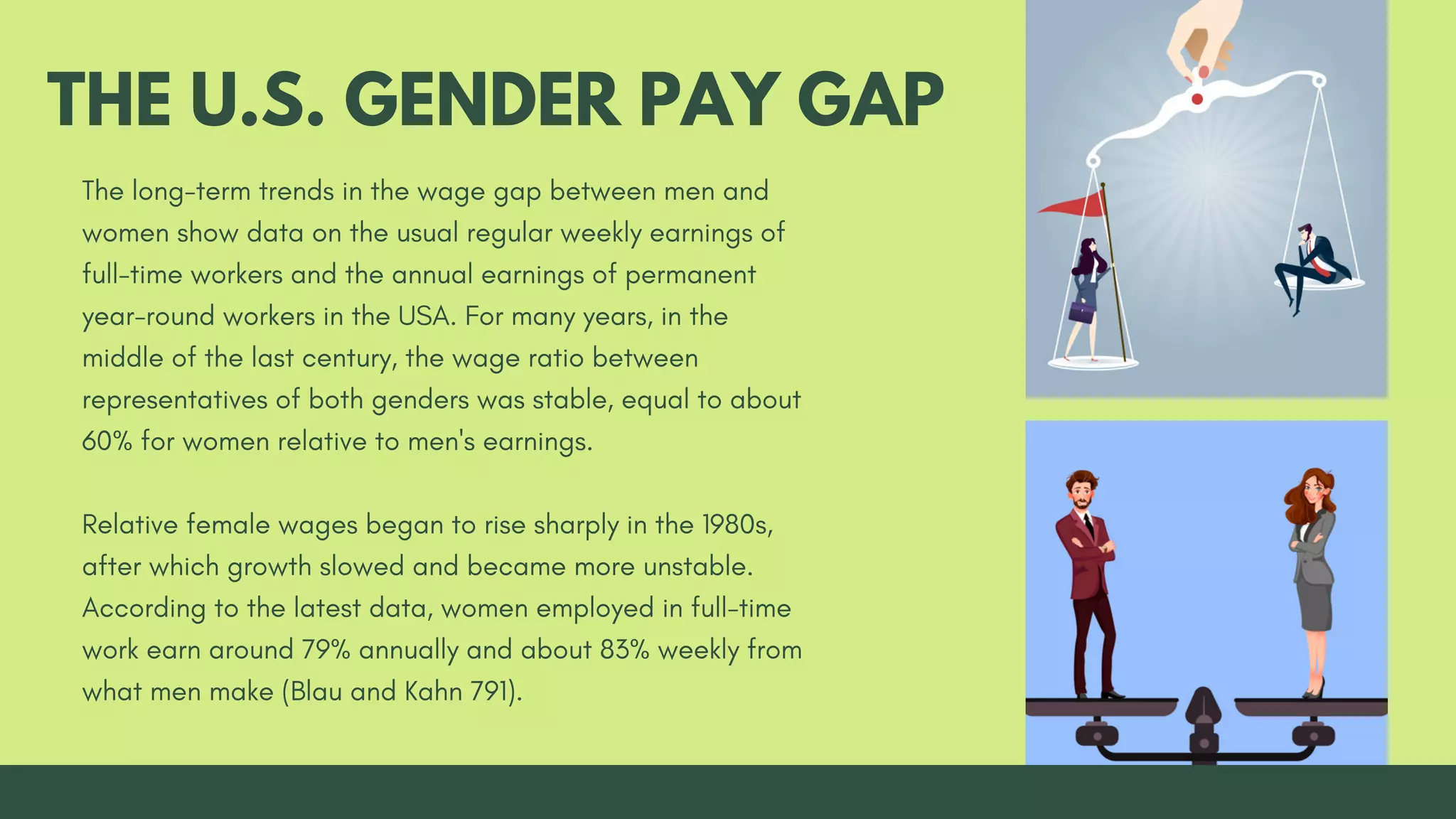
THE U.S. GENDER PAY GAP
The long-term trends in the wage gap between men and
women show data on the usual regular weekly earnings of
full-time workers and the annual earnings of permanent
year-round workers in the USA. For many years, in the
middle of the last century, the wage ratio between
representatives of both genders was stable, equal to about
60% for women relative to men's earnings.
Relative female wages began to rise sharply in the 1980s,
after which growth slowed and became more unstable.
According to the latest data, women employed in full-time
work earn around 79% annually and about 83% weekly from
what men make (Blau and Kahn 791).
PROFESSIONS
WITH THE
BIGGEST GAP
The gender wage gap can be seen in
almost all professions and industries,
because in workplaces where men
dominate, wages are usually higher.
Statistically significant differences in
wages in favor of men have remained
constant in recent years. Moreover, in
some professions, women earn billions less
than men. Here are some of the positions
on which the female wage gap is
particularly high (Vagins).
When compiling a list of qualified candidates, include
several women for hiring and promotion.
Use skill-based assessment tasks when recruiting staff
instead of relying solely on interviews.
Use structured interviews for hiring and promotion
because they do not allow unfair bias to influence
decisions.
Encourage wage negotiation, especially among women’s
teams, to show salary ranges.
Ensure the transparency of the processes of promotion,
payment, and remuneration so that employees clearly
understand the decisions of managers.
Assign managers or task forces on diversity (Government
Equalities Office).
STRATEGIES TO
OVERCOME
INEQUALITY
TO OVERCOME THE PAY GAP
BETWEEN MALE AND FEMALE
EMPLOYEES, THESE STEPS MAY
BE HELPFUL:
WORKS CITED
Alkadry, Mohamad G., and Leslie E. Tower. "Covert Pay Discrimination: How Authority Predicts Pay Differences between Women and
Men." Public Administration Review, vol. 71, no. 5, 2011, pp. 740-750. Wiley, doi:10.1111/j.1540-6210.2011.02413.x.
Blau, Francine D., and Lawrence M. Kahn. "The Gender Pay Gap." Academy of Management Perspectives, vol. 21, no. 1, 2007, pp. 7-
23. Academy of Management, doi:10.5465/amp.2007.24286161.
Blau, Francine D, and Lawrence M Kahn. "The Gender Pay Gap." The Economists' Voice, vol. 4, no. 4, 2007. Walter De Gruyter Gmbh,
doi:10.2202/1553-3832.1190.
Blau, Francine D., and Lawrence M. Kahn. "The Gender Wage Gap: Extent, Trends, and Explanations." Journal of Economic Literature,
vol. 55, no. 3, 2017, pp. 789-865. American Economic Association, doi:10.1257/jel.20160995. Accessed 18 Feb 2019.
Government Equalities Office. "Reducing the Gender Pay Gap and Improving Gender Equality in Organisations."
Assets.Publishing.Service.Gov.Uk, 2017,
www.assets.publishing.service.gov.uk/government/uploads/system/uploads/attachment_data/file/731288/Gender-Pay-Gap-
actions_.pdf.
McGrath, Gary. Gender Pay Gap Report 2017. Zotefoams, 2017, www.zotefoams.com/wp-content/uploads/2018/04/GENDER-
PAY-GAP-3-APR-18-1.pdf.
Vagins, Deborah. "The Simple Truth about the Gender Pay Gap." AAUW: Empowering Women Since 1881, 2019,
www.aauw.org/research/the-simple-truth-about-the-gender-pay-gap/.

The Pay Gap Between Male and Female Employees

  • 1.
    The Pay Gapbetween Male and Female Employees
  • 2.
    11% MEDIAN 17% MEAN (McGrath) ACCORDING TO THE2017 SNAPSHOT, THE PAY GAP BETWEEN MALES AND FEMALES IS:
  • 3.
    THE GENDER PAY GAP Thedifference in pay in the world of work is a well- established global phenomenon. When it comes to rewards or salaries, women usually earn less than men. This principle is called the gender pay gap, which refers to the average payment disparity between working males and females (Blau and Kahn).
  • 4.
    THE WAGE CAN BEDIVIDED INTO TWO CATEGORIES DEPENDING ON THE NUMBERS: The actual or unadjusted gender wage for women is approximately 80% of men (Blau and Kahn 12). 1. The adjusted salary takes into account differences like human capital, professional distribution, education, and work experience, and constitutes 91% (Blau and Kahn 12). 2. Considering all the characteristics, it is clear that women earn less than men either way.
  • 5.
    Causes of GenderPay Gap On average, men have gained a little more potential work experience since graduation. Women are more likely to work in low-paying occupations and industries. Men are more likely to take the positions of managers and high-paying jobs. Traditionally, women depend on the needs of their families and more often enter and leave the labor force, which reduces their work experience. Male workers are more often white than female workers, which links it to one of the discriminatory reasons for wage differentials where white people earn more (Blau and Kahn 2-3). The economic analysis of the gender pay gap shows that some differences are due to these variations in the characteristics of men and women:
  • 6.
    Often women becomesegregated into certain positions, while their inadequate proportion in traditionally male-dominated professions is a problem in business and public spheres. The low number of women in high-paying occupations ultimately leads to an increase in the gender wage gap. Moreover, since the institutional policy is not gender-neutral, women in female- dominated workplaces have less opportunity to be leaders (Alkadry and Tower 741). OCCUPATIONAL Agency segregation is due to the concentration of female workers in agencies dominated by women, such as redistributive agencies, which redistribute money and provide services to certain segments of society. However, their representation is not enough in regulatory agencies focused on the implementation of control policies and distributive agencies aimed at serving the general population (Alkadry and Tower 741). AGENCY
  • 7.
    GLASS CEILING One more typeof disparity relates to position segregation, which is the difference in wages earned due to the inability of women to occupy the upper levels of organizations with raised salaries. This concept is called the “glass ceiling,” as it is a systematic barrier that hinders the process of transition to a higher position. Women usually concentrate on lower levels of organizations without upward mobility within the organization (Alkadry and Tower 741).
  • 8.
    DISPARITIES LINKED WITH AGEAND RACE A clear relationship between age and difference in payments has not yet been identified in the research. However, age is an important determinant regarding the length of service required to earn higher wages and bonuses (Alkadry and Tower 743). AGE In turn, race is an essential predictor of wages, because it plays a role in wage differentials, even in such areas of labor as the federal (Alkadry and Tower 743). RACE
  • 9.
    GENDER IMAGE Women often haveto choose between a family and a career, which results in additional social costs for them. FAMILY Marriage reduces the chances of being promoted for women, while, on the contrary, it helps men get promotions and bonuses. MARRIAGE Married working women have more responsibilities at home, are more likely to be single or divorced, and have fewer children if they decide to move in their careers (Alkadry and Tower 741) RESPONSIBILITIES WOMEN IN THE WORKPLACE ARE ALSO AFFECTED BY SOCIAL ROLES, FAMILY RESPONSIBILITY, AND ORGANIZATIONAL IDEOLOGY, WHICH LEADS TO SUCH CONSEQUENCES:
  • 10.
    THE U.S. GENDERPAY GAP The long-term trends in the wage gap between men and women show data on the usual regular weekly earnings of full-time workers and the annual earnings of permanent year-round workers in the USA. For many years, in the middle of the last century, the wage ratio between representatives of both genders was stable, equal to about 60% for women relative to men's earnings. Relative female wages began to rise sharply in the 1980s, after which growth slowed and became more unstable. According to the latest data, women employed in full-time work earn around 79% annually and about 83% weekly from what men make (Blau and Kahn 791).
  • 11.
    PROFESSIONS WITH THE BIGGEST GAP Thegender wage gap can be seen in almost all professions and industries, because in workplaces where men dominate, wages are usually higher. Statistically significant differences in wages in favor of men have remained constant in recent years. Moreover, in some professions, women earn billions less than men. Here are some of the positions on which the female wage gap is particularly high (Vagins).
  • 13.
    When compiling alist of qualified candidates, include several women for hiring and promotion. Use skill-based assessment tasks when recruiting staff instead of relying solely on interviews. Use structured interviews for hiring and promotion because they do not allow unfair bias to influence decisions. Encourage wage negotiation, especially among women’s teams, to show salary ranges. Ensure the transparency of the processes of promotion, payment, and remuneration so that employees clearly understand the decisions of managers. Assign managers or task forces on diversity (Government Equalities Office). STRATEGIES TO OVERCOME INEQUALITY TO OVERCOME THE PAY GAP BETWEEN MALE AND FEMALE EMPLOYEES, THESE STEPS MAY BE HELPFUL:
  • 14.
    WORKS CITED Alkadry, MohamadG., and Leslie E. Tower. "Covert Pay Discrimination: How Authority Predicts Pay Differences between Women and Men." Public Administration Review, vol. 71, no. 5, 2011, pp. 740-750. Wiley, doi:10.1111/j.1540-6210.2011.02413.x. Blau, Francine D., and Lawrence M. Kahn. "The Gender Pay Gap." Academy of Management Perspectives, vol. 21, no. 1, 2007, pp. 7- 23. Academy of Management, doi:10.5465/amp.2007.24286161. Blau, Francine D, and Lawrence M Kahn. "The Gender Pay Gap." The Economists' Voice, vol. 4, no. 4, 2007. Walter De Gruyter Gmbh, doi:10.2202/1553-3832.1190. Blau, Francine D., and Lawrence M. Kahn. "The Gender Wage Gap: Extent, Trends, and Explanations." Journal of Economic Literature, vol. 55, no. 3, 2017, pp. 789-865. American Economic Association, doi:10.1257/jel.20160995. Accessed 18 Feb 2019. Government Equalities Office. "Reducing the Gender Pay Gap and Improving Gender Equality in Organisations." Assets.Publishing.Service.Gov.Uk, 2017, www.assets.publishing.service.gov.uk/government/uploads/system/uploads/attachment_data/file/731288/Gender-Pay-Gap- actions_.pdf. McGrath, Gary. Gender Pay Gap Report 2017. Zotefoams, 2017, www.zotefoams.com/wp-content/uploads/2018/04/GENDER- PAY-GAP-3-APR-18-1.pdf. Vagins, Deborah. "The Simple Truth about the Gender Pay Gap." AAUW: Empowering Women Since 1881, 2019, www.aauw.org/research/the-simple-truth-about-the-gender-pay-gap/.