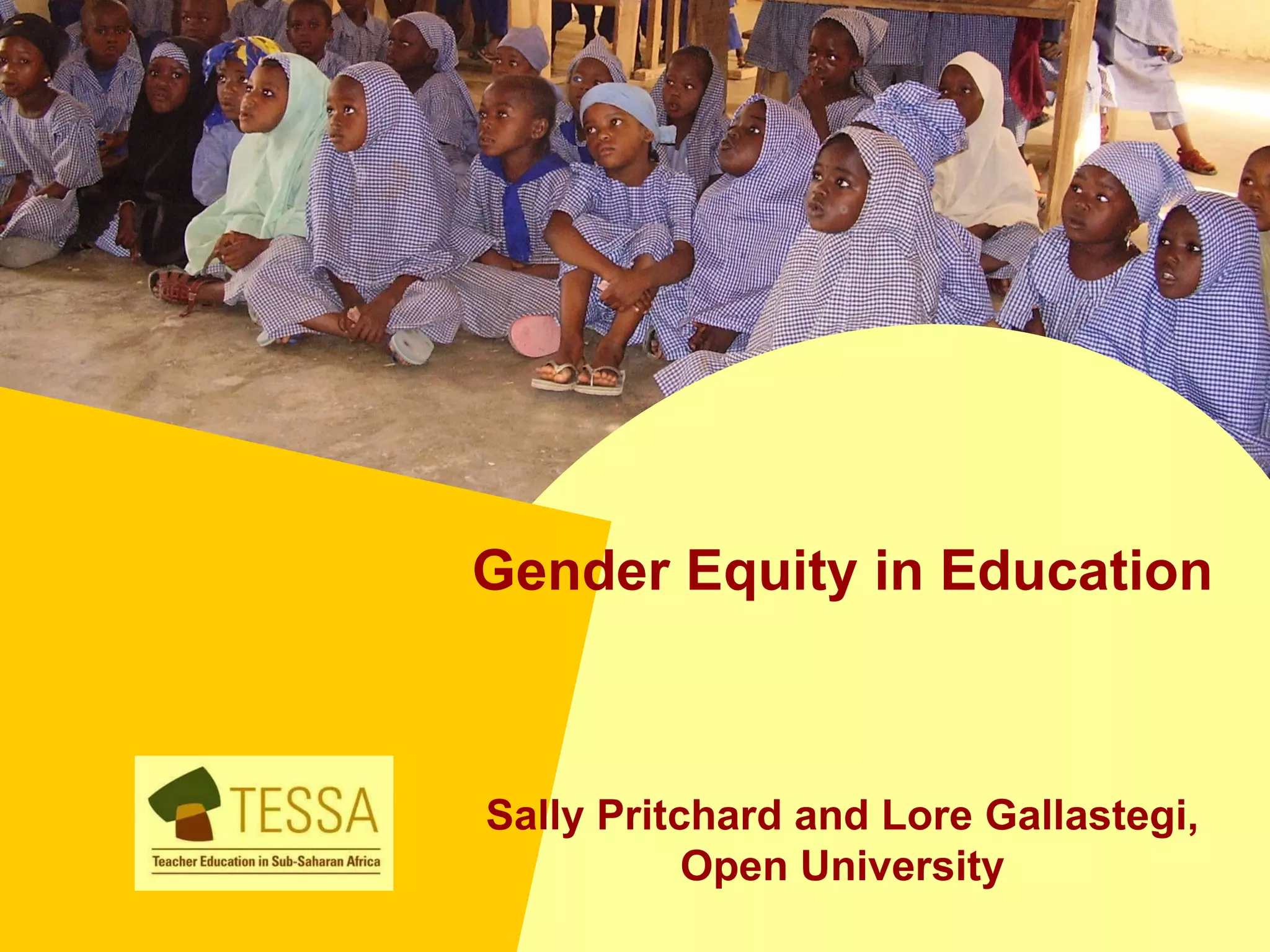
Gender Equity inEducation
Sally Pritchard and Lore Gallastegi,
Open University
2.
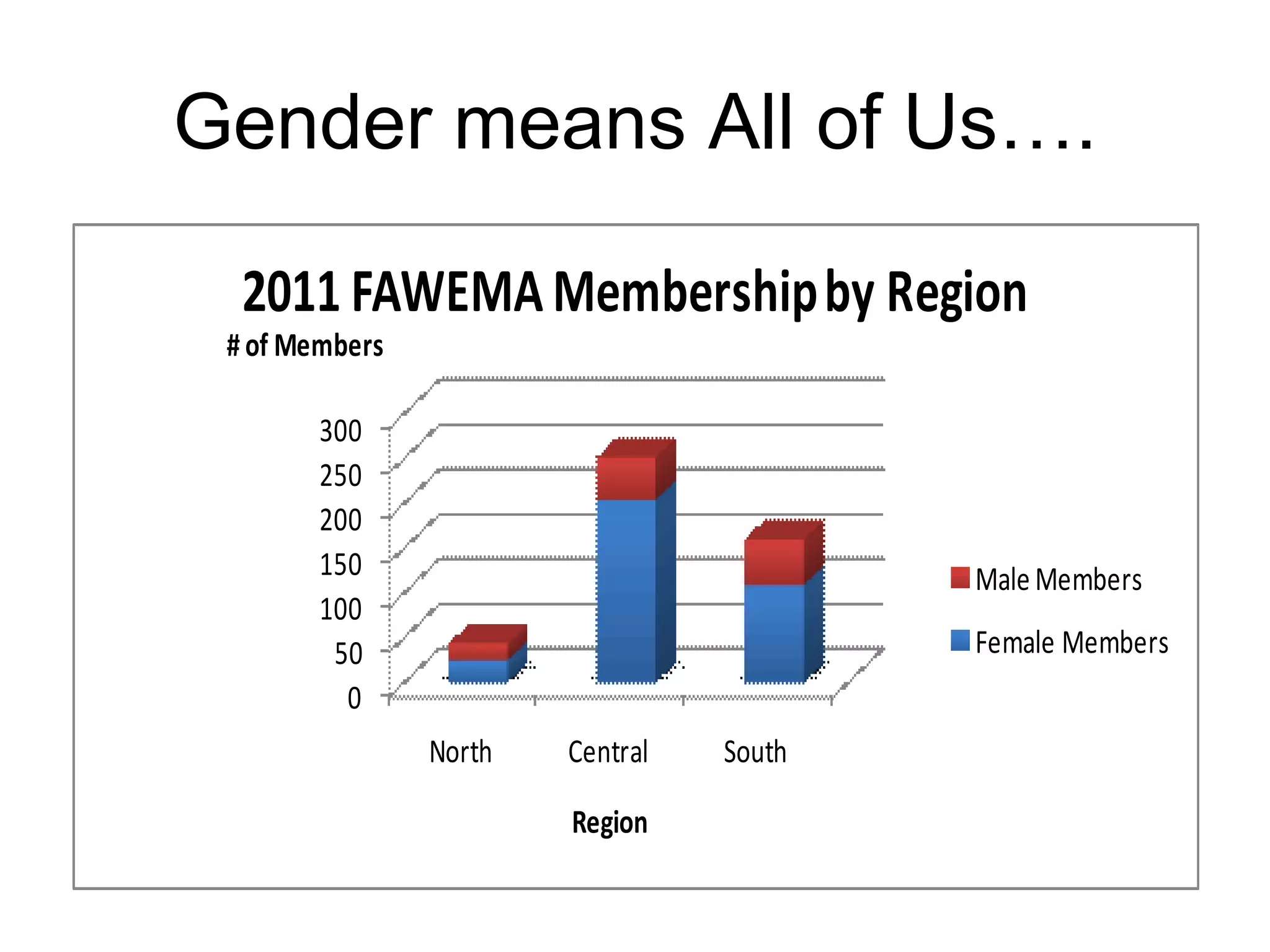
Gender means Allof Us….
2011 FAWEMA Membership by Region
# of Members
300
250
200
150 Male Members
100
50 Female Members
0
North Central South
Region
3.
Malawi Access toTeaching
Saltire Scholarships Project wins
an award!
• In March 2012, everyone at TESSA was delighted
that the Malawi Access to Teaching Saltire
Scholarship project was honoured with a ‘Women
Deliver’ award.
• The award names the top 50 Ideas and Solutions
Improving the Lives of Girls and Women Worldwide.
• The Access to Teaching Saltire Scholarship project
has been chosen for the impact it has had on girls
and women in Malawi.
4.
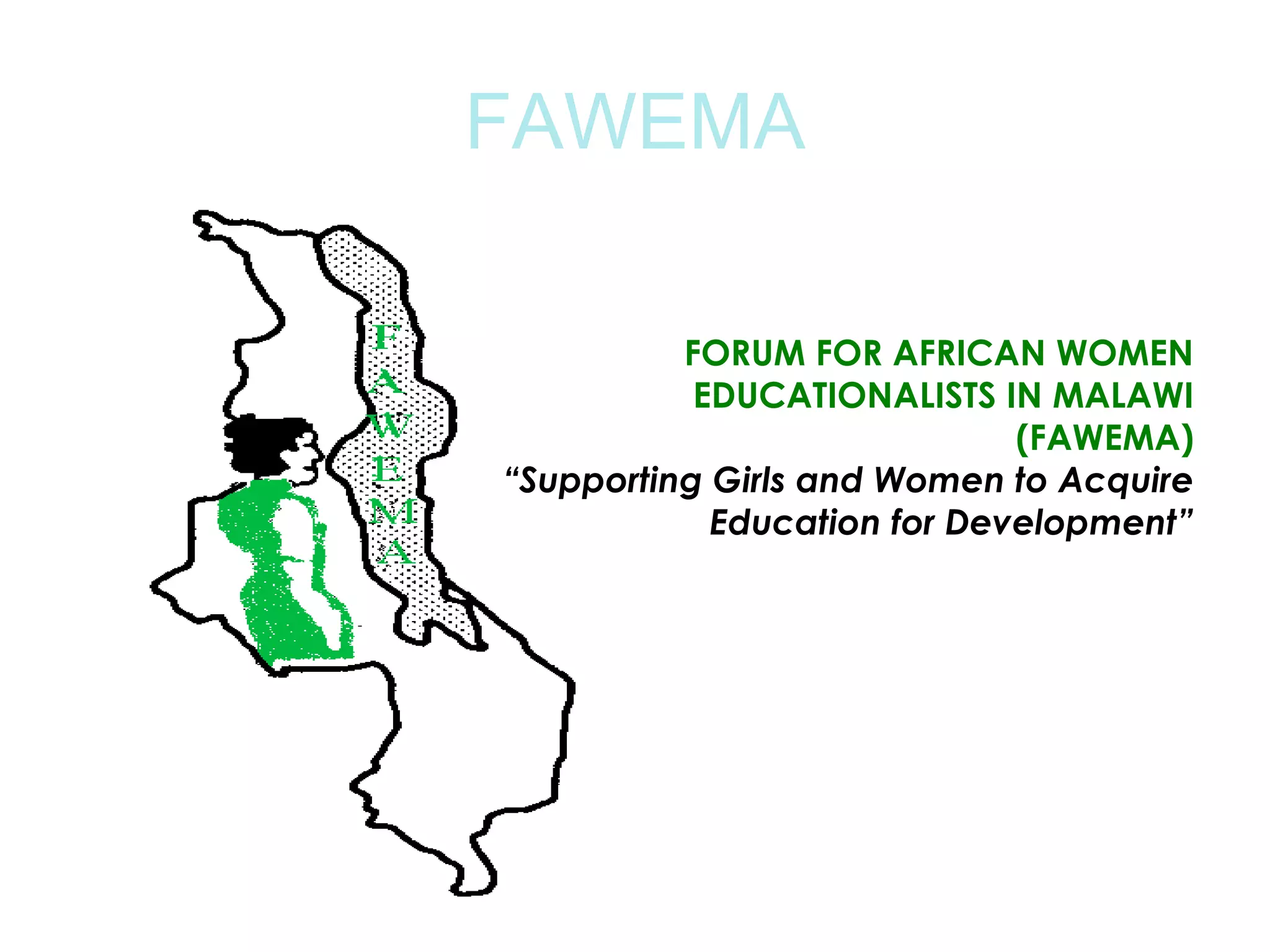
FAWEMA
FORUM FOR AFRICAN WOMEN
EDUCATIONALISTS IN MALAWI
(FAWEMA)
“Supporting Girls and Women to Acquire
Education for Development”
5.
Fawema
Vision: Genderparity in education i.e. to
enable girls and women to exploit their full
potential in order to effectively contribute
towards community and national
development.
Mission: To mobilize expertise and
resources in order to support and
advance girls’ and women’s education in
Malawi for development.
Role Models
‘FAWEMA exposed me to a Lady Lawyer, I want to be like
her” Mercy doing 2nd year, studying Law at Blantyre
International University’
Editor's Notes
#3 But culture functions with both together, therefore we need to look at both at the same time.
#6 The Millennium Development Goal (MDG) for gender equality in education by 2005 has been criticised for its grandiose ambition, its failure to adequately conceptualise the nature of gender inequality or the diverse forms this takes, the inadequate policies developed to put the goal into practice and the limited measurements used for monitoring. The paper argues for a strategic defence of the MDG as an opportunity to think more widely about what the contents of rights in education are and how gender equality might be advanced. Drawing on the capability approach of Amartya Sen and Martha Nussbaum it considers gender equality in education in relation to wellbeing and agency freedom and achievement.
#7 the number of girls compared to boys who are out of school, who drop out, who complete primary / secondary school. The number of girls who go to university, who qualify in the professions, who become high achievers. In every case, girls come out worse than their male counterparts, and the differences become wider the further along the educational journey you go. So that the last time I was in Malawi I met a women who told me she was the first woman in her district ever to go to University.
#8 )…. How we all, whatever our gender treat girls and women differently to boys and men and expect different things of them. Not just about access – it’s about what happens when they are there Content matters – one of the Professors at the OU carried out some research eg girls don’t answer questions about cars even if the question is about looking at a pie chart. Vice versa with boys not answering questions about women’s clothes. A different teacher led an exercise to design an apparatus to move an object 5 m. To the boys he was clear on the brief, to the girls he told them not to worry if they couldn’t do it and to do what they could. They focused more on decorative aspects than functional ones. It operates at a number of levels. Eg differences in assessment levels.
#11 Confidence of women and girls to envisage themselves as ……





![Coded Agents – with UiPath SDK + LangGraph [Virtual Hands-on Workshop]](https://cdn.slidesharecdn.com/ss_thumbnails/codedagentsdeck-251215155422-5497c599-thumbnail.jpg?width=640&height=640&fit=bounds)

