School Math
Learning Teams
AGENDA
MATH	VISION
What	does	it	mean	to	be	good	at	math?
Burning	questions
EARLY	MATH	LEARNING
Counting	and	Quantity
JUNIOR	and	INTERMEDIATE	 MATH
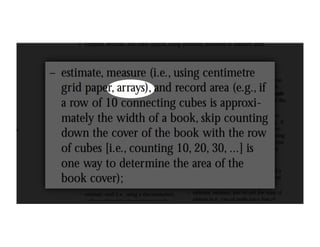
Arrays	and	Areas	Models
PEDAGOGICAL	SYSTEMS
Planning	a	Task
LEADING	MATH	IN	YOUR	SCHOOL
The	role	of	the	school	math	learning	team
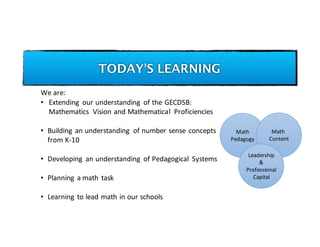
TODAY’S LEARNING
We	are:
• Extending	 our	understanding	 of	the	GECDSB:	
Mathematics	 Vision	and	Mathematical	 Proficiencies
• Building	an	understanding	 of	number	sense	concepts	
from	K-10
• Developing	 an	understanding	 of	Pedagogical	 Systems
• Planning	a	math	task
• Learning	to	lead	math	in	our	schools
Math	
Pedagogy
Math
Content
Leadership	
&	
Professional	
Capital
THE MATHEMATICS JOURNEY
• Mathematics	journey	is	unlike	many	others
• It	is	not	an	implementation	 of	a	program	or	process
• It	is	the	 enaction	of	the	GECDSB	Vision
The Work: Ambitious and Necessary
Enact the Vision
“The GECDSB provides mathematics education that engages and
empowers students through collaboration, communication, inquiry,
critical thinking and problem-solving, to support each student’s
learning and nurture a positive attitude towards mathematics.”
Table Talk…
Why is this work both ambitious and necessary?
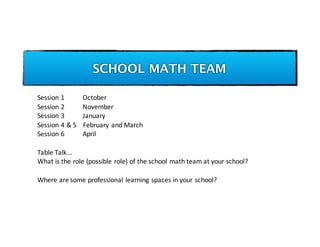
SCHOOL MATH TEAM
Click	to	
add	text
Session	1 October
Session	2 November
Session	3 January
Session 4 & 5 February	and	March
Session	6 April
Table	Talk...
What	is	the	role	(possible	role)	of	the	school	math	team	at	your	school?
Where	are	some	professional	learning	spaces	in	your	school?
What does it mean to be good
at mathematics?
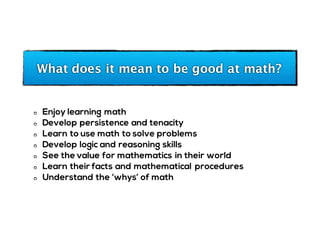
What does it mean to be good at math?
Enjoy learning math
Develop persistence and tenacity
Learn to use math to solve problems
Develop logic and reasoning skills
See the value for mathematics in their world
Learn their facts and mathematical procedures
Understand the ‘whys’ of math
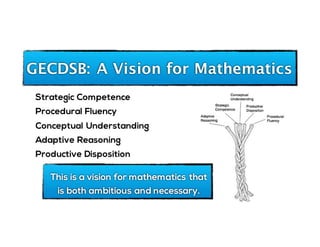
GECDSB: A Vision for Mathematics
Strategic Competence
Procedural Fluency
Conceptual Understanding
Adaptive Reasoning
Productive Disposition
This is a vision for mathematics that
is both ambitious and necessary.
Math Task Force Data
What does it mean to be good at math?
Math as a functional skill
Math as applied to a profession
Math as a way of thinking and seeing the world
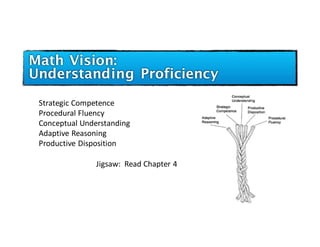
Math Vision:
Understanding Proficiency
Strategic	Competence
Procedural	Fluency
Conceptual	Understanding
Adaptive	Reasoning
Productive	Disposition
Jigsaw: Read	Chapter	4
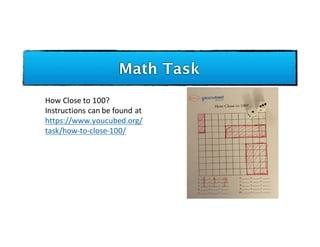
Math Task
Click	to	
add	text
How	Close	to	100?	
Instructions	can	be	found	at	
https://www.youcubed.org/
task/how-to-close-100/
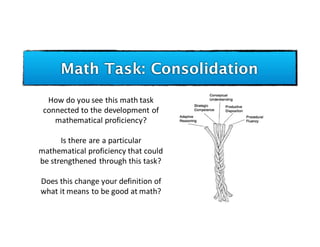
Math Task: Consolidation
How	do	you	see	this	math	task	
connected	to	the	development	of	
mathematical	proficiency?
Is	there	are	a	particular	
mathematical	proficiency	that	could	
be	strengthened	through	this	task?
Does	this	change	your	definition	of	
what	it	means	to	be	good	at	math?
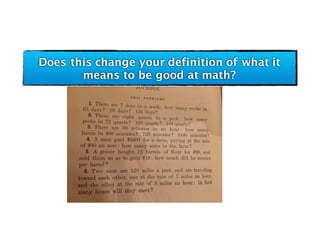
Does this change your definition of what it
means to be good at math?
The Work: Guided By Our Questions
We have many questions about mathematics education.
Table Talk…
With the learners at your table, brainstorm some of the
questions you have or yourstaff may have about mathematics
education.
Share them with the larger group.
COFFEE BREAK
Early Mathematics
In	2007,	it	was	found	 that	mathematics	skills	among	children	in	Kindergarten	were	the	
best	predictor	of	later	school	achievement,	regardless	of	gender	or	socio-economic	
status	(Duncan	et	al.,	2007).	 Kindergarten	 Program,	 2016
Critical	Question
How	can	educators	take	advantage	of	the	mathematical	knowledge	and	experience	that	
children	have?
Critical	Understanding
The	presence	alone	of	mathematics	in	play	is	insufficient	for	rich	learning	to	occur	
Intentional,	purposeful	 teacher	interactions	are	necessary	to	ensure	that	mathematical	
learning	is	maximized	during	play.
Early Mathematics
As	educators	we	must	constantly	ask	ourselves:
Why	this	learning,
for	this	student,
at	this	time?
Early Mathematics
What	mathematical	skills	do	you	think	our	young	learners	need?
Number	Sense
• Counting
• Quantity	Relationships	
Geometry	and	Measurement
are	foundational	skills	that	must	be	in	place	to	support	all	future	
math	learning.
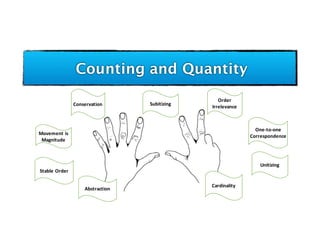
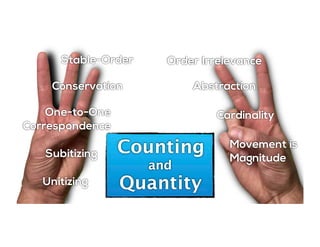
Counting and Quantity
Conservation
One-to-one
Correspondence
Cardinality
Stable	Order
Order	
Irrelevance
Abstraction
Movement	is	
Magnitude
Subitizing
Unitizing
Case Study
• What	principles	of	quantity	and	counting	
does	the	child	understand?
• What	might	be	the	next	step(s)	for	learning	
for	this	child?
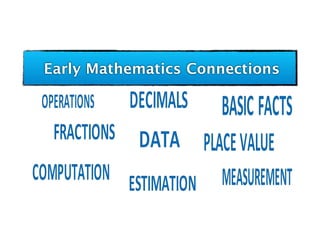
Early Mathematics Connections
Mathematics
Learning
Teams
M
L
T
Counting
and
Quantity
Stable-Order Order Irrelevance
Conservation
One-to-One
Correspondence
Abstraction
Movement is
MagnitudeSubitizing
Unitizing
Cardinality
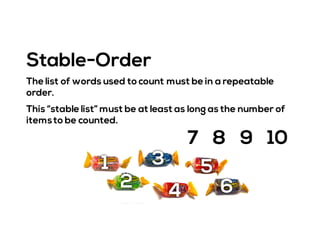
Stable-Order
The list of words used to count must be in a repeatable
order.
This “stable list” must be at least as long as the number of
itemsto be counted.
1
2
3
4
5
6
7 8 9 10
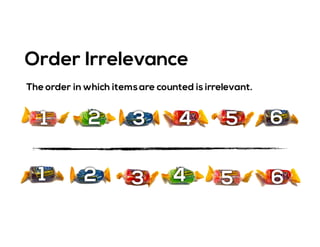
Order Irrelevance
The order in which itemsare counted is irrelevant.
1 2 3 4 5 6
1 2 3 4 5 6
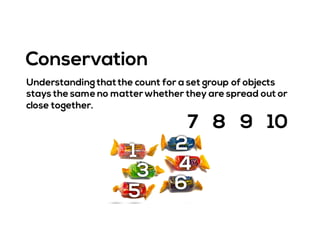
Conservation
Understanding thatthe count for a set group of objects
stays the same no matterwhether they are spread out or
close together.
7 8 9 10
1 2
3 4
5 6
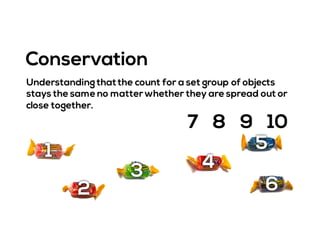
Conservation
Understanding thatthe count for a set group of objects
stays the same no matterwhether they are spread out or
close together.
7 8 9 10
1
2
3 4
5
6
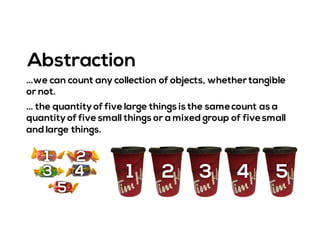
… the quantityof five large things is the samecount as a
quantityof five small things or a mixed group of fivesmall
and large things.
Abstraction
…we can count any collection of objects, whether tangible
or not.
1 2
3 4
5
1 2 3 4 5
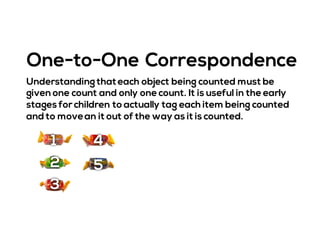
Understanding thateach object being counted must be
given one count and only one count. It is useful in the early
stages for children to actually tag each item being counted
and to movean it out of the way as it is counted.
One-to-One Correspondence
1
2
3
4
5
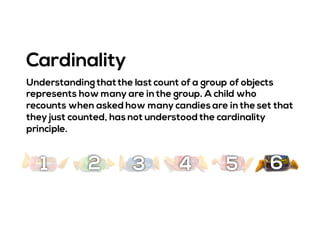
Understanding thatthe last count of a group of objects
represents how many are in the group. A child who
recounts when asked how many candies are in the set that
they just counted, has not understood the cardinality
principle.
Cardinality
1 2 3 4 5 6
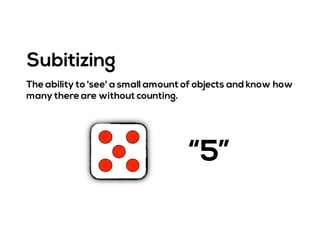
The ability to 'see' a small amount of objects and know how
many there are without counting.
Subitizing
“5”
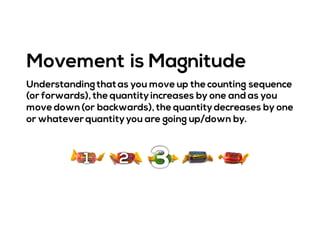
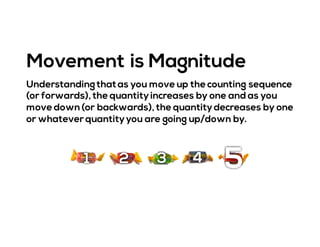
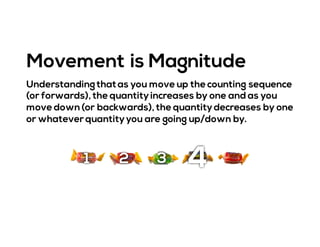
Understanding thatas you move up the counting sequence
(or forwards), the quantityincreases by one and as you
move down (or backwards), the quantitydecreases by one
or whatever quantityyou are going up/down by.
Movement is Magnitude
1 2 3
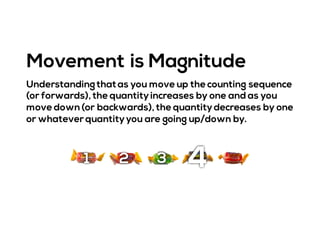
Understanding thatas you move up the counting sequence
(or forwards), the quantityincreases by one and as you
move down (or backwards), the quantitydecreases by one
or whatever quantityyou are going up/down by.
Movement is Magnitude
1 2 3 4
Understanding thatas you move up the counting sequence
(or forwards), the quantityincreases by one and as you
move down (or backwards), the quantitydecreases by one
or whatever quantityyou are going up/down by.
Movement is Magnitude
1 2 3 4 5
Understanding thatas you move up the counting sequence
(or forwards), the quantityincreases by one and as you
move down (or backwards), the quantitydecreases by one
or whatever quantityyou are going up/down by.
Movement is Magnitude
1 2 3 4
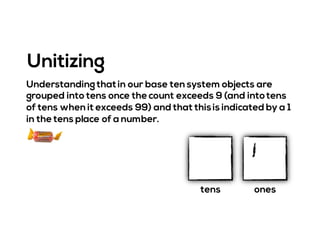
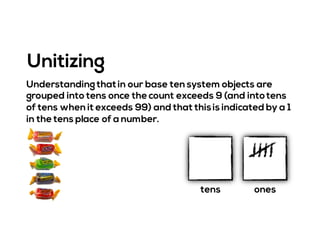
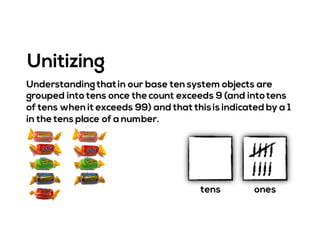
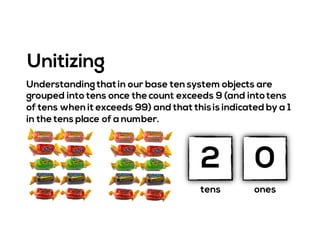
Understanding thatin our base ten system objects are
grouped into tens once the count exceeds 9 (and intotens
of tens when it exceeds 99) and that thisis indicated by a 1
in the tens place of a number.
Unitizing
tens ones
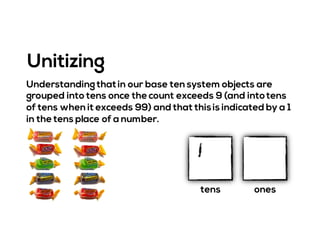
Understanding thatin our base ten system objects are
grouped into tens once the count exceeds 9 (and intotens
of tens when it exceeds 99) and that thisis indicated by a 1
in the tens place of a number.
Unitizing
tens ones
Understanding thatin our base ten system objects are
grouped into tens once the count exceeds 9 (and intotens
of tens when it exceeds 99) and that thisis indicated by a 1
in the tens place of a number.
Unitizing
tens ones
Understanding thatin our base ten system objects are
grouped into tens once the count exceeds 9 (and intotens
of tens when it exceeds 99) and that thisis indicated by a 1
in the tens place of a number.
Unitizing
tens ones
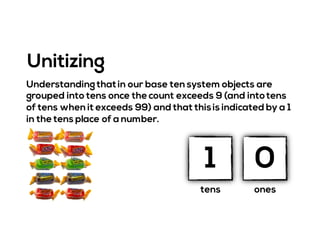
Understanding thatin our base ten system objects are
grouped into tens once the count exceeds 9 (and intotens
of tens when it exceeds 99) and that thisis indicated by a 1
in the tens place of a number.
Unitizing
tens ones
1 0
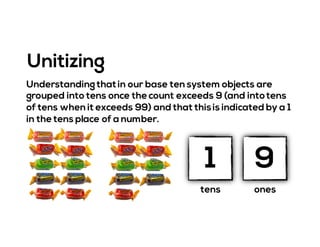
Understanding thatin our base ten system objects are
grouped into tens once the count exceeds 9 (and intotens
of tens when it exceeds 99) and that thisis indicated by a 1
in the tens place of a number.
Unitizing
tens ones
1 9
Understanding thatin our base ten system objects are
grouped into tens once the count exceeds 9 (and intotens
of tens when it exceeds 99) and that thisis indicated by a 1
in the tens place of a number.
Unitizing
tens ones
2 0
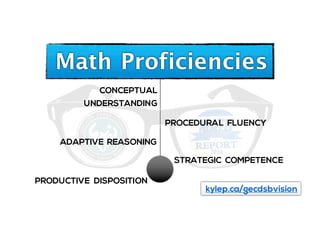
PROCEDURAL FLUENCY
STRATEGIC COMPETENCE
ADAPTIVE REASONING
PRODUCTIVE DISPOSITION
CONCEPTUAL
UNDERSTANDING
kylep.ca/gecdsbvision
Math Proficiencies
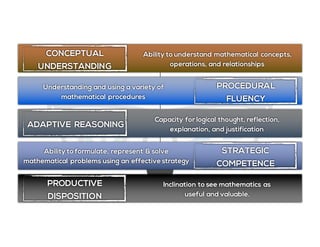
PRODUCTIVE
DISPOSITION
Ability to formulate, represent & solve
mathematical problems using an effective strategy
STRATEGIC
COMPETENCE
PROCEDURAL
FLUENCY
Understanding and using a variety of
mathematical procedures
ADAPTIVE REASONING
Capacity for logical thought, reflection,
explanation, and justification
Inclination to see mathematics as
useful and valuable.
Ability to understand mathematical concepts,
operations, and relationships
CONCEPTUAL
UNDERSTANDING
@MathletePearcewww.tapintoteenminds.com
LAST TIME
@MathletePearcewww.tapintoteenminds.com
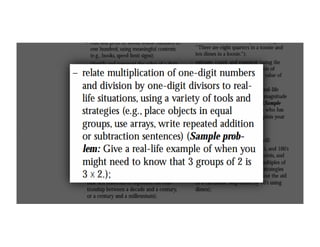
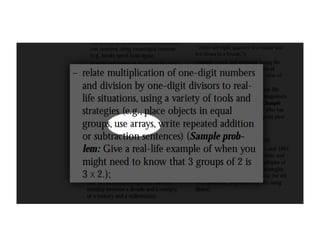
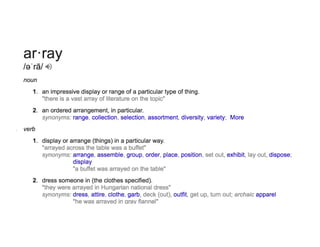
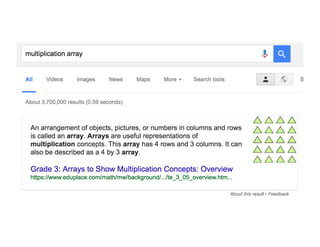
Array
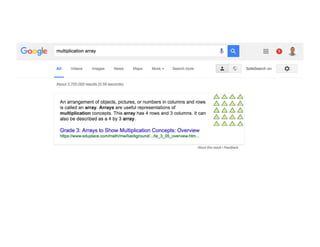
Multiplication
Array
Array
Array
Array
Array
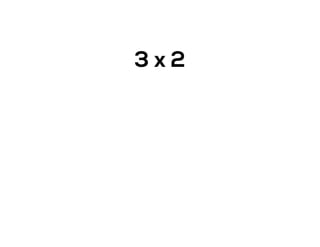
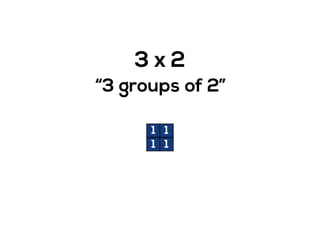
3 x 2
3 x 2
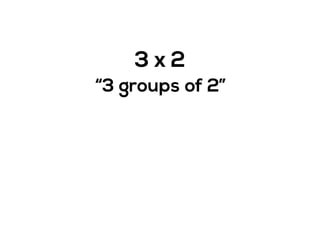
“3 groups of 2”
3 x 2
“3 groups of 2”
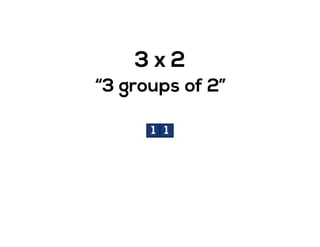
1 1
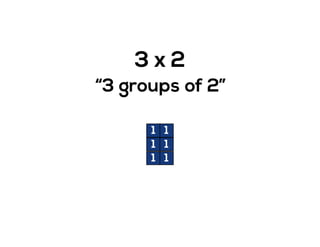
3 x 2
“3 groups of 2”
1 1
1 1
3 x 2
“3 groups of 2”
1 1
1 1
1 1
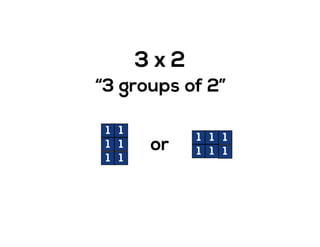
3 x 2
“3 groups of 2”
1 1
1 1
1 1
1 1
1 1
1
1or
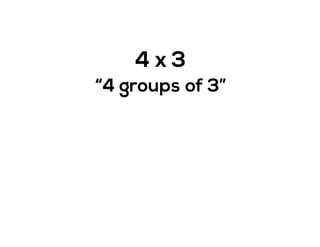
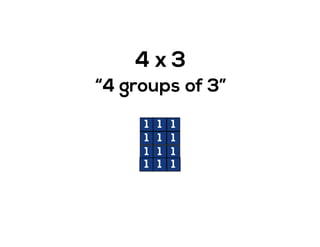
4 x 3
4 x 3
“4 groups of 3”
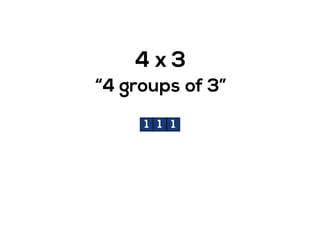
4 x 3
“4 groups of 3”
1 1 1
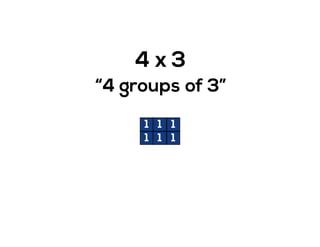
4 x 3
“4 groups of 3”
1 1
1 1
1
1
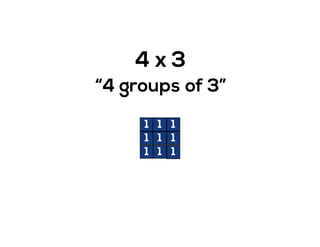
4 x 3
“4 groups of 3”
1 1
1 1
1 1
1
1
1
4 x 3
“4 groups of 3”
1 1
1 1
1 1
1
1
1
1 1 1
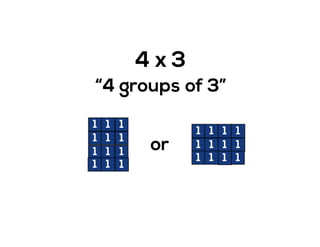
4 x 3
“4 groups of 3”
1 1
1 1
1 1
1 1
1 1
1
1or
1
1
1
1 1 1
1
1
1 1 1 1
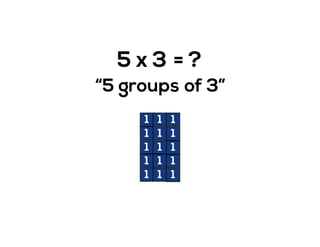
5 x 3 = ?
“5 groups of 3”
5 x 3
“5 groups of 3”
1 1
1 1
1 1
= ?
1
1
1
1 1
1 1
1
1
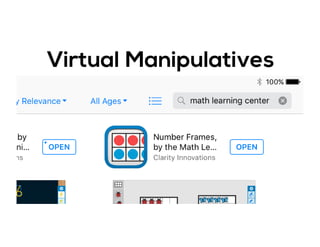
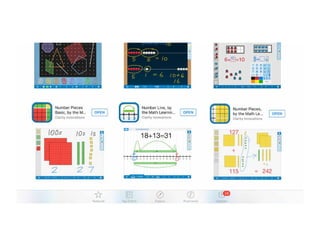
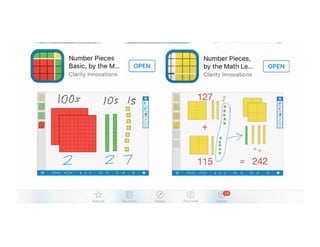
Virtual Manipulatives
catalog.mathlearningcenter.org/apps
Virtual Manipulatives
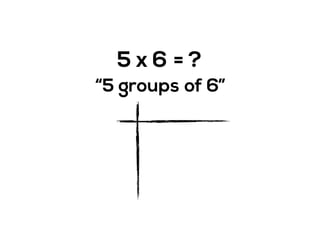
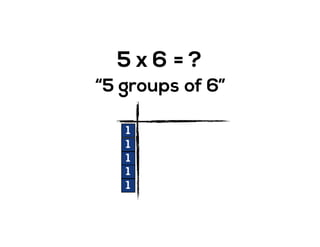
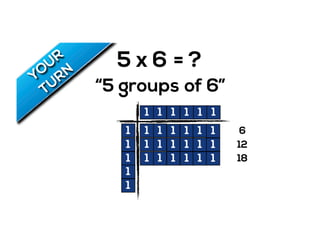
5 x 6
“5 groups of 6”
= ?
5 x 6
“5 groups of 6”
= ?
1
1
1
1
1
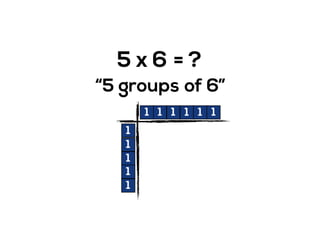
5 x 6
“5 groups of 6”
= ?
1
1
1
1
1
1 1 1 1 1 1
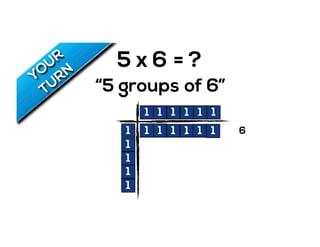
5 x 6
“5 groups of 6”
= ?
1
1
1
1
1
1 1 1 1 1 1
1 1 1 11 1 6
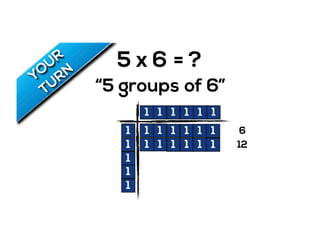
5 x 6
“5 groups of 6”
= ?
1
1
1
1
1
1 1 1 1 1 1
1 1 1 11 1
1 1 1 11 1
6
12
5 x 6
“5 groups of 6”
= ?
1
1
1
1
1
1 1 1 1 1 1
1 1 1 11 1
1 1 1 11 1
1 1 1 11 1
6
12
18
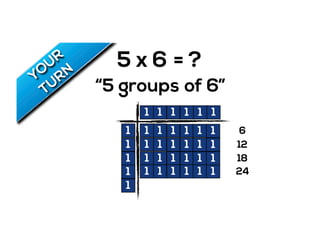
5 x 6
“5 groups of 6”
= ?
1
1
1
1
1
1 1 1 1 1 1
1 1 1 11 1
1 1 1 11 1
1 1 1 11 1
1 1 1 11 1
6
12
18
24
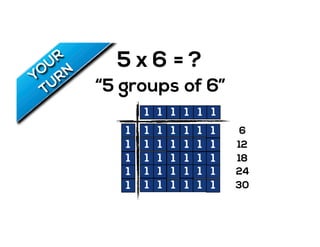
5 x 6
“5 groups of 6”
= ?
1
1
1
1
1
1 1 1 1 1 1
1 1 1 11 1
1 1 1 11 1
1 1 1 11 1
1 1 1 11 1
1 1 1 11 1
6
12
18
24
30
1
1
1
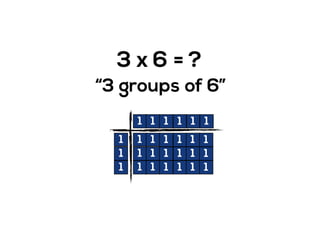
3 x 6
“3 groups of 6”
1 1 1 1
= ?
1 1
1 1 1 11 1
1 1 1 11 1
1 1 1 1 1 1
1 1
1
1
1
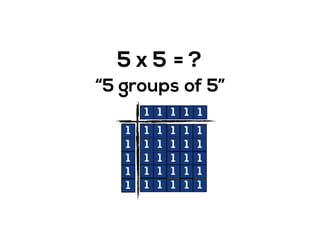
5 x 5
“5 groups of 5”
1 1 1 1
= ?
1
1
1
1
1 1 1 11
1 1 1 11
1 1 1 11
1 1 1 11
1 1
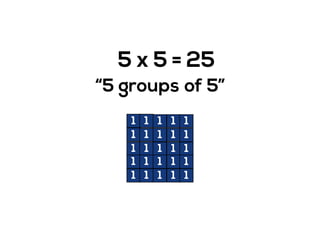
5 x 5
“5 groups of 5”
1 1 1 1
= 25
1
1 1 1 11
1 1 1 11
1 1 1 11
1 1 1 11
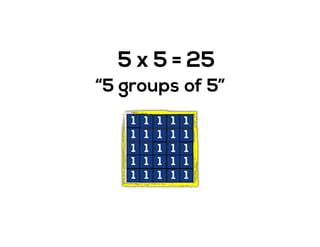
5 x 5
“5 groups of 5”
1 1 1 1
= 25
1
1 1 1 11
1 1 1 11
1 1 1 11
1 1 1 11
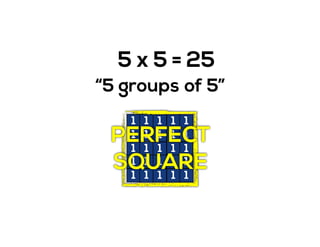
5 x 5
“5 groups of 5”
1 1 1 1
= 25
1
1 1 1 11
1 1 1 11
1 1 1 11
1 1 1 11
PERFECT
SQUARE
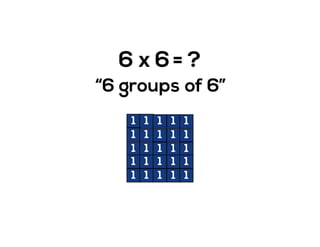
6 x 6
“6 groups of 6”
1 1 1 1
= ?
1
1 1 1 11
1 1 1 11
1 1 1 11
1 1 1 11
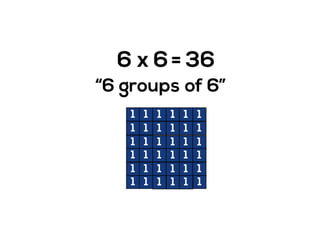
6 x 6
“6 groups of 6”
1 1 1 1
= 36
1
1 1 1 11
1 1 1 11
1 1 1 11
1 1 1 11
1
1
1
1
1
1 1 1 11 1
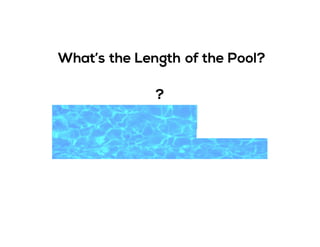
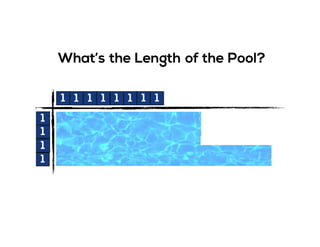
What’s the Length of the Pool?
?
1
1
1
1
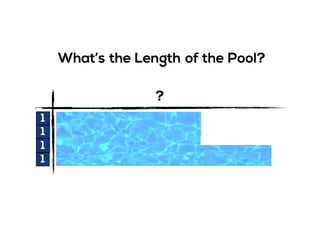
What’s the Length of the Pool?
?
1
1
1
1
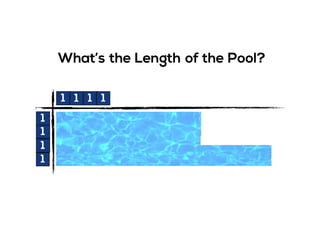
What’s the Length of the Pool?
1 1 1 1
1
1
1
1
What’s the Length of the Pool?
1 1 1 1 1 1 1 1
1
1
1
1
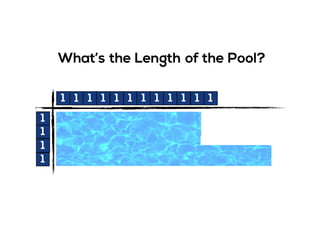
What’s the Length of the Pool?
1 1 1 1 1 1 1 1 1 1 1 1
1
1
1
1
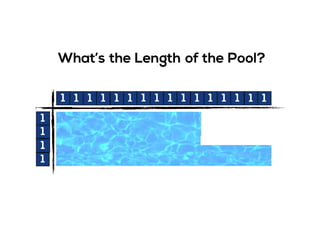
What’s the Length of the Pool?
1 1 1 1 1 1 1 1 1 1 1 1 1 1 1 1
1
1
1
1
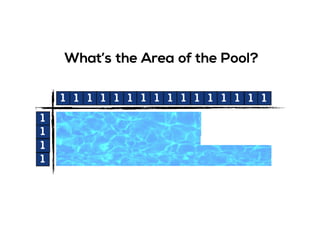
1 1 1 1 1 1 1 1 1 1 1 1 1 1 1 1
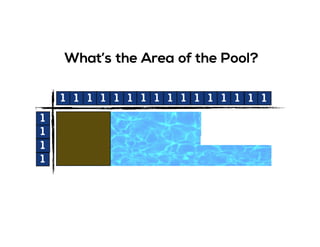
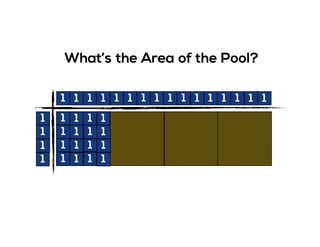
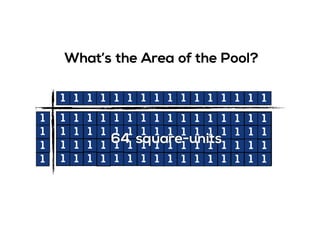
What’s the Area of the Pool?
1
1
1
1
1 1 1 1 1 1 1 1 1 1 1 1 1 1 1 1
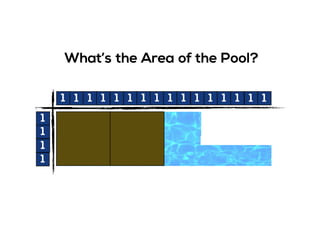
What’s the Area of the Pool?
1
1
1
1
1 1 1 1 1 1 1 1 1 1 1 1 1 1 1 1
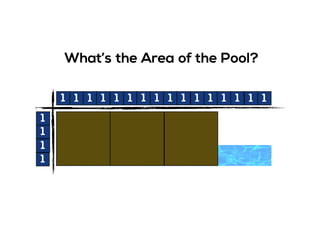
What’s the Area of the Pool?
1
1
1
1
1 1 1 1 1 1 1 1 1 1 1 1 1 1 1 1
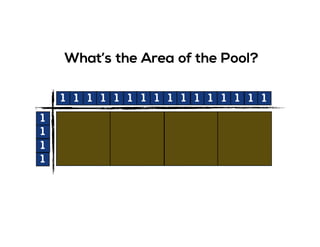
What’s the Area of the Pool?
1
1
1
1
1 1 1 1 1 1 1 1 1 1 1 1 1 1 1 1
What’s the Area of the Pool?
1
1
1
1
1 1 1 1 1 1 1 1 1 1 1 1 1 1 1 1
What’s the Area of the Pool?
1 1 1
1 1 1
1 1 1
1
1
1
1 1 1 1
1 1 1
1 1 1
1 1 1
1
1
1
1 1 1 1
1
1
1
1
1 1 1 1 1 1 1 1 1 1 1 1 1 1 1 1
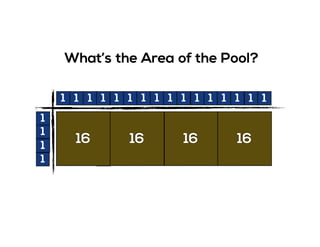
What’s the Area of the Pool?
16 16 16 16
1 1 1
1 1 1
1 1 1
1
1
1
1 1 1 1
1
1
1
1
1 1 1 1 1 1 1 1 1 1 1 1 1 1 1 1
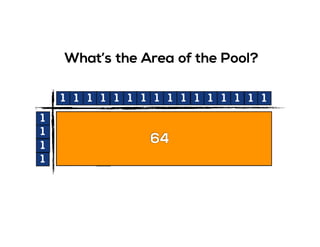
What’s the Area of the Pool?
16 16 16 1664
1 1 1
1 1 1
1 1 1
1
1
1
1 1 1 1
1
1
1
1
1 1 1 1 1 1 1 1 1 1 1 1 1 1 1 1
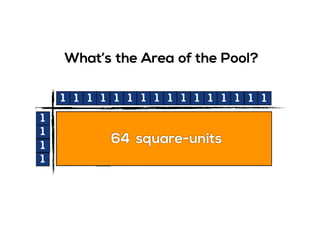
What’s the Area of the Pool?
16 16 16 1664 square-units
1 1 1
1 1 1
1 1 1
1
1
1
1 1 1 1
1
1
1
1
1 1 1 1 1 1 1 1 1 1 1 1 1 1 1 1
What’s the Area of the Pool?
16 16
1 1 1
1 1 1
1 1 1
1 1 1
1 1 1
1 1 1
1 1 1
1 1 1
1 1 1
1 1 1
1 1 1
1 1 1
1 1 1
1 1 1
1 1 1
1
1
1
1 1 1 1 1 1 1 1 1 1 1 1 1 1 1 1
64 square-units
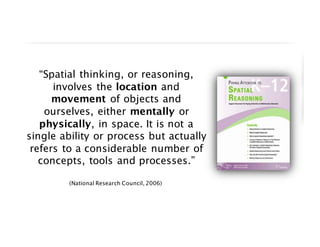
“Spatial thinking, or reasoning,
involves the location and
movement of objects and
ourselves, either mentally or
physically, in space. It is not a
single ability or process but actually
refers to a considerable number of
concepts, tools and processes.”
(National Research Council, 2006)
“The relation between spatial
ability and mathematics is so
well established that it no longer
makes sense to ask whether
they are related…”
“…moreover, spatial thinking
was a better predictor of
mathematics success than either
verbal or mathematical skills.”
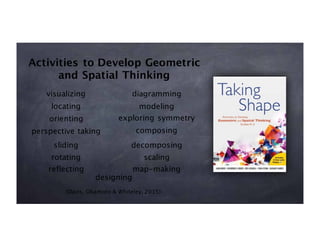
Activities to Develop Geometric
and Spatial Thinking
visualizing diagramming
designing
(Davis, Okamoto & Whiteley, 2015)
orienting
locating
perspective taking
sliding
rotating
reflecting
modeling
exploring symmetry
composing
decomposing
scaling
map-making
1
1
1
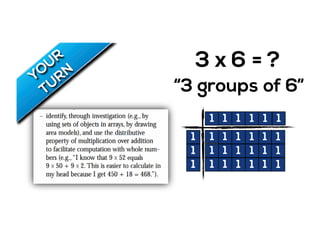
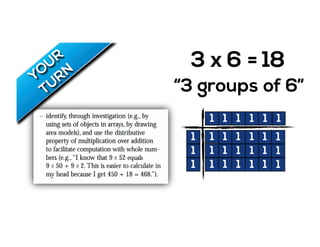
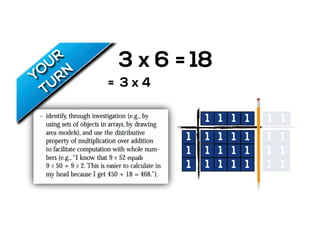
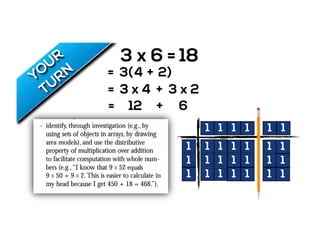
3 x 6
“3 groups of 6”
1
= ?
1
1 1
1
1 1 11
1 1 11
1 1 11 1
1 1 1 1 1 1
= 18
1
1
1
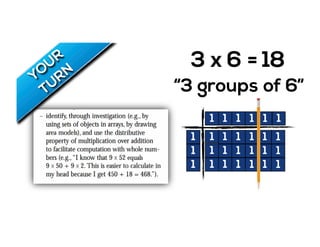
3 x 6
“3 groups of 6”
1 1
1 1
1
1 1 11
1 1 11
1 1 11 1
1 1 1 1 1 1
= 18
1
1
1
3 x 6
“3 groups of 6”
1 1
1 1
1
1 1 11
1 1 11
1 1 11 1
1 1 1 1 1 1
= 18
1
1
1
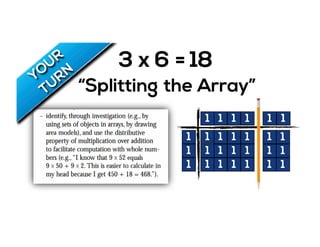
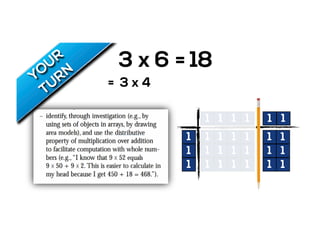
3 x 6
“Splitting the Array”
1 1
1 1
1
1 1 11
1 1 11
1 1 11 1
1 1 1 1 1 1
= 18
1
1
1
3 x 6
1 1
1 1
1
1 1 11
1 1 11
1 1 11 1
1 1 1 1 1 1
3 x 4=
= 18
1
1
1
3 x 6
1 1
1 1
1
1 1 11
1 1 11
1 1 11 1
1 1 1 1 1 1
3 x 4=
= 18
1
1
1
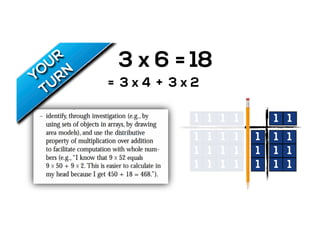
3 x 6
1 1
1 1
1
1 1 11
1 1 11
1 1 11 1
1 1 1 1 1 1
3 x 4= + 3 x 2
= 18
1
1
1
3 x 6
1 1
1 1
1
1 1 11
1 1 11
1 1 11 1
1 1 1 1 1 1
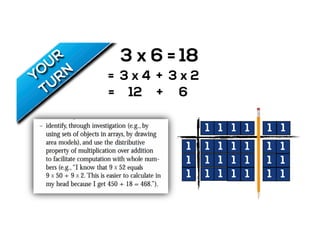
3 x 4= + 3 x 2
12= + 6
= 18
1
1
1
3 x 6
1 1
1 1
1
1 1 11
1 1 11
1 1 11 1
1 1 1 1 1 1
3 x 4= + 3 x 2
12= + 6
3(= +4 2)
@MathletePearcewww.tapintoteenminds.com
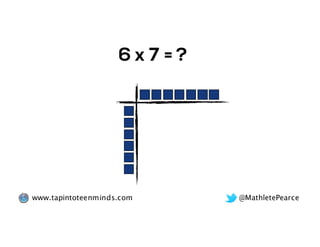
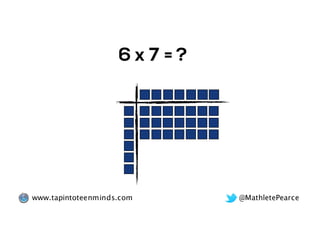
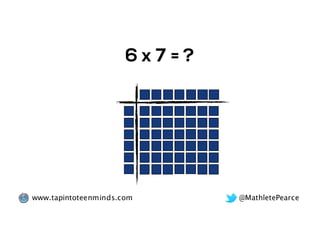
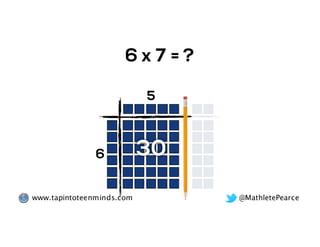
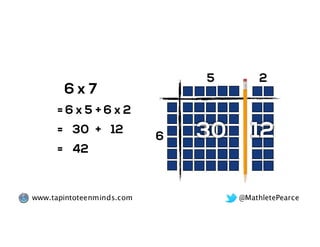
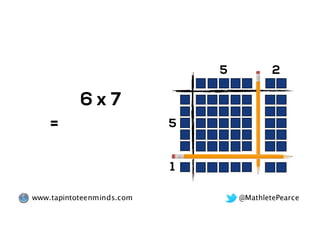
=6 x 7 ?
@MathletePearcewww.tapintoteenminds.com
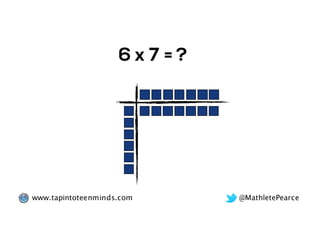
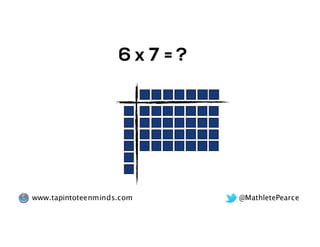
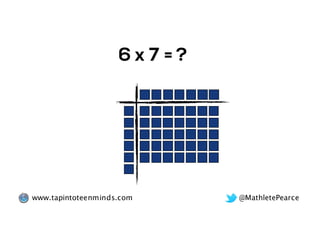
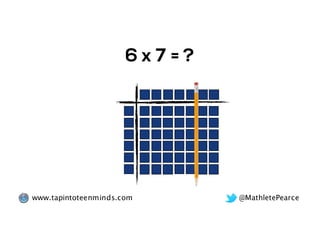
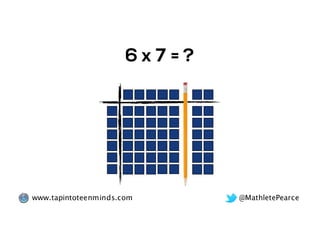
6 x 7 = ?
@MathletePearcewww.tapintoteenminds.com
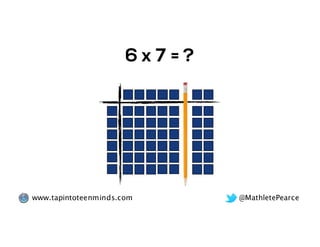
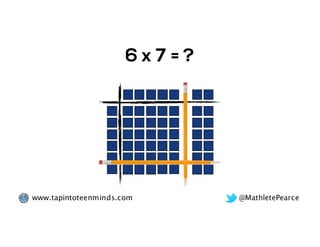
6 x 7 = ?
@MathletePearcewww.tapintoteenminds.com
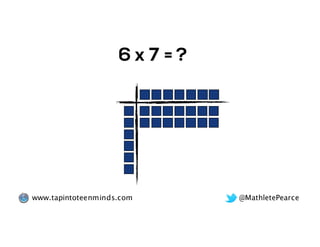
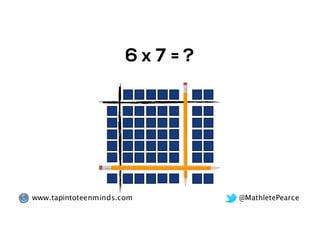
6 x 7 = ?
@MathletePearcewww.tapintoteenminds.com
6 x 7 = ?
@MathletePearcewww.tapintoteenminds.com
6 x 7 = ?
@MathletePearcewww.tapintoteenminds.com
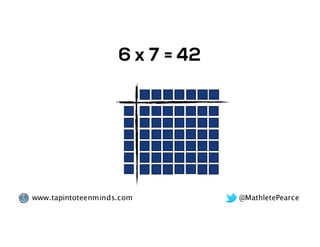
= 426 x 7
@MathletePearcewww.tapintoteenminds.com
= ?6 x 7
@MathletePearcewww.tapintoteenminds.com
= ?6 x 7
@MathletePearcewww.tapintoteenminds.com
= ?6 x 7
@MathletePearcewww.tapintoteenminds.com
= ?6 x 7
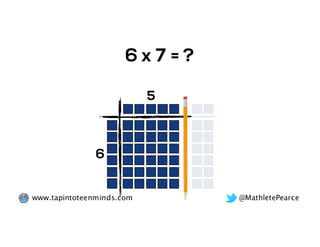
5
6
@MathletePearcewww.tapintoteenminds.com
= ?6 x 7
5
6 30
@MathletePearcewww.tapintoteenminds.com
= ?6 x 7
5
6 30
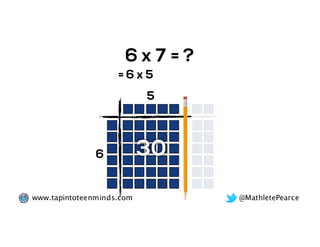
= 6 x 5
@MathletePearcewww.tapintoteenminds.com
= ?6 x 7
5
6 30
= 6 x 5
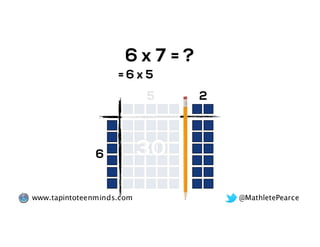
2
@MathletePearcewww.tapintoteenminds.com
= ?6 x 7
5
6 30
= 6 x 5
2
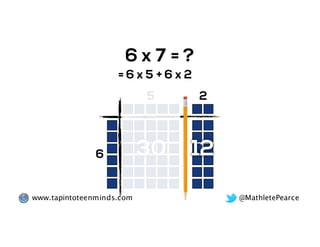
12
+ 6 x 2
@MathletePearcewww.tapintoteenminds.com
6 x 7
5
6 30
= 6 x 5
2
12
+ 6 x 2
= 30 + 12
= 42
@MathletePearcewww.tapintoteenminds.com
= ?6 x 7
@MathletePearcewww.tapintoteenminds.com
= ?6 x 7
@MathletePearcewww.tapintoteenminds.com
= ?6 x 7
@MathletePearcewww.tapintoteenminds.com
=
5
5
2
1
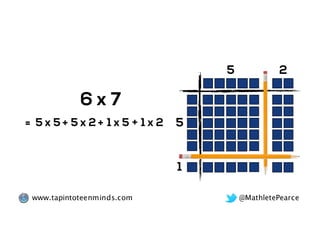
6 x 7
@MathletePearcewww.tapintoteenminds.com
=
5
5
2
1
5 x 5 5 x 2 1 x 5 1 x 2+ + +
6 x 7
@MathletePearcewww.tapintoteenminds.com
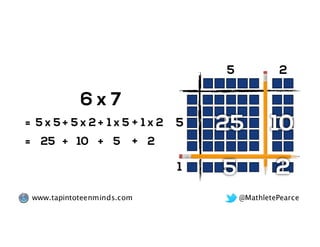
6 x 7
=
5
5 25
2
10
1
5 x 5 5 x 2 1 x 5 1 x 2+ + +
= 25 10 5 2+ + +
5 2
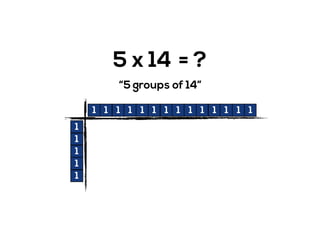
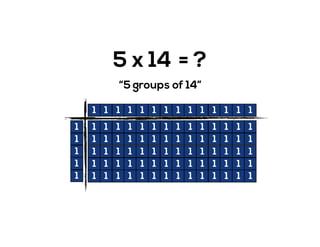
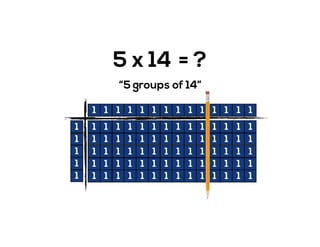
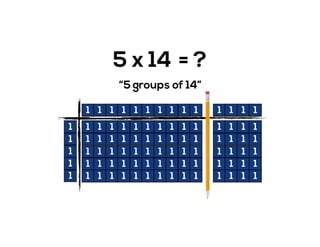
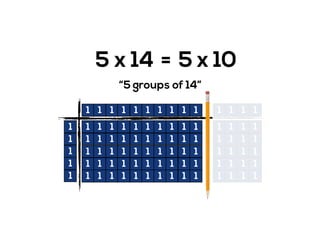
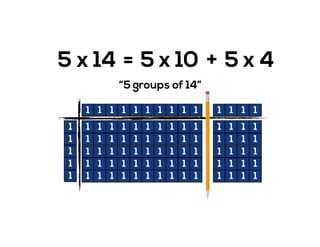
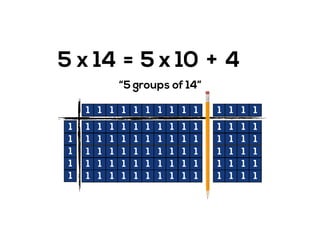
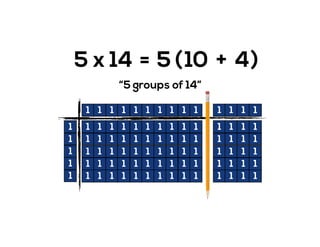
5 x 14 = ?
“5 groups of 14”
1
1
1
1
1
1 1 1 1 1 1 1 1 1 1 1 1 1 1
5 x 14 = ?
“5 groups of 14”
1
1
1
1
1
1 1 1 1 1 1 1 1 1 1 1 1 1 1
1 1 1 1 1 1 1 1 1 1 1 1 1 1
1 1 1 1 1 1 1 1 1 1 1 1 1 1
1 1 1 1 1 1 1 1 1 1 1 1 1 1
1 1 1 1 1 1 1 1 1 1 1 1 1 1
1 1 1 1 1 1 1 1 1 1 1 1 1 1
5 x 14 = ?
“5 groups of 14”
1
1
1
1
1
1 1 1 1 1 1 1 1 1 1 1 1 1 1
1 1 1 1 1 1 1 1 1 1 1 1 1 1
1 1 1 1 1 1 1 1 1 1 1 1 1 1
1 1 1 1 1 1 1 1 1 1 1 1 1 1
1 1 1 1 1 1 1 1 1 1 1 1 1 1
1 1 1 1 1 1 1 1 1 1 1 1 1 1
5 x 14 = ?
“5 groups of 14”
1
1
1
1
1
1 1 1 1 1 1 1 1 1 1 1 1 1 1
1 1 1 1 1 1 1 1 1 1 1 1 1 1
1 1 1 1 1 1 1 1 1 1 1 1 1 1
1 1 1 1 1 1 1 1 1 1 1 1 1 1
1 1 1 1 1 1 1 1 1 1 1 1 1 1
1 1 1 1 1 1 1 1 1 1 1 1 1 1
5 x 14 =
“5 groups of 14”
1
1
1
1
1
1 1 1 1 1 1 1 1 1 1 1 1 1 1
1 1 1 1 1 1 1 1 1 1 1 1 1 1
1 1 1 1 1 1 1 1 1 1 1 1 1 1
1 1 1 1 1 1 1 1 1 1 1 1 1 1
1 1 1 1 1 1 1 1 1 1 1 1 1 1
1 1 1 1 1 1 1 1 1 1 1 1 1 1
x 105
5 x 14 =
“5 groups of 14”
1
1
1
1
1
1 1 1 1 1 1 1 1 1 1 1 1 1 1
1 1 1 1 1 1 1 1 1 1 1 1 1 1
1 1 1 1 1 1 1 1 1 1 1 1 1 1
1 1 1 1 1 1 1 1 1 1 1 1 1 1
1 1 1 1 1 1 1 1 1 1 1 1 1 1
1 1 1 1 1 1 1 1 1 1 1 1 1 1
+x 105 x 45
5 x 14 =
“5 groups of 14”
1
1
1
1
1
1 1 1 1 1 1 1 1 1 1 1 1 1 1
1 1 1 1 1 1 1 1 1 1 1 1 1 1
1 1 1 1 1 1 1 1 1 1 1 1 1 1
1 1 1 1 1 1 1 1 1 1 1 1 1 1
1 1 1 1 1 1 1 1 1 1 1 1 1 1
1 1 1 1 1 1 1 1 1 1 1 1 1 1
+x 105 x 45
5 x 14 =
“5 groups of 14”
1
1
1
1
1
1 1 1 1 1 1 1 1 1 1 1 1 1 1
1 1 1 1 1 1 1 1 1 1 1 1 1 1
1 1 1 1 1 1 1 1 1 1 1 1 1 1
1 1 1 1 1 1 1 1 1 1 1 1 1 1
1 1 1 1 1 1 1 1 1 1 1 1 1 1
1 1 1 1 1 1 1 1 1 1 1 1 1 1
+(105 )45
@MathletePearcewww.tapintoteenminds.com
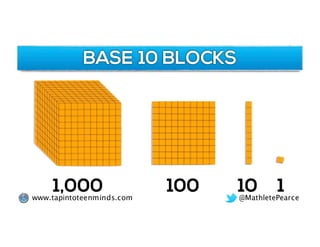
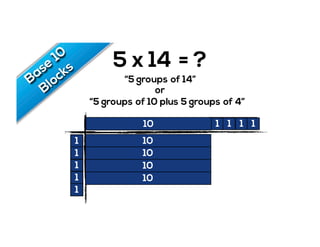
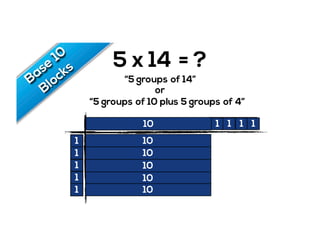
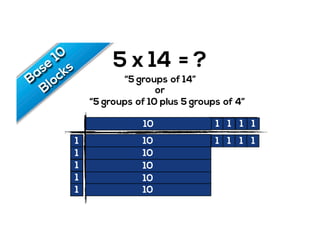
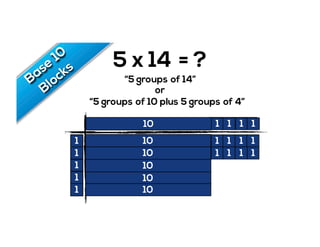
BASE 10 BLOCKS
1001,000 10 1
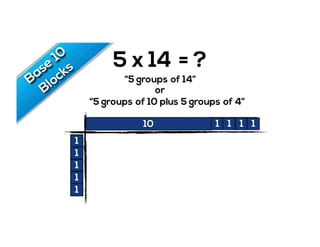
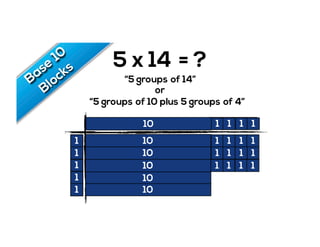
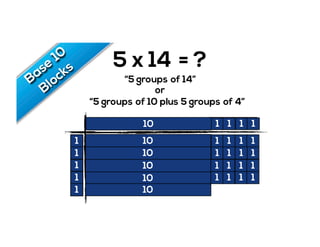
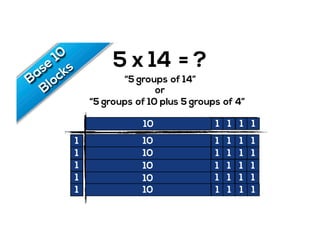
5 x 14 = ?
“5 groups of 14”
“5 groups of 10 plus 5 groups of 4”
or
1 1 1 1
1
1
1
1
1
1 1 1 1 1 1 1 1 1 1 1 1 1 110
5
1
1
1
1
1
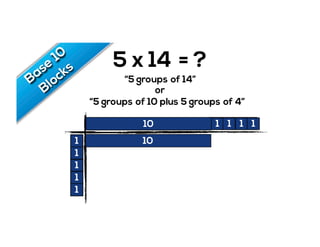
5 x 14 = ?
“5 groups of 14”
“5 groups of 10 plus 5 groups of 4”
or
1 1 1 1
1
1
1
1
1
1 1 1 1 1 1 1 1 1 1 1 1 1 110
5
1
1
1
1
1
10
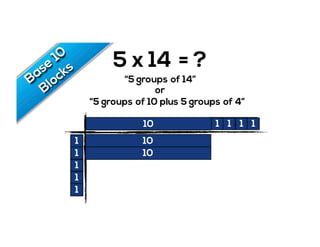
5 x 14 = ?
“5 groups of 14”
“5 groups of 10 plus 5 groups of 4”
or
1 1 1 1
1
1
1
1
1
1 1 1 1 1 1 1 1 1 1 1 1 1 110
5
1
1
1
1
1
10
10
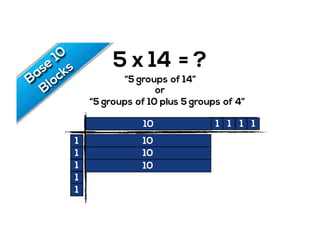
5 x 14 = ?
“5 groups of 14”
“5 groups of 10 plus 5 groups of 4”
or
1 1 1 1
1
1
1
1
1
1 1 1 1 1 1 1 1 1 1 1 1 1 110
5
1
1
1
1
1
10
10
10
5 x 14 = ?
“5 groups of 14”
“5 groups of 10 plus 5 groups of 4”
or
1 1 1 1
1
1
1
1
1
1 1 1 1 1 1 1 1 1 1 1 1 1 110
5
1
1
1
1
1
10
10
10
10
5 x 14 = ?
“5 groups of 14”
“5 groups of 10 plus 5 groups of 4”
or
1 1 1 1
1
1
1
1
1
1 1 1 1 1 1 1 1 1 1 1 1 1 110
5
1
1
1
1
1
10
10
10
10
10
5 x 14 = ?
“5 groups of 14”
“5 groups of 10 plus 5 groups of 4”
or
1 1 1 1
1
1
1
1
1
1 1 1 1 1 1 1 1 1 1 1 1 1 110
5
1
1
1
1
1
10
10
10
10
10
1 1 1 1
5 x 14 = ?
“5 groups of 14”
“5 groups of 10 plus 5 groups of 4”
or
1 1 1 1
1
1
1
1
1
1 1 1 1 1 1 1 1 1 1 1 1 1 110
5
1
1
1
1
1
10
10
10
10
10
1 1 1 1
1 1 1 1
5 x 14 = ?
“5 groups of 14”
“5 groups of 10 plus 5 groups of 4”
or
1 1 1 1
1
1
1
1
1
1 1 1 1 1 1 1 1 1 1 1 1 1 110
5
1
1
1
1
1
10
10
10
10
10
1 1 1 1
1 1 1 1
1 1 1 1
5 x 14 = ?
“5 groups of 14”
“5 groups of 10 plus 5 groups of 4”
or
1 1 1 1
1
1
1
1
1
1 1 1 1 1 1 1 1 1 1 1 1 1 110
5
1
1
1
1
1
10
10
10
10
10
1 1 1 1
1 1 1 1
1 1 1 1
1 1 1 1
1 1 1 1
5 x 14 = ?
“5 groups of 14”
1
1
1
1
1
1 1 1 1 1 1 1 1 1 1 1 1 1 110
5
“5 groups of 10 plus 5 groups of 4”
or
1
1
1
1
1
10
10
10
10
10
1 1 1 1
1 1 1 1
1 1 1 1
1 1 1 1
1 1 1 1
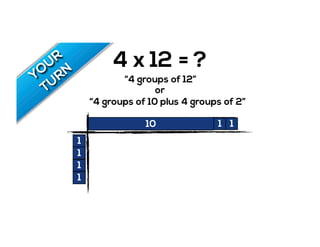
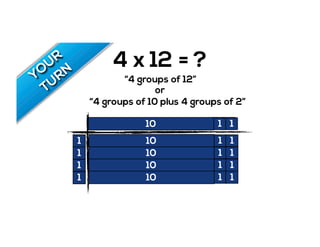
4 x 12 = ?
“4 groups of 12”
“4 groups of 10 plus 4 groups of 2”
or
1 1
1
1
1
1
1 1 1 1 1 1 1 1 1 1 1 110
1
1
1
1
4 x 12 = ?
“4 groups of 12”
“4 groups of 10 plus 4 groups of 2”
or
1 1
1
1
1
1
1 1 1 1 1 1 1 1 1 1 1 110
1
1
1
1
1 110
1 110
1 110
1 110
@MathletePearcewww.tapintoteenminds.com
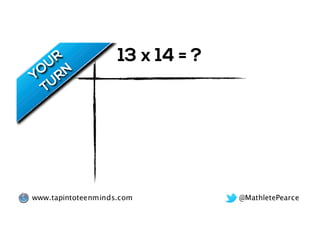
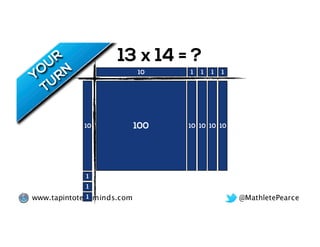
13 x 14 = ?
@MathletePearcewww.tapintoteenminds.com
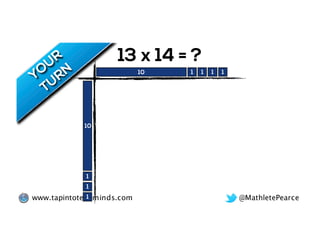
13 x 14 = ?
1 110 1 1
10
1
1
1
@MathletePearcewww.tapintoteenminds.com
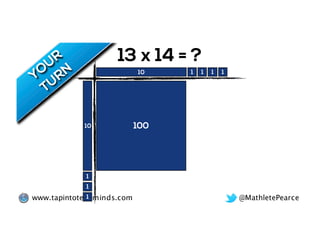
13 x 14 = ?
1 110 1 1
10
1
1
1
100
@MathletePearcewww.tapintoteenminds.com
13 x 14 = ?
1 110 1 1
10
1
1
1
100 10 10 10 10
@MathletePearcewww.tapintoteenminds.com
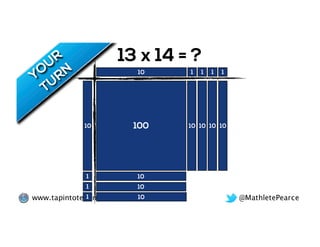
13 x 14 = ?
1 110 1 1
10
1
1
1
100 10 10 10 10
10
10
10
@MathletePearcewww.tapintoteenminds.com
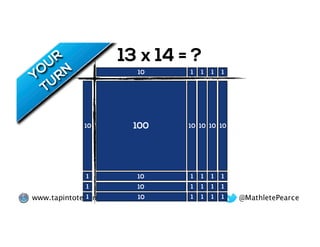
13 x 14 = ?
1 110 1 1
10
1
1
1
100 10 10 10 10
10
10
10
1 1 1 1
1 1 1 1
1 1 1 1
@MathletePearcewww.tapintoteenminds.com
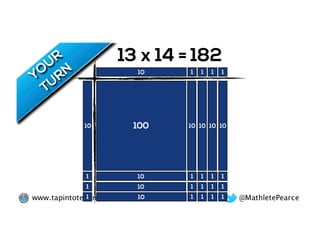
13 x 14 = 182
1 110 1 1
10
1
1
1
100 10 10 10 10
10
10
10
1 1 1 1
1 1 1 1
1 1 1 1
@MathletePearcewww.tapintoteenminds.com
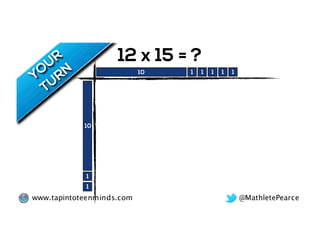
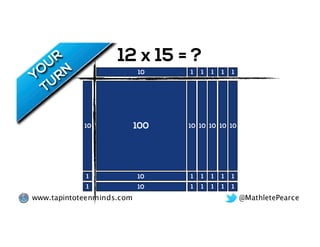
12 x 15 = ?
1 110 1 1 1
10
1
1
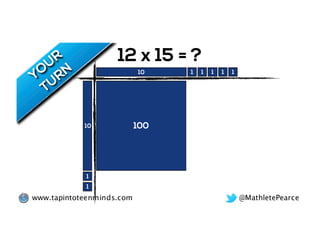
@MathletePearcewww.tapintoteenminds.com
1 110 1 1 1
10
1
1
100
12 x 15 = ?
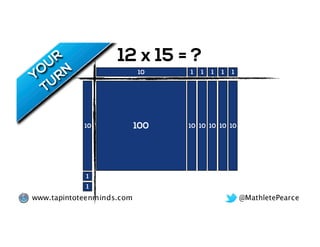
@MathletePearcewww.tapintoteenminds.com
1 110 1 1 1
10
1
1
100 10 10 10 10 10
12 x 15 = ?
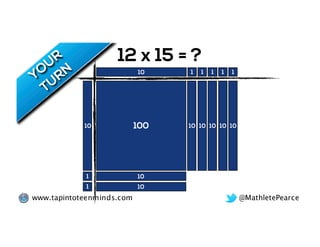
@MathletePearcewww.tapintoteenminds.com
1 110 1 1 1
10
1
1
100 10 10 10 10 10
10
10
12 x 15 = ?
@MathletePearcewww.tapintoteenminds.com
1 110 1 1 1
10
1
1
100 10 10 10 10 10
10
10
1 1 1 1 1
1 1 1 1 1
12 x 15 = ?
@MathletePearcewww.tapintoteenminds.com
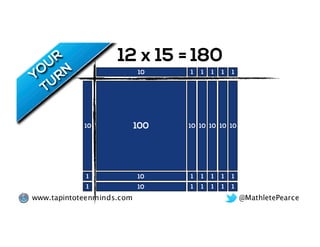
1 110 1 1 1
10
1
1
100 10 10 10 10 10
10
10
1 1 1 1 1
1 1 1 1 1
12 x 15 = 180
@MathletePearcewww.tapintoteenminds.com
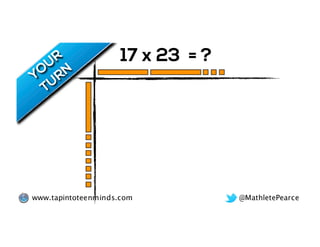
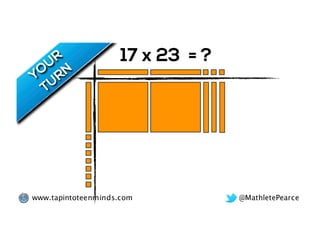
17 x 23 = ?
@MathletePearcewww.tapintoteenminds.com
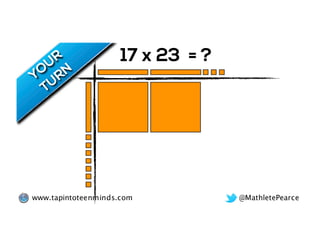
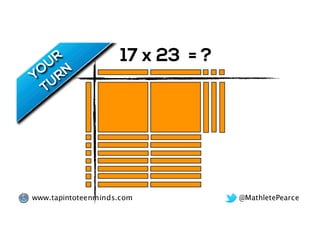
17 x 23 = ?
@MathletePearcewww.tapintoteenminds.com
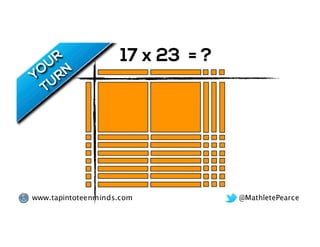
17 x 23 = ?
@MathletePearcewww.tapintoteenminds.com
17 x 23 = ?
@MathletePearcewww.tapintoteenminds.com
17 x 23 = ?
@MathletePearcewww.tapintoteenminds.com
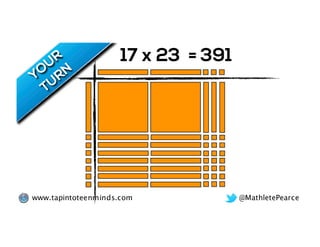
17 x 23 = 391
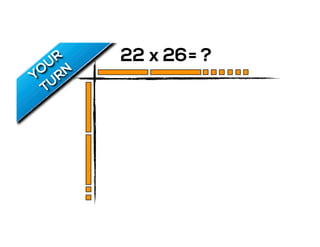
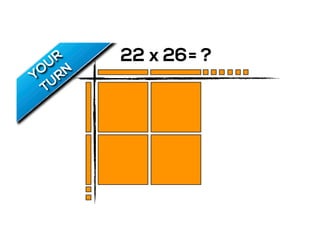
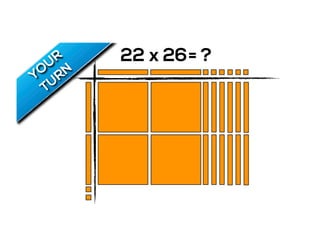
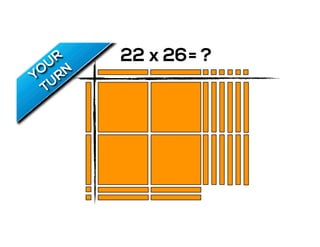
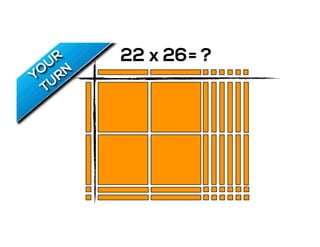
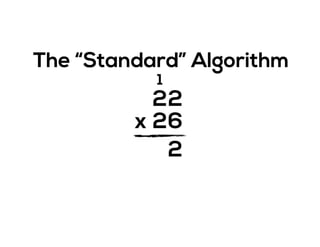
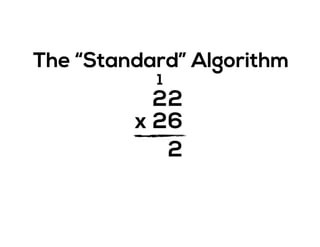
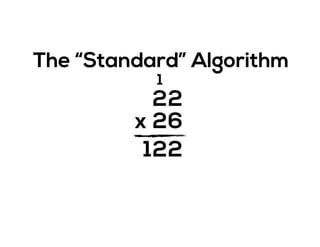
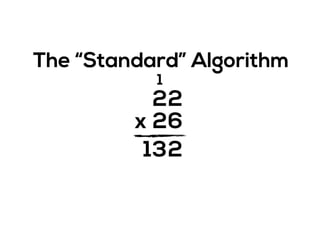
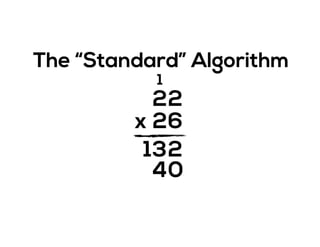
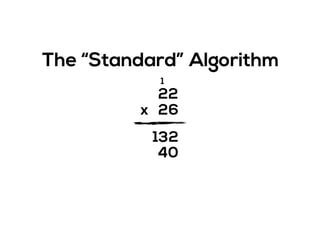
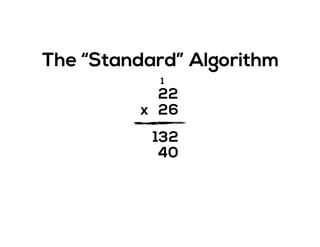
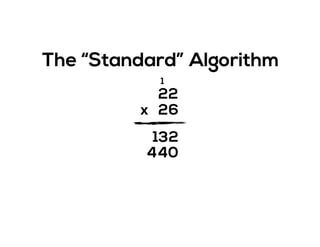
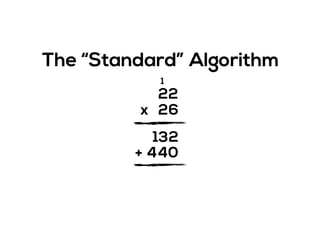
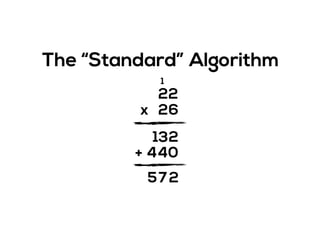
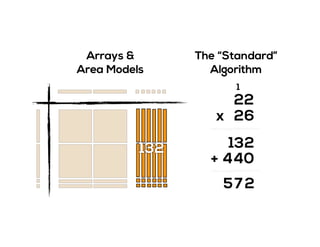
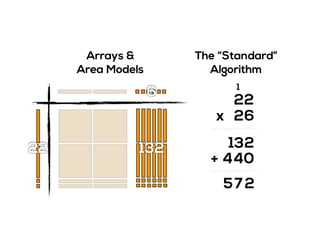
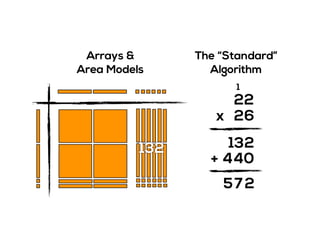
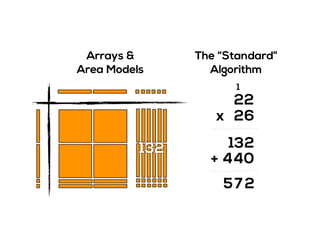
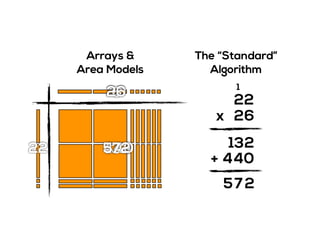
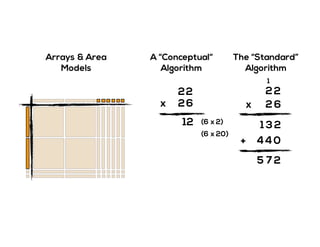
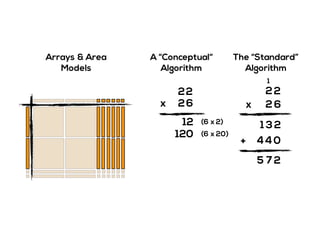
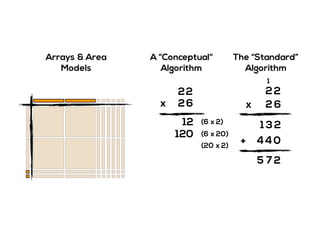
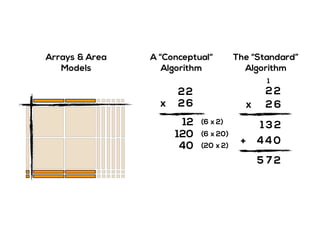
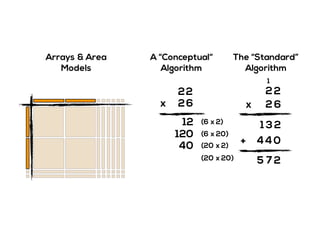
22 x 26= ?
22 x 26= ?
22 x 26= ?
22 x 26= ?
22 x 26= ?
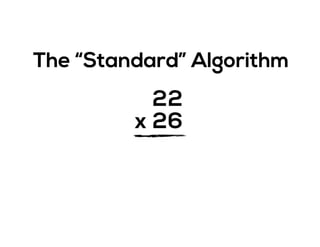
2
2x
2
6
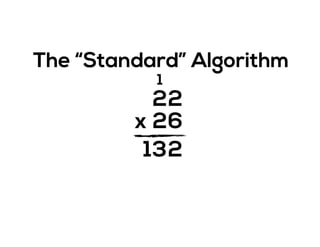
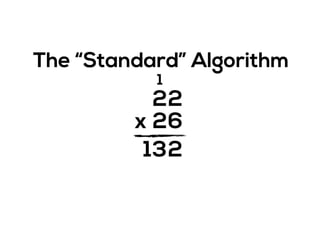
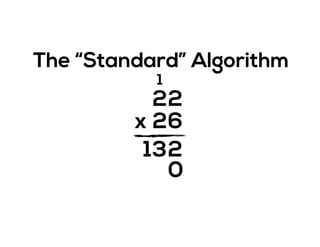
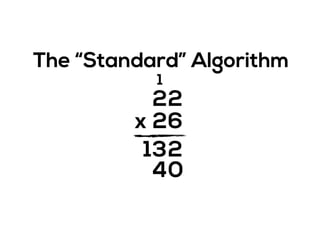
The “Standard” Algorithm
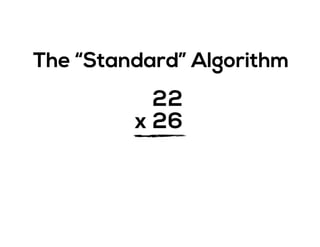
2
2x
2
6
The “Standard” Algorithm
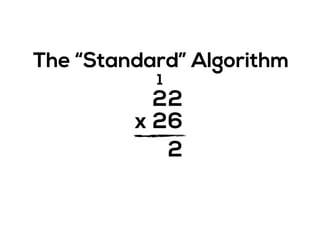
2
2x
2
6
2
1
The “Standard” Algorithm
2
2x
2
6
2
1
The “Standard” Algorithm
2
2x
2
6
2
1
The “Standard” Algorithm
2
2x
2
6
2
1
12
The “Standard” Algorithm
2
2x
2
6
1
213
The “Standard” Algorithm
2
2x
2
6
1
213
The “Standard” Algorithm
2
2x
2
6
1
213
The “Standard” Algorithm
2
2x
2
6
1
0
213
The “Standard” Algorithm
2
2x
2
6
1
04
213
The “Standard” Algorithm
2
2x
2
6
1
04
213
The “Standard” Algorithm
2
2x
2
6
2
1
1
04
3
The “Standard” Algorithm
2
2x
2
6
2
1
1
04
3
The “Standard” Algorithm
2
2x
2
6
1
044
213
The “Standard” Algorithm
2
2x
2
6
1
044
213
The “Standard” Algorithm
+
2
2x
2
6
1
044
213
The “Standard” Algorithm
+
275
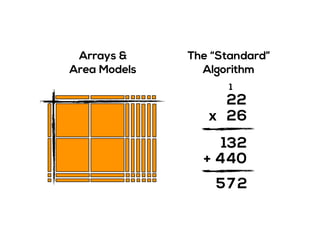
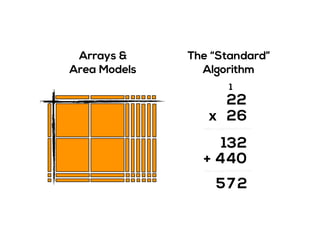
The “Standard”
Algorithm
Arrays &
Area Models
2
2x
2
6
1
044
213
+
275
The “Standard”
Algorithm
Arrays &
Area Models
2
2x
2
6
1
044
213
+
275
The “Standard”
Algorithm
Arrays &
Area Models
2
2x
2
6
1
044
213
+
275
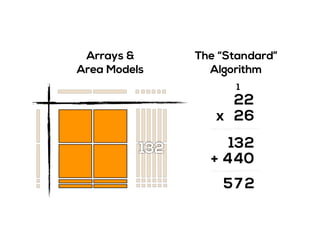
132
The “Standard”
Algorithm
Arrays &
Area Models
2
2x
2
6
1
044
213
+
275
13222
6
The “Standard”
Algorithm
Arrays &
Area Models
2
2x
2
6
1
044
213
+
275
132
The “Standard”
Algorithm
Arrays &
Area Models
2
2x
2
6
1
044
213
+
275
132
The “Standard”
Algorithm
Arrays &
Area Models
2
2x
2
6
1
044
213
+
275
132
The “Standard”
Algorithm
Arrays &
Area Models
2
2x
2
6
1
044
213
+
275
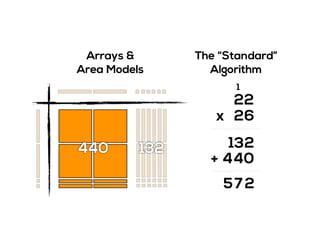
132440
The “Standard”
Algorithm
Arrays &
Area Models
2
2x
2
6
1
044
213
+
275
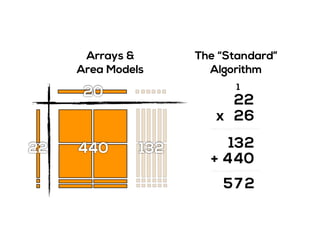
13244022
20
The “Standard”
Algorithm
Arrays &
Area Models
2
2x
2
6
1
044
213
+
275
13244022
20 6
The “Standard”
Algorithm
Arrays &
Area Models
2
2x
2
6
1
044
213
+
275
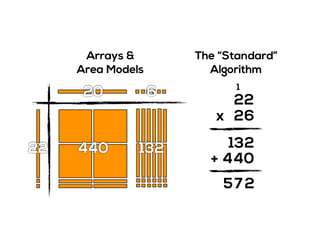
13244022
206
572
26
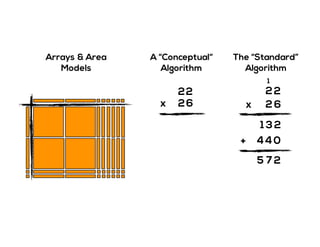
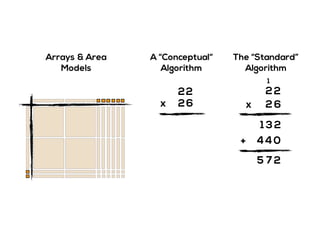
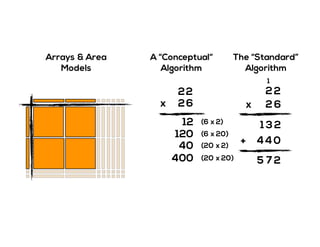
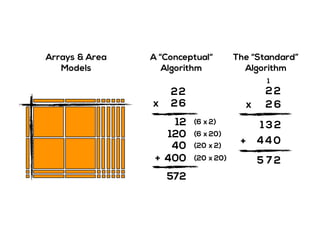
Arrays & Area
Models
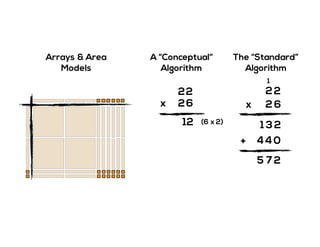
A “Conceptual“
Algorithm
2
2x
2
6
The “Standard”
Algorithm
2
2x
2
6
1
044
21 3
+
275
Arrays & Area
Models
A “Conceptual“
Algorithm
2
2x
2
6
The “Standard”
Algorithm
2
2x
2
6
1
044
21 3
+
275
Arrays & Area
Models
A “Conceptual“
Algorithm
2
2x
2
6
12 (6 x 2)
The “Standard”
Algorithm
2
2x
2
6
1
044
21 3
+
275
Arrays & Area
Models
A “Conceptual“
Algorithm
2
2x
2
6
12 (6 x 2)
(6 x 20)
The “Standard”
Algorithm
2
2x
2
6
1
044
21 3
+
275
Arrays & Area
Models
A “Conceptual“
Algorithm
2
2x
2
6
12 (6 x 2)
120 (6 x 20)
The “Standard”
Algorithm
2
2x
2
6
1
044
21 3
+
275
Arrays & Area
Models
A “Conceptual“
Algorithm
2
2x
2
6
12 (6 x 2)
120 (6 x 20)
(20 x 2)
The “Standard”
Algorithm
2
2x
2
6
1
044
21 3
+
275
Arrays & Area
Models
A “Conceptual“
Algorithm
2
2x
2
6
12 (6 x 2)
120 (6 x 20)
40 (20 x 2)
The “Standard”
Algorithm
2
2x
2
6
1
044
21 3
+
275
Arrays & Area
Models
A “Conceptual“
Algorithm
2
2x
2
6
12 (6 x 2)
120 (6 x 20)
40 (20 x 2)
(20 x 20)
The “Standard”
Algorithm
2
2x
2
6
1
044
21 3
+
275
Arrays & Area
Models
A “Conceptual“
Algorithm
2
2x
2
6
12 (6 x 2)
120 (6 x 20)
40 (20 x 2)
400 (20 x 20)
The “Standard”
Algorithm
2
2x
2
6
1
044
21 3
+
275
Arrays & Area
Models
A “Conceptual“
Algorithm
2
2x
2
6
12 (6 x 2)
120 (6 x 20)
40 (20 x 2)
400 (20 x 20)
572
+
The “Standard”
Algorithm
2
2x
2
6
1
044
21 3
+
275
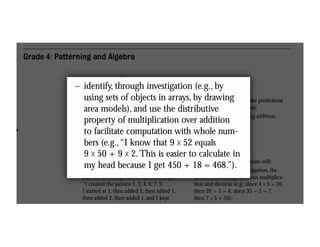
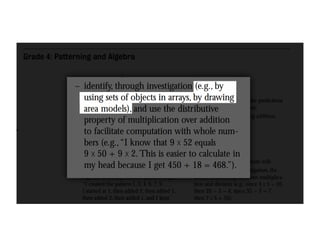
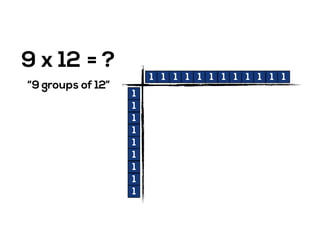
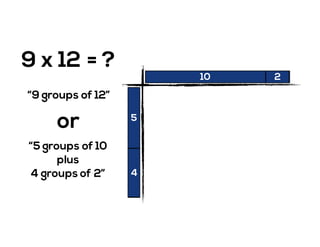
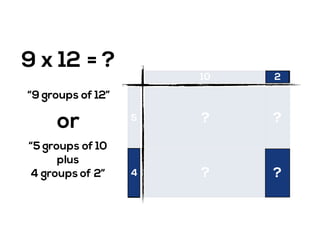
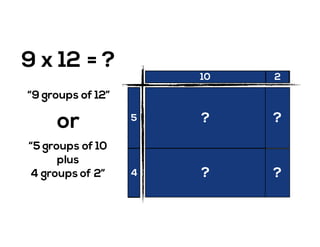
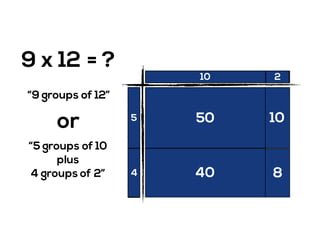
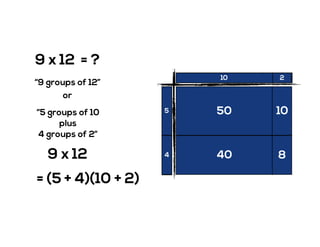
9 x 12 = ?
“9 groups of 12”
1
1
1
1
1
1
1
1
1
1 1 1 1 1 1 1 1 1 1 1 1
9 x 12 = ?
“9 groups of 12” 1
1
1
1
1
1
1
1
1
1 1 1 1 1 1 1 1 1 1 1 110 2
5
4
“5 groups of 10
plus
4 groups of 2”
or
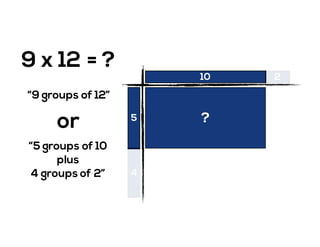
9 x 12 = ?
1
1
1
1
1
1
1
1
1
1 1 1 1 1 1 1 1 1 1 1 110 2
5
4
?
“9 groups of 12”
“5 groups of 10
plus
4 groups of 2”
or
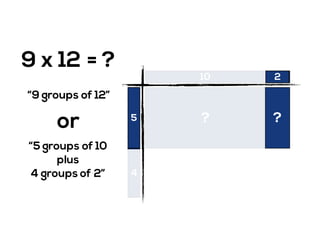
9 x 12 = ?
1
1
1
1
1
1
1
1
1
1 1 1 1 1 1 1 1 1 1 1 110 2
5
4
? ?
“9 groups of 12”
“5 groups of 10
plus
4 groups of 2”
or
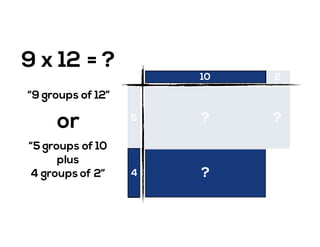
9 x 12 = ?
1
1
1
1
1
1
1
1
1
1 1 1 1 1 1 1 1 1 1 1 110 2
5
4
?
?
?
“9 groups of 12”
“5 groups of 10
plus
4 groups of 2”
or
9 x 12 = ?
1
1
1
1
1
1
1
1
1
1 1 1 1 1 1 1 1 1 1 1 110 2
5
4
?
?
?
?
“9 groups of 12”
“5 groups of 10
plus
4 groups of 2”
or
9 x 12 = ?
1
1
1
1
1
1
1
1
1
1 1 1 1 1 1 1 1 1 1 1 110 2
5
4
?
?
?
?
“9 groups of 12”
“5 groups of 10
plus
4 groups of 2”
or
9 x 12 = ?
1
1
1
1
1
1
1
1
1
1 1 1 1 1 1 1 1 1 1 1 110 2
5
4
50
40
10
8
“9 groups of 12”
“5 groups of 10
plus
4 groups of 2”
or
9 x 12 = ?
1
1
1
1
1
1
1
1
1
1 1 1 1 1 1 1 1 1 1 1 110 2
5
4
50
40
10
8
“9 groups of 12”
“5 groups of 10
plus
4 groups of 2”
or
9 x 12
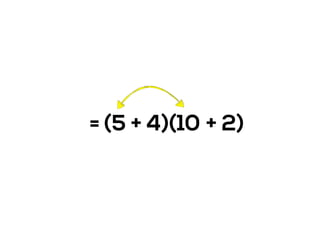
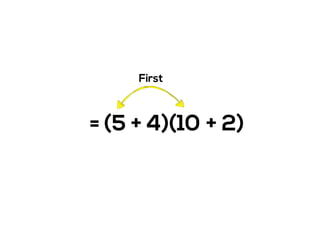
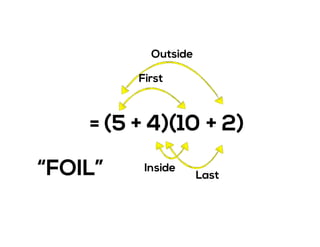
= (5 + 4)(10 + 2)
= (5 + 4)(10 + 2)
= (5 + 4)(10 + 2)
= (5 + 4)(10 + 2)
= (5 + 4)(10 + 2)
= (5 + 4)(10 + 2)
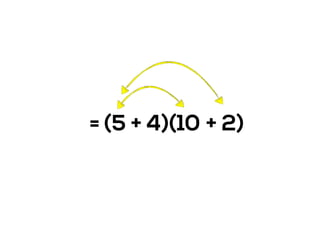
First
= (5 + 4)(10 + 2)
First
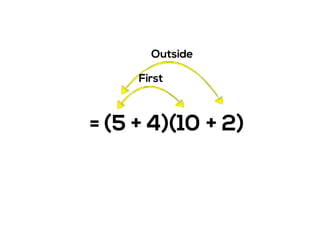
Outside
= (5 + 4)(10 + 2)
First
Outside
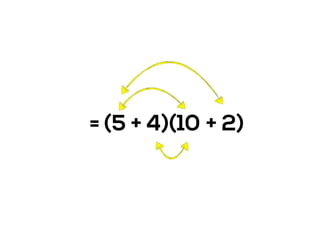
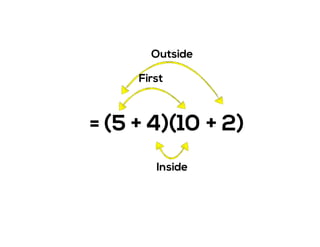
Inside
= (5 + 4)(10 + 2)
First
Outside
Inside
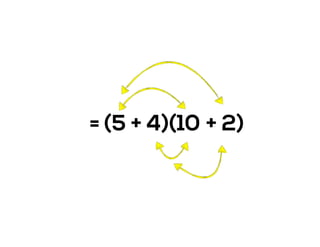
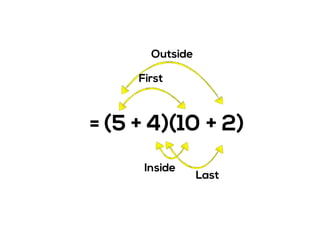
Last
= (5 + 4)(10 + 2)
First
Outside
Inside
Last“FOIL”
= (5 + 4)(10 + 2)
First
Outside
Inside
Last
“FOIL”
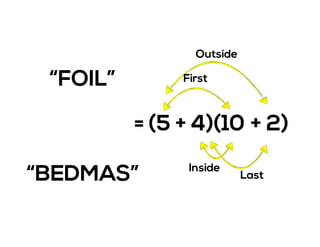
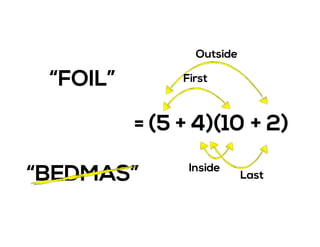
“BEDMAS”
= (5 + 4)(10 + 2)
First
Outside
Inside
Last
“FOIL”
“BEDMAS”
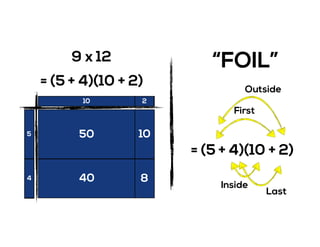
9 x 12
1
1
1
1
1
1
1
1
1
1 1 1 1 1 1 1 1 1 1 1 110 2
5
4
50
40
10
8
= (5 + 4)(10 + 2)
= (5 + 4)(10 + 2)
First
Outside
Inside
Last
“FOIL”
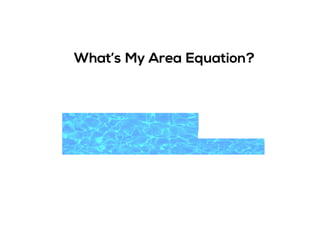
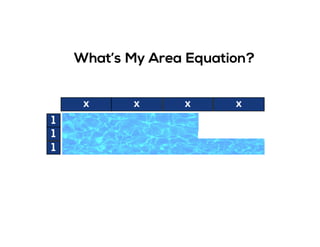
What’s My Area Equation?
x x x x
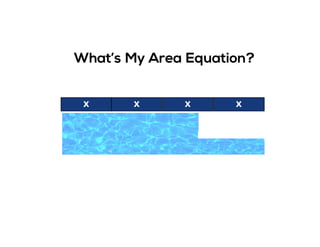
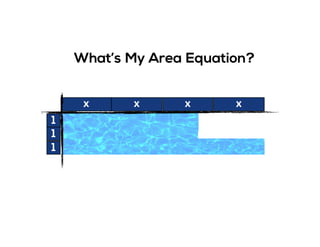
What’s My Area Equation?
x x x x
1
1
1
What’s My Area Equation?
x x x x
1
1
1
What’s My Area Equation?
x x x x
1
1
1
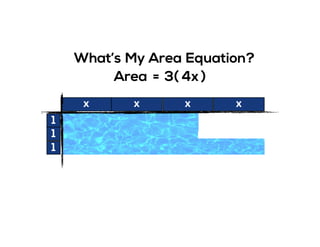
Area = 3( )4x
What’s My Area Equation?
x x x x
1
1
1
x x x x
x x x x
x x x x
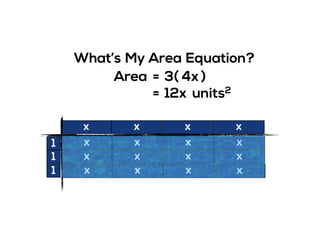
Area = 3( )4x
= 12x units2
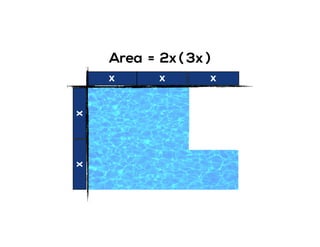
x x x xx
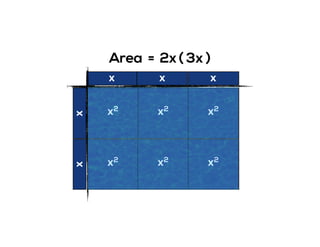
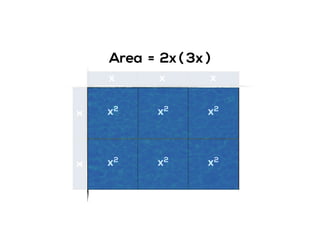
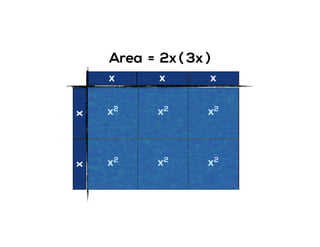
Area = 2x ( )3x
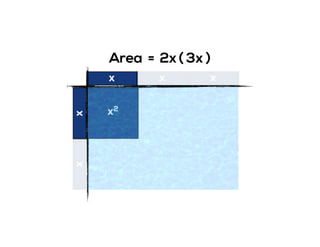
x x x xx
x2
Area = 2x ( )3x
x2
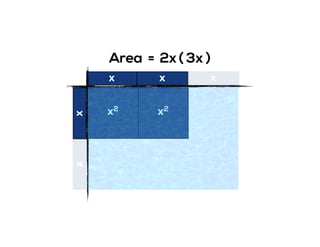
x x x xx
x2
Area = 2x ( )3x
x2x2
x x x xx
x2
Area = 2x ( )3x
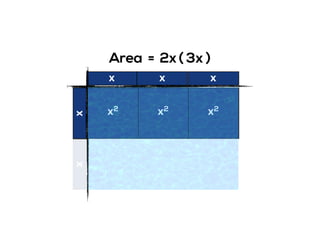
x x x xx
x2 x2 x2
x2 x2 x2
Area = 2x ( )3x
x x x xx
x2 x2 x2
x2 x2 x2
Area = 2x ( )3x
x x x xx
x2 x2 x2
x2 x2 x2
Area = 2x ( )3x
x x x xx
x2 x2 x2
x2 x2 x2
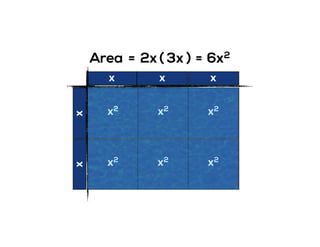
6x2Area = 2x ( )3x =
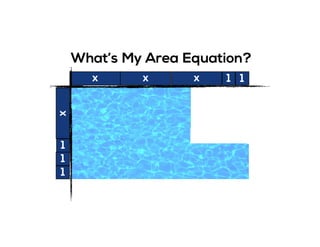
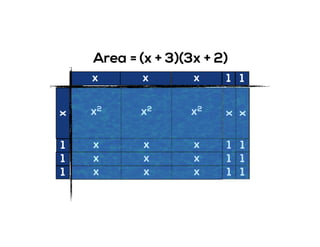
What’s My Area Equation?x
1 1
1
1
x
1
x x
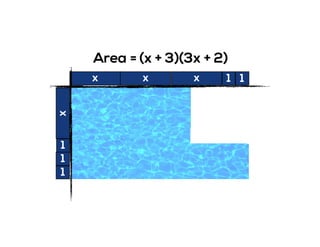
Area = (x + 3)(3x + 2)x
1 1
1
1
x
1
x x
x
1 1
1
1
x
1
x x
x2 x2 x2
x x x
x x x
x x x
x
x
1
1
1
1
1
1
Area = (x + 3)(3x + 2)
x
1 1
1
1
x
1
x x
x2 x2 x2
x x x
x x x
x x x
x
x
1
1
1
1
1
1
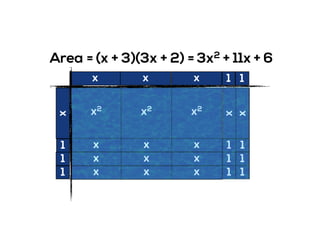
Area = (x + 3)(3x + 2) = 3x2 + 11x + 6
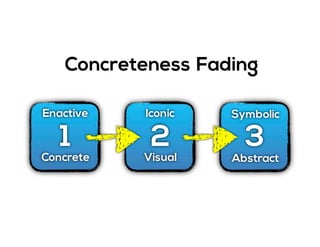
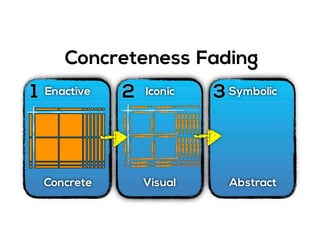
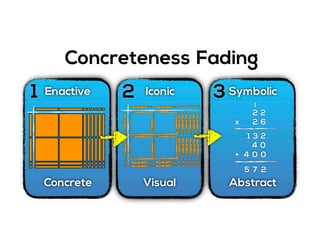
Concreteness Fading
1 2 3
Enactive
Concrete
Iconic
Visual
Symbolic
Abstract
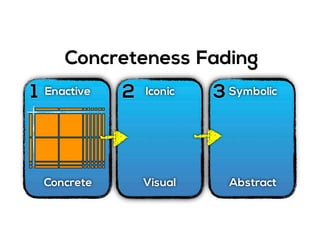
Concreteness Fading
1 2 3Enactive
Concrete
Iconic
Visual
Symbolic
Abstract
Concreteness Fading
1 2 3Enactive
Concrete
Iconic
Visual
Symbolic
Abstract
Concreteness Fading
1 2 3Enactive
Concrete
Iconic
Visual
Symbolic
Abstract
2
2x
2
6
1
04
004
21 3
+
275
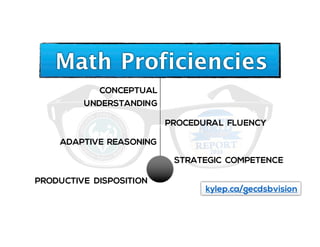
PROCEDURAL FLUENCY
STRATEGIC COMPETENCE
ADAPTIVE REASONING
PRODUCTIVE DISPOSITION
CONCEPTUAL
UNDERSTANDING
kylep.ca/gecdsbvision
Math Proficiencies
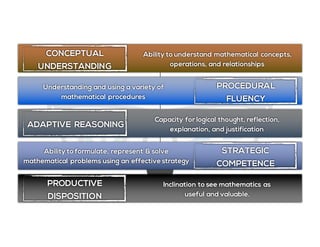
PRODUCTIVE
DISPOSITION
Ability to formulate, represent & solve
mathematical problems using an effective strategy
STRATEGIC
COMPETENCE
PROCEDURAL
FLUENCY
Understanding and using a variety of
mathematical procedures
ADAPTIVE REASONING
Capacity for logical thought, reflection,
explanation, and justification
Inclination to see mathematics as
useful and valuable.
Ability to understand mathematical concepts,
operations, and relationships
CONCEPTUAL
UNDERSTANDING
Leading Mathematics Learning:
Building Confidence
What’s your next best move?
In Math Class
Table Talk…
What would we see, hear and feel in an exemplary
math class?
Write one idea per sticky note.
Identify the groups with a heading/theme/category.
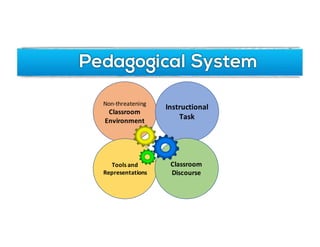
Pedagogical System
Non-threatening
Classroom	
Environment
Instructional	
Task
Tools	and	
Representations
Classroom	
Discourse
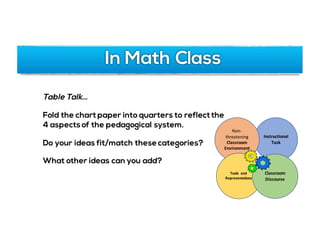
In Math Class
Table Talk…
Fold the chart paper into quarters to reflect the
4 aspects of the pedagogical system.
Do your ideas fit/match these categories?
What other ideas can you add?
Instructional	
Task
Non-
threatening
Classroom	
Environment
Tools	 and	
Representations
Classroom	
Discourse
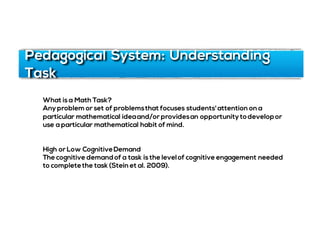
Pedagogical System: Understanding
Task
What is a Math Task?
Anyproblem or set of problemsthat focuses students'attention on a
particular mathematical ideaand/or providesan opportunitytodevelopor
use a particular mathematical habit of mind.
High or Low CognitiveDemand
The cognitive demandof a task is the levelof cognitive engagement needed
to completethe task (Stein et al. 2009).
A task by itself is not rich;
it is what we do with the task and
how it connects to the pedagogical
system that makes it rich.
Understanding Task
Bump It Up
Bump	up	a	task	as	an	Assessmentfor	Learning
• Use	the	Task	Cards	at	your	table
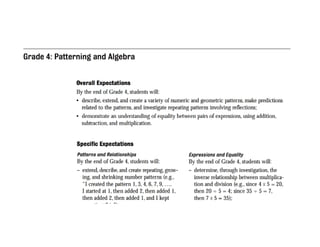
• Grade,	Topic,	Overall	Expectation	and	a	Task
• Use	the	Mathematics	Curriculum	and	find	
the	specific	expectations
• Re-write	the	task
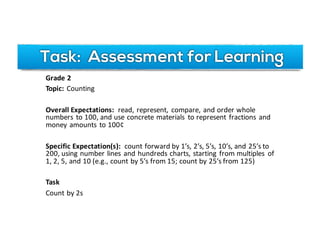
Task: Assessment for Learning
Tom	Schimmer’s (Grading	From	the	Inside	Out,	2016)	premise	is	that	
all	assessment	practices	should	be	put	through	two	filters:
1.	Is	it	accurate?
2.	Does	it	promote	confidence/optimism	in	students?
“School	is	no	longer	about	the	completion	of	a	series	of	activities,	
but	rather	the	pursuit	of	proficiency	as	a	set	of	outcomes	that	
students	achieve	through	the	instructional	 experience”
Understanding	Math	Tasks
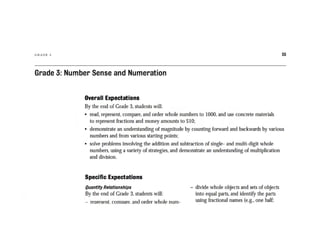
Grade	2
Topic: Counting
Overall	Expectations:		read,	represent,	compare,	and	order	whole	
numbers	to	100,	and	use	concrete	materials	 to	represent	fractions	and	
money	amounts	to	100¢
Specific	Expectation(s):	 count	forward	by	1’s,	2’s,	5’s,	10’s,	and	25’s	to	
200,	using	number	lines	and	hundreds	charts,	starting	from	multiples	 of	
1,	2,	5,	and	10	(e.g.,	count	by	5’s	from	15;	count	by	25’s	from	125)
Task
Count	by	2s
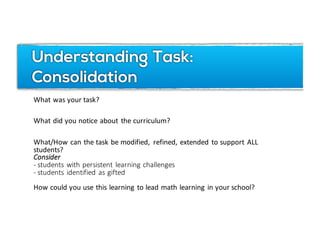
Task: Assessment for Learning
What	was	your	task?
What	did	you	notice	about	the	curriculum?
What/How	can	the	task	be	modified,	 refined,	extended	to	support	ALL	
students?	
CCoonnssiiddeerr
- students	with	persistent	learning	challenges
- students	identified	as	gifted
How	could	you	use	this	learning	to	lead	math	learning	in	your	school?
Understanding Task:
Consolidation
Understanding	Math	Tasks
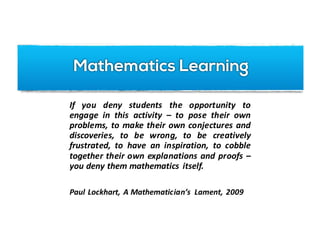
If you deny students the opportunity to
engage in this activity – to pose their own
problems, to make their own conjectures and
discoveries, to be wrong, to be creatively
frustrated, to have an inspiration, to cobble
together their own explanations and proofs –
you deny them mathematics itself.
Paul Lockhart, A Mathematician’s Lament, 2009
Mathematics Learning
Understanding	Math	Tasks
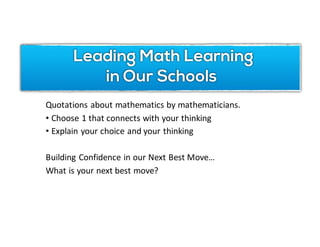
Quotations	about	mathematics	by	mathematicians.
• Choose	1	that	connects	with	your	thinking
• Explain	your	choice	and	your	thinking
Building	Confidence	in	our	Next	Best	Move…
What	is	your	next	best	move?
Leading Math Learning
in Our Schools
Bring	student	work	based	on	a	mathematics	 task.	
Consider
Curriculum	expectation
Assessment for	Learning
We	will	analyze	the	task	in	the	context	of	pedagogical	 system.
For Next Time…
What	was	one	(or	more)	key	learning(s)	from	today?
What	was	one	thing	you	would	have	changed	in	the	day?
What	questions	do	you	still	have?
What	learning	would	you	like	to	see	for	next	session?
Feedback

GECDSB Mathematics Learning Teams (MLT) Session #1