GEAR DRIVES
NISCHITH MS
ECE-B
ELEMENTS OF MECHANICAL ENGINEERING
INTRODUCTION
•The transmission of power or motion from one shaft to another by means of gears is called gear
drive.
•Gears are mounted on shafts. The gear mounted on the shaft to which power source is connected
is called driver gear, while the gear which is driven by the driver gear, is called driven gear.
•Uses of gears
1. Transmit power from one shaft to another
2. To reverse the direction of rotation
3. To increase or decrease speed of rotation
4. To move rotational motion to a different axis
5. To keep the rotation of two axes synchronised
TYPES OF GEARS
Gears are commonly classified based on the position of the axis of the shaft on
which the gear is mounted. The most commonly used gears are:
1. Spur gear
2. Bevel gear
3. Helical gears
4. Worm gears
5. Rack and Pinion
SPUR GEAR
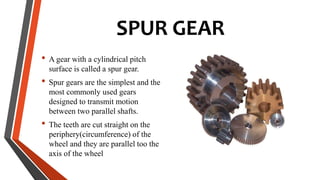
• A gear with a cylindrical pitch
surface is called a spur gear.
• Spur gears are the simplest and the
most commonly used gears
designed to transmit motion
between two parallel shafts.
• The teeth are cut straight on the
periphery(circumference) of the
wheel and they are parallel too the
axis of the wheel
APPLICATIONS OF SPUR GEAR
•Metal Cutting Machine
•Power Plant
•Marine Engines
•Mechanical Clock and Watches
•Fuel Pumps
•Washing Machine
•Gear Motors and Gear Pumps
•Rolling Mill
•Rack and Pinion mechanism
BEVEL GEARS
• Bevel gears are used for
transmitting power between two
intersecting shafts.’
• They operate on shafts that are 90⁰
to each other.
• The teeth are cut on the outside of
the conical surface and vary in
cross section throughout their
length. Since the diameter of the
cone is greatest at its base, the teeth
will be thicker at the base.
APPLICATIONS OF BEVEL GEARS
•Printing Machine
•Agriculture
•Bottling
•Material Handling
•Steering
•Differential Drives
•Hand Drill
HELICAL GEARS
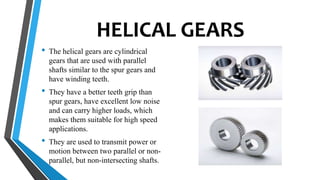
• The helical gears are cylindrical
gears that are used with parallel
shafts similar to the spur gears and
have winding teeth.
• They have a better teeth grip than
spur gears, have excellent low noise
and can carry higher loads, which
makes them suitable for high speed
applications.
• They are used to transmit power or
motion between two parallel or non-
parallel, but non-intersecting shafts.
APPLICATIONS OF HELICAL GEARS
•Fertilizer industries
•Printing industries
•Earth moving industries
•Rolling Mill
•Power and Port Industries
•Textile Industries
•Plastic Industries
•Automobile Gearboxes
•Machine Tool Gearboxes
WORM GEARS
• Worm gear is a type of screw
gearing that consists of a screw
meshing with a helical gear or spur
gear. [‘screw’ = worm and ‘gear
wheel meshing’ = worm gear]
• Worm gears are used when large
reductions are needed especially
from 20:1 to 300:1 or greater.
• They are used to transmit power or
motion between two shafts having
their axis at right angles and non-
intersecting.
APPLICATIONS OF WORM GEARS
•Gate Control Mechanism
•Hoisting Machines
•Automobile Steering Mechanism
•Lifts
•Conveyors
•Presses
•Speed Reducer
RACK AND PINION
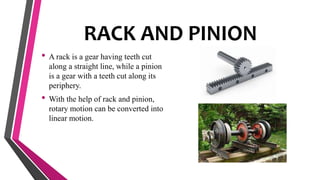
• A rack is a gear having teeth cut
along a straight line, while a pinion
is a gear with a teeth cut along its
periphery.
• With the help of rack and pinion,
rotary motion can be converted into
linear motion.
APPLICATIONS OF RACK AND PINION
•Stair lifts
•Steering Mechanism of Cars
•Rack Railways
•Actuators
•Used in some scales to turn the dial that displays a weight
THANK YOU

Gear drives and it's types

  • 1.
    GEAR DRIVES NISCHITH MS ECE-B ELEMENTSOF MECHANICAL ENGINEERING
  • 2.
    INTRODUCTION •The transmission ofpower or motion from one shaft to another by means of gears is called gear drive. •Gears are mounted on shafts. The gear mounted on the shaft to which power source is connected is called driver gear, while the gear which is driven by the driver gear, is called driven gear. •Uses of gears 1. Transmit power from one shaft to another 2. To reverse the direction of rotation 3. To increase or decrease speed of rotation 4. To move rotational motion to a different axis 5. To keep the rotation of two axes synchronised
  • 3.
    TYPES OF GEARS Gearsare commonly classified based on the position of the axis of the shaft on which the gear is mounted. The most commonly used gears are: 1. Spur gear 2. Bevel gear 3. Helical gears 4. Worm gears 5. Rack and Pinion
  • 4.
    SPUR GEAR • Agear with a cylindrical pitch surface is called a spur gear. • Spur gears are the simplest and the most commonly used gears designed to transmit motion between two parallel shafts. • The teeth are cut straight on the periphery(circumference) of the wheel and they are parallel too the axis of the wheel
  • 5.
    APPLICATIONS OF SPURGEAR •Metal Cutting Machine •Power Plant •Marine Engines •Mechanical Clock and Watches •Fuel Pumps •Washing Machine •Gear Motors and Gear Pumps •Rolling Mill •Rack and Pinion mechanism
  • 6.
    BEVEL GEARS • Bevelgears are used for transmitting power between two intersecting shafts.’ • They operate on shafts that are 90⁰ to each other. • The teeth are cut on the outside of the conical surface and vary in cross section throughout their length. Since the diameter of the cone is greatest at its base, the teeth will be thicker at the base.
  • 7.
    APPLICATIONS OF BEVELGEARS •Printing Machine •Agriculture •Bottling •Material Handling •Steering •Differential Drives •Hand Drill
  • 8.
    HELICAL GEARS • Thehelical gears are cylindrical gears that are used with parallel shafts similar to the spur gears and have winding teeth. • They have a better teeth grip than spur gears, have excellent low noise and can carry higher loads, which makes them suitable for high speed applications. • They are used to transmit power or motion between two parallel or non- parallel, but non-intersecting shafts.
  • 9.
    APPLICATIONS OF HELICALGEARS •Fertilizer industries •Printing industries •Earth moving industries •Rolling Mill •Power and Port Industries •Textile Industries •Plastic Industries •Automobile Gearboxes •Machine Tool Gearboxes
  • 10.
    WORM GEARS • Wormgear is a type of screw gearing that consists of a screw meshing with a helical gear or spur gear. [‘screw’ = worm and ‘gear wheel meshing’ = worm gear] • Worm gears are used when large reductions are needed especially from 20:1 to 300:1 or greater. • They are used to transmit power or motion between two shafts having their axis at right angles and non- intersecting.
  • 11.
    APPLICATIONS OF WORMGEARS •Gate Control Mechanism •Hoisting Machines •Automobile Steering Mechanism •Lifts •Conveyors •Presses •Speed Reducer
  • 12.
    RACK AND PINION •A rack is a gear having teeth cut along a straight line, while a pinion is a gear with a teeth cut along its periphery. • With the help of rack and pinion, rotary motion can be converted into linear motion.
  • 13.
    APPLICATIONS OF RACKAND PINION •Stair lifts •Steering Mechanism of Cars •Rack Railways •Actuators •Used in some scales to turn the dial that displays a weight
  • 14.