Powerpoint Templates
Page 1
Powerpoint Templates
Promoting Independent Learning in MFL
Isabelle Jones
http://isabellejones.blogspot.com
Twitter: @icpjones
icpjones@yahoo.co.uk
Powerpoint Templates
Page 2
• Why developing independence is crucial to
raising standards in languages
• Barriers and opportunities
• Tools to support the development of
independence in languages
Powerpoint Templates
Page 3
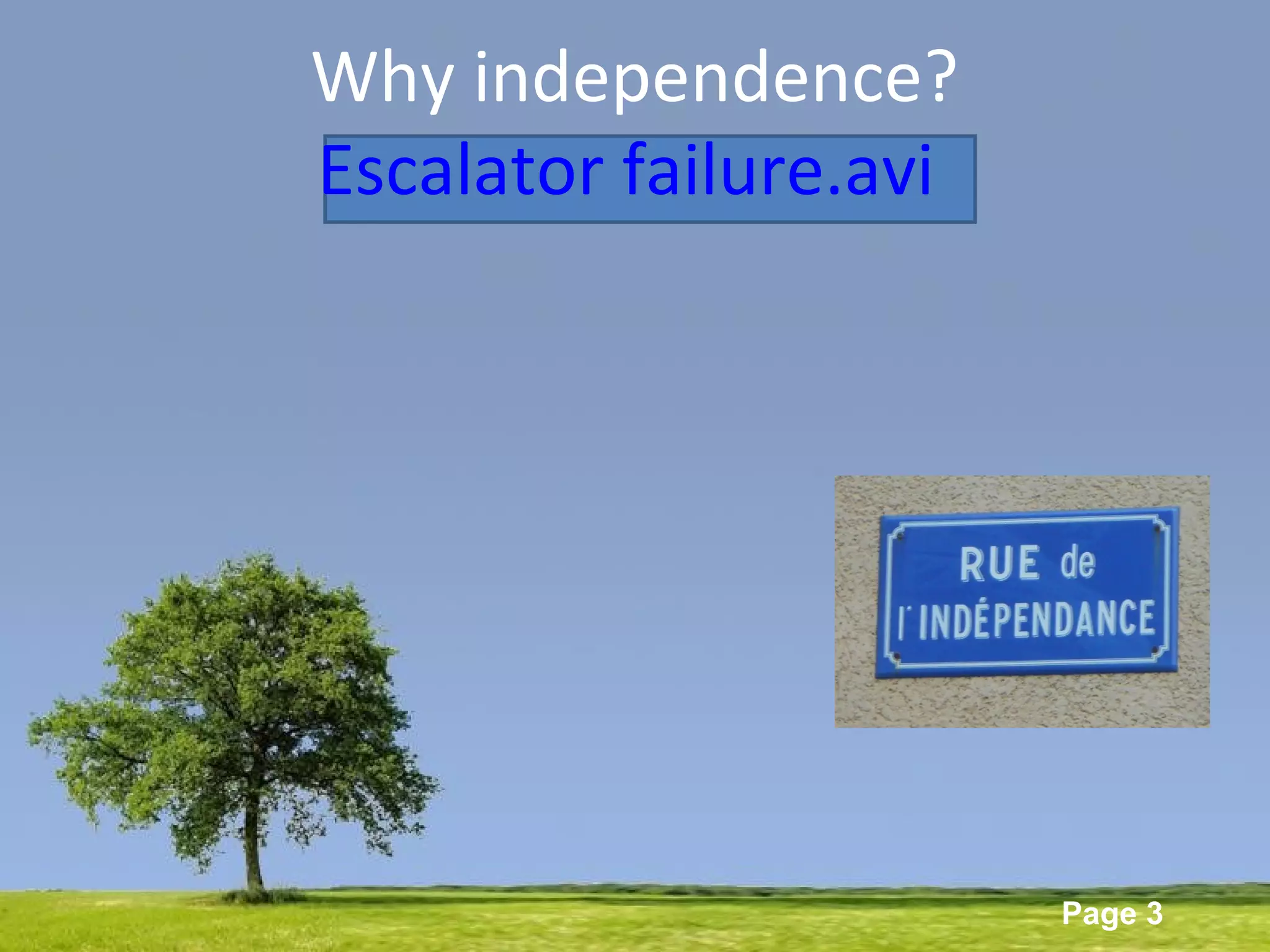
Why independence?
Escalator failure.avi
Powerpoint Templates
Page 4
• Independence, curriculum time and standards
of learning & teaching
• Better learners, better linguists
• Future-proof linguists
Why independence?
Powerpoint Templates
Page 5
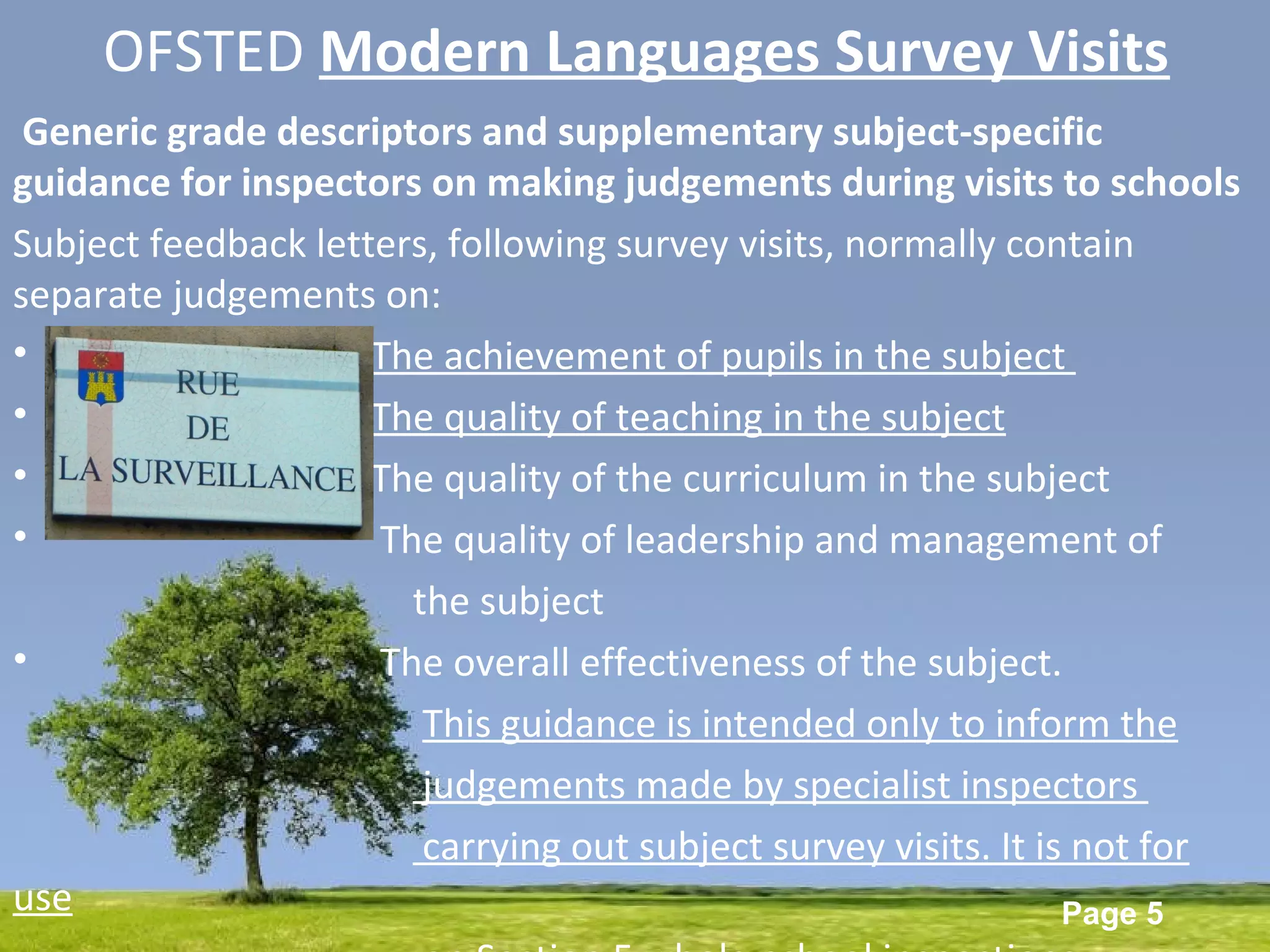
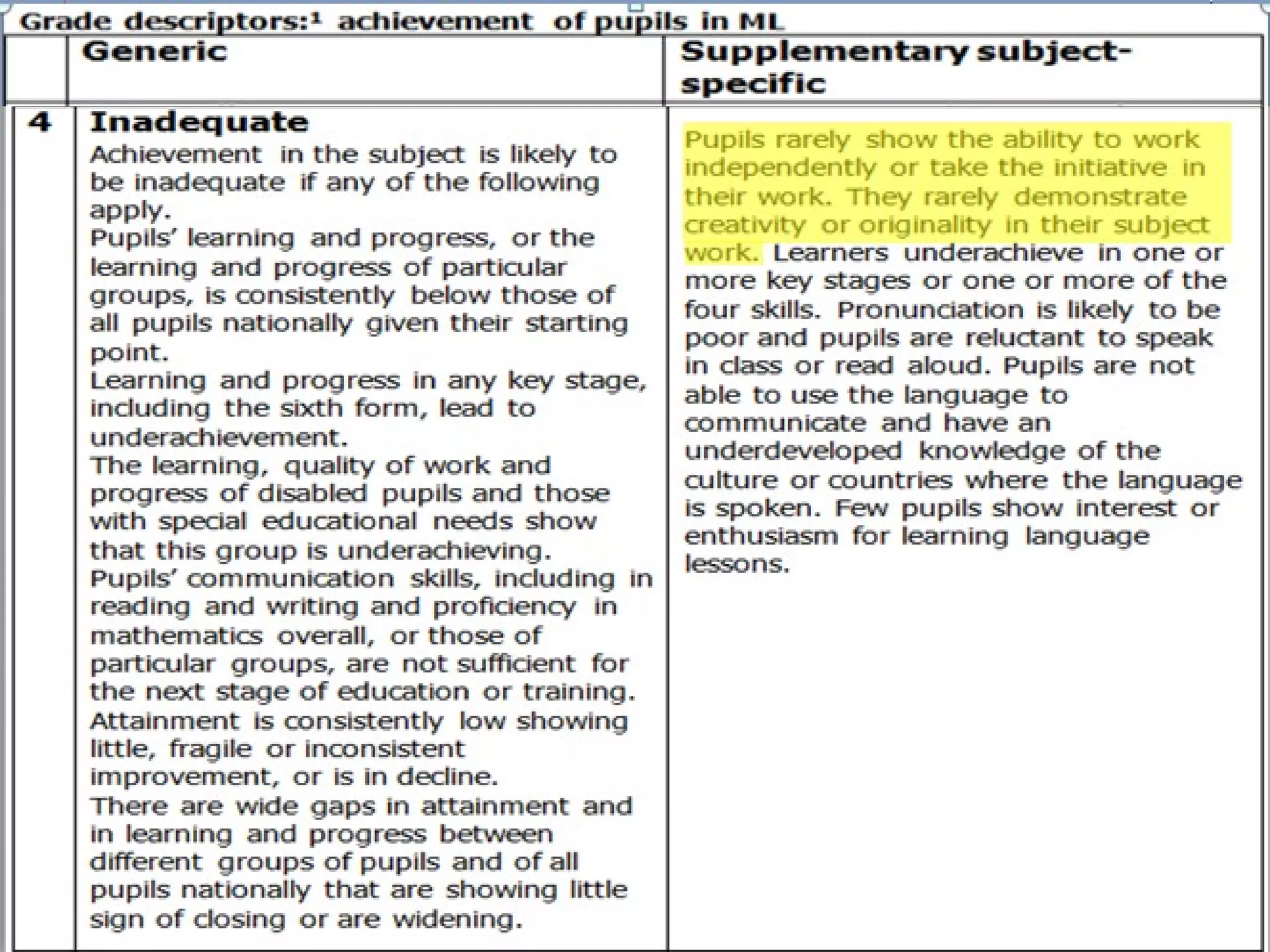
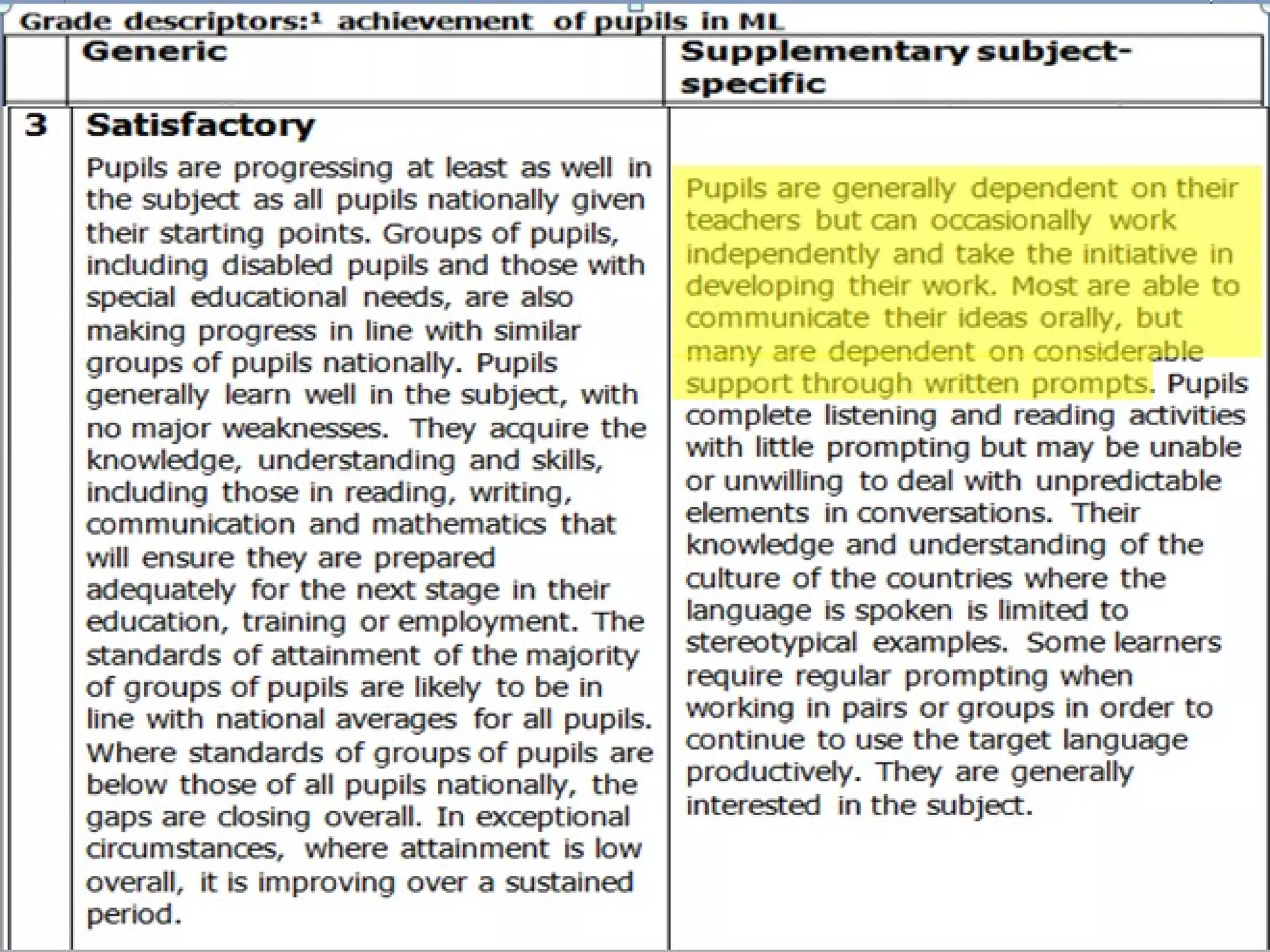
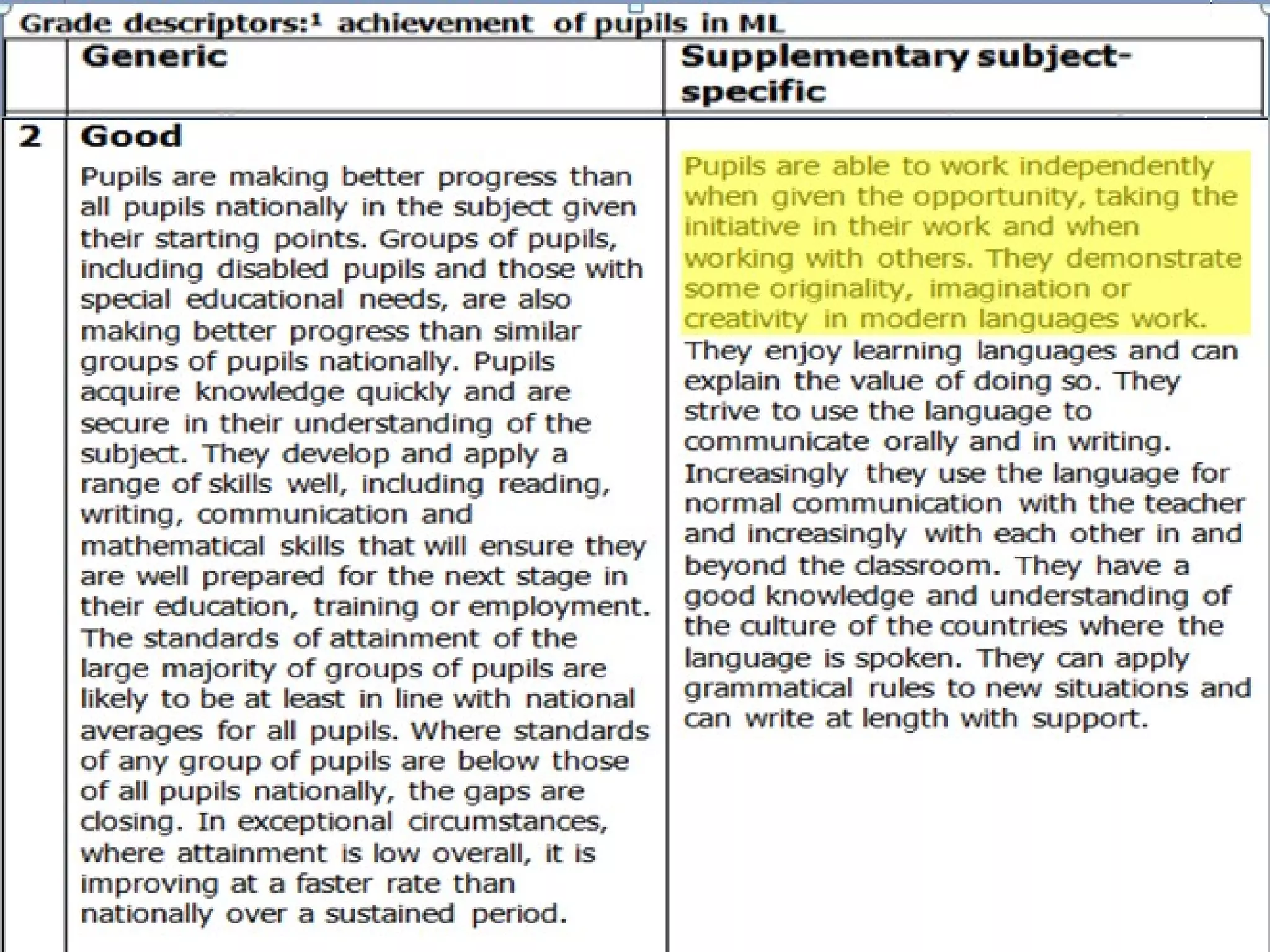
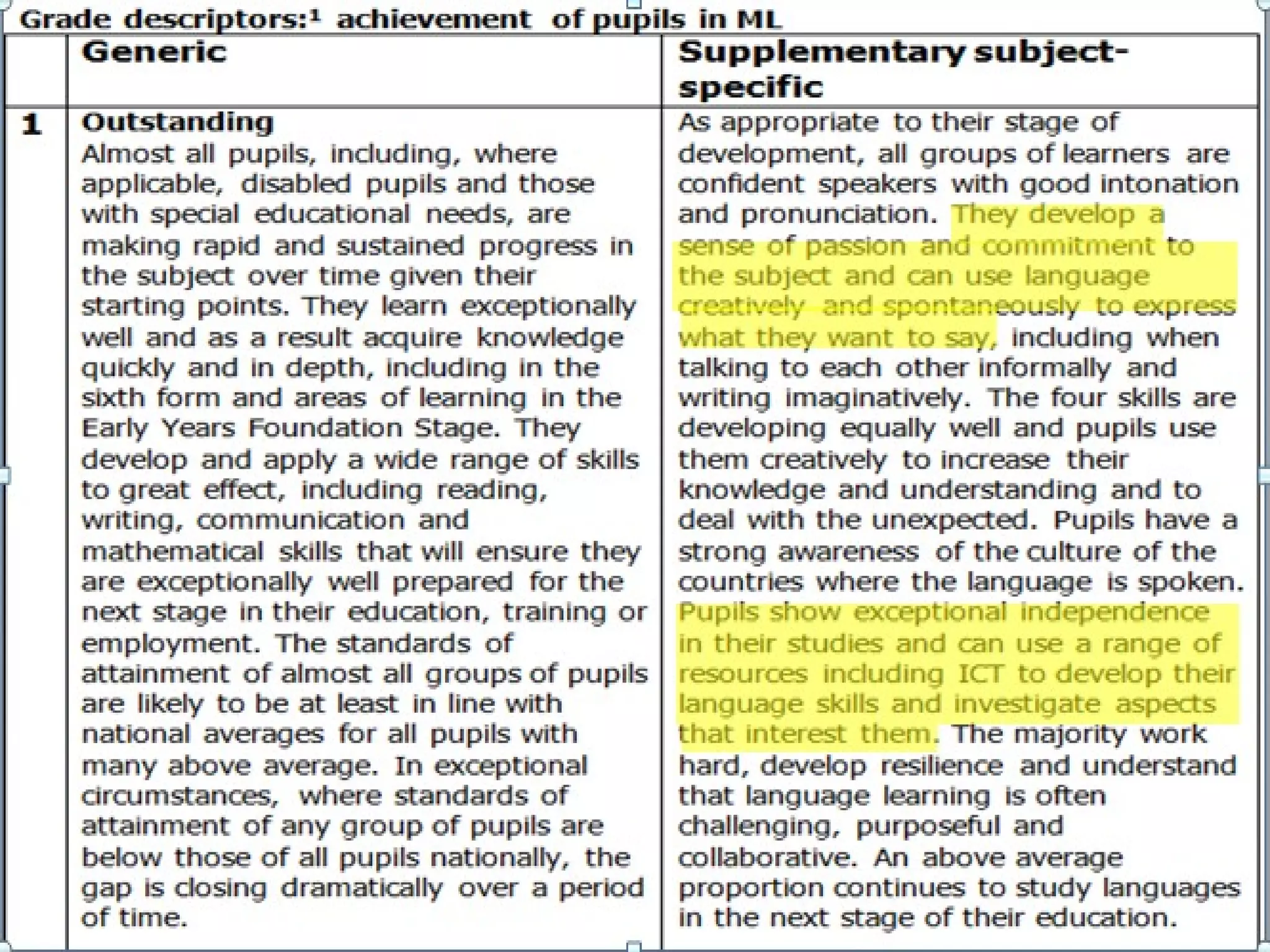
OFSTED Modern Languages Survey Visits
Generic grade descriptors and supplementary subject-specific
guidance for inspectors on making judgements during visits to schools
Subject feedback letters, following survey visits, normally contain
separate judgements on:
• The achievement of pupils in the subject
• The quality of teaching in the subject
• The quality of the curriculum in the subject
• The quality of leadership and management of
the subject
• The overall effectiveness of the subject.
This guidance is intended only to inform the
judgements made by specialist inspectors
carrying out subject survey visits. It is not for
use
Powerpoint Templates
Page 6
Powerpoint Templates
Page 7
Powerpoint Templates
Page 8
Powerpoint Templates
Page 9
Powerpoint Templates
Page 10
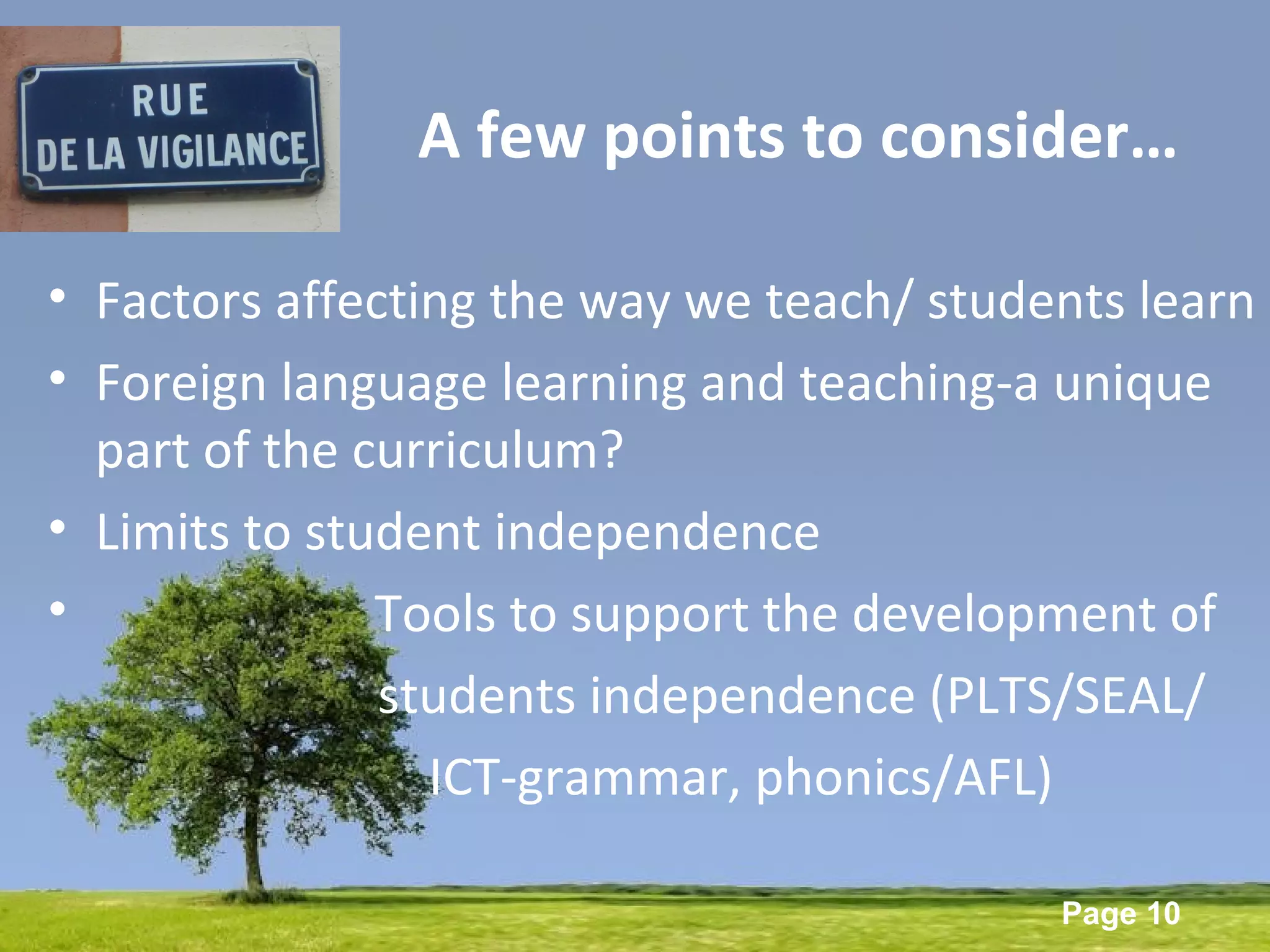
A few points to consider…
• Factors affecting the way we teach/ students learn
• Foreign language learning and teaching-a unique
part of the curriculum?
• Limits to student independence
• Tools to support the development of
students independence (PLTS/SEAL/
ICT-grammar, phonics/AFL)
Powerpoint Templates
Page 11
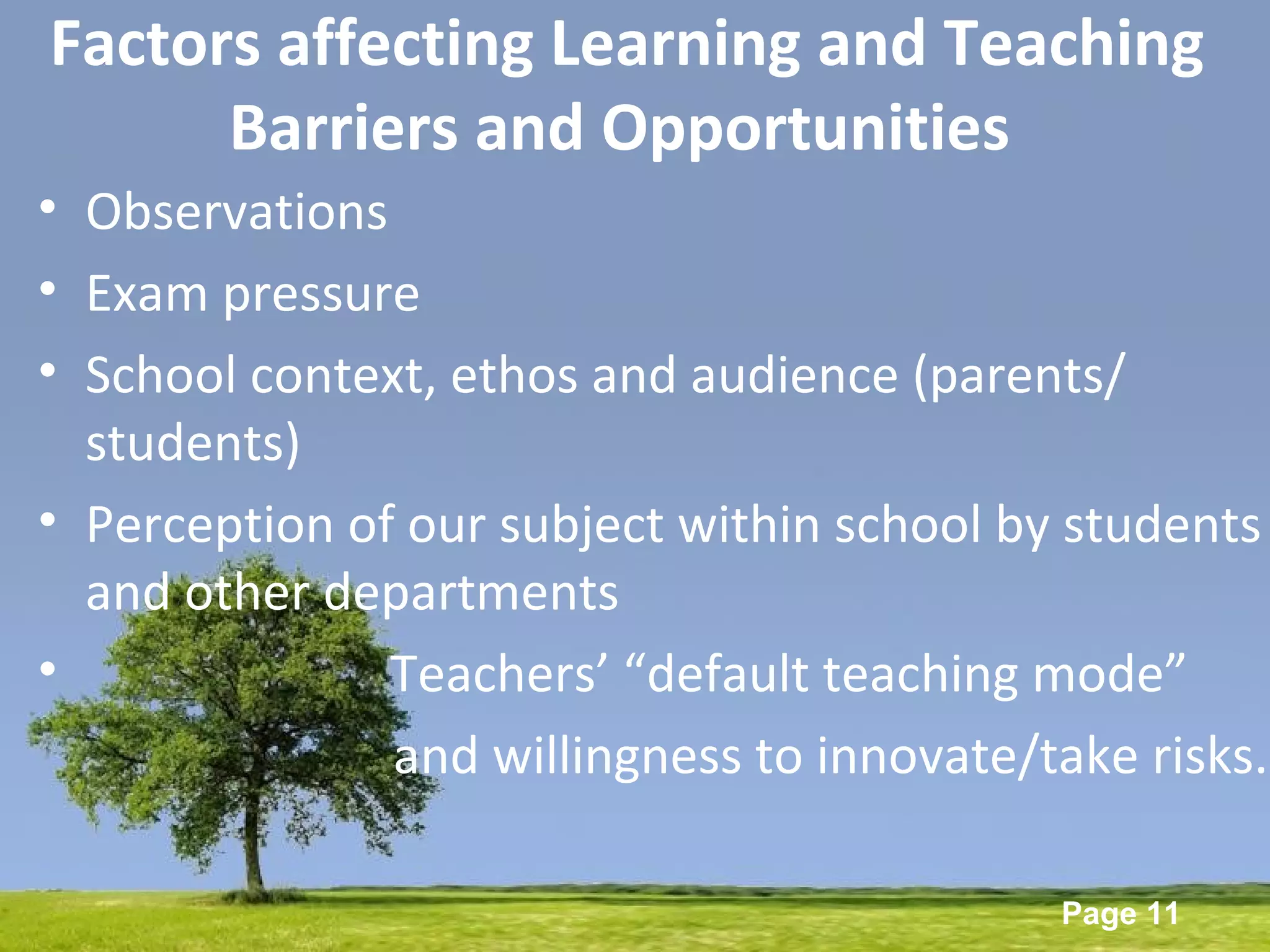
Factors affecting Learning and Teaching
Barriers and Opportunities
• Observations
• Exam pressure
• School context, ethos and audience (parents/
students)
• Perception of our subject within school by students
and other departments
• Teachers’ “default teaching mode”
and willingness to innovate/take risks.
Powerpoint Templates
Page 12
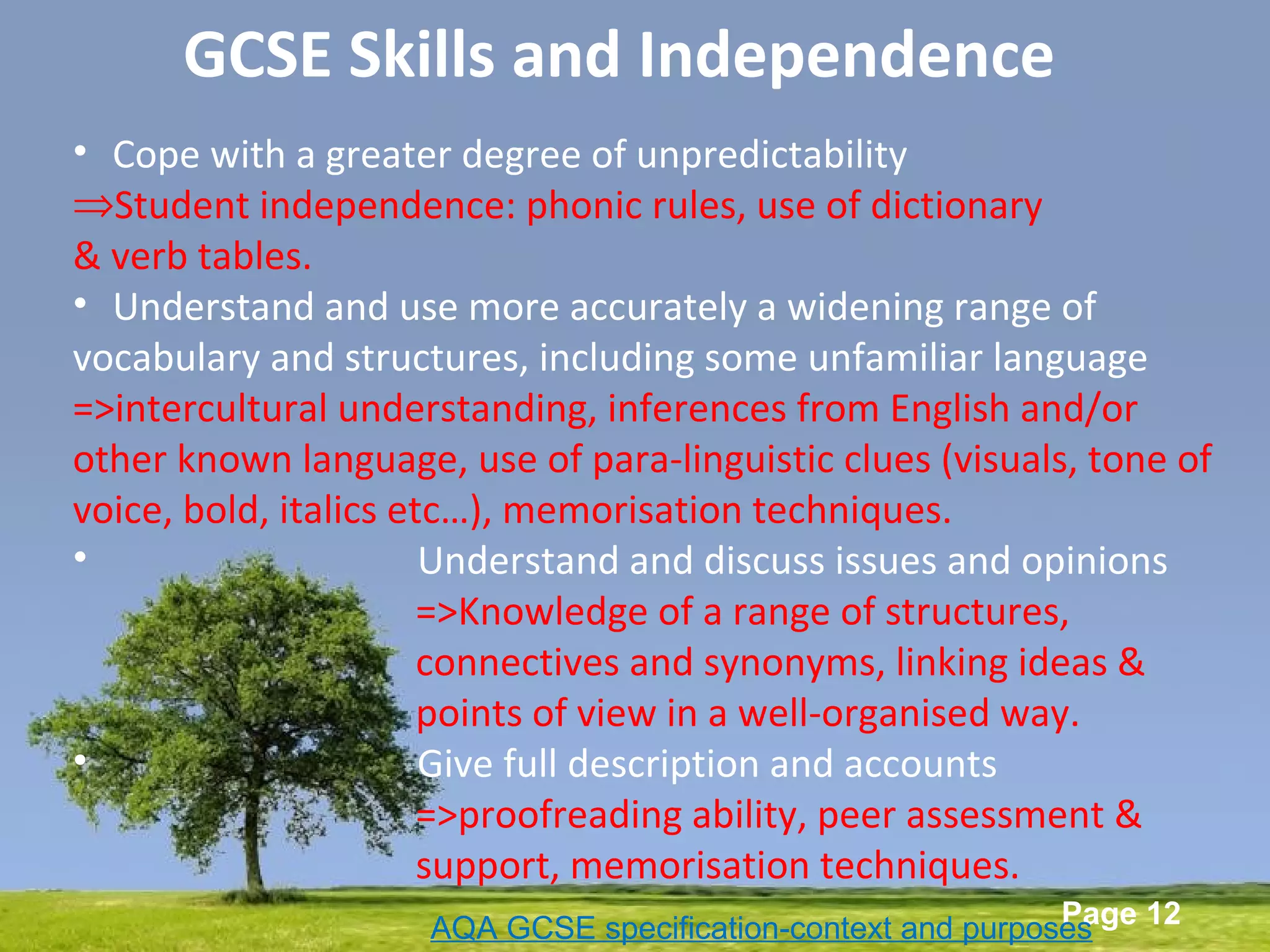
• Cope with a greater degree of unpredictability
⇒Student independence: phonic rules, use of dictionary
& verb tables.
• Understand and use more accurately a widening range of
vocabulary and structures, including some unfamiliar language
=>intercultural understanding, inferences from English and/or
other known language, use of para-linguistic clues (visuals, tone of
voice, bold, italics etc…), memorisation techniques.
• Understand and discuss issues and opinions
=>Knowledge of a range of structures,
connectives and synonyms, linking ideas &
points of view in a well-organised way.
• Give full description and accounts
=>proofreading ability, peer assessment &
support, memorisation techniques.
AQA GCSE specification-context and purposes
GCSE Skills and Independence
Powerpoint Templates
Page 13
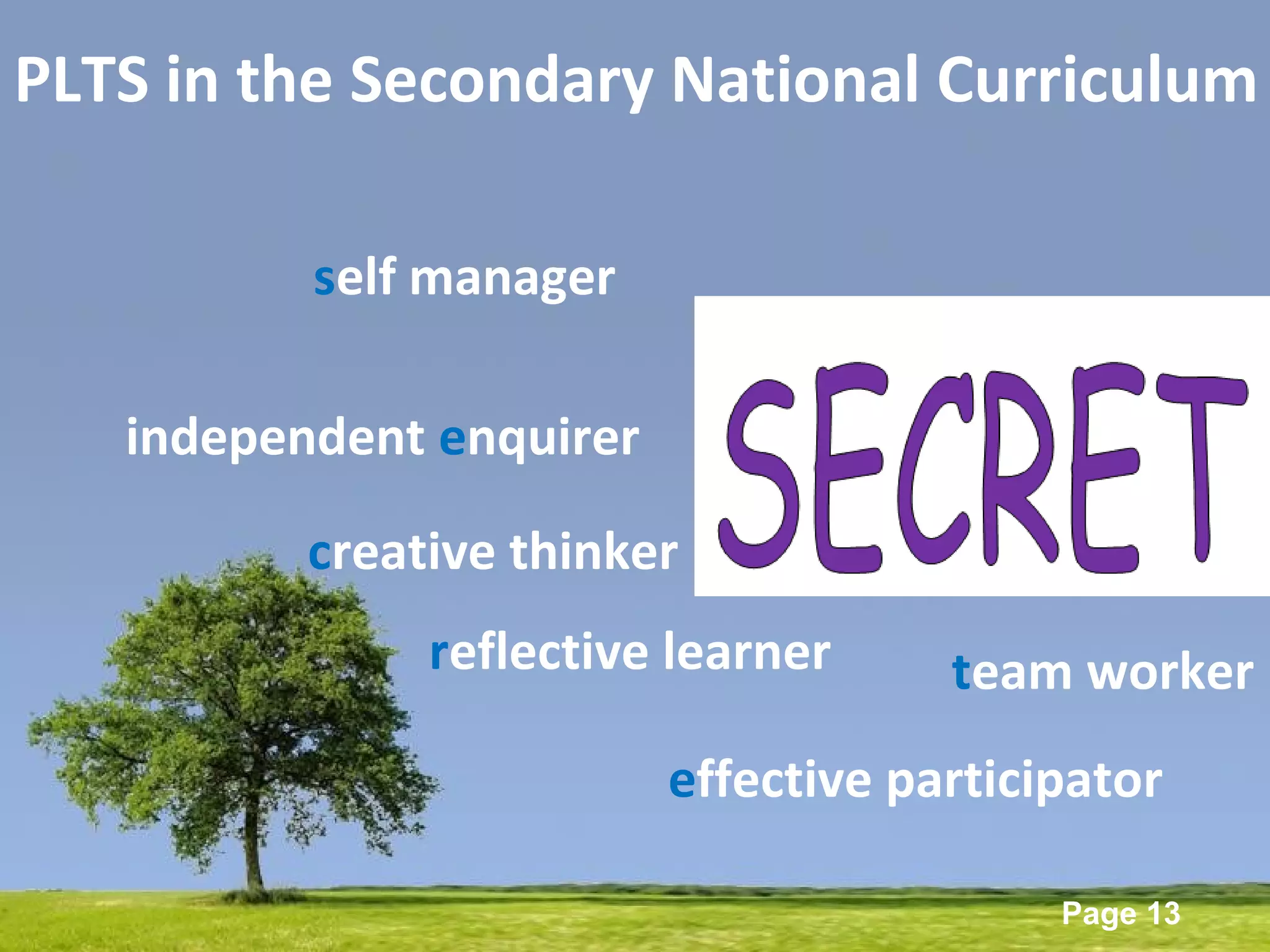
PLTS in the Secondary National Curriculum
self manager
independent enquirer
creative thinker
reflective learner team worker
effective participator
Powerpoint Templates
Page 14
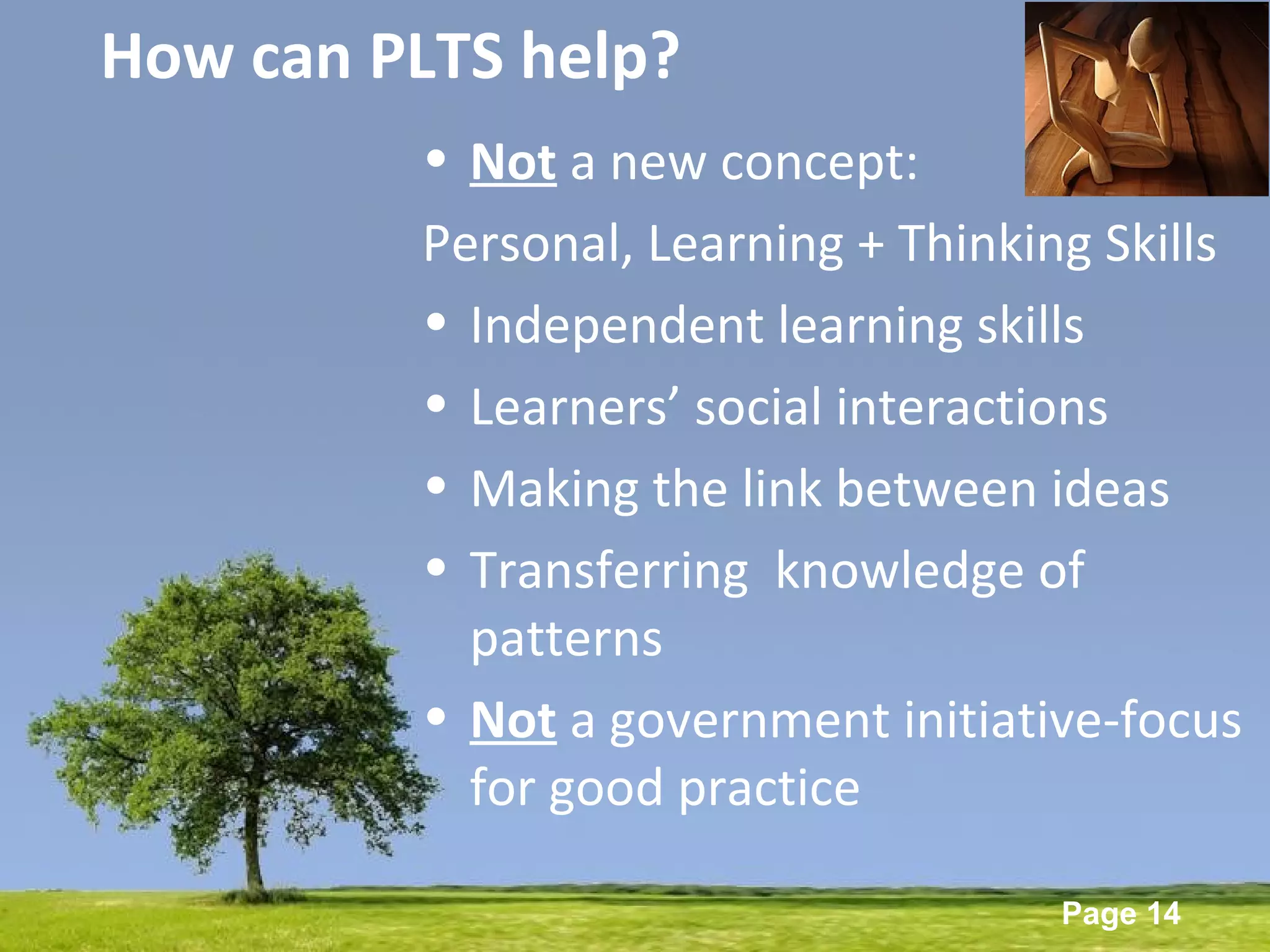
How can PLTS help?
• Not a new concept:
Personal, Learning + Thinking Skills
• Independent learning skills
• Learners’ social interactions
• Making the link between ideas
• Transferring knowledge of
patterns
• Not a government initiative-focus
for good practice
Powerpoint Templates
Page 15
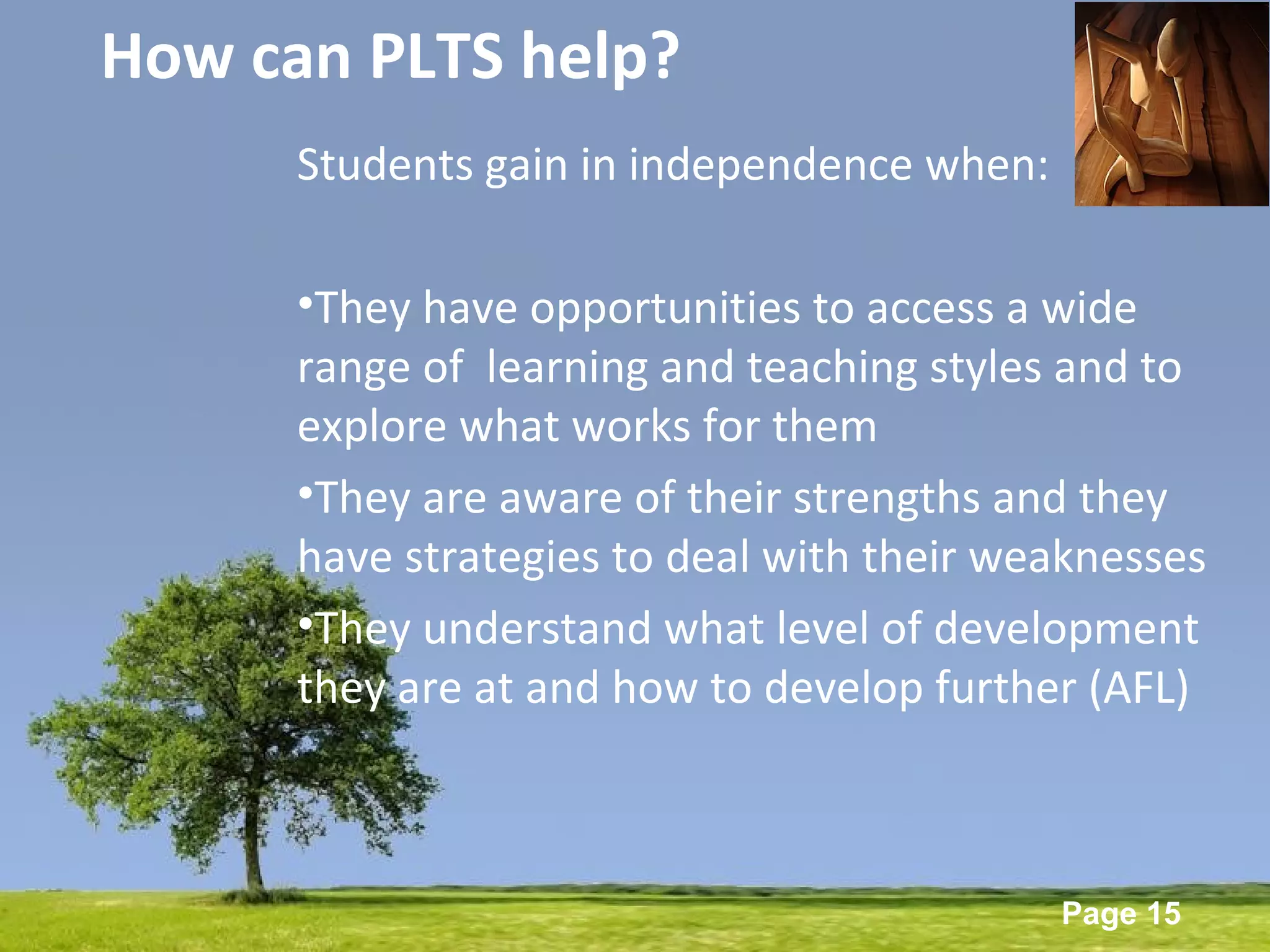
How can PLTS help?
Students gain in independence when:
•They have opportunities to access a wide
range of learning and teaching styles and to
explore what works for them
•They are aware of their strengths and they
have strategies to deal with their weaknesses
•They understand what level of development
they are at and how to develop further (AFL)
Powerpoint Templates
Page 16
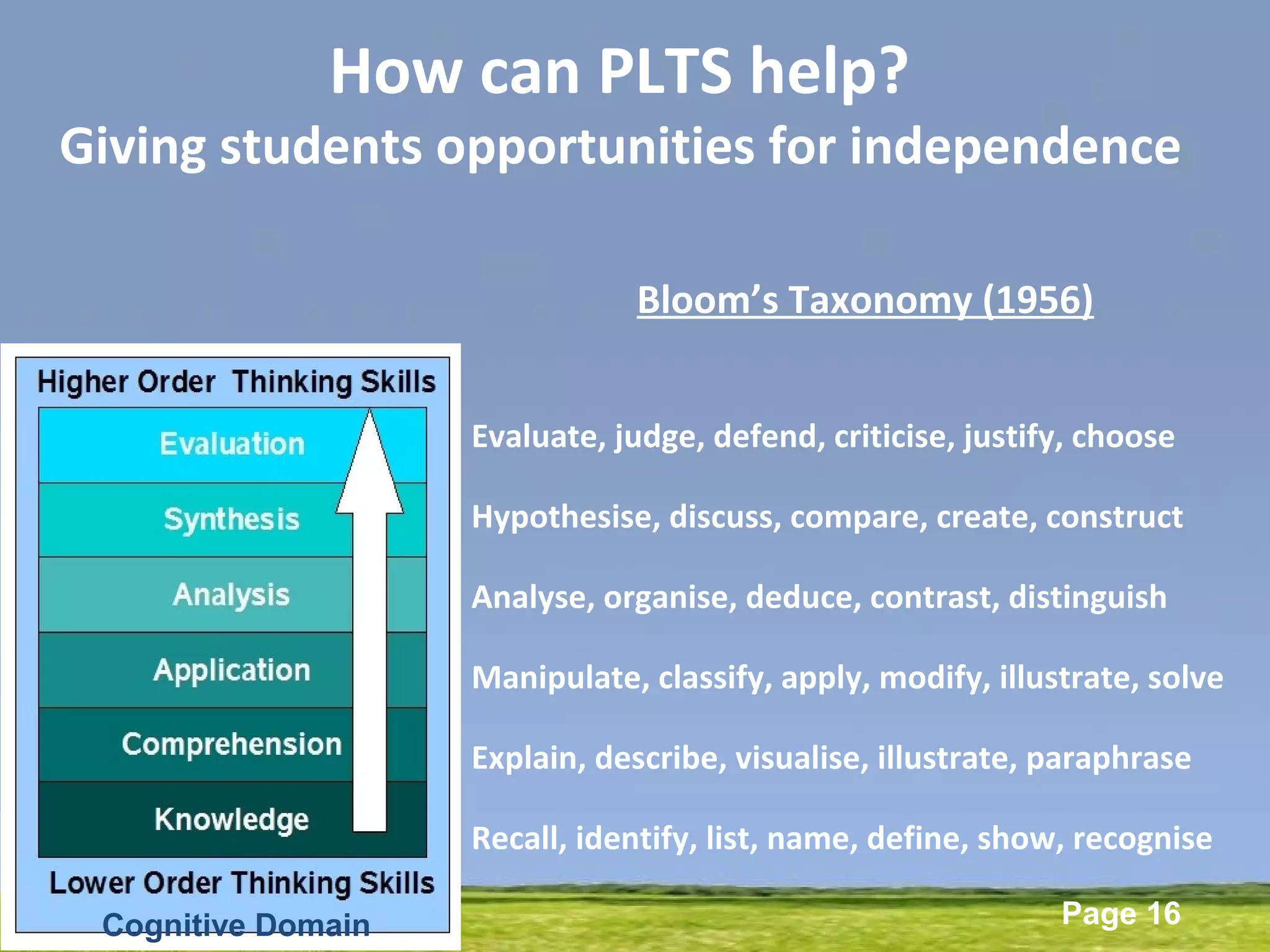
How can PLTS help?
Giving students opportunities for independence
Evaluate, judge, defend, criticise, justify, choose
Hypothesise, discuss, compare, create, construct
Analyse, organise, deduce, contrast, distinguish
Manipulate, classify, apply, modify, illustrate, solve
Explain, describe, visualise, illustrate, paraphrase
Recall, identify, list, name, define, show, recognise
Bloom’s Taxonomy (1956)
Cognitive Domain
Powerpoint Templates
Page 17
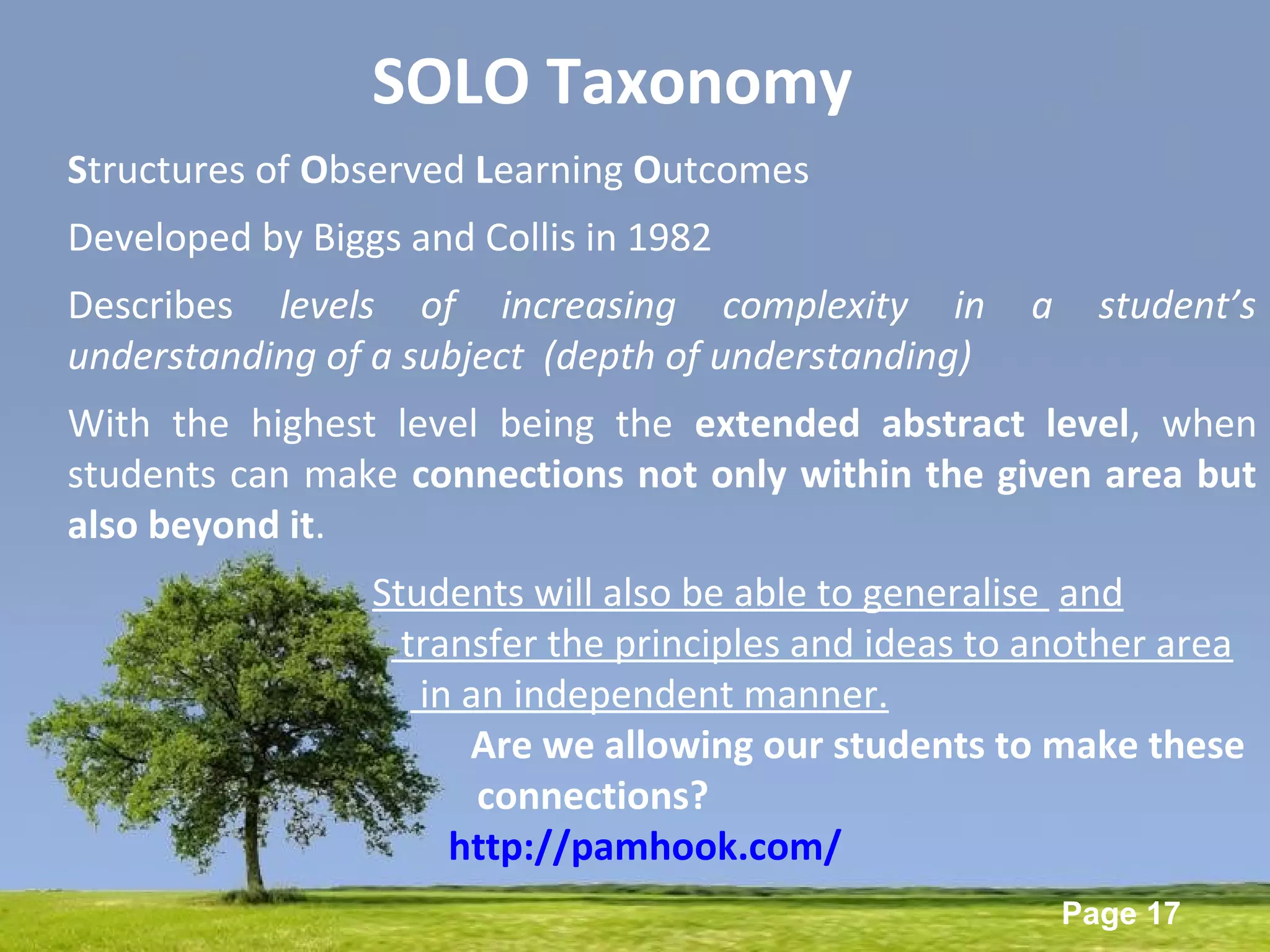
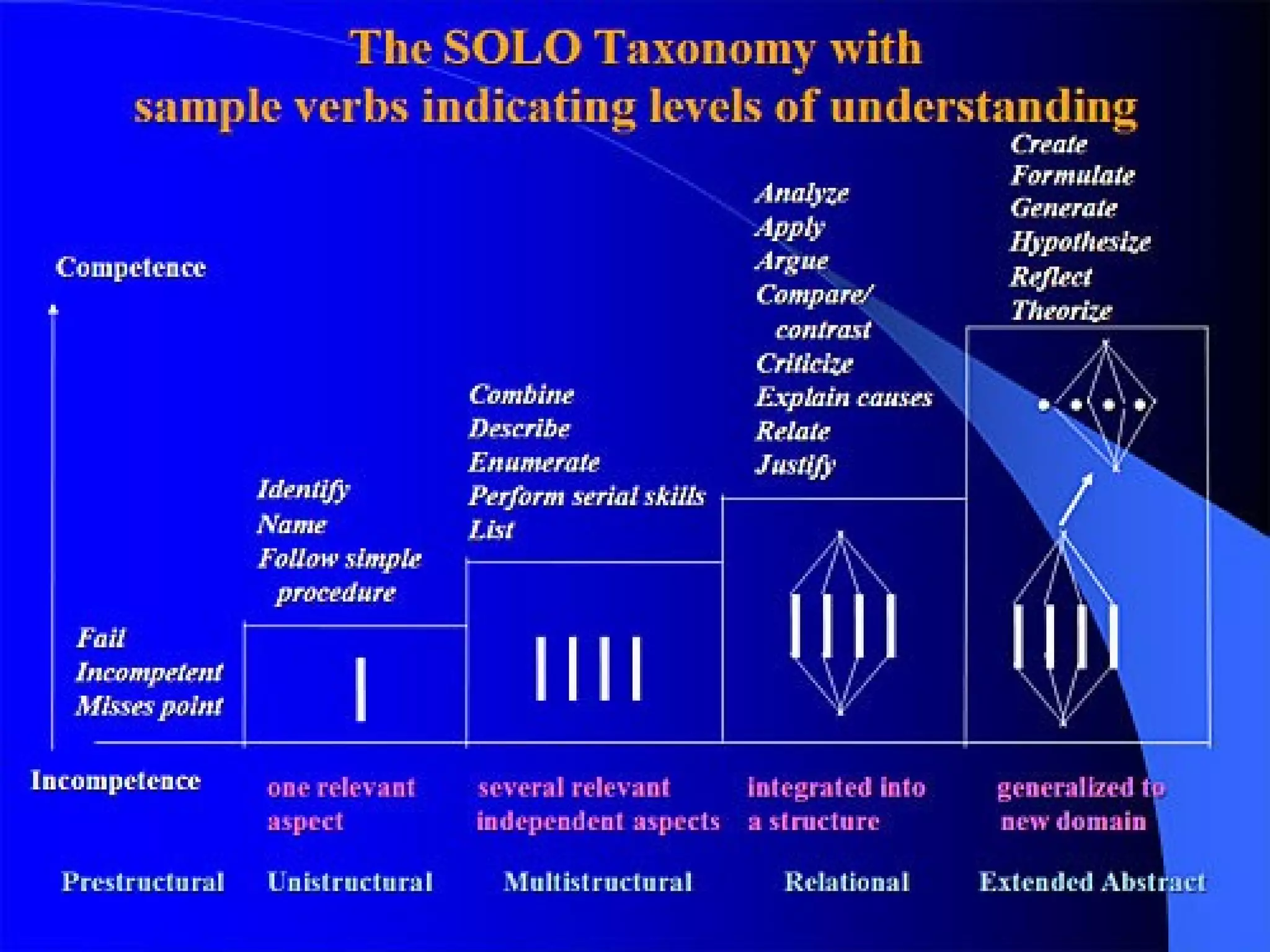
SOLO Taxonomy
Structures of Observed Learning Outcomes
Developed by Biggs and Collis in 1982
Describes levels of increasing complexity in a student’s
understanding of a subject (depth of understanding)
With the highest level being the extended abstract level, when
students can make connections not only within the given area but
also beyond it.
Students will also be able to generalise and
transfer the principles and ideas to another area
in an independent manner.
Are we allowing our students to make these
connections?
http://pamhook.com/
Powerpoint Templates
Page 18
Powerpoint Templates
Page 19
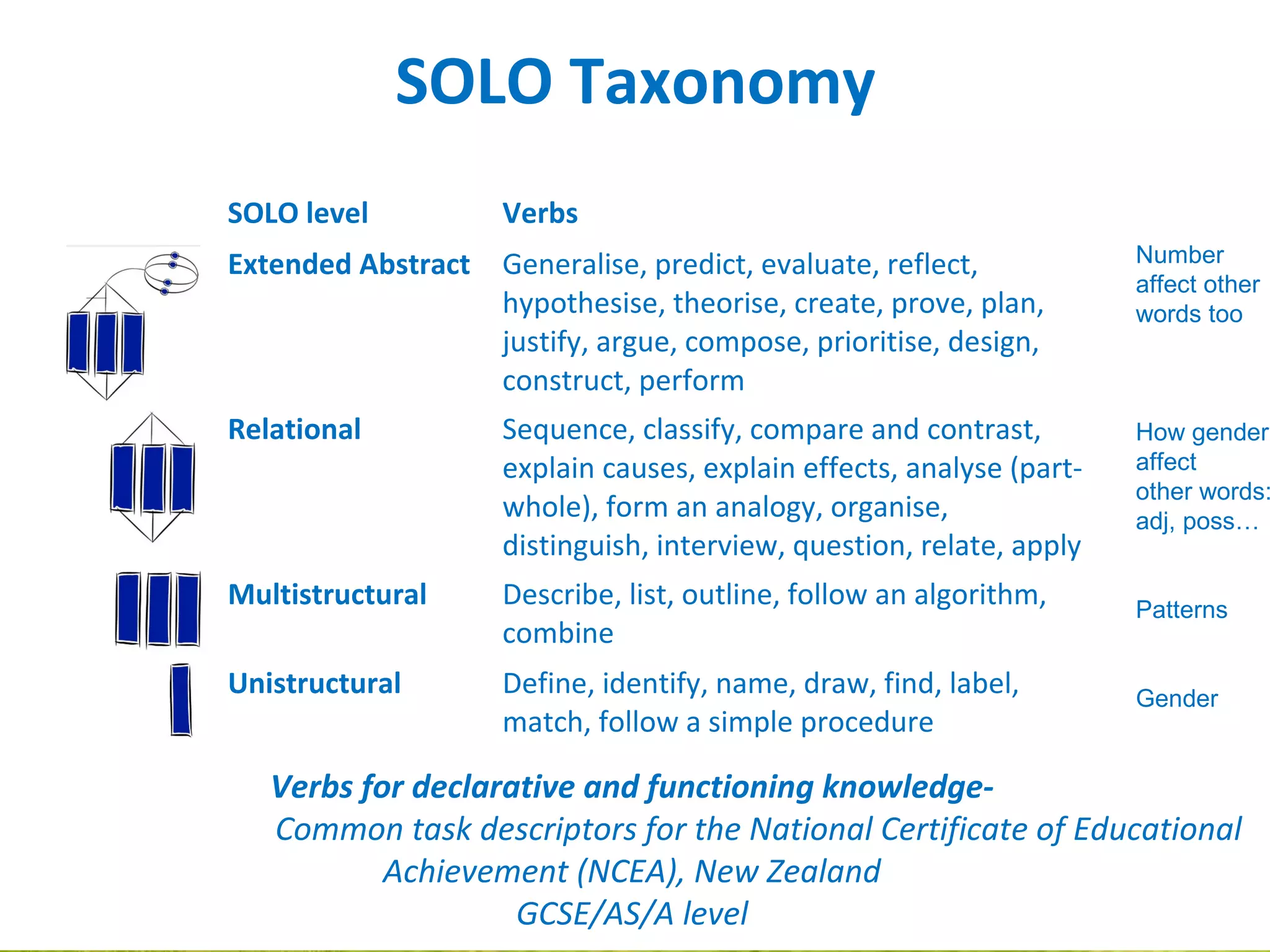
SOLO Taxonomy
SOLO level Verbs
Extended Abstract Generalise, predict, evaluate, reflect,
hypothesise, theorise, create, prove, plan,
justify, argue, compose, prioritise, design,
construct, perform
Relational Sequence, classify, compare and contrast,
explain causes, explain effects, analyse (part-
whole), form an analogy, organise,
distinguish, interview, question, relate, apply
Multistructural Describe, list, outline, follow an algorithm,
combine
Unistructural Define, identify, name, draw, find, label,
match, follow a simple procedure
Verbs for declarative and functioning knowledge-
Common task descriptors for the National Certificate of Educational
Achievement (NCEA), New Zealand
GCSE/AS/A level
Number
affect other
words too
How gender
affect
other words:
adj, poss…
Patterns
Gender
Powerpoint Templates
Page 20
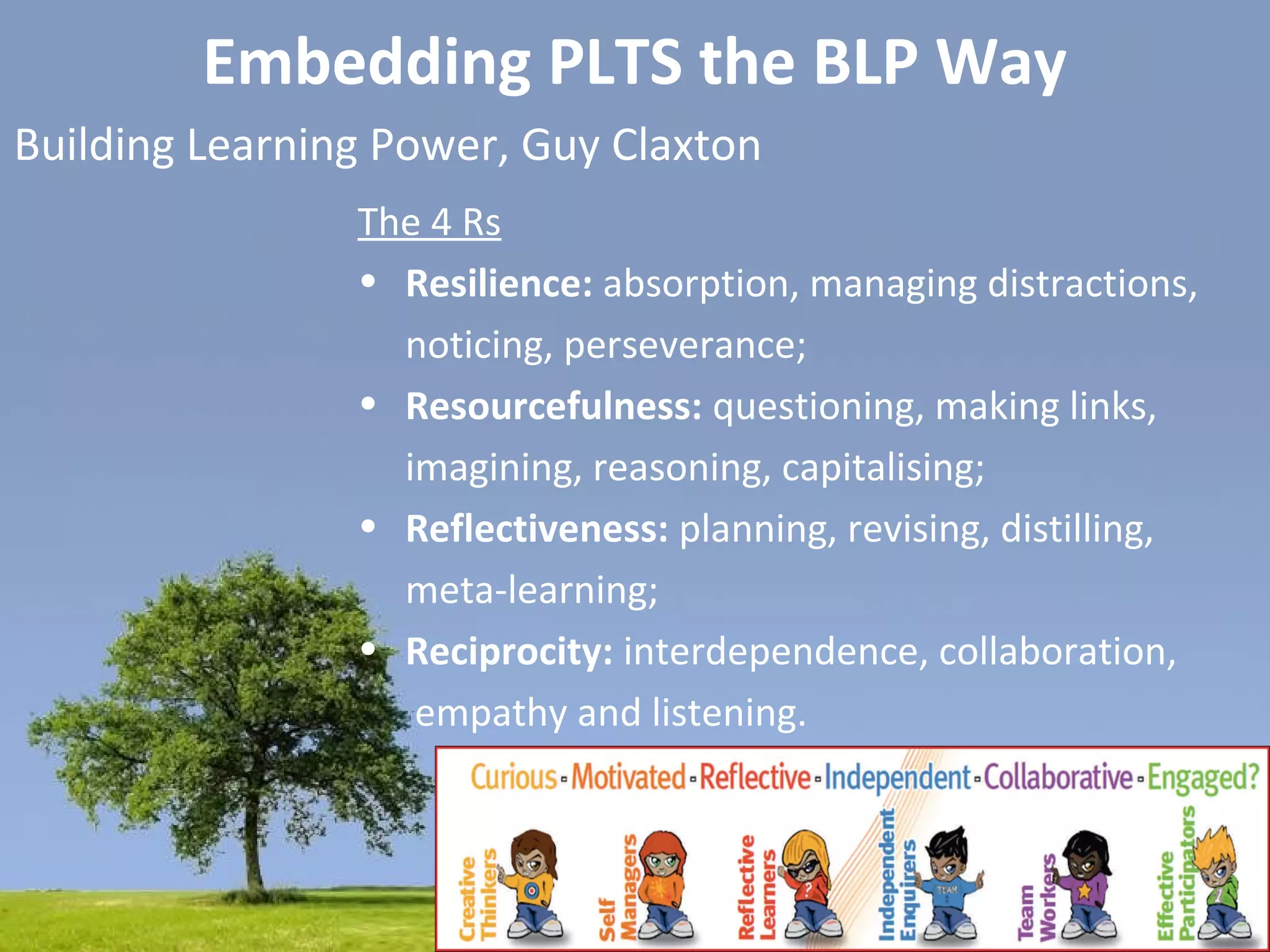
Embedding PLTS the BLP Way
The 4 Rs
• Resilience: absorption, managing distractions,
noticing, perseverance;
• Resourcefulness: questioning, making links,
imagining, reasoning, capitalising;
• Reflectiveness: planning, revising, distilling,
meta-learning;
• Reciprocity: interdependence, collaboration,
empathy and listening.
Building Learning Power, Guy Claxton
Powerpoint Templates
Page 21
Strategies for developing reflective
independent learners
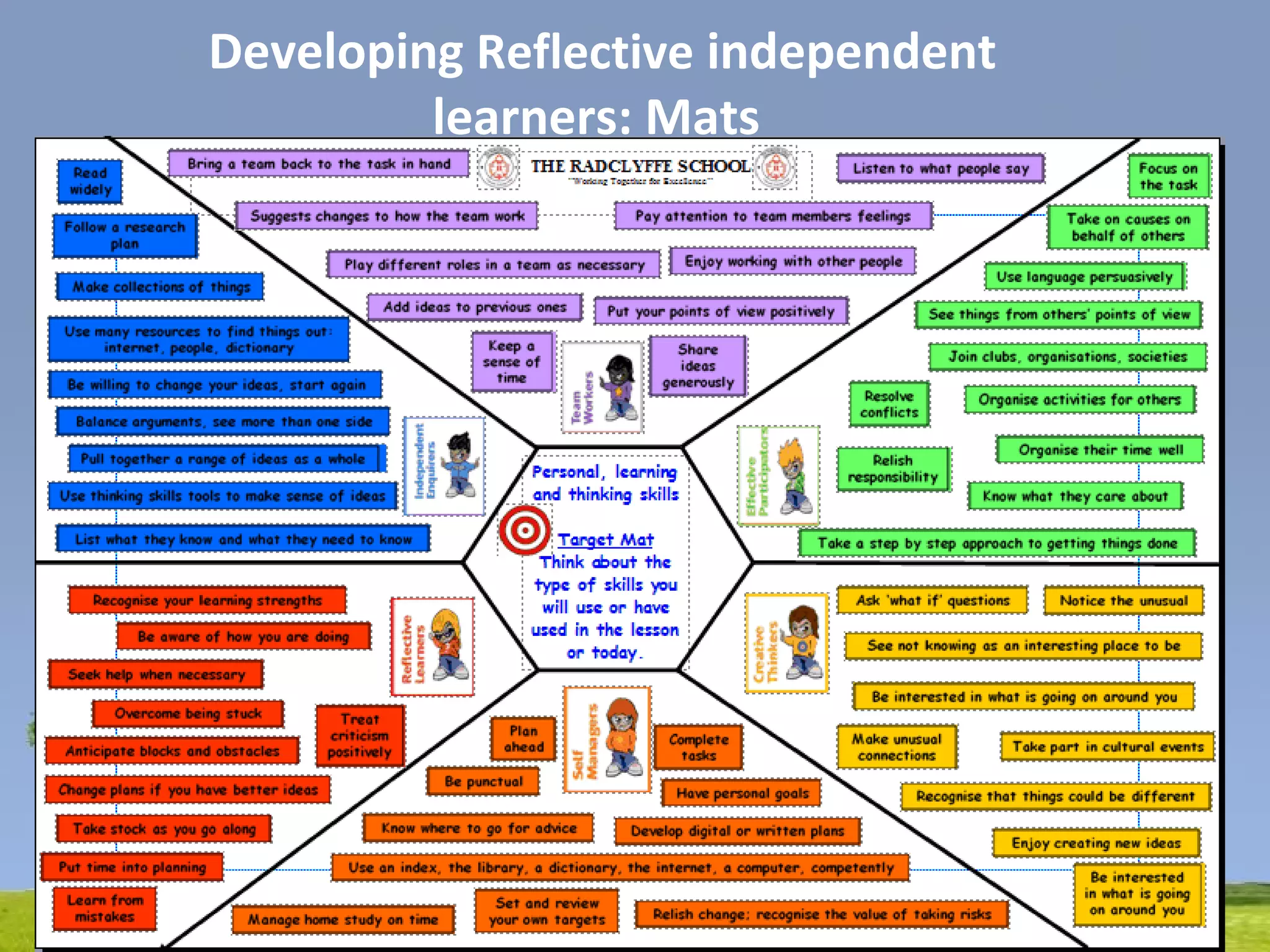
• Introducing Meta-language to talk
about learning: mats, display
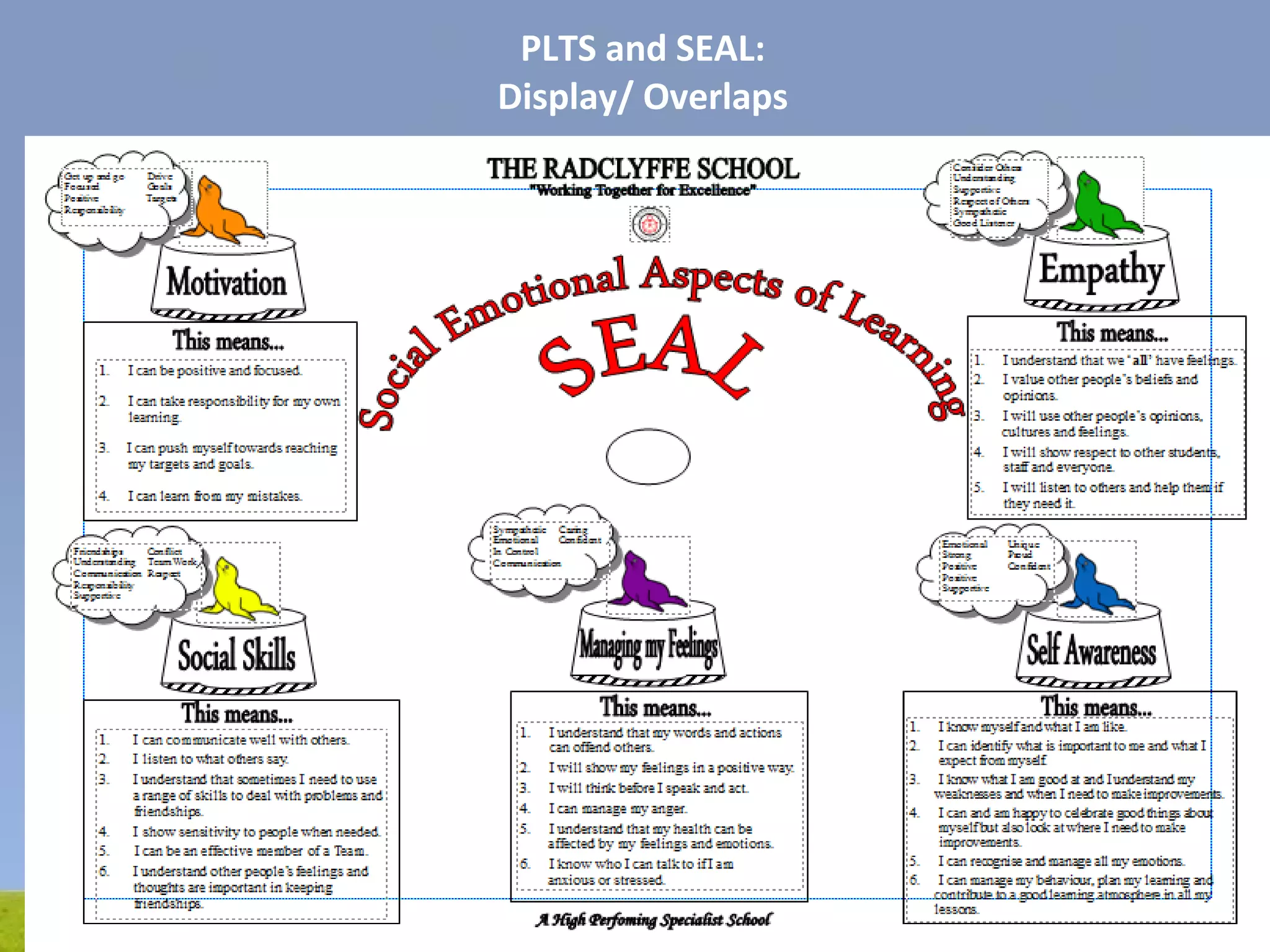
• Overlaps with AFL and SEAL:
understanding of assessment criteria,
different types of motivation…
• Focus on developing PLTS as a
wholeschool approach
• http://isabellejones.blogspot.com/2009/10/flip-cramlington-model-fo
• http://isabellejones.blogspot.com/2009/10/flip-approach-for-languag
Powerpoint Templates
Page 22
Developing Reflective independent
learners: Mats
Powerpoint Templates
Page 23
PLTS and SEAL:
Display/ Overlaps
Powerpoint Templates
Page 24
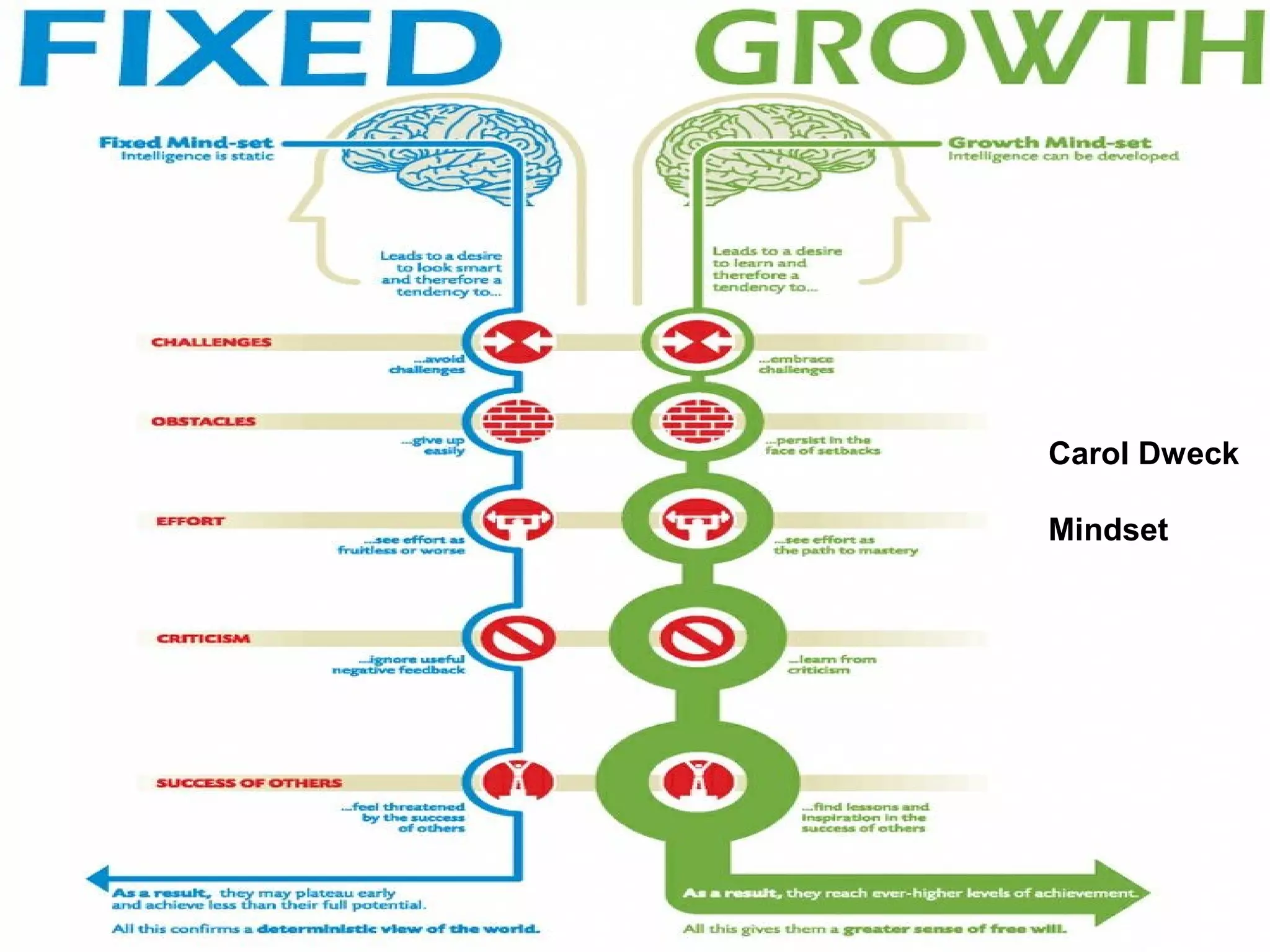
Carol Dweck
Mindset
Powerpoint Templates
Page 25
Speaking and Teacher Talk
• Teacher use of the Target
Language-a barrier to students’
independent access to language
activities?
• Can students practise speaking
independently?
Powerpoint Templates
Page 26
Independence and Creativity
Art: colours and descriptions, biographies, use of visuals
and 3D “hooks”
Music: rhymes, sounds and rhythm
Drama: role-play/ puppets
History: a new slant on what they are familiar with e.g. ww2
Geography: Barcelona, Paris, the environment, fair trade
Dance: cultural aspects, use movement to remember
Media studies: looking at advertising or short films
Cultural awareness and identity: celebrate
and promote diversity through using pictures,
music, the French & Spanish-speaking world…
Powerpoint Templates
Page 27
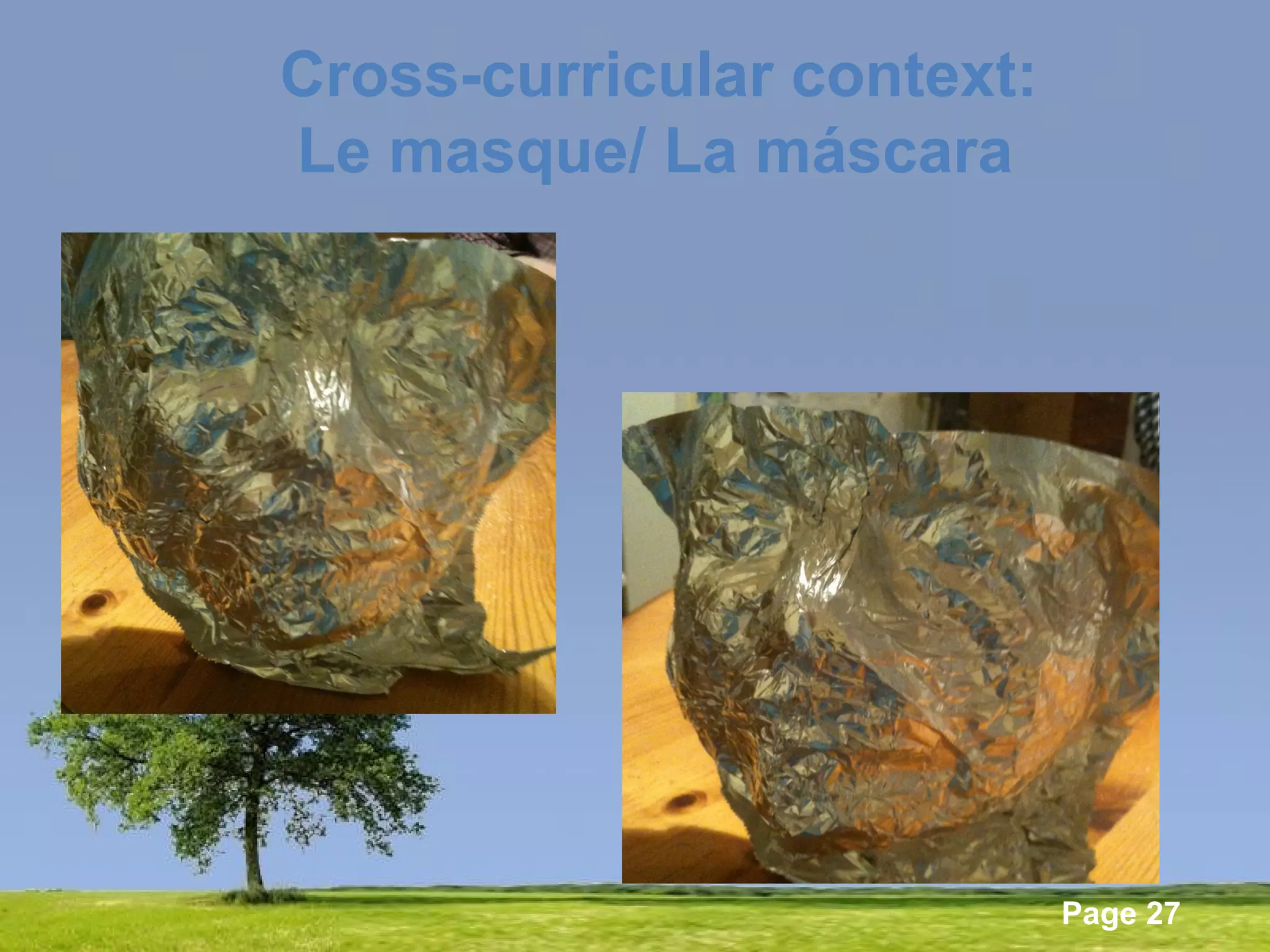
Cross-curricular context:
Le masque/ La máscara
Powerpoint Templates
Page 28
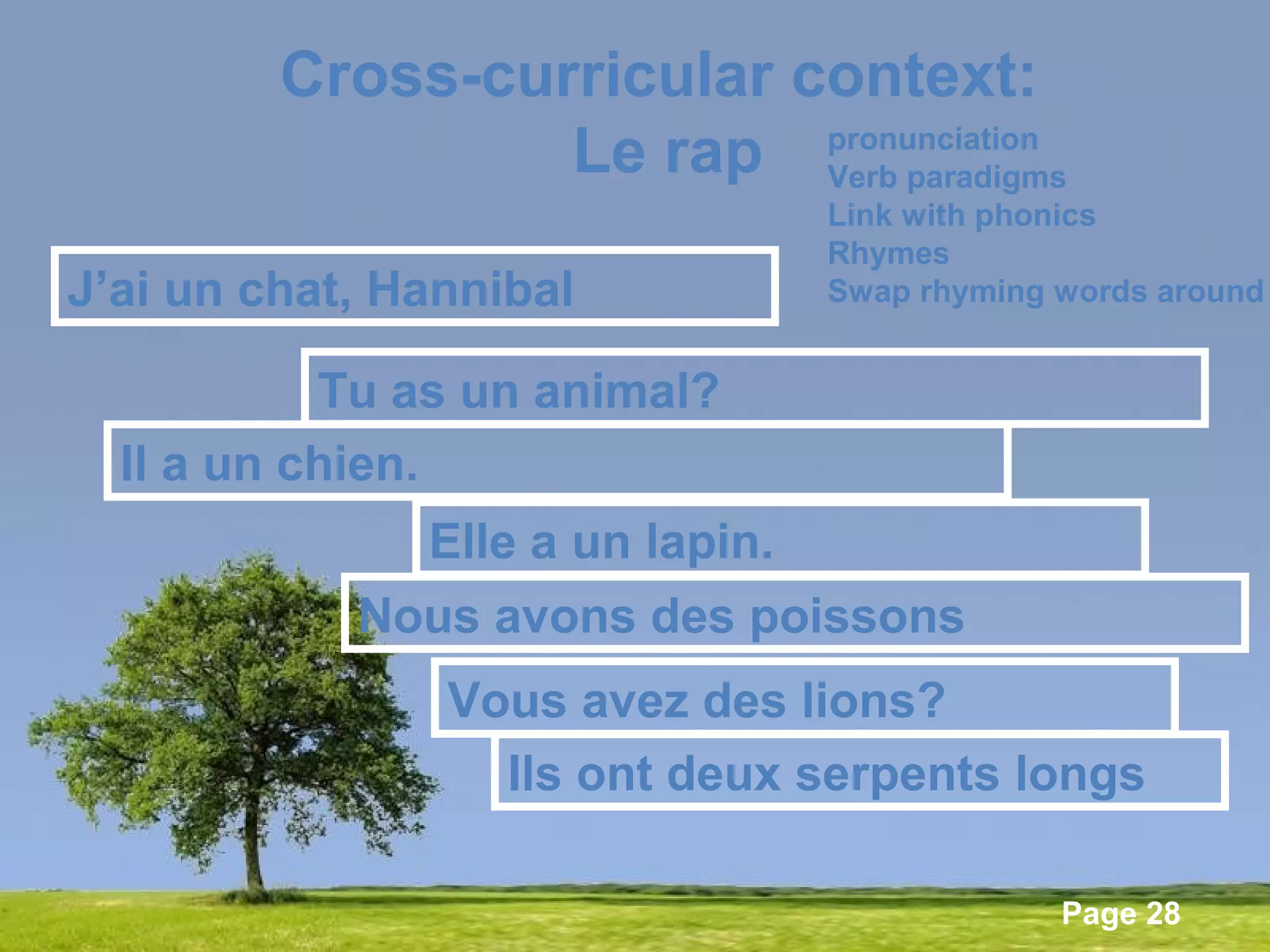
Cross-curricular context:
Le rap
J’ai un chat, Hannibal
Tu as un animal?
Il a un chien.
Nous avons des poissons
Vous avez des lions?
Ils ont deux serpents longs
pronunciation
Verb paradigms
Link with phonics
Rhymes
Swap rhyming words around
Elle a un lapin.
Powerpoint Templates
Page 29
Cross-curricular context:
Rap: Trouve la rime!1.Find a theme
2.Write down 5 key words linked with the theme
3.Think of possible rhyming word. Remember suffixes that are the
same or
nearly the same in both languages e.g. ción/ tion, ism/ isme/ ismo
using rhyme
dictionary/apps
4.Fill in the gaps!
Powerpoint Templates
Page 30
ICT support for learners:
in and out of the classroom
Online dictionary and apps vs paper dictionary http://www.wordreference.com/
Le Robert-Dixel
http://itunes.apple.com/fr/app/le-robert-dictionnaire-dixel/id324277188?mt=8
Verb apps and verb tables http://www.bescherelle.com/
http://www.elconjugador.com/enindex.php?newlang=Y&langvalue=en
Recording themselves to improve accent: audacity/ phone, voki, text-to-speech,
FLA or teacher. http://text-to-speech.imtranslator.net/ http://voki.com/
Opportunities to practise speaking without a public
performance
Homework or extension work send via Edmodo (free)
or Doddle (subscription)
Powerpoint Templates
Page 31
ICT support for learners: in
and out of the classroom
VLE: homework, consolidation and extension work
Facebook page: Departmental/ Faculty page with links promoting
Languages
Twitter page http://twitter.com/AESG_MFL
Blog/ wiki: http://chilternedgemfl.typepad.com/chiltern-edge-mfl/
http://stmichaelsmfl.wikispaces.com/
App list: http://isabellejones.blogspot.co.uk/search?q=iphone+
Powerpoint Templates
Page 32
AFL and Student Independence
Self and peer assessment: proofreading/ developing students’
understanding of assessment criteria
Understanding criteria: what I am at/ how do I move on
(break it down/ beware of oversimplification)
Peer assessment: oral/ written feedback
Student learning skills training needs to feature highly in the SoWs
Powerpoint Templates
Page 33
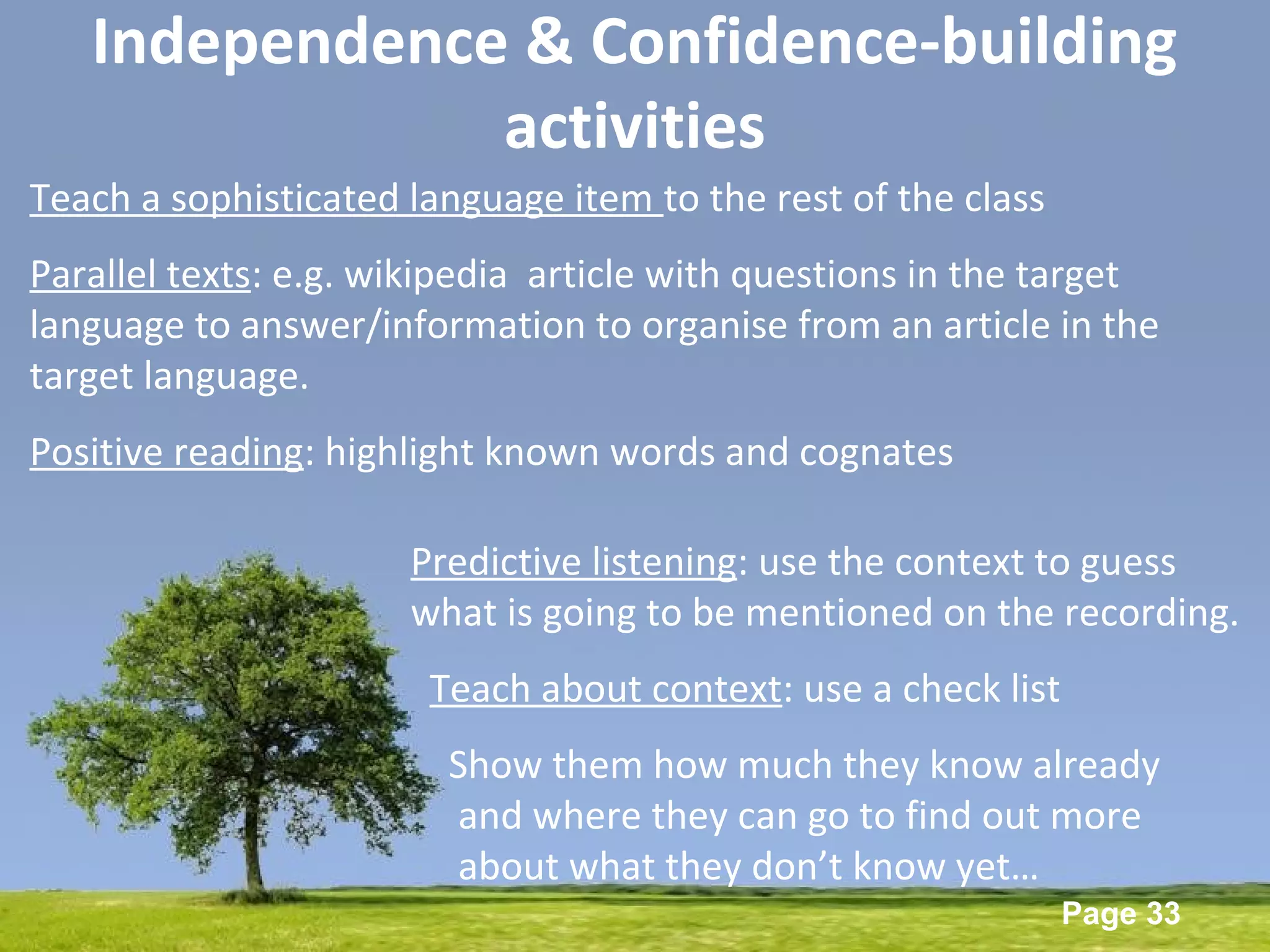
Independence & Confidence-building
activities
Teach a sophisticated language item to the rest of the class
Parallel texts: e.g. wikipedia article with questions in the target
language to answer/information to organise from an article in the
target language.
Positive reading: highlight known words and cognates
Predictive listening: use the context to guess
what is going to be mentioned on the recording.
Teach about context: use a check list
Show them how much they know already
and where they can go to find out more
about what they don’t know yet…
Powerpoint Templates
Page 34
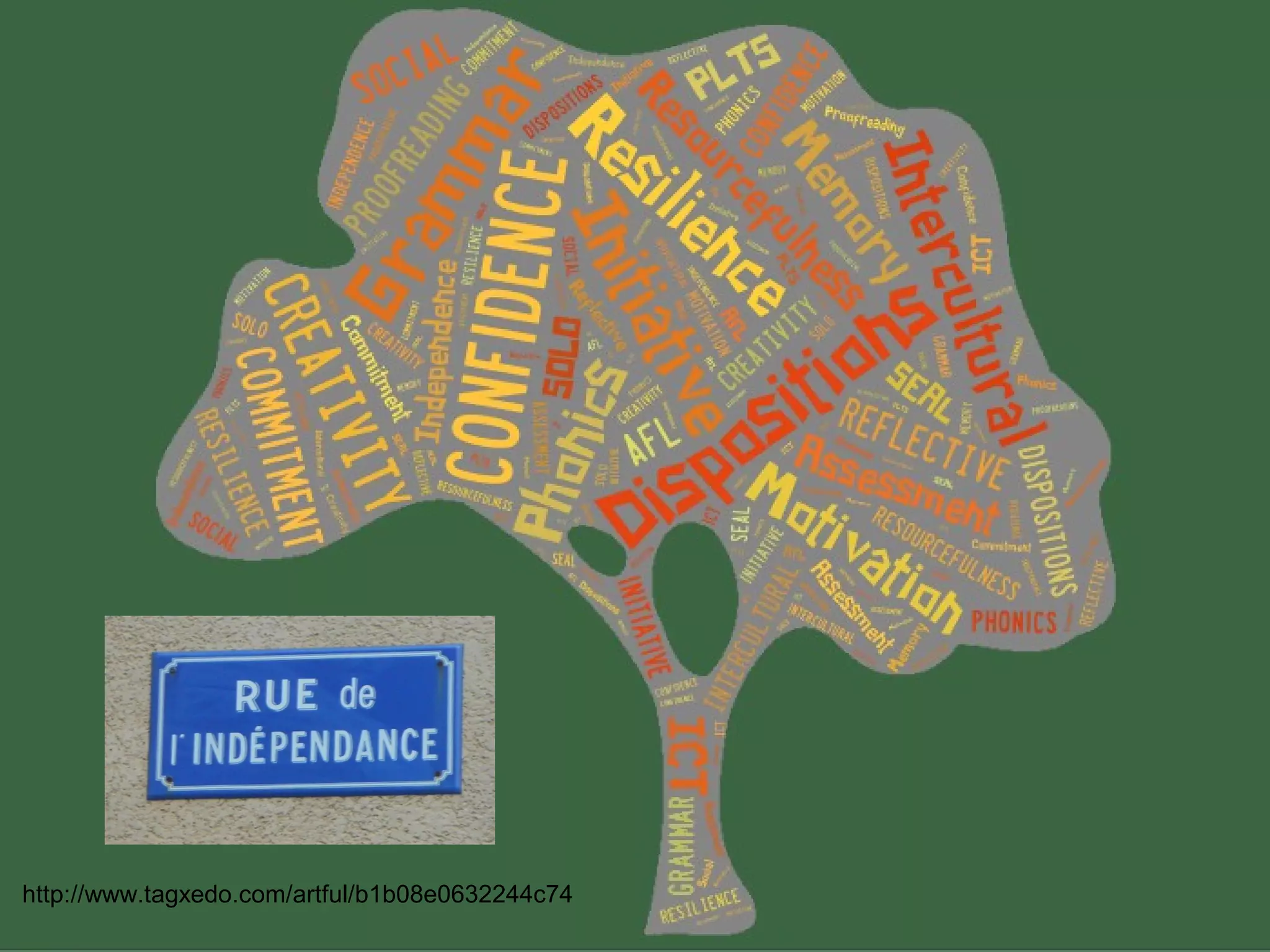
http://www.tagxedo.com/artful/b1b08e0632244c74
Powerpoint Templates
Page 35
• Why developing independence is crucial to
raising standards in languages
• Barriers and opportunities
• Tools to support the development of
independence in languages
Powerpoint Templates
Page 36
Action!
Developing independent learning skills in
the languages classroom
•PLTS:
•SEAL:
• ICT-grammar, phonics:
• AFL:
Powerpoint Templates
Page 37
Powerpoint Templates
Promoting Independent Learning in MFL
Isabelle Jones
http://isabellejones.blogspot.com
Twitter: @icpjones
icpjones@yahoo.co.uk

Rastrick developing student independence in mfl

  • 1.
    Powerpoint Templates Page 1 PowerpointTemplates Promoting Independent Learning in MFL Isabelle Jones http://isabellejones.blogspot.com Twitter: @icpjones icpjones@yahoo.co.uk
  • 2.
    Powerpoint Templates Page 2 •Why developing independence is crucial to raising standards in languages • Barriers and opportunities • Tools to support the development of independence in languages
  • 3.
    Powerpoint Templates Page 3 Whyindependence? Escalator failure.avi
  • 4.
    Powerpoint Templates Page 4 •Independence, curriculum time and standards of learning & teaching • Better learners, better linguists • Future-proof linguists Why independence?
  • 5.
    Powerpoint Templates Page 5 OFSTEDModern Languages Survey Visits Generic grade descriptors and supplementary subject-specific guidance for inspectors on making judgements during visits to schools Subject feedback letters, following survey visits, normally contain separate judgements on: • The achievement of pupils in the subject • The quality of teaching in the subject • The quality of the curriculum in the subject • The quality of leadership and management of the subject • The overall effectiveness of the subject. This guidance is intended only to inform the judgements made by specialist inspectors carrying out subject survey visits. It is not for use
  • 6.
  • 7.
  • 8.
  • 9.
  • 10.
    Powerpoint Templates Page 10 Afew points to consider… • Factors affecting the way we teach/ students learn • Foreign language learning and teaching-a unique part of the curriculum? • Limits to student independence • Tools to support the development of students independence (PLTS/SEAL/ ICT-grammar, phonics/AFL)
  • 11.
    Powerpoint Templates Page 11 Factorsaffecting Learning and Teaching Barriers and Opportunities • Observations • Exam pressure • School context, ethos and audience (parents/ students) • Perception of our subject within school by students and other departments • Teachers’ “default teaching mode” and willingness to innovate/take risks.
  • 12.
    Powerpoint Templates Page 12 •Cope with a greater degree of unpredictability ⇒Student independence: phonic rules, use of dictionary & verb tables. • Understand and use more accurately a widening range of vocabulary and structures, including some unfamiliar language =>intercultural understanding, inferences from English and/or other known language, use of para-linguistic clues (visuals, tone of voice, bold, italics etc…), memorisation techniques. • Understand and discuss issues and opinions =>Knowledge of a range of structures, connectives and synonyms, linking ideas & points of view in a well-organised way. • Give full description and accounts =>proofreading ability, peer assessment & support, memorisation techniques. AQA GCSE specification-context and purposes GCSE Skills and Independence
  • 13.
    Powerpoint Templates Page 13 PLTSin the Secondary National Curriculum self manager independent enquirer creative thinker reflective learner team worker effective participator
  • 14.
    Powerpoint Templates Page 14 Howcan PLTS help? • Not a new concept: Personal, Learning + Thinking Skills • Independent learning skills • Learners’ social interactions • Making the link between ideas • Transferring knowledge of patterns • Not a government initiative-focus for good practice
  • 15.
    Powerpoint Templates Page 15 Howcan PLTS help? Students gain in independence when: •They have opportunities to access a wide range of learning and teaching styles and to explore what works for them •They are aware of their strengths and they have strategies to deal with their weaknesses •They understand what level of development they are at and how to develop further (AFL)
  • 16.
    Powerpoint Templates Page 16 Howcan PLTS help? Giving students opportunities for independence Evaluate, judge, defend, criticise, justify, choose Hypothesise, discuss, compare, create, construct Analyse, organise, deduce, contrast, distinguish Manipulate, classify, apply, modify, illustrate, solve Explain, describe, visualise, illustrate, paraphrase Recall, identify, list, name, define, show, recognise Bloom’s Taxonomy (1956) Cognitive Domain
  • 17.
    Powerpoint Templates Page 17 SOLOTaxonomy Structures of Observed Learning Outcomes Developed by Biggs and Collis in 1982 Describes levels of increasing complexity in a student’s understanding of a subject (depth of understanding) With the highest level being the extended abstract level, when students can make connections not only within the given area but also beyond it. Students will also be able to generalise and transfer the principles and ideas to another area in an independent manner. Are we allowing our students to make these connections? http://pamhook.com/
  • 18.
  • 19.
    Powerpoint Templates Page 19 SOLOTaxonomy SOLO level Verbs Extended Abstract Generalise, predict, evaluate, reflect, hypothesise, theorise, create, prove, plan, justify, argue, compose, prioritise, design, construct, perform Relational Sequence, classify, compare and contrast, explain causes, explain effects, analyse (part- whole), form an analogy, organise, distinguish, interview, question, relate, apply Multistructural Describe, list, outline, follow an algorithm, combine Unistructural Define, identify, name, draw, find, label, match, follow a simple procedure Verbs for declarative and functioning knowledge- Common task descriptors for the National Certificate of Educational Achievement (NCEA), New Zealand GCSE/AS/A level Number affect other words too How gender affect other words: adj, poss… Patterns Gender
  • 20.
    Powerpoint Templates Page 20 EmbeddingPLTS the BLP Way The 4 Rs • Resilience: absorption, managing distractions, noticing, perseverance; • Resourcefulness: questioning, making links, imagining, reasoning, capitalising; • Reflectiveness: planning, revising, distilling, meta-learning; • Reciprocity: interdependence, collaboration, empathy and listening. Building Learning Power, Guy Claxton
  • 21.
    Powerpoint Templates Page 21 Strategiesfor developing reflective independent learners • Introducing Meta-language to talk about learning: mats, display • Overlaps with AFL and SEAL: understanding of assessment criteria, different types of motivation… • Focus on developing PLTS as a wholeschool approach • http://isabellejones.blogspot.com/2009/10/flip-cramlington-model-fo • http://isabellejones.blogspot.com/2009/10/flip-approach-for-languag
  • 22.
    Powerpoint Templates Page 22 DevelopingReflective independent learners: Mats
  • 23.
    Powerpoint Templates Page 23 PLTSand SEAL: Display/ Overlaps
  • 24.
  • 25.
    Powerpoint Templates Page 25 Speakingand Teacher Talk • Teacher use of the Target Language-a barrier to students’ independent access to language activities? • Can students practise speaking independently?
  • 26.
    Powerpoint Templates Page 26 Independenceand Creativity Art: colours and descriptions, biographies, use of visuals and 3D “hooks” Music: rhymes, sounds and rhythm Drama: role-play/ puppets History: a new slant on what they are familiar with e.g. ww2 Geography: Barcelona, Paris, the environment, fair trade Dance: cultural aspects, use movement to remember Media studies: looking at advertising or short films Cultural awareness and identity: celebrate and promote diversity through using pictures, music, the French & Spanish-speaking world…
  • 27.
    Powerpoint Templates Page 27 Cross-curricularcontext: Le masque/ La máscara
  • 28.
    Powerpoint Templates Page 28 Cross-curricularcontext: Le rap J’ai un chat, Hannibal Tu as un animal? Il a un chien. Nous avons des poissons Vous avez des lions? Ils ont deux serpents longs pronunciation Verb paradigms Link with phonics Rhymes Swap rhyming words around Elle a un lapin.
  • 29.
    Powerpoint Templates Page 29 Cross-curricularcontext: Rap: Trouve la rime!1.Find a theme 2.Write down 5 key words linked with the theme 3.Think of possible rhyming word. Remember suffixes that are the same or nearly the same in both languages e.g. ción/ tion, ism/ isme/ ismo using rhyme dictionary/apps 4.Fill in the gaps!
  • 30.
    Powerpoint Templates Page 30 ICTsupport for learners: in and out of the classroom Online dictionary and apps vs paper dictionary http://www.wordreference.com/ Le Robert-Dixel http://itunes.apple.com/fr/app/le-robert-dictionnaire-dixel/id324277188?mt=8 Verb apps and verb tables http://www.bescherelle.com/ http://www.elconjugador.com/enindex.php?newlang=Y&langvalue=en Recording themselves to improve accent: audacity/ phone, voki, text-to-speech, FLA or teacher. http://text-to-speech.imtranslator.net/ http://voki.com/ Opportunities to practise speaking without a public performance Homework or extension work send via Edmodo (free) or Doddle (subscription)
  • 31.
    Powerpoint Templates Page 31 ICTsupport for learners: in and out of the classroom VLE: homework, consolidation and extension work Facebook page: Departmental/ Faculty page with links promoting Languages Twitter page http://twitter.com/AESG_MFL Blog/ wiki: http://chilternedgemfl.typepad.com/chiltern-edge-mfl/ http://stmichaelsmfl.wikispaces.com/ App list: http://isabellejones.blogspot.co.uk/search?q=iphone+
  • 32.
    Powerpoint Templates Page 32 AFLand Student Independence Self and peer assessment: proofreading/ developing students’ understanding of assessment criteria Understanding criteria: what I am at/ how do I move on (break it down/ beware of oversimplification) Peer assessment: oral/ written feedback Student learning skills training needs to feature highly in the SoWs
  • 33.
    Powerpoint Templates Page 33 Independence& Confidence-building activities Teach a sophisticated language item to the rest of the class Parallel texts: e.g. wikipedia article with questions in the target language to answer/information to organise from an article in the target language. Positive reading: highlight known words and cognates Predictive listening: use the context to guess what is going to be mentioned on the recording. Teach about context: use a check list Show them how much they know already and where they can go to find out more about what they don’t know yet…
  • 34.
  • 35.
    Powerpoint Templates Page 35 •Why developing independence is crucial to raising standards in languages • Barriers and opportunities • Tools to support the development of independence in languages
  • 36.
    Powerpoint Templates Page 36 Action! Developingindependent learning skills in the languages classroom •PLTS: •SEAL: • ICT-grammar, phonics: • AFL:
  • 37.
    Powerpoint Templates Page 37 PowerpointTemplates Promoting Independent Learning in MFL Isabelle Jones http://isabellejones.blogspot.com Twitter: @icpjones icpjones@yahoo.co.uk

Editor's Notes

  • #21 How do they overlap with plts