KSSM
English Language
Secondary Curriculum Framework
2
Secondary
Content and Learning Standards
3
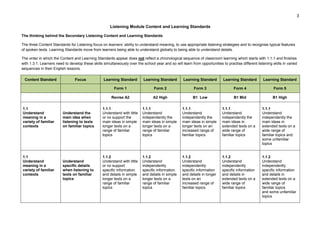
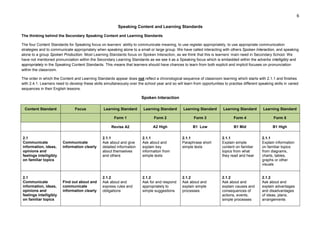
Listening Module Content and Learning Standards
The thinking behind the Secondary Listening Content and Learning Standards
The three Content Standards for Listening focus on learners’ ability to understand meaning, to use appropriate listening strategies and to recognise typical features
of spoken texts. Learning Standards move from learners being able to understand globally to being able to understand details.
The order in which the Content and Learning Standards appear does not reflect a chronological sequence of classroom learning which starts with 1.1.1 and finishes
with 1.3.1. Learners need to develop these skills simultaneously over the school year and so will learn from opportunities to practise different listening skills in varied
sequences in their English lessons.
Content Standard Focus Learning Standard Learning Standard Learning Standard Learning Standard Learning Standard
Form 1 Form 2 Form 3 Form 4 Form 5
Revise A2 A2 High B1 Low B1 Mid B1 High
1.1
Understand
meaning in a
variety of familiar
contexts
Understand the
main idea when
listening to texts
on familiar topics
1.1.1
Understand with little
or no support the
main ideas in simple
longer texts on a
range of familiar
topics
1.1.1
Understand
independently the
main ideas in simple
longer texts on a
range of familiar
topics
1.1.1
Understand
independently the
main ideas in simple
longer texts on an
increased range of
familiar topics
1.1.1
Understand
independently the
main ideas in
extended texts on a
wide range of
familiar topics
1.1.1
Understand
independently the
main ideas in
extended texts on a
wide range of
familiar topics and
some unfamiliar
topics
1.1
Understand
meaning in a
variety of familiar
contexts
Understand
specific details
when listening to
texts on familiar
topics
1.1.2
Understand with little
or no support
specific information
and details in simple
longer texts on a
range of familiar
topics
1.1.2
Understand
independently
specific information
and details in simple
longer texts on a
range of familiar
topics
1.1.2
Understand
independently
specific information
and details in longer
texts on an
increased range of
familiar topics
1.1.2
Understand
independently
specific information
and details in
extended texts on a
wide range of
familiar topics
1.1.2
Understand
independently
specific information
and details in
extended texts on a
wide range of
familiar topics
and some unfamiliar
topics
4
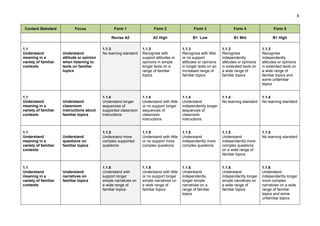
Content Standard Focus Form 1 Form 2 Form 3 Form 4 Form 5
Revise A2 A2 High B1 Low B1 Mid B1 High
1.1
Understand
meaning in a
variety of familiar
contexts
Understand
attitude or opinion
when listening to
texts on familiar
topics
1.1.3
No learning standard
1.1.3
Recognise with
support attitudes or
opinions in simple
longer texts on a
range of familiar
topics
1.1.3
Recognise with little
or no support
attitudes or opinions
in longer texts on an
increased range of
familiar topics
1.1.3
Recognise
independently
attitudes or opinions
in extended texts on
a wide range of
familiar topics
1.1.3
Recognise
independently
attitudes or opinions
in extended texts on
a wide range of
familiar topics and
some unfamiliar
topics
1.1
Understand
meaning in a
variety of familiar
contexts
Understand
classroom
instructions about
familiar topics
1.1.4
Understand longer
sequences of
supported classroom
instructions
1.1.4
Understand with little
or no support longer
sequences of
classroom
instructions
1.1.4
Understand
independently longer
sequences of
classroom
instructions
1.1.4
No learning standard
1.1.4
No learning standard
1.1
Understand
meaning in a
variety of familiar
contexts
Understand
questions on
familiar topics
1.1.5
Understand more
complex supported
questions
1.1.5
Understand with little
or no support more
complex questions
1.1.5
Understand
independently more
complex questions
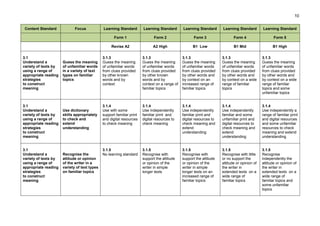
1.1.5
Understand
independently more
complex questions
on a wide range of
familiar topics
1.1.5
No learning standard
1.1
Understand
meaning in a
variety of familiar
contexts
Understand
narratives on
familiar topics
1.1.6
Understand with
support longer
simple narratives on
a wide range of
familiar topics
1.1.6
Understand with little
or no support longer
simple narratives on
a wide range of
familiar topics
1.1.6
Understand
independently
longer simple
narratives on a
range of familiar
topics
1.1.6
Understand
independently longer
simple narratives on
a wide range of
familiar topics
1.1.6
Understand
independently longer
more complex
narratives on a wide
range of familiar
topics and some
unfamiliar topics
5
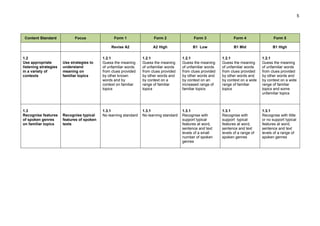
Content Standard Focus Form 1 Form 2 Form 3 Form 4 Form 5
Revise A2 A2 High B1 Low B1 Mid B1 High
1.2
Use appropriate
listening strategies
in a variety of
contexts
Use strategies to
understand
meaning on
familiar topics
1.2.1
Guess the meaning
of unfamiliar words
from clues provided
by other known
words and by
context on familiar
topics
1.2.1
Guess the meaning
of unfamiliar words
from clues provided
by other words and
by context on a
range of familiar
topics
1.2.1
Guess the meaning
of unfamiliar words
from clues provided
by other words and
by context on an
increased range of
familiar topics
1.2.1
Guess the meaning
of unfamiliar words
from clues provided
by other words and
by context on a wide
range of familiar
topics
1.2.1
Guess the meaning
of unfamiliar words
from clues provided
by other words and
by context on a wide
range of familiar
topics and some
unfamiliar topics
1.3
Recognise features
of spoken genres
on familiar topics
Recognise typical
features of spoken
texts
1.3.1
No learning standard
1.3.1
No learning standard
1.3.1
Recognise with
support typical
features at word,
sentence and text
levels of a small
number of spoken
genres
1.3.1
Recognise with
support typical
features at word,
sentence and text
levels of a range of
spoken genres
1.3.1
Recognise with little
or no support typical
features at word,
sentence and text
levels of a range of
spoken genres
6
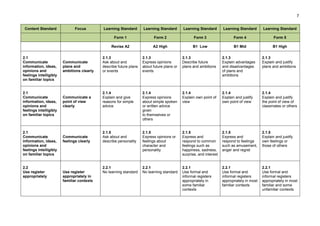
Speaking Content and Learning Standards
The thinking behind the Secondary Speaking Content and Learning Standards
The four Content Standards for Speaking focus on learners’ ability to communicate meaning, to use register appropriately, to use appropriate communication
strategies and to communicate appropriately when speaking alone to a small or large group. We have called interacting with others Spoken Interaction, and speaking
alone to a group Spoken Production. Most Learning Standards focus on Spoken Interaction, as we think that this is learners’ main need in Secondary School. We
have not mentioned pronunciation within the Secondary Learning Standards as we see it as a Speaking focus which is embedded within the adverbs intelligibly and
appropriately in the Speaking Content Standards. This means that learners should have chances to learn from both explicit and implicit focuses on pronunciation
within the classroom.
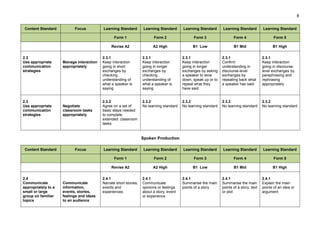
The order in which the Content and Learning Standards appear does not reflect a chronological sequence of classroom learning which starts with 2.1.1 and finishes
with 2.4.1. Learners need to develop these skills simultaneously over the school year and so will learn from opportunities to practise different speaking skills in varied
sequences in their English lessons.
Spoken Interaction
Content Standard Focus Learning Standard Learning Standard Learning Standard Learning Standard Learning Standard
Form 1 Form 2 Form 3 Form 4 Form 5
Revise A2 A2 High B1 Low B1 Mid B1 High
2.1
Communicate
information, ideas,
opinions and
feelings intelligibly
on familiar topics
Communicate
information clearly
2.1.1
Ask about and give
detailed information
about themselves
and others
2.1.1
Ask about and
explain key
information from
simple texts
2.1.1
Paraphrase short
simple texts
2.1.1
Explain simple
content on familiar
topics from what
they read and hear
2.1.1
Explain information
on familiar topics
from diagrams,
charts, tables,
graphs or other
visuals
2.1
Communicate
information, ideas,
opinions and
feelings intelligibly
on familiar topics
Find out about and
communicate
information clearly
2.1.2
Ask about and
express rules and
obligations
2.1.2
Ask for and respond
appropriately to
simple suggestions
2.1.2
Ask about and
explain simple
processes
2.1.2
Ask about and
explain causes and
consequences of
actions, events,
simple processes
2.1.2
Ask about and
explain advantages
and disadvantages
of ideas, plans,
arrangements
7
Content Standard Focus Learning Standard Learning Standard Learning Standard Learning Standard Learning Standard
Form 1 Form 2 Form 3 Form 4 Form 5
Revise A2 A2 High B1 Low B1 Mid B1 High
2.1
Communicate
information, ideas,
opinions and
feelings intelligibly
on familiar topics
Communicate
plans and
ambitions clearly
2.1.3
Ask about and
describe future plans
or events
2.1.3
Express opinions
about future plans or
events
2.1.3
Describe future
plans and ambitions
2.1.3
Explain advantages
and disadvantages
of plans and
ambitions
2.1.3
Explain and justify
plans and ambitions
2.1
Communicate
information, ideas,
opinions and
feelings intelligibly
on familiar topics
Communicate a
point of view
clearly
2.1.4
Explain and give
reasons for simple
advice
2.1.4
Express opinions
about simple spoken
or written advice
given
to themselves or
others
2.1.4
Explain own point of
view
2.1.4
Explain and justify
own point of view
2.1.4
Explain and justify
the point of view of
classmates or others
2.1
Communicate
information, ideas,
opinions and
feelings intelligibly
on familiar topics
Communicate
feelings clearly
2.1.5
Ask about and
describe personality
2.1.5
Express opinions or
feelings about
character and
personality
2.1.5
Express and
respond to common
feelings such as
happiness, sadness,
surprise, and interest
2.1.5
Express and
respond to feelings
such as amusement,
anger and regret
2.1.5
Explain and justify
own feelings or
those of others
2.2
Use register
appropriately
Use register
appropriately in
familiar contexts
2.2.1
No learning standard
2.2.1
No learning standard
2.2.1
Use formal and
informal registers
appropriately in
some familiar
contexts
2.2.1
Use formal and
informal registers
appropriately in most
familiar contexts
2.2.1
Use formal and
informal registers
appropriately in most
familiar and some
unfamiliar contexts
8
Content Standard Focus Learning Standard Learning Standard Learning Standard Learning Standard Learning Standard
Form 1 Form 2 Form 3 Form 4 Form 5
Revise A2 A2 High B1 Low B1 Mid B1 High
2.3
Use appropriate
communication
strategies
Manage interaction
appropriately
2.3.1
Keep interaction
going in short
exchanges by
checking
understanding of
what a speaker is
saying
2.3.1
Keep interaction
going in longer
exchanges by
checking
understanding of
what a speaker is
saying
2.3.1
Keep interaction
going in longer
exchanges by asking
a speaker to slow
down, speak up or to
repeat what they
have said
2.3.1
Confirm
understanding in
discourse-level
exchanges by
repeating back what
a speaker has said
2.3.1
Keep interaction
going in discourse-
level exchanges by
paraphrasing and
rephrasing
appropriately
2.3
Use appropriate
communication
strategies
Negotiate
classroom tasks
appropriately
2.3.2
Agree on a set of
basic steps needed
to complete
extended classroom
tasks
2.3.2
No learning standard
2.3.2
No learning standard
2.3.2
No learning standard
2.3.2
No learning standard
Spoken Production
Content Standard Focus Learning Standard Learning Standard Learning Standard Learning Standard Learning Standard
Form 1 Form 2 Form 3 Form 4 Form 5
Revise A2 A2 High B1 Low B1 Mid B1 High
2.4
Communicate
appropriately to a
small or large
group on familiar
topics
Communicate
information,
events, stories,
feelings and ideas
to an audience
2.4.1
Narrate short stories,
events and
experiences
2.4.1
Communicate
opinions or feelings
about a story, event
or experience
2.4.1
Summarise the main
points of a story
2.4.1
Summarise the main
points of a story, text
or plot
2.4.1
Explain the main
points of an idea or
argument
9
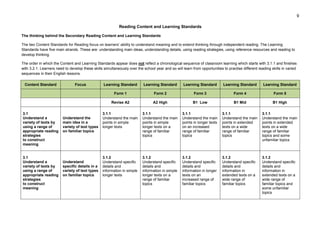
Reading Content and Learning Standards
The thinking behind the Secondary Reading Content and Learning Standards
The two Content Standards for Reading focus on learners’ ability to understand meaning and to extend thinking through independent reading. The Learning
Standards have five main strands. These are: understanding main ideas, understanding details, using reading strategies, using reference resources and reading to
develop thinking.
The order in which the Content and Learning Standards appear does not reflect a chronological sequence of classroom learning which starts with 3.1.1 and finishes
with 3.2.1. Learners need to develop these skills simultaneously over the school year and so will learn from opportunities to practise different reading skills in varied
sequences in their English lessons.
Content Standard Focus Learning Standard Learning Standard Learning Standard Learning Standard Learning Standard
Form 1 Form 2 Form 3 Form 4 Form 5
Revise A2 A2 High B1 Low B1 Mid B1 High
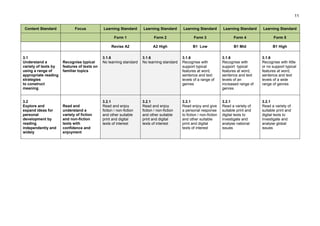
3.1
Understand a
variety of texts by
using a range of
appropriate reading
strategies
to construct
meaning
Understand the
main idea in a
variety of text types
on familiar topics
3.1.1
Understand the main
points in simple
longer texts
3.1.1
Understand the main
points in simple
longer texts on a
range of familiar
topics
3.1.1
Understand the main
points in longer texts
on an increased
range of familiar
topics
3.1.1
Understand the main
points in extended
texts on a wide
range of familiar
topics
3.1.1
Understand the main
points in extended
texts on a wide
range of familiar
topics and some
unfamiliar topics
3.1
Understand a
variety of texts by
using a range of
appropriate reading
strategies
to construct
meaning
Understand
specific details in a
variety of text types
on familiar topics
3.1.2
Understand specific
details and
information in simple
longer texts
3.1.2
Understand specific
details and
information in simple
longer texts on a
range of familiar
topics
3.1.2
Understand specific
details and
information in longer
texts on an
increased range of
familiar topics
3.1.2
Understand specific
details and
information in
extended texts on a
wide range of
familiar topics
3.1.2
Understand specific
details and
information in
extended texts on a
wide range of
familiar topics and
some unfamiliar
topics
10
Content Standard Focus Learning Standard Learning Standard Learning Standard Learning Standard Learning Standard
Form 1 Form 2 Form 3 Form 4 Form 5
Revise A2 A2 High B1 Low B1 Mid B1 High
3.1
Understand a
variety of texts by
using a range of
appropriate reading
strategies
to construct
meaning
Guess the meaning
of unfamiliar words
in a variety of text
types on familiar
topics
3.1.3
Guess the meaning
of unfamiliar words
from clues provided
by other known
words and by
context
3.1.3
Guess the meaning
of unfamiliar words
from clues provided
by other known
words and by
context on a range of
familiar topics
3.1.3
Guess the meaning
of unfamiliar words
from clues provided
by other words and
by context on an
increased range of
familiar topics
3.1.3
Guess the meaning
of unfamiliar words
from clues provided
by other words and
by context on a wide
range of familiar
topics
3.1.3
Guess the meaning
of unfamiliar words
from clues provided
by other words and
by context on a wide
range of familiar
topics and some
unfamiliar topics
3.1
Understand a
variety of texts by
using a range of
appropriate reading
strategies
to construct
meaning
Use dictionary
skills appropriately
to check and
extend
understanding
3.1.4
Use with some
support familiar print
and digital resources
to check meaning
3.1.4
Use independently
familiar print and
digital resources to
check meaning
3.1.4
Use independently
familiar print and
digital resources to
check meaning and
extend
understanding
3.1.4
Use independently
familiar and some
unfamiliar print and
digital resources to
check meaning and
extend
understanding
3.1.4
Use independently a
range of familiar print
and digital resources
and some unfamiliar
resources to check
meaning and extend
understanding
3.1
Understand a
variety of texts by
using a range of
appropriate reading
strategies
to construct
meaning
Recognise the
attitude or opinion
of the writer in a
variety of text types
on familiar topics
3.1.5
No learning standard
3.1.5
Recognise with
support the attitude
or opinion of the
writer in simple
longer texts
3.1.5
Recognise with
support the attitude
or opinion of the
writer in simple
longer texts on an
increased range of
familiar topics
3.1.5
Recognise with little
or no support the
attitude or opinion of
the writer in
extended texts on a
wide range of
familiar topics
3.1.5
Recognise
independently the
attitude or opinion of
the writer in
extended texts on a
wide range of
familiar topics and
some unfamiliar
topics
11
Content Standard Focus Learning Standard Learning Standard Learning Standard Learning Standard Learning Standard
Form 1 Form 2 Form 3 Form 4 Form 5
Revise A2 A2 High B1 Low B1 Mid B1 High
3.1
Understand a
variety of texts by
using a range of
appropriate reading
strategies
to construct
meaning
Recognise typical
features of texts on
familiar topics
3.1.6
No learning standard
3.1.6
No learning standard
3.1.6
Recognise with
support typical
features at word,
sentence and text
levels of a range of
genres
3.1.6
Recognise with
support typical
features at word,
sentence and text
levels of an
increased range of
genres
3.1.6
Recognise with little
or no support typical
features at word,
sentence and text
levels of a wide
range of genres
3.2
Explore and
expand ideas for
personal
development by
reading
independently and
widely
Read and
understand a
variety of fiction
and non-fiction
texts with
confidence and
enjoyment
3.2.1
Read and enjoy
fiction / non-fiction
and other suitable
print and digital
texts of interest
3.2.1
Read and enjoy
fiction / non-fiction
and other suitable
print and digital
texts of interest
3.2.1
Read enjoy and give
a personal response
to fiction / non-fiction
and other suitable
print and digital
texts of interest
3.2.1
Read a variety of
suitable print and
digital texts to
investigate and
analyse national
issues
3.2.1
Read a variety of
suitable print and
digital texts to
investigate and
analyse global
issues
12
Writing Content and Learning Standards
The thinking behind the Secondary Writing Content and Learning Standards
The two Writing Content Standards focus on learners’ ability to communicate meaning and to use appropriate language, form and style when doing so. Learning
Standards are divided almost equally between the two Content Standards. This reflects the importance of both fluency and accuracy in writing at this stage of the
learners’ school career.
The order in which the Content and Learning Standards appear does not reflect a chronological sequence of classroom learning which starts with 4.1.1 and finishes
with 4.2.4. Learners need to develop these skills simultaneously over the school year and so will learn from opportunities to practise different writing skills in varied
sequences in their English lessons.
Content Standard Focus Learning Standard Learning Standard Learning Standard Learning Standard Learning Standard
Form 1 Form 2 Form 3 Form 4 Form 5
Revise A2 A2 High B1 Low B1 Mid B1 High
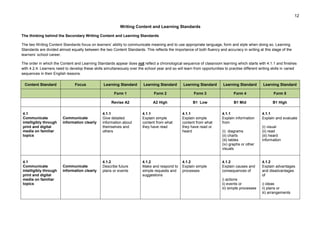
4.1
Communicate
intelligibly through
print and digital
media on familiar
topics
Communicate
information clearly
4.1.1
Give detailed
information about
themselves and
others
4.1.1
Explain simple
content from what
they have read
4.1.1
Explain simple
content from what
they have read or
heard
4.1.1
Explain information
from
(i) diagrams
(ii) charts
(iii) tables
(iv) graphs or other
visuals
4.1.1
Explain and evaluate
(i) visual
(ii) read
(iii) heard
information
4.1
Communicate
intelligibly through
print and digital
media on familiar
topics
Communicate
information clearly
4.1.2
Describe future
plans or events
4.1.2
Make and respond to
simple requests and
suggestions
4.1.2
Explain simple
processes
4.1.2
Explain causes and
consequences of
i) actions
ii) events or
iii) simple processes
4.1.2
Explain advantages
and disadvantages
of
i) ideas
ii) plans or
iii) arrangements
13
Content Standard Focus Learning Standard Learning Standard Learning Standard Learning Standard Learning Standard
Form 1 Form 2 Form 3 Form 4 Form 5
Revise A2 A2 High B1 Low B1 Mid B1 High
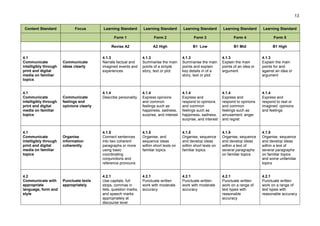
4.1
Communicate
intelligibly through
print and digital
media on familiar
topics
Communicate
ideas clearly
4.1.3
Narrate factual and
imagined events and
experiences
4.1.3
Summarise the main
points of a simple
story, text or plot
4.1.3
Summarise the main
points and explain
key details in of a
story, text or plot
4.1.3
Explain the main
points of an idea or
argument
4.1.3
Explain the main
points for and
against an idea or
argument
4.1
Communicate
intelligibly through
print and digital
media on familiar
topics
Communicate
feelings and
opinions clearly
4.1.4
Describe personality
4.1.4
Express opinions
and common
feelings such as
happiness, sadness,
surprise, and interest
4.1.4
Express and
respond to opinions
and common
feelings such as
happiness, sadness,
surprise, and interest
4.1.4
Express and
respond to opinions
and common
feelings such as
amusement, anger
and regret
4.1.4
Express and
respond to real or
imagined opinions
and feelings
4.1
Communicate
intelligibly through
print and digital
media on familiar
topics
Organise
information
coherently
4.1.5
Connect sentences
into two coherent
paragraphs or more
using basic
coordinating
conjunctions and
reference pronouns
4.1.5
Organise, and
sequence ideas
within short texts on
familiar topics
4.1.5
Organise, sequence
and develop ideas
within short texts on
familiar topics
4.1.5
Organise, sequence
and develop ideas
within a text of
several paragraphs
on familiar topics
4.1.5
Organise, sequence
and develop ideas
within a text of
several paragraphs
on familiar topics
and some unfamiliar
topics
4.2
Communicate with
appropriate
language, form and
style
Punctuate texts
appropriately
4.2.1
Use capitals, full
stops, commas in
lists, question marks,
and speech marks
appropriately at
discourse level
4.2.1
Punctuate written
work with moderate
accuracy
4.2.1
Punctuate written
work with moderate
accuracy
4.2.1
Punctuate written
work on a range of
text types with
reasonable
accuracy
4.2.1
Punctuate written
work on a range of
text types with
reasonable accuracy
14
Content Standard Focus Learning Standard Learning Standard Learning Standard Learning Standard Learning Standard
Form 1 Form 2 Form 3 Form 4 Form 5
Revise A2 A2 High B1 Low B1 Mid B1 High
4.2
Communicate with
appropriate
language, form and
style
Spell written work
accurately
4.2.2
Spell most high
frequency words
accurately in
independent writing
4.2.2
Spell written work
with moderate
accuracy
4.2.2
Spell written work
with moderate
accuracy
4.2.2
Spell written work on
a range of text types
with reasonable
accuracy
4.2.2
Spell written work on
a range of text types
with reasonable
accuracy
4.2
Communicate with
appropriate
language, form and
style
Plan, draft and edit
work appropriately
4.2.3
Produce a plan or
draft of two
paragraphs or more
and modify this
appropriately in
response to
feedback
4.2.3
Produce a plan or
draft of two
paragraphs or more
and modify this
appropriately either
in response to
feedback or
independently
4.2.3
Produce a plan or
draft of two
paragraphs or more
and modify this
appropriately
independently
4.2.3
Produce an
extended plan or
draft and modify this
appropriately in
response to
feedback or
independently
4.2.3
Produce a plan or
draft and modify this
appropriately
independently
4.2
Communicate with
appropriate
language, form and
style
Use register
appropriately
4.2.4
No learning standard
4.2.4
No learning standard
4.2.4
Begin to use formal
and informal
registers appropriate
to the target
audience in familiar
situations
4.2.4
Use formal and
informal registers
appropriate to the
target audience in
most familiar
situations
4.2.4
Use formal and
informal registers
appropriate to the
target audience in
most familiar and
some unfamiliar
situations
15
Literature in Action Content and Learning Standards
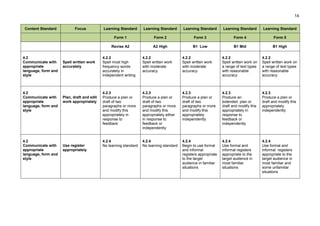
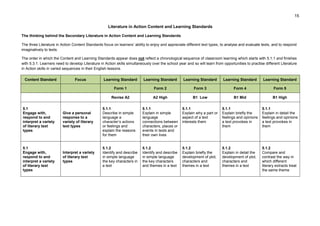
The thinking behind the Secondary Literature in Action Content and Learning Standards
The three Literature in Action Content Standards focus on learners’ ability to enjoy and appreciate different text types, to analyse and evaluate texts, and to respond
imaginatively to texts.
The order in which the Content and Learning Standards appear does not reflect a chronological sequence of classroom learning which starts with 5.1.1 and finishes
with 5.3.1. Learners need to develop Literature in Action skills simultaneously over the school year and so will learn from opportunities to practise different Literature
in Action skills in varied sequences in their English lessons.
Content Standard Focus Learning Standard Learning Standard Learning Standard Learning Standard Learning Standard
Form 1 Form 2 Form 3 Form 4 Form 5
Revise A2 A2 High B1 Low B1 Mid B1 High
5.1
Engage with,
respond to and
interpret a variety
of literary text
types
Give a personal
response to a
variety of literary
text types
5.1.1
Describe in simple
language a
character’s actions
or feelings and
explain the reasons
for them
5.1.1
Explain in simple
language
connections between
characters, places or
events in texts and
their own lives
5.1.1
Explain why a part or
aspect of a text
interests them
5.1.1
Explain briefly the
feelings and opinions
a text provokes in
them
5.1.1
Explain in detail the
feelings and opinions
a text provokes in
them
5.1
Engage with,
respond to and
interpret a variety
of literary text
types
Interpret a variety
of literary text
types
5.1.2
Identify and describe
in simple language
the key characters in
a text
5.1.2
Identify and describe
in simple language
the key characters
and themes in a text
5.1.2
Explain briefly the
development of plot,
characters and
themes in a text
5.1.2
Explain in detail the
development of plot,
characters and
themes in a text
5.1.2
Compare and
contrast the way in
which different
literary extracts treat
the same theme
16
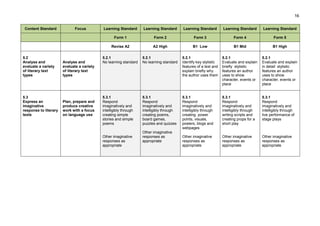
Content Standard Focus Learning Standard Learning Standard Learning Standard Learning Standard Learning Standard
Form 1 Form 2 Form 3 Form 4 Form 5
Revise A2 A2 High B1 Low B1 Mid B1 High
5.2
Analyse and
evaluate a variety
of literary text
types
Analyse and
evaluate a variety
of literary text
types
5.2.1
No learning standard
5.2.1
No learning standard
5.2.1
Identify key stylistic
features of a text and
explain briefly why
the author uses them
5.2.1
Evaluate and explain
briefly stylistic
features an author
uses to show
character, events or
place
5.2.1
Evaluate and explain
in detail stylistic
features an author
uses to show
character, events or
place
5.3
Express an
imaginative
response to literary
texts
Plan, prepare and
produce creative
work with a focus
on language use
5.3.1
Respond
imaginatively and
intelligibly through
creating simple
stories and simple
poems
Other imaginative
responses as
appropriate
5.3.1
Respond
imaginatively and
intelligibly through
creating poems,
board games,
puzzles and quizzes
Other imaginative
responses as
appropriate
5.3.1
Respond
imaginatively and
intelligibly through
creating power
points, visuals,
posters, blogs and
webpages
Other imaginative
responses as
appropriate
5.3.1
Respond
imaginatively and
intelligibly through
writing scripts and
creating props for a
short play
Other imaginative
responses as
appropriate
5.3.1
Respond
imaginatively and
intelligibly through
live performance of
stage plays
Other imaginative
responses as
appropriate
ENGLISH CURRICULUM FRAMEWORK (SMKC 2025).pdf

  • 1.
  • 2.
  • 3.
    3 Listening Module Contentand Learning Standards The thinking behind the Secondary Listening Content and Learning Standards The three Content Standards for Listening focus on learners’ ability to understand meaning, to use appropriate listening strategies and to recognise typical features of spoken texts. Learning Standards move from learners being able to understand globally to being able to understand details. The order in which the Content and Learning Standards appear does not reflect a chronological sequence of classroom learning which starts with 1.1.1 and finishes with 1.3.1. Learners need to develop these skills simultaneously over the school year and so will learn from opportunities to practise different listening skills in varied sequences in their English lessons. Content Standard Focus Learning Standard Learning Standard Learning Standard Learning Standard Learning Standard Form 1 Form 2 Form 3 Form 4 Form 5 Revise A2 A2 High B1 Low B1 Mid B1 High 1.1 Understand meaning in a variety of familiar contexts Understand the main idea when listening to texts on familiar topics 1.1.1 Understand with little or no support the main ideas in simple longer texts on a range of familiar topics 1.1.1 Understand independently the main ideas in simple longer texts on a range of familiar topics 1.1.1 Understand independently the main ideas in simple longer texts on an increased range of familiar topics 1.1.1 Understand independently the main ideas in extended texts on a wide range of familiar topics 1.1.1 Understand independently the main ideas in extended texts on a wide range of familiar topics and some unfamiliar topics 1.1 Understand meaning in a variety of familiar contexts Understand specific details when listening to texts on familiar topics 1.1.2 Understand with little or no support specific information and details in simple longer texts on a range of familiar topics 1.1.2 Understand independently specific information and details in simple longer texts on a range of familiar topics 1.1.2 Understand independently specific information and details in longer texts on an increased range of familiar topics 1.1.2 Understand independently specific information and details in extended texts on a wide range of familiar topics 1.1.2 Understand independently specific information and details in extended texts on a wide range of familiar topics and some unfamiliar topics
  • 4.
    4 Content Standard FocusForm 1 Form 2 Form 3 Form 4 Form 5 Revise A2 A2 High B1 Low B1 Mid B1 High 1.1 Understand meaning in a variety of familiar contexts Understand attitude or opinion when listening to texts on familiar topics 1.1.3 No learning standard 1.1.3 Recognise with support attitudes or opinions in simple longer texts on a range of familiar topics 1.1.3 Recognise with little or no support attitudes or opinions in longer texts on an increased range of familiar topics 1.1.3 Recognise independently attitudes or opinions in extended texts on a wide range of familiar topics 1.1.3 Recognise independently attitudes or opinions in extended texts on a wide range of familiar topics and some unfamiliar topics 1.1 Understand meaning in a variety of familiar contexts Understand classroom instructions about familiar topics 1.1.4 Understand longer sequences of supported classroom instructions 1.1.4 Understand with little or no support longer sequences of classroom instructions 1.1.4 Understand independently longer sequences of classroom instructions 1.1.4 No learning standard 1.1.4 No learning standard 1.1 Understand meaning in a variety of familiar contexts Understand questions on familiar topics 1.1.5 Understand more complex supported questions 1.1.5 Understand with little or no support more complex questions 1.1.5 Understand independently more complex questions 1.1.5 Understand independently more complex questions on a wide range of familiar topics 1.1.5 No learning standard 1.1 Understand meaning in a variety of familiar contexts Understand narratives on familiar topics 1.1.6 Understand with support longer simple narratives on a wide range of familiar topics 1.1.6 Understand with little or no support longer simple narratives on a wide range of familiar topics 1.1.6 Understand independently longer simple narratives on a range of familiar topics 1.1.6 Understand independently longer simple narratives on a wide range of familiar topics 1.1.6 Understand independently longer more complex narratives on a wide range of familiar topics and some unfamiliar topics
  • 5.
    5 Content Standard FocusForm 1 Form 2 Form 3 Form 4 Form 5 Revise A2 A2 High B1 Low B1 Mid B1 High 1.2 Use appropriate listening strategies in a variety of contexts Use strategies to understand meaning on familiar topics 1.2.1 Guess the meaning of unfamiliar words from clues provided by other known words and by context on familiar topics 1.2.1 Guess the meaning of unfamiliar words from clues provided by other words and by context on a range of familiar topics 1.2.1 Guess the meaning of unfamiliar words from clues provided by other words and by context on an increased range of familiar topics 1.2.1 Guess the meaning of unfamiliar words from clues provided by other words and by context on a wide range of familiar topics 1.2.1 Guess the meaning of unfamiliar words from clues provided by other words and by context on a wide range of familiar topics and some unfamiliar topics 1.3 Recognise features of spoken genres on familiar topics Recognise typical features of spoken texts 1.3.1 No learning standard 1.3.1 No learning standard 1.3.1 Recognise with support typical features at word, sentence and text levels of a small number of spoken genres 1.3.1 Recognise with support typical features at word, sentence and text levels of a range of spoken genres 1.3.1 Recognise with little or no support typical features at word, sentence and text levels of a range of spoken genres
  • 6.
    6 Speaking Content andLearning Standards The thinking behind the Secondary Speaking Content and Learning Standards The four Content Standards for Speaking focus on learners’ ability to communicate meaning, to use register appropriately, to use appropriate communication strategies and to communicate appropriately when speaking alone to a small or large group. We have called interacting with others Spoken Interaction, and speaking alone to a group Spoken Production. Most Learning Standards focus on Spoken Interaction, as we think that this is learners’ main need in Secondary School. We have not mentioned pronunciation within the Secondary Learning Standards as we see it as a Speaking focus which is embedded within the adverbs intelligibly and appropriately in the Speaking Content Standards. This means that learners should have chances to learn from both explicit and implicit focuses on pronunciation within the classroom. The order in which the Content and Learning Standards appear does not reflect a chronological sequence of classroom learning which starts with 2.1.1 and finishes with 2.4.1. Learners need to develop these skills simultaneously over the school year and so will learn from opportunities to practise different speaking skills in varied sequences in their English lessons. Spoken Interaction Content Standard Focus Learning Standard Learning Standard Learning Standard Learning Standard Learning Standard Form 1 Form 2 Form 3 Form 4 Form 5 Revise A2 A2 High B1 Low B1 Mid B1 High 2.1 Communicate information, ideas, opinions and feelings intelligibly on familiar topics Communicate information clearly 2.1.1 Ask about and give detailed information about themselves and others 2.1.1 Ask about and explain key information from simple texts 2.1.1 Paraphrase short simple texts 2.1.1 Explain simple content on familiar topics from what they read and hear 2.1.1 Explain information on familiar topics from diagrams, charts, tables, graphs or other visuals 2.1 Communicate information, ideas, opinions and feelings intelligibly on familiar topics Find out about and communicate information clearly 2.1.2 Ask about and express rules and obligations 2.1.2 Ask for and respond appropriately to simple suggestions 2.1.2 Ask about and explain simple processes 2.1.2 Ask about and explain causes and consequences of actions, events, simple processes 2.1.2 Ask about and explain advantages and disadvantages of ideas, plans, arrangements
  • 7.
    7 Content Standard FocusLearning Standard Learning Standard Learning Standard Learning Standard Learning Standard Form 1 Form 2 Form 3 Form 4 Form 5 Revise A2 A2 High B1 Low B1 Mid B1 High 2.1 Communicate information, ideas, opinions and feelings intelligibly on familiar topics Communicate plans and ambitions clearly 2.1.3 Ask about and describe future plans or events 2.1.3 Express opinions about future plans or events 2.1.3 Describe future plans and ambitions 2.1.3 Explain advantages and disadvantages of plans and ambitions 2.1.3 Explain and justify plans and ambitions 2.1 Communicate information, ideas, opinions and feelings intelligibly on familiar topics Communicate a point of view clearly 2.1.4 Explain and give reasons for simple advice 2.1.4 Express opinions about simple spoken or written advice given to themselves or others 2.1.4 Explain own point of view 2.1.4 Explain and justify own point of view 2.1.4 Explain and justify the point of view of classmates or others 2.1 Communicate information, ideas, opinions and feelings intelligibly on familiar topics Communicate feelings clearly 2.1.5 Ask about and describe personality 2.1.5 Express opinions or feelings about character and personality 2.1.5 Express and respond to common feelings such as happiness, sadness, surprise, and interest 2.1.5 Express and respond to feelings such as amusement, anger and regret 2.1.5 Explain and justify own feelings or those of others 2.2 Use register appropriately Use register appropriately in familiar contexts 2.2.1 No learning standard 2.2.1 No learning standard 2.2.1 Use formal and informal registers appropriately in some familiar contexts 2.2.1 Use formal and informal registers appropriately in most familiar contexts 2.2.1 Use formal and informal registers appropriately in most familiar and some unfamiliar contexts
  • 8.
    8 Content Standard FocusLearning Standard Learning Standard Learning Standard Learning Standard Learning Standard Form 1 Form 2 Form 3 Form 4 Form 5 Revise A2 A2 High B1 Low B1 Mid B1 High 2.3 Use appropriate communication strategies Manage interaction appropriately 2.3.1 Keep interaction going in short exchanges by checking understanding of what a speaker is saying 2.3.1 Keep interaction going in longer exchanges by checking understanding of what a speaker is saying 2.3.1 Keep interaction going in longer exchanges by asking a speaker to slow down, speak up or to repeat what they have said 2.3.1 Confirm understanding in discourse-level exchanges by repeating back what a speaker has said 2.3.1 Keep interaction going in discourse- level exchanges by paraphrasing and rephrasing appropriately 2.3 Use appropriate communication strategies Negotiate classroom tasks appropriately 2.3.2 Agree on a set of basic steps needed to complete extended classroom tasks 2.3.2 No learning standard 2.3.2 No learning standard 2.3.2 No learning standard 2.3.2 No learning standard Spoken Production Content Standard Focus Learning Standard Learning Standard Learning Standard Learning Standard Learning Standard Form 1 Form 2 Form 3 Form 4 Form 5 Revise A2 A2 High B1 Low B1 Mid B1 High 2.4 Communicate appropriately to a small or large group on familiar topics Communicate information, events, stories, feelings and ideas to an audience 2.4.1 Narrate short stories, events and experiences 2.4.1 Communicate opinions or feelings about a story, event or experience 2.4.1 Summarise the main points of a story 2.4.1 Summarise the main points of a story, text or plot 2.4.1 Explain the main points of an idea or argument
  • 9.
    9 Reading Content andLearning Standards The thinking behind the Secondary Reading Content and Learning Standards The two Content Standards for Reading focus on learners’ ability to understand meaning and to extend thinking through independent reading. The Learning Standards have five main strands. These are: understanding main ideas, understanding details, using reading strategies, using reference resources and reading to develop thinking. The order in which the Content and Learning Standards appear does not reflect a chronological sequence of classroom learning which starts with 3.1.1 and finishes with 3.2.1. Learners need to develop these skills simultaneously over the school year and so will learn from opportunities to practise different reading skills in varied sequences in their English lessons. Content Standard Focus Learning Standard Learning Standard Learning Standard Learning Standard Learning Standard Form 1 Form 2 Form 3 Form 4 Form 5 Revise A2 A2 High B1 Low B1 Mid B1 High 3.1 Understand a variety of texts by using a range of appropriate reading strategies to construct meaning Understand the main idea in a variety of text types on familiar topics 3.1.1 Understand the main points in simple longer texts 3.1.1 Understand the main points in simple longer texts on a range of familiar topics 3.1.1 Understand the main points in longer texts on an increased range of familiar topics 3.1.1 Understand the main points in extended texts on a wide range of familiar topics 3.1.1 Understand the main points in extended texts on a wide range of familiar topics and some unfamiliar topics 3.1 Understand a variety of texts by using a range of appropriate reading strategies to construct meaning Understand specific details in a variety of text types on familiar topics 3.1.2 Understand specific details and information in simple longer texts 3.1.2 Understand specific details and information in simple longer texts on a range of familiar topics 3.1.2 Understand specific details and information in longer texts on an increased range of familiar topics 3.1.2 Understand specific details and information in extended texts on a wide range of familiar topics 3.1.2 Understand specific details and information in extended texts on a wide range of familiar topics and some unfamiliar topics
  • 10.
    10 Content Standard FocusLearning Standard Learning Standard Learning Standard Learning Standard Learning Standard Form 1 Form 2 Form 3 Form 4 Form 5 Revise A2 A2 High B1 Low B1 Mid B1 High 3.1 Understand a variety of texts by using a range of appropriate reading strategies to construct meaning Guess the meaning of unfamiliar words in a variety of text types on familiar topics 3.1.3 Guess the meaning of unfamiliar words from clues provided by other known words and by context 3.1.3 Guess the meaning of unfamiliar words from clues provided by other known words and by context on a range of familiar topics 3.1.3 Guess the meaning of unfamiliar words from clues provided by other words and by context on an increased range of familiar topics 3.1.3 Guess the meaning of unfamiliar words from clues provided by other words and by context on a wide range of familiar topics 3.1.3 Guess the meaning of unfamiliar words from clues provided by other words and by context on a wide range of familiar topics and some unfamiliar topics 3.1 Understand a variety of texts by using a range of appropriate reading strategies to construct meaning Use dictionary skills appropriately to check and extend understanding 3.1.4 Use with some support familiar print and digital resources to check meaning 3.1.4 Use independently familiar print and digital resources to check meaning 3.1.4 Use independently familiar print and digital resources to check meaning and extend understanding 3.1.4 Use independently familiar and some unfamiliar print and digital resources to check meaning and extend understanding 3.1.4 Use independently a range of familiar print and digital resources and some unfamiliar resources to check meaning and extend understanding 3.1 Understand a variety of texts by using a range of appropriate reading strategies to construct meaning Recognise the attitude or opinion of the writer in a variety of text types on familiar topics 3.1.5 No learning standard 3.1.5 Recognise with support the attitude or opinion of the writer in simple longer texts 3.1.5 Recognise with support the attitude or opinion of the writer in simple longer texts on an increased range of familiar topics 3.1.5 Recognise with little or no support the attitude or opinion of the writer in extended texts on a wide range of familiar topics 3.1.5 Recognise independently the attitude or opinion of the writer in extended texts on a wide range of familiar topics and some unfamiliar topics
  • 11.
    11 Content Standard FocusLearning Standard Learning Standard Learning Standard Learning Standard Learning Standard Form 1 Form 2 Form 3 Form 4 Form 5 Revise A2 A2 High B1 Low B1 Mid B1 High 3.1 Understand a variety of texts by using a range of appropriate reading strategies to construct meaning Recognise typical features of texts on familiar topics 3.1.6 No learning standard 3.1.6 No learning standard 3.1.6 Recognise with support typical features at word, sentence and text levels of a range of genres 3.1.6 Recognise with support typical features at word, sentence and text levels of an increased range of genres 3.1.6 Recognise with little or no support typical features at word, sentence and text levels of a wide range of genres 3.2 Explore and expand ideas for personal development by reading independently and widely Read and understand a variety of fiction and non-fiction texts with confidence and enjoyment 3.2.1 Read and enjoy fiction / non-fiction and other suitable print and digital texts of interest 3.2.1 Read and enjoy fiction / non-fiction and other suitable print and digital texts of interest 3.2.1 Read enjoy and give a personal response to fiction / non-fiction and other suitable print and digital texts of interest 3.2.1 Read a variety of suitable print and digital texts to investigate and analyse national issues 3.2.1 Read a variety of suitable print and digital texts to investigate and analyse global issues
  • 12.
    12 Writing Content andLearning Standards The thinking behind the Secondary Writing Content and Learning Standards The two Writing Content Standards focus on learners’ ability to communicate meaning and to use appropriate language, form and style when doing so. Learning Standards are divided almost equally between the two Content Standards. This reflects the importance of both fluency and accuracy in writing at this stage of the learners’ school career. The order in which the Content and Learning Standards appear does not reflect a chronological sequence of classroom learning which starts with 4.1.1 and finishes with 4.2.4. Learners need to develop these skills simultaneously over the school year and so will learn from opportunities to practise different writing skills in varied sequences in their English lessons. Content Standard Focus Learning Standard Learning Standard Learning Standard Learning Standard Learning Standard Form 1 Form 2 Form 3 Form 4 Form 5 Revise A2 A2 High B1 Low B1 Mid B1 High 4.1 Communicate intelligibly through print and digital media on familiar topics Communicate information clearly 4.1.1 Give detailed information about themselves and others 4.1.1 Explain simple content from what they have read 4.1.1 Explain simple content from what they have read or heard 4.1.1 Explain information from (i) diagrams (ii) charts (iii) tables (iv) graphs or other visuals 4.1.1 Explain and evaluate (i) visual (ii) read (iii) heard information 4.1 Communicate intelligibly through print and digital media on familiar topics Communicate information clearly 4.1.2 Describe future plans or events 4.1.2 Make and respond to simple requests and suggestions 4.1.2 Explain simple processes 4.1.2 Explain causes and consequences of i) actions ii) events or iii) simple processes 4.1.2 Explain advantages and disadvantages of i) ideas ii) plans or iii) arrangements
  • 13.
    13 Content Standard FocusLearning Standard Learning Standard Learning Standard Learning Standard Learning Standard Form 1 Form 2 Form 3 Form 4 Form 5 Revise A2 A2 High B1 Low B1 Mid B1 High 4.1 Communicate intelligibly through print and digital media on familiar topics Communicate ideas clearly 4.1.3 Narrate factual and imagined events and experiences 4.1.3 Summarise the main points of a simple story, text or plot 4.1.3 Summarise the main points and explain key details in of a story, text or plot 4.1.3 Explain the main points of an idea or argument 4.1.3 Explain the main points for and against an idea or argument 4.1 Communicate intelligibly through print and digital media on familiar topics Communicate feelings and opinions clearly 4.1.4 Describe personality 4.1.4 Express opinions and common feelings such as happiness, sadness, surprise, and interest 4.1.4 Express and respond to opinions and common feelings such as happiness, sadness, surprise, and interest 4.1.4 Express and respond to opinions and common feelings such as amusement, anger and regret 4.1.4 Express and respond to real or imagined opinions and feelings 4.1 Communicate intelligibly through print and digital media on familiar topics Organise information coherently 4.1.5 Connect sentences into two coherent paragraphs or more using basic coordinating conjunctions and reference pronouns 4.1.5 Organise, and sequence ideas within short texts on familiar topics 4.1.5 Organise, sequence and develop ideas within short texts on familiar topics 4.1.5 Organise, sequence and develop ideas within a text of several paragraphs on familiar topics 4.1.5 Organise, sequence and develop ideas within a text of several paragraphs on familiar topics and some unfamiliar topics 4.2 Communicate with appropriate language, form and style Punctuate texts appropriately 4.2.1 Use capitals, full stops, commas in lists, question marks, and speech marks appropriately at discourse level 4.2.1 Punctuate written work with moderate accuracy 4.2.1 Punctuate written work with moderate accuracy 4.2.1 Punctuate written work on a range of text types with reasonable accuracy 4.2.1 Punctuate written work on a range of text types with reasonable accuracy
  • 14.
    14 Content Standard FocusLearning Standard Learning Standard Learning Standard Learning Standard Learning Standard Form 1 Form 2 Form 3 Form 4 Form 5 Revise A2 A2 High B1 Low B1 Mid B1 High 4.2 Communicate with appropriate language, form and style Spell written work accurately 4.2.2 Spell most high frequency words accurately in independent writing 4.2.2 Spell written work with moderate accuracy 4.2.2 Spell written work with moderate accuracy 4.2.2 Spell written work on a range of text types with reasonable accuracy 4.2.2 Spell written work on a range of text types with reasonable accuracy 4.2 Communicate with appropriate language, form and style Plan, draft and edit work appropriately 4.2.3 Produce a plan or draft of two paragraphs or more and modify this appropriately in response to feedback 4.2.3 Produce a plan or draft of two paragraphs or more and modify this appropriately either in response to feedback or independently 4.2.3 Produce a plan or draft of two paragraphs or more and modify this appropriately independently 4.2.3 Produce an extended plan or draft and modify this appropriately in response to feedback or independently 4.2.3 Produce a plan or draft and modify this appropriately independently 4.2 Communicate with appropriate language, form and style Use register appropriately 4.2.4 No learning standard 4.2.4 No learning standard 4.2.4 Begin to use formal and informal registers appropriate to the target audience in familiar situations 4.2.4 Use formal and informal registers appropriate to the target audience in most familiar situations 4.2.4 Use formal and informal registers appropriate to the target audience in most familiar and some unfamiliar situations
  • 15.
    15 Literature in ActionContent and Learning Standards The thinking behind the Secondary Literature in Action Content and Learning Standards The three Literature in Action Content Standards focus on learners’ ability to enjoy and appreciate different text types, to analyse and evaluate texts, and to respond imaginatively to texts. The order in which the Content and Learning Standards appear does not reflect a chronological sequence of classroom learning which starts with 5.1.1 and finishes with 5.3.1. Learners need to develop Literature in Action skills simultaneously over the school year and so will learn from opportunities to practise different Literature in Action skills in varied sequences in their English lessons. Content Standard Focus Learning Standard Learning Standard Learning Standard Learning Standard Learning Standard Form 1 Form 2 Form 3 Form 4 Form 5 Revise A2 A2 High B1 Low B1 Mid B1 High 5.1 Engage with, respond to and interpret a variety of literary text types Give a personal response to a variety of literary text types 5.1.1 Describe in simple language a character’s actions or feelings and explain the reasons for them 5.1.1 Explain in simple language connections between characters, places or events in texts and their own lives 5.1.1 Explain why a part or aspect of a text interests them 5.1.1 Explain briefly the feelings and opinions a text provokes in them 5.1.1 Explain in detail the feelings and opinions a text provokes in them 5.1 Engage with, respond to and interpret a variety of literary text types Interpret a variety of literary text types 5.1.2 Identify and describe in simple language the key characters in a text 5.1.2 Identify and describe in simple language the key characters and themes in a text 5.1.2 Explain briefly the development of plot, characters and themes in a text 5.1.2 Explain in detail the development of plot, characters and themes in a text 5.1.2 Compare and contrast the way in which different literary extracts treat the same theme
  • 16.
    16 Content Standard FocusLearning Standard Learning Standard Learning Standard Learning Standard Learning Standard Form 1 Form 2 Form 3 Form 4 Form 5 Revise A2 A2 High B1 Low B1 Mid B1 High 5.2 Analyse and evaluate a variety of literary text types Analyse and evaluate a variety of literary text types 5.2.1 No learning standard 5.2.1 No learning standard 5.2.1 Identify key stylistic features of a text and explain briefly why the author uses them 5.2.1 Evaluate and explain briefly stylistic features an author uses to show character, events or place 5.2.1 Evaluate and explain in detail stylistic features an author uses to show character, events or place 5.3 Express an imaginative response to literary texts Plan, prepare and produce creative work with a focus on language use 5.3.1 Respond imaginatively and intelligibly through creating simple stories and simple poems Other imaginative responses as appropriate 5.3.1 Respond imaginatively and intelligibly through creating poems, board games, puzzles and quizzes Other imaginative responses as appropriate 5.3.1 Respond imaginatively and intelligibly through creating power points, visuals, posters, blogs and webpages Other imaginative responses as appropriate 5.3.1 Respond imaginatively and intelligibly through writing scripts and creating props for a short play Other imaginative responses as appropriate 5.3.1 Respond imaginatively and intelligibly through live performance of stage plays Other imaginative responses as appropriate