SOLO GCSE PE Question Generator
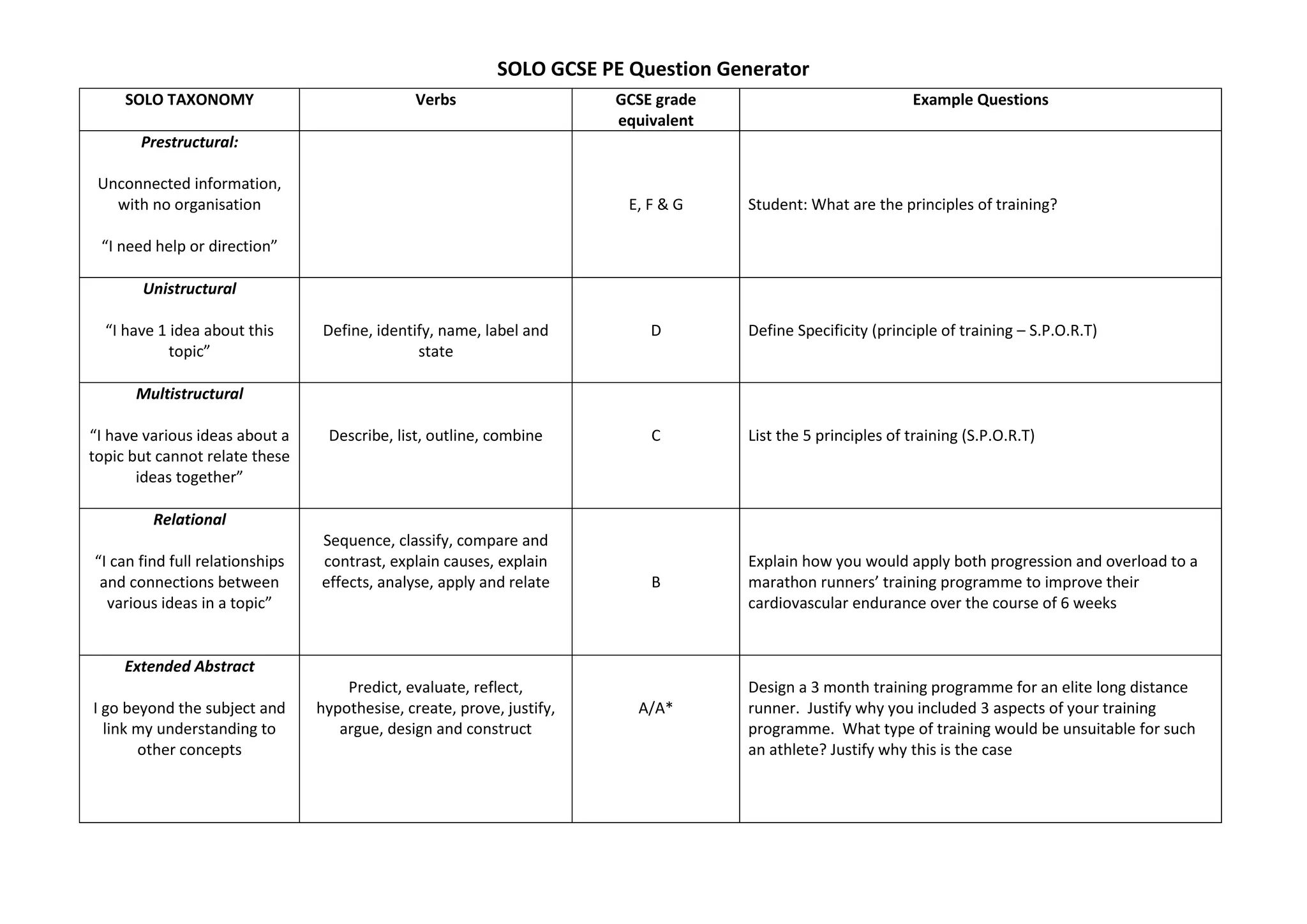
     SOLO TAXONOMY                             Verbs                    GCSE grade                            Example Questions
                                                                        equivalent
       Prestructural:

 Unconnected information,
   with no organisation                                                  E, F & G    Student: What are the principles of training?

 “I need help or direction”

       Unistructural

  “I have 1 idea about this      Define, identify, name, label and          D        Define Specificity (principle of training – S.P.O.R.T)
            topic”                             state

      Multistructural

“I have various ideas about a     Describe, list, outline, combine          C        List the 5 principles of training (S.P.O.R.T)
topic but cannot relate these
       ideas together”

         Relational
                                 Sequence, classify, compare and
“I can find full relationships   contrast, explain causes, explain                   Explain how you would apply both progression and overload to a
 and connections between         effects, analyse, apply and relate         B        marathon runners’ training programme to improve their
  various ideas in a topic”                                                          cardiovascular endurance over the course of 6 weeks


     Extended Abstract
                                     Predict, evaluate, reflect,                     Design a 3 month training programme for an elite long distance
I go beyond the subject and      hypothesise, create, prove, justify,     A/A*       runner. Justify why you included 3 aspects of your training
  link my understanding to          argue, design and construct                      programme. What type of training would be unsuitable for such
       other concepts                                                                an athlete? Justify why this is the case
SOLO GCSE PE Question Generator


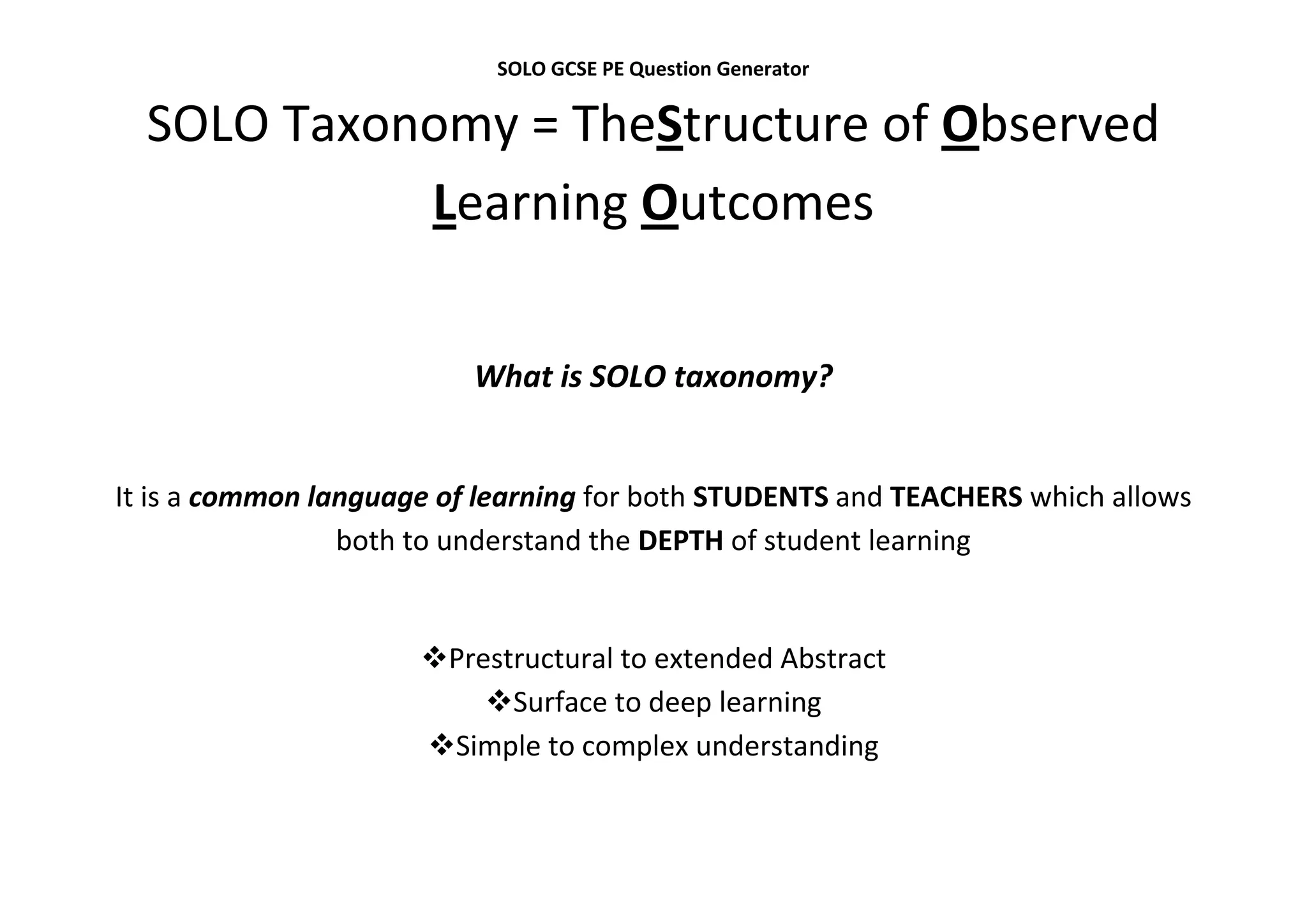
  SOLO Taxonomy = TheStructure of Observed
            Learning Outcomes

                          What is SOLO taxonomy?


It is a common language of learning for both STUDENTS and TEACHERS which allows
                 both to understand the DEPTH of student learning


                      Prestructural to extended Abstract
                          Surface to deep learning
                      Simple to complex understanding

Gcse PE SOLO explanation

  • 1.
    SOLO GCSE PEQuestion Generator SOLO TAXONOMY Verbs GCSE grade Example Questions equivalent Prestructural: Unconnected information, with no organisation E, F & G Student: What are the principles of training? “I need help or direction” Unistructural “I have 1 idea about this Define, identify, name, label and D Define Specificity (principle of training – S.P.O.R.T) topic” state Multistructural “I have various ideas about a Describe, list, outline, combine C List the 5 principles of training (S.P.O.R.T) topic but cannot relate these ideas together” Relational Sequence, classify, compare and “I can find full relationships contrast, explain causes, explain Explain how you would apply both progression and overload to a and connections between effects, analyse, apply and relate B marathon runners’ training programme to improve their various ideas in a topic” cardiovascular endurance over the course of 6 weeks Extended Abstract Predict, evaluate, reflect, Design a 3 month training programme for an elite long distance I go beyond the subject and hypothesise, create, prove, justify, A/A* runner. Justify why you included 3 aspects of your training link my understanding to argue, design and construct programme. What type of training would be unsuitable for such other concepts an athlete? Justify why this is the case
  • 2.
    SOLO GCSE PEQuestion Generator SOLO Taxonomy = TheStructure of Observed Learning Outcomes What is SOLO taxonomy? It is a common language of learning for both STUDENTS and TEACHERS which allows both to understand the DEPTH of student learning Prestructural to extended Abstract Surface to deep learning Simple to complex understanding