Downloaded 16 times
![Dr J.Sridevi Int. Journal of Engineering Research and Applications www.ijera.com
ISSN : 2248-9622, Vol. 4, Issue 9( Version 5), September 2014, pp.114-117
www.ijera.com 114 | P a g e
Implementation Of Thyristor Controlled Series Capacitor
(TCSC) In Transmission Line Model Using Arduino
Dr J.Sridevi
Professor, Dept of EEE, Gokaraju Rangaraju Institute of Engineering and Technology, Bachupally, Hyderabad,
A.P, India
ABSTRACT
A grid of transmission lines operating at high or extra high voltages is required to transmit power from
generating stations to load. In addition to transmission lines that carry power from source to load, modern power
systems are highly interconnected for economic reasons. The large interconnected transmission networks are
prone to faults due to the lightning discharges and reduce insulation strength. Changing of loads and atmosphere
conditions are unpredictable factors. This may cause overloading of lines due to which voltage collapse takes
place. These problems can be eased by providing sufficient margin of working parameters and power transfer,
but it is not possible due to expansion of transmission network. Still the required margin is reduced by
introduction of fast dynamic control over reactive and active power by high power electronic controllers. This
paper describes about implementation of Thyristor Controlled Series Capacitor (TCSC) in transmission line
model in order to enhance power flow at the receiving end. The triggering pulses to the thyristor are given using
Arduino.
Keywords - Thyristor Controlled Series Capacitor, Arduino, Compensation
I. INTRODUCTION
The increasing Industrialization, urbanization of
life style has lead to increasing dependency on the
electrical energy. This has resulted into rapid growth
of PSs [1]. This rapid growth has resulted into few
uncertainties. Power disruptions and individual
power outages are one of the major problems and
affect the economy of any country. In contrast to the
rapid changes in technologies and the power required
by these technologies, transmission systems are being
pushed to operate closer to their stability limits and at
the same time reaching their thermal limits due to the
fact that the delivery of power have been increasing.
The major problems faced by power industries in
establishing the match between supply and demand
are Transmission & Distribution which supply the
electric demand without exceeding the thermal limit.
In large PS, stability problems causing power
disruptions and blackouts leading to huge losses
[2].These constraints affect the quality of power
delivered. However, these constraints can be
suppressed by enhancing the PS control.
One of the best methods for reducing these
constraints is FACTS devices. With the rapid
development of power electronics, FACTS devices
have been proposed and implemented in PSs. FACTS
devices can be utilized to control power flow and
enhance system stability. Particularly with the
deregulation of the electricity market, there is an
increasing interest in using FACTS devices in the
operation and control of PSs [3,4]. A better
utilization of the existing PSs to increase their
capacities and controllability by installing FACTS
devices becomes imperative. FACTS devices are cost
effective alternatives to new transmission line
construction.
Due to the present situation, there are two main
aspects that should be considered in using FACTS
devices: The first aspect is the flexible power system
operation according to the power flow control
capability of FACTS devices. The other aspect is the
improvement of transient and SSVS of PSs. FACTS
devices are the right equipment to meet these
challenges [5,6].
II. THYRISTOR CONTROLLED SERIES
CAPACITOR
A capacitive reactance compensator which
consists of series capacitor bank shunted by a thyristor
controlled reactor in order to provide a smoothly
variable series capacitive reactance [7] as shown in
Fig.1.
Fig.1: TCSC Circuit
RESEARCH ARTICLE OPEN ACCESS](https://image.slidesharecdn.com/t4905114117-141021035322-conversion-gate02/85/Implementation-Of-Thyristor-Controlled-Series-Capacitor-TCSC-In-Transmission-Line-Model-Using-Arduino-1-320.jpg)
![Dr J.Sridevi Int. Journal of Engineering Research and Applications www.ijera.com
ISSN : 2248-9622, Vol. 4, Issue 9( Version 5), September 2014, pp.114-117
www.ijera.com 114 | P a g e
Implementation Of Thyristor Controlled Series Capacitor
(TCSC) In Transmission Line Model Using Arduino
Dr J.Sridevi
Professor, Dept of EEE, Gokaraju Rangaraju Institute of Engineering and Technology, Bachupally, Hyderabad,
A.P, India
ABSTRACT
A grid of transmission lines operating at high or extra high voltages is required to transmit power from
generating stations to load. In addition to transmission lines that carry power from source to load, modern power
systems are highly interconnected for economic reasons. The large interconnected transmission networks are
prone to faults due to the lightning discharges and reduce insulation strength. Changing of loads and atmosphere
conditions are unpredictable factors. This may cause overloading of lines due to which voltage collapse takes
place. These problems can be eased by providing sufficient margin of working parameters and power transfer,
but it is not possible due to expansion of transmission network. Still the required margin is reduced by
introduction of fast dynamic control over reactive and active power by high power electronic controllers. This
paper describes about implementation of Thyristor Controlled Series Capacitor (TCSC) in transmission line
model in order to enhance power flow at the receiving end. The triggering pulses to the thyristor are given using
Arduino.
Keywords - Thyristor Controlled Series Capacitor, Arduino, Compensation
I. INTRODUCTION
The increasing Industrialization, urbanization of
life style has lead to increasing dependency on the
electrical energy. This has resulted into rapid growth
of PSs [1]. This rapid growth has resulted into few
uncertainties. Power disruptions and individual
power outages are one of the major problems and
affect the economy of any country. In contrast to the
rapid changes in technologies and the power required
by these technologies, transmission systems are being
pushed to operate closer to their stability limits and at
the same time reaching their thermal limits due to the
fact that the delivery of power have been increasing.
The major problems faced by power industries in
establishing the match between supply and demand
are Transmission & Distribution which supply the
electric demand without exceeding the thermal limit.
In large PS, stability problems causing power
disruptions and blackouts leading to huge losses
[2].These constraints affect the quality of power
delivered. However, these constraints can be
suppressed by enhancing the PS control.
One of the best methods for reducing these
constraints is FACTS devices. With the rapid
development of power electronics, FACTS devices
have been proposed and implemented in PSs. FACTS
devices can be utilized to control power flow and
enhance system stability. Particularly with the
deregulation of the electricity market, there is an
increasing interest in using FACTS devices in the
operation and control of PSs [3,4]. A better
utilization of the existing PSs to increase their
capacities and controllability by installing FACTS
devices becomes imperative. FACTS devices are cost
effective alternatives to new transmission line
construction.
Due to the present situation, there are two main
aspects that should be considered in using FACTS
devices: The first aspect is the flexible power system
operation according to the power flow control
capability of FACTS devices. The other aspect is the
improvement of transient and SSVS of PSs. FACTS
devices are the right equipment to meet these
challenges [5,6].
II. THYRISTOR CONTROLLED SERIES
CAPACITOR
A capacitive reactance compensator which
consists of series capacitor bank shunted by a thyristor
controlled reactor in order to provide a smoothly
variable series capacitive reactance [7] as shown in
Fig.1.
Fig.1: TCSC Circuit
RESEARCH ARTICLE OPEN ACCESS](https://image.slidesharecdn.com/t4905114117-141021035322-conversion-gate02/75/Implementation-Of-Thyristor-Controlled-Series-Capacitor-TCSC-In-Transmission-Line-Model-Using-Arduino-1-2048.jpg)
![Dr J.Sridevi Int. Journal of Engineering Research and Applications www.ijera.com
ISSN : 2248-9622, Vol. 4, Issue 9( Version 5), September 2014, pp.114-117
www.ijera.com 115 | P a g e
Shunt compensation is ineffective in controlling the actual transmitted power, which at a defined transmission voltage, is ultimately determined by the series line impedance and the angle between the voltages of line
It is always recognized that ac power transmission over long lines was primarily limited by the series reactive impedance of the line.
Series Compensators are quite affective to Improve Voltage Stability, Transient Stability, and Power Oscillation Damping and also to Mitigate SSR and Power Quality Problems.
A TCSC is a series-controlled capacitive reactance that can provide continuous control of power on the ac line over a wide range [8]. From the system viewpoint, the principle of variable-series compensation is simply to increase the fundamental- frequency voltage across an fixed capacitor (FC) in a series compensated line through appropriate variation of the firing angle, α. A simple understanding of TCSC functioning can be obtained by analyzing the behaviour of a variable inductor connected in parallel with an FC. The equivalent impedance, Zeq, of this LC combination is expressed as
The impedance of the FC alone, however, is given by -j(l/ωC).
If ωC - (l/ωL) > 0 or, in other words, ωL > (1/ωC), the reactance of the FC is less than that of the parallel-connected variable reactor and that this combination provides a variable-capacitive reactance are both implied.
If ωC - (1/ωL) = 0, a resonance develops that results in an infinite-capacitive impedance-an obviously unacceptable condition.
If, however, ωC – (1/ωL) < 0, the LC combination provides inductance above the value of the fixed inductor.
This situation corresponds to the inductive- mode of the TCSC operation. In the variable-capacitance mode of the TCSC, as the inductive reactance of the variable inductor is increased, the equivalent- capacitive reactance is gradually decreased. The minimum equivalent-capacitive reactance is obtained for extremely large inductive reactance or when the variable inductor is open-cir-cuited, in which the value is equal to the reactance of the FC itself.
Providing fixed-series compensation on the parallel path to augment power-transfer capability appears to be a feasible solution, but it may increase the total system losses. Therefore, it is advantageous to install a TCSC in transmission paths, which can adapt its series-compensation level to the instantaneous system requirements and provide a lower loss alternative to fixed-series compensation. The series compensation provided by the TCSC can be adjusted rapidly ensure specified magnitudes of power flow along designated transmission line. This condition is evident from the TCSC's effectively, that is, ability to change its power-flow as a function of its capacitive-reactance setting: P = V1 V2 Sinδ / X (1) Where P = the power flow from bus 1 to bus 2. V1, V2 = the voltage magnitudes of buses 1 and 2, respectively XL= the line-inductive reactance, XC= the controlled TCSC reactance combined with fixed-series capacitor reactance. δ= the difference in the voltage angles of buses 1, 2. This change in transmitted power is further accomplished with minimal influence on the voltage of interconnecting buses, as it introduces voltage in quadrature. The freedom to locate a TCSC almost anywhere in line is a significant advantage. Power- flow control does not necessitate the high-speed operation of power flow control devices. Hence discrete control through a TSSC may also be adequate in certain situations. However, the TCSC cannot reverse the power flow in a line, unlike HVDC controllers and phase shifters. . The font size for heading is 11 points bold face and subsections with 10 points and not bold. Do not underline any of the headings, or add dashes, colons, etc.
III. DESIGN CRITERION OF TCSC
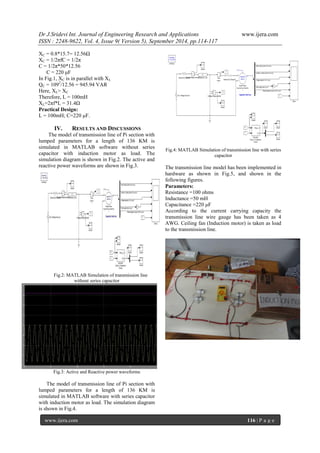
Consider the Line reactance of the transmission line in per unit system. For 50% compensation, the value of the capacitor in the TCSC will be 50% of the line reactance. Now for capacitive compensation, the value of inductive reactance must be greater than capacitive reactance, that is, XL > XC XTCSC = (XL * XC) / (XL – XC) (2) Total reactance of the line with TCSC is X = XL – XTCSC (3) The design criterion for the present case to find the value of capacitance and inductance of a TCSC controller is based on the net reactance of the transmission line and power flow control through it. SMTB Test System is developed with a transmission line model of 0.2p.u reactance. The design of TCSC is based on line reactance value, in the present case the compensation is limited to 50%. Hence take the fixed capacitive reactance value equal to 0.1p.u, Take the value of XC as 0.1p.u Line reactance is 61.1Ω Actual XC = % of compensation * line reactance](https://image.slidesharecdn.com/t4905114117-141021035322-conversion-gate02/85/Implementation-Of-Thyristor-Controlled-Series-Capacitor-TCSC-In-Transmission-Line-Model-Using-Arduino-2-320.jpg)
![Dr J.Sridevi Int. Journal of Engineering Research and Applications www.ijera.com
ISSN : 2248-9622, Vol. 4, Issue 9( Version 5), September 2014, pp.114-117
www.ijera.com 117 | P a g e
Fig 5 Voltage at the receiving end without using TCSC
TCSC is placed in the transmission line and thyristors
are triggered using aurdino program as shown in Fig.
6.
Fig 6: Single phase transmission line model involving
TCSC using Arduino
Arduino Program:
int sensorPin1= A3;
int sensorPin2= A4 ;
int output= 12;
int sensorValue1=0;
int sensorValue2=0;
void setup()
{
pinMode(12,OUTPUT);
Serial.begin(9600);
}
void loop()
{
sensorValue1= analogRead (sensorPin1);
Serial.println(sensorValue1);
sensorValue2= analogRead (sensorPin2);
Serial.println (sensorValue2);
if(sensorValue1<=298 || sensorValue2<=298 )
{
digitalWrite(output, LOW);
}
if (sensorValue1>298 || sensorValue2>298 )
{
digitalWrite(output, HIGH); }}
Fig 7: Voltage at the receiving end with TCSC
V. CONCLUSION
Thyristor controlled series capacitor (TCSC) using
Arduino has been implemented to a Transmission line
model and we have observed that there has been an
improvement in the receiving end power and voltage for
the same sending end voltage with TCSC. Also there is
an improvement in the efficiency and voltage regulation
of transmission line. Receiving end voltage and active
power can be improved where ever necessary in
transmission line according to our requirements, by
varying the firing angle of anti-parallel Thyristors .
REFERENCES
[1] IEEE. FACTS overview. Power Engr. Soc. Summer
Meeting, 95 TP 108, 1995.
[2] S.G. Jalali, R.H. Lasseter, 1.Dobson. Dynamic
response of a thyristor controlled switched capacitor.
IEEE Power Eng. Soc. Winter Meeting Paper no. 94
WM 065-3-PWRD, 1994.
[3] J. Urbanek, R.J. Piwko, E.V. Larsen, B.L. Damsky,
B.C. Furumasu, W. Mittelstadt, J.D. Eden. Thrystor
controlled series capacitor- Prototype installation at
the Slatt 500 kV Substation. IEEE %ns. Power
Delivery, 19(2):992-1000, April 1994
[4] N. Noroozian, M.Ghandari, "Improving Power System
Dynamics By Series Connected FACTS Devices",
IEEE Trans. Power Delivery, vol. 12, N° 4, pp. 1635-
1641, Oct. 1997.
[5] R.M. Mathur and R.K. Varma, Thyristor-Based
FACTS Controllers for Electrical Transmission
Systems, IEEE Press and Wiley Interscience, New
York, USA, Feb. 2002.
[6] IEEE Power Engg. Society/CIGRE, “FACTS
Overview”, Publication 95 TP 108, IEEE Press, New
York, 1995.
[7] N.G. Hingorani and L. Gyugyi, Understanding
FACTS, IEEE Press, New York, USA, 1999.](https://image.slidesharecdn.com/t4905114117-141021035322-conversion-gate02/85/Implementation-Of-Thyristor-Controlled-Series-Capacitor-TCSC-In-Transmission-Line-Model-Using-Arduino-4-320.jpg)

The document presents the implementation of a Thyristor Controlled Series Capacitor (TCSC) in a transmission line model using Arduino to improve power flow and voltage at the receiving end. It highlights the challenges faced by power systems due to increased demand and instability, suggesting the use of FACTS devices like TCSC as efficient solutions. The study demonstrates that incorporating TCSC enhances efficiency and voltage regulation in the transmission line.


