Malcolm Crompton

Web 2.0 in Government:
the key issue of privacy

Web 2.0 in Government
Conference 2009

Sydney
24 June 2009
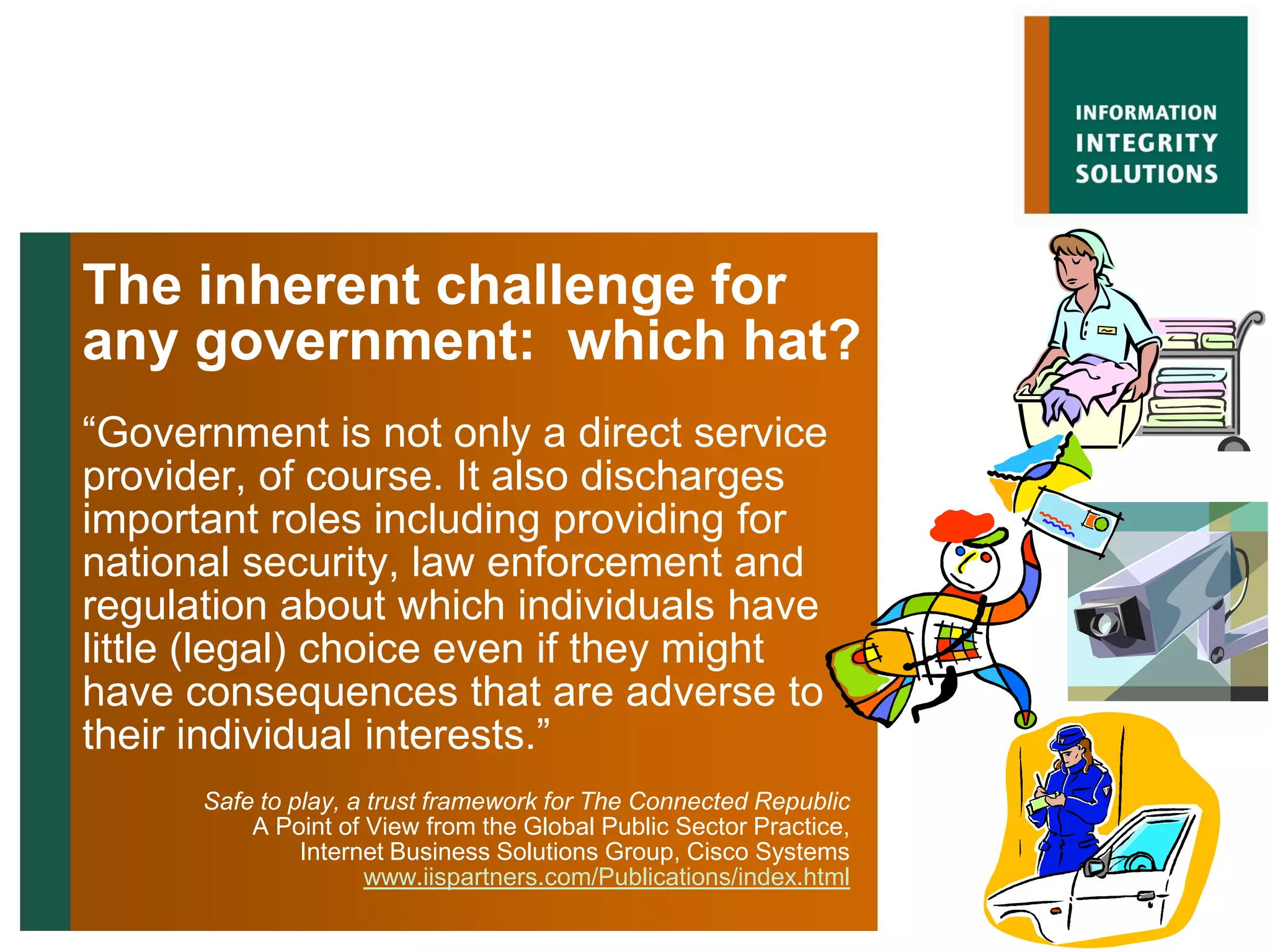
The inherent challenge for
any government: which hat?
“Government is not only a direct service
provider, of course. It also discharges
important roles including providing for
national security, law enforcement and
regulation about which individuals have
little (legal) choice even if they might
have consequences that are adverse to
their individual interests.”
      Safe to play, a trust framework for The Connected Republic
          A Point of View from the Global Public Sector Practice,
               Internet Business Solutions Group, Cisco Systems
                     www.iispartners.com/Publications/index.html
Where we‟ve been ...
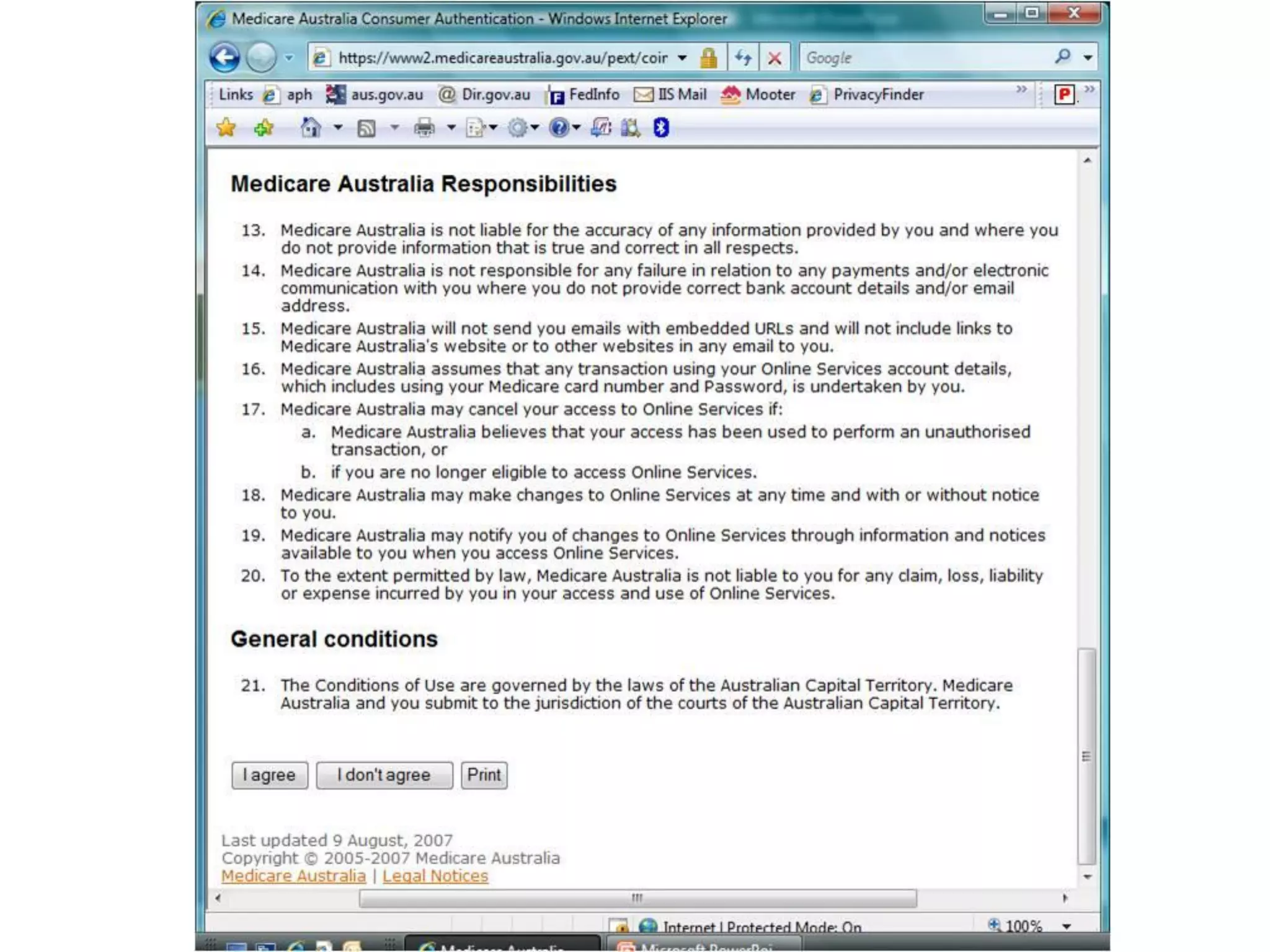
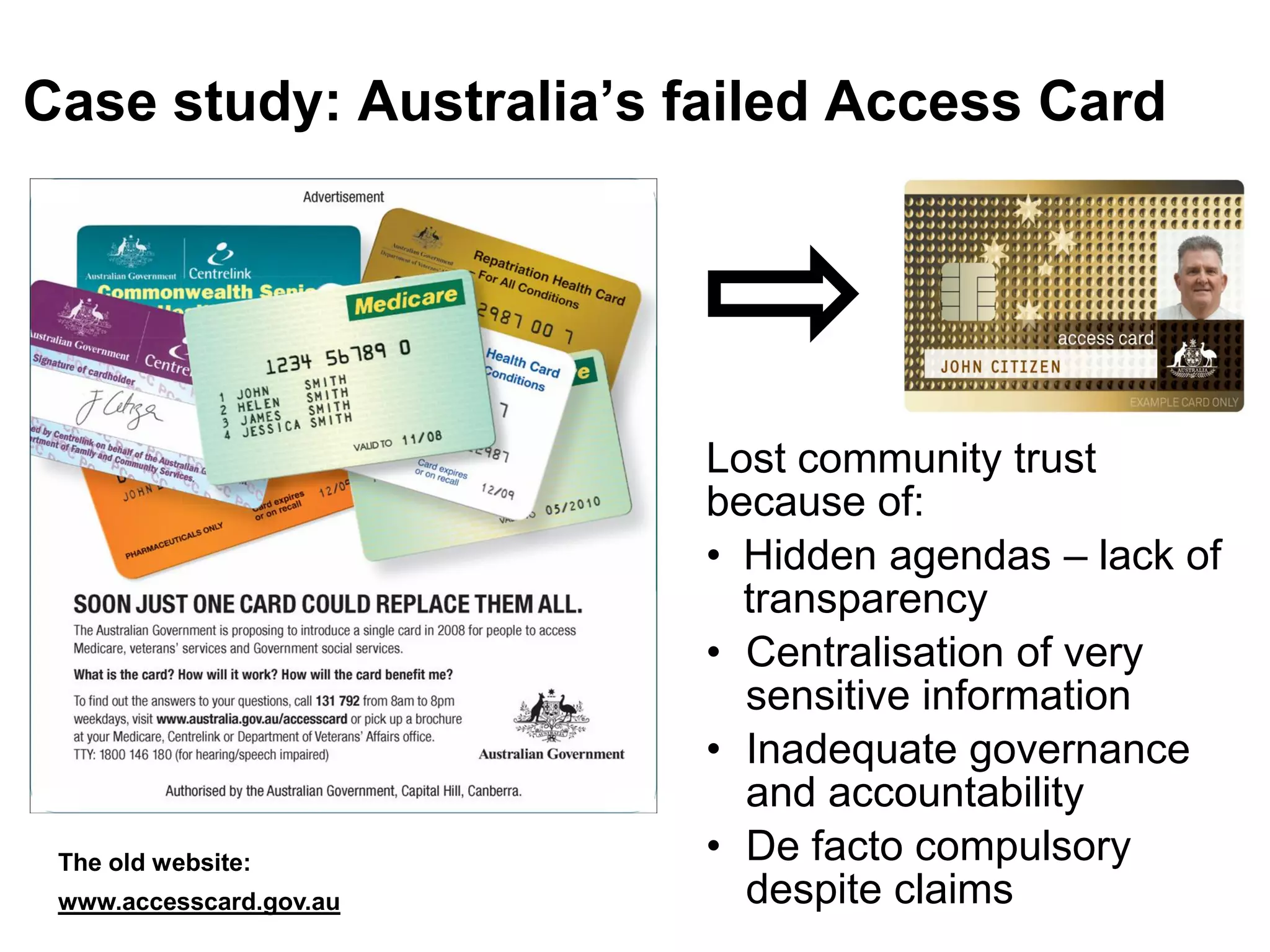
Case study: Australia’s failed Access Card


                         Lost community trust
                         because of:
                         • Hidden agendas – lack of
                           transparency
                         • Centralisation of very
                           sensitive information
                         • Inadequate governance
                           and accountability
 The old website:        • De facto compulsory
 www.accesscard.gov.au     despite claims
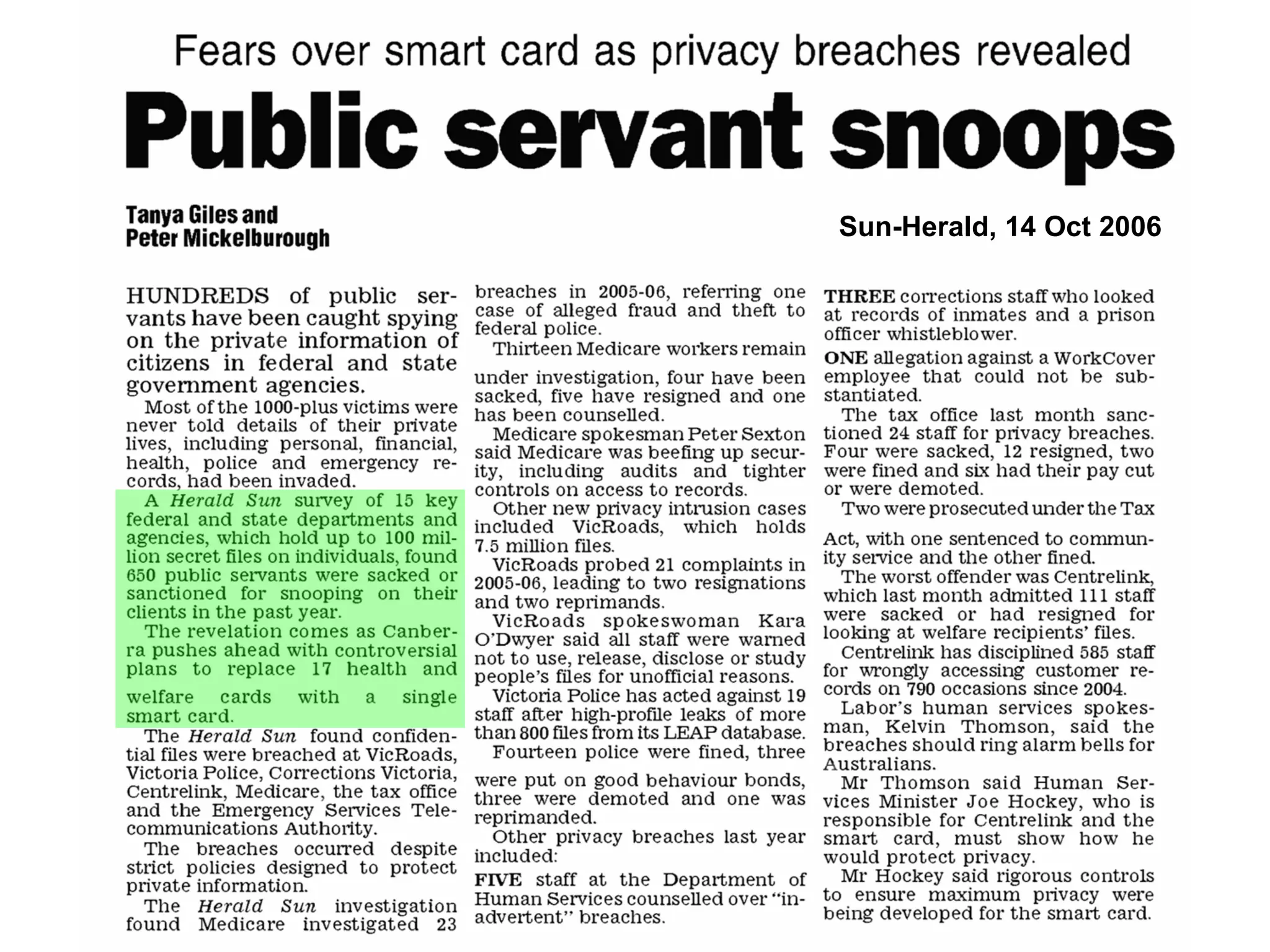
Sun-Herald, 14 Oct 2006
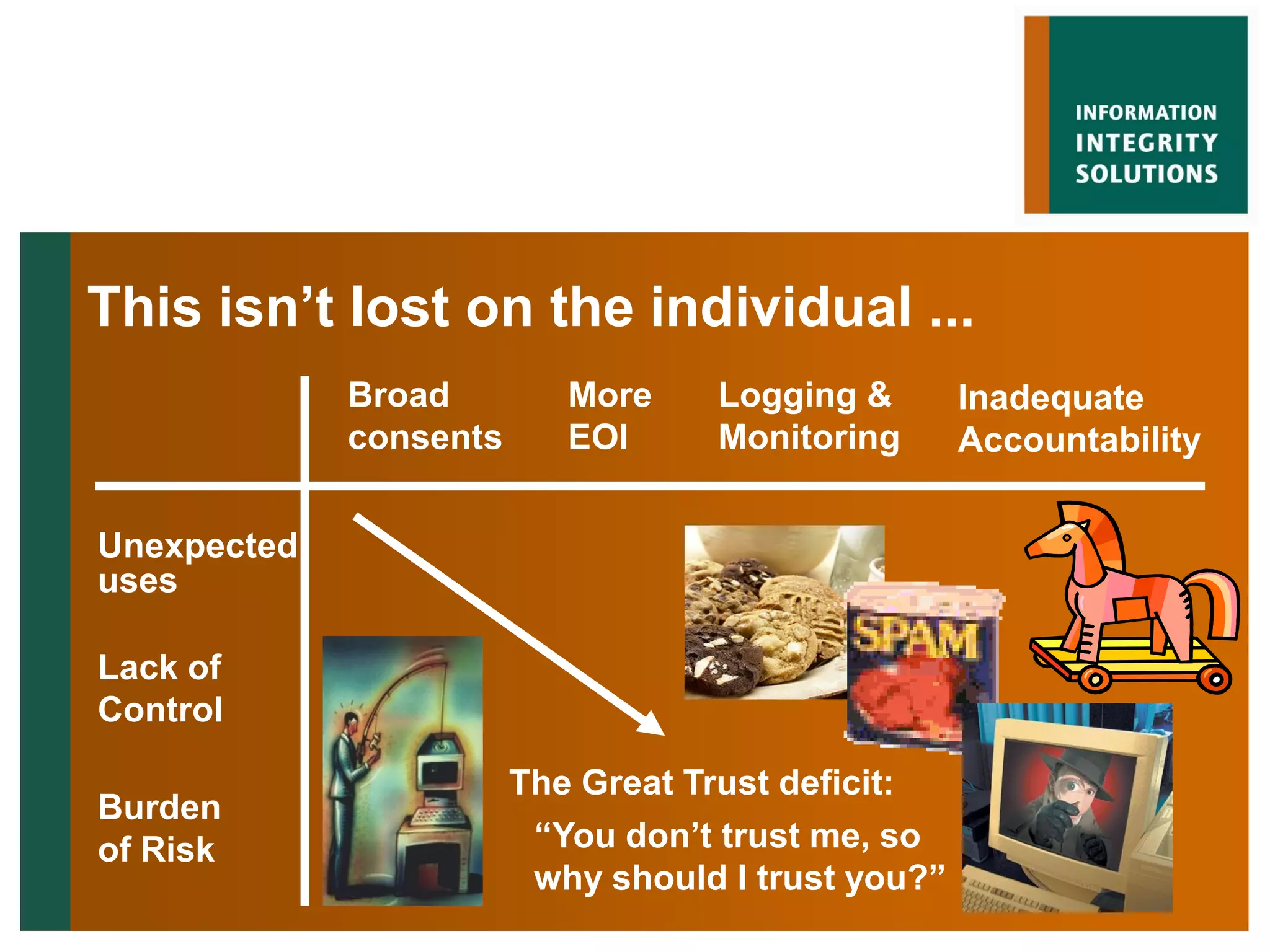
This isn’t lost on the individual ...
             Broad         More    Logging &        Inadequate
             consents      EOI     Monitoring       Accountability

Unexpected
uses

Lack of
Control

                        The Great Trust deficit:
Burden
of Risk                  “You don’t trust me, so
                         why should I trust you?”
Trust
“The ongoing debate about data privacy needs to evolve into a dialogue
about consumer trust …
“The Yankelovich Consumer Trust Report clearly pointed out the need for
a new approach. „The state of mistrust is not a new problem, but it is one
that can no longer be ignored,‟ Wood said. „According to our findings,
80% of consumers believe American businesses are too concerned about
making a profit and not concerned enough about their responsibilities …‟
“Distrust has a potentially devastating impact on profitability … Almost
half (45%) of the respondents say there is at least one retail business that
they trusted at one time but no longer trust. Of those people, nearly all
(94%) say they spent less money with that company, resulting in an
average 87% decrease in spending by that group.”
Craig Rogers, Yankelovich Partners, Press Release on The State of Consumer Trust Report
                                                                           8 June 2004
Survey after survey shows the impact
 Research into Community attitudes towards Privacy in Australia
 2007, 2004 & 2001, OPC Australia
 “Poll: Americans fear ID theft but try to protect themselves”,
 CNN Money, 18 July 2005
 Attitudes and Behaviors of Online Consumers: A Study of Five
 Cities (Sydney, Singapore, Bangalore, Seoul, New York), NUS,
 2003-04
 The New e-Government Equation: Ease, Engagement, Privacy
 and Protection, Hart-Teeter Research in US, 2003
 Privacy and data-sharing: The way forward for public services,
 UK Cabinet Office, 2002
 TRUSTe-TNS 2008 Study: Consumer Attitudes about
 Behavioral Targeting
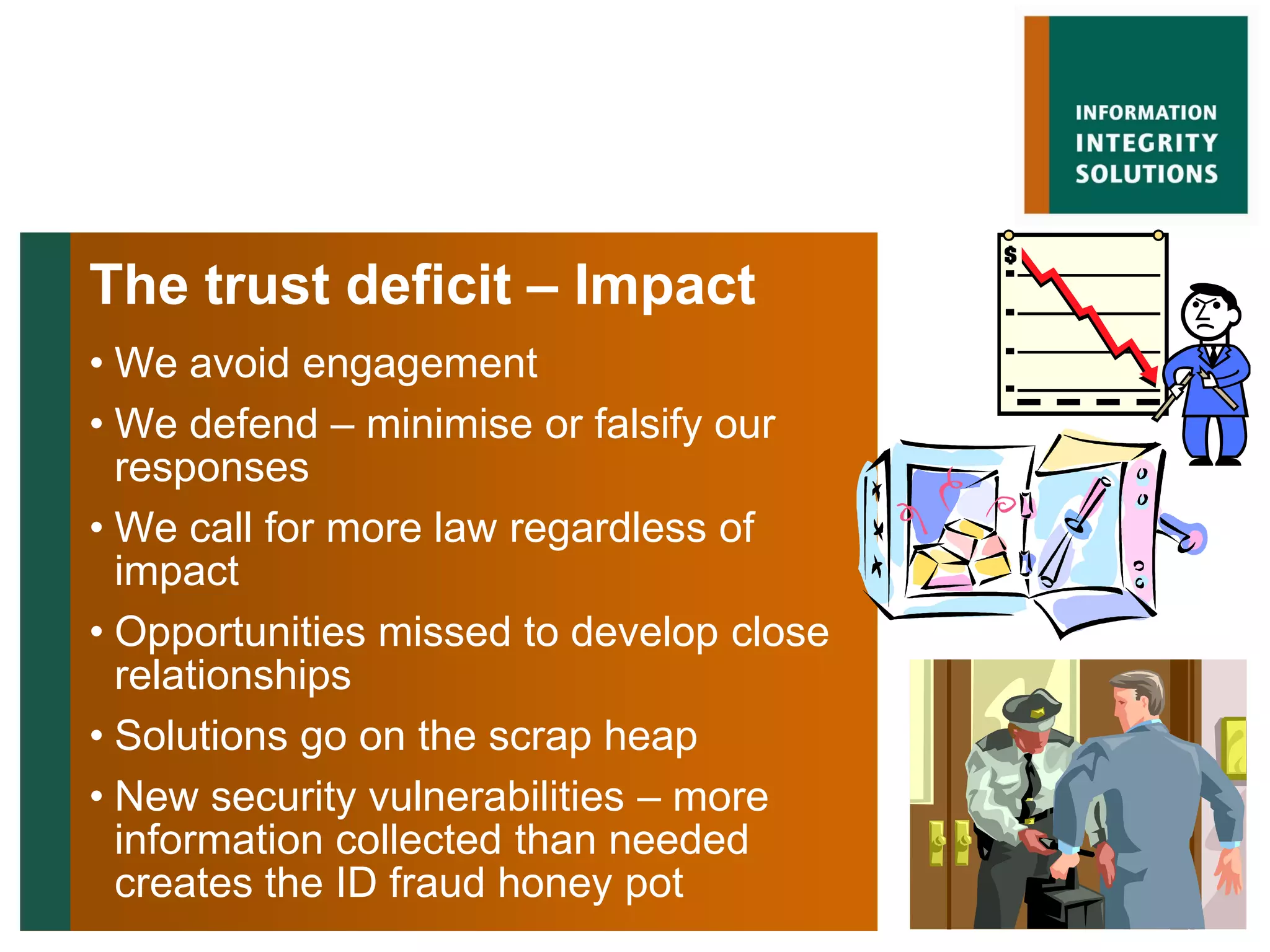
The trust deficit – Impact
• We avoid engagement
• We defend – minimise or falsify our
  responses
• We call for more law regardless of
  impact
• Opportunities missed to develop close
  relationships
• Solutions go on the scrap heap
• New security vulnerabilities – more
  information collected than needed
  creates the ID fraud honey pot
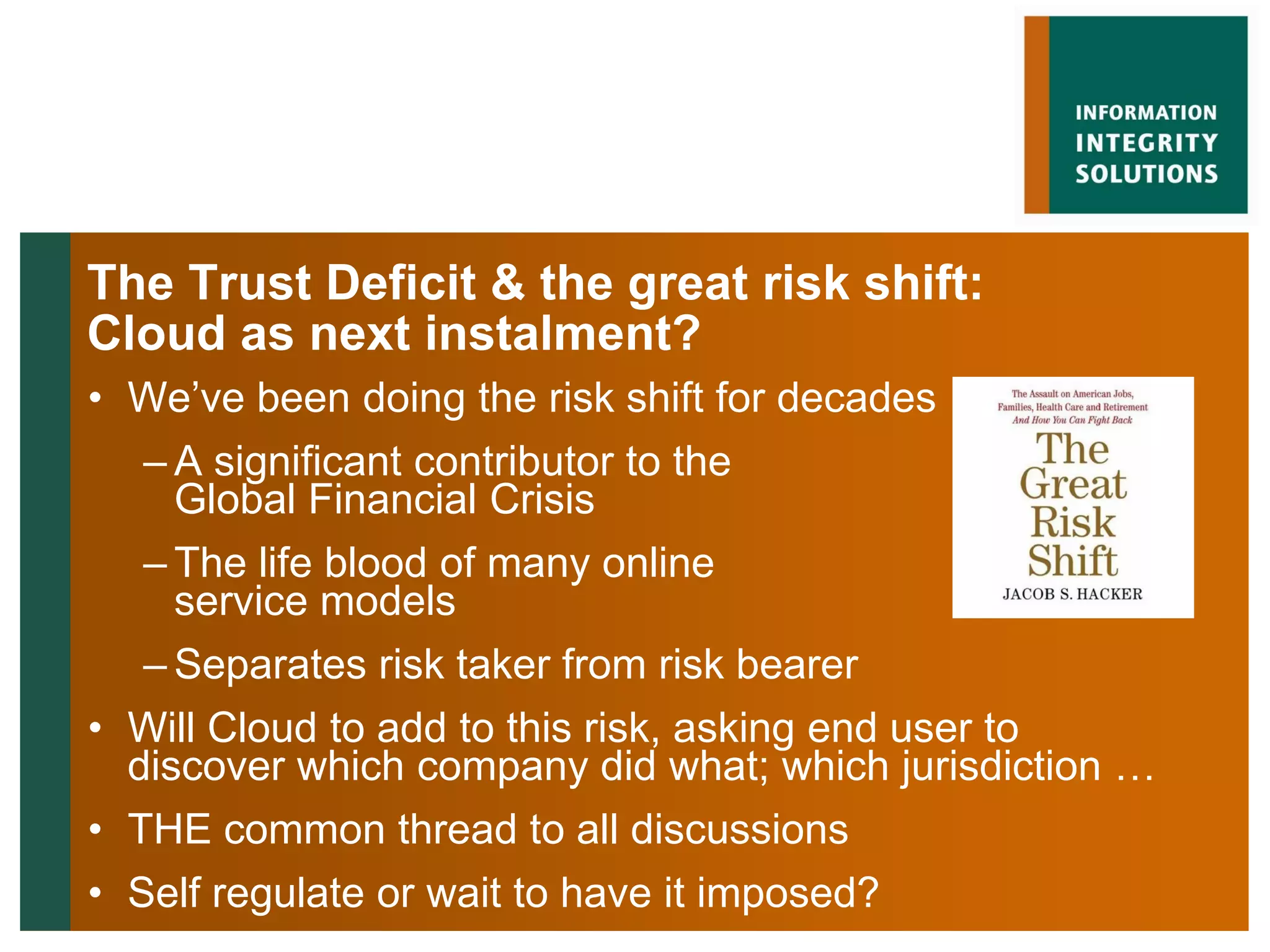
The Trust Deficit & the great risk shift:
Cloud as next instalment?
• We‟ve been doing the risk shift for decades
   – A significant contributor to the
     Global Financial Crisis
   – The life blood of many online
     service models
   – Separates risk taker from risk bearer
• Will Cloud to add to this risk, asking end user to
  discover which company did what; which jurisdiction …
• THE common thread to all discussions
• Self regulate or wait to have it imposed?
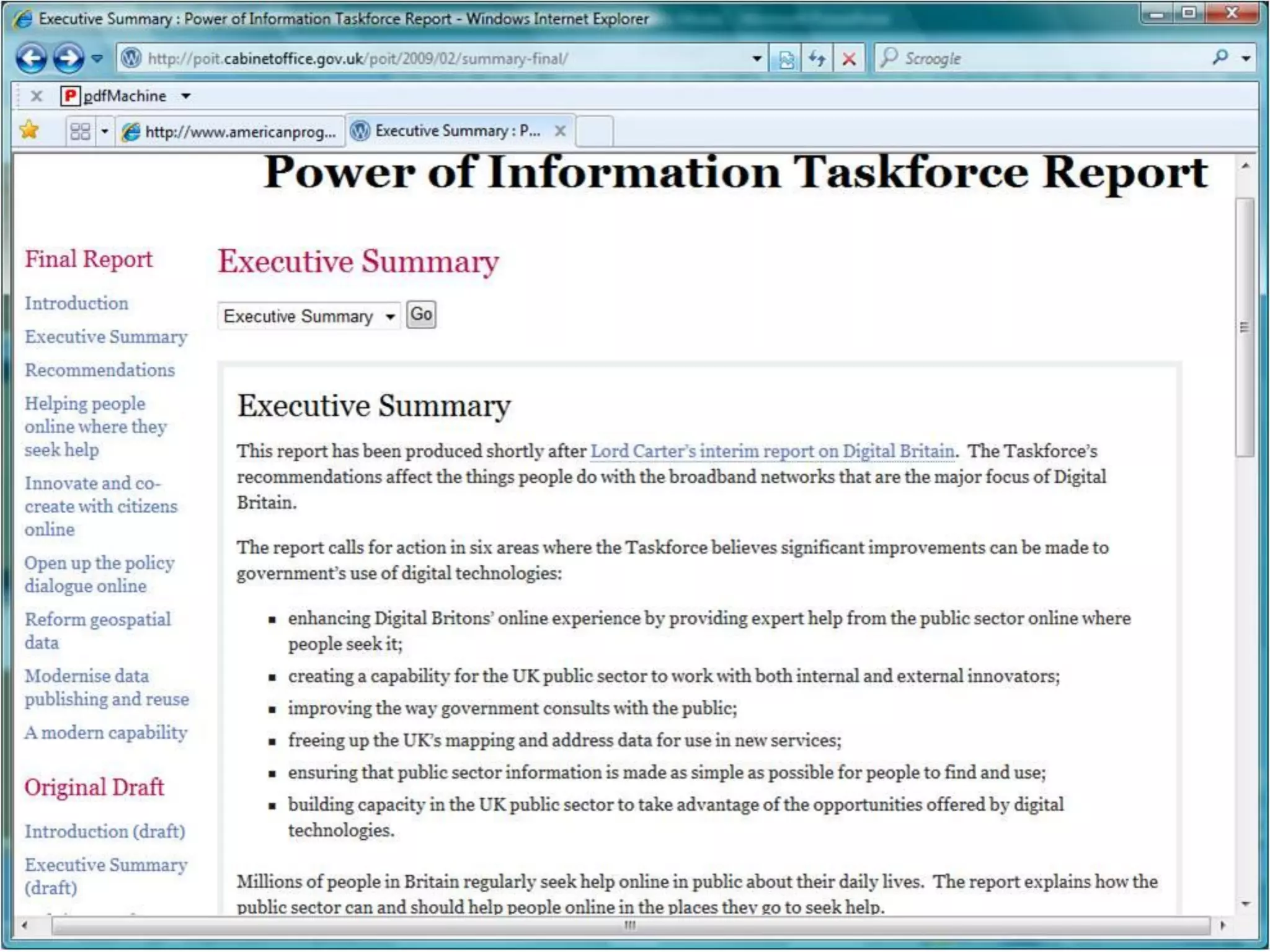
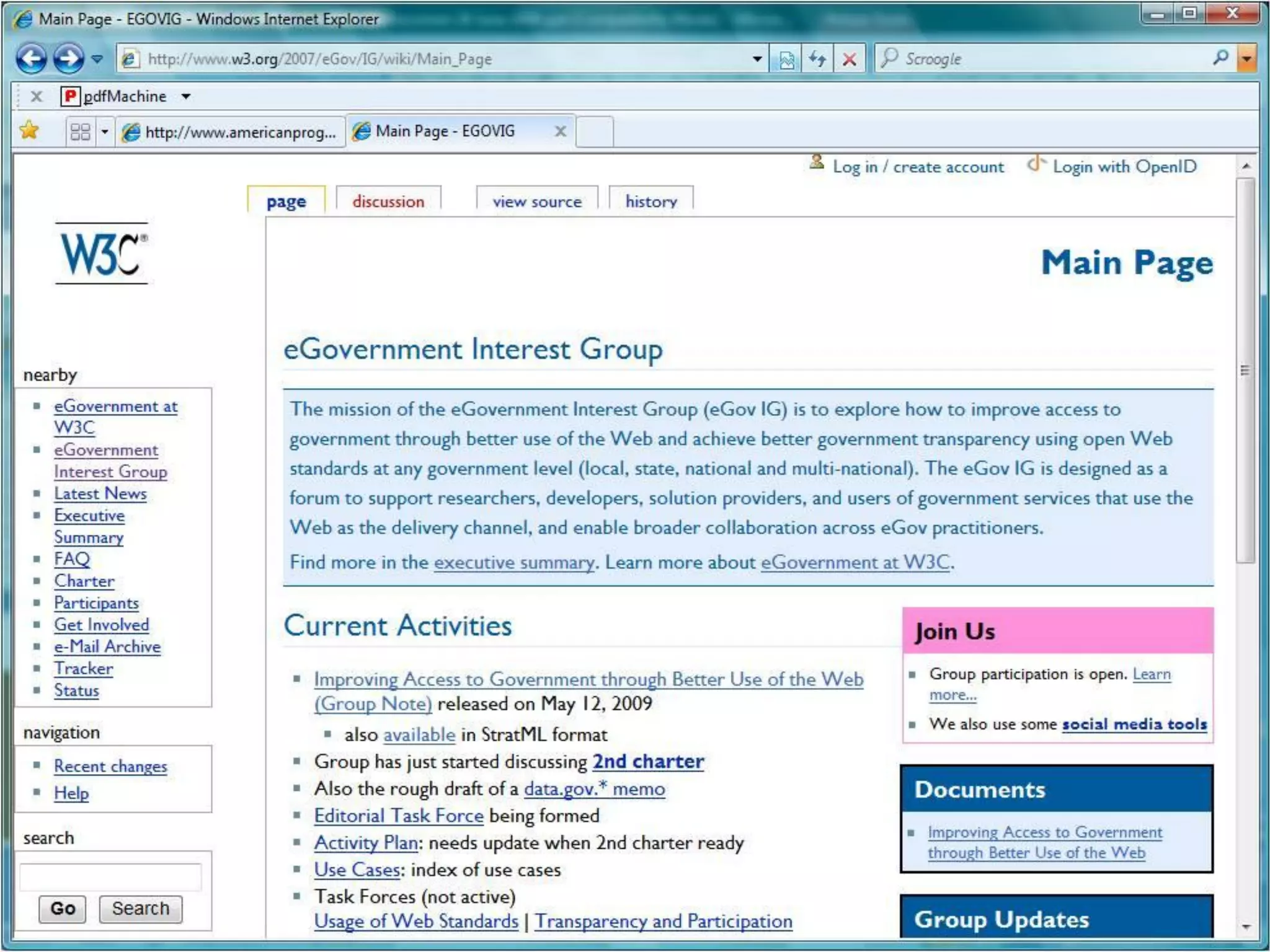
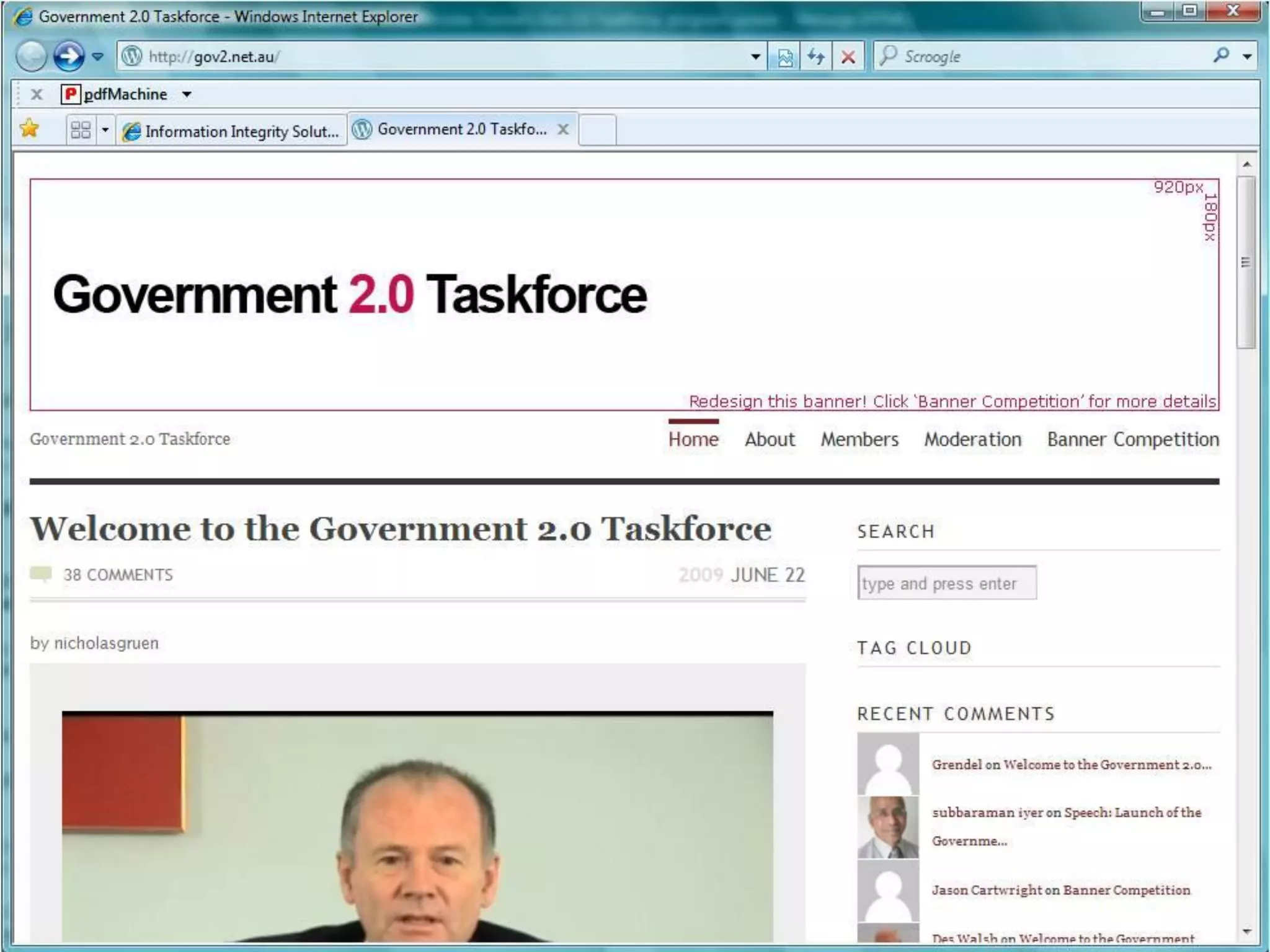
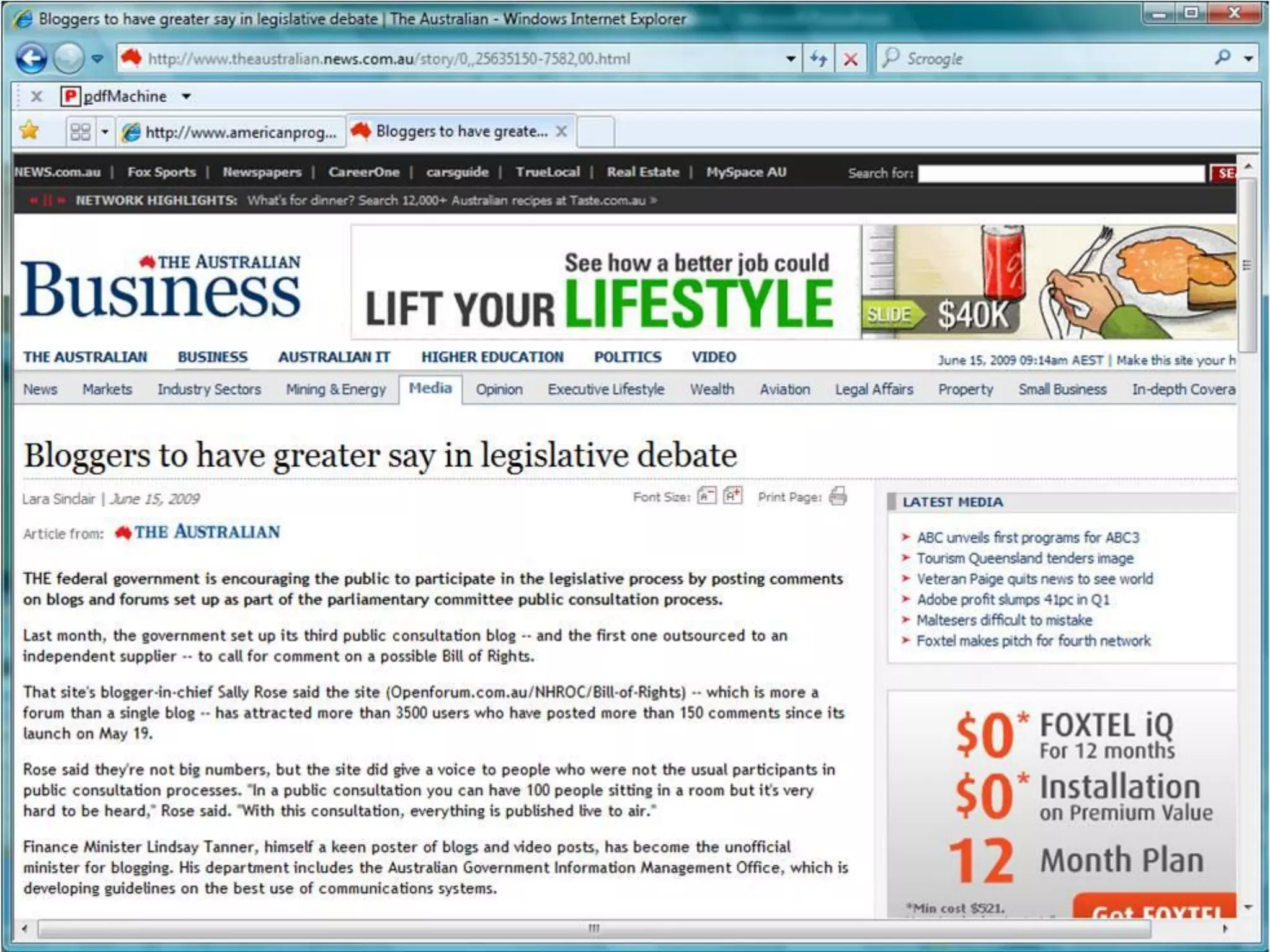
And now Govt 2.0
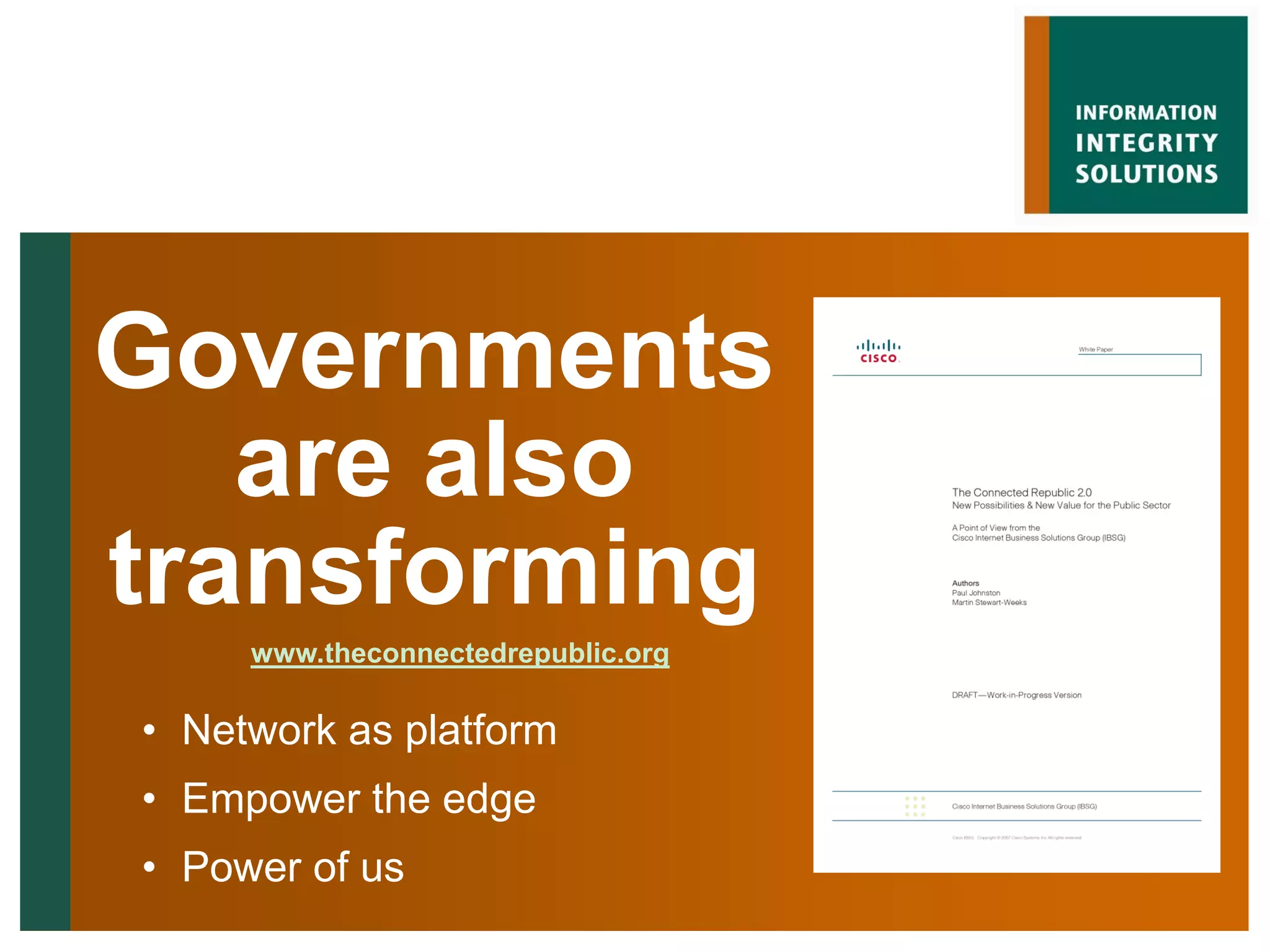
Governments
   are also
transforming
     www.theconnectedrepublic.org

• Network as platform
• Empower the edge
• Power of us
But is it safe?
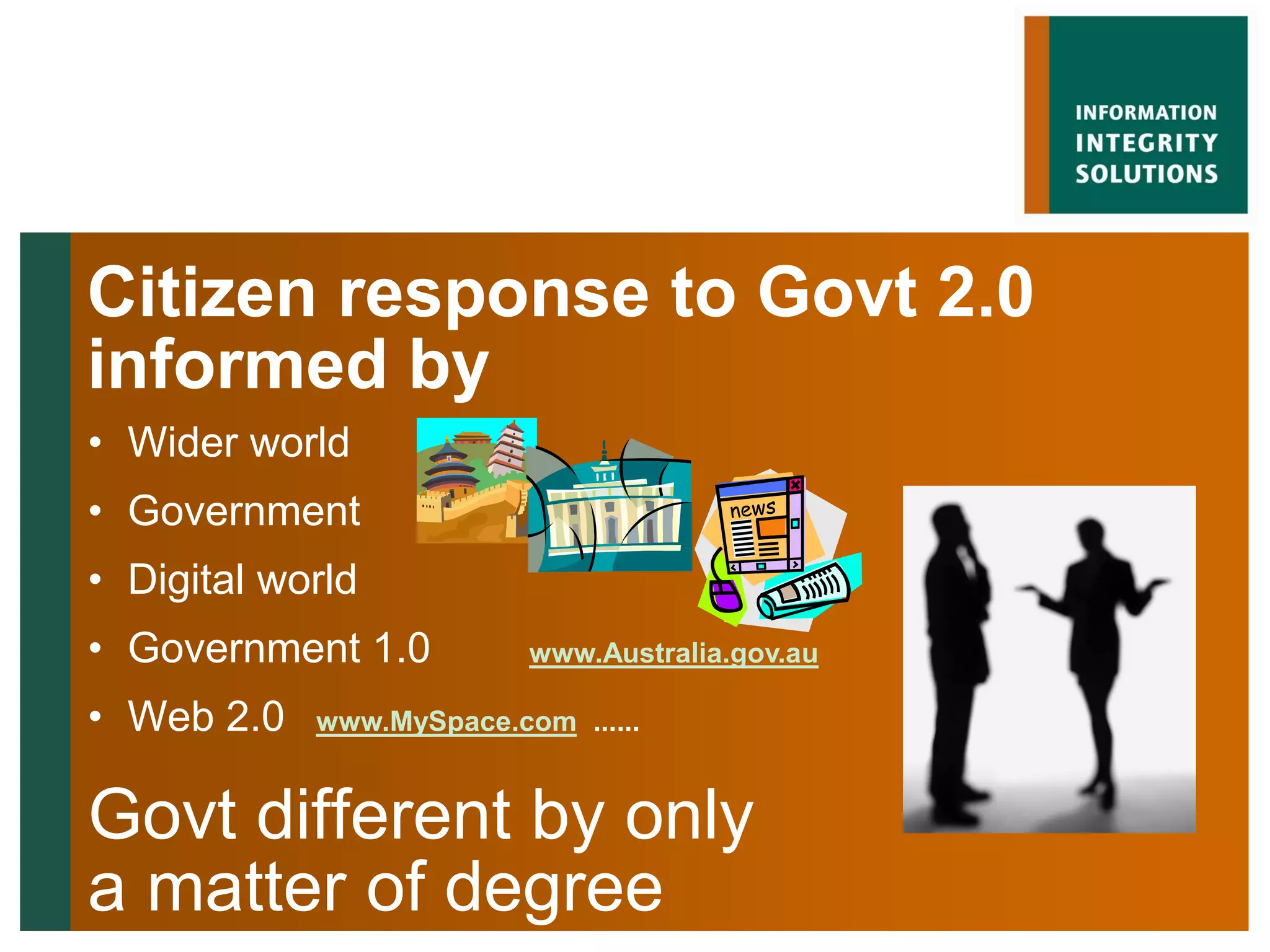
Citizen response to Govt 2.0
informed by
• Wider world
• Government
• Digital world
• Government 1.0          www.Australia.gov.au

• Web 2.0   www.MySpace.com ......


Govt different by only
a matter of degree
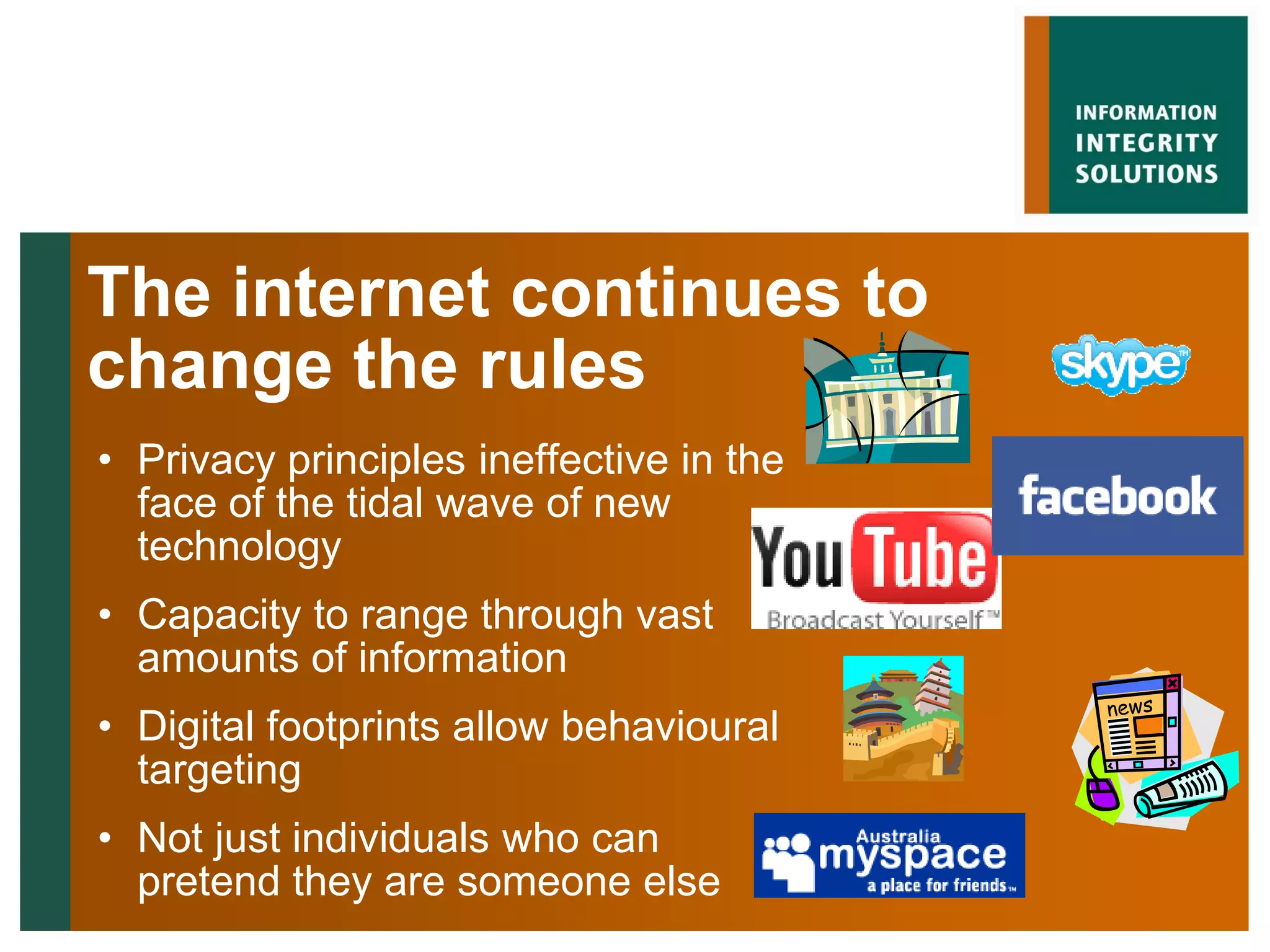
The internet continues to
change the rules
• Privacy principles ineffective in the
  face of the tidal wave of new
  technology
• Capacity to range through vast
  amounts of information
• Digital footprints allow behavioural
  targeting
• Not just individuals who can
  pretend they are someone else

Facebook
• 700,000 protest “Facebook and the Politics of Privacy”
                                              MotherJones.com, 14 September 2006
                                         www.motherjones.com/interview/2006/09/facebook.html

• Disable but NOT delete accounts
• “Facebook privacy row hits Oxford University”
                                               The Daily Telegraph UK, 18 July 2007
  www.telegraph.co.uk/core/Content/displayPrintable.jhtml?xml=/news/2007/07/18/noxford118.xml&
                                                                                site=5&page=0

• Opened up to Google Search
• “Facebook fiasco: Zuckerberg says sorry”
                                                            The Age, 6 December 2007
                     www.theage.com.au/news/web/bfacebookb-privacy-fiasco-forces-founder-to-
                                                 apologise/2007/12/06/1196812874843.html

• Terms & Conditions backdown & rewrite
                                          http://blog.facebook.com/blog.php?post=79146552130
How to make it safe
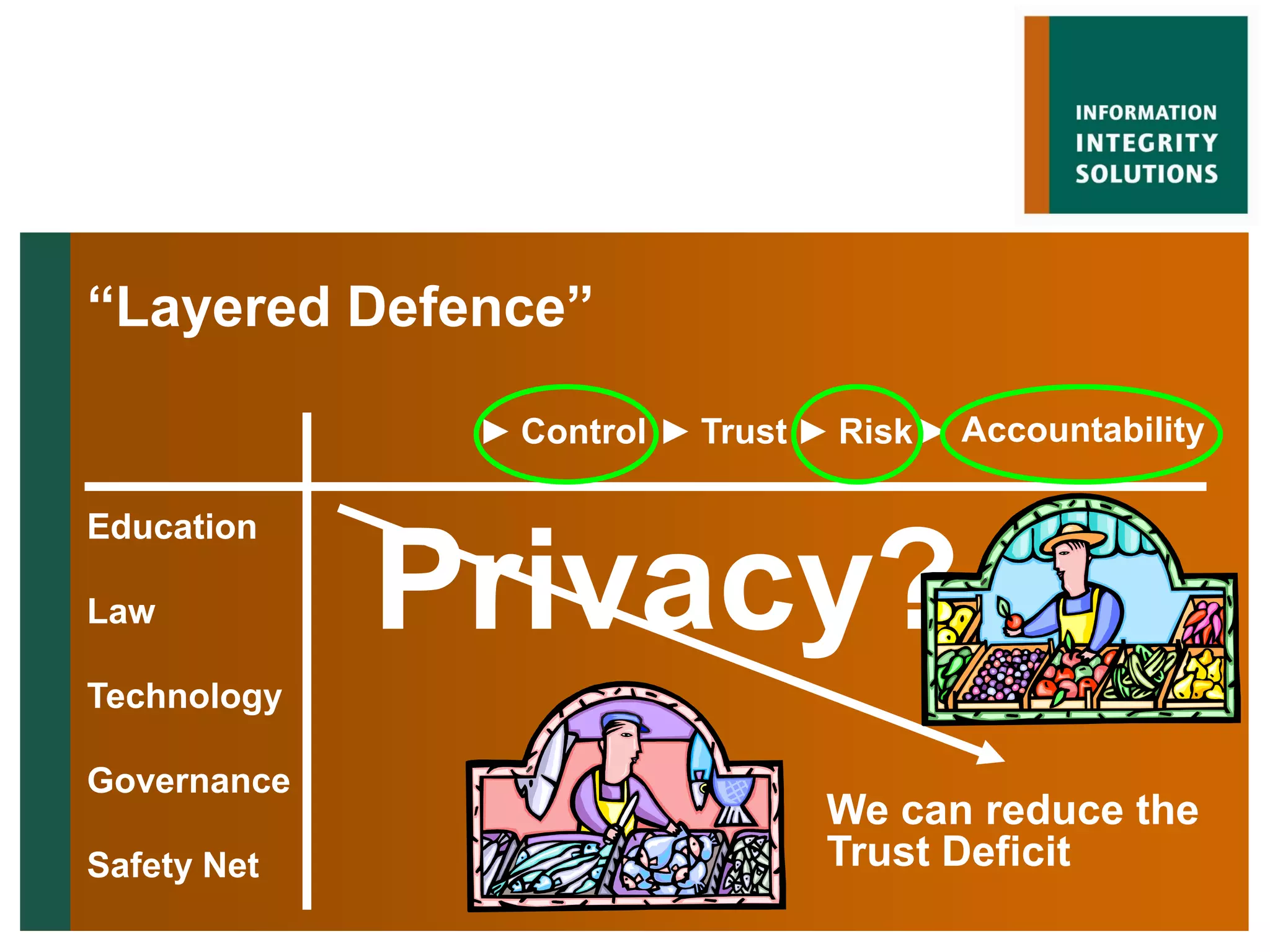
“Layered Defence”

              ► Control ► Trust ► Risk ► Accountability

Education

Law          Privacy?
Technology

Governance
                                 We can reduce the
Safety Net                       Trust Deficit
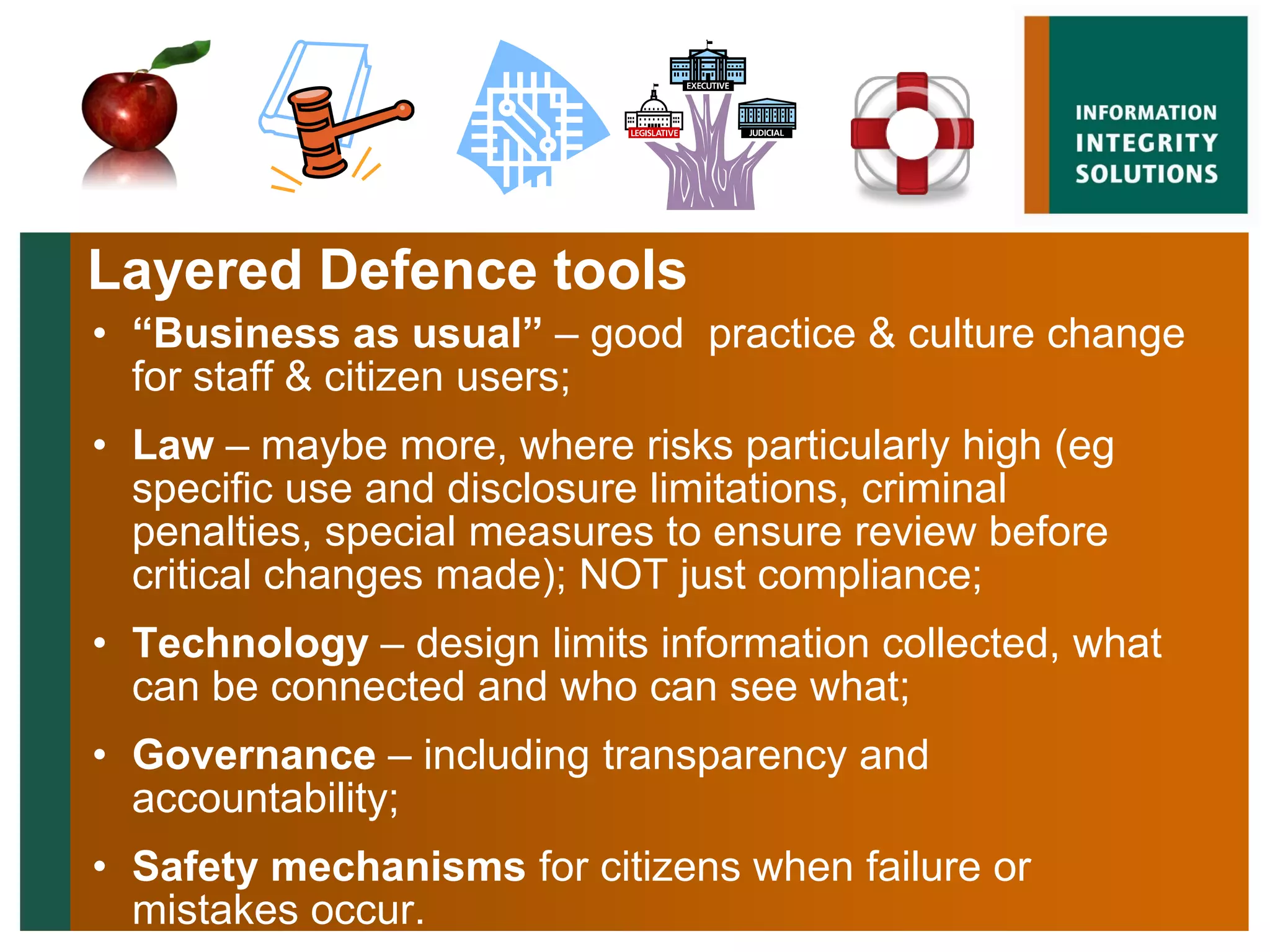
Layered Defence tools
• “Business as usual” – good practice & culture change
  for staff & citizen users;
• Law – maybe more, where risks particularly high (eg
  specific use and disclosure limitations, criminal
  penalties, special measures to ensure review before
  critical changes made); NOT just compliance;
• Technology – design limits information collected, what
  can be connected and who can see what;
• Governance – including transparency and
  accountability;
• Safety mechanisms for citizens when failure or
  mistakes occur.
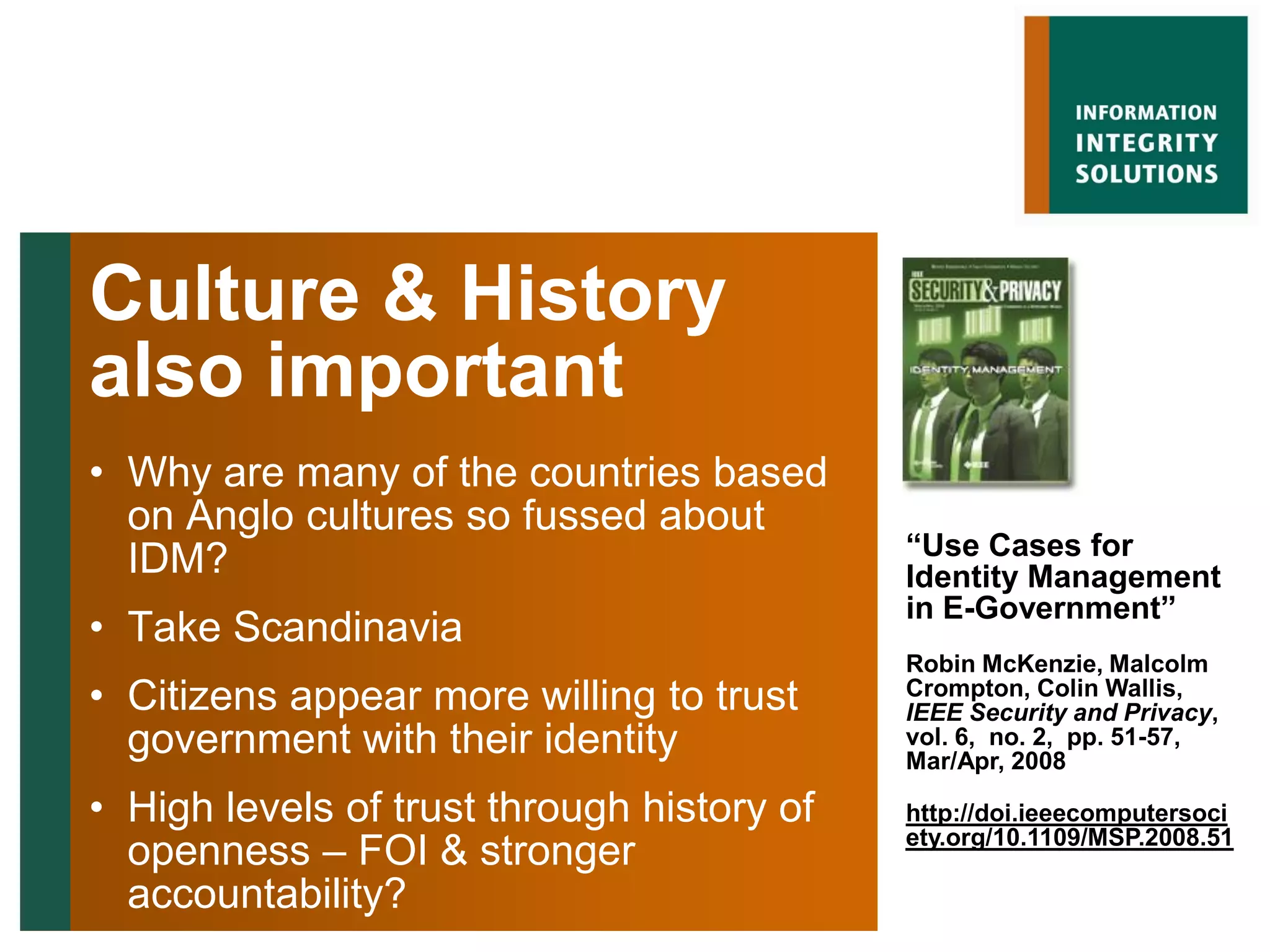
Culture & History
also important
• Why are many of the countries based
  on Anglo cultures so fussed about
                                            “Use Cases for
  IDM?                                      Identity Management
                                            in E-Government”
• Take Scandinavia
                                            Robin McKenzie, Malcolm
• Citizens appear more willing to trust     Crompton, Colin Wallis,
                                            IEEE Security and Privacy,
  government with their identity            vol. 6, no. 2, pp. 51-57,
                                            Mar/Apr, 2008

• High levels of trust through history of   http://doi.ieeecomputersoci
  openness – FOI & stronger                 ety.org/10.1109/MSP.2008.51

  accountability?
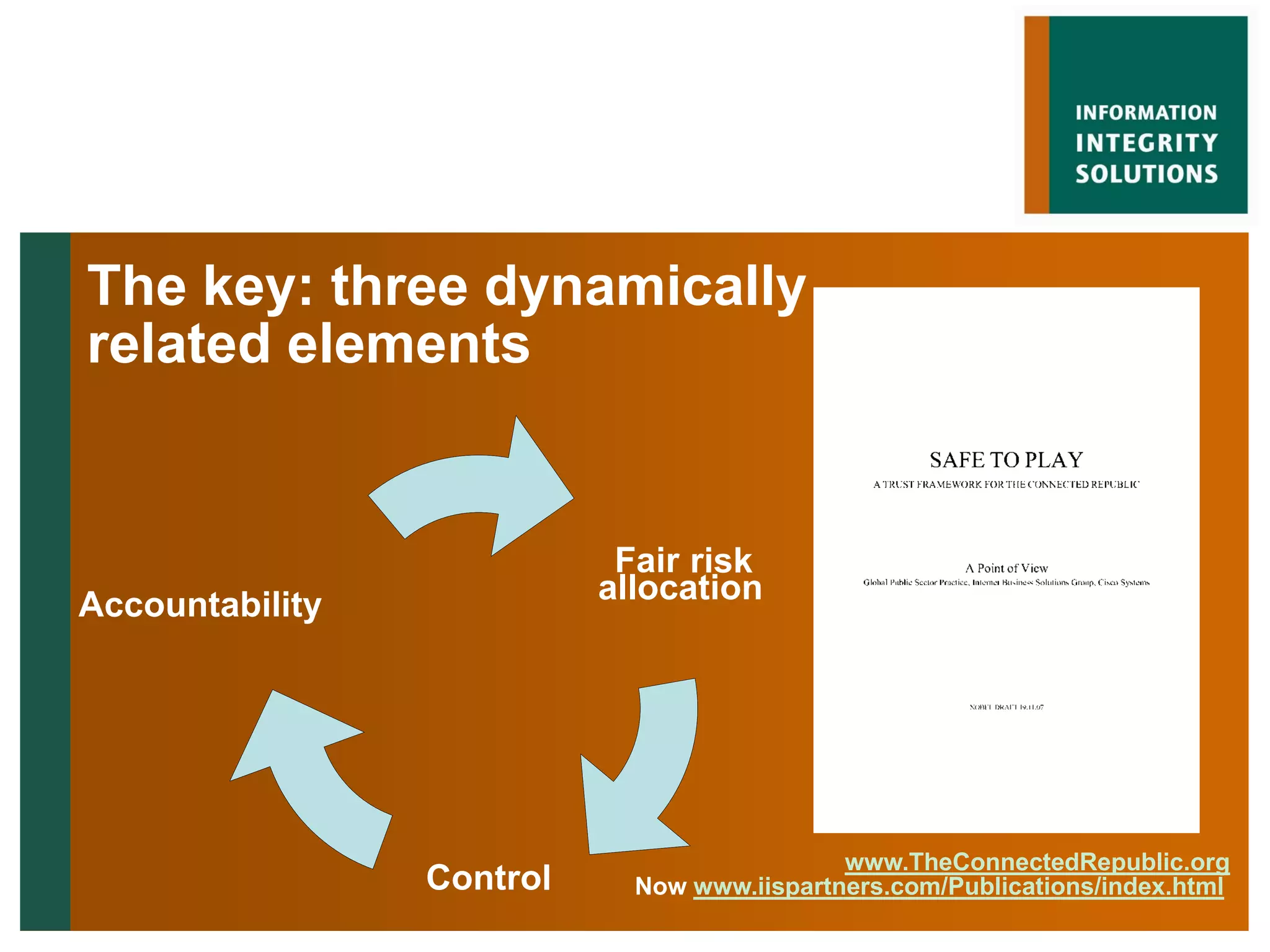
The key: three dynamically
related elements


                            Fair risk
Accountability             allocation


                                             www.TheConnectedRepublic.org
                 Control     Now www.iispartners.com/Publications/index.html
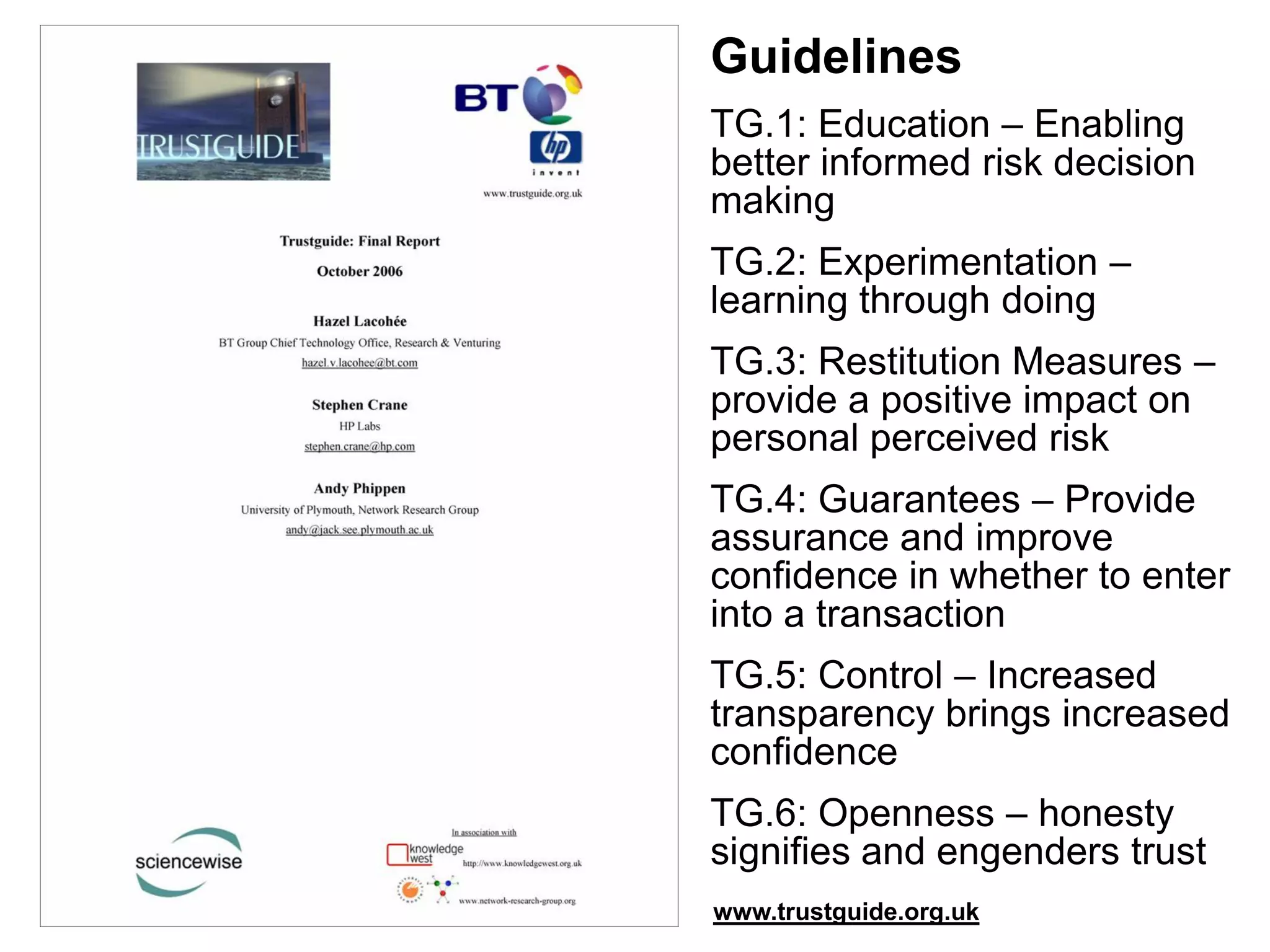
Guidelines
TG.1: Education – Enabling
better informed risk decision
making
TG.2: Experimentation –
learning through doing
TG.3: Restitution Measures –
provide a positive impact on
personal perceived risk
TG.4: Guarantees – Provide
assurance and improve
confidence in whether to enter
into a transaction
TG.5: Control – Increased
transparency brings increased
confidence
TG.6: Openness – honesty
signifies and engenders trust
www.trustguide.org.uk
Swire’s recommendations
• The Obama administration should begin to work on a more long-
  term solution on persistent cookies that addresses the complexity of
  the issue, the conflicting views of privacy and new media advocates,
  and the public policy debates about online advertising...
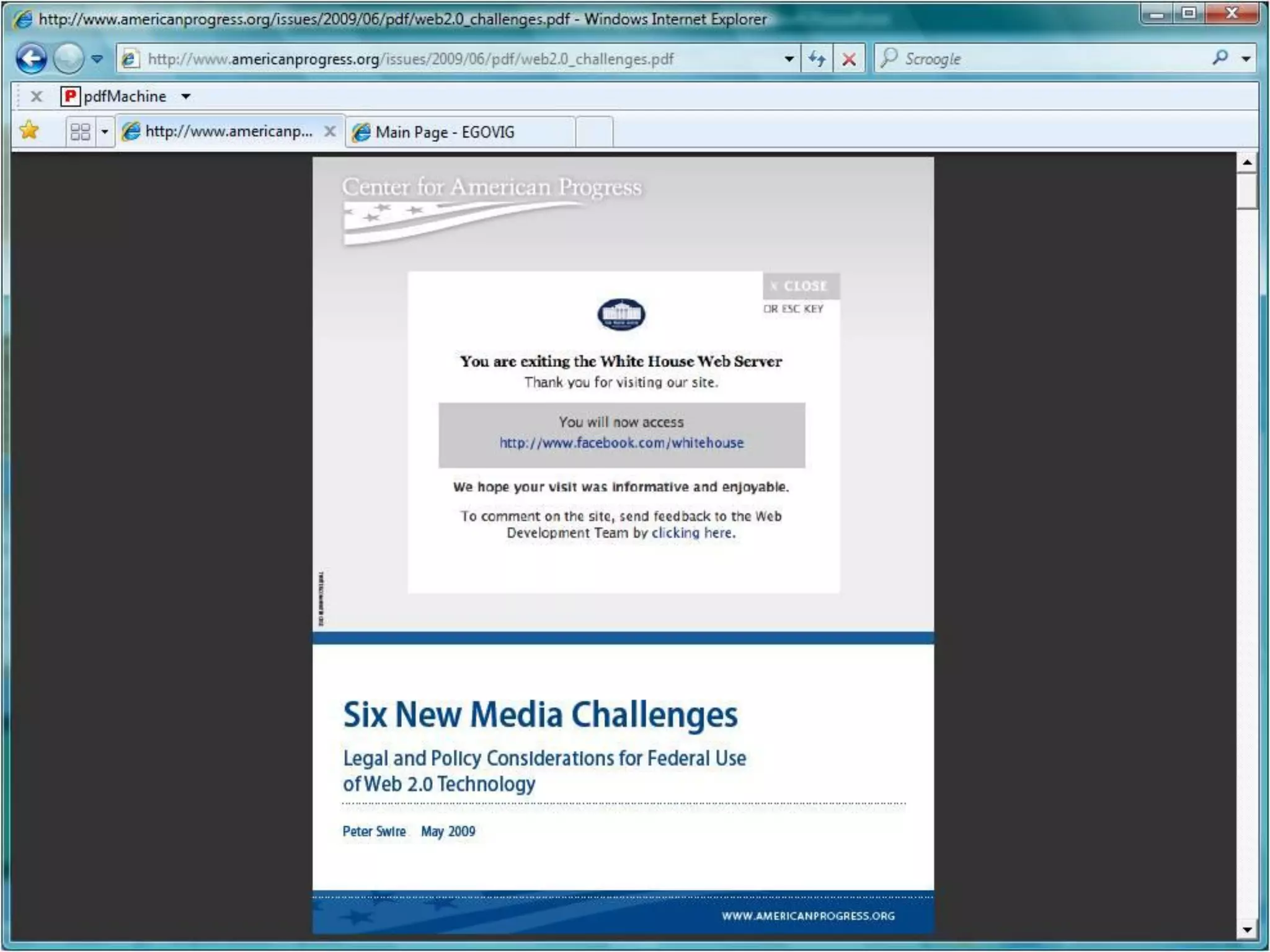
• WhiteHouse.gov and all other federal websites should provide a
  disclaimer making it clear to users when they leave an official
  federal website...
• Privacy should be one of the factors that the federal government
  considers when it selects thirdparty Web 2.0 services...
• If a social networking or other Web 2.0 application allows more
  access to personal information than is appropriate, the agency can
  announce in its own privacy policy that it will not access that
  information.
Jason Ryan’s recommendations
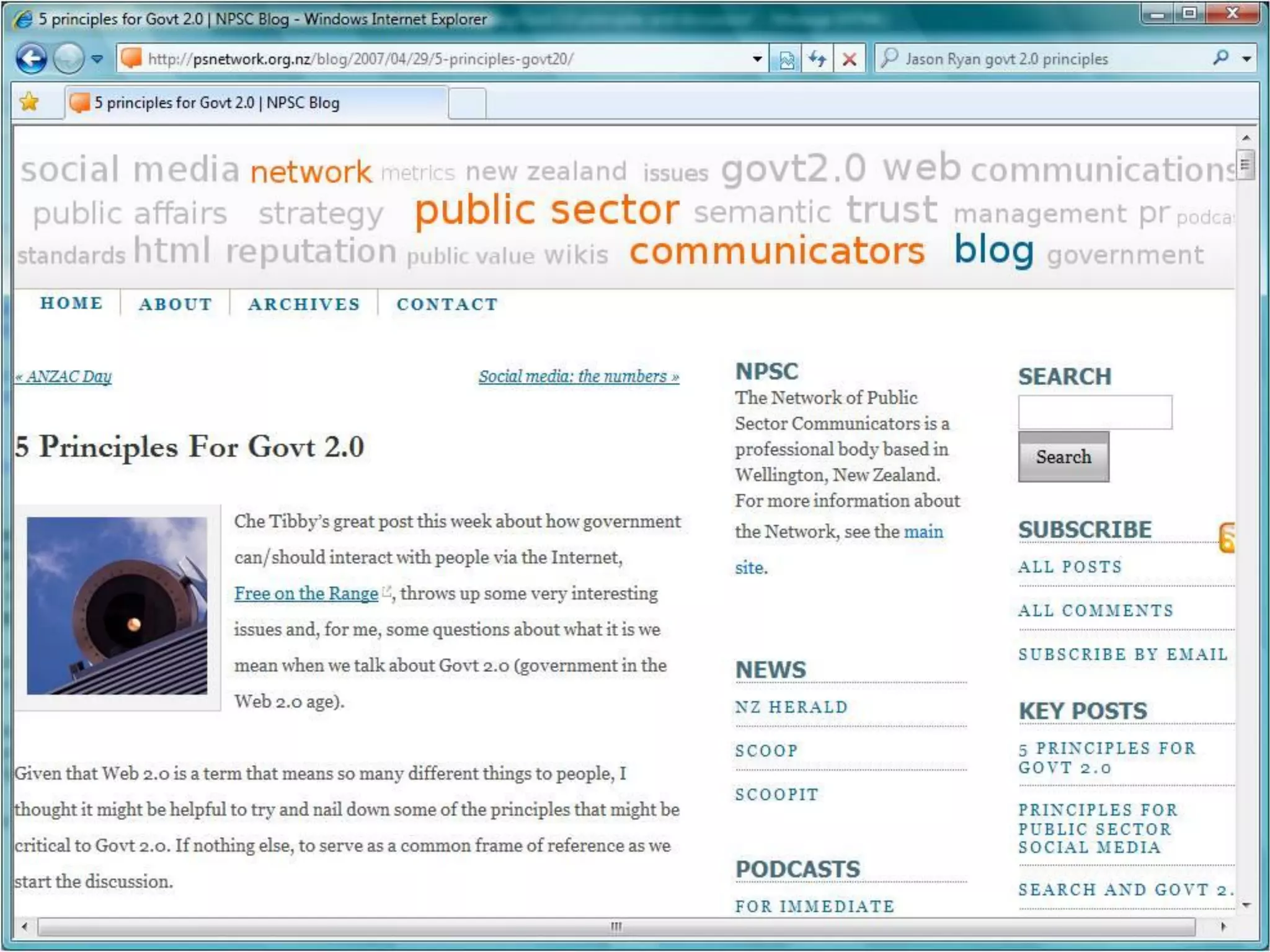
• Data web – who owns the data?
• Personalisation – Users across the web expect to be able
  to tailor their experience to their own requirements
• Open source government – build web applications that
  allow the people who have funded to them to build,
  deploy and access their own APIs
• Search – information must be discoverable ... be able to
  be repackaged according to user interests
• Authentication – ability to establish identity with an
  agency and be sure that the party receiving that
  information to is who they claim to be
Some more strategies and principles
• Use Web 2.0 capabilities to solve Web 2.0 problems
• Make sure you address citizen risk (not just yours)
• Give citizens as much control as possible
• Recognise that sometimes citizens can‟t choose, and
  compensate by strengthening accountability and fair
  risk allocation
• Be transparent, accountable and have strong
  governance
• Take responsibility for fixing failures
Questions for governments
• Which hat are you wearing? What is
  your agenda?
• Are you willing to be transparent about
  your agendas?
• If you cannot be fully transparent are
  you prepared to be highly accountable?
• How will you gain citizen trust where
  choice not an option?
• Are you willing to take responsibility for
  fixing failures?
Malcolm  Crompton  I I S  Frocomm  Web 2 O In  Govt  24  June 2009

Malcolm Crompton I I S Frocomm Web 2 O In Govt 24 June 2009

  • 1.
    Malcolm Crompton Web 2.0in Government: the key issue of privacy Web 2.0 in Government Conference 2009 Sydney 24 June 2009
  • 2.
    The inherent challengefor any government: which hat? “Government is not only a direct service provider, of course. It also discharges important roles including providing for national security, law enforcement and regulation about which individuals have little (legal) choice even if they might have consequences that are adverse to their individual interests.” Safe to play, a trust framework for The Connected Republic A Point of View from the Global Public Sector Practice, Internet Business Solutions Group, Cisco Systems www.iispartners.com/Publications/index.html
  • 3.
  • 7.
    Case study: Australia’sfailed Access Card Lost community trust because of: • Hidden agendas – lack of transparency • Centralisation of very sensitive information • Inadequate governance and accountability The old website: • De facto compulsory www.accesscard.gov.au despite claims
  • 8.
  • 9.
    This isn’t loston the individual ... Broad More Logging & Inadequate consents EOI Monitoring Accountability Unexpected uses Lack of Control The Great Trust deficit: Burden of Risk “You don’t trust me, so why should I trust you?”
  • 10.
    Trust “The ongoing debateabout data privacy needs to evolve into a dialogue about consumer trust … “The Yankelovich Consumer Trust Report clearly pointed out the need for a new approach. „The state of mistrust is not a new problem, but it is one that can no longer be ignored,‟ Wood said. „According to our findings, 80% of consumers believe American businesses are too concerned about making a profit and not concerned enough about their responsibilities …‟ “Distrust has a potentially devastating impact on profitability … Almost half (45%) of the respondents say there is at least one retail business that they trusted at one time but no longer trust. Of those people, nearly all (94%) say they spent less money with that company, resulting in an average 87% decrease in spending by that group.” Craig Rogers, Yankelovich Partners, Press Release on The State of Consumer Trust Report 8 June 2004
  • 11.
    Survey after surveyshows the impact Research into Community attitudes towards Privacy in Australia 2007, 2004 & 2001, OPC Australia “Poll: Americans fear ID theft but try to protect themselves”, CNN Money, 18 July 2005 Attitudes and Behaviors of Online Consumers: A Study of Five Cities (Sydney, Singapore, Bangalore, Seoul, New York), NUS, 2003-04 The New e-Government Equation: Ease, Engagement, Privacy and Protection, Hart-Teeter Research in US, 2003 Privacy and data-sharing: The way forward for public services, UK Cabinet Office, 2002 TRUSTe-TNS 2008 Study: Consumer Attitudes about Behavioral Targeting
  • 12.
    The trust deficit– Impact • We avoid engagement • We defend – minimise or falsify our responses • We call for more law regardless of impact • Opportunities missed to develop close relationships • Solutions go on the scrap heap • New security vulnerabilities – more information collected than needed creates the ID fraud honey pot
  • 13.
    The Trust Deficit& the great risk shift: Cloud as next instalment? • We‟ve been doing the risk shift for decades – A significant contributor to the Global Financial Crisis – The life blood of many online service models – Separates risk taker from risk bearer • Will Cloud to add to this risk, asking end user to discover which company did what; which jurisdiction … • THE common thread to all discussions • Self regulate or wait to have it imposed?
  • 14.
  • 15.
    Governments are also transforming www.theconnectedrepublic.org • Network as platform • Empower the edge • Power of us
  • 21.
    But is itsafe?
  • 22.
    Citizen response toGovt 2.0 informed by • Wider world • Government • Digital world • Government 1.0 www.Australia.gov.au • Web 2.0 www.MySpace.com ...... Govt different by only a matter of degree
  • 23.
    The internet continuesto change the rules • Privacy principles ineffective in the face of the tidal wave of new technology • Capacity to range through vast amounts of information • Digital footprints allow behavioural targeting • Not just individuals who can pretend they are someone else
  • 24.
    Facebook • 700,000 protest“Facebook and the Politics of Privacy” MotherJones.com, 14 September 2006 www.motherjones.com/interview/2006/09/facebook.html • Disable but NOT delete accounts • “Facebook privacy row hits Oxford University” The Daily Telegraph UK, 18 July 2007 www.telegraph.co.uk/core/Content/displayPrintable.jhtml?xml=/news/2007/07/18/noxford118.xml& site=5&page=0 • Opened up to Google Search • “Facebook fiasco: Zuckerberg says sorry” The Age, 6 December 2007 www.theage.com.au/news/web/bfacebookb-privacy-fiasco-forces-founder-to- apologise/2007/12/06/1196812874843.html • Terms & Conditions backdown & rewrite http://blog.facebook.com/blog.php?post=79146552130
  • 25.
    How to makeit safe
  • 26.
    “Layered Defence” ► Control ► Trust ► Risk ► Accountability Education Law Privacy? Technology Governance We can reduce the Safety Net Trust Deficit
  • 27.
    Layered Defence tools •“Business as usual” – good practice & culture change for staff & citizen users; • Law – maybe more, where risks particularly high (eg specific use and disclosure limitations, criminal penalties, special measures to ensure review before critical changes made); NOT just compliance; • Technology – design limits information collected, what can be connected and who can see what; • Governance – including transparency and accountability; • Safety mechanisms for citizens when failure or mistakes occur.
  • 28.
    Culture & History alsoimportant • Why are many of the countries based on Anglo cultures so fussed about “Use Cases for IDM? Identity Management in E-Government” • Take Scandinavia Robin McKenzie, Malcolm • Citizens appear more willing to trust Crompton, Colin Wallis, IEEE Security and Privacy, government with their identity vol. 6, no. 2, pp. 51-57, Mar/Apr, 2008 • High levels of trust through history of http://doi.ieeecomputersoci openness – FOI & stronger ety.org/10.1109/MSP.2008.51 accountability?
  • 29.
    The key: threedynamically related elements Fair risk Accountability allocation www.TheConnectedRepublic.org Control Now www.iispartners.com/Publications/index.html
  • 30.
    Guidelines TG.1: Education –Enabling better informed risk decision making TG.2: Experimentation – learning through doing TG.3: Restitution Measures – provide a positive impact on personal perceived risk TG.4: Guarantees – Provide assurance and improve confidence in whether to enter into a transaction TG.5: Control – Increased transparency brings increased confidence TG.6: Openness – honesty signifies and engenders trust www.trustguide.org.uk
  • 32.
    Swire’s recommendations • TheObama administration should begin to work on a more long- term solution on persistent cookies that addresses the complexity of the issue, the conflicting views of privacy and new media advocates, and the public policy debates about online advertising... • WhiteHouse.gov and all other federal websites should provide a disclaimer making it clear to users when they leave an official federal website... • Privacy should be one of the factors that the federal government considers when it selects thirdparty Web 2.0 services... • If a social networking or other Web 2.0 application allows more access to personal information than is appropriate, the agency can announce in its own privacy policy that it will not access that information.
  • 34.
    Jason Ryan’s recommendations •Data web – who owns the data? • Personalisation – Users across the web expect to be able to tailor their experience to their own requirements • Open source government – build web applications that allow the people who have funded to them to build, deploy and access their own APIs • Search – information must be discoverable ... be able to be repackaged according to user interests • Authentication – ability to establish identity with an agency and be sure that the party receiving that information to is who they claim to be
  • 36.
    Some more strategiesand principles • Use Web 2.0 capabilities to solve Web 2.0 problems • Make sure you address citizen risk (not just yours) • Give citizens as much control as possible • Recognise that sometimes citizens can‟t choose, and compensate by strengthening accountability and fair risk allocation • Be transparent, accountable and have strong governance • Take responsibility for fixing failures
  • 37.
    Questions for governments •Which hat are you wearing? What is your agenda? • Are you willing to be transparent about your agendas? • If you cannot be fully transparent are you prepared to be highly accountable? • How will you gain citizen trust where choice not an option? • Are you willing to take responsibility for fixing failures?