The Gilliam Autism Rating Scale – Second editon        (GARS-2™) A Training Module for Early InterventionistsVT-ILEHP ASD LEND Program2010
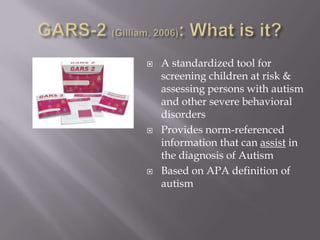
GARS-2 (Gilliam, 2006): What is it?A standardized tool for screening children at risk & assessing persons with autism and other severe behavioral disordersProvides norm-referenced information that can assist in the diagnosis of AutismBased on APA definition of autism
GARS (Gilliam, 1995) vs. GARS-2 (Gilliam, 2006)Changes made to the GARS to improve reliability & reflect changes in understanding Autism:Structured parent interview form replaces the Early Development subscaleSome items rewritten for clarityDemographic characteristics of the normative sample were keyed to 2000 U.S. Census data.New norms createdGuidelines provided for interpreting subscale scores Autism Index replaced the Autism QuotientInstructional Objectives for Children Who Have Autism included to assist in the formulation of instructional goals and objectives based on the GARS-2 results
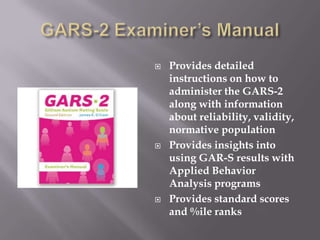
GARS-2 Examiner’s ManualProvides detailed instructions on how to administer the GARS-2 along with information about reliability, validity, normative populationProvides insights into using GAR-S results with Applied Behavior Analysis programsProvides standard scores and %ile ranks
GARS-2 SubscalesThree subscales:Stereotyped BehaviorsCommunicationSocial Interaction
Stereotyped BehaviorsItems 1-14 describe stereotyped behaviors, motility disorders, and other unique and atypical behaviorsExamples:Stares at hands, objects, or items in the environment for at least 5 seconds.Spins objects not designed for spinning (e.g. cups, saucers, glasses…)Flaps hands or fingers in front of face or at sides.
CommunicationItems 15-28 describe verbal and non-verbal behaviors displayed by children with Autism and Autism Spectrum Disorders.Examples:Repeats words or phrases over and over.Looks away or avoids looking at speaker when name is calledRepeats unintelligible sounds (babbles) over and over.
Social InteractionItems 29-42 evaluate a child’s ability to relate appropriately to people, events, and objects.Examples:Does not imitate other people when imitation is required or desirable, such as in games or learning activities.Withdraws, remains aloof, or acts standoffish in group situations.Becomes upset when routines are changed.
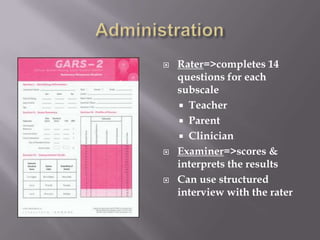
AdministrationRater=>completes 14 questions for each subscaleTeacherParentClinicianExaminer=>scores & interprets the resultsCan use structured interview with the rater
Guidelines for RatingMay be necessary for more than one person to complete the rating based on relationship with the childEXAMPLE: Classroom teacher rates the Stereotyped Behaviors &  Social Interactions while SLP rates Communication.Raters should read the questions carefully & ask questions for clarificationRaters should not take into account a child’s age when rating
Rating FrequencyFour different measures of frequency0 – Never observed – You have never seen the individual behave in this manner.1 – Seldom observed – Individual behaves in this manner 1-2 times per 6-hour period.2 – Sometimes observed – Individual behaves in this manner 3-4 times per 6-hour period.3 – Frequently observed – Individual behaves in this manner at least 5-6 times per 6-hour period.
Parent InterviewParents are a good source of information about their children’s behaviors.Parents/caregivers describe child’s behavior before age 3First 10 questions deal with delays15 questions deal with abnormal functioningQuestions are scored ‘yes’ or ‘no’Examiner can give examples to explain the behaviors‘No’ responses indicate abnormality or developmental delayNecessary to have evidence that an individual demonstrated delays before age 3 to diagnose Autism.
Scoring GARS-2: Subscale Standard Scores and the Autism IndexMake sure all items in each subscale have been ratedAdd raw scores for each item & total theseFind %ile rank and standard score for each subscale Standard score (SS) of 7 or higher on a subscale indicates a very likely possibility of Autism (based on a mean of 10; standard deviation (SD) of 3)SS of 4-6 on a subscale indicates a possibility of AutismSS of 0-3 on a subscale indicates Autism is unlikelyAdd up subscales to determine the Autism Index (based on a mean of 100 & SD of 15It is possible to use 2 subscales instead of 3 to determine the Autism Index
Research behind GARS-2Normative scores come from a sample of 1,107 children & young adults between the ages of 3 & 22 diagnosed with AutismInternal consistency & test-retest coefficients are large to very largeValidity was demonstrated by confirming that: Items on the subscales are representative of the characteristics of autismSubscales are strongly correlated to each other and to the performance of other tests that screen for autismScores discriminate persons with autism from persons with other severe behavioral disorders as well as persons without disabilities
Case Examples
Case Study: Beatrice5-year old, verbal femaleBackground: Kindergarten teacher noticed that she was not socializing with other children & exhibited repetitive motions; school psychologist was asked to complete the GARS-2.  Beatrice was receiving speech-language services and her SLP completed the Communication subscale of the GARS-2 while the kindergarten teachers filled out the Stereotyped Behaviors and Social Interaction subscales.Subscale 1 - Stereotyped Behaviors:Teacher reported  frequently observing the following behaviors:•	2.  Stares at hand objects, or items in the environment for at least 5 seconds.•	8. Spins objects not designed for spinning (e.g., saucers, cups, glasses)•	9. Rocks back and forth while seated or standing.•	12. Flaps hands or fingers in front of face or at sides.Other behaviors were not observed.
Case Study: BeatriceQUESTIONS:	1.	How often is ‘frequently observed’?	2.	What is the subscale SS for Beatrice?  	3.	Does this mean Beatrice has Autism?ANSWER: 	1.	Frequently observed means the individual behaves in this manner at least 5-6 times per 6-hour period.	2.	The subscale score is ___:	3.	No, but her score indicates a high risk for Autism as it is falls in the range of 7 or higher.
Case Study: Beatrice Subscale 2 - Communication: The SLP completed the subscale & found that Beatrice sometimes exhibited the following:17. Repeats words or phrases over and over.18. Speaks or signs with flat tone, affect, or dysrhythmic patters28. Inappropriately answers questions about a statement or brief story.The SLP did not observe any other behaviors listed on the subscale.
Case Study: BeatriceQUESTIONS:1.	Does this subscale indicate a risk of Autism?ANSWER: Yes, Beatrice scored a __ on this subscale and as such there is some indication of a possibility of Autism.  Combined with the Stereotyped Interactions data, there is an indication of a high risk of Autism.2.	Was it appropriate for more than one adult to complete the GARS-2?ANSWER:  Yes, each professional has a different perspective & multiple raters who have the best view into a particular domain can complete the subscales of the GARS-2.
Case Study: BeatriceSubscale 3 - Social Interaction: The kindergarten teacher completed this subscale and found that Beatrice sometimes:40. Becomes upset when routines are changed.42. Lines up objects in precise, orderly fashion and becomes upset when the order is disturbed.The teacher seldom observed Beatrice exhibiting the following:31. Resists physical contact from others.33.  Withdraws, remains aloof, or acts standoffish in group situations.
Case Study: BeatriceQUESTION:Does this subscale indicate a risk of Autism?ANSWER: Yes, Beatrice scored a ___ on this subscale and as such there is some indication of a possibility of Autism.  Combined with the Stereotyped Interactions data, and the Communications subscale there is an indication of a high risk of Autism.
Case Study:BeatriceBeatrice was referred to a developmental pediatrician for a developmental evaluation.She was eventually diagnosed with PDD-NOS.She was referred to an intensive after school intervention program.
ReferencesAmerican Psychiatric Association. (2000). Diagnostic and statistical manual of mental disorders (4th ed., text rev.). Washington, DC: Author.Autism Society of America (2003). What is Autism? Retrieved January 5, 2005, from http://www.autismsociety.org/site/pageserver?pagename=whatisautismGilliam, James E. (1995). Gilliam Autism Rating Scale. Austin TX: PRO-ED.Gilliam, James E. (2006). GARS-2; Gilliam Autism Rating Scale, Second Edition, Examiner’s Manual. Austin, TX: PRO-ED.

Gars2

  • 1.
    The Gilliam AutismRating Scale – Second editon (GARS-2™) A Training Module for Early InterventionistsVT-ILEHP ASD LEND Program2010
  • 2.
    GARS-2 (Gilliam, 2006):What is it?A standardized tool for screening children at risk & assessing persons with autism and other severe behavioral disordersProvides norm-referenced information that can assist in the diagnosis of AutismBased on APA definition of autism
  • 3.
    GARS (Gilliam, 1995)vs. GARS-2 (Gilliam, 2006)Changes made to the GARS to improve reliability & reflect changes in understanding Autism:Structured parent interview form replaces the Early Development subscaleSome items rewritten for clarityDemographic characteristics of the normative sample were keyed to 2000 U.S. Census data.New norms createdGuidelines provided for interpreting subscale scores Autism Index replaced the Autism QuotientInstructional Objectives for Children Who Have Autism included to assist in the formulation of instructional goals and objectives based on the GARS-2 results
  • 4.
    GARS-2 Examiner’s ManualProvidesdetailed instructions on how to administer the GARS-2 along with information about reliability, validity, normative populationProvides insights into using GAR-S results with Applied Behavior Analysis programsProvides standard scores and %ile ranks
  • 5.
    GARS-2 SubscalesThree subscales:StereotypedBehaviorsCommunicationSocial Interaction
  • 6.
    Stereotyped BehaviorsItems 1-14describe stereotyped behaviors, motility disorders, and other unique and atypical behaviorsExamples:Stares at hands, objects, or items in the environment for at least 5 seconds.Spins objects not designed for spinning (e.g. cups, saucers, glasses…)Flaps hands or fingers in front of face or at sides.
  • 7.
    CommunicationItems 15-28 describeverbal and non-verbal behaviors displayed by children with Autism and Autism Spectrum Disorders.Examples:Repeats words or phrases over and over.Looks away or avoids looking at speaker when name is calledRepeats unintelligible sounds (babbles) over and over.
  • 8.
    Social InteractionItems 29-42evaluate a child’s ability to relate appropriately to people, events, and objects.Examples:Does not imitate other people when imitation is required or desirable, such as in games or learning activities.Withdraws, remains aloof, or acts standoffish in group situations.Becomes upset when routines are changed.
  • 9.
    AdministrationRater=>completes 14 questionsfor each subscaleTeacherParentClinicianExaminer=>scores & interprets the resultsCan use structured interview with the rater
  • 10.
    Guidelines for RatingMaybe necessary for more than one person to complete the rating based on relationship with the childEXAMPLE: Classroom teacher rates the Stereotyped Behaviors & Social Interactions while SLP rates Communication.Raters should read the questions carefully & ask questions for clarificationRaters should not take into account a child’s age when rating
  • 11.
    Rating FrequencyFour differentmeasures of frequency0 – Never observed – You have never seen the individual behave in this manner.1 – Seldom observed – Individual behaves in this manner 1-2 times per 6-hour period.2 – Sometimes observed – Individual behaves in this manner 3-4 times per 6-hour period.3 – Frequently observed – Individual behaves in this manner at least 5-6 times per 6-hour period.
  • 12.
    Parent InterviewParents area good source of information about their children’s behaviors.Parents/caregivers describe child’s behavior before age 3First 10 questions deal with delays15 questions deal with abnormal functioningQuestions are scored ‘yes’ or ‘no’Examiner can give examples to explain the behaviors‘No’ responses indicate abnormality or developmental delayNecessary to have evidence that an individual demonstrated delays before age 3 to diagnose Autism.
  • 13.
    Scoring GARS-2: SubscaleStandard Scores and the Autism IndexMake sure all items in each subscale have been ratedAdd raw scores for each item & total theseFind %ile rank and standard score for each subscale Standard score (SS) of 7 or higher on a subscale indicates a very likely possibility of Autism (based on a mean of 10; standard deviation (SD) of 3)SS of 4-6 on a subscale indicates a possibility of AutismSS of 0-3 on a subscale indicates Autism is unlikelyAdd up subscales to determine the Autism Index (based on a mean of 100 & SD of 15It is possible to use 2 subscales instead of 3 to determine the Autism Index
  • 14.
    Research behind GARS-2Normativescores come from a sample of 1,107 children & young adults between the ages of 3 & 22 diagnosed with AutismInternal consistency & test-retest coefficients are large to very largeValidity was demonstrated by confirming that: Items on the subscales are representative of the characteristics of autismSubscales are strongly correlated to each other and to the performance of other tests that screen for autismScores discriminate persons with autism from persons with other severe behavioral disorders as well as persons without disabilities
  • 15.
  • 16.
    Case Study: Beatrice5-yearold, verbal femaleBackground: Kindergarten teacher noticed that she was not socializing with other children & exhibited repetitive motions; school psychologist was asked to complete the GARS-2. Beatrice was receiving speech-language services and her SLP completed the Communication subscale of the GARS-2 while the kindergarten teachers filled out the Stereotyped Behaviors and Social Interaction subscales.Subscale 1 - Stereotyped Behaviors:Teacher reported frequently observing the following behaviors:• 2. Stares at hand objects, or items in the environment for at least 5 seconds.• 8. Spins objects not designed for spinning (e.g., saucers, cups, glasses)• 9. Rocks back and forth while seated or standing.• 12. Flaps hands or fingers in front of face or at sides.Other behaviors were not observed.
  • 17.
    Case Study: BeatriceQUESTIONS: 1. Howoften is ‘frequently observed’? 2. What is the subscale SS for Beatrice? 3. Does this mean Beatrice has Autism?ANSWER: 1. Frequently observed means the individual behaves in this manner at least 5-6 times per 6-hour period. 2. The subscale score is ___: 3. No, but her score indicates a high risk for Autism as it is falls in the range of 7 or higher.
  • 18.
    Case Study: BeatriceSubscale 2 - Communication: The SLP completed the subscale & found that Beatrice sometimes exhibited the following:17. Repeats words or phrases over and over.18. Speaks or signs with flat tone, affect, or dysrhythmic patters28. Inappropriately answers questions about a statement or brief story.The SLP did not observe any other behaviors listed on the subscale.
  • 19.
    Case Study: BeatriceQUESTIONS:1. Doesthis subscale indicate a risk of Autism?ANSWER: Yes, Beatrice scored a __ on this subscale and as such there is some indication of a possibility of Autism. Combined with the Stereotyped Interactions data, there is an indication of a high risk of Autism.2. Was it appropriate for more than one adult to complete the GARS-2?ANSWER: Yes, each professional has a different perspective & multiple raters who have the best view into a particular domain can complete the subscales of the GARS-2.
  • 20.
    Case Study: BeatriceSubscale3 - Social Interaction: The kindergarten teacher completed this subscale and found that Beatrice sometimes:40. Becomes upset when routines are changed.42. Lines up objects in precise, orderly fashion and becomes upset when the order is disturbed.The teacher seldom observed Beatrice exhibiting the following:31. Resists physical contact from others.33. Withdraws, remains aloof, or acts standoffish in group situations.
  • 21.
    Case Study: BeatriceQUESTION:Doesthis subscale indicate a risk of Autism?ANSWER: Yes, Beatrice scored a ___ on this subscale and as such there is some indication of a possibility of Autism. Combined with the Stereotyped Interactions data, and the Communications subscale there is an indication of a high risk of Autism.
  • 22.
    Case Study:BeatriceBeatrice wasreferred to a developmental pediatrician for a developmental evaluation.She was eventually diagnosed with PDD-NOS.She was referred to an intensive after school intervention program.
  • 23.
    ReferencesAmerican Psychiatric Association.(2000). Diagnostic and statistical manual of mental disorders (4th ed., text rev.). Washington, DC: Author.Autism Society of America (2003). What is Autism? Retrieved January 5, 2005, from http://www.autismsociety.org/site/pageserver?pagename=whatisautismGilliam, James E. (1995). Gilliam Autism Rating Scale. Austin TX: PRO-ED.Gilliam, James E. (2006). GARS-2; Gilliam Autism Rating Scale, Second Edition, Examiner’s Manual. Austin, TX: PRO-ED.