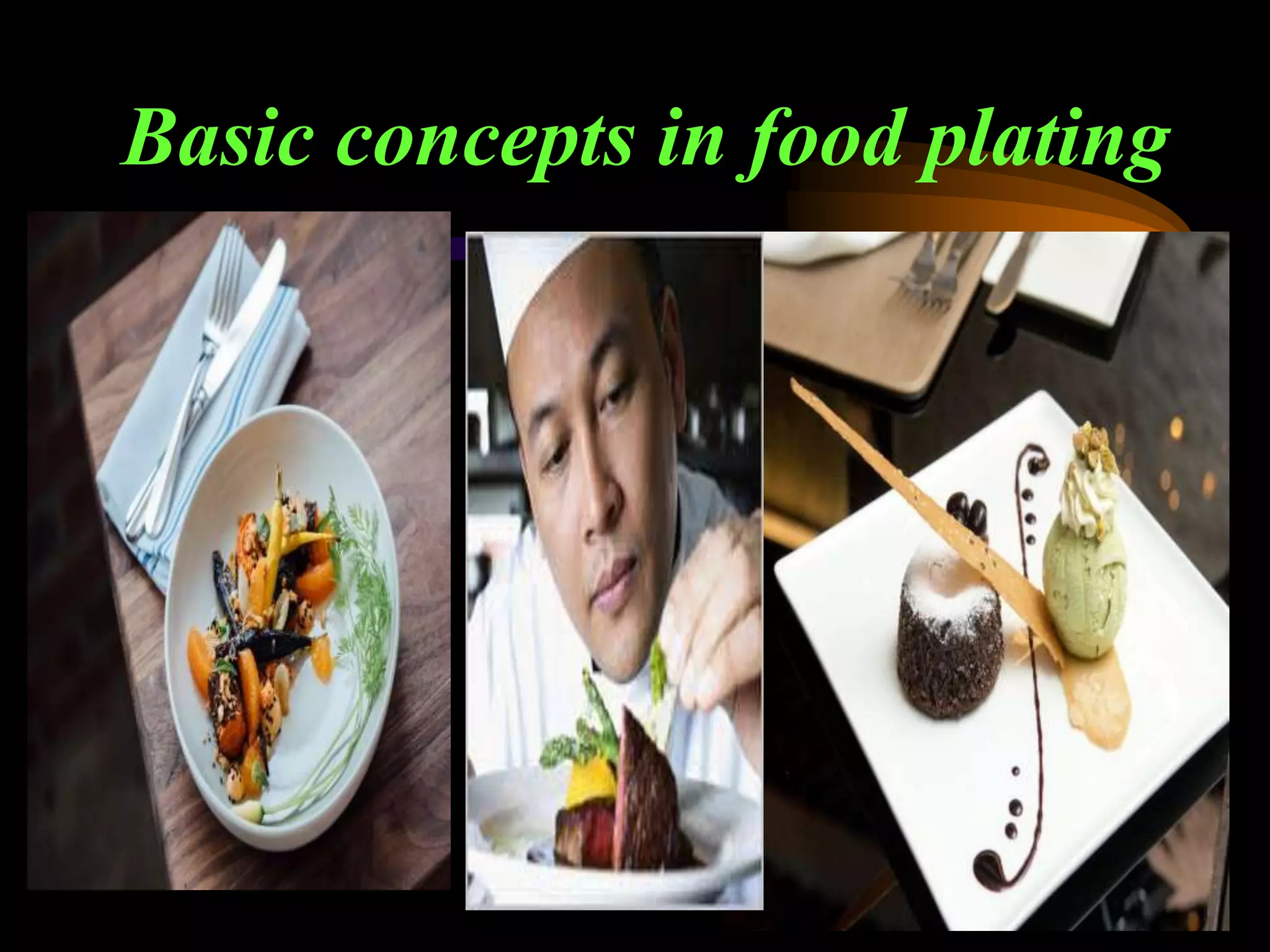
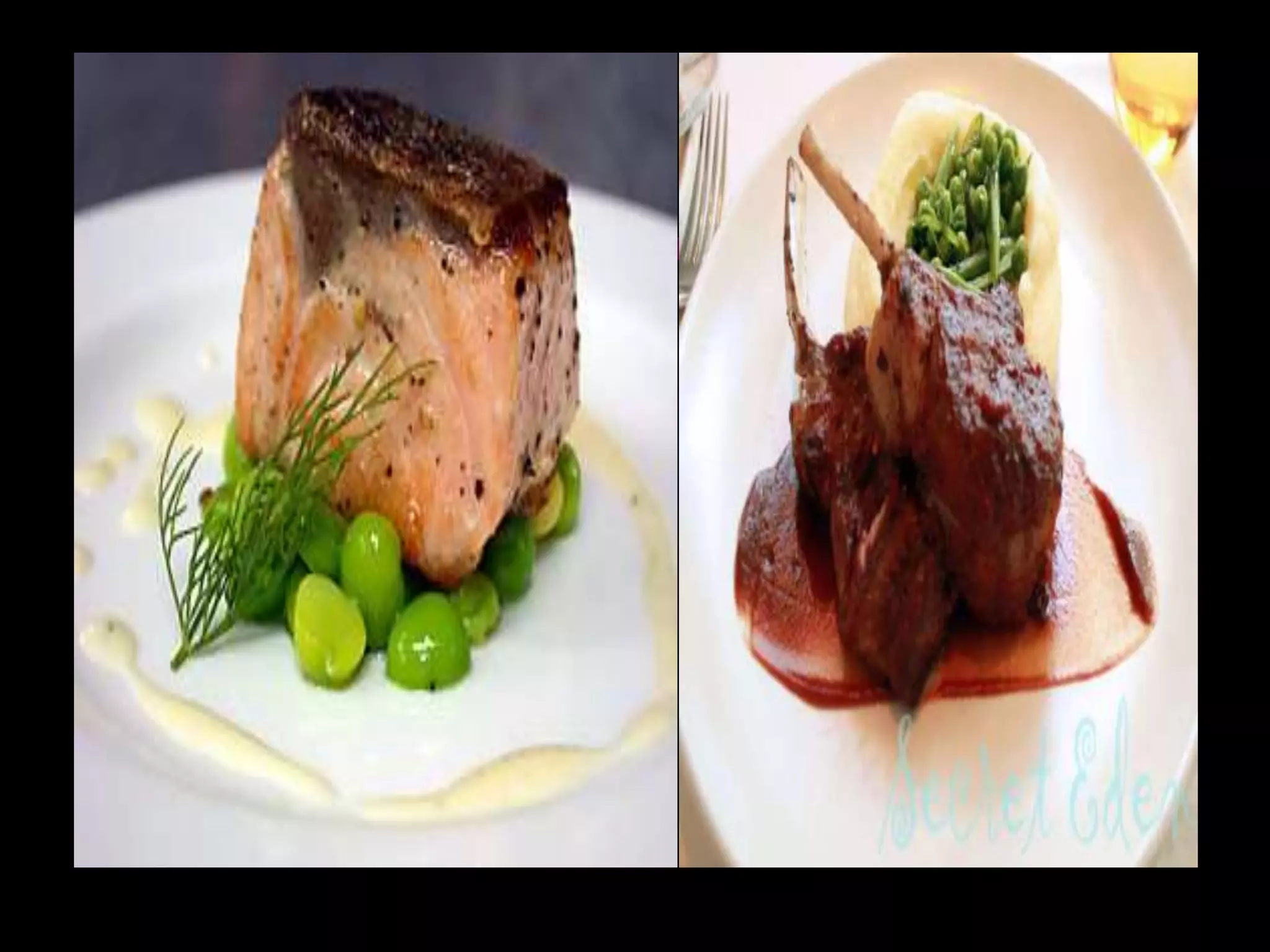
Basic concepts in food plating
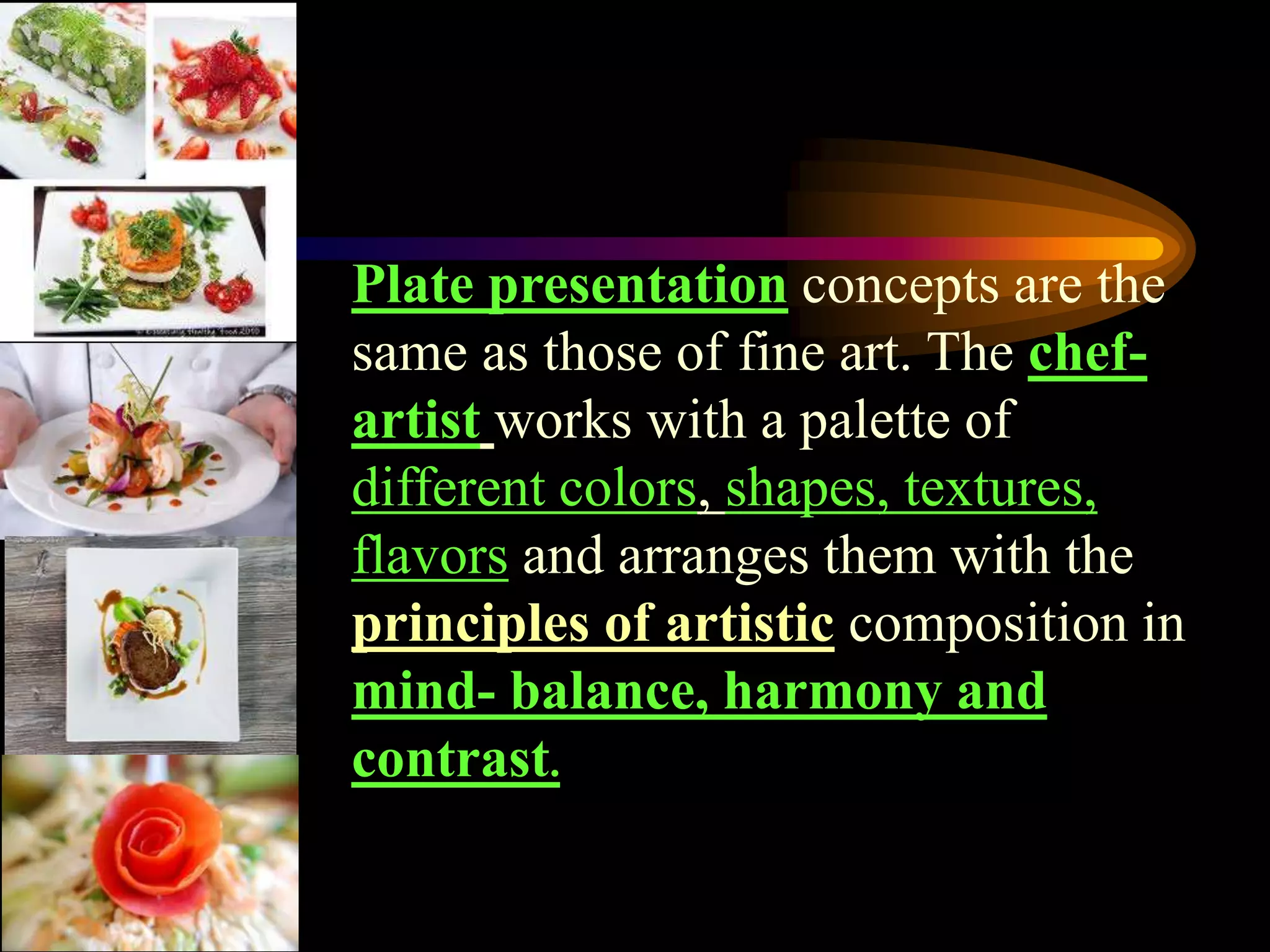
Plate presentation concepts are the
same as those of fine art. The chef-
artist works with a palette of
different colors, shapes, textures,
flavors and arranges them with the
principles of artistic composition in
mind- balance, harmony and
contrast.
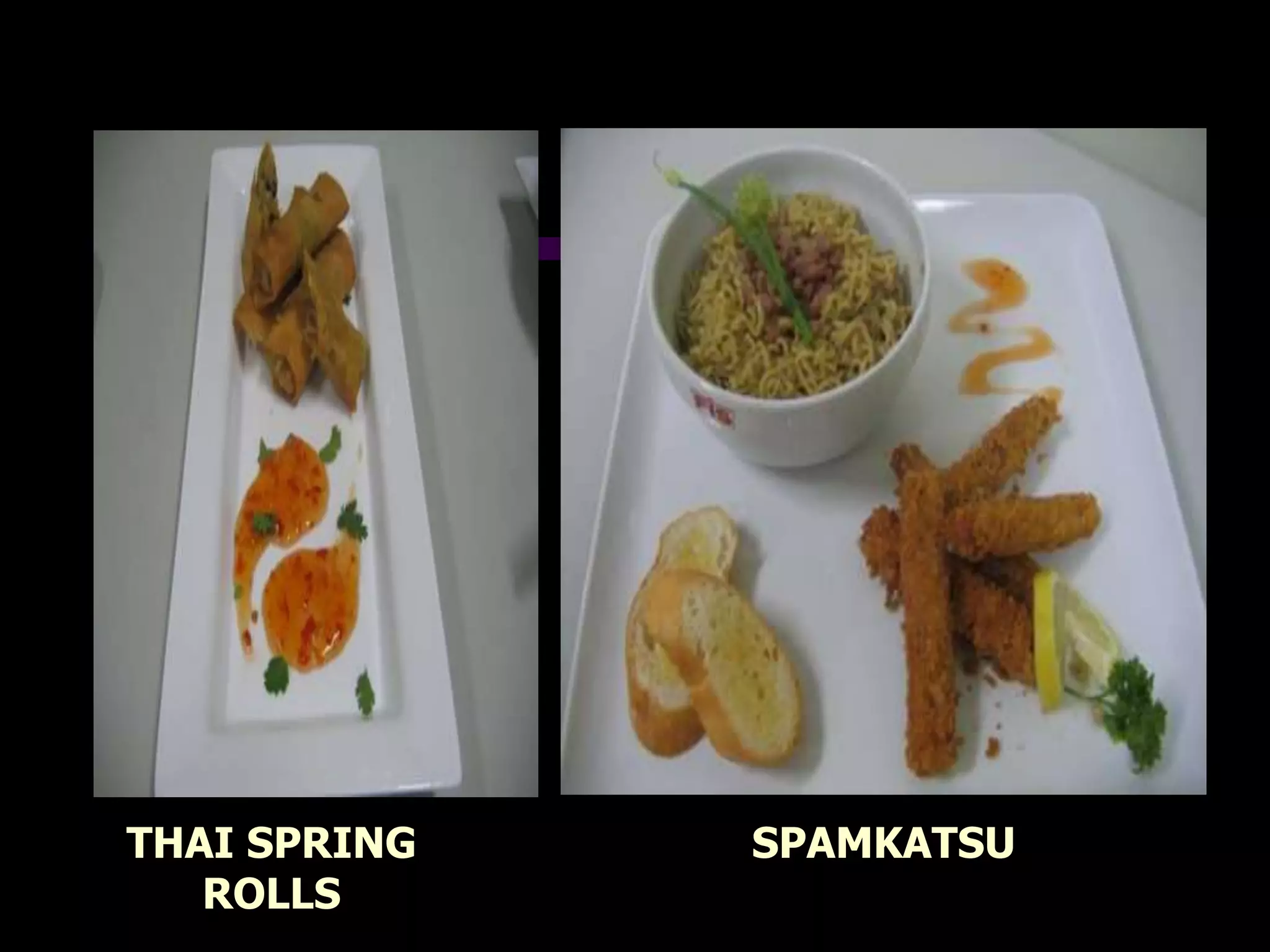
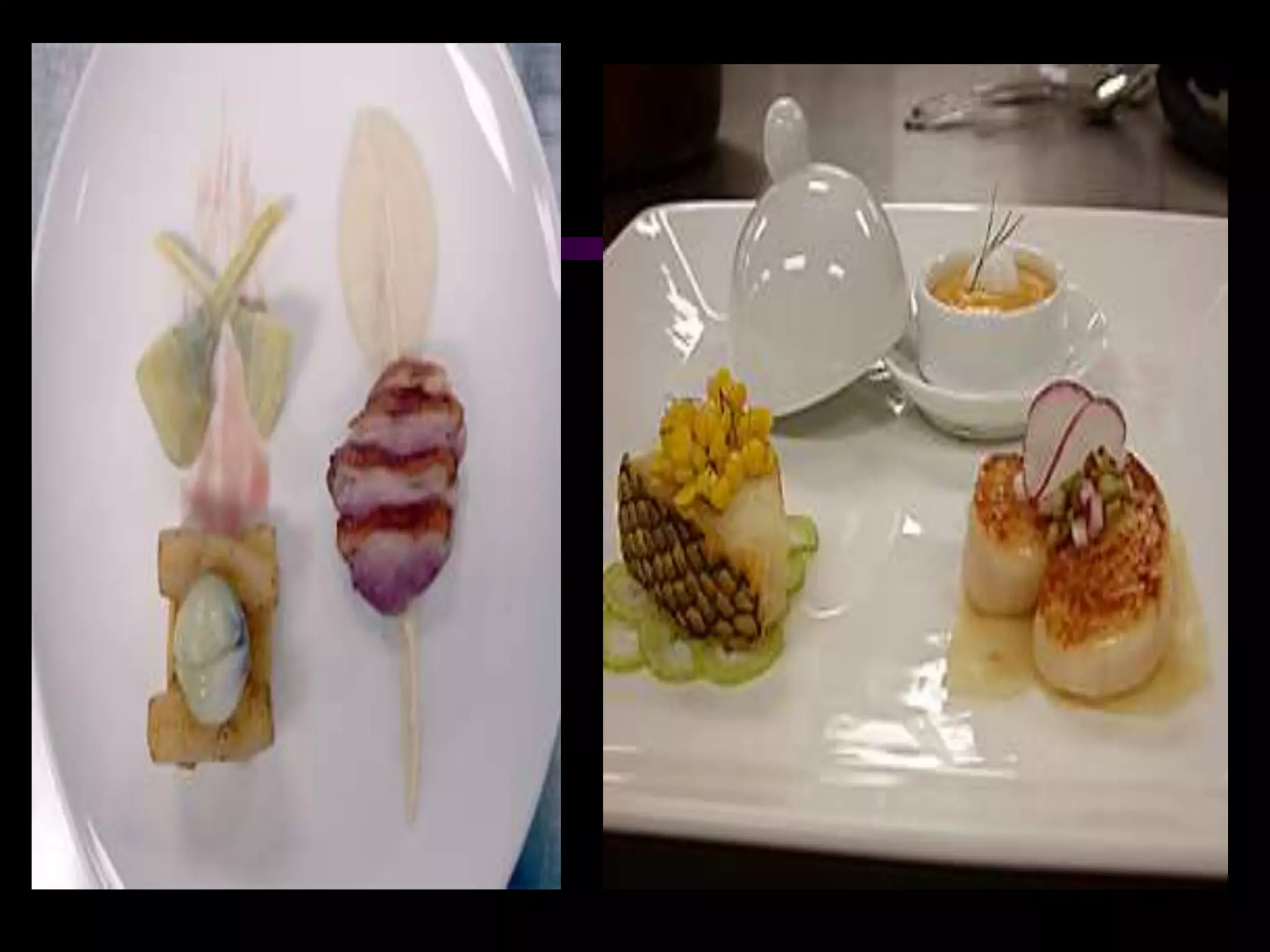
THAI SPRING
ROLLS
SPAMKATSU
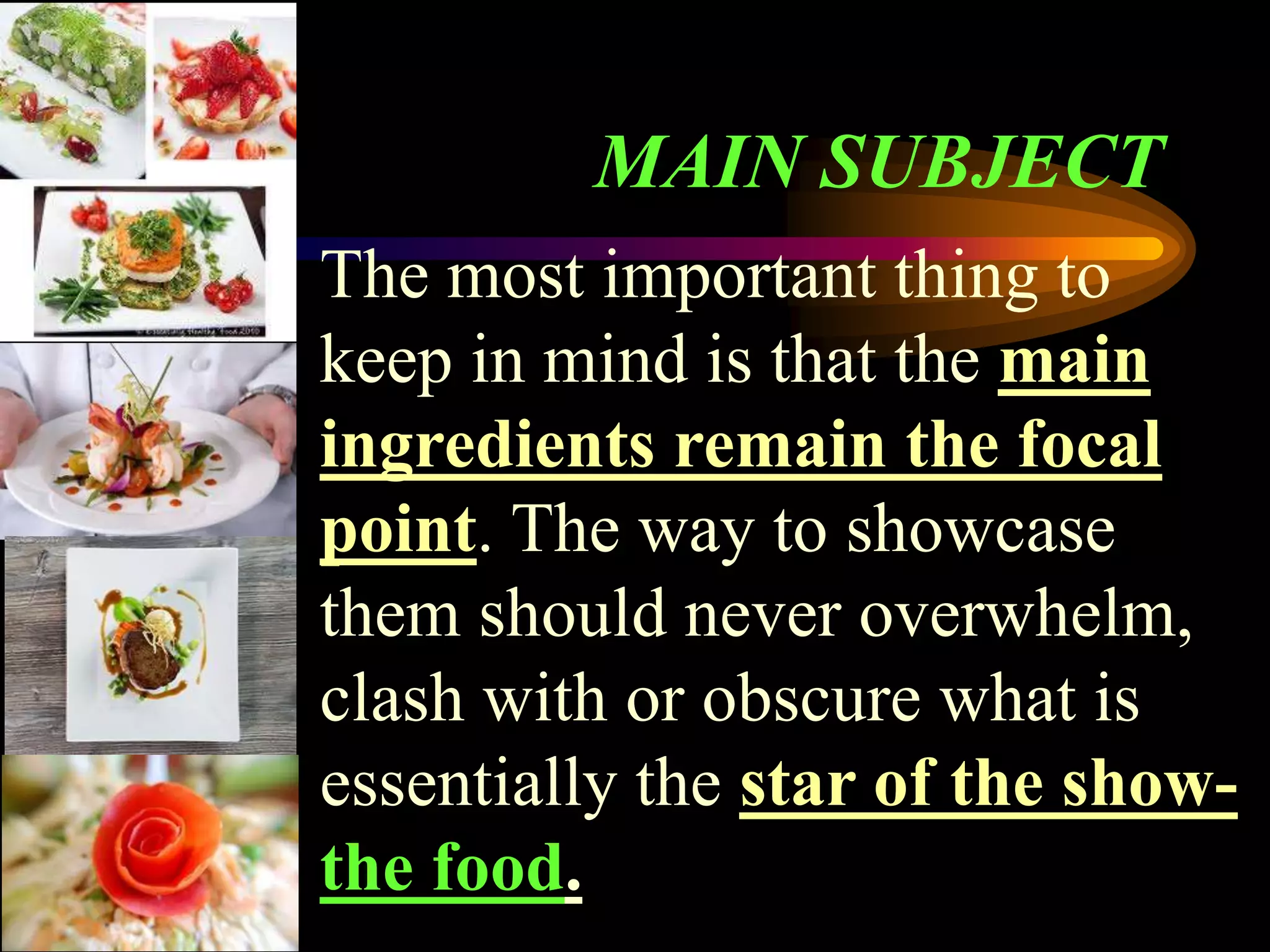
MAIN SUBJECT
The most important thing to
keep in mind is that the main
ingredients remain the focal
point. The way to showcase
them should never overwhelm,
clash with or obscure what is
essentially the star of the show-
the food.
PORTIONS
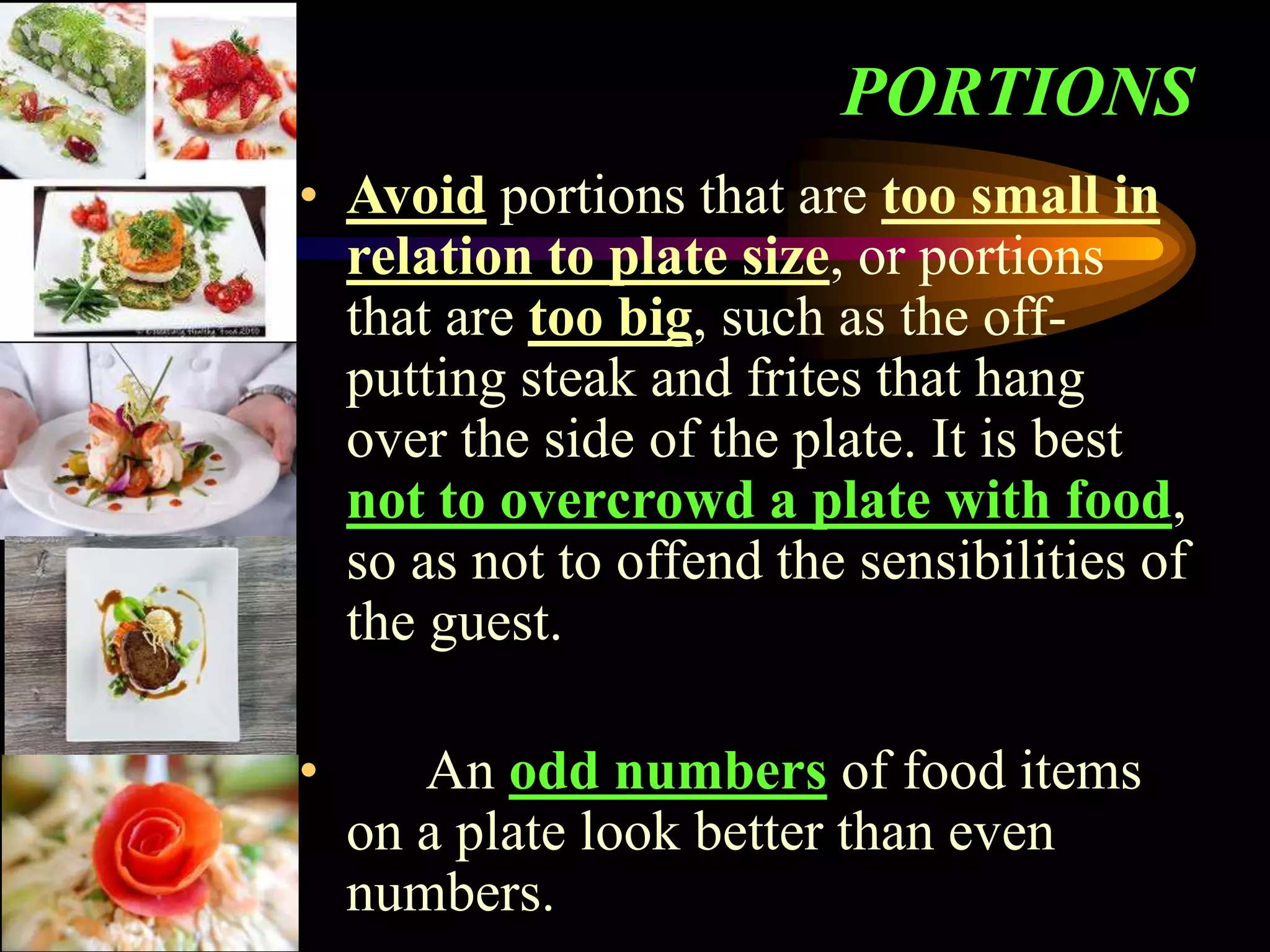
• Avoid portions that are too small in
relation to plate size, or portions
that are too big, such as the off-
putting steak and frites that hang
over the side of the plate. It is best
not to overcrowd a plate with food,
so as not to offend the sensibilities of
the guest.
• An odd numbers of food items
on a plate look better than even
numbers.
PLATES
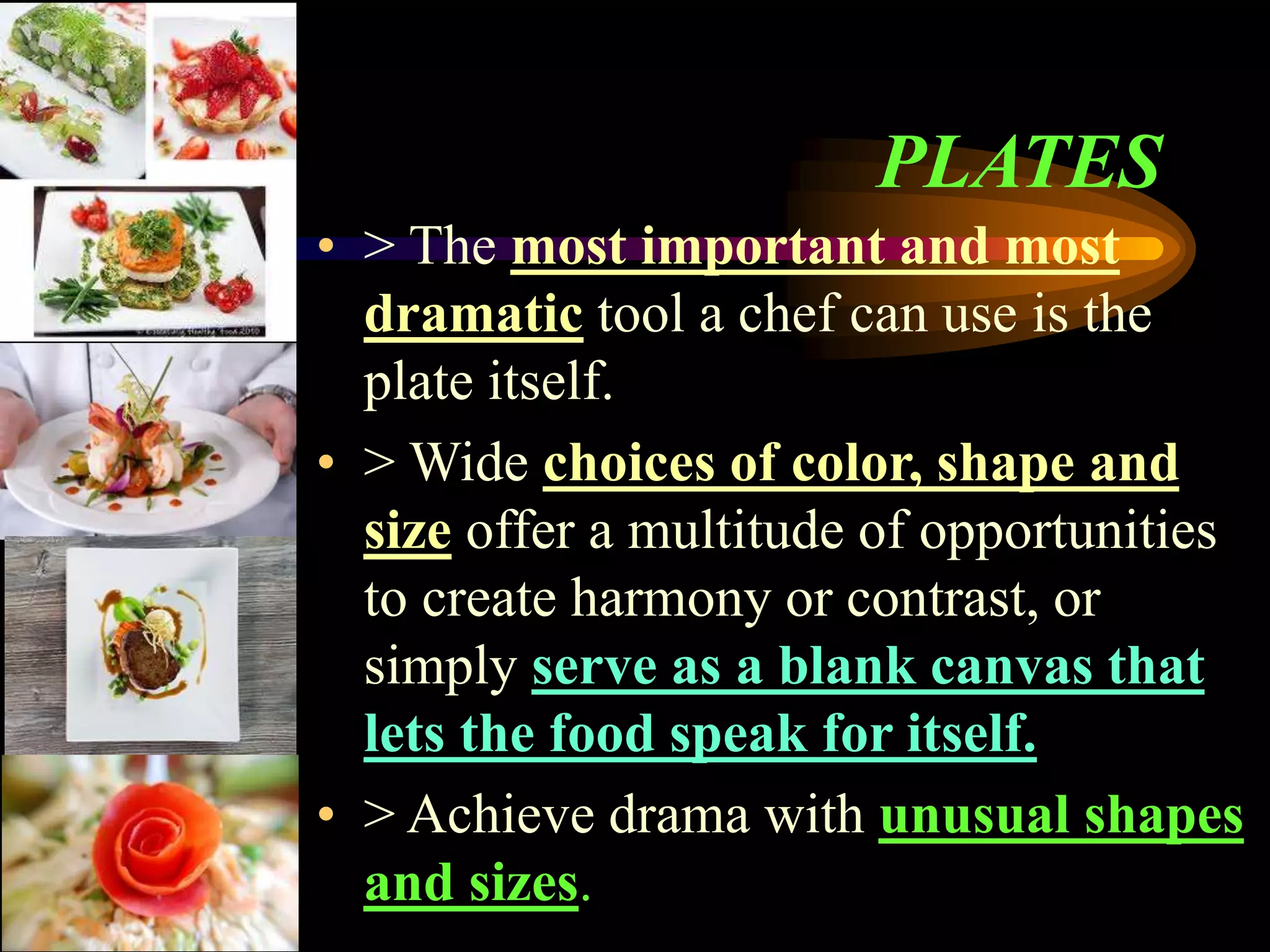
• > The most important and most
dramatic tool a chef can use is the
plate itself.
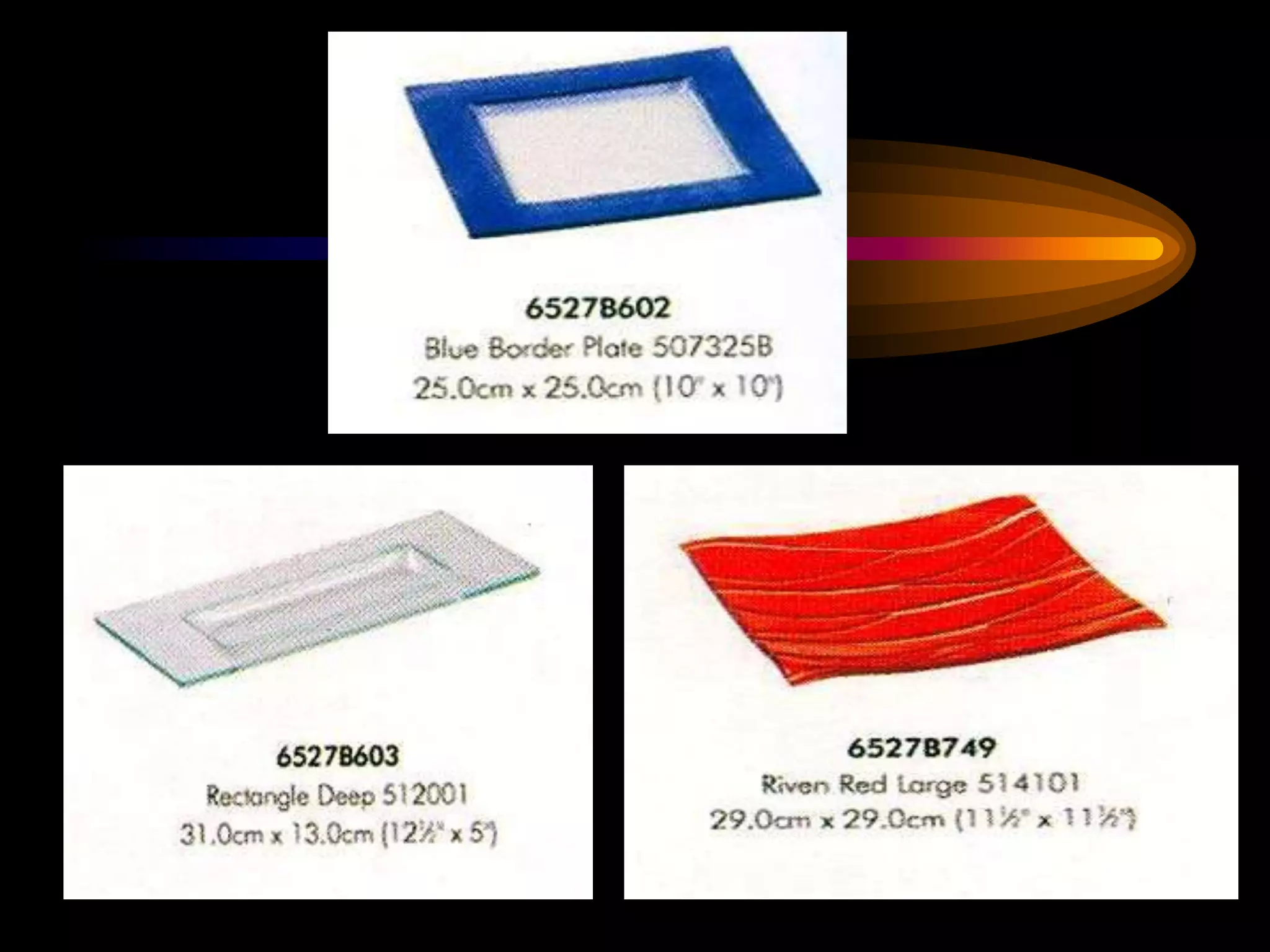
• > Wide choices of color, shape and
size offer a multitude of opportunities
to create harmony or contrast, or
simply serve as a blank canvas that
lets the food speak for itself.
• > Achieve drama with unusual shapes
and sizes.
PLATES
• Choose the Perfect Plate
-Selecting the right plate for your
meal is key to attractive food
presentation.
One way to conceptualize plating is to
think of yourself as an artist, the plate
as your canvas, and the food as your
medium.
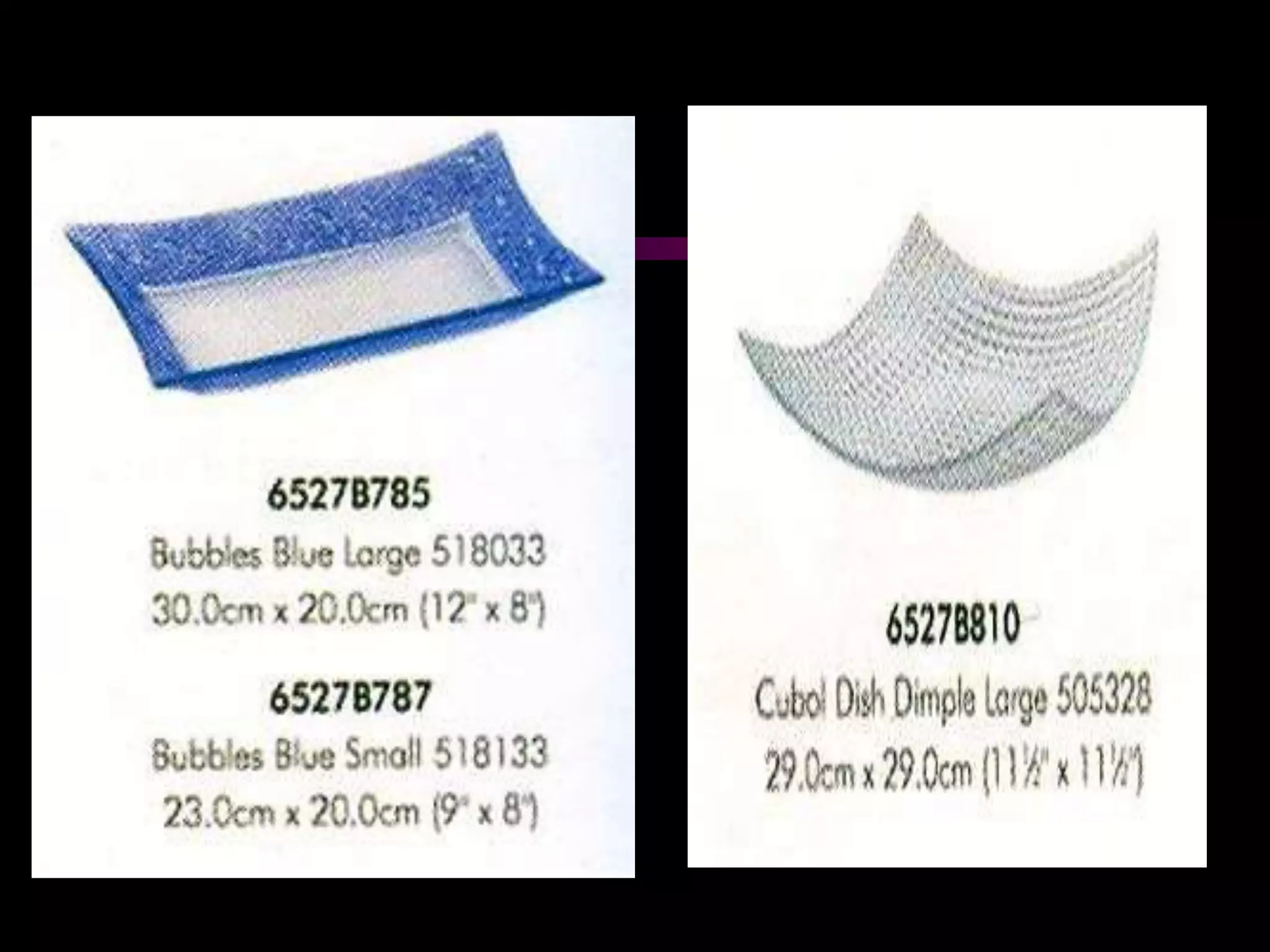
• The hot trend in food presentation is the use of
small platters in glass and porcelain for
accompaniments placed within the individual
dinner plate.
Plating
Finally, once we have completed our
cooking methods, we are ready to start
the plating process.
The element of balance is key to any
plate, no matter what the shape or size.
The first concern is the size and
balance of the food versus the plate.
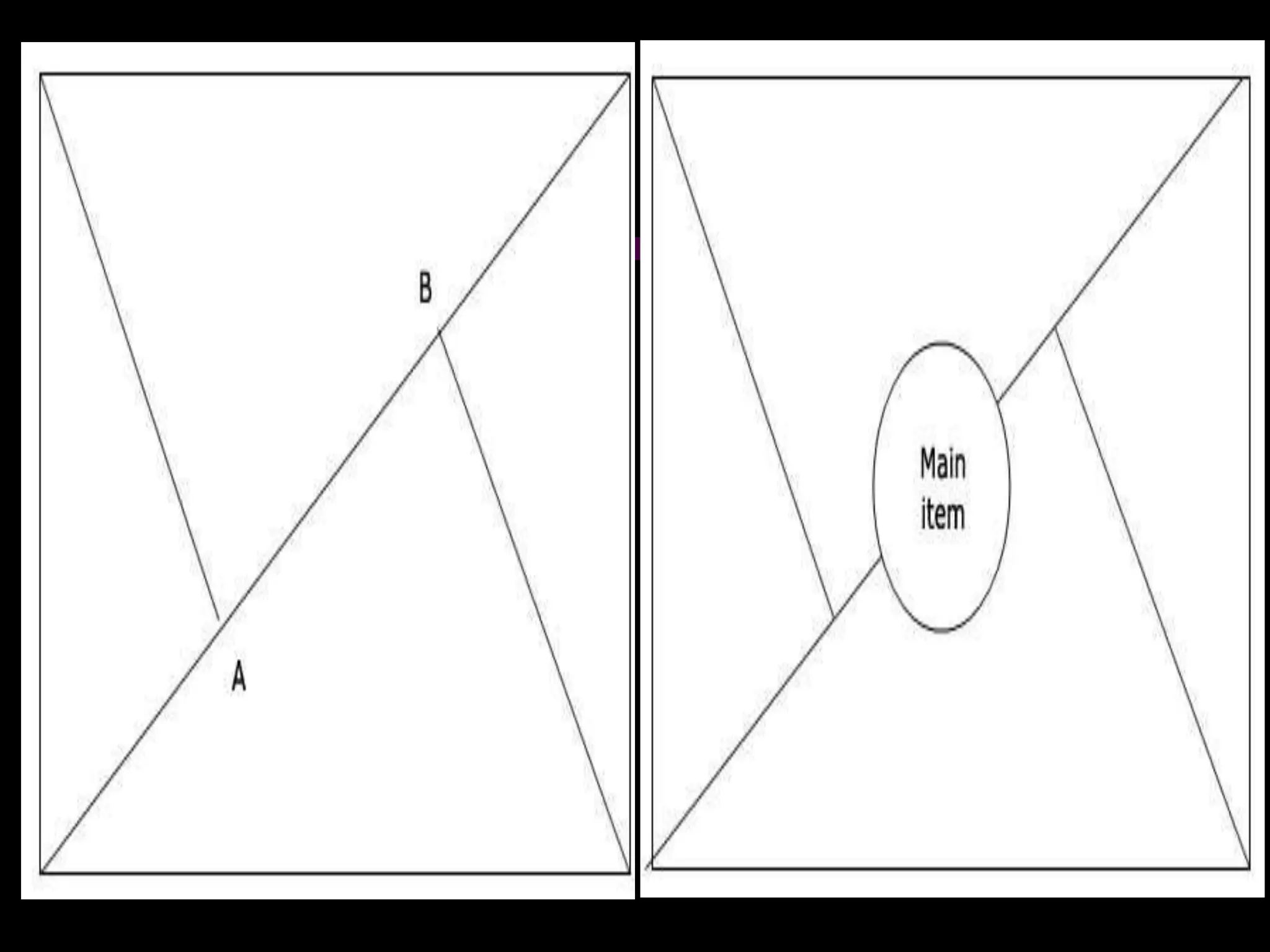
• "Emeril-itis" is everywhere, and it is a
common problem that you see in people
just starting to present food. By Emeril-
itis
• I mean that everyone wants to "bam"
spices or blends on the rims of the
plates, or they want to strip chocolate
sauce across a plate and up on the rim.
When plating, it is imperative that you
leave what is referred to as dead space.
This is the area on the rim that you
want to leave clean.
Design Elements in Food
Plating
The basic building blocks
• Line
• Shape/Form
• Texture
• Color
• Height
Lines
• A mark made by a moving point.
• Directs the eye – horizontal, vertical,
diagonal, curvy, zig-zag, etc.
• Can be actual obvious lines or the borders
or edges of shapes.
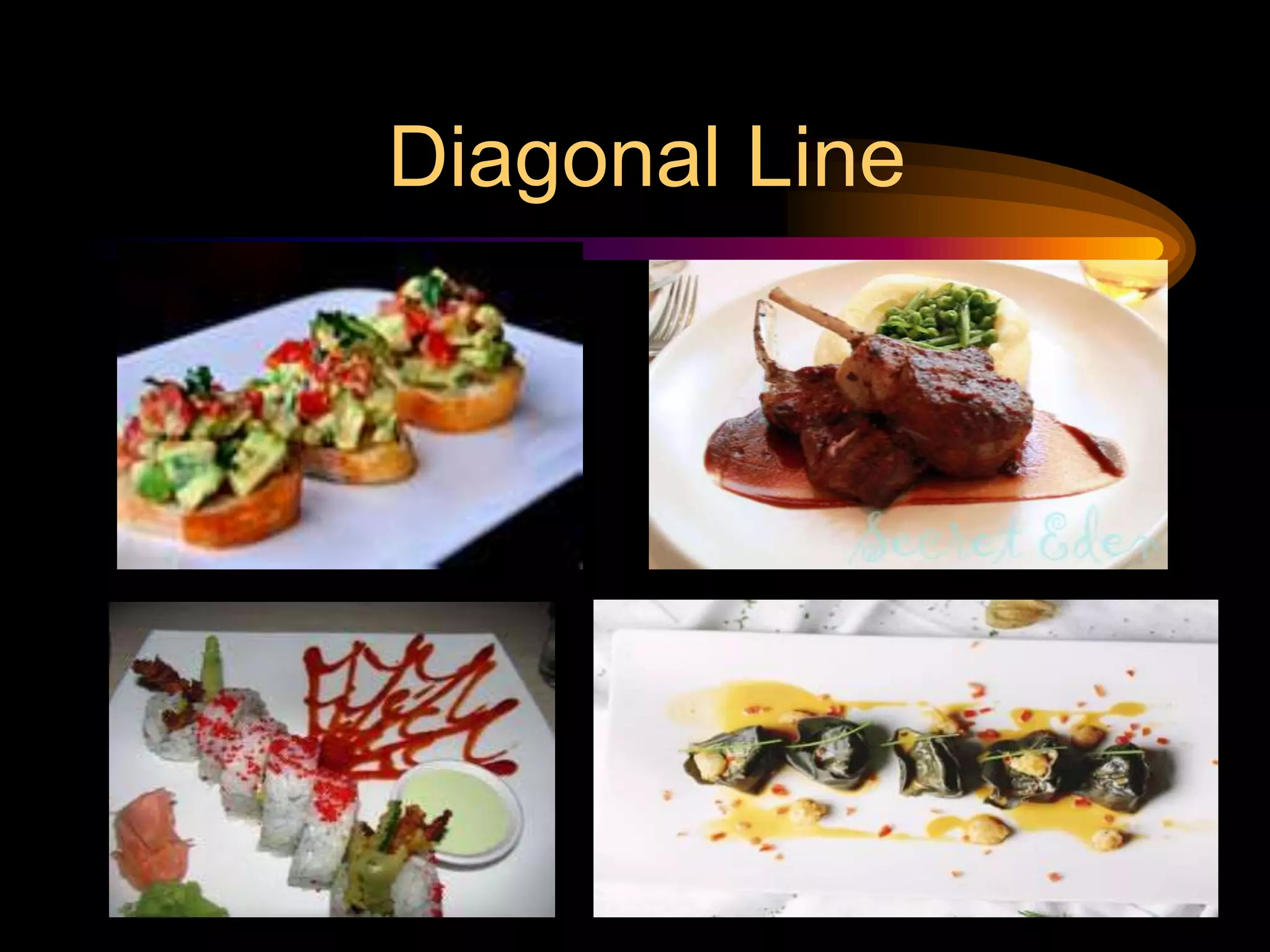
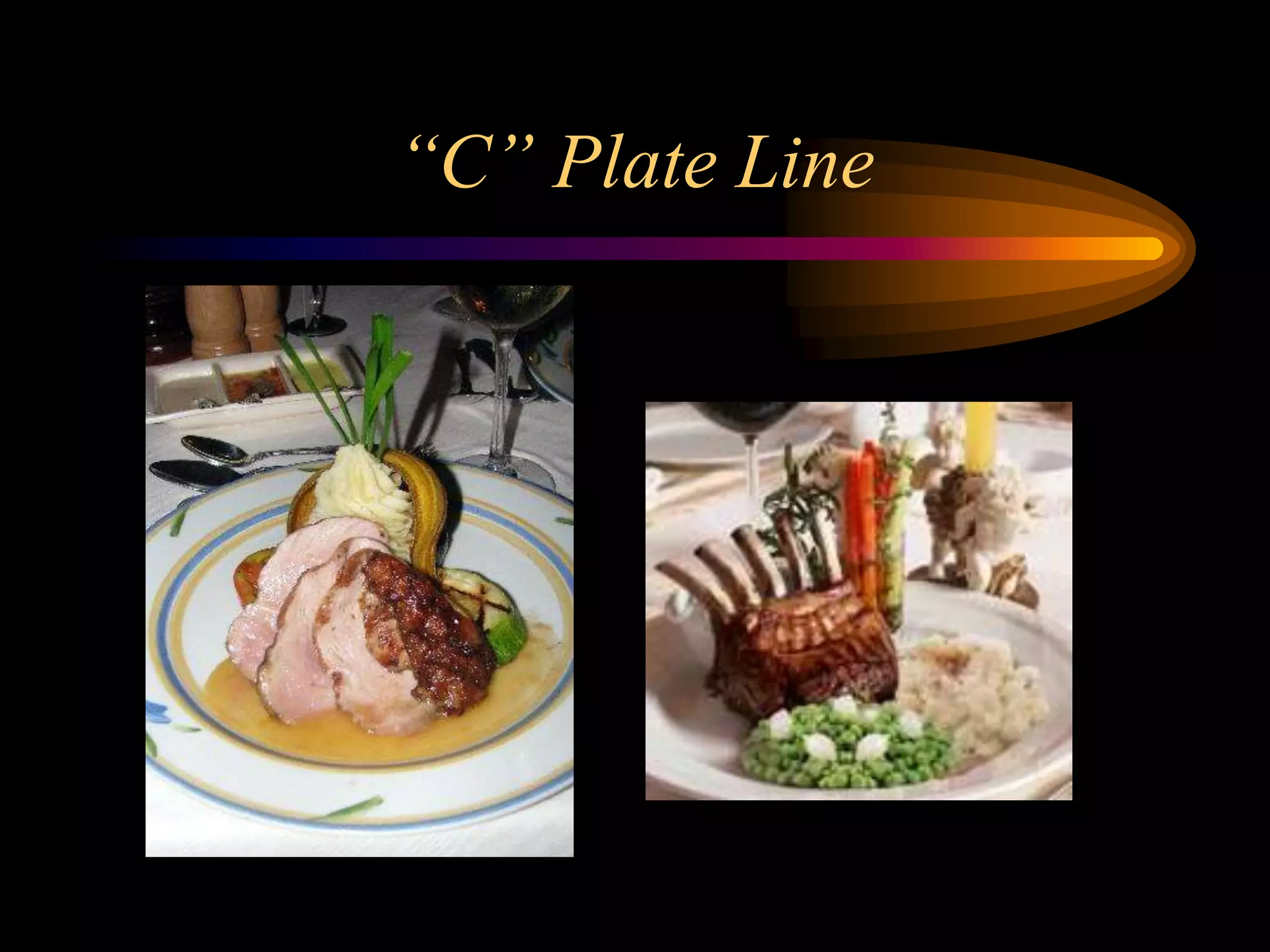
• Strongest Line in plate design is a diagonal
followed by the “C” design
Diagonal Line
“C” Plate Line
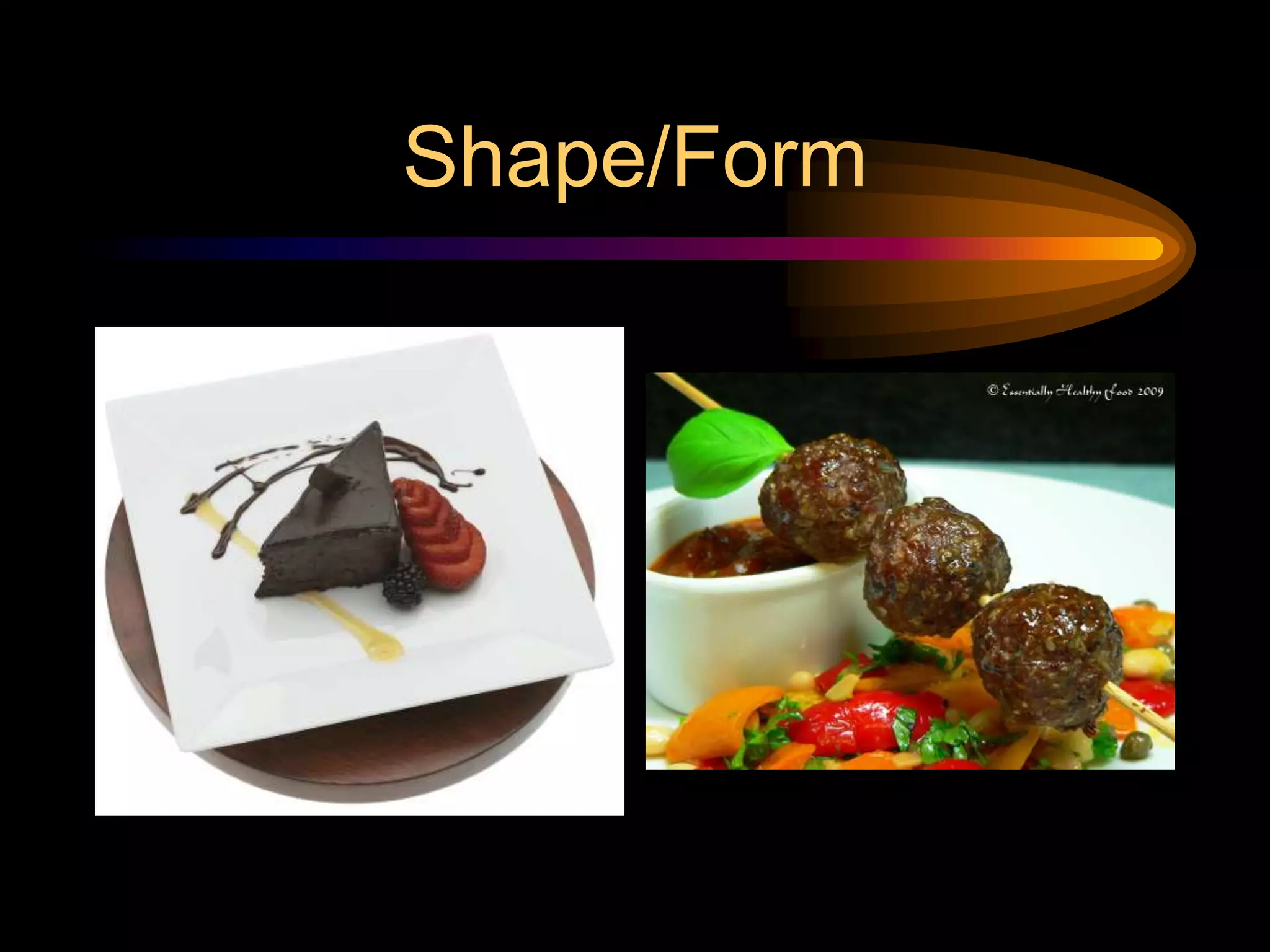
Shape/Form
• A contained area.
• Can be GEOMETRIC (man-made) ex.
Square, triangle, circle, etc.
• Can be ORGANIC (natural)
• Forms are 3-Dimensional with height, width
and depth. (sphere)
• Used to create a sense of space and
substance.
Shape/Form
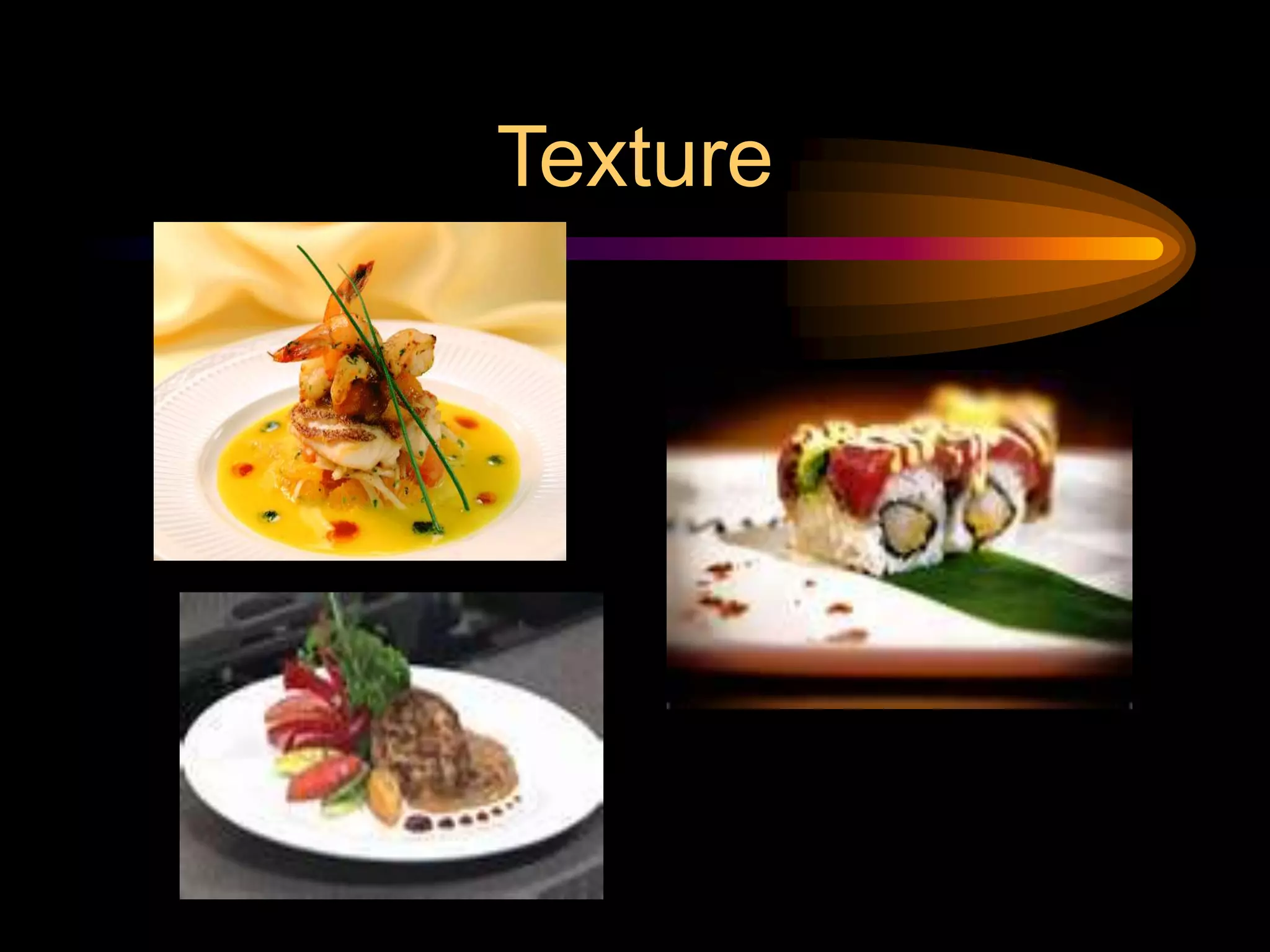
Texture
• The surface quality.
• How an object feels, or how it looks like
it feels.
• Rough, smooth, bumpy, gooey, sharp,
etc.
• Adds interest! Sense of sight and sense
of touch involved.
Texture
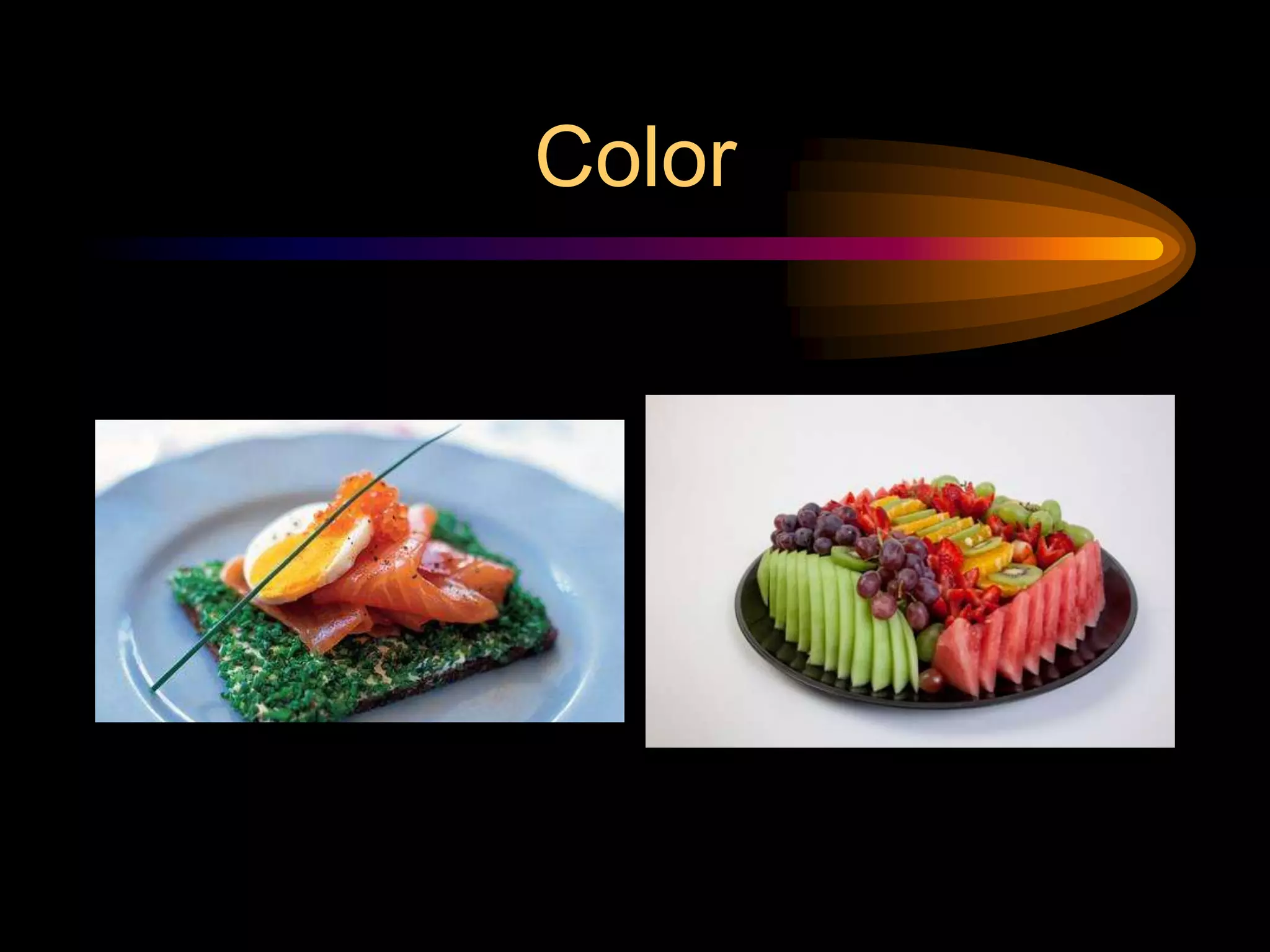
Color
• Primary, Secondary, Intermediates.
• Use color schemes to enhance appeal or
make impact.
Color
Height
• Stacking remains an effective and
dramatic technique, but simplicity can make
a design statement all by itself.
• Developing ideas
The final elements that will enhance your food
presentations are some things you might not
think of, but they are an essential part of making
food look good: your imagination and brain.
These need to be focused if you expect your food
to look focused; if they are sloppy and distracted,
your food will look sloppy and distracted.
Your imagination and brain need to be fed
new ideas as often as possible as well.
What are the Principles of Art
Utilized in Food Plating?
• Emphasis
• Balance
• Unity-Harmony
• Contrast
• Movement/ Rhythm
• Seqencing and Facing
• Pattern/Repetition
Pattern/Repetition
• An element that occurs over and over again
in a composition.
• Can repeat the element in a consistent
pattern.
• Can repeat the element in a variation of the
pattern.
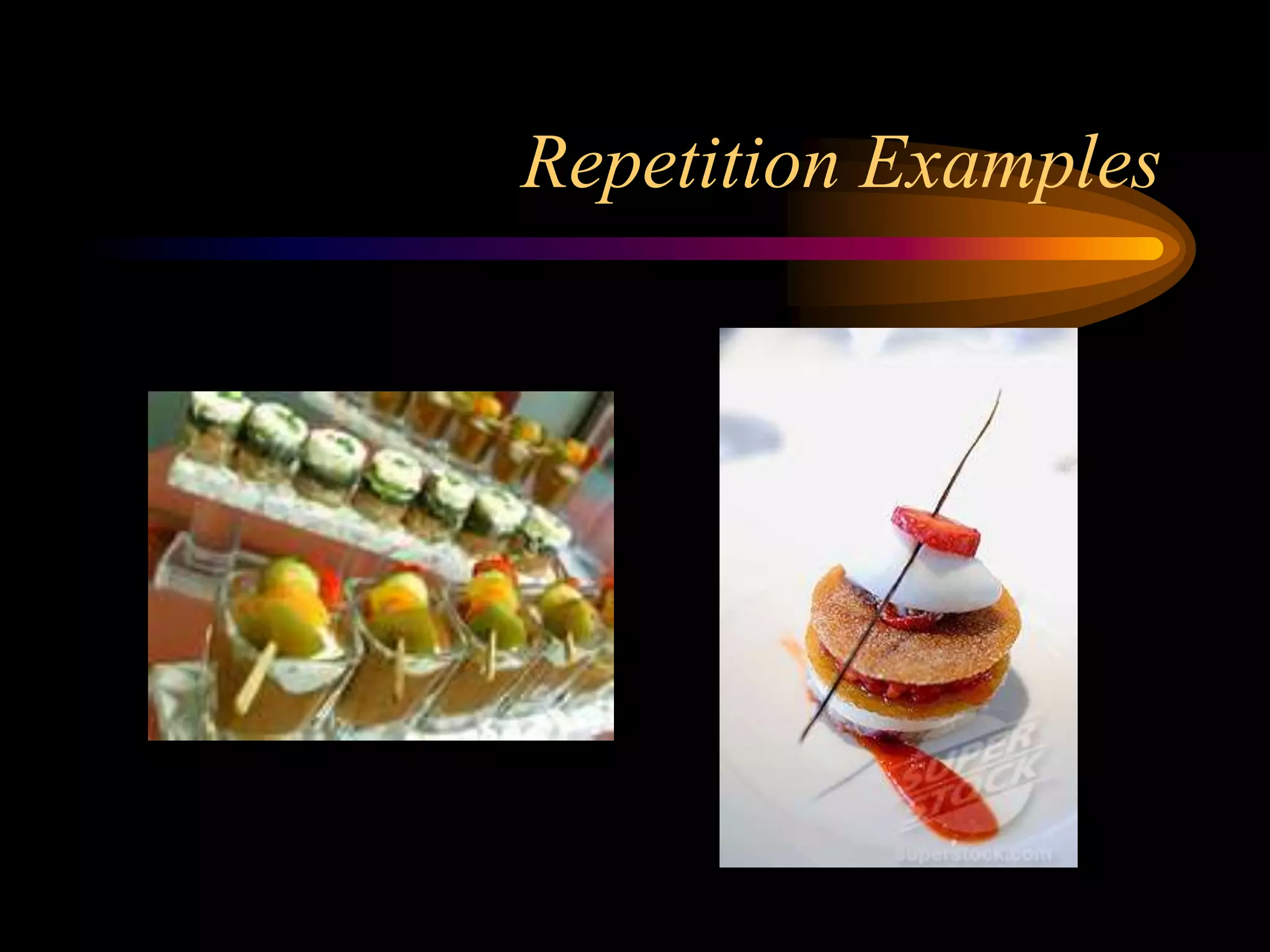
Repetition Examples
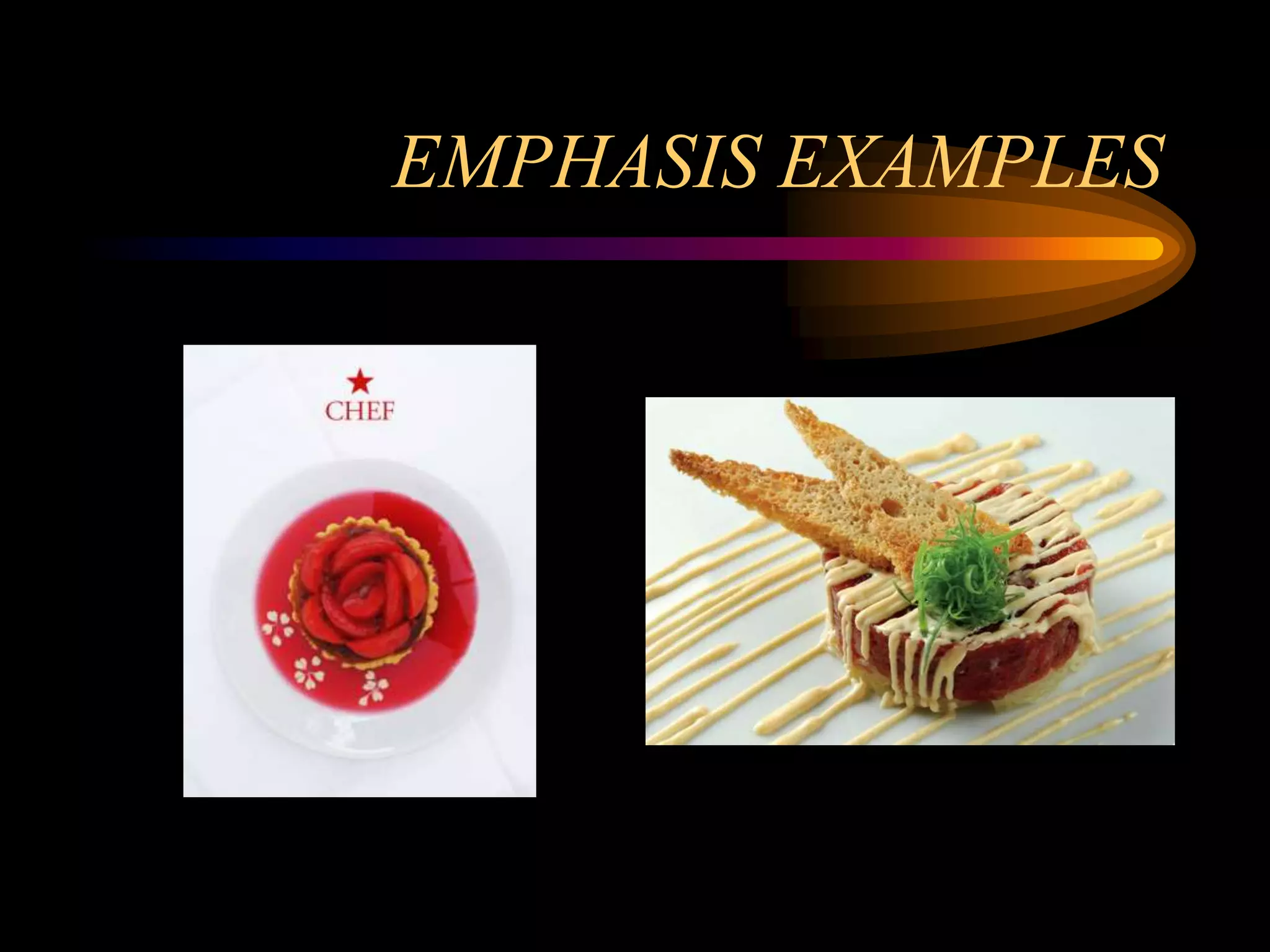
EMPHASIS or Focal Point
Emphasis in a composition refers
to developing points of interest to
pull the viewer's eye to important
parts of the plate.
EMPHASIS EXAMPLES
Balance
Balance is a sense of stability in
the body of work. Balance can be
created by repeating same
shapes and by creating a feeling
of equal weight.
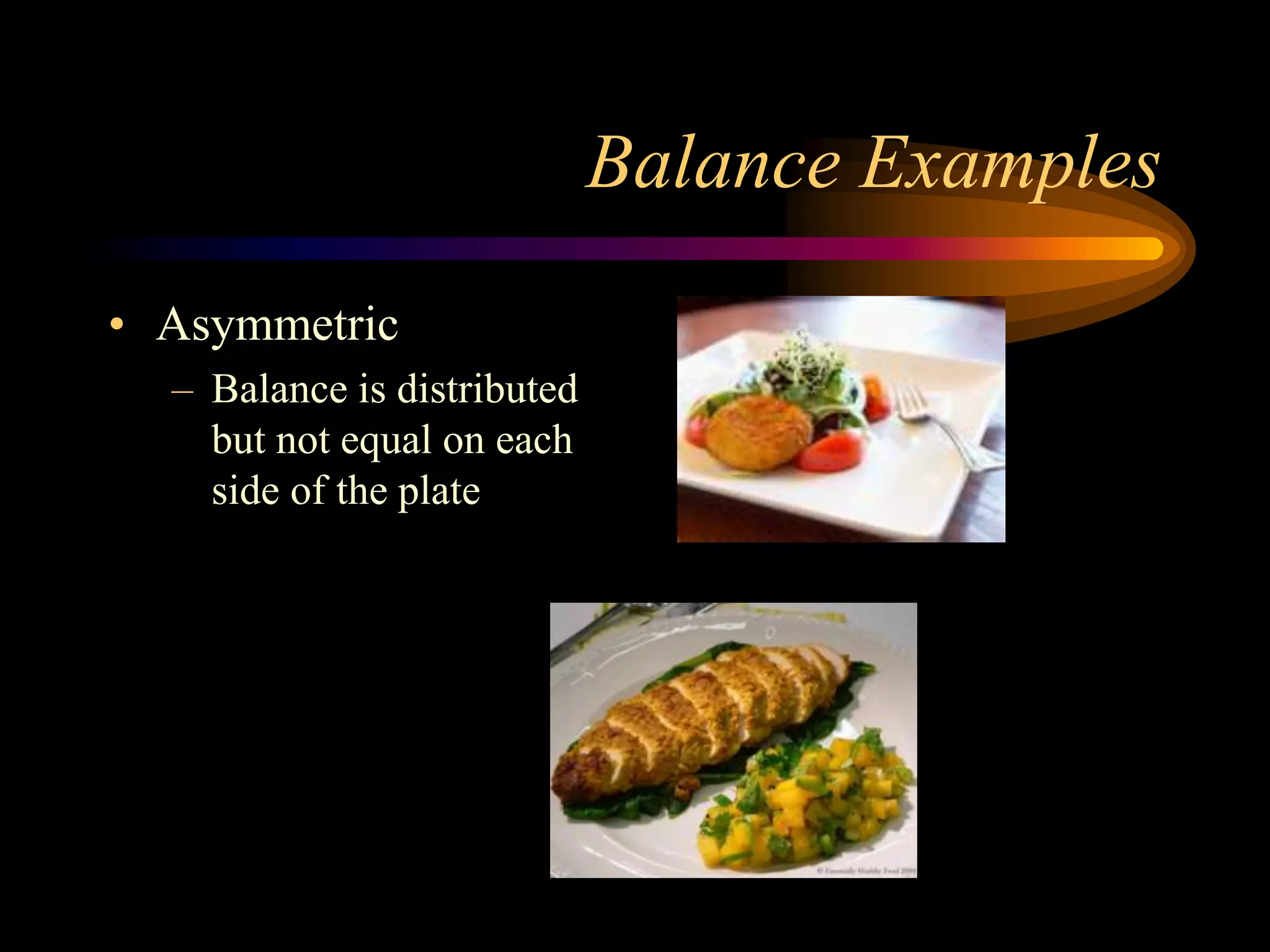
Balance Examples
• Asymmetric
– Balance is distributed
but not equal on each
side of the plate
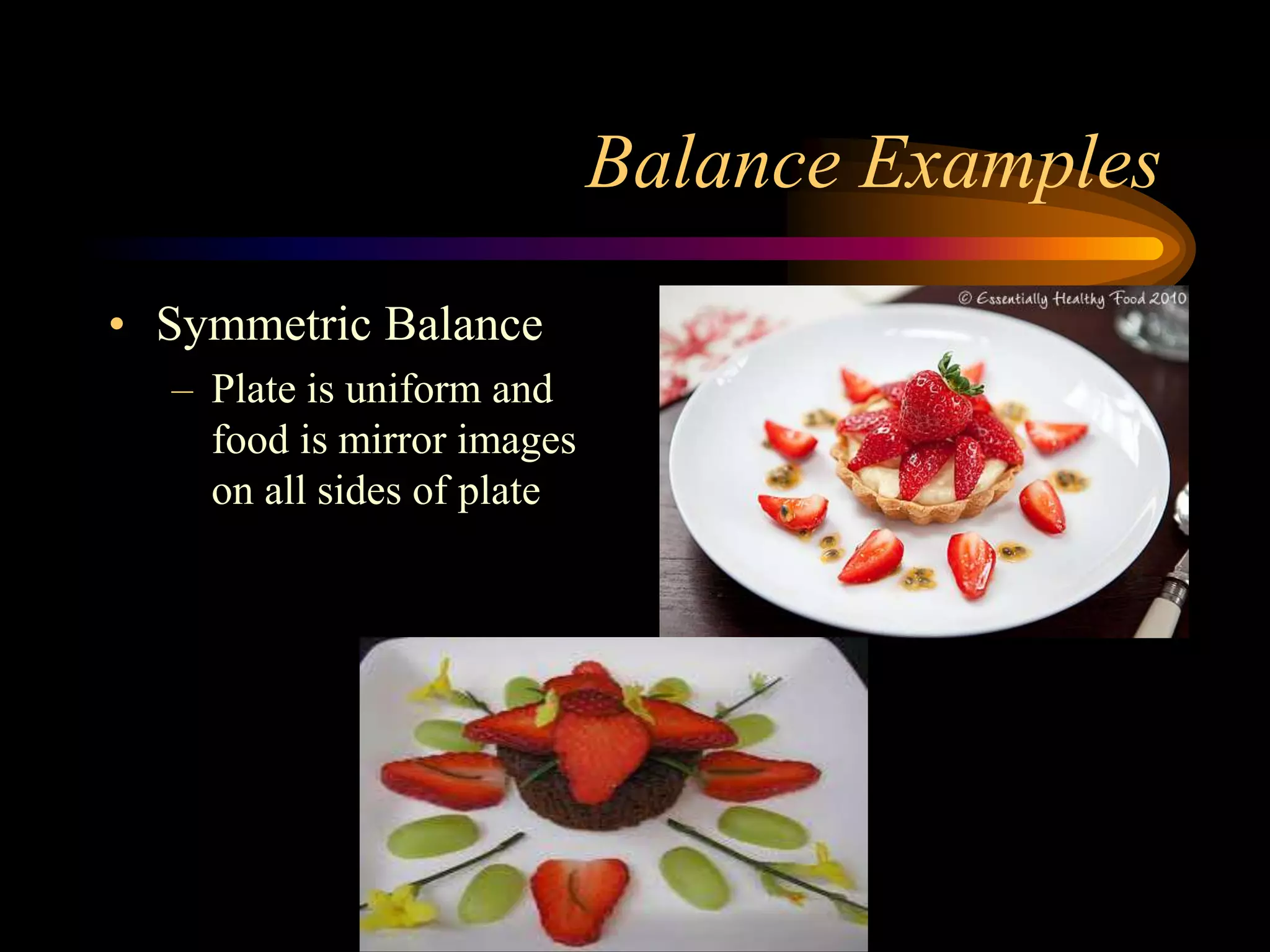
Balance Examples
• Symmetric Balance
– Plate is uniform and
food is mirror images
on all sides of plate
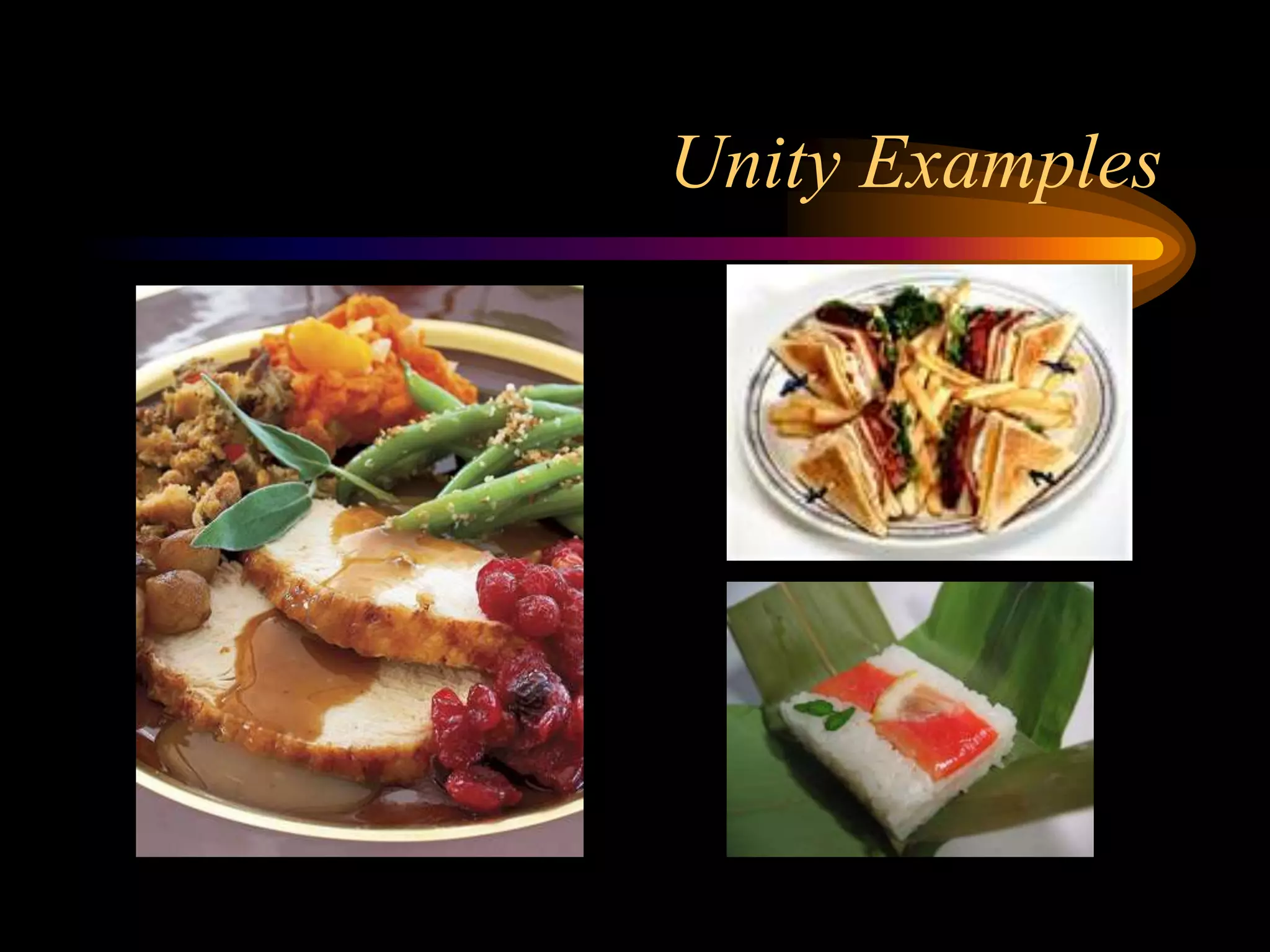
Unity
Unity is when all the parts
harmonize and seem to fit
together.
Unity Examples
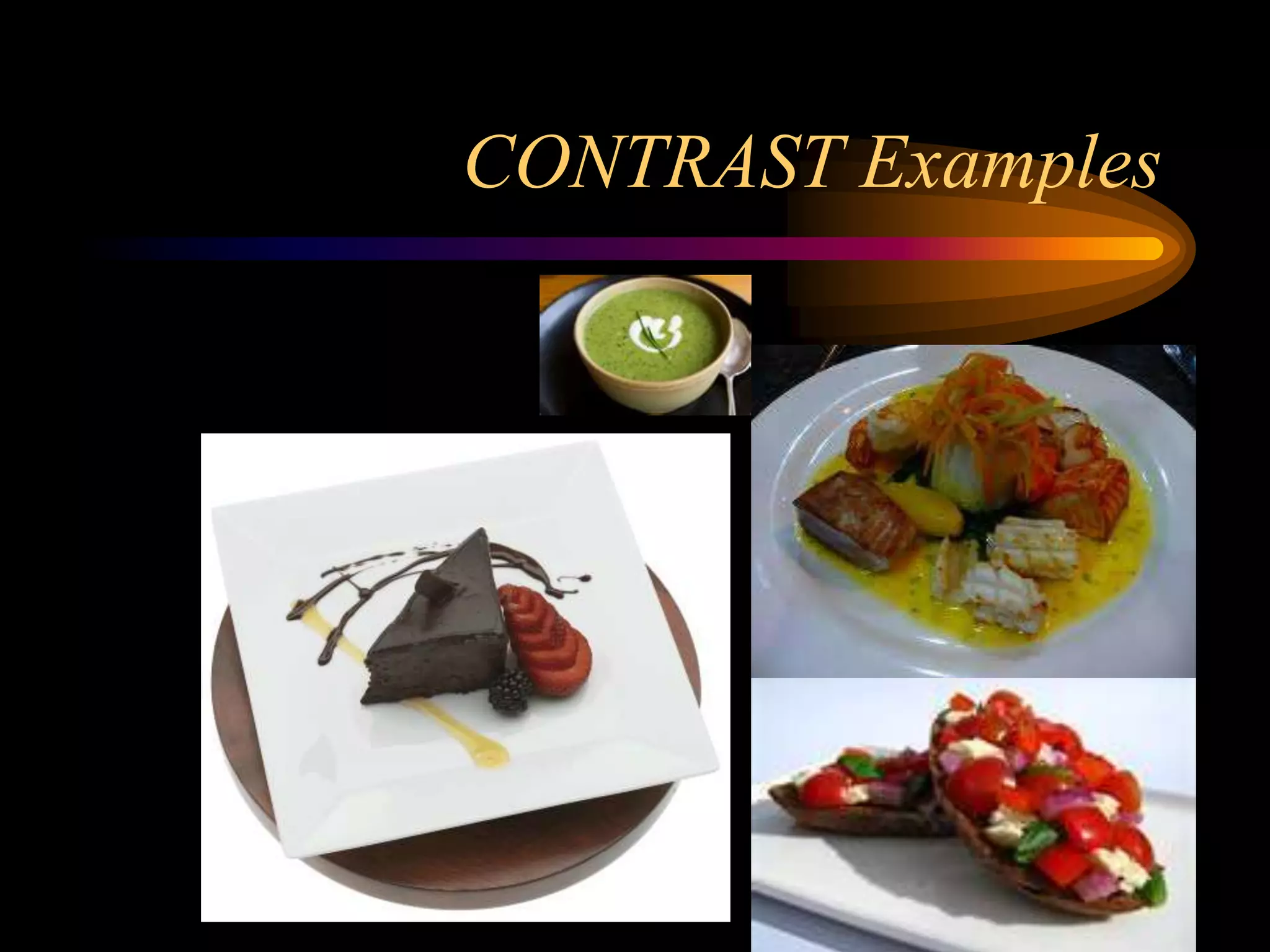
CONTRAST
Contrast refers to the opposites
and differences in the work. You
can achieve variety by using
different shapes, textures, colors
and height in your work.
CONTRAST Examples
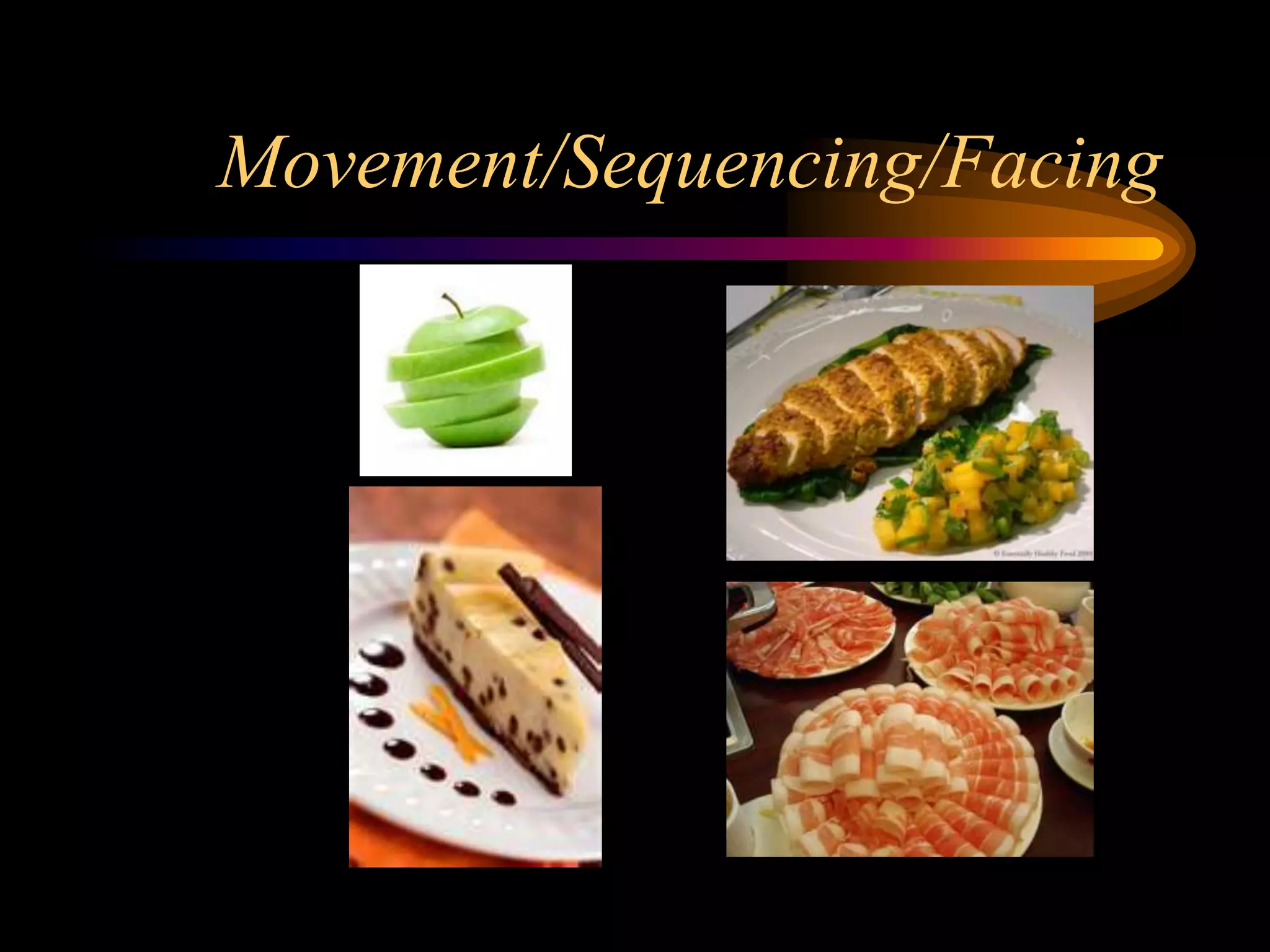
Movement
Movement adds excitement to
your work by showing action and
directing the viewers eye
throughout the picture plane.
Rhythm is a type of movement in
plating that you can achieve
through sequencing, facing and
garnish
Movement/Sequencing/Facing
Eating is a full body experience. We
eat with our mouths. We smell it
with our nose. We see it with our
eyes. If something doesn’t look
appetizing, we probably won’t eat it,
if given another choice. Garnishing
adds that last bit of visual appeal to
a dish…
GARNISHES
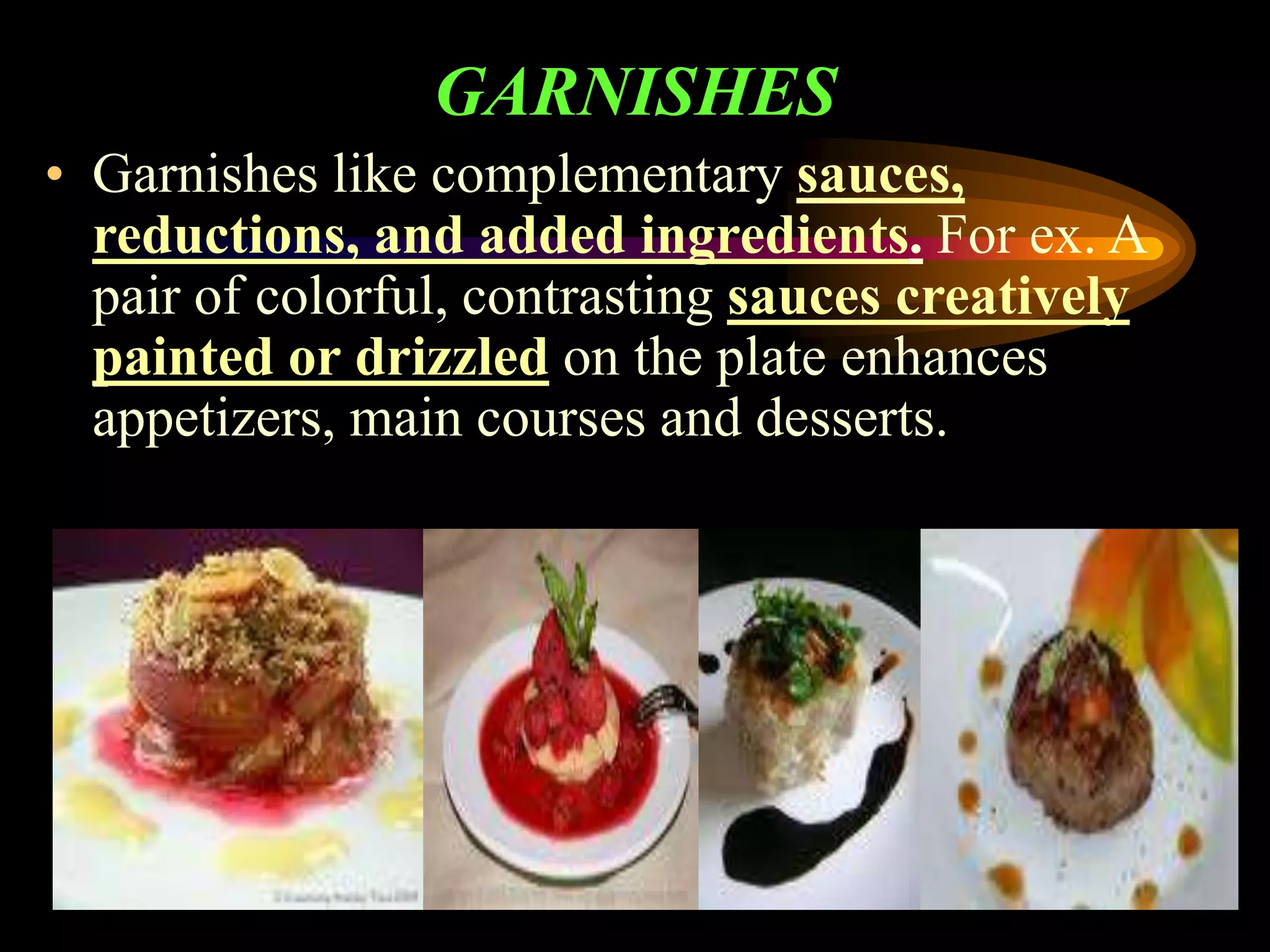
• Garnishes like complementary sauces,
reductions, and added ingredients. For ex. A
pair of colorful, contrasting sauces creatively
painted or drizzled on the plate enhances
appetizers, main courses and desserts.
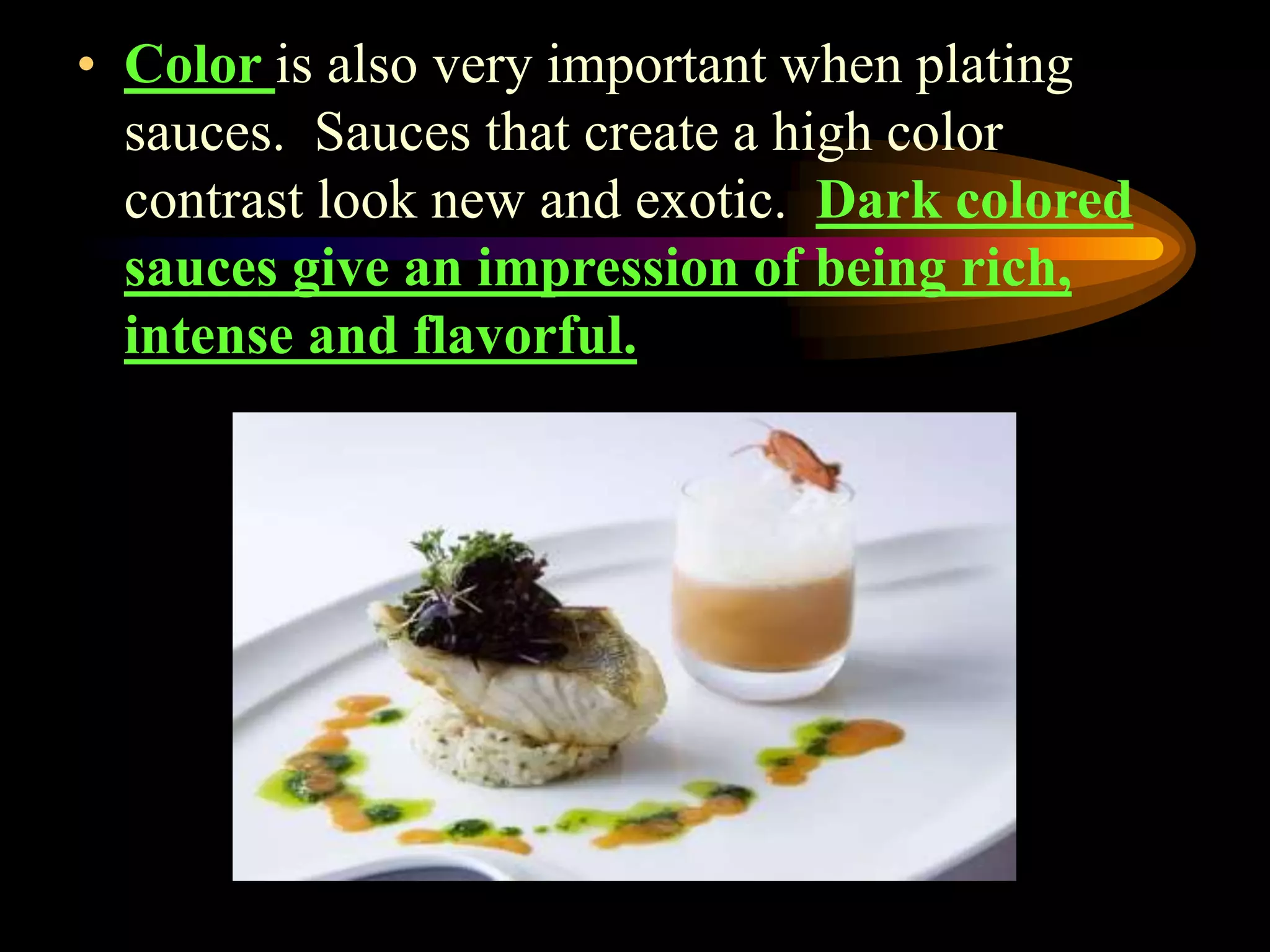
• Color is also very important when plating
sauces. Sauces that create a high color
contrast look new and exotic. Dark colored
sauces give an impression of being rich,
intense and flavorful.
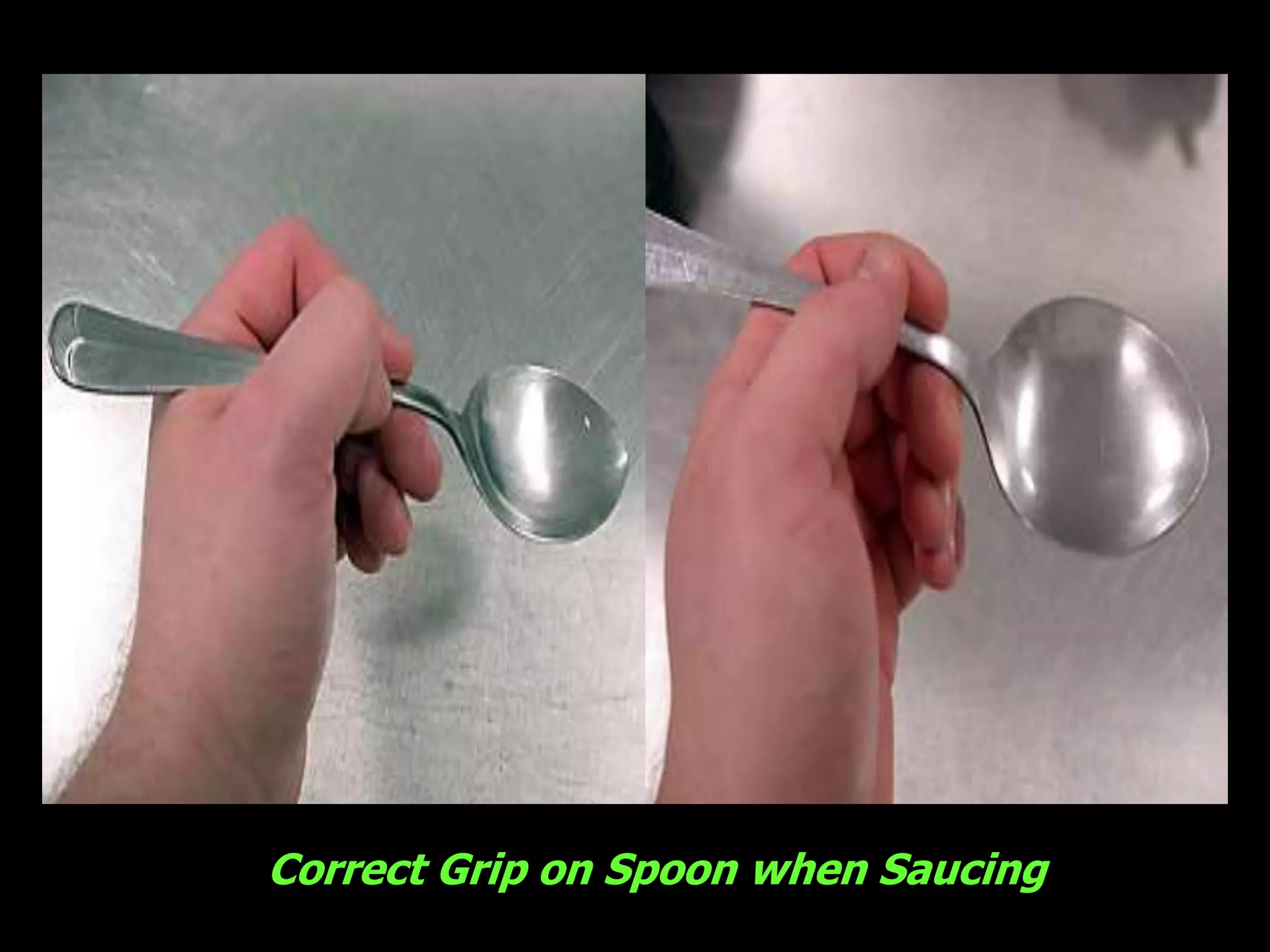
Correct Grip on Spoon when Saucing
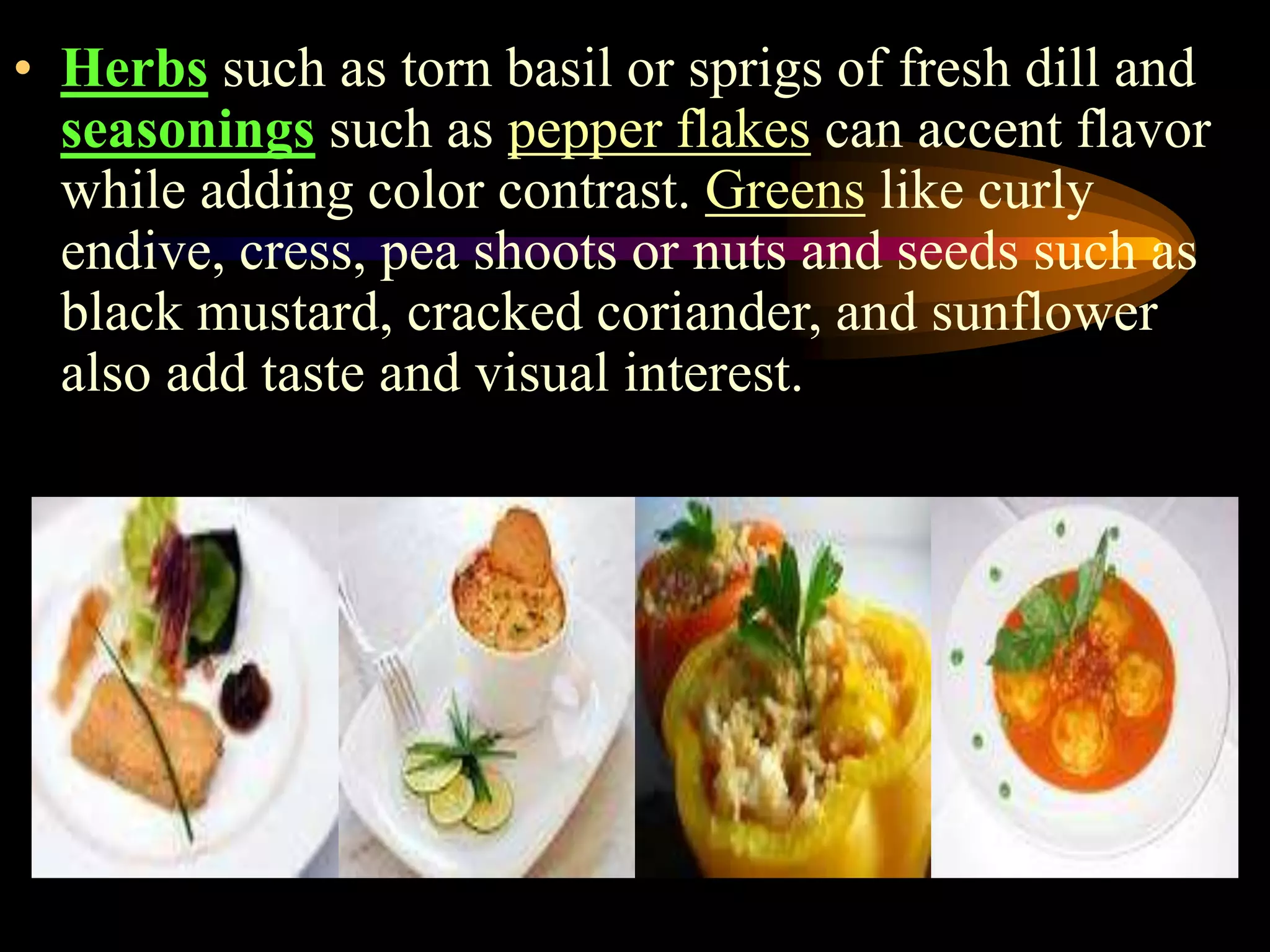
• Herbs such as torn basil or sprigs of fresh dill and
seasonings such as pepper flakes can accent flavor
while adding color contrast. Greens like curly
endive, cress, pea shoots or nuts and seeds such as
black mustard, cracked coriander, and sunflower
also add taste and visual interest.
• When deciding on garnishes, your creativity
and sensibility are your only limitations.
Prepare garnish in a way that best accents
natural beauty and patterns but does not disrupt
the dish itself
To garnish is to decorate, adorn, dress up,
pretty up, embellish, prettify, spice up.
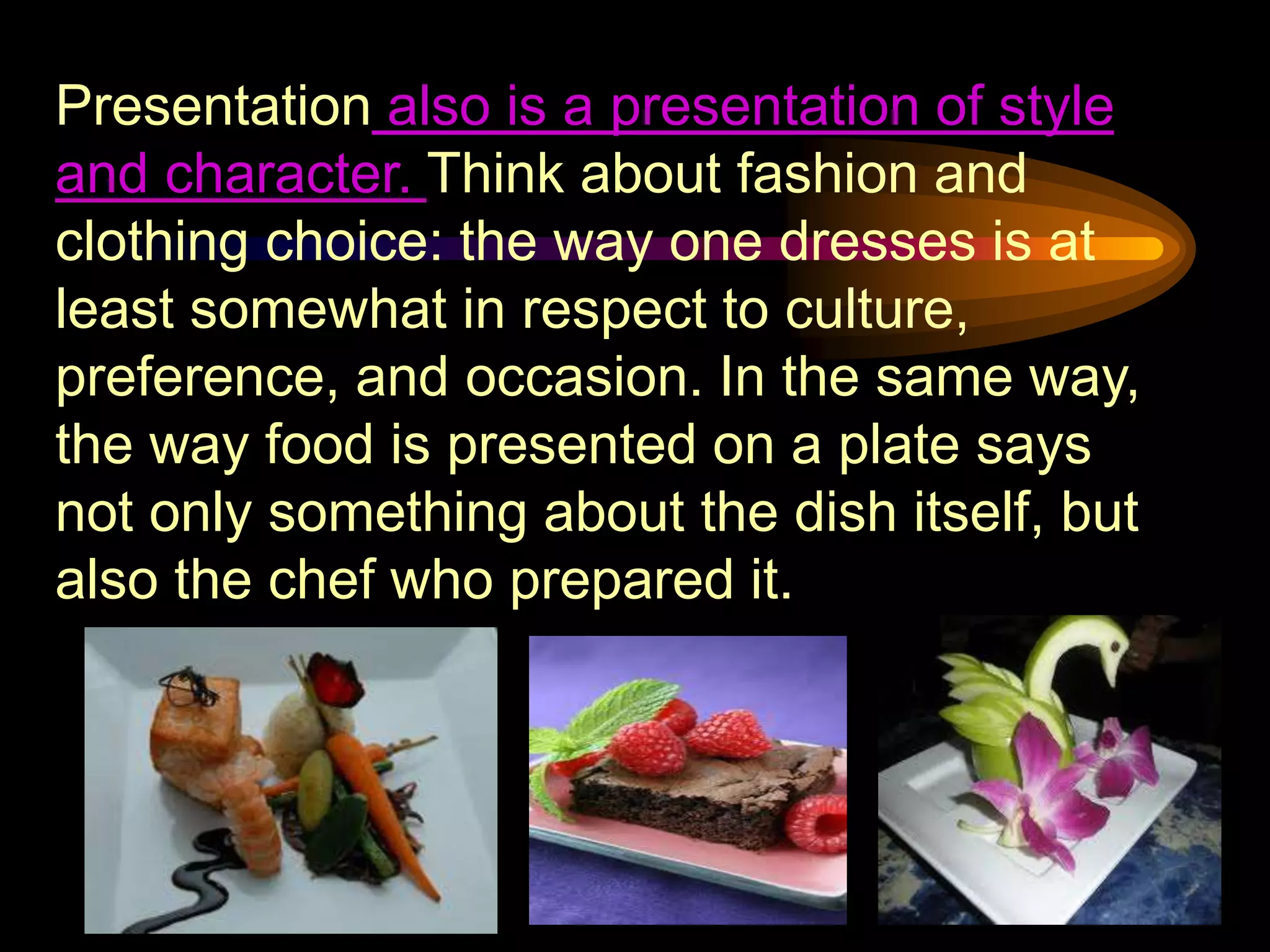
Presentation also is a presentation of style
and character. Think about fashion and
clothing choice: the way one dresses is at
least somewhat in respect to culture,
preference, and occasion. In the same way,
the way food is presented on a plate says
not only something about the dish itself, but
also the chef who prepared it.
Advice from Gordon Ramsey
• Keep your presentation clean and simple
• Use an odd number of ingredients on the
plate to avoid symmetry “eyeballs"
• Never go for looks rather than flavor.
This includes the use of herbs as a
garnish, unless they go with the meal
Advice from Gordon Ramsey
• Avoid moving things around once they’re on
the plate, as this will simply make a mess
• Visualize what your dish will look like
before you start arranging it on the plate

platingusingartprincipleslecture.ppt

  • 1.
    Basic concepts infood plating
  • 2.
    Plate presentation conceptsare the same as those of fine art. The chef- artist works with a palette of different colors, shapes, textures, flavors and arranges them with the principles of artistic composition in mind- balance, harmony and contrast.
  • 3.
  • 4.
    MAIN SUBJECT The mostimportant thing to keep in mind is that the main ingredients remain the focal point. The way to showcase them should never overwhelm, clash with or obscure what is essentially the star of the show- the food.
  • 6.
    PORTIONS • Avoid portionsthat are too small in relation to plate size, or portions that are too big, such as the off- putting steak and frites that hang over the side of the plate. It is best not to overcrowd a plate with food, so as not to offend the sensibilities of the guest. • An odd numbers of food items on a plate look better than even numbers.
  • 7.
    PLATES • > Themost important and most dramatic tool a chef can use is the plate itself. • > Wide choices of color, shape and size offer a multitude of opportunities to create harmony or contrast, or simply serve as a blank canvas that lets the food speak for itself. • > Achieve drama with unusual shapes and sizes.
  • 8.
    PLATES • Choose thePerfect Plate -Selecting the right plate for your meal is key to attractive food presentation. One way to conceptualize plating is to think of yourself as an artist, the plate as your canvas, and the food as your medium.
  • 10.
    • The hottrend in food presentation is the use of small platters in glass and porcelain for accompaniments placed within the individual dinner plate.
  • 12.
    Plating Finally, once wehave completed our cooking methods, we are ready to start the plating process. The element of balance is key to any plate, no matter what the shape or size. The first concern is the size and balance of the food versus the plate.
  • 14.
    • "Emeril-itis" iseverywhere, and it is a common problem that you see in people just starting to present food. By Emeril- itis • I mean that everyone wants to "bam" spices or blends on the rims of the plates, or they want to strip chocolate sauce across a plate and up on the rim. When plating, it is imperative that you leave what is referred to as dead space. This is the area on the rim that you want to leave clean.
  • 16.
    Design Elements inFood Plating The basic building blocks • Line • Shape/Form • Texture • Color • Height
  • 17.
    Lines • A markmade by a moving point. • Directs the eye – horizontal, vertical, diagonal, curvy, zig-zag, etc. • Can be actual obvious lines or the borders or edges of shapes. • Strongest Line in plate design is a diagonal followed by the “C” design
  • 18.
  • 19.
  • 20.
    Shape/Form • A containedarea. • Can be GEOMETRIC (man-made) ex. Square, triangle, circle, etc. • Can be ORGANIC (natural) • Forms are 3-Dimensional with height, width and depth. (sphere) • Used to create a sense of space and substance.
  • 21.
  • 22.
    Texture • The surfacequality. • How an object feels, or how it looks like it feels. • Rough, smooth, bumpy, gooey, sharp, etc. • Adds interest! Sense of sight and sense of touch involved.
  • 23.
  • 24.
    Color • Primary, Secondary,Intermediates. • Use color schemes to enhance appeal or make impact.
  • 25.
  • 26.
    Height • Stacking remainsan effective and dramatic technique, but simplicity can make a design statement all by itself.
  • 27.
    • Developing ideas Thefinal elements that will enhance your food presentations are some things you might not think of, but they are an essential part of making food look good: your imagination and brain. These need to be focused if you expect your food to look focused; if they are sloppy and distracted, your food will look sloppy and distracted. Your imagination and brain need to be fed new ideas as often as possible as well.
  • 29.
    What are thePrinciples of Art Utilized in Food Plating? • Emphasis • Balance • Unity-Harmony • Contrast • Movement/ Rhythm • Seqencing and Facing • Pattern/Repetition
  • 30.
    Pattern/Repetition • An elementthat occurs over and over again in a composition. • Can repeat the element in a consistent pattern. • Can repeat the element in a variation of the pattern.
  • 31.
  • 32.
    EMPHASIS or FocalPoint Emphasis in a composition refers to developing points of interest to pull the viewer's eye to important parts of the plate.
  • 33.
  • 34.
    Balance Balance is asense of stability in the body of work. Balance can be created by repeating same shapes and by creating a feeling of equal weight.
  • 35.
    Balance Examples • Asymmetric –Balance is distributed but not equal on each side of the plate
  • 36.
    Balance Examples • SymmetricBalance – Plate is uniform and food is mirror images on all sides of plate
  • 37.
    Unity Unity is whenall the parts harmonize and seem to fit together.
  • 38.
  • 39.
    CONTRAST Contrast refers tothe opposites and differences in the work. You can achieve variety by using different shapes, textures, colors and height in your work.
  • 40.
  • 41.
    Movement Movement adds excitementto your work by showing action and directing the viewers eye throughout the picture plane. Rhythm is a type of movement in plating that you can achieve through sequencing, facing and garnish
  • 42.
  • 44.
    Eating is afull body experience. We eat with our mouths. We smell it with our nose. We see it with our eyes. If something doesn’t look appetizing, we probably won’t eat it, if given another choice. Garnishing adds that last bit of visual appeal to a dish…
  • 45.
    GARNISHES • Garnishes likecomplementary sauces, reductions, and added ingredients. For ex. A pair of colorful, contrasting sauces creatively painted or drizzled on the plate enhances appetizers, main courses and desserts.
  • 46.
    • Color isalso very important when plating sauces. Sauces that create a high color contrast look new and exotic. Dark colored sauces give an impression of being rich, intense and flavorful.
  • 47.
    Correct Grip onSpoon when Saucing
  • 48.
    • Herbs suchas torn basil or sprigs of fresh dill and seasonings such as pepper flakes can accent flavor while adding color contrast. Greens like curly endive, cress, pea shoots or nuts and seeds such as black mustard, cracked coriander, and sunflower also add taste and visual interest.
  • 49.
    • When decidingon garnishes, your creativity and sensibility are your only limitations. Prepare garnish in a way that best accents natural beauty and patterns but does not disrupt the dish itself To garnish is to decorate, adorn, dress up, pretty up, embellish, prettify, spice up.
  • 50.
    Presentation also isa presentation of style and character. Think about fashion and clothing choice: the way one dresses is at least somewhat in respect to culture, preference, and occasion. In the same way, the way food is presented on a plate says not only something about the dish itself, but also the chef who prepared it.
  • 51.
    Advice from GordonRamsey • Keep your presentation clean and simple • Use an odd number of ingredients on the plate to avoid symmetry “eyeballs" • Never go for looks rather than flavor. This includes the use of herbs as a garnish, unless they go with the meal
  • 52.
    Advice from GordonRamsey • Avoid moving things around once they’re on the plate, as this will simply make a mess • Visualize what your dish will look like before you start arranging it on the plate