Learning Competency
Prepare
Meat Dishes
Prepared by: Ms. Marivic R. Francisco
Learning Outcome
2:
Prepare Meat
Dishes Aesthetically
REVIEW
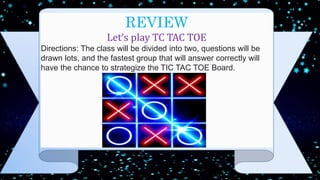
Let’s play TC TAC TOE
Directions: The class will be divided into two, questions will be
drawn lots, and the fastest group that will answer correctly will
have the chance to strategize the TIC TAC TOE Board.
TIK TOK CHALLENGE
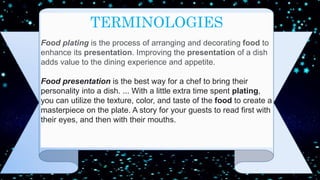
TERMINOLOGIES
Food plating is the process of arranging and decorating food to
enhance its presentation. Improving the presentation of a dish
adds value to the dining experience and appetite.
Food presentation is the best way for a chef to bring their
personality into a dish. ... With a little extra time spent plating,
you can utilize the texture, color, and taste of the food to create a
masterpiece on the plate. A story for your guests to read first with
their eyes, and then with their mouths.
Plate/Present
MeatDishes
BasicPrinciples of Platter
Presentation
1.Presentation must have three
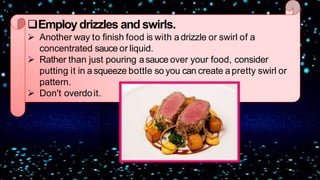
elements.
Centerpiece may be an uncut portion of the
main food item.
Slices or serving portions of the main food
item, arrange artistically.
Garnish, arranged artistically in proportion
to the cut slices.
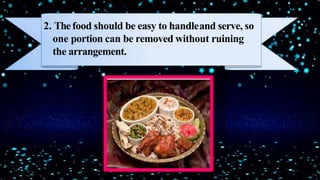
2. Thefood should be easy to handleand serve, so
one portion can be removed without ruining
the arrangement.
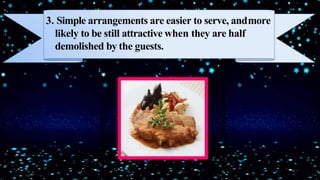
3. Simple arrangements are easier to serve, andmore
likely to be still attractive when they are half
demolished by the guests.
4. Attractive platter are made of metals, mirrors,
china, plastic or woods, presentable and suitable
for use with food.
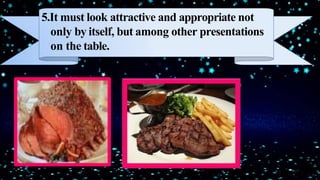
5.It must look attractive and appropriate not
only by itself, but among other presentations
on the table.
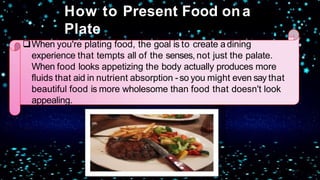
When you're plating food, the goal is to create adining
experience that tempts all of the senses, not just the palate.
When food looks appetizing the body actually produces more
fluids that aid in nutrient absorption -so you might even say that
beautiful food is more wholesome than food that doesn't look
appealing.
How to Present Food ona
Plate
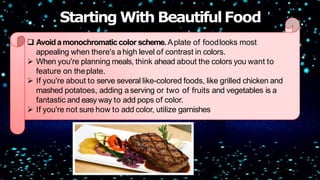
 Avoidamonochromaticcolor scheme. Aplate of foodlooks most
appealing when there's ahigh level of contrast in colors.
 When you're planning meals, think ahead about the colors you want to
feature on theplate.
 If you're about to serve several like-colored foods, like grilled chicken and
mashed potatoes, adding aserving or two of fruits and vegetables is a
fantastic and easy way to add pops of color.
 If you're not sure how to add color, utilize garnishes
Starting With BeautifulFood
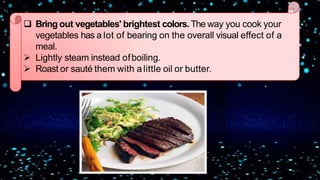
 Bring out vegetables' brightest colors. The way you cook your
vegetables has a lot of bearing on the overall visual effect of a
meal.
 Lightly steam instead ofboiling.
 Roast or sauté them with a little oil or butter.
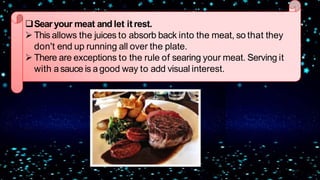
Searyour meat and let itrest.
 This allows the juices to absorb back into the meat, so that they
don't end up running all over the plate.
 There are exceptions to the rule of searing your meat. Serving it
with asauce is a good way to add visual interest.
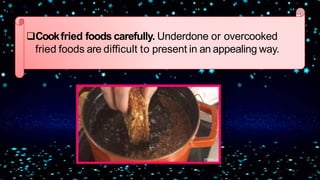
Cookfried foods carefully. Underdone or overcooked
fried foods are difficult to present in an appealing way.
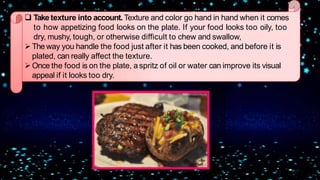
 Take texture into account. Texture and color go hand in hand when it comes
to how appetizing food looks on the plate. If your food looks too oily, too
dry, mushy, tough, or otherwise difficult to chew and swallow,
The way you handle the food just after it has been cooked, and before it is
plated, can really affect the texture.
Once the food is on the plate, aspritz of oil or water can improve its visual
appeal if it looks too dry.
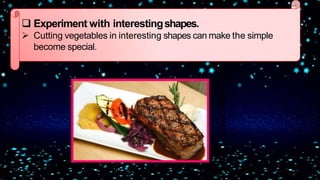
 Experiment with interestingshapes.
 Cutting vegetables in interesting shapes can make the simple
become special.
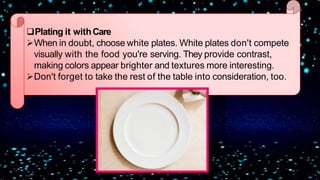
Plating it withCare
When in doubt, choose white plates. White plates don't compete
visually with the food you're serving. They provide contrast,
making colors appear brighter and textures more interesting.
Don't forget to take the rest of the table into consideration, too.
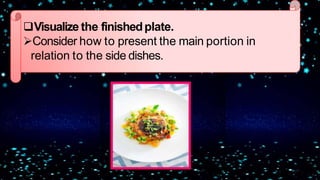
Visualize the finishedplate.
Consider how to present the main portion in
relation to the side dishes.
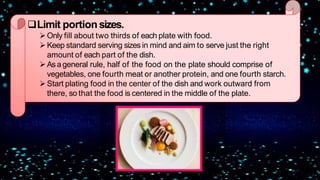
Limit portionsizes.
Only fill about two thirds of each plate with food.
Keep standard serving sizes in mind and aim to serve just the right
amount of each part of the dish.
Asageneral rule, half of the food on the plate should comprise of
vegetables, one fourth meat or another protein, and one fourth starch.
Start plating food in the center of the dish and work outward from
there, so that the food is centered in the middle of the plate.
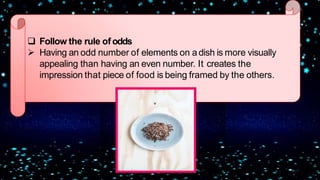
 Follow the rule ofodds
 Having an odd number of elements on a dish is more visually
appealing than having an even number. It creates the
impression that piece of food is being framed by the others.
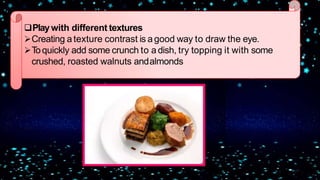
Playwith different textures
Creating a texture contrast is a good way to draw the eye.
Toquickly add some crunch to a dish, try topping it with some
crushed, roasted walnuts andalmonds
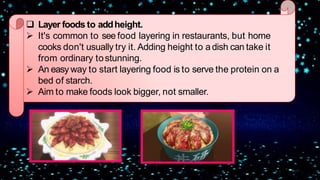
 Layer foods to addheight.
 It's common to see food layering in restaurants, but home
cooks don't usually try it. Adding height to a dish can take it
from ordinary tostunning.
 An easy way to start layering food is to serve the protein on a
bed of starch.
 Aim to make foods look bigger, not smaller.
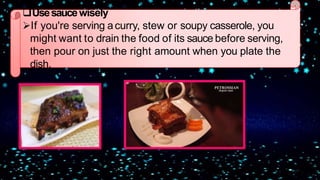
Usesaucewisely
If you're serving acurry, stew or soupy casserole, you
might want to drain the food of its sauce before serving,
then pour on just the right amount when you plate the
dish.
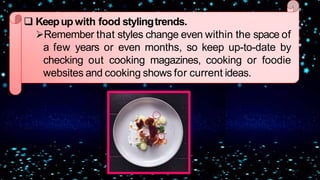
 Keepup with food stylingtrends.
Remember that styles change even within the space of
a few years or even months, so keep up-to-date by
checking out cooking magazines, cooking or foodie
websites and cooking shows for current ideas.
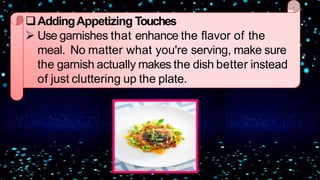
AddingAppetizing Touches
 Use garnishes that enhance the flavor of the
meal. No matter what you're serving, make sure
the garnish actually makes the dish better instead
of just cluttering up the plate.
Employdrizzles and swirls.
 Another way to finish food is with a drizzle or swirl of a
concentrated sauce or liquid.
 Rather than just pouring asauce over your food, consider
putting it in a squeeze bottle so you can create apretty swirl or
pattern.
 Don't overdoit.
Make surethe plate isclean
Examine the edges of the plate for fingerprints and
smudges.
This gives your presentation aprofessionaltouch.
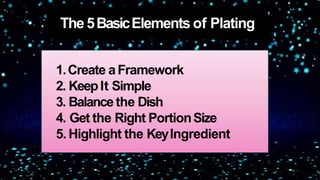
The 5BasicElements of Plating
1.Create aFramework
2. KeepIt Simple
3. Balancethe Dish
4. Get the Right PortionSize
5. Highlight the KeyIngredient
PERFORMANCE TASKS
GROUP PRESENTATION
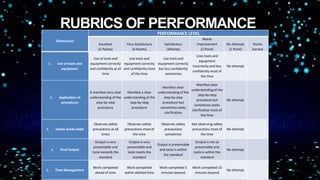
RUBRICS OF PERFORMANCE
Dimension
PERFORMANCE LEVEL
Excellent
(5 Points)
Very Satisfactory
(4 Points)
Satisfactory
(3Points)
Needs
improvement
(2 Point)
No Attempt
(1 Point)
Points
Earned
1. Use of tools and
equipment
Use of tools and
equipment correctly
and confidently at all
time
Use tools and
equipment correctly
and confidently most
of the time
Use tools and
equipment correctly
but less confidently
sometimes
Uses tools and
equipment
incorrectly and less
confidently most of
the time
No attempt
1. Application of
procedures
A manifest very clear
understanding of the
step-by-step
procedure
Manifest a clear
understanding of the
step-by-step
procedure
Manifest clear
understanding of the
step-by-step
procedure but
sometimes seeks
clarification
Manifest clear
understanding of the
step-by-step
procedure but
sometimes seeks
clarification most of
the time
No attempt
1. Safety works habit
Observes safety
precautions at all
times
Observes safety
precautions most of
the time
Observes safety
precautions
sometimes
Not observing safety
precautions most of
the time
No attempt
1. Final Output
Output is very
presentable and
taste exceeds the
standard
Output is very
presentable and
taste meets the
standard
Output is presentable
and taste is within
the standard
Output is not so
presentable and
taste is within the
standard
No attempt
1. Time Management
Work completed
ahead of time
Work completed
within allotted time
Work completed 5
minutes beyond
Work completed 10
minutes beyond
No attempt
Complete the sentences:
The things that I had learned from this
lesson___________
The importance of this lesson__________
The values that I had learned from the
lesson_______
.
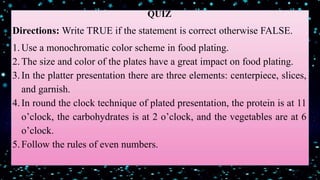
QUIZ
Directions: Write TRUE if the statement is correct otherwise FALSE.
1.Use a monochromatic color scheme in food plating.
2.The size and color of the plates have a great impact on food plating.
3.In the platter presentation there are three elements: centerpiece, slices,
and garnish.
4.In round the clock technique of plated presentation, the protein is at 11
o’clock, the carbohydrates is at 2 o’clock, and the vegetables are at 6
o’clock.
5.Follow the rules of even numbers.
Homework:
Enumerate the storing
techniques in storing
meat and meat dishes.

COT 2 PPT Present Meat Dishes and plating

  • 1.
  • 2.
  • 3.
    REVIEW Let’s play TCTAC TOE Directions: The class will be divided into two, questions will be drawn lots, and the fastest group that will answer correctly will have the chance to strategize the TIC TAC TOE Board.
  • 4.
  • 5.
    TERMINOLOGIES Food plating isthe process of arranging and decorating food to enhance its presentation. Improving the presentation of a dish adds value to the dining experience and appetite. Food presentation is the best way for a chef to bring their personality into a dish. ... With a little extra time spent plating, you can utilize the texture, color, and taste of the food to create a masterpiece on the plate. A story for your guests to read first with their eyes, and then with their mouths.
  • 7.
    Plate/Present MeatDishes BasicPrinciples of Platter Presentation 1.Presentationmust have three elements. Centerpiece may be an uncut portion of the main food item. Slices or serving portions of the main food item, arrange artistically. Garnish, arranged artistically in proportion to the cut slices.
  • 8.
    2. Thefood shouldbe easy to handleand serve, so one portion can be removed without ruining the arrangement.
  • 9.
    3. Simple arrangementsare easier to serve, andmore likely to be still attractive when they are half demolished by the guests.
  • 10.
    4. Attractive platterare made of metals, mirrors, china, plastic or woods, presentable and suitable for use with food.
  • 11.
    5.It must lookattractive and appropriate not only by itself, but among other presentations on the table.
  • 12.
    When you're platingfood, the goal is to create adining experience that tempts all of the senses, not just the palate. When food looks appetizing the body actually produces more fluids that aid in nutrient absorption -so you might even say that beautiful food is more wholesome than food that doesn't look appealing. How to Present Food ona Plate
  • 13.
     Avoidamonochromaticcolor scheme.Aplate of foodlooks most appealing when there's ahigh level of contrast in colors.  When you're planning meals, think ahead about the colors you want to feature on theplate.  If you're about to serve several like-colored foods, like grilled chicken and mashed potatoes, adding aserving or two of fruits and vegetables is a fantastic and easy way to add pops of color.  If you're not sure how to add color, utilize garnishes Starting With BeautifulFood
  • 14.
     Bring outvegetables' brightest colors. The way you cook your vegetables has a lot of bearing on the overall visual effect of a meal.  Lightly steam instead ofboiling.  Roast or sauté them with a little oil or butter.
  • 15.
    Searyour meat andlet itrest.  This allows the juices to absorb back into the meat, so that they don't end up running all over the plate.  There are exceptions to the rule of searing your meat. Serving it with asauce is a good way to add visual interest.
  • 16.
    Cookfried foods carefully.Underdone or overcooked fried foods are difficult to present in an appealing way.
  • 17.
     Take textureinto account. Texture and color go hand in hand when it comes to how appetizing food looks on the plate. If your food looks too oily, too dry, mushy, tough, or otherwise difficult to chew and swallow, The way you handle the food just after it has been cooked, and before it is plated, can really affect the texture. Once the food is on the plate, aspritz of oil or water can improve its visual appeal if it looks too dry.
  • 18.
     Experiment withinterestingshapes.  Cutting vegetables in interesting shapes can make the simple become special.
  • 19.
    Plating it withCare Whenin doubt, choose white plates. White plates don't compete visually with the food you're serving. They provide contrast, making colors appear brighter and textures more interesting. Don't forget to take the rest of the table into consideration, too.
  • 20.
    Visualize the finishedplate. Considerhow to present the main portion in relation to the side dishes.
  • 21.
    Limit portionsizes. Only fillabout two thirds of each plate with food. Keep standard serving sizes in mind and aim to serve just the right amount of each part of the dish. Asageneral rule, half of the food on the plate should comprise of vegetables, one fourth meat or another protein, and one fourth starch. Start plating food in the center of the dish and work outward from there, so that the food is centered in the middle of the plate.
  • 22.
     Follow therule ofodds  Having an odd number of elements on a dish is more visually appealing than having an even number. It creates the impression that piece of food is being framed by the others.
  • 23.
    Playwith different textures Creatinga texture contrast is a good way to draw the eye. Toquickly add some crunch to a dish, try topping it with some crushed, roasted walnuts andalmonds
  • 24.
     Layer foodsto addheight.  It's common to see food layering in restaurants, but home cooks don't usually try it. Adding height to a dish can take it from ordinary tostunning.  An easy way to start layering food is to serve the protein on a bed of starch.  Aim to make foods look bigger, not smaller.
  • 25.
    Usesaucewisely If you're servingacurry, stew or soupy casserole, you might want to drain the food of its sauce before serving, then pour on just the right amount when you plate the dish.
  • 26.
     Keepup withfood stylingtrends. Remember that styles change even within the space of a few years or even months, so keep up-to-date by checking out cooking magazines, cooking or foodie websites and cooking shows for current ideas.
  • 27.
    AddingAppetizing Touches  Usegarnishes that enhance the flavor of the meal. No matter what you're serving, make sure the garnish actually makes the dish better instead of just cluttering up the plate.
  • 28.
    Employdrizzles and swirls. Another way to finish food is with a drizzle or swirl of a concentrated sauce or liquid.  Rather than just pouring asauce over your food, consider putting it in a squeeze bottle so you can create apretty swirl or pattern.  Don't overdoit.
  • 29.
    Make surethe plateisclean Examine the edges of the plate for fingerprints and smudges. This gives your presentation aprofessionaltouch.
  • 30.
    The 5BasicElements ofPlating 1.Create aFramework 2. KeepIt Simple 3. Balancethe Dish 4. Get the Right PortionSize 5. Highlight the KeyIngredient
  • 31.
  • 32.
    RUBRICS OF PERFORMANCE Dimension PERFORMANCELEVEL Excellent (5 Points) Very Satisfactory (4 Points) Satisfactory (3Points) Needs improvement (2 Point) No Attempt (1 Point) Points Earned 1. Use of tools and equipment Use of tools and equipment correctly and confidently at all time Use tools and equipment correctly and confidently most of the time Use tools and equipment correctly but less confidently sometimes Uses tools and equipment incorrectly and less confidently most of the time No attempt 1. Application of procedures A manifest very clear understanding of the step-by-step procedure Manifest a clear understanding of the step-by-step procedure Manifest clear understanding of the step-by-step procedure but sometimes seeks clarification Manifest clear understanding of the step-by-step procedure but sometimes seeks clarification most of the time No attempt 1. Safety works habit Observes safety precautions at all times Observes safety precautions most of the time Observes safety precautions sometimes Not observing safety precautions most of the time No attempt 1. Final Output Output is very presentable and taste exceeds the standard Output is very presentable and taste meets the standard Output is presentable and taste is within the standard Output is not so presentable and taste is within the standard No attempt 1. Time Management Work completed ahead of time Work completed within allotted time Work completed 5 minutes beyond Work completed 10 minutes beyond No attempt
  • 33.
    Complete the sentences: Thethings that I had learned from this lesson___________ The importance of this lesson__________ The values that I had learned from the lesson_______ .
  • 34.
    QUIZ Directions: Write TRUEif the statement is correct otherwise FALSE. 1.Use a monochromatic color scheme in food plating. 2.The size and color of the plates have a great impact on food plating. 3.In the platter presentation there are three elements: centerpiece, slices, and garnish. 4.In round the clock technique of plated presentation, the protein is at 11 o’clock, the carbohydrates is at 2 o’clock, and the vegetables are at 6 o’clock. 5.Follow the rules of even numbers.
  • 35.
    Homework: Enumerate the storing techniquesin storing meat and meat dishes.