Functional Organization
• Project is made part of a functional organization
• Project may be undertaken by one or more of the functional
departments. The project is provided a parent department or
it may be given to all the departments and head of
organization might supervise it.
• Project is an additional responsibility for the team members
which are otherwise busy in their routine
departmental/functional activities
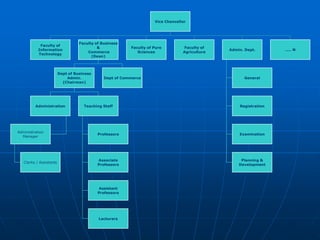
Vice Chancellor
Faculty of
Information
Technology
Faculty of Business
&
Commerce
(Dean)
Dept of Business
Admin.
(Chairman)
Administration
Administration
Manager
Clerks / Assistants
Teaching Staff
Professors
Associate
Professors
Assistant
Professors
Lecturers
Dept of Commerce
Faculty of Pure
Sciences
Faculty of
Agriculture
Admin. Dept.
General
Registration
Examination
Planning &
Development
….. N
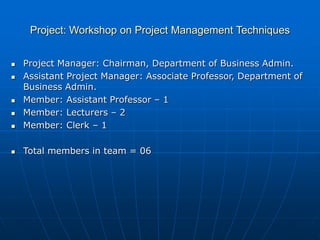
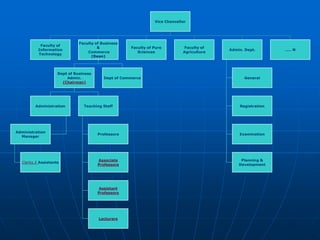
Project: Workshop on Project Management Techniques
 Project Manager: Chairman, Department of Business Admin.
 Assistant Project Manager: Associate Professor, Department of
Business Admin.
 Member: Assistant Professor – 1
 Member: Lecturers – 2
 Member: Clerk – 1
 Total members in team = 06
Vice Chancellor
Faculty of
Information
Technology
Faculty of Business
&
Commerce
(Dean)
Dept of Business
Admin.
(Chairman)
Administration
Administration
Manager
Clerks / Assistants
Teaching Staff
Professors
Associate
Professors
Assistant
Professors
Lecturers
Dept of Commerce
Faculty of Pure
Sciences
Faculty of
Agriculture
Admin. Dept.
General
Registration
Examination
Planning &
Development
….. N
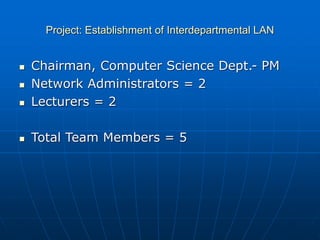
Project: Establishment of Interdepartmental LAN
 Chairman, Computer Science Dept.- PM
 Network Administrators = 2
 Lecturers = 2
 Total Team Members = 5
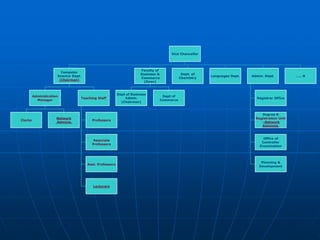
Vice Chancellor
Computer
Science Dept.
(Chairman)
Administration
Manager
Clerks
Network
Adminis.
Teaching Staff
Professors
Associate
Professors
Asst. Professors
Lecturers
Faculty of
Business &
Commerce
(Dean)
Dept of Business
Admin.
(Chairman)
Dept of
Commerce
Dept. of
Chemistry
Languages Dept. Admin. Dept.
Registrar Office
Degree &
Registration Unit
--Network
Administ.
Office of
Controller
Examination
Planning &
Development
….. N
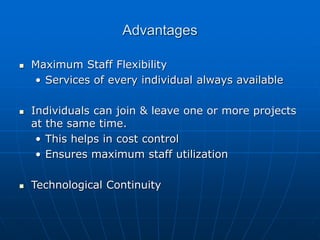
Advantages
 Maximum Staff Flexibility
• Services of every individual always available
 Individuals can join & leave one or more projects
at the same time.
• This helps in cost control
• Ensures maximum staff utilization
 Technological Continuity
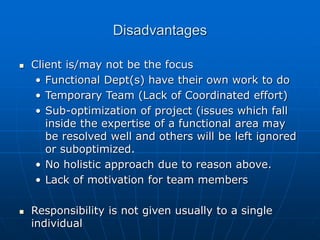
Disadvantages
 Client is/may not be the focus
• Functional Dept(s) have their own work to do
• Temporary Team (Lack of Coordinated effort)
• Sub-optimization of project (issues which fall
inside the expertise of a functional area may
be resolved well and others will be left ignored
or suboptimized.
• No holistic approach due to reason above.
• Lack of motivation for team members
 Responsibility is not given usually to a single
individual
Pure Project Organization
OR
Task Force Structure
 Project is separate from its parent
organization
 Own administration, own permanent staff
working exclusively for the project(s).
 Tied to the parent firm through monitoring
system and periodic progress reports.
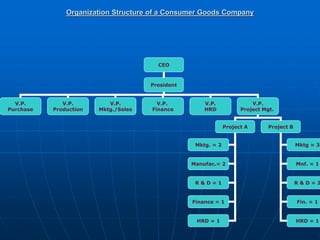
Organization Structure of a Consumer Goods Company
CEO
President
V.P.
Purchase
V.P.
Production
V.P.
Mktg./Sales
V.P.
Finance
V.P.
HRD
V.P.
Project Mgt.
Project A Project B
Mktg. = 2
Manufac.= 2
R & D = 1
Finance = 1
HRD = 1
Mktg = 3
Mnf. = 1
R & D = 2
Fin. = 1
HRD = 1
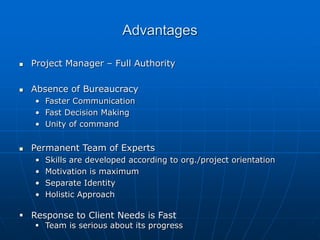
Advantages
 Project Manager – Full Authority
 Absence of Bureaucracy
• Faster Communication
• Fast Decision Making
• Unity of command
 Permanent Team of Experts
• Skills are developed according to org./project orientation
• Motivation is maximum
• Separate Identity
• Holistic Approach
 Response to Client Needs is Fast
 Team is serious about its progress
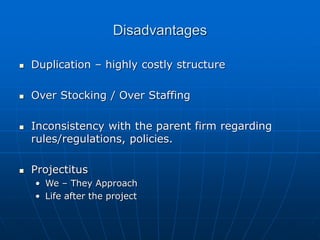
Disadvantages
 Duplication – highly costly structure
 Over Stocking / Over Staffing
 Inconsistency with the parent firm regarding
rules/regulations, policies.
 Projectitus
• We – They Approach
• Life after the project
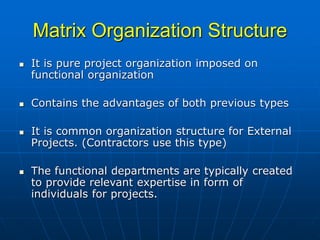
Matrix Organization Structure
 It is pure project organization imposed on
functional organization
 Contains the advantages of both previous types
 It is common organization structure for External
Projects. (Contractors use this type)
 The functional departments are typically created
to provide relevant expertise in form of
individuals for projects.
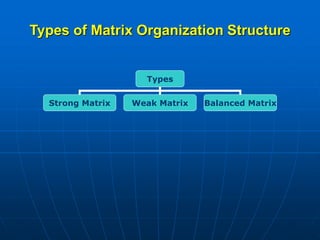
Types of Matrix Organization Structure
Types
Strong Matrix Weak Matrix Balanced Matrix
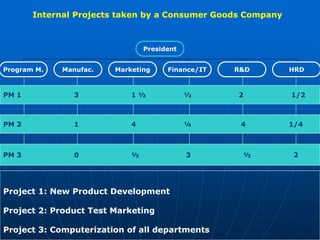
President
Program M. Manufac. Marketing HRD
R&D
Finance/IT
PM 1 3 1 ½ ½ 2 1/2
PM 2 1 4 ¼ 4 1/4
PM 3 0 ½ 3 ½ 2
Project 1: New Product Development
Project 2: Product Test Marketing
Project 3: Computerization of all departments
Internal Projects taken by a Consumer Goods Company
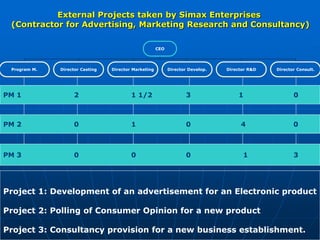
CEO
Program M. Director Casting Director Marketing Director Consult.
Director R&D
Director Develop.
PM 1 2 1 1/2 3 1 0
PM 2 0 1 0 4 0
PM 3 0 0 0 1 3
External Projects taken by Simax Enterprises
(Contractor for Advertising, Marketing Research and Consultancy)
Project 1: Development of an advertisement for an Electronic product
Project 2: Polling of Consumer Opinion for a new product
Project 3: Consultancy provision for a new business establishment.
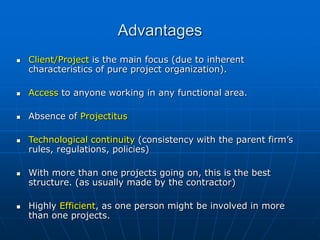
Advantages
 Client/Project is the main focus (due to inherent
characteristics of pure project organization).
 Access to anyone working in any functional area.
 Absence of Projectitus
 Technological continuity (consistency with the parent firm’s
rules, regulations, policies)
 With more than one projects going on, this is the best
structure. (as usually made by the contractor)
 Highly Efficient, as one person might be involved in more
than one projects.
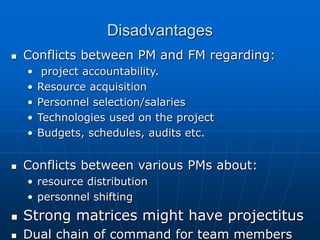
Disadvantages
 Conflicts between PM and FM regarding:
• project accountability.
• Resource acquisition
• Personnel selection/salaries
• Technologies used on the project
• Budgets, schedules, audits etc.
 Conflicts between various PMs about:
• resource distribution
• personnel shifting
 Strong matrices might have projectitus
 Dual chain of command for team members

Project Organization.ppt

  • 1.
    Functional Organization • Projectis made part of a functional organization • Project may be undertaken by one or more of the functional departments. The project is provided a parent department or it may be given to all the departments and head of organization might supervise it. • Project is an additional responsibility for the team members which are otherwise busy in their routine departmental/functional activities
  • 2.
    Vice Chancellor Faculty of Information Technology Facultyof Business & Commerce (Dean) Dept of Business Admin. (Chairman) Administration Administration Manager Clerks / Assistants Teaching Staff Professors Associate Professors Assistant Professors Lecturers Dept of Commerce Faculty of Pure Sciences Faculty of Agriculture Admin. Dept. General Registration Examination Planning & Development ….. N
  • 3.
    Project: Workshop onProject Management Techniques  Project Manager: Chairman, Department of Business Admin.  Assistant Project Manager: Associate Professor, Department of Business Admin.  Member: Assistant Professor – 1  Member: Lecturers – 2  Member: Clerk – 1  Total members in team = 06
  • 4.
    Vice Chancellor Faculty of Information Technology Facultyof Business & Commerce (Dean) Dept of Business Admin. (Chairman) Administration Administration Manager Clerks / Assistants Teaching Staff Professors Associate Professors Assistant Professors Lecturers Dept of Commerce Faculty of Pure Sciences Faculty of Agriculture Admin. Dept. General Registration Examination Planning & Development ….. N
  • 5.
    Project: Establishment ofInterdepartmental LAN  Chairman, Computer Science Dept.- PM  Network Administrators = 2  Lecturers = 2  Total Team Members = 5
  • 6.
    Vice Chancellor Computer Science Dept. (Chairman) Administration Manager Clerks Network Adminis. TeachingStaff Professors Associate Professors Asst. Professors Lecturers Faculty of Business & Commerce (Dean) Dept of Business Admin. (Chairman) Dept of Commerce Dept. of Chemistry Languages Dept. Admin. Dept. Registrar Office Degree & Registration Unit --Network Administ. Office of Controller Examination Planning & Development ….. N
  • 7.
    Advantages  Maximum StaffFlexibility • Services of every individual always available  Individuals can join & leave one or more projects at the same time. • This helps in cost control • Ensures maximum staff utilization  Technological Continuity
  • 8.
    Disadvantages  Client is/maynot be the focus • Functional Dept(s) have their own work to do • Temporary Team (Lack of Coordinated effort) • Sub-optimization of project (issues which fall inside the expertise of a functional area may be resolved well and others will be left ignored or suboptimized. • No holistic approach due to reason above. • Lack of motivation for team members  Responsibility is not given usually to a single individual
  • 9.
    Pure Project Organization OR TaskForce Structure  Project is separate from its parent organization  Own administration, own permanent staff working exclusively for the project(s).  Tied to the parent firm through monitoring system and periodic progress reports.
  • 10.
    Organization Structure ofa Consumer Goods Company CEO President V.P. Purchase V.P. Production V.P. Mktg./Sales V.P. Finance V.P. HRD V.P. Project Mgt. Project A Project B Mktg. = 2 Manufac.= 2 R & D = 1 Finance = 1 HRD = 1 Mktg = 3 Mnf. = 1 R & D = 2 Fin. = 1 HRD = 1
  • 11.
    Advantages  Project Manager– Full Authority  Absence of Bureaucracy • Faster Communication • Fast Decision Making • Unity of command  Permanent Team of Experts • Skills are developed according to org./project orientation • Motivation is maximum • Separate Identity • Holistic Approach  Response to Client Needs is Fast  Team is serious about its progress
  • 12.
    Disadvantages  Duplication –highly costly structure  Over Stocking / Over Staffing  Inconsistency with the parent firm regarding rules/regulations, policies.  Projectitus • We – They Approach • Life after the project
  • 13.
    Matrix Organization Structure It is pure project organization imposed on functional organization  Contains the advantages of both previous types  It is common organization structure for External Projects. (Contractors use this type)  The functional departments are typically created to provide relevant expertise in form of individuals for projects.
  • 14.
    Types of MatrixOrganization Structure Types Strong Matrix Weak Matrix Balanced Matrix
  • 15.
    President Program M. Manufac.Marketing HRD R&D Finance/IT PM 1 3 1 ½ ½ 2 1/2 PM 2 1 4 ¼ 4 1/4 PM 3 0 ½ 3 ½ 2 Project 1: New Product Development Project 2: Product Test Marketing Project 3: Computerization of all departments Internal Projects taken by a Consumer Goods Company
  • 16.
    CEO Program M. DirectorCasting Director Marketing Director Consult. Director R&D Director Develop. PM 1 2 1 1/2 3 1 0 PM 2 0 1 0 4 0 PM 3 0 0 0 1 3 External Projects taken by Simax Enterprises (Contractor for Advertising, Marketing Research and Consultancy) Project 1: Development of an advertisement for an Electronic product Project 2: Polling of Consumer Opinion for a new product Project 3: Consultancy provision for a new business establishment.
  • 17.
    Advantages  Client/Project isthe main focus (due to inherent characteristics of pure project organization).  Access to anyone working in any functional area.  Absence of Projectitus  Technological continuity (consistency with the parent firm’s rules, regulations, policies)  With more than one projects going on, this is the best structure. (as usually made by the contractor)  Highly Efficient, as one person might be involved in more than one projects.
  • 18.
    Disadvantages  Conflicts betweenPM and FM regarding: • project accountability. • Resource acquisition • Personnel selection/salaries • Technologies used on the project • Budgets, schedules, audits etc.  Conflicts between various PMs about: • resource distribution • personnel shifting  Strong matrices might have projectitus  Dual chain of command for team members