The Open Budget Survey 2008 Vivek Ramkumar Manager, Open Budget Initiative
What is the Open Budget Survey 2008? A comprehensive survey and analysis that evaluates whether national governments give the public  access to budget information and opportunities to participate in the budget process, and  the strength of formal oversight institutions such as legislatures and auditors. It is independent and non-partisan and is managed by the IBP and implemented by researchers from the 85 countries surveyed.  www.InternationalBudget.org
Key Finding #1: Public Shut out of Budget Process   in the Majority of Countries Only five countries provide  extensive information  on budgets to the public. Forty-one of 85 countries provide only  minimal, scant , or  no information. The budget approval stage is relatively more open than the formulation, execution and audit stages.  Low scoring countries often share similar characteristics, including regional locations, dependence on oil and gas exports and foreign aid, and weakness of democratic institutions. www.InternationalBudget.org
Key Finding #2:  Lack of Transparency is Compounded by Weak Oversight Institutions LEGISLATURE Limited legal powers Inadequate time to review budgets SUPREME AUDIT INSTITUTION Lack independence Limited funding/resources www.InternationalBudget.org
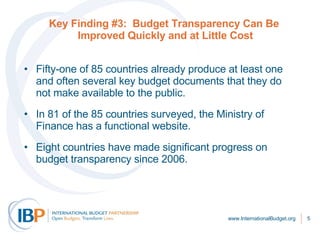
Key Finding #3:  Budget Transparency Can Be  Improved Quickly and at Little Cost Fifty-one of 85 countries already produce at least one and often several key budget documents that they do not make available to the public.  In 81 of the 85 countries surveyed, the Ministry of Finance has a functional website.  Eight countries have made significant progress on budget transparency since 2006.  www.InternationalBudget.org
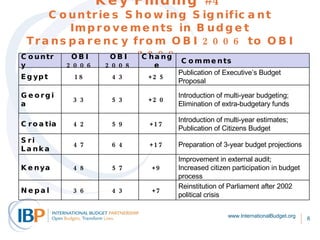
Key Finding #4 Countries Showing Significant Improvements in Budget Transparency from OBI 2006 to OBI 2008   www.InternationalBudget.org Country OBI 2006 OBI 2008 Change Comments Egypt 18 43 +25 Publication of Executive’s Budget Proposal Georgia 33 53 +20 Introduction of multi-year budgeting; Elimination of extra-budgetary funds Croatia 42 59 +17 Introduction of multi-year estimates;  Publication of Citizens Budget Sri Lanka 47 64 +17 Preparation of 3-year budget projections Kenya 48 57 +9 Improvement in external audit; Increased citizen participation in budget process Nepal 36 43 +7 Reinstitution of Parliament after 2002 political crisis
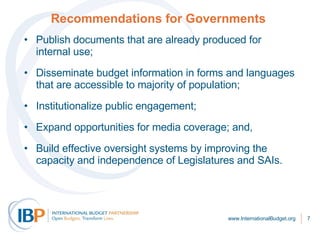
Recommendations for Governments     Publish documents that are already produced for internal use; Disseminate budget information in forms and languages that are accessible to majority of population; Institutionalize public engagement;  Expand opportunities for media coverage; and,  Build effective oversight systems by improving the capacity and independence of Legislatures and SAIs.  www.InternationalBudget.org
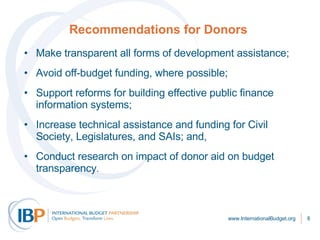
Recommendations for Donors   Make transparent all forms of development assistance;  Avoid off-budget funding, where possible;  Support reforms for building effective public finance information systems; Increase technical assistance and funding for Civil Society, Legislatures, and SAIs; and, Conduct research on impact of donor aid on budget transparency . www.InternationalBudget.org
Contact Information 820 First Street, NE Suite 510 Washington, DC 20002 Phone: +1-202-408-1080 Fax: +1-202-408-8173 Email: info@internationalbudget.org www.InternationalBudget.org

Government for Informed Citizens Obi

  • 1.
    The Open BudgetSurvey 2008 Vivek Ramkumar Manager, Open Budget Initiative
  • 2.
    What is theOpen Budget Survey 2008? A comprehensive survey and analysis that evaluates whether national governments give the public access to budget information and opportunities to participate in the budget process, and the strength of formal oversight institutions such as legislatures and auditors. It is independent and non-partisan and is managed by the IBP and implemented by researchers from the 85 countries surveyed. www.InternationalBudget.org
  • 3.
    Key Finding #1:Public Shut out of Budget Process in the Majority of Countries Only five countries provide extensive information on budgets to the public. Forty-one of 85 countries provide only minimal, scant , or no information. The budget approval stage is relatively more open than the formulation, execution and audit stages. Low scoring countries often share similar characteristics, including regional locations, dependence on oil and gas exports and foreign aid, and weakness of democratic institutions. www.InternationalBudget.org
  • 4.
    Key Finding #2: Lack of Transparency is Compounded by Weak Oversight Institutions LEGISLATURE Limited legal powers Inadequate time to review budgets SUPREME AUDIT INSTITUTION Lack independence Limited funding/resources www.InternationalBudget.org
  • 5.
    Key Finding #3: Budget Transparency Can Be Improved Quickly and at Little Cost Fifty-one of 85 countries already produce at least one and often several key budget documents that they do not make available to the public. In 81 of the 85 countries surveyed, the Ministry of Finance has a functional website. Eight countries have made significant progress on budget transparency since 2006. www.InternationalBudget.org
  • 6.
    Key Finding #4Countries Showing Significant Improvements in Budget Transparency from OBI 2006 to OBI 2008 www.InternationalBudget.org Country OBI 2006 OBI 2008 Change Comments Egypt 18 43 +25 Publication of Executive’s Budget Proposal Georgia 33 53 +20 Introduction of multi-year budgeting; Elimination of extra-budgetary funds Croatia 42 59 +17 Introduction of multi-year estimates; Publication of Citizens Budget Sri Lanka 47 64 +17 Preparation of 3-year budget projections Kenya 48 57 +9 Improvement in external audit; Increased citizen participation in budget process Nepal 36 43 +7 Reinstitution of Parliament after 2002 political crisis
  • 7.
    Recommendations for Governments Publish documents that are already produced for internal use; Disseminate budget information in forms and languages that are accessible to majority of population; Institutionalize public engagement; Expand opportunities for media coverage; and, Build effective oversight systems by improving the capacity and independence of Legislatures and SAIs. www.InternationalBudget.org
  • 8.
    Recommendations for Donors Make transparent all forms of development assistance; Avoid off-budget funding, where possible; Support reforms for building effective public finance information systems; Increase technical assistance and funding for Civil Society, Legislatures, and SAIs; and, Conduct research on impact of donor aid on budget transparency . www.InternationalBudget.org
  • 9.
    Contact Information 820First Street, NE Suite 510 Washington, DC 20002 Phone: +1-202-408-1080 Fax: +1-202-408-8173 Email: info@internationalbudget.org www.InternationalBudget.org