Samco Scandinavia
                  Goodwood Ship Management
Disclaimer: This Presentation is made from copied material from internet research and Goodwood
SMS reference


                                                                                                 Pankaj K Jha
                                                                                                 Chief Officer
                    Samco Scandinavia, Goodwood Ship
                    Management                                                                           1
The purpose of Garbage Management plan is to provide guidance to the Master and
crew on board the ship on the procedures for collecting, storing, processing and
disposing of garbage, including the use of the equipment on board.

The Plan is written in accordance with the requirements of Regulation 10 of the
revised MARPOL Annex V (IMO Resolution MEPC.201(62) with an entry into force
date of 1 January, 2013.

The guidelines contained in IMO Resolution MEPC.219(63) and MEPC.220(63)
are used as a direction on complying with mandatory requirements for the
development of a ship’s Garbage Management Plan and in implementing
regulation 10.2 of the revised MARPOL Annex V.


                           Samco Scandinavia, Goodwood Ship
                                     Management                                    2
Designated officer ?


(i.e. Chief Officer) for shipboard handling and discharge of garbage. Chief Officer shall
also ensure that persons responsible to operate garbage handing equipments listed in
appendix-7 are suitably trained.

Placards
The placards shall be written in the working language of the ship’s crew
The placards shall be permanently posted stating the prohibition and restrictions for
discharging garbage from ships under MARPOL Annex V and the possible penalties
for failure to comply.
Placards should also be replaced when damage or wear compromises the readability
Placards should be displayed at eye line height and be printed in the working language
of the crew.


                             Samco Scandinavia, Goodwood Ship
                                       Management                                     3
Samco Scandinavia, Goodwood Ship
          Management               4
Samco Scandinavia, Goodwood Ship
          Management               5
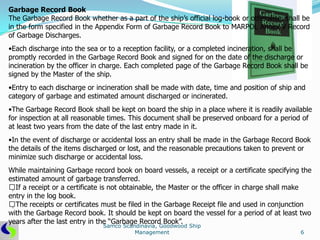
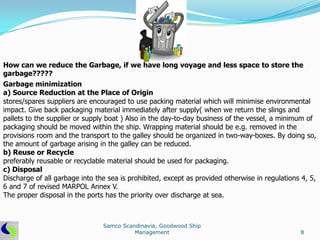
Garbage Record Book
The Garbage Record Book whether as a part of the ship’s official log-book or otherwise, shall be
in the form specified in the Appendix Form of Garbage Record Book to MARPOL Annex V Record
of Garbage Discharges.
•Each discharge into the sea or to a reception facility, or a completed incineration, shall be
promptly recorded in the Garbage Record Book and signed for on the date of the discharge or
incineration by the officer in charge. Each completed page of the Garbage Record Book shall be
signed by the Master of the ship.
•Entry to each discharge or incineration shall be made with date, time and position of ship and
category of garbage and estimated amount discharged or incinerated.
•The Garbage Record Book shall be kept on board the ship in a place where it is readily available
for inspection at all reasonable times. This document shall be preserved onboard for a period of
at least two years from the date of the last entry made in it.
•In the event of discharge or accidental loss an entry shall be made in the Garbage Record Book
the details of the items discharged or lost, and the reasonable precautions taken to prevent or
minimize such discharge or accidental loss.
While maintaining Garbage record book on board vessels, a receipt or a certificate specifying the
estimated amount of garbage transferred.
If a receipt or a certificate is not obtainable, the Master or the officer in charge shall make
entry in the log book.
The receipts or certificates must be filed in the Garbage Receipt file and used in conjunction
with the Garbage Record book. It should be kept on board the vessel for a period of at least two
years after the last entry in the “Garbage Record Book”.
                              Samco Scandinavia, Goodwood Ship
                                        Management                                           6
Garbage Record Book
Garbage is to be grouped into categories for the
purposes of the Garbage Record
Book (or ship's official log-book) as follows:
A. Plastics
B. Food wastes
C. Domestic wastes (e.g., paper products, rags,
glass, metal, bottles,
crockery, etc.)
D. Cooking oil
E. Incinerator Ashes
F. Operational wastes
G. Cargo residues
H. Animal Carcass(es)
I. Fishing gear


                          Samco Scandinavia, Goodwood Ship
                                    Management               7
How can we reduce the Garbage, if we have long voyage and less space to store the
garbage?????
Garbage minimization
a) Source Reduction at the Place of Origin
stores/spares suppliers are encouraged to use packing material which will minimise environmental
impact. Give back packaging material immediately after supply( when we return the slings and
pallets to the supplier or supply boat ) Also in the day-to-day business of the vessel, a minimum of
packaging should be moved within the ship. Wrapping material should be e.g. removed in the
provisions room and the transport to the galley should be organized in two-way-boxes. By doing so,
the amount of garbage arising in the galley can be reduced.
b) Reuse or Recycle
preferably reusable or recyclable material should be used for packaging.
c) Disposal
Discharge of all garbage into the sea is prohibited, except as provided otherwise in regulations 4, 5,
6 and 7 of revised MARPOL Annex V.
The proper disposal in the ports has the priority over discharge at sea.


                                Samco Scandinavia, Goodwood Ship
                                          Management                                            8
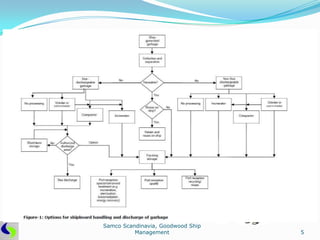
Shipboard garbage handling (collection, processing, storage and
discharge)
Regulation 3 of MARPOL Annex V provides that the discharge of all garbage into the sea is
prohibited, with limited exceptions, as summarised in Table-1. Under certain conditions,
discharge into the sea is permitted for food wastes; animal carcasses; cleaning agents and
additives contained in hold wash water, deck and external surface wash water; and cargo
residues which are not considered to be harmful to the marine environment.
Special exceptions for the discharge of garbage
Regulation 3, 4, 5 and 6 of MARPOL Annex V shall not apply to:
a) The discharge of garbage from a ship necessary for the purpose of securing the safety of a
    ship and those on board or saving life at sea; or
b) The accidental loss of garbage resulting from damage to a ship or its equipment provided all
    reasonable precautions have been taken before and after the occurrence of the damage, to
    prevent or minimize the accidental loss; or
c) The accidental loss of fishing gear from a ship provided that all reasonable precautions have
been taken to prevent such loss; or
d) The discharge of fishing gear from a ship for the protection of the marine
environment or for the safety of that ship or its crew.


                              Samco Scandinavia, Goodwood Ship
                                        Management                                          9
Designated person in charge of carrying out the plan
Master and Chief Engineer shall have overall responsibility to ensure that Garbage Management
Plan is effectively implemented. In accordance with the regulation 10.2 of the revised MARPOL
Annex V.
Chief Officer is designated as the person in-charge of carrying out the Garbage Management
Plan and is responsible for implementing the procedures within the Garbage Management Plan.
The Chief Officer will be assisted by personnel of all departments Chief Officer shall assign
duties of collection and stowage of garbage from deck and accommodation areas to Bosun.
Bosun shall be assisted by other crewmembers in collection, separation and stowage of garbage.
For galley area & accommodation areas, duties of collection and stowage of
Garbage shall be assigned to Chief cook.
Chief Cook shall be assisted by other galley crew in collection, separation and
stowage of garbage.

Chief Engineer and 2nd Engineer has the day to day responsibility for the collection and stowage of
garbage from the Engine department including store rooms, workshops, lockers, casings,
Emergency generator room etc.
2ndEngineer shall assign duties of collection and stowage of garbage from engine room to
responsible person from engine crew.
The 2nd Engineer has the obligation to assist the Chief Officer in the education of the crew
concerning garbage handling.
All shipboard personnel who are assigned tasks as required by this procedure
shall comply with this plan.


                               Samco Scandinavia, Goodwood Ship
                                         Management                                          10
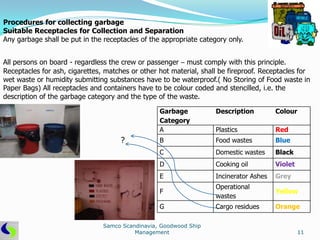
Procedures for collecting garbage
Suitable Receptacles for Collection and Separation
Any garbage shall be put in the receptacles of the appropriate category only.


All persons on board - regardless the crew or passenger – must comply with this principle.
Receptacles for ash, cigarettes, matches or other hot material, shall be fireproof. Receptacles for
wet waste or humidity submitting substances have to be waterproof.( No Storing of Food waste in
Paper Bags) All receptacles and containers have to be colour coded and stencilled, i.e. the
description of the garbage category and the type of the waste.

                                                  Garbage           Description         Colour
                                                  Category
                                                  A                 Plastics            Red
                                     ?            B                 Food wastes         Blue
                                                  C                 Domestic wastes     Black
                                                  D                 Cooking oil         Violet
                                                  E                 Incinerator Ashes   Grey
                                                                    Operational
                                                  F                                     Yellow
                                                                    wastes
                                                  G                 Cargo residues      Orange

                                Samco Scandinavia, Goodwood Ship
                                          Management                                             11
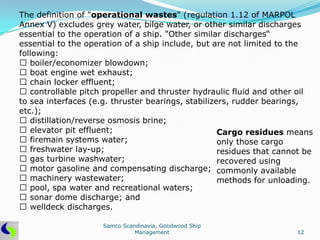
The definition of "operational wastes" (regulation 1.12 of MARPOL
Annex V) excludes grey water, bilge water, or other similar discharges
essential to the operation of a ship. "Other similar discharges“
essential to the operation of a ship include, but are not limited to the
following:
 boiler/economizer blowdown;
 boat engine wet exhaust;
 chain locker effluent;
 controllable pitch propeller and thruster hydraulic fluid and other oil
to sea interfaces (e.g. thruster bearings, stabilizers, rudder bearings,
etc.);
 distillation/reverse osmosis brine;
 elevator pit effluent;                            Cargo residues means
 firemain systems water;                           only those cargo
 freshwater lay-up;                                residues that cannot be
 gas turbine washwater;                            recovered using
 motor gasoline and compensating discharge; commonly available
 machinery wastewater;                             methods for unloading.
 pool, spa water and recreational waters;
 sonar dome discharge; and
 welldeck discharges.

                     Samco Scandinavia, Goodwood Ship
                               Management                             12
So, are we doing proper Garbage Segregation?


                                                       Paper in Food waste!!!

                                                       Who segregates this???

                                                       Steward?

                                                       Chief Officer??

                                                       Or “You”


                    Samco Scandinavia, Goodwood Ship
                              Management                                    13
C. Transport from the Source of Generation to the Collection and
Separation Stations
a. Garbage in the Crew Area (Crew Cabins)
The cabins of the ship’s officers are shall be served by galley crew. All other crew cabins shall be
served by the respective crew. They shall bring their garbage to the central collection and
separation stations in the receptacles located in their cabins.
b. Garbage in the Accommodation Area
Garbage arising in the accommodation area of the crew and in common areas shall be collected
in receptacles served by the galley crew / deck crew. Cans, bottles, etc. which are generated in
galley, dining room, saloon and private rooms shall be collected separately by each individuals.
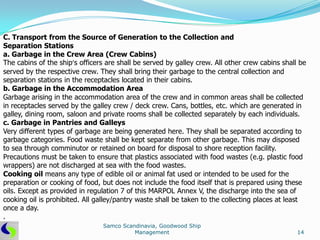
c. Garbage in Pantries and Galleys
Very different types of garbage are being generated here. They shall be separated according to
garbage categories. Food waste shall be kept separate from other garbage. This may disposed
to sea through comminutor or retained on board for disposal to shore reception facility.
Precautions must be taken to ensure that plastics associated with food wastes (e.g. plastic food
wrappers) are not discharged at sea with the food wastes.
Cooking oil means any type of edible oil or animal fat used or intended to be used for the
preparation or cooking of food, but does not include the food itself that is prepared using these
oils. Except as provided in regulation 7 of this MARPOL Annex V, the discharge into the sea of
cooking oil is prohibited. All galley/pantry waste shall be taken to the collecting places at least
once a day.
.
                                 Samco Scandinavia, Goodwood Ship
                                           Management                                            14
d. Cargo-associated Waste(N/A Tankers)
These are all materials which have become wastes as a result of use on board a ship
for cargo stowage and handling. The cargo associated wastes include, but are not
limited to dunnage, shoring, pallets, lining and packing materials, plywood, paper,
cardboard, separation nets, jute cloths, wire and steel strapping. The waste is
collected and separated by responsible person for the deck area.
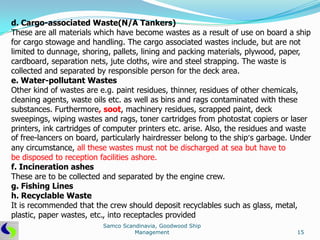
e. Water-pollutant Wastes
Other kind of wastes are e.g. paint residues, thinner, residues of other chemicals,
cleaning agents, waste oils etc. as well as bins and rags contaminated with these
substances. Furthermore, soot, machinery residues, scrapped paint, deck
sweepings, wiping wastes and rags, toner cartridges from photostat copiers or laser
printers, ink cartridges of computer printers etc. arise. Also, the residues and waste
of free-lancers on board, particularly hairdresser belong to the ship’s garbage. Under
any circumstance, all these wastes must not be discharged at sea but have to
be disposed to reception facilities ashore.
f. Incineration ashes
These are to be collected and separated by the engine crew.
g. Fishing Lines
h. Recyclable Waste
It is recommended that the crew should deposit recyclables such as glass, metal,
plastic, paper wastes, etc., into receptacles provided
                          Samco Scandinavia, Goodwood Ship
                                    Management                                    15
Ship’s Training or Education Programmes to Facilitate Collection
of Garbage
This is what we are doing now.
After joining the Company vessels, all crew members shall receive an introduction to Garbage
Management Plan. The treatment of garbage and keeping the oceans and waters clean is an
integral part of on-board familiarization programme.
Before commencement of the voyage, ship’s officers shall give a brief introduction about voyage
schedule, in which all crew members on board shall take part. Garbage handling during the voyage
shall be discussed in this briefing.
In addition to that, this Garbage Management Plan shall be made available to everyone at any time
for information.
The Chief Officer with the assistance of 2nd engineer shall provide training to all
crew involved in operating garbage processing equipment and collecting,
separating and disposing of garbage as part of their operational responsibilities.
This should be carried out during on board familiarization (Ref to 08.10.082)


                               Samco Scandinavia, Goodwood Ship
                                         Management                                        16
Compactors


Compactors make garbage easier to store on board ship and to
transfer to port reception facilities.
A compactor shall be installed in a compartment with adequate
room for operating and maintaining the unit and for storing the
trash to be processed.
Eg. At Hound Point the charge for landing garbage ashore was
approximately 2100$ per Cubic Meter. If the garbage like Plastic,
Cartons and Papers are not compacted they tend to appear in
sizes approximately 5 times that of the compacted size
it is recommended that the space where compactor is installed
should have freshwater wash down service, coamings, deck
drains, adequate ventilation and hand or automatic fixed fire-
fighting equipment.
.


                                Samco Scandinavia, Goodwood Ship
                                          Management                17
Grinders or comminutors


The discharge of comminuted food wastes may be permitted under
regulations4.1.1 and 6.1.1 of MARPOL Annex V while the ship is en
route. Such comminuted or ground food waste must be capable of
passing through a screen with openings no greater than 25 mm.
Most modern ships' galleys have the equipment needed to produce slurry
of food particles and water that washes easily through the required 25
mm screen. Output ranges from 10 to 250 litres per minute. Although
larger food scraps may be discharged beyond 12 nautical miles, it is
recommended that comminutors be used even outside this limit because
they hasten assimilation into the marine environment. Because food
wastes comminuted with plastics cannot be discharged at sea, all plastic
materials must be removed before food wastes are ground up.
When operating inside a special area, regulation 6 of MARPOL Annex V
requires all food wastes to be comminuted or ground before discharge
into the sea. All discharges are to be made as far as practicable and not
less than 12 nautical miles from the nearest land or ice-shelf.


                               Samco Scandinavia, Goodwood Ship
                                         Management                         18
Incinerators
Incineration conducted in a shipboard incinerator can significantly reduce the need to store garbage
on board the ship. Shipboard incinerators should be designed, constructed, operated and
maintained in accordance with the IMO Standard Specification for Shipboard Incinerators (IMO
Resolution MEPC.76(40) as amended). MARPOL Annex VI requires shipboard incinerators installed
after 1 January 2000 to be type approved and meet specific air pollution criteria. Incinerators
should only be used to incinerate materials that are specified by the incinerator manufacturer.
Annex VI prohibits the incineration of MARPOL Annex I, II and III cargo residues, related
contaminated packing materials, The incineration of sewage sludge and sludge oil,generated during
the normal operation of the ship, is allowed in main or auxiliary power plant or boilers under Annex
VI, but incineration by such methods is banned in ports, harbors and estuaries.
Note: Residue from plastic incineration is still considered plastic and
thus cannot be discharged overboard.


                               Samco Scandinavia, Goodwood Ship
                                         Management                                          19
Review of Garbage management Plan
The Office shall review garbage management plan on annual basis. Master shall conduct review of
this plan while preparing master’s review.
Technical Superintendents shall ensure that this plan is effectively implemented and records are
maintained as required by MARPOL, Annex V. They shall ensure that garbage processing
equipments are maintained in good order at all times.
During internal audits, auditors shall check the contents of this plan, garbage record book, garbage
receipt file, garbage collection, separation & stowage areas. Master’s review shall be checked for
any suggestion given to improvise this plan.

                              Group Discussion and Doubts


                                Samco Scandinavia, Goodwood Ship
                                          Management                                          20

Garbage management marpol 2012 training

  • 1.
    Samco Scandinavia Goodwood Ship Management Disclaimer: This Presentation is made from copied material from internet research and Goodwood SMS reference Pankaj K Jha Chief Officer Samco Scandinavia, Goodwood Ship Management 1
  • 2.
    The purpose ofGarbage Management plan is to provide guidance to the Master and crew on board the ship on the procedures for collecting, storing, processing and disposing of garbage, including the use of the equipment on board. The Plan is written in accordance with the requirements of Regulation 10 of the revised MARPOL Annex V (IMO Resolution MEPC.201(62) with an entry into force date of 1 January, 2013. The guidelines contained in IMO Resolution MEPC.219(63) and MEPC.220(63) are used as a direction on complying with mandatory requirements for the development of a ship’s Garbage Management Plan and in implementing regulation 10.2 of the revised MARPOL Annex V. Samco Scandinavia, Goodwood Ship Management 2
  • 3.
    Designated officer ? (i.e.Chief Officer) for shipboard handling and discharge of garbage. Chief Officer shall also ensure that persons responsible to operate garbage handing equipments listed in appendix-7 are suitably trained. Placards The placards shall be written in the working language of the ship’s crew The placards shall be permanently posted stating the prohibition and restrictions for discharging garbage from ships under MARPOL Annex V and the possible penalties for failure to comply. Placards should also be replaced when damage or wear compromises the readability Placards should be displayed at eye line height and be printed in the working language of the crew. Samco Scandinavia, Goodwood Ship Management 3
  • 4.
    Samco Scandinavia, GoodwoodShip Management 4
  • 5.
    Samco Scandinavia, GoodwoodShip Management 5
  • 6.
    Garbage Record Book TheGarbage Record Book whether as a part of the ship’s official log-book or otherwise, shall be in the form specified in the Appendix Form of Garbage Record Book to MARPOL Annex V Record of Garbage Discharges. •Each discharge into the sea or to a reception facility, or a completed incineration, shall be promptly recorded in the Garbage Record Book and signed for on the date of the discharge or incineration by the officer in charge. Each completed page of the Garbage Record Book shall be signed by the Master of the ship. •Entry to each discharge or incineration shall be made with date, time and position of ship and category of garbage and estimated amount discharged or incinerated. •The Garbage Record Book shall be kept on board the ship in a place where it is readily available for inspection at all reasonable times. This document shall be preserved onboard for a period of at least two years from the date of the last entry made in it. •In the event of discharge or accidental loss an entry shall be made in the Garbage Record Book the details of the items discharged or lost, and the reasonable precautions taken to prevent or minimize such discharge or accidental loss. While maintaining Garbage record book on board vessels, a receipt or a certificate specifying the estimated amount of garbage transferred. If a receipt or a certificate is not obtainable, the Master or the officer in charge shall make entry in the log book. The receipts or certificates must be filed in the Garbage Receipt file and used in conjunction with the Garbage Record book. It should be kept on board the vessel for a period of at least two years after the last entry in the “Garbage Record Book”. Samco Scandinavia, Goodwood Ship Management 6
  • 7.
    Garbage Record Book Garbageis to be grouped into categories for the purposes of the Garbage Record Book (or ship's official log-book) as follows: A. Plastics B. Food wastes C. Domestic wastes (e.g., paper products, rags, glass, metal, bottles, crockery, etc.) D. Cooking oil E. Incinerator Ashes F. Operational wastes G. Cargo residues H. Animal Carcass(es) I. Fishing gear Samco Scandinavia, Goodwood Ship Management 7
  • 8.
    How can wereduce the Garbage, if we have long voyage and less space to store the garbage????? Garbage minimization a) Source Reduction at the Place of Origin stores/spares suppliers are encouraged to use packing material which will minimise environmental impact. Give back packaging material immediately after supply( when we return the slings and pallets to the supplier or supply boat ) Also in the day-to-day business of the vessel, a minimum of packaging should be moved within the ship. Wrapping material should be e.g. removed in the provisions room and the transport to the galley should be organized in two-way-boxes. By doing so, the amount of garbage arising in the galley can be reduced. b) Reuse or Recycle preferably reusable or recyclable material should be used for packaging. c) Disposal Discharge of all garbage into the sea is prohibited, except as provided otherwise in regulations 4, 5, 6 and 7 of revised MARPOL Annex V. The proper disposal in the ports has the priority over discharge at sea. Samco Scandinavia, Goodwood Ship Management 8
  • 9.
    Shipboard garbage handling(collection, processing, storage and discharge) Regulation 3 of MARPOL Annex V provides that the discharge of all garbage into the sea is prohibited, with limited exceptions, as summarised in Table-1. Under certain conditions, discharge into the sea is permitted for food wastes; animal carcasses; cleaning agents and additives contained in hold wash water, deck and external surface wash water; and cargo residues which are not considered to be harmful to the marine environment. Special exceptions for the discharge of garbage Regulation 3, 4, 5 and 6 of MARPOL Annex V shall not apply to: a) The discharge of garbage from a ship necessary for the purpose of securing the safety of a ship and those on board or saving life at sea; or b) The accidental loss of garbage resulting from damage to a ship or its equipment provided all reasonable precautions have been taken before and after the occurrence of the damage, to prevent or minimize the accidental loss; or c) The accidental loss of fishing gear from a ship provided that all reasonable precautions have been taken to prevent such loss; or d) The discharge of fishing gear from a ship for the protection of the marine environment or for the safety of that ship or its crew. Samco Scandinavia, Goodwood Ship Management 9
  • 10.
    Designated person incharge of carrying out the plan Master and Chief Engineer shall have overall responsibility to ensure that Garbage Management Plan is effectively implemented. In accordance with the regulation 10.2 of the revised MARPOL Annex V. Chief Officer is designated as the person in-charge of carrying out the Garbage Management Plan and is responsible for implementing the procedures within the Garbage Management Plan. The Chief Officer will be assisted by personnel of all departments Chief Officer shall assign duties of collection and stowage of garbage from deck and accommodation areas to Bosun. Bosun shall be assisted by other crewmembers in collection, separation and stowage of garbage. For galley area & accommodation areas, duties of collection and stowage of Garbage shall be assigned to Chief cook. Chief Cook shall be assisted by other galley crew in collection, separation and stowage of garbage. Chief Engineer and 2nd Engineer has the day to day responsibility for the collection and stowage of garbage from the Engine department including store rooms, workshops, lockers, casings, Emergency generator room etc. 2ndEngineer shall assign duties of collection and stowage of garbage from engine room to responsible person from engine crew. The 2nd Engineer has the obligation to assist the Chief Officer in the education of the crew concerning garbage handling. All shipboard personnel who are assigned tasks as required by this procedure shall comply with this plan. Samco Scandinavia, Goodwood Ship Management 10
  • 11.
    Procedures for collectinggarbage Suitable Receptacles for Collection and Separation Any garbage shall be put in the receptacles of the appropriate category only. All persons on board - regardless the crew or passenger – must comply with this principle. Receptacles for ash, cigarettes, matches or other hot material, shall be fireproof. Receptacles for wet waste or humidity submitting substances have to be waterproof.( No Storing of Food waste in Paper Bags) All receptacles and containers have to be colour coded and stencilled, i.e. the description of the garbage category and the type of the waste. Garbage Description Colour Category A Plastics Red ? B Food wastes Blue C Domestic wastes Black D Cooking oil Violet E Incinerator Ashes Grey Operational F Yellow wastes G Cargo residues Orange Samco Scandinavia, Goodwood Ship Management 11
  • 12.
    The definition of"operational wastes" (regulation 1.12 of MARPOL Annex V) excludes grey water, bilge water, or other similar discharges essential to the operation of a ship. "Other similar discharges“ essential to the operation of a ship include, but are not limited to the following:  boiler/economizer blowdown;  boat engine wet exhaust;  chain locker effluent;  controllable pitch propeller and thruster hydraulic fluid and other oil to sea interfaces (e.g. thruster bearings, stabilizers, rudder bearings, etc.);  distillation/reverse osmosis brine;  elevator pit effluent; Cargo residues means  firemain systems water; only those cargo  freshwater lay-up; residues that cannot be  gas turbine washwater; recovered using  motor gasoline and compensating discharge; commonly available  machinery wastewater; methods for unloading.  pool, spa water and recreational waters;  sonar dome discharge; and  welldeck discharges. Samco Scandinavia, Goodwood Ship Management 12
  • 13.
    So, are wedoing proper Garbage Segregation? Paper in Food waste!!! Who segregates this??? Steward? Chief Officer?? Or “You” Samco Scandinavia, Goodwood Ship Management 13
  • 14.
    C. Transport fromthe Source of Generation to the Collection and Separation Stations a. Garbage in the Crew Area (Crew Cabins) The cabins of the ship’s officers are shall be served by galley crew. All other crew cabins shall be served by the respective crew. They shall bring their garbage to the central collection and separation stations in the receptacles located in their cabins. b. Garbage in the Accommodation Area Garbage arising in the accommodation area of the crew and in common areas shall be collected in receptacles served by the galley crew / deck crew. Cans, bottles, etc. which are generated in galley, dining room, saloon and private rooms shall be collected separately by each individuals. c. Garbage in Pantries and Galleys Very different types of garbage are being generated here. They shall be separated according to garbage categories. Food waste shall be kept separate from other garbage. This may disposed to sea through comminutor or retained on board for disposal to shore reception facility. Precautions must be taken to ensure that plastics associated with food wastes (e.g. plastic food wrappers) are not discharged at sea with the food wastes. Cooking oil means any type of edible oil or animal fat used or intended to be used for the preparation or cooking of food, but does not include the food itself that is prepared using these oils. Except as provided in regulation 7 of this MARPOL Annex V, the discharge into the sea of cooking oil is prohibited. All galley/pantry waste shall be taken to the collecting places at least once a day. . Samco Scandinavia, Goodwood Ship Management 14
  • 15.
    d. Cargo-associated Waste(N/ATankers) These are all materials which have become wastes as a result of use on board a ship for cargo stowage and handling. The cargo associated wastes include, but are not limited to dunnage, shoring, pallets, lining and packing materials, plywood, paper, cardboard, separation nets, jute cloths, wire and steel strapping. The waste is collected and separated by responsible person for the deck area. e. Water-pollutant Wastes Other kind of wastes are e.g. paint residues, thinner, residues of other chemicals, cleaning agents, waste oils etc. as well as bins and rags contaminated with these substances. Furthermore, soot, machinery residues, scrapped paint, deck sweepings, wiping wastes and rags, toner cartridges from photostat copiers or laser printers, ink cartridges of computer printers etc. arise. Also, the residues and waste of free-lancers on board, particularly hairdresser belong to the ship’s garbage. Under any circumstance, all these wastes must not be discharged at sea but have to be disposed to reception facilities ashore. f. Incineration ashes These are to be collected and separated by the engine crew. g. Fishing Lines h. Recyclable Waste It is recommended that the crew should deposit recyclables such as glass, metal, plastic, paper wastes, etc., into receptacles provided Samco Scandinavia, Goodwood Ship Management 15
  • 16.
    Ship’s Training orEducation Programmes to Facilitate Collection of Garbage This is what we are doing now. After joining the Company vessels, all crew members shall receive an introduction to Garbage Management Plan. The treatment of garbage and keeping the oceans and waters clean is an integral part of on-board familiarization programme. Before commencement of the voyage, ship’s officers shall give a brief introduction about voyage schedule, in which all crew members on board shall take part. Garbage handling during the voyage shall be discussed in this briefing. In addition to that, this Garbage Management Plan shall be made available to everyone at any time for information. The Chief Officer with the assistance of 2nd engineer shall provide training to all crew involved in operating garbage processing equipment and collecting, separating and disposing of garbage as part of their operational responsibilities. This should be carried out during on board familiarization (Ref to 08.10.082) Samco Scandinavia, Goodwood Ship Management 16
  • 17.
    Compactors Compactors make garbageeasier to store on board ship and to transfer to port reception facilities. A compactor shall be installed in a compartment with adequate room for operating and maintaining the unit and for storing the trash to be processed. Eg. At Hound Point the charge for landing garbage ashore was approximately 2100$ per Cubic Meter. If the garbage like Plastic, Cartons and Papers are not compacted they tend to appear in sizes approximately 5 times that of the compacted size it is recommended that the space where compactor is installed should have freshwater wash down service, coamings, deck drains, adequate ventilation and hand or automatic fixed fire- fighting equipment. . Samco Scandinavia, Goodwood Ship Management 17
  • 18.
    Grinders or comminutors Thedischarge of comminuted food wastes may be permitted under regulations4.1.1 and 6.1.1 of MARPOL Annex V while the ship is en route. Such comminuted or ground food waste must be capable of passing through a screen with openings no greater than 25 mm. Most modern ships' galleys have the equipment needed to produce slurry of food particles and water that washes easily through the required 25 mm screen. Output ranges from 10 to 250 litres per minute. Although larger food scraps may be discharged beyond 12 nautical miles, it is recommended that comminutors be used even outside this limit because they hasten assimilation into the marine environment. Because food wastes comminuted with plastics cannot be discharged at sea, all plastic materials must be removed before food wastes are ground up. When operating inside a special area, regulation 6 of MARPOL Annex V requires all food wastes to be comminuted or ground before discharge into the sea. All discharges are to be made as far as practicable and not less than 12 nautical miles from the nearest land or ice-shelf. Samco Scandinavia, Goodwood Ship Management 18
  • 19.
    Incinerators Incineration conducted ina shipboard incinerator can significantly reduce the need to store garbage on board the ship. Shipboard incinerators should be designed, constructed, operated and maintained in accordance with the IMO Standard Specification for Shipboard Incinerators (IMO Resolution MEPC.76(40) as amended). MARPOL Annex VI requires shipboard incinerators installed after 1 January 2000 to be type approved and meet specific air pollution criteria. Incinerators should only be used to incinerate materials that are specified by the incinerator manufacturer. Annex VI prohibits the incineration of MARPOL Annex I, II and III cargo residues, related contaminated packing materials, The incineration of sewage sludge and sludge oil,generated during the normal operation of the ship, is allowed in main or auxiliary power plant or boilers under Annex VI, but incineration by such methods is banned in ports, harbors and estuaries. Note: Residue from plastic incineration is still considered plastic and thus cannot be discharged overboard. Samco Scandinavia, Goodwood Ship Management 19
  • 20.
    Review of Garbagemanagement Plan The Office shall review garbage management plan on annual basis. Master shall conduct review of this plan while preparing master’s review. Technical Superintendents shall ensure that this plan is effectively implemented and records are maintained as required by MARPOL, Annex V. They shall ensure that garbage processing equipments are maintained in good order at all times. During internal audits, auditors shall check the contents of this plan, garbage record book, garbage receipt file, garbage collection, separation & stowage areas. Master’s review shall be checked for any suggestion given to improvise this plan. Group Discussion and Doubts Samco Scandinavia, Goodwood Ship Management 20