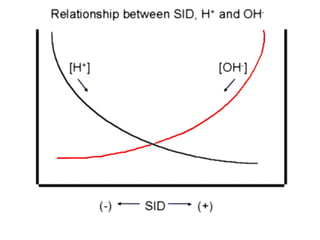
Fencl–Stewart approach:   Telaah Kasus Gangguan Asam-Basa Kiki MK Samsi, dr.,Sp.A, M.Kes   Pediatric Critical Care Unit Tarumanagara University - Sumber Waras Hospital
 
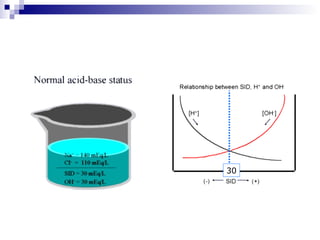
30
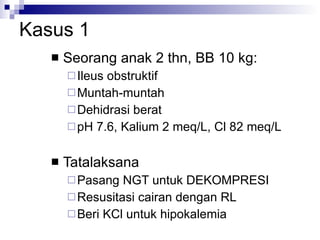
Kasus 1 Seorang anak 2 thn, BB 10 kg:  Ileus obstruktif Muntah-muntah  Dehidrasi berat pH 7.6, Kalium 2 meq/L, Cl 82 meq/L Tatalaksana Pasang NGT untuk DEKOMPRESI Resusitasi cairan dengan RL Beri KCl untuk hipokalemia
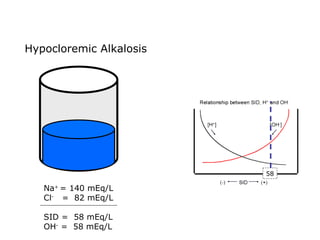
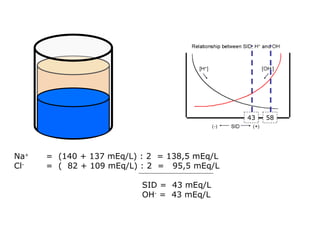
Na +  = 140 mEq/L Cl -   =  82 mEq/L SID =  58 mEq/L OH -  =  58 mEq/L Hypocloremic Alkalosis 58
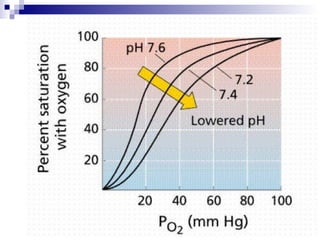
The adverse effects of a severe alkalosis   Decreased myocardial contractility  Arrhythmias  Decreased cerebral blood flow  Confusion  Mental obtundation  Neuromuscular excitability  Impaired peripheral oxygen unloading (due shift of oxygen dissociation curve to left).
 
The adverse effects of a severe alkalosis   Hypoventilation (due respiratory response to metabolic alkalosis)  Pulmonary microatelectasis (consequent on hypoventilation)  Increased ventilation-perfusion mismatch (as alkalosis inhibits hypoxic pulmonary vasoconstriction).
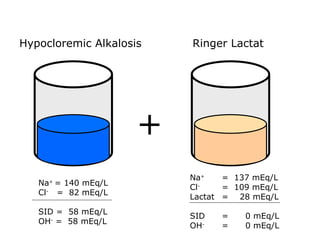
Na +  = 140 mEq/L Cl -   =  82 mEq/L SID =  58 mEq/L OH -  =  58 mEq/L + Hypocloremic Alkalosis Na +  =  137 mEq/L Cl -   =  109 mEq/L Lactat  =  28 mEq/L SID  =  0 mEq/L OH -   =  0 mEq/L Ringer Lactat
Na +  =  (140 + 137 mEq/L) : 2  = 138,5 mEq/L  Cl -   =  (  82 + 109 mEq/L) : 2  =  95,5 mEq/L SID =  43 mEq/L OH -  =  43 mEq/L 58 43
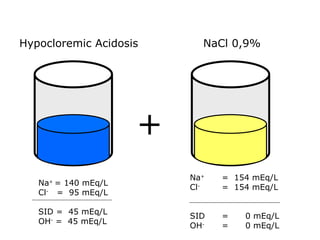
Na +  = 140 mEq/L Cl -   =  95 mEq/L SID =  45 mEq/L OH -  =  45 mEq/L + Hypocloremic Acidosis Na +  =  154 mEq/L Cl -   =  154 mEq/L SID  =  0 mEq/L OH -   =  0 mEq/L NaCl 0,9%
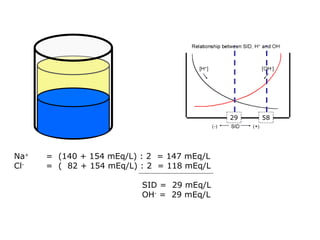
Na +  =  (140 + 154 mEq/L) : 2  = 147 mEq/L  Cl -   =  (  82 + 154 mEq/L) : 2  = 118 mEq/L SID =  29 mEq/L OH -  =  29 mEq/L 58 29
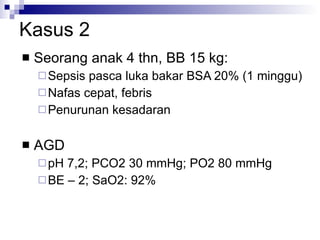
Kasus 2 Seorang anak 4 thn, BB 15 kg:  Sepsis pasca luka bakar BSA 20% (1 minggu) Nafas cepat, febris Penurunan kesadaran AGD pH 7,2; PCO2 30 mmHg; PO2 80 mmHg BE – 2; SaO2: 92%
The major effects of a metabolic acidosis  Depression of myocardial contractility  Sympathetic overactivity (incl tachycardia, vasoconstriction, decreased arrhythmia threshold)  Resistance to the effects of catecholamines  Peripheral arteriolar vasodilatation  Venoconstriction of peripheral veins  Vasoconstriction of pulmonary arteries Shift of K+ out of cells -> hyperkalaemia
Terapi Resusitasi cairan RL disertai:  Bicarbonat natrikus: Setuju atau Tidak Setuju Penderita kejang-kejang Hypocapnia
Recognised undesirable effects of bicarbonate administration  Hypernatraemia  Hyperosmolality  Volume overload  Rebound or ‘overshoot’ alkalosis  Hypokalaemia  Hypercapnia  Impaired oxygen unloading due to left shift of the  oxyhaemoglobin dissociation curve
Kasus 2 Elektrolit Natrium : 160 mEq/L Chlorida : 110 mEq/L Kalium : 3.5 Lab lain: Darah rutin dalam batas normal Protein total 4.0  Albumin 1.2 g/dL
Kasus 2 Stong Ion Difference =[Na + ]–[Cl – ] = 160-110 =  50  ALBUMIN EFFECT = albumin 1.2 g/dL =  HIPOALBUMIN   UNMEASURED ION EFFECT ???? As. Laktat akibat gangguan perfusi dan oksigenisasi
Clinical Investigations Strong ions, weak acids and base excess: a simplified Fencl–Stewart approach to clinical acid–base disorders D. A. Story*,1, H. Morimatsu2 and R. Bellomo2 British Journal of Anaesthesia, 2004, Vol. 92, No. 1  54-60
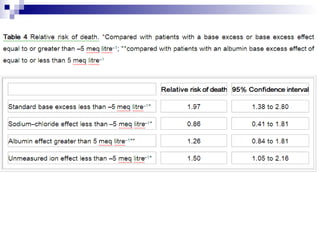
Four variables STANDARD BASE EXCESS  (mmol /litre = meq / litre) from a blood gas  machine  SODIUM–CHLORIDE EFFECT (meq / litre) =[Na + ]–[Cl – ]–38 ALBUMIN EFFECT (meq/ litre) =0.25x[42–albumin (g/litre)]  UNMEASURED ION EFFECT (meq / litre) = standard base excess–(sodium–chloride effect)–   albumin effect
Kasus 2 STANDARD BASE EXCESS  from a blood gas machine =  -2 mEq/L   SODIUM–CHLORIDE EFFECT (meq / litre) =[Na + ]–[Cl – ]–38 = 160-110-38 =  12 mEq/L ALBUMIN EFFECT (meq/ litre) = 0.25 x [42–albumin (g/litre)]  = 0.25 x [42-12 g/L] =  7.5 mEq/L UNMEASURED ION EFFECT (meq / litre) = standard base excess–(sodium–chloride effect)–     albumin effect = -2 – 12 – 7.5 =  -21.5
 
TATALAKSANA KASUS 2 Untuk memperbaiki asidosis:  perbaiki oksigenisasi jaringan Koreksi hypernatremia Koreksi hipoalbuminemia Na Bicarbonat ????
Important points about the use of bicarbonate in metabolic acidosis Ventilation must be adequate to eliminate the CO2 produced from bicarbonate Bicarbonate therapy can increase extracellular pH only if the CO2 produced can be removed by adequate ventilation.  Indeed if hypercapnia occurs then as CO2 crosses cell membranes easily, intracellular pH may decrease even further with further deterioration of cellular function.
Important points about the use of bicarbonate in metabolic acidosis Bicarbonate may cause clinical deterioration if tissue hypoxia is present If tissue hypoxia is present, then the use of bicarbonate may be particularly disadvantageous due to increased lactate production (removal of acidotic inhibition of glycolysis) and the impairment of tissue oxygen unloading (left shift of ODC).  This means that with lactic acidosis or cardiac arrest then  BICARBONATE THERAPY MAY BE DANGEROUS.
Important points about the use of bicarbonate in metabolic acidosis Bicarbonate is probably not useful in most cases of high anion gap acidosis As mentioned above lactic acidosis can get worse if  bicarbonate is given.  Studies have shown no benefit from bicarbonate in  diabetic ketoacidosis.  In these cases, the only indication for bicarbonate  use is for the  emergency management of severe  hyperkalaemia
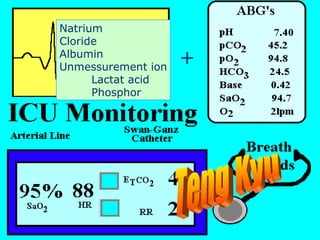
Teng Kyu Natrium Cloride Albumin Unmessurement ion Lactat acid Phosphor +

Gangguan Asam Basa

  • 1.
    Fencl–Stewart approach: Telaah Kasus Gangguan Asam-Basa Kiki MK Samsi, dr.,Sp.A, M.Kes Pediatric Critical Care Unit Tarumanagara University - Sumber Waras Hospital
  • 2.
  • 3.
  • 4.
    Kasus 1 Seoranganak 2 thn, BB 10 kg: Ileus obstruktif Muntah-muntah Dehidrasi berat pH 7.6, Kalium 2 meq/L, Cl 82 meq/L Tatalaksana Pasang NGT untuk DEKOMPRESI Resusitasi cairan dengan RL Beri KCl untuk hipokalemia
  • 5.
    Na + = 140 mEq/L Cl - = 82 mEq/L SID = 58 mEq/L OH - = 58 mEq/L Hypocloremic Alkalosis 58
  • 6.
    The adverse effectsof a severe alkalosis Decreased myocardial contractility Arrhythmias Decreased cerebral blood flow Confusion Mental obtundation Neuromuscular excitability Impaired peripheral oxygen unloading (due shift of oxygen dissociation curve to left).
  • 7.
  • 8.
    The adverse effectsof a severe alkalosis Hypoventilation (due respiratory response to metabolic alkalosis) Pulmonary microatelectasis (consequent on hypoventilation) Increased ventilation-perfusion mismatch (as alkalosis inhibits hypoxic pulmonary vasoconstriction).
  • 9.
    Na + = 140 mEq/L Cl - = 82 mEq/L SID = 58 mEq/L OH - = 58 mEq/L + Hypocloremic Alkalosis Na + = 137 mEq/L Cl - = 109 mEq/L Lactat = 28 mEq/L SID = 0 mEq/L OH - = 0 mEq/L Ringer Lactat
  • 10.
    Na + = (140 + 137 mEq/L) : 2 = 138,5 mEq/L Cl - = ( 82 + 109 mEq/L) : 2 = 95,5 mEq/L SID = 43 mEq/L OH - = 43 mEq/L 58 43
  • 11.
    Na + = 140 mEq/L Cl - = 95 mEq/L SID = 45 mEq/L OH - = 45 mEq/L + Hypocloremic Acidosis Na + = 154 mEq/L Cl - = 154 mEq/L SID = 0 mEq/L OH - = 0 mEq/L NaCl 0,9%
  • 12.
    Na + = (140 + 154 mEq/L) : 2 = 147 mEq/L Cl - = ( 82 + 154 mEq/L) : 2 = 118 mEq/L SID = 29 mEq/L OH - = 29 mEq/L 58 29
  • 13.
    Kasus 2 Seoranganak 4 thn, BB 15 kg: Sepsis pasca luka bakar BSA 20% (1 minggu) Nafas cepat, febris Penurunan kesadaran AGD pH 7,2; PCO2 30 mmHg; PO2 80 mmHg BE – 2; SaO2: 92%
  • 14.
    The major effectsof a metabolic acidosis Depression of myocardial contractility Sympathetic overactivity (incl tachycardia, vasoconstriction, decreased arrhythmia threshold) Resistance to the effects of catecholamines Peripheral arteriolar vasodilatation Venoconstriction of peripheral veins Vasoconstriction of pulmonary arteries Shift of K+ out of cells -> hyperkalaemia
  • 15.
    Terapi Resusitasi cairanRL disertai: Bicarbonat natrikus: Setuju atau Tidak Setuju Penderita kejang-kejang Hypocapnia
  • 16.
    Recognised undesirable effectsof bicarbonate administration Hypernatraemia Hyperosmolality Volume overload Rebound or ‘overshoot’ alkalosis Hypokalaemia Hypercapnia Impaired oxygen unloading due to left shift of the oxyhaemoglobin dissociation curve
  • 17.
    Kasus 2 ElektrolitNatrium : 160 mEq/L Chlorida : 110 mEq/L Kalium : 3.5 Lab lain: Darah rutin dalam batas normal Protein total 4.0 Albumin 1.2 g/dL
  • 18.
    Kasus 2 StongIon Difference =[Na + ]–[Cl – ] = 160-110 = 50 ALBUMIN EFFECT = albumin 1.2 g/dL = HIPOALBUMIN UNMEASURED ION EFFECT ???? As. Laktat akibat gangguan perfusi dan oksigenisasi
  • 19.
    Clinical Investigations Strongions, weak acids and base excess: a simplified Fencl–Stewart approach to clinical acid–base disorders D. A. Story*,1, H. Morimatsu2 and R. Bellomo2 British Journal of Anaesthesia, 2004, Vol. 92, No. 1 54-60
  • 20.
    Four variables STANDARDBASE EXCESS (mmol /litre = meq / litre) from a blood gas machine SODIUM–CHLORIDE EFFECT (meq / litre) =[Na + ]–[Cl – ]–38 ALBUMIN EFFECT (meq/ litre) =0.25x[42–albumin (g/litre)] UNMEASURED ION EFFECT (meq / litre) = standard base excess–(sodium–chloride effect)– albumin effect
  • 21.
    Kasus 2 STANDARDBASE EXCESS from a blood gas machine = -2 mEq/L SODIUM–CHLORIDE EFFECT (meq / litre) =[Na + ]–[Cl – ]–38 = 160-110-38 = 12 mEq/L ALBUMIN EFFECT (meq/ litre) = 0.25 x [42–albumin (g/litre)] = 0.25 x [42-12 g/L] = 7.5 mEq/L UNMEASURED ION EFFECT (meq / litre) = standard base excess–(sodium–chloride effect)– albumin effect = -2 – 12 – 7.5 = -21.5
  • 22.
  • 23.
    TATALAKSANA KASUS 2Untuk memperbaiki asidosis: perbaiki oksigenisasi jaringan Koreksi hypernatremia Koreksi hipoalbuminemia Na Bicarbonat ????
  • 24.
    Important points aboutthe use of bicarbonate in metabolic acidosis Ventilation must be adequate to eliminate the CO2 produced from bicarbonate Bicarbonate therapy can increase extracellular pH only if the CO2 produced can be removed by adequate ventilation. Indeed if hypercapnia occurs then as CO2 crosses cell membranes easily, intracellular pH may decrease even further with further deterioration of cellular function.
  • 25.
    Important points aboutthe use of bicarbonate in metabolic acidosis Bicarbonate may cause clinical deterioration if tissue hypoxia is present If tissue hypoxia is present, then the use of bicarbonate may be particularly disadvantageous due to increased lactate production (removal of acidotic inhibition of glycolysis) and the impairment of tissue oxygen unloading (left shift of ODC). This means that with lactic acidosis or cardiac arrest then BICARBONATE THERAPY MAY BE DANGEROUS.
  • 26.
    Important points aboutthe use of bicarbonate in metabolic acidosis Bicarbonate is probably not useful in most cases of high anion gap acidosis As mentioned above lactic acidosis can get worse if bicarbonate is given. Studies have shown no benefit from bicarbonate in diabetic ketoacidosis. In these cases, the only indication for bicarbonate use is for the emergency management of severe hyperkalaemia
  • 27.
    Teng Kyu NatriumCloride Albumin Unmessurement ion Lactat acid Phosphor +