Sustainable Rural Development
              A Gandhian Perspective

                    Anil K Rajvanshi
     Nimbkar Agricultural Research Institute (NARI)
                   Phaltan, Maharashtra
   www.nariphaltan.org http://nariphaltan.virtualave.net
Nehru center 2007                                          1
Structure of Talk
    Present problems in rural India
    Decentralized high technology solutions
          Energy production
          Energy devices for lighting and cooking
    Relevance of Gandhiji’s philosophy for
    holistic India
    Strategy for rural development


Nehru center 2007                                   2
Introduction
 60% of rural population (~ 400 million) in India live in
 primitive conditions. No electricity and primitive cookstoves.
 Around 300,000 deaths/yr take place because of pollution
 from these stoves. Modern technology has not touched their
 lives even after 60 years of independence.
 54% of India’s population is below 25 years of age and most
 of them live in rural areas with very little employment
 opportunities. Around 260 million people (1/4th of our
 population) live on less than Rs 50/day.
 Because of rural poverty large scale migration to cities takes
 place leading to serious urban problems.
 Increased aspirations because of mass media are leading to
 social unrest. Riots in Delhi, Mumbai, Gujarat and recently in
 UP. Release of bottled-up emotions. Spark could be from any
 source.
Nehru center 2007                                           3
Introduction (cont..)
  Poverty in rural areas has resulted in suicides of a large
  number of farmers. In last 10 years about 150,000 farmers
  have committed suicide. Poor support price, increased input
  costs and aspirations. Also no long term agriculture policy.
  Serious energy crisis in India. In rural areas 250 kWh/yr per
  capita electricity consumption. This is 2% of that in US and
  lowest in the world.
  In Maharashtra alone ~ 6000 MW shortage resulting in 12-15
  hours daily blackouts in rural areas.
  Last year India imported Rs. 120,000 crores worth of
  petroleum products. Serious balance of payment problems. 8-
  9% p.a. growth in petroleum consumption.
  Above events are direct result of lopsided development. Based
  on 100 year-old centralized model of developed countries.
  Preference to cities over rural areas.
Nehru center 2007                                            4
Introduction (cont..)
    Centralized production and control inherently leads to
    corruption. Decentralization leads to accountability.
    Governance is the first casualty of corruption. All the above
    problems are result of non-governance.
    With proper governance, one of the best technological
    solutions for the above problems is energy production via
    agriculture.
    Energy is the basis of life. Lack of it produces economic
    stagnation and social upheavals.
    Energy from agriculture will provide rural wealth and
    create employment. Can bring 60% marginalized people
    into mainstream India, without which India cannot become
    an economic superpower.
Nehru center 2007                                             5
Energy Production
 India produces ~ 600 million tons/yr of residues. Mostly burned
 in fields. Creates environmental pollution and loss of energy.
 Fuels from these residues can take care of major requirements of
 energy for India. With increased agriculture these residues will
 further increase.
 From crops and residues we can produce three types of fuel
     Liquid fuels like ethanol, biodiesel or pyrolysis oil.
     Gaseous fuel like methane (biogas).
     Electricity via biomass-based power plants.
 In any agriculture 25-40% of produce is food and rest are
 residues. No remunerations from residues, hence farming is
 uneconomical. No industry can survive on such norms.
 Residues for energy can give an extra income of Rs. 2000-
 4000/acre/season to the farmers. Insurance against distress sale.

Nehru center 2007                                             6
Energy Production (cont..)
 Residues can produce 156 b l/yr of ethanol which is 42% of
 India’s oil demand in 2012; or 80% of oil demand via
 pyrolysis oil or 80,000 MW of
 electric power.
 With increased industrial demand
 for fuel and electricity, large tracts
 of farmlands may come under fuel
 crops only.
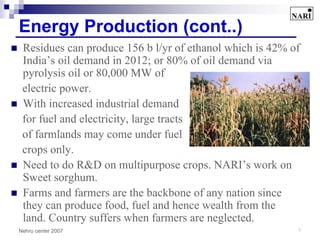
 Need to do R&D on multipurpose crops. NARI’s work on
 Sweet sorghum.
 Farms and farmers are the backbone of any nation since
 they can produce food, fuel and hence wealth from the
 land. Country suffers when farmers are neglected.
Nehru center 2007                                         7
Water Issues
   Increased farming for energy production will require
   adequate water supply.
   Already water shortage though adequate rainfall.
   Rainwater harvesting provides the best solution. Need
   for setting up private rural water utilities.
   Issues of ownership of water bodies need to be
   resolved. Water Act similar to Electricity Act needed.
   Use of flue gases from power generation can provide
   potable water. Combined electricity and water plants
   will improve efficiency.

Nehru center 2007                                       8
Energy Industry from Agriculture
    Energy production from agriculture alone can be of the
    order of Rs. 30-40,000 crore/yr industry. Similar numbers
    may exist for water utilities in rural areas.
    Will also create about 30 million jobs in rural areas.
    Could increase large number of industries in these areas.
    Will supply liquid, gaseous fuels and electricity from
    biomass.
    Wealth of a country comes from its land and we should
    encourage farmers and provide funds and technologies
    for farming sector.
    Need for enlightened agriculture policy which has energy
    production as its cornerstone.
Nehru center 2007                                           9
Development of Energy Devices
    High technology devices needed for rural areas.
    Resources and energy in dilute forms.
    Very efficient devices allow maximum energy and
    materials to be extracted for useful purposes.
    Hallmark of evolution is size reduction, increase in
    complexity and efficiency. All our modern devices
    follow this route. Sustainable size for high efficiency.
    Future societies may be taluka-type powered by high
    technologies in communication, power, etc.
    Examples of high technology for lighting and
    cooking, since 75% of total household energy is used
    for this purpose.

Nehru center 2007                                          10
Strategy for Lighting
Liquid fuel for lighting
   Simple hurricane lanterns used presently.
   Very poor light output.
   Noorie lantern a major improvement.
   Presently mantle efficacy ~ 2-3 lm/W;
   light bulb ~10-15 lm/W and CFL ~ 50-70
   lm/W. Need to match mantle efficacy           Noorie lantern
   with that of light bulb.                    •Lightweight 2 kg
   Power plant-to-light efficiency (PPL)       •Light output ~ 1350 lm
   point of view liquid fuel lighting can be   •Runs on kerosene, diesel
   superior to electric lighting. PPL of CFL   or low conc. ethanol
   is ~ 12-14 lm/W. With increased T&D         •Lighting and cooking
   losses PPL will further reduce.             •Low cost Rs.400-450/-


Nehru center 2007                                                  11
Liquid Fuel Lighting (cont..)
 Present T/L mantles have rare earth oxides and are 1880’s
 vintage. Use 99% thorium oxide and 1% cerium oxide.
 Nanotechnology can help in developing new mixtures of rare
 earth or other oxides which can glow at lower temperatures
 (1000-1500 0C) with higher luminous efficacy.
 R&D also required in developing sturdier mantles. Could be
 ceramic cloth-based, carbon-carbon composites, etc.
 Need to copy bioluminescence technology of firefly.
 With grid electricity still a distant dream for major portion of
 rural areas, efficient liquid fuel lighting based on home
 grown fuel needs to be encouraged.

Nehru center 2007                                             12
Electricity-based Lighting
Taluka level plants (10-20 MW capacity)
   Biomass or clean coal-based technology.
Small scale plants (10-500 kWe range):
  R&D needed in:
          Gasifiers, space-age steam engines.
          Stirling engines, biomass gas turbines, low cost PV, etc.
          Nuclear power for micro utilities.
Micro scale power units:
   Thermoelectric elements for cookstoves. Can produce 40-50 W
   power for small fans and LED. R&D needed in efficient batteries,
   ultra capacitors, etc. Paper thin batteries developed.
   10-30 W micro engines? No batteries needed.
   Human-powered small PMDC generators. Real play radios.
   Gandhiji’s energy charkha.
Nehru center 2007                                                     13
Cooking Energy Strategy
Liquid and gaseous fuels best. Ethanol is an
excellent fuel for cooking. 50% ethanol-water is
easy to distill and a very safe mixture.
Excise laws need to be modified for use of
ethanol for cooking and lighting.
R&D required for biodiesel and pyrolysis oil in
stoves.
R&D required in high-tech biogas reactors and      NARI alcohol stove
storage of biogas in hydrates, porous carbon, etc.
                                                   •50% (w/w) ethanol
Nano materials for such structures.
                                                   •0.7 - 2.5 kWth capacity
Scenario of a small utility in rural areas which
                                                   •Controllable flame
processes waste into biogas and supplies it in
small gas cylinders lined with storage materials. •Silent and easy to light
Will revolutionize rural cooking.                  •Cost ~ Rs. 1500/-

 Nehru center 2007                                                     14
NARI technologies


Nehru center 2007   15
NARI technologies


Nehru center 2007   16
Gandhiji’s Philosophy
   Gandhiji was a spiritual being first. Other things were by-
   products of his spirituality.
   His spirituality guided all his work in politics, rural
   development and non-violence.
   He realized from an early age the importance of a great body
   and mind. His experiments on food, brahmacharya and fasting
   came from this belief. He followed age old yogic tradition.
   A spiritual person becomes less interested in hoarding things.
   This was the basis of Gandhi’s sustainability. He believed in
   simple living and high thinking.
   With little energy and very few needs he produced a very high
   quality of thought.
Nehru center 2007                                           17
Gandhiji’s Rural Development
 Gandhi focussed on rural development for last 30 years of his
 life.
 He felt intuitively that future of India is in decentralized rural
 development. His concept of dream village was based on local
 rural production and consumption. Taluka strategy as a step
 towards fulfilling his dream.
 Evolution of decentralized systems can be helped by
 biomimicry-based solutions. Gandhiji’s philosophy.
 Gandhi was not anti- technology or science. He was a pujari of
 human body. He was a prisoner of his time.
 Modern high technology (examples given earlier) provides
 tools to bring his dream village to reality. Desktop
 manufacturing units may further help in this process.
Nehru center 2007                                             18
Strategy for Rural Development
 Modern systems in rural areas require management and
 technology. Need for partnership between corporations, NGOs
 and villagers. NARI/NFCL.
 Makes lot of business sense for corporate world. Need to curb the
 excessive greed of profit making.
 Also there is a need to reduce our consumptive lifestyle. If we
 follow American lifestyle then we will need resources of 4 earths.
 A decent lifestyle is possible with energy consumption of 50-70
 GJ/person/yr. US consumption is 350 GJ and India’s is 10 GJ.
 This can happen when we become spiritual and hence internally
 secure. This is what Gandhiji showed through his life.
 Becoming sustainable in our personal lives and giving something
 back to the society will help make India a holistic and sustainable
 society according to the dream of Mahatma Gandhi.

Nehru center 2007                                             19
Thank you


Nehru center 2007               20
Useful sites
  www.nariphaltan.org
  http://education.vsnl.com/nimbkar/spiritual.html
  (my writings on spirituality and sustainability)


Nehru center 2007                               21

Sustainable Rural Development - A gandhian perspective

  • 1.
    Sustainable Rural Development A Gandhian Perspective Anil K Rajvanshi Nimbkar Agricultural Research Institute (NARI) Phaltan, Maharashtra www.nariphaltan.org http://nariphaltan.virtualave.net Nehru center 2007 1
  • 2.
    Structure of Talk Present problems in rural India Decentralized high technology solutions Energy production Energy devices for lighting and cooking Relevance of Gandhiji’s philosophy for holistic India Strategy for rural development Nehru center 2007 2
  • 3.
    Introduction 60% ofrural population (~ 400 million) in India live in primitive conditions. No electricity and primitive cookstoves. Around 300,000 deaths/yr take place because of pollution from these stoves. Modern technology has not touched their lives even after 60 years of independence. 54% of India’s population is below 25 years of age and most of them live in rural areas with very little employment opportunities. Around 260 million people (1/4th of our population) live on less than Rs 50/day. Because of rural poverty large scale migration to cities takes place leading to serious urban problems. Increased aspirations because of mass media are leading to social unrest. Riots in Delhi, Mumbai, Gujarat and recently in UP. Release of bottled-up emotions. Spark could be from any source. Nehru center 2007 3
  • 4.
    Introduction (cont..) Poverty in rural areas has resulted in suicides of a large number of farmers. In last 10 years about 150,000 farmers have committed suicide. Poor support price, increased input costs and aspirations. Also no long term agriculture policy. Serious energy crisis in India. In rural areas 250 kWh/yr per capita electricity consumption. This is 2% of that in US and lowest in the world. In Maharashtra alone ~ 6000 MW shortage resulting in 12-15 hours daily blackouts in rural areas. Last year India imported Rs. 120,000 crores worth of petroleum products. Serious balance of payment problems. 8- 9% p.a. growth in petroleum consumption. Above events are direct result of lopsided development. Based on 100 year-old centralized model of developed countries. Preference to cities over rural areas. Nehru center 2007 4
  • 5.
    Introduction (cont..) Centralized production and control inherently leads to corruption. Decentralization leads to accountability. Governance is the first casualty of corruption. All the above problems are result of non-governance. With proper governance, one of the best technological solutions for the above problems is energy production via agriculture. Energy is the basis of life. Lack of it produces economic stagnation and social upheavals. Energy from agriculture will provide rural wealth and create employment. Can bring 60% marginalized people into mainstream India, without which India cannot become an economic superpower. Nehru center 2007 5
  • 6.
    Energy Production Indiaproduces ~ 600 million tons/yr of residues. Mostly burned in fields. Creates environmental pollution and loss of energy. Fuels from these residues can take care of major requirements of energy for India. With increased agriculture these residues will further increase. From crops and residues we can produce three types of fuel Liquid fuels like ethanol, biodiesel or pyrolysis oil. Gaseous fuel like methane (biogas). Electricity via biomass-based power plants. In any agriculture 25-40% of produce is food and rest are residues. No remunerations from residues, hence farming is uneconomical. No industry can survive on such norms. Residues for energy can give an extra income of Rs. 2000- 4000/acre/season to the farmers. Insurance against distress sale. Nehru center 2007 6
  • 7.
    Energy Production (cont..) Residues can produce 156 b l/yr of ethanol which is 42% of India’s oil demand in 2012; or 80% of oil demand via pyrolysis oil or 80,000 MW of electric power. With increased industrial demand for fuel and electricity, large tracts of farmlands may come under fuel crops only. Need to do R&D on multipurpose crops. NARI’s work on Sweet sorghum. Farms and farmers are the backbone of any nation since they can produce food, fuel and hence wealth from the land. Country suffers when farmers are neglected. Nehru center 2007 7
  • 8.
    Water Issues Increased farming for energy production will require adequate water supply. Already water shortage though adequate rainfall. Rainwater harvesting provides the best solution. Need for setting up private rural water utilities. Issues of ownership of water bodies need to be resolved. Water Act similar to Electricity Act needed. Use of flue gases from power generation can provide potable water. Combined electricity and water plants will improve efficiency. Nehru center 2007 8
  • 9.
    Energy Industry fromAgriculture Energy production from agriculture alone can be of the order of Rs. 30-40,000 crore/yr industry. Similar numbers may exist for water utilities in rural areas. Will also create about 30 million jobs in rural areas. Could increase large number of industries in these areas. Will supply liquid, gaseous fuels and electricity from biomass. Wealth of a country comes from its land and we should encourage farmers and provide funds and technologies for farming sector. Need for enlightened agriculture policy which has energy production as its cornerstone. Nehru center 2007 9
  • 10.
    Development of EnergyDevices High technology devices needed for rural areas. Resources and energy in dilute forms. Very efficient devices allow maximum energy and materials to be extracted for useful purposes. Hallmark of evolution is size reduction, increase in complexity and efficiency. All our modern devices follow this route. Sustainable size for high efficiency. Future societies may be taluka-type powered by high technologies in communication, power, etc. Examples of high technology for lighting and cooking, since 75% of total household energy is used for this purpose. Nehru center 2007 10
  • 11.
    Strategy for Lighting Liquidfuel for lighting Simple hurricane lanterns used presently. Very poor light output. Noorie lantern a major improvement. Presently mantle efficacy ~ 2-3 lm/W; light bulb ~10-15 lm/W and CFL ~ 50-70 lm/W. Need to match mantle efficacy Noorie lantern with that of light bulb. •Lightweight 2 kg Power plant-to-light efficiency (PPL) •Light output ~ 1350 lm point of view liquid fuel lighting can be •Runs on kerosene, diesel superior to electric lighting. PPL of CFL or low conc. ethanol is ~ 12-14 lm/W. With increased T&D •Lighting and cooking losses PPL will further reduce. •Low cost Rs.400-450/- Nehru center 2007 11
  • 12.
    Liquid Fuel Lighting(cont..) Present T/L mantles have rare earth oxides and are 1880’s vintage. Use 99% thorium oxide and 1% cerium oxide. Nanotechnology can help in developing new mixtures of rare earth or other oxides which can glow at lower temperatures (1000-1500 0C) with higher luminous efficacy. R&D also required in developing sturdier mantles. Could be ceramic cloth-based, carbon-carbon composites, etc. Need to copy bioluminescence technology of firefly. With grid electricity still a distant dream for major portion of rural areas, efficient liquid fuel lighting based on home grown fuel needs to be encouraged. Nehru center 2007 12
  • 13.
    Electricity-based Lighting Taluka levelplants (10-20 MW capacity) Biomass or clean coal-based technology. Small scale plants (10-500 kWe range): R&D needed in: Gasifiers, space-age steam engines. Stirling engines, biomass gas turbines, low cost PV, etc. Nuclear power for micro utilities. Micro scale power units: Thermoelectric elements for cookstoves. Can produce 40-50 W power for small fans and LED. R&D needed in efficient batteries, ultra capacitors, etc. Paper thin batteries developed. 10-30 W micro engines? No batteries needed. Human-powered small PMDC generators. Real play radios. Gandhiji’s energy charkha. Nehru center 2007 13
  • 14.
    Cooking Energy Strategy Liquidand gaseous fuels best. Ethanol is an excellent fuel for cooking. 50% ethanol-water is easy to distill and a very safe mixture. Excise laws need to be modified for use of ethanol for cooking and lighting. R&D required for biodiesel and pyrolysis oil in stoves. R&D required in high-tech biogas reactors and NARI alcohol stove storage of biogas in hydrates, porous carbon, etc. •50% (w/w) ethanol Nano materials for such structures. •0.7 - 2.5 kWth capacity Scenario of a small utility in rural areas which •Controllable flame processes waste into biogas and supplies it in small gas cylinders lined with storage materials. •Silent and easy to light Will revolutionize rural cooking. •Cost ~ Rs. 1500/- Nehru center 2007 14
  • 15.
  • 16.
  • 17.
    Gandhiji’s Philosophy Gandhiji was a spiritual being first. Other things were by- products of his spirituality. His spirituality guided all his work in politics, rural development and non-violence. He realized from an early age the importance of a great body and mind. His experiments on food, brahmacharya and fasting came from this belief. He followed age old yogic tradition. A spiritual person becomes less interested in hoarding things. This was the basis of Gandhi’s sustainability. He believed in simple living and high thinking. With little energy and very few needs he produced a very high quality of thought. Nehru center 2007 17
  • 18.
    Gandhiji’s Rural Development Gandhi focussed on rural development for last 30 years of his life. He felt intuitively that future of India is in decentralized rural development. His concept of dream village was based on local rural production and consumption. Taluka strategy as a step towards fulfilling his dream. Evolution of decentralized systems can be helped by biomimicry-based solutions. Gandhiji’s philosophy. Gandhi was not anti- technology or science. He was a pujari of human body. He was a prisoner of his time. Modern high technology (examples given earlier) provides tools to bring his dream village to reality. Desktop manufacturing units may further help in this process. Nehru center 2007 18
  • 19.
    Strategy for RuralDevelopment Modern systems in rural areas require management and technology. Need for partnership between corporations, NGOs and villagers. NARI/NFCL. Makes lot of business sense for corporate world. Need to curb the excessive greed of profit making. Also there is a need to reduce our consumptive lifestyle. If we follow American lifestyle then we will need resources of 4 earths. A decent lifestyle is possible with energy consumption of 50-70 GJ/person/yr. US consumption is 350 GJ and India’s is 10 GJ. This can happen when we become spiritual and hence internally secure. This is what Gandhiji showed through his life. Becoming sustainable in our personal lives and giving something back to the society will help make India a holistic and sustainable society according to the dream of Mahatma Gandhi. Nehru center 2007 19
  • 20.
  • 21.
    Useful sites www.nariphaltan.org http://education.vsnl.com/nimbkar/spiritual.html (my writings on spirituality and sustainability) Nehru center 2007 21