SUBJECT ENRICHMENT
ACTIVITY
Sub: Social Science
THE GREENFINGERS SCHOOL, AKLUJ
WHAT ARE ENERGY RESOURCES ?
Energy resources are all forms of fuels
used in the modern world, either for
heating, generation of electrical energy,
or for other forms of energy conversion
processes.
Examples - Coal,Petroleum,Natural gas,
Solar energy, Tidal energy, Biogas,Oil,
Wind, etc.
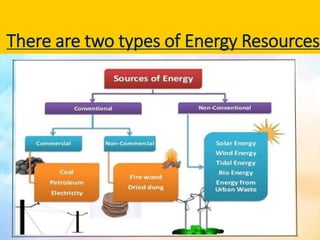
There are two types of Energy Resources
Conventional Sources
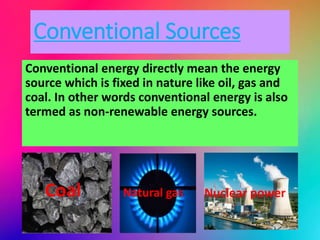
Conventional energy directly mean the energy
source which is fixed in nature like oil, gas and
coal. In other words conventional energy is also
termed as non-renewable energy sources.
Coal Natural gas Nuclear power
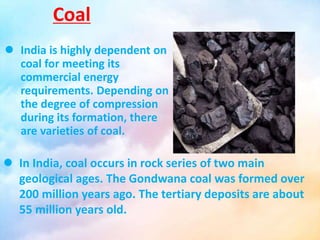
 India is highly dependent on
coal for meeting its
commercial energy
requirements. Depending on
the degree of compression
during its formation, there
are varieties of coal.
 In India, coal occurs in rock series of two main
geological ages. The Gondwana coal was formed over
200 million years ago. The tertiary deposits are about
55 million years old.
Coal
Coal Deposits In India
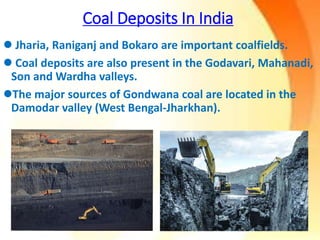
 Jharia, Raniganj and Bokaro are important coalfields.
 Coal deposits are also present in the Godavari, Mahanadi,
Son and Wardha valleys.
The major sources of Gondwana coal are located in the
Damodar valley (West Bengal-Jharkhan).
Petroleum
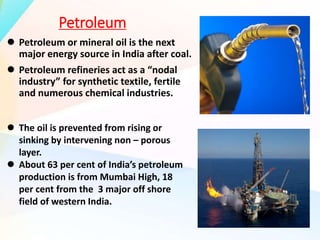
 Petroleum or mineral oil is the next
major energy source in India after coal.
 Petroleum refineries act as a “nodal
industry” for synthetic textile, fertile
and numerous chemical industries.
 The oil is prevented from rising or
sinking by intervening non – porous
layer.
 About 63 per cent of India’s petroleum
production is from Mumbai High, 18
per cent from the 3 major off shore
field of western India.
Natural Gas
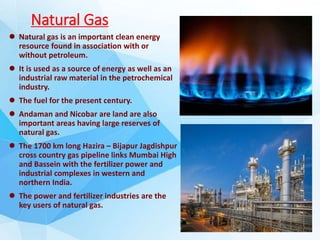
 Natural gas is an important clean energy
resource found in association with or
without petroleum.
 It is used as a source of energy as well as an
industrial raw material in the petrochemical
industry.
 The fuel for the present century.
 Andaman and Nicobar are land are also
important areas having large reserves of
natural gas.
 The 1700 km long Hazira – Bijapur Jagdishpur
cross country gas pipeline links Mumbai High
and Bassein with the fertilizer power and
industrial complexes in western and
northern India.
 The power and fertilizer industries are the
key users of natural gas.
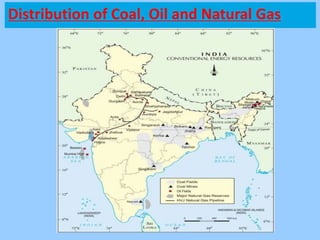
Distribution of Coal, Oil and Natural Gas
Electricity
 Electricity has such a wide range of
application in today’s world that its per
capita consumption is considered as an
index of development.
 Electricity is generated mainly in two ways
by running water.
 Burning of fuels such a coal petroleum gas
to drive turbines to produce thermal
power.
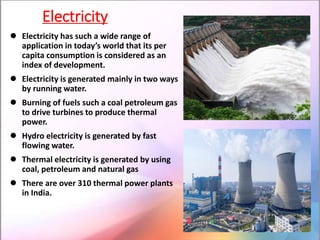
 Hydro electricity is generated by fast
flowing water.
 Thermal electricity is generated by using
coal, petroleum and natural gas
 There are over 310 thermal power plants
in India.
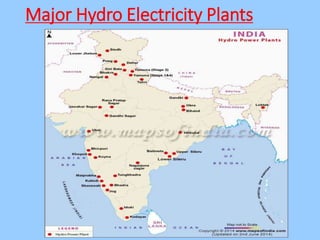
Major Hydro Electricity Plants
Nuclear or Atomic Energy
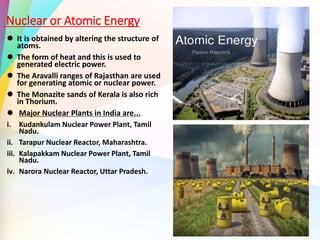
 It is obtained by altering the structure of
atoms.
 The form of heat and this is used to
generated electric power.
 The Aravalli ranges of Rajasthan are used
for generating atomic or nuclear power.
 The Monazite sands of Kerala is also rich
in Thorium.
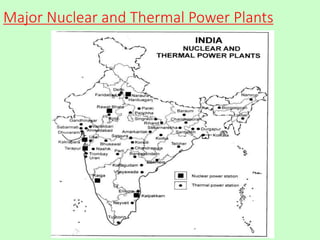
 Major Nuclear Plants in India are...
i. Kudankulam Nuclear Power Plant, Tamil
Nadu.
ii. Tarapur Nuclear Reactor, Maharashtra.
iii. Kalapakkam Nuclear Power Plant, Tamil
Nadu.
iv. Narora Nuclear Reactor, Uttar Pradesh.
Major Nuclear and Thermal Power Plants
NON-CONVENTIONAL SOURCES
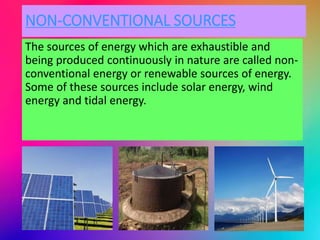
The sources of energy which are exhaustible and
being produced continuously in nature are called non-
conventional energy or renewable sources of energy.
Some of these sources include solar energy, wind
energy and tidal energy.
Solar Energy
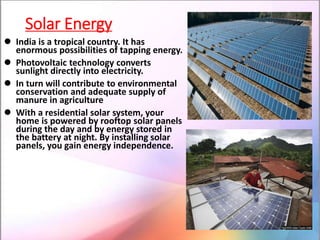
 India is a tropical country. It has
enormous possibilities of tapping energy.
 Photovoltaic technology converts
sunlight directly into electricity.
 In turn will contribute to environmental
conservation and adequate supply of
manure in agriculture
 With a residential solar system, your
home is powered by rooftop solar panels
during the day and by energy stored in
the battery at night. By installing solar
panels, you gain energy independence.
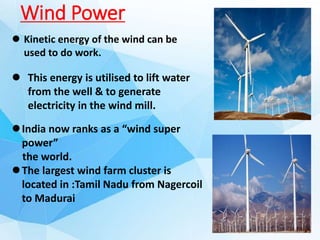
Wind Power
India now ranks as a “wind super
power”
the world.
The largest wind farm cluster is
located in :Tamil Nadu from Nagercoil
to Madurai
 Kinetic energy of the wind can be
used to do work.
 This energy is utilised to lift water
from the well & to generate
electricity in the wind mill.
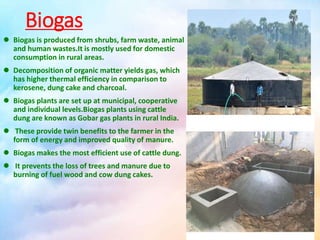
Biogas
 Biogas is produced from shrubs, farm waste, animal
and human wastes.It is mostly used for domestic
consumption in rural areas.
 Decomposition of organic matter yields gas, which
has higher thermal efficiency in comparison to
kerosene, dung cake and charcoal.
 Biogas plants are set up at municipal, cooperative
and individual levels.Biogas plants using cattle
dung are known as Gobar gas plants in rural India.
 These provide twin benefits to the farmer in the
form of energy and improved quality of manure.
 Biogas makes the most efficient use of cattle dung.
 It prevents the loss of trees and manure due to
burning of fuel wood and cow dung cakes.
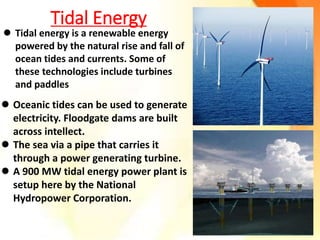
Tidal Energy
 Oceanic tides can be used to generate
electricity. Floodgate dams are built
across intellect.
 The sea via a pipe that carries it
through a power generating turbine.
 A 900 MW tidal energy power plant is
setup here by the National
Hydropower Corporation.
 Tidal energy is a renewable energy
powered by the natural rise and fall of
ocean tides and currents. Some of
these technologies include turbines
and paddles
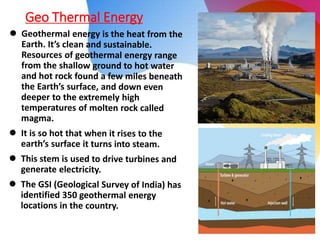
Geo Thermal Energy
Conservation of Energy Resources
Energy is a basic requirement for economic development.
The economic development plans implemented since
Independence necessarily required increasing amounts of
energy to remain operational.
Promotion of energy conservation and increased use of
renewable energy sources are the twin planks of
sustainable energy.
India is presently one of the least energy efficient
countries in the world
Energy saved is energy produced.
Measures To Conserve Energy
Resources
• Adjust your day-to-day behaviors.
• Replace your light bulbs.
• Use smart power strips.
• Install a programmable or smart thermostat.
• Purchase energy efficient appliances.
• Reduce your water heating expenses.
• Install energy efficient windows.
• Upgrade your HVAC system.
Energy resources subject enrichment activity

Energy resources subject enrichment activity

  • 3.
    SUBJECT ENRICHMENT ACTIVITY Sub: SocialScience THE GREENFINGERS SCHOOL, AKLUJ
  • 5.
    WHAT ARE ENERGYRESOURCES ? Energy resources are all forms of fuels used in the modern world, either for heating, generation of electrical energy, or for other forms of energy conversion processes. Examples - Coal,Petroleum,Natural gas, Solar energy, Tidal energy, Biogas,Oil, Wind, etc.
  • 6.
    There are twotypes of Energy Resources
  • 7.
    Conventional Sources Conventional energydirectly mean the energy source which is fixed in nature like oil, gas and coal. In other words conventional energy is also termed as non-renewable energy sources. Coal Natural gas Nuclear power
  • 8.
     India ishighly dependent on coal for meeting its commercial energy requirements. Depending on the degree of compression during its formation, there are varieties of coal.  In India, coal occurs in rock series of two main geological ages. The Gondwana coal was formed over 200 million years ago. The tertiary deposits are about 55 million years old. Coal
  • 9.
    Coal Deposits InIndia  Jharia, Raniganj and Bokaro are important coalfields.  Coal deposits are also present in the Godavari, Mahanadi, Son and Wardha valleys. The major sources of Gondwana coal are located in the Damodar valley (West Bengal-Jharkhan).
  • 10.
    Petroleum  Petroleum ormineral oil is the next major energy source in India after coal.  Petroleum refineries act as a “nodal industry” for synthetic textile, fertile and numerous chemical industries.  The oil is prevented from rising or sinking by intervening non – porous layer.  About 63 per cent of India’s petroleum production is from Mumbai High, 18 per cent from the 3 major off shore field of western India.
  • 11.
    Natural Gas  Naturalgas is an important clean energy resource found in association with or without petroleum.  It is used as a source of energy as well as an industrial raw material in the petrochemical industry.  The fuel for the present century.  Andaman and Nicobar are land are also important areas having large reserves of natural gas.  The 1700 km long Hazira – Bijapur Jagdishpur cross country gas pipeline links Mumbai High and Bassein with the fertilizer power and industrial complexes in western and northern India.  The power and fertilizer industries are the key users of natural gas.
  • 12.
    Distribution of Coal,Oil and Natural Gas
  • 13.
    Electricity  Electricity hassuch a wide range of application in today’s world that its per capita consumption is considered as an index of development.  Electricity is generated mainly in two ways by running water.  Burning of fuels such a coal petroleum gas to drive turbines to produce thermal power.  Hydro electricity is generated by fast flowing water.  Thermal electricity is generated by using coal, petroleum and natural gas  There are over 310 thermal power plants in India.
  • 14.
  • 15.
    Nuclear or AtomicEnergy  It is obtained by altering the structure of atoms.  The form of heat and this is used to generated electric power.  The Aravalli ranges of Rajasthan are used for generating atomic or nuclear power.  The Monazite sands of Kerala is also rich in Thorium.  Major Nuclear Plants in India are... i. Kudankulam Nuclear Power Plant, Tamil Nadu. ii. Tarapur Nuclear Reactor, Maharashtra. iii. Kalapakkam Nuclear Power Plant, Tamil Nadu. iv. Narora Nuclear Reactor, Uttar Pradesh.
  • 16.
    Major Nuclear andThermal Power Plants
  • 17.
    NON-CONVENTIONAL SOURCES The sourcesof energy which are exhaustible and being produced continuously in nature are called non- conventional energy or renewable sources of energy. Some of these sources include solar energy, wind energy and tidal energy.
  • 18.
    Solar Energy  Indiais a tropical country. It has enormous possibilities of tapping energy.  Photovoltaic technology converts sunlight directly into electricity.  In turn will contribute to environmental conservation and adequate supply of manure in agriculture  With a residential solar system, your home is powered by rooftop solar panels during the day and by energy stored in the battery at night. By installing solar panels, you gain energy independence.
  • 19.
    Wind Power India nowranks as a “wind super power” the world. The largest wind farm cluster is located in :Tamil Nadu from Nagercoil to Madurai  Kinetic energy of the wind can be used to do work.  This energy is utilised to lift water from the well & to generate electricity in the wind mill.
  • 20.
    Biogas  Biogas isproduced from shrubs, farm waste, animal and human wastes.It is mostly used for domestic consumption in rural areas.  Decomposition of organic matter yields gas, which has higher thermal efficiency in comparison to kerosene, dung cake and charcoal.  Biogas plants are set up at municipal, cooperative and individual levels.Biogas plants using cattle dung are known as Gobar gas plants in rural India.  These provide twin benefits to the farmer in the form of energy and improved quality of manure.  Biogas makes the most efficient use of cattle dung.  It prevents the loss of trees and manure due to burning of fuel wood and cow dung cakes.
  • 21.
    Tidal Energy  Oceanictides can be used to generate electricity. Floodgate dams are built across intellect.  The sea via a pipe that carries it through a power generating turbine.  A 900 MW tidal energy power plant is setup here by the National Hydropower Corporation.  Tidal energy is a renewable energy powered by the natural rise and fall of ocean tides and currents. Some of these technologies include turbines and paddles
  • 22.
  • 23.
    Conservation of EnergyResources Energy is a basic requirement for economic development. The economic development plans implemented since Independence necessarily required increasing amounts of energy to remain operational. Promotion of energy conservation and increased use of renewable energy sources are the twin planks of sustainable energy. India is presently one of the least energy efficient countries in the world Energy saved is energy produced.
  • 24.
    Measures To ConserveEnergy Resources • Adjust your day-to-day behaviors. • Replace your light bulbs. • Use smart power strips. • Install a programmable or smart thermostat. • Purchase energy efficient appliances. • Reduce your water heating expenses. • Install energy efficient windows. • Upgrade your HVAC system.