Proposal for setting up Assembling Units
For
PV Solar LED lights
Detailed Project Report
Thrive Solar Energy Pvt. Ltd.
Plot No. 38/B, Phase I, IDA Cherlapally, Hyderabad - 500051.
Phone: +91 40 32901212, Fax: +91 40 27261212
Website: www.thriveenergy.co.in
Email: ranga@thriveenergy.co.in
DPR: Local production and assembly of quality solar led lights by SHGs/Microfinance organizations / cooperatives2
Foreword
As per Census Report 2011, more than one lakh villages in India are yet to be electrified. Further,
more than 40 per cent rural households do not have access to electricity and largely depend on
kerosene for lighting. It is estimated that more than 13 crore school children use kerosene lamps
for studying after sunset.
Demand for power is growing exponentially. Industry and agriculture sectors are severely affected
on account of power shortage. In the short run it will be difficult to meet the energy demand
through already stressed out grid power. The need is therefore promote off-grid and renewable
energy so as to take power to remote areas. Even in electrified areas, frequent power outages;
suggest use of more renewable energy.
Solar Energy is emerging as a front runner amongst different sources of renewable energy because
of inherent advantages. It is an inexhaustible and free source of energy. India has the unique
advantage of having 300 plus clear sunny days. It has immense potential to tap unlimited solar
energy and become a world leader.
While solar energy could be linked to the grid, this Detailed Project Report (DPR) focuses on using
solar energy for home lighting through portable solar LED lights. The DPR would facilitate setting
up of localized solar LED lights assembling units by solar entrepreneurs, with analysis of the market
demand and setting up units with various capacities.
We hope this will propel setting up Solar LED light units across the country and taking light into the
lives of people who lack access to electricity. DPR also would help banks in financing for solar LED
lights assembling units. It would be a win-win situation for all stakeholders.
“TAMASOMA JYOTIRGAMAYA”
Dr. B. Ranganayakulu
DPR: Local production and assembly of quality solar led lights by SHGs/Microfinance organizations / cooperatives3
1. Introduction
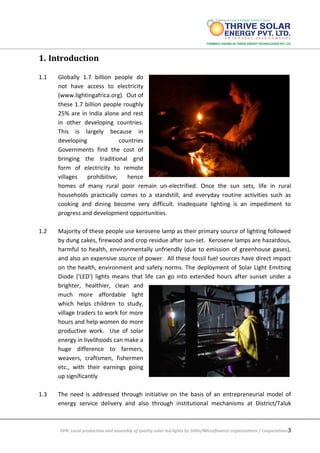
1.1 Globally 1.7 billion people do
not have access to electricity
(www.lightingafrica.org). Out of
these 1.7 billion people roughly
25% are in India alone and rest
in other developing countries.
This is largely because in
developing countries
Governments find the cost of
bringing the traditional grid
form of electricity to remote
villages prohibitive; hence
homes of many rural poor remain un-electrified. Once the sun sets, life in rural
households practically comes to a standstill, and everyday routine activities such as
cooking and dining become very difficult. Inadequate lighting is an impediment to
progress and development opportunities.
1.2 Majority of these people use kerosene lamp as their primary source of lighting followed
by dung cakes, firewood and crop residue after sun-set. Kerosene lamps are hazardous,
harmful to health, environmentally unfriendly (due to emission of greenhouse gases),
and also an expensive source of power. All these fossil fuel sources have direct impact
on the health, environment and safety norms. The deployment of Solar Light Emitting
Diode ('LED') lights means that life can go into extended hours after sunset under a
brighter, healthier, clean and
much more affordable light
which helps children to study,
village traders to work for more
hours and help women do more
productive work. Use of solar
energy in livelihoods can make a
huge difference to farmers,
weavers, craftsmen, fishermen
etc., with their earnings going
up significantly
1.3 The need is addressed through initiative on the basis of an entrepreneurial model of
energy service delivery and also through institutional mechanisms at District/Taluk
DPR: Local production and assembly of quality solar led lights by SHGs/Microfinance organizations / cooperatives4
Levels. The entrepreneurial model benefits the user and it can sustain the whole
process. The individuals or Self-Help Groups are trained to manage and run a solar
assembling unit, charging stations. The model facilitates entrepreneurship development
among rural communities apart from providing reliable and ensured lighting to
households.
1.4 These types of rural technology models are more sustainable when they are promoted
as an enterprise model, which gives opportunity for income generation, in addition to
meeting basic needs.
The proposal discussed the profitable business model of setting up of an assembling unit
and also its impact in the society.
2. Indian Scenario
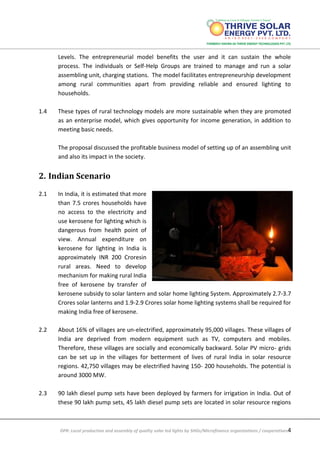
2.1 In India, it is estimated that more
than 7.5 crores households have
no access to the electricity and
use kerosene for lighting which is
dangerous from health point of
view. Annual expenditure on
kerosene for lighting in India is
approximately INR 200 Croresin
rural areas. Need to develop
mechanism for making rural India
free of kerosene by transfer of
kerosene subsidy to solar lantern and solar home lighting System. Approximately 2.7-3.7
Crores solar lanterns and 1.9-2.9 Crores solar home lighting systems shall be required for
making India free of kerosene.
2.2 About 16% of villages are un-electrified, approximately 95,000 villages. These villages of
India are deprived from modern equipment such as TV, computers and mobiles.
Therefore, these villages are socially and economically backward. Solar PV micro- grids
can be set up in the villages for betterment of lives of rural India in solar resource
regions. 42,750 villages may be electrified having 150- 200 households. The potential is
around 3000 MW.
2.3 90 lakh diesel pump sets have been deployed by farmers for irrigation in India. Out of
these 90 lakh pump sets, 45 lakh diesel pump sets are located in solar resource regions
DPR: Local production and assembly of quality solar led lights by SHGs/Microfinance organizations / cooperatives5
and have the land for installation Solar PV system. Average capacity of pump is 3.73 KW,
and total potential of these pumps comes to 16,785 MW.
2.4 4,00,000 telecommunication towers are installed in India, out of which 84,000 telecom
towers powered by diesel generating sets are located in solar resource regions and
having land for installation of solar PV. Average capacity of diesel generating set is 4KW;
the total potential comes to 336 MW.
2.5 Off-grid solar PV has a bright future in India. Mainly, three factors will collectively work
and increase off- grid potential several times in India. First factor- limited land resource
in India restricts utility scale solar PV end –use sector, Second factor- electrifying remote
villages is not techno-economically feasible, since requires long transmission and
distribution lines which involve heavy capital expenditure, and third factor - economic
and population growth of the country will increase supply and demand gap of electricity,
this increasing supply and demand gap would substantially increase in off-grid potential.
As per IEA, Technology Roadmap, Solar Photovoltaic Energy 2010, off- grid solar PV
potential of the world would be 463 GW by 2050, India would have potential of 20 to
25%, 92 GW to 115 GW by 2050.
2.6 India has the highest off-grid potential in the world, therefore, there is need to develop
strong R&D on off–grid solar PV to enable to provide minimum requirement of
electricity to the rural peoples at reasonable and affordable rates. Government of India
and the State Governments need to encourage off-grid solar PV system in India, by
providing capital subsidy and soft loans to phase out Kerosene and diesel from the
Indian scene.
(Reference: World Energy Outlook, IEA, 2011)
The demand and supply estimates for solar lights based upon Census Report 2011, is
given in the para “Market Demand” in the foregoing paragraphs.
3. Alternative Low Cost Lighting Solutions for the Poor
3.1 Role of Solar and LED Technologies
3.1.1 Solar technology coupled with LED technology has made it possible for
entrepreneurs in the lighting industry to come up with innovative low cost lighting
solutions for the off-grid poor around the world.
DPR: Local production and assembly of quality solar led lights by SHGs/Microfinance organizations / cooperatives6
3.1.2 The impressive growth of the photovoltaic market, mainly driven by European
interest for this technology, has led to a large scale decrease in prices of solar panels.
Solar Panels of different sizes are now available even in small towns and cities of the
developing world at a very low retail price of about US$ 1 (INR 60/-) per watt.
3.1.3 Solar panels, when coupled with Light Emitting Diodes (LEDs), which are durable
semiconductors under Solid State Lighting, provide one of the world’s most energy
efficient light sources. White LED commercial bulbs have today reached efficacies of
180 lm/W, comparable to the efficacies of certain fluorescent and high intensity
discharge (HID) lamps, LED bulb efficacies will only continue to get better. LED lights
use approximately 10% of the energy consumption of incandescent bulbs (normal
light bulbs) and 40% of the energy of compact fluorescent
lamp (CFL) bulbs. LED lights have very low failure rates (less
than 1 in every 1000) and consume very little power (either
from the grid or from solar recharging). Few years ago, a
one watt solar panel could not do anything by itself, and
probably they were not even made for any consumption.
But, today with LED technology even a half watt solar panel
can be put to use with a light that delivers 30 to 60 lumens
of light without fail every day.
3.2 Solar LED lights- User benefits
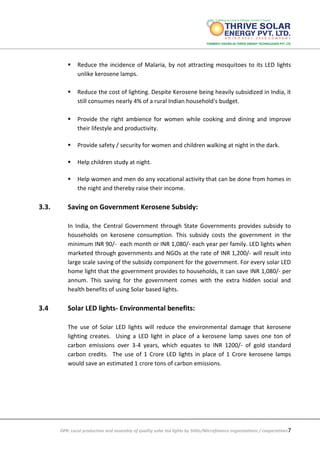
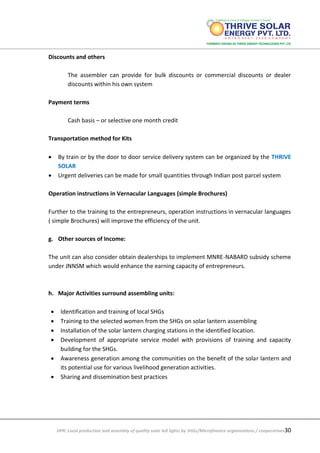
 Provide clean and reliable
lighting to rural / tribal
homes.
 Eliminate air pollution in
the homes by replacing
kerosene lights. A recent
report by the World Bank
suggests that indoor air
pollution from kerosene
results in 16 Lakh deaths
worldwide every year. The
World Bank also notes that 78 Crore people in the developing world, mostly
women and children, are exposed to kerosene lantern fumes, which are
equivalent to two packs of cigarettes a day.
DPR: Local production and assembly of quality solar led lights by SHGs/Microfinance organizations / cooperatives7
 Reduce the incidence of Malaria, by not attracting mosquitoes to its LED lights
unlike kerosene lamps.
 Reduce the cost of lighting. Despite Kerosene being heavily subsidized in India, it
still consumes nearly 4% of a rural Indian household's budget.
 Provide the right ambience for women while cooking and dining and improve
their lifestyle and productivity.
 Provide safety / security for women and children walking at night in the dark.
 Help children study at night.
 Help women and men do any vocational activity that can be done from homes in
the night and thereby raise their income.
3.3. Saving on Government Kerosene Subsidy:
In India, the Central Government through State Governments provides subsidy to
households on kerosene consumption. This subsidy costs the government in the
minimum INR 90/- each month or INR 1,080/- each year per family. LED lights when
marketed through governments and NGOs at the rate of INR 1,200/- will result into
large scale saving of the subsidy component for the government. For every solar LED
home light that the government provides to households, it can save INR 1,080/- per
annum. This saving for the government comes with the extra hidden social and
health benefits of using Solar based lights.
3.4 Solar LED lights- Environmental benefits:
The use of Solar LED lights will reduce the environmental damage that kerosene
lighting creates. Using a LED light in place of a kerosene lamp saves one ton of
carbon emissions over 3-4 years, which equates to INR 1200/- of gold standard
carbon credits. The use of 1 Crore LED lights in place of 1 Crore kerosene lamps
would save an estimated 1 crore tons of carbon emissions.
DPR: Local production and assembly of quality solar led lights by SHGs/Microfinance organizations / cooperatives8
4. Thrive Solar Energy Private Limited
4.1 It is in this innovative space that organizations like THRIVE SOLAR have come to play.
THRIVE SOLAR helps the needy by providing them with lights that use very small and
low cost solar panels and low watt LED lights. These lights are not only less expensive
and reliable but much brighter and safer than kerosene lamps.
The Company was formed and incorporated as Thrive Energy Technologies Private
Limited under the Companies’ Act 1956 in India on 24th February 2007. On May 19,
2013, it was renamed as Thrive Solar Energy Private Ltd., (THRIVE SOLAR). The
Company’s Headquarters is located in Hyderabad, Telangana, and is focused on
designing and developing high quality, low-cost LED home lights that help serve the
millions of poor in inaccessible areas in Asia and Africa. The complete profile of THRIVE
SOLAR is attached and is a part of this proposal.
4.2 Creation of Social Entrepreneurs at village level:
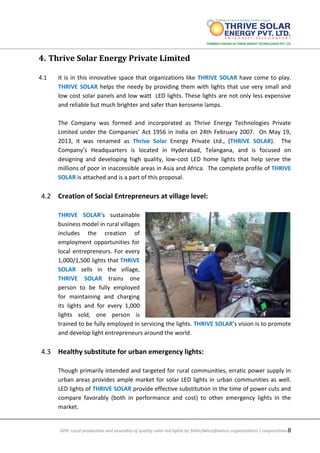
THRIVE SOLAR’s sustainable
business model in rural villages
includes the creation of
employment opportunities for
local entrepreneurs. For every
1,000/1,500 lights that THRIVE
SOLAR sells in the village,
THRIVE SOLAR trains one
person to be fully employed
for maintaining and charging
its lights and for every 1,000
lights sold, one person is
trained to be fully employed in servicing the lights. THRIVE SOLAR’s vision is to promote
and develop light entrepreneurs around the world.
4.3 Healthy substitute for urban emergency lights:
Though primarily intended and targeted for rural communities, erratic power supply in
urban areas provides ample market for solar LED lights in urban communities as well.
LED lights of THRIVE SOLAR provide effective substitution in the time of power cuts and
compare favorably (both in performance and cost) to other emergency lights in the
market.
DPR: Local production and assembly of quality solar led lights by SHGs/Microfinance organizations / cooperatives9
5. Estimated Social, Economic And Environmental Impact Of
Thrive Solar Products
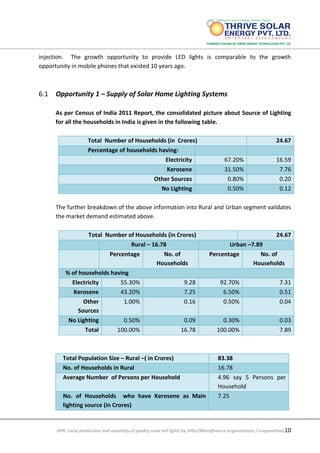
5.1 THRIVE SOLAR, by virtue of its
presence in the market for
some time, has guesstimates of
the social, economic and
environmental impact of the
sale, installation and use of its
products. THRIVE SOLAR
believes that by the use of 50
lakh THRIVE Solar LED Study
Lights can improve the literacy
levels of that many rural
children and ultimately enable
these children to compete with urban children to become professionals-engineers,
doctors, policy makers, legislators or businessmen. The use of 20 lakh ACCENDO Solar
LED Mini lights can improve women's economic productivity by 10 to 30%. 15 Lakhs
ACCENDO Solar LED Home Lights can improve home and outdoor productivity in the
villages, and help improve the incomes of households. 50,000 village streets lighted up
would mean better ambience, safety and security to women, and reduced alcoholics
moving around in the villages in the nights. The sale of 100,000 Hawker lights for
fishermen, weavers, small businesses can improve their daily earnings by 10 to 20%.
5.2 On the whole, THRIVE SOLAR’s ambitious sale of 1 crore lights can save 72 Crore liters
of kerosene a year or 20 Lakh tons of carbon pollution every year Also, 1 Crore lights
spread over at least 10,000 villages provide employment opportunity to 10,000 village
youth. Though measuring social impact of the lights is difficult, it is easy to visualize the
value of a reliable light to the emotional safety of old or sick people, children or small
businesswomen who make a living with meager incomes.
6. Market Demand
It is estimated that the demand for LED home lights will be 10 Crore units in the next 5 years.
THRIVE SOLAR's business plan assumes that it takes just 2% of this (20 Lakhs lights).
Considering that THRIVE SOLAR today has the largest LED home lights base installed in the
country, the projected market share seems to be extremely conservative given the capital
DPR: Local production and assembly of quality solar led lights by SHGs/Microfinance organizations / cooperatives10
injection. The growth opportunity to provide LED lights is comparable to the growth
opportunity in mobile phones that existed 10 years ago.
6.1 Opportunity 1 – Supply of Solar Home Lighting Systems
As per Census of India 2011 Report, the consolidated picture about Source of Lighting
for all the households in India is given in the following table.
Total Number of Households (in Crores) 24.67
Percentage of households having:
Electricity 67.20% 16.59
Kerosene 31.50% 7.76
Other Sources 0.80% 0.20
No Lighting 0.50% 0.12
The further breakdown of the above information into Rural and Urban segment validates
the market demand estimated above.
Total Number of Households (in Crores) 24.67
Rural – 16.78 Urban –7.89
Percentage No. of
Households
Percentage No. of
Households
% of households having
Electricity 55.30% 9.28 92.70% 7.31
Kerosene 43.20% 7.25 6.50% 0.51
Other
Sources
1.00% 0.16 0.50% 0.04
No Lighting 0.50% 0.09 0.30% 0.03
Total 100.00% 16.78 100.00% 7.89
Total Population Size – Rural –( in Crores) 83.38
No. of Households in Rural 16.78
Average Number of Persons per Household 4.96 say 5 Persons per
Household
No. of Households who have Kerosene as Main
lighting source (in Crores)
7.25
DPR: Local production and assembly of quality solar led lights by SHGs/Microfinance organizations / cooperatives11
No. of Persons who are exposed to kerosene 7.25 Crores x 5 = 36.25
Crores persons
Out of the 7.25 Crore households who have Kerosene as main lighting source (in India) if
2% market is targeted it results to supply of 14.50Lakhsolar LED lights. Those households
who are categorized under “Electricity” (9.28 Crores households in rural areas) also do
not have regular grid power supply and the erratic power supply forced them to use
alternative energy. 90% of households do not have regular supply of grid power. Even
1% of market from this segment is targeted it results to 9.28Lakh. Thereby, the target of
THRIVE SOLAR of 20 Lakh Lights can be considered quite conservative.
6.2 Opportunity 2 – Setting up Assembling Units
Creation of entrepreneurship among the rural households is one of the primary goals of
THRIVE SOLAR. The total rural population as per census 2011 is estimated at 83.38
Crores and the number of villages is 640,867.
Total Population Size – Rural – in Crores 83.38
No. of Districts in India 640
Number of villages 640,867
Number of proposed Assembling Units 500
No. of Rural Households using Kerosene in Crores 7.25
Average Number of households that can be served by
each manufacturing/Assembling Unit
1,45,000@@
@@This is the opportunity available for the entrepreneurs in the villages for setting up
an manufacturing/assembling unit with backup service facilities ensuring regular O&M
to the lights manufactured/assembled.
The feasibility of the opportunity is discussed in the foregoing paragraphs.
6.3 Promoting local production in a block or a large village.
Although on a large scale, lights (almost 1000 Million+ for all varieties) can always be
produced in large factories like mobile phones and others, THRIVE SOLAR believes in
promoting their production in small block HQ or large village through women groups,
cooperatives, federations and others. Advantages of this approach include:
DPR: Local production and assembly of quality solar led lights by SHGs/Microfinance organizations / cooperatives12
1) Women groups are empowered with technology, finance and with host of other
skills.
2) Knowledge of production, business and host of other formalities of doing quality
work, will spin off into other businesses by the women or their peers.
3) Service and maintenance support is available to the customers from the
manufacturer themselves or their trained village level technicians and this is all done
locally.
4) The production processes are made simple.
5) The required capital is reasonable.
6) The space and power requirements are also limited.
7) They can easily market them in their area/block/district.
8) With little training any unskilled women groups can start producing the lights.
6.4 Proposed Intervention
Thrive solar proposes to help set up around 500 SOLAR LED lights manufacturing and
assembly centers in India to help empower women, provide local employment, increase
the work skills and provide for kerosene free and well lighted rural India.
However the production is simplified, processes can be mastered, the skills can be easily
acquired, but the critical issue is to market the lights in reasonable quantity. It all
depends on how much they can market the lights in local area or in …
The production size, teams, finances, machinery, marketing plans and other details are
discussed in the ensuing paragraphs.
It is proposed to set-up facility of assembly of lights and sales with less manpower and
capital.
DPR: Local production and assembly of quality solar led lights by SHGs/Microfinance organizations / cooperatives13
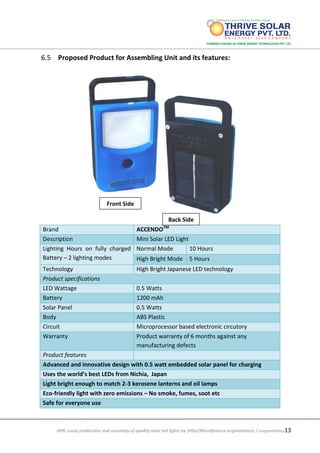
6.5 Proposed Product for Assembling Unit and its features:
Brand ACCENDOTM
Description Mini Solar LED Light
Lighting Hours on fully charged
Battery – 2 lighting modes
Normal Mode 10 Hours
High Bright Mode 5 Hours
Technology High Bright Japanese LED technology
Product specifications
LED Wattage 0.5 Watts
Battery 1200 mAh
Solar Panel 0.5 Watts
Body ABS Plastic
Circuit Microprocessor based electronic circutory
Warranty Product warranty of 6 months against any
manufacturing defects
Product features
Advanced and innovative design with 0.5 watt embedded solar panel for charging
Uses the world’s best LEDs from Nichia, Japan
Light bright enough to match 2-3 kerosene lanterns and oil lamps
Eco-friendly light with zero emissions – No smoke, fumes, soot etc
Safe for everyone use
Front Side
Back Side
DPR: Local production and assembly of quality solar led lights by SHGs/Microfinance organizations / cooperatives14
6.6 Technical Aspects:
6.6.1 Process of Manufacture/Assembling:-
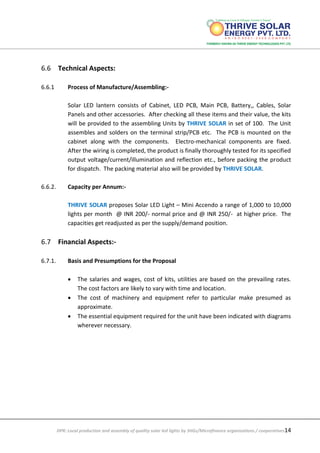
Solar LED lantern consists of Cabinet, LED PCB, Main PCB, Battery,, Cables, Solar
Panels and other accessories. After checking all these items and their value, the kits
will be provided to the assembling Units by THRIVE SOLAR in set of 100. The Unit
assembles and solders on the terminal strip/PCB etc. The PCB is mounted on the
cabinet along with the components. Electro-mechanical components are fixed.
After the wiring is completed, the product is finally thoroughly tested for its specified
output voltage/current/illumination and reflection etc., before packing the product
for dispatch. The packing material also will be provided by THRIVE SOLAR.
6.6.2. Capacity per Annum:-
THRIVE SOLAR proposes Solar LED Light – Mini Accendo a range of 1,000 to 10,000
lights per month @ INR 200/- normal price and @ INR 250/- at higher price. The
capacities get readjusted as per the supply/demand position.
6.7 Financial Aspects:-
6.7.1. Basis and Presumptions for the Proposal
 The salaries and wages, cost of kits, utilities are based on the prevailing rates.
The cost factors are likely to vary with time and location.
 The cost of machinery and equipment refer to particular make presumed as
approximate.
 The essential equipment required for the unit have been indicated with diagrams
wherever necessary.
DPR: Local production and assembly of quality solar led lights by SHGs/Microfinance organizations / cooperatives15
6.7.2. Fixed Capital:
Premises: - Rented Premises @ INR 2000/- per month taken into expenses. Six months
advance rent i.e, INR 12,000/- as taken as pre-operative expenses.
Sr. No Description In Sq. Ft.
1 Office space 100
2 Assembly space 400
3 Store for raw materials and
finished goods
100
4 Loading and unloading area 100
5 Bathroom 50
6 Others 50
Except some Civil works of INR 50,000/- (taken as a pre-operative expenses) no other
fixed cost is envisaged for Premises. Total pre-operative expenses = INR 62,000
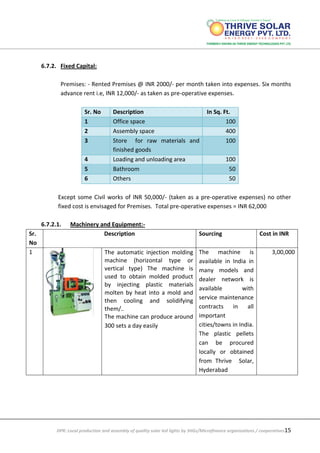
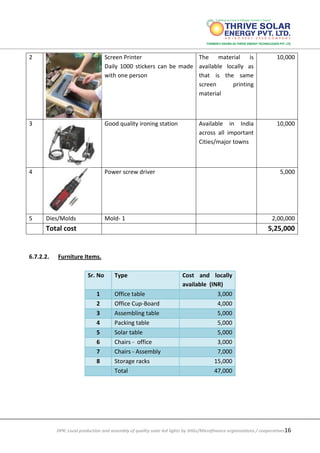
6.7.2.1. Machinery and Equipment:-
Sr.
No
Description Sourcing Cost in INR
1 The automatic injection molding
machine (horizontal type or
vertical type) The machine is
used to obtain molded product
by injecting plastic materials
molten by heat into a mold and
then cooling and solidifying
them/..
The machine can produce around
300 sets a day easily
The machine is
available in India in
many models and
dealer network is
available with
service maintenance
contracts in all
important
cities/towns in India.
The plastic pellets
can be procured
locally or obtained
from Thrive Solar,
Hyderabad
3,00,000
DPR: Local production and assembly of quality solar led lights by SHGs/Microfinance organizations / cooperatives16
2 Screen Printer
Daily 1000 stickers can be made
with one person
The material is
available locally as
that is the same
screen printing
material
10,000
3 Good quality ironing station Available in India
across all important
Cities/major towns
10,000
4 Power screw driver 5,000
5 Dies/Molds Mold- 1 2,00,000
Total cost 5,25,000
6.7.2.2. Furniture Items.
Sr. No Type Cost and locally
available (INR)
1 Office table 3,000
2 Office Cup-Board 4,000
3 Assembling table 5,000
4 Packing table 5,000
5 Solar table 5,000
6 Chairs - office 3,000
7 Chairs - Assembly 7,000
8 Storage racks 15,000
Total 47,000
DPR: Local production and assembly of quality solar led lights by SHGs/Microfinance organizations / cooperatives17
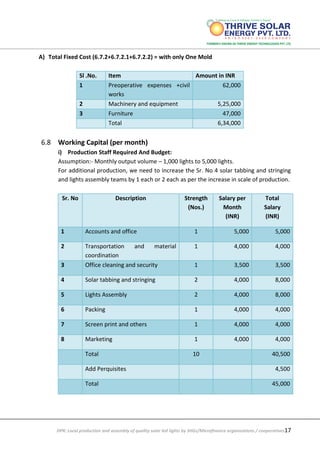
A) Total Fixed Cost (6.7.2+6.7.2.1+6.7.2.2) = with only One Mold
Sl .No. Item Amount in INR
1 Preoperative expenses +civil
works
62,000
2 Machinery and equipment 5,25,000
3 Furniture 47,000
Total 6,34,000
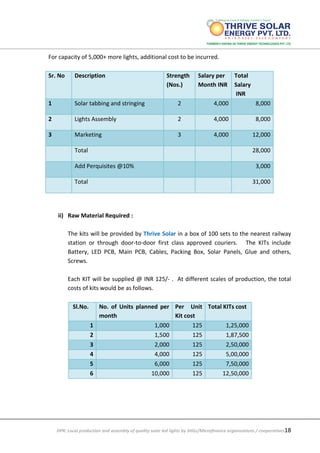
6.8 Working Capital (per month)
i) Production Staff Required And Budget:
Assumption:- Monthly output volume – 1,000 lights to 5,000 lights.
For additional production, we need to increase the Sr. No 4 solar tabbing and stringing
and lights assembly teams by 1 each or 2 each as per the increase in scale of production.
Sr. No Description Strength
(Nos.)
Salary per
Month
(INR)
Total
Salary
(INR)
1 Accounts and office 1 5,000 5,000
2 Transportation and material
coordination
1 4,000 4,000
3 Office cleaning and security 1 3,500 3,500
4 Solar tabbing and stringing 2 4,000 8,000
5 Lights Assembly 2 4,000 8,000
6 Packing 1 4,000 4,000
7 Screen print and others 1 4,000 4,000
8 Marketing 1 4,000 4,000
Total 10 40,500
Add Perquisites 4,500
Total 45,000
DPR: Local production and assembly of quality solar led lights by SHGs/Microfinance organizations / cooperatives18
For capacity of 5,000+ more lights, additional cost to be incurred.
Sr. No Description Strength
(Nos.)
Salary per
Month INR
Total
Salary
INR
1 Solar tabbing and stringing 2 4,000 8,000
2 Lights Assembly 2 4,000 8,000
3 Marketing 3 4,000 12,000
Total 28,000
Add Perquisites @10% 3,000
Total 31,000
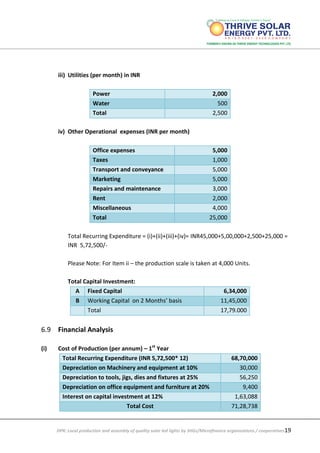
ii) Raw Material Required :
The kits will be provided by Thrive Solar in a box of 100 sets to the nearest railway
station or through door-to-door first class approved couriers. The KITs include
Battery, LED PCB, Main PCB, Cables, Packing Box, Solar Panels, Glue and others,
Screws.
Each KIT will be supplied @ INR 125/- . At different scales of production, the total
costs of kits would be as follows.
Sl.No. No. of Units planned per
month
Per Unit
Kit cost
Total KITs cost
1 1,000 125 1,25,000
2 1,500 125 1,87,500
3 2,000 125 2,50,000
4 4,000 125 5,00,000
5 6,000 125 7,50,000
6 10,000 125 12,50,000
DPR: Local production and assembly of quality solar led lights by SHGs/Microfinance organizations / cooperatives19
iii) Utilities (per month) in INR
Power 2,000
Water 500
Total 2,500
iv) Other Operational expenses (INR per month)
Office expenses 5,000
Taxes 1,000
Transport and conveyance 5,000
Marketing 5,000
Repairs and maintenance 3,000
Rent 2,000
Miscellaneous 4,000
Total 25,000
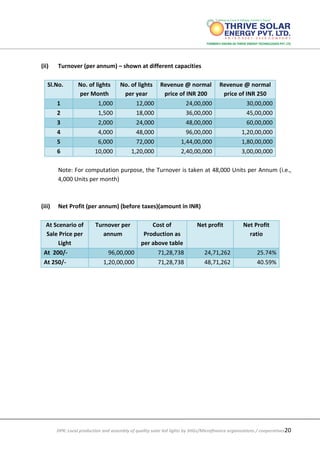
Total Recurring Expenditure = (i)+(ii)+(iii)+(iv)= INR45,000+5,00,000+2,500+25,000 =
INR 5,72,500/-
Please Note: For Item ii – the production scale is taken at 4,000 Units.
Total Capital Investment:
A Fixed Capital 6,34,000
B Working Capital on 2 Months’ basis 11,45,000
Total 17,79.000
6.9 Financial Analysis
(i) Cost of Production (per annum) – 1st
Year
Total Recurring Expenditure (INR 5,72,500* 12) 68,70,000
Depreciation on Machinery and equipment at 10% 30,000
Depreciation to tools, jigs, dies and fixtures at 25% 56,250
Depreciation on office equipment and furniture at 20% 9,400
Interest on capital investment at 12% 1,63,088
Total Cost 71,28,738
DPR: Local production and assembly of quality solar led lights by SHGs/Microfinance organizations / cooperatives20
(ii) Turnover (per annum) – shown at different capacities
Sl.No. No. of lights
per Month
No. of lights
per year
Revenue @ normal
price of INR 200
Revenue @ normal
price of INR 250
1 1,000 12,000 24,00,000 30,00,000
2 1,500 18,000 36,00,000 45,00,000
3 2,000 24,000 48,00,000 60,00,000
4 4,000 48,000 96,00,000 1,20,00,000
5 6,000 72,000 1,44,00,000 1,80,00,000
6 10,000 1,20,000 2,40,00,000 3,00,00,000
Note: For computation purpose, the Turnover is taken at 48,000 Units per Annum (i.e.,
4,000 Units per month)
(iii) Net Profit (per annum) (before taxes)(amount in INR)
At Scenario of
Sale Price per
Light
Turnover per
annum
Cost of
Production as
per above table
Net profit Net Profit
ratio
At 200/- 96,00,000 71,28,738 24,71,262 25.74%
At 250/- 1,20,00,000 71,28,738 48,71,262 40.59%
DPR: Local production and assembly of quality solar led lights by SHGs/Microfinance organizations / cooperatives21
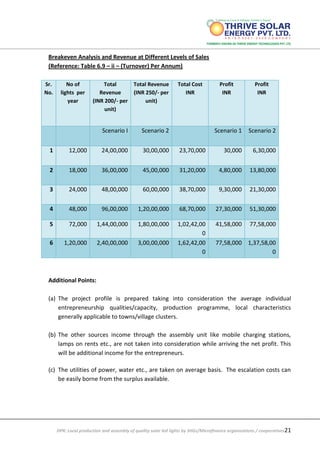
Breakeven Analysis and Revenue at Different Levels of Sales
(Reference: Table 6.9 – ii – (Turnover) Per Annum)
Sr.
No.
No of
lights per
year
Total
Revenue
(INR 200/- per
unit)
Total Revenue
(INR 250/- per
unit)
Total Cost
INR
Profit
INR
Profit
INR
Scenario I Scenario 2 Scenario 1 Scenario 2
1 12,000 24,00,000 30,00,000 23,70,000 30,000 6,30,000
2 18,000 36,00,000 45,00,000 31,20,000 4,80,000 13,80,000
3 24,000 48,00,000 60,00,000 38,70,000 9,30,000 21,30,000
4 48,000 96,00,000 1,20,00,000 68,70,000 27,30,000 51,30,000
5 72,000 1,44,00,000 1,80,00,000 1,02,42,00
0
41,58,000 77,58,000
6 1,20,000 2,40,00,000 3,00,00,000 1,62,42,00
0
77,58,000 1,37,58,00
0
Additional Points:
(a) The project profile is prepared taking into consideration the average individual
entrepreneurship qualities/capacity, production programme, local characteristics
generally applicable to towns/village clusters.
(b) The other sources income through the assembly unit like mobile charging stations,
lamps on rents etc., are not taken into consideration while arriving the net profit. This
will be additional income for the entrepreneurs.
(c) The utilities of power, water etc., are taken on average basis. The escalation costs can
be easily borne from the surplus available.
DPR: Local production and assembly of quality solar led lights by SHGs/Microfinance organizations / cooperatives22
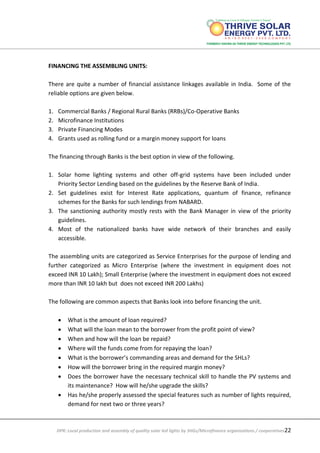
FINANCING THE ASSEMBLING UNITS:
There are quite a number of financial assistance linkages available in India. Some of the
reliable options are given below.
1. Commercial Banks / Regional Rural Banks (RRBs)/Co-Operative Banks
2. Microfinance Institutions
3. Private Financing Modes
4. Grants used as rolling fund or a margin money support for loans
The financing through Banks is the best option in view of the following.
1. Solar home lighting systems and other off-grid systems have been included under
Priority Sector Lending based on the guidelines by the Reserve Bank of India.
2. Set guidelines exist for Interest Rate applications, quantum of finance, refinance
schemes for the Banks for such lendings from NABARD.
3. The sanctioning authority mostly rests with the Bank Manager in view of the priority
guidelines.
4. Most of the nationalized banks have wide network of their branches and easily
accessible.
The assembling units are categorized as Service Enterprises for the purpose of lending and
further categorized as Micro Enterprise (where the investment in equipment does not
exceed INR 10 Lakh); Small Enterprise (where the investment in equipment does not exceed
more than INR 10 lakh but does not exceed INR 200 Lakhs)
The following are common aspects that Banks look into before financing the unit.
 What is the amount of loan required?
 What will the loan mean to the borrower from the profit point of view?
 When and how will the loan be repaid?
 Where will the funds come from for repaying the loan?
 What is the borrower’s commanding areas and demand for the SHLs?
 How will the borrower bring in the required margin money?
 Does the borrower have the necessary technical skill to handle the PV systems and
its maintenance? How will he/she upgrade the skills?
 Has he/she properly assessed the special features such as number of lights required,
demand for next two or three years?
DPR: Local production and assembly of quality solar led lights by SHGs/Microfinance organizations / cooperatives23
 Are there any additional sources of income for the Unit – like through rentals of the
lights, through dealer commissions, mobile charging fees, any surplus from other
sources etc.,
 What are the terms of sales by the Assembling Unit to the village people? Any
support from Self Help groups is available?
Interest Rates:
The category of the borrower, quantum of the loans, repayment capacity of the borrower
etc., determine the rate of Interest to be charged on the loan borrowed.
However in many cases, the interest rate is regulated as the loan is categorized under
priority sector lending and refinance is normally available for such loans.
Applicability of JNNSM scheme:
The main objectives of the scheme are to promote off-grid applications of solar energy and
create a paradigm shift needed for commodization of off-grid solar applications. The margin
money, loan period and rate of interest on the loans will be based upon the capital subsidy
scheme by NABARD through Regional Rural Banks and other Commercial Banks for solar
lighting systems.
Calculations On Availment Of Bank Loan Facility.
Assumptions:
1) No collateral security assumed as per the present banking norms available to Micro
enterprises.
2) Capital Cost+2 months’ working capital Cost are capitalized as WCTL.
3) Margin is pegged at 20%. Margin money also can be brought by MFI to support the unit.
However in the present case it is not assumed.
4) Interest Rate is assumed at 12%.
5) For calculation purpose the turnover of 4,000 lamps per month is taken into
consideration as worked in preceding paragraphs.
DPR: Local production and assembly of quality solar led lights by SHGs/Microfinance organizations / cooperatives24
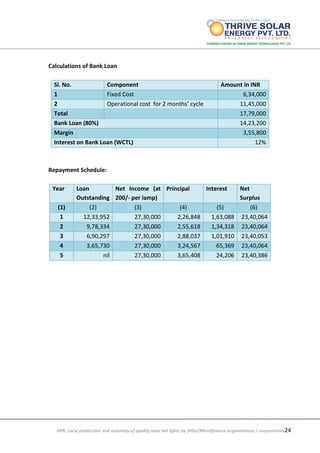
Calculations of Bank Loan
Sl. No. Component Amount in INR
1 Fixed Cost 6,34,000
2 Operational cost for 2 months’ cycle 11,45,000
Total 17,79,000
Bank Loan (80%) 14,23,200
Margin 3,55,800
Interest on Bank Loan (WCTL) 12%
Repayment Schedule:
Year Loan
Outstanding
Net Income (at
200/- per lamp)
Principal Interest Net
Surplus
(1) (2) (3) (4) (5) (6)
1 12,33,952 27,30,000 2,26,848 1,63,088 23,40,064
2 9,78,334 27,30,000 2,55,618 1,34,318 23,40,064
3 6,90,297 27,30,000 2,88,037 1,01,910 23,40,053
4 3,65,730 27,30,000 3,24,567 65,369 23,40,064
5 nil 27,30,000 3,65,408 24,206 23,40,386
DPR: Local production and assembly of quality solar led lights by SHGs/Microfinance organizations / cooperatives25
7. The Effectiveness of the Assembly Units
7.1 Scope of the Model:
• Identification and training of local individuals, youth, women, physical challenged and
also Self Help Groups (SHGs) on solar lantern assembling.
• Installation of the solar lantern charging stations in the identified location.
• Development of appropriate service model with provisions of training and capacity
building for participants.
• Awareness generation among the communities on the benefit of the solar lantern and
its potential use for various livelihood generation activities.
• Sharing and dissemination best practices.
• Rural energy technologies are most sustainable when they are promoted as an
enterprise model, which gives opportunity for income generation, in addition to meeting
basic needs.
7.2 Employment Potential:
A centralized assembling unit – one for each District/cluster
 Provides employment for 10/20 persons – unskilled and uneducated old and
handicapped
 Assembly ranges from 1,000 to 10,000 Lanterns per month as per the size of the
Unit
 Hiring of Lamps collection and Battery charging
 Income from Charging of Lanterns
 Have Dealers at various levels as collection agents
 Mobile charging / lanterns / lamps for a fee
 Facilities for local repair and service enhancing credibility
 SHG / NGOs can provide market assistance
DPR: Local production and assembly of quality solar led lights by SHGs/Microfinance organizations / cooperatives26
7.3 Advantages to the End Users:
 Assurance of delivery across the counter, repair and maintenance of battery charge.
 Greater faith in the product due to local entrepreneur managing the operations.
 Easy availability by various product models
 Pay per use or daily installments - choice is left with the end user
 Acquisition of lantern by EMIs also.
7.4 Potential Assemblers
 Uneducated, unemployed youth, women and handicapped adults
 Skill set required is minimal.
 Easy to assemble with minimal steps involved
 Requirement of tools and space minimal
7.5 Thrive Solar Plans to Improve the Effectiveness
a. Through the training methods:
Thrive Solar plans to provide/arrange trainings in skill improvements both at the assembly
unit and also at the manufacturing facility of Thrive Solar in Hyderabad. The duration and
location of the training depends upon the efficiencies of the entrepreneurs. The Rural
Technology Project established at National Institute of Rural Development, Hyderabad by
Thrive Solar will be also a training centre for the proposed entrepreneurs.
DPR: Local production and assembly of quality solar led lights by SHGs/Microfinance organizations / cooperatives27
b. Spares supplied by Thrive Solar:
Thrive Solar provides spares at an economical price (table given below) – by direct or
through local franchisee arrangement.
Sr. No Description Price in INR
1 BATTERY 40
2 Led PCB 15
3 MAIN PCB 35
4 Cables 5
5 Packing box 4
6 Solar panels 40
7 Glue and others
8 Screws 2
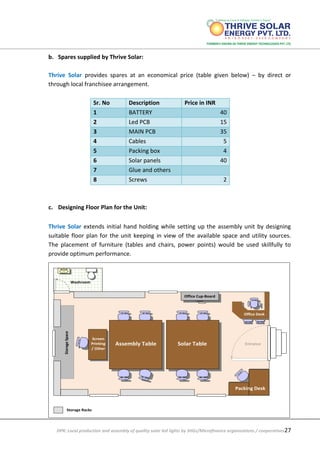
c. Designing Floor Plan for the Unit:
Thrive Solar extends initial hand holding while setting up the assembly unit by designing
suitable floor plan for the unit keeping in view of the available space and utility sources.
The placement of furniture (tables and chairs, power points) would be used skillfully to
provide optimum performance.
Washroom
Office Desk
Packing Desk
Entrance
Storage Racks
Assembly Table Solar Table
Screen
Printing
/ Other
StorageSpace
Office Cup-Board
DPR: Local production and assembly of quality solar led lights by SHGs/Microfinance organizations / cooperatives28
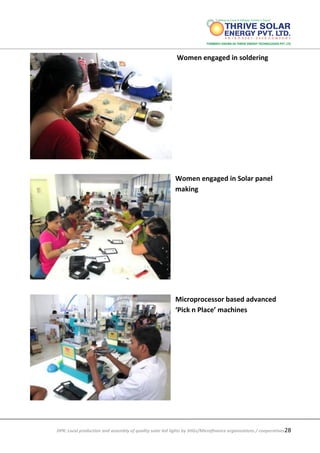
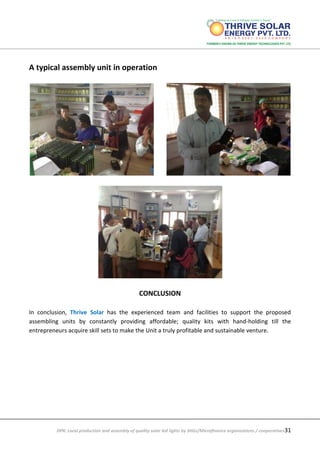
Women engaged in soldering
Women engaged in Solar panel
making
Microprocessor based advanced
‘Pick n Place’ machines
DPR: Local production and assembly of quality solar led lights by SHGs/Microfinance organizations / cooperatives29
d. Ideas on Marketing the Lights:
The lights can be hand marketed, marketed through cooperatives, marketed through retail
shops with prior arrangements,
 Particular NGOs/Individual Entrepreneurs who promoted this type of assembly line units
might have their own members/contacts. Generally NGOs service one or several districts
of India and have their own membership groups spanning into lakhs of households.
 Schools in rural and semi urban areas.
 Cooperatives of all types, like weavers, fishermen, handloom or any
 Dairy federations and individual farmers(nomenclature vary in each state)
 Small pan shops (they can use the light and as well make available for sale to their
customers)
 Street vendors (they can use the light and as well make available for sale to their
customers)
 Families – in the vicinity of the factory
 Gift ideas
 Weavers, Fishermen, Handicraft makers
e. Sale and Service of other Thrive Products as indicated in the Annexure-B
The basic description of other products is given below.
1. Accendo Super LED Home Light: 3 Watt LED bulb, with 6V solar panel.
2. Accendo Solar LED Study Light: 1 Watt LED bulb with 2 x 1.2 V Batteries and 5.5V solar
panel
3. Thrive Solar Home Lighting Systems: Customized solutions
4. Solar LED Home Lighting Systems: Four bright LED lamps with a 6W Solar panel system
f. Proposed Maintenance and service of Lights
Warranty
 General warranty of 6 months can be provided by the assembler on the lights
 For items not in the warranty list, nominal service charge can be made from the light
owners so that the confidence in the local brand is increased.
DPR: Local production and assembly of quality solar led lights by SHGs/Microfinance organizations / cooperatives30
Discounts and others
The assembler can provide for bulk discounts or commercial discounts or dealer
discounts within his own system
Payment terms
Cash basis – or selective one month credit
Transportation method for Kits
 By train or by the door to door service delivery system can be organized by the THRIVE
SOLAR
 Urgent deliveries can be made for small quantities through Indian post parcel system
Operation instructions in Vernacular Languages (simple Brochures)
Further to the training to the entrepreneurs, operation instructions in vernacular languages
( simple Brochures) will improve the efficiency of the unit.
g. Other sources of Income:
The unit can also consider obtain dealerships to implement MNRE-NABARD subsidy scheme
under JNNSM which would enhance the earning capacity of entrepreneurs.
h. Major Activities surround assembling units:
 Identification and training of local SHGs
 Training to the selected women from the SHGs on solar lantern assembling
 Installation of the solar lantern charging stations in the identified location.
 Development of appropriate service model with provisions of training and capacity
building for the SHGs.
 Awareness generation among the communities on the benefit of the solar lantern and
its potential use for various livelihood generation activities.
 Sharing and dissemination best practices
DPR: Local production and assembly of quality solar led lights by SHGs/Microfinance organizations / cooperatives31
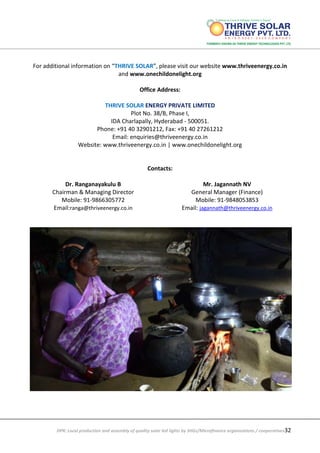
A typical assembly unit in operation
CONCLUSION
In conclusion, Thrive Solar has the experienced team and facilities to support the proposed
assembling units by constantly providing affordable; quality kits with hand-holding till the
entrepreneurs acquire skill sets to make the Unit a truly profitable and sustainable venture.
DPR: Local production and assembly of quality solar led lights by SHGs/Microfinance organizations / cooperatives32
For additional information on “THRIVE SOLAR”, please visit our website www.thriveenergy.co.in
and www.onechildonelight.org
Office Address:
THRIVE SOLAR ENERGY PRIVATE LIMITED
Plot No. 38/B, Phase I,
IDA Charlapally, Hyderabad - 500051.
Phone: +91 40 32901212, Fax: +91 40 27261212
Email: enquiries@thriveenergy.co.in
Website: www.thriveenergy.co.in | www.onechildonelight.org
Contacts:
Dr. Ranganayakulu B
Chairman & Managing Director
Mobile: 91-9866305772
Email:ranga@thriveenergy.co.in
Mr. Jagannath NV
General Manager (Finance)
Mobile: 91-9848053853
Email: jagannath@thriveenergy.co.in

Dpr solar-lights-assembly-unit-for-ng os-charities-shgs

  • 1.
    Proposal for settingup Assembling Units For PV Solar LED lights Detailed Project Report Thrive Solar Energy Pvt. Ltd. Plot No. 38/B, Phase I, IDA Cherlapally, Hyderabad - 500051. Phone: +91 40 32901212, Fax: +91 40 27261212 Website: www.thriveenergy.co.in Email: ranga@thriveenergy.co.in
  • 2.
    DPR: Local productionand assembly of quality solar led lights by SHGs/Microfinance organizations / cooperatives2 Foreword As per Census Report 2011, more than one lakh villages in India are yet to be electrified. Further, more than 40 per cent rural households do not have access to electricity and largely depend on kerosene for lighting. It is estimated that more than 13 crore school children use kerosene lamps for studying after sunset. Demand for power is growing exponentially. Industry and agriculture sectors are severely affected on account of power shortage. In the short run it will be difficult to meet the energy demand through already stressed out grid power. The need is therefore promote off-grid and renewable energy so as to take power to remote areas. Even in electrified areas, frequent power outages; suggest use of more renewable energy. Solar Energy is emerging as a front runner amongst different sources of renewable energy because of inherent advantages. It is an inexhaustible and free source of energy. India has the unique advantage of having 300 plus clear sunny days. It has immense potential to tap unlimited solar energy and become a world leader. While solar energy could be linked to the grid, this Detailed Project Report (DPR) focuses on using solar energy for home lighting through portable solar LED lights. The DPR would facilitate setting up of localized solar LED lights assembling units by solar entrepreneurs, with analysis of the market demand and setting up units with various capacities. We hope this will propel setting up Solar LED light units across the country and taking light into the lives of people who lack access to electricity. DPR also would help banks in financing for solar LED lights assembling units. It would be a win-win situation for all stakeholders. “TAMASOMA JYOTIRGAMAYA” Dr. B. Ranganayakulu
  • 3.
    DPR: Local productionand assembly of quality solar led lights by SHGs/Microfinance organizations / cooperatives3 1. Introduction 1.1 Globally 1.7 billion people do not have access to electricity (www.lightingafrica.org). Out of these 1.7 billion people roughly 25% are in India alone and rest in other developing countries. This is largely because in developing countries Governments find the cost of bringing the traditional grid form of electricity to remote villages prohibitive; hence homes of many rural poor remain un-electrified. Once the sun sets, life in rural households practically comes to a standstill, and everyday routine activities such as cooking and dining become very difficult. Inadequate lighting is an impediment to progress and development opportunities. 1.2 Majority of these people use kerosene lamp as their primary source of lighting followed by dung cakes, firewood and crop residue after sun-set. Kerosene lamps are hazardous, harmful to health, environmentally unfriendly (due to emission of greenhouse gases), and also an expensive source of power. All these fossil fuel sources have direct impact on the health, environment and safety norms. The deployment of Solar Light Emitting Diode ('LED') lights means that life can go into extended hours after sunset under a brighter, healthier, clean and much more affordable light which helps children to study, village traders to work for more hours and help women do more productive work. Use of solar energy in livelihoods can make a huge difference to farmers, weavers, craftsmen, fishermen etc., with their earnings going up significantly 1.3 The need is addressed through initiative on the basis of an entrepreneurial model of energy service delivery and also through institutional mechanisms at District/Taluk
  • 4.
    DPR: Local productionand assembly of quality solar led lights by SHGs/Microfinance organizations / cooperatives4 Levels. The entrepreneurial model benefits the user and it can sustain the whole process. The individuals or Self-Help Groups are trained to manage and run a solar assembling unit, charging stations. The model facilitates entrepreneurship development among rural communities apart from providing reliable and ensured lighting to households. 1.4 These types of rural technology models are more sustainable when they are promoted as an enterprise model, which gives opportunity for income generation, in addition to meeting basic needs. The proposal discussed the profitable business model of setting up of an assembling unit and also its impact in the society. 2. Indian Scenario 2.1 In India, it is estimated that more than 7.5 crores households have no access to the electricity and use kerosene for lighting which is dangerous from health point of view. Annual expenditure on kerosene for lighting in India is approximately INR 200 Croresin rural areas. Need to develop mechanism for making rural India free of kerosene by transfer of kerosene subsidy to solar lantern and solar home lighting System. Approximately 2.7-3.7 Crores solar lanterns and 1.9-2.9 Crores solar home lighting systems shall be required for making India free of kerosene. 2.2 About 16% of villages are un-electrified, approximately 95,000 villages. These villages of India are deprived from modern equipment such as TV, computers and mobiles. Therefore, these villages are socially and economically backward. Solar PV micro- grids can be set up in the villages for betterment of lives of rural India in solar resource regions. 42,750 villages may be electrified having 150- 200 households. The potential is around 3000 MW. 2.3 90 lakh diesel pump sets have been deployed by farmers for irrigation in India. Out of these 90 lakh pump sets, 45 lakh diesel pump sets are located in solar resource regions
  • 5.
    DPR: Local productionand assembly of quality solar led lights by SHGs/Microfinance organizations / cooperatives5 and have the land for installation Solar PV system. Average capacity of pump is 3.73 KW, and total potential of these pumps comes to 16,785 MW. 2.4 4,00,000 telecommunication towers are installed in India, out of which 84,000 telecom towers powered by diesel generating sets are located in solar resource regions and having land for installation of solar PV. Average capacity of diesel generating set is 4KW; the total potential comes to 336 MW. 2.5 Off-grid solar PV has a bright future in India. Mainly, three factors will collectively work and increase off- grid potential several times in India. First factor- limited land resource in India restricts utility scale solar PV end –use sector, Second factor- electrifying remote villages is not techno-economically feasible, since requires long transmission and distribution lines which involve heavy capital expenditure, and third factor - economic and population growth of the country will increase supply and demand gap of electricity, this increasing supply and demand gap would substantially increase in off-grid potential. As per IEA, Technology Roadmap, Solar Photovoltaic Energy 2010, off- grid solar PV potential of the world would be 463 GW by 2050, India would have potential of 20 to 25%, 92 GW to 115 GW by 2050. 2.6 India has the highest off-grid potential in the world, therefore, there is need to develop strong R&D on off–grid solar PV to enable to provide minimum requirement of electricity to the rural peoples at reasonable and affordable rates. Government of India and the State Governments need to encourage off-grid solar PV system in India, by providing capital subsidy and soft loans to phase out Kerosene and diesel from the Indian scene. (Reference: World Energy Outlook, IEA, 2011) The demand and supply estimates for solar lights based upon Census Report 2011, is given in the para “Market Demand” in the foregoing paragraphs. 3. Alternative Low Cost Lighting Solutions for the Poor 3.1 Role of Solar and LED Technologies 3.1.1 Solar technology coupled with LED technology has made it possible for entrepreneurs in the lighting industry to come up with innovative low cost lighting solutions for the off-grid poor around the world.
  • 6.
    DPR: Local productionand assembly of quality solar led lights by SHGs/Microfinance organizations / cooperatives6 3.1.2 The impressive growth of the photovoltaic market, mainly driven by European interest for this technology, has led to a large scale decrease in prices of solar panels. Solar Panels of different sizes are now available even in small towns and cities of the developing world at a very low retail price of about US$ 1 (INR 60/-) per watt. 3.1.3 Solar panels, when coupled with Light Emitting Diodes (LEDs), which are durable semiconductors under Solid State Lighting, provide one of the world’s most energy efficient light sources. White LED commercial bulbs have today reached efficacies of 180 lm/W, comparable to the efficacies of certain fluorescent and high intensity discharge (HID) lamps, LED bulb efficacies will only continue to get better. LED lights use approximately 10% of the energy consumption of incandescent bulbs (normal light bulbs) and 40% of the energy of compact fluorescent lamp (CFL) bulbs. LED lights have very low failure rates (less than 1 in every 1000) and consume very little power (either from the grid or from solar recharging). Few years ago, a one watt solar panel could not do anything by itself, and probably they were not even made for any consumption. But, today with LED technology even a half watt solar panel can be put to use with a light that delivers 30 to 60 lumens of light without fail every day. 3.2 Solar LED lights- User benefits  Provide clean and reliable lighting to rural / tribal homes.  Eliminate air pollution in the homes by replacing kerosene lights. A recent report by the World Bank suggests that indoor air pollution from kerosene results in 16 Lakh deaths worldwide every year. The World Bank also notes that 78 Crore people in the developing world, mostly women and children, are exposed to kerosene lantern fumes, which are equivalent to two packs of cigarettes a day.
  • 7.
    DPR: Local productionand assembly of quality solar led lights by SHGs/Microfinance organizations / cooperatives7  Reduce the incidence of Malaria, by not attracting mosquitoes to its LED lights unlike kerosene lamps.  Reduce the cost of lighting. Despite Kerosene being heavily subsidized in India, it still consumes nearly 4% of a rural Indian household's budget.  Provide the right ambience for women while cooking and dining and improve their lifestyle and productivity.  Provide safety / security for women and children walking at night in the dark.  Help children study at night.  Help women and men do any vocational activity that can be done from homes in the night and thereby raise their income. 3.3. Saving on Government Kerosene Subsidy: In India, the Central Government through State Governments provides subsidy to households on kerosene consumption. This subsidy costs the government in the minimum INR 90/- each month or INR 1,080/- each year per family. LED lights when marketed through governments and NGOs at the rate of INR 1,200/- will result into large scale saving of the subsidy component for the government. For every solar LED home light that the government provides to households, it can save INR 1,080/- per annum. This saving for the government comes with the extra hidden social and health benefits of using Solar based lights. 3.4 Solar LED lights- Environmental benefits: The use of Solar LED lights will reduce the environmental damage that kerosene lighting creates. Using a LED light in place of a kerosene lamp saves one ton of carbon emissions over 3-4 years, which equates to INR 1200/- of gold standard carbon credits. The use of 1 Crore LED lights in place of 1 Crore kerosene lamps would save an estimated 1 crore tons of carbon emissions.
  • 8.
    DPR: Local productionand assembly of quality solar led lights by SHGs/Microfinance organizations / cooperatives8 4. Thrive Solar Energy Private Limited 4.1 It is in this innovative space that organizations like THRIVE SOLAR have come to play. THRIVE SOLAR helps the needy by providing them with lights that use very small and low cost solar panels and low watt LED lights. These lights are not only less expensive and reliable but much brighter and safer than kerosene lamps. The Company was formed and incorporated as Thrive Energy Technologies Private Limited under the Companies’ Act 1956 in India on 24th February 2007. On May 19, 2013, it was renamed as Thrive Solar Energy Private Ltd., (THRIVE SOLAR). The Company’s Headquarters is located in Hyderabad, Telangana, and is focused on designing and developing high quality, low-cost LED home lights that help serve the millions of poor in inaccessible areas in Asia and Africa. The complete profile of THRIVE SOLAR is attached and is a part of this proposal. 4.2 Creation of Social Entrepreneurs at village level: THRIVE SOLAR’s sustainable business model in rural villages includes the creation of employment opportunities for local entrepreneurs. For every 1,000/1,500 lights that THRIVE SOLAR sells in the village, THRIVE SOLAR trains one person to be fully employed for maintaining and charging its lights and for every 1,000 lights sold, one person is trained to be fully employed in servicing the lights. THRIVE SOLAR’s vision is to promote and develop light entrepreneurs around the world. 4.3 Healthy substitute for urban emergency lights: Though primarily intended and targeted for rural communities, erratic power supply in urban areas provides ample market for solar LED lights in urban communities as well. LED lights of THRIVE SOLAR provide effective substitution in the time of power cuts and compare favorably (both in performance and cost) to other emergency lights in the market.
  • 9.
    DPR: Local productionand assembly of quality solar led lights by SHGs/Microfinance organizations / cooperatives9 5. Estimated Social, Economic And Environmental Impact Of Thrive Solar Products 5.1 THRIVE SOLAR, by virtue of its presence in the market for some time, has guesstimates of the social, economic and environmental impact of the sale, installation and use of its products. THRIVE SOLAR believes that by the use of 50 lakh THRIVE Solar LED Study Lights can improve the literacy levels of that many rural children and ultimately enable these children to compete with urban children to become professionals-engineers, doctors, policy makers, legislators or businessmen. The use of 20 lakh ACCENDO Solar LED Mini lights can improve women's economic productivity by 10 to 30%. 15 Lakhs ACCENDO Solar LED Home Lights can improve home and outdoor productivity in the villages, and help improve the incomes of households. 50,000 village streets lighted up would mean better ambience, safety and security to women, and reduced alcoholics moving around in the villages in the nights. The sale of 100,000 Hawker lights for fishermen, weavers, small businesses can improve their daily earnings by 10 to 20%. 5.2 On the whole, THRIVE SOLAR’s ambitious sale of 1 crore lights can save 72 Crore liters of kerosene a year or 20 Lakh tons of carbon pollution every year Also, 1 Crore lights spread over at least 10,000 villages provide employment opportunity to 10,000 village youth. Though measuring social impact of the lights is difficult, it is easy to visualize the value of a reliable light to the emotional safety of old or sick people, children or small businesswomen who make a living with meager incomes. 6. Market Demand It is estimated that the demand for LED home lights will be 10 Crore units in the next 5 years. THRIVE SOLAR's business plan assumes that it takes just 2% of this (20 Lakhs lights). Considering that THRIVE SOLAR today has the largest LED home lights base installed in the country, the projected market share seems to be extremely conservative given the capital
  • 10.
    DPR: Local productionand assembly of quality solar led lights by SHGs/Microfinance organizations / cooperatives10 injection. The growth opportunity to provide LED lights is comparable to the growth opportunity in mobile phones that existed 10 years ago. 6.1 Opportunity 1 – Supply of Solar Home Lighting Systems As per Census of India 2011 Report, the consolidated picture about Source of Lighting for all the households in India is given in the following table. Total Number of Households (in Crores) 24.67 Percentage of households having: Electricity 67.20% 16.59 Kerosene 31.50% 7.76 Other Sources 0.80% 0.20 No Lighting 0.50% 0.12 The further breakdown of the above information into Rural and Urban segment validates the market demand estimated above. Total Number of Households (in Crores) 24.67 Rural – 16.78 Urban –7.89 Percentage No. of Households Percentage No. of Households % of households having Electricity 55.30% 9.28 92.70% 7.31 Kerosene 43.20% 7.25 6.50% 0.51 Other Sources 1.00% 0.16 0.50% 0.04 No Lighting 0.50% 0.09 0.30% 0.03 Total 100.00% 16.78 100.00% 7.89 Total Population Size – Rural –( in Crores) 83.38 No. of Households in Rural 16.78 Average Number of Persons per Household 4.96 say 5 Persons per Household No. of Households who have Kerosene as Main lighting source (in Crores) 7.25
  • 11.
    DPR: Local productionand assembly of quality solar led lights by SHGs/Microfinance organizations / cooperatives11 No. of Persons who are exposed to kerosene 7.25 Crores x 5 = 36.25 Crores persons Out of the 7.25 Crore households who have Kerosene as main lighting source (in India) if 2% market is targeted it results to supply of 14.50Lakhsolar LED lights. Those households who are categorized under “Electricity” (9.28 Crores households in rural areas) also do not have regular grid power supply and the erratic power supply forced them to use alternative energy. 90% of households do not have regular supply of grid power. Even 1% of market from this segment is targeted it results to 9.28Lakh. Thereby, the target of THRIVE SOLAR of 20 Lakh Lights can be considered quite conservative. 6.2 Opportunity 2 – Setting up Assembling Units Creation of entrepreneurship among the rural households is one of the primary goals of THRIVE SOLAR. The total rural population as per census 2011 is estimated at 83.38 Crores and the number of villages is 640,867. Total Population Size – Rural – in Crores 83.38 No. of Districts in India 640 Number of villages 640,867 Number of proposed Assembling Units 500 No. of Rural Households using Kerosene in Crores 7.25 Average Number of households that can be served by each manufacturing/Assembling Unit 1,45,000@@ @@This is the opportunity available for the entrepreneurs in the villages for setting up an manufacturing/assembling unit with backup service facilities ensuring regular O&M to the lights manufactured/assembled. The feasibility of the opportunity is discussed in the foregoing paragraphs. 6.3 Promoting local production in a block or a large village. Although on a large scale, lights (almost 1000 Million+ for all varieties) can always be produced in large factories like mobile phones and others, THRIVE SOLAR believes in promoting their production in small block HQ or large village through women groups, cooperatives, federations and others. Advantages of this approach include:
  • 12.
    DPR: Local productionand assembly of quality solar led lights by SHGs/Microfinance organizations / cooperatives12 1) Women groups are empowered with technology, finance and with host of other skills. 2) Knowledge of production, business and host of other formalities of doing quality work, will spin off into other businesses by the women or their peers. 3) Service and maintenance support is available to the customers from the manufacturer themselves or their trained village level technicians and this is all done locally. 4) The production processes are made simple. 5) The required capital is reasonable. 6) The space and power requirements are also limited. 7) They can easily market them in their area/block/district. 8) With little training any unskilled women groups can start producing the lights. 6.4 Proposed Intervention Thrive solar proposes to help set up around 500 SOLAR LED lights manufacturing and assembly centers in India to help empower women, provide local employment, increase the work skills and provide for kerosene free and well lighted rural India. However the production is simplified, processes can be mastered, the skills can be easily acquired, but the critical issue is to market the lights in reasonable quantity. It all depends on how much they can market the lights in local area or in … The production size, teams, finances, machinery, marketing plans and other details are discussed in the ensuing paragraphs. It is proposed to set-up facility of assembly of lights and sales with less manpower and capital.
  • 13.
    DPR: Local productionand assembly of quality solar led lights by SHGs/Microfinance organizations / cooperatives13 6.5 Proposed Product for Assembling Unit and its features: Brand ACCENDOTM Description Mini Solar LED Light Lighting Hours on fully charged Battery – 2 lighting modes Normal Mode 10 Hours High Bright Mode 5 Hours Technology High Bright Japanese LED technology Product specifications LED Wattage 0.5 Watts Battery 1200 mAh Solar Panel 0.5 Watts Body ABS Plastic Circuit Microprocessor based electronic circutory Warranty Product warranty of 6 months against any manufacturing defects Product features Advanced and innovative design with 0.5 watt embedded solar panel for charging Uses the world’s best LEDs from Nichia, Japan Light bright enough to match 2-3 kerosene lanterns and oil lamps Eco-friendly light with zero emissions – No smoke, fumes, soot etc Safe for everyone use Front Side Back Side
  • 14.
    DPR: Local productionand assembly of quality solar led lights by SHGs/Microfinance organizations / cooperatives14 6.6 Technical Aspects: 6.6.1 Process of Manufacture/Assembling:- Solar LED lantern consists of Cabinet, LED PCB, Main PCB, Battery,, Cables, Solar Panels and other accessories. After checking all these items and their value, the kits will be provided to the assembling Units by THRIVE SOLAR in set of 100. The Unit assembles and solders on the terminal strip/PCB etc. The PCB is mounted on the cabinet along with the components. Electro-mechanical components are fixed. After the wiring is completed, the product is finally thoroughly tested for its specified output voltage/current/illumination and reflection etc., before packing the product for dispatch. The packing material also will be provided by THRIVE SOLAR. 6.6.2. Capacity per Annum:- THRIVE SOLAR proposes Solar LED Light – Mini Accendo a range of 1,000 to 10,000 lights per month @ INR 200/- normal price and @ INR 250/- at higher price. The capacities get readjusted as per the supply/demand position. 6.7 Financial Aspects:- 6.7.1. Basis and Presumptions for the Proposal  The salaries and wages, cost of kits, utilities are based on the prevailing rates. The cost factors are likely to vary with time and location.  The cost of machinery and equipment refer to particular make presumed as approximate.  The essential equipment required for the unit have been indicated with diagrams wherever necessary.
  • 15.
    DPR: Local productionand assembly of quality solar led lights by SHGs/Microfinance organizations / cooperatives15 6.7.2. Fixed Capital: Premises: - Rented Premises @ INR 2000/- per month taken into expenses. Six months advance rent i.e, INR 12,000/- as taken as pre-operative expenses. Sr. No Description In Sq. Ft. 1 Office space 100 2 Assembly space 400 3 Store for raw materials and finished goods 100 4 Loading and unloading area 100 5 Bathroom 50 6 Others 50 Except some Civil works of INR 50,000/- (taken as a pre-operative expenses) no other fixed cost is envisaged for Premises. Total pre-operative expenses = INR 62,000 6.7.2.1. Machinery and Equipment:- Sr. No Description Sourcing Cost in INR 1 The automatic injection molding machine (horizontal type or vertical type) The machine is used to obtain molded product by injecting plastic materials molten by heat into a mold and then cooling and solidifying them/.. The machine can produce around 300 sets a day easily The machine is available in India in many models and dealer network is available with service maintenance contracts in all important cities/towns in India. The plastic pellets can be procured locally or obtained from Thrive Solar, Hyderabad 3,00,000
  • 16.
    DPR: Local productionand assembly of quality solar led lights by SHGs/Microfinance organizations / cooperatives16 2 Screen Printer Daily 1000 stickers can be made with one person The material is available locally as that is the same screen printing material 10,000 3 Good quality ironing station Available in India across all important Cities/major towns 10,000 4 Power screw driver 5,000 5 Dies/Molds Mold- 1 2,00,000 Total cost 5,25,000 6.7.2.2. Furniture Items. Sr. No Type Cost and locally available (INR) 1 Office table 3,000 2 Office Cup-Board 4,000 3 Assembling table 5,000 4 Packing table 5,000 5 Solar table 5,000 6 Chairs - office 3,000 7 Chairs - Assembly 7,000 8 Storage racks 15,000 Total 47,000
  • 17.
    DPR: Local productionand assembly of quality solar led lights by SHGs/Microfinance organizations / cooperatives17 A) Total Fixed Cost (6.7.2+6.7.2.1+6.7.2.2) = with only One Mold Sl .No. Item Amount in INR 1 Preoperative expenses +civil works 62,000 2 Machinery and equipment 5,25,000 3 Furniture 47,000 Total 6,34,000 6.8 Working Capital (per month) i) Production Staff Required And Budget: Assumption:- Monthly output volume – 1,000 lights to 5,000 lights. For additional production, we need to increase the Sr. No 4 solar tabbing and stringing and lights assembly teams by 1 each or 2 each as per the increase in scale of production. Sr. No Description Strength (Nos.) Salary per Month (INR) Total Salary (INR) 1 Accounts and office 1 5,000 5,000 2 Transportation and material coordination 1 4,000 4,000 3 Office cleaning and security 1 3,500 3,500 4 Solar tabbing and stringing 2 4,000 8,000 5 Lights Assembly 2 4,000 8,000 6 Packing 1 4,000 4,000 7 Screen print and others 1 4,000 4,000 8 Marketing 1 4,000 4,000 Total 10 40,500 Add Perquisites 4,500 Total 45,000
  • 18.
    DPR: Local productionand assembly of quality solar led lights by SHGs/Microfinance organizations / cooperatives18 For capacity of 5,000+ more lights, additional cost to be incurred. Sr. No Description Strength (Nos.) Salary per Month INR Total Salary INR 1 Solar tabbing and stringing 2 4,000 8,000 2 Lights Assembly 2 4,000 8,000 3 Marketing 3 4,000 12,000 Total 28,000 Add Perquisites @10% 3,000 Total 31,000 ii) Raw Material Required : The kits will be provided by Thrive Solar in a box of 100 sets to the nearest railway station or through door-to-door first class approved couriers. The KITs include Battery, LED PCB, Main PCB, Cables, Packing Box, Solar Panels, Glue and others, Screws. Each KIT will be supplied @ INR 125/- . At different scales of production, the total costs of kits would be as follows. Sl.No. No. of Units planned per month Per Unit Kit cost Total KITs cost 1 1,000 125 1,25,000 2 1,500 125 1,87,500 3 2,000 125 2,50,000 4 4,000 125 5,00,000 5 6,000 125 7,50,000 6 10,000 125 12,50,000
  • 19.
    DPR: Local productionand assembly of quality solar led lights by SHGs/Microfinance organizations / cooperatives19 iii) Utilities (per month) in INR Power 2,000 Water 500 Total 2,500 iv) Other Operational expenses (INR per month) Office expenses 5,000 Taxes 1,000 Transport and conveyance 5,000 Marketing 5,000 Repairs and maintenance 3,000 Rent 2,000 Miscellaneous 4,000 Total 25,000 Total Recurring Expenditure = (i)+(ii)+(iii)+(iv)= INR45,000+5,00,000+2,500+25,000 = INR 5,72,500/- Please Note: For Item ii – the production scale is taken at 4,000 Units. Total Capital Investment: A Fixed Capital 6,34,000 B Working Capital on 2 Months’ basis 11,45,000 Total 17,79.000 6.9 Financial Analysis (i) Cost of Production (per annum) – 1st Year Total Recurring Expenditure (INR 5,72,500* 12) 68,70,000 Depreciation on Machinery and equipment at 10% 30,000 Depreciation to tools, jigs, dies and fixtures at 25% 56,250 Depreciation on office equipment and furniture at 20% 9,400 Interest on capital investment at 12% 1,63,088 Total Cost 71,28,738
  • 20.
    DPR: Local productionand assembly of quality solar led lights by SHGs/Microfinance organizations / cooperatives20 (ii) Turnover (per annum) – shown at different capacities Sl.No. No. of lights per Month No. of lights per year Revenue @ normal price of INR 200 Revenue @ normal price of INR 250 1 1,000 12,000 24,00,000 30,00,000 2 1,500 18,000 36,00,000 45,00,000 3 2,000 24,000 48,00,000 60,00,000 4 4,000 48,000 96,00,000 1,20,00,000 5 6,000 72,000 1,44,00,000 1,80,00,000 6 10,000 1,20,000 2,40,00,000 3,00,00,000 Note: For computation purpose, the Turnover is taken at 48,000 Units per Annum (i.e., 4,000 Units per month) (iii) Net Profit (per annum) (before taxes)(amount in INR) At Scenario of Sale Price per Light Turnover per annum Cost of Production as per above table Net profit Net Profit ratio At 200/- 96,00,000 71,28,738 24,71,262 25.74% At 250/- 1,20,00,000 71,28,738 48,71,262 40.59%
  • 21.
    DPR: Local productionand assembly of quality solar led lights by SHGs/Microfinance organizations / cooperatives21 Breakeven Analysis and Revenue at Different Levels of Sales (Reference: Table 6.9 – ii – (Turnover) Per Annum) Sr. No. No of lights per year Total Revenue (INR 200/- per unit) Total Revenue (INR 250/- per unit) Total Cost INR Profit INR Profit INR Scenario I Scenario 2 Scenario 1 Scenario 2 1 12,000 24,00,000 30,00,000 23,70,000 30,000 6,30,000 2 18,000 36,00,000 45,00,000 31,20,000 4,80,000 13,80,000 3 24,000 48,00,000 60,00,000 38,70,000 9,30,000 21,30,000 4 48,000 96,00,000 1,20,00,000 68,70,000 27,30,000 51,30,000 5 72,000 1,44,00,000 1,80,00,000 1,02,42,00 0 41,58,000 77,58,000 6 1,20,000 2,40,00,000 3,00,00,000 1,62,42,00 0 77,58,000 1,37,58,00 0 Additional Points: (a) The project profile is prepared taking into consideration the average individual entrepreneurship qualities/capacity, production programme, local characteristics generally applicable to towns/village clusters. (b) The other sources income through the assembly unit like mobile charging stations, lamps on rents etc., are not taken into consideration while arriving the net profit. This will be additional income for the entrepreneurs. (c) The utilities of power, water etc., are taken on average basis. The escalation costs can be easily borne from the surplus available.
  • 22.
    DPR: Local productionand assembly of quality solar led lights by SHGs/Microfinance organizations / cooperatives22 FINANCING THE ASSEMBLING UNITS: There are quite a number of financial assistance linkages available in India. Some of the reliable options are given below. 1. Commercial Banks / Regional Rural Banks (RRBs)/Co-Operative Banks 2. Microfinance Institutions 3. Private Financing Modes 4. Grants used as rolling fund or a margin money support for loans The financing through Banks is the best option in view of the following. 1. Solar home lighting systems and other off-grid systems have been included under Priority Sector Lending based on the guidelines by the Reserve Bank of India. 2. Set guidelines exist for Interest Rate applications, quantum of finance, refinance schemes for the Banks for such lendings from NABARD. 3. The sanctioning authority mostly rests with the Bank Manager in view of the priority guidelines. 4. Most of the nationalized banks have wide network of their branches and easily accessible. The assembling units are categorized as Service Enterprises for the purpose of lending and further categorized as Micro Enterprise (where the investment in equipment does not exceed INR 10 Lakh); Small Enterprise (where the investment in equipment does not exceed more than INR 10 lakh but does not exceed INR 200 Lakhs) The following are common aspects that Banks look into before financing the unit.  What is the amount of loan required?  What will the loan mean to the borrower from the profit point of view?  When and how will the loan be repaid?  Where will the funds come from for repaying the loan?  What is the borrower’s commanding areas and demand for the SHLs?  How will the borrower bring in the required margin money?  Does the borrower have the necessary technical skill to handle the PV systems and its maintenance? How will he/she upgrade the skills?  Has he/she properly assessed the special features such as number of lights required, demand for next two or three years?
  • 23.
    DPR: Local productionand assembly of quality solar led lights by SHGs/Microfinance organizations / cooperatives23  Are there any additional sources of income for the Unit – like through rentals of the lights, through dealer commissions, mobile charging fees, any surplus from other sources etc.,  What are the terms of sales by the Assembling Unit to the village people? Any support from Self Help groups is available? Interest Rates: The category of the borrower, quantum of the loans, repayment capacity of the borrower etc., determine the rate of Interest to be charged on the loan borrowed. However in many cases, the interest rate is regulated as the loan is categorized under priority sector lending and refinance is normally available for such loans. Applicability of JNNSM scheme: The main objectives of the scheme are to promote off-grid applications of solar energy and create a paradigm shift needed for commodization of off-grid solar applications. The margin money, loan period and rate of interest on the loans will be based upon the capital subsidy scheme by NABARD through Regional Rural Banks and other Commercial Banks for solar lighting systems. Calculations On Availment Of Bank Loan Facility. Assumptions: 1) No collateral security assumed as per the present banking norms available to Micro enterprises. 2) Capital Cost+2 months’ working capital Cost are capitalized as WCTL. 3) Margin is pegged at 20%. Margin money also can be brought by MFI to support the unit. However in the present case it is not assumed. 4) Interest Rate is assumed at 12%. 5) For calculation purpose the turnover of 4,000 lamps per month is taken into consideration as worked in preceding paragraphs.
  • 24.
    DPR: Local productionand assembly of quality solar led lights by SHGs/Microfinance organizations / cooperatives24 Calculations of Bank Loan Sl. No. Component Amount in INR 1 Fixed Cost 6,34,000 2 Operational cost for 2 months’ cycle 11,45,000 Total 17,79,000 Bank Loan (80%) 14,23,200 Margin 3,55,800 Interest on Bank Loan (WCTL) 12% Repayment Schedule: Year Loan Outstanding Net Income (at 200/- per lamp) Principal Interest Net Surplus (1) (2) (3) (4) (5) (6) 1 12,33,952 27,30,000 2,26,848 1,63,088 23,40,064 2 9,78,334 27,30,000 2,55,618 1,34,318 23,40,064 3 6,90,297 27,30,000 2,88,037 1,01,910 23,40,053 4 3,65,730 27,30,000 3,24,567 65,369 23,40,064 5 nil 27,30,000 3,65,408 24,206 23,40,386
  • 25.
    DPR: Local productionand assembly of quality solar led lights by SHGs/Microfinance organizations / cooperatives25 7. The Effectiveness of the Assembly Units 7.1 Scope of the Model: • Identification and training of local individuals, youth, women, physical challenged and also Self Help Groups (SHGs) on solar lantern assembling. • Installation of the solar lantern charging stations in the identified location. • Development of appropriate service model with provisions of training and capacity building for participants. • Awareness generation among the communities on the benefit of the solar lantern and its potential use for various livelihood generation activities. • Sharing and dissemination best practices. • Rural energy technologies are most sustainable when they are promoted as an enterprise model, which gives opportunity for income generation, in addition to meeting basic needs. 7.2 Employment Potential: A centralized assembling unit – one for each District/cluster  Provides employment for 10/20 persons – unskilled and uneducated old and handicapped  Assembly ranges from 1,000 to 10,000 Lanterns per month as per the size of the Unit  Hiring of Lamps collection and Battery charging  Income from Charging of Lanterns  Have Dealers at various levels as collection agents  Mobile charging / lanterns / lamps for a fee  Facilities for local repair and service enhancing credibility  SHG / NGOs can provide market assistance
  • 26.
    DPR: Local productionand assembly of quality solar led lights by SHGs/Microfinance organizations / cooperatives26 7.3 Advantages to the End Users:  Assurance of delivery across the counter, repair and maintenance of battery charge.  Greater faith in the product due to local entrepreneur managing the operations.  Easy availability by various product models  Pay per use or daily installments - choice is left with the end user  Acquisition of lantern by EMIs also. 7.4 Potential Assemblers  Uneducated, unemployed youth, women and handicapped adults  Skill set required is minimal.  Easy to assemble with minimal steps involved  Requirement of tools and space minimal 7.5 Thrive Solar Plans to Improve the Effectiveness a. Through the training methods: Thrive Solar plans to provide/arrange trainings in skill improvements both at the assembly unit and also at the manufacturing facility of Thrive Solar in Hyderabad. The duration and location of the training depends upon the efficiencies of the entrepreneurs. The Rural Technology Project established at National Institute of Rural Development, Hyderabad by Thrive Solar will be also a training centre for the proposed entrepreneurs.
  • 27.
    DPR: Local productionand assembly of quality solar led lights by SHGs/Microfinance organizations / cooperatives27 b. Spares supplied by Thrive Solar: Thrive Solar provides spares at an economical price (table given below) – by direct or through local franchisee arrangement. Sr. No Description Price in INR 1 BATTERY 40 2 Led PCB 15 3 MAIN PCB 35 4 Cables 5 5 Packing box 4 6 Solar panels 40 7 Glue and others 8 Screws 2 c. Designing Floor Plan for the Unit: Thrive Solar extends initial hand holding while setting up the assembly unit by designing suitable floor plan for the unit keeping in view of the available space and utility sources. The placement of furniture (tables and chairs, power points) would be used skillfully to provide optimum performance. Washroom Office Desk Packing Desk Entrance Storage Racks Assembly Table Solar Table Screen Printing / Other StorageSpace Office Cup-Board
  • 28.
    DPR: Local productionand assembly of quality solar led lights by SHGs/Microfinance organizations / cooperatives28 Women engaged in soldering Women engaged in Solar panel making Microprocessor based advanced ‘Pick n Place’ machines
  • 29.
    DPR: Local productionand assembly of quality solar led lights by SHGs/Microfinance organizations / cooperatives29 d. Ideas on Marketing the Lights: The lights can be hand marketed, marketed through cooperatives, marketed through retail shops with prior arrangements,  Particular NGOs/Individual Entrepreneurs who promoted this type of assembly line units might have their own members/contacts. Generally NGOs service one or several districts of India and have their own membership groups spanning into lakhs of households.  Schools in rural and semi urban areas.  Cooperatives of all types, like weavers, fishermen, handloom or any  Dairy federations and individual farmers(nomenclature vary in each state)  Small pan shops (they can use the light and as well make available for sale to their customers)  Street vendors (they can use the light and as well make available for sale to their customers)  Families – in the vicinity of the factory  Gift ideas  Weavers, Fishermen, Handicraft makers e. Sale and Service of other Thrive Products as indicated in the Annexure-B The basic description of other products is given below. 1. Accendo Super LED Home Light: 3 Watt LED bulb, with 6V solar panel. 2. Accendo Solar LED Study Light: 1 Watt LED bulb with 2 x 1.2 V Batteries and 5.5V solar panel 3. Thrive Solar Home Lighting Systems: Customized solutions 4. Solar LED Home Lighting Systems: Four bright LED lamps with a 6W Solar panel system f. Proposed Maintenance and service of Lights Warranty  General warranty of 6 months can be provided by the assembler on the lights  For items not in the warranty list, nominal service charge can be made from the light owners so that the confidence in the local brand is increased.
  • 30.
    DPR: Local productionand assembly of quality solar led lights by SHGs/Microfinance organizations / cooperatives30 Discounts and others The assembler can provide for bulk discounts or commercial discounts or dealer discounts within his own system Payment terms Cash basis – or selective one month credit Transportation method for Kits  By train or by the door to door service delivery system can be organized by the THRIVE SOLAR  Urgent deliveries can be made for small quantities through Indian post parcel system Operation instructions in Vernacular Languages (simple Brochures) Further to the training to the entrepreneurs, operation instructions in vernacular languages ( simple Brochures) will improve the efficiency of the unit. g. Other sources of Income: The unit can also consider obtain dealerships to implement MNRE-NABARD subsidy scheme under JNNSM which would enhance the earning capacity of entrepreneurs. h. Major Activities surround assembling units:  Identification and training of local SHGs  Training to the selected women from the SHGs on solar lantern assembling  Installation of the solar lantern charging stations in the identified location.  Development of appropriate service model with provisions of training and capacity building for the SHGs.  Awareness generation among the communities on the benefit of the solar lantern and its potential use for various livelihood generation activities.  Sharing and dissemination best practices
  • 31.
    DPR: Local productionand assembly of quality solar led lights by SHGs/Microfinance organizations / cooperatives31 A typical assembly unit in operation CONCLUSION In conclusion, Thrive Solar has the experienced team and facilities to support the proposed assembling units by constantly providing affordable; quality kits with hand-holding till the entrepreneurs acquire skill sets to make the Unit a truly profitable and sustainable venture.
  • 32.
    DPR: Local productionand assembly of quality solar led lights by SHGs/Microfinance organizations / cooperatives32 For additional information on “THRIVE SOLAR”, please visit our website www.thriveenergy.co.in and www.onechildonelight.org Office Address: THRIVE SOLAR ENERGY PRIVATE LIMITED Plot No. 38/B, Phase I, IDA Charlapally, Hyderabad - 500051. Phone: +91 40 32901212, Fax: +91 40 27261212 Email: enquiries@thriveenergy.co.in Website: www.thriveenergy.co.in | www.onechildonelight.org Contacts: Dr. Ranganayakulu B Chairman & Managing Director Mobile: 91-9866305772 Email:ranga@thriveenergy.co.in Mr. Jagannath NV General Manager (Finance) Mobile: 91-9848053853 Email: jagannath@thriveenergy.co.in