Downloaded 24 times
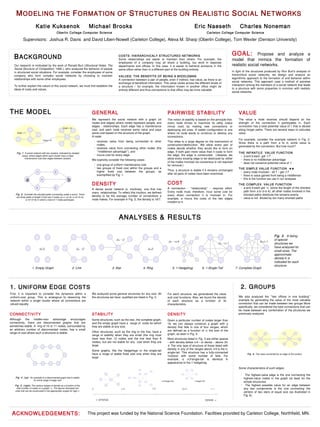
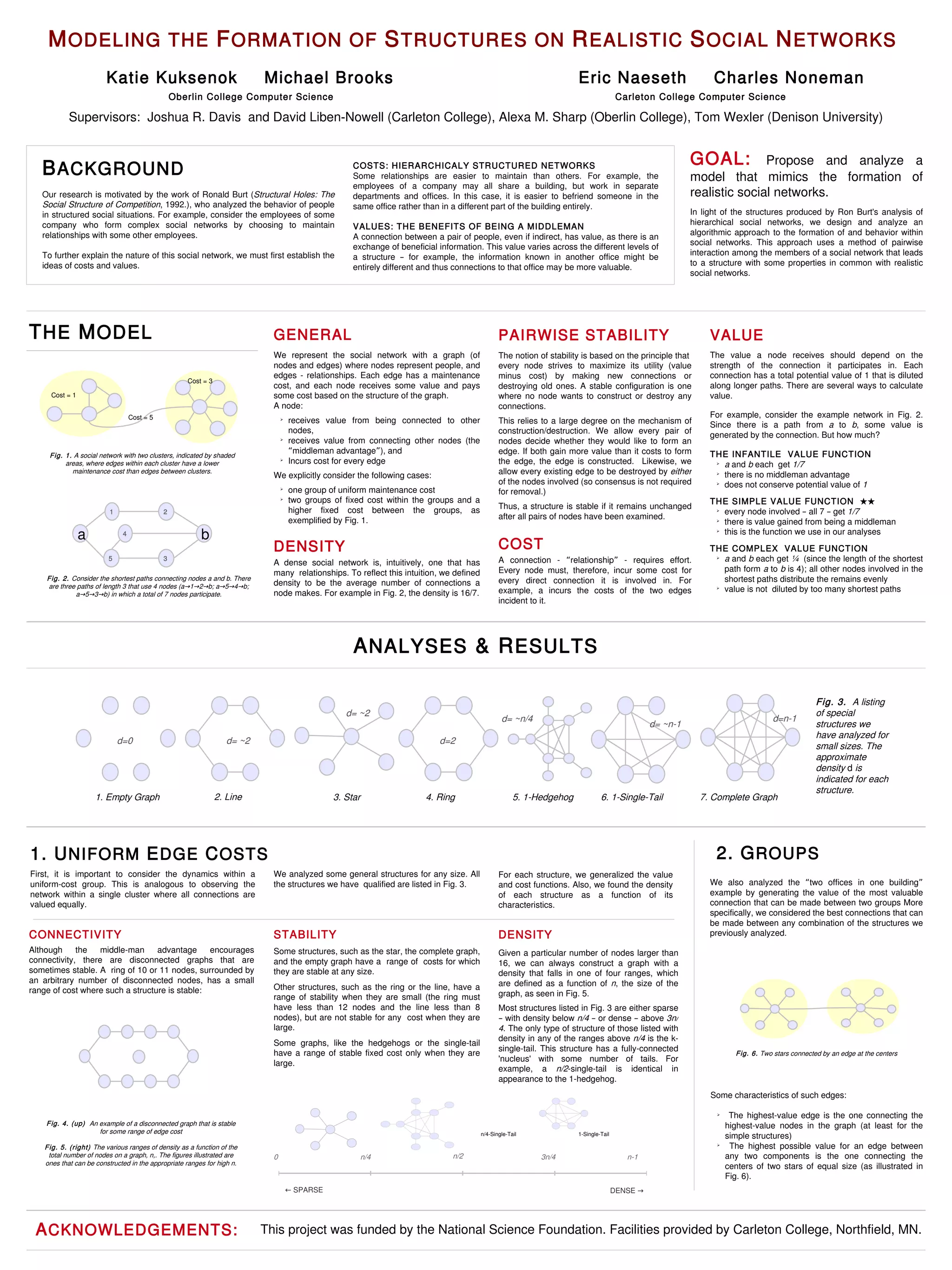

1. The authors propose and analyze a model for how social structures form on realistic social networks. They design an algorithmic approach that uses pairwise interactions between members of a social network to lead to the formation of structures with properties similar to empirical networks. 2. The model represents social networks as graphs where nodes are people and edges are relationships. Each edge has a cost and nodes receive value based on their position in the network. Structures form through pairwise interactions where nodes decide whether to form or destroy connections based on the costs and benefits. 3. The authors analyze uniform cost structures, the effects of groups with different costs, and the properties of stable structures like density and connectivity. They find the highest value connections tend to connect


