The Small Group Dynamics
          A minority voting game experiment


                             A. Cini(1) and A. Guazzini(1,2)
          1) CSDC, University of Florence, via S. Marta 3, I-50139 Firenze, Italy.
2) Department of Psychology, University of Florence,Via di San Salvi 12, 50100, Firenze, Italy.


                     Summer Solstice 2012 - Arcidosso - Italy

                                   26 - 29 June 2012
From Psychology...
              The Small Group
              Communication and Structure


      From Physics...
              Group as a Complex System
              Relationships as Complex Networks


      Small Group Dynamics Experiment
              Framework Introduction
              Method
              Results
              Conclusion


26 - 29 June 2012   A.Cini, A.Guazzini            Summer Solstice 2012 - Arcidosso - Italy   2
Introduction
                                                   From Psychology...
                                                      From Physics...
                                     Small Group Dynamics Experiment


                                                                             We present here the results of a
                                                                                  minority game situation
                                                                            (Voting modality), in which there is
                                                                        no winning strategy for reaching consensus
                                                                          in the majority of participants, and we
                                                                                 confront the outcome of
                                                                               this experiments with that of
                                                                                   similar set-ups without
                                                                              any task (Blank modality) and a
                                                                              majority game (Topic modality)


    The main goal of the present work is the characterization of how a small group of people builds
     and structures their communication network and the related affinities, during a short virtual
      group interaction, and what differences can be revealed by comparing different conditions.
         We show how our experimental framework captures some fundamental aspects of
                       the subject’s behaviour in a small group virtual dynamics.

26 - 29 June 2012   A.Cini, A.Guazzini                                              Summer Solstice 2012 - Arcidosso - Italy   3
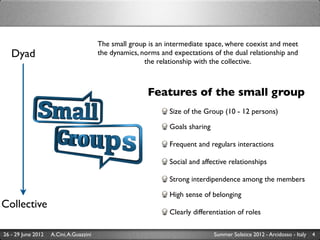
The small group is an intermediate space, where coexist and meet
   Dyad                                  the dynamics, norms and expectations of the dual relationship and
                                                        the relationship with the collective.


                                                         Features of the small group
                                                                Size of the Group (10 - 12 persons)	


                                                                Goals sharing

                                                                Frequent and regulars interactions

                                                                Social and affective relationships

                                                                Strong interdipendence among the members

                                                                High sense of belonging
Collective
                                                                Clearly differentiation of roles

26 - 29 June 2012   A.Cini, A.Guazzini                                          Summer Solstice 2012 - Arcidosso - Italy   4
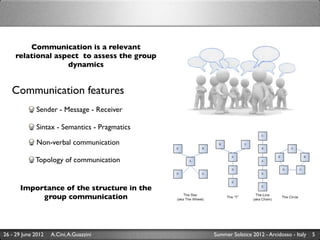
Communication is a relevant
     relational aspect to assess the group
                   dynamics


   Communication features
             Sender - Message - Receiver

             Sintax - Semantics - Pragmatics

             Non-verbal communication

             Topology of communication


       Importance of the structure in the
            group communication


26 - 29 June 2012   A.Cini, A.Guazzini         Summer Solstice 2012 - Arcidosso - Italy   5
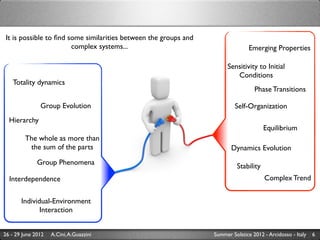
It is possible to find some similarities between the groups and
                       complex systems...                                       Emerging Properties

                                                                      Sensitivity to Initial
                                                                         Conditions
   Totality dynamics
                                                                                  Phase Transitions

               Group Evolution                                            Self-Organization
  Hierarchy
                                                                                      Equilibrium
         The whole as more than
          the sum of the parts                                          Dynamics Evolution
              Group Phenomena                                             Stability
  Interdependence                                                                     Complex Trend


       Individual-Environment
              Interaction


26 - 29 June 2012   A.Cini, A.Guazzini                           Summer Solstice 2012 - Arcidosso - Italy   6
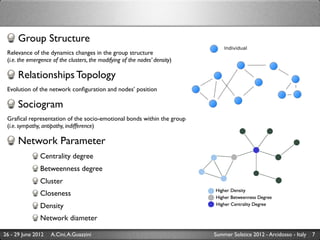
Group Structure
 Relevance of the dynamics changes in the group structure
 (i.e. the emergence of the clusters, the modifying of the nodes’ density)

      Relationships Topology
 Evolution of the network configuration and nodes’ position

      Sociogram
 Grafical representation of the socio-emotional bonds within the group
 (i.e. sympathy, antipathy, indifference)

      Network Parameter
               Centrality degree
               Betweenness degree
               Cluster
               Closeness
               Density
               Network diameter

26 - 29 June 2012   A.Cini, A.Guazzini                                       Summer Solstice 2012 - Arcidosso - Italy   7
Interface Definition
  Interaction Environment


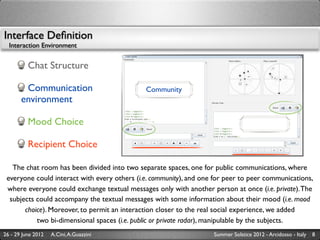
          Chat Structure

        Communication                         Community
       environment

          Mood Choice

          Recipient Choice

   The chat room has been divided into two separate spaces, one for public communications, where
 everyone could interact with every others (i.e. community), and one for peer to peer communications,
 where everyone could exchange textual messages only with another person at once (i.e. private). The
  subjects could accompany the textual messages with some information about their mood (i.e. mood
       choice). Moreover, to permit an interaction closer to the real social experience, we added
           two bi-dimensional spaces (i.e. public or private radar), manipulable by the subjects.
26 - 29 June 2012   A.Cini, A.Guazzini                              Summer Solstice 2012 - Arcidosso - Italy   8
Interface Definition
  Radar Environment


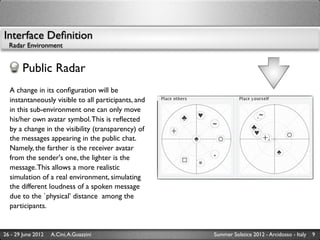
        Public Radar
  A change in its configuration will be
  instantaneously visible to all participants, and
  in this sub-environment one can only move
  his/her own avatar symbol. This is reflected
  by a change in the visibility (transparency) of
  the messages appearing in the public chat.
  Namely, the farther is the receiver avatar
  from the sender's one, the lighter is the
  message. This allows a more realistic
  simulation of a real environment, simulating
  the different loudness of a spoken message
  due to the `physical’ distance among the
  participants.


26 - 29 June 2012   A.Cini, A.Guazzini               Summer Solstice 2012 - Arcidosso - Italy   9
Interface Definition
  Radar Environment


        Private Radar
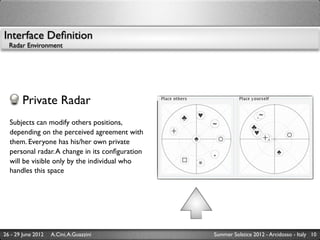
  Subjects can modify others positions,
  depending on the perceived agreement with
  them. Everyone has his/her own private
  personal radar. A change in its configuration
  will be visible only by the individual who
  handles this space


26 - 29 June 2012   A.Cini, A.Guazzini           Summer Solstice 2012 - Arcidosso - Italy 10
Order Parameters Formalization

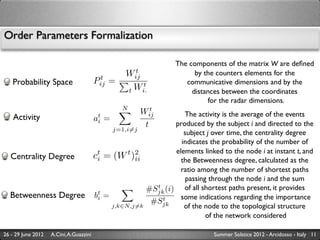
                                                                   The components of the matrix W are defined
                                                  t                      by the counters elements for the
                                                Wij
   Probability Space                     Pij = 
                                          t
                                                    t                 communicative dimensions and by the
                                                t Wi.                   distances between the coordinates
                                                                             for the radar dimensions.
                                                 N
                                                          t
                                                        Wij         The activity is the average of the events
    Activity                             at =
                                          i
                                                         t       produced by the subject i and directed to the
                                              j=1,i=j
                                                                    subject j over time, the centrality degree
                                                                   indicates the probability of the number of
                                                                 elements linked to the node i at instant t, and
   Centrality Degree                     ci = (W )ii
                                          t        t 2
                                                                   the Betweenness degree, calculated as the
                                                                   ratio among the number of shortest paths
                                                                     passing through the node i and the sum
                                                        #Sjk (i) of all shortest paths present, it provides
                                                           t
  Betweenness Degree                     bt =                      some indications regarding the importance
                                          i
                                                          #Sjk
                                                             t
                                              j,k∈N,j=k            of the node to the topological structure
                                                                            of the network considered

26 - 29 June 2012   A.Cini, A.Guazzini                                         Summer Solstice 2012 - Arcidosso - Italy 11
Dimensions Considered

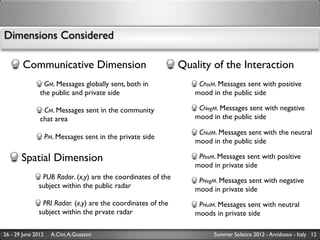
        Communicative Dimension                              Quality of the Interaction
                GM. Messages globally sent, both in              CPosM. Messages sent with positive
               the public and private side                      mood in the public side

                CM. Messages sent in the community               CNegM. Messages sent with negative
               chat area                                        mood in the public side

                                                                 CNulM. Messages sent with the neutral
                    PM. Messages sent in the private side
                                                                mood in the public side

       Spatial Dimension                                         PPosM. Messages sent with positive
                                                                mood in private side
               PUB Radar. (x,y) are the coordinates of the       PNegM. Messages sent with negative
              subject within the public radar                   mood in private side
               PRI Radar. (x,y) are the coordinates of the       PNulM. Messages sent with neutral
              subject within the prvate radar                   moods in private side

26 - 29 June 2012     A.Cini, A.Guazzini                              Summer Solstice 2012 - Arcidosso - Italy 12
Sample

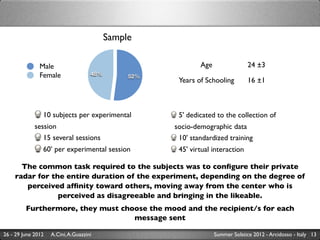
               Male                                           Age                 24 ±3
               Female                48%        52%
                                                       Years of Schooling         16 ±1


                10 subjects per experimental           5' dedicated to the collection of
             session                                  socio-demographic data
                15 several sessions                    10' standardized training
                60’ per experimental session           45' virtual interaction

      The common task required to the subjects was to configure their private
    radar for the entire duration of the experiment, depending on the degree of
       perceived affinity toward others, moving away from the center who is
                perceived as disagreeable and bringing in the likeable.
         Furthermore, they must choose the mood and the recipient/s for each
                                   message sent

26 - 29 June 2012   A.Cini, A.Guazzini                              Summer Solstice 2012 - Arcidosso - Italy 13
The Tasks
  Blank Modality vs Topic Modality vs Voting Modality

    Blank Modality                         Topic Modality                         Voting Modality
                                          In this modality it was required
                                           to the subjects to talk about a
                                             specific topic, in particular
                                          about animals experimentation.
                                         The choice of this argument has
                                             been designed to strongly
                                           polarize the group, to lead and
                                           to force the subjects’ opinion
   In this modality the subjects         toward two contraries opinions.           This modality consists in a
could interact freely, without any                                              frustrated minority game. It was
 specification about the topic of                                                   required to the subjects to
       the conversation. The                                                      discuss about three different
 experimental task asked to the                                                  features, and for each of these.
    subjects was to represent                                                     choose their own preference,
themselves and to configure the                                                 expressed through three different
    private radar based on the                                                  phases of voting (i.e one every 15
    perceived feeling of affinity                                               minutes of discussion), with the aim
    with others for the entire                                                  to belong in the last vote to the
   duration of the experiment.                                                       second largest cluster.
26 - 29 June 2012   A.Cini, A.Guazzini                                       Summer Solstice 2012 - Arcidosso - Italy 14
Voting Modality
                               Distribution of Cluster Size
                                                  Standardized Colour Voting                                                                                       Standardized Shape Voting                                                                                     Standardized Acronym Voting
                                     Distribution of the clusters size : First (Colour) Voting                                                      Distribution of the clusters size : Second (Shape) Voting                                                       Distribution of the clusters size : Third (Acronym) Voting
                       6                                                                                                                7                                                                                                              10
                                                                                                 Exp1                                                                                                           Exp1                                                                                                             Exp1
                                                                                                 Exp2                                                                                                           Exp2                                                                                                             Exp2
                                                                                                 Exp3                                                                                                           Exp3                                    9                                                                        Exp3
                                                                                                 Exp4                                   6                                                                       Exp4                                                                                                             Exp4
                       5                                                                         Exp5                                                                                                           Exp5                                                                                                             Exp5
                                                                                                 Cumulate                                                                                                       Cumulate                                8                                                                        Cumulate

                                                                                                                                        5
                                                                                                                                                                                                                                                        7
                       4
Normalized Frequency


                                                                                                                 Normalized Frequency


                                                                                                                                                                                                                                Normalized Frequency
                                                                                                                                                                                                                                                        6
                                                                                                                                        4

                       3                                                                                                                                                                                                                                5

                                                                                                                                        3
                                                                                                                                                                                                                                                        4

                       2
                                                                                                                                        2                                                                                                               3


                                                                                                                                                                                                                                                        2
                       1
                                                                                                                                        1
                                                                                                                                                                                                                                                        1


                       0                                                                                                                0                                                                                                               0
                           1     2     3         4         5         6         7         8       9          10                              1   2      3         4        5         6        7         8        9          10                               1   2      3         4        5         6         7         8        9          10
                                                      Size of the Cluster                                                                                             Size of the Cluster                                                                                             Size of the Cluster


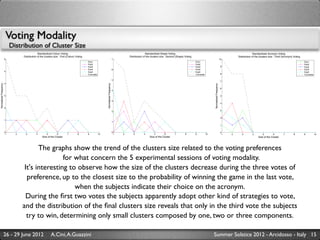
                                            The graphs show the trend of the clusters size related to the voting preferences
                                                     for what concern the 5 experimental sessions of voting modality.
                                      It's interesting to observe how the size of the clusters decrease during the three votes of
                                       preference, up to the closest size to the probability of winning the game in the last vote,
                                                         when the subjects indicate their choice on the acronym.
                                      During the first two votes the subjects apparently adopt other kind of strategies to vote,
                                     and the distribution of the final clusters size reveals that only in the third vote the subjects
                                       try to win, determining only small clusters composed by one, two or three components.

                       26 - 29 June 2012                       A.Cini, A.Guazzini                                                                                                                                               Summer Solstice 2012 - Arcidosso - Italy 15
Voting Modality
                             Experimental vs Random Generated Data
                                                         First Vote (Color)                                                                                                   Second Vote (Shape)                                                                                                    Third Vote (Acronym)
                                     Comparison between Experimental and Random generated data                                                              Comparison between Experimental and Random generated data                                                              Comparison between Experimental and Random generated data
                       0.7                                                                                                                    0.7                                                                                                                    0.7
                                                                               Size distribution (Random)                                                                                             Size distribution (Random)                                                                                             Size distribution (Random)
                                                                               Win Probability (Random)                                                                                               Win Probability (Random)                                                                                               Win Probability (Random)
                                                                               Size distribution (Experimental)                                                                                       Size distribution (Experimental)                                                                                       Size distribution (Experimental)
                       0.6                                                     Win Probability (Experimental)                                 0.6                                                     Win Probability (Experimental)                                 0.6                                                     Win Probability (Experimental)


                       0.5                                                                                                                    0.5                                                                                                                    0.5
Normalized Frequency


                                                                                                                       Normalized Frequency


                                                                                                                                                                                                                                              Normalized Frequency
                       0.4                                                                                                                    0.4                                                                                                                    0.4


                       0.3                                                                                                                    0.3                                                                                                                    0.3


                       0.2                                                                                                                    0.2                                                                                                                    0.2


                       0.1                                                                                                                    0.1                                                                                                                    0.1


                        0                                                                                                                      0                                                                                                                      0
                             1   2          3       4        5        6        7         8          9             10                                1   2          3       4        5        6        7         8          9             10                                1   2          3       4        5        6        7         8          9             10
                                                         Size of the Cluster                                                                                                    Size of the Cluster                                                                                                    Size of the Cluster


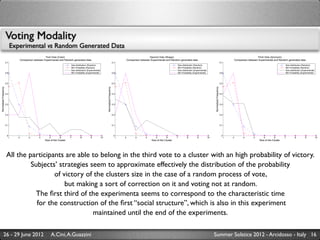
                        All the participants are able to belong in the third vote to a cluster with an high probability of victory.
                                 Subjects’ strategies seem to approximate effectively the distribution of the probability
                                         of victory of the clusters size in the case of a random process of vote,
                                             but making a sort of correction on it and voting not at random.
                                   The first third of the experimenta seems to correspond to the characteristic time
                                   for the construction of the first “social structure”, which is also in this experiment
                                                       maintained until the end of the experiments.

            26 - 29 June 2012                                    A.Cini, A.Guazzini                                                                                                                                                           Summer Solstice 2012 - Arcidosso - Italy 16
Order Parameters Trend
                                            Public Messages Centrality Degree
                                                              Centrality Degree                                                                          Centrality Degree                                                                                Centrality Degree
                                                           Blank−Exp 05 : Public Messages                                                              Topic−Exp 01 : Public Messages                                                              Voting−Exp 05 : Public Messages
                                          0.025                                                                                            0.025                                                                                       0.045


                                                                                                                                                                                                                                        0.04
Weighted Centrality Degree of the agent


                                                                                                 Weighted Centrality Degree of the agent


                                                                                                                                                                                             Weighted Centrality Degree of the agent
                                           0.02                                                                                             0.02
                                                                                                                                                                                                                                       0.035


                                                                                                                                                                                                                                        0.03

                                          0.015                                                                                            0.015
                                                                                                                                                                                                                                       0.025


                                                                                                                                                                                                                                        0.02
                                           0.01                                                                                             0.01

                                                                                                                                                                                                                                       0.015


                                                                                                                                                                                                                                        0.01
                                          0.005                                                                                            0.005


                                                                                                                                                                                                                                       0.005


                                             0                                                                                                0                                                                                           0
                                                  0          15                   30        45                                                     0    15                 30           45                                                     0   15                 30             45
                                                                      Time                                                                                        Time                                                                                         Time


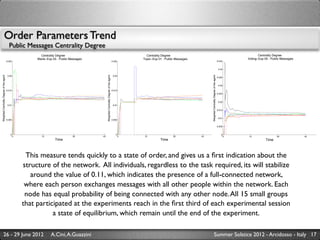
                                                       This measure tends quickly to a state of order, and gives us a first indication about the
                                                      structure of the network. All individuals, regardless to the task required, its will stabilize
                                                         around the value of 0.11, which indicates the presence of a full-connected network,
                                                       where each person exchanges messages with all other people within the network. Each
                                                       node has equal probability of being connected with any other node. All 15 small groups
                                                      that participated at the experiments reach in the first third of each experimental session
                                                                 a state of equilibrium, which remain until the end of the experiment.

            26 - 29 June 2012                                       A.Cini, A.Guazzini                                                                                                                  Summer Solstice 2012 - Arcidosso - Italy 17
Order Parameters Trend
                                             Private Messages Centrality Degree
                                                                Centrality Degree                                                                          Centrality Degree                                                                            Centrality Degree
                                                         Blank−Exp 01 : Private Messages                                                             Topic−Exp 01 : Private Messages                                                             Voting−Exp 04 : Private Messages
                                          0.12                                                                                            0.12                                                                                        0.12


                                           0.1                                                                                             0.1                                                                                         0.1
Weighted Centrality Degree of the agent


                                                                                                Weighted Centrality Degree of the agent


                                                                                                                                                                                            Weighted Centrality Degree of the agent
                                          0.08                                                                                            0.08                                                                                        0.08


                                          0.06                                                                                            0.06                                                                                        0.06


                                          0.04                                                                                            0.04                                                                                        0.04


                                          0.02                                                                                            0.02                                                                                        0.02


                                            0                                                                                               0                                                                                           0
                                                 0         15                  30          45                                                    0    15                 30            45                                                    0     15                   30          45
                                                                     Time                                                                                        Time                                                                                        Time


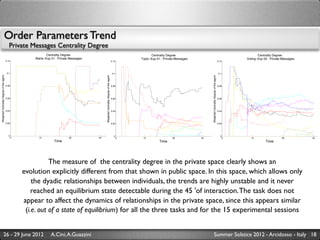
                                                                The measure of the centrality degree in the private space clearly shows an
                                                     evolution explicitly different from that shown in public space. In this space, which allows only
                                                         the dyadic relationships between individuals, the trends are highly unstable and it never
                                                         reached an equilibrium state detectable during the 45 'of interaction. The task does not
                                                     appear to affect the dynamics of relationships in the private space, since this appears similar
                                                      (i.e. out of a state of equilibrium) for all the three tasks and for the 15 experimental sessions


                      26 - 29 June 2012                            A.Cini, A.Guazzini                                                                                                              Summer Solstice 2012 - Arcidosso - Italy 18
Experimenta Comparison
  Anova for Activity

                      Exp. Modality                      Blank                             Topic
                                          Mean Diff. Topic   Mean Diff.Voting       Mean Diff.Voting
                        Observables             45’                45’                       45’
                         Activity GM           81.7*                                      -107.1**
                         Activity CM           73.8*                                       -95.7**
                        Activity CposM        106.3**                                     -127.4**
                        Activity CneuM        -46.8*                                        44.1*
                         Activity PM           7.8*                                        -11.3**
                        Activity PposM         5.2**                                        -7.6**
                      Activity PRIRADAR                          -20.1**
                                                                                     **: p.  .01, *: p.  .05 (Test Bonferroni for ANOVA)


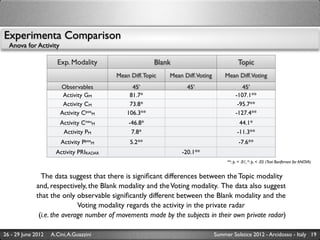
               The data suggest that there is significant differences between the Topic modality
             and, respectively, the Blank modality and the Voting modality. The data also suggest
             that the only observable significantly different between the Blank modality and the
                             Voting modality regards the activity in the private radar
              (i.e. the average number of movements made by the subjects in their own private radar)

26 - 29 June 2012   A.Cini, A.Guazzini                                          Summer Solstice 2012 - Arcidosso - Italy 19
Experimenta Comparison
  Anova for Betweeness Degree

                         Exp. Modality                    Blank                          Topic
                                           Mean Diff. Topic   Mean Diff.Voting     Mean Diff.Voting
                           Observables           45’                45’                    45’
                       Betweenness CposM       .015**                -                   -.15**
                       Betweenness CneuM          -                  -                   .020**
                       Betweenness CnegM       .051**              .032*                     -
                        Betweenness PM          .078*              -.068*               -.146**
                       Betweenness PposM       .056**             -.049**               -.105**
                       Betweenness PneuM          -                  -                  -.109**
                                                                                     **: p.  .01, *: p.  .05 (Test Bonferroni for ANOVA)


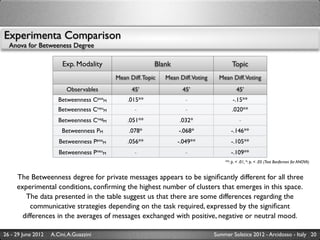
     The Betweenness degree for private messages appears to be significantly different for all three
     experimental conditions, confirming the highest number of clusters that emerges in this space.
        The data presented in the table suggest us that there are some differences regarding the
          communicative strategies depending on the task required, expressed by the significant
       differences in the averages of messages exchanged with positive, negative or neutral mood.

26 - 29 June 2012   A.Cini, A.Guazzini                                           Summer Solstice 2012 - Arcidosso - Italy 20
Correlations in Different Session
  Private Radar Betweenness Centrality Degree

                    Exp. Modality                Blank                 Topic                    Voting
                      Observables          Pri Rad Betweenness   Pri Rad Betweenness     Pri Rad Betweenness
                    Pri Rad Centrality           (45’).516*            (45’).398*               (45’).515*

                        Activity CM             (15’) .508*               ns                    (30’) .368*

                      Activity CposM            (30’) .505*               ns                    (15’) .385*

                        Degree CM               (45’) .463*               ns                    (45’) .511*

                      Degree CposM              (45’) .487*               ns                    (45’) .444*

                    Betweenness CposM           (45’) .673*                 ns                        ns
                     Activity PRIRADAR              ns                (30’) .533*                     ns
                    Betweenness CnegM               ns                (15’) .350*                     ns
                      Activity PnegM                ns                      ns                  (15’) .364*

                     Betweenness PM                 ns                      ns                  (30’) .459*

                    Betweenness PnegM               ns                    ns                    (30’) .386*


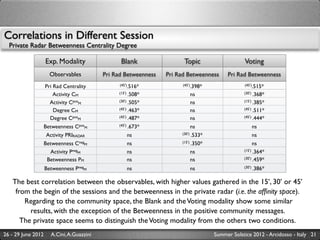
   The best correlation between the observables, with higher values gathered in the 15’, 30’ or 45’
    from the begin of the sessions and the betweenness in the private radar (i.e. the affinity space).
       Regarding to the community space, the Blank and the Voting modality show some similar
         results, with the exception of the Betweenness in the positive community messages.
      The private space seems to distinguish the Voting modality from the others two conditions.
26 - 29 June 2012     A.Cini, A.Guazzini                                            Summer Solstice 2012 - Arcidosso - Italy 21
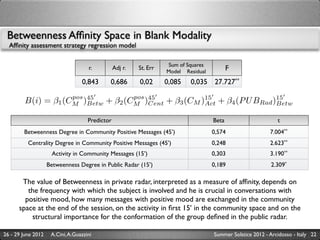
Betweenness Affinity Space in Blank Modality
  Affinity assessment strategy regression model

                                                                     Sum of Squares
                                     r.          Adj r.   St. Err
                                                                    Model Residual           F
                                  0,843      0,686        0,02      0,085    0,035 27.727**
                           pos 45                     pos 45                  15                         15
         B(i) =       β1 (CM )Betw         +      β2 (CM )Cent      +   β3 (CM )Act     +     β4 (P U BRad )Betw

                                     Predictor                                        Beta                      t
        Betweenness Degree in Community Positive Messages (45’)                       0,574                  7.004**
          Centrality Degree in Community Positive Messages (45’)                      0,248                  2.623**
                     Activity in Community Messages (15’)                             0,303                  3.190**
                    Betweenness Degree in Public Radar (15’)                          0,189                  2.309*

       The value of Betweenness in private radar, interpreted as a measure of affinity, depends on
         the frequency with which the subject is involved and he is crucial in conversations with
        positive mood, how many messages with positive mood are exchanged in the community
      space at the end of the session, on the activity in first 15’ in the community space and on the
          structural importance for the conformation of the group defined in the public radar.

26 - 29 June 2012    A.Cini, A.Guazzini                                               Summer Solstice 2012 - Arcidosso - Italy 22
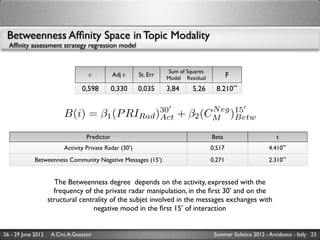
Betweenness Affinity Space in Topic Modality
  Affinity assessment strategy regression model


                                                                    Sum of Squares
                                     r.         Adj r.   St. Err   Model Residual            F
                                  0,598         0,330    0,035     3,84     5,26       8.210**

                                                       30                      N eg 15
                          B(i) =          β1 (P RIRad )Act             +   β2 (CM )Betw
                                    Predictor                                        Beta                       t
                          Activity Private Radar (30’)                               0,517                   4.410**
             Betweenness Community Negative Messages (15’)                           0,271                   2.310**


                      The Betweenness degree depends on the activity, expressed with the
                      frequency of the private radar manipulation, in the first 30’ and on the
                    structural centrality of the subjet involved in the messages exchanges with
                                    negative mood in the first 15’ of interaction


26 - 29 June 2012    A.Cini, A.Guazzini                                               Summer Solstice 2012 - Arcidosso - Italy 23
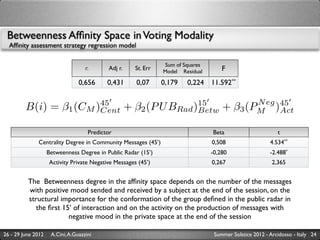
Betweenness Affinity Space in Voting Modality
  Affinity assessment strategy regression model

                                                                    Sum of Squares
                                    r.      Adj r.       St. Err   Model Residual        F
                                 0,656      0,431        0,07      0,179    0,224 11.592**

                                  45                                  15                         N eg 45
         B(i) =           β1 (CM )Cent               +   β2 (P U BRad )Betw              +    β3 (PM )Act

                                     Predictor                                       Beta                       t
              Centrality Degree in Community Messages (45’)                          0,508                   4.534**
                    Betweenness Degree in Public Radar (15’)                         -0,280                  -2.488*
                    Activity Private Negative Messages (45’)                         0,267                    2,365


          The Betweenness degree in the affinity space depends on the number of the messages
          with positive mood sended and received by a subject at the end of the session, on the
          structural importance for the conformation of the group defined in the public radar in
             the first 15’ of interaction and on the activity on the production of messages with
                        negative mood in the private space at the end of the session

26 - 29 June 2012    A.Cini, A.Guazzini                                               Summer Solstice 2012 - Arcidosso - Italy 24
Defining a                                                        Setting up of the
         Framework Reasearch                                                        survey instrument

                                                Relationship between
                                           Microscopic / Macroscopic level
            Group                                                                              Individual


                                                       Task

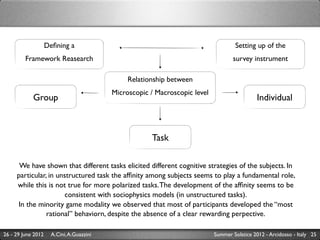
      We have shown that different tasks elicited different cognitive strategies of the subjects. In
     particular, in unstructured task the affinity among subjects seems to play a fundamental role,
     while this is not true for more polarized tasks. The development of the affinity seems to be
                       consistent with sociophysics models (in unstructured tasks).
     In the minority game modality we observed that most of participants developed the “most
                rational” behaviorn, despite the absence of a clear rewarding perpective.

26 - 29 June 2012     A.Cini, A.Guazzini                                     Summer Solstice 2012 - Arcidosso - Italy 25

Summer solstice arcidosso 2012 (poster)

  • 1.
    The Small GroupDynamics A minority voting game experiment A. Cini(1) and A. Guazzini(1,2) 1) CSDC, University of Florence, via S. Marta 3, I-50139 Firenze, Italy. 2) Department of Psychology, University of Florence,Via di San Salvi 12, 50100, Firenze, Italy. Summer Solstice 2012 - Arcidosso - Italy 26 - 29 June 2012
  • 2.
    From Psychology... The Small Group Communication and Structure From Physics... Group as a Complex System Relationships as Complex Networks Small Group Dynamics Experiment Framework Introduction Method Results Conclusion 26 - 29 June 2012 A.Cini, A.Guazzini Summer Solstice 2012 - Arcidosso - Italy 2
  • 3.
    Introduction From Psychology... From Physics... Small Group Dynamics Experiment We present here the results of a minority game situation (Voting modality), in which there is no winning strategy for reaching consensus in the majority of participants, and we confront the outcome of this experiments with that of similar set-ups without any task (Blank modality) and a majority game (Topic modality) The main goal of the present work is the characterization of how a small group of people builds and structures their communication network and the related affinities, during a short virtual group interaction, and what differences can be revealed by comparing different conditions. We show how our experimental framework captures some fundamental aspects of the subject’s behaviour in a small group virtual dynamics. 26 - 29 June 2012 A.Cini, A.Guazzini Summer Solstice 2012 - Arcidosso - Italy 3
  • 4.
    The small groupis an intermediate space, where coexist and meet Dyad the dynamics, norms and expectations of the dual relationship and the relationship with the collective. Features of the small group Size of the Group (10 - 12 persons) Goals sharing Frequent and regulars interactions Social and affective relationships Strong interdipendence among the members High sense of belonging Collective Clearly differentiation of roles 26 - 29 June 2012 A.Cini, A.Guazzini Summer Solstice 2012 - Arcidosso - Italy 4
  • 5.
    Communication is arelevant relational aspect to assess the group dynamics Communication features Sender - Message - Receiver Sintax - Semantics - Pragmatics Non-verbal communication Topology of communication Importance of the structure in the group communication 26 - 29 June 2012 A.Cini, A.Guazzini Summer Solstice 2012 - Arcidosso - Italy 5
  • 6.
    It is possibleto find some similarities between the groups and complex systems... Emerging Properties Sensitivity to Initial Conditions Totality dynamics Phase Transitions Group Evolution Self-Organization Hierarchy Equilibrium The whole as more than the sum of the parts Dynamics Evolution Group Phenomena Stability Interdependence Complex Trend Individual-Environment Interaction 26 - 29 June 2012 A.Cini, A.Guazzini Summer Solstice 2012 - Arcidosso - Italy 6
  • 7.
    Group Structure Relevanceof the dynamics changes in the group structure (i.e. the emergence of the clusters, the modifying of the nodes’ density) Relationships Topology Evolution of the network configuration and nodes’ position Sociogram Grafical representation of the socio-emotional bonds within the group (i.e. sympathy, antipathy, indifference) Network Parameter Centrality degree Betweenness degree Cluster Closeness Density Network diameter 26 - 29 June 2012 A.Cini, A.Guazzini Summer Solstice 2012 - Arcidosso - Italy 7
  • 8.
    Interface Definition Interaction Environment Chat Structure Communication Community environment Mood Choice Recipient Choice The chat room has been divided into two separate spaces, one for public communications, where everyone could interact with every others (i.e. community), and one for peer to peer communications, where everyone could exchange textual messages only with another person at once (i.e. private). The subjects could accompany the textual messages with some information about their mood (i.e. mood choice). Moreover, to permit an interaction closer to the real social experience, we added two bi-dimensional spaces (i.e. public or private radar), manipulable by the subjects. 26 - 29 June 2012 A.Cini, A.Guazzini Summer Solstice 2012 - Arcidosso - Italy 8
  • 9.
    Interface Definition Radar Environment Public Radar A change in its configuration will be instantaneously visible to all participants, and in this sub-environment one can only move his/her own avatar symbol. This is reflected by a change in the visibility (transparency) of the messages appearing in the public chat. Namely, the farther is the receiver avatar from the sender's one, the lighter is the message. This allows a more realistic simulation of a real environment, simulating the different loudness of a spoken message due to the `physical’ distance among the participants. 26 - 29 June 2012 A.Cini, A.Guazzini Summer Solstice 2012 - Arcidosso - Italy 9
  • 10.
    Interface Definition Radar Environment Private Radar Subjects can modify others positions, depending on the perceived agreement with them. Everyone has his/her own private personal radar. A change in its configuration will be visible only by the individual who handles this space 26 - 29 June 2012 A.Cini, A.Guazzini Summer Solstice 2012 - Arcidosso - Italy 10
  • 11.
    Order Parameters Formalization The components of the matrix W are defined t by the counters elements for the Wij Probability Space Pij = t t communicative dimensions and by the t Wi. distances between the coordinates for the radar dimensions. N t Wij The activity is the average of the events Activity at = i t produced by the subject i and directed to the j=1,i=j subject j over time, the centrality degree indicates the probability of the number of elements linked to the node i at instant t, and Centrality Degree ci = (W )ii t t 2 the Betweenness degree, calculated as the ratio among the number of shortest paths passing through the node i and the sum #Sjk (i) of all shortest paths present, it provides t Betweenness Degree bt = some indications regarding the importance i #Sjk t j,k∈N,j=k of the node to the topological structure of the network considered 26 - 29 June 2012 A.Cini, A.Guazzini Summer Solstice 2012 - Arcidosso - Italy 11
  • 12.
    Dimensions Considered Communicative Dimension Quality of the Interaction GM. Messages globally sent, both in CPosM. Messages sent with positive the public and private side mood in the public side CM. Messages sent in the community CNegM. Messages sent with negative chat area mood in the public side CNulM. Messages sent with the neutral PM. Messages sent in the private side mood in the public side Spatial Dimension PPosM. Messages sent with positive mood in private side PUB Radar. (x,y) are the coordinates of the PNegM. Messages sent with negative subject within the public radar mood in private side PRI Radar. (x,y) are the coordinates of the PNulM. Messages sent with neutral subject within the prvate radar moods in private side 26 - 29 June 2012 A.Cini, A.Guazzini Summer Solstice 2012 - Arcidosso - Italy 12
  • 13.
    Sample Male Age 24 ±3 Female 48% 52% Years of Schooling 16 ±1 10 subjects per experimental 5' dedicated to the collection of session socio-demographic data 15 several sessions 10' standardized training 60’ per experimental session  45' virtual interaction The common task required to the subjects was to configure their private radar for the entire duration of the experiment, depending on the degree of perceived affinity toward others, moving away from the center who is perceived as disagreeable and bringing in the likeable. Furthermore, they must choose the mood and the recipient/s for each message sent 26 - 29 June 2012 A.Cini, A.Guazzini Summer Solstice 2012 - Arcidosso - Italy 13
  • 14.
    The Tasks Blank Modality vs Topic Modality vs Voting Modality Blank Modality Topic Modality Voting Modality In this modality it was required to the subjects to talk about a specific topic, in particular about animals experimentation. The choice of this argument has been designed to strongly polarize the group, to lead and to force the subjects’ opinion In this modality the subjects toward two contraries opinions. This modality consists in a could interact freely, without any frustrated minority game. It was specification about the topic of required to the subjects to the conversation. The discuss about three different experimental task asked to the features, and for each of these. subjects was to represent choose their own preference, themselves and to configure the expressed through three different private radar based on the phases of voting (i.e one every 15 perceived feeling of affinity minutes of discussion), with the aim with others for the entire to belong in the last vote to the duration of the experiment. second largest cluster. 26 - 29 June 2012 A.Cini, A.Guazzini Summer Solstice 2012 - Arcidosso - Italy 14
  • 15.
    Voting Modality Distribution of Cluster Size Standardized Colour Voting Standardized Shape Voting Standardized Acronym Voting Distribution of the clusters size : First (Colour) Voting Distribution of the clusters size : Second (Shape) Voting Distribution of the clusters size : Third (Acronym) Voting 6 7 10 Exp1 Exp1 Exp1 Exp2 Exp2 Exp2 Exp3 Exp3 9 Exp3 Exp4 6 Exp4 Exp4 5 Exp5 Exp5 Exp5 Cumulate Cumulate 8 Cumulate 5 7 4 Normalized Frequency Normalized Frequency Normalized Frequency 6 4 3 5 3 4 2 2 3 2 1 1 1 0 0 0 1 2 3 4 5 6 7 8 9 10 1 2 3 4 5 6 7 8 9 10 1 2 3 4 5 6 7 8 9 10 Size of the Cluster Size of the Cluster Size of the Cluster The graphs show the trend of the clusters size related to the voting preferences for what concern the 5 experimental sessions of voting modality. It's interesting to observe how the size of the clusters decrease during the three votes of preference, up to the closest size to the probability of winning the game in the last vote, when the subjects indicate their choice on the acronym. During the first two votes the subjects apparently adopt other kind of strategies to vote, and the distribution of the final clusters size reveals that only in the third vote the subjects try to win, determining only small clusters composed by one, two or three components. 26 - 29 June 2012 A.Cini, A.Guazzini Summer Solstice 2012 - Arcidosso - Italy 15
  • 16.
    Voting Modality Experimental vs Random Generated Data First Vote (Color) Second Vote (Shape) Third Vote (Acronym) Comparison between Experimental and Random generated data Comparison between Experimental and Random generated data Comparison between Experimental and Random generated data 0.7 0.7 0.7 Size distribution (Random) Size distribution (Random) Size distribution (Random) Win Probability (Random) Win Probability (Random) Win Probability (Random) Size distribution (Experimental) Size distribution (Experimental) Size distribution (Experimental) 0.6 Win Probability (Experimental) 0.6 Win Probability (Experimental) 0.6 Win Probability (Experimental) 0.5 0.5 0.5 Normalized Frequency Normalized Frequency Normalized Frequency 0.4 0.4 0.4 0.3 0.3 0.3 0.2 0.2 0.2 0.1 0.1 0.1 0 0 0 1 2 3 4 5 6 7 8 9 10 1 2 3 4 5 6 7 8 9 10 1 2 3 4 5 6 7 8 9 10 Size of the Cluster Size of the Cluster Size of the Cluster All the participants are able to belong in the third vote to a cluster with an high probability of victory. Subjects’ strategies seem to approximate effectively the distribution of the probability of victory of the clusters size in the case of a random process of vote, but making a sort of correction on it and voting not at random. The first third of the experimenta seems to correspond to the characteristic time for the construction of the first “social structure”, which is also in this experiment maintained until the end of the experiments. 26 - 29 June 2012 A.Cini, A.Guazzini Summer Solstice 2012 - Arcidosso - Italy 16
  • 17.
    Order Parameters Trend Public Messages Centrality Degree Centrality Degree Centrality Degree Centrality Degree Blank−Exp 05 : Public Messages Topic−Exp 01 : Public Messages Voting−Exp 05 : Public Messages 0.025 0.025 0.045 0.04 Weighted Centrality Degree of the agent Weighted Centrality Degree of the agent Weighted Centrality Degree of the agent 0.02 0.02 0.035 0.03 0.015 0.015 0.025 0.02 0.01 0.01 0.015 0.01 0.005 0.005 0.005 0 0 0 0 15 30 45 0 15 30 45 0 15 30 45 Time Time Time This measure tends quickly to a state of order, and gives us a first indication about the structure of the network. All individuals, regardless to the task required, its will stabilize around the value of 0.11, which indicates the presence of a full-connected network, where each person exchanges messages with all other people within the network. Each node has equal probability of being connected with any other node. All 15 small groups that participated at the experiments reach in the first third of each experimental session a state of equilibrium, which remain until the end of the experiment. 26 - 29 June 2012 A.Cini, A.Guazzini Summer Solstice 2012 - Arcidosso - Italy 17
  • 18.
    Order Parameters Trend Private Messages Centrality Degree Centrality Degree Centrality Degree Centrality Degree Blank−Exp 01 : Private Messages Topic−Exp 01 : Private Messages Voting−Exp 04 : Private Messages 0.12 0.12 0.12 0.1 0.1 0.1 Weighted Centrality Degree of the agent Weighted Centrality Degree of the agent Weighted Centrality Degree of the agent 0.08 0.08 0.08 0.06 0.06 0.06 0.04 0.04 0.04 0.02 0.02 0.02 0 0 0 0 15 30 45 0 15 30 45 0 15 30 45 Time Time Time The measure of the centrality degree in the private space clearly shows an evolution explicitly different from that shown in public space. In this space, which allows only the dyadic relationships between individuals, the trends are highly unstable and it never reached an equilibrium state detectable during the 45 'of interaction. The task does not appear to affect the dynamics of relationships in the private space, since this appears similar (i.e. out of a state of equilibrium) for all the three tasks and for the 15 experimental sessions 26 - 29 June 2012 A.Cini, A.Guazzini Summer Solstice 2012 - Arcidosso - Italy 18
  • 19.
    Experimenta Comparison Anova for Activity Exp. Modality Blank Topic Mean Diff. Topic Mean Diff.Voting Mean Diff.Voting Observables 45’ 45’ 45’ Activity GM 81.7* -107.1** Activity CM 73.8* -95.7** Activity CposM 106.3** -127.4** Activity CneuM -46.8* 44.1* Activity PM 7.8* -11.3** Activity PposM 5.2** -7.6** Activity PRIRADAR -20.1** **: p. .01, *: p. .05 (Test Bonferroni for ANOVA) The data suggest that there is significant differences between the Topic modality and, respectively, the Blank modality and the Voting modality. The data also suggest that the only observable significantly different between the Blank modality and the Voting modality regards the activity in the private radar (i.e. the average number of movements made by the subjects in their own private radar) 26 - 29 June 2012 A.Cini, A.Guazzini Summer Solstice 2012 - Arcidosso - Italy 19
  • 20.
    Experimenta Comparison Anova for Betweeness Degree Exp. Modality Blank Topic Mean Diff. Topic Mean Diff.Voting Mean Diff.Voting Observables 45’ 45’ 45’ Betweenness CposM .015** - -.15** Betweenness CneuM - - .020** Betweenness CnegM .051** .032* - Betweenness PM .078* -.068* -.146** Betweenness PposM .056** -.049** -.105** Betweenness PneuM - - -.109** **: p. .01, *: p. .05 (Test Bonferroni for ANOVA) The Betweenness degree for private messages appears to be significantly different for all three experimental conditions, confirming the highest number of clusters that emerges in this space. The data presented in the table suggest us that there are some differences regarding the communicative strategies depending on the task required, expressed by the significant differences in the averages of messages exchanged with positive, negative or neutral mood. 26 - 29 June 2012 A.Cini, A.Guazzini Summer Solstice 2012 - Arcidosso - Italy 20
  • 21.
    Correlations in DifferentSession Private Radar Betweenness Centrality Degree Exp. Modality Blank Topic Voting Observables Pri Rad Betweenness Pri Rad Betweenness Pri Rad Betweenness Pri Rad Centrality (45’).516* (45’).398* (45’).515* Activity CM (15’) .508* ns (30’) .368* Activity CposM (30’) .505* ns (15’) .385* Degree CM (45’) .463* ns (45’) .511* Degree CposM (45’) .487* ns (45’) .444* Betweenness CposM (45’) .673* ns ns Activity PRIRADAR ns (30’) .533* ns Betweenness CnegM ns (15’) .350* ns Activity PnegM ns ns (15’) .364* Betweenness PM ns ns (30’) .459* Betweenness PnegM ns ns (30’) .386* The best correlation between the observables, with higher values gathered in the 15’, 30’ or 45’ from the begin of the sessions and the betweenness in the private radar (i.e. the affinity space). Regarding to the community space, the Blank and the Voting modality show some similar results, with the exception of the Betweenness in the positive community messages. The private space seems to distinguish the Voting modality from the others two conditions. 26 - 29 June 2012 A.Cini, A.Guazzini Summer Solstice 2012 - Arcidosso - Italy 21
  • 22.
    Betweenness Affinity Spacein Blank Modality Affinity assessment strategy regression model Sum of Squares r. Adj r. St. Err Model Residual F 0,843 0,686 0,02 0,085 0,035 27.727** pos 45 pos 45 15 15 B(i) = β1 (CM )Betw + β2 (CM )Cent + β3 (CM )Act + β4 (P U BRad )Betw Predictor Beta t Betweenness Degree in Community Positive Messages (45’) 0,574 7.004** Centrality Degree in Community Positive Messages (45’) 0,248 2.623** Activity in Community Messages (15’) 0,303 3.190** Betweenness Degree in Public Radar (15’) 0,189 2.309* The value of Betweenness in private radar, interpreted as a measure of affinity, depends on the frequency with which the subject is involved and he is crucial in conversations with positive mood, how many messages with positive mood are exchanged in the community space at the end of the session, on the activity in first 15’ in the community space and on the structural importance for the conformation of the group defined in the public radar. 26 - 29 June 2012 A.Cini, A.Guazzini Summer Solstice 2012 - Arcidosso - Italy 22
  • 23.
    Betweenness Affinity Spacein Topic Modality Affinity assessment strategy regression model Sum of Squares r. Adj r. St. Err Model Residual F 0,598 0,330 0,035 3,84 5,26 8.210** 30 N eg 15 B(i) = β1 (P RIRad )Act + β2 (CM )Betw Predictor Beta t Activity Private Radar (30’) 0,517 4.410** Betweenness Community Negative Messages (15’) 0,271 2.310** The Betweenness degree depends on the activity, expressed with the frequency of the private radar manipulation, in the first 30’ and on the structural centrality of the subjet involved in the messages exchanges with negative mood in the first 15’ of interaction 26 - 29 June 2012 A.Cini, A.Guazzini Summer Solstice 2012 - Arcidosso - Italy 23
  • 24.
    Betweenness Affinity Spacein Voting Modality Affinity assessment strategy regression model Sum of Squares r. Adj r. St. Err Model Residual F 0,656 0,431 0,07 0,179 0,224 11.592** 45 15 N eg 45 B(i) = β1 (CM )Cent + β2 (P U BRad )Betw + β3 (PM )Act Predictor Beta t Centrality Degree in Community Messages (45’) 0,508 4.534** Betweenness Degree in Public Radar (15’) -0,280 -2.488* Activity Private Negative Messages (45’) 0,267 2,365 The Betweenness degree in the affinity space depends on the number of the messages with positive mood sended and received by a subject at the end of the session, on the structural importance for the conformation of the group defined in the public radar in the first 15’ of interaction and on the activity on the production of messages with negative mood in the private space at the end of the session 26 - 29 June 2012 A.Cini, A.Guazzini Summer Solstice 2012 - Arcidosso - Italy 24
  • 25.
    Defining a Setting up of the Framework Reasearch survey instrument Relationship between Microscopic / Macroscopic level Group Individual Task We have shown that different tasks elicited different cognitive strategies of the subjects. In particular, in unstructured task the affinity among subjects seems to play a fundamental role, while this is not true for more polarized tasks. The development of the affinity seems to be consistent with sociophysics models (in unstructured tasks). In the minority game modality we observed that most of participants developed the “most rational” behaviorn, despite the absence of a clear rewarding perpective. 26 - 29 June 2012 A.Cini, A.Guazzini Summer Solstice 2012 - Arcidosso - Italy 25