Manthan Topic: Increasing the employability of youth
Tanzim Hussain
Jyotishman Mudiar
Jyotirmoy Sarma
Subhra Jyoti Nath
Samrat Baruah
Presented by
BUILDING EMPLOYABILITY
an insight into basic components of
EDUCATION, TRAINING & RECRUITMENT
2.4
3.2
5.5
14.3
8.5
18.9
19.8
0.3
1.5
9.1
26.2
27.1
34.5
29.4
0
5
10
15
20
25
30
35
40
Illiterate Primary Higher Graduate Tech
degree
Diploma
below
graduate
Diploma
above
graduate
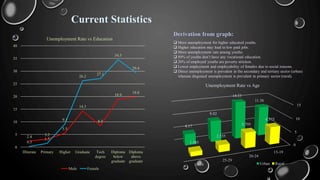
Unemployment Rate vs Education
Male Female
Current Statistics
0
5
10
15
15-19
20-24
25-29
15-59
11.38
14.23
8.02
4.17
6.575
5.795
2.535
1.565
Unemployment Rate vs Age
Urban Rural
 More unemployment for higher educated youths.
 Higher education may lead to low paid jobs.
 More unemployment rate among youths.
 89% of youths don’t have any vocational education.
 26% of employed youths are poverty stricken.
 Lower employment and employability of females due to social reasons.
 Direct unemployment is prevalent in the secondary and tertiary sector (urban)
whereas disguised unemployment is prevalent in primary sector (rural).
Derivation from graph:
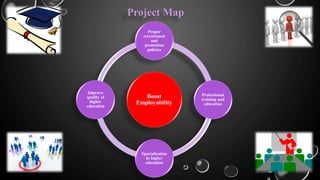
Boost
Employability
Proper
recruitment
and
promotion
policies
Professional
training and
education
Specialization
in higher
education
Improve
quality of
higher
education
Project Map
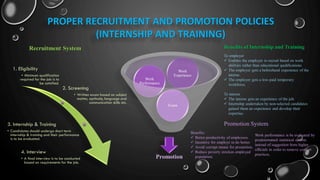
PROPER RECRUITMENT AND PROMOTION POLICIES
(INTERNSHIP AND TRAINING)
1. Eligibility
• Minimum qualification
required for the job is to
be satisfied.
2. Screening
• Written exam based on subject
matter, aptitude, language and
communication skills etc.
3. Internship & Training
• Candidates should undergo short term
internship & training and their performance
is to be evaluated.
4. Interview
• A final interview is to be conducted
based on requirements for the job.
Recruitment System
To employer
 Enables the employer to recruit based on work
abilities rather than educational qualifications.
 The employer gets a beforehand experience of the
interne.
 The employer gets a low-paid temporary
workforce.
To interne
 The interne gets an experience of the job.
 Internship undertaken by non-selected candidates
gained them an experience and develop their
expertise.
Benefits of Internship and Training
Promotion
Exam
Work
Performance
Work
Experience
Work performance is be evaluated by
predetermined statistical system
instead of suggestion from higher
officials in order to remove corrupt
practices.
Benefits:
 Better productivity of employees.
 Incentive for employs to do better.
 Avoid corrupt means for promotion.
 Reduce poverty stricken employed
population.
Promotion System
 A minimum interne to employ annual ratio of 0.05 for all government
and private sector companies having more than 300 employs.
 A fixed minimum wage for internships above 2 months.
Laws required for internship
Benefits:
 A well trained work force .
 Prevent people from moving into profession where he/she would be
less productive.
 Minimum wage for internes serves as incentive for people to join as
interne.
 Better integration of labour market with education sector.
Recommendations for recruitment facilities
 Final decision on selection of employs should be statistical i.e.
weighted summation of all the stages of recruitment.
 Interviews, pre-selection internship and screening tests are to be
conducted by different persons.
Benefits:
 Recruitment would be solely based on performance and no favour.
 Low chances of unfair means getting involved as the different stages
are to be handled by different person.
PROFESSIONAL EDUCATION & TRAINING COUNCIL
Central
Council
State
Council
District
Council
Stations Placement
Cell
Technical
Council
Administrative Structure
 The technical council decides the curriculum
of various courses and conducts exams. It
consists of eminent educators in all
concerned fields.
 The state council decides the courses for
various districts according to requirements in
a certain area evaluated by conducting
surveys and assessment of existing labour
statistics.
 The district council monitors the activities of
the stations in the district and supervises the
examinations.
 Stations are work places.
 Placement cell manages jobs for trained
students. It calls the probable employers from
organized and unorganized sector for
recruitment of students.
Functions:
• Establishment of a professional training institute in all district headquarters.
• Providing short term training in all government schools and colleges
Screening
Training
Placement
The eligibility criteria of the
courses are predefined,
students are selected according
to written exams and
interviews. A students won’t be
allowed in more than one
course for the initial years.
Records of outgoing students are
to be kept and placement cell will
contact them for an year after
completion of their respective
courses.
Student Timeline
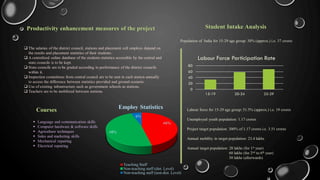
Population of India for 15-29 age group: 30% (approx.) i.e. 37 crores
0
20
40
60
80
15-19 20-24 25-29
Labour Force Participation Rate
Labour force for 15-29 age group: 51.5% (approx.) i.e. 19 crores
Unemployed youth population: 1.17 crores
Project target population: 300% of 1.17 crores i.e. 3.51 crores
Annual mobility in target population: 23.4 lakhs
Annual target population: 20 lakhs (for 1st year)
60 lakhs (for 2nd to 6th year)
30 lakhs (afterwards)
Student Intake AnalysisProductivity enhancement measures of the project
 The salaries of the district council, stations and placement cell employs depend on
the results and placement statistics of their students.
 A centralized online database of the students statistics accessible by the central and
state councils is to be kept.
 State councils are to be graded according to performance of the district councils
within it.
 Inspection committees from central council are to be sent in each station annually
to access the difference between statistics provided and ground scenario.
 Use of existing infrastructure such as government schools as stations.
 Teachers are to be mobilized between stations.
46%
48%
6%
Employ Statistics
Teaching Staff
Non-teaching staff (dist. Level)
Non-teaching staff (non-dist. Level)
 Language and communication skills
 Computer hardware & software skills
 Agriculture techniques
 Sales and marketing skills
 Mechanical repairing
 Electrical repairing
Courses
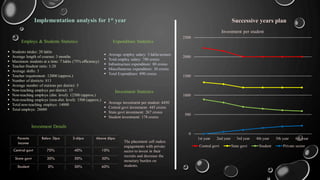
Implementation analysis for 1st year
 Students intake: 20 lakhs
 Average length of courses: 3 months
 Maximum students at a time: 7 lakhs (75% efficiency)
 Teacher-Student ratio: 1:20
 Average shifts: 3
 Teacher requirement: 12000 (approx.)
 Number of districts: 813
 Average number of stations per district: 5
 Non-teaching employs per district: 15
 Non-teaching employs (dist. level): 12500 (approx.)
 Non-teaching employs (non-dist. level): 1500 (approx.)
 Total non-teaching employs: 14000
 Total employs: 26000
Employs & Students Statistics Expenditure Statistics
 Average employ salary: 3 lakhs/annum
 Total employ salary: 780 crores
 Infrastructure expenditure: 80 crores
 Miscellaneous expenditure: 30 crores
 Total Expenditure: 890 crores
 Average investment per student: 4450
 Central govt investment: 445 crores
 State govt investment: 267 crores
 Student investment: 178 crores
Investment Statistics
Parents
income
Below 3lpa 3-6lpa Above 6lpa
Central govt 70% 40% 10%
State govt 30% 30% 30%
Student 0% 30% 60%
Investment Details
The placement cell makes
engagements with private
sector to invest in their
recruits and decrease the
monetary burden on
students.
Successive years plan
0
500
1000
1500
2000
2500
1st year 2nd year 3rd year 4th year 5th year 6th year
Investment per student
Central govt State govt Student Private sector
MORE SPECIALIZATION IN HIGHER EDUCATION
 The higher education system should be more specialized i.e.
specializations should be decided from a lower level than current
scenario.
 Courses should be decided according to future aspiration of the students.
Job oriented
course
Research
oriented course
 Students should be given the opportunity to decide their future
aspirations, if they are interested in higher education or in jobs at about
50% completion of their course.
 The elective subjects for next 50% course is to be designed according to
requirements i.e. more practical skills for the job seekers and more
research projects for higher education aspirants.
Analysis in Engineering
Duration of Bachelor Degree course: 4years
Declaration is to be made after 2nd year.
Elective courses for job seekers:
 Communication skills
 Practical skills
 Compulsory job internship
Elective courses for higher education aspirants:
 Research projects
 Theoretical subjects
 Compulsory research internship
Benefits:
 Low waste of resources (eg: research
internship in a premier institute followed by
a non-research job makes the internship less
beneficial which may be useful for a research
interested student)
 Decrease burden of unnecessary subjects on
students; instead more productive subjects
may be projected.
 Job interested students will move to the
labour market which increases productivity
and employability.
Students should be allowed to choose from a pool of diverse elective subjects
according to their interests so that they may integrate better with the next phase of
their career.
For example:
 Public management may be an elective subject for a B.Sc. student if is interested
in a career in administrative service.
 Accountancy may be an elective for a B.A. student if he/she is interested in a
bank job.
Recommended changes
IMPROVE QUALITY OF HIGHER EDUCATION
In terms of salary, the jobs related to a higher educational qualification do not
have significant difference as compared to that of its less qualified counterpart.
In fact, in some cases, say in engineering, a B. Tech graduate entering a job
immediately after graduation does his job for 3-5 years whereas a graduate who
continues further studies complete his study in the mean time. After 5 years, the
mockery is the salary obtained by the graduate employee is much higher than
the first salary obtained by his higher counterpart. This is one reason why
higher education in India is not preferred by capable and interested students,
thus restricting their self upliftment leading to lower employability .At the same
time, the students failing to get a job are forced to pursue higher education; thus
resulting in lower employability in comparisons.
On the contrary, the benefits of an improved well defined and valued higher
education offers several useful insights in the field of employability
 Higher education would be preferred by passionate students that would
definitely improve employability in the field of research and development.
 In terms of jobs, the un-interested students would not occupy them for the sake
of a good salary only. Instead, it would be able to have employees who are
interested in jobs and not research.
 Further, the development of higher education has immense prospect in new
inventions and discoveries that would open up various insights into the field of
employments, thereby helping the employability to great extent
 Even in case of jobs, the better and higher qualified people would have
something different in comparison to the already working experienced and less
qualified employee. That can be utilized to new changes in the company,
thereby making proper use of education and giving impulse to employability.
Benefits
Reference
 Youth Employment and Unemployment: an Indian perspective (ILO)
www.ilo.org/wcmsp5/groups/public/---asia/---ro-bangkok/---sro-new_delhi/documents/publication/wcms_211552.pdf
 Youth Employment and Unemployment in India: Indira Gandhi institute of Development Research
www.igidr.ac.in/pdf/publication/WP-2011-009.pdf
 Census of India Website: Office of Registrar General and census commissioner of India
www.censusindia.gov.in
 National Employability Study: Aspiring minds
www.aspiringminds.in/docs/national_employability_IT_aspiringminds.pdf

Unavocationers

  • 1.
    Manthan Topic: Increasingthe employability of youth Tanzim Hussain Jyotishman Mudiar Jyotirmoy Sarma Subhra Jyoti Nath Samrat Baruah Presented by BUILDING EMPLOYABILITY an insight into basic components of EDUCATION, TRAINING & RECRUITMENT
  • 2.
    2.4 3.2 5.5 14.3 8.5 18.9 19.8 0.3 1.5 9.1 26.2 27.1 34.5 29.4 0 5 10 15 20 25 30 35 40 Illiterate Primary HigherGraduate Tech degree Diploma below graduate Diploma above graduate Unemployment Rate vs Education Male Female Current Statistics 0 5 10 15 15-19 20-24 25-29 15-59 11.38 14.23 8.02 4.17 6.575 5.795 2.535 1.565 Unemployment Rate vs Age Urban Rural  More unemployment for higher educated youths.  Higher education may lead to low paid jobs.  More unemployment rate among youths.  89% of youths don’t have any vocational education.  26% of employed youths are poverty stricken.  Lower employment and employability of females due to social reasons.  Direct unemployment is prevalent in the secondary and tertiary sector (urban) whereas disguised unemployment is prevalent in primary sector (rural). Derivation from graph:
  • 3.
  • 4.
    PROPER RECRUITMENT ANDPROMOTION POLICIES (INTERNSHIP AND TRAINING) 1. Eligibility • Minimum qualification required for the job is to be satisfied. 2. Screening • Written exam based on subject matter, aptitude, language and communication skills etc. 3. Internship & Training • Candidates should undergo short term internship & training and their performance is to be evaluated. 4. Interview • A final interview is to be conducted based on requirements for the job. Recruitment System To employer  Enables the employer to recruit based on work abilities rather than educational qualifications.  The employer gets a beforehand experience of the interne.  The employer gets a low-paid temporary workforce. To interne  The interne gets an experience of the job.  Internship undertaken by non-selected candidates gained them an experience and develop their expertise. Benefits of Internship and Training Promotion Exam Work Performance Work Experience Work performance is be evaluated by predetermined statistical system instead of suggestion from higher officials in order to remove corrupt practices. Benefits:  Better productivity of employees.  Incentive for employs to do better.  Avoid corrupt means for promotion.  Reduce poverty stricken employed population. Promotion System
  • 5.
     A minimuminterne to employ annual ratio of 0.05 for all government and private sector companies having more than 300 employs.  A fixed minimum wage for internships above 2 months. Laws required for internship Benefits:  A well trained work force .  Prevent people from moving into profession where he/she would be less productive.  Minimum wage for internes serves as incentive for people to join as interne.  Better integration of labour market with education sector. Recommendations for recruitment facilities  Final decision on selection of employs should be statistical i.e. weighted summation of all the stages of recruitment.  Interviews, pre-selection internship and screening tests are to be conducted by different persons. Benefits:  Recruitment would be solely based on performance and no favour.  Low chances of unfair means getting involved as the different stages are to be handled by different person.
  • 6.
    PROFESSIONAL EDUCATION &TRAINING COUNCIL Central Council State Council District Council Stations Placement Cell Technical Council Administrative Structure  The technical council decides the curriculum of various courses and conducts exams. It consists of eminent educators in all concerned fields.  The state council decides the courses for various districts according to requirements in a certain area evaluated by conducting surveys and assessment of existing labour statistics.  The district council monitors the activities of the stations in the district and supervises the examinations.  Stations are work places.  Placement cell manages jobs for trained students. It calls the probable employers from organized and unorganized sector for recruitment of students. Functions: • Establishment of a professional training institute in all district headquarters. • Providing short term training in all government schools and colleges Screening Training Placement The eligibility criteria of the courses are predefined, students are selected according to written exams and interviews. A students won’t be allowed in more than one course for the initial years. Records of outgoing students are to be kept and placement cell will contact them for an year after completion of their respective courses. Student Timeline
  • 7.
    Population of Indiafor 15-29 age group: 30% (approx.) i.e. 37 crores 0 20 40 60 80 15-19 20-24 25-29 Labour Force Participation Rate Labour force for 15-29 age group: 51.5% (approx.) i.e. 19 crores Unemployed youth population: 1.17 crores Project target population: 300% of 1.17 crores i.e. 3.51 crores Annual mobility in target population: 23.4 lakhs Annual target population: 20 lakhs (for 1st year) 60 lakhs (for 2nd to 6th year) 30 lakhs (afterwards) Student Intake AnalysisProductivity enhancement measures of the project  The salaries of the district council, stations and placement cell employs depend on the results and placement statistics of their students.  A centralized online database of the students statistics accessible by the central and state councils is to be kept.  State councils are to be graded according to performance of the district councils within it.  Inspection committees from central council are to be sent in each station annually to access the difference between statistics provided and ground scenario.  Use of existing infrastructure such as government schools as stations.  Teachers are to be mobilized between stations. 46% 48% 6% Employ Statistics Teaching Staff Non-teaching staff (dist. Level) Non-teaching staff (non-dist. Level)  Language and communication skills  Computer hardware & software skills  Agriculture techniques  Sales and marketing skills  Mechanical repairing  Electrical repairing Courses
  • 8.
    Implementation analysis for1st year  Students intake: 20 lakhs  Average length of courses: 3 months  Maximum students at a time: 7 lakhs (75% efficiency)  Teacher-Student ratio: 1:20  Average shifts: 3  Teacher requirement: 12000 (approx.)  Number of districts: 813  Average number of stations per district: 5  Non-teaching employs per district: 15  Non-teaching employs (dist. level): 12500 (approx.)  Non-teaching employs (non-dist. level): 1500 (approx.)  Total non-teaching employs: 14000  Total employs: 26000 Employs & Students Statistics Expenditure Statistics  Average employ salary: 3 lakhs/annum  Total employ salary: 780 crores  Infrastructure expenditure: 80 crores  Miscellaneous expenditure: 30 crores  Total Expenditure: 890 crores  Average investment per student: 4450  Central govt investment: 445 crores  State govt investment: 267 crores  Student investment: 178 crores Investment Statistics Parents income Below 3lpa 3-6lpa Above 6lpa Central govt 70% 40% 10% State govt 30% 30% 30% Student 0% 30% 60% Investment Details The placement cell makes engagements with private sector to invest in their recruits and decrease the monetary burden on students. Successive years plan 0 500 1000 1500 2000 2500 1st year 2nd year 3rd year 4th year 5th year 6th year Investment per student Central govt State govt Student Private sector
  • 9.
    MORE SPECIALIZATION INHIGHER EDUCATION  The higher education system should be more specialized i.e. specializations should be decided from a lower level than current scenario.  Courses should be decided according to future aspiration of the students. Job oriented course Research oriented course  Students should be given the opportunity to decide their future aspirations, if they are interested in higher education or in jobs at about 50% completion of their course.  The elective subjects for next 50% course is to be designed according to requirements i.e. more practical skills for the job seekers and more research projects for higher education aspirants. Analysis in Engineering Duration of Bachelor Degree course: 4years Declaration is to be made after 2nd year. Elective courses for job seekers:  Communication skills  Practical skills  Compulsory job internship Elective courses for higher education aspirants:  Research projects  Theoretical subjects  Compulsory research internship Benefits:  Low waste of resources (eg: research internship in a premier institute followed by a non-research job makes the internship less beneficial which may be useful for a research interested student)  Decrease burden of unnecessary subjects on students; instead more productive subjects may be projected.  Job interested students will move to the labour market which increases productivity and employability. Students should be allowed to choose from a pool of diverse elective subjects according to their interests so that they may integrate better with the next phase of their career. For example:  Public management may be an elective subject for a B.Sc. student if is interested in a career in administrative service.  Accountancy may be an elective for a B.A. student if he/she is interested in a bank job. Recommended changes
  • 10.
    IMPROVE QUALITY OFHIGHER EDUCATION In terms of salary, the jobs related to a higher educational qualification do not have significant difference as compared to that of its less qualified counterpart. In fact, in some cases, say in engineering, a B. Tech graduate entering a job immediately after graduation does his job for 3-5 years whereas a graduate who continues further studies complete his study in the mean time. After 5 years, the mockery is the salary obtained by the graduate employee is much higher than the first salary obtained by his higher counterpart. This is one reason why higher education in India is not preferred by capable and interested students, thus restricting their self upliftment leading to lower employability .At the same time, the students failing to get a job are forced to pursue higher education; thus resulting in lower employability in comparisons. On the contrary, the benefits of an improved well defined and valued higher education offers several useful insights in the field of employability  Higher education would be preferred by passionate students that would definitely improve employability in the field of research and development.  In terms of jobs, the un-interested students would not occupy them for the sake of a good salary only. Instead, it would be able to have employees who are interested in jobs and not research.  Further, the development of higher education has immense prospect in new inventions and discoveries that would open up various insights into the field of employments, thereby helping the employability to great extent  Even in case of jobs, the better and higher qualified people would have something different in comparison to the already working experienced and less qualified employee. That can be utilized to new changes in the company, thereby making proper use of education and giving impulse to employability. Benefits
  • 11.
    Reference  Youth Employmentand Unemployment: an Indian perspective (ILO) www.ilo.org/wcmsp5/groups/public/---asia/---ro-bangkok/---sro-new_delhi/documents/publication/wcms_211552.pdf  Youth Employment and Unemployment in India: Indira Gandhi institute of Development Research www.igidr.ac.in/pdf/publication/WP-2011-009.pdf  Census of India Website: Office of Registrar General and census commissioner of India www.censusindia.gov.in  National Employability Study: Aspiring minds www.aspiringminds.in/docs/national_employability_IT_aspiringminds.pdf