Dominant Strategy
PROFESSOR RAVI KIRAN
What is Dominant Strategy?
• The dominant strategy in game theory refers to a situation where
one player has superior tactics regardless of how their opponent
may play.
• Holding all factors constant, that player enjoys an upper hand in
the game over the opposition.
• A dominant strategy example is when a company benefits more
when increasing production than lowering it regardless of what
their competition does.
Dominant strategy in Nash Equilibrium
• Nash equilibrium states that nothing is gained if any of the players
change their strategy while all of the other players maintain their
strategy.
• Dominant strategy asserts that a player will choose a strategy that
will lead to the best outcome regardless of the strategies that the
other players have chosen.
Dominant Strategy and Nash Equilibrium
• Dominant Strategies : I am doing the best I can, no matter what you do .
• Dominant Strategies : You are doing the best you can, no matter what I do.
• Nash Equilibrium : I am doing the best I can, given what you are doing.
• Nash Equilibrium : You are doing the best you can, given what I am doing.
Prisoner’s Dilemma: Dominant Strategy
(1) If B CONF, A should CONF (8 < 15)
(2) If B does NOT CONF, A should CONF (1 < 3)
…A has the same strategy (CONF) no matter what B does.
(3) If A CONF, B should CONF (8 < 15)
(4) If A does NOT CONF , B should CONF (1 < 3)
…B has the same strategy (CONF) no matter what A does.
Thus, the equilibrium in dominant strategies for this game is (CONF, CONF) = (8,8).
A second solution to games is a Nash Equilibrium.
Nash Equilibrium = A set of strategies in which each player has
chosen its best strategy given the strategy of its rivals.
To solve for a Nash Equilibrium:
(1) Check each outcome of a game to see if any player wants to change
strategies, given the strategy of its rival.
(a) If no player wants to change, the outcome is a Nash Equilibrium.
(b) If one or more player wants to change, the outcome is not a Nash
Equilibrium.
A game may have zero, one, or more than one Nash Equilibria. We will
determine if this game has any Nash Equilibria for PD data given above.
Prisoner’s Dilemma: Nash Equilibrium
(1) Outcome = (CONF, CONF)
(a) Is CONF best for A given B CONF? Yes.
(b) Is CONF best for B given A CONF? Yes.
…(CONF, CONF) is a Nash Equilibrium.
(2) Outcome = (CONF, NOT CONF)
(a) Is CONF best for A given B NOT? Yes.
(b) Is NOT CONF best for B given A CONF? No.
…(CONF, NOT) is not a Nash Equilibrium.
(3) Outcome = (NOT, CONF)
(a) Is NOT best for A given B CONF? No.
(b) Is CONF best for B given A NOT? Yes.
…(NOT, CONF) is not a Nash Equilibrium.
(4) Outcome = (NOT, NOT)
(a) Is NOT best for A given B NOT? No.
(b) Is NOT best for B given A NOT? No.
…(NOT, NOT) is not a Nash Equilibrium.
Therefore, (CONF, CONF) is a Nash Equilibrium, and the only one Nash Equilibrium in the Prisoner’s
Dilemma game. Note that in the Prisoner’s Dilemma game, the Equilibrium in Dominant Strategies is
also a Nash Equilibrium.
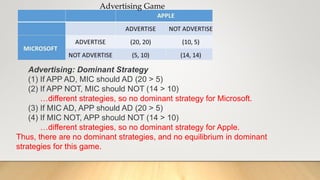
Advertising Game
Advertising: Dominant Strategy
(1) If APP AD, MIC should AD (20 > 5)
(2) If APP NOT, MIC should NOT (14 > 10)
…different strategies, so no dominant strategy for Microsoft.
(3) If MIC AD, APP should AD (20 > 5)
(4) If MIC NOT, APP should NOT (14 > 10)
…different strategies, so no dominant strategy for Apple.
Thus, there are no dominant strategies, and no equilibrium in dominant
strategies for this game.
Advertising: Nash Equilibria
(1) Outcome = (AD, AD)
(a) Is AD best for MIC given APP AD? Yes.
(b) Is AD best for APP given MIC AD? Yes.
…(AD, AD) is a Nash Equilibrium.
(2) Outcome = (AD, NOT)
(a) Is AD best for MIC given APP NOT? No.
(b) Is NOT best for APP given MIC AD? No.
…(AD, NOT) is not a Nash Equilibrium.
(3) Outcome = (NOT, AD)
(a) Is NOT best for MIC given APP AD? No.
(b) Is AD best for APP given MIC NOT? No.
…(NOT, AD) is not a Nash Equilibrium.
(4) Outcome = (NOT, NOT)
(a) Is NOT best for MIC given APP NOT? Yes.
(b) Is NOT best for APP given MIC NOT? Yes.
…(NOT, NOT) is a Nash Equilibrium.
There are two Nash Equilibria in the Advertising game: (AD, AD) and (NOT, NOT).
Therefore, in the Advertising game, there are two Nash Equilibria, and no
Equilibrium in Dominant Strategies.
Summing Up
• It can be proven that in game theory, every Equilibrium in Dominant Strategies
is a Nash Equilibrium. However, a Nash Equilibrium may or may not be an
Equilibrium in Dominant Strategies.
Firm B
Firm A
Advertise Not Advertise
Advertise 10, 5 15, 0
Not Advertise 6, 8 10, 2
Firm B
Firm A
Advertise Not Advertise
Advertise 10, 5 15, 0
Not Advertise 6, 8 10, 2
If both firms advertise, Firm A will make profit of 10, Firm B will make profit of 5.
If A Ad , B doesn’t , Firm A will make profit of 15,Firm B will make profit of 0.

Dominant Strategy .pptx

  • 1.
  • 2.
    What is DominantStrategy? • The dominant strategy in game theory refers to a situation where one player has superior tactics regardless of how their opponent may play. • Holding all factors constant, that player enjoys an upper hand in the game over the opposition. • A dominant strategy example is when a company benefits more when increasing production than lowering it regardless of what their competition does.
  • 3.
    Dominant strategy inNash Equilibrium • Nash equilibrium states that nothing is gained if any of the players change their strategy while all of the other players maintain their strategy. • Dominant strategy asserts that a player will choose a strategy that will lead to the best outcome regardless of the strategies that the other players have chosen.
  • 4.
    Dominant Strategy andNash Equilibrium • Dominant Strategies : I am doing the best I can, no matter what you do . • Dominant Strategies : You are doing the best you can, no matter what I do. • Nash Equilibrium : I am doing the best I can, given what you are doing. • Nash Equilibrium : You are doing the best you can, given what I am doing.
  • 6.
    Prisoner’s Dilemma: DominantStrategy (1) If B CONF, A should CONF (8 < 15) (2) If B does NOT CONF, A should CONF (1 < 3) …A has the same strategy (CONF) no matter what B does. (3) If A CONF, B should CONF (8 < 15) (4) If A does NOT CONF , B should CONF (1 < 3) …B has the same strategy (CONF) no matter what A does. Thus, the equilibrium in dominant strategies for this game is (CONF, CONF) = (8,8).
  • 7.
    A second solutionto games is a Nash Equilibrium. Nash Equilibrium = A set of strategies in which each player has chosen its best strategy given the strategy of its rivals.
  • 8.
    To solve fora Nash Equilibrium: (1) Check each outcome of a game to see if any player wants to change strategies, given the strategy of its rival. (a) If no player wants to change, the outcome is a Nash Equilibrium. (b) If one or more player wants to change, the outcome is not a Nash Equilibrium. A game may have zero, one, or more than one Nash Equilibria. We will determine if this game has any Nash Equilibria for PD data given above.
  • 9.
    Prisoner’s Dilemma: NashEquilibrium (1) Outcome = (CONF, CONF) (a) Is CONF best for A given B CONF? Yes. (b) Is CONF best for B given A CONF? Yes. …(CONF, CONF) is a Nash Equilibrium. (2) Outcome = (CONF, NOT CONF) (a) Is CONF best for A given B NOT? Yes. (b) Is NOT CONF best for B given A CONF? No. …(CONF, NOT) is not a Nash Equilibrium. (3) Outcome = (NOT, CONF) (a) Is NOT best for A given B CONF? No. (b) Is CONF best for B given A NOT? Yes. …(NOT, CONF) is not a Nash Equilibrium. (4) Outcome = (NOT, NOT) (a) Is NOT best for A given B NOT? No. (b) Is NOT best for B given A NOT? No. …(NOT, NOT) is not a Nash Equilibrium. Therefore, (CONF, CONF) is a Nash Equilibrium, and the only one Nash Equilibrium in the Prisoner’s Dilemma game. Note that in the Prisoner’s Dilemma game, the Equilibrium in Dominant Strategies is also a Nash Equilibrium.
  • 10.
    Advertising Game Advertising: DominantStrategy (1) If APP AD, MIC should AD (20 > 5) (2) If APP NOT, MIC should NOT (14 > 10) …different strategies, so no dominant strategy for Microsoft. (3) If MIC AD, APP should AD (20 > 5) (4) If MIC NOT, APP should NOT (14 > 10) …different strategies, so no dominant strategy for Apple. Thus, there are no dominant strategies, and no equilibrium in dominant strategies for this game.
  • 11.
    Advertising: Nash Equilibria (1)Outcome = (AD, AD) (a) Is AD best for MIC given APP AD? Yes. (b) Is AD best for APP given MIC AD? Yes. …(AD, AD) is a Nash Equilibrium. (2) Outcome = (AD, NOT) (a) Is AD best for MIC given APP NOT? No. (b) Is NOT best for APP given MIC AD? No. …(AD, NOT) is not a Nash Equilibrium. (3) Outcome = (NOT, AD) (a) Is NOT best for MIC given APP AD? No. (b) Is AD best for APP given MIC NOT? No. …(NOT, AD) is not a Nash Equilibrium. (4) Outcome = (NOT, NOT) (a) Is NOT best for MIC given APP NOT? Yes. (b) Is NOT best for APP given MIC NOT? Yes. …(NOT, NOT) is a Nash Equilibrium. There are two Nash Equilibria in the Advertising game: (AD, AD) and (NOT, NOT). Therefore, in the Advertising game, there are two Nash Equilibria, and no Equilibrium in Dominant Strategies.
  • 12.
    Summing Up • Itcan be proven that in game theory, every Equilibrium in Dominant Strategies is a Nash Equilibrium. However, a Nash Equilibrium may or may not be an Equilibrium in Dominant Strategies.
  • 13.
    Firm B Firm A AdvertiseNot Advertise Advertise 10, 5 15, 0 Not Advertise 6, 8 10, 2
  • 14.
    Firm B Firm A AdvertiseNot Advertise Advertise 10, 5 15, 0 Not Advertise 6, 8 10, 2 If both firms advertise, Firm A will make profit of 10, Firm B will make profit of 5. If A Ad , B doesn’t , Firm A will make profit of 15,Firm B will make profit of 0.