DEPARTMENT OF COMPUTER SCIENCE
ENGINEERING & INFORMATION
TECHNOLOGY
JAYPEE INSTITUTE OF INFORMATION
TECHNOLOGY, NOIDA
SUPERVISOR: Dr. Vikas Saxena
Name : Eshita , Rajat Bhatia
Enroll No. 10104674, 10104773
 Computer and Video Games are one of the most popular and the
most important products of the software industry. One of the
greatest contributors to this success is the rapid improvement of
technologies. However, the Game Development processes still
have to face some difficulties. In fact, the lack of guidelines and
theoretical foundations are the major causes for most of Game
Designers need to bring their own experiences and intuitions into
the Game Design. Therefore, it is essential to increase the
involvement of the Human Computer Interaction (or HCI) and
design in the processes of designing games.
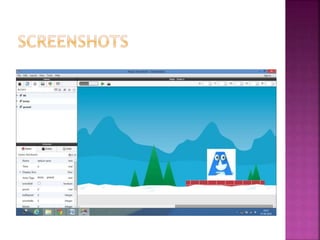
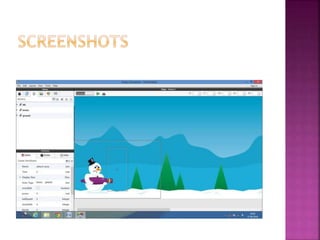
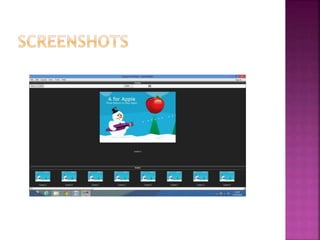
 Developed an angry birds type platform game from
scratch which aims at cognitive development of children
as well as providing them with an enjoyable environment
to learn the basics of counting and alphabets. Thus we
have made an attempt to revolutionize the methodology
of learning by utilizing the screens available to the
present generation for their own benefit.
 HUMAN COMPUTER INTERACTION IN GAME
DESIGN .
 Hung Nguyen
 Published:Spring 2012
 Published at: Business Information
Technology ,Oulu University of Applied
Sciences.
In order to create a game which can be easily
learned, effectively played and enjoyed at the
same time, the Game Designers should not only
use their own intuitions and experiences but also
it is important to build a relationship between
design and use.
 a list of principles for Game Design were brought
together. They serve for the one common goal – to
create a better and more usable interface. And
lastly but not least important was the set of skills
that can be useful for every Game Designer. It is
essential to point out that, by no mean, this list is
neither completed or that can be applied for
every scenario.
 The purposes of game form into a set of game
genres, then the technologies help to bring those
ideas into life.
 these principles will serve as guidelines for every
Game Designer, and they can be changed
accordingly depended on the situation.
 Every Game Development process requires high
level of complexity, which includes teams of
programmers, artists, project managers, writer,
musicians and also some other roles. Among these
roles, the Game Designer is at the central of
Game Development process.
 One of the matters was about the HCI
technologies which contributed to the interaction
in games, and the other was about using HCI to
solve the negative effect of computer and videos
games have in the modern society. In addition,
the game interface design process was also
introduced as one of the applica-tions of HCI in
Game Interface Development; the HCI human
factors are the major element to decide the
design‘s goals for the Designer.
 Practical Game Design and Development
Pedagogy
 Paul J. Diefenbach
 Published at: Drexel University
 Game Design:
They noticed that students often have creative
ideas but miss factors that might at first seem
intuitive.So, Workshop were organized that
reintroduces strategy, game- play, and story to
focus on designing games from the player’s
perspective so that students can assess how this
affects code and assets.
This paper presents the challenges and possibilities
that arise from the integration of a 2D physics engine into an
adventure game platform (i.e. engine and editor). This integration
allows the use of a complex physics model within a narrative
environment, thus increasing expressiveness and educational
potential (through re-usability and increased challenge). In this
work eAdventure is used as the adventure game platform and
Box2D is used as the physics engine. While adventure games have
been successfully applied in educational contexts from language
learning to medicine, including a physics engine broadens the
number of subjects that can be covered, thus increasing the scope
and potential of the resulting games.
 Gameplay
Students often design games from an abstract
perspective, as if the characters in the game are
self-governed and the designer is an all-knowing
god. For example, they might propose a game
about two aliens battling over a magic crystal. The
students will have decided the game’s look and
physical characteristics, the aliens’ abilities, the
conflict’s backstory, and bizarre power-ups, yet
disagree when we ask them whether the game is
played from a first- or third-person perspective or
whether it’s played with a keyboard or controller.
 Game Development
Once the students have vetted their game concept
on the basis of the concerns we just detailed, they
follow an iterative Scrum development cycle that
permits continual refinement. This has introduced
problems due to students having little experience
in incremental development, milestone planning,
and resource management. We now structure the
milestones to guide inexperienced students in
long-term project planning. Development now
involves three distinct phases: establishing the as-
set pipeline, refining and balancing gameplay, and
dressing up the game.
 The 80/20 Rule
Direct teams to focus on efforts that provide the
most “bang for the buck,” as exemplified by the
80/20 rule, also called the Pareto principle or the
“vital few and trivial many.” This rule states that
approximately 20 percent of the vital tasks
produce 80 percent of the results.
 GAME ENGINEERING
 ROBERT J. AUMANN
 Accepted in September 2009
 Published at :The Hebrew University,
Jerusalam
 "Game Engineering" deals with the
application of game theoretic methods to
interactive situations or systems in which the
rules are well defined, or where the designer
can himself specify the rules. This talk,
which addressed a business-school audience
with no specific knowledge of game theory,
describes five examples of gameengineering:
two dealing with auctions, two with traffic
systems, and one with arbitration.
 Few examples of ‘game engineering’:
 Design physics based 2D platform game,
incorporating the physics system of Game
Engine to govern the environmental objects and
player character. The game aims at providing
enjoyment and increase learning of the users
regarding various fundamental concepts of
physics such as friction, velocity, bounciness and
collisions which lead to cognitive development
as well as impart kindergarten teaching to kids
up to 5 years of age.
A platform game (or platformer) is a video game which
involves guiding an avatar to jump between suspended
platforms, over obstacles, or both to advance the game.
These challenges are known as jumping
puzzles or freerunning. The player controls the jumps
to avoid letting the avatar fall from platforms or miss
necessary jumps. The most common unifying element
of games of this genre is the jump button. Jumping, in
this genre, may include swinging from extendable
arms, as in Ristar or Bionic Commando, or bouncing
from springboards or trampolines, as in Alpha Waves.
 The unique structural elements of games build
brainpower because they:
 Provide a platform for self-directed exploration
 Deliver just-in-time learning
 Use data to help players understand their
progress, and what to do and where to go next in
the game
 Create a compelling need to know, ask, examine,
assimilate, and master skills and content

 Taking these things into consideration, we have
designed a game for children upto 5 years for
learning alphabets along with playing game.
A side-scrolling game or side-scroller is a video
game in which the gameplay action is viewed
from a side-view camera angle, and the onscreen
characters generally move from the left side of
the screen to the right (or less commonly, right
to left) to meet an objective. These games make
use of scrolling computer display technology. The
move from single-screen or flip-screen graphics
to scrolling graphics, during the golden age of
video arcade games and during third-generation
consoles, would prove to be a pivotal leap in
game design, comparable to the move to 3D
graphics during the fifth generation.
 Integrated physics engine and a set of 2D
physics components
 Rigid-body component (RigidBody2D)
supporting static/kinematic/dynamic body,
mass, linear/angular velocities, drag and
auto-sleeping and fixed-angle constraint.
 Circle collider (CircleCollider2D) supporting a
centroid and radius.
 Rectangle collider (BoxCollider2D) supporting
a centroid and a size.
 Language : Monodevelop Behaviour Settings ,
XML
 Software Technology : GameSalad and Itegrated
Physics Engine.
The purpose of testing is quality assurance,
verification and validation, or reliability
estimation.
Functionality Testing
Compatibility testing
Beta testing
Soak Testing
Regression Testing
GROUP MEMBERS:
ESHITA (10104674)
RAJAT BHATIA (10104773)

Game engineering

  • 1.
    DEPARTMENT OF COMPUTERSCIENCE ENGINEERING & INFORMATION TECHNOLOGY JAYPEE INSTITUTE OF INFORMATION TECHNOLOGY, NOIDA SUPERVISOR: Dr. Vikas Saxena Name : Eshita , Rajat Bhatia Enroll No. 10104674, 10104773
  • 2.
     Computer andVideo Games are one of the most popular and the most important products of the software industry. One of the greatest contributors to this success is the rapid improvement of technologies. However, the Game Development processes still have to face some difficulties. In fact, the lack of guidelines and theoretical foundations are the major causes for most of Game Designers need to bring their own experiences and intuitions into the Game Design. Therefore, it is essential to increase the involvement of the Human Computer Interaction (or HCI) and design in the processes of designing games.
  • 3.
     Developed anangry birds type platform game from scratch which aims at cognitive development of children as well as providing them with an enjoyable environment to learn the basics of counting and alphabets. Thus we have made an attempt to revolutionize the methodology of learning by utilizing the screens available to the present generation for their own benefit.
  • 4.
     HUMAN COMPUTERINTERACTION IN GAME DESIGN .  Hung Nguyen  Published:Spring 2012  Published at: Business Information Technology ,Oulu University of Applied Sciences.
  • 5.
    In order tocreate a game which can be easily learned, effectively played and enjoyed at the same time, the Game Designers should not only use their own intuitions and experiences but also it is important to build a relationship between design and use.
  • 6.
     a listof principles for Game Design were brought together. They serve for the one common goal – to create a better and more usable interface. And lastly but not least important was the set of skills that can be useful for every Game Designer. It is essential to point out that, by no mean, this list is neither completed or that can be applied for every scenario.  The purposes of game form into a set of game genres, then the technologies help to bring those ideas into life.  these principles will serve as guidelines for every Game Designer, and they can be changed accordingly depended on the situation.
  • 7.
     Every GameDevelopment process requires high level of complexity, which includes teams of programmers, artists, project managers, writer, musicians and also some other roles. Among these roles, the Game Designer is at the central of Game Development process.  One of the matters was about the HCI technologies which contributed to the interaction in games, and the other was about using HCI to solve the negative effect of computer and videos games have in the modern society. In addition, the game interface design process was also introduced as one of the applica-tions of HCI in Game Interface Development; the HCI human factors are the major element to decide the design‘s goals for the Designer.
  • 8.
     Practical GameDesign and Development Pedagogy  Paul J. Diefenbach  Published at: Drexel University
  • 9.
     Game Design: Theynoticed that students often have creative ideas but miss factors that might at first seem intuitive.So, Workshop were organized that reintroduces strategy, game- play, and story to focus on designing games from the player’s perspective so that students can assess how this affects code and assets.
  • 10.
    This paper presentsthe challenges and possibilities that arise from the integration of a 2D physics engine into an adventure game platform (i.e. engine and editor). This integration allows the use of a complex physics model within a narrative environment, thus increasing expressiveness and educational potential (through re-usability and increased challenge). In this work eAdventure is used as the adventure game platform and Box2D is used as the physics engine. While adventure games have been successfully applied in educational contexts from language learning to medicine, including a physics engine broadens the number of subjects that can be covered, thus increasing the scope and potential of the resulting games.
  • 11.
     Gameplay Students oftendesign games from an abstract perspective, as if the characters in the game are self-governed and the designer is an all-knowing god. For example, they might propose a game about two aliens battling over a magic crystal. The students will have decided the game’s look and physical characteristics, the aliens’ abilities, the conflict’s backstory, and bizarre power-ups, yet disagree when we ask them whether the game is played from a first- or third-person perspective or whether it’s played with a keyboard or controller.
  • 12.
     Game Development Oncethe students have vetted their game concept on the basis of the concerns we just detailed, they follow an iterative Scrum development cycle that permits continual refinement. This has introduced problems due to students having little experience in incremental development, milestone planning, and resource management. We now structure the milestones to guide inexperienced students in long-term project planning. Development now involves three distinct phases: establishing the as- set pipeline, refining and balancing gameplay, and dressing up the game.
  • 13.
     The 80/20Rule Direct teams to focus on efforts that provide the most “bang for the buck,” as exemplified by the 80/20 rule, also called the Pareto principle or the “vital few and trivial many.” This rule states that approximately 20 percent of the vital tasks produce 80 percent of the results.
  • 14.
     GAME ENGINEERING ROBERT J. AUMANN  Accepted in September 2009  Published at :The Hebrew University, Jerusalam
  • 15.
     "Game Engineering"deals with the application of game theoretic methods to interactive situations or systems in which the rules are well defined, or where the designer can himself specify the rules. This talk, which addressed a business-school audience with no specific knowledge of game theory, describes five examples of gameengineering: two dealing with auctions, two with traffic systems, and one with arbitration.  Few examples of ‘game engineering’:
  • 16.
     Design physicsbased 2D platform game, incorporating the physics system of Game Engine to govern the environmental objects and player character. The game aims at providing enjoyment and increase learning of the users regarding various fundamental concepts of physics such as friction, velocity, bounciness and collisions which lead to cognitive development as well as impart kindergarten teaching to kids up to 5 years of age.
  • 17.
    A platform game(or platformer) is a video game which involves guiding an avatar to jump between suspended platforms, over obstacles, or both to advance the game. These challenges are known as jumping puzzles or freerunning. The player controls the jumps to avoid letting the avatar fall from platforms or miss necessary jumps. The most common unifying element of games of this genre is the jump button. Jumping, in this genre, may include swinging from extendable arms, as in Ristar or Bionic Commando, or bouncing from springboards or trampolines, as in Alpha Waves.
  • 18.
     The uniquestructural elements of games build brainpower because they:  Provide a platform for self-directed exploration  Deliver just-in-time learning  Use data to help players understand their progress, and what to do and where to go next in the game  Create a compelling need to know, ask, examine, assimilate, and master skills and content   Taking these things into consideration, we have designed a game for children upto 5 years for learning alphabets along with playing game.
  • 19.
    A side-scrolling gameor side-scroller is a video game in which the gameplay action is viewed from a side-view camera angle, and the onscreen characters generally move from the left side of the screen to the right (or less commonly, right to left) to meet an objective. These games make use of scrolling computer display technology. The move from single-screen or flip-screen graphics to scrolling graphics, during the golden age of video arcade games and during third-generation consoles, would prove to be a pivotal leap in game design, comparable to the move to 3D graphics during the fifth generation.
  • 20.
     Integrated physicsengine and a set of 2D physics components  Rigid-body component (RigidBody2D) supporting static/kinematic/dynamic body, mass, linear/angular velocities, drag and auto-sleeping and fixed-angle constraint.  Circle collider (CircleCollider2D) supporting a centroid and radius.  Rectangle collider (BoxCollider2D) supporting a centroid and a size.
  • 21.
     Language :Monodevelop Behaviour Settings , XML  Software Technology : GameSalad and Itegrated Physics Engine.
  • 22.
    The purpose oftesting is quality assurance, verification and validation, or reliability estimation. Functionality Testing Compatibility testing Beta testing Soak Testing Regression Testing
  • 26.