Computer game graphics


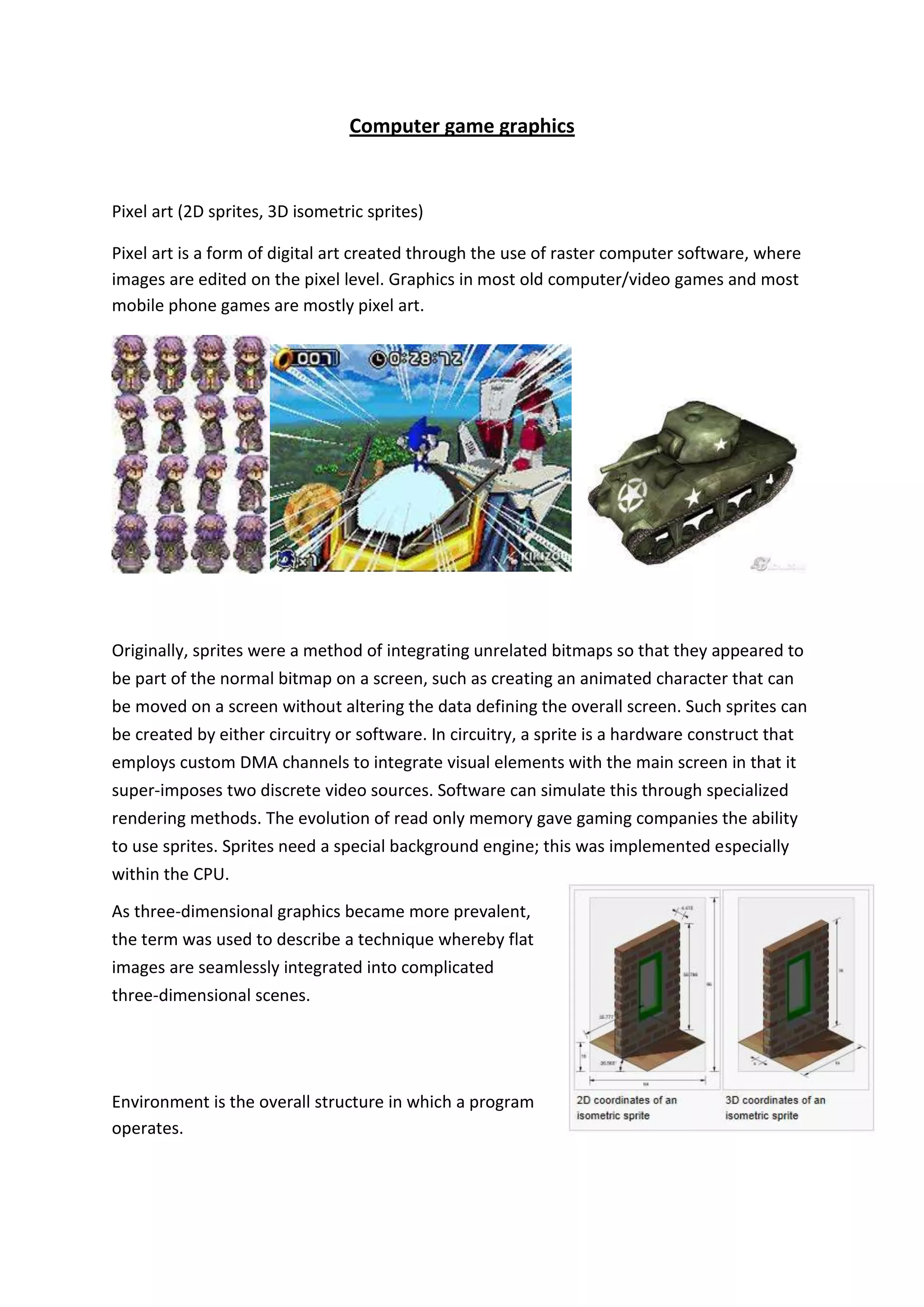
Pixel art (2D sprites, 3D isometric sprites)

Pixel art is a form of digital art created through the use of raster computer software, where
images are edited on the pixel level. Graphics in most old computer/video games and most
mobile phone games are mostly pixel art.


Originally, sprites were a method of integrating unrelated bitmaps so that they appeared to
be part of the normal bitmap on a screen, such as creating an animated character that can
be moved on a screen without altering the data defining the overall screen. Such sprites can
be created by either circuitry or software. In circuitry, a sprite is a hardware construct that
employs custom DMA channels to integrate visual elements with the main screen in that it
super-imposes two discrete video sources. Software can simulate this through specialized
rendering methods. The evolution of read only memory gave gaming companies the ability
to use sprites. Sprites need a special background engine; this was implemented especially
within the CPU.

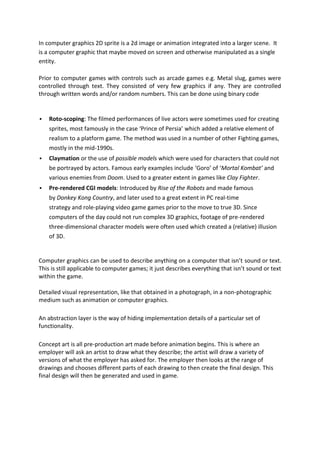
As three-dimensional graphics became more prevalent,
the term was used to describe a technique whereby flat
images are seamlessly integrated into complicated
three-dimensional scenes.


Environment is the overall structure in which a program
operates.
In computer graphics 2D sprite is a 2d image or animation integrated into a larger scene. It
is a computer graphic that maybe moved on screen and otherwise manipulated as a single
entity.

Prior to computer games with controls such as arcade games e.g. Metal slug, games were
controlled through text. They consisted of very few graphics if any. They are controlled
through written words and/or random numbers. This can be done using binary code


   Roto-scoping: The filmed performances of live actors were sometimes used for creating
    sprites, most famously in the case ‘Prince of Persia’ which added a relative element of
    realism to a platform game. The method was used in a number of other Fighting games,
    mostly in the mid-1990s.
   Claymation or the use of possible models which were used for characters that could not
    be portrayed by actors. Famous early examples include ‘Goro’ of ‘Mortal Kombat’ and
    various enemies from Doom. Used to a greater extent in games like Clay Fighter.
   Pre-rendered CGI models: Introduced by Rise of the Robots and made famous
    by Donkey Kong Country, and later used to a great extent in PC real-time
    strategy and role-playing video game games prior to the move to true 3D. Since
    computers of the day could not run complex 3D graphics, footage of pre-rendered
    three-dimensional character models were often used which created a (relative) illusion
    of 3D.


Computer graphics can be used to describe anything on a computer that isn’t sound or text.
This is still applicable to computer games; it just describes everything that isn’t sound or text
within the game.

Detailed visual representation, like that obtained in a photograph, in a non-photographic
medium such as animation or computer graphics.

An abstraction layer is the way of hiding implementation details of a particular set of
functionality.

Concept art is all pre-production art made before animation begins. This is where an
employer will ask an artist to draw what they describe; the artist will draw a variety of
versions of what the employer has asked for. The employer then looks at the range of
drawings and chooses different parts of each drawing to then create the final design. This
final design will then be generated and used in game.
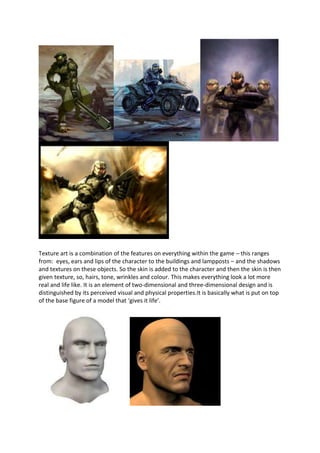
Texture art is a combination of the features on everything within the game – this ranges
from: eyes, ears and lips of the character to the buildings and lampposts – and the shadows
and textures on these objects. So the skin is added to the character and then the skin is then
given texture, so, hairs, tone, wrinkles and colour. This makes everything look a lot more
real and life like. It is an element of two-dimensional and three-dimensional design and is
distinguished by its perceived visual and physical properties.It is basically what is put on top
of the base figure of a model that ‘gives it life’.
Background graphics is the area of a display screen not covered by characters and graphics.
The background is like a canvas on top of which characters and graphics are placed. Some
monitors allow you to control the colour or shading of the background.

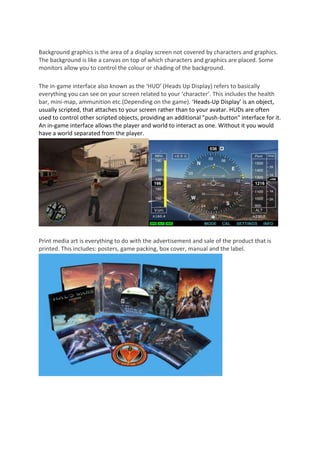
The in-game interface also known as the ‘HUD’ (Heads Up Display) refers to basically
everything you can see on your screen related to your ‘character’. This includes the health
bar, mini-map, ammunition etc.(Depending on the game). ‘Heads-Up Display’ is an object,
usually scripted, that attaches to your screen rather than to your avatar. HUDs are often
used to control other scripted objects, providing an additional "push-button" interface for it.
An in-game interface allows the player and world to interact as one. Without it you would
have a world separated from the player.


Print media art is everything to do with the advertisement and sale of the product that is
printed. This includes: posters, game packing, box cover, manual and the label.
The print media art can be used as an incentive to pay more for the product. As you can see
in the picture you get more than just the game for the right price. It can include such things
as a more sophisticated case - with this copy of ‘halo wars legendary edition’ you get a
metal case with different images on, along with a place mat, exclusive art work of the main
character’s as well as concept art which can also be a type of print media art - . Other print
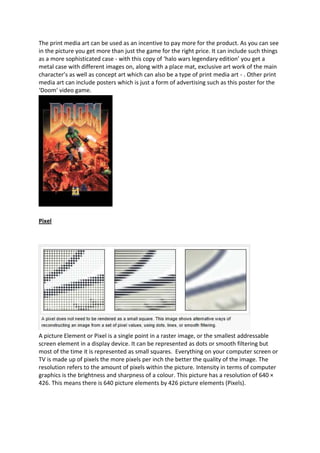
media art can include posters which is just a form of advertising such as this poster for the
‘Doom’ video game.


Pixel


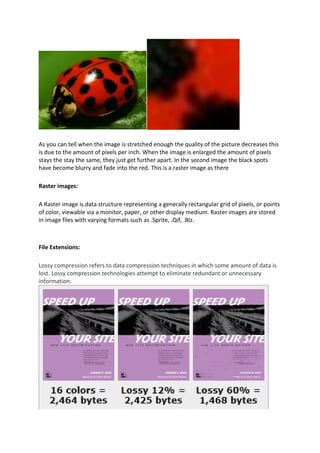
A picture Element or Pixel is a single point in a raster image, or the smallest addressable
screen element in a display device. It can be represented as dots or smooth filtering but
most of the time it is represented as small squares. Everything on your computer screen or
TV is made up of pixels the more pixels per inch the better the quality of the image. The
resolution refers to the amount of pixels within the picture. Intensity in terms of computer
graphics is the brightness and sharpness of a colour. This picture has a resolution of 640 ×
426. This means there is 640 picture elements by 426 picture elements (Pixels).
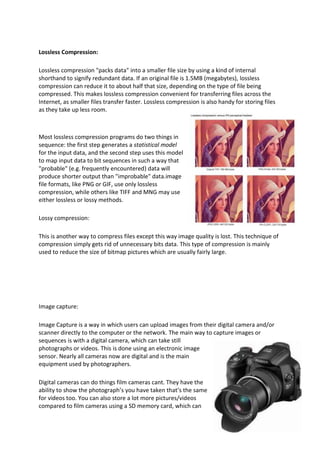
As you can tell when the image is stretched enough the quality of the picture decreases this
is due to the amount of pixels per inch. When the image is enlarged the amount of pixels
stays the stay the same, they just get further apart. In the second image the black spots
have become blurry and fade into the red. This is a raster image as there

Raster images:

A Raster image is data structure representing a generally rectangular grid of pixels, or points
of color, viewable via a monitor, paper, or other display medium. Raster images are stored
in image files with varying formats such as .Sprite, .Qif, .Blz.


File Extensions:

Lossy compression refers to data compression techniques in which some amount of data is
lost. Lossy compression technologies attempt to eliminate redundant or unnecessary
information.
Lossless Compression:

Lossless compression "packs data" into a smaller file size by using a kind of internal
shorthand to signify redundant data. If an original file is 1.5MB (megabytes), lossless
compression can reduce it to about half that size, depending on the type of file being
compressed. This makes lossless compression convenient for transferring files across the
Internet, as smaller files transfer faster. Lossless compression is also handy for storing files
as they take up less room.


Most lossless compression programs do two things in
sequence: the first step generates a statistical model
for the input data, and the second step uses this model
to map input data to bit sequences in such a way that
"probable" (e.g. frequently encountered) data will
produce shorter output than "improbable" data.image
file formats, like PNG or GIF, use only lossless
compression, while others like TIFF and MNG may use
either lossless or lossy methods.

Lossy compression:

This is another way to compress files except this way image quality is lost. This technique of
compression simply gets rid of unnecessary bits data. This type of compression is mainly
used to reduce the size of bitmap pictures which are usually fairly large.


Image capture:

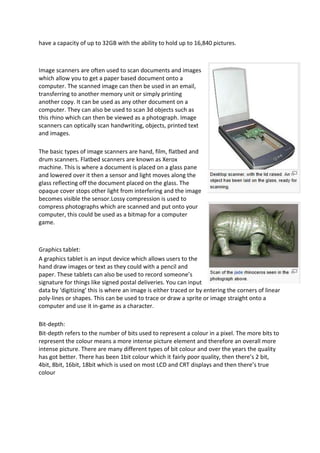
Image Capture is a way in which users can upload images from their digital camera and/or
scanner directly to the computer or the network. The main way to capture images or
sequences is with a digital camera, which can take still
photographs or videos. This is done using an electronic image
sensor. Nearly all cameras now are digital and is the main
equipment used by photographers.

Digital cameras can do things film cameras cant. They have the
ability to show the photograph’s you have taken that’s the same
for videos too. You can also store a lot more pictures/videos
compared to film cameras using a SD memory card, which can
have a capacity of up to 32GB with the ability to hold up to 16,840 pictures.


Image scanners are often used to scan documents and images
which allow you to get a paper based document onto a
computer. The scanned image can then be used in an email,
transferring to another memory unit or simply printing
another copy. It can be used as any other document on a
computer. They can also be used to scan 3d objects such as
this rhino which can then be viewed as a photograph. Image
scanners can optically scan handwriting, objects, printed text
and images.

The basic types of image scanners are hand, film, flatbed and
drum scanners. Flatbed scanners are known as Xerox
machine. This is where a document is placed on a glass pane
and lowered over it then a sensor and light moves along the
glass reflecting off the document placed on the glass. The
opaque cover stops other light from interfering and the image
becomes visible the sensor.Lossy compression is used to
compress photographs which are scanned and put onto your
computer, this could be used as a bitmap for a computer
game.


Graphics tablet:
A graphics tablet is an input device which allows users to the
hand draw images or text as they could with a pencil and
paper. These tablets can also be used to record someone’s
signature for things like signed postal deliveries. You can input
data by ‘digitizing’ this is where an image is either traced or by entering the corners of linear
poly-lines or shapes. This can be used to trace or draw a sprite or image straight onto a
computer and use it in-game as a character.

Bit-depth:
Bit-depth refers to the number of bits used to represent a colour in a pixel. The more bits to
represent the colour means a more intense picture element and therefore an overall more
intense picture. There are many different types of bit colour and over the years the quality
has got better. There has been 1bit colour which it fairly poor quality, then there’s 2 bit,
4bit, 8bit, 16bit, 18bit which is used on most LCD and CRT displays and then there’s true
colour
Bibliography
Abstraction layer. (2011, 09 06). Retrieved from wikipedia:
       http://en.wikipedia.org/wiki/Abstraction_layer

Concept art. (2011, 09 07). Retrieved from wikipedia: en.wikipedia.org/wiki/Concept_art

enviroment. (2011, 09 06). Retrieved from google dictionary:
       http://www.google.co.uk/#hl=en&safe=off&q=environment&tbs=dfn:1&tbo=u&sa=
       X&ei=0mhmTs_pN8Wp8APYuNGrCg&ved=0CBsQkQ4&bav=on.2,or.r_gc.r_pw.&fp=3
       d8c1ef1a7c12238&biw=1333&bih=645

Lossys compresion. (2011, 09 20). Retrieved from webopedia:
        http://www.webopedia.com/TERM/L/lossy_compression.html

Photorealism. (2011, 09 06). Retrieved from wikipedia: en.wikipedia.org/wiki/Photorealism

Pixel. (2011, 09 13). Retrieved from wikipedia: http://en.wikipedia.org/wiki/Pixel

Pixel art. (2011, 09 06). Retrieved from en.wikipedia.org/wiki/Pixel_art:
        http://en.wikipedia.org/wiki/Pixel

Sprite (computer graphics). (2011, 09 06). Retrieved from wikipedia:
        http://en.wikipedia.org/wiki/Sprite_(computer_graphics)

Sprites. (2011, 09 06). Retrieved from wikepedia:
        en.wikipedia.org/wiki/Sprite_(computer_graphics)

Texture . (2011, 09 07). Retrieved from wikipedia:
       http://en.wikipedia.org/wiki/Texture_(visual_arts)#Visual
wikipedia. (2011, 09 20). Retrieved from lossless compression:
       http://en.wikipedia.org/wiki/Lossless_data_compression

Computer game graphics

  • 1.
    Computer game graphics Pixelart (2D sprites, 3D isometric sprites) Pixel art is a form of digital art created through the use of raster computer software, where images are edited on the pixel level. Graphics in most old computer/video games and most mobile phone games are mostly pixel art. Originally, sprites were a method of integrating unrelated bitmaps so that they appeared to be part of the normal bitmap on a screen, such as creating an animated character that can be moved on a screen without altering the data defining the overall screen. Such sprites can be created by either circuitry or software. In circuitry, a sprite is a hardware construct that employs custom DMA channels to integrate visual elements with the main screen in that it super-imposes two discrete video sources. Software can simulate this through specialized rendering methods. The evolution of read only memory gave gaming companies the ability to use sprites. Sprites need a special background engine; this was implemented especially within the CPU. As three-dimensional graphics became more prevalent, the term was used to describe a technique whereby flat images are seamlessly integrated into complicated three-dimensional scenes. Environment is the overall structure in which a program operates.
  • 2.
    In computer graphics2D sprite is a 2d image or animation integrated into a larger scene. It is a computer graphic that maybe moved on screen and otherwise manipulated as a single entity. Prior to computer games with controls such as arcade games e.g. Metal slug, games were controlled through text. They consisted of very few graphics if any. They are controlled through written words and/or random numbers. This can be done using binary code  Roto-scoping: The filmed performances of live actors were sometimes used for creating sprites, most famously in the case ‘Prince of Persia’ which added a relative element of realism to a platform game. The method was used in a number of other Fighting games, mostly in the mid-1990s.  Claymation or the use of possible models which were used for characters that could not be portrayed by actors. Famous early examples include ‘Goro’ of ‘Mortal Kombat’ and various enemies from Doom. Used to a greater extent in games like Clay Fighter.  Pre-rendered CGI models: Introduced by Rise of the Robots and made famous by Donkey Kong Country, and later used to a great extent in PC real-time strategy and role-playing video game games prior to the move to true 3D. Since computers of the day could not run complex 3D graphics, footage of pre-rendered three-dimensional character models were often used which created a (relative) illusion of 3D. Computer graphics can be used to describe anything on a computer that isn’t sound or text. This is still applicable to computer games; it just describes everything that isn’t sound or text within the game. Detailed visual representation, like that obtained in a photograph, in a non-photographic medium such as animation or computer graphics. An abstraction layer is the way of hiding implementation details of a particular set of functionality. Concept art is all pre-production art made before animation begins. This is where an employer will ask an artist to draw what they describe; the artist will draw a variety of versions of what the employer has asked for. The employer then looks at the range of drawings and chooses different parts of each drawing to then create the final design. This final design will then be generated and used in game.
  • 3.
    Texture art isa combination of the features on everything within the game – this ranges from: eyes, ears and lips of the character to the buildings and lampposts – and the shadows and textures on these objects. So the skin is added to the character and then the skin is then given texture, so, hairs, tone, wrinkles and colour. This makes everything look a lot more real and life like. It is an element of two-dimensional and three-dimensional design and is distinguished by its perceived visual and physical properties.It is basically what is put on top of the base figure of a model that ‘gives it life’.
  • 4.
    Background graphics isthe area of a display screen not covered by characters and graphics. The background is like a canvas on top of which characters and graphics are placed. Some monitors allow you to control the colour or shading of the background. The in-game interface also known as the ‘HUD’ (Heads Up Display) refers to basically everything you can see on your screen related to your ‘character’. This includes the health bar, mini-map, ammunition etc.(Depending on the game). ‘Heads-Up Display’ is an object, usually scripted, that attaches to your screen rather than to your avatar. HUDs are often used to control other scripted objects, providing an additional "push-button" interface for it. An in-game interface allows the player and world to interact as one. Without it you would have a world separated from the player. Print media art is everything to do with the advertisement and sale of the product that is printed. This includes: posters, game packing, box cover, manual and the label.
  • 5.
    The print mediaart can be used as an incentive to pay more for the product. As you can see in the picture you get more than just the game for the right price. It can include such things as a more sophisticated case - with this copy of ‘halo wars legendary edition’ you get a metal case with different images on, along with a place mat, exclusive art work of the main character’s as well as concept art which can also be a type of print media art - . Other print media art can include posters which is just a form of advertising such as this poster for the ‘Doom’ video game. Pixel A picture Element or Pixel is a single point in a raster image, or the smallest addressable screen element in a display device. It can be represented as dots or smooth filtering but most of the time it is represented as small squares. Everything on your computer screen or TV is made up of pixels the more pixels per inch the better the quality of the image. The resolution refers to the amount of pixels within the picture. Intensity in terms of computer graphics is the brightness and sharpness of a colour. This picture has a resolution of 640 × 426. This means there is 640 picture elements by 426 picture elements (Pixels).
  • 6.
    As you cantell when the image is stretched enough the quality of the picture decreases this is due to the amount of pixels per inch. When the image is enlarged the amount of pixels stays the stay the same, they just get further apart. In the second image the black spots have become blurry and fade into the red. This is a raster image as there Raster images: A Raster image is data structure representing a generally rectangular grid of pixels, or points of color, viewable via a monitor, paper, or other display medium. Raster images are stored in image files with varying formats such as .Sprite, .Qif, .Blz. File Extensions: Lossy compression refers to data compression techniques in which some amount of data is lost. Lossy compression technologies attempt to eliminate redundant or unnecessary information.
  • 7.
    Lossless Compression: Lossless compression"packs data" into a smaller file size by using a kind of internal shorthand to signify redundant data. If an original file is 1.5MB (megabytes), lossless compression can reduce it to about half that size, depending on the type of file being compressed. This makes lossless compression convenient for transferring files across the Internet, as smaller files transfer faster. Lossless compression is also handy for storing files as they take up less room. Most lossless compression programs do two things in sequence: the first step generates a statistical model for the input data, and the second step uses this model to map input data to bit sequences in such a way that "probable" (e.g. frequently encountered) data will produce shorter output than "improbable" data.image file formats, like PNG or GIF, use only lossless compression, while others like TIFF and MNG may use either lossless or lossy methods. Lossy compression: This is another way to compress files except this way image quality is lost. This technique of compression simply gets rid of unnecessary bits data. This type of compression is mainly used to reduce the size of bitmap pictures which are usually fairly large. Image capture: Image Capture is a way in which users can upload images from their digital camera and/or scanner directly to the computer or the network. The main way to capture images or sequences is with a digital camera, which can take still photographs or videos. This is done using an electronic image sensor. Nearly all cameras now are digital and is the main equipment used by photographers. Digital cameras can do things film cameras cant. They have the ability to show the photograph’s you have taken that’s the same for videos too. You can also store a lot more pictures/videos compared to film cameras using a SD memory card, which can
  • 8.
    have a capacityof up to 32GB with the ability to hold up to 16,840 pictures. Image scanners are often used to scan documents and images which allow you to get a paper based document onto a computer. The scanned image can then be used in an email, transferring to another memory unit or simply printing another copy. It can be used as any other document on a computer. They can also be used to scan 3d objects such as this rhino which can then be viewed as a photograph. Image scanners can optically scan handwriting, objects, printed text and images. The basic types of image scanners are hand, film, flatbed and drum scanners. Flatbed scanners are known as Xerox machine. This is where a document is placed on a glass pane and lowered over it then a sensor and light moves along the glass reflecting off the document placed on the glass. The opaque cover stops other light from interfering and the image becomes visible the sensor.Lossy compression is used to compress photographs which are scanned and put onto your computer, this could be used as a bitmap for a computer game. Graphics tablet: A graphics tablet is an input device which allows users to the hand draw images or text as they could with a pencil and paper. These tablets can also be used to record someone’s signature for things like signed postal deliveries. You can input data by ‘digitizing’ this is where an image is either traced or by entering the corners of linear poly-lines or shapes. This can be used to trace or draw a sprite or image straight onto a computer and use it in-game as a character. Bit-depth: Bit-depth refers to the number of bits used to represent a colour in a pixel. The more bits to represent the colour means a more intense picture element and therefore an overall more intense picture. There are many different types of bit colour and over the years the quality has got better. There has been 1bit colour which it fairly poor quality, then there’s 2 bit, 4bit, 8bit, 16bit, 18bit which is used on most LCD and CRT displays and then there’s true colour
  • 9.
    Bibliography Abstraction layer. (2011,09 06). Retrieved from wikipedia: http://en.wikipedia.org/wiki/Abstraction_layer Concept art. (2011, 09 07). Retrieved from wikipedia: en.wikipedia.org/wiki/Concept_art enviroment. (2011, 09 06). Retrieved from google dictionary: http://www.google.co.uk/#hl=en&safe=off&q=environment&tbs=dfn:1&tbo=u&sa= X&ei=0mhmTs_pN8Wp8APYuNGrCg&ved=0CBsQkQ4&bav=on.2,or.r_gc.r_pw.&fp=3 d8c1ef1a7c12238&biw=1333&bih=645 Lossys compresion. (2011, 09 20). Retrieved from webopedia: http://www.webopedia.com/TERM/L/lossy_compression.html Photorealism. (2011, 09 06). Retrieved from wikipedia: en.wikipedia.org/wiki/Photorealism Pixel. (2011, 09 13). Retrieved from wikipedia: http://en.wikipedia.org/wiki/Pixel Pixel art. (2011, 09 06). Retrieved from en.wikipedia.org/wiki/Pixel_art: http://en.wikipedia.org/wiki/Pixel Sprite (computer graphics). (2011, 09 06). Retrieved from wikipedia: http://en.wikipedia.org/wiki/Sprite_(computer_graphics) Sprites. (2011, 09 06). Retrieved from wikepedia: en.wikipedia.org/wiki/Sprite_(computer_graphics) Texture . (2011, 09 07). Retrieved from wikipedia: http://en.wikipedia.org/wiki/Texture_(visual_arts)#Visual
  • 10.
    wikipedia. (2011, 0920). Retrieved from lossless compression: http://en.wikipedia.org/wiki/Lossless_data_compression