Be A Game Changer The Pessimist complains about the Wind The Optimist waits for it to Change But the Realist adjust the Sails “ To exist is to change, to change is to mature, to mature is to go on creating oneself endlessly.” H. Bergson
Carrier Hamilton Sundstrand Otis Sikorsky UTC Fire & Security Pratt & Whitney V. Subramaniam Director – IT & CIO (India & Gulf Area) Otis Elevator Company (India) Limited (A United Technologies Company) A Great Company is like a Work of Art No one single item makes the whole thing work It’s the entire work, all the Process & Systems Together &  People Working together as a  Synergetic TEAM Create an overall effect. That leads to overall Greatness
Visit Us At  www.utc.com  and  www.otis.com
Email & IM Peripherals (MFD…) IT Security Servers & Data Storage Network  (LAN & WAN) Suppliers/ partners connect Data centers & Computer  Room PC’s (Desktops & Laptops) Handheld devices Remote access Customers Partners Employees System Architecture for for
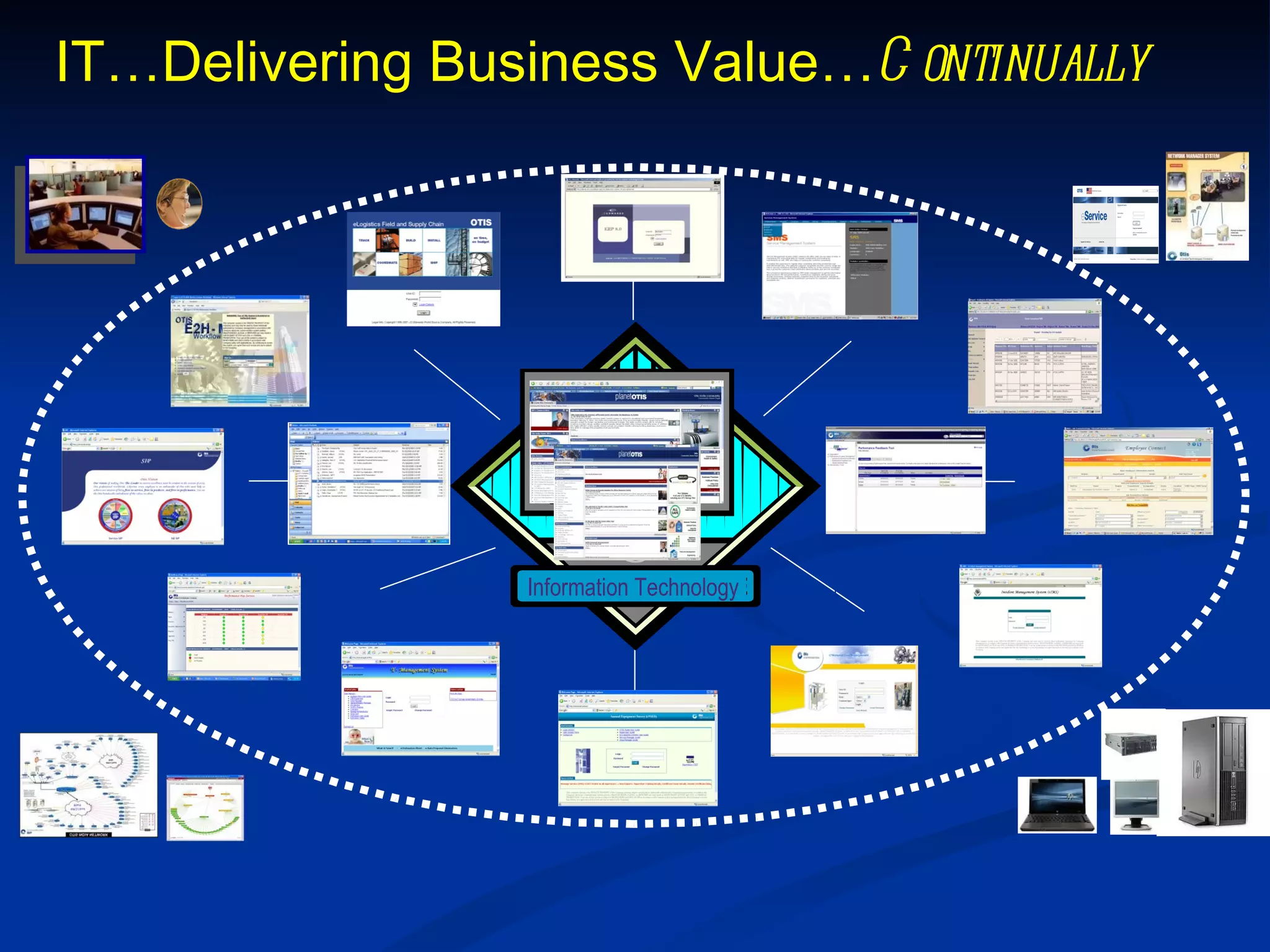
IT…Delivering Business Value… Continually Information Technology
Leadership & Project Management LEAD inspire win
The Agile Enterprise Customer Service Supply Chain  ERP Human Resources Financial Services Customers Partners Employees
 
Project Management Principles Technology People Process Discipline Of Execution Quality Speed Agility Change Management Enhance Productivity Collaboration Communication Co-ordination Co-Operation Responsibility Accountability Morale Simplification Standardization Governance Costs Quality Schedule Integrated Consolidated Controlled Centralized PM Tools Reliability Integrity Urgency
The Project Management Life Cycle A Complete Step-by-Step Methodology for  Initiating, Planning, Executing and Closing a Project Successfully Future State Current State Transformation
What is a project? A project is: A unique undertaking to produce a set of deliverables  within clearly specified time, cost and quality constraints. Projects  differ from o perational  activities as they: - are  unique ; - have a defined  timescale ; - have an approved  budget ; - involve limited  resources ; - have an element of  risk ; - achieve beneficial  change . Project Life Cycle Overview
What is project management? Project management is: The skills, tools and management processes required  to undertake a project successfully. Project management comprises: - A set of  skills , specialist knowledge and experience. - A set of  tools  used to improve the chances of success. - A set of  processes  for monitoring and controlling a project.
What is the project life cycle? The project life cycle is: The phases, activities and tasks required to successfully  deliver a project. There are four phases within the project life cycle: 1) Project initiation 2) Project planning 3) Project execution 4) Project closure
Phase 1: Project initiation The initiation phase essentially involves the start-up of the project. To initiate a project, you need to: - Develop a  business case  to justify the new project. - Undertake a  feasibility study  to measure the solution feasibility. - Establish the  terms of reference  by defining the project boundaries. - Appoint a  project team  with the right skills and experience. - Set up a  project office  with the required facilities and tools. - Perform a  stage-gate review  to request approval to proceed.
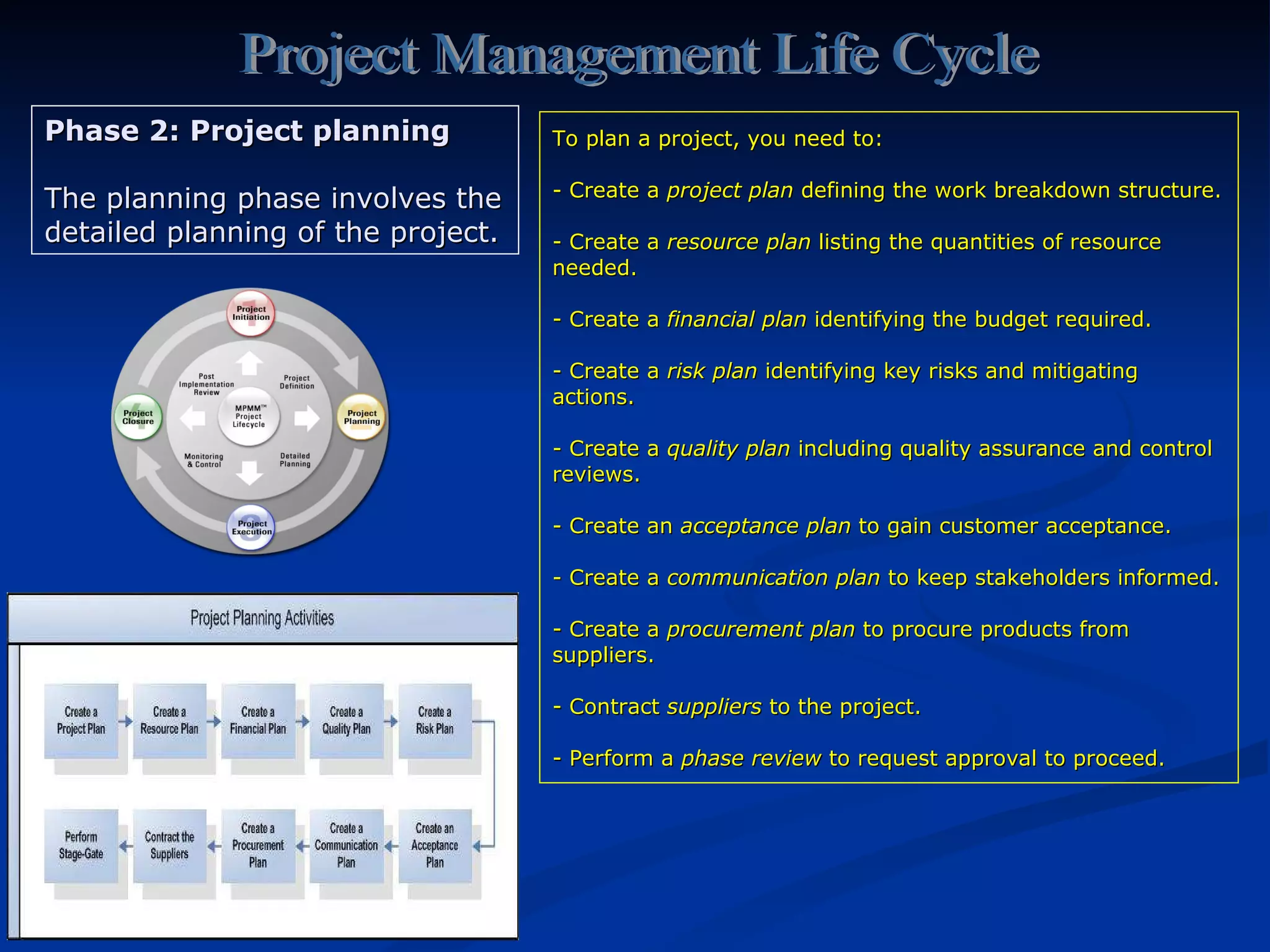
To plan a project, you need to: - Create a  project plan  defining the work breakdown structure. - Create a  resource plan  listing the quantities of resource needed. - Create a  financial plan  identifying the budget required. - Create a  risk plan  identifying key risks and mitigating actions. - Create a  quality plan  including quality assurance and control reviews.  - Create an  acceptance plan  to gain customer acceptance. - Create a  communication plan  to keep stakeholders informed. - Create a  procurement plan  to procure products from suppliers.  - Contract  suppliers  to the project. - Perform a  phase review  to request approval to proceed. Phase 2: Project planning The planning phase involves the detailed planning of the project.
Phase 3: Project execution The execution phase involves the construction of the project deliverables and the monitoring and control of the project delivery. To execute a project, you need to: - Build the project deliverables. - Monitor and control the project by performing: - time management; - cost management; - quality management; - change management; - risk management; - issue management; - procurement management; - acceptance management; - communications management.
Phase 4: Project closure The closure phase involves the closure and review of the success of the project. To close a project, you need to: - Perform  project closure  by creating a  project closure report ; - Review  project completion  by undertaking a  post implementation review.
Project Execution Future State Current State Transformation
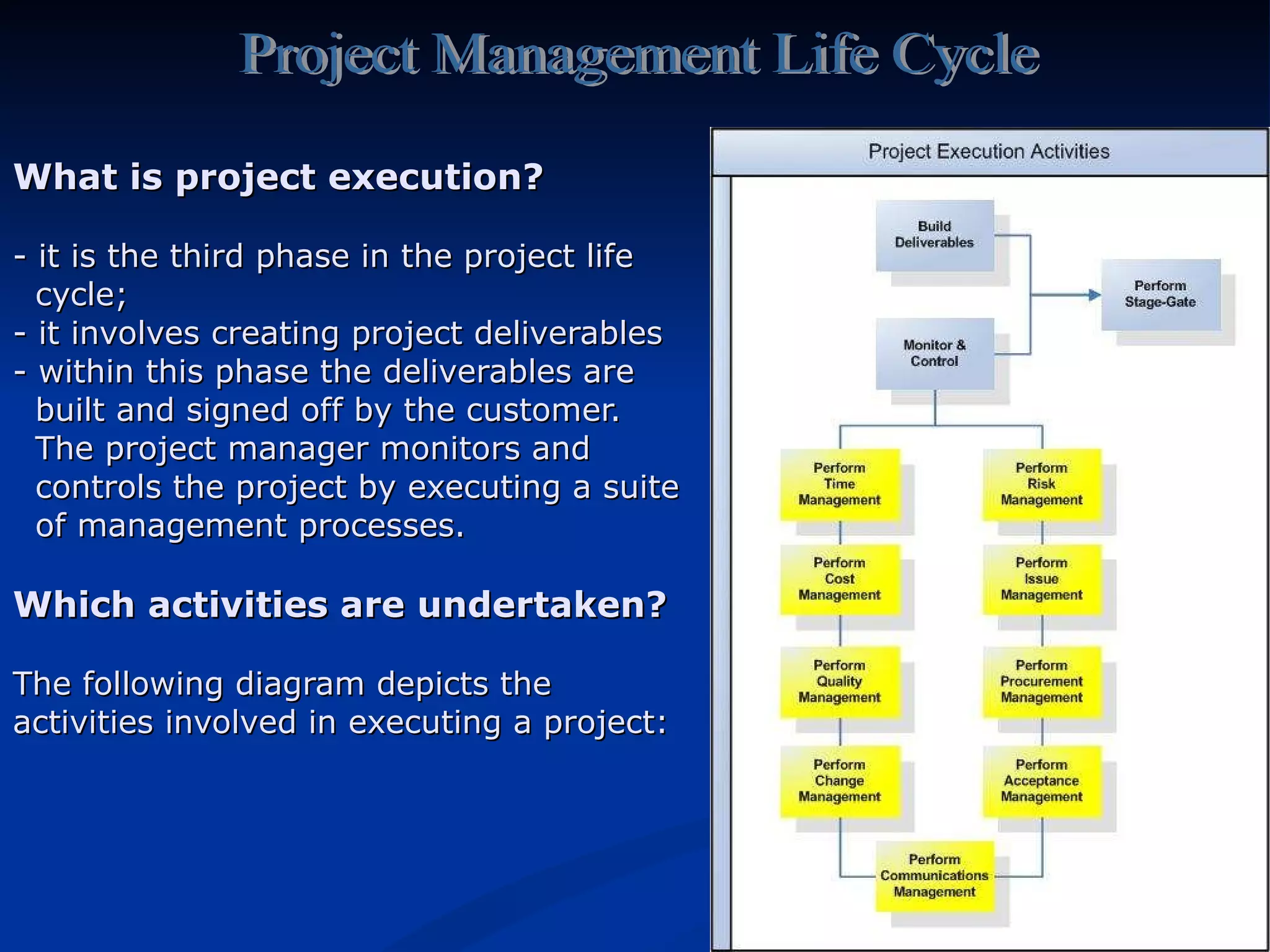
What is project execution? - it is the third phase in the project life   cycle; - it involves creating project deliverables - within this phase the deliverables are    built and signed off by the customer.   The project manager monitors and    controls the project by executing a suite    of management processes.  Which activities are undertaken? The following diagram depicts the activities involved in executing a project:
Step 1: Build deliverables A deliverable is: A quantifiable outcome of a project which results in the partial or full achievement of the project  objectives. To build project deliverables, you need to: - delegate the building of deliverables to project staff; - physically construct each project deliverable; - measure the deliverables against the quality targets set; - request acceptance of deliverables by the customer.
Step 2: Monitor and control During the execution of the project, you need to monitor and control the project delivery by performing: - time management; - cost management; - quality management; - change management; - risk management; - issue management; - procurement management; - acceptance management; - communications management.
Perform time management Time management is: The process of recording and  quantifying time spent completing  tasks on a project. Time management involves: - completing and approving timesheets; - recording time spent, within a timesheet    register and project plan; - identifying and resolving exceptions.
Perform cost management Cost management is: The process by which costs (ie  expenses) incurred on a project are  identified, approved and paid. Cost management involves: - completing and approving expense forms; - recording expenditure, within an    expense register and project plan; - resolving expense issues.
Perform quality management Quality management is: The process by which the  quality of the deliverables  and management processes  is assured and controlled. Quality management involves: - setting quality targets; - measuring deliverable quality; - performing quality assurance; - performing quality control; - resolving quality issues. TURN BACKS ESCAPES
Quality…A Way Of Work Life ACE Tools Process Management Quality Clinic Process Chart Relentless Root Cause Analysis Mistake Proofing Market Feedback Analysis Standard Work Total Productive Maintenance New 5S Value Stream mapping Passport System Process Certification
Perform change management Change management is: The process by which changes to  the project scope, deliverables,  timescales or resources are approved  and managed. Change management involves: - completing change requests; - assessing change feasibility; - approving change requests; - scheduling change requests; - implementing change requests.  “ When the rate of change outside exceeds the rate of change inside, the end is in sight”....Jack Welch Envision Evaluate Empower Execute Excel
Ingredients of Change Frustration Gradual Change Anxiety False Start Confusion Vision Motivation Skills Resources Action Plan Change Vision Motivation Skills Resources Action Plan Vision Motivation Skills Resources Action Plan Vision Motivation Skills Resources Action Plan Vision Motivation Skills Resources Action Plan Vision Motivation Skills Resources Action Plan
If You Do Not Change, You Can Become Extinct The Quicker You Let Go Of Old Cheese, The Sooner you Find New Cheese. Old Beliefs Do Not Lead You To New Cheese. When You See That You Can Find And Enjoy New Cheese, You Change Course. Noticing Small Changes Early Helps You Adapt To The Bigger Changes That Are To Come. Change Happens Anticipate Change Monitor Change Adapt To Change Quickly Change Enjoy Change ! Be Ready To Change Quickly & Enjoy It Again. Movement In A New Direction Helps You Find New Cheese. When You Move Beyond Your Fear, You Feel Free. Imagining Myself Enjoying New Cheese, Even Before I Find It, Leads Me To It. Who Moved My Cheese?
Perform risk management Risk management is: The process of identifying, quantifying  and mitigating risks throughout a  project. Risk management involves: - identifying project risks; - completing risk forms; - reviewing and assessing risks; - implementing risk mitigation actions; - constantly reviewing the risk status.
Perform issue management Issue management is: The process by which issues are  formally identified, reviewed and  resolved. Issue management involves: - identifying project issues; - completing issue forms; - reviewing and assessing issues; - implementing issue resolution actions; - constantly reviewing the issue status
Perform procurement management Procurement management is: The process of  procuring products from external suppliers. Procurement management involves: - issuing purchase orders; - fulfilling purchase orders; - managing supplier contracts.
Perform acceptance management Acceptance management is: The process by which project  deliverables are reviewed and  accepted by the customer. Acceptance management involves: - identifying the completion of deliverables; - requesting customer acceptance tests; - completing acceptance tests; - accepting final deliverables.
Perform communications management Communications management is: The process of keeping stakeholders  informed of the progress of the project. Communications management involves: - identifying communication required; - creating communications messages; - dispatching communications messages; - reviewing communication effectiveness.
Step 3: Perform a stage gate  A stage gate is: A checkpoint at the end of the project phase to ensure  that the project has achieved its stated objectives and  deliverables. To perform a stage gate, you need to: - identify the stage-gate review criteria; - undertake the stage-gate review; - complete the stage-gate review form; - seek approval to proceed.
Project Team Plan Review Execute Project Organization (Team) Project Office / Space Strengths and Limitations Project Risks and Mitigation Milestones and Tasks Time Lines PROJECT Method of Execution Turn Around Strategy Quick Wins Point Of Failures Point Of Success Change Management Governance Model Change Control Dash Boards / Metrics Project Check / Passport Communication Celebrate Success
Project Team On Site Team Virtual Team Management Team – Roles & Responsibilities Skills and Competencies Contingency / Back Fill Adaptability Stress Management Technology Can Be Put In Place, People Make IT Happen Sponsor Role Involvement & Decision Committed Communication / Update Project Incentive Review Team – Roles & Resp. Skills and Competencies Culture Time Zones Review Mechanism Responsibility, Authority and Accountability Delegation Transparency Manage The Organization Manage Your Team Manage Your Resources
Plan For Execution Project Plan What Who How Why When GO / NO GO
PROJECT SUCCESS FAILURE HOLD Critical Success Factors Key Learning’s Doings things differently Valid Reasons for Hold Revive of Project Turn Around Critical Failure Factors Key Learning’s Revive and Turn Around
5C’s For Project Excellence EFFECTIVENESS Communication Collaboration Co - Operation Co - Creation Co Ordination
Project Team Partners Project success Management Team Strategic Execution - Support Role Execution Support Role Strategic Facilitator Role Successful  Implementation People processes Implementation Methodology Technology
ERP EVALUATE BEYOND EXECUTE Vendor -> Partner Package Team Business Case Approvals Project Organization Team &Organization Readiness Requirement Phase (As Is) To Be Processes - BRD Infrastructure Readiness Interface Readiness Enhancements / Developments Data Migration Security (R&R) Walk Through & Training Testing – UAT / IUAT Documentation Contingency Plan Support Model Go Live Readiness Post Go Live - Usage Leverage & Effective Usage Information to Insights Upgrades Enhancements
L isten E mpathize A pologize R esolve N otify Customer…Compliant & Management Call Back / Turn Back / Escapes RRCA – Relentless Root Cause Analysis Mistake Proof Solution Feedback &  Continual Improvements
Confidentiality Ensure protection of user information and transmission of Data Integrity Ensure accuracy  Transparency Controls & Compliance A Secured System leads to Secured Enterprise
Leadership Lead & Be Loyal to the role Energetic & Enthusiasm  Adaptability & Agile Dynamic, Discipline & Dedication & Determination Excellence (Will to WIN & Can Do) & Execution (Focus) Remarkable & Result Oriented (Customer Centric) Shape the Future & Significance to the role Humble, Holistic and Happening (Make Things Happen) Integrity, Inspire and Invest in Self+People Performance & People Oriented
Lead the  Business Leadership is by Choice, not by options Stephen R Covey Mission Goals Strategic  Objectives Execution Results Lead the people Grow Yourself
TEAM WORK Attitude…Skills…Knowledge T otal Commitment (Committed) E xcellence A daptability M otivated W ill to Win O rganized / Systematic R esult Oriented K nowledge Clear Expectations Context Commitment Competence Charter Control Collaboration Commitment Creative Innovation Consequence Co-Ordination Cultural Change 12 Cs of  Team Work
BEHAVIOUR! B - Beliefs E - Expectations H- Habits A - Attitudes V - Values I - Intentions O - Outlook U - Understanding R - Responses T ruth R esponsibility U nderstanding S haring T eamwork
Project Management Mantra DOMAIN EXPERTISE & BUSINESS ACUMEN LEADERSHIP MANAGEMENT PROJECT PLANNING ORGANIZED RESULT JOYFUL EXECUTION COLLABORATION TURN AROUND
“ WINNERS DON’T DO  DIFFERENT THINGS THEY DO THINGS DIFFERENTLY” “ WINNERS recognize their limitations But focus on their strengths Losers recognize their strengths But focus on their limitations … .Shiv Khera “ WINNing is inspiration to work harder A winner gives hope to ordinary people & inspire them to Move to extra…ordinary” The WINNING EDGE
A demanding customer is very similar to a coach. Not only does he demand the best and expect nothing else, but he also appreciates it when he gets the best.
When you are inspired by  some great purpose , some  extraordinary project ,  all  your thoughts break their bonds .  Your mind transcends limitations ,  your consciousness expands  in every direction, and  you find yourself in a new, great and wonderful world .  Dormant forces ,  faculties and talents become alive , and you discover  yourself to be a greater person by far than you ever dreamed yourself to be . Patanjali (1 st  – 3 rd  Century BC)
Subbu

Project life cycle_management by Subbu

  • 1.
    Be A GameChanger The Pessimist complains about the Wind The Optimist waits for it to Change But the Realist adjust the Sails “ To exist is to change, to change is to mature, to mature is to go on creating oneself endlessly.” H. Bergson
  • 2.
    Carrier Hamilton SundstrandOtis Sikorsky UTC Fire & Security Pratt & Whitney V. Subramaniam Director – IT & CIO (India & Gulf Area) Otis Elevator Company (India) Limited (A United Technologies Company) A Great Company is like a Work of Art No one single item makes the whole thing work It’s the entire work, all the Process & Systems Together & People Working together as a Synergetic TEAM Create an overall effect. That leads to overall Greatness
  • 3.
    Visit Us At www.utc.com and www.otis.com
  • 4.
    Email & IMPeripherals (MFD…) IT Security Servers & Data Storage Network (LAN & WAN) Suppliers/ partners connect Data centers & Computer Room PC’s (Desktops & Laptops) Handheld devices Remote access Customers Partners Employees System Architecture for for
  • 5.
    IT…Delivering Business Value…Continually Information Technology
  • 6.
    Leadership & ProjectManagement LEAD inspire win
  • 7.
    The Agile EnterpriseCustomer Service Supply Chain ERP Human Resources Financial Services Customers Partners Employees
  • 8.
  • 9.
    Project Management PrinciplesTechnology People Process Discipline Of Execution Quality Speed Agility Change Management Enhance Productivity Collaboration Communication Co-ordination Co-Operation Responsibility Accountability Morale Simplification Standardization Governance Costs Quality Schedule Integrated Consolidated Controlled Centralized PM Tools Reliability Integrity Urgency
  • 10.
    The Project ManagementLife Cycle A Complete Step-by-Step Methodology for Initiating, Planning, Executing and Closing a Project Successfully Future State Current State Transformation
  • 11.
    What is aproject? A project is: A unique undertaking to produce a set of deliverables within clearly specified time, cost and quality constraints. Projects differ from o perational activities as they: - are unique ; - have a defined timescale ; - have an approved budget ; - involve limited resources ; - have an element of risk ; - achieve beneficial change . Project Life Cycle Overview
  • 12.
    What is projectmanagement? Project management is: The skills, tools and management processes required to undertake a project successfully. Project management comprises: - A set of skills , specialist knowledge and experience. - A set of tools used to improve the chances of success. - A set of processes for monitoring and controlling a project.
  • 13.
    What is theproject life cycle? The project life cycle is: The phases, activities and tasks required to successfully deliver a project. There are four phases within the project life cycle: 1) Project initiation 2) Project planning 3) Project execution 4) Project closure
  • 14.
    Phase 1: Projectinitiation The initiation phase essentially involves the start-up of the project. To initiate a project, you need to: - Develop a business case to justify the new project. - Undertake a feasibility study to measure the solution feasibility. - Establish the terms of reference by defining the project boundaries. - Appoint a project team with the right skills and experience. - Set up a project office with the required facilities and tools. - Perform a stage-gate review to request approval to proceed.
  • 15.
    To plan aproject, you need to: - Create a project plan defining the work breakdown structure. - Create a resource plan listing the quantities of resource needed. - Create a financial plan identifying the budget required. - Create a risk plan identifying key risks and mitigating actions. - Create a quality plan including quality assurance and control reviews. - Create an acceptance plan to gain customer acceptance. - Create a communication plan to keep stakeholders informed. - Create a procurement plan to procure products from suppliers. - Contract suppliers to the project. - Perform a phase review to request approval to proceed. Phase 2: Project planning The planning phase involves the detailed planning of the project.
  • 16.
    Phase 3: Projectexecution The execution phase involves the construction of the project deliverables and the monitoring and control of the project delivery. To execute a project, you need to: - Build the project deliverables. - Monitor and control the project by performing: - time management; - cost management; - quality management; - change management; - risk management; - issue management; - procurement management; - acceptance management; - communications management.
  • 17.
    Phase 4: Projectclosure The closure phase involves the closure and review of the success of the project. To close a project, you need to: - Perform project closure by creating a project closure report ; - Review project completion by undertaking a post implementation review.
  • 18.
    Project Execution FutureState Current State Transformation
  • 19.
    What is projectexecution? - it is the third phase in the project life cycle; - it involves creating project deliverables - within this phase the deliverables are built and signed off by the customer. The project manager monitors and controls the project by executing a suite of management processes. Which activities are undertaken? The following diagram depicts the activities involved in executing a project:
  • 20.
    Step 1: Builddeliverables A deliverable is: A quantifiable outcome of a project which results in the partial or full achievement of the project objectives. To build project deliverables, you need to: - delegate the building of deliverables to project staff; - physically construct each project deliverable; - measure the deliverables against the quality targets set; - request acceptance of deliverables by the customer.
  • 21.
    Step 2: Monitorand control During the execution of the project, you need to monitor and control the project delivery by performing: - time management; - cost management; - quality management; - change management; - risk management; - issue management; - procurement management; - acceptance management; - communications management.
  • 22.
    Perform time managementTime management is: The process of recording and quantifying time spent completing tasks on a project. Time management involves: - completing and approving timesheets; - recording time spent, within a timesheet register and project plan; - identifying and resolving exceptions.
  • 23.
    Perform cost managementCost management is: The process by which costs (ie expenses) incurred on a project are identified, approved and paid. Cost management involves: - completing and approving expense forms; - recording expenditure, within an expense register and project plan; - resolving expense issues.
  • 24.
    Perform quality managementQuality management is: The process by which the quality of the deliverables and management processes is assured and controlled. Quality management involves: - setting quality targets; - measuring deliverable quality; - performing quality assurance; - performing quality control; - resolving quality issues. TURN BACKS ESCAPES
  • 25.
    Quality…A Way OfWork Life ACE Tools Process Management Quality Clinic Process Chart Relentless Root Cause Analysis Mistake Proofing Market Feedback Analysis Standard Work Total Productive Maintenance New 5S Value Stream mapping Passport System Process Certification
  • 26.
    Perform change managementChange management is: The process by which changes to the project scope, deliverables, timescales or resources are approved and managed. Change management involves: - completing change requests; - assessing change feasibility; - approving change requests; - scheduling change requests; - implementing change requests. “ When the rate of change outside exceeds the rate of change inside, the end is in sight”....Jack Welch Envision Evaluate Empower Execute Excel
  • 27.
    Ingredients of ChangeFrustration Gradual Change Anxiety False Start Confusion Vision Motivation Skills Resources Action Plan Change Vision Motivation Skills Resources Action Plan Vision Motivation Skills Resources Action Plan Vision Motivation Skills Resources Action Plan Vision Motivation Skills Resources Action Plan Vision Motivation Skills Resources Action Plan
  • 28.
    If You DoNot Change, You Can Become Extinct The Quicker You Let Go Of Old Cheese, The Sooner you Find New Cheese. Old Beliefs Do Not Lead You To New Cheese. When You See That You Can Find And Enjoy New Cheese, You Change Course. Noticing Small Changes Early Helps You Adapt To The Bigger Changes That Are To Come. Change Happens Anticipate Change Monitor Change Adapt To Change Quickly Change Enjoy Change ! Be Ready To Change Quickly & Enjoy It Again. Movement In A New Direction Helps You Find New Cheese. When You Move Beyond Your Fear, You Feel Free. Imagining Myself Enjoying New Cheese, Even Before I Find It, Leads Me To It. Who Moved My Cheese?
  • 29.
    Perform risk managementRisk management is: The process of identifying, quantifying and mitigating risks throughout a project. Risk management involves: - identifying project risks; - completing risk forms; - reviewing and assessing risks; - implementing risk mitigation actions; - constantly reviewing the risk status.
  • 30.
    Perform issue managementIssue management is: The process by which issues are formally identified, reviewed and resolved. Issue management involves: - identifying project issues; - completing issue forms; - reviewing and assessing issues; - implementing issue resolution actions; - constantly reviewing the issue status
  • 31.
    Perform procurement managementProcurement management is: The process of procuring products from external suppliers. Procurement management involves: - issuing purchase orders; - fulfilling purchase orders; - managing supplier contracts.
  • 32.
    Perform acceptance managementAcceptance management is: The process by which project deliverables are reviewed and accepted by the customer. Acceptance management involves: - identifying the completion of deliverables; - requesting customer acceptance tests; - completing acceptance tests; - accepting final deliverables.
  • 33.
    Perform communications managementCommunications management is: The process of keeping stakeholders informed of the progress of the project. Communications management involves: - identifying communication required; - creating communications messages; - dispatching communications messages; - reviewing communication effectiveness.
  • 34.
    Step 3: Performa stage gate A stage gate is: A checkpoint at the end of the project phase to ensure that the project has achieved its stated objectives and deliverables. To perform a stage gate, you need to: - identify the stage-gate review criteria; - undertake the stage-gate review; - complete the stage-gate review form; - seek approval to proceed.
  • 35.
    Project Team PlanReview Execute Project Organization (Team) Project Office / Space Strengths and Limitations Project Risks and Mitigation Milestones and Tasks Time Lines PROJECT Method of Execution Turn Around Strategy Quick Wins Point Of Failures Point Of Success Change Management Governance Model Change Control Dash Boards / Metrics Project Check / Passport Communication Celebrate Success
  • 36.
    Project Team OnSite Team Virtual Team Management Team – Roles & Responsibilities Skills and Competencies Contingency / Back Fill Adaptability Stress Management Technology Can Be Put In Place, People Make IT Happen Sponsor Role Involvement & Decision Committed Communication / Update Project Incentive Review Team – Roles & Resp. Skills and Competencies Culture Time Zones Review Mechanism Responsibility, Authority and Accountability Delegation Transparency Manage The Organization Manage Your Team Manage Your Resources
  • 37.
    Plan For ExecutionProject Plan What Who How Why When GO / NO GO
  • 38.
    PROJECT SUCCESS FAILUREHOLD Critical Success Factors Key Learning’s Doings things differently Valid Reasons for Hold Revive of Project Turn Around Critical Failure Factors Key Learning’s Revive and Turn Around
  • 39.
    5C’s For ProjectExcellence EFFECTIVENESS Communication Collaboration Co - Operation Co - Creation Co Ordination
  • 40.
    Project Team PartnersProject success Management Team Strategic Execution - Support Role Execution Support Role Strategic Facilitator Role Successful Implementation People processes Implementation Methodology Technology
  • 41.
    ERP EVALUATE BEYONDEXECUTE Vendor -> Partner Package Team Business Case Approvals Project Organization Team &Organization Readiness Requirement Phase (As Is) To Be Processes - BRD Infrastructure Readiness Interface Readiness Enhancements / Developments Data Migration Security (R&R) Walk Through & Training Testing – UAT / IUAT Documentation Contingency Plan Support Model Go Live Readiness Post Go Live - Usage Leverage & Effective Usage Information to Insights Upgrades Enhancements
  • 42.
    L isten Empathize A pologize R esolve N otify Customer…Compliant & Management Call Back / Turn Back / Escapes RRCA – Relentless Root Cause Analysis Mistake Proof Solution Feedback & Continual Improvements
  • 43.
    Confidentiality Ensure protectionof user information and transmission of Data Integrity Ensure accuracy Transparency Controls & Compliance A Secured System leads to Secured Enterprise
  • 44.
    Leadership Lead &Be Loyal to the role Energetic & Enthusiasm Adaptability & Agile Dynamic, Discipline & Dedication & Determination Excellence (Will to WIN & Can Do) & Execution (Focus) Remarkable & Result Oriented (Customer Centric) Shape the Future & Significance to the role Humble, Holistic and Happening (Make Things Happen) Integrity, Inspire and Invest in Self+People Performance & People Oriented
  • 45.
    Lead the Business Leadership is by Choice, not by options Stephen R Covey Mission Goals Strategic Objectives Execution Results Lead the people Grow Yourself
  • 46.
    TEAM WORK Attitude…Skills…KnowledgeT otal Commitment (Committed) E xcellence A daptability M otivated W ill to Win O rganized / Systematic R esult Oriented K nowledge Clear Expectations Context Commitment Competence Charter Control Collaboration Commitment Creative Innovation Consequence Co-Ordination Cultural Change 12 Cs of Team Work
  • 47.
    BEHAVIOUR! B -Beliefs E - Expectations H- Habits A - Attitudes V - Values I - Intentions O - Outlook U - Understanding R - Responses T ruth R esponsibility U nderstanding S haring T eamwork
  • 48.
    Project Management MantraDOMAIN EXPERTISE & BUSINESS ACUMEN LEADERSHIP MANAGEMENT PROJECT PLANNING ORGANIZED RESULT JOYFUL EXECUTION COLLABORATION TURN AROUND
  • 49.
    “ WINNERS DON’TDO DIFFERENT THINGS THEY DO THINGS DIFFERENTLY” “ WINNERS recognize their limitations But focus on their strengths Losers recognize their strengths But focus on their limitations … .Shiv Khera “ WINNing is inspiration to work harder A winner gives hope to ordinary people & inspire them to Move to extra…ordinary” The WINNING EDGE
  • 50.
    A demanding customeris very similar to a coach. Not only does he demand the best and expect nothing else, but he also appreciates it when he gets the best.
  • 51.
    When you areinspired by some great purpose , some extraordinary project , all your thoughts break their bonds . Your mind transcends limitations , your consciousness expands in every direction, and you find yourself in a new, great and wonderful world . Dormant forces , faculties and talents become alive , and you discover yourself to be a greater person by far than you ever dreamed yourself to be . Patanjali (1 st – 3 rd Century BC)
  • 52.

Editor's Notes

  • #2 We set out with a mission to identify the connection between our people and processes and tools over the course of executing an order. While the initiative was targeted for New Sales equipment, it can readily be applied to our modernization and service order.
  • #6 Company private, Otis Elevator Co.
  • #36 02/13/12 13:31
  • #37 02/13/12 13:31
  • #39 02/13/12 13:31
  • #41 3 2 Delivering Business Benefit successfully will only come from addressing all 3 components - Business, People & Technology. The Business change programme requires a holistic view of the changes necessary in all of the elements.
  • #42 02/13/12 13:31
  • #44 02/13/12 13:31 © 2004 Microsoft Corporation. All rights reserved. This presentation is for informational purposes only. Microsoft makes no warranties, express or implied, in this summary.
  • #52 Company private, Otis Elevator Co.