
Game 
Design
Reference 
Ê Game 
Architecture 
and 
Design 
“A 
New 
Edition” 
Ê Andrew 
Rollings 
and 
Dave 
Morris 
2
Treatment 
Ê No 
more 
than 
6 
pages 
Ê A.k.a. 
The 
Pitch 
Ê Overview 
of 
the 
Game 
Ê Basic 
Rules 
3
Game 
Designer 
Role 
Ê Create 
something 
new 
Ê No 
such 
thing 
as 
something 
new 
Ê Old 
ideas 
presented 
in 
a 
new 
way 
Ê Synthesize 
previous 
ideas 
Ê Ideas 
are 
not 
like 
resources, 
instead, 
they’re 
like 
living 
things 
Ê Whacky 
ideas 
may 
work 
4
Stages 
in 
Creating 
a 
Game
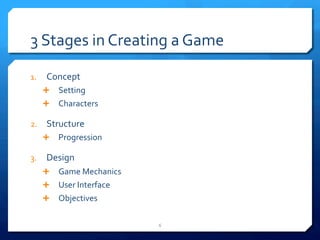
3 
Stages 
in 
Creating 
a 
Game 
1. Concept 
Ê Setting 
Ê Characters 
2. Structure 
Ê Progression 
3. Design 
Ê Game 
Mechanics 
Ê User 
Interface 
Ê Objectives 
6
Identify 
Ê Identify 
the 
Concept, 
Structure 
and 
Design 
of 
the 
ff 
games 
Ê Super 
Mario 
Ê Plants 
vs 
Zombies 
Ê Starcraft 
Ê Quake 
Ê Final 
Fantasy 
VII 
7
Creative 
Process 
Formulating 
Ideas
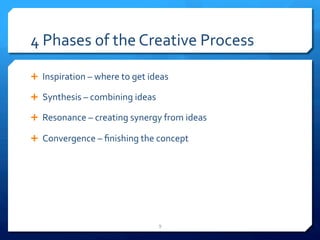
4 
Phases 
of 
the 
Creative 
Process 
Ê Inspiration 
– 
where 
to 
get 
ideas 
Ê Synthesis 
– 
combining 
ideas 
Ê Resonance 
– 
creating 
synergy 
from 
ideas 
Ê Convergence 
– 
finishing 
the 
concept 
9
Inspiration 
Ê Get 
ideas 
from 
anywhere 
and 
everywhere 
Ê Stay 
away 
from 
stale 
thinking 
Ê Do 
something 
new 
Ê Look 
at 
the 
same 
thing, 
differently 
Ê Ask 
“What 
If?” 
10
Inspiration 
Ê Stephen 
King 
said 
that 
the 
spark 
of 
originality 
comes 
when 
you 
put 
familiar 
things 
together 
in 
an 
unexpected 
way 
Ê Ideas 
should 
have 
public 
resonance 
11
Synthesis 
Ê Different 
ideas 
need 
to 
“click” 
together 
Ê Consider 
Plants 
Vs 
Zombies 
12
Resonance 
Ê A 
way 
of 
making 
the 
whole 
greater 
than 
the 
sum 
of 
the 
parts 
Ê Consider 
Warcraft 
13
Convergence 
Ê Validate 
if 
the 
ideas 
are 
going 
to 
work 
or 
not 
Ê Good 
critical 
judgment 
requires 
experience 
14
Elements 
of 
Drama
5 
Elements 
of 
Drama 
Ê Style 
Ê Plot 
Ê Character 
Ê Setting 
Ê Theme 
16
Style 
Ê Genre 
– 
goal 
of 
the 
designer 
Ê Action 
– 
lots 
of 
frantic 
button 
pushing 
Ê Adventure 
– 
story 
J 
Ê Strategy 
– 
Non-­‐trivial 
choices 
Ê Simulation 
– 
Optimization 
exercises 
Ê Puzzle 
– 
Hard 
analytic 
thinking 
Ê Toys 
– 
just 
have 
fun 
with 
Ê Educational 
– 
Learning 
by 
doing 
17
Style 
Ê A 
game 
can 
belong 
to 
multiple 
genre 
Ê Games 
of 
the 
same 
genre 
may 
have 
different 
ways 
to 
execute 
Ê Style 
is 
the 
way 
the 
game 
is 
executed 
Ê Consider 
RTS 
Ê Red 
Alert, 
Warcraft, 
Battle 
Realms 
Ê Consider 
RPGs 
Ê Final 
Fantasy 
18
Plot 
Ê “Choose-­‐Your-­‐Own-­‐Adventure” 
books 
are 
early 
forms 
of 
Adventure 
Games 
Ê Linear 
vs 
Non-­‐Linear 
Ê Player, 
not 
Game 
Designer, 
is 
the 
author 
of 
the 
game’s 
events 
Ê Consider 
Diablo 
19
Character 
Ê In 
terms 
of 
Marketing, 
a 
commodity 
Ê For 
the 
Game 
Designer, 
enhances 
the 
story 
Ê The 
character 
may 
not 
be 
visible 
like 
in 
RTS 
or 
Puzzle 
Games 
Ê Consider 
Final 
Fantasy 
Ê Consider 
Portal 
20
Setting 
Ê Where? 
Ê When? 
21
Theme 
Ê The 
theme 
is 
the 
philosophical 
idea 
that 
the 
author 
is 
trying 
to 
express 
Ê Can 
peace 
exist? 
Ê Does 
love 
conquer 
all? 
Ê What 
is 
more 
valuable? 
Ê Even 
if 
the 
theme 
may 
be 
created 
by 
the 
designer, 
the 
player 
should 
still 
have 
freedom 
of 
choice 
22
Tips 
Ê NO 
technical 
Ê Have 
fun 
Ê Write 
many 
ideas 
separately, 
don’t 
force 
them 
to 
link 
early 
23
Criticizing
3 
Steps 
to 
Criticizing 
an 
Idea 
Ê Analysis 
Ê Evaluation 
Ê Justification 
25
Analysis 
Ê Dissect 
your 
idea 
Ê What 
is 
the 
game 
genre(s)? 
Ê What 
existing/popular 
game 
resembles 
the 
concept? 
Ê In 
what 
ways 
is 
your 
game 
like 
to 
those 
games? 
Ê In 
what 
ways 
is 
it 
different? 
26
Evaluation 
Ê How 
‘unique’ 
is 
your 
game? 
Ê Identify 
Unique 
Selling 
Points 
(USP) 
a.k.a. 
features 
Ê For 
each 
feature, 
ask 
Ê Will 
the 
feature 
be 
fun? 
(#1 
rule!) 
Ê Will 
the 
feature 
lead 
to 
good 
gameplay? 
Ê Why 
isn’t 
the 
feature 
common 
or 
why 
hasn’t 
it 
been 
used 
yet? 
Ê Is 
it 
realistic 
to 
be 
implemented 
with 
your 
team? 
Ê Will 
the 
feature 
be 
workable 
despite 
the 
limitations 
of 
the 
platform? 
27
Justification 
Ê Present 
to 
the 
team 
(publishers 
and 
developers) 
Ê Team 
will 
critique 
and 
you 
justify 
the 
idea/feature 
Ê When 
presenting… 
1. In 
2 
mins, 
give 
them 
a 
reason 
to 
continue 
listening 
to 
you 
2. Present 
theme 
3. Elaborate 
theme 
and 
how 
the 
player 
will 
experience 
4. How 
to 
deliver 
that 
experience 
28
Feasibility
Feasibility 
Ê Creating 
treatment 
knows 
no 
bounds! 
Ê However, 
there 
are 
limitations 
on 
development 
Ê Tip: 
keep 
a 
file 
with 
ready-­‐made 
ideas 
and 
concepts 
Ê Factors 
Ê Commercial 
Ê Technological 
Ê Developmental 
30
Sample 
Treatment 
Ê http://www.scribd.com/nicol%C3%A1s_barr%C3%ADa_1/d/ 
51628648/21-­‐Case-­‐Study-­‐1-­‐2-­‐Initial-­‐Treatment-­‐for-­‐ 
Conquerors 
31
Exercise 
Ê Create 
a 
concept 
for 
a 
Battle 
City 
game 
Ê Create 
a 
concept 
for 
a 
puzzle 
game 
Ê Limit 
concept 
to 
1 
page 
each 
32
What 
is 
a 
Game?
What 
a 
game 
is 
NOT 
Ê “It’s 
in 
the 
features!” 
Ê “If 
it 
looks 
good, 
it 
must 
be 
good” 
Ê “Players 
love 
challenges” 
Ê “It 
must 
have 
an 
intriguing 
plot” 
34
Feature 
Freak! 
Ê Adding 
features 
is 
ok 
but 
know 
when 
to 
stop 
Ê Do 
not 
entertain 
unnecessary 
features 
Ê A.k.a. 
Gold 
Plating 
35
Fancy 
Graphics 
Ê Graphics:Games::Special 
Effects:Movies 
Ê Does 
not 
compensate 
for 
lack 
of 
creativity 
and 
quality 
Ê Fancy 
Graphics 
are 
always 
entertained 
BUT 
the 
game 
should 
work 
without 
them 
36
Puzzles 
Ê People 
like 
puzzles 
Ê No 
such 
thing 
as 
a 
“pure” 
puzzle 
game 
– 
usually 
merged 
with 
another 
to 
increase 
selling 
point 
Ê Puzzles 
are 
not 
gameplays, 
puzzles 
are 
level 
designs 
Ê Game 
Design 
is 
creating 
a 
set 
of 
rules 
where 
different 
problems 
can 
sprout 
from 
37
Setting 
and 
Story 
Ê A 
good 
story 
keeps 
the 
player 
immersed 
in 
the 
game 
Ê “The 
willing 
suspension 
of 
disbelief” 
Ê Avoid 
using 
the 
game 
to 
tell 
a 
story 
38
Games 
Need 
Not 
Everything 
Ê The 
last 
4 
factors 
are 
about 
enhancing 
games 
Ê Games 
need 
to 
be 
FUN! 
Ê Consider 
Text 
Twist 
Ê Difference 
between 
Movies 
and 
Video 
Games 
Ê Interaction 
Ê Choices 
39
Games 
= 
Gameplay 
Ê A 
good 
game 
is 
one 
that 
you 
can 
win 
by 
doing 
the 
unexpected 
and 
making 
it 
work 
Ê A.k.a. 
Surprise 
and 
Delight 
Factor 
40
Game 
Objectives 
Ê Collect 
Something 
Ê Gain 
Territory 
Ê Get 
Somewhere 
First 
Ê Remove 
a 
Series 
of 
Obstacles 
Ê Discovery 
Ê Eliminate 
Other 
Players 
Ê Survival 
41
Game 
Objectives 
Ê What 
are 
the 
aims 
of 
the 
game? 
Ê How 
will 
players 
achieve 
those 
aims? 
Ê What 
will 
the 
game 
be 
like 
to 
play? 
Ê What 
are 
the 
key 
features 
that 
will 
create 
that 
gameplay? 
42
Game 
Specifications
Game 
Specifications 
Ê Features 
Ê Gameplay 
Ê Interface 
Ê Rules 
Ê Level 
Design 
44
Features 
Ê Unique 
Selling 
Points 
Ê Features 
are 
emergent 
from 
rules 
Ê 3 
Types 
Ê Integral 
Features 
Ê Chrome 
Ê Substitutes 
45
Gameplay 
Ê How 
to 
play 
the 
game 
Ê 3 
Purposes 
Ê For 
developers 
to 
understand 
how 
it 
works 
Ê Vision 
statement 
throughout 
the 
development 
Ê Determine 
priority, 
between 
integral 
and 
chrome 
features 
46
Interface 
Ê Primary 
objective 
is 
to 
aid 
the 
player 
Ê Intuitive 
controls 
Ê Minimize 
icons 
Ê Clutter 
free 
Ê Consider 
MMORPGS, 
RTS 
and 
FPS 
47
Rules 
Ê Limitations 
Ê Guidelines 
Ê Rules 
must 
serve 
the 
features 
48
Level 
Design 
Ê Scenarios 
of 
the 
Rules 
Ê Affects 
style, 
plot, 
background 
Ê Tutorial 
Levels 
Ê Linear 
vs 
Non-­‐Linear 
49
Game 
Design 
Document
Parts 
of 
a 
GDD 
Ê Concept 
Ê Overview 
Ê Interface 
Ê Entities 
Ê Features 
Ê Rules 
Ê Level 
Design 
Ê Art 
Document 
Ê Technical 
Document 
51
Concept 
Ê Setting 
Ê Where 
and 
When 
Ê Character 
Ê Main 
Character 
Ê Side 
Character 
Ê Antagonist 
Ê Theme 
Ê Philosophical 
Idea 
52
Overview 
Ê Style 
Ê Genre 
Ê Similar 
Game 
Ê Plot 
Ê Progression 
of 
Experience 
Ê Objectives 
Ê Different 
aims 
of 
the 
players 
53
Interface 
Ê Screen 
Flow 
Ê Title 
Screen 
Ê Option 
Screen 
Ê Game 
Screen 
Ê Different 
game 
modes/phases 
Ê Screen 
Layout 
Ê Icons 
Ê Controls 
Ê Hotkeys 
Ê Mouse 
Commands 
54
Entities 
Ê Player-­‐controlled 
Ê Main 
and 
Side 
Characters 
Ê Non-­‐Player-­‐controlled 
Ê Weapons 
Ê Enemies 
Ê Spells 
Ê Visible 
Game 
Objects 
55
Feature 
List 
Ê Unique 
Selling 
Points 
Ê Example: 
Ê Resources 
Ê AI 
Ê Procedural 
Level 
Generation 
Ê Games 
within 
the 
game 
(side 
quests, 
puzzles, 
etc) 
Ê Identify 
Integral 
and 
Chrome 
features 
(prioritization) 
56
Rules 
Ê Gameplay 
Mechanics 
Ê How 
to 
achieve 
objectives 
Ê Winning 
and 
Losing 
Conditions 
57
Level 
Design 
Ê Must 
support 
Overview 
Ê Tutorial 
Levels 
Ê Level 
1: 
Introduce 
player 
and 
feature 
A 
Ê Level 
2: 
Player, 
feature 
A 
and 
feature 
B 
Ê Level 
3: 
Player, 
feature 
B 
and 
enemy 
C 
Ê Level 
4: 
Player, 
enemy 
C, 
objective 
D 
58
Art 
Document 
Ê List 
of 
Art 
Assets 
Ê Indicate 
priority 
59
Technical 
Document 
Ê Platform 
Ê Software 
and 
Hardware 
Requirements 
Ê Specific 
values 
used 
Ê Identify 
which 
Physics 
are 
involved 
60
Last 
Notes!
Last 
Notes! 
Ê GDD 
has 
no 
standard 
Ê Each 
video 
game 
has 
its 
own 
GDD 
format 
depending 
on 
the 
relevance 
Ê GDD 
is 
a 
living 
thing, 
it 
changes 
throughout 
the 
whole 
game 
design 
process 
Ê Try 
googling 
for 
“Game 
Design 
Document 
Template” 
J 
62

Game Production

  • 1.
  • 2.
    Reference Ê Game Architecture and Design “A New Edition” Ê Andrew Rollings and Dave Morris 2
  • 3.
    Treatment Ê No more than 6 pages Ê A.k.a. The Pitch Ê Overview of the Game Ê Basic Rules 3
  • 4.
    Game Designer Role Ê Create something new Ê No such thing as something new Ê Old ideas presented in a new way Ê Synthesize previous ideas Ê Ideas are not like resources, instead, they’re like living things Ê Whacky ideas may work 4
  • 5.
  • 6.
    3 Stages in Creating a Game 1. Concept Ê Setting Ê Characters 2. Structure Ê Progression 3. Design Ê Game Mechanics Ê User Interface Ê Objectives 6
  • 7.
    Identify Ê Identify the Concept, Structure and Design of the ff games Ê Super Mario Ê Plants vs Zombies Ê Starcraft Ê Quake Ê Final Fantasy VII 7
  • 8.
  • 9.
    4 Phases of the Creative Process Ê Inspiration – where to get ideas Ê Synthesis – combining ideas Ê Resonance – creating synergy from ideas Ê Convergence – finishing the concept 9
  • 10.
    Inspiration Ê Get ideas from anywhere and everywhere Ê Stay away from stale thinking Ê Do something new Ê Look at the same thing, differently Ê Ask “What If?” 10
  • 11.
    Inspiration Ê Stephen King said that the spark of originality comes when you put familiar things together in an unexpected way Ê Ideas should have public resonance 11
  • 12.
    Synthesis Ê Different ideas need to “click” together Ê Consider Plants Vs Zombies 12
  • 13.
    Resonance Ê A way of making the whole greater than the sum of the parts Ê Consider Warcraft 13
  • 14.
    Convergence Ê Validate if the ideas are going to work or not Ê Good critical judgment requires experience 14
  • 15.
  • 16.
    5 Elements of Drama Ê Style Ê Plot Ê Character Ê Setting Ê Theme 16
  • 17.
    Style Ê Genre – goal of the designer Ê Action – lots of frantic button pushing Ê Adventure – story J Ê Strategy – Non-­‐trivial choices Ê Simulation – Optimization exercises Ê Puzzle – Hard analytic thinking Ê Toys – just have fun with Ê Educational – Learning by doing 17
  • 18.
    Style Ê A game can belong to multiple genre Ê Games of the same genre may have different ways to execute Ê Style is the way the game is executed Ê Consider RTS Ê Red Alert, Warcraft, Battle Realms Ê Consider RPGs Ê Final Fantasy 18
  • 19.
    Plot Ê “Choose-­‐Your-­‐Own-­‐Adventure” books are early forms of Adventure Games Ê Linear vs Non-­‐Linear Ê Player, not Game Designer, is the author of the game’s events Ê Consider Diablo 19
  • 20.
    Character Ê In terms of Marketing, a commodity Ê For the Game Designer, enhances the story Ê The character may not be visible like in RTS or Puzzle Games Ê Consider Final Fantasy Ê Consider Portal 20
  • 21.
    Setting Ê Where? Ê When? 21
  • 22.
    Theme Ê The theme is the philosophical idea that the author is trying to express Ê Can peace exist? Ê Does love conquer all? Ê What is more valuable? Ê Even if the theme may be created by the designer, the player should still have freedom of choice 22
  • 23.
    Tips Ê NO technical Ê Have fun Ê Write many ideas separately, don’t force them to link early 23
  • 24.
  • 25.
    3 Steps to Criticizing an Idea Ê Analysis Ê Evaluation Ê Justification 25
  • 26.
    Analysis Ê Dissect your idea Ê What is the game genre(s)? Ê What existing/popular game resembles the concept? Ê In what ways is your game like to those games? Ê In what ways is it different? 26
  • 27.
    Evaluation Ê How ‘unique’ is your game? Ê Identify Unique Selling Points (USP) a.k.a. features Ê For each feature, ask Ê Will the feature be fun? (#1 rule!) Ê Will the feature lead to good gameplay? Ê Why isn’t the feature common or why hasn’t it been used yet? Ê Is it realistic to be implemented with your team? Ê Will the feature be workable despite the limitations of the platform? 27
  • 28.
    Justification Ê Present to the team (publishers and developers) Ê Team will critique and you justify the idea/feature Ê When presenting… 1. In 2 mins, give them a reason to continue listening to you 2. Present theme 3. Elaborate theme and how the player will experience 4. How to deliver that experience 28
  • 29.
  • 30.
    Feasibility Ê Creating treatment knows no bounds! Ê However, there are limitations on development Ê Tip: keep a file with ready-­‐made ideas and concepts Ê Factors Ê Commercial Ê Technological Ê Developmental 30
  • 31.
    Sample Treatment Êhttp://www.scribd.com/nicol%C3%A1s_barr%C3%ADa_1/d/ 51628648/21-­‐Case-­‐Study-­‐1-­‐2-­‐Initial-­‐Treatment-­‐for-­‐ Conquerors 31
  • 32.
    Exercise Ê Create a concept for a Battle City game Ê Create a concept for a puzzle game Ê Limit concept to 1 page each 32
  • 33.
    What is a Game?
  • 34.
    What a game is NOT Ê “It’s in the features!” Ê “If it looks good, it must be good” Ê “Players love challenges” Ê “It must have an intriguing plot” 34
  • 35.
    Feature Freak! ÊAdding features is ok but know when to stop Ê Do not entertain unnecessary features Ê A.k.a. Gold Plating 35
  • 36.
    Fancy Graphics ÊGraphics:Games::Special Effects:Movies Ê Does not compensate for lack of creativity and quality Ê Fancy Graphics are always entertained BUT the game should work without them 36
  • 37.
    Puzzles Ê People like puzzles Ê No such thing as a “pure” puzzle game – usually merged with another to increase selling point Ê Puzzles are not gameplays, puzzles are level designs Ê Game Design is creating a set of rules where different problems can sprout from 37
  • 38.
    Setting and Story Ê A good story keeps the player immersed in the game Ê “The willing suspension of disbelief” Ê Avoid using the game to tell a story 38
  • 39.
    Games Need Not Everything Ê The last 4 factors are about enhancing games Ê Games need to be FUN! Ê Consider Text Twist Ê Difference between Movies and Video Games Ê Interaction Ê Choices 39
  • 40.
    Games = Gameplay Ê A good game is one that you can win by doing the unexpected and making it work Ê A.k.a. Surprise and Delight Factor 40
  • 41.
    Game Objectives ÊCollect Something Ê Gain Territory Ê Get Somewhere First Ê Remove a Series of Obstacles Ê Discovery Ê Eliminate Other Players Ê Survival 41
  • 42.
    Game Objectives ÊWhat are the aims of the game? Ê How will players achieve those aims? Ê What will the game be like to play? Ê What are the key features that will create that gameplay? 42
  • 43.
  • 44.
    Game Specifications ÊFeatures Ê Gameplay Ê Interface Ê Rules Ê Level Design 44
  • 45.
    Features Ê Unique Selling Points Ê Features are emergent from rules Ê 3 Types Ê Integral Features Ê Chrome Ê Substitutes 45
  • 46.
    Gameplay Ê How to play the game Ê 3 Purposes Ê For developers to understand how it works Ê Vision statement throughout the development Ê Determine priority, between integral and chrome features 46
  • 47.
    Interface Ê Primary objective is to aid the player Ê Intuitive controls Ê Minimize icons Ê Clutter free Ê Consider MMORPGS, RTS and FPS 47
  • 48.
    Rules Ê Limitations Ê Guidelines Ê Rules must serve the features 48
  • 49.
    Level Design ÊScenarios of the Rules Ê Affects style, plot, background Ê Tutorial Levels Ê Linear vs Non-­‐Linear 49
  • 50.
  • 51.
    Parts of a GDD Ê Concept Ê Overview Ê Interface Ê Entities Ê Features Ê Rules Ê Level Design Ê Art Document Ê Technical Document 51
  • 52.
    Concept Ê Setting Ê Where and When Ê Character Ê Main Character Ê Side Character Ê Antagonist Ê Theme Ê Philosophical Idea 52
  • 53.
    Overview Ê Style Ê Genre Ê Similar Game Ê Plot Ê Progression of Experience Ê Objectives Ê Different aims of the players 53
  • 54.
    Interface Ê Screen Flow Ê Title Screen Ê Option Screen Ê Game Screen Ê Different game modes/phases Ê Screen Layout Ê Icons Ê Controls Ê Hotkeys Ê Mouse Commands 54
  • 55.
    Entities Ê Player-­‐controlled Ê Main and Side Characters Ê Non-­‐Player-­‐controlled Ê Weapons Ê Enemies Ê Spells Ê Visible Game Objects 55
  • 56.
    Feature List ÊUnique Selling Points Ê Example: Ê Resources Ê AI Ê Procedural Level Generation Ê Games within the game (side quests, puzzles, etc) Ê Identify Integral and Chrome features (prioritization) 56
  • 57.
    Rules Ê Gameplay Mechanics Ê How to achieve objectives Ê Winning and Losing Conditions 57
  • 58.
    Level Design ÊMust support Overview Ê Tutorial Levels Ê Level 1: Introduce player and feature A Ê Level 2: Player, feature A and feature B Ê Level 3: Player, feature B and enemy C Ê Level 4: Player, enemy C, objective D 58
  • 59.
    Art Document ÊList of Art Assets Ê Indicate priority 59
  • 60.
    Technical Document ÊPlatform Ê Software and Hardware Requirements Ê Specific values used Ê Identify which Physics are involved 60
  • 61.
  • 62.
    Last Notes! ÊGDD has no standard Ê Each video game has its own GDD format depending on the relevance Ê GDD is a living thing, it changes throughout the whole game design process Ê Try googling for “Game Design Document Template” J 62