© Fluent Inc. 4/8/20143-1
Introductory GAMBIT Notes
GAMBIT v2.0 Jan 2002
Fluent User Services Center
www.fluentusers.com
Edge and Face Meshing
© Fluent Inc. 4/8/20143-2
Introductory GAMBIT Notes
GAMBIT v2.0 Jan 2002
Fluent User Services Center
www.fluentusers.com
Meshing - General
 To reduce overall mesh size, confine small cells to areas where
they are needed (e.g., where high gradients are expected).
 Controlling cell size distribution
 Edges, Faces and Volumes can be directly meshed
 A uniform mesh is generated unless pre-meshing or sizing functions
are used.
 Pre-meshing
 Edge meshes can be graded (varying interval size on edge)
 Graded edge mesh can be used to control distribution of cell size in
face mesh.
 Controlling distribution of cell size in face mesh also controls
distribution of cell size in volume mesh.
 Sizing Functions
 New feature to control cell size in faces and volumes directly.
© Fluent Inc. 4/8/20143-3
Introductory GAMBIT Notes
GAMBIT v2.0 Jan 2002
Fluent User Services Center
www.fluentusers.com
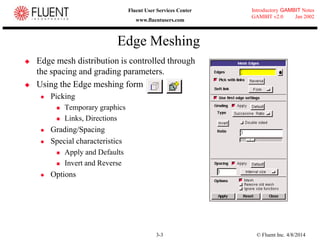
Edge Meshing
 Edge mesh distribution is controlled through
the spacing and grading parameters.
 Using the Edge meshing form
 Picking
 Temporary graphics
 Links, Directions
 Grading/Spacing
 Special characteristics
 Apply and Defaults
 Invert and Reverse
 Options
© Fluent Inc. 4/8/20143-4
Introductory GAMBIT Notes
GAMBIT v2.0 Jan 2002
Fluent User Services Center
www.fluentusers.com
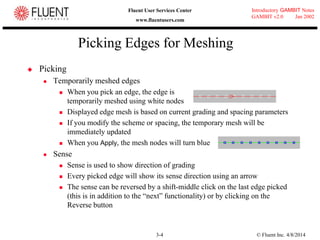
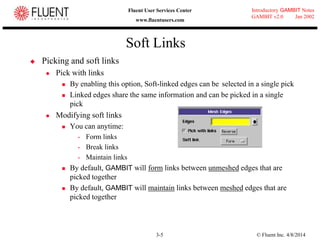
Picking Edges for Meshing
 Picking
 Temporarily meshed edges
 When you pick an edge, the edge is
temporarily meshed using white nodes
 Displayed edge mesh is based on current grading and spacing parameters
 If you modify the scheme or spacing, the temporary mesh will be
immediately updated
 When you Apply, the mesh nodes will turn blue
 Sense
 Sense is used to show direction of grading
 Every picked edge will show its sense direction using an arrow
 The sense can be reversed by a shift-middle click on the last edge picked
(this is in addition to the “next” functionality) or by clicking on the
Reverse button
© Fluent Inc. 4/8/20143-5
Introductory GAMBIT Notes
GAMBIT v2.0 Jan 2002
Fluent User Services Center
www.fluentusers.com
Soft Links
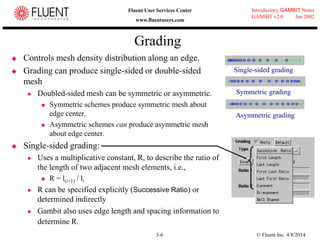
 Picking and soft links
 Pick with links
 By enabling this option, Soft-linked edges can be selected in a single pick
 Linked edges share the same information and can be picked in a single
pick
 Modifying soft links
 You can anytime:
 Form links
 Break links
 Maintain links
 By default, GAMBIT will form links between unmeshed edges that are
picked together
 By default, GAMBIT will maintain links between meshed edges that are
picked together
© Fluent Inc. 4/8/20143-6
Introductory GAMBIT Notes
GAMBIT v2.0 Jan 2002
Fluent User Services Center
www.fluentusers.com
Grading
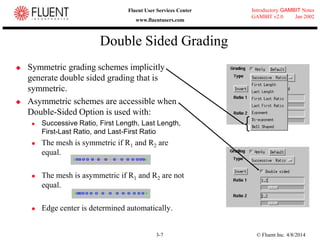
 Controls mesh density distribution along an edge.
 Grading can produce single-sided or double-sided
mesh
 Doubled-sided mesh can be symmetric or asymmetric.
 Symmetric schemes produce symmetric mesh about
edge center.
 Asymmetric schemes can produce asymmetric mesh
about edge center.
 Single-sided grading:
 Uses a multiplicative constant, R, to describe the ratio of
the length of two adjacent mesh elements, i.e.,
 R = l(i+1) / li
 R can be specified explicitly (Successive Ratio) or
determined indirectly
 Gambit also uses edge length and spacing information to
determine R.
Single-sided grading
Symmetric grading
Asymmetric grading
© Fluent Inc. 4/8/20143-7
Introductory GAMBIT Notes
GAMBIT v2.0 Jan 2002
Fluent User Services Center
www.fluentusers.com
Double Sided Grading
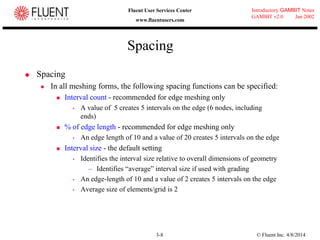
 Symmetric grading schemes implicitly
generate double sided grading that is
symmetric.
 Asymmetric schemes are accessible when
Double-Sided Option is used with:
 Successive Ratio, First Length, Last Length,
First-Last Ratio, and Last-First Ratio
 The mesh is symmetric if R1 and R2 are
equal.
 The mesh is asymmetric if R1 and R2 are not
equal.
 Edge center is determined automatically.
© Fluent Inc. 4/8/20143-8
Introductory GAMBIT Notes
GAMBIT v2.0 Jan 2002
Fluent User Services Center
www.fluentusers.com
Spacing
 Spacing
 In all meshing forms, the following spacing functions can be specified:
 Interval count - recommended for edge meshing only
 A value of 5 creates 5 intervals on the edge (6 nodes, including
ends)
 % of edge length - recommended for edge meshing only
 An edge length of 10 and a value of 20 creates 5 intervals on the edge
 Interval size - the default setting
 Identifies the interval size relative to overall dimensions of geometry
– Identifies “average” interval size if used with grading
 An edge-length of 10 and a value of 2 creates 5 intervals on the edge
 Average size of elements/grid is 2
© Fluent Inc. 4/8/20143-9
Introductory GAMBIT Notes
GAMBIT v2.0 Jan 2002
Fluent User Services Center
www.fluentusers.com
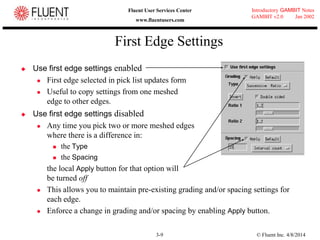
First Edge Settings
 Use first edge settings enabled
 First edge selected in pick list updates form
 Useful to copy settings from one meshed
edge to other edges.
 Use first edge settings disabled
 Any time you pick two or more meshed edges
where there is a difference in:
 the Type
 the Spacing
the local Apply button for that option will
be turned off
 This allows you to maintain pre-existing grading and/or spacing settings for
each edge.
 Enforce a change in grading and/or spacing by enabling Apply button.
© Fluent Inc. 4/8/20143-10
Introductory GAMBIT Notes
GAMBIT v2.0 Jan 2002
Fluent User Services Center
www.fluentusers.com
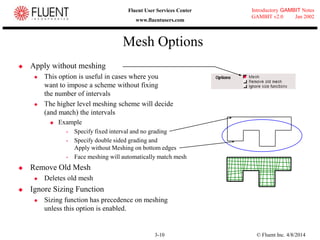
Mesh Options
 Apply without meshing
 This option is useful in cases where you
want to impose a scheme without fixing
the number of intervals
 The higher level meshing scheme will decide
(and match) the intervals
 Example
 Specify fixed interval and no grading
 Specify double sided grading and
Apply without Meshing on bottom edges
 Face meshing will automatically match mesh
 Remove Old Mesh
 Deletes old mesh
 Ignore Sizing Function
 Sizing function has precedence on meshing
unless this option is enabled.
© Fluent Inc. 4/8/20143-11
Introductory GAMBIT Notes
GAMBIT v2.0 Jan 2002
Fluent User Services Center
www.fluentusers.com
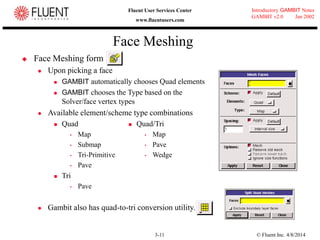
Face Meshing
 Face Meshing form
 Upon picking a face
 GAMBIT automatically chooses Quad elements
 GAMBIT chooses the Type based on the
Solver/face vertex types
 Available element/scheme type combinations
 Quad
 Map
 Submap
 Tri-Primitive
 Pave
 Tri
 Pave
 Gambit also has quad-to-tri conversion utility.
 Quad/Tri
 Map
 Pave
 Wedge
© Fluent Inc. 4/8/20143-12
Introductory GAMBIT Notes
GAMBIT v2.0 Jan 2002
Fluent User Services Center
www.fluentusers.com
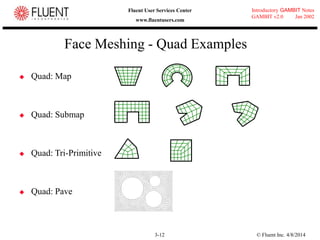
Face Meshing - Quad Examples
 Quad: Map
 Quad: Submap
 Quad: Tri-Primitive
 Quad: Pave
© Fluent Inc. 4/8/20143-13
Introductory GAMBIT Notes
GAMBIT v2.0 Jan 2002
Fluent User Services Center
www.fluentusers.com
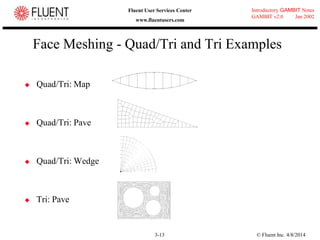
Face Meshing - Quad/Tri and Tri Examples
 Quad/Tri: Map
 Quad/Tri: Pave
 Quad/Tri: Wedge
 Tri: Pave
© Fluent Inc. 4/8/20143-14
Introductory GAMBIT Notes
GAMBIT v2.0 Jan 2002
Fluent User Services Center
www.fluentusers.com
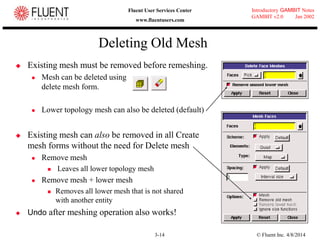
Deleting Old Mesh
 Existing mesh must be removed before remeshing.
 Mesh can be deleted using
delete mesh form.
 Lower topology mesh can also be deleted (default)
 Existing mesh can also be removed in all Create
mesh forms without the need for Delete mesh
 Remove mesh
 Leaves all lower topology mesh
 Remove mesh + lower mesh
 Removes all lower mesh that is not shared
with another entity
 Undo after meshing operation also works!
© Fluent Inc. 4/8/20143-15
Introductory GAMBIT Notes
GAMBIT v2.0 Jan 2002
Fluent User Services Center
www.fluentusers.com
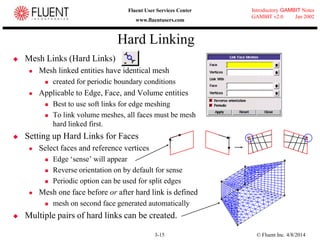
Hard Linking
 Mesh Links (Hard Links)
 Mesh linked entities have identical mesh
 created for periodic boundary conditions
 Applicable to Edge, Face, and Volume entities
 Best to use soft links for edge meshing
 To link volume meshes, all faces must be mesh
hard linked first.
 Setting up Hard Links for Faces
 Select faces and reference vertices
 Edge „sense‟ will appear
 Reverse orientation on by default for sense
 Periodic option can be used for split edges
 Mesh one face before or after hard link is defined
 mesh on second face generated automatically
 Multiple pairs of hard links can be created.
+ + + +
© Fluent Inc. 4/8/20143-16
Introductory GAMBIT Notes
GAMBIT v2.0 Jan 2002
Fluent User Services Center
www.fluentusers.com
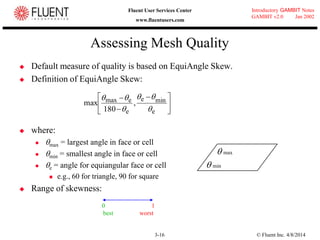
Assessing Mesh Quality
 Default measure of quality is based on EquiAngle Skew.
 Definition of EquiAngle Skew:
 where:
 max = largest angle in face or cell
 min = smallest angle in face or cell
 e = angle for equiangular face or cell
 e.g., 60 for triangle, 90 for square
 Range of skewness:





 


e
mine
e
emax ,
180
max




 min
 max
0 1
best worst
© Fluent Inc. 4/8/20143-17
Introductory GAMBIT Notes
GAMBIT v2.0 Jan 2002
Fluent User Services Center
www.fluentusers.com
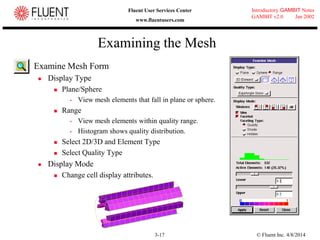
Examining the Mesh
Examine Mesh Form
 Display Type
 Plane/Sphere
 View mesh elements that fall in plane or sphere.
 Range
 View mesh elements within quality range.
 Histogram shows quality distribution.
 Select 2D/3D and Element Type
 Select Quality Type
 Display Mode
 Change cell display attributes.
© Fluent Inc. 4/8/20143-18
Introductory GAMBIT Notes
GAMBIT v2.0 Jan 2002
Fluent User Services Center
www.fluentusers.com
Striving for Quality
 A poor quality grid will cause inaccurate solutions and/or slow convergence.
 Minimize EquiAngle Skew:
 Hex and Quad Cells
 Skewness should not exceed 0.85.
 Tri‟s
 Skewness should not exceed 0.85.
 Tet‟s
 Skewness should not exceed 0.9
 Minimize local variations in cell size:
 e.g., adjacent cells should not have „size ratio‟ greater than 20%.
 If Examine Mesh shows such violations:
 Delete mesh
 Perform necessary decomposition and/or pre-mesh edges and faces.
 Remesh
© Fluent Inc. 4/8/20143-19
Introductory GAMBIT Notes
GAMBIT v2.0 Jan 2002
Fluent User Services Center
www.fluentusers.com
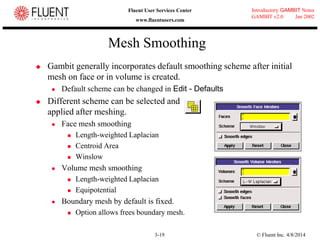
Mesh Smoothing
 Gambit generally incorporates default smoothing scheme after initial
mesh on face or in volume is created.
 Default scheme can be changed in Edit - Defaults
 Different scheme can be selected and
applied after meshing.
 Face mesh smoothing
 Length-weighted Laplacian
 Centroid Area
 Winslow
 Volume mesh smoothing
 Length-weighted Laplacian
 Equipotential
 Boundary mesh by default is fixed.
 Option allows frees boundary mesh.
© Fluent Inc. 4/8/20143-20
Introductory GAMBIT Notes
GAMBIT v2.0 Jan 2002
Fluent User Services Center
www.fluentusers.com
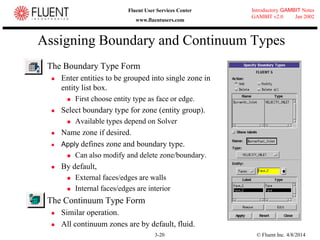
Assigning Boundary and Continuum Types
 The Boundary Type Form
 Enter entities to be grouped into single zone in
entity list box.
 First choose entity type as face or edge.
 Select boundary type for zone (entity group).
 Available types depend on Solver
 Name zone if desired.
 Apply defines zone and boundary type.
 Can also modify and delete zone/boundary.
 By default,
 External faces/edges are walls
 Internal faces/edges are interior
 The Continuum Type Form
 Similar operation.
 All continuum zones are by default, fluid.
© Fluent Inc. 4/8/20143-21
Introductory GAMBIT Notes
GAMBIT v2.0 Jan 2002
Fluent User Services Center
www.fluentusers.com
Linear/Quadratic Elements
(FIDAP/POLYFLOW USERS ONLY)
 General tools
 Higher-order elements
 For FEM codes (FIDAP and POLYFLOW), the element order can be
changed at all three meshing levels
 Only linear and quadratic elements are directly available
 A change to quadratic element type at one level will automatically
change the element type in other levels
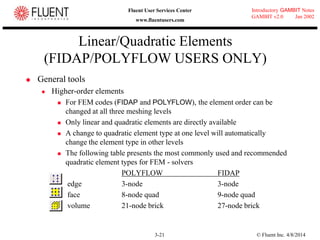
 The following table presents the most commonly used and recommended
quadratic element types for FEM - solvers
POLYFLOW FIDAP
edge 3-node 3-node
face 8-node quad 9-node quad
volume 21-node brick 27-node brick

Gambit 3 edgeface

  • 1.
    © Fluent Inc.4/8/20143-1 Introductory GAMBIT Notes GAMBIT v2.0 Jan 2002 Fluent User Services Center www.fluentusers.com Edge and Face Meshing
  • 2.
    © Fluent Inc.4/8/20143-2 Introductory GAMBIT Notes GAMBIT v2.0 Jan 2002 Fluent User Services Center www.fluentusers.com Meshing - General  To reduce overall mesh size, confine small cells to areas where they are needed (e.g., where high gradients are expected).  Controlling cell size distribution  Edges, Faces and Volumes can be directly meshed  A uniform mesh is generated unless pre-meshing or sizing functions are used.  Pre-meshing  Edge meshes can be graded (varying interval size on edge)  Graded edge mesh can be used to control distribution of cell size in face mesh.  Controlling distribution of cell size in face mesh also controls distribution of cell size in volume mesh.  Sizing Functions  New feature to control cell size in faces and volumes directly.
  • 3.
    © Fluent Inc.4/8/20143-3 Introductory GAMBIT Notes GAMBIT v2.0 Jan 2002 Fluent User Services Center www.fluentusers.com Edge Meshing  Edge mesh distribution is controlled through the spacing and grading parameters.  Using the Edge meshing form  Picking  Temporary graphics  Links, Directions  Grading/Spacing  Special characteristics  Apply and Defaults  Invert and Reverse  Options
  • 4.
    © Fluent Inc.4/8/20143-4 Introductory GAMBIT Notes GAMBIT v2.0 Jan 2002 Fluent User Services Center www.fluentusers.com Picking Edges for Meshing  Picking  Temporarily meshed edges  When you pick an edge, the edge is temporarily meshed using white nodes  Displayed edge mesh is based on current grading and spacing parameters  If you modify the scheme or spacing, the temporary mesh will be immediately updated  When you Apply, the mesh nodes will turn blue  Sense  Sense is used to show direction of grading  Every picked edge will show its sense direction using an arrow  The sense can be reversed by a shift-middle click on the last edge picked (this is in addition to the “next” functionality) or by clicking on the Reverse button
  • 5.
    © Fluent Inc.4/8/20143-5 Introductory GAMBIT Notes GAMBIT v2.0 Jan 2002 Fluent User Services Center www.fluentusers.com Soft Links  Picking and soft links  Pick with links  By enabling this option, Soft-linked edges can be selected in a single pick  Linked edges share the same information and can be picked in a single pick  Modifying soft links  You can anytime:  Form links  Break links  Maintain links  By default, GAMBIT will form links between unmeshed edges that are picked together  By default, GAMBIT will maintain links between meshed edges that are picked together
  • 6.
    © Fluent Inc.4/8/20143-6 Introductory GAMBIT Notes GAMBIT v2.0 Jan 2002 Fluent User Services Center www.fluentusers.com Grading  Controls mesh density distribution along an edge.  Grading can produce single-sided or double-sided mesh  Doubled-sided mesh can be symmetric or asymmetric.  Symmetric schemes produce symmetric mesh about edge center.  Asymmetric schemes can produce asymmetric mesh about edge center.  Single-sided grading:  Uses a multiplicative constant, R, to describe the ratio of the length of two adjacent mesh elements, i.e.,  R = l(i+1) / li  R can be specified explicitly (Successive Ratio) or determined indirectly  Gambit also uses edge length and spacing information to determine R. Single-sided grading Symmetric grading Asymmetric grading
  • 7.
    © Fluent Inc.4/8/20143-7 Introductory GAMBIT Notes GAMBIT v2.0 Jan 2002 Fluent User Services Center www.fluentusers.com Double Sided Grading  Symmetric grading schemes implicitly generate double sided grading that is symmetric.  Asymmetric schemes are accessible when Double-Sided Option is used with:  Successive Ratio, First Length, Last Length, First-Last Ratio, and Last-First Ratio  The mesh is symmetric if R1 and R2 are equal.  The mesh is asymmetric if R1 and R2 are not equal.  Edge center is determined automatically.
  • 8.
    © Fluent Inc.4/8/20143-8 Introductory GAMBIT Notes GAMBIT v2.0 Jan 2002 Fluent User Services Center www.fluentusers.com Spacing  Spacing  In all meshing forms, the following spacing functions can be specified:  Interval count - recommended for edge meshing only  A value of 5 creates 5 intervals on the edge (6 nodes, including ends)  % of edge length - recommended for edge meshing only  An edge length of 10 and a value of 20 creates 5 intervals on the edge  Interval size - the default setting  Identifies the interval size relative to overall dimensions of geometry – Identifies “average” interval size if used with grading  An edge-length of 10 and a value of 2 creates 5 intervals on the edge  Average size of elements/grid is 2
  • 9.
    © Fluent Inc.4/8/20143-9 Introductory GAMBIT Notes GAMBIT v2.0 Jan 2002 Fluent User Services Center www.fluentusers.com First Edge Settings  Use first edge settings enabled  First edge selected in pick list updates form  Useful to copy settings from one meshed edge to other edges.  Use first edge settings disabled  Any time you pick two or more meshed edges where there is a difference in:  the Type  the Spacing the local Apply button for that option will be turned off  This allows you to maintain pre-existing grading and/or spacing settings for each edge.  Enforce a change in grading and/or spacing by enabling Apply button.
  • 10.
    © Fluent Inc.4/8/20143-10 Introductory GAMBIT Notes GAMBIT v2.0 Jan 2002 Fluent User Services Center www.fluentusers.com Mesh Options  Apply without meshing  This option is useful in cases where you want to impose a scheme without fixing the number of intervals  The higher level meshing scheme will decide (and match) the intervals  Example  Specify fixed interval and no grading  Specify double sided grading and Apply without Meshing on bottom edges  Face meshing will automatically match mesh  Remove Old Mesh  Deletes old mesh  Ignore Sizing Function  Sizing function has precedence on meshing unless this option is enabled.
  • 11.
    © Fluent Inc.4/8/20143-11 Introductory GAMBIT Notes GAMBIT v2.0 Jan 2002 Fluent User Services Center www.fluentusers.com Face Meshing  Face Meshing form  Upon picking a face  GAMBIT automatically chooses Quad elements  GAMBIT chooses the Type based on the Solver/face vertex types  Available element/scheme type combinations  Quad  Map  Submap  Tri-Primitive  Pave  Tri  Pave  Gambit also has quad-to-tri conversion utility.  Quad/Tri  Map  Pave  Wedge
  • 12.
    © Fluent Inc.4/8/20143-12 Introductory GAMBIT Notes GAMBIT v2.0 Jan 2002 Fluent User Services Center www.fluentusers.com Face Meshing - Quad Examples  Quad: Map  Quad: Submap  Quad: Tri-Primitive  Quad: Pave
  • 13.
    © Fluent Inc.4/8/20143-13 Introductory GAMBIT Notes GAMBIT v2.0 Jan 2002 Fluent User Services Center www.fluentusers.com Face Meshing - Quad/Tri and Tri Examples  Quad/Tri: Map  Quad/Tri: Pave  Quad/Tri: Wedge  Tri: Pave
  • 14.
    © Fluent Inc.4/8/20143-14 Introductory GAMBIT Notes GAMBIT v2.0 Jan 2002 Fluent User Services Center www.fluentusers.com Deleting Old Mesh  Existing mesh must be removed before remeshing.  Mesh can be deleted using delete mesh form.  Lower topology mesh can also be deleted (default)  Existing mesh can also be removed in all Create mesh forms without the need for Delete mesh  Remove mesh  Leaves all lower topology mesh  Remove mesh + lower mesh  Removes all lower mesh that is not shared with another entity  Undo after meshing operation also works!
  • 15.
    © Fluent Inc.4/8/20143-15 Introductory GAMBIT Notes GAMBIT v2.0 Jan 2002 Fluent User Services Center www.fluentusers.com Hard Linking  Mesh Links (Hard Links)  Mesh linked entities have identical mesh  created for periodic boundary conditions  Applicable to Edge, Face, and Volume entities  Best to use soft links for edge meshing  To link volume meshes, all faces must be mesh hard linked first.  Setting up Hard Links for Faces  Select faces and reference vertices  Edge „sense‟ will appear  Reverse orientation on by default for sense  Periodic option can be used for split edges  Mesh one face before or after hard link is defined  mesh on second face generated automatically  Multiple pairs of hard links can be created. + + + +
  • 16.
    © Fluent Inc.4/8/20143-16 Introductory GAMBIT Notes GAMBIT v2.0 Jan 2002 Fluent User Services Center www.fluentusers.com Assessing Mesh Quality  Default measure of quality is based on EquiAngle Skew.  Definition of EquiAngle Skew:  where:  max = largest angle in face or cell  min = smallest angle in face or cell  e = angle for equiangular face or cell  e.g., 60 for triangle, 90 for square  Range of skewness:          e mine e emax , 180 max      min  max 0 1 best worst
  • 17.
    © Fluent Inc.4/8/20143-17 Introductory GAMBIT Notes GAMBIT v2.0 Jan 2002 Fluent User Services Center www.fluentusers.com Examining the Mesh Examine Mesh Form  Display Type  Plane/Sphere  View mesh elements that fall in plane or sphere.  Range  View mesh elements within quality range.  Histogram shows quality distribution.  Select 2D/3D and Element Type  Select Quality Type  Display Mode  Change cell display attributes.
  • 18.
    © Fluent Inc.4/8/20143-18 Introductory GAMBIT Notes GAMBIT v2.0 Jan 2002 Fluent User Services Center www.fluentusers.com Striving for Quality  A poor quality grid will cause inaccurate solutions and/or slow convergence.  Minimize EquiAngle Skew:  Hex and Quad Cells  Skewness should not exceed 0.85.  Tri‟s  Skewness should not exceed 0.85.  Tet‟s  Skewness should not exceed 0.9  Minimize local variations in cell size:  e.g., adjacent cells should not have „size ratio‟ greater than 20%.  If Examine Mesh shows such violations:  Delete mesh  Perform necessary decomposition and/or pre-mesh edges and faces.  Remesh
  • 19.
    © Fluent Inc.4/8/20143-19 Introductory GAMBIT Notes GAMBIT v2.0 Jan 2002 Fluent User Services Center www.fluentusers.com Mesh Smoothing  Gambit generally incorporates default smoothing scheme after initial mesh on face or in volume is created.  Default scheme can be changed in Edit - Defaults  Different scheme can be selected and applied after meshing.  Face mesh smoothing  Length-weighted Laplacian  Centroid Area  Winslow  Volume mesh smoothing  Length-weighted Laplacian  Equipotential  Boundary mesh by default is fixed.  Option allows frees boundary mesh.
  • 20.
    © Fluent Inc.4/8/20143-20 Introductory GAMBIT Notes GAMBIT v2.0 Jan 2002 Fluent User Services Center www.fluentusers.com Assigning Boundary and Continuum Types  The Boundary Type Form  Enter entities to be grouped into single zone in entity list box.  First choose entity type as face or edge.  Select boundary type for zone (entity group).  Available types depend on Solver  Name zone if desired.  Apply defines zone and boundary type.  Can also modify and delete zone/boundary.  By default,  External faces/edges are walls  Internal faces/edges are interior  The Continuum Type Form  Similar operation.  All continuum zones are by default, fluid.
  • 21.
    © Fluent Inc.4/8/20143-21 Introductory GAMBIT Notes GAMBIT v2.0 Jan 2002 Fluent User Services Center www.fluentusers.com Linear/Quadratic Elements (FIDAP/POLYFLOW USERS ONLY)  General tools  Higher-order elements  For FEM codes (FIDAP and POLYFLOW), the element order can be changed at all three meshing levels  Only linear and quadratic elements are directly available  A change to quadratic element type at one level will automatically change the element type in other levels  The following table presents the most commonly used and recommended quadratic element types for FEM - solvers POLYFLOW FIDAP edge 3-node 3-node face 8-node quad 9-node quad volume 21-node brick 27-node brick