Hydrostatic
Transmissions
Rajeev kumar
Hydrostatic Operation
 Hydrostatic transmissions are a pump and
motor connected in a circuit together
 Most are constructed using piston pumps and
piston motors
 Four basic configurations:
 In-line
 U-shaped
 S-shaped
 Split
In-Line Configuration
 The pump is directly connected to the motor
 All fluid is contained within the pump/motor
combination
 Usually uses a variable pump and a constant
displacement motor
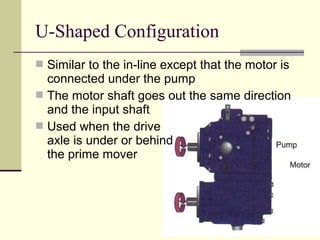
U-Shaped Configuration
 Similar to the in-line except that the motor is
connected under the pump
 The motor shaft goes out the same direction
and the input shaft
 Used when the drive
axle is under or behind
the prime mover
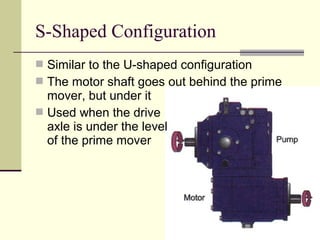
S-Shaped Configuration
 Similar to the U-shaped configuration
 The motor shaft goes out behind the prime
mover, but under it
 Used when the drive
axle is under the level
of the prime mover
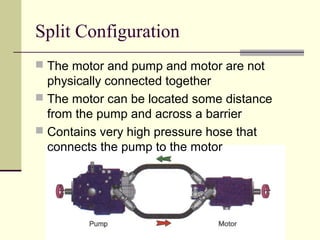
Split Configuration
 The motor and pump and motor are not
physically connected together
 The motor can be located some distance
from the pump and across a barrier
 Contains very high pressure hose that
connects the pump to the motor
Advantages of Hydrostatic
Transmissions
 It offers the ability to operate over a wide
range of speeds without changing the prime
mover speed
 It can change speeds rapidly because there
are no large parts which add inertia
 It provide dynamic braking
 There is no interruption of power to the
wheels when shifting
Hydrostatic Circuits
 Open circuit
 All fluid comes from the tank and is pumped
to the motor
 When the fluid leaves
the motor, it goes back
to the tank
 Does not require a
charge pump
Hydrostatic Circuits
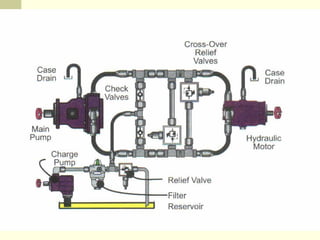
 Closed circuit
 The fluid is pumped to the motor
 As the fluid leaves the motor, it is returned to
the pump inlet
 Requires a
charge pump
Hydrostatic Transmission Operation -
Pump
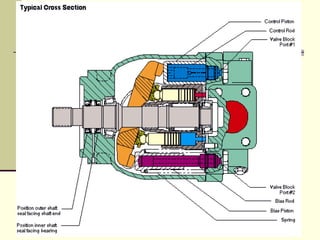
 The cylinder is turned by the input shaft
 The pistons are connected to a swash plate,
which varies how much the pistons travel
 The greater the angle of the swash plate, the
more fluid is pumped
 Reversing the angle of the swash plate
causes it to pump backwards
 The more fluid is pumped per revolution, the
more horsepower is needed
Hydrostatic Transmission Operation -
Motor
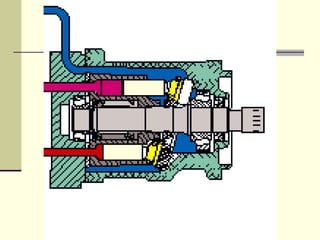
 The motor accepts the fluid from the pump
and turns a differential or wheel, depending
on the configuration
 When the pump reverses direction, the motor
turns backwards, giving you reverse
 Not all hydrostats are designed to pump
backwards
 Many motors use a shuttle valve to reverse
the flow of hydraulic fluid
Hydrostatic Transmission Components
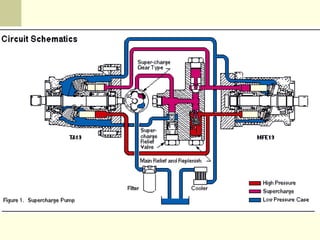
 All circuit types require a relief valve to
prevent overpressurizing during dynamic
braking
 The pump and motor have case drain lines to
keep fluid that leaks internally from building
pressure behind the piston
 Case drains are connected to the tank
 Charge pumps must provide enough fluid to
replace leakage and cool the pump/motor
assembly
Servo Activated Hydrostatic
Transmissions
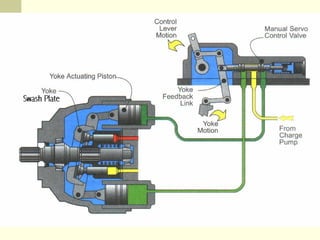
 In larger hydrostats, the swash plate can be
hard to move
 In these systems, a small piston assembly is
attached to the swash plate and activated by
low pressure (300 PSI)
 These servos are controlled by a small
shuttle, making it easier to move the swash
plate
Hydrostatic Transmission Testing
 Use a flow meter hooked to the case drain
line to measure to output. It should be below
the charge pump volume
 All hydrostatic transmissions have tight
tolerances. The filters should be change at
regular intervals
 Many systems have a pressure sensor that
shuts down the prime mover if the charge
pressure falls below a certain level
Hydrostatic Transmission Testing
 If the prime mover has a problem, it could fail
to supply the needed power to the hydrostat
 Always rule out the prime mover first when
checking for insufficient power problems
 Charge pressure varies, but should be
between 160 to 300 PSI

Hydrostatic transmissions

  • 1.
  • 2.
    Hydrostatic Operation  Hydrostatictransmissions are a pump and motor connected in a circuit together  Most are constructed using piston pumps and piston motors  Four basic configurations:  In-line  U-shaped  S-shaped  Split
  • 3.
    In-Line Configuration  Thepump is directly connected to the motor  All fluid is contained within the pump/motor combination  Usually uses a variable pump and a constant displacement motor
  • 4.
    U-Shaped Configuration  Similarto the in-line except that the motor is connected under the pump  The motor shaft goes out the same direction and the input shaft  Used when the drive axle is under or behind the prime mover
  • 5.
    S-Shaped Configuration  Similarto the U-shaped configuration  The motor shaft goes out behind the prime mover, but under it  Used when the drive axle is under the level of the prime mover
  • 6.
    Split Configuration  Themotor and pump and motor are not physically connected together  The motor can be located some distance from the pump and across a barrier  Contains very high pressure hose that connects the pump to the motor
  • 7.
    Advantages of Hydrostatic Transmissions It offers the ability to operate over a wide range of speeds without changing the prime mover speed  It can change speeds rapidly because there are no large parts which add inertia  It provide dynamic braking  There is no interruption of power to the wheels when shifting
  • 8.
    Hydrostatic Circuits  Opencircuit  All fluid comes from the tank and is pumped to the motor  When the fluid leaves the motor, it goes back to the tank  Does not require a charge pump
  • 9.
    Hydrostatic Circuits  Closedcircuit  The fluid is pumped to the motor  As the fluid leaves the motor, it is returned to the pump inlet  Requires a charge pump
  • 11.
    Hydrostatic Transmission Operation- Pump  The cylinder is turned by the input shaft  The pistons are connected to a swash plate, which varies how much the pistons travel  The greater the angle of the swash plate, the more fluid is pumped  Reversing the angle of the swash plate causes it to pump backwards  The more fluid is pumped per revolution, the more horsepower is needed
  • 13.
    Hydrostatic Transmission Operation- Motor  The motor accepts the fluid from the pump and turns a differential or wheel, depending on the configuration  When the pump reverses direction, the motor turns backwards, giving you reverse  Not all hydrostats are designed to pump backwards  Many motors use a shuttle valve to reverse the flow of hydraulic fluid
  • 15.
    Hydrostatic Transmission Components All circuit types require a relief valve to prevent overpressurizing during dynamic braking  The pump and motor have case drain lines to keep fluid that leaks internally from building pressure behind the piston  Case drains are connected to the tank  Charge pumps must provide enough fluid to replace leakage and cool the pump/motor assembly
  • 17.
    Servo Activated Hydrostatic Transmissions In larger hydrostats, the swash plate can be hard to move  In these systems, a small piston assembly is attached to the swash plate and activated by low pressure (300 PSI)  These servos are controlled by a small shuttle, making it easier to move the swash plate
  • 19.
    Hydrostatic Transmission Testing Use a flow meter hooked to the case drain line to measure to output. It should be below the charge pump volume  All hydrostatic transmissions have tight tolerances. The filters should be change at regular intervals  Many systems have a pressure sensor that shuts down the prime mover if the charge pressure falls below a certain level
  • 20.
    Hydrostatic Transmission Testing If the prime mover has a problem, it could fail to supply the needed power to the hydrostat  Always rule out the prime mover first when checking for insufficient power problems  Charge pressure varies, but should be between 160 to 300 PSI