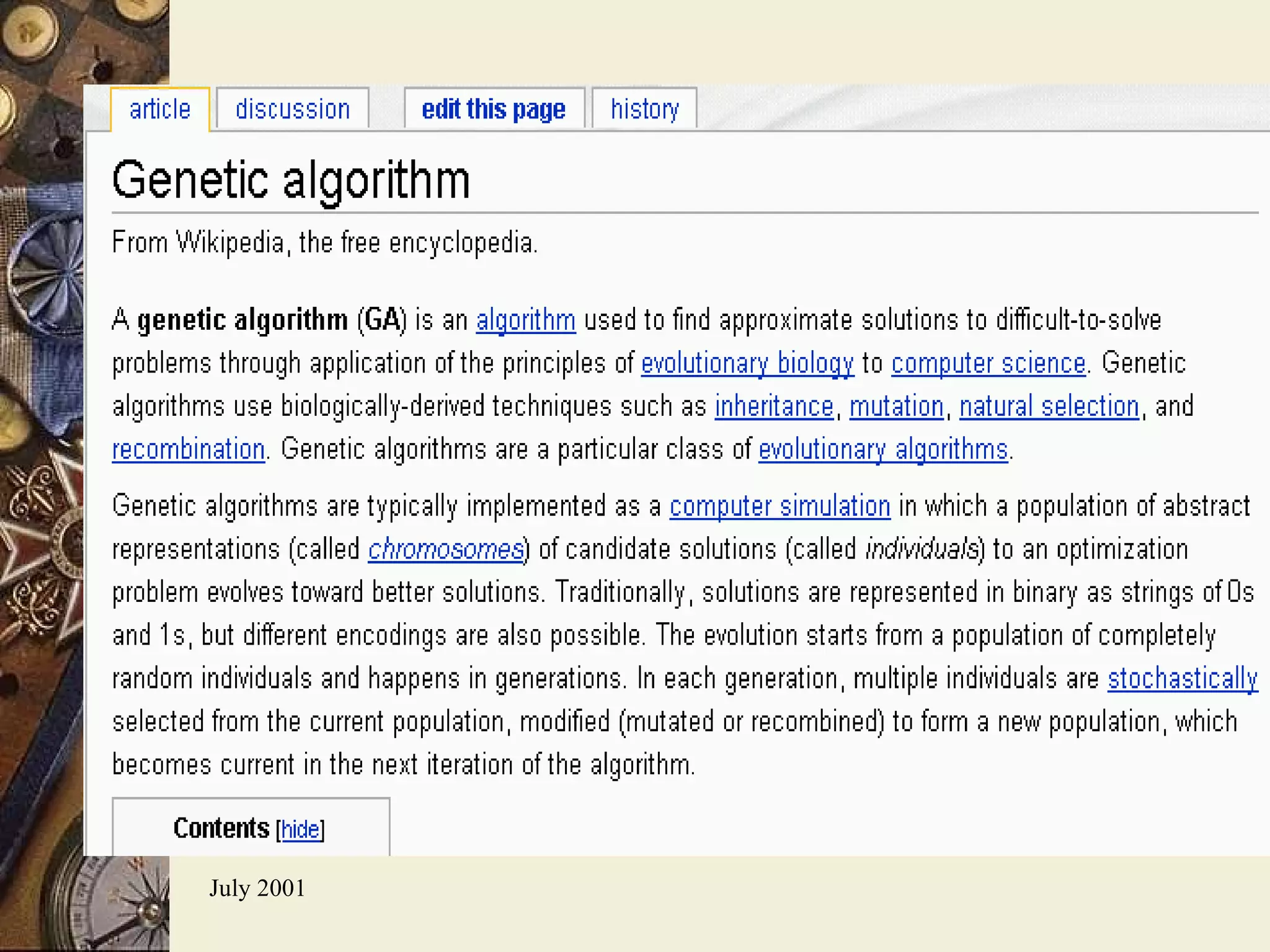
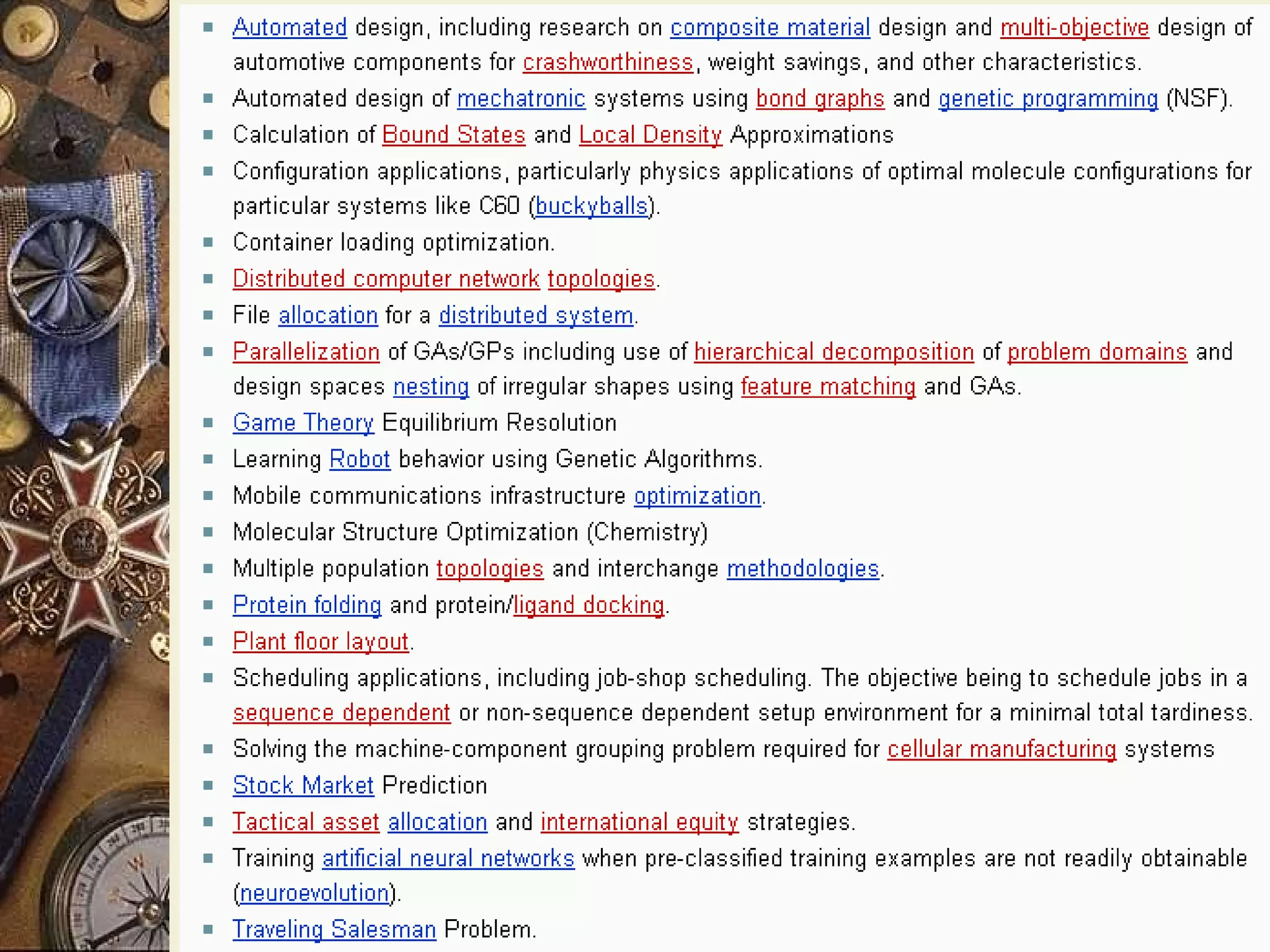
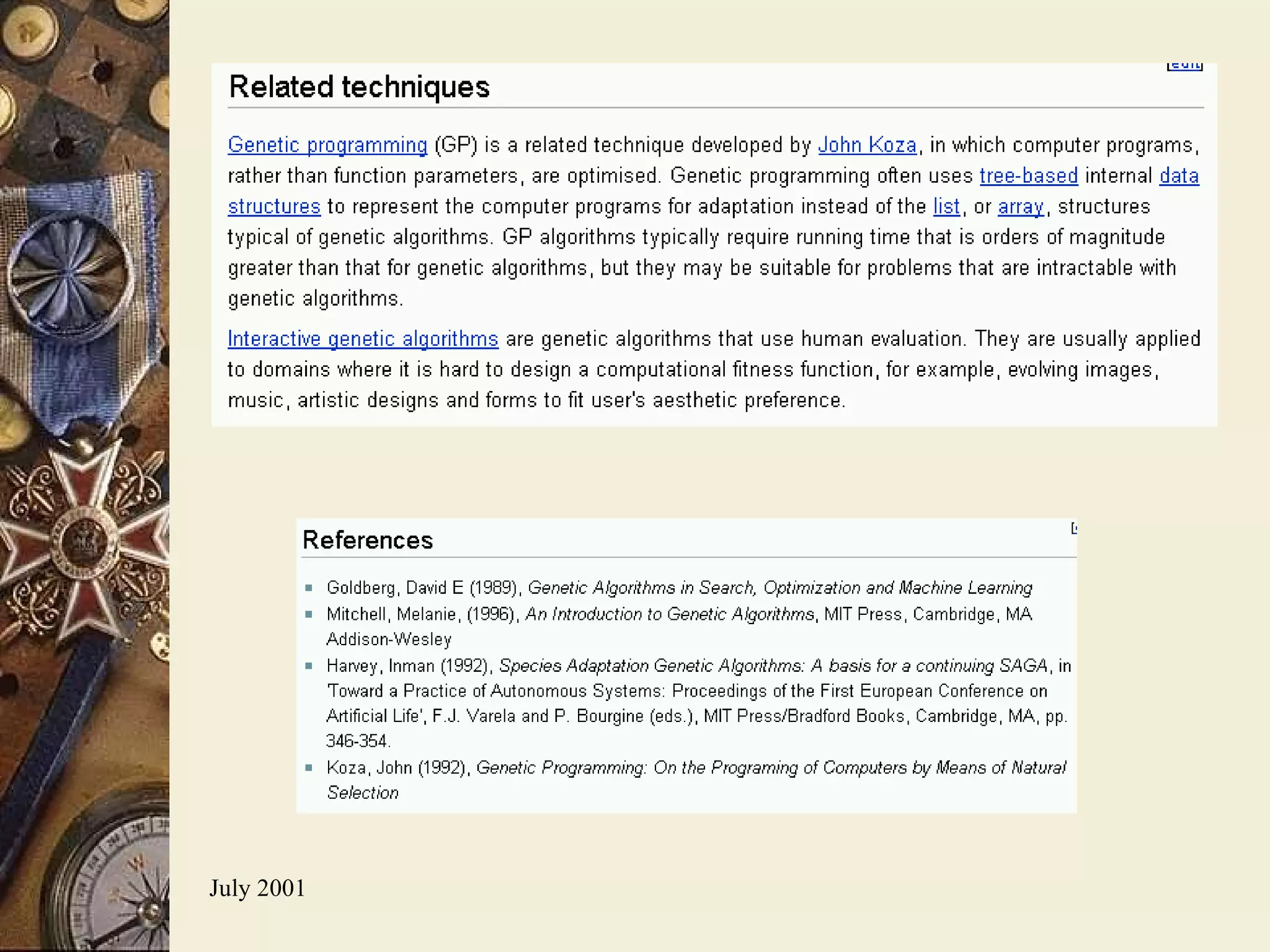




An Evolutionary approach to Standard Cell Design: a proof of concept Anil Bahuman Artificial Intelligence Center University of Georgia July 2001


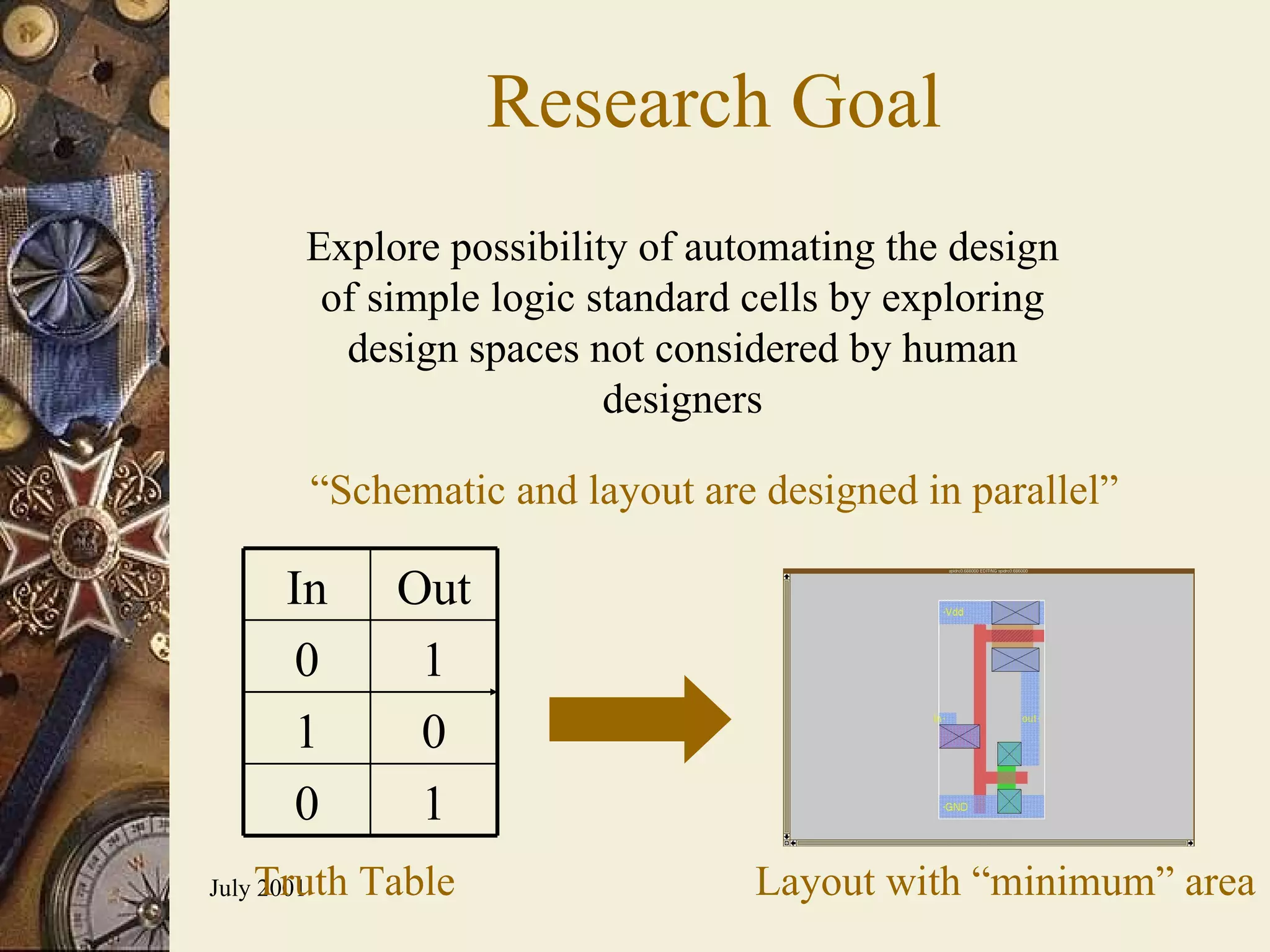
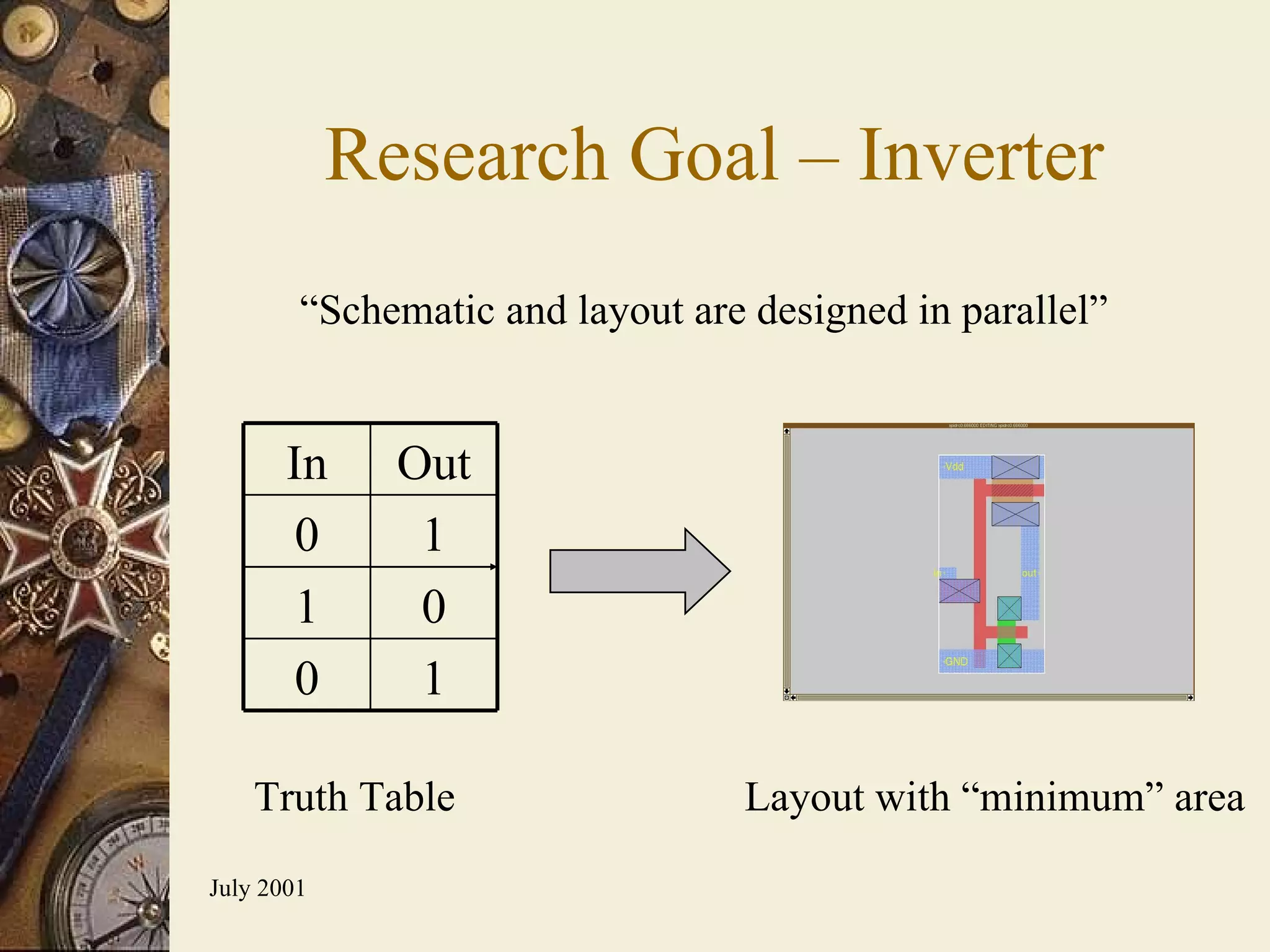
Research Goal Truth Table Layout with “minimum” area “ Schematic and layout are designed in parallel” Explore possibility of automating the design of simple logic standard cells by exploring design spaces not considered by human designers 1 0 1 0 0 1 Out In
Standard Cell Design Building blocks for chips. Frequently used logics. NAND, full adder, latch etc. Costly (time + money) to redesign. Can we design on-the-fly? Standard cells are building blocks of frequently used logics employed in VLSI Design.  Examples include NAND, Full Adder, Latch and Inverter.  These libraries are typically designed by hand in a very costly and time consuming process.  One of the major challenges is the migration of standard cell layouts every time there is a change in the process.  There is a strong need for automation alternatives.
Design Example
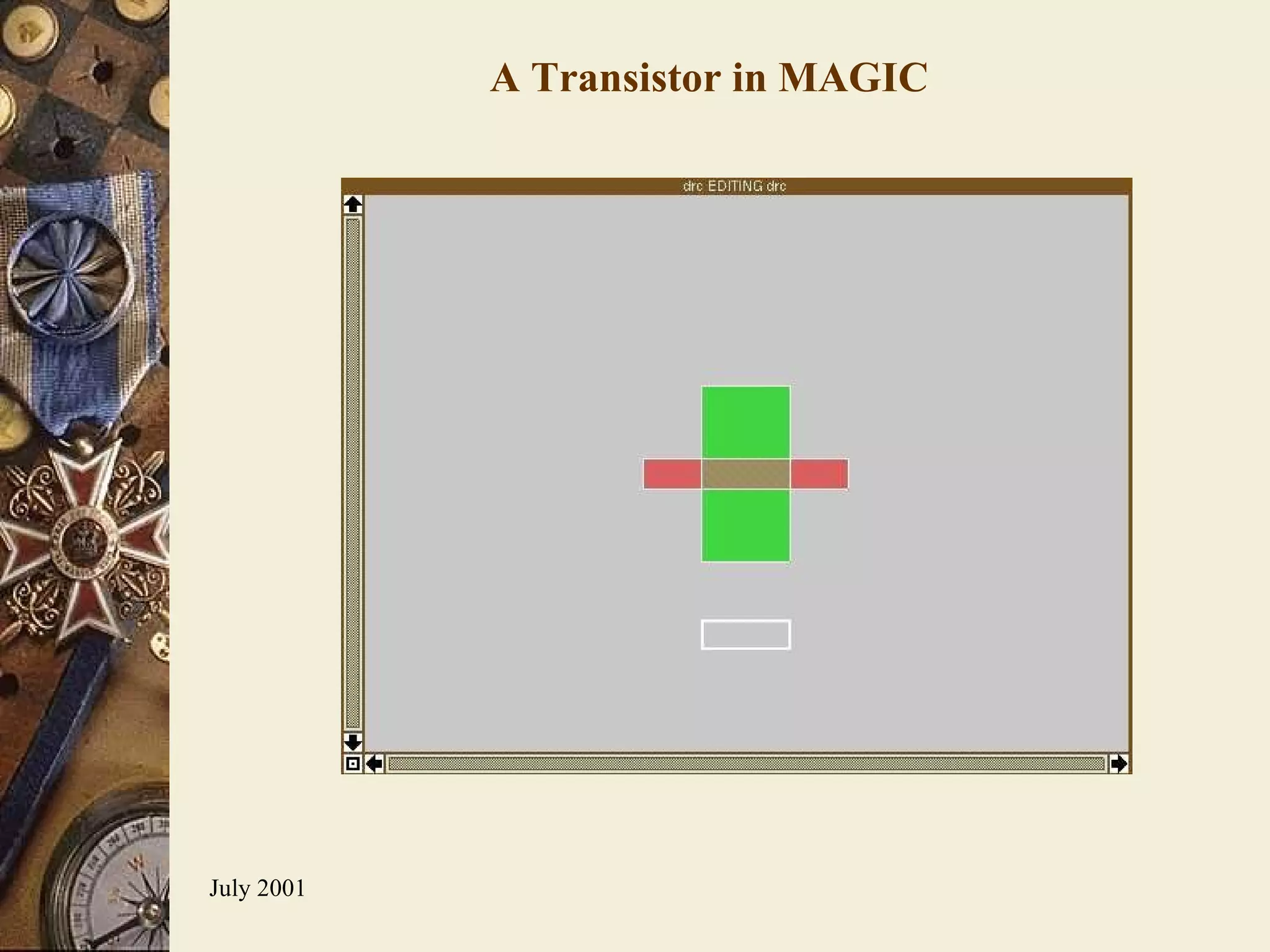
A Transistor in MAGIC
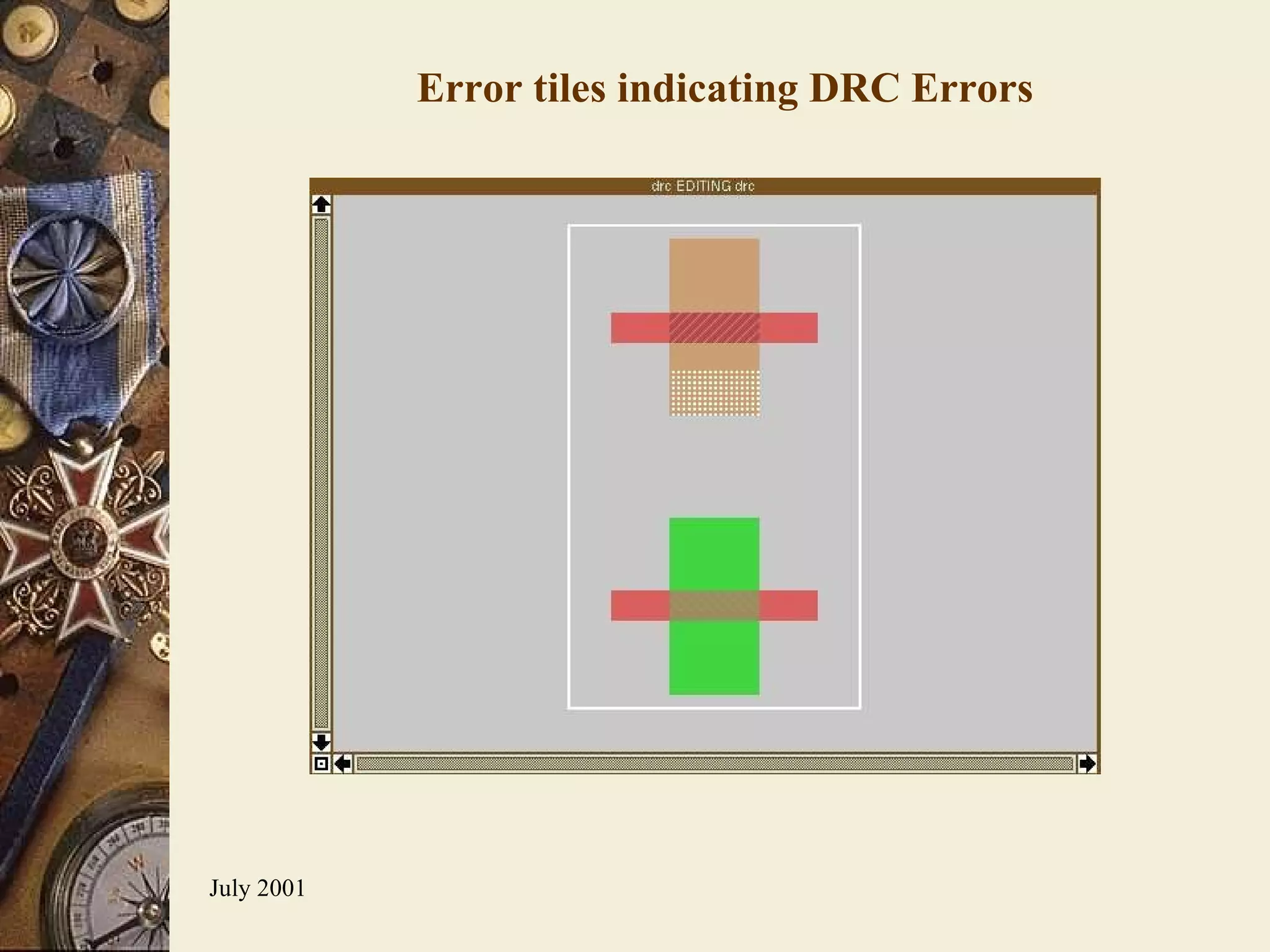
Error tiles indicating DRC Errors
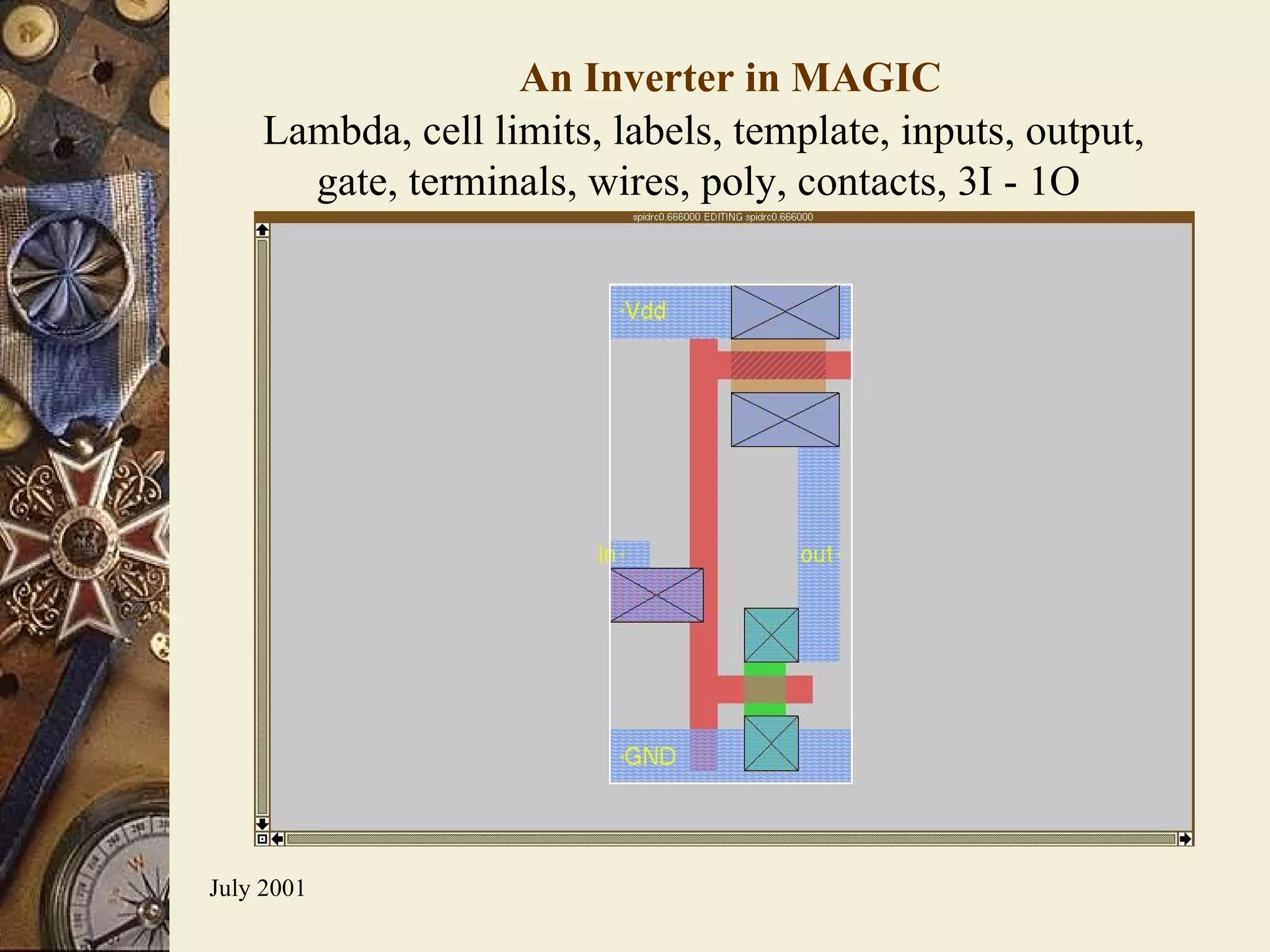
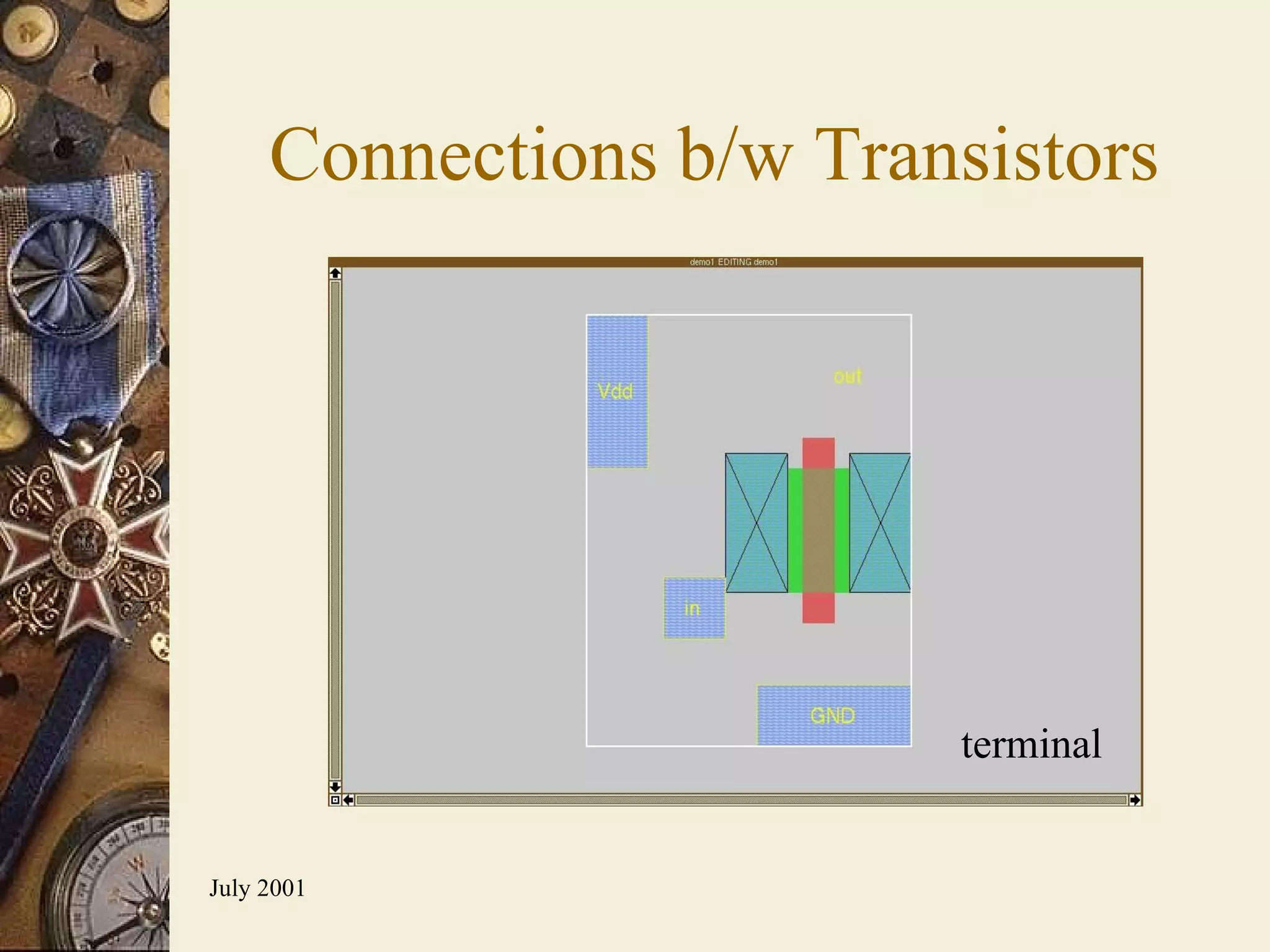
An Inverter in MAGIC Lambda, cell limits, labels, template, inputs, output, gate, terminals, wires, poly, contacts, 3I - 1O
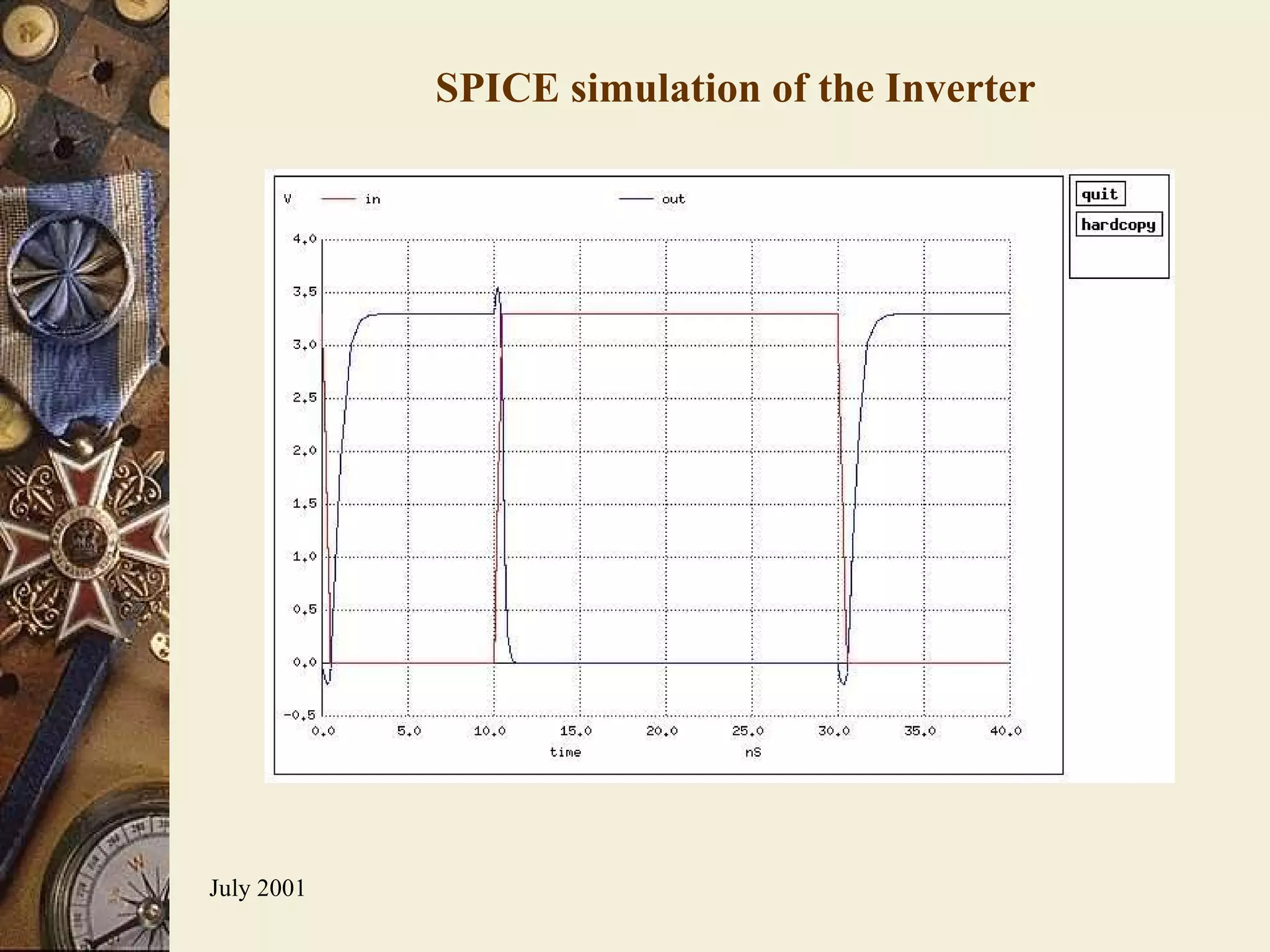
SPICE simulation of the Inverter
Research Goal
Research Goal – Inverter Truth Table Layout with “minimum” area “ Schematic and layout are designed in parallel” 1 0 1 0 0 1 Out In
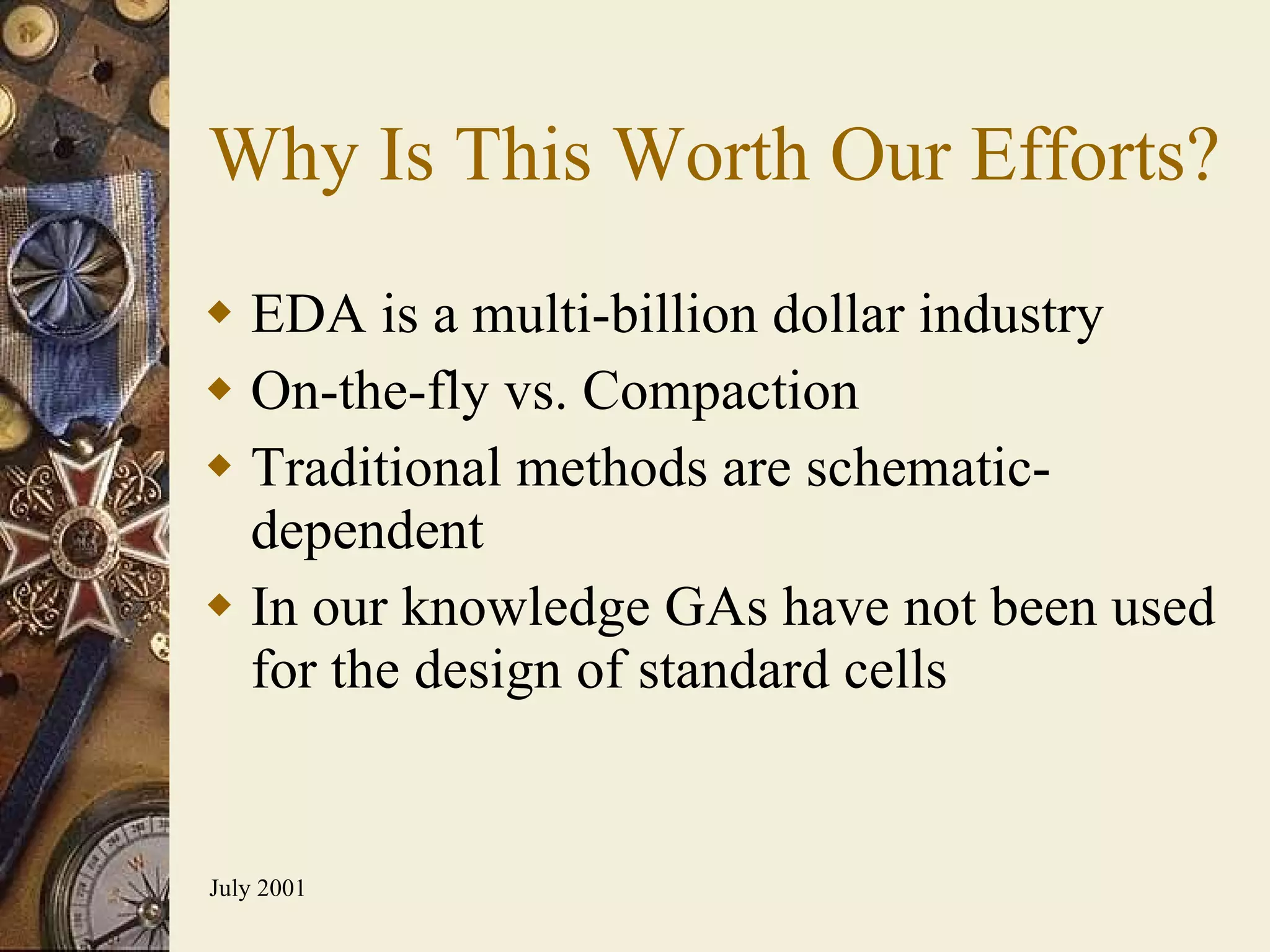
Why Is This Worth Our Efforts? EDA is a multi-billion dollar industry On-the-fly vs. Compaction Traditional methods are schematic-dependent In our knowledge GAs have not been used for the design of standard cells
Architecture
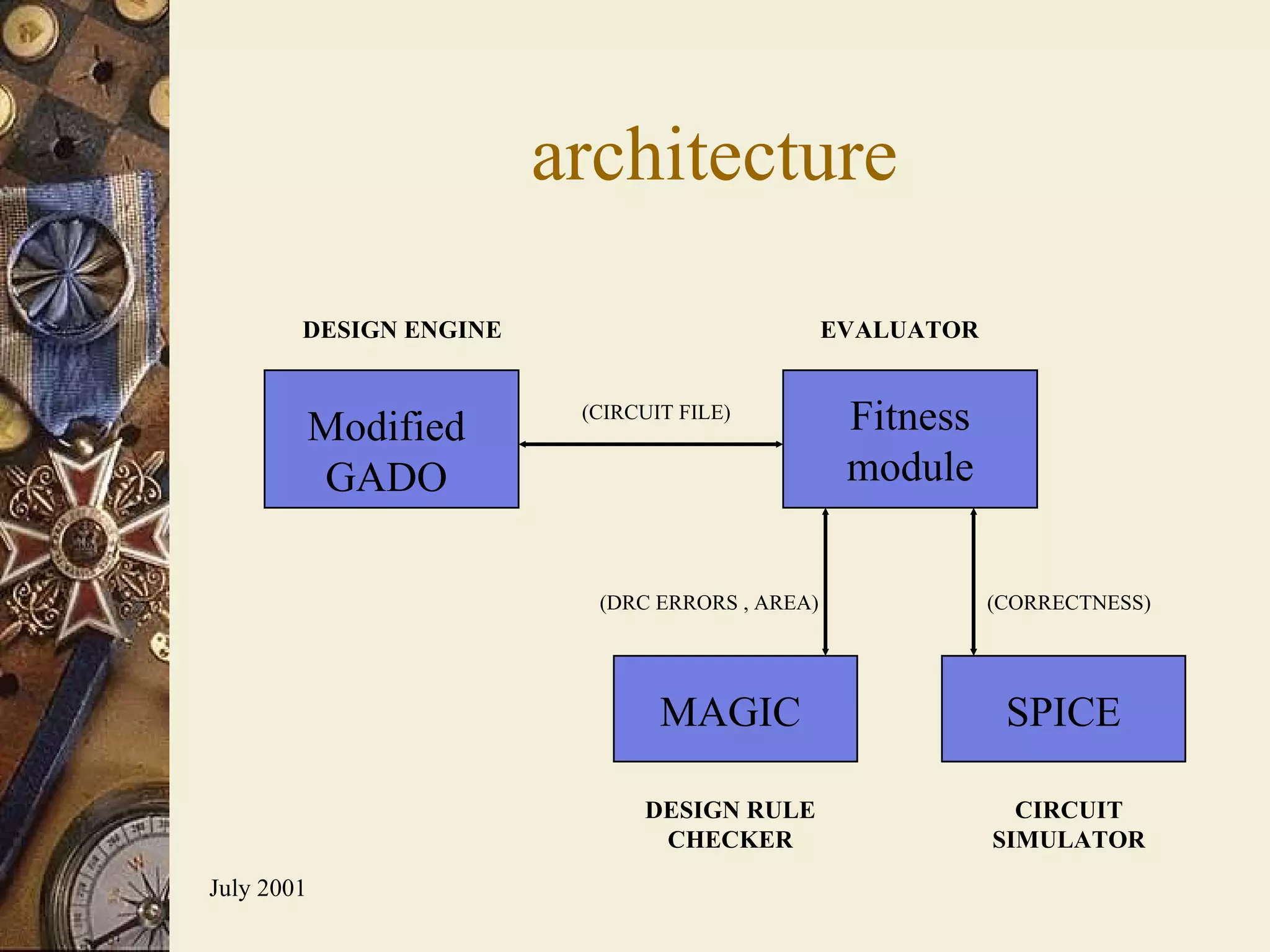
architecture MAGIC  SPICE Modified GADO (DRC ERRORS , AREA) (CORRECTNESS) DESIGN ENGINE EVALUATOR DESIGN RULE CHECKER CIRCUIT SIMULATOR Fitness module (CIRCUIT FILE)
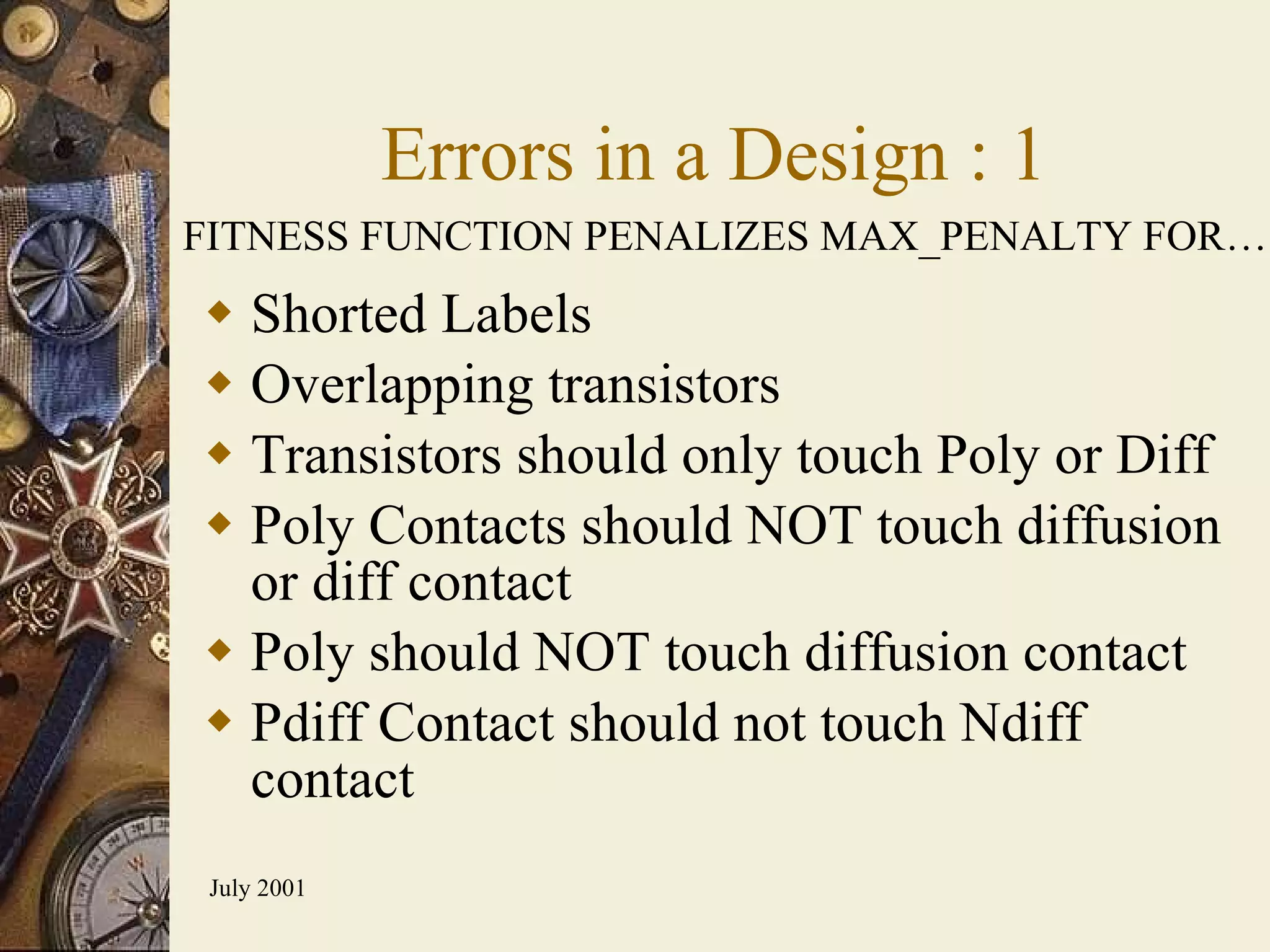
Errors in a Design : 1 Shorted Labels Overlapping transistors Transistors should only touch Poly or Diff  Poly Contacts should NOT touch diffusion or diff contact Poly should NOT touch diffusion contact Pdiff Contact should not touch Ndiff contact FITNESS FUNCTION PENALIZES MAX_PENALTY FOR…
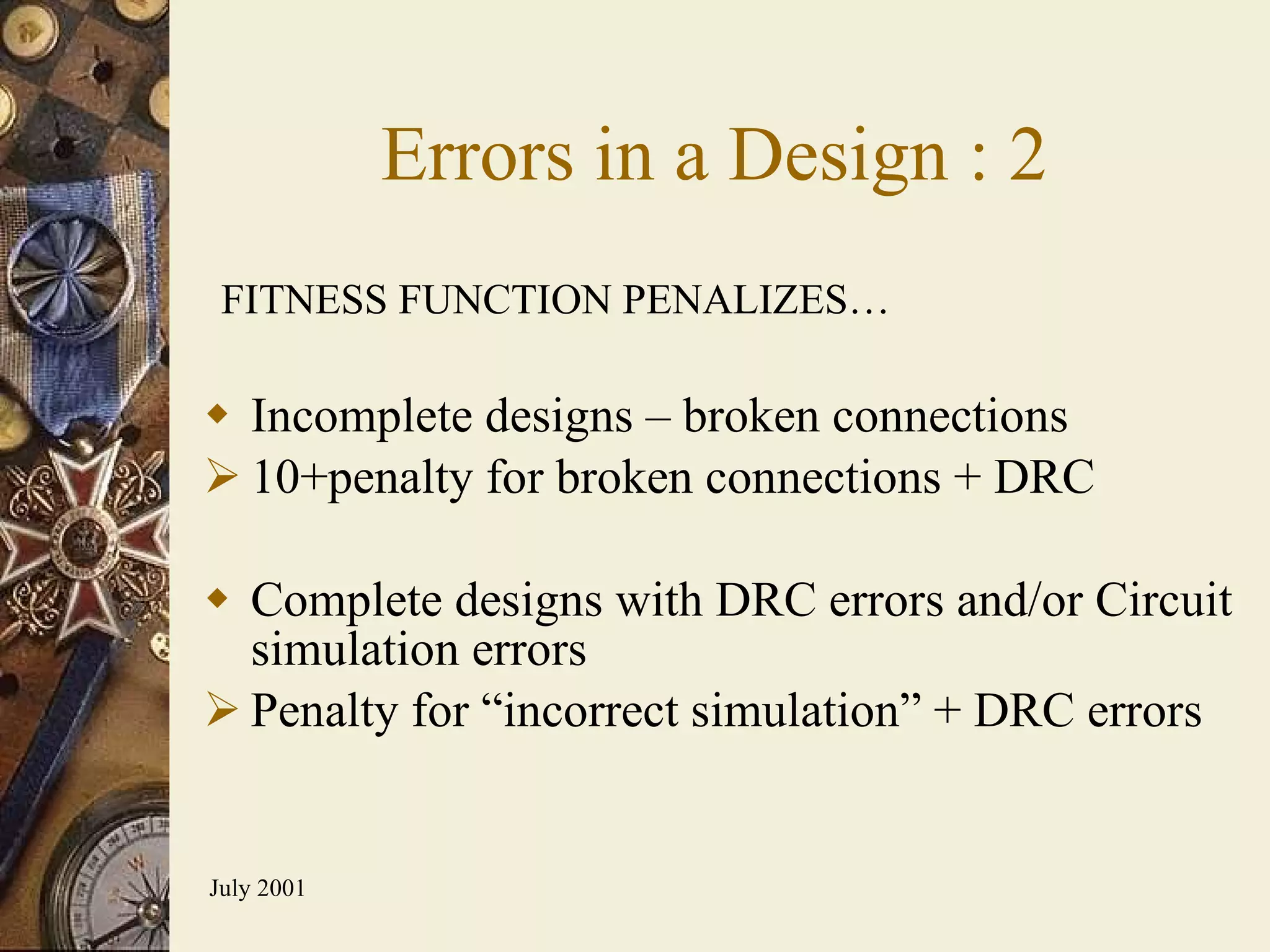
Incomplete designs – broken connections 10+penalty for broken connections + DRC Complete designs with DRC errors and/or Circuit simulation errors Penalty for “incorrect simulation” + DRC errors Errors in a Design : 2 FITNESS FUNCTION PENALIZES…
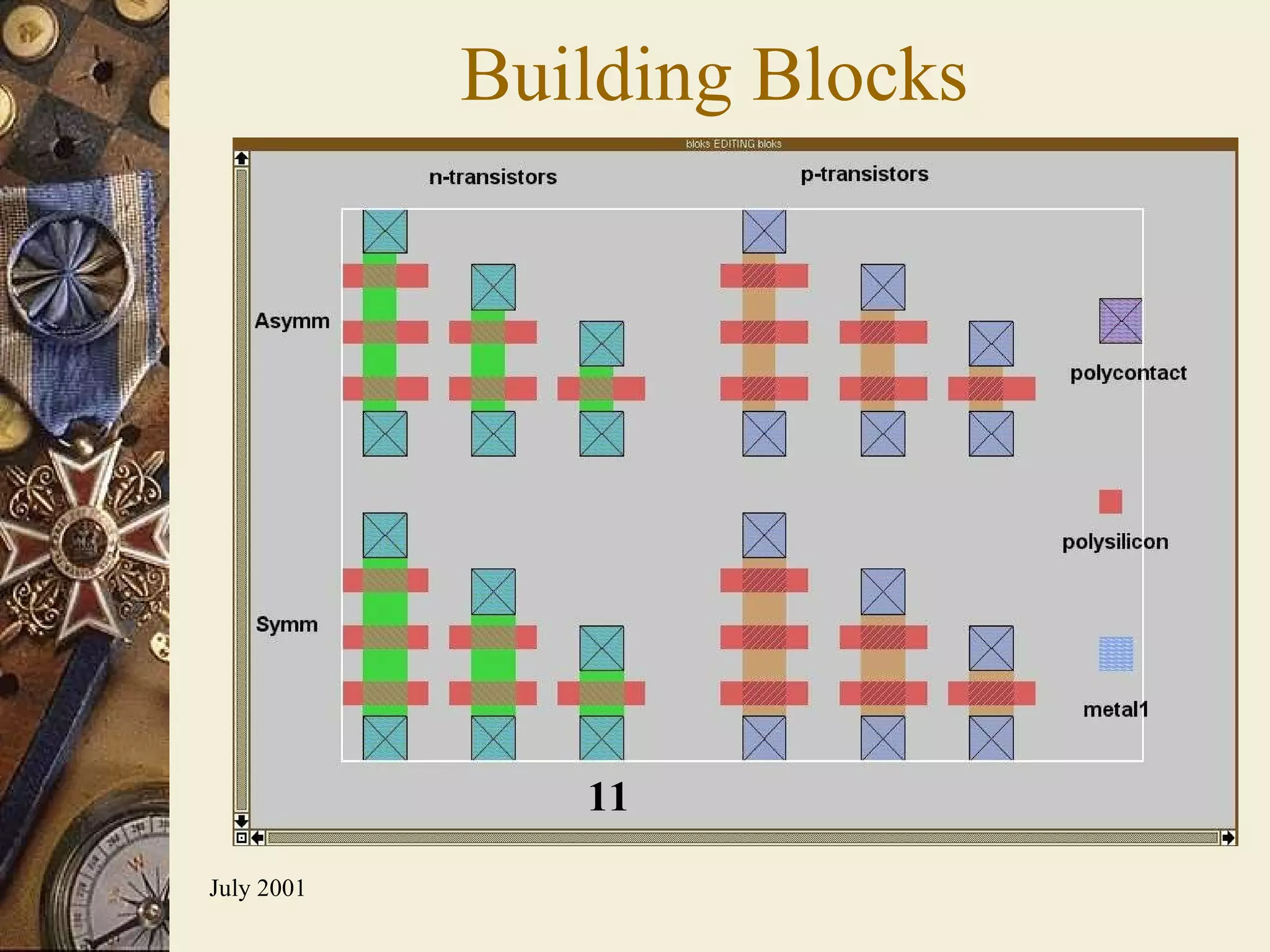
11 Building Blocks
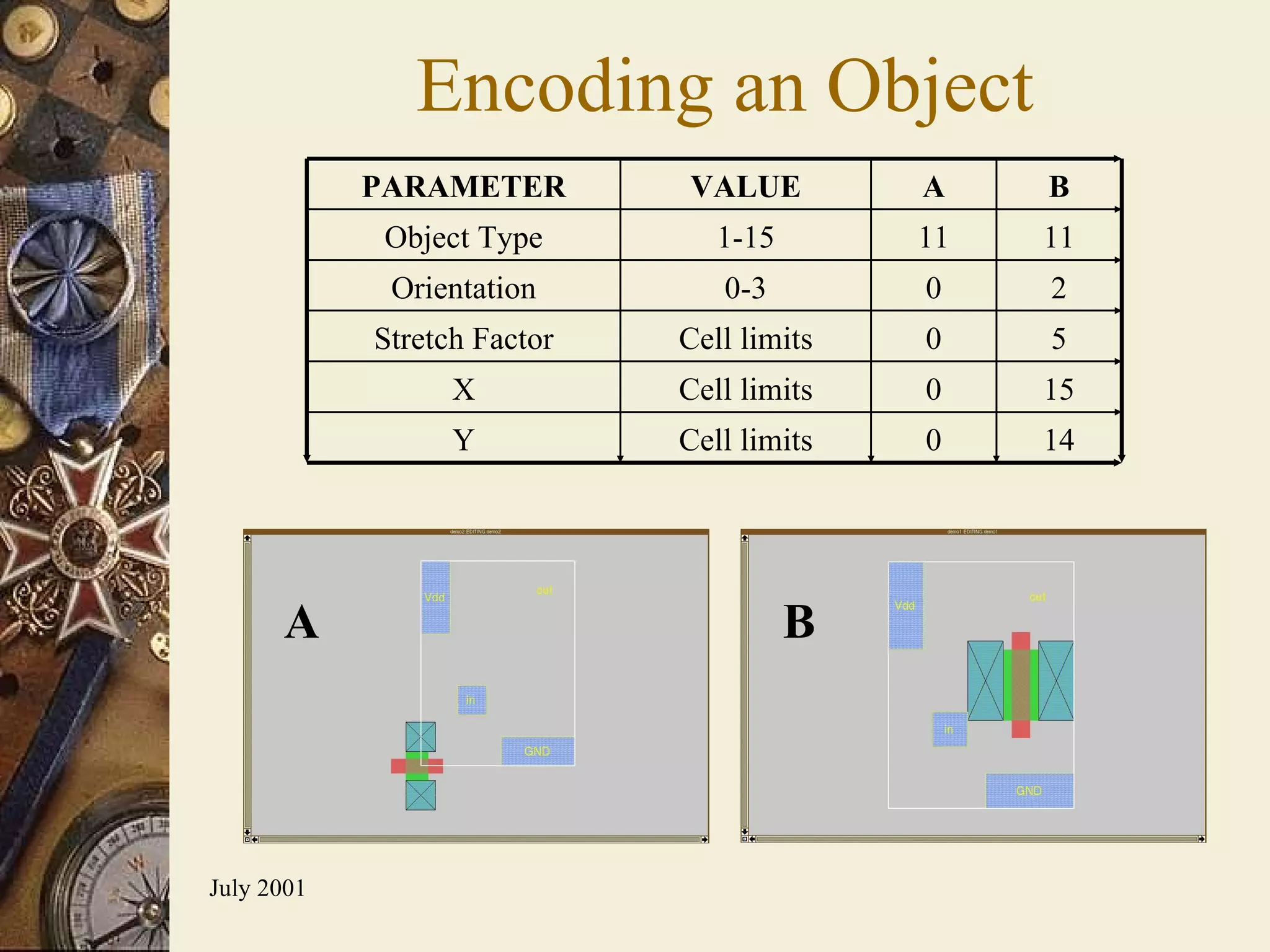
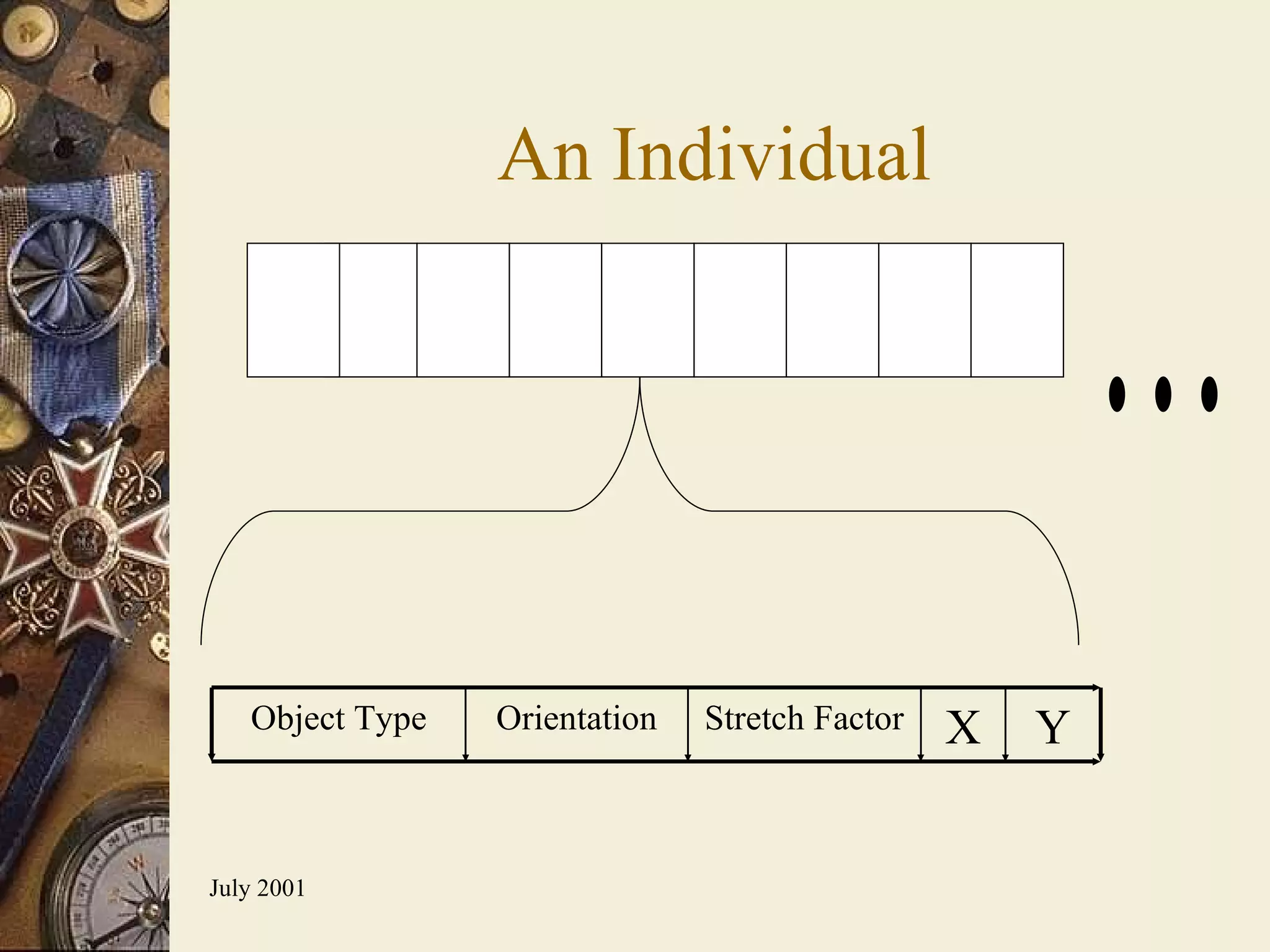
Encoding an Object A B 14 0 Cell limits Y 15 0 Cell limits X 5 0 Cell limits Stretch Factor 2 0 0-3 Orientation 11 11 1-15 Object Type B A VALUE PARAMETER
An Individual Y X Stretch Factor Orientation Object Type
Connections b/w Transistors terminal
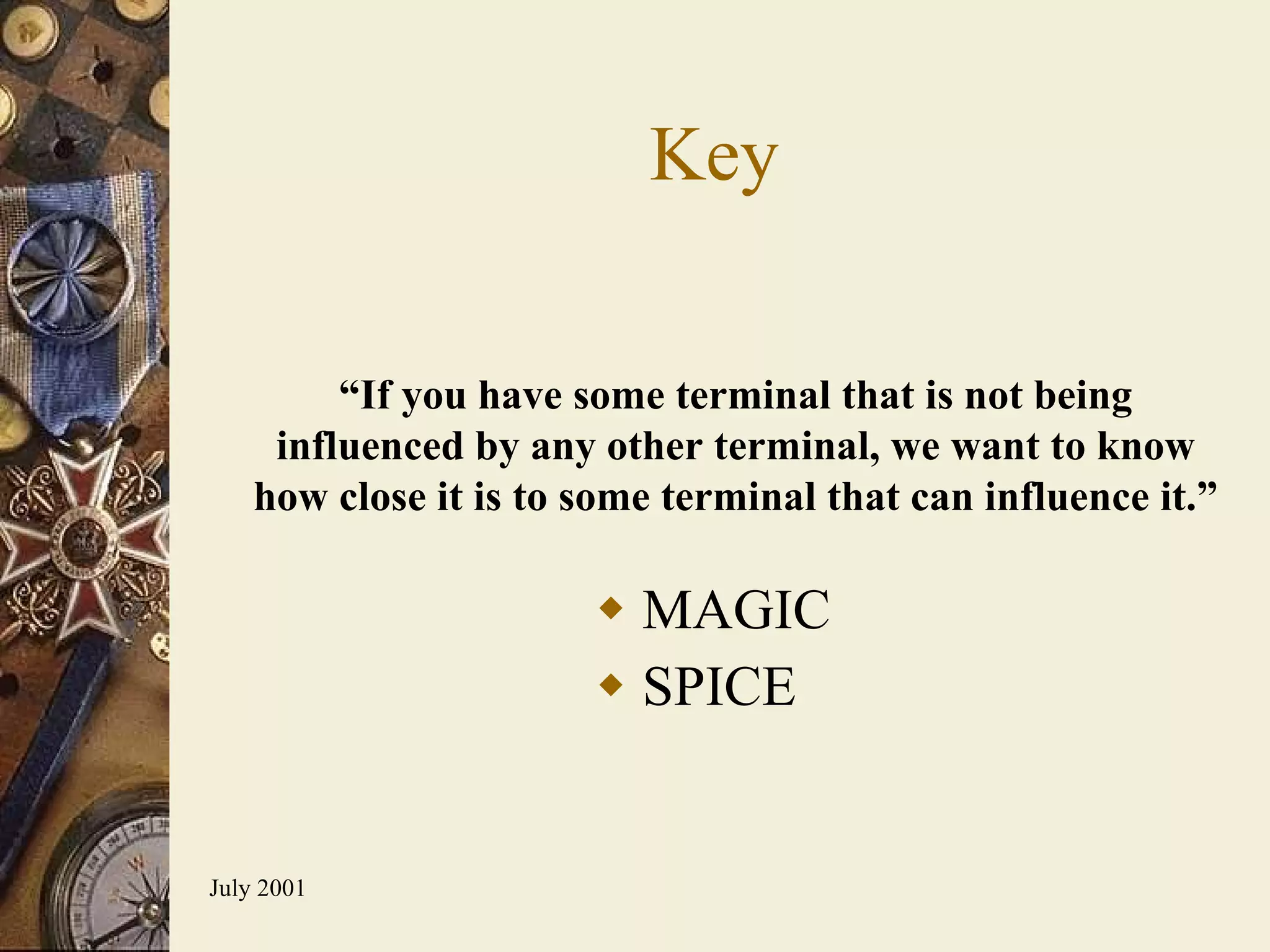
Key MAGIC SPICE “ If you have some terminal that is not being influenced by any other terminal, we want to know how close it is to some terminal that can influence it. ”
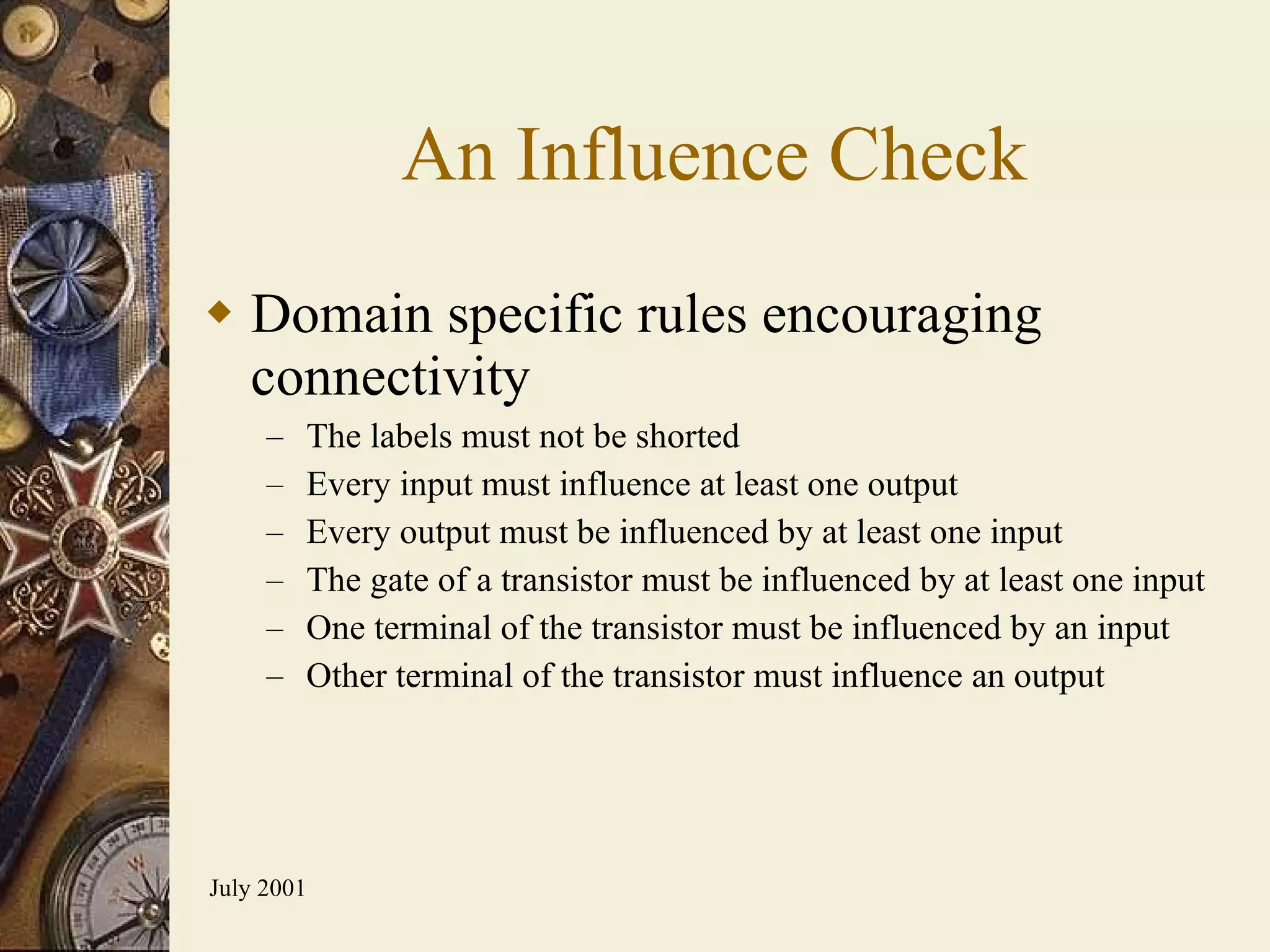
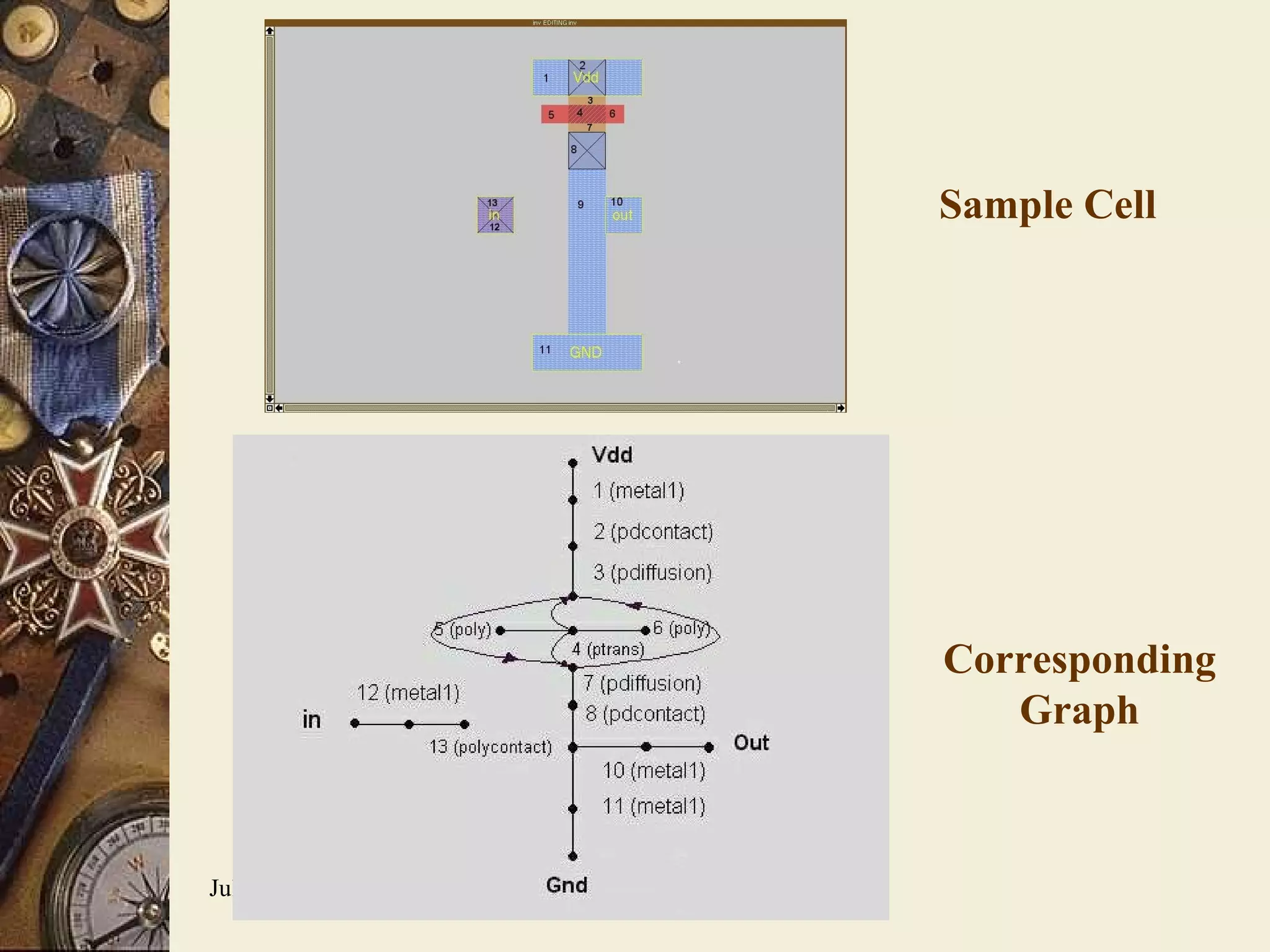
An Influence Check Domain specific rules encouraging connectivity The labels must not be shorted Every input must influence at least one output Every output must be influenced by at least one input The gate of a transistor must be influenced by at least one input One terminal of the transistor must be influenced by an input Other terminal of the transistor must influence an output
Sample Cell Corresponding Graph
Results
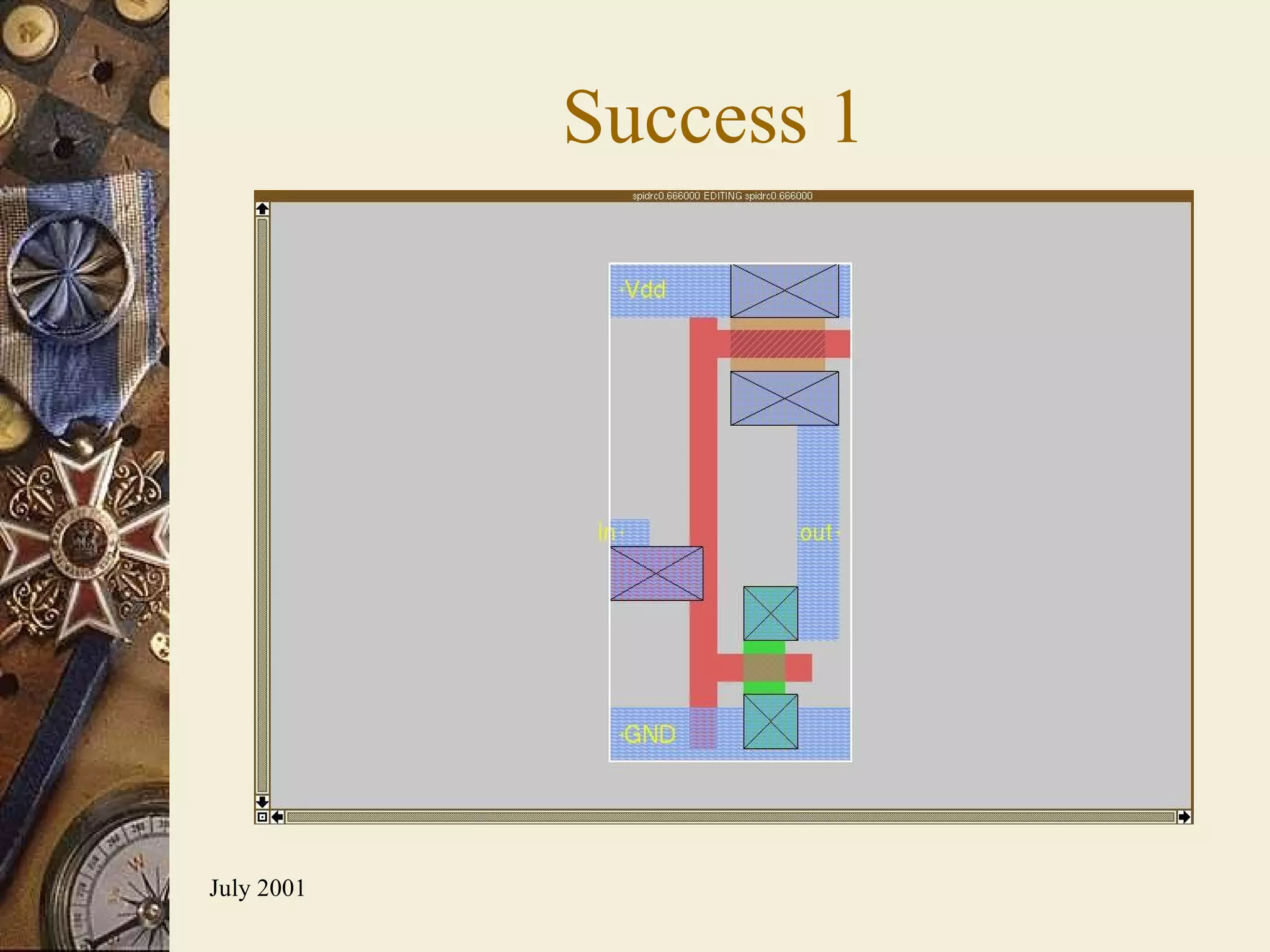
Success 1
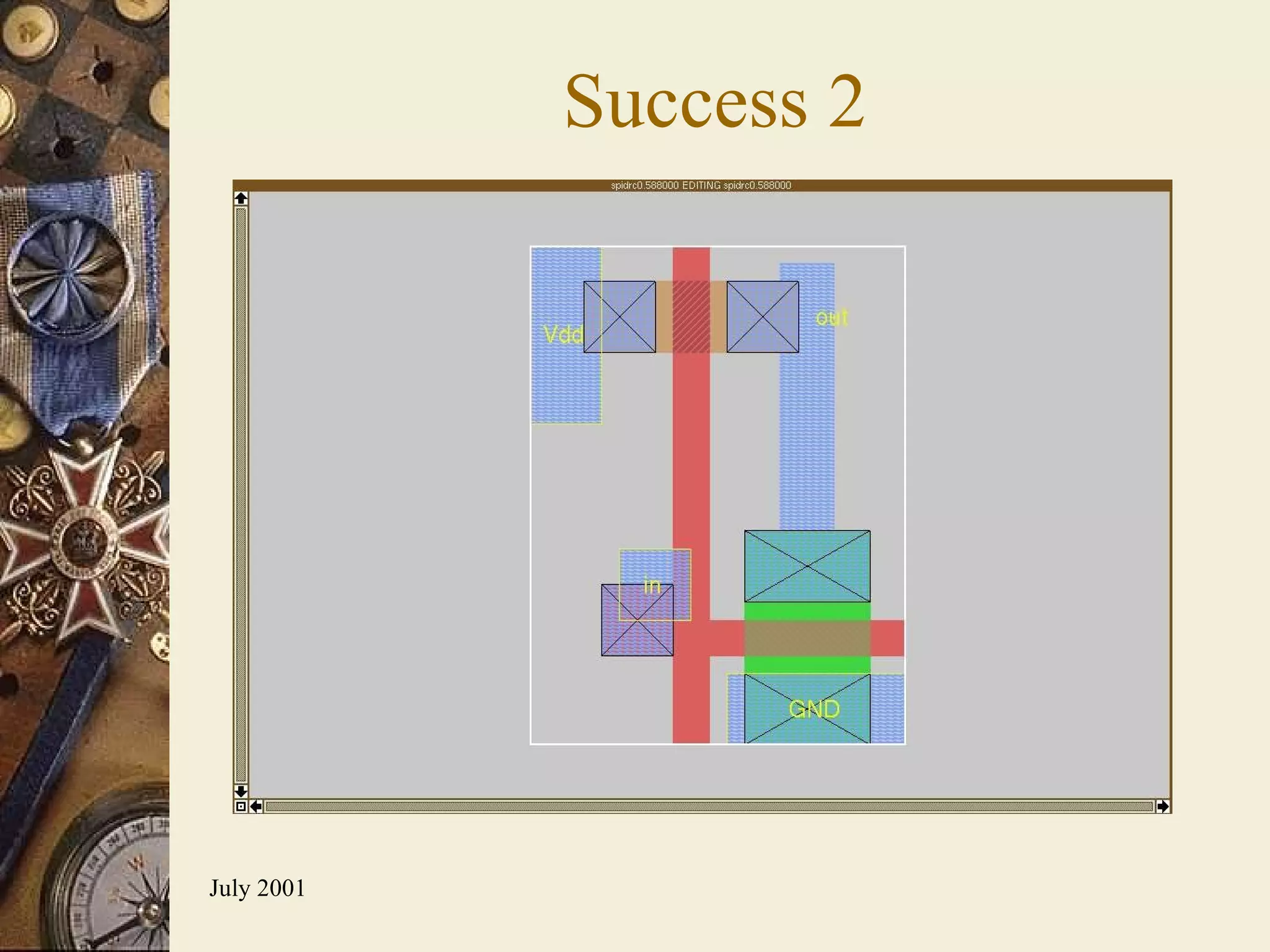
Success 2
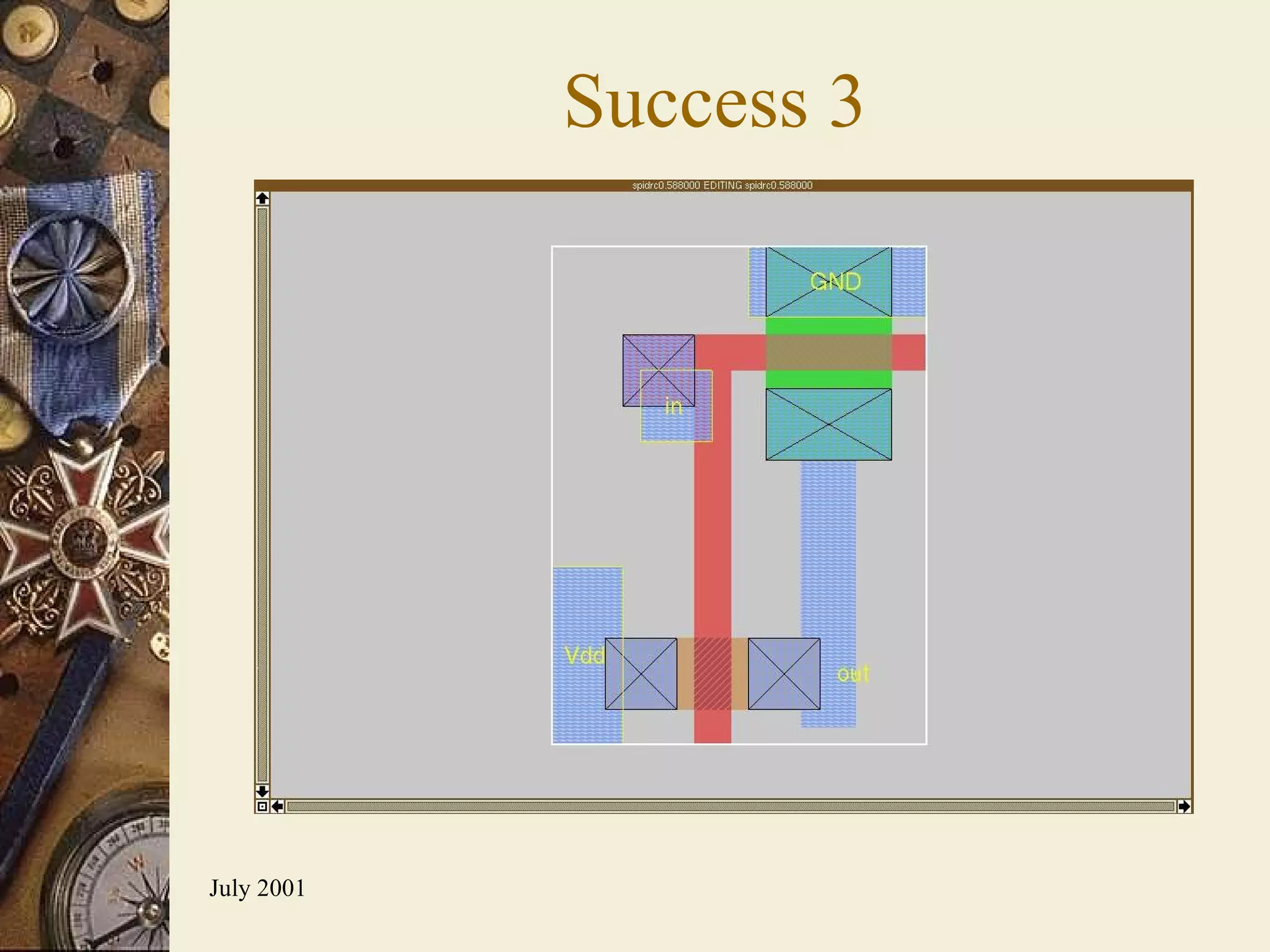
Success 3
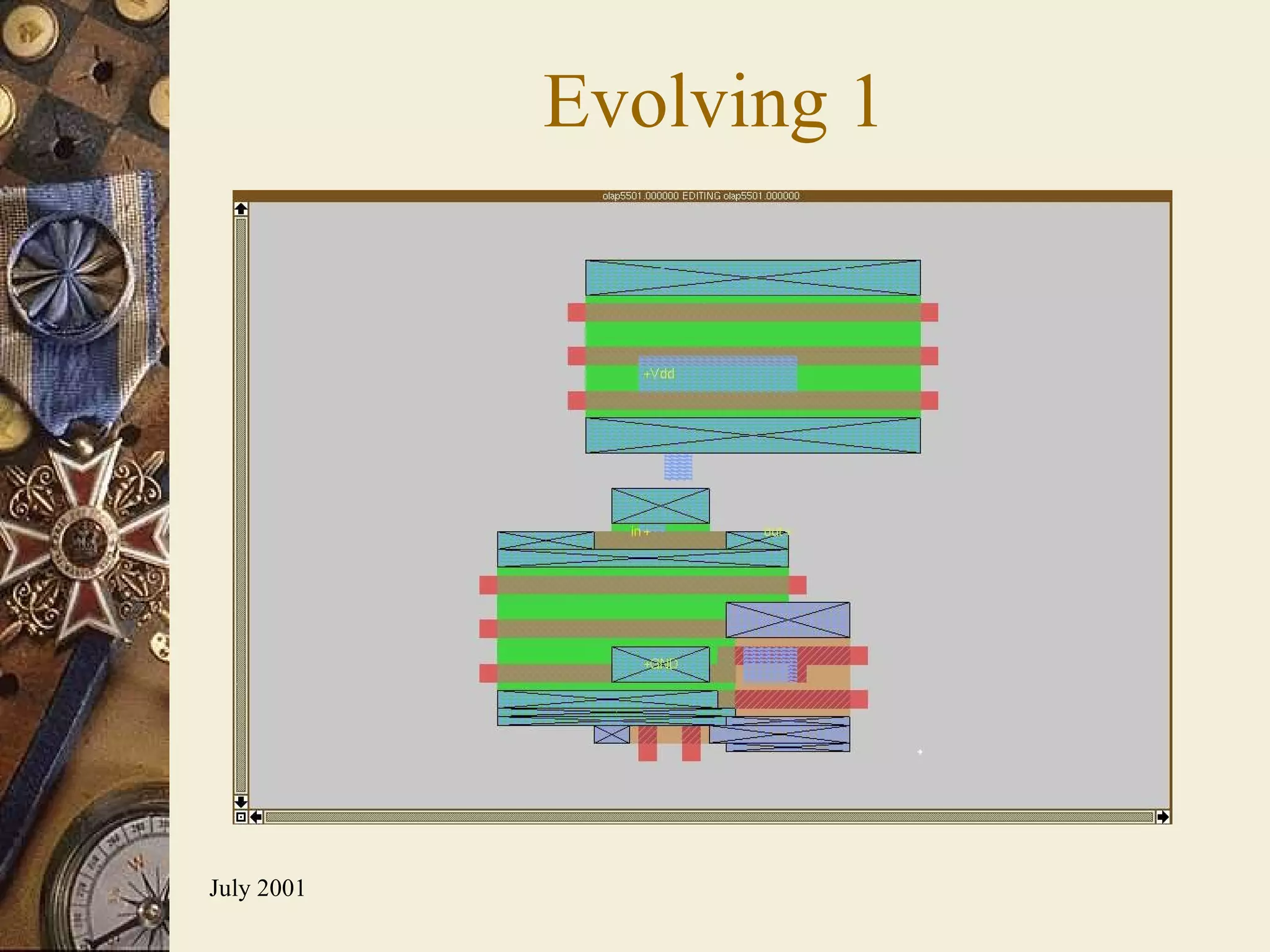
Evolving 1
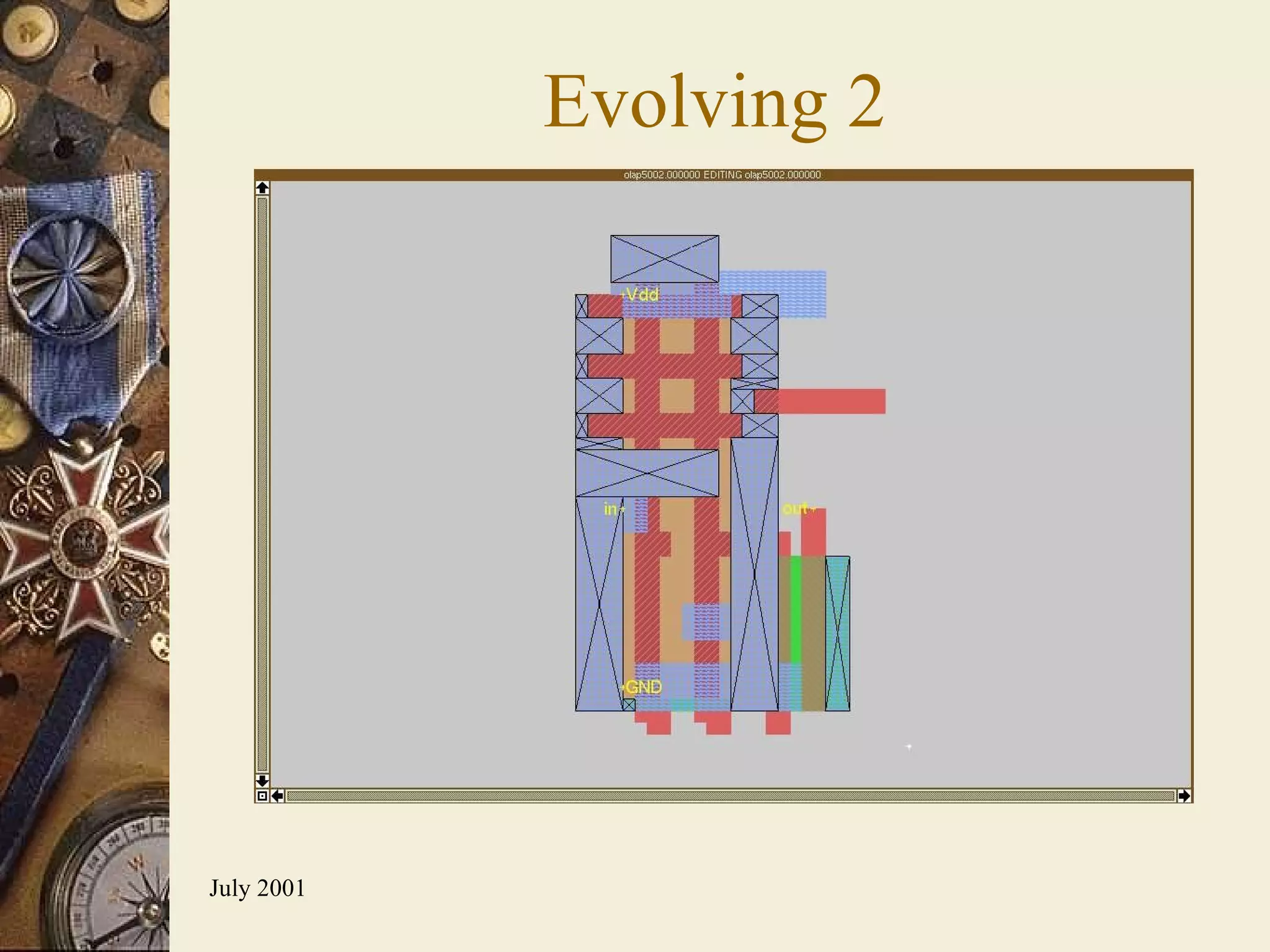
Evolving 2
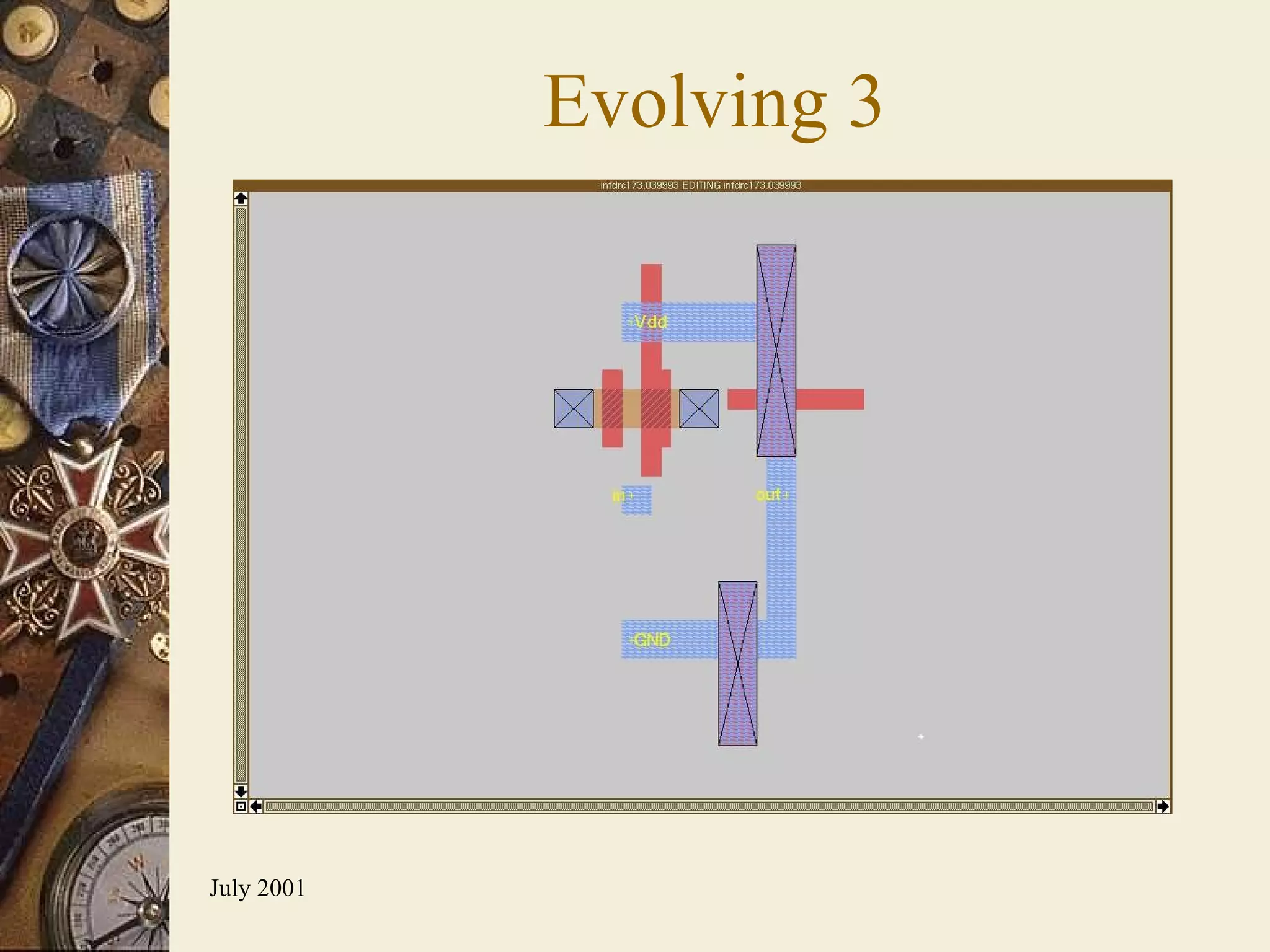
Evolving 3
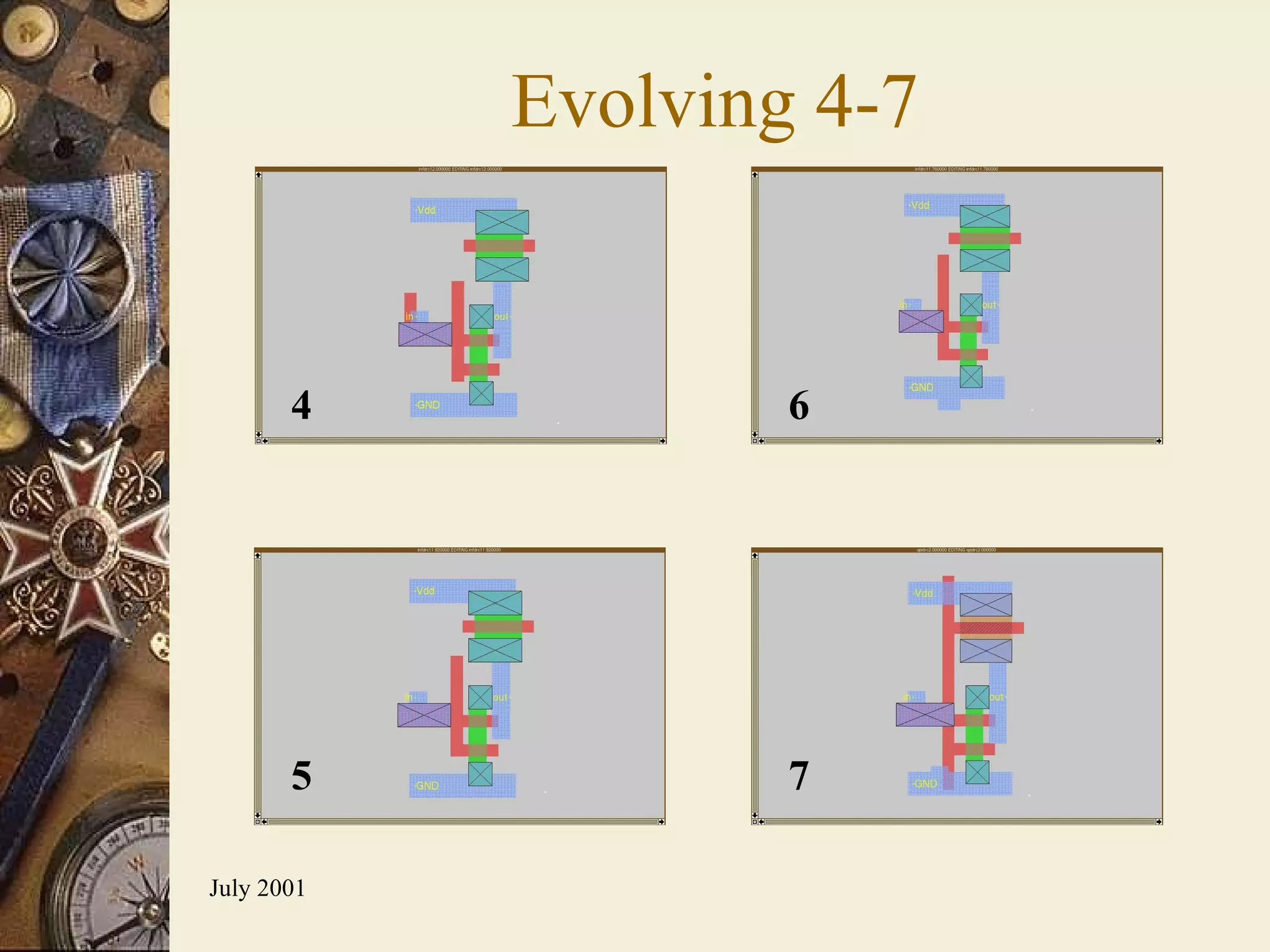
Evolving 4-7 4 6 5 7
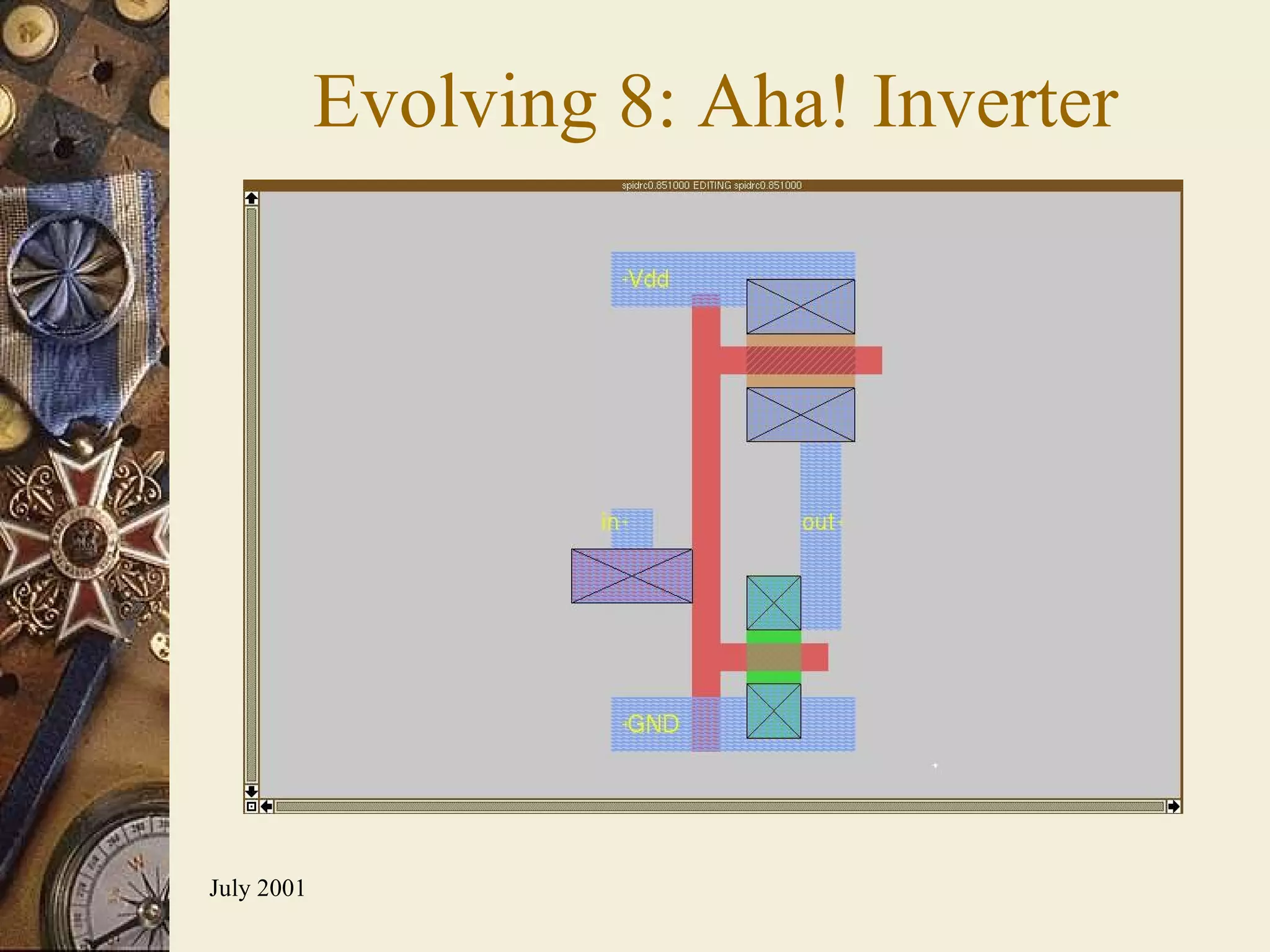
Evolving 8: Aha! Inverter
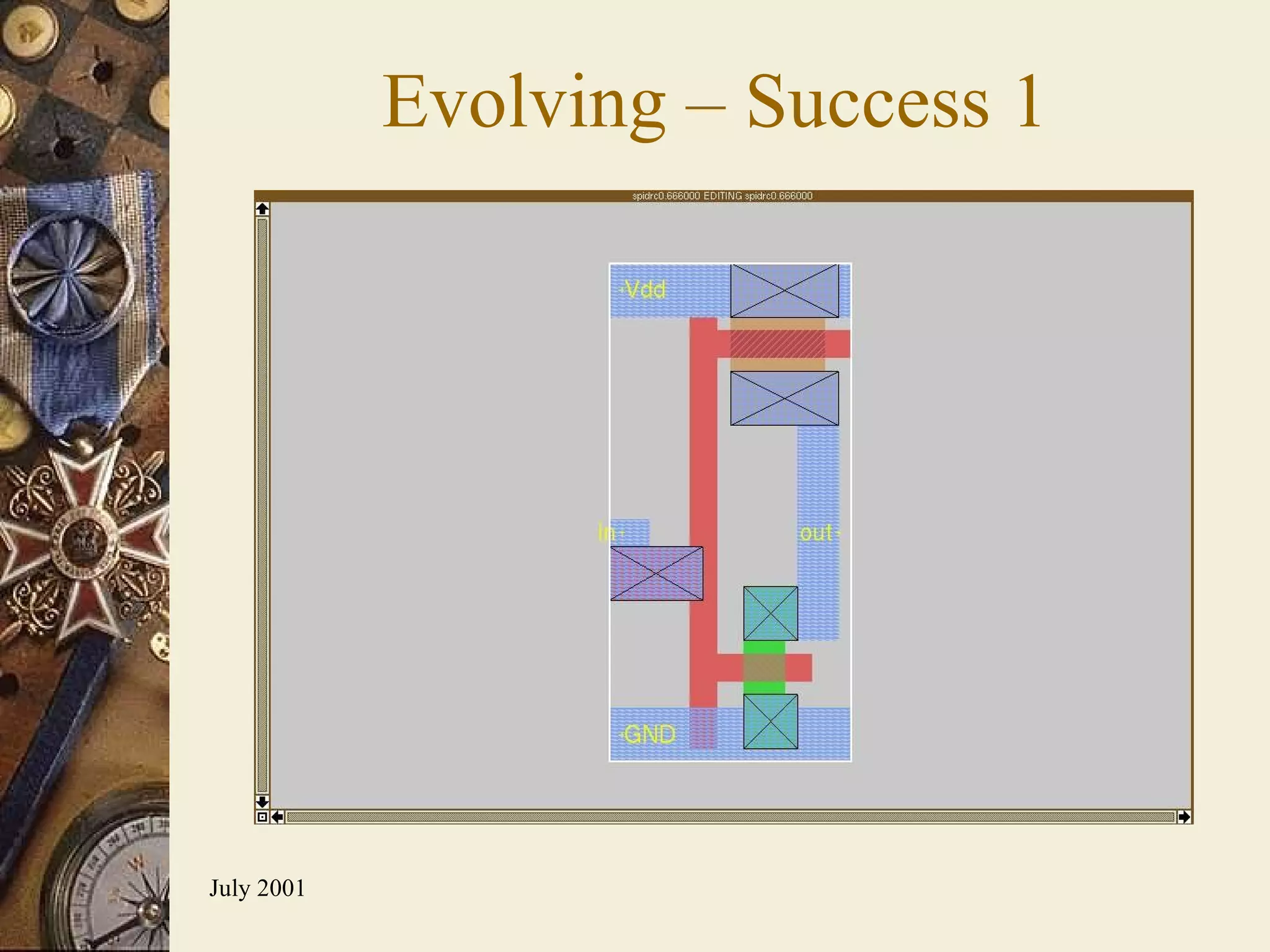
Evolving – Success 1
Limitations Does not always find the best solution – Is this acceptable? Presently unable to design more complex cells Alternative representation Starting from similar designs Speed – almost linear speedup [Mazumder]
References 1 T. Lengauer.  Combinatorial Algorithms for Integrated Circuit Layout. K. Rasheed.  GADO:  A Genetic Algorithm for Continuous Design Optimization, PhD. Thesis.  http://www.cs.uga.edu/~khaled P. Mazumder and E. M. Rudnick.  Genetic Algorithms for VLSI Design, Layout & Test Automation. D. E. Goldberg.  Genetic Algorithms in Search, Optimization and Machine Learning. J. Rabaey.  Digital Integrated Circuits: A Design Perspective.
References 2 N. H. E. Weste, K. Eshragian.  Principles of CMOS VLSI Design. C. Edwards . EDA Vendors Rethink Standard-Cell Libraries, Electronics Times, June 2000. D. Pietromonaco.  Automating Cost-Effective Library Creation, Integrated System Design, November 2000. http://www.research.compaq.com/wrl/projects/ magic / http://bwrc.eecs.berkeley.edu/Classes/IcBook/ SPICE / http://ece.www.colorado.edu/~ecen4228/ spice /spice.htm
Merci  Danke   Sas efharisto   Mahalo  Merci  Dhanyavaad  Arigato   Vandane  Wneeweh  Shukran

Example of Automating Transistor-level Design

  • 1.
    An Evolutionary approachto Standard Cell Design: a proof of concept Anil Bahuman Artificial Intelligence Center University of Georgia July 2001
  • 2.
  • 3.
  • 4.
  • 5.
    Research Goal TruthTable Layout with “minimum” area “ Schematic and layout are designed in parallel” Explore possibility of automating the design of simple logic standard cells by exploring design spaces not considered by human designers 1 0 1 0 0 1 Out In
  • 6.
    Standard Cell DesignBuilding blocks for chips. Frequently used logics. NAND, full adder, latch etc. Costly (time + money) to redesign. Can we design on-the-fly? Standard cells are building blocks of frequently used logics employed in VLSI Design. Examples include NAND, Full Adder, Latch and Inverter. These libraries are typically designed by hand in a very costly and time consuming process. One of the major challenges is the migration of standard cell layouts every time there is a change in the process. There is a strong need for automation alternatives.
  • 7.
  • 8.
  • 9.
  • 10.
    An Inverter inMAGIC Lambda, cell limits, labels, template, inputs, output, gate, terminals, wires, poly, contacts, 3I - 1O
  • 11.
    SPICE simulation ofthe Inverter
  • 12.
  • 13.
    Research Goal –Inverter Truth Table Layout with “minimum” area “ Schematic and layout are designed in parallel” 1 0 1 0 0 1 Out In
  • 14.
    Why Is ThisWorth Our Efforts? EDA is a multi-billion dollar industry On-the-fly vs. Compaction Traditional methods are schematic-dependent In our knowledge GAs have not been used for the design of standard cells
  • 15.
  • 16.
    architecture MAGIC SPICE Modified GADO (DRC ERRORS , AREA) (CORRECTNESS) DESIGN ENGINE EVALUATOR DESIGN RULE CHECKER CIRCUIT SIMULATOR Fitness module (CIRCUIT FILE)
  • 17.
    Errors in aDesign : 1 Shorted Labels Overlapping transistors Transistors should only touch Poly or Diff Poly Contacts should NOT touch diffusion or diff contact Poly should NOT touch diffusion contact Pdiff Contact should not touch Ndiff contact FITNESS FUNCTION PENALIZES MAX_PENALTY FOR…
  • 18.
    Incomplete designs –broken connections 10+penalty for broken connections + DRC Complete designs with DRC errors and/or Circuit simulation errors Penalty for “incorrect simulation” + DRC errors Errors in a Design : 2 FITNESS FUNCTION PENALIZES…
  • 19.
  • 20.
    Encoding an ObjectA B 14 0 Cell limits Y 15 0 Cell limits X 5 0 Cell limits Stretch Factor 2 0 0-3 Orientation 11 11 1-15 Object Type B A VALUE PARAMETER
  • 21.
    An Individual YX Stretch Factor Orientation Object Type
  • 22.
  • 23.
    Key MAGIC SPICE“ If you have some terminal that is not being influenced by any other terminal, we want to know how close it is to some terminal that can influence it. ”
  • 24.
    An Influence CheckDomain specific rules encouraging connectivity The labels must not be shorted Every input must influence at least one output Every output must be influenced by at least one input The gate of a transistor must be influenced by at least one input One terminal of the transistor must be influenced by an input Other terminal of the transistor must influence an output
  • 25.
  • 26.
  • 27.
  • 28.
  • 29.
  • 30.
  • 31.
  • 32.
  • 33.
  • 34.
  • 35.
  • 36.
    Limitations Does notalways find the best solution – Is this acceptable? Presently unable to design more complex cells Alternative representation Starting from similar designs Speed – almost linear speedup [Mazumder]
  • 37.
    References 1 T.Lengauer. Combinatorial Algorithms for Integrated Circuit Layout. K. Rasheed. GADO: A Genetic Algorithm for Continuous Design Optimization, PhD. Thesis. http://www.cs.uga.edu/~khaled P. Mazumder and E. M. Rudnick. Genetic Algorithms for VLSI Design, Layout & Test Automation. D. E. Goldberg. Genetic Algorithms in Search, Optimization and Machine Learning. J. Rabaey. Digital Integrated Circuits: A Design Perspective.
  • 38.
    References 2 N.H. E. Weste, K. Eshragian. Principles of CMOS VLSI Design. C. Edwards . EDA Vendors Rethink Standard-Cell Libraries, Electronics Times, June 2000. D. Pietromonaco. Automating Cost-Effective Library Creation, Integrated System Design, November 2000. http://www.research.compaq.com/wrl/projects/ magic / http://bwrc.eecs.berkeley.edu/Classes/IcBook/ SPICE / http://ece.www.colorado.edu/~ecen4228/ spice /spice.htm
  • 39.
    Merci Danke Sas efharisto Mahalo Merci Dhanyavaad Arigato Vandane Wneeweh Shukran