

Rapidly Testing
out Assumptions
of a new Business:
Lean Startup
and Other
Approaches
Anil Bahuman
TiE Business Builder
Gulmohar, IIT Bombay
Profile
 Education – NIT-Karnataka & University of
GA
 Citibank, Boeing, MIT Media Lab and IIT
Bombay
 Startup Experience
 3 years – US at GA Tech Incubator
 7 years – Cofounder, CEO, Managing
Director
 Vice-President, Ecosystem Development
at Reliance Jio Infocomm
Outline
 What Lean Start-up Does not cover
 Example of a fictitious Lean Startup
 What is the Lean Start-up Approach and what
are the advantages?
 Lean Startup Lingo
 What are the Limitations?
 What are the Alternatives?
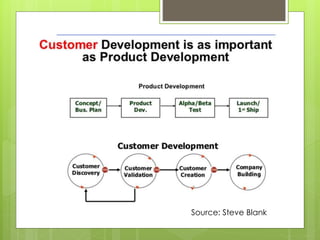
 Customer Development
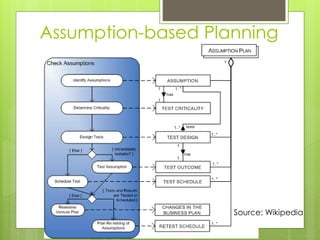
 Assumption-based Planning
 Do your own
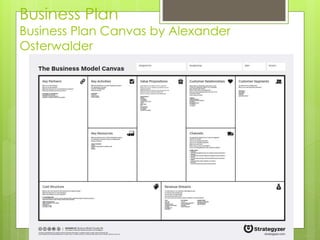
Business Plan
Business Plan Canvas by Alexander
Osterwalder
Processes
Entrepreneur Operating System by Gino
Wickman
 The V/TO – Vision/Traction Organizer
 The EOS Model™ and Scorecard - Track 6 Major Areas and
a Scorecard
 The Eight Cash-Flow Drivers™
 Rocks - Three to seven most important priorities that must
get done every 90 days.
 The 5-5-5™ - 5 values-5 roles-5 rocks/Quarter
 The Meeting Pulse™ and The Level 10 Meeting™ –
Templates for Meetings
 The Issues Solving Track™ – Template to help solve issues
 The Five Leadership Abilities™ – Five Leadership Abilities
 Clarity Break – Managing frustration.
 Delegate and Elevate™ and The Assistance Track™ –
Identify your sweet spot and follow five ways to help you
delegate.
 LMA – Leadership-Management-Accountability
Questionnaire
 The People Analyzer™– Identifying strengths of each
individual in a team
 The Trust Builders™ – 10 ways to keep trust levels high
Networking
TiE-IQ Bootcamp – Peer learning environment
 What to expect
 Refine and finish the minimal viable product
(MVP) into a ready to buy product
 Market your product
 Get the first few customers
 Pitch to your first group of investors
Example
Tactics
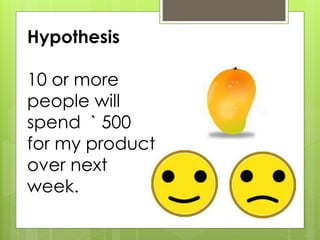
Hypothesis
10 or more
people will
spend ` 500
for my product
over next
week.
What is the Lean Start-up
Approach?
 A new trend among Silicon Valley and
Bangalore tech startups
 Learn about customer behaviour at
lowest possible cost
What is the Lean Start-up
Approach?
 Origins
 2008 Meltdown
 “The Lean Startup” by Eric Ries
 Steve Blank (“Four Steps to the Epiphany”)
 “Lean Mgmt” techniques of Japanese auto-
makers….applied to the Tech industry
 “Discovery-driven Planning” introduced by
Rita McGrath & Ian MacMillan in a 1995 HBR
 .com businesses –
 Engineering bias – “Customer Development”
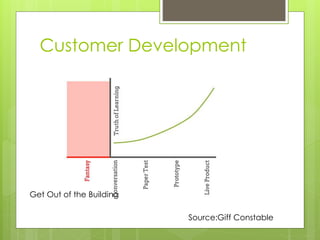
Source:Giff Constable
Customer Development
Get Out of the Building
Lingo
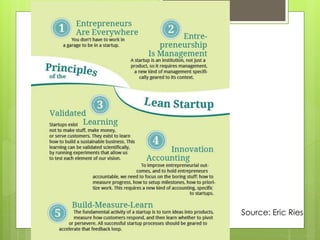
Source: Eric Ries
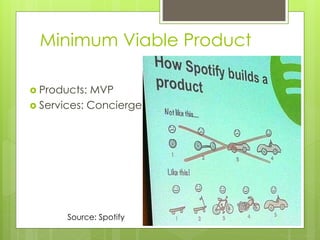
Minimum Viable Product
 Products: MVP
 Services: Concierge
Source: Spotify
Continuous Development
 Frequency:
Accept incremental improvements?
Split Testing
 Try out 2 versions – with and without a
feature
Actionable Metrics
 Metrics that show traction
 Vs. metrics that make you look good
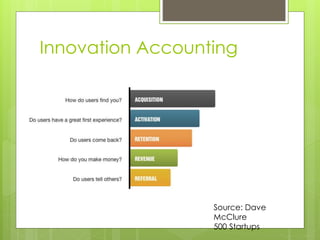
Innovation Accounting
Source: Dave
McClure
500 Startups
Pivot
 Major change in business model
Build-Measure-Learn
 MVP-Test Traction-Revise-Iterate
Limitations
Serious Limitations
 “Research stage”
 Annoy prospective customers
 Annoy prospective investors
 Annoy key employees
 Speculative activity?
 Akin to learning the Stock Market
 “Engineering” solution to Customer
Development
 Not applicable to physical-products
 Exploiting Adwords does not create new
Demand
 Hype, Bubble
 Not a strategy – its Tactics.
Harm Discipline
 Misinterpretation – Shortcut
 Underestimate Commitment
 Little knowledge
 Expect instant results
 Get carried away by over-enthusiastic
early-adopters seeking instant-
gratification
 100 code improvements per day
Alternatives
To Lean Approach
Source: Steve Blank
Assumption-based Planning
Source: Wikipedia
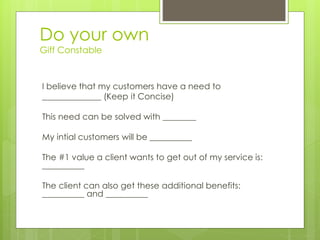
Do your own
Giff Constable
I believe that my customers have a need to
______________ (Keep it Concise)
This need can be solved with ________
My intial customers will be __________
The #1 value a client wants to get out of my service is:
__________
The client can also get these additional benefits:
__________ and __________
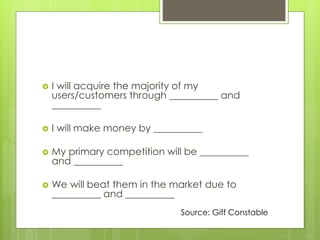
 I will acquire the majority of my
users/customers through __________ and
__________
 I will make money by __________
 My primary competition will be __________
and __________
 We will beat them in the market due to
__________ and __________
Source: Giff Constable
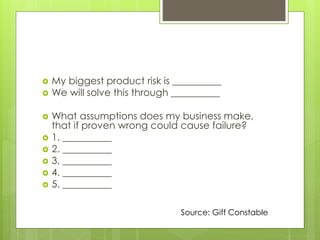
 My biggest product risk is __________
 We will solve this through __________
 What assumptions does my business make,
that if proven wrong could cause failure?
 1. __________
 2. __________
 3. __________
 4. __________
 5. __________
Source: Giff Constable
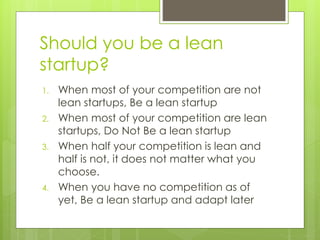
Should you be a lean
startup?
1. When most of your competition are not
lean startups, Be a lean startup
2. When most of your competition are lean
startups, Do Not Be a lean startup
3. When half your competition is lean and
half is not, it does not matter what you
choose.
4. When you have no competition as of
yet, Be a lean startup and adapt later
Thanks
Pls. go to
www.govote.at
and enter 43 34 92
to vote

TiE IITB - Jun 11 talk on Lean Startup Tactics

  • 1.
    Rapidly Testing out Assumptions ofa new Business: Lean Startup and Other Approaches Anil Bahuman TiE Business Builder Gulmohar, IIT Bombay
  • 2.
    Profile  Education –NIT-Karnataka & University of GA  Citibank, Boeing, MIT Media Lab and IIT Bombay  Startup Experience  3 years – US at GA Tech Incubator  7 years – Cofounder, CEO, Managing Director  Vice-President, Ecosystem Development at Reliance Jio Infocomm
  • 3.
    Outline  What LeanStart-up Does not cover  Example of a fictitious Lean Startup  What is the Lean Start-up Approach and what are the advantages?  Lean Startup Lingo  What are the Limitations?  What are the Alternatives?  Customer Development  Assumption-based Planning  Do your own
  • 4.
    Business Plan Business PlanCanvas by Alexander Osterwalder
  • 5.
    Processes Entrepreneur Operating Systemby Gino Wickman  The V/TO – Vision/Traction Organizer  The EOS Model™ and Scorecard - Track 6 Major Areas and a Scorecard  The Eight Cash-Flow Drivers™  Rocks - Three to seven most important priorities that must get done every 90 days.  The 5-5-5™ - 5 values-5 roles-5 rocks/Quarter  The Meeting Pulse™ and The Level 10 Meeting™ – Templates for Meetings  The Issues Solving Track™ – Template to help solve issues  The Five Leadership Abilities™ – Five Leadership Abilities  Clarity Break – Managing frustration.  Delegate and Elevate™ and The Assistance Track™ – Identify your sweet spot and follow five ways to help you delegate.  LMA – Leadership-Management-Accountability Questionnaire  The People Analyzer™– Identifying strengths of each individual in a team  The Trust Builders™ – 10 ways to keep trust levels high
  • 6.
    Networking TiE-IQ Bootcamp –Peer learning environment  What to expect  Refine and finish the minimal viable product (MVP) into a ready to buy product  Market your product  Get the first few customers  Pitch to your first group of investors
  • 7.
  • 9.
    Hypothesis 10 or more peoplewill spend ` 500 for my product over next week.
  • 10.
    What is theLean Start-up Approach?  A new trend among Silicon Valley and Bangalore tech startups  Learn about customer behaviour at lowest possible cost
  • 11.
    What is theLean Start-up Approach?  Origins  2008 Meltdown  “The Lean Startup” by Eric Ries  Steve Blank (“Four Steps to the Epiphany”)  “Lean Mgmt” techniques of Japanese auto- makers….applied to the Tech industry  “Discovery-driven Planning” introduced by Rita McGrath & Ian MacMillan in a 1995 HBR  .com businesses –  Engineering bias – “Customer Development”
  • 12.
  • 13.
  • 14.
  • 15.
    Minimum Viable Product Products: MVP  Services: Concierge Source: Spotify
  • 16.
  • 17.
    Split Testing  Tryout 2 versions – with and without a feature
  • 18.
    Actionable Metrics  Metricsthat show traction  Vs. metrics that make you look good
  • 19.
  • 20.
    Pivot  Major changein business model
  • 21.
  • 23.
  • 24.
    Serious Limitations  “Researchstage”  Annoy prospective customers  Annoy prospective investors  Annoy key employees  Speculative activity?  Akin to learning the Stock Market  “Engineering” solution to Customer Development  Not applicable to physical-products  Exploiting Adwords does not create new Demand  Hype, Bubble  Not a strategy – its Tactics.
  • 25.
    Harm Discipline  Misinterpretation– Shortcut  Underestimate Commitment  Little knowledge  Expect instant results  Get carried away by over-enthusiastic early-adopters seeking instant- gratification  100 code improvements per day
  • 26.
  • 27.
  • 28.
  • 29.
    Do your own GiffConstable I believe that my customers have a need to ______________ (Keep it Concise) This need can be solved with ________ My intial customers will be __________ The #1 value a client wants to get out of my service is: __________ The client can also get these additional benefits: __________ and __________
  • 30.
     I willacquire the majority of my users/customers through __________ and __________  I will make money by __________  My primary competition will be __________ and __________  We will beat them in the market due to __________ and __________ Source: Giff Constable
  • 31.
     My biggestproduct risk is __________  We will solve this through __________  What assumptions does my business make, that if proven wrong could cause failure?  1. __________  2. __________  3. __________  4. __________  5. __________ Source: Giff Constable
  • 32.
    Should you bea lean startup? 1. When most of your competition are not lean startups, Be a lean startup 2. When most of your competition are lean startups, Do Not Be a lean startup 3. When half your competition is lean and half is not, it does not matter what you choose. 4. When you have no competition as of yet, Be a lean startup and adapt later
  • 33.