Pure Substances, Mixtures, and
Solutions
PREPARED BY: Mrs. Jenny Rose J. Gengos
Distinguish mixtures from
substances based on a set
of properties
S7MTIe-f-4
Pure substance: matter that has a
fixed (constant) composition and
unique properties. Contains only 1
type element or compound;
homogeneous
Mixture: Contains at least 2 PHYSICALLY
combined compounds; can be homogeneous
or heterogeneous
Homogeneous Substances
Means same throughout
1) element: only 1 type of atom
2) compound: 2 or more CHEMICALLY combined
elements (not easily separated from each other)
ex: water, CO2
3) Solution: a special kind of mixture 2 phases/parts
(SOLUTE dissolves & SOLVENT does the
dissolving)
ex: moist air (H2O in Air); sterling silver (Cu
in Ag…called an alloy)
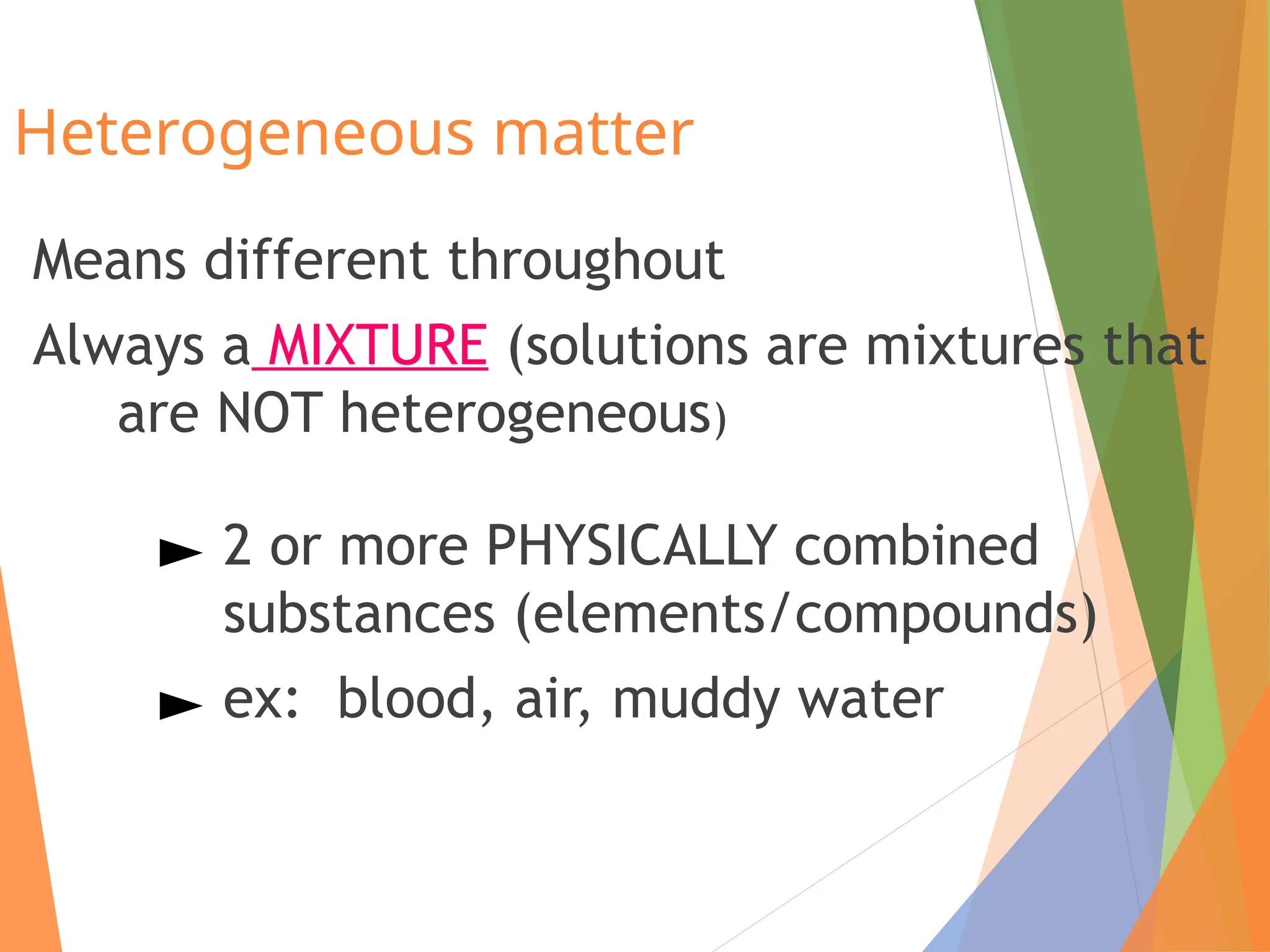
Heterogeneous matter
Means different throughout
Always a MIXTURE (solutions are mixtures that
are NOT heterogeneous)
► 2 or more PHYSICALLY combined
substances (elements/compounds)
► ex: blood, air, muddy water
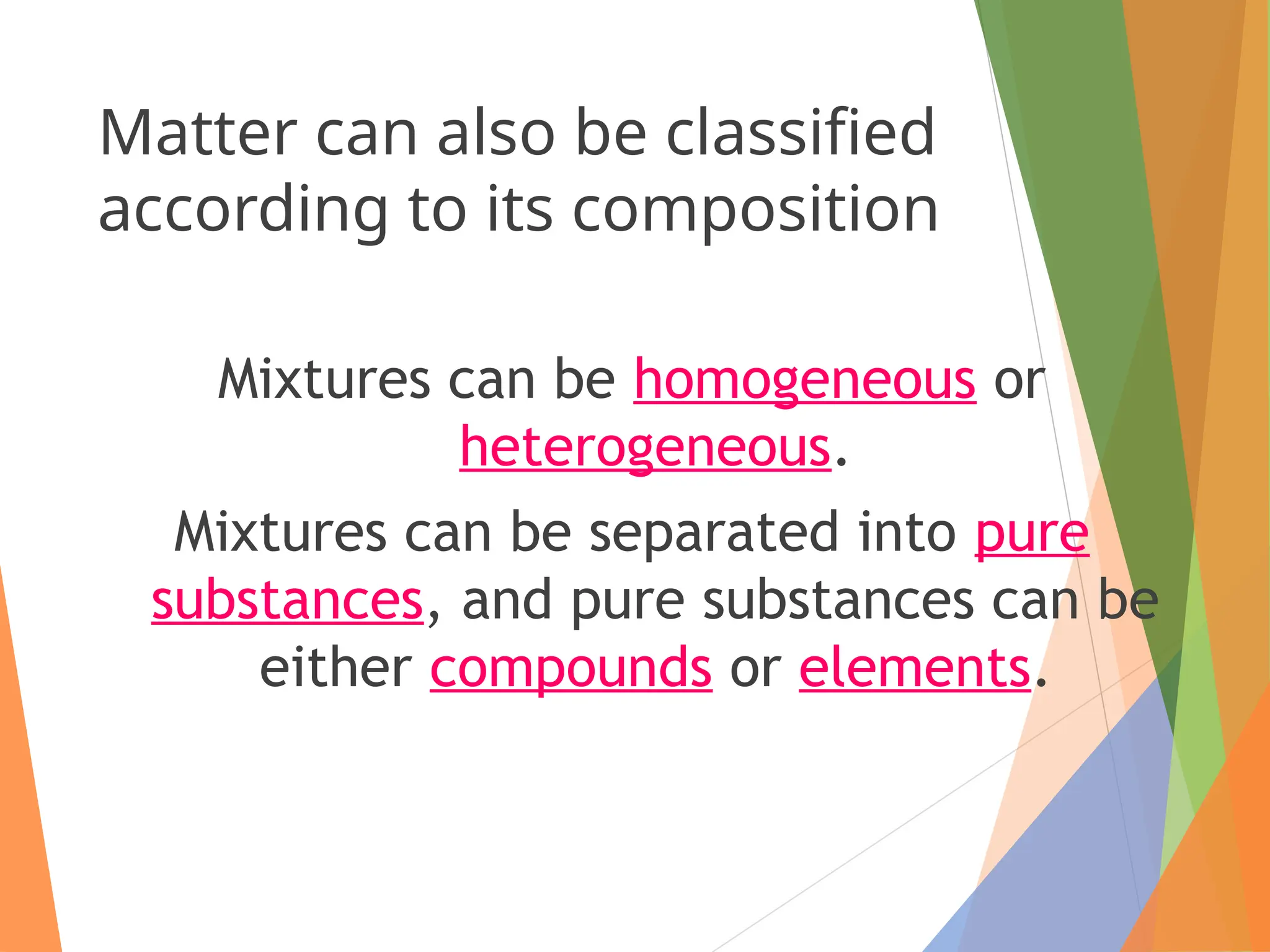
Matter can also be classified
according to its composition
Mixtures can be homogeneous or
heterogeneous.
Mixtures can be separated into pure
substances, and pure substances can be
either compounds or elements.
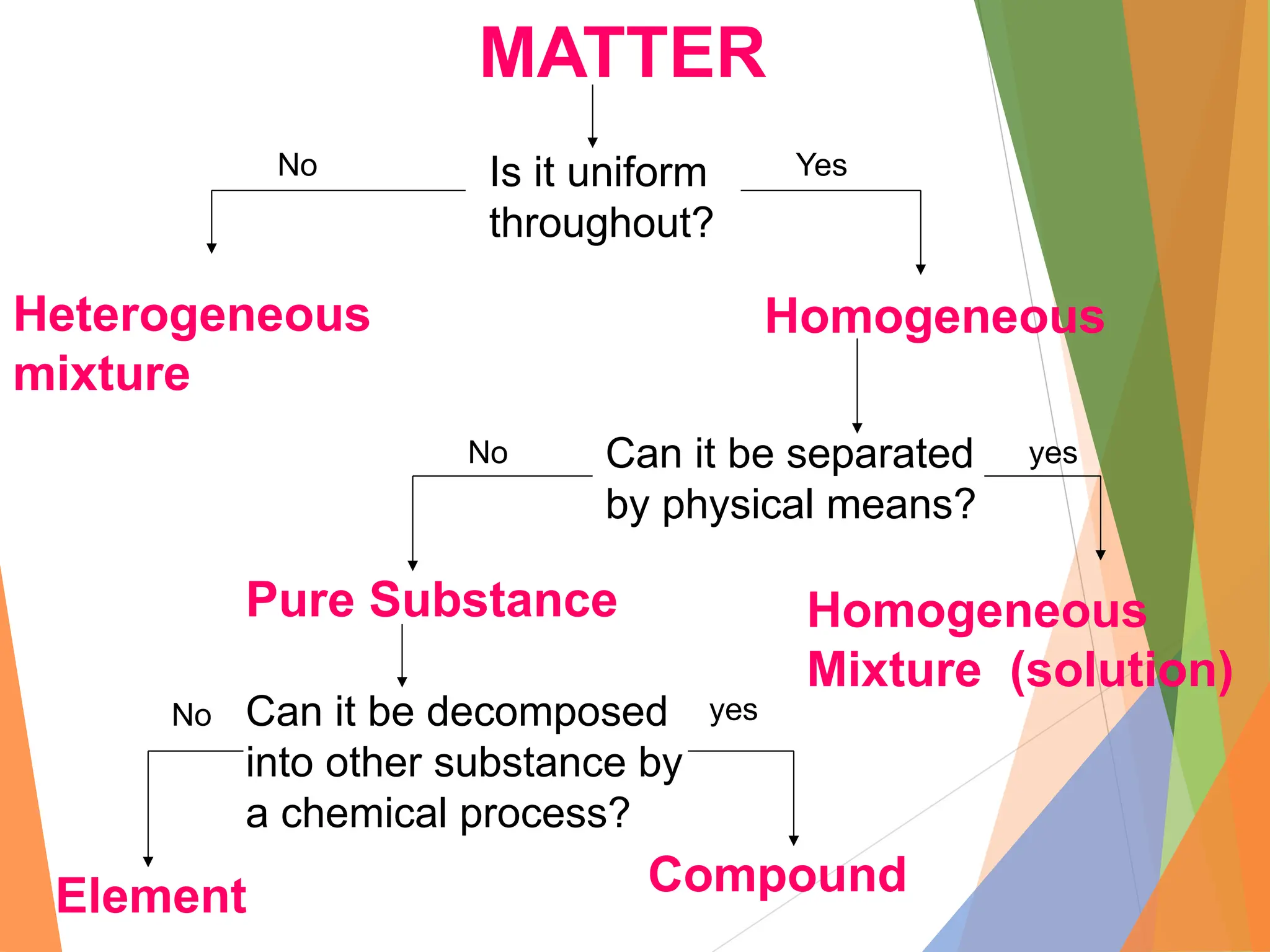
MATTER
Heterogeneous
mixture
Is it uniform
throughout?
No
Homogeneous
Yes
Can it be separated
by physical means?
Pure Substance Homogeneous
Mixture (solution)
Can it be decomposed
into other substance by
a chemical process?
Element Compound
No yes
No yes
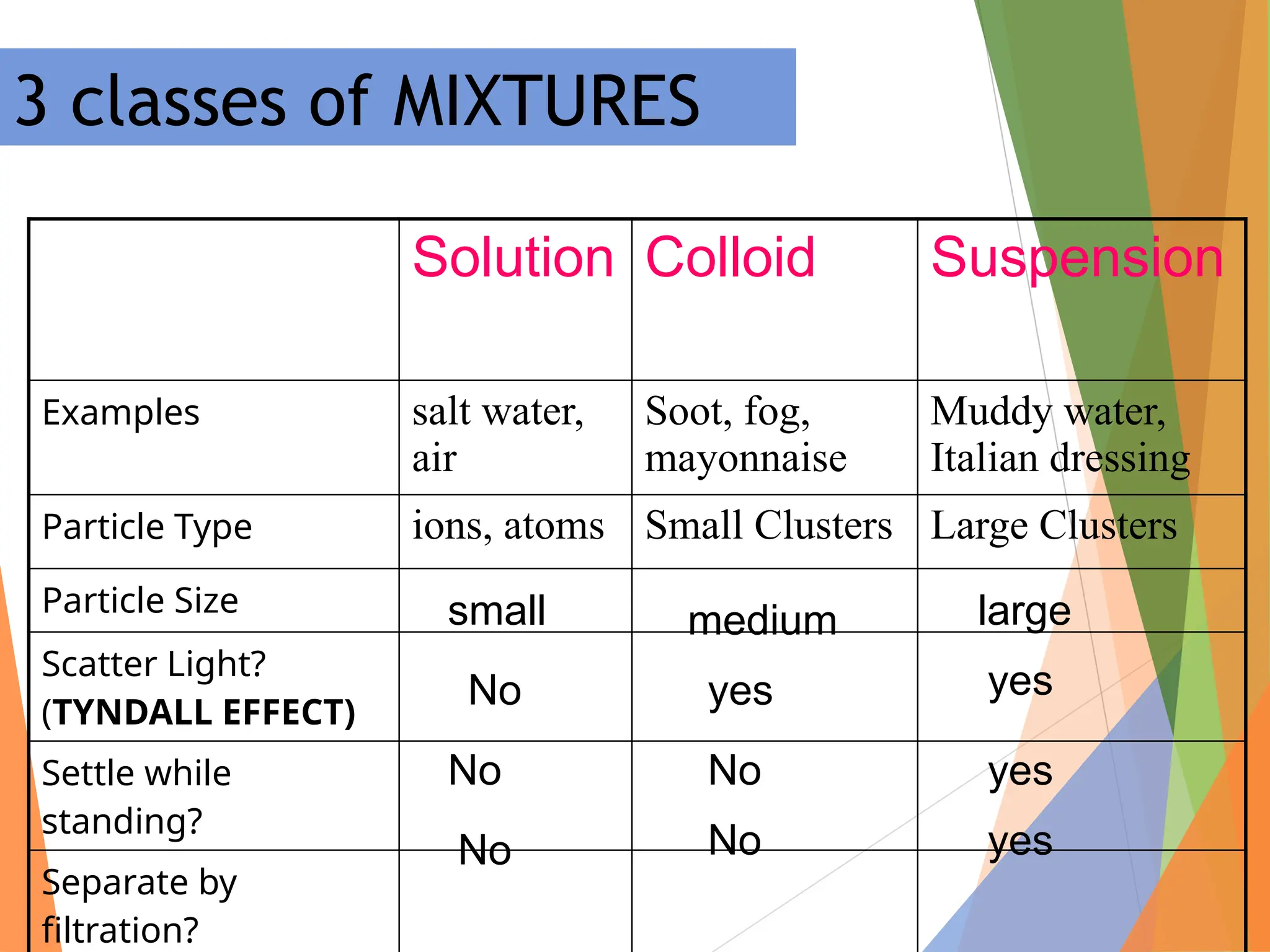
Solution Colloid Suspension
Examples salt water,
air
Soot, fog,
mayonnaise
Muddy water,
Italian dressing
Particle Type ions, atoms Small Clusters Large Clusters
Particle Size
Scatter Light?
(TYNDALL EFFECT)
Settle while
standing?
Separate by
filtration?
small medium large
No
No
No
No
No
yes yes
yes
yes
3 classes of MIXTURES
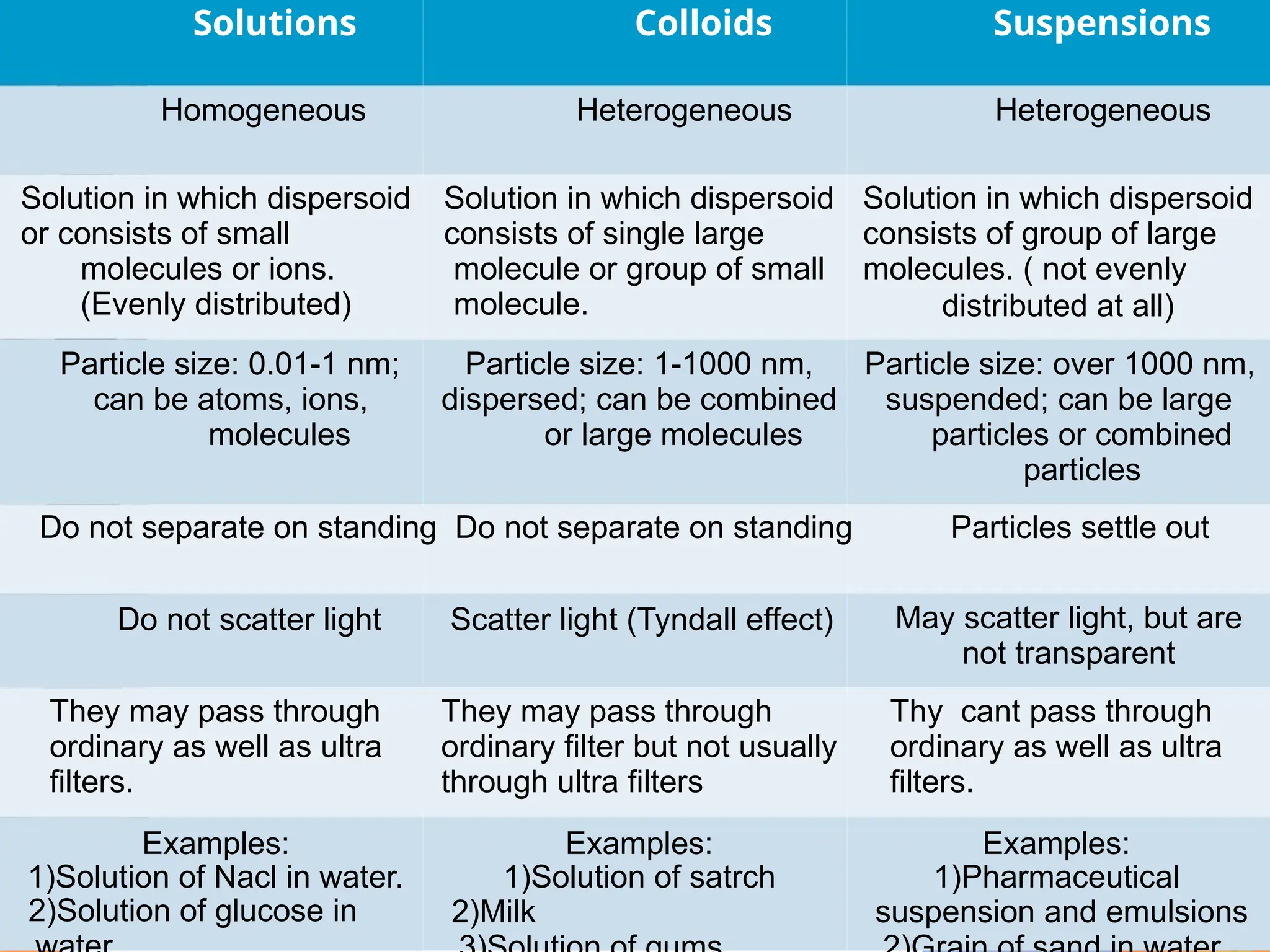
Solutions
Homogeneous
Solution in which dispersoid
or consists of small
molecules or ions.
(Evenly distributed)
Particle size: 0.01-1 nm;
can be atoms, ions,
molecules
Colloids
Heterogeneous
Solution in which dispersoid
consists of single large
molecule or group of small
molecule.
Particle size: 1-1000 nm,
dispersed; can be combined
or large molecules
Suspensions
Heterogeneous
Solution in which dispersoid
consists of group of large
molecules. ( not evenly
distributed at all)
Particle size: over 1000 nm,
suspended; can be large
particles or combined
particles
Do not separate on standing Do not separate on standing Particles settle out
Do not scatter light
They may pass through
ordinary as well as ultra
filters.
Examples:
1)Solution of Nacl in water.
Scatter light (Tyndall effect)
They may pass through
ordinary filter but not usually
through ultra filters
Examples:
1)Solution of satrch
May scatter light, but are
not transparent
Thy cant pass through
ordinary as well as ultra
filters.
Examples:
1)Pharmaceutical
2)Solution of glucose in 2)Milk suspension and emulsions
[A colloid can be
separated by filtration?]
A.True
B.False
Homogeneus mixtures
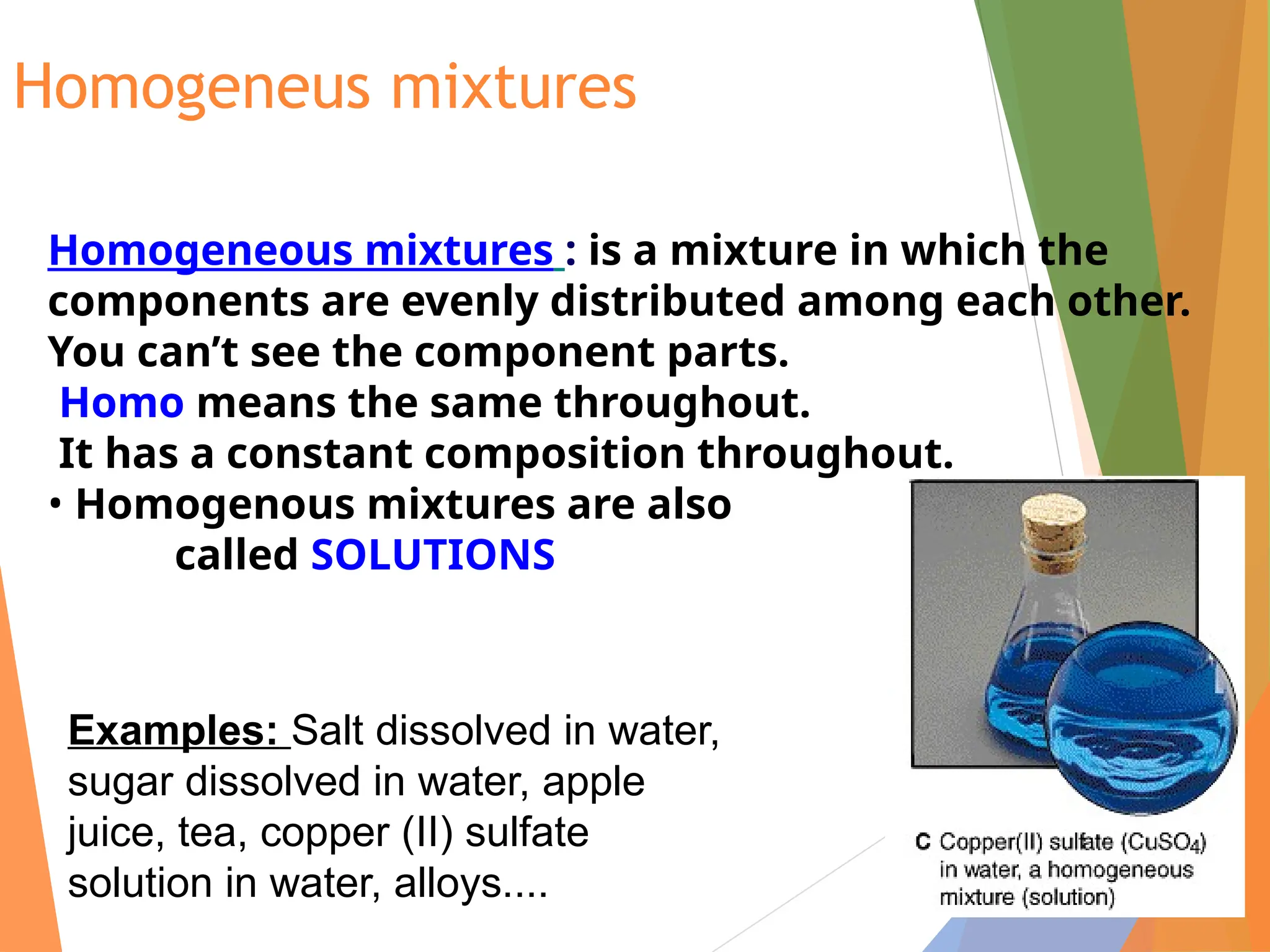
Homogeneous mixtures : is a mixture in which the
components are evenly distributed among each other.
You can’t see the component parts.
Homo means the same throughout.
It has a constant composition throughout.
• Homogenous mixtures are also
called SOLUTIONS
Examples: Salt dissolved in water,
sugar dissolved in water, apple
juice, tea, copper (II) sulfate
solution in water, alloys....
Solutions
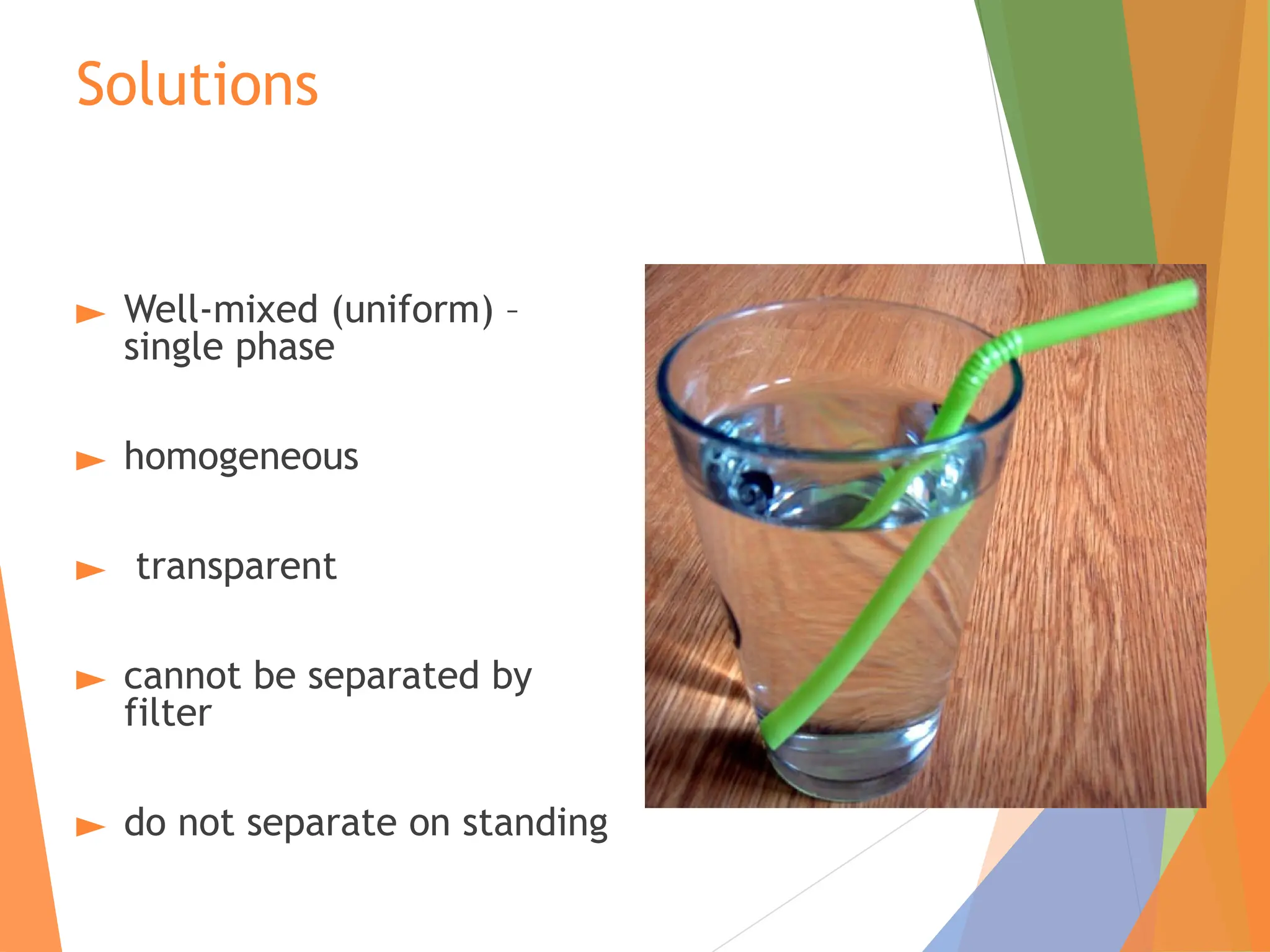
► Well-mixed (uniform) –
single phase
► homogeneous
► transparent
► cannot be separated by
filter
► do not separate on standing
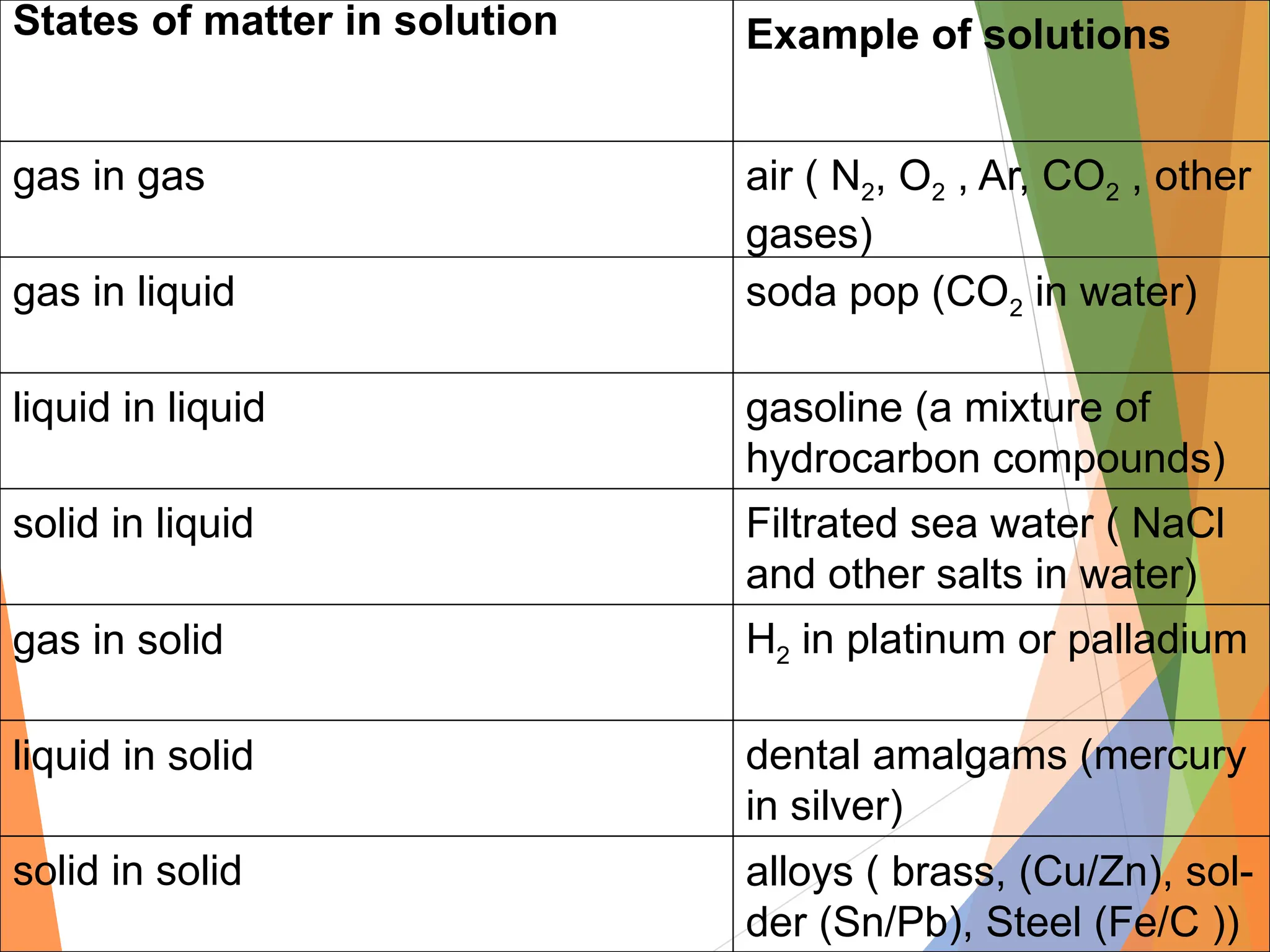
States of matter in solution Example of solutions
gas in gas air ( N2, O2 , Ar, CO2 , other
gases)
gas in liquid soda pop (CO2 in water)
liquid in liquid gasoline (a mixture of
hydrocarbon compounds)
solid in liquid Filtrated sea water ( NaCl
and other salts in water)
gas in solid H2 in platinum or palladium
liquid in solid dental amalgams (mercury
in silver)
solid in solid alloys ( brass, (Cu/Zn), sol-
der (Sn/Pb), Steel (Fe/C ))
Heterogeneous Mixtures
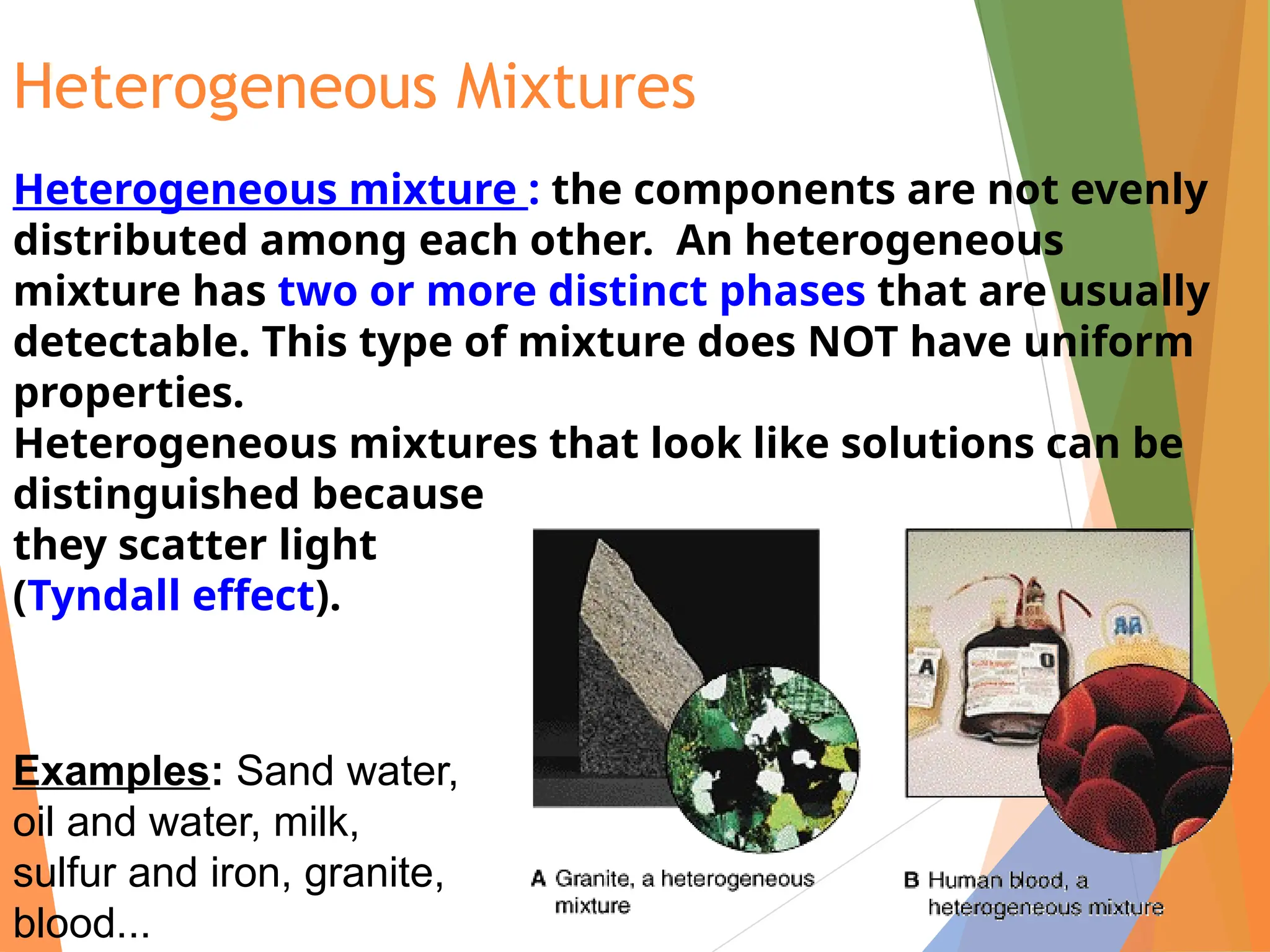
Heterogeneous mixture : the components are not evenly
distributed among each other. An heterogeneous
mixture has two or more distinct phases that are usually
detectable. This type of mixture does NOT have uniform
properties.
Heterogeneous mixtures that look like solutions can be
distinguished because
they scatter light
(Tyndall effect).
Examples: Sand water,
oil and water, milk,
sulfur and iron, granite,
blood...
[After passing through a muddy pond, the water
in a stream contains dirt particles. Which of the
following describes the stream?]
A. [solution]
B. [suspension]
C. [pure substance]
D. [colloid]
Colloids
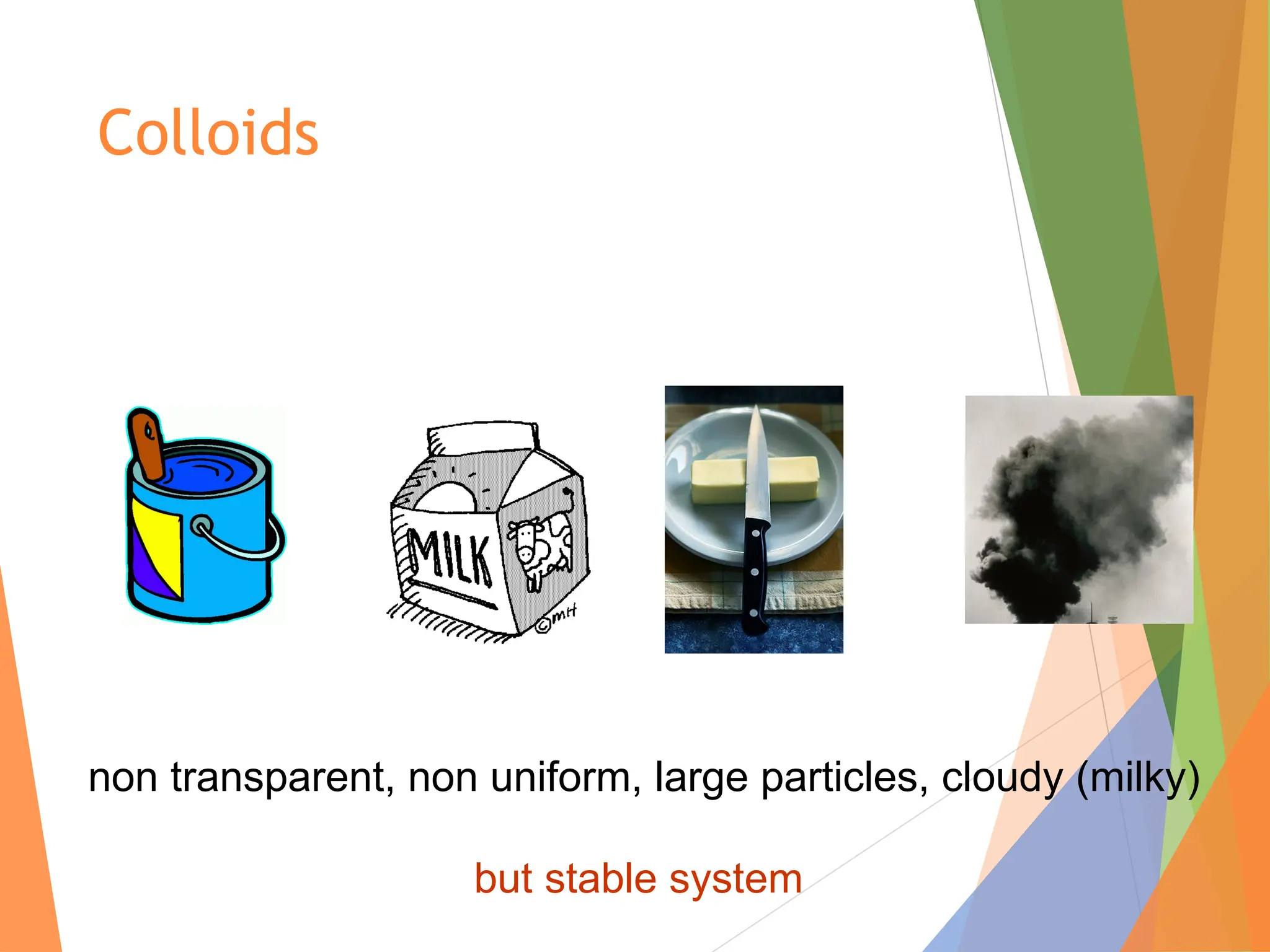
non transparent, non uniform, large particles, cloudy (milky)
but stable system
Colloids
Suspensions
► A suspension of liquid droplets or fine solid particles in a
gas is called an aerosolA suspension of liquid droplets or
fine solid particles in a gas is called an aerosol. In the
atmosphereA suspension of liquid droplets or fine solid
particles in a gas is called an aerosol. In the atmosphere
these consist of fine dust and sootA suspension of liquid
droplets or fine solid particles in a gas is called an aerosol.
In the atmosphere these consist of fine dust and soot
particles, and cloud droplets.
► suspension: system does not stays stable and settle
► Chalk powder suspended in water.
► Dust particles suspended in air.
► Algae in water
► Milk of Magnesia
►Mud or muddy water, is where soil
Mud or muddy water, is where soil,
clayMud or muddy water, is where
soil, clay, or silt particles are
suspended in water.
►Flour suspended in water, as
pictured to the right.
►Paint
Examples of
Suspensions
Colloids
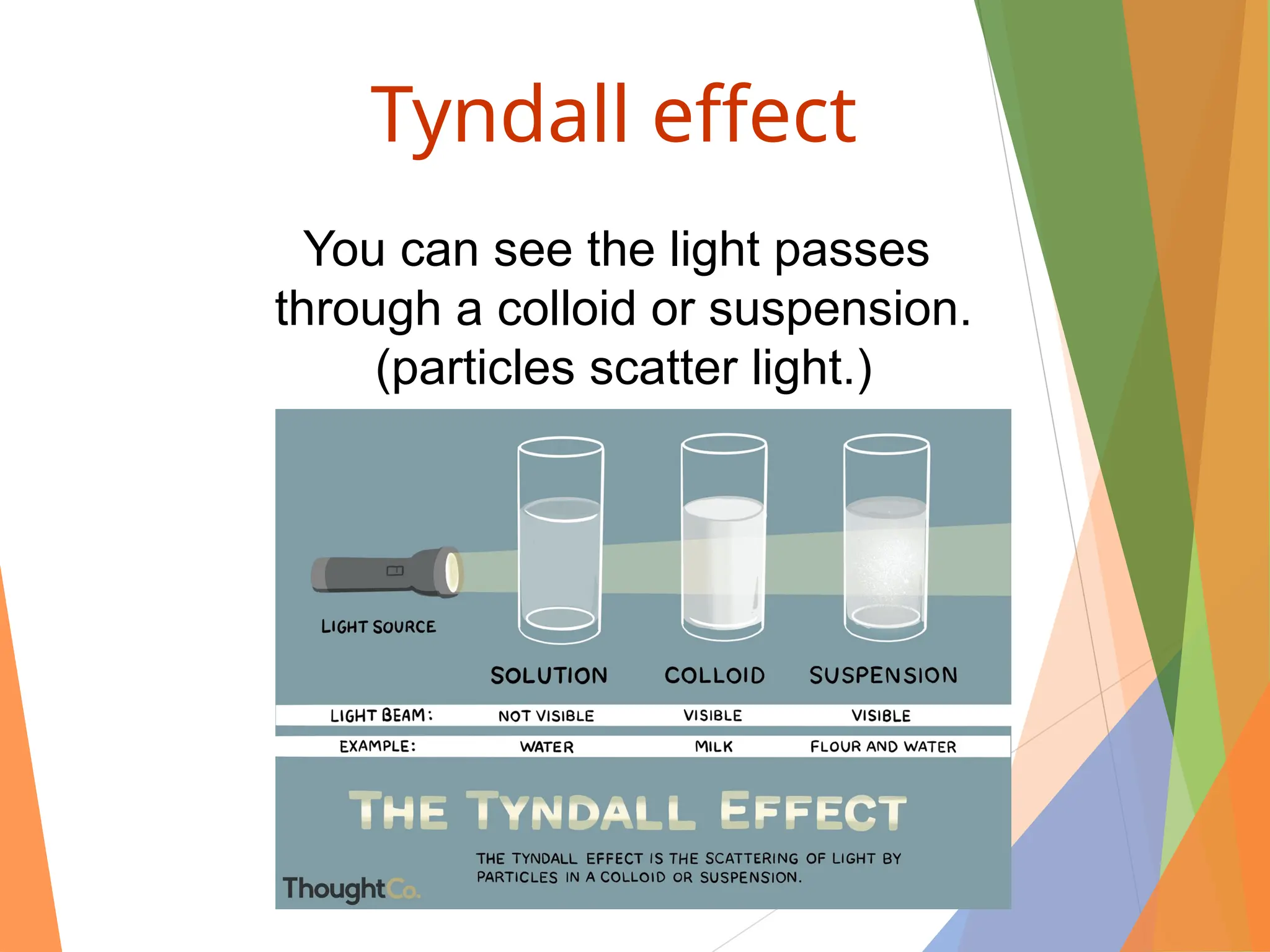
Tyndall effect
You can see the light passes
through a colloid or suspension.
(particles scatter light.)
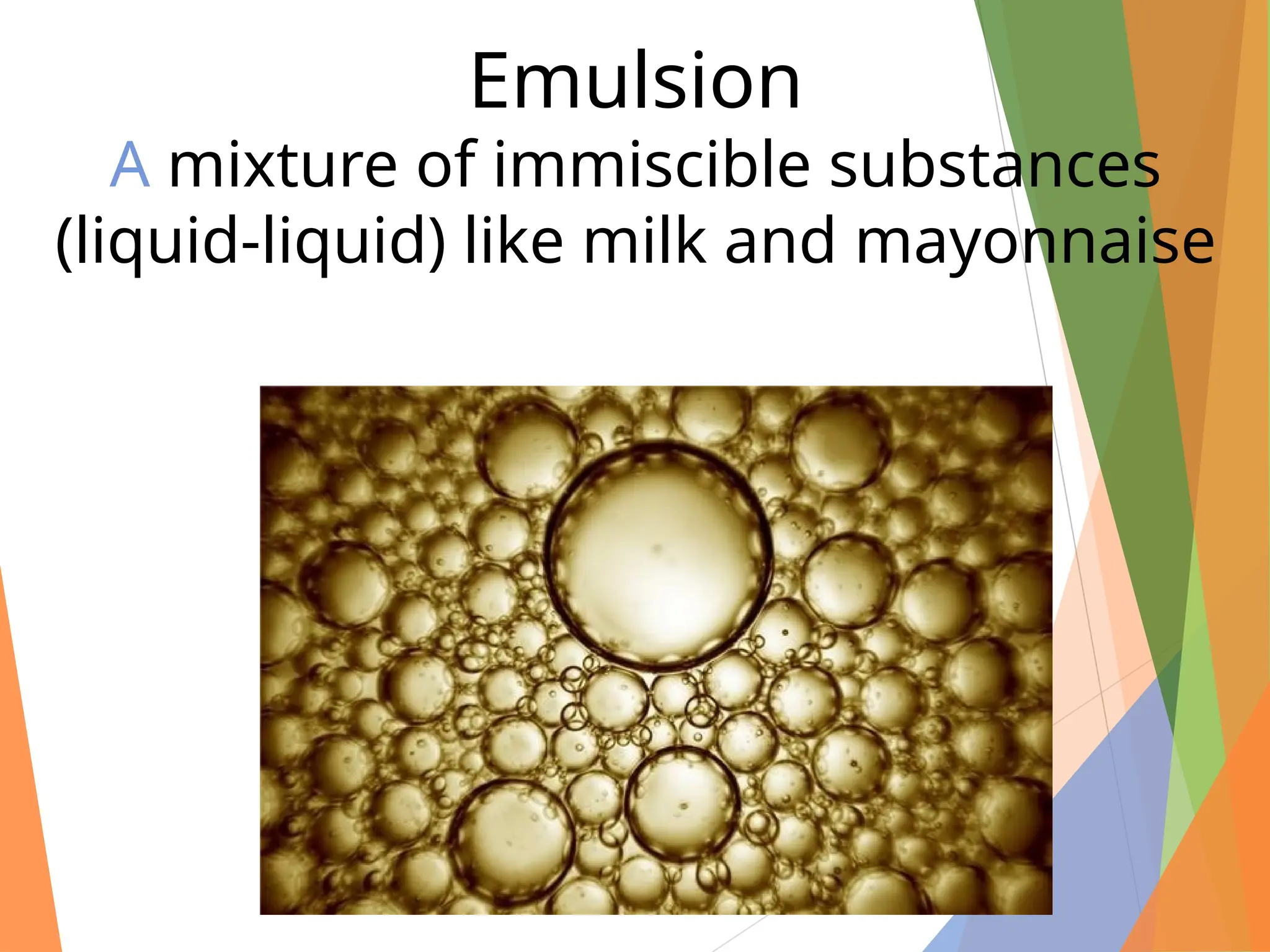
Emulsion
A mixture of immiscible substances
(liquid-liquid) like milk and mayonnaise
Which of the following will show the
Tyndall Effect
A.[water]
B.[sugar water]
C.[oxygen gas]
D.[fog]
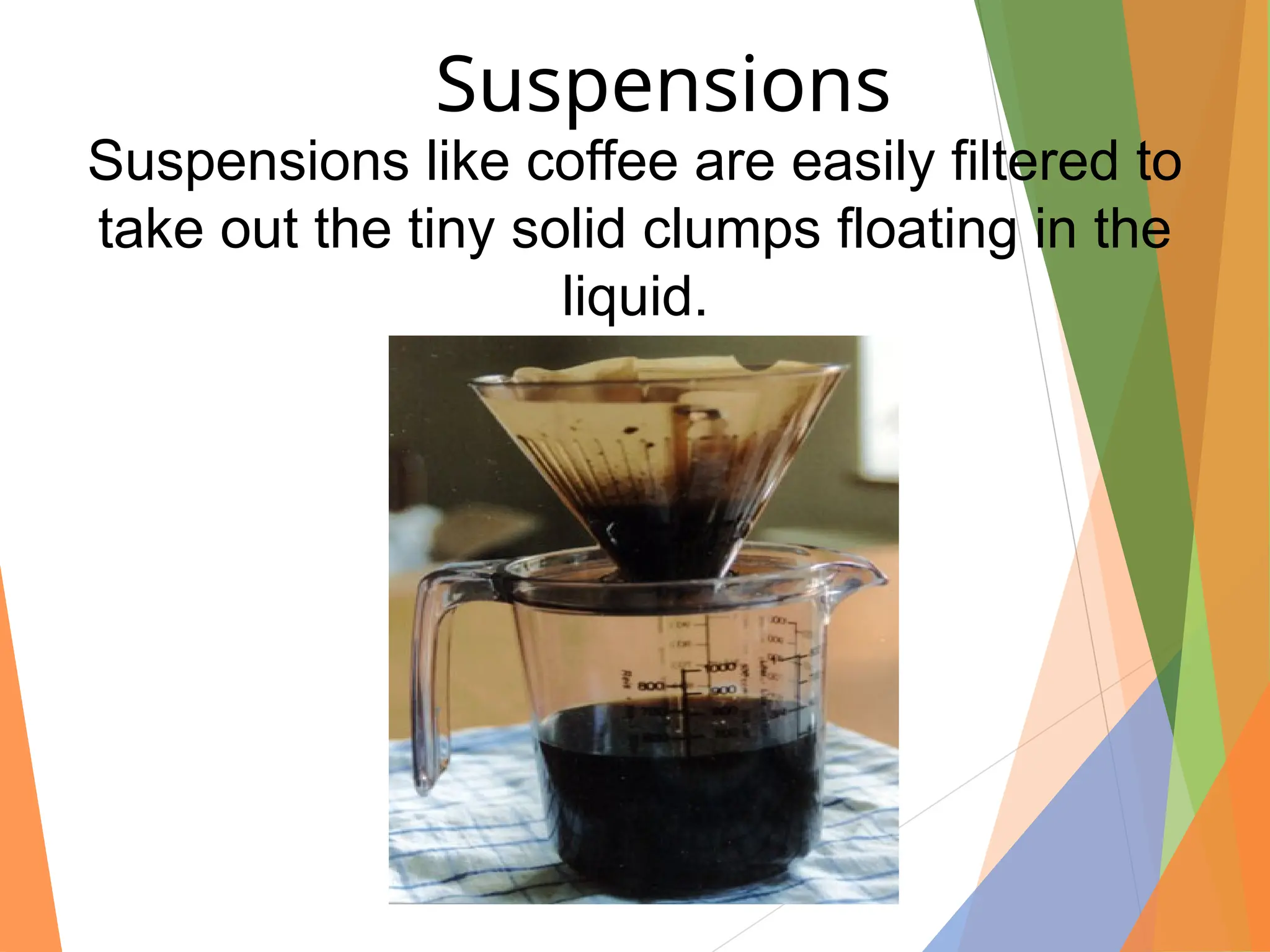
Suspensions like coffee are easily filtered to
take out the tiny solid clumps floating in the
liquid.
Suspensions
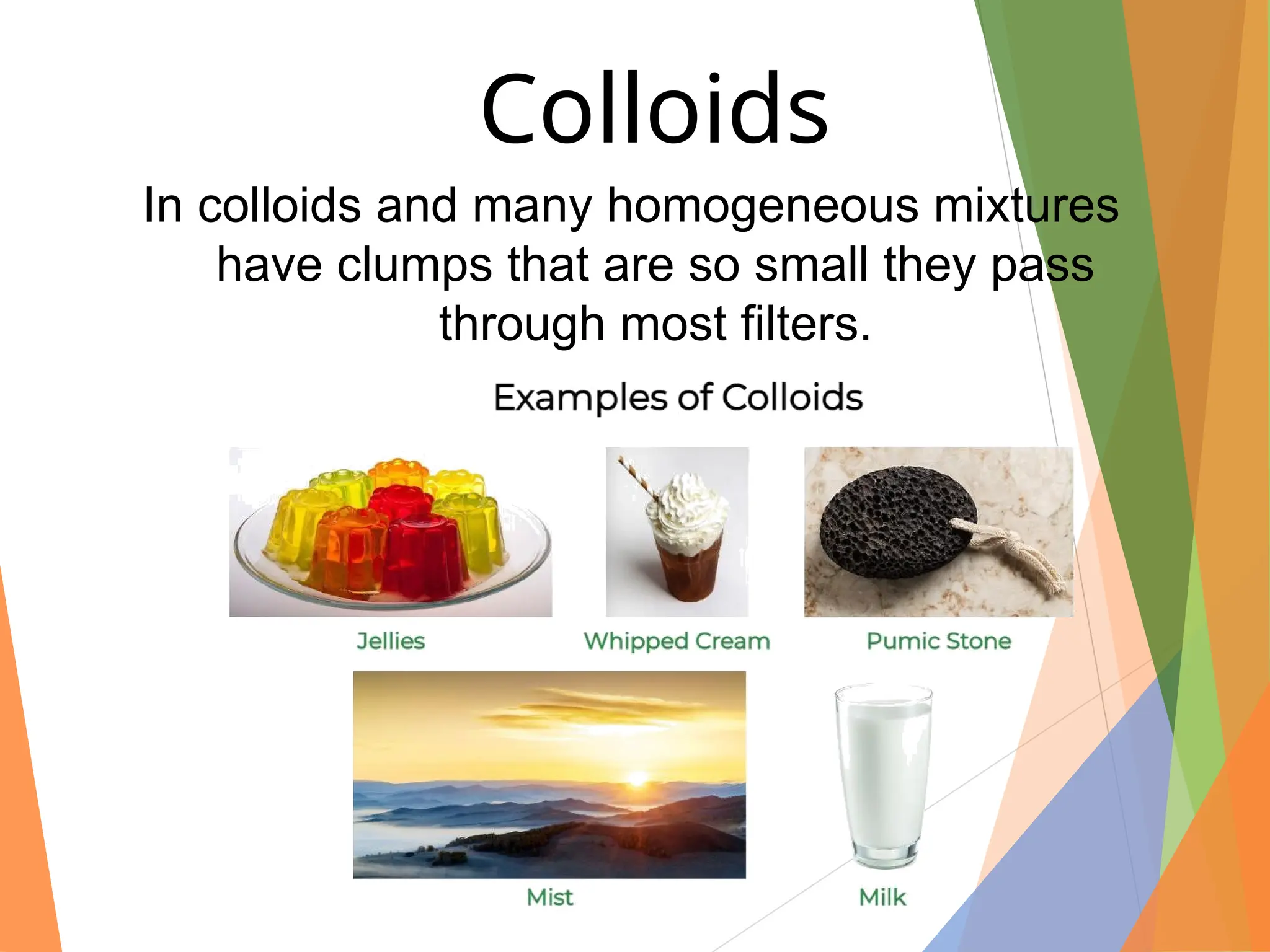
In colloids and many homogeneous mixtures
have clumps that are so small they pass
through most filters.
Colloids
Which of the following is a colloid
A.[milk]
B. [NaCl in water]
C.[sand and water]
D.[raisin bread]

G7 Science Q1- Week 4-5-Mixture from Substances based on property.pptx

  • 1.
    Pure Substances, Mixtures,and Solutions PREPARED BY: Mrs. Jenny Rose J. Gengos
  • 2.
    Distinguish mixtures from substancesbased on a set of properties S7MTIe-f-4
  • 3.
    Pure substance: matterthat has a fixed (constant) composition and unique properties. Contains only 1 type element or compound; homogeneous Mixture: Contains at least 2 PHYSICALLY combined compounds; can be homogeneous or heterogeneous
  • 4.
    Homogeneous Substances Means samethroughout 1) element: only 1 type of atom 2) compound: 2 or more CHEMICALLY combined elements (not easily separated from each other) ex: water, CO2 3) Solution: a special kind of mixture 2 phases/parts (SOLUTE dissolves & SOLVENT does the dissolving) ex: moist air (H2O in Air); sterling silver (Cu in Ag…called an alloy)
  • 5.
    Heterogeneous matter Means differentthroughout Always a MIXTURE (solutions are mixtures that are NOT heterogeneous) ► 2 or more PHYSICALLY combined substances (elements/compounds) ► ex: blood, air, muddy water
  • 6.
    Matter can alsobe classified according to its composition Mixtures can be homogeneous or heterogeneous. Mixtures can be separated into pure substances, and pure substances can be either compounds or elements.
  • 7.
    MATTER Heterogeneous mixture Is it uniform throughout? No Homogeneous Yes Canit be separated by physical means? Pure Substance Homogeneous Mixture (solution) Can it be decomposed into other substance by a chemical process? Element Compound No yes No yes
  • 8.
    Solution Colloid Suspension Examplessalt water, air Soot, fog, mayonnaise Muddy water, Italian dressing Particle Type ions, atoms Small Clusters Large Clusters Particle Size Scatter Light? (TYNDALL EFFECT) Settle while standing? Separate by filtration? small medium large No No No No No yes yes yes yes 3 classes of MIXTURES
  • 9.
    Solutions Homogeneous Solution in whichdispersoid or consists of small molecules or ions. (Evenly distributed) Particle size: 0.01-1 nm; can be atoms, ions, molecules Colloids Heterogeneous Solution in which dispersoid consists of single large molecule or group of small molecule. Particle size: 1-1000 nm, dispersed; can be combined or large molecules Suspensions Heterogeneous Solution in which dispersoid consists of group of large molecules. ( not evenly distributed at all) Particle size: over 1000 nm, suspended; can be large particles or combined particles Do not separate on standing Do not separate on standing Particles settle out Do not scatter light They may pass through ordinary as well as ultra filters. Examples: 1)Solution of Nacl in water. Scatter light (Tyndall effect) They may pass through ordinary filter but not usually through ultra filters Examples: 1)Solution of satrch May scatter light, but are not transparent Thy cant pass through ordinary as well as ultra filters. Examples: 1)Pharmaceutical 2)Solution of glucose in 2)Milk suspension and emulsions
  • 10.
    [A colloid canbe separated by filtration?] A.True B.False
  • 11.
    Homogeneus mixtures Homogeneous mixtures: is a mixture in which the components are evenly distributed among each other. You can’t see the component parts. Homo means the same throughout. It has a constant composition throughout. • Homogenous mixtures are also called SOLUTIONS Examples: Salt dissolved in water, sugar dissolved in water, apple juice, tea, copper (II) sulfate solution in water, alloys....
  • 12.
    Solutions ► Well-mixed (uniform)– single phase ► homogeneous ► transparent ► cannot be separated by filter ► do not separate on standing
  • 13.
    States of matterin solution Example of solutions gas in gas air ( N2, O2 , Ar, CO2 , other gases) gas in liquid soda pop (CO2 in water) liquid in liquid gasoline (a mixture of hydrocarbon compounds) solid in liquid Filtrated sea water ( NaCl and other salts in water) gas in solid H2 in platinum or palladium liquid in solid dental amalgams (mercury in silver) solid in solid alloys ( brass, (Cu/Zn), sol- der (Sn/Pb), Steel (Fe/C ))
  • 14.
    Heterogeneous Mixtures Heterogeneous mixture: the components are not evenly distributed among each other. An heterogeneous mixture has two or more distinct phases that are usually detectable. This type of mixture does NOT have uniform properties. Heterogeneous mixtures that look like solutions can be distinguished because they scatter light (Tyndall effect). Examples: Sand water, oil and water, milk, sulfur and iron, granite, blood...
  • 15.
    [After passing througha muddy pond, the water in a stream contains dirt particles. Which of the following describes the stream?] A. [solution] B. [suspension] C. [pure substance] D. [colloid]
  • 16.
    Colloids non transparent, nonuniform, large particles, cloudy (milky) but stable system Colloids
  • 17.
    Suspensions ► A suspensionof liquid droplets or fine solid particles in a gas is called an aerosolA suspension of liquid droplets or fine solid particles in a gas is called an aerosol. In the atmosphereA suspension of liquid droplets or fine solid particles in a gas is called an aerosol. In the atmosphere these consist of fine dust and sootA suspension of liquid droplets or fine solid particles in a gas is called an aerosol. In the atmosphere these consist of fine dust and soot particles, and cloud droplets. ► suspension: system does not stays stable and settle ► Chalk powder suspended in water. ► Dust particles suspended in air. ► Algae in water ► Milk of Magnesia
  • 18.
    ►Mud or muddywater, is where soil Mud or muddy water, is where soil, clayMud or muddy water, is where soil, clay, or silt particles are suspended in water. ►Flour suspended in water, as pictured to the right. ►Paint Examples of Suspensions
  • 19.
    Colloids Tyndall effect You cansee the light passes through a colloid or suspension. (particles scatter light.)
  • 20.
    Emulsion A mixture ofimmiscible substances (liquid-liquid) like milk and mayonnaise
  • 21.
    Which of thefollowing will show the Tyndall Effect A.[water] B.[sugar water] C.[oxygen gas] D.[fog]
  • 22.
    Suspensions like coffeeare easily filtered to take out the tiny solid clumps floating in the liquid. Suspensions
  • 23.
    In colloids andmany homogeneous mixtures have clumps that are so small they pass through most filters. Colloids
  • 24.
    Which of thefollowing is a colloid A.[milk] B. [NaCl in water] C.[sand and water] D.[raisin bread]