IOSR Journal of Mathematics (IOSR-JM)
e-ISSN: 2278-5728,p-ISSN: 2319-765X, Volume 7, Issue 3 (Jul. - Aug. 2013), PP 39-45
www.iosrjournals.org
www.iosrjournals.org 39 | Page
Some aspects of Harmonic Numbers which divide the sum of its
Positive divisors.
Pranjal Rajkhowa1
, Hemen Bharali2
1
(Department of Mathematics),Gauhati University. India
2
(Department of Basic Sciences),Don Bosco College of Engineering and Technology ,Guwahati ,India
Abstract: In this paper some particular harmonic numbers n, where n divides σ(n) completely have been
taken. Three types of numbers prime factorised as say, 𝑝 𝑚
𝑞, 2 𝑘
𝑝 𝑚
𝑞, 2 𝑘
𝑝1 𝑝2 … … 𝑝 𝑚 have been discussed and
some propositions have been developed to understand the properties of these type of numbers. It has been
observed that harmonic numbers n having 𝑔. 𝑐. 𝑑. 𝑛, 𝜎 𝑛 = 𝑛 of the form 𝑝𝑞, 𝑝2
𝑞, 𝑝 𝑚
𝑞 does not exist if p,q
both of them are odd primes. Further some useful properties of the harmonic numbers of the form 2 𝑘
𝑝 𝑚
𝑞, for
some values of m have been discussed with the help of some propositions. After that an algorithm has been
proposed to get the numbers of the form 2 𝑘
𝑝1 𝑝2 … … 𝑝 𝑚 , where n divides σ(n) completely.
Keywords: Harmonic number, Mersene prime, Ore’s conjecture, Perfect number
I. Introduction
In 1948 Ore [9] introduced the concept of Harmonic numbers, and these numbers were named as Ore’s
harmonic numbers(some 15 years later) by Pomerance[10].In general, the harmonic mean of positive numbers
𝑎1, 𝑎2, … … . . , 𝑎 𝑘 is defined by
1
𝑎 𝑖
𝑘
𝑖=1
−1
A positive integer n is said to be harmonic if the harmonic mean of its positive divisors 𝐻 𝑛 =
𝑛𝜏(𝑛)
𝜎(𝑛)
is
an integer, where 𝜏(𝑛) denotes the number of positive divisors and σ(n) denotes the sum of the positive divisors
of n. We call 1 the trivial harmonic number. A list of harmonic numbers less than 2.109
have been given by
Cohen [2]. This have been extended by Goto and Okeya [5] which is up to 1014
. If n is a harmonic divisor
number then there are two possibilities (i) 𝑔. 𝑐. 𝑑. 𝑛, 𝜎 𝑛 = 𝑛 or (ii) 𝑔. 𝑐. 𝑑. 𝑛, 𝜎 𝑛 ≠ 𝑛.(i) implies that
σ(n)=kn, where k is a positive integer. In fact if σ(n)=2n, then the numbers are called perfect numbers. Ore [9]
proved that every perfect number is harmonic. But the converse is not true. For example, 140 is not perfect, but
H(140)=5. Ore [4] conjectured that all harmonic numbers other than 1 must be even.
In the present paper , we focus on those harmonic numbers which satisfies the property (i). Some
examples of this kind of numbers are 6,28,496,672,8128,30240, … ….In section 2, some properties of the
numbers of the form 𝑝 𝑚
𝑞 where p,q are any prime numbers have been discussed. In section 3, the type of
numbers have been extended to the form 2 𝑘
𝑝 𝑚
𝑞. In section 4, the numbers have been further extended to the
form 2 𝑘
𝑝1 𝑝2 … … 𝑝 𝑚 . In fact in this section a search technique have been obtained to get the numbers of the
form 𝑔. 𝑐. 𝑑. 𝑛, 𝜎 𝑛 = 𝑛, where 𝑛 = 2 𝑘
𝑝1 𝑝2 … … 𝑝 𝑚 .
II. Some properties of harmonic numbers having 𝒈. 𝒄. 𝒅. 𝒏, 𝝈 𝒏 = 𝒏 of the form 𝒑 𝒎
𝒒
Theorem 2.1 The only harmonic divisor number of the form 𝒑𝒒, where 𝒑 and 𝒒 are prime numbers and
𝒈. 𝒄. 𝒅. 𝒏, 𝝈 𝒏 = 𝒏, is 𝟔.
Proof: Let 𝑛 = 𝑝𝑞, where 𝑝, 𝑞 are two prime numbers. Now 𝜎 𝑛 = 1 + 𝑝 + 𝑞 + 𝑝𝑞. If n divides σ(n)
completely then 1 + 𝑝 + 𝑞 + 𝑝𝑞 = 𝑘𝑝𝑞, for some number k. Since n is a harmonic divisor number so
𝑘|𝜏 𝑛 = 4. So the possible values of k are 1,2,4 . Since 1 + 𝑝 + 𝑞 ≠ 0 therefore 𝑘 ≠ 1. The other possible
equations are 1 + 𝑝 + 𝑞 = 𝑝𝑞 or 1 + 𝑝 + 𝑞 = 3𝑝𝑞. The possible values of 𝑝 are
1+𝑞
𝑞−1
,
1+𝑞
3𝑞−1
. Now 1 + 𝑞 >
3𝑞 − 1 => 2𝑞 < 2, which is not possible. Hence the only possible solutions are 2,3. Therefore 6 is the only
harmonic divisor number of the form 𝑝𝑞.
Theorem 2.2 The only harmonic divisor number of the form 𝒑 𝟐
𝒒, where 𝒑 𝒂𝒏𝒅 𝒒 are prime numbers such
that 𝒈. 𝒄. 𝒅. 𝒏, 𝝈 𝒏 = 𝒏 is 𝟐𝟖.
Some aspects of Harmonic Numbers which divide the sum of its positive divisors
www.iosrjournals.org 40 | Page
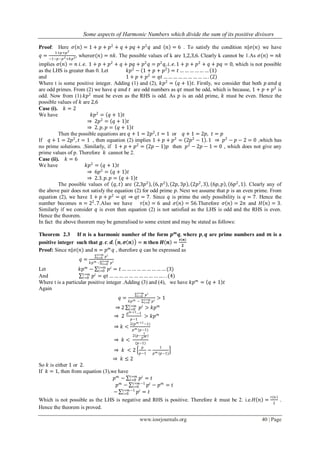
Proof: Here 𝜎 𝑛 = 1 + 𝑝 + 𝑝2
+ 𝑞 + 𝑝𝑞 + 𝑝2
𝑞 and 𝑛 = 6 . To satisfy the condition 𝑛|𝜎(𝑛) we have
𝑞 =
1+𝑝+𝑝2
−1−𝑝−𝑝2+𝑘 𝑝2, where𝜎(𝑛) = 𝑛𝑘. The possible values of k are 1,2,3,6. Clearly k cannot be 1.As 𝜎(𝑛) = 𝑛𝑘
implies 𝜎 𝑛 = 𝑛 𝑖. 𝑒. 1 + 𝑝 + 𝑝2
+ 𝑞 + 𝑝𝑞 + 𝑝2
𝑞 = 𝑝2
𝑞, 𝑖. 𝑒. 1 + 𝑝 + 𝑝2
+ 𝑞 + 𝑝𝑞 = 0, which is not possible
as the LHS is greater than 0. Let 𝑘𝑝2
− 1 + 𝑝 + 𝑝2
= 𝑡 … … … … … … 1
and 1 + 𝑝 + 𝑝2
= 𝑞𝑡 … … … … … … … … … . 2
Where t is some positive integer. Adding (1) and (2), 𝑘𝑝2
= 𝑞 + 1 𝑡. Firstly, we consider that both 𝑝 𝑎𝑛𝑑 𝑞
are odd primes. From (2) we have 𝑞 𝑎𝑛𝑑 𝑡 are odd numbers as 𝑞𝑡 must be odd, which is because, 1 + 𝑝 + 𝑝2
is
odd. Now from (1) 𝑘𝑝2
must be even as the RHS is odd. As 𝑝 is an odd prime, 𝑘 must be even. Hence the
possible values of 𝑘 are 2,6
Case (i). 𝑘 = 2
We have 𝑘𝑝2
= 𝑞 + 1 𝑡
⇒ 2𝑝2
= 𝑞 + 1 𝑡
⇒ 2. 𝑝. 𝑝 = 𝑞 + 1 𝑡
Then the possible equations are 𝑞 + 1 = 2𝑝2
, 𝑡 = 1 or 𝑞 + 1 = 2𝑝, 𝑡 = 𝑝
If 𝑞 + 1 = 2𝑝2
, 𝑡 = 1 , then equation (2) implies 1 + 𝑝 + 𝑝2
= 2𝑝2
− 1 . 1 ⇒ 𝑝2
− 𝑝 − 2 = 0 ,which has
no prime solutions. .Similarly, if 1 + 𝑝 + 𝑝2
= (2𝑝 − 1)𝑝 then 𝑝2
− 2𝑝 − 1 = 0 , which does not give any
prime values of p. Therefore 𝑘 cannot be 2.
Case (ii). 𝑘 = 6
We have 𝑘𝑝2
= 𝑞 + 1 𝑡
⇒ 6𝑝2
= 𝑞 + 1 𝑡
⇒ 2.3. 𝑝. 𝑝 = 𝑞 + 1 𝑡
The possible values of 𝑞, 𝑡 are 2,3𝑝2
, 6, 𝑝2
, 2𝑝, 3𝑝 , 2𝑝2
, 3 , 6𝑝, 𝑝 , 6𝑝2
, 1 . Clearly any of
the above pair does not satisfy the equation (2) for odd prime 𝑝. Next we assume that 𝑝 is an even prime. From
equation (2), we have 1 + 𝑝 + 𝑝2
= 𝑞𝑡 ⇒ 𝑞𝑡 = 7. Since 𝑞 is prime the only possibility is 𝑞 = 7. Hence the
number becomes 𝑛 = 22
. 7.Also we have 𝜏 𝑛 = 6 and 𝜎 𝑛 = 56.Therefore 𝜎 𝑛 = 2𝑛 and 𝐻 𝑛 = 3.
Similarly if we consider 𝑞 is even then equation (2) is not satisfied as the LHS is odd and the RHS is even.
Hence the theorem.
In fact the above theorem may be generalised to some extent and may be stated as follows:
Theorem 2.3 If 𝒏 is a harmonic number of the form 𝒑 𝒎
𝒒, where 𝒑, 𝒒 are prime numbers and 𝒎 is a
positive integer such that 𝒈. 𝒄. 𝒅. 𝒏, 𝝈 𝒏 = 𝒏 then 𝑯 𝒏 =
𝝉(𝒏)
𝟐
Proof: Since 𝑛|𝜎(𝑛) and 𝑛 = 𝑝 𝑚
𝑞 , therefore 𝑞 can be expressed as
𝑞 =
𝑝 𝑖𝑖=𝑚
𝑖=0
𝑘 𝑝 𝑚 − 𝑝 𝑖𝑖=𝑚
𝑖=0
Let 𝑘𝑝 𝑚
− 𝑝𝑖
= 𝑡 … … … … … … … … … (3)𝑖=𝑚
𝑖=0
And 𝑝𝑖
= 𝑞𝑡 … … … … … … … … … … … . . (4)𝑖=𝑚
𝑖=0
Where t is a particular positive integer .Adding (3) and (4), we have 𝑘𝑝 𝑚
= 𝑞 + 1 𝑡
Again
𝑞 =
𝑝 𝑖𝑖=𝑚
𝑖=0
𝑘𝑝 𝑚 − 𝑝 𝑖𝑖=𝑚
𝑖=0
> 1
⇒ 2 𝑝𝑖𝑖=𝑚
𝑖=0 > 𝑘𝑝 𝑚
⇒ 2
𝑝 𝑚 +1−1
𝑝−1
> 𝑘𝑝 𝑚
⇒ 𝑘 <
2(𝑝 𝑚 +1−1)
𝑝 𝑚 (𝑝−1)
⇒ 𝑘 <
2(𝑝−
1
𝑝 𝑚 )
(𝑝−1)
⇒ 𝑘 < 2
𝑝
𝑝−1
−
1
𝑝 𝑚 (𝑝−1)
⇒ 𝑘 ≤ 2
So 𝑘 is either 1 or 2.
If 𝑘 = 1, then from equation (3),we have
𝑝 𝑚
− 𝑝𝑖
= 𝑡𝑖=𝑚
𝑖=0
𝑝 𝑚
− 𝑝𝑖
− 𝑝 𝑚
= 𝑡𝑖=𝑚−1
𝑖=0
− 𝑝𝑖
= 𝑡𝑖=𝑚−1
𝑖=0
Which is not possible as the LHS is negative and RHS is positive. Therefore 𝑘 must be 2. i.e.𝐻 𝑛 =
𝜏(𝑛)
2
.
Hence the theorem is proved.
Some aspects of Harmonic Numbers which divide the sum of its positive divisors
www.iosrjournals.org 41 | Page
In fact, it has been observed by Pomerance [10] and Callan [7] that the only harmonic numbers of the
form 𝑝 𝑎
𝑞 𝑏
are perfect numbers.
Theorem 2.4 There is no perfect number of the form 𝒑 𝟑
𝒒, where 𝒑, 𝒒 are odd primes.
Proof: Let 𝑛 = 𝑝3
𝑞 then 𝜎 𝑛 = 1 + 𝑝 + 𝑝2
+ 𝑝3
1 + 𝑞 . Since we are considering the perfect number
,therefore 𝜎 𝑛 = 2𝑛.That is 1 + 𝑝 + 𝑝2
+ 𝑝3
1 + 𝑞 = 2𝑝3
𝑞.
Or
1+𝑝+𝑝2+𝑝3
𝑝3
1+𝑞
𝑞
= 2 … … … … … … … … … . . (5)
Suppose if possible 𝑝| 1 + 𝑝 + 𝑝2
+ 𝑝3
. Obviously 𝑝| 𝑝 + 𝑝2
+ 𝑝3
. Therefore, we have 𝑝|( 1 +
𝑝+𝑝2+𝑝3− 𝑝+𝑝2+𝑝3). i.e. 𝑝|1, which is not possible. Hence 𝑝∤(1+𝑝+𝑝2+𝑝3). Therefore the only possibility
is 𝑝3
| 1 + 𝑞 and 𝑞| 1 + 𝑝 + 𝑝2
+ 𝑝3
. 2 being a prime number the only possibilities are (i) 2𝑝3
= 1 + 𝑞 and
𝑞 = 1 + 𝑝 + 𝑝2
+ 𝑝3
. But second one is not possible as the LHS is odd and the RHS is even. and (ii) 2𝑞 = 1 +
𝑝 + 𝑝2
+ 𝑝3
and 𝑝3
= 1 + 𝑞.Again the second one is not possible as the LHS is odd and the RHS is even
.Hence the Result.
The above theorem may be generalized as:
Theorem 2.5 There is no perfect number of the form 𝒑 𝒎
𝒒, where p and q are odd primes and 𝒎 is an odd
numbers.
Proof: Let 𝑛 = 𝑝 𝑚
𝑞 then 𝜎 𝑛 = 𝑝𝑖𝑖=𝑚
𝑖=0 (1 + 𝑞). Since we considering the perfect number therefore
𝜎 𝑛 = 2𝑛.That is 𝑝𝑖𝑖=𝑚
𝑖=0 1 + 𝑞 = 2 𝑝 𝑚
𝑞
Or
𝑝 𝑖𝑖=𝑚
𝑖=0 1+𝑞
𝑝 𝑚 𝑞
= 2..........................................................(6)
Suppose, if possible𝑝| 𝑝𝑖𝑖=𝑚
𝑖=0 . Obviously 𝑝| 𝑝𝑖𝑖=𝑚
𝑖=1 .Therefore, we have 𝑝| 𝑝𝑖𝑖=𝑚
𝑖=0 −
𝑝𝑖𝑖=𝑚
𝑖=1 . i.e. 𝑝|1, which is not possible. Hence 𝑝 ∤. 𝑝𝑖𝑖=𝑚
𝑖=0 . Therefore the only possibility is 𝑝 𝑚
|1 + 𝑞 and
𝑞| 𝑝𝑖𝑖=𝑚
𝑖=0 . 2 being a prime number the possibilities are (i) 2𝑝 𝑚
= 1 + 𝑞 and 𝑞 = 𝑝𝑖𝑖=𝑚
𝑖=0 .But second one
is not possible, as the LHS is odd and the RHS is even. (ii) 2𝑞 = 𝑝𝑖𝑖=𝑚
𝑖=0 and 𝑝 𝑚
= 1 + 𝑞, again second one
is not possible as the LHS is odd and the RHS is even and so the result. Theorem 2.4 is a particular case when
m=3.
We now state that “There is no harmonic number of the form 𝒑 𝒎
𝒒, where p and q are odd
primes and 𝒎 is an odd number such that 𝒈. 𝒄. 𝒅. 𝒏, 𝝈 𝒏 = 𝒏. "
III. Some properties of the harmonic numbers having 𝒈. 𝒄. 𝒅. 𝒏, 𝝈 𝒏 = 𝒏 of the form
𝟐 𝒌
𝒑 𝒎
𝒒
In this section we are trying to find the existence of some harmonic numbers of the form 2 𝑘
𝑝 𝑚
, for
small values of m.
Theorem 3.1 Let the number be of the form 𝒏 = 𝟐 𝒌
𝒑 and let 𝒈. 𝒄. 𝒅. 𝒏, 𝝈 𝒏 = 𝒏, then there exists at
least one 𝒏 such that 𝑯 𝒏 =
𝝉(𝒏)
𝟐
Proof: If 𝑛 = 2 𝑘
𝑝 then 𝜎 𝑛 = 2𝑖
(1 + 𝑝)𝑖=𝑘
𝑖=0 . Since𝜎 𝑛 = 𝑛𝑘1, for some number k1 . We have
𝑛𝑘1 = 2𝑖
(1 + 𝑝)𝑖=𝑘
𝑖=0
2 𝑘
𝑝𝑘1 = 2𝑖
(1 + 𝑝)𝑖=𝑘
𝑖=0
𝑘1 =
1 + 𝑝
𝑝
2 𝑘+1
− 1
2 𝑘
Let 𝐻 𝑛 be the harmonic mean divisors of n. Then 𝑘1 𝐻 𝑛 = 𝜏(𝑛)
Hence 𝜏 𝑛 = 𝐻 𝑛
1+𝑝
𝑝
2 𝑘+1−1
2 𝑘
1 + 𝑘 2 = 𝐻 𝑛
1+𝑝
𝑝
2 𝑘+1−1
2 𝑘
1 + 𝑘 = 𝐻 𝑛
1+𝑝
𝑝
2 𝑘+1−1
2 𝑘+1 .................................................(7)
We observed that if 𝑝 = 2 𝑘+1
− 1 then 𝐻 𝑛 =
𝜏(𝑛)
2
.
With a small program in MATHEMATICA software it can be easily seen that some of the values of k +1 , for
which 𝑝 = 2 𝑘+1
− 1 is a prime number are
{2,3,5,7,13,17,19,31,61,89,107,127,521,607,1279,2203,2281,3217,4253,4423,9689,9941}. However it has
been observed that if 𝑝 = 2 𝑘+1
− 1 is a prime number then 𝑘 + 1 itself must be a prime number. These
Some aspects of Harmonic Numbers which divide the sum of its positive divisors
www.iosrjournals.org 42 | Page
numbers are called Mersene primes and the numbers of the form 2 𝑘
(2 𝑘+1
− 1) are called perfect numbers. So
far there are 48 Mersene primes .
Theorem 3.2 There does not exist any harmonic number of the form 𝒏 = 𝟐 𝒌
𝒑 𝟐
for which
𝒈. 𝒄. 𝒅. 𝒏, 𝝈 𝒏 = 𝒏 ,where 𝒌 is a positive integer and 𝒑 is an odd prime.
Proof: For 𝑛 = 2 𝑘
𝑝2
, we have 𝜎 𝑛 = 2 𝑘+1
− 1 (1 + 𝑝 + 𝑝2
). Then
𝜎(𝑛)
𝑛
=
2 𝑘+1−1 (1+𝑝+𝑝2)
2 𝑘 𝑝2
Now 2 𝑘
∤ (2 𝑘+1
− 1) and 2 𝑘
∤ (1 + 𝑝 + 𝑝2
), as 𝑝 is an odd prime. Hence 1 + 𝑝 + 𝑝2
becomes odd. Hence
the theorem.
The above theorem is possible as 1 + 𝑝 + 𝑝2
becomes odd. So this will happen till 𝑝𝑖
is odd for some values
of 𝑖, in fact if 𝑖 is even. So we can state the following result:
Theorem 3.3 There does not exists any harmonic number of the form 𝟐 𝒌
𝒑 𝟐𝒙
of which 𝒈. 𝒄. 𝒅. 𝒏, 𝝈 𝒏 =
𝒏 where 𝒌, 𝒙 are positive integers and 𝒑 is an odd prime.
Theorem 3.4 There is no harmonic numbers up to 𝟏𝟎 𝟕𝟔
of the form 𝟐 𝒌
𝒑 𝟑
, where 𝒌 is a positive integer
and 𝒑 is odd prime.
Proof: Let 𝑛 = 2 𝑘
𝑝3
. Then 𝜎 𝑛 = 2 𝑘+1
− 1 1 + 𝑝 + 𝑝2
+ 𝑝3
and 𝜏 𝑛 = 4(𝑘 + 1). As
𝑔. 𝑐. 𝑑. 𝑛, 𝜎 𝑛 = 𝑛 we may assume 𝜎 𝑛 = 𝑛𝑘1 where 𝑘1 is an integer.
Then 𝑘1 =
2 𝑘+1−1 (1+𝑝+𝑝2+𝑝3)
2 𝑘 𝑝3 is also an integer.
Now 𝑝|(𝑝 + 𝑝2
+ 𝑝3
), if we assume 𝑝|(1 + 𝑝 + 𝑝2
+ 𝑝3
) then 𝑝|(1 + 𝑝 + 𝑝2
+ 𝑝3
) − (𝑝 + 𝑝2
+ 𝑝3
) i.e. 𝑝|1,
which is not possible. Hence 𝑝 ∤ 1 + 𝑝 + 𝑝2
+ 𝑝3
i.e. 𝑝3
∤ (1 + 𝑝 + 𝑝2
+ 𝑝3
). Therefore the only
possibility is 𝑝3
|(2 𝑘+1
− 1). As . 2 𝑘
∤ (2 𝑘+1
− 1) so 2 𝑘
|(1 + 𝑝 + 𝑝2
+ 𝑝3
).
Let 𝑥𝑝3
= 2 𝑘+1
− 1...............................................................(8)
And 1 + 𝑝 + 𝑝2
+ 𝑝3
= 𝑦2 𝑘
..................................................(9)
for some positive integer 𝑥, 𝑦. It is clear that for large value of 2 𝑘+1
− 1 , if 𝑝 is comparatively very small then
the equation (9) is not satisfied for 𝑦 ≥ 1. We have searched the numbers of the form 2 𝑘+1
− 1 for 1 ≤ 𝑘 ≤
251 in MATHEMATICA for which the value of 𝑝 has been found to be very very small. Hence all these
numbers does not satisfy the second equation. Hence there is no number of the form 2 𝑘
𝑝3
for 𝑘 ≤ 251.i.e.
there is no harmonic numbers up to 1076
of the form 2 𝑘
𝑝3
.
Theorem 3.5 Let the number be of the form 𝒏 = 𝟐 𝒌
𝒑𝒒 and let 𝒈. 𝒄. 𝒅. 𝒏, 𝝈 𝒏 = 𝒏 then there exists no 𝒏
such that 𝑯 𝒏 =
𝝉(𝒏)
𝟐 𝒙 , 𝒙 ≥ 𝟏
Proof: For 𝑛 = 2 𝑘
𝑝𝑞, we have 𝜎 𝑛 = 2 𝑘+1
− 1 1 + 𝑝 (1 + 𝑞) and 𝜏 𝑛 = 4(𝑘 + 1). Let 𝜎 𝑛 = 𝑛𝑘1
where 𝑘1a positive integer. Therefore
𝑘1 =
2 𝑘+1−1 1+𝑝 (1+𝑞)
2 𝑘 𝑝𝑞
as 𝑘1 𝐻 𝑛 = 𝜏(𝑛)
1 + 𝑘 4 = 𝐻 𝑛 (
1+𝑝
𝑝
)(
1+𝑞
𝑞
)
2 𝑘+1−1
2 𝑘
Or 1 + 𝑘 2 = 𝐻 𝑛 (
1+𝑝
𝑝
)(
1+𝑞
𝑞
)
2 𝑘+1−1
2 𝑘+1
For 𝐻 𝑛 =
𝜏(𝑛)
2
,
1 + 𝑝
𝑝
1 + 𝑞
𝑞
2 𝑘+1
− 1
2 𝑘+1
= 1
Or
1+𝑝+𝑞+𝑝𝑞
𝑝𝑞
=
2 𝑘+1
2 𝑘+1−1
Or ( 2 𝑘+1
− 1) 1 + 𝑝 + 𝑞 = 𝑝𝑞.............................................................(10)
If 𝑝 = 𝑥(2 𝑘+1
− 1) for 𝑥 > 1 then 𝑞 is a composite number. Same is true for 𝑞.Hence the only
possibility is 𝑝 or 𝑞 must be of the form 2 𝑘+1
− 1. But if 𝑝 = 2 𝑘+1
− 1 then from the equation (10), we have
1 + 𝑝 + 𝑞 = 𝑞 𝑖. 𝑒. 𝑝 = −1 is not possible. Same is true for q also. Thus 𝐻 𝑛 =
𝜏(𝑛)
2
is not possible for all 𝑝
and 𝑞 odd primes. Now we can consider the case of 𝐻 𝑛 =
𝜏(𝑛)
2 𝑥 , 𝑥 > 1. Then we have
𝜎(𝑛)
2 𝑥 𝑛
= 1.This implies
that
Some aspects of Harmonic Numbers which divide the sum of its positive divisors
www.iosrjournals.org 43 | Page
1 + 𝑝
𝑝
1 + 𝑞
𝑞
2 𝑘+1
− 1
2 𝑘+𝑥
= 1
1+𝑝+𝑞
𝑝𝑞
+ 1
2 𝑘+1−1
2 𝑘+𝑥 = 1
1+𝑝+𝑞
𝑝𝑞
2 𝑘+1−1
2 𝑘+𝑥 = 1 −
2 𝑘+1−1
2 𝑘+𝑥
1 + 𝑝 + 𝑞 2 𝑘+1
− 1 = 2 𝑘+𝑥
− 2 𝑘+1
+ 1 𝑝𝑞
1 + 𝑝 + 𝑞 2 𝑘+1
− 1 = 2 𝑘+1
2 𝑥−1
− 1 + 1 𝑝𝑞.....................................(11)
For 𝑥 ≥ 2, 2 𝑘+1
2 𝑥−1
− 1 + 1 > (2 𝑘+1
− 1). Also 𝑝𝑞 > 1 + 𝑝 + 𝑞 . Hence the RHS of the equation (11)
is greater than the LHS , which is not possible. Hence the theorem.
Theorem 3.6 If a number is of the form 𝒏 = 𝟐 𝒌
𝒑 𝟐
𝒒 with 𝒈. 𝒄. 𝒅. 𝒏, 𝝈 𝒏 = 𝒏 and 𝑯 𝒏 =
𝝉(𝒏)
𝟐
, then 𝒏
does not exist.
Proof: For 𝑛 = 2 𝑘
𝑝2
𝑞 we have 𝜎 𝑛 = 2 𝑘+1
1 + 𝑝 + 𝑝2
(1 + 𝑞) and 𝜏 𝑛 = 3(𝑘 + 1)2. Let 𝜎 𝑛 = 𝑛𝑘1
where 𝑘1 is a positive integer. Then we have
2 𝑘+1
− 1 1 + 𝑝 + 𝑝2
1 + 𝑞 = 2 𝑘
𝑝2
𝑞𝑘1
Or
2 𝑘+1−1
2 𝑘
1+𝑝+𝑝2
𝑝2
1+𝑞
𝑞
= 𝑘1
Again 𝐻 𝑛 =
𝑛𝜏(𝑛)
𝜎(𝑛)
=
𝜏(𝑛)
𝑘1
Or
2 𝑘+1−1
2 𝑘
1+𝑝+𝑝2
𝑝2
1+𝑞
𝑞
=
𝜏(𝑛)
𝐻(𝑛)
Or 𝐻(𝑛)
2 𝑘+1−1
2 𝑘
1+𝑝+𝑝2
𝑝2
1+𝑞
𝑞
= 3 1 + 𝑘 2
Or 𝐻(𝑛)
2 𝑘+1−1
2 𝑘+1
1+𝑝+𝑝2
𝑝2
1+𝑞
𝑞
= 3 1 + 𝑘 ...............................(12)
A necessary condition that 𝐻(𝑛)
2 𝑘+1−1
2 𝑘+1
1+𝑝+𝑝2
𝑝2
1+𝑞
𝑞
is an integer.
Suppose we want to make 𝐻 𝑛 = 3(1 + 𝑘)
Then
2 𝑘+1−1
2 𝑘+1
1+𝑝+𝑝2
𝑝2
1+𝑞
𝑞
= 1 ....................................................(13)
As 2 𝑘+1
− 1, 1 + 𝑝 + 𝑝2
are odd numbers so only possibility is 2 𝑘+1
|1 + 𝑞.
Let 𝑞 = 𝑥2 𝑛
− 1, where 𝑛 ≥ 𝑘 + 1
If 𝑛 > 𝑘 + 1 then the expression (13) becomes
2 𝑘+1
− 1
1+𝑝+𝑝2
𝑝2
𝑥2 𝑦
𝑞
= 1 for some 𝑦 ≥ 0 ..............................(14)
As 𝑝 and 𝑞 are odd primes the only possibility is 𝑦 = 0 i.e. 𝑛 = 𝑘 + 1
Hence the expression (14) becomes
2 𝑘+1
− 1
1+𝑝+𝑝2
𝑝2
𝑥
𝑞
= 1 ....................................................(15)
For 𝑥 ≥ 1, 𝑞 does not divide 2 𝑘+1
− 1, hence the only possibility is 𝑞|(1 + 𝑝 + 𝑝2
)
Let 𝑞𝑡 = 1 + 𝑝 + 𝑝2
for some positive integer 𝑡, then the expression (15) becomes
2 𝑘+1
− 1
𝑡𝑥
𝑝2 = 1 ...........................................................(16)
As 𝑥 > 1, and 2 𝑘+1
− 1 > 1, the only possibility is 𝑡 = 1 and 𝑥 = 2 𝑘+1
− 1 = 𝑝
Now 𝑞 = 1 + 𝑝 + 𝑝2
=> 𝑥2 𝑘+1
− 1 = 1 + 𝑝 + 𝑝2
=> 𝑝2 𝑘+1
− 𝑝 = 2 + 𝑝2
=> 𝑝 2 𝑘+1
− 1 = 2 + 𝑝2
i.e. 𝑝2
= 2 + 𝑝2
, which is not possible.
Now , we consider 𝑥 = 1. then 𝑞 = 2 𝑘+1
− 1. Therefore the equation (16) becomes 2 𝑘+1
− 1
𝑡
𝑝2 = 1
If 𝑡 = 1 then 𝑝2
= 2 𝑘+1
− 1 = 𝑞.Therefore 𝑞𝑡 = 1 + 𝑝 + 𝑝2
implies 𝑞 = 1 + 𝑝 + 𝑝2
, which gives 𝑝 = −1
,which is not possible.
Next we consider that 𝑡 > 1. Again there are two possibilities, 𝑡 = 𝑝 and 𝑡 = 𝑝2
. If 𝑡 = 𝑝2
then
2 𝑘+1
− 1 = 1. This implies that 𝑘 = 0 which is not acceptable .Lastly we have 𝑡 = 𝑝. Then 2 𝑘+1
− 1 = 𝑝 i.e.
𝑝 = 𝑞.So 𝑞𝑡 = 1 + 𝑝 + 𝑝2
implies 𝑝2
= 1 + 𝑝 + 𝑝2
i.e. 𝑝 = −1, not possible .Thus there exists no number of
the form 𝑛 = 2 𝑘
𝑝2
𝑞 such that H(n) = 3(𝑘 + 1) =
𝜏(𝑛)
2
. The above theorem may be generalized on the power of
of p and can be written as follows:
Some aspects of Harmonic Numbers which divide the sum of its positive divisors
www.iosrjournals.org 44 | Page
Theorem 3.7 Let the number be of the form 𝒏 = 𝟐 𝒌
𝒑 𝟐𝒙
𝒒 where 𝒙 is any positive integer and 𝒑, 𝒒 are odd
primes. Let 𝒈. 𝒄. 𝒅. 𝒏, 𝝈 𝒏 = 𝒏 and 𝑯 𝒏 =
𝝉(𝒏)
𝟐
, then 𝒏 does not exist.
Proof: If 𝐻 𝑛 =
𝜏(𝑛)
2
then we have
2 𝑘+1−1
2 𝑘+1
𝑝 𝑖𝑖=2𝑥
𝑖=0
𝑝2𝑥
1+𝑞
𝑞
= 1 ............................................................(17
As 2 𝑘+1
− 1 and 𝑝𝑖𝑖=2𝑥
𝑖=0 are odd numbers, so 2 𝑘+1
|1 + 𝑞.
Let 𝑞 = 𝑥12 𝑛
− 1, 𝑤ℎ𝑒𝑟𝑒 𝑛 ≥ 𝑘 + 1
If 𝑛 > 𝑘 + 1 then the expression (17) becomes
2 𝑘+1
− 1
𝑝 𝑖𝑖=2𝑥
𝑖=0
𝑝2𝑥
𝑥 2 𝑦
𝑞
= 1 , for some 𝑦 ≥ 1 .............................(18)
For 𝑥 ≥ 1, 𝑞 does not divide 2 𝑘+1
− 1, so the only possibility is 𝑞| 𝑝𝑖𝑖=2𝑥
𝑖=0 . Let 𝑞𝑡 = 𝑝𝑖𝑖=2𝑥
𝑖=0 , then the
equation (18) becomes
2 𝑘+1
− 1
𝑡𝑥1
𝑝2𝑥 = 1
The only possibility is 2 𝑘+1
− 1 = 𝑝 𝑦1, 𝑡 = 𝑝 𝑦2, 𝑥1 = 𝑝 𝑦3, 𝑤ℎ𝑒𝑟𝑒 𝑦1 + 𝑦2 + 𝑦3 = 2𝑥 and 𝑦𝑖 ≥ 0, 𝑖 =
1,2,3
Now 𝑞𝑡 = 𝑝𝑖𝑖=2𝑥
𝑖=0
=> (𝑥12 𝑘+1
− 1)𝑝 𝑦2 = 𝑝𝑖𝑖=2𝑥
𝑖=0
=> 𝑝 𝑦2+𝑦3 2 𝑘+1
− 𝑝 𝑦2+𝑦3 = 1 + 𝑝 𝑦2 + 𝑝𝑖𝑖=2𝑥
𝑖=1,𝑖≠𝑦2+𝑦3
=> 𝑝 𝑦2+𝑦3 (2 𝑘+1
− 1) = 1 + 𝑝 𝑦2 + 𝑝𝑖𝑖=2𝑥
𝑖=1,𝑖≠𝑦2+𝑦3
=> 0 = 1 + 𝑝 𝑦2 + 𝑝𝑖𝑖=2𝑥−1
𝑖=1,𝑖≠𝑦2+𝑦3
.....................................................(19)
This is not possible .Hence the theorem.
In theorem 3.6 we have seen that there is no harmonic number of the form 𝑛 = 2 𝑘
𝑝2
𝑞 such that 𝑛
completely divides 𝜎 𝑛 .However there are some harmonic numbers of this form such that 𝑛 does not divide
completely 𝜎 𝑛 . Let 𝑞 = 2 𝑘+1
− 1 . Then, we have
𝐻 𝑛 𝜎(𝑛)
𝑛
= 𝜏(𝑛)
i.e. 𝐻(𝑛)
2 𝑘+1−1
2 𝑘+1
1+𝑝+𝑝2
𝑝2
1+𝑞
𝑞
= 3 1 + 𝑘
i.e. 𝐻(𝑛)
1+𝑝+𝑝2
𝑝2 = 3 1 + 𝑘
As 𝑔. 𝑐. 𝑑. 𝑝2
, 1 + 𝑝 + 𝑝2
= 1, the only possibility is 3 1 + 𝑘 = 𝑦(1 + 𝑝 + 𝑝2
). Taking 𝑦 = 3 some of the
numbers are 212
32
213
− 1 , 230
52
231
− 1 , taking 𝑦 = 1 some of the numbers are 2126
192
2127
− 1 ,
260
132
261
− 1 , 218
72
219
− 1 .
IV. Some properties of harmonic numbers having 𝒈. 𝒄. 𝒅. 𝒏, 𝝈 𝒏 = 𝒏 of the form
𝟐 𝒌
𝒑 𝟏 𝒑 𝟐 … … . 𝒑 𝒎
Theorem 4.1 Let the number be of the form 𝒏 = 𝟐 𝒌
𝒑 𝟏 𝒑 𝟐 … … . 𝒑 𝒎. Let one of them is 𝟐 𝒌+𝟏
− 𝟏 then
𝝈 𝒏 ≠ 𝒌𝒏, where 𝒌 = 𝟐𝒙, 𝒙 being odd and 𝒑𝒊 are odd prime, 𝒊 = 𝟏, 𝟐, … . . , 𝒎
Proof: We have 𝜎 𝑛 = 2 𝑘+1
− 1 (1 + 𝑝)𝑖
𝑚
𝑖=1 . Let 𝑝1 = 2 𝑘+1
− 1. If possible, let 𝜎 𝑛 = 2𝑥𝑛 where 𝑥 is
an odd number. We have
2 𝑘+1−1
2 𝑘+1
1+𝑝 𝑖
𝑝 𝑖
= 𝑥𝑚
𝑖=1
Or
1+𝑝 𝑖
𝑝 𝑖
= 𝑥𝑚
𝑖=1 ...............................................................(20)
This is not possible because the numerator part of LHS of (20) is even number and denominator part
being odd the LHS becomes even. But the RHS is odd. This theorem can be generalized further to give the
following theorem:
Theorem 4.2 Let the number be of the form 𝒏 = 𝟐 𝒌
𝒑 𝟏 𝒑 𝟐 … … . 𝒑 𝒎, where all 𝒑’s are distinct odd primes,
then 𝝈 𝒏 ≠ 𝟐𝒏.
Proof: Without loss of generality, we consider that 𝑝1 < 𝑝2 … … … … … . 𝑝 𝑚 .
Now
𝜎(𝑛)
𝑛
=
2 𝑘+1−1
2 𝑘+1
1+𝑝 𝑖
𝑝 𝑖
= 𝑘1(𝑠𝑎𝑦)𝑚
𝑖=1 ...................................(21)
Where 𝑘is a positive integer. Now 𝑝 𝑚 ∤ 1 + 𝑝𝑖 , ∀ 𝑖 = 1,2, … . . , 𝑚 as 𝑝 𝑚 > 𝑝𝑖, ∀𝑖 = 1,2,… . . , 𝑚 − 1.
Therefore only possibility is 𝑝 𝑚 |2 𝑘+1
− 1. Let 2 𝑘+1
− 1 = 𝑟𝑚 𝑝 𝑚, 𝑟𝑚 ≥ 1.
Some aspects of Harmonic Numbers which divide the sum of its positive divisors
www.iosrjournals.org 45 | Page
So
𝜎(𝑛)
𝑛
=
2 𝑘+1−1
2 𝑘+1
1+𝑝 𝑚
𝑝 𝑚
1+𝑝 𝑖
𝑝 𝑖
𝑚−1
𝑖=1
=
𝑟 𝑚 𝑝 𝑚
2 𝑘
2 𝑘+1−1+𝑟 𝑚
𝑟 𝑚 𝑝 𝑚
1+𝑝 𝑖
𝑝 𝑖
𝑚−1
𝑖=1
=
1
2 𝑘 (2 𝑘+1
− 1 + 𝑟𝑚 )
1+𝑝 𝑚 −1
𝑝 𝑚 −1
.
1+𝑝 𝑖
𝑝 𝑖
𝑚−2
𝑖=1 .....................................(22)
Now 𝑝 𝑚−11 ∤ 1 + 𝑝𝑖 , ∀ 𝑖 = 1,2, … . . , 𝑚 − 1 as 𝑝 𝑚−1 > 𝑝𝑖, ∀𝑖 = 1,2, … . . , 𝑚 − 2.
So the possibility is 𝑝 𝑚−1|2 𝑘+1
− 1 + 𝑟𝑚 . Let 2 𝑘+1
− 1 + 𝑟𝑚 = 𝑟 𝑚−1 𝑝 𝑚−1, .Then the equation (22) can be
written as
𝜎(𝑛)
𝑛
=
1
2 𝑘 (𝑟 𝑚−1 𝑝 𝑚−1)
2 𝑘+1−1+𝑟 𝑚 +𝑟 𝑚 −1
𝑟 𝑚 −1 𝑝 𝑚 −1
1+𝑝 𝑖
𝑝 𝑖
𝑚−2
𝑖=1
Continuing this process at the 𝑗th stage , where the remaining primes are 𝑝1, 𝑝2 … … … … … . 𝑝𝑗 .
We have
𝜎(𝑛)
𝑛
=
1
2 𝑘 (𝑟𝑗 𝑝𝑗 )
2 𝑘+1−1+ 𝑟 𝑗
𝑚
𝑖=𝑗
𝑟 𝑗 𝑝 𝑗
1+𝑝 𝑖
𝑝 𝑖
𝑗 −1
𝑖=1
and 𝑟𝑗 −1 𝑝𝑗 −1 = 2 𝑘+1
− 1 + 𝑟𝑗
𝑚
𝑖=𝑗 . Therefore at the m-th stage we have
𝜎(𝑛)
𝑛
=
1
2 𝑘 2 𝑘+1
− 1 + 𝑟𝑖
𝑚
𝑖=1 ...................................................(23)
If possible, let
𝜎(𝑛)
𝑛
= 2, then the equation (23) becomes 2 𝑘+1
− 1 + 𝑟𝑖
𝑚
𝑖=1 =2 𝑘+1
.So 𝑟𝑖
𝑚
𝑖=1 = 1,which is
not possible .Hence the result.
In fact the above theorem helps us to search numbers of the form 2 𝑘
𝑝1 𝑝2 … … . 𝑝 𝑚 ,where 𝑝1, 𝑝2, … … . , 𝑝 𝑚 are
distinct odd primes and 𝑝1< 𝑝2 <, … … . , < 𝑝 𝑚 (say), which are harmonic of course 𝑔. 𝑐. 𝑑. 𝑛, 𝜎 𝑛 =
𝑛 .Following are the steps:
Step 1. We chose the number 2 𝑘+1
− 1 and get its factor.It is desired to have the prime factors whose
power is one .However if a prime factor is 2 or ,say 𝑞 𝑚
, 𝑚 ≥ 1 occurs which is also a factor of (𝑘 + 1), then it
may be allowed. We take the highest prime say 𝑝 𝑚 ,as stated in the theorem, let 2 𝑘+1
− 1 = 𝑟𝑚 𝑝 𝑚
Step 2. We calculate the prime factor of 2 𝑘+1
− 1 + 𝑟𝑚 . In fact the prime factors of 2 𝑘+1
− 1 except
𝑝 𝑚 will also be the prime factors of 2 𝑘+1
− 1 + 𝑟𝑚 .Hence the prime factors are never lost at any stage. Again it
is desired to have the prime factors whose power is one. However if a prime factor is 2 or ,say 𝑞 𝑚
, 𝑚 ≥ 1 occurs
which is also a factor of (𝑘 + 1),then it may be allowed.
Step 3. We repeat the above process and at the j-th stage we consider the prime factors of 2 𝑘+1
− 1 +
𝑟𝑖
𝑚
𝑖=𝑗 , again we choose the highest prime provided in the factorization all the prime factor other than prime
factors of (k+1) are square free. We end the process when 2 𝑘+1
− 1 + 𝑟𝑖
𝑚
𝑖=𝑗 has only prime factor 2.Harmonic
mean H(n) of these numbers will be of the form 𝑞1 𝑞2 … . . 𝑞𝑖2𝑗
, for some 𝑗 where 𝑞1, 𝑞2, … . . , 𝑞𝑖 are some of the
prime factors of (k+1). Since the searching process is dependent only on 𝑘, it takes less time to search the
numbers of the said form out of a wide range of numbers. It has been observed that there is no numbers of the
said form whose harmonic mean is (𝑘 + 1)2 𝑥
for some 𝑥 up to 10100
.
References
[1] D.Callan, Solution to Problem 6616, Amer.Math.Monthly 99 (1992),783-789,MR1542194
[2] G.L.Cohen, Numbers whose positive divisors have small integral harmonic mean. Mathematics of computation.Vol. 66,
No.218,1997, PP 883-891.
[3] G.L.Cohen and R.M.Soril. Odd harmonic number exceed 1024
, Mathematics of Computation, S 0025- 5718(10)02337-9
[4] T. Goto and S.Shobata . All numbers whose positive divisors have integral harmonic mean up to 300, Mathematics of
Computation, Vol. 73, No. 245, PP 473-491
[5] T. Goto and K.Okeya. All Harmonic numbers less than 1014
, Japan J. Indust.Appl. Math.24(2007), 275-288
[6] M.Gracia. On numbers with integral harmonic mean, Amer. Math. Monthly, 61(1954), 89-96. MR 15:506d
[7] R.K.Guy. Unsolved Problems in Number Theory, 3rd edition. Springer-Verlag, New York, 2004.
[8] G.H.Hardy and E.M.Wright. An Introduction to the Theory of Numbers, fourth edition, Oxford (1962). MR0067125(16:673c)
[9] O.Ore. On the averages of the divisors of a number, Amer.Math.Monthly, 55 (1948), PP 615-619
[10] C. Pomerance. On a problem of Ore: harmonic numbers, unpublished manuscript (1973) see abstract *709-A5, Notice
Amer.Math.soc. 20(1973),a-648
[11] Solution to Problem E3445, Amer. Math.Monthly 99(1992),795
[12] J.Spiess. 1990, Some identities involving harmonic numbers , Math.Comp.55,839-863.

G0733945

  • 1.
    IOSR Journal ofMathematics (IOSR-JM) e-ISSN: 2278-5728,p-ISSN: 2319-765X, Volume 7, Issue 3 (Jul. - Aug. 2013), PP 39-45 www.iosrjournals.org www.iosrjournals.org 39 | Page Some aspects of Harmonic Numbers which divide the sum of its Positive divisors. Pranjal Rajkhowa1 , Hemen Bharali2 1 (Department of Mathematics),Gauhati University. India 2 (Department of Basic Sciences),Don Bosco College of Engineering and Technology ,Guwahati ,India Abstract: In this paper some particular harmonic numbers n, where n divides σ(n) completely have been taken. Three types of numbers prime factorised as say, 𝑝 𝑚 𝑞, 2 𝑘 𝑝 𝑚 𝑞, 2 𝑘 𝑝1 𝑝2 … … 𝑝 𝑚 have been discussed and some propositions have been developed to understand the properties of these type of numbers. It has been observed that harmonic numbers n having 𝑔. 𝑐. 𝑑. 𝑛, 𝜎 𝑛 = 𝑛 of the form 𝑝𝑞, 𝑝2 𝑞, 𝑝 𝑚 𝑞 does not exist if p,q both of them are odd primes. Further some useful properties of the harmonic numbers of the form 2 𝑘 𝑝 𝑚 𝑞, for some values of m have been discussed with the help of some propositions. After that an algorithm has been proposed to get the numbers of the form 2 𝑘 𝑝1 𝑝2 … … 𝑝 𝑚 , where n divides σ(n) completely. Keywords: Harmonic number, Mersene prime, Ore’s conjecture, Perfect number I. Introduction In 1948 Ore [9] introduced the concept of Harmonic numbers, and these numbers were named as Ore’s harmonic numbers(some 15 years later) by Pomerance[10].In general, the harmonic mean of positive numbers 𝑎1, 𝑎2, … … . . , 𝑎 𝑘 is defined by 1 𝑎 𝑖 𝑘 𝑖=1 −1 A positive integer n is said to be harmonic if the harmonic mean of its positive divisors 𝐻 𝑛 = 𝑛𝜏(𝑛) 𝜎(𝑛) is an integer, where 𝜏(𝑛) denotes the number of positive divisors and σ(n) denotes the sum of the positive divisors of n. We call 1 the trivial harmonic number. A list of harmonic numbers less than 2.109 have been given by Cohen [2]. This have been extended by Goto and Okeya [5] which is up to 1014 . If n is a harmonic divisor number then there are two possibilities (i) 𝑔. 𝑐. 𝑑. 𝑛, 𝜎 𝑛 = 𝑛 or (ii) 𝑔. 𝑐. 𝑑. 𝑛, 𝜎 𝑛 ≠ 𝑛.(i) implies that σ(n)=kn, where k is a positive integer. In fact if σ(n)=2n, then the numbers are called perfect numbers. Ore [9] proved that every perfect number is harmonic. But the converse is not true. For example, 140 is not perfect, but H(140)=5. Ore [4] conjectured that all harmonic numbers other than 1 must be even. In the present paper , we focus on those harmonic numbers which satisfies the property (i). Some examples of this kind of numbers are 6,28,496,672,8128,30240, … ….In section 2, some properties of the numbers of the form 𝑝 𝑚 𝑞 where p,q are any prime numbers have been discussed. In section 3, the type of numbers have been extended to the form 2 𝑘 𝑝 𝑚 𝑞. In section 4, the numbers have been further extended to the form 2 𝑘 𝑝1 𝑝2 … … 𝑝 𝑚 . In fact in this section a search technique have been obtained to get the numbers of the form 𝑔. 𝑐. 𝑑. 𝑛, 𝜎 𝑛 = 𝑛, where 𝑛 = 2 𝑘 𝑝1 𝑝2 … … 𝑝 𝑚 . II. Some properties of harmonic numbers having 𝒈. 𝒄. 𝒅. 𝒏, 𝝈 𝒏 = 𝒏 of the form 𝒑 𝒎 𝒒 Theorem 2.1 The only harmonic divisor number of the form 𝒑𝒒, where 𝒑 and 𝒒 are prime numbers and 𝒈. 𝒄. 𝒅. 𝒏, 𝝈 𝒏 = 𝒏, is 𝟔. Proof: Let 𝑛 = 𝑝𝑞, where 𝑝, 𝑞 are two prime numbers. Now 𝜎 𝑛 = 1 + 𝑝 + 𝑞 + 𝑝𝑞. If n divides σ(n) completely then 1 + 𝑝 + 𝑞 + 𝑝𝑞 = 𝑘𝑝𝑞, for some number k. Since n is a harmonic divisor number so 𝑘|𝜏 𝑛 = 4. So the possible values of k are 1,2,4 . Since 1 + 𝑝 + 𝑞 ≠ 0 therefore 𝑘 ≠ 1. The other possible equations are 1 + 𝑝 + 𝑞 = 𝑝𝑞 or 1 + 𝑝 + 𝑞 = 3𝑝𝑞. The possible values of 𝑝 are 1+𝑞 𝑞−1 , 1+𝑞 3𝑞−1 . Now 1 + 𝑞 > 3𝑞 − 1 => 2𝑞 < 2, which is not possible. Hence the only possible solutions are 2,3. Therefore 6 is the only harmonic divisor number of the form 𝑝𝑞. Theorem 2.2 The only harmonic divisor number of the form 𝒑 𝟐 𝒒, where 𝒑 𝒂𝒏𝒅 𝒒 are prime numbers such that 𝒈. 𝒄. 𝒅. 𝒏, 𝝈 𝒏 = 𝒏 is 𝟐𝟖.
  • 2.
    Some aspects ofHarmonic Numbers which divide the sum of its positive divisors www.iosrjournals.org 40 | Page Proof: Here 𝜎 𝑛 = 1 + 𝑝 + 𝑝2 + 𝑞 + 𝑝𝑞 + 𝑝2 𝑞 and 𝑛 = 6 . To satisfy the condition 𝑛|𝜎(𝑛) we have 𝑞 = 1+𝑝+𝑝2 −1−𝑝−𝑝2+𝑘 𝑝2, where𝜎(𝑛) = 𝑛𝑘. The possible values of k are 1,2,3,6. Clearly k cannot be 1.As 𝜎(𝑛) = 𝑛𝑘 implies 𝜎 𝑛 = 𝑛 𝑖. 𝑒. 1 + 𝑝 + 𝑝2 + 𝑞 + 𝑝𝑞 + 𝑝2 𝑞 = 𝑝2 𝑞, 𝑖. 𝑒. 1 + 𝑝 + 𝑝2 + 𝑞 + 𝑝𝑞 = 0, which is not possible as the LHS is greater than 0. Let 𝑘𝑝2 − 1 + 𝑝 + 𝑝2 = 𝑡 … … … … … … 1 and 1 + 𝑝 + 𝑝2 = 𝑞𝑡 … … … … … … … … … . 2 Where t is some positive integer. Adding (1) and (2), 𝑘𝑝2 = 𝑞 + 1 𝑡. Firstly, we consider that both 𝑝 𝑎𝑛𝑑 𝑞 are odd primes. From (2) we have 𝑞 𝑎𝑛𝑑 𝑡 are odd numbers as 𝑞𝑡 must be odd, which is because, 1 + 𝑝 + 𝑝2 is odd. Now from (1) 𝑘𝑝2 must be even as the RHS is odd. As 𝑝 is an odd prime, 𝑘 must be even. Hence the possible values of 𝑘 are 2,6 Case (i). 𝑘 = 2 We have 𝑘𝑝2 = 𝑞 + 1 𝑡 ⇒ 2𝑝2 = 𝑞 + 1 𝑡 ⇒ 2. 𝑝. 𝑝 = 𝑞 + 1 𝑡 Then the possible equations are 𝑞 + 1 = 2𝑝2 , 𝑡 = 1 or 𝑞 + 1 = 2𝑝, 𝑡 = 𝑝 If 𝑞 + 1 = 2𝑝2 , 𝑡 = 1 , then equation (2) implies 1 + 𝑝 + 𝑝2 = 2𝑝2 − 1 . 1 ⇒ 𝑝2 − 𝑝 − 2 = 0 ,which has no prime solutions. .Similarly, if 1 + 𝑝 + 𝑝2 = (2𝑝 − 1)𝑝 then 𝑝2 − 2𝑝 − 1 = 0 , which does not give any prime values of p. Therefore 𝑘 cannot be 2. Case (ii). 𝑘 = 6 We have 𝑘𝑝2 = 𝑞 + 1 𝑡 ⇒ 6𝑝2 = 𝑞 + 1 𝑡 ⇒ 2.3. 𝑝. 𝑝 = 𝑞 + 1 𝑡 The possible values of 𝑞, 𝑡 are 2,3𝑝2 , 6, 𝑝2 , 2𝑝, 3𝑝 , 2𝑝2 , 3 , 6𝑝, 𝑝 , 6𝑝2 , 1 . Clearly any of the above pair does not satisfy the equation (2) for odd prime 𝑝. Next we assume that 𝑝 is an even prime. From equation (2), we have 1 + 𝑝 + 𝑝2 = 𝑞𝑡 ⇒ 𝑞𝑡 = 7. Since 𝑞 is prime the only possibility is 𝑞 = 7. Hence the number becomes 𝑛 = 22 . 7.Also we have 𝜏 𝑛 = 6 and 𝜎 𝑛 = 56.Therefore 𝜎 𝑛 = 2𝑛 and 𝐻 𝑛 = 3. Similarly if we consider 𝑞 is even then equation (2) is not satisfied as the LHS is odd and the RHS is even. Hence the theorem. In fact the above theorem may be generalised to some extent and may be stated as follows: Theorem 2.3 If 𝒏 is a harmonic number of the form 𝒑 𝒎 𝒒, where 𝒑, 𝒒 are prime numbers and 𝒎 is a positive integer such that 𝒈. 𝒄. 𝒅. 𝒏, 𝝈 𝒏 = 𝒏 then 𝑯 𝒏 = 𝝉(𝒏) 𝟐 Proof: Since 𝑛|𝜎(𝑛) and 𝑛 = 𝑝 𝑚 𝑞 , therefore 𝑞 can be expressed as 𝑞 = 𝑝 𝑖𝑖=𝑚 𝑖=0 𝑘 𝑝 𝑚 − 𝑝 𝑖𝑖=𝑚 𝑖=0 Let 𝑘𝑝 𝑚 − 𝑝𝑖 = 𝑡 … … … … … … … … … (3)𝑖=𝑚 𝑖=0 And 𝑝𝑖 = 𝑞𝑡 … … … … … … … … … … … . . (4)𝑖=𝑚 𝑖=0 Where t is a particular positive integer .Adding (3) and (4), we have 𝑘𝑝 𝑚 = 𝑞 + 1 𝑡 Again 𝑞 = 𝑝 𝑖𝑖=𝑚 𝑖=0 𝑘𝑝 𝑚 − 𝑝 𝑖𝑖=𝑚 𝑖=0 > 1 ⇒ 2 𝑝𝑖𝑖=𝑚 𝑖=0 > 𝑘𝑝 𝑚 ⇒ 2 𝑝 𝑚 +1−1 𝑝−1 > 𝑘𝑝 𝑚 ⇒ 𝑘 < 2(𝑝 𝑚 +1−1) 𝑝 𝑚 (𝑝−1) ⇒ 𝑘 < 2(𝑝− 1 𝑝 𝑚 ) (𝑝−1) ⇒ 𝑘 < 2 𝑝 𝑝−1 − 1 𝑝 𝑚 (𝑝−1) ⇒ 𝑘 ≤ 2 So 𝑘 is either 1 or 2. If 𝑘 = 1, then from equation (3),we have 𝑝 𝑚 − 𝑝𝑖 = 𝑡𝑖=𝑚 𝑖=0 𝑝 𝑚 − 𝑝𝑖 − 𝑝 𝑚 = 𝑡𝑖=𝑚−1 𝑖=0 − 𝑝𝑖 = 𝑡𝑖=𝑚−1 𝑖=0 Which is not possible as the LHS is negative and RHS is positive. Therefore 𝑘 must be 2. i.e.𝐻 𝑛 = 𝜏(𝑛) 2 . Hence the theorem is proved.
  • 3.
    Some aspects ofHarmonic Numbers which divide the sum of its positive divisors www.iosrjournals.org 41 | Page In fact, it has been observed by Pomerance [10] and Callan [7] that the only harmonic numbers of the form 𝑝 𝑎 𝑞 𝑏 are perfect numbers. Theorem 2.4 There is no perfect number of the form 𝒑 𝟑 𝒒, where 𝒑, 𝒒 are odd primes. Proof: Let 𝑛 = 𝑝3 𝑞 then 𝜎 𝑛 = 1 + 𝑝 + 𝑝2 + 𝑝3 1 + 𝑞 . Since we are considering the perfect number ,therefore 𝜎 𝑛 = 2𝑛.That is 1 + 𝑝 + 𝑝2 + 𝑝3 1 + 𝑞 = 2𝑝3 𝑞. Or 1+𝑝+𝑝2+𝑝3 𝑝3 1+𝑞 𝑞 = 2 … … … … … … … … … . . (5) Suppose if possible 𝑝| 1 + 𝑝 + 𝑝2 + 𝑝3 . Obviously 𝑝| 𝑝 + 𝑝2 + 𝑝3 . Therefore, we have 𝑝|( 1 + 𝑝+𝑝2+𝑝3− 𝑝+𝑝2+𝑝3). i.e. 𝑝|1, which is not possible. Hence 𝑝∤(1+𝑝+𝑝2+𝑝3). Therefore the only possibility is 𝑝3 | 1 + 𝑞 and 𝑞| 1 + 𝑝 + 𝑝2 + 𝑝3 . 2 being a prime number the only possibilities are (i) 2𝑝3 = 1 + 𝑞 and 𝑞 = 1 + 𝑝 + 𝑝2 + 𝑝3 . But second one is not possible as the LHS is odd and the RHS is even. and (ii) 2𝑞 = 1 + 𝑝 + 𝑝2 + 𝑝3 and 𝑝3 = 1 + 𝑞.Again the second one is not possible as the LHS is odd and the RHS is even .Hence the Result. The above theorem may be generalized as: Theorem 2.5 There is no perfect number of the form 𝒑 𝒎 𝒒, where p and q are odd primes and 𝒎 is an odd numbers. Proof: Let 𝑛 = 𝑝 𝑚 𝑞 then 𝜎 𝑛 = 𝑝𝑖𝑖=𝑚 𝑖=0 (1 + 𝑞). Since we considering the perfect number therefore 𝜎 𝑛 = 2𝑛.That is 𝑝𝑖𝑖=𝑚 𝑖=0 1 + 𝑞 = 2 𝑝 𝑚 𝑞 Or 𝑝 𝑖𝑖=𝑚 𝑖=0 1+𝑞 𝑝 𝑚 𝑞 = 2..........................................................(6) Suppose, if possible𝑝| 𝑝𝑖𝑖=𝑚 𝑖=0 . Obviously 𝑝| 𝑝𝑖𝑖=𝑚 𝑖=1 .Therefore, we have 𝑝| 𝑝𝑖𝑖=𝑚 𝑖=0 − 𝑝𝑖𝑖=𝑚 𝑖=1 . i.e. 𝑝|1, which is not possible. Hence 𝑝 ∤. 𝑝𝑖𝑖=𝑚 𝑖=0 . Therefore the only possibility is 𝑝 𝑚 |1 + 𝑞 and 𝑞| 𝑝𝑖𝑖=𝑚 𝑖=0 . 2 being a prime number the possibilities are (i) 2𝑝 𝑚 = 1 + 𝑞 and 𝑞 = 𝑝𝑖𝑖=𝑚 𝑖=0 .But second one is not possible, as the LHS is odd and the RHS is even. (ii) 2𝑞 = 𝑝𝑖𝑖=𝑚 𝑖=0 and 𝑝 𝑚 = 1 + 𝑞, again second one is not possible as the LHS is odd and the RHS is even and so the result. Theorem 2.4 is a particular case when m=3. We now state that “There is no harmonic number of the form 𝒑 𝒎 𝒒, where p and q are odd primes and 𝒎 is an odd number such that 𝒈. 𝒄. 𝒅. 𝒏, 𝝈 𝒏 = 𝒏. " III. Some properties of the harmonic numbers having 𝒈. 𝒄. 𝒅. 𝒏, 𝝈 𝒏 = 𝒏 of the form 𝟐 𝒌 𝒑 𝒎 𝒒 In this section we are trying to find the existence of some harmonic numbers of the form 2 𝑘 𝑝 𝑚 , for small values of m. Theorem 3.1 Let the number be of the form 𝒏 = 𝟐 𝒌 𝒑 and let 𝒈. 𝒄. 𝒅. 𝒏, 𝝈 𝒏 = 𝒏, then there exists at least one 𝒏 such that 𝑯 𝒏 = 𝝉(𝒏) 𝟐 Proof: If 𝑛 = 2 𝑘 𝑝 then 𝜎 𝑛 = 2𝑖 (1 + 𝑝)𝑖=𝑘 𝑖=0 . Since𝜎 𝑛 = 𝑛𝑘1, for some number k1 . We have 𝑛𝑘1 = 2𝑖 (1 + 𝑝)𝑖=𝑘 𝑖=0 2 𝑘 𝑝𝑘1 = 2𝑖 (1 + 𝑝)𝑖=𝑘 𝑖=0 𝑘1 = 1 + 𝑝 𝑝 2 𝑘+1 − 1 2 𝑘 Let 𝐻 𝑛 be the harmonic mean divisors of n. Then 𝑘1 𝐻 𝑛 = 𝜏(𝑛) Hence 𝜏 𝑛 = 𝐻 𝑛 1+𝑝 𝑝 2 𝑘+1−1 2 𝑘 1 + 𝑘 2 = 𝐻 𝑛 1+𝑝 𝑝 2 𝑘+1−1 2 𝑘 1 + 𝑘 = 𝐻 𝑛 1+𝑝 𝑝 2 𝑘+1−1 2 𝑘+1 .................................................(7) We observed that if 𝑝 = 2 𝑘+1 − 1 then 𝐻 𝑛 = 𝜏(𝑛) 2 . With a small program in MATHEMATICA software it can be easily seen that some of the values of k +1 , for which 𝑝 = 2 𝑘+1 − 1 is a prime number are {2,3,5,7,13,17,19,31,61,89,107,127,521,607,1279,2203,2281,3217,4253,4423,9689,9941}. However it has been observed that if 𝑝 = 2 𝑘+1 − 1 is a prime number then 𝑘 + 1 itself must be a prime number. These
  • 4.
    Some aspects ofHarmonic Numbers which divide the sum of its positive divisors www.iosrjournals.org 42 | Page numbers are called Mersene primes and the numbers of the form 2 𝑘 (2 𝑘+1 − 1) are called perfect numbers. So far there are 48 Mersene primes . Theorem 3.2 There does not exist any harmonic number of the form 𝒏 = 𝟐 𝒌 𝒑 𝟐 for which 𝒈. 𝒄. 𝒅. 𝒏, 𝝈 𝒏 = 𝒏 ,where 𝒌 is a positive integer and 𝒑 is an odd prime. Proof: For 𝑛 = 2 𝑘 𝑝2 , we have 𝜎 𝑛 = 2 𝑘+1 − 1 (1 + 𝑝 + 𝑝2 ). Then 𝜎(𝑛) 𝑛 = 2 𝑘+1−1 (1+𝑝+𝑝2) 2 𝑘 𝑝2 Now 2 𝑘 ∤ (2 𝑘+1 − 1) and 2 𝑘 ∤ (1 + 𝑝 + 𝑝2 ), as 𝑝 is an odd prime. Hence 1 + 𝑝 + 𝑝2 becomes odd. Hence the theorem. The above theorem is possible as 1 + 𝑝 + 𝑝2 becomes odd. So this will happen till 𝑝𝑖 is odd for some values of 𝑖, in fact if 𝑖 is even. So we can state the following result: Theorem 3.3 There does not exists any harmonic number of the form 𝟐 𝒌 𝒑 𝟐𝒙 of which 𝒈. 𝒄. 𝒅. 𝒏, 𝝈 𝒏 = 𝒏 where 𝒌, 𝒙 are positive integers and 𝒑 is an odd prime. Theorem 3.4 There is no harmonic numbers up to 𝟏𝟎 𝟕𝟔 of the form 𝟐 𝒌 𝒑 𝟑 , where 𝒌 is a positive integer and 𝒑 is odd prime. Proof: Let 𝑛 = 2 𝑘 𝑝3 . Then 𝜎 𝑛 = 2 𝑘+1 − 1 1 + 𝑝 + 𝑝2 + 𝑝3 and 𝜏 𝑛 = 4(𝑘 + 1). As 𝑔. 𝑐. 𝑑. 𝑛, 𝜎 𝑛 = 𝑛 we may assume 𝜎 𝑛 = 𝑛𝑘1 where 𝑘1 is an integer. Then 𝑘1 = 2 𝑘+1−1 (1+𝑝+𝑝2+𝑝3) 2 𝑘 𝑝3 is also an integer. Now 𝑝|(𝑝 + 𝑝2 + 𝑝3 ), if we assume 𝑝|(1 + 𝑝 + 𝑝2 + 𝑝3 ) then 𝑝|(1 + 𝑝 + 𝑝2 + 𝑝3 ) − (𝑝 + 𝑝2 + 𝑝3 ) i.e. 𝑝|1, which is not possible. Hence 𝑝 ∤ 1 + 𝑝 + 𝑝2 + 𝑝3 i.e. 𝑝3 ∤ (1 + 𝑝 + 𝑝2 + 𝑝3 ). Therefore the only possibility is 𝑝3 |(2 𝑘+1 − 1). As . 2 𝑘 ∤ (2 𝑘+1 − 1) so 2 𝑘 |(1 + 𝑝 + 𝑝2 + 𝑝3 ). Let 𝑥𝑝3 = 2 𝑘+1 − 1...............................................................(8) And 1 + 𝑝 + 𝑝2 + 𝑝3 = 𝑦2 𝑘 ..................................................(9) for some positive integer 𝑥, 𝑦. It is clear that for large value of 2 𝑘+1 − 1 , if 𝑝 is comparatively very small then the equation (9) is not satisfied for 𝑦 ≥ 1. We have searched the numbers of the form 2 𝑘+1 − 1 for 1 ≤ 𝑘 ≤ 251 in MATHEMATICA for which the value of 𝑝 has been found to be very very small. Hence all these numbers does not satisfy the second equation. Hence there is no number of the form 2 𝑘 𝑝3 for 𝑘 ≤ 251.i.e. there is no harmonic numbers up to 1076 of the form 2 𝑘 𝑝3 . Theorem 3.5 Let the number be of the form 𝒏 = 𝟐 𝒌 𝒑𝒒 and let 𝒈. 𝒄. 𝒅. 𝒏, 𝝈 𝒏 = 𝒏 then there exists no 𝒏 such that 𝑯 𝒏 = 𝝉(𝒏) 𝟐 𝒙 , 𝒙 ≥ 𝟏 Proof: For 𝑛 = 2 𝑘 𝑝𝑞, we have 𝜎 𝑛 = 2 𝑘+1 − 1 1 + 𝑝 (1 + 𝑞) and 𝜏 𝑛 = 4(𝑘 + 1). Let 𝜎 𝑛 = 𝑛𝑘1 where 𝑘1a positive integer. Therefore 𝑘1 = 2 𝑘+1−1 1+𝑝 (1+𝑞) 2 𝑘 𝑝𝑞 as 𝑘1 𝐻 𝑛 = 𝜏(𝑛) 1 + 𝑘 4 = 𝐻 𝑛 ( 1+𝑝 𝑝 )( 1+𝑞 𝑞 ) 2 𝑘+1−1 2 𝑘 Or 1 + 𝑘 2 = 𝐻 𝑛 ( 1+𝑝 𝑝 )( 1+𝑞 𝑞 ) 2 𝑘+1−1 2 𝑘+1 For 𝐻 𝑛 = 𝜏(𝑛) 2 , 1 + 𝑝 𝑝 1 + 𝑞 𝑞 2 𝑘+1 − 1 2 𝑘+1 = 1 Or 1+𝑝+𝑞+𝑝𝑞 𝑝𝑞 = 2 𝑘+1 2 𝑘+1−1 Or ( 2 𝑘+1 − 1) 1 + 𝑝 + 𝑞 = 𝑝𝑞.............................................................(10) If 𝑝 = 𝑥(2 𝑘+1 − 1) for 𝑥 > 1 then 𝑞 is a composite number. Same is true for 𝑞.Hence the only possibility is 𝑝 or 𝑞 must be of the form 2 𝑘+1 − 1. But if 𝑝 = 2 𝑘+1 − 1 then from the equation (10), we have 1 + 𝑝 + 𝑞 = 𝑞 𝑖. 𝑒. 𝑝 = −1 is not possible. Same is true for q also. Thus 𝐻 𝑛 = 𝜏(𝑛) 2 is not possible for all 𝑝 and 𝑞 odd primes. Now we can consider the case of 𝐻 𝑛 = 𝜏(𝑛) 2 𝑥 , 𝑥 > 1. Then we have 𝜎(𝑛) 2 𝑥 𝑛 = 1.This implies that
  • 5.
    Some aspects ofHarmonic Numbers which divide the sum of its positive divisors www.iosrjournals.org 43 | Page 1 + 𝑝 𝑝 1 + 𝑞 𝑞 2 𝑘+1 − 1 2 𝑘+𝑥 = 1 1+𝑝+𝑞 𝑝𝑞 + 1 2 𝑘+1−1 2 𝑘+𝑥 = 1 1+𝑝+𝑞 𝑝𝑞 2 𝑘+1−1 2 𝑘+𝑥 = 1 − 2 𝑘+1−1 2 𝑘+𝑥 1 + 𝑝 + 𝑞 2 𝑘+1 − 1 = 2 𝑘+𝑥 − 2 𝑘+1 + 1 𝑝𝑞 1 + 𝑝 + 𝑞 2 𝑘+1 − 1 = 2 𝑘+1 2 𝑥−1 − 1 + 1 𝑝𝑞.....................................(11) For 𝑥 ≥ 2, 2 𝑘+1 2 𝑥−1 − 1 + 1 > (2 𝑘+1 − 1). Also 𝑝𝑞 > 1 + 𝑝 + 𝑞 . Hence the RHS of the equation (11) is greater than the LHS , which is not possible. Hence the theorem. Theorem 3.6 If a number is of the form 𝒏 = 𝟐 𝒌 𝒑 𝟐 𝒒 with 𝒈. 𝒄. 𝒅. 𝒏, 𝝈 𝒏 = 𝒏 and 𝑯 𝒏 = 𝝉(𝒏) 𝟐 , then 𝒏 does not exist. Proof: For 𝑛 = 2 𝑘 𝑝2 𝑞 we have 𝜎 𝑛 = 2 𝑘+1 1 + 𝑝 + 𝑝2 (1 + 𝑞) and 𝜏 𝑛 = 3(𝑘 + 1)2. Let 𝜎 𝑛 = 𝑛𝑘1 where 𝑘1 is a positive integer. Then we have 2 𝑘+1 − 1 1 + 𝑝 + 𝑝2 1 + 𝑞 = 2 𝑘 𝑝2 𝑞𝑘1 Or 2 𝑘+1−1 2 𝑘 1+𝑝+𝑝2 𝑝2 1+𝑞 𝑞 = 𝑘1 Again 𝐻 𝑛 = 𝑛𝜏(𝑛) 𝜎(𝑛) = 𝜏(𝑛) 𝑘1 Or 2 𝑘+1−1 2 𝑘 1+𝑝+𝑝2 𝑝2 1+𝑞 𝑞 = 𝜏(𝑛) 𝐻(𝑛) Or 𝐻(𝑛) 2 𝑘+1−1 2 𝑘 1+𝑝+𝑝2 𝑝2 1+𝑞 𝑞 = 3 1 + 𝑘 2 Or 𝐻(𝑛) 2 𝑘+1−1 2 𝑘+1 1+𝑝+𝑝2 𝑝2 1+𝑞 𝑞 = 3 1 + 𝑘 ...............................(12) A necessary condition that 𝐻(𝑛) 2 𝑘+1−1 2 𝑘+1 1+𝑝+𝑝2 𝑝2 1+𝑞 𝑞 is an integer. Suppose we want to make 𝐻 𝑛 = 3(1 + 𝑘) Then 2 𝑘+1−1 2 𝑘+1 1+𝑝+𝑝2 𝑝2 1+𝑞 𝑞 = 1 ....................................................(13) As 2 𝑘+1 − 1, 1 + 𝑝 + 𝑝2 are odd numbers so only possibility is 2 𝑘+1 |1 + 𝑞. Let 𝑞 = 𝑥2 𝑛 − 1, where 𝑛 ≥ 𝑘 + 1 If 𝑛 > 𝑘 + 1 then the expression (13) becomes 2 𝑘+1 − 1 1+𝑝+𝑝2 𝑝2 𝑥2 𝑦 𝑞 = 1 for some 𝑦 ≥ 0 ..............................(14) As 𝑝 and 𝑞 are odd primes the only possibility is 𝑦 = 0 i.e. 𝑛 = 𝑘 + 1 Hence the expression (14) becomes 2 𝑘+1 − 1 1+𝑝+𝑝2 𝑝2 𝑥 𝑞 = 1 ....................................................(15) For 𝑥 ≥ 1, 𝑞 does not divide 2 𝑘+1 − 1, hence the only possibility is 𝑞|(1 + 𝑝 + 𝑝2 ) Let 𝑞𝑡 = 1 + 𝑝 + 𝑝2 for some positive integer 𝑡, then the expression (15) becomes 2 𝑘+1 − 1 𝑡𝑥 𝑝2 = 1 ...........................................................(16) As 𝑥 > 1, and 2 𝑘+1 − 1 > 1, the only possibility is 𝑡 = 1 and 𝑥 = 2 𝑘+1 − 1 = 𝑝 Now 𝑞 = 1 + 𝑝 + 𝑝2 => 𝑥2 𝑘+1 − 1 = 1 + 𝑝 + 𝑝2 => 𝑝2 𝑘+1 − 𝑝 = 2 + 𝑝2 => 𝑝 2 𝑘+1 − 1 = 2 + 𝑝2 i.e. 𝑝2 = 2 + 𝑝2 , which is not possible. Now , we consider 𝑥 = 1. then 𝑞 = 2 𝑘+1 − 1. Therefore the equation (16) becomes 2 𝑘+1 − 1 𝑡 𝑝2 = 1 If 𝑡 = 1 then 𝑝2 = 2 𝑘+1 − 1 = 𝑞.Therefore 𝑞𝑡 = 1 + 𝑝 + 𝑝2 implies 𝑞 = 1 + 𝑝 + 𝑝2 , which gives 𝑝 = −1 ,which is not possible. Next we consider that 𝑡 > 1. Again there are two possibilities, 𝑡 = 𝑝 and 𝑡 = 𝑝2 . If 𝑡 = 𝑝2 then 2 𝑘+1 − 1 = 1. This implies that 𝑘 = 0 which is not acceptable .Lastly we have 𝑡 = 𝑝. Then 2 𝑘+1 − 1 = 𝑝 i.e. 𝑝 = 𝑞.So 𝑞𝑡 = 1 + 𝑝 + 𝑝2 implies 𝑝2 = 1 + 𝑝 + 𝑝2 i.e. 𝑝 = −1, not possible .Thus there exists no number of the form 𝑛 = 2 𝑘 𝑝2 𝑞 such that H(n) = 3(𝑘 + 1) = 𝜏(𝑛) 2 . The above theorem may be generalized on the power of of p and can be written as follows:
  • 6.
    Some aspects ofHarmonic Numbers which divide the sum of its positive divisors www.iosrjournals.org 44 | Page Theorem 3.7 Let the number be of the form 𝒏 = 𝟐 𝒌 𝒑 𝟐𝒙 𝒒 where 𝒙 is any positive integer and 𝒑, 𝒒 are odd primes. Let 𝒈. 𝒄. 𝒅. 𝒏, 𝝈 𝒏 = 𝒏 and 𝑯 𝒏 = 𝝉(𝒏) 𝟐 , then 𝒏 does not exist. Proof: If 𝐻 𝑛 = 𝜏(𝑛) 2 then we have 2 𝑘+1−1 2 𝑘+1 𝑝 𝑖𝑖=2𝑥 𝑖=0 𝑝2𝑥 1+𝑞 𝑞 = 1 ............................................................(17 As 2 𝑘+1 − 1 and 𝑝𝑖𝑖=2𝑥 𝑖=0 are odd numbers, so 2 𝑘+1 |1 + 𝑞. Let 𝑞 = 𝑥12 𝑛 − 1, 𝑤ℎ𝑒𝑟𝑒 𝑛 ≥ 𝑘 + 1 If 𝑛 > 𝑘 + 1 then the expression (17) becomes 2 𝑘+1 − 1 𝑝 𝑖𝑖=2𝑥 𝑖=0 𝑝2𝑥 𝑥 2 𝑦 𝑞 = 1 , for some 𝑦 ≥ 1 .............................(18) For 𝑥 ≥ 1, 𝑞 does not divide 2 𝑘+1 − 1, so the only possibility is 𝑞| 𝑝𝑖𝑖=2𝑥 𝑖=0 . Let 𝑞𝑡 = 𝑝𝑖𝑖=2𝑥 𝑖=0 , then the equation (18) becomes 2 𝑘+1 − 1 𝑡𝑥1 𝑝2𝑥 = 1 The only possibility is 2 𝑘+1 − 1 = 𝑝 𝑦1, 𝑡 = 𝑝 𝑦2, 𝑥1 = 𝑝 𝑦3, 𝑤ℎ𝑒𝑟𝑒 𝑦1 + 𝑦2 + 𝑦3 = 2𝑥 and 𝑦𝑖 ≥ 0, 𝑖 = 1,2,3 Now 𝑞𝑡 = 𝑝𝑖𝑖=2𝑥 𝑖=0 => (𝑥12 𝑘+1 − 1)𝑝 𝑦2 = 𝑝𝑖𝑖=2𝑥 𝑖=0 => 𝑝 𝑦2+𝑦3 2 𝑘+1 − 𝑝 𝑦2+𝑦3 = 1 + 𝑝 𝑦2 + 𝑝𝑖𝑖=2𝑥 𝑖=1,𝑖≠𝑦2+𝑦3 => 𝑝 𝑦2+𝑦3 (2 𝑘+1 − 1) = 1 + 𝑝 𝑦2 + 𝑝𝑖𝑖=2𝑥 𝑖=1,𝑖≠𝑦2+𝑦3 => 0 = 1 + 𝑝 𝑦2 + 𝑝𝑖𝑖=2𝑥−1 𝑖=1,𝑖≠𝑦2+𝑦3 .....................................................(19) This is not possible .Hence the theorem. In theorem 3.6 we have seen that there is no harmonic number of the form 𝑛 = 2 𝑘 𝑝2 𝑞 such that 𝑛 completely divides 𝜎 𝑛 .However there are some harmonic numbers of this form such that 𝑛 does not divide completely 𝜎 𝑛 . Let 𝑞 = 2 𝑘+1 − 1 . Then, we have 𝐻 𝑛 𝜎(𝑛) 𝑛 = 𝜏(𝑛) i.e. 𝐻(𝑛) 2 𝑘+1−1 2 𝑘+1 1+𝑝+𝑝2 𝑝2 1+𝑞 𝑞 = 3 1 + 𝑘 i.e. 𝐻(𝑛) 1+𝑝+𝑝2 𝑝2 = 3 1 + 𝑘 As 𝑔. 𝑐. 𝑑. 𝑝2 , 1 + 𝑝 + 𝑝2 = 1, the only possibility is 3 1 + 𝑘 = 𝑦(1 + 𝑝 + 𝑝2 ). Taking 𝑦 = 3 some of the numbers are 212 32 213 − 1 , 230 52 231 − 1 , taking 𝑦 = 1 some of the numbers are 2126 192 2127 − 1 , 260 132 261 − 1 , 218 72 219 − 1 . IV. Some properties of harmonic numbers having 𝒈. 𝒄. 𝒅. 𝒏, 𝝈 𝒏 = 𝒏 of the form 𝟐 𝒌 𝒑 𝟏 𝒑 𝟐 … … . 𝒑 𝒎 Theorem 4.1 Let the number be of the form 𝒏 = 𝟐 𝒌 𝒑 𝟏 𝒑 𝟐 … … . 𝒑 𝒎. Let one of them is 𝟐 𝒌+𝟏 − 𝟏 then 𝝈 𝒏 ≠ 𝒌𝒏, where 𝒌 = 𝟐𝒙, 𝒙 being odd and 𝒑𝒊 are odd prime, 𝒊 = 𝟏, 𝟐, … . . , 𝒎 Proof: We have 𝜎 𝑛 = 2 𝑘+1 − 1 (1 + 𝑝)𝑖 𝑚 𝑖=1 . Let 𝑝1 = 2 𝑘+1 − 1. If possible, let 𝜎 𝑛 = 2𝑥𝑛 where 𝑥 is an odd number. We have 2 𝑘+1−1 2 𝑘+1 1+𝑝 𝑖 𝑝 𝑖 = 𝑥𝑚 𝑖=1 Or 1+𝑝 𝑖 𝑝 𝑖 = 𝑥𝑚 𝑖=1 ...............................................................(20) This is not possible because the numerator part of LHS of (20) is even number and denominator part being odd the LHS becomes even. But the RHS is odd. This theorem can be generalized further to give the following theorem: Theorem 4.2 Let the number be of the form 𝒏 = 𝟐 𝒌 𝒑 𝟏 𝒑 𝟐 … … . 𝒑 𝒎, where all 𝒑’s are distinct odd primes, then 𝝈 𝒏 ≠ 𝟐𝒏. Proof: Without loss of generality, we consider that 𝑝1 < 𝑝2 … … … … … . 𝑝 𝑚 . Now 𝜎(𝑛) 𝑛 = 2 𝑘+1−1 2 𝑘+1 1+𝑝 𝑖 𝑝 𝑖 = 𝑘1(𝑠𝑎𝑦)𝑚 𝑖=1 ...................................(21) Where 𝑘is a positive integer. Now 𝑝 𝑚 ∤ 1 + 𝑝𝑖 , ∀ 𝑖 = 1,2, … . . , 𝑚 as 𝑝 𝑚 > 𝑝𝑖, ∀𝑖 = 1,2,… . . , 𝑚 − 1. Therefore only possibility is 𝑝 𝑚 |2 𝑘+1 − 1. Let 2 𝑘+1 − 1 = 𝑟𝑚 𝑝 𝑚, 𝑟𝑚 ≥ 1.
  • 7.
    Some aspects ofHarmonic Numbers which divide the sum of its positive divisors www.iosrjournals.org 45 | Page So 𝜎(𝑛) 𝑛 = 2 𝑘+1−1 2 𝑘+1 1+𝑝 𝑚 𝑝 𝑚 1+𝑝 𝑖 𝑝 𝑖 𝑚−1 𝑖=1 = 𝑟 𝑚 𝑝 𝑚 2 𝑘 2 𝑘+1−1+𝑟 𝑚 𝑟 𝑚 𝑝 𝑚 1+𝑝 𝑖 𝑝 𝑖 𝑚−1 𝑖=1 = 1 2 𝑘 (2 𝑘+1 − 1 + 𝑟𝑚 ) 1+𝑝 𝑚 −1 𝑝 𝑚 −1 . 1+𝑝 𝑖 𝑝 𝑖 𝑚−2 𝑖=1 .....................................(22) Now 𝑝 𝑚−11 ∤ 1 + 𝑝𝑖 , ∀ 𝑖 = 1,2, … . . , 𝑚 − 1 as 𝑝 𝑚−1 > 𝑝𝑖, ∀𝑖 = 1,2, … . . , 𝑚 − 2. So the possibility is 𝑝 𝑚−1|2 𝑘+1 − 1 + 𝑟𝑚 . Let 2 𝑘+1 − 1 + 𝑟𝑚 = 𝑟 𝑚−1 𝑝 𝑚−1, .Then the equation (22) can be written as 𝜎(𝑛) 𝑛 = 1 2 𝑘 (𝑟 𝑚−1 𝑝 𝑚−1) 2 𝑘+1−1+𝑟 𝑚 +𝑟 𝑚 −1 𝑟 𝑚 −1 𝑝 𝑚 −1 1+𝑝 𝑖 𝑝 𝑖 𝑚−2 𝑖=1 Continuing this process at the 𝑗th stage , where the remaining primes are 𝑝1, 𝑝2 … … … … … . 𝑝𝑗 . We have 𝜎(𝑛) 𝑛 = 1 2 𝑘 (𝑟𝑗 𝑝𝑗 ) 2 𝑘+1−1+ 𝑟 𝑗 𝑚 𝑖=𝑗 𝑟 𝑗 𝑝 𝑗 1+𝑝 𝑖 𝑝 𝑖 𝑗 −1 𝑖=1 and 𝑟𝑗 −1 𝑝𝑗 −1 = 2 𝑘+1 − 1 + 𝑟𝑗 𝑚 𝑖=𝑗 . Therefore at the m-th stage we have 𝜎(𝑛) 𝑛 = 1 2 𝑘 2 𝑘+1 − 1 + 𝑟𝑖 𝑚 𝑖=1 ...................................................(23) If possible, let 𝜎(𝑛) 𝑛 = 2, then the equation (23) becomes 2 𝑘+1 − 1 + 𝑟𝑖 𝑚 𝑖=1 =2 𝑘+1 .So 𝑟𝑖 𝑚 𝑖=1 = 1,which is not possible .Hence the result. In fact the above theorem helps us to search numbers of the form 2 𝑘 𝑝1 𝑝2 … … . 𝑝 𝑚 ,where 𝑝1, 𝑝2, … … . , 𝑝 𝑚 are distinct odd primes and 𝑝1< 𝑝2 <, … … . , < 𝑝 𝑚 (say), which are harmonic of course 𝑔. 𝑐. 𝑑. 𝑛, 𝜎 𝑛 = 𝑛 .Following are the steps: Step 1. We chose the number 2 𝑘+1 − 1 and get its factor.It is desired to have the prime factors whose power is one .However if a prime factor is 2 or ,say 𝑞 𝑚 , 𝑚 ≥ 1 occurs which is also a factor of (𝑘 + 1), then it may be allowed. We take the highest prime say 𝑝 𝑚 ,as stated in the theorem, let 2 𝑘+1 − 1 = 𝑟𝑚 𝑝 𝑚 Step 2. We calculate the prime factor of 2 𝑘+1 − 1 + 𝑟𝑚 . In fact the prime factors of 2 𝑘+1 − 1 except 𝑝 𝑚 will also be the prime factors of 2 𝑘+1 − 1 + 𝑟𝑚 .Hence the prime factors are never lost at any stage. Again it is desired to have the prime factors whose power is one. However if a prime factor is 2 or ,say 𝑞 𝑚 , 𝑚 ≥ 1 occurs which is also a factor of (𝑘 + 1),then it may be allowed. Step 3. We repeat the above process and at the j-th stage we consider the prime factors of 2 𝑘+1 − 1 + 𝑟𝑖 𝑚 𝑖=𝑗 , again we choose the highest prime provided in the factorization all the prime factor other than prime factors of (k+1) are square free. We end the process when 2 𝑘+1 − 1 + 𝑟𝑖 𝑚 𝑖=𝑗 has only prime factor 2.Harmonic mean H(n) of these numbers will be of the form 𝑞1 𝑞2 … . . 𝑞𝑖2𝑗 , for some 𝑗 where 𝑞1, 𝑞2, … . . , 𝑞𝑖 are some of the prime factors of (k+1). Since the searching process is dependent only on 𝑘, it takes less time to search the numbers of the said form out of a wide range of numbers. It has been observed that there is no numbers of the said form whose harmonic mean is (𝑘 + 1)2 𝑥 for some 𝑥 up to 10100 . References [1] D.Callan, Solution to Problem 6616, Amer.Math.Monthly 99 (1992),783-789,MR1542194 [2] G.L.Cohen, Numbers whose positive divisors have small integral harmonic mean. Mathematics of computation.Vol. 66, No.218,1997, PP 883-891. [3] G.L.Cohen and R.M.Soril. Odd harmonic number exceed 1024 , Mathematics of Computation, S 0025- 5718(10)02337-9 [4] T. Goto and S.Shobata . All numbers whose positive divisors have integral harmonic mean up to 300, Mathematics of Computation, Vol. 73, No. 245, PP 473-491 [5] T. Goto and K.Okeya. All Harmonic numbers less than 1014 , Japan J. Indust.Appl. Math.24(2007), 275-288 [6] M.Gracia. On numbers with integral harmonic mean, Amer. Math. Monthly, 61(1954), 89-96. MR 15:506d [7] R.K.Guy. Unsolved Problems in Number Theory, 3rd edition. Springer-Verlag, New York, 2004. [8] G.H.Hardy and E.M.Wright. An Introduction to the Theory of Numbers, fourth edition, Oxford (1962). MR0067125(16:673c) [9] O.Ore. On the averages of the divisors of a number, Amer.Math.Monthly, 55 (1948), PP 615-619 [10] C. Pomerance. On a problem of Ore: harmonic numbers, unpublished manuscript (1973) see abstract *709-A5, Notice Amer.Math.soc. 20(1973),a-648 [11] Solution to Problem E3445, Amer. Math.Monthly 99(1992),795 [12] J.Spiess. 1990, Some identities involving harmonic numbers , Math.Comp.55,839-863.