Section 15

SEISMIC ISOLATION

15.1 SCOPE
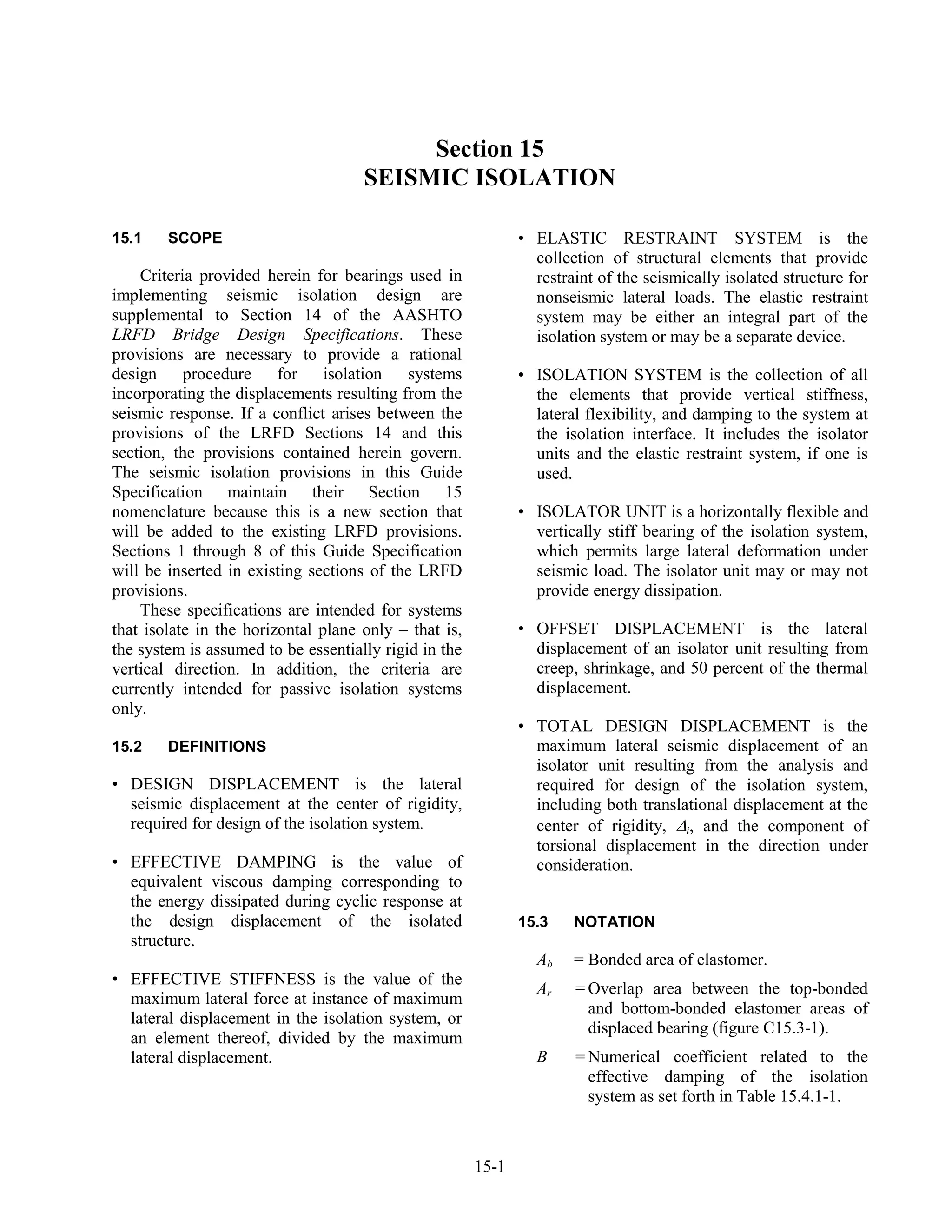
Criteria provided herein for bearings used in
implementing seismic isolation design are
supplemental to Section 14 of the AASHTO
LRFD Bridge Design Specifications. These
provisions are necessary to provide a rational
design procedure for isolation systems
incorporating the displacements resulting from the
seismic response. If a conflict arises between the
provisions of the LRFD Sections 14 and this
section, the provisions contained herein govern.
The seismic isolation provisions in this Guide
Specification maintain their Section 15
nomenclature because this is a new section that
will be added to the existing LRFD provisions.
Sections 1 through 8 of this Guide Specification
will be inserted in existing sections of the LRFD
provisions.
These specifications are intended for systems
that isolate in the horizontal plane only – that is,
the system is assumed to be essentially rigid in the
vertical direction. In addition, the criteria are
currently intended for passive isolation systems
only.
15.2 DEFINITIONS
•	 DESIGN DISPLACEMENT is the lateral
seismic displacement at the center of rigidity,
required for design of the isolation system.
•	 EFFECTIVE DAMPING is the value of
equivalent viscous damping corresponding to
the energy dissipated during cyclic response at
the design displacement of the isolated
structure.
•	 EFFECTIVE STIFFNESS is the value of the
maximum lateral force at instance of maximum
lateral displacement in the isolation system, or
an element thereof, divided by the maximum
lateral displacement.
•	 ELASTIC RESTRAINT SYSTEM is the
collection of structural elements that provide
restraint of the seismically isolated structure for
nonseismic lateral loads. The elastic restraint
system may be either an integral part of the
isolation system or may be a separate device.
•	 ISOLATION SYSTEM is the collection of all
the elements that provide vertical stiffness,
lateral flexibility, and damping to the system at
the isolation interface. It includes the isolator
units and the elastic restraint system, if one is
used.
•	 ISOLATOR UNIT is a horizontally flexible and
vertically stiff bearing of the isolation system,
which permits large lateral deformation under
seismic load. The isolator unit may or may not
provide energy dissipation.
•	 OFFSET DISPLACEMENT is the lateral
displacement of an isolator unit resulting from
creep, shrinkage, and 50 percent of the thermal
displacement.
•	 TOTAL DESIGN DISPLACEMENT is the
maximum lateral seismic displacement of an
isolator unit resulting from the analysis and
required for design of the isolation system,
including both translational displacement at the
center of rigidity, Li, and the component of
torsional displacement in the direction under
consideration.
15.3 NOTATION
Ab = Bonded area of elastomer.
Ar =Overlap area between the top-bonded
and bottom-bonded elastomer areas of
displaced bearing (figure C15.3-1).
B =Numerical coefficient related to the
effective damping of the isolation
system as set forth in Table 15.4.1-1.
15-1
15-2	 HIGHWAY BRIDGES SECTION 15

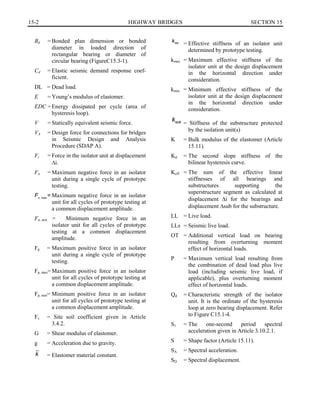
Bd =Bonded plan dimension or bonded
diameter in loaded direction of
rectangular bearing or diameter of
circular bearing (FigureC15.3-1).
Cd =Elastic seismic demand response coef­
ficient.
DL = Dead load.
E =Young’s modulus of elastomer.
EDC =Energy dissipated per cycle (area of
hysteresis loop).
V =Statically equivalent seismic force.
VA =Design force for connections for bridges
in Seismic Design and Analysis
Procedure (SDAP A).
Fi =Force in the isolator unit at displacement
�i.
Fn =Maximum negative force in an isolator
unit during a single cycle of prototype
testing.
F = Maximum negative force in an isolatorn, max
unit for all cycles of prototype testing at
a common displacement amplitude.
Fn, min	 = Minimum negative force in an
isolator unit for all cycles of prototype
testing at a common displacement
amplitude.
Fp = Maximum positive force in an isolator
unit during a single cycle of prototype
testing.
Fp, max= Maximum positive force in an isolator
unit for all cycles of prototype testing at
a common displacement amplitude.
Fp, min= Minimum positive force in an isolator
unit for all cycles of prototype testing at
a common displacement amplitude.
Fv = Site soil coefficient given in Article
3.4.2.
G = Shear modulus of elastomer.
g = Acceleration due to gravity.
k = Elastomer material constant.
kiso = Effective stiffness of an isolator unit
determined by prototype testing.
kmax = Maximum effective stiffness of the
isolator unit at the design displacement
in the horizontal direction under
consideration.
kmin = Minimum effective stiffness of the
isolator unit at the design displacement
in the horizontal direction under
consideration.
ksub = Stiffness of the substructure protected
by the isolation unit(s)
K = Bulk modulus of the elastomer (Article
15.11).
Kd = The second slope stiffness of the
bilinear hysteresis curve.
Keff = The sum of the effective linear
stiffnesses of all bearings and
substructures supporting the
superstructure segment as calculated at
displacement �i for the bearings and
displacement �sub for the substructure.
LL = Live load.
LLs = Seismic live load.
OT = Additional vertical load on bearing
resulting from overturning moment
effect of horizontal loads.
P = Maximum vertical load resulting from
the combination of dead load plus live
load (including seismic live load, if
applicable), plus overturning moment
effect of horizontal loads.
Qd = Characteristic strength of the isolator
unit. It is the ordinate of the hysteresis
loop at zero bearing displacement. Refer
to Figure C15.1-4.
S1 = The one-second period spectral
acceleration given in Article 3.10.2.1.
S = Shape factor (Article 15.11).
SA = Spectral acceleration.
SD = Spectral displacement.
�
� �
�
�
�
�
�
�
�
�
15-3
i
SECTION 15 2001 GUIDELINES
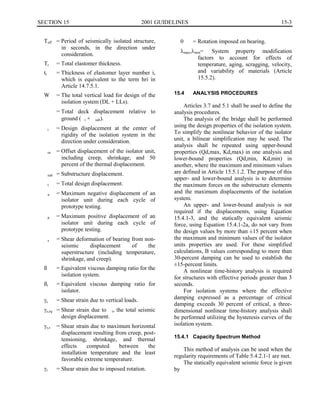
Teff = Period of seismically isolated structure,
in seconds, in the direction under
consideration.
Tr = Total elastomer thickness.
ti = Thickness of elastomer layer number i,
which is equivalent to the term hri in
Article 14.7.5.1.
W = The total vertical load for design of the
isolation system (DL + LLs).
= Total deck displacement relative to
ground ( i + sub).
= Design displacement at the center of
rigidity of the isolation system in the
direction under consideration.
os = Offset displacement of the isolator unit,
including creep, shrinkage, and 50
percent of the thermal displacement.
sub = Substructure displacement.
t = Total design displacement.
n = Maximum negative displacement of an
isolator unit during each cycle of
prototype testing.
p = Maximum positive displacement of an
isolator unit during each cycle of
prototype testing.
s = Shear deformation of bearing from non­
seismic displacement of the
superstructure (including temperature,
shrinkage, and creep).
ß = Equivalent viscous damping ratio for the
isolation system.
ßi = Equivalent viscous damping ratio for
isolator.
Yc = Shear strain due to vertical loads.
Ys,eq = Shear strain due to t, the total seismic
design displacement.
Ys,s = Shear strain due to maximum horizontal
displacement resulting from creep, post­
tensioning, shrinkage, and thermal
effects computed between the
installation temperature and the least
favorable extreme temperature.
Yr = Shear strain due to imposed rotation.
8 = Rotation imposed on bearing.
Amax,Amin= System property modification
factors to account for effects of
temperature, aging, scragging, velocity,
and variability of materials (Article
15.5.2).
15.4 ANALYSIS PROCEDURES
Articles 3.7 and 5.1 shall be used to define the
analysis procedures.
The analysis of the bridge shall be performed
using the design properties of the isolation system.
To simplify the nonlinear behavior of the isolator
unit, a bilinear simplification may be used. The
analysis shall be repeated using upper-bound
properties (Qd,max, Kd,max) in one analysis and
lower-bound properties (Qd,min, Kd,min) in
another, where the maximum and minimum values
are defined in Article 15.5.1.2. The purpose of this
upper- and lower-bound analysis is to determine
the maximum forces on the substructure elements
and the maximum displacements of the isolation
system.
An upper- and lower-bound analysis is not
required if the displacements, using Equation
15.4.1-3, and the statically equivalent seismic
force, using Equation 15.4.1-2a, do not vary from
the design values by more than ±15 percent when
the maximum and minimum values of the isolator
units properties are used. For these simplified
calculations, B values corresponding to more than
30-percent damping can be used to establish the
±15-percent limits.
A nonlinear time-history analysis is required
for structures with effective periods greater than 3
seconds.
For isolation systems where the effective
damping expressed as a percentage of critical
damping exceeds 30 percent of critical, a three­
dimensional nonlinear time-history analysis shall
be performed utilizing the hysteresis curves of the
isolation system.
15.4.1 Capacity Spectrum Method
This method of analysis can be used when the
regularity requirements of Table 5.4.2.1-1 are met.
The statically equivalent seismic force is given
by
�
15-4	 HIGHWAY BRIDGES SECTION 15

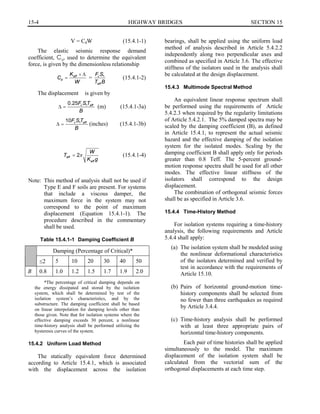
V = CdW (15.4.1-1)
The elastic seismic response demand
coefficient, Cd
, used to determine the equivalent
force, is given by the dimensionless relationship
K X � F Seff v 1
Cd - = (15.4.1-2)
W T Beff
The displacement is given by
0.25F STv 1 eff
� = (m) (15.4.1-3a)
B
10F STv 1 eff
A = (inches) (15.4.1-3b)
B
Teff 2
W
(15.4.1-4)
K geff
Note: This method of analysis shall not be used if
Type E and F soils are present. For systems
that include a viscous damper, the
maximum force in the system may not
correspond to the point of maximum
displacement (Equation 15.4.1-1). The
procedure described in the commentary
shall be used.
Table 15.4.1-1 Damping Coefficient B
Damping (Percentage of Critical)*
:2 5 10 20 30 40 50
B 0.8 1.0 1.2 1.5 1.7 1.9 2.0
*The percentage of critical damping depends on
the energy dissipated and stored by the isolation
system, which shall be determined by test of the
isolation system’s characteristics, and by the
substructure. The damping coefficient shall be based
on linear interpolation for damping levels other than
those given. Note that for isolation systems where the
effective damping exceeds 30 percent, a nonlinear
time-history analysis shall be performed utilizing the
hysteresis curves of the system.
15.4.2 Uniform Load Method
The statically equivalent force determined
according to Article 15.4.1, which is associated
with the displacement across the isolation
bearings, shall be applied using the uniform load
method of analysis described in Article 5.4.2.2
independently along two perpendicular axes and
combined as specified in Article 3.6. The effective
stiffness of the isolators used in the analysis shall
be calculated at the design displacement.
15.4.3 Multimode Spectral Method
An equivalent linear response spectrum shall
be performed using the requirements of Article
5.4.2.3 when required by the regularity limitations
of Article 5.4.2.1. The 5% damped spectra may be
scaled by the damping coefficient (B), as defined
in Article 15.4.1, to represent the actual seismic
hazard and the effective damping of the isolation
system for the isolated modes. Scaling by the
damping coefficient B shall apply only for periods
greater than 0.8 Teff. The 5-percent ground­
motion response spectra shall be used for all other
modes. The effective linear stiffness of the
isolators shall correspond to the design
displacement.
The combination of orthogonal seismic forces
shall be as specified in Article 3.6.
15.4.4 Time-History Method
For isolation systems requiring a time-history
analysis, the following requirements and Article
5.4.4 shall apply:
(a) The isolation system shall be modeled using
the nonlinear deformational characteristics
of the isolators determined and verified by
test in accordance with the requirements of
Article 15.10.
(b) Pairs	 of horizontal ground-motion time­
history components shall be selected from
no fewer than three earthquakes as required
by Article 3.4.4.
(c) Time-history	 analysis shall be performed
with at least three appropriate pairs of
horizontal time-history components.
Each pair of time histories shall be applied
simultaneously to the model. The maximum
displacement of the isolation system shall be
calculated from the vectorial sum of the
orthogonal displacements at each time step.
15-5SECTION 15	 2001 GUIDELINES
The parameter of interest shall be
calculated for each time-history analysis. If three
time-history analyses are performed, then the
maximum response of the parameter of interest
shall be used for design. If seven or more time­
history analyses are performed, then the average
value of the response parameter of interest may be
used for design.
15.5.	 DESIGN PROPERTIES OF THE
ISOLATION SYSTEM
15.5.1	 Nominal Design Properties
The minimum and maximum effective
stiffness of the isolation system (Kmin and Kmax)
shall be determined from the minimum and
maximum values of Kd and Qd.
The minimum and maximum values of Kd and
Qd shall be determined as follows:
Kd,max	 = Kd x Amax,Kd (15.5.1-1)
Kd,min	 = Kd x Amin,Kd (15.5.1-2)
Qd,max	 = Qd x Amax,Qd (15.5.1-3)
Qd,min	 = Qd x Amin,Qd (15.5.1-4)
System property modification factors (A)
(defined in Article 15.5.2) used for design shall be
established by system characterization tests and
approved by the engineer. In lieu of the test
values, the A values given in Appendix 15A may
be used
15.5.2	 System Property Modification
Factors (A)
The mechanical properties of the isolator units
are affected by temperature, aging, scragging,
velocity, travel, and contamination.
15.5.2.1	 Minimum and Maximum System
Property Modification Factors
=Amin,Kd Amin,t,Kd x Amin,a,Kd x Amin,v,Kd
x Amin,tr,Kd x Amin,c,Kd
x Amin,scrag,Kd (15.5.2-1)
=Amax,Kd Amax,t,Kd x Amax,a,Kd x Amax,v,Kd
x Amax,tr,Kd x Amax,c,Kd
x Amax,scrag,Kd (15.5.2-2)
Amin,Qd = Amin,t, Qd xAmin,a, Qd x Amin,v, Qd
x Amin,tr,Qd x Amin,c,Qd
x Amin,scrag,Qd (15.5.2-3)
Amax,Qd =
Amax,t,Qd xAmax,a,Qd x Amax,v,Qd
x Amax,tr,Qd xAmax,c,Qd
x Amax,scrag,Qd (15.5.2-4)
where:
At = Factors to account for effects of

temperature

Aa = Factors to account for effects of aging
(including corrosion)
Av = Factors to account for effects of velocity
(including frequency for elastomeric
systems)
Property value at relevant velocity
Av =
Property value at velocity of testing
Atr = Factors to account for effects of travel
(wear)
Ac = Factors to account for effects of

contamination (in sliding systems)

Ascrag= Factors to account for effects of
scragging a bearing (in elastomeric systems)
15.5.2.2	 System Property Adjustment Factors
Adjustment factors are applied to individual A
factors to account for the probability of
occurrence. The following adjustment factors shall
apply to all A factors except Av:
1.0	 for operational bridges
0.67	 for all other bridges
The adjustment factors shall apply to the
portion of a A that deviates from unity.
15.6	 CLEARANCES
The clearances in the two orthogonal
directions shall be the maximum displacement
determined in each direction from the analysis.
The clearance shall not be less than
0.20F ST1 effv
(m) (15.6-1a)
B
�
15-6 HIGHWAY BRIDGES SECTION 15

8F STv 1 eff
(inches) (15.6-1b)
B
or 1 inch (25 mm), whichever is greater.
Displacements in the isolators resulting from
load combinations involving BR, WS, WL, CE,
and T shall be calculated and adequate clearance
provided.
The minimum design forces shall be
consistent with the clearances calculated with
Equation 15.6-1.
15.7 DESIGN FORCES FOR SDAP A1 AND A2
The seismic design force for the connection
between superstructure and substructure at each
bearing is given by
VA = keff Lt (15.7-1)
where Lt shall be based on a minimum value of
FvS1, not less than 0.25.
15.8 DESIGN FORCES FOR SDAP C, D, AND E
The seismic design force for columns and
piers shall not be less than the forces resulting
from the yield level of a softening system, the
friction level of a sliding system, or the ultimate
capacity of a sacrificial service restraint system. In
all cases the larger of static or dynamic conditions
shall apply.
If the elastic foundation forces are less than
the forces resulting from column hinging, they
may be used for the foundation design. The
foundation shall be designed using an R value
equal to 1.0.
The seismic design force for the connection
between the superstructure and substructure at
each bearing is given by
Va = keff Lt (15.8-1)
Where Lt is the total design displacement and
includes Li the center of mass displacement from
seismic forces plus any displacement resulting
from torsional effects.
15.9 OTHER REQUIREMENTS
15.9.1 Non-Seismic Lateral Forces
The isolation system must resist all non­
seismic lateral load combinations applied above
the isolation interface. Such load combinations are
those involving WS, WL, BR, CE, and T.
15.9.1.1 Service Force Resistance
Resistance to forces such as wind, centrifugal,
and braking, and forces induced by restraint of
thermal displacements, shall be established by
testing in accordance with Article 15.10.2.
15.9.1.2 Cold Weather Requirements
Cold weather performance shall be considered
in the design of all types of isolation systems.
Low-temperature zones shall conform with Figure
14.7.5.2-1 in the absence of more site-specific
data.
15.9.2 Lateral Restoring Force
The isolation system shall be configured to
produce a lateral restoring force such that the
period corresponding to its tangent stiffness based
on the restoring force alone at any displacement,
, up to its design displacement shall be less than
6 seconds (Figure C15.9.2-1). Also the restoring
force at Li shall be greater than the restoring force
at 0.5 Li by not less than W/80. Isolation systems
with constant restoring force need not satisfy the
requirements above. In these cases, the combined
constant restoring force of the isolation system
shall be at least equal to 1.05 times the
characteristic strength of the isolation system
under service conditions.
Forces that are not dependent on
displacements, such as viscous forces, may not be
used to meet the minimum restoring force or
tangent stiffness requirements.
15.9.3 Vertical Load Stability
The isolation system shall provide a factor of
safety of at least three (3) for vertical loads (dead
load plus live load) in its laterally undeformed
state. It shall also be designed to be stable under
1.2 times the dead load plus any vertical load
resulting from seismic live load, plus overturning
at a horizontal displacement equal to the offset
displacement plus 1.1 times the total design
displacement, plus 0.5 times the design rotation.
15-7SECTION 15	 2001 GUIDELINES
15.9.4	 Rotational Capacity
The design rotation capacity of the isolation
unit shall include the effects of dead load, live
load, and construction misalignments. In no case
shall the design rotation for the construction
misalignment be less than 0.005 radians.
15.10	 REQUIRED TESTS OF ISOLATION
SYSTEMS
All isolation systems shall have their seismic
performance verified by testing. In general, there
are three types of tests to be performed on
isolation systems: (1) system characterization
tests, described in Article 15.10.1; (2) prototype
tests, described in Article 15.10.2; and (3) quality
control tests, described in Articles 15.12, 15.14
and 15.15.
15.10.1 System Characterization Tests
The fundamental properties of the isolation
system shall be evaluated by testing prior to its
use. The purpose of system characterization tests
is to substantiate the properties of individual
isolator units as well as the behavior of an
isolation system. Therefore, these tests include
both component tests of individual isolator units
and shake table tests of complete isolation
systems.
At a minimum, these tests shall consist of
•	 Tests of individual isolator units in accordance
with the National Institute of Standards and
Technology (NIST) guidelines or the Highway
Innovative Technology Evaluation Center
(HITEC) guidelines.
•	 Shaking table tests at a scale no less than 1/4
full scale. Scale factors must be well­
established and approved by the engineer.
15.10.1.1 Low-Temperature Test
If the isolators are for low-temperature areas,
then Test 6 specified in section 15.10.2 shall be
performed at temperatures of 20, 5, �5, or �15
degrees F (�7, �15, �21, or �26 degrees C) for
temperature zones A, B, C, and D, respectively.
The specimen shall be cooled for a duration
not less than the maximum number of consecutive
days below freezing specified in Table 14.7.5.2-2.
15.10.1.2 Wear and Fatigue Tests
Wear or travel and fatigue tests are required to
account for movements resulting both from
imposed thermal displacements and live load
rotations. Thermal displacements and live load
rotations shall correspond to at least 30 years of
expected movement. Tests shall be performed at
the design contact pressure at 68 degrees F ± 15
degrees (20 degrees C ±8 degrees). The rate of
application shall not be less than 2.5 inches/minute
(63.5 mm/minute). As a minimum, the following
displacements shall be used for the test:
•	 Bearings: 1 mile (1.6 km)
•	 Dampers (attached to the web at the neutral
axis): 1 mile (1.6 km)
•	 Dampers (attached to the girder bottom):
2 miles (3.2 km)
Additional wear or travel and fatigue will
occur in long structures with greater thermal
movements, high traffic counts, and lively spans.
If the isolator units are for low-temperature
areas, then 10 percent of the test shall be
performed at temperatures of 20, 5, �5, or �15
degrees F (�7, �15, �21, �26 degrees C) for
temperature zones A, B, C, and D, respectively.
In lieu of the low-temperature test criteria, the
components may be tested for a cumulative travel
of twice the calculated service displacements or
twice the values above when approved by the
engineer.
15.10.2 Prototype Tests
The deformation characteristics and damping
values of the isolation system used in the design
and analysis shall be verified by prototype tests.
Tests on similarly sized isolator units may be used
to satisfy the requirements of this section. Such
tests must validate design properties that can be
extrapolated to the actual sizes used in the design.
Prototype tests shall be performed on a
minimum of two full-size specimens of each type
and size similar to that used in the design. The test
15-8	 HIGHWAY BRIDGES SECTION 15

specimens shall include the elastic restraint system
if such a system is used in the design. Prototype
test specimens may be used in construction, if they
have the specified stiffness and damping
properties and they satisfy the project quality
control tests after having successfully completed
all prototype tests. All sacrificial elements shall be
replaced prior to use.
Reduced-scale prototype specimens will only
be allowed when full-scale specimens exceed the
capacity of existing testing facilities and approval
is granted by the engineer of record.
If reduced-scale prototype specimens are used
to quantify properties of isolator units, specimens
shall be geometrically similar and of the same type
and material. The specimens shall also be
manufactured with the same processes and quality
as full-scale prototypes, and shall be tested at a
frequency that represents full-scale prototypes.
The following sequence of tests shall be
performed for the prescribed number of cycles at a
vertical load similar to the typical or average dead
load on the isolator units of a common type and
size. The design displacement for these tests is
defined in Article 15.4.
Test 1, Thermal – Three fully reversed cycles
of loads at a lateral displacement
corresponding to the maximum thermal
displacement. The test velocity shall not be
less than 0.003 inches per minute.
Test 2, Wind and Braking – Twenty fully
reversed cycles between limits of plus and
minus the maximum load for a total duration
not less than 40 seconds. After the cyclic
testing, the maximum load shall be held for
1 minute.
Test 3, Seismic – Three fully reversed cycles
of loading at each of the following multiples
of the total design displacement: 1.0, 0.25,
0.50, 0.75, 1.0, and 1.25, in the sequence
shown.
Test 4, Seismic – 20 cycles of loading at 1.0
times the design displacement. The test shall
be started from a displacement equal to the
offset displacement.
Test 5, Wind and Braking – Three fully
reversed cycles between limits of plus and
minus the maximum load for a total duration
not less than 40 seconds. After the cyclic
testing, the maximum load shall be held for
1 minute.
Test 6, Seismic Performance Verification –
Three fully reversed cycles of loading at the
total design displacement.
Test 7, Stability Verification – The vertical
load-carrying elements of the isolation
system shall be demonstrated to be stable
under one fully reversed cycle at the
displacements given in Article 15.4. In these
tests, the combined vertical load of
1.2 D + LLs + OT (15.10.2-1)
shall be taken as the maximum downward
force, and the combined vertical load of
0.8 D – OT (15.10.2-2)
shall be taken as the minimum downward
force.
•	 If a sacrificial elastic restraint system is
utilized, then its ultimate capacity shall be
established by test.
•	 The prototype and quality control tests shall
include all components that comprise the
isolation system.
•	 For systems that are not restrained to
perform unidirectionally, Test 6 shall be
performed in the direction of loading
orthogonal to the original direction of
loading. For systems that include
unidirectional devices, or those that are
sensitive to orthogonal effects, Test 6 shall
be repeated at 45 degrees to the primary
axis of the unidirectional device.
•	 The force-deflection properties of an
isolator unit shall be considered to be
dependent on the rate of loading if there is
greater than a plus or minus 15-percent
difference in either Kd or Qd for the test at
15-9SECTION 15	 2001 GUIDELINES
the design displacement when dynamically
tested at any frequency in the range of 0.5
to 1.5 times the inverse of the effective
period of the isolated structure.
If the force-deflection properties of the
isolator units are dependent on the rate of
loading, then each set of tests specified in
Article 15.10.2 shall be performed
dynamically at a frequency equal to the
inverse of the effective period of the
isolated structure. If the test can not be
performed dynamically, then a l factor must
be established that relates properties Kd or
Qd determined at the actual speed of testing
with the dynamic velocities in accordance
with Article 15.5.2.1.
15.10.3 Determination of System
Characteristics
(a) The force-deflection characteristics of the
isolation system shall be based on the cyclic
load test results for each fully reversed
cycle of loading.
(b) The effective stiffness of an isolator unit
shall be calculated for each cycle of loading
as follows:
Fp - Fn
keff = (15.10.3-1)
� - �p n
where Lp and Ln are the maximum positive
and maximum negative test displacements,
respectively, and Fp and Fn are the
maximum positive and maximum negative
forces at instance of displacements Lp and
Ln, respectively.
(c) Equivalent	 Damping. The equivalent
viscous damping ratio (ß) of the isolation
system shall be calculated as
1 Total EDC Area
j = x	 (15.10.3-2)
21 I(keff f2
i )
The total EDC area shall be taken as the
sum of the areas of the hysteresis loops of
all isolator units. The hysteresis loop area of
each isolator unit shall be taken as the
minimum area of the three hysteresis loops
established by the cyclic tests in Test 3 of
Article 15.10.2 at a displacement amplitude
equal to the design displacement.
15.10.3.1 System Adequacy
The performance of the test specimens shall be
assessed as adequate if the following conditions
are satisfied:
•	 The force-deflection plots, excluding
any viscous damping component, of all
tests specified in Article 15.10.2 show a
positive incremental force-carrying
capacity consistent with the
requirements of Article 15.9.2.
•	 For Test 1, the maximum measured
force shall be less than the design value.
•	 For Tests 2 and 5, the maximum
measured displacement shall be less
than the design value.
•	 The average effective stiffness measured
in the last three cycles to the total design
displacement specified in Test 3 shall lie
within 10 percent of the value used in
design.
For each test displacement level specified
for Test 3, the minimum effective stiffness
measured during the three cycles shall not
be less than 80 percent of the maximum
effective stiffness.
For Test 4, the minimum effective stiffness
measured during the specified number of
cycles shall not be less than 80 percent of
the maximum effective stiffness. At the
discretion of the engineer, a larger variation
may be accepted, provided that both the
minimum and maximum values of effective
stiffness are used in the design.
•	 For Test 4, the minimum EDC measured
during the specified number of cycles
shall not be less than 70 percent of the
maximum EDC. At the discretion of the
15-10	 HIGHWAY BRIDGES SECTION 15

engineer, a larger variation may be
accepted, provided that both the
minimum and maximum values of EDC
are used in the design.
All vertical load-carrying elements of the
isolation system shall remain stable
(positive incremental stiffness) at the
displacements specified in Article 15.9.3
for static loads as prescribed for Test 7.
Test specimens shall be visually inspected
for evidence of significant deterioration. If
any deterioration exists, then the adequacy
of the test specimen shall be determined by
the engineer.
15.11	 ELASTOMERIC BEARINGS
15.11.1 General
The following shall be considered
supplemental to Section 14 of the LRFD
provisions.
Elastomeric bearings utilized in implementing
seismic isolation design shall be designed by the
procedures and specifications given in the
following subsections. Additional test
requirements for seismic isolation bearings are
given in Article 15.12. The design procedures are
based on service loads excluding impact. The
elastomeric bearings must be reinforced using
steel reinforcement. Fabric reinforcement is not
permitted.
15.11.2 Shear Strain Components for Isolation
Design
The various components of shear strain in the
bearing shall be computed as follows:
•	 Shear strain (yc) due to compression by
vertical loads is given by
Y =
3SP
(15.11.2-1)c	
2ArG(1+ 2kS2
)
if S : 15, or
3 (1P + 8GkS2
/K)
Y _	 (15.11.2-2)c	
4GkSAr
if S > 15,
where K is the bulk modulus of the
elastomer. In absence of measured data,
K may be taken as 300,000 psi (2,000
MPa). The shape factor S shall be taken
as the plan area of the elastomer layer
divided by the area of perimeter free to
bulge.
•	 Shear strain (Ys,s) due to imposed non­
seismic lateral displacement is given by
�s
Y ,	 = (15.11.2-3)s s
Tr
•	 Shear strain (Ys,eq) due to earthquake­
imposed lateral displacement is given by
�t
Y , = (15.11.2-4)s eq
Tr
•	 Shear strain (yr) due to rotation is given
by
Bd
2
r 	 (15.11.2-5)
2t Ti r
The design rotation (8) shall include the rotational
effects of DL, LL, and construction.
15.11.3 Load Combinations
Elastomeric bearings shall satisfy
Yc 	 : 2.5 (15.11.3-1)
Yc + Ys,s + Yr : 5.0 (15.11.3-2)
Yc + Ys,eq + 0.5 Yr : 5.5 (15.11.3-3)
15.12	 ELASTOMERIC BEARINGS –
CONSTRUCTION
15.12.1 General Requirements
The following shall be considered
supplemental to article 18.2 of the AASHTO
Standard Specifications (Division II). The
provision of Article 15.12.2 replaces those in
15-11SECTION 15	 2001 GUIDELINES
articles 18.2.7.6, 18.2.7.7, and 18.2.7.8 of the
AASHTO Standard Specifications (Division II).
The layers of elastomeric bearings used in
seismic isolation shall be integrally bonded during
vulcanization. Cold bonding is not allowed.
15.12.2 Quality Control Tests
The following quality control tests shall also
be performed on elastomeric bearings.
15.12.2.1 Compression Capacity
A 5-minute sustained proof load test shall be
conducted on each bearing. The compressive load
for the test shall be 1.5 times the maximum (dead
load plus live load). If bulging suggests poor
laminate bond, the bearing shall be rejected.
15.12.2.2 Combined Compression and Shear
All bearings shall be tested in combined
compression and shear. The bearings may be
tested in pairs. The compressive load shall be the
average dead load of all bearings of that type, and
the bearings shall be subjected to five fully
reversed cycles of loading at the larger of the total
design displacement or 50 percent of the elastomer
thickness.
For each bearing, the effective stiffness and
EDC shall be averaged over the five cycles of the
test. For each group of similar bearings of the
same type and size, the effective stiffness and
EDC shall be averaged. The results shall not differ
from the design values by more than the limits
given in Table 15.12.2.2-1.
Table 15.12.2.2-1
Keff EDC
Individual Bearings ±20% –25%
Average of Group ±10% –15%
15.12.2.3 Acceptance Criteria
After quality control testing, all bearings shall
be visually inspected for defects. The following
faults shall be cause for rejection:
•	 Lack of rubber-to-steel bond.
•	 Laminate placement fault.
•	 Surface cracks on the rubber that are wider
or deeper than 2/3 of the rubber cover
thickness.
•	 Permanent deformation.
15.13 SLIDING BEARINGS – DESIGN
15.13.1 General
Sliding bearings used in isolation systems may
use flat or curved surfaces.
15.13.2 Materials
15.13.2.1 PTFE Bearing Liners
All PTFE surfaces, other than guides, shall
satisfy the requirements specified herein. The
PTFE bearing liner shall be made from virgin
PTFE resin satisfying the requirements of ASTM
D1457. It may be fabricated as unfilled sheet,
filled sheet, or fabric woven from PTFE and other
fibers.
Unfilled sheets shall be made from PTFE resin
alone. Filled sheets shall be made from PTFE resin
uniformly blended with glass fibers, carbon fibers,
or other chemically inert reinforcing fibers.
Sheet PTFE may contain dimples to act as
reservoirs for lubricant. Their diameter shall not
exceed 0.32 inch (8 mm) at the surface of the
PTFE and their depth shall be not less than 0.08
inch (2 mm) and not more than half the thickness
of the PTFE. The reservoirs should cover more
than 20 percent, but less than 30 percent of the
contact surface. Dimples should not be placed to
intersect the edge of the contact area. Lubricant
shall be silicone grease, effective to –30½ F (–34º
C). Silicone grease shall conform to Military
specification MIL-S-8660.
15.13.2.2 Other Bearing Liner Materials
Other materials may be used for the bearing
liner if test results demonstrate a stable long-term
coefficient of friction, chemical stability, and wear
resistance in accordance with Article 15.10.1.2,
and are approved by the engineer.
15-12 HIGHWAY BRIDGES SECTION 15

15.13.2.3 Mating Surface
Mating surfaces shall be stainless steel
(welded overlay, solid, or sheet metal). Stainless
steel shall have a corrosion resistance and strength
equal to or exceeding type 304, conforming to
ASTM A167/A264. The average surface
roughness shall not exceed 32 micro inches (0.8
micro meters) Ra (arithmetic
determined by procedures
ANSI/ASME B46.1-1985 (ASME,
average)
described
1985).
as
in
15.13.3 Geometry
15.13.3.1 Minimum Thickness
15.13.3.1.1 PTFE Bearing Liner
The minimum thickness for PTFE shall be at
least 0.0625 inch (1.6 mm) after compression.
Recessed sheet PTFE shall be at least 0.1875 inch
(4.8 mm) thick when the maximum dimension of
the PTFE is less than or equal to 24.0 inches (610
mm), and 0.25 inch (6.4 mm) when the maximum
dimension of the PTFE is greater than 24.0 inches
(610 mm). Woven fabric PTFE shall have, after
compression, a minimum thickness of 0.0625 inch
(1.6 mm) and a maximum thickness of 0.125 inch
(3.2 mm).
15.13.3.1.2 Other Bearing Liner Materials
The minimum thickness for all other bearing
liners shall be determined by conducting wear
tests in accordance with Article 15.10.1.2.
15.13.3.2 Mating Surface
The thickness of the stainless steel mating
surface sheet shall be at least 16 gauge when the
maximum dimension of the surface is less than or
equal to 12.0 inches (305 mm), and at least 13
gauge when the maximum dimension is larger
than 12.0 inches (305 mm) and less than or equal
to 36.0 inches (915 mm). When the maximum
dimension is larger than 36.0 inches (915 mm), the
thickness of the stainless steel mating surface shall
be verified by performance of suitable system
characterization tests.
The minimum thickness of stainless steel weld
overlays shall be 3/32 inch (2.4 mm) thick after
welding, grinding, and polishing.
15.13.3.3 Displacement Capacity
The mating surface dimensions shall be large
enough to ensure that the sliding surface does not
come into contact with the edge of the mating
surface at the total design displacement plus the
offset displacement.
15.13.4 Loads and Stresses
15.13.4.1 Contact Pressure
Contact stresses for bearing liners shall be
established by testing. Test pressures shall be at
least 110 percent of the value used in design and
must satisfy the wear requirements in Article
15.10.1.2. As a minimum, 50 percent of the usable
bearing liner thickness must remain after
completion of the wear test. Allowable contact
stresses for PTFE liners tabulated in Table
15.13.4.1-1 may be used without completing the
wear test, provided that the stainless steel mating
surface has a surface roughness less than 20 micro
inches (0.5 micro meter) Ra.
Table 15.13.4.1-1

Allowable Average Contact Stress for PTFE

Material
Allowable
Contact Stress
Service
Loads
Seismic
Loads
Average
Stress
Edge
Stress
Average
Stress
ksi MPa ksi MPa ksi MPa
Unfilled
sheets
(recessed)
3.5 24 5.0 34 6.0 41
Filled sheets
(recessed)
3.5 24 5.0 34 6.0 41
Woven PTFE
fiber over a
metallic
substrate
3.5 24 10.0 69 6.0 41
15-13SECTION 15 2001 GUIDELINES
15.13.4.2 Coefficient of Friction
15.13.4.2.1 Service Coefficient of Friction
The service limit state coefficient of friction of
the PTFE sliding surface shall be taken as
specified in Table 15.13.4.2.1-1. Intermediate
values may be determined by interpolation. The
coefficient of friction shall be determined by using
the stress level associated with the service load
combination specified in Table 3.4.1-1. Different
values may be used if verified by tests and
adjusted by the appropriate A values in accordance
with Article 15.5.
Table 15.13.4.2.1-1 Service Coefficients of Friction
Type of
Surface
Temp.
Average Bearing Stress
0.5 1.0 2.0 �3.0 ksi
°F °C 3.5 6.9 13.8 20.7 MPa
Dimpled
lubricate
d PTFE
sheets
68
–13
–49
20
–25
–45
0.04
0.06
0.10
0.03
0.045
0.075
0.025
0.04
0.06
0.02
0.03
0.05
Unfilled
PTFE
sheets
68
–13
–49
20
–25
–45
0.08
0.20
0.20
0.07
0.18
0.18
0.05
0.13
0.13
0.03
0.10
0.10
Filled
PTFE
sheets
68
–13
–49
20
–25
–45
0.24
0.44
0.65
0.17
0.32
0.55
0.09
0.25
0.45
0.06
0.20
0.35
Woven
PTFE
fiber
68
–13
–49
20
–25
–45
0.08
0.20
0.20
0.07
0.18
0.18
0.06
0.13
0.13
0.045
0.10
0.10
Service coefficients of friction for other
surface finishes, stresses, and bearing liners shall
be established by testing. The testing procedures
and results shall be subject to the approval of the
engineer.
15.13.4.2.2 Seismic Coefficient of Friction
The seismic coefficient of friction may be
determined from the area under the force
displacement loops of three cycles divided by the
total travel distance and vertical load (Qd/vertical
load).
15.13.5 Other Details
15.13.5.1 Bearing Liner Attachment
All sheet PTFE shall be recessed for one-half
of its thickness and bonded into a metal backing
plate.
All bearing liners shall be attached to resist a
shear force of 0.15 times the applied compressive
force or 2 times Qd, whichever is greater.
15.13.5.2 Mating Surface Attachment
The mating surface for the bearing liner shall
be attached to a backing plate by welding or other
suitable means in such a way that it remains free
of undulations and in full contact with its backing
plate throughout its service life. The attachment
shall include an effective moisture seal around the
entire perimeter of the mating surface to prevent
interface corrosion. The attachment shall be
capable of resisting the maximum friction force
that can be developed by the bearing under service
limit state and seismic load combinations. The
welds used for the attachment shall be clear of the
contact and sliding area of the bearing liner.
15.13.6 Materials for Guides
Bearing guides may be made from materials
not described in Article 15.13.2. The materials
used shall have sufficient strength, stiffness, and
resistance to creep and decay to ensure the proper
functioning of the guide throughout its design life.
15.14 SLIDING BEARINGS – CONSTRUCTION
15.14.1 General Requirements
Isolator units that use sliding bearings shall be
constructed in accordance with the applicable
provisions of articles 18.4 and 18.8.2 of the
AASHTO Standard Specifications (Division II).
15.14.2 Quality Control Tests
The following quality control tests shall also
be performed on sliding isolation bearings.
15-14	 HIGHWAY BRIDGES SECTION 15

15.14.2.1 Compression Capacity
A 5-minute sustained proof load test shall be
conducted on each bearing. The compressive load
for the test shall be 1.5 times the maximum (dead
load plus live load). If flow of the bearing liner
suggests inadequate bonding, or it leaves a
permanent deformation in the mating surface, the
bearing shall be rejected.
15.14.2.2 Combined Compression and Shear
All bearings shall be tested in combined
compression and shear. The bearings may be
tested in pairs. The compressive load shall be the
average dead load of all bearings of that type, and
the bearings shall be subjected to five fully
reversed cycles of loading at the total design
displacement.
For each bearing, the effective stiffness and
EDC shall be averaged over the five cycles of the
test. For each group of similar bearings of the
same type and size, the effective stiffness and
EDC shall be averaged. The results shall not differ
from the design values by more than the limits
given in table 15.12.2.2-1.
15.14.2.3 Acceptance Criteria
After quality control testing, all bearings shall
be visually inspected and, if applicable,
disassembled and inspected for defects. The
following faults shall be cause for rejection:
(1) Lack of bearing-liner-to-metal bond.
(2) Scoring of stainless steel plate.
(3) Permanent deformation.
(4) Leakage.
15.15 OTHER ISOLATION SYSTEMS
15.15.1 Scope
All isolation units or systems that contain a
flexible element, restoring force capacity, and
energy dissipation capacity, and that are not
covered in Articles 15.11 to 15.14 of this
specification, shall be subject to the requirements
of this section and approved by the engineer.
Isolation bearings that depend on a metal
roller element for lateral displacement shall satisfy
the requirements of Article 14.7.
Acceptance of the system shall be based on
satisfying the requirements of Articles 15.15.2
through 15.15.6.
Materials used for contact surfaces, such as
sliding or rolling elements, shall be selected so as
to provide the least possible change in those
properties over time.
15.15.2 System Characterization Tests
The characteristics of the isolation system that
are used in design shall be verified by tests and
approved by the engineer. At a minimum, the
following tests shall be conducted:
•	 Lateral load tests to determine properties and
capacities in accordance with tests prescribed in
the NIST report (National Institute of Standards
and Technology 1996; ASCE Standards
Committee on Testing of Base Isolation
Systems 1996) or HITEC report (Highway
Innovation Technology Center 1996).
•	 Shaking table tests at a scale no less than 1/4
full scale. Scale factors must be well­
established and approved by the engineer.
•	 Tests to investigate the variations in system
properties and their effects on response. At a
minimum, the effects on temperature, rate­
dependency, prior loading (including wear), and
environmental effects shall be investigated.
Values for Amin and Amax, similar to those
defined in Article 15.5, shall be developed from
these tests.
In addition to the foregoing test data,
information from previous field experience in
other applications may be used to demonstrate the
system characteristics.
For all tests, no adjustments to the system may
be made except those that are explicitly included
in the maintenance plan, which must be given to
the engineer prior to the start of prototype testing.
15.15.3 Design Procedure
A complete, rational design procedure for the
isolation system shall be provided to the engineer
15-15SECTION 15	 2001 GUIDELINES
prior to the start of the prototype testing defined in
section 18.5. This procedure shall include
•	 the basis for the selection of the limiting
material stresses, deformations, or other critical
response quantities;
•	 the method for predicting the cyclic load
deformation relationship of the system; and
•	 the method for predicting the stability limit of
the system.
At least one design example shall be submitted
with the design procedure, including the
calculations for obtaining the maximum force
response and maximum displacement response.
15.15.4 Fabrication, Installation, Inspection,
and Maintenance Requirements
All special requirements for fabrication,
installation, inspection, and maintenance shall be
submitted, in writing, to the engineer prior to the
start of prototype testing. At a minimum, these
shall include
•	 materials to be used and the specifications they
must satisfy,
•	 any special material testing requirements,
•	 fabrication sequence and procedures,
•	 fabrication tolerances and surface finish
requirements,
•	 any special handling requirements,
•	 installation procedures and tolerances, and
•	 maintenance requirements, including a
schedule for replacement of any components,
for the lifetime of the system.
15.15.5 Prototype Tests
Prototype testing shall be conducted for each
job in order to demonstrate that the design
achieves the performance requirements set out in
the job specifications. Insofar as possible, the tests
shall conform to those defined in Article 15.10.2.
The engineer may, at his or her discretion, require
additional tests to verify particular characteristics
of the system.
Prior to the start of testing, design values for
critical response quantities shall be submitted to
the engineer, and the engineer shall establish
criteria for accepting the system on the basis of the
prototype tests. At a minimum, those criteria shall
include permissible variations from the design
values of the resistance and energy dissipation at
critical displacements, velocities, or accelerations.
15.15.6 Quality Control Tests
Quality control testing shall be conducted on
every bearing. Test requirements and acceptance
requirements shall be established by the engineer.
15.15.6.1 Compression Capacity
A 5-minute sustained proof load test shall be
conducted on each bearing. The compressive load
for the test shall be 1.5 times the maximum (dead
load plus live load).
15.15.6.2 Combined Compression and Shear
All bearings shall be tested in combined
compression and shear. The bearings may be
tested in pairs. The compressive load shall be the
average dead load of all bearings of that type, and
the bearings shall be subjected to five fully
reversed cycles of loading at the total design
displacement.
15.15.6.3 Acceptance Criteria
Acceptance criteria for requirements specified
in this section shall be determined by the engineer.
15-16	 HIGHWAY BRIDGES SECTION 15

REFERENCES
1.	 American Association of State Highway and Transportation Officials. 1999. Guide Specifications for
Seismic Isolation Design. 2
nd
Edition. Washington, DC: American Association of State Highway and
Transportation Officials.
2.	 American Association of State Highway and Transportation Officials. 1998. LRFD Bridge Design
Specifications. 2nd Edition. Washington, DC: American Association of State Highway and
Transportation Officials.
3.	 American Association of State Highway and Transportation Officials. 1996. Standard Specifications for
Highway Bridges. 16th Edition. Washington, DC: American Association of State Highway and
Transportation Officials.
4.	 American Society of Civil Engineers (ASCE) Standards Committee on Testing of Base Isolation
Systems. 1996. ASCE Standard for Testing Seismic Isolation Systems, Units and Components. Draft
C. Reston, VA: ASCE.
5.	 American Society of Mechanical Engineers. 1985. Surface Texture (Surface Roughness, Waviness
and Lay). ANSI/ASME B46.1-1985. New York.
6.	 Department of Defense. 1976. Dissimilar Metals. Military Standard MIL-STD 889B. Philadelphia, PA:
Defense Printing Service Detachment Office.
7.	 British Standards Institution, 1983. BS5400 – Steel, Concrete and Composite Bridges: Part 9, Bridge
Bearings. London: British Standards Institution.
8.	 British Standards Institution. 1979. Commentary on Corrosion at Bimetallic Contacts and Its Alleviation.
BSI Standards PD 6484. Confirmed March 1990. London: British Standards Institution.
9.	 Building Seismic Safety Council. 1997. NEHRP Recommended Provisions for Seismic Regulations for
New Buildings and Other Structures. Report FEMA 302, Washington, DC.
10.	 Constantinou, M. C. and J. K. Quarshie. 1998. Response Modification Factors for Seismically Isolated
Bridges. Technical Report MCEER-98-0014, Multidisciplinary Center for Earthquake Engineering
Research, Buffalo, NY.
11.	 Constantinou, M. C., P. Tsopelas, A. Kasalanati, and E. D. Wolff. 1999. Property Modification Factors
for Seismic Isolation Bearings. Technical Report MCEER-99-0012, Multidisciplinary Center for
Earthquake Engineering Research, Buffalo, NY.
12.	 European Standard on Structural Bearings. 1996. Eurocode EN 1337. Draft. Brussels.
13.	 Highway Innovative Technology Evaluation Center (HITEC). 1996. Guidelines for the Testing of
Seismic Isolation and Energy Dissipation Devices. CERF Report: HITEC 96-02. Washington, DC:
HITEC.
14.	 International Conference of Building Officials. 1994. Uniform Building Code: Structural Engineering
Design Provision. Vol. 2. Whittier, CA: ICBO.
15.	 Kelly, J. 1997. Earthquake Resistant Design with Rubber. 2nd Edition. Richmond, CA: Earthquake
Engineering Research Center, National Information Service for Earthquake Engineering, Springer-
Verlag London Limited.
15-17SECTION 15	 2001 GUIDELINES
16.	 Kim, D. K., J. B. Mander, and S. S. Chen. 1996. Temperature and Strain Rate Effects on the Seismic
Performance of Elastomeric and Lead-Rubber Bearings. Proc., 4th World Congress on Joint Sealing
and Bearing Systems for Concrete Structures, American Concrete Institute, Publication SP-164. Vol. 1.
17.	 Lee, D. D., 1993, The Base Isolation of Koeberg Nuclear Power Station 14 Years After Installation,
Post-SMiRT Conference on Isolation, Energy Dissipation and Control of Vibration of Structures. Capri,
Italy.
18.	 Nakano, O., H. Nishi, T. Shirono, and K. Kumagai. December 1992. Temperature-Dependency of Base
Isolation Bearings. Proc., Second U.S.-Japan Workshop on Earthquake Protective Systems for
Bridges. Tsukuba, Japan.
19.	 National Institute of Standards and Technology. 1996. Guidelines for Pre-Qualification, Prototype and
Quality Control Testing of Seismic Isolation Systems. Publication NISTIR 5800. Gaithersburg, MD:
National Institute of Standards and Technology, Building and Fire Research Laboratory.
20.	 Newmark, N. M. and W. J. Hall. 1982. Earthquake Spectra and Design. Oakland, California:
Earthquake Engineering Research Institute.
21.	 Reaveley and Nordenson. 1992. Acceptable Damage in Low and Moderate Seismic Zones.
Proceedings, 4th U.S.-Japan Workshop on Improvement of Structural Design and Construction
Practices. ATC-15-3 Report. Redwood City, CA: Applied Technology Council.
22.	 Roeder, C. W., J. F. Stanton, and A. W. Taylor. 1987. Performance of Elastomeric Bearings. National
Cooperative Highway Research Program, Report 298. Washington, DC: Transportation Research
Board.
23.	 Stanton, J. F. and C. W. Roeder. 1982. Elastomeric Bearings Design, Construction, and Materials.
National Cooperative Highway Research Program, Report 248. Washington, DC: Transportation
Research Board.
24.	 Stanton, J. F., C. W. Roeder, and T. I. Campbell. 1993. High Load Multi-Rotational Bridge Bearings.
Final Report. National Cooperative Highway Research Program, NCHRP 10-20A. Washington, DC:
Transportation Research Board.
25.	 United Kingdom Highways Directorate. 1976. Design Requirements for Elastomatic Bridge Bearings.
Technical Memorandum BE 1/76. Department of Environment.
26. 	 Use of Rubber Bearings for Rail Bridges. 1973. UIC Code 772R.
27. 	 Whalen, T., and E. Simiu. 1998. “Assessment of wind load factors for hurricane-prone regions,”
Structural Safety, No. 20, Elsevier Science Ltd.

G section15

  • 1.
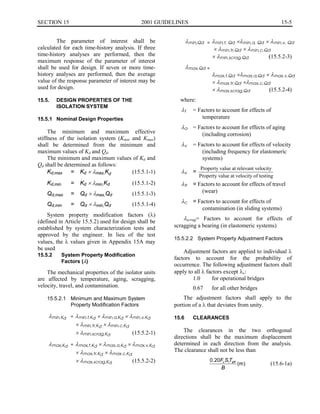
    Section 15 SEISMIC ISOLATION 15.1SCOPE Criteria provided herein for bearings used in implementing seismic isolation design are supplemental to Section 14 of the AASHTO LRFD Bridge Design Specifications. These provisions are necessary to provide a rational design procedure for isolation systems incorporating the displacements resulting from the seismic response. If a conflict arises between the provisions of the LRFD Sections 14 and this section, the provisions contained herein govern. The seismic isolation provisions in this Guide Specification maintain their Section 15 nomenclature because this is a new section that will be added to the existing LRFD provisions. Sections 1 through 8 of this Guide Specification will be inserted in existing sections of the LRFD provisions. These specifications are intended for systems that isolate in the horizontal plane only – that is, the system is assumed to be essentially rigid in the vertical direction. In addition, the criteria are currently intended for passive isolation systems only. 15.2 DEFINITIONS • DESIGN DISPLACEMENT is the lateral seismic displacement at the center of rigidity, required for design of the isolation system. • EFFECTIVE DAMPING is the value of equivalent viscous damping corresponding to the energy dissipated during cyclic response at the design displacement of the isolated structure. • EFFECTIVE STIFFNESS is the value of the maximum lateral force at instance of maximum lateral displacement in the isolation system, or an element thereof, divided by the maximum lateral displacement. • ELASTIC RESTRAINT SYSTEM is the collection of structural elements that provide restraint of the seismically isolated structure for nonseismic lateral loads. The elastic restraint system may be either an integral part of the isolation system or may be a separate device. • ISOLATION SYSTEM is the collection of all the elements that provide vertical stiffness, lateral flexibility, and damping to the system at the isolation interface. It includes the isolator units and the elastic restraint system, if one is used. • ISOLATOR UNIT is a horizontally flexible and vertically stiff bearing of the isolation system, which permits large lateral deformation under seismic load. The isolator unit may or may not provide energy dissipation. • OFFSET DISPLACEMENT is the lateral displacement of an isolator unit resulting from creep, shrinkage, and 50 percent of the thermal displacement. • TOTAL DESIGN DISPLACEMENT is the maximum lateral seismic displacement of an isolator unit resulting from the analysis and required for design of the isolation system, including both translational displacement at the center of rigidity, Li, and the component of torsional displacement in the direction under consideration. 15.3 NOTATION Ab = Bonded area of elastomer. Ar =Overlap area between the top-bonded and bottom-bonded elastomer areas of displaced bearing (figure C15.3-1). B =Numerical coefficient related to the effective damping of the isolation system as set forth in Table 15.4.1-1. 15-1
  • 2.
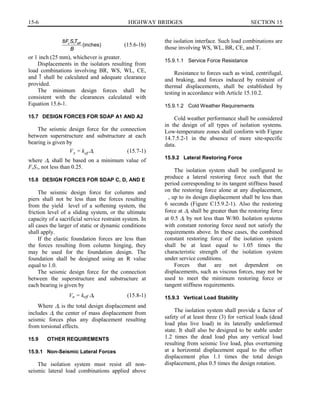
    15-2 HIGHWAY BRIDGESSECTION 15 Bd =Bonded plan dimension or bonded diameter in loaded direction of rectangular bearing or diameter of circular bearing (FigureC15.3-1). Cd =Elastic seismic demand response coef­ ficient. DL = Dead load. E =Young’s modulus of elastomer. EDC =Energy dissipated per cycle (area of hysteresis loop). V =Statically equivalent seismic force. VA =Design force for connections for bridges in Seismic Design and Analysis Procedure (SDAP A). Fi =Force in the isolator unit at displacement �i. Fn =Maximum negative force in an isolator unit during a single cycle of prototype testing. F = Maximum negative force in an isolatorn, max unit for all cycles of prototype testing at a common displacement amplitude. Fn, min = Minimum negative force in an isolator unit for all cycles of prototype testing at a common displacement amplitude. Fp = Maximum positive force in an isolator unit during a single cycle of prototype testing. Fp, max= Maximum positive force in an isolator unit for all cycles of prototype testing at a common displacement amplitude. Fp, min= Minimum positive force in an isolator unit for all cycles of prototype testing at a common displacement amplitude. Fv = Site soil coefficient given in Article 3.4.2. G = Shear modulus of elastomer. g = Acceleration due to gravity. k = Elastomer material constant. kiso = Effective stiffness of an isolator unit determined by prototype testing. kmax = Maximum effective stiffness of the isolator unit at the design displacement in the horizontal direction under consideration. kmin = Minimum effective stiffness of the isolator unit at the design displacement in the horizontal direction under consideration. ksub = Stiffness of the substructure protected by the isolation unit(s) K = Bulk modulus of the elastomer (Article 15.11). Kd = The second slope stiffness of the bilinear hysteresis curve. Keff = The sum of the effective linear stiffnesses of all bearings and substructures supporting the superstructure segment as calculated at displacement �i for the bearings and displacement �sub for the substructure. LL = Live load. LLs = Seismic live load. OT = Additional vertical load on bearing resulting from overturning moment effect of horizontal loads. P = Maximum vertical load resulting from the combination of dead load plus live load (including seismic live load, if applicable), plus overturning moment effect of horizontal loads. Qd = Characteristic strength of the isolator unit. It is the ordinate of the hysteresis loop at zero bearing displacement. Refer to Figure C15.1-4. S1 = The one-second period spectral acceleration given in Article 3.10.2.1. S = Shape factor (Article 15.11). SA = Spectral acceleration. SD = Spectral displacement.
  • 3.
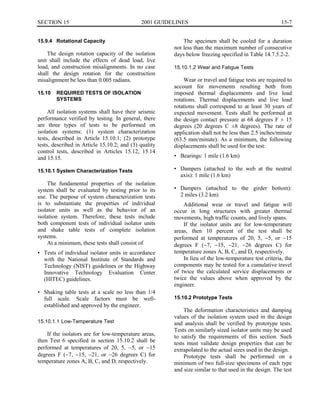
    � � � � � � � � � � � 15-3 i SECTION 152001 GUIDELINES Teff = Period of seismically isolated structure, in seconds, in the direction under consideration. Tr = Total elastomer thickness. ti = Thickness of elastomer layer number i, which is equivalent to the term hri in Article 14.7.5.1. W = The total vertical load for design of the isolation system (DL + LLs). = Total deck displacement relative to ground ( i + sub). = Design displacement at the center of rigidity of the isolation system in the direction under consideration. os = Offset displacement of the isolator unit, including creep, shrinkage, and 50 percent of the thermal displacement. sub = Substructure displacement. t = Total design displacement. n = Maximum negative displacement of an isolator unit during each cycle of prototype testing. p = Maximum positive displacement of an isolator unit during each cycle of prototype testing. s = Shear deformation of bearing from non­ seismic displacement of the superstructure (including temperature, shrinkage, and creep). ß = Equivalent viscous damping ratio for the isolation system. ßi = Equivalent viscous damping ratio for isolator. Yc = Shear strain due to vertical loads. Ys,eq = Shear strain due to t, the total seismic design displacement. Ys,s = Shear strain due to maximum horizontal displacement resulting from creep, post­ tensioning, shrinkage, and thermal effects computed between the installation temperature and the least favorable extreme temperature. Yr = Shear strain due to imposed rotation. 8 = Rotation imposed on bearing. Amax,Amin= System property modification factors to account for effects of temperature, aging, scragging, velocity, and variability of materials (Article 15.5.2). 15.4 ANALYSIS PROCEDURES Articles 3.7 and 5.1 shall be used to define the analysis procedures. The analysis of the bridge shall be performed using the design properties of the isolation system. To simplify the nonlinear behavior of the isolator unit, a bilinear simplification may be used. The analysis shall be repeated using upper-bound properties (Qd,max, Kd,max) in one analysis and lower-bound properties (Qd,min, Kd,min) in another, where the maximum and minimum values are defined in Article 15.5.1.2. The purpose of this upper- and lower-bound analysis is to determine the maximum forces on the substructure elements and the maximum displacements of the isolation system. An upper- and lower-bound analysis is not required if the displacements, using Equation 15.4.1-3, and the statically equivalent seismic force, using Equation 15.4.1-2a, do not vary from the design values by more than ±15 percent when the maximum and minimum values of the isolator units properties are used. For these simplified calculations, B values corresponding to more than 30-percent damping can be used to establish the ±15-percent limits. A nonlinear time-history analysis is required for structures with effective periods greater than 3 seconds. For isolation systems where the effective damping expressed as a percentage of critical damping exceeds 30 percent of critical, a three­ dimensional nonlinear time-history analysis shall be performed utilizing the hysteresis curves of the isolation system. 15.4.1 Capacity Spectrum Method This method of analysis can be used when the regularity requirements of Table 5.4.2.1-1 are met. The statically equivalent seismic force is given by
  • 4.
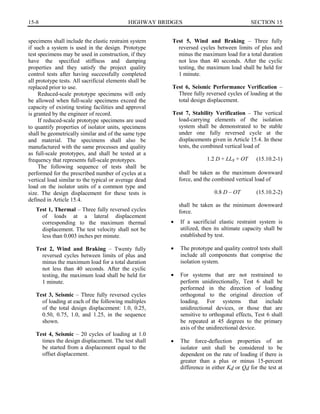
    � 15-4 HIGHWAY BRIDGESSECTION 15 V = CdW (15.4.1-1) The elastic seismic response demand coefficient, Cd , used to determine the equivalent force, is given by the dimensionless relationship K X � F Seff v 1 Cd - = (15.4.1-2) W T Beff The displacement is given by 0.25F STv 1 eff � = (m) (15.4.1-3a) B 10F STv 1 eff A = (inches) (15.4.1-3b) B Teff 2 W (15.4.1-4) K geff Note: This method of analysis shall not be used if Type E and F soils are present. For systems that include a viscous damper, the maximum force in the system may not correspond to the point of maximum displacement (Equation 15.4.1-1). The procedure described in the commentary shall be used. Table 15.4.1-1 Damping Coefficient B Damping (Percentage of Critical)* :2 5 10 20 30 40 50 B 0.8 1.0 1.2 1.5 1.7 1.9 2.0 *The percentage of critical damping depends on the energy dissipated and stored by the isolation system, which shall be determined by test of the isolation system’s characteristics, and by the substructure. The damping coefficient shall be based on linear interpolation for damping levels other than those given. Note that for isolation systems where the effective damping exceeds 30 percent, a nonlinear time-history analysis shall be performed utilizing the hysteresis curves of the system. 15.4.2 Uniform Load Method The statically equivalent force determined according to Article 15.4.1, which is associated with the displacement across the isolation bearings, shall be applied using the uniform load method of analysis described in Article 5.4.2.2 independently along two perpendicular axes and combined as specified in Article 3.6. The effective stiffness of the isolators used in the analysis shall be calculated at the design displacement. 15.4.3 Multimode Spectral Method An equivalent linear response spectrum shall be performed using the requirements of Article 5.4.2.3 when required by the regularity limitations of Article 5.4.2.1. The 5% damped spectra may be scaled by the damping coefficient (B), as defined in Article 15.4.1, to represent the actual seismic hazard and the effective damping of the isolation system for the isolated modes. Scaling by the damping coefficient B shall apply only for periods greater than 0.8 Teff. The 5-percent ground­ motion response spectra shall be used for all other modes. The effective linear stiffness of the isolators shall correspond to the design displacement. The combination of orthogonal seismic forces shall be as specified in Article 3.6. 15.4.4 Time-History Method For isolation systems requiring a time-history analysis, the following requirements and Article 5.4.4 shall apply: (a) The isolation system shall be modeled using the nonlinear deformational characteristics of the isolators determined and verified by test in accordance with the requirements of Article 15.10. (b) Pairs of horizontal ground-motion time­ history components shall be selected from no fewer than three earthquakes as required by Article 3.4.4. (c) Time-history analysis shall be performed with at least three appropriate pairs of horizontal time-history components. Each pair of time histories shall be applied simultaneously to the model. The maximum displacement of the isolation system shall be calculated from the vectorial sum of the orthogonal displacements at each time step.
  • 5.
    15-5SECTION 15 2001GUIDELINES The parameter of interest shall be calculated for each time-history analysis. If three time-history analyses are performed, then the maximum response of the parameter of interest shall be used for design. If seven or more time­ history analyses are performed, then the average value of the response parameter of interest may be used for design. 15.5. DESIGN PROPERTIES OF THE ISOLATION SYSTEM 15.5.1 Nominal Design Properties The minimum and maximum effective stiffness of the isolation system (Kmin and Kmax) shall be determined from the minimum and maximum values of Kd and Qd. The minimum and maximum values of Kd and Qd shall be determined as follows: Kd,max = Kd x Amax,Kd (15.5.1-1) Kd,min = Kd x Amin,Kd (15.5.1-2) Qd,max = Qd x Amax,Qd (15.5.1-3) Qd,min = Qd x Amin,Qd (15.5.1-4) System property modification factors (A) (defined in Article 15.5.2) used for design shall be established by system characterization tests and approved by the engineer. In lieu of the test values, the A values given in Appendix 15A may be used 15.5.2 System Property Modification Factors (A) The mechanical properties of the isolator units are affected by temperature, aging, scragging, velocity, travel, and contamination. 15.5.2.1 Minimum and Maximum System Property Modification Factors =Amin,Kd Amin,t,Kd x Amin,a,Kd x Amin,v,Kd x Amin,tr,Kd x Amin,c,Kd x Amin,scrag,Kd (15.5.2-1) =Amax,Kd Amax,t,Kd x Amax,a,Kd x Amax,v,Kd x Amax,tr,Kd x Amax,c,Kd x Amax,scrag,Kd (15.5.2-2) Amin,Qd = Amin,t, Qd xAmin,a, Qd x Amin,v, Qd x Amin,tr,Qd x Amin,c,Qd x Amin,scrag,Qd (15.5.2-3) Amax,Qd = Amax,t,Qd xAmax,a,Qd x Amax,v,Qd x Amax,tr,Qd xAmax,c,Qd x Amax,scrag,Qd (15.5.2-4) where: At = Factors to account for effects of temperature Aa = Factors to account for effects of aging (including corrosion) Av = Factors to account for effects of velocity (including frequency for elastomeric systems) Property value at relevant velocity Av = Property value at velocity of testing Atr = Factors to account for effects of travel (wear) Ac = Factors to account for effects of contamination (in sliding systems) Ascrag= Factors to account for effects of scragging a bearing (in elastomeric systems) 15.5.2.2 System Property Adjustment Factors Adjustment factors are applied to individual A factors to account for the probability of occurrence. The following adjustment factors shall apply to all A factors except Av: 1.0 for operational bridges 0.67 for all other bridges The adjustment factors shall apply to the portion of a A that deviates from unity. 15.6 CLEARANCES The clearances in the two orthogonal directions shall be the maximum displacement determined in each direction from the analysis. The clearance shall not be less than 0.20F ST1 effv (m) (15.6-1a) B
  • 6.
    � 15-6 HIGHWAY BRIDGESSECTION 15 8F STv 1 eff (inches) (15.6-1b) B or 1 inch (25 mm), whichever is greater. Displacements in the isolators resulting from load combinations involving BR, WS, WL, CE, and T shall be calculated and adequate clearance provided. The minimum design forces shall be consistent with the clearances calculated with Equation 15.6-1. 15.7 DESIGN FORCES FOR SDAP A1 AND A2 The seismic design force for the connection between superstructure and substructure at each bearing is given by VA = keff Lt (15.7-1) where Lt shall be based on a minimum value of FvS1, not less than 0.25. 15.8 DESIGN FORCES FOR SDAP C, D, AND E The seismic design force for columns and piers shall not be less than the forces resulting from the yield level of a softening system, the friction level of a sliding system, or the ultimate capacity of a sacrificial service restraint system. In all cases the larger of static or dynamic conditions shall apply. If the elastic foundation forces are less than the forces resulting from column hinging, they may be used for the foundation design. The foundation shall be designed using an R value equal to 1.0. The seismic design force for the connection between the superstructure and substructure at each bearing is given by Va = keff Lt (15.8-1) Where Lt is the total design displacement and includes Li the center of mass displacement from seismic forces plus any displacement resulting from torsional effects. 15.9 OTHER REQUIREMENTS 15.9.1 Non-Seismic Lateral Forces The isolation system must resist all non­ seismic lateral load combinations applied above the isolation interface. Such load combinations are those involving WS, WL, BR, CE, and T. 15.9.1.1 Service Force Resistance Resistance to forces such as wind, centrifugal, and braking, and forces induced by restraint of thermal displacements, shall be established by testing in accordance with Article 15.10.2. 15.9.1.2 Cold Weather Requirements Cold weather performance shall be considered in the design of all types of isolation systems. Low-temperature zones shall conform with Figure 14.7.5.2-1 in the absence of more site-specific data. 15.9.2 Lateral Restoring Force The isolation system shall be configured to produce a lateral restoring force such that the period corresponding to its tangent stiffness based on the restoring force alone at any displacement, , up to its design displacement shall be less than 6 seconds (Figure C15.9.2-1). Also the restoring force at Li shall be greater than the restoring force at 0.5 Li by not less than W/80. Isolation systems with constant restoring force need not satisfy the requirements above. In these cases, the combined constant restoring force of the isolation system shall be at least equal to 1.05 times the characteristic strength of the isolation system under service conditions. Forces that are not dependent on displacements, such as viscous forces, may not be used to meet the minimum restoring force or tangent stiffness requirements. 15.9.3 Vertical Load Stability The isolation system shall provide a factor of safety of at least three (3) for vertical loads (dead load plus live load) in its laterally undeformed state. It shall also be designed to be stable under 1.2 times the dead load plus any vertical load resulting from seismic live load, plus overturning at a horizontal displacement equal to the offset displacement plus 1.1 times the total design displacement, plus 0.5 times the design rotation.
  • 7.
    15-7SECTION 15 2001GUIDELINES 15.9.4 Rotational Capacity The design rotation capacity of the isolation unit shall include the effects of dead load, live load, and construction misalignments. In no case shall the design rotation for the construction misalignment be less than 0.005 radians. 15.10 REQUIRED TESTS OF ISOLATION SYSTEMS All isolation systems shall have their seismic performance verified by testing. In general, there are three types of tests to be performed on isolation systems: (1) system characterization tests, described in Article 15.10.1; (2) prototype tests, described in Article 15.10.2; and (3) quality control tests, described in Articles 15.12, 15.14 and 15.15. 15.10.1 System Characterization Tests The fundamental properties of the isolation system shall be evaluated by testing prior to its use. The purpose of system characterization tests is to substantiate the properties of individual isolator units as well as the behavior of an isolation system. Therefore, these tests include both component tests of individual isolator units and shake table tests of complete isolation systems. At a minimum, these tests shall consist of • Tests of individual isolator units in accordance with the National Institute of Standards and Technology (NIST) guidelines or the Highway Innovative Technology Evaluation Center (HITEC) guidelines. • Shaking table tests at a scale no less than 1/4 full scale. Scale factors must be well­ established and approved by the engineer. 15.10.1.1 Low-Temperature Test If the isolators are for low-temperature areas, then Test 6 specified in section 15.10.2 shall be performed at temperatures of 20, 5, �5, or �15 degrees F (�7, �15, �21, or �26 degrees C) for temperature zones A, B, C, and D, respectively. The specimen shall be cooled for a duration not less than the maximum number of consecutive days below freezing specified in Table 14.7.5.2-2. 15.10.1.2 Wear and Fatigue Tests Wear or travel and fatigue tests are required to account for movements resulting both from imposed thermal displacements and live load rotations. Thermal displacements and live load rotations shall correspond to at least 30 years of expected movement. Tests shall be performed at the design contact pressure at 68 degrees F ± 15 degrees (20 degrees C ±8 degrees). The rate of application shall not be less than 2.5 inches/minute (63.5 mm/minute). As a minimum, the following displacements shall be used for the test: • Bearings: 1 mile (1.6 km) • Dampers (attached to the web at the neutral axis): 1 mile (1.6 km) • Dampers (attached to the girder bottom): 2 miles (3.2 km) Additional wear or travel and fatigue will occur in long structures with greater thermal movements, high traffic counts, and lively spans. If the isolator units are for low-temperature areas, then 10 percent of the test shall be performed at temperatures of 20, 5, �5, or �15 degrees F (�7, �15, �21, �26 degrees C) for temperature zones A, B, C, and D, respectively. In lieu of the low-temperature test criteria, the components may be tested for a cumulative travel of twice the calculated service displacements or twice the values above when approved by the engineer. 15.10.2 Prototype Tests The deformation characteristics and damping values of the isolation system used in the design and analysis shall be verified by prototype tests. Tests on similarly sized isolator units may be used to satisfy the requirements of this section. Such tests must validate design properties that can be extrapolated to the actual sizes used in the design. Prototype tests shall be performed on a minimum of two full-size specimens of each type and size similar to that used in the design. The test
  • 8.
    15-8 HIGHWAY BRIDGESSECTION 15 specimens shall include the elastic restraint system if such a system is used in the design. Prototype test specimens may be used in construction, if they have the specified stiffness and damping properties and they satisfy the project quality control tests after having successfully completed all prototype tests. All sacrificial elements shall be replaced prior to use. Reduced-scale prototype specimens will only be allowed when full-scale specimens exceed the capacity of existing testing facilities and approval is granted by the engineer of record. If reduced-scale prototype specimens are used to quantify properties of isolator units, specimens shall be geometrically similar and of the same type and material. The specimens shall also be manufactured with the same processes and quality as full-scale prototypes, and shall be tested at a frequency that represents full-scale prototypes. The following sequence of tests shall be performed for the prescribed number of cycles at a vertical load similar to the typical or average dead load on the isolator units of a common type and size. The design displacement for these tests is defined in Article 15.4. Test 1, Thermal – Three fully reversed cycles of loads at a lateral displacement corresponding to the maximum thermal displacement. The test velocity shall not be less than 0.003 inches per minute. Test 2, Wind and Braking – Twenty fully reversed cycles between limits of plus and minus the maximum load for a total duration not less than 40 seconds. After the cyclic testing, the maximum load shall be held for 1 minute. Test 3, Seismic – Three fully reversed cycles of loading at each of the following multiples of the total design displacement: 1.0, 0.25, 0.50, 0.75, 1.0, and 1.25, in the sequence shown. Test 4, Seismic – 20 cycles of loading at 1.0 times the design displacement. The test shall be started from a displacement equal to the offset displacement. Test 5, Wind and Braking – Three fully reversed cycles between limits of plus and minus the maximum load for a total duration not less than 40 seconds. After the cyclic testing, the maximum load shall be held for 1 minute. Test 6, Seismic Performance Verification – Three fully reversed cycles of loading at the total design displacement. Test 7, Stability Verification – The vertical load-carrying elements of the isolation system shall be demonstrated to be stable under one fully reversed cycle at the displacements given in Article 15.4. In these tests, the combined vertical load of 1.2 D + LLs + OT (15.10.2-1) shall be taken as the maximum downward force, and the combined vertical load of 0.8 D – OT (15.10.2-2) shall be taken as the minimum downward force. • If a sacrificial elastic restraint system is utilized, then its ultimate capacity shall be established by test. • The prototype and quality control tests shall include all components that comprise the isolation system. • For systems that are not restrained to perform unidirectionally, Test 6 shall be performed in the direction of loading orthogonal to the original direction of loading. For systems that include unidirectional devices, or those that are sensitive to orthogonal effects, Test 6 shall be repeated at 45 degrees to the primary axis of the unidirectional device. • The force-deflection properties of an isolator unit shall be considered to be dependent on the rate of loading if there is greater than a plus or minus 15-percent difference in either Kd or Qd for the test at
  • 9.
    15-9SECTION 15 2001GUIDELINES the design displacement when dynamically tested at any frequency in the range of 0.5 to 1.5 times the inverse of the effective period of the isolated structure. If the force-deflection properties of the isolator units are dependent on the rate of loading, then each set of tests specified in Article 15.10.2 shall be performed dynamically at a frequency equal to the inverse of the effective period of the isolated structure. If the test can not be performed dynamically, then a l factor must be established that relates properties Kd or Qd determined at the actual speed of testing with the dynamic velocities in accordance with Article 15.5.2.1. 15.10.3 Determination of System Characteristics (a) The force-deflection characteristics of the isolation system shall be based on the cyclic load test results for each fully reversed cycle of loading. (b) The effective stiffness of an isolator unit shall be calculated for each cycle of loading as follows: Fp - Fn keff = (15.10.3-1) � - �p n where Lp and Ln are the maximum positive and maximum negative test displacements, respectively, and Fp and Fn are the maximum positive and maximum negative forces at instance of displacements Lp and Ln, respectively. (c) Equivalent Damping. The equivalent viscous damping ratio (ß) of the isolation system shall be calculated as 1 Total EDC Area j = x (15.10.3-2) 21 I(keff f2 i ) The total EDC area shall be taken as the sum of the areas of the hysteresis loops of all isolator units. The hysteresis loop area of each isolator unit shall be taken as the minimum area of the three hysteresis loops established by the cyclic tests in Test 3 of Article 15.10.2 at a displacement amplitude equal to the design displacement. 15.10.3.1 System Adequacy The performance of the test specimens shall be assessed as adequate if the following conditions are satisfied: • The force-deflection plots, excluding any viscous damping component, of all tests specified in Article 15.10.2 show a positive incremental force-carrying capacity consistent with the requirements of Article 15.9.2. • For Test 1, the maximum measured force shall be less than the design value. • For Tests 2 and 5, the maximum measured displacement shall be less than the design value. • The average effective stiffness measured in the last three cycles to the total design displacement specified in Test 3 shall lie within 10 percent of the value used in design. For each test displacement level specified for Test 3, the minimum effective stiffness measured during the three cycles shall not be less than 80 percent of the maximum effective stiffness. For Test 4, the minimum effective stiffness measured during the specified number of cycles shall not be less than 80 percent of the maximum effective stiffness. At the discretion of the engineer, a larger variation may be accepted, provided that both the minimum and maximum values of effective stiffness are used in the design. • For Test 4, the minimum EDC measured during the specified number of cycles shall not be less than 70 percent of the maximum EDC. At the discretion of the
  • 10.
    15-10 HIGHWAY BRIDGESSECTION 15 engineer, a larger variation may be accepted, provided that both the minimum and maximum values of EDC are used in the design. All vertical load-carrying elements of the isolation system shall remain stable (positive incremental stiffness) at the displacements specified in Article 15.9.3 for static loads as prescribed for Test 7. Test specimens shall be visually inspected for evidence of significant deterioration. If any deterioration exists, then the adequacy of the test specimen shall be determined by the engineer. 15.11 ELASTOMERIC BEARINGS 15.11.1 General The following shall be considered supplemental to Section 14 of the LRFD provisions. Elastomeric bearings utilized in implementing seismic isolation design shall be designed by the procedures and specifications given in the following subsections. Additional test requirements for seismic isolation bearings are given in Article 15.12. The design procedures are based on service loads excluding impact. The elastomeric bearings must be reinforced using steel reinforcement. Fabric reinforcement is not permitted. 15.11.2 Shear Strain Components for Isolation Design The various components of shear strain in the bearing shall be computed as follows: • Shear strain (yc) due to compression by vertical loads is given by Y = 3SP (15.11.2-1)c 2ArG(1+ 2kS2 ) if S : 15, or 3 (1P + 8GkS2 /K) Y _ (15.11.2-2)c 4GkSAr if S > 15, where K is the bulk modulus of the elastomer. In absence of measured data, K may be taken as 300,000 psi (2,000 MPa). The shape factor S shall be taken as the plan area of the elastomer layer divided by the area of perimeter free to bulge. • Shear strain (Ys,s) due to imposed non­ seismic lateral displacement is given by �s Y , = (15.11.2-3)s s Tr • Shear strain (Ys,eq) due to earthquake­ imposed lateral displacement is given by �t Y , = (15.11.2-4)s eq Tr • Shear strain (yr) due to rotation is given by Bd 2 r (15.11.2-5) 2t Ti r The design rotation (8) shall include the rotational effects of DL, LL, and construction. 15.11.3 Load Combinations Elastomeric bearings shall satisfy Yc : 2.5 (15.11.3-1) Yc + Ys,s + Yr : 5.0 (15.11.3-2) Yc + Ys,eq + 0.5 Yr : 5.5 (15.11.3-3) 15.12 ELASTOMERIC BEARINGS – CONSTRUCTION 15.12.1 General Requirements The following shall be considered supplemental to article 18.2 of the AASHTO Standard Specifications (Division II). The provision of Article 15.12.2 replaces those in
  • 11.
    15-11SECTION 15 2001GUIDELINES articles 18.2.7.6, 18.2.7.7, and 18.2.7.8 of the AASHTO Standard Specifications (Division II). The layers of elastomeric bearings used in seismic isolation shall be integrally bonded during vulcanization. Cold bonding is not allowed. 15.12.2 Quality Control Tests The following quality control tests shall also be performed on elastomeric bearings. 15.12.2.1 Compression Capacity A 5-minute sustained proof load test shall be conducted on each bearing. The compressive load for the test shall be 1.5 times the maximum (dead load plus live load). If bulging suggests poor laminate bond, the bearing shall be rejected. 15.12.2.2 Combined Compression and Shear All bearings shall be tested in combined compression and shear. The bearings may be tested in pairs. The compressive load shall be the average dead load of all bearings of that type, and the bearings shall be subjected to five fully reversed cycles of loading at the larger of the total design displacement or 50 percent of the elastomer thickness. For each bearing, the effective stiffness and EDC shall be averaged over the five cycles of the test. For each group of similar bearings of the same type and size, the effective stiffness and EDC shall be averaged. The results shall not differ from the design values by more than the limits given in Table 15.12.2.2-1. Table 15.12.2.2-1 Keff EDC Individual Bearings ±20% –25% Average of Group ±10% –15% 15.12.2.3 Acceptance Criteria After quality control testing, all bearings shall be visually inspected for defects. The following faults shall be cause for rejection: • Lack of rubber-to-steel bond. • Laminate placement fault. • Surface cracks on the rubber that are wider or deeper than 2/3 of the rubber cover thickness. • Permanent deformation. 15.13 SLIDING BEARINGS – DESIGN 15.13.1 General Sliding bearings used in isolation systems may use flat or curved surfaces. 15.13.2 Materials 15.13.2.1 PTFE Bearing Liners All PTFE surfaces, other than guides, shall satisfy the requirements specified herein. The PTFE bearing liner shall be made from virgin PTFE resin satisfying the requirements of ASTM D1457. It may be fabricated as unfilled sheet, filled sheet, or fabric woven from PTFE and other fibers. Unfilled sheets shall be made from PTFE resin alone. Filled sheets shall be made from PTFE resin uniformly blended with glass fibers, carbon fibers, or other chemically inert reinforcing fibers. Sheet PTFE may contain dimples to act as reservoirs for lubricant. Their diameter shall not exceed 0.32 inch (8 mm) at the surface of the PTFE and their depth shall be not less than 0.08 inch (2 mm) and not more than half the thickness of the PTFE. The reservoirs should cover more than 20 percent, but less than 30 percent of the contact surface. Dimples should not be placed to intersect the edge of the contact area. Lubricant shall be silicone grease, effective to –30½ F (–34º C). Silicone grease shall conform to Military specification MIL-S-8660. 15.13.2.2 Other Bearing Liner Materials Other materials may be used for the bearing liner if test results demonstrate a stable long-term coefficient of friction, chemical stability, and wear resistance in accordance with Article 15.10.1.2, and are approved by the engineer.
  • 12.
    15-12 HIGHWAY BRIDGESSECTION 15 15.13.2.3 Mating Surface Mating surfaces shall be stainless steel (welded overlay, solid, or sheet metal). Stainless steel shall have a corrosion resistance and strength equal to or exceeding type 304, conforming to ASTM A167/A264. The average surface roughness shall not exceed 32 micro inches (0.8 micro meters) Ra (arithmetic determined by procedures ANSI/ASME B46.1-1985 (ASME, average) described 1985). as in 15.13.3 Geometry 15.13.3.1 Minimum Thickness 15.13.3.1.1 PTFE Bearing Liner The minimum thickness for PTFE shall be at least 0.0625 inch (1.6 mm) after compression. Recessed sheet PTFE shall be at least 0.1875 inch (4.8 mm) thick when the maximum dimension of the PTFE is less than or equal to 24.0 inches (610 mm), and 0.25 inch (6.4 mm) when the maximum dimension of the PTFE is greater than 24.0 inches (610 mm). Woven fabric PTFE shall have, after compression, a minimum thickness of 0.0625 inch (1.6 mm) and a maximum thickness of 0.125 inch (3.2 mm). 15.13.3.1.2 Other Bearing Liner Materials The minimum thickness for all other bearing liners shall be determined by conducting wear tests in accordance with Article 15.10.1.2. 15.13.3.2 Mating Surface The thickness of the stainless steel mating surface sheet shall be at least 16 gauge when the maximum dimension of the surface is less than or equal to 12.0 inches (305 mm), and at least 13 gauge when the maximum dimension is larger than 12.0 inches (305 mm) and less than or equal to 36.0 inches (915 mm). When the maximum dimension is larger than 36.0 inches (915 mm), the thickness of the stainless steel mating surface shall be verified by performance of suitable system characterization tests. The minimum thickness of stainless steel weld overlays shall be 3/32 inch (2.4 mm) thick after welding, grinding, and polishing. 15.13.3.3 Displacement Capacity The mating surface dimensions shall be large enough to ensure that the sliding surface does not come into contact with the edge of the mating surface at the total design displacement plus the offset displacement. 15.13.4 Loads and Stresses 15.13.4.1 Contact Pressure Contact stresses for bearing liners shall be established by testing. Test pressures shall be at least 110 percent of the value used in design and must satisfy the wear requirements in Article 15.10.1.2. As a minimum, 50 percent of the usable bearing liner thickness must remain after completion of the wear test. Allowable contact stresses for PTFE liners tabulated in Table 15.13.4.1-1 may be used without completing the wear test, provided that the stainless steel mating surface has a surface roughness less than 20 micro inches (0.5 micro meter) Ra. Table 15.13.4.1-1 Allowable Average Contact Stress for PTFE Material Allowable Contact Stress Service Loads Seismic Loads Average Stress Edge Stress Average Stress ksi MPa ksi MPa ksi MPa Unfilled sheets (recessed) 3.5 24 5.0 34 6.0 41 Filled sheets (recessed) 3.5 24 5.0 34 6.0 41 Woven PTFE fiber over a metallic substrate 3.5 24 10.0 69 6.0 41
  • 13.
    15-13SECTION 15 2001GUIDELINES 15.13.4.2 Coefficient of Friction 15.13.4.2.1 Service Coefficient of Friction The service limit state coefficient of friction of the PTFE sliding surface shall be taken as specified in Table 15.13.4.2.1-1. Intermediate values may be determined by interpolation. The coefficient of friction shall be determined by using the stress level associated with the service load combination specified in Table 3.4.1-1. Different values may be used if verified by tests and adjusted by the appropriate A values in accordance with Article 15.5. Table 15.13.4.2.1-1 Service Coefficients of Friction Type of Surface Temp. Average Bearing Stress 0.5 1.0 2.0 �3.0 ksi °F °C 3.5 6.9 13.8 20.7 MPa Dimpled lubricate d PTFE sheets 68 –13 –49 20 –25 –45 0.04 0.06 0.10 0.03 0.045 0.075 0.025 0.04 0.06 0.02 0.03 0.05 Unfilled PTFE sheets 68 –13 –49 20 –25 –45 0.08 0.20 0.20 0.07 0.18 0.18 0.05 0.13 0.13 0.03 0.10 0.10 Filled PTFE sheets 68 –13 –49 20 –25 –45 0.24 0.44 0.65 0.17 0.32 0.55 0.09 0.25 0.45 0.06 0.20 0.35 Woven PTFE fiber 68 –13 –49 20 –25 –45 0.08 0.20 0.20 0.07 0.18 0.18 0.06 0.13 0.13 0.045 0.10 0.10 Service coefficients of friction for other surface finishes, stresses, and bearing liners shall be established by testing. The testing procedures and results shall be subject to the approval of the engineer. 15.13.4.2.2 Seismic Coefficient of Friction The seismic coefficient of friction may be determined from the area under the force displacement loops of three cycles divided by the total travel distance and vertical load (Qd/vertical load). 15.13.5 Other Details 15.13.5.1 Bearing Liner Attachment All sheet PTFE shall be recessed for one-half of its thickness and bonded into a metal backing plate. All bearing liners shall be attached to resist a shear force of 0.15 times the applied compressive force or 2 times Qd, whichever is greater. 15.13.5.2 Mating Surface Attachment The mating surface for the bearing liner shall be attached to a backing plate by welding or other suitable means in such a way that it remains free of undulations and in full contact with its backing plate throughout its service life. The attachment shall include an effective moisture seal around the entire perimeter of the mating surface to prevent interface corrosion. The attachment shall be capable of resisting the maximum friction force that can be developed by the bearing under service limit state and seismic load combinations. The welds used for the attachment shall be clear of the contact and sliding area of the bearing liner. 15.13.6 Materials for Guides Bearing guides may be made from materials not described in Article 15.13.2. The materials used shall have sufficient strength, stiffness, and resistance to creep and decay to ensure the proper functioning of the guide throughout its design life. 15.14 SLIDING BEARINGS – CONSTRUCTION 15.14.1 General Requirements Isolator units that use sliding bearings shall be constructed in accordance with the applicable provisions of articles 18.4 and 18.8.2 of the AASHTO Standard Specifications (Division II). 15.14.2 Quality Control Tests The following quality control tests shall also be performed on sliding isolation bearings.
  • 14.
    15-14 HIGHWAY BRIDGESSECTION 15 15.14.2.1 Compression Capacity A 5-minute sustained proof load test shall be conducted on each bearing. The compressive load for the test shall be 1.5 times the maximum (dead load plus live load). If flow of the bearing liner suggests inadequate bonding, or it leaves a permanent deformation in the mating surface, the bearing shall be rejected. 15.14.2.2 Combined Compression and Shear All bearings shall be tested in combined compression and shear. The bearings may be tested in pairs. The compressive load shall be the average dead load of all bearings of that type, and the bearings shall be subjected to five fully reversed cycles of loading at the total design displacement. For each bearing, the effective stiffness and EDC shall be averaged over the five cycles of the test. For each group of similar bearings of the same type and size, the effective stiffness and EDC shall be averaged. The results shall not differ from the design values by more than the limits given in table 15.12.2.2-1. 15.14.2.3 Acceptance Criteria After quality control testing, all bearings shall be visually inspected and, if applicable, disassembled and inspected for defects. The following faults shall be cause for rejection: (1) Lack of bearing-liner-to-metal bond. (2) Scoring of stainless steel plate. (3) Permanent deformation. (4) Leakage. 15.15 OTHER ISOLATION SYSTEMS 15.15.1 Scope All isolation units or systems that contain a flexible element, restoring force capacity, and energy dissipation capacity, and that are not covered in Articles 15.11 to 15.14 of this specification, shall be subject to the requirements of this section and approved by the engineer. Isolation bearings that depend on a metal roller element for lateral displacement shall satisfy the requirements of Article 14.7. Acceptance of the system shall be based on satisfying the requirements of Articles 15.15.2 through 15.15.6. Materials used for contact surfaces, such as sliding or rolling elements, shall be selected so as to provide the least possible change in those properties over time. 15.15.2 System Characterization Tests The characteristics of the isolation system that are used in design shall be verified by tests and approved by the engineer. At a minimum, the following tests shall be conducted: • Lateral load tests to determine properties and capacities in accordance with tests prescribed in the NIST report (National Institute of Standards and Technology 1996; ASCE Standards Committee on Testing of Base Isolation Systems 1996) or HITEC report (Highway Innovation Technology Center 1996). • Shaking table tests at a scale no less than 1/4 full scale. Scale factors must be well­ established and approved by the engineer. • Tests to investigate the variations in system properties and their effects on response. At a minimum, the effects on temperature, rate­ dependency, prior loading (including wear), and environmental effects shall be investigated. Values for Amin and Amax, similar to those defined in Article 15.5, shall be developed from these tests. In addition to the foregoing test data, information from previous field experience in other applications may be used to demonstrate the system characteristics. For all tests, no adjustments to the system may be made except those that are explicitly included in the maintenance plan, which must be given to the engineer prior to the start of prototype testing. 15.15.3 Design Procedure A complete, rational design procedure for the isolation system shall be provided to the engineer
  • 15.
    15-15SECTION 15 2001GUIDELINES prior to the start of the prototype testing defined in section 18.5. This procedure shall include • the basis for the selection of the limiting material stresses, deformations, or other critical response quantities; • the method for predicting the cyclic load deformation relationship of the system; and • the method for predicting the stability limit of the system. At least one design example shall be submitted with the design procedure, including the calculations for obtaining the maximum force response and maximum displacement response. 15.15.4 Fabrication, Installation, Inspection, and Maintenance Requirements All special requirements for fabrication, installation, inspection, and maintenance shall be submitted, in writing, to the engineer prior to the start of prototype testing. At a minimum, these shall include • materials to be used and the specifications they must satisfy, • any special material testing requirements, • fabrication sequence and procedures, • fabrication tolerances and surface finish requirements, • any special handling requirements, • installation procedures and tolerances, and • maintenance requirements, including a schedule for replacement of any components, for the lifetime of the system. 15.15.5 Prototype Tests Prototype testing shall be conducted for each job in order to demonstrate that the design achieves the performance requirements set out in the job specifications. Insofar as possible, the tests shall conform to those defined in Article 15.10.2. The engineer may, at his or her discretion, require additional tests to verify particular characteristics of the system. Prior to the start of testing, design values for critical response quantities shall be submitted to the engineer, and the engineer shall establish criteria for accepting the system on the basis of the prototype tests. At a minimum, those criteria shall include permissible variations from the design values of the resistance and energy dissipation at critical displacements, velocities, or accelerations. 15.15.6 Quality Control Tests Quality control testing shall be conducted on every bearing. Test requirements and acceptance requirements shall be established by the engineer. 15.15.6.1 Compression Capacity A 5-minute sustained proof load test shall be conducted on each bearing. The compressive load for the test shall be 1.5 times the maximum (dead load plus live load). 15.15.6.2 Combined Compression and Shear All bearings shall be tested in combined compression and shear. The bearings may be tested in pairs. The compressive load shall be the average dead load of all bearings of that type, and the bearings shall be subjected to five fully reversed cycles of loading at the total design displacement. 15.15.6.3 Acceptance Criteria Acceptance criteria for requirements specified in this section shall be determined by the engineer.
  • 16.
    15-16 HIGHWAY BRIDGESSECTION 15 REFERENCES 1. American Association of State Highway and Transportation Officials. 1999. Guide Specifications for Seismic Isolation Design. 2 nd Edition. Washington, DC: American Association of State Highway and Transportation Officials. 2. American Association of State Highway and Transportation Officials. 1998. LRFD Bridge Design Specifications. 2nd Edition. Washington, DC: American Association of State Highway and Transportation Officials. 3. American Association of State Highway and Transportation Officials. 1996. Standard Specifications for Highway Bridges. 16th Edition. Washington, DC: American Association of State Highway and Transportation Officials. 4. American Society of Civil Engineers (ASCE) Standards Committee on Testing of Base Isolation Systems. 1996. ASCE Standard for Testing Seismic Isolation Systems, Units and Components. Draft C. Reston, VA: ASCE. 5. American Society of Mechanical Engineers. 1985. Surface Texture (Surface Roughness, Waviness and Lay). ANSI/ASME B46.1-1985. New York. 6. Department of Defense. 1976. Dissimilar Metals. Military Standard MIL-STD 889B. Philadelphia, PA: Defense Printing Service Detachment Office. 7. British Standards Institution, 1983. BS5400 – Steel, Concrete and Composite Bridges: Part 9, Bridge Bearings. London: British Standards Institution. 8. British Standards Institution. 1979. Commentary on Corrosion at Bimetallic Contacts and Its Alleviation. BSI Standards PD 6484. Confirmed March 1990. London: British Standards Institution. 9. Building Seismic Safety Council. 1997. NEHRP Recommended Provisions for Seismic Regulations for New Buildings and Other Structures. Report FEMA 302, Washington, DC. 10. Constantinou, M. C. and J. K. Quarshie. 1998. Response Modification Factors for Seismically Isolated Bridges. Technical Report MCEER-98-0014, Multidisciplinary Center for Earthquake Engineering Research, Buffalo, NY. 11. Constantinou, M. C., P. Tsopelas, A. Kasalanati, and E. D. Wolff. 1999. Property Modification Factors for Seismic Isolation Bearings. Technical Report MCEER-99-0012, Multidisciplinary Center for Earthquake Engineering Research, Buffalo, NY. 12. European Standard on Structural Bearings. 1996. Eurocode EN 1337. Draft. Brussels. 13. Highway Innovative Technology Evaluation Center (HITEC). 1996. Guidelines for the Testing of Seismic Isolation and Energy Dissipation Devices. CERF Report: HITEC 96-02. Washington, DC: HITEC. 14. International Conference of Building Officials. 1994. Uniform Building Code: Structural Engineering Design Provision. Vol. 2. Whittier, CA: ICBO. 15. Kelly, J. 1997. Earthquake Resistant Design with Rubber. 2nd Edition. Richmond, CA: Earthquake Engineering Research Center, National Information Service for Earthquake Engineering, Springer- Verlag London Limited.
  • 17.
    15-17SECTION 15 2001GUIDELINES 16. Kim, D. K., J. B. Mander, and S. S. Chen. 1996. Temperature and Strain Rate Effects on the Seismic Performance of Elastomeric and Lead-Rubber Bearings. Proc., 4th World Congress on Joint Sealing and Bearing Systems for Concrete Structures, American Concrete Institute, Publication SP-164. Vol. 1. 17. Lee, D. D., 1993, The Base Isolation of Koeberg Nuclear Power Station 14 Years After Installation, Post-SMiRT Conference on Isolation, Energy Dissipation and Control of Vibration of Structures. Capri, Italy. 18. Nakano, O., H. Nishi, T. Shirono, and K. Kumagai. December 1992. Temperature-Dependency of Base Isolation Bearings. Proc., Second U.S.-Japan Workshop on Earthquake Protective Systems for Bridges. Tsukuba, Japan. 19. National Institute of Standards and Technology. 1996. Guidelines for Pre-Qualification, Prototype and Quality Control Testing of Seismic Isolation Systems. Publication NISTIR 5800. Gaithersburg, MD: National Institute of Standards and Technology, Building and Fire Research Laboratory. 20. Newmark, N. M. and W. J. Hall. 1982. Earthquake Spectra and Design. Oakland, California: Earthquake Engineering Research Institute. 21. Reaveley and Nordenson. 1992. Acceptable Damage in Low and Moderate Seismic Zones. Proceedings, 4th U.S.-Japan Workshop on Improvement of Structural Design and Construction Practices. ATC-15-3 Report. Redwood City, CA: Applied Technology Council. 22. Roeder, C. W., J. F. Stanton, and A. W. Taylor. 1987. Performance of Elastomeric Bearings. National Cooperative Highway Research Program, Report 298. Washington, DC: Transportation Research Board. 23. Stanton, J. F. and C. W. Roeder. 1982. Elastomeric Bearings Design, Construction, and Materials. National Cooperative Highway Research Program, Report 248. Washington, DC: Transportation Research Board. 24. Stanton, J. F., C. W. Roeder, and T. I. Campbell. 1993. High Load Multi-Rotational Bridge Bearings. Final Report. National Cooperative Highway Research Program, NCHRP 10-20A. Washington, DC: Transportation Research Board. 25. United Kingdom Highways Directorate. 1976. Design Requirements for Elastomatic Bridge Bearings. Technical Memorandum BE 1/76. Department of Environment. 26. Use of Rubber Bearings for Rail Bridges. 1973. UIC Code 772R. 27. Whalen, T., and E. Simiu. 1998. “Assessment of wind load factors for hurricane-prone regions,” Structural Safety, No. 20, Elsevier Science Ltd.