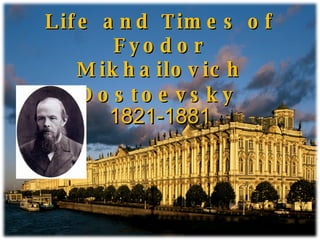
Life and Times of Fyodor Mikhailovich Dostoevsky   1821-1881
 
Dostoevksy Timeline 1881- born in Moscow 1837-mother died of TB, Dostoevsky and brother were sent to the Military Engineering Academy at Saint Petersburg 1839-father died  1841- obtained commission in the military, wrote  Mary Stuart  and  Boris Godunov , romantic plays 1847- published  Poor Folk  to great acclaim 1849- arrested with the Petrashevsky Circle and sentenced to death. 1849-sentence changed to four years of labor in Siberia and the required to serve in the Siberian Regiment
Dostoevksy Timeline 1857- married Maria Dmitrievna Isaeva 1859- returned to Saint Petersburg 1863- travelled abroad and met Apollinaria Suslova 1864- Maria Dmitrievna Isaeva dies, Dostoevsky sank into depression and suffered from a gambling compulsion 1867- married Anna Grigorevna Snitkina a 20-year-old stenographer 1880- died
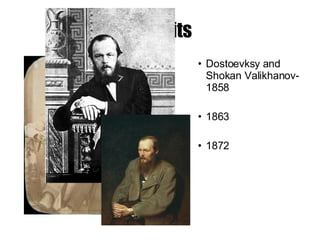
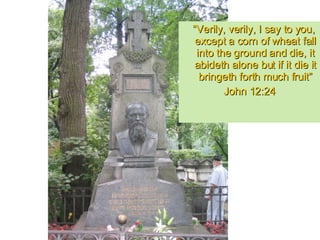
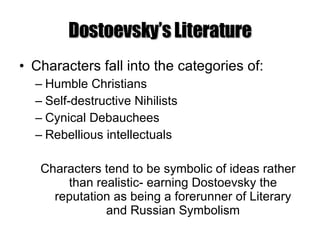
Portraits   Dostoevksy and Shokan Valikhanov- 1858 1863 1872
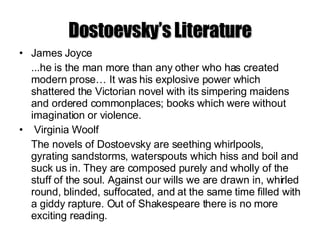
“ Verily, verily, I say to you, except a corn of wheat fall into the ground and die, it abideth alone but if it die it bringeth forth much fruit” John 12:24
Dostoevsky’s Literature Characters fall into the categories of: Humble Christians Self-destructive Nihilists Cynical Debauchees Rebellious intellectuals Characters tend to be symbolic of ideas rather than realistic- earning Dostoevsky the reputation as being a forerunner of Literary and Russian Symbolism
Dostoevsky’s Literature James Joyce ...he is the man more than any other who has created modern prose… It was his explosive power which shattered the Victorian novel with its simpering maidens and ordered commonplaces; books which were without imagination or violence. Virginia Woolf  The novels of Dostoevsky are seething whirlpools, gyrating sandstorms, waterspouts which hiss and boil and suck us in. They are composed purely and wholly of the stuff of the soul. Against our wills we are drawn in, whirled round, blinded, suffocated, and at the same time filled with a giddy rapture. Out of Shakespeare there is no more exciting reading.
Dostoevksy’s Literature Intense study of the New Testament while in prison led to a conversion experience Dostoevsky rejected his former liberal political ideas His mature fiction conveys the conviction that redemption is possible only through suffering and faith and criticizes the contemporary Nihilistic and Socialist ideas His works are considered the foundation of 20 th  Century existentialism
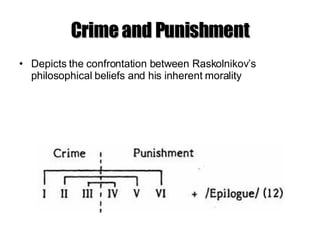
Crime and Punishment Depicts the confrontation between Raskolnikov’s philosophical beliefs and his inherent morality
“ I wrote [this chapter] with genuine inspiration, but perhaps it is no good; but for them the question is not its literary worth, they are worried about its morality. Here I was in the right—nothing was against morality, and even quite the contrary, but they saw otherwise and, what's mores, saw traces of nihilism ... I took it back, and this revision of a large chapter cost me at least three new chapters of work, judging by the effort and the weariness; but I corrected it and gave it back. ” — Dostoevsky's letter to A.P. Milyukov
 

Fyodor Mikhailovich Dostoevsky 1

  • 1.
    Life and Timesof Fyodor Mikhailovich Dostoevsky 1821-1881
  • 2.
  • 3.
    Dostoevksy Timeline 1881-born in Moscow 1837-mother died of TB, Dostoevsky and brother were sent to the Military Engineering Academy at Saint Petersburg 1839-father died 1841- obtained commission in the military, wrote Mary Stuart and Boris Godunov , romantic plays 1847- published Poor Folk to great acclaim 1849- arrested with the Petrashevsky Circle and sentenced to death. 1849-sentence changed to four years of labor in Siberia and the required to serve in the Siberian Regiment
  • 4.
    Dostoevksy Timeline 1857-married Maria Dmitrievna Isaeva 1859- returned to Saint Petersburg 1863- travelled abroad and met Apollinaria Suslova 1864- Maria Dmitrievna Isaeva dies, Dostoevsky sank into depression and suffered from a gambling compulsion 1867- married Anna Grigorevna Snitkina a 20-year-old stenographer 1880- died
  • 5.
    Portraits Dostoevksy and Shokan Valikhanov- 1858 1863 1872
  • 6.
    “ Verily, verily,I say to you, except a corn of wheat fall into the ground and die, it abideth alone but if it die it bringeth forth much fruit” John 12:24
  • 7.
    Dostoevsky’s Literature Charactersfall into the categories of: Humble Christians Self-destructive Nihilists Cynical Debauchees Rebellious intellectuals Characters tend to be symbolic of ideas rather than realistic- earning Dostoevsky the reputation as being a forerunner of Literary and Russian Symbolism
  • 8.
    Dostoevsky’s Literature JamesJoyce ...he is the man more than any other who has created modern prose… It was his explosive power which shattered the Victorian novel with its simpering maidens and ordered commonplaces; books which were without imagination or violence. Virginia Woolf The novels of Dostoevsky are seething whirlpools, gyrating sandstorms, waterspouts which hiss and boil and suck us in. They are composed purely and wholly of the stuff of the soul. Against our wills we are drawn in, whirled round, blinded, suffocated, and at the same time filled with a giddy rapture. Out of Shakespeare there is no more exciting reading.
  • 9.
    Dostoevksy’s Literature Intensestudy of the New Testament while in prison led to a conversion experience Dostoevsky rejected his former liberal political ideas His mature fiction conveys the conviction that redemption is possible only through suffering and faith and criticizes the contemporary Nihilistic and Socialist ideas His works are considered the foundation of 20 th Century existentialism
  • 10.
    Crime and PunishmentDepicts the confrontation between Raskolnikov’s philosophical beliefs and his inherent morality
  • 11.
    “ I wrote[this chapter] with genuine inspiration, but perhaps it is no good; but for them the question is not its literary worth, they are worried about its morality. Here I was in the right—nothing was against morality, and even quite the contrary, but they saw otherwise and, what's mores, saw traces of nihilism ... I took it back, and this revision of a large chapter cost me at least three new chapters of work, judging by the effort and the weariness; but I corrected it and gave it back. ” — Dostoevsky's letter to A.P. Milyukov
  • 12.

Editor's Notes

  • #2 November 11 1821 – February 9 1881 Dostoevsky's literary output explores human psychology in the troubled political , social and spiritual context of 19th-century Russian society. Considered by many as a founder or precursor of 20th century existentialism , his Notes from Underground (1864), written in the embittered voice of the anonymous "underground man", was called by Walter Kaufmann the "best overture for existentialism ever written." [2] FYUU-dur mih-HY-loe-vich dahs-tuh-YEF-skee