FUZZY LOGIC BASED MODEL OF
GRN INFERENCE
By Ali Zaid Bin Nawab
MSc. Bioinformatics II Sem.
19MBI003
FUZZY LOGIC
�Fuzzy logic is a fundamental approach of computing
which is based on the degrees of truth rather than crisp
values i.e. true or false (0 or 1). It uses 0 and 1 for the
extreme cases of truth.
�The concept of Fuzzy Logic (FL) was introduced by
Lotfi Zadeh in 1965 with the introduction of fuzzy set
theory.
�Till late 1970s, fuzzy set theory was not applied to
control systems because of limited processing power of
computers.
�Fuzzy logic is essential to the development of human-
like capabilities for AI, sometimes referred to
as artificial general intelligence: the representation of
generalized human cognitive abilities in software so
that, faced with an unfamiliar task, the AI system could
find a solution.
FUZZY
LOGIC
SYSTEMS
ARCHITECTU
RE
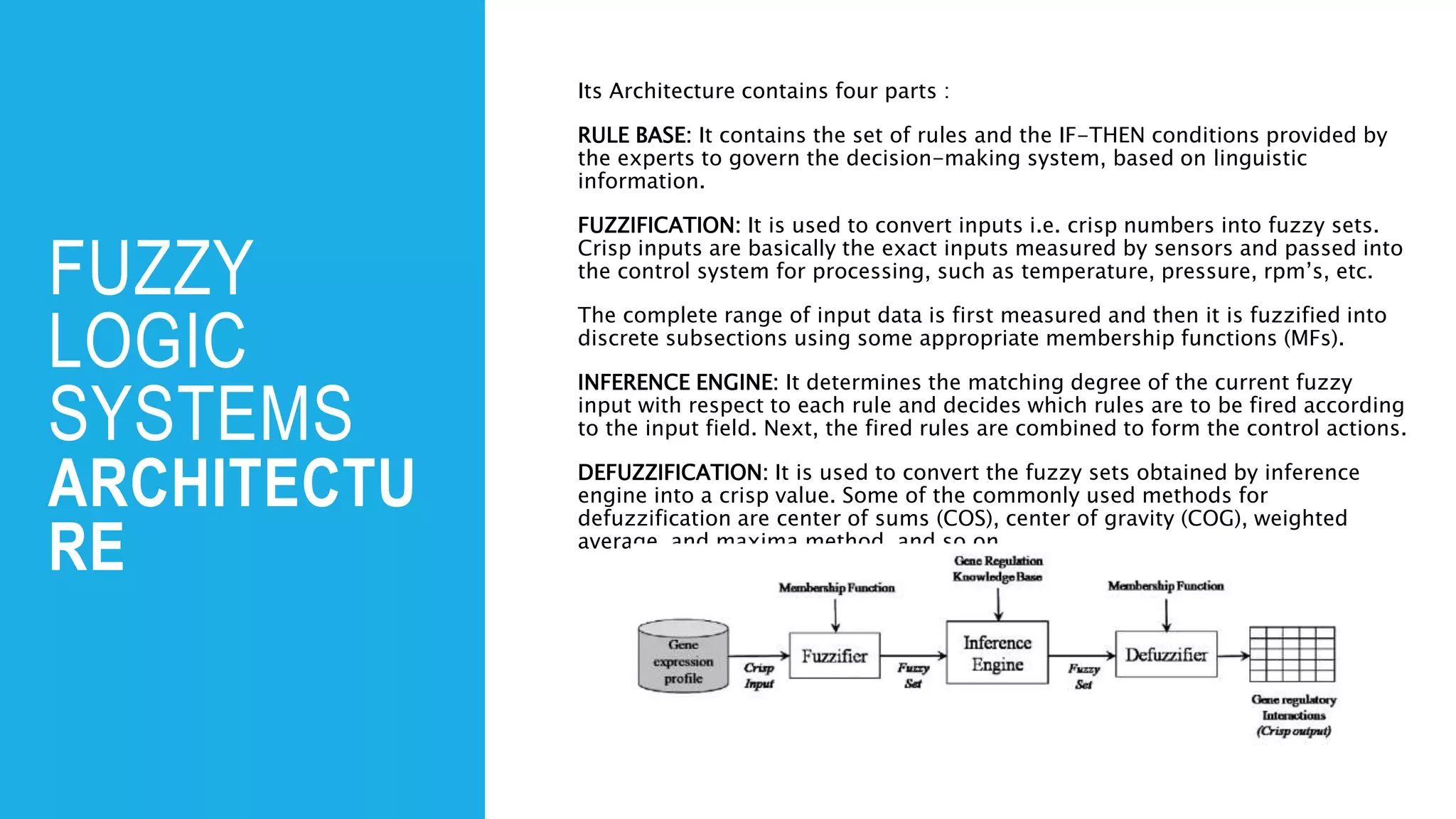
Its Architecture contains four parts :
RULE BASE: It contains the set of rules and the IF-THEN conditions provided by
the experts to govern the decision-making system, based on linguistic
information.
FUZZIFICATION: It is used to convert inputs i.e. crisp numbers into fuzzy sets.
Crisp inputs are basically the exact inputs measured by sensors and passed into
the control system for processing, such as temperature, pressure, rpm’s, etc.
The complete range of input data is first measured and then it is fuzzified into
discrete subsections using some appropriate membership functions (MFs).
INFERENCE ENGINE: It determines the matching degree of the current fuzzy
input with respect to each rule and decides which rules are to be fired according
to the input field. Next, the fired rules are combined to form the control actions.
DEFUZZIFICATION: It is used to convert the fuzzy sets obtained by inference
engine into a crisp value. Some of the commonly used methods for
defuzzification are center of sums (COS), center of gravity (COG), weighted
average, and maxima method, and so on
GENE REGULATORY
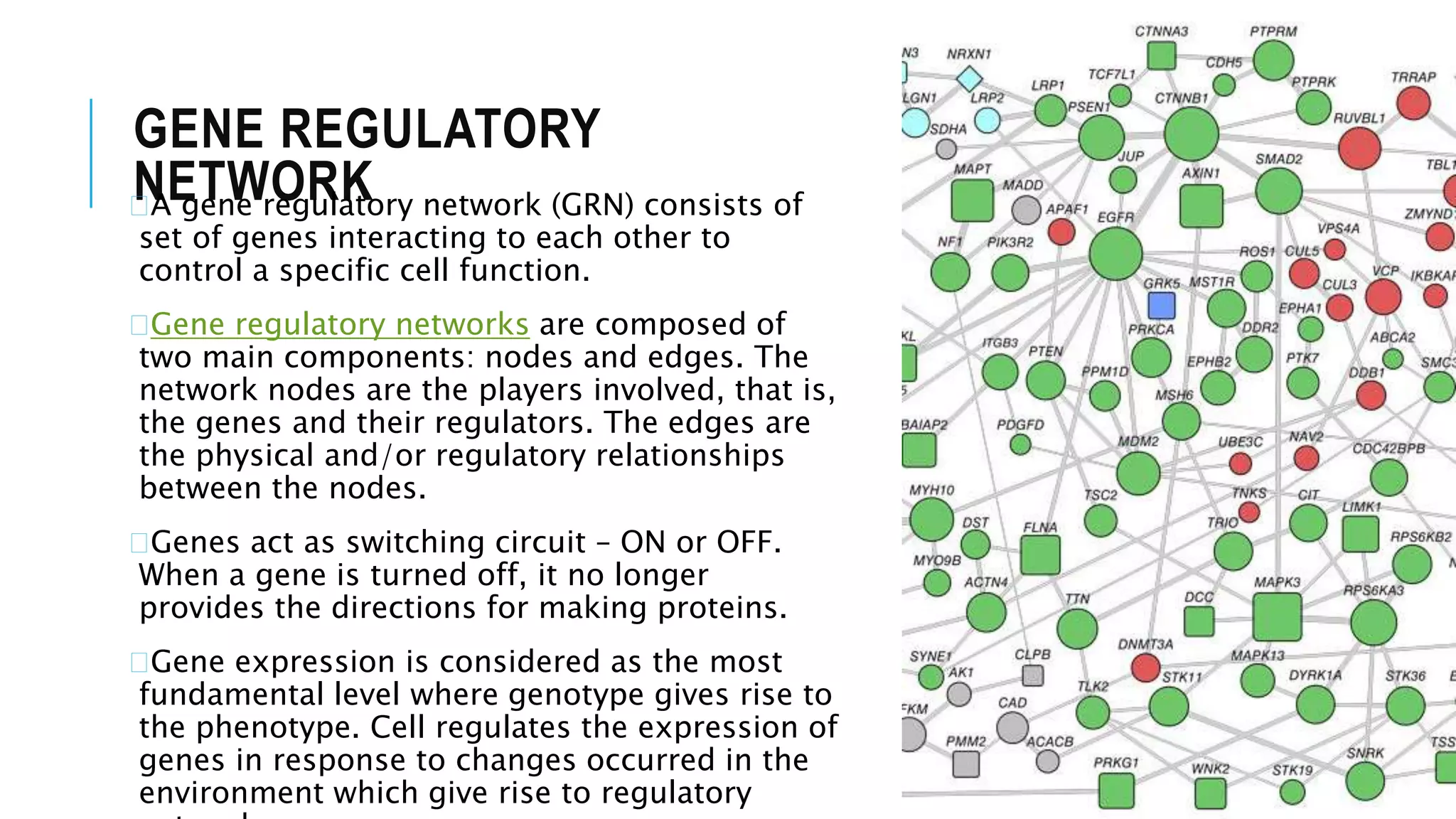
NETWORK�A gene regulatory network (GRN) consists of
set of genes interacting to each other to
control a specific cell function.
�Gene regulatory networks are composed of
two main components: nodes and edges. The
network nodes are the players involved, that is,
the genes and their regulators. The edges are
the physical and/or regulatory relationships
between the nodes.
�Genes act as switching circuit – ON or OFF.
When a gene is turned off, it no longer
provides the directions for making proteins.
�Gene expression is considered as the most
fundamental level where genotype gives rise to
the phenotype. Cell regulates the expression of
genes in response to changes occurred in the
environment which give rise to regulatory
FUZZY LOGIC FOR GENE REGULATORY
INFERENCE
The biological systems are very complex which behave in a fuzzy
manner. Fuzzy logic offers a mathematical framework for modeling,
describing and analyzing biological systems.
Woolf and Wang’s Algorithm:
One of the first attempts at applying fuzzy logic to GRN
Inference(GRNI).
Woolf and Wang both proposed this to find gene triplets in yeast.
They are in the form of activators(A), Repressors(R) and targets(T).
This algorithm assumes three states of gene expression: LOW,
MEDIUM, and HIGH.
P Q
A
P Q
A
High Low Low High
Low High
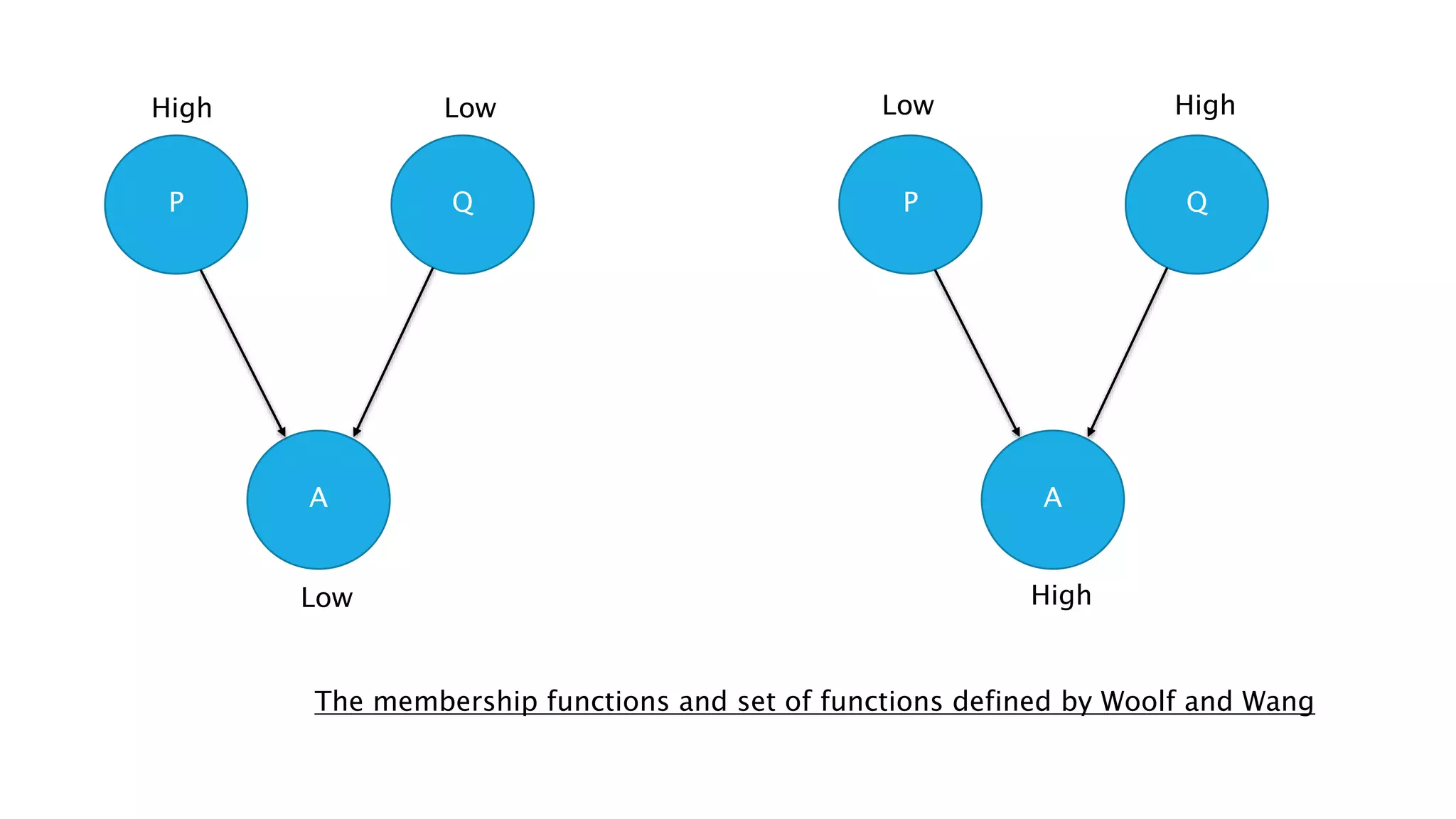
The membership functions and set of functions defined by Woolf and Wang
STEPS FOR MAKING GRN’S USING
FL
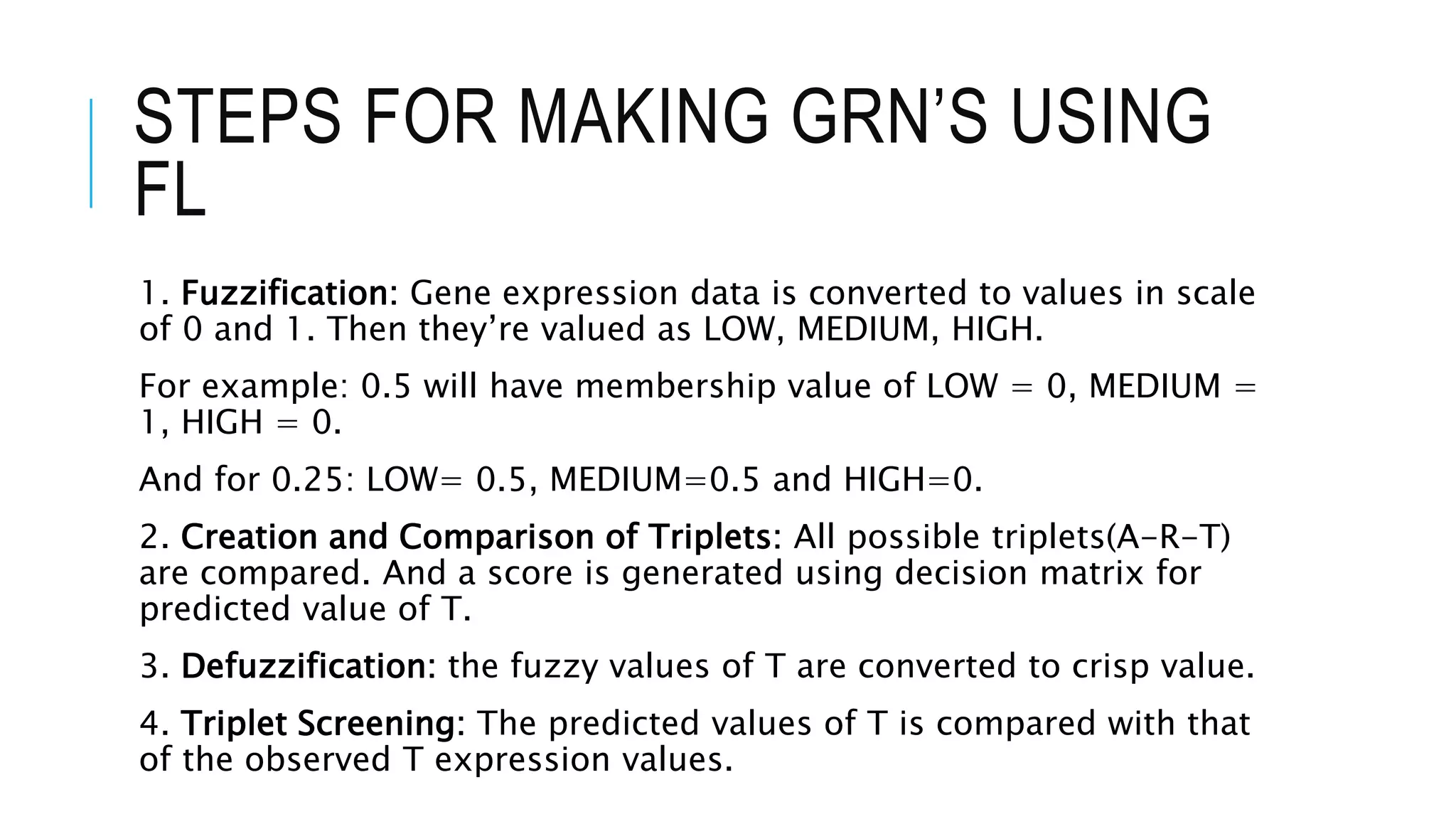
1. Fuzzification: Gene expression data is converted to values in scale
of 0 and 1. Then they’re valued as LOW, MEDIUM, HIGH.
For example: 0.5 will have membership value of LOW = 0, MEDIUM =
1, HIGH = 0.
And for 0.25: LOW= 0.5, MEDIUM=0.5 and HIGH=0.
2. Creation and Comparison of Triplets: All possible triplets(A-R-T)
are compared. And a score is generated using decision matrix for
predicted value of T.
3. Defuzzification: the fuzzy values of T are converted to crisp value.
4. Triplet Screening: The predicted values of T is compared with that
of the observed T expression values.
Further other researchers have introduced various ways to decrease the
computational time and remove redundancy from the gene expression network.
A. In 2003, Ressom and collaborators improved the performance of Woolf and Wang
algorithm by reducing computing time up to 50%.
B. In 2006 Ram also extended Woolf and Wang’s model by two important assumptions:
(i) input transcript factors (TFs) as driver for gene expression
(ii) similar gene expression profiles are redundant for computation.
C. Mahanta et al. (2014) developed a fuzzy network module extraction technique
(FUMET). The FUMET takes two input parameters such as number of modules and
membership threshold and works on weighted co-expression network.
D. Dickerson in 2001 applied fuzzy cognitive maps to model metabolic networks.
E. Bosl (2007) applied fuzzy rule-based method representing expert knowledge in cell
cycle regulation and tumor growth.
FUZZY LOGIC AND
IT’S HYBRIDIZATION
Fuzzy cognitive maps (FCMs)
Dynamic fuzzy modeling
Neuro-fuzzy
Neuro-evolutionary
Fuzzy Petri nets
Fuzzy answer set programming
Dynamic fuzzy modeling approach has the
capability to incorporate the prior structural
knowledge to the GRN model and infer gene
interactions as fuzzy rules. Neuro-fuzzy is one of
the most widely applied hybrid approach for GRNI
which combines the learning and adaptation feature
of ANN and knowledge representation through
fuzzy logic.
REFRENCES
‫܀‬Raza, Khalid. (2018). Fuzzy logic-based approaches for gene
regulatory network inference.
https://doi.org/10.1016/j.artmed.2018.12.004
‫܀‬Geeks for Geeks: https://www.geeksforgeeks.org/fuzzy-logic-
introduction/
‫܀‬Kaur R, Abhishek Singh S, A Novel Fuzzy Logic Based Reverse
Engineering of Gene Regulatory Network, Future Computing and
Informatics Journal (2017), doi: 10.1016/ j.fcij.2017.07.002.
‫“܀‬Thank you” Photo by Hanny Naibaho on Unsplash.
Fuzzy logic based model of GRN Inference

Fuzzy logic based model of GRN Inference

  • 1.
    FUZZY LOGIC BASEDMODEL OF GRN INFERENCE By Ali Zaid Bin Nawab MSc. Bioinformatics II Sem. 19MBI003
  • 2.
    FUZZY LOGIC �Fuzzy logicis a fundamental approach of computing which is based on the degrees of truth rather than crisp values i.e. true or false (0 or 1). It uses 0 and 1 for the extreme cases of truth. �The concept of Fuzzy Logic (FL) was introduced by Lotfi Zadeh in 1965 with the introduction of fuzzy set theory. �Till late 1970s, fuzzy set theory was not applied to control systems because of limited processing power of computers. �Fuzzy logic is essential to the development of human- like capabilities for AI, sometimes referred to as artificial general intelligence: the representation of generalized human cognitive abilities in software so that, faced with an unfamiliar task, the AI system could find a solution.
  • 3.
    FUZZY LOGIC SYSTEMS ARCHITECTU RE Its Architecture containsfour parts : RULE BASE: It contains the set of rules and the IF-THEN conditions provided by the experts to govern the decision-making system, based on linguistic information. FUZZIFICATION: It is used to convert inputs i.e. crisp numbers into fuzzy sets. Crisp inputs are basically the exact inputs measured by sensors and passed into the control system for processing, such as temperature, pressure, rpm’s, etc. The complete range of input data is first measured and then it is fuzzified into discrete subsections using some appropriate membership functions (MFs). INFERENCE ENGINE: It determines the matching degree of the current fuzzy input with respect to each rule and decides which rules are to be fired according to the input field. Next, the fired rules are combined to form the control actions. DEFUZZIFICATION: It is used to convert the fuzzy sets obtained by inference engine into a crisp value. Some of the commonly used methods for defuzzification are center of sums (COS), center of gravity (COG), weighted average, and maxima method, and so on
  • 4.
    GENE REGULATORY NETWORK�A generegulatory network (GRN) consists of set of genes interacting to each other to control a specific cell function. �Gene regulatory networks are composed of two main components: nodes and edges. The network nodes are the players involved, that is, the genes and their regulators. The edges are the physical and/or regulatory relationships between the nodes. �Genes act as switching circuit – ON or OFF. When a gene is turned off, it no longer provides the directions for making proteins. �Gene expression is considered as the most fundamental level where genotype gives rise to the phenotype. Cell regulates the expression of genes in response to changes occurred in the environment which give rise to regulatory
  • 5.
    FUZZY LOGIC FORGENE REGULATORY INFERENCE The biological systems are very complex which behave in a fuzzy manner. Fuzzy logic offers a mathematical framework for modeling, describing and analyzing biological systems. Woolf and Wang’s Algorithm: One of the first attempts at applying fuzzy logic to GRN Inference(GRNI). Woolf and Wang both proposed this to find gene triplets in yeast. They are in the form of activators(A), Repressors(R) and targets(T). This algorithm assumes three states of gene expression: LOW, MEDIUM, and HIGH.
  • 6.
    P Q A P Q A HighLow Low High Low High The membership functions and set of functions defined by Woolf and Wang
  • 7.
    STEPS FOR MAKINGGRN’S USING FL 1. Fuzzification: Gene expression data is converted to values in scale of 0 and 1. Then they’re valued as LOW, MEDIUM, HIGH. For example: 0.5 will have membership value of LOW = 0, MEDIUM = 1, HIGH = 0. And for 0.25: LOW= 0.5, MEDIUM=0.5 and HIGH=0. 2. Creation and Comparison of Triplets: All possible triplets(A-R-T) are compared. And a score is generated using decision matrix for predicted value of T. 3. Defuzzification: the fuzzy values of T are converted to crisp value. 4. Triplet Screening: The predicted values of T is compared with that of the observed T expression values.
  • 8.
    Further other researchershave introduced various ways to decrease the computational time and remove redundancy from the gene expression network. A. In 2003, Ressom and collaborators improved the performance of Woolf and Wang algorithm by reducing computing time up to 50%. B. In 2006 Ram also extended Woolf and Wang’s model by two important assumptions: (i) input transcript factors (TFs) as driver for gene expression (ii) similar gene expression profiles are redundant for computation. C. Mahanta et al. (2014) developed a fuzzy network module extraction technique (FUMET). The FUMET takes two input parameters such as number of modules and membership threshold and works on weighted co-expression network. D. Dickerson in 2001 applied fuzzy cognitive maps to model metabolic networks. E. Bosl (2007) applied fuzzy rule-based method representing expert knowledge in cell cycle regulation and tumor growth.
  • 9.
    FUZZY LOGIC AND IT’SHYBRIDIZATION Fuzzy cognitive maps (FCMs) Dynamic fuzzy modeling Neuro-fuzzy Neuro-evolutionary Fuzzy Petri nets Fuzzy answer set programming Dynamic fuzzy modeling approach has the capability to incorporate the prior structural knowledge to the GRN model and infer gene interactions as fuzzy rules. Neuro-fuzzy is one of the most widely applied hybrid approach for GRNI which combines the learning and adaptation feature of ANN and knowledge representation through fuzzy logic.
  • 10.
    REFRENCES ‫܀‬Raza, Khalid. (2018).Fuzzy logic-based approaches for gene regulatory network inference. https://doi.org/10.1016/j.artmed.2018.12.004 ‫܀‬Geeks for Geeks: https://www.geeksforgeeks.org/fuzzy-logic- introduction/ ‫܀‬Kaur R, Abhishek Singh S, A Novel Fuzzy Logic Based Reverse Engineering of Gene Regulatory Network, Future Computing and Informatics Journal (2017), doi: 10.1016/ j.fcij.2017.07.002. ‫“܀‬Thank you” Photo by Hanny Naibaho on Unsplash.

Editor's Notes

  • #4 The Membership functions represents the magnitude of participation and associates a “weight” with each input, defines functional overlaps between inputs. The membership function is used to map the non-fuzzy inputs to fuzzy linguistic terms and vice-versa.
  • #5 Gene regulatory networks are different from better-known protein–protein interaction networks, because gene regulatory networks  are both bipartite and directional. They are bipartite because there are two types of nodes: genes and regulators, although of course some genes are themselves regulators of other genes or proteins. Gene regulatory networks are directional because regulators control genes and usually not the other way around.
  • #9 , (i) and therefore inputs having lower gene expressions are assumed to produce no significant change at output gene expression level;