FUTURES AND
OPTIONS
SUBMITTED BY
SREE SANJANA
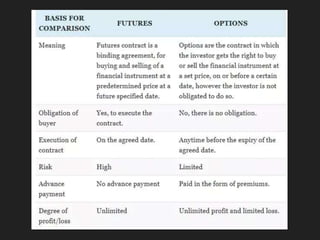
• A futures contract is a legal agreement to buy or sell a particular
commodity or asset at a predetermined price at a specified time in
the future.
• Futures contracts are standardized for quality and quantity to facilitate
trading on a futures exchange.
• The contracts have standardized specifications like market lot, expiry
day, unit of price quotation, tick size and method of settlement.
• The buyer of a futures contract is taking on the obligation to buy the
underlying asset when the futures contract expires.
• The seller of the futures contract is taking on the obligation to provide
the underlying asset at the expiration date.
FUTURES
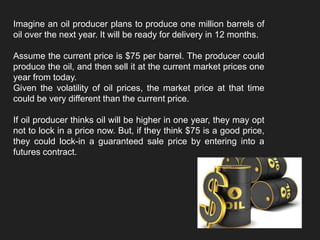
Imagine an oil producer plans to produce one million barrels of
oil over the next year. It will be ready for delivery in 12 months.
Assume the current price is $75 per barrel. The producer could
produce the oil, and then sell it at the current market prices one
year from today.
Given the volatility of oil prices, the market price at that time
could be very different than the current price.
If oil producer thinks oil will be higher in one year, they may opt
not to lock in a price now. But, if they think $75 is a good price,
they could lock-in a guaranteed sale price by entering into a
futures contract.
CHARACTERISTICS
• Spot price: the price at which an instrument/asset trades in the spot
market.
• Future price: the price at which the futures contract trade in the future
market.
• Contract cycle: the period over which a contract trades. For instance,
futures contracts typically have one month (near month futures), two
months (next month futures) and three months (far month futures)
expiry cycles that expire on the last Thursday of the month.
• Expiry date: it is the date specified in the futures contract. This is the
last day on which the contract will be traded, at the end of which it will
cease to exist.
• Contract size: the amount of asset that has to be delivered under one
contract. For instance, the contract size of the NSE future market is 200
Nifties.
There are many different kinds of futures contracts, reflecting the many
different kinds of "tradable" assets about which the contract may be
based such as commodities, securities, currencies or intangibles such
as interest rates and indexes.
Some of the futures contracts are
• Stock futures
• Index futures
• Currency futures
• Commodity futures
• Interest rate futures
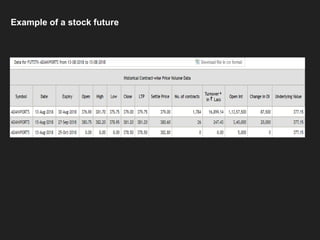
Example of a stock future
OPTIONS
It is a contract that confers the right to its owner/holder but not the obligation to
buy or sell a specified security at a specified price on or before a given date.
• Buyer of an Option: is the one, who by paying the option premium buys the
right to buy/sell securities.
• Writer of an Option: is the one who receives the option premium and is thereby
obliged to sell/buy the securities if the buyer exercises the option on him.
• Option Price/Premium: is the price that the option buyer pays to the option
seller.
• Expiration Date: is the date specified in the options contract by which the option
can be exercised. It is also known as the exercise date, strike date or maturity date.
• Strike/Exercise Price: the price specified in the options contract at which the
buyer can exercise his right to buy or sell the securities.
• At-the-Money Option: an option that would lead to zero cash flow to the holder if
it were exercised.
• In-the-Money Option: option that would lead to positive cash flow to the holder
if it were exercised.
• Out-of-the-Money Option: option that would lead to negative cash flow to the
holder if it were exercised.
• American Option: allows its holder to exercise the right to purchase or sell the
underlying asset on or before the expiration date.
• European Option: allows for exercise of the option only on the expiration date
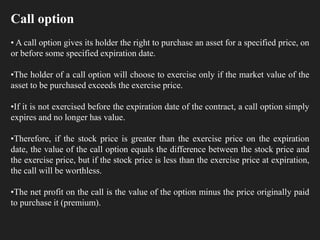
Call option
• A call option gives its holder the right to purchase an asset for a specified price, on
or before some specified expiration date.
•The holder of a call option will choose to exercise only if the market value of the
asset to be purchased exceeds the exercise price.
•If it is not exercised before the expiration date of the contract, a call option simply
expires and no longer has value.
•Therefore, if the stock price is greater than the exercise price on the expiration
date, the value of the call option equals the difference between the stock price and
the exercise price, but if the stock price is less than the exercise price at expiration,
the call will be worthless.
•The net profit on the call is the value of the option minus the price originally paid
to purchase it (premium).
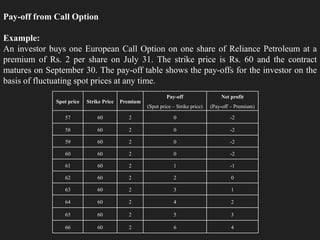
Spot price Strike Price Premium
Pay-off
(Spot price – Strike price)
Net profit
(Pay-off – Premium)
57 60 2 0 -2
58 60 2 0 -2
59 60 2 0 -2
60 60 2 0 -2
61 60 2 1 -1
62 60 2 2 0
63 60 2 3 1
64 60 2 4 2
65 60 2 5 3
66 60 2 6 4
Pay-off from Call Option
Example:
An investor buys one European Call Option on one share of Reliance Petroleum at a
premium of Rs. 2 per share on July 31. The strike price is Rs. 60 and the contract
matures on September 30. The pay-off table shows the pay-offs for the investor on the
basis of fluctuating spot prices at any time.
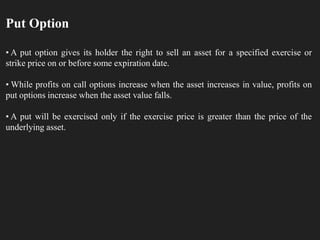
Put Option
• A put option gives its holder the right to sell an asset for a specified exercise or
strike price on or before some expiration date.
• While profits on call options increase when the asset increases in value, profits on
put options increase when the asset value falls.
• A put will be exercised only if the exercise price is greater than the price of the
underlying asset.
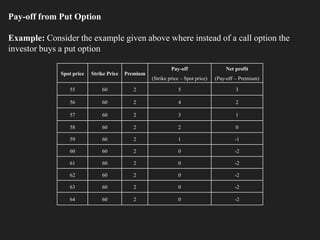
Spot price Strike Price Premium
Pay-off
(Strike price – Spot price)
Net profit
(Pay-off – Premium)
55 60 2 5 3
56 60 2 4 2
57 60 2 3 1
58 60 2 2 0
59 60 2 1 -1
60 60 2 0 -2
61 60 2 0 -2
62 60 2 0 -2
63 60 2 0 -2
64 60 2 0 -2
Pay-off from Put Option
Example: Consider the example given above where instead of a call option the
investor buys a put option
Futures and options
Futures and options

Futures and options

  • 1.
  • 2.
    • A futurescontract is a legal agreement to buy or sell a particular commodity or asset at a predetermined price at a specified time in the future. • Futures contracts are standardized for quality and quantity to facilitate trading on a futures exchange. • The contracts have standardized specifications like market lot, expiry day, unit of price quotation, tick size and method of settlement. • The buyer of a futures contract is taking on the obligation to buy the underlying asset when the futures contract expires. • The seller of the futures contract is taking on the obligation to provide the underlying asset at the expiration date. FUTURES
  • 3.
    Imagine an oilproducer plans to produce one million barrels of oil over the next year. It will be ready for delivery in 12 months. Assume the current price is $75 per barrel. The producer could produce the oil, and then sell it at the current market prices one year from today. Given the volatility of oil prices, the market price at that time could be very different than the current price. If oil producer thinks oil will be higher in one year, they may opt not to lock in a price now. But, if they think $75 is a good price, they could lock-in a guaranteed sale price by entering into a futures contract.
  • 4.
    CHARACTERISTICS • Spot price:the price at which an instrument/asset trades in the spot market. • Future price: the price at which the futures contract trade in the future market. • Contract cycle: the period over which a contract trades. For instance, futures contracts typically have one month (near month futures), two months (next month futures) and three months (far month futures) expiry cycles that expire on the last Thursday of the month. • Expiry date: it is the date specified in the futures contract. This is the last day on which the contract will be traded, at the end of which it will cease to exist. • Contract size: the amount of asset that has to be delivered under one contract. For instance, the contract size of the NSE future market is 200 Nifties.
  • 5.
    There are manydifferent kinds of futures contracts, reflecting the many different kinds of "tradable" assets about which the contract may be based such as commodities, securities, currencies or intangibles such as interest rates and indexes. Some of the futures contracts are • Stock futures • Index futures • Currency futures • Commodity futures • Interest rate futures
  • 6.
    Example of astock future
  • 8.
    OPTIONS It is acontract that confers the right to its owner/holder but not the obligation to buy or sell a specified security at a specified price on or before a given date. • Buyer of an Option: is the one, who by paying the option premium buys the right to buy/sell securities. • Writer of an Option: is the one who receives the option premium and is thereby obliged to sell/buy the securities if the buyer exercises the option on him. • Option Price/Premium: is the price that the option buyer pays to the option seller. • Expiration Date: is the date specified in the options contract by which the option can be exercised. It is also known as the exercise date, strike date or maturity date. • Strike/Exercise Price: the price specified in the options contract at which the buyer can exercise his right to buy or sell the securities.
  • 9.
    • At-the-Money Option:an option that would lead to zero cash flow to the holder if it were exercised. • In-the-Money Option: option that would lead to positive cash flow to the holder if it were exercised. • Out-of-the-Money Option: option that would lead to negative cash flow to the holder if it were exercised. • American Option: allows its holder to exercise the right to purchase or sell the underlying asset on or before the expiration date. • European Option: allows for exercise of the option only on the expiration date
  • 10.
    Call option • Acall option gives its holder the right to purchase an asset for a specified price, on or before some specified expiration date. •The holder of a call option will choose to exercise only if the market value of the asset to be purchased exceeds the exercise price. •If it is not exercised before the expiration date of the contract, a call option simply expires and no longer has value. •Therefore, if the stock price is greater than the exercise price on the expiration date, the value of the call option equals the difference between the stock price and the exercise price, but if the stock price is less than the exercise price at expiration, the call will be worthless. •The net profit on the call is the value of the option minus the price originally paid to purchase it (premium).
  • 11.
    Spot price StrikePrice Premium Pay-off (Spot price – Strike price) Net profit (Pay-off – Premium) 57 60 2 0 -2 58 60 2 0 -2 59 60 2 0 -2 60 60 2 0 -2 61 60 2 1 -1 62 60 2 2 0 63 60 2 3 1 64 60 2 4 2 65 60 2 5 3 66 60 2 6 4 Pay-off from Call Option Example: An investor buys one European Call Option on one share of Reliance Petroleum at a premium of Rs. 2 per share on July 31. The strike price is Rs. 60 and the contract matures on September 30. The pay-off table shows the pay-offs for the investor on the basis of fluctuating spot prices at any time.
  • 12.
    Put Option • Aput option gives its holder the right to sell an asset for a specified exercise or strike price on or before some expiration date. • While profits on call options increase when the asset increases in value, profits on put options increase when the asset value falls. • A put will be exercised only if the exercise price is greater than the price of the underlying asset.
  • 13.
    Spot price StrikePrice Premium Pay-off (Strike price – Spot price) Net profit (Pay-off – Premium) 55 60 2 5 3 56 60 2 4 2 57 60 2 3 1 58 60 2 2 0 59 60 2 1 -1 60 60 2 0 -2 61 60 2 0 -2 62 60 2 0 -2 63 60 2 0 -2 64 60 2 0 -2 Pay-off from Put Option Example: Consider the example given above where instead of a call option the investor buys a put option