Computer Aided Detection of 
Pulmonary Nodules in CT Scans 
Wookjin Choi, PhD
Introduction 
Lung cancer is the leading cause of cancer deaths. 
Most patients diagnosed with lung cancer already have advanced disease 
40% are stage IV and 30% are III 
The current five-year survival rate is only 16% 
Defective nodules are detected at an early stage 
The survival rate can be increased 
(a) male (b) female 
Trends in death rates for selected cancers, United States, 1930-2008 [1]
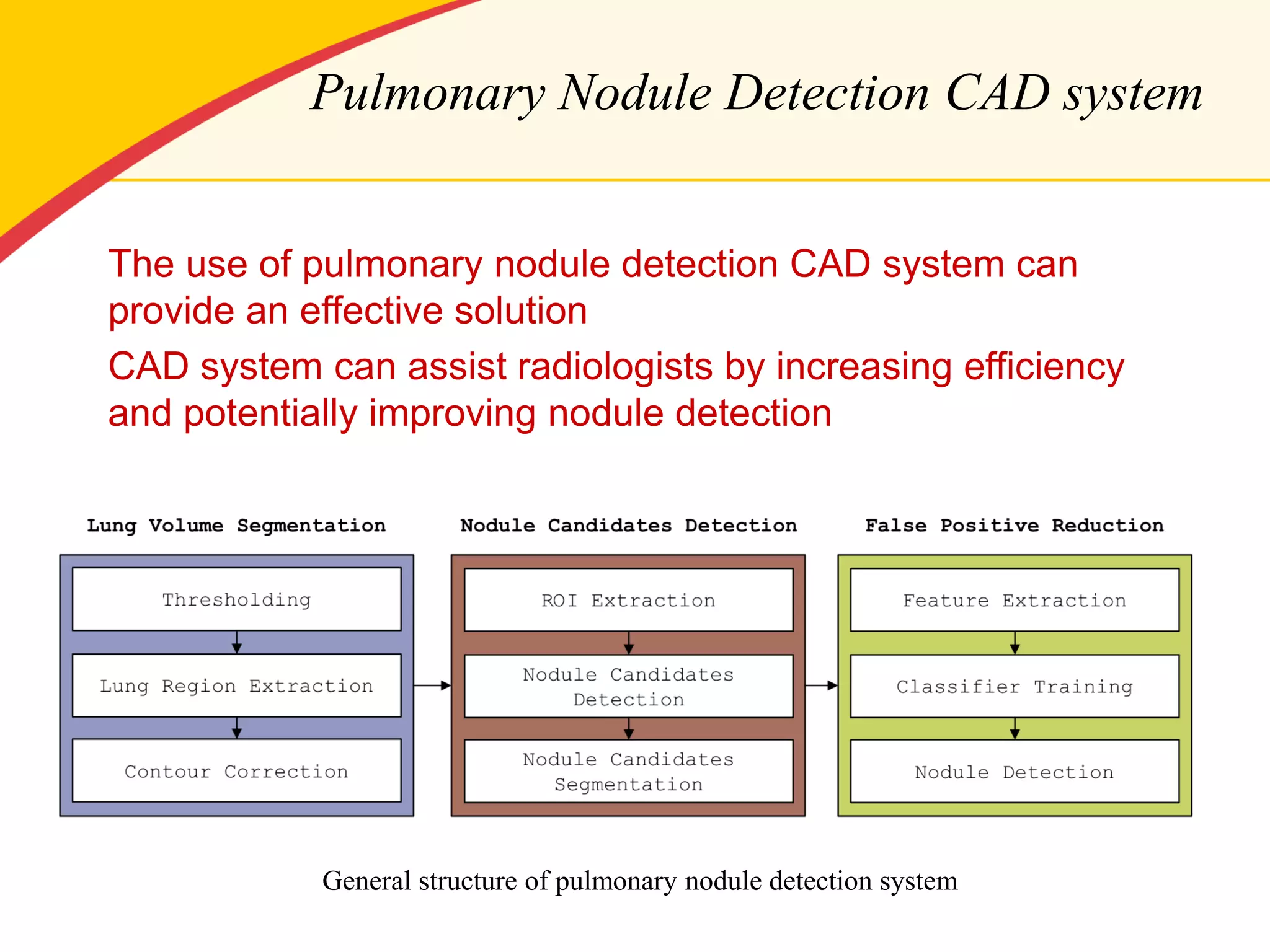
Pulmonary Nodule Detection CAD system 
The use of pulmonary nodule detection CAD system can provide an effective solution 
CAD system can assist radiologists by increasing efficiency and potentially improving nodule detection 
General structure of pulmonary nodule detection system
Pulmonary Nodule Detection CAD system 
CAD systems 
Lung segmentation 
Nodule Candidate Detection 
False Positive Reduction 
Suzuki et al.(2003)[3] 
Thresholding 
Multiple thresholding 
MTANN 
Rubin et al.(2005)[4] 
Thresholding 
Surface normal overlap 
Lantern transform and rule- based classifier 
Dehmeshki et al.(2007)[5] 
Adaptive thresholding 
Shape-based GATM 
Rule-based filtering 
Suarez-Cuenca et al.(2009)[6] 
Thresholding and 3-D connected component labeling 
3-D iris filtering 
Multiple rule-based LDA classifier 
Golosio et al.(2009)[7] 
Isosurface-triangulation 
Multiple thresholding 
Neural network 
Ye et al.(2009)[8] 
3-D adaptive fuzzy segmentation 
Shape based detection 
Rule-based filtering and weighted SVM classifier 
Sousa et al.(2010)[9] 
Region growing 
Structure extraction 
SVM classifier 
Messay et al.(2010)[10] 
Thresholding and 3-D connected component labeling 
Multiple thresholding and morphological opening 
Fisher linear discriminant and quadratic classifier 
Riccardi et al.(2011)[11] 
Iterative thresholding 
3-D fast radial filtering and scale space analysis 
Zernike MIP classification based on SVM 
Cascio et al.(2012)[12] 
Region growing 
Mass-spring model 
Double-threshold cut and neural network
Experimental Data Set 
Lung Image Database Consortium (LIDC) database [2] is applied to evaluate the performance of the proposed method. 
LIDC database, National Cancer Institute (NCI), United States 
The LIDC is developing a publicly available database of thoracic computed tomography (CT) scans as a medical imaging research resource to promote the development of computer-aided detection or characterization of pulmonary nodules. 
The database consists of 84 CT scans (up to 2007) [2] 
100-400 Digital Imaging and Communication (DICOM) images 
An XML data file containing the physician annotations of nodules 
148 nodules 
The pixel size in the database ranged from 0.5 to 0.76 mm 
The reconstruction interval ranged from 1 to 3mm
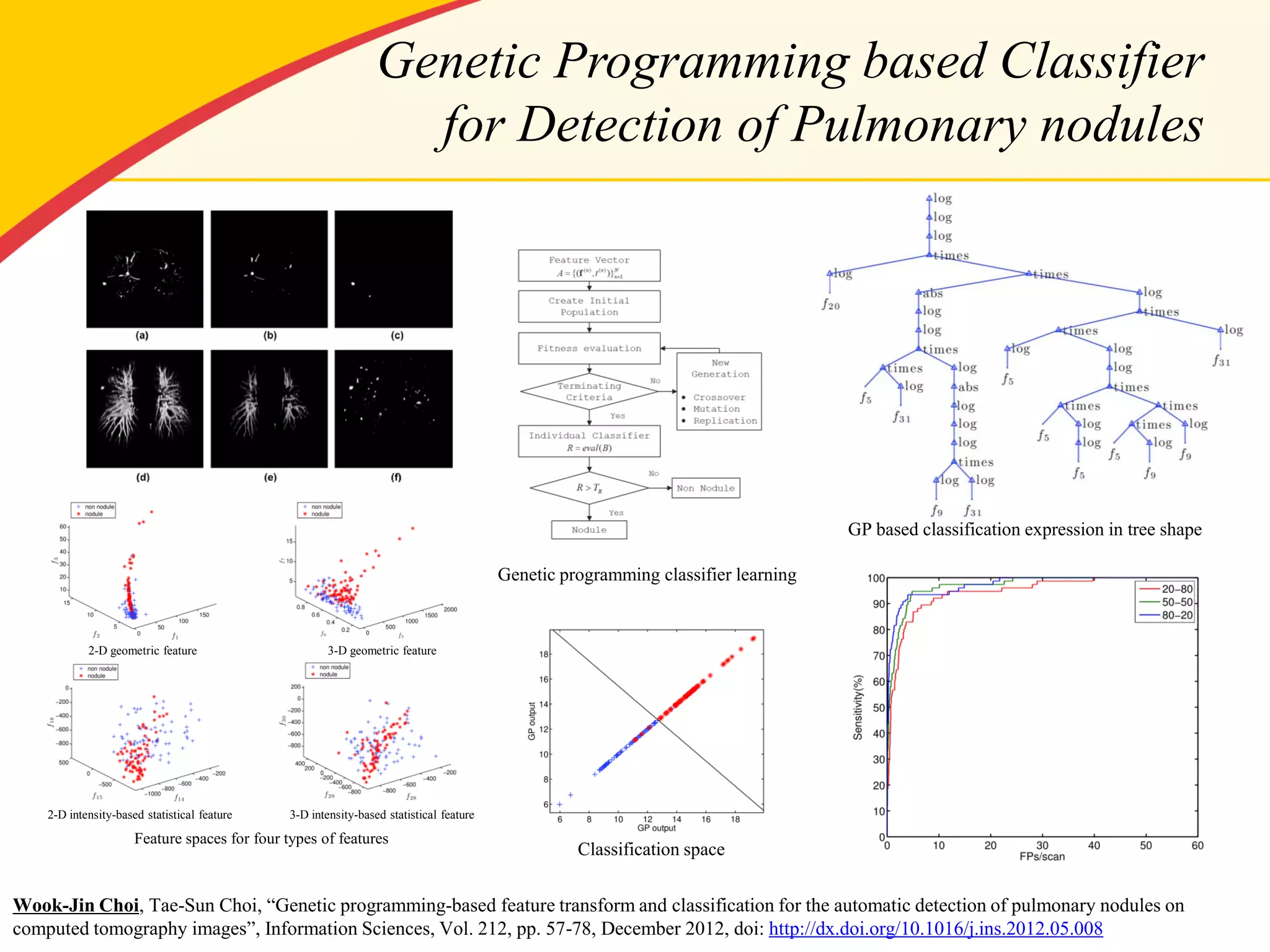
Genetic Programming based Classifier for Detection of Pulmonary nodules 
Wook-Jin Choi, Tae-Sun Choi, “Genetic programming-based feature transform and classification for the automatic detection of pulmonary nodules on computed tomography images”, Information Sciences, Vol. 212, pp. 57-78, December 2012, doi: http://dx.doi.org/10.1016/j.ins.2012.05.008 
Feature spaces for four types of features 
2-D geometric feature 
3-D geometric feature 
2-D intensity-based statistical feature 
3-D intensity-based statistical feature 
Genetic programming classifier learning 
Classification space 
GP based classification expression in tree shape
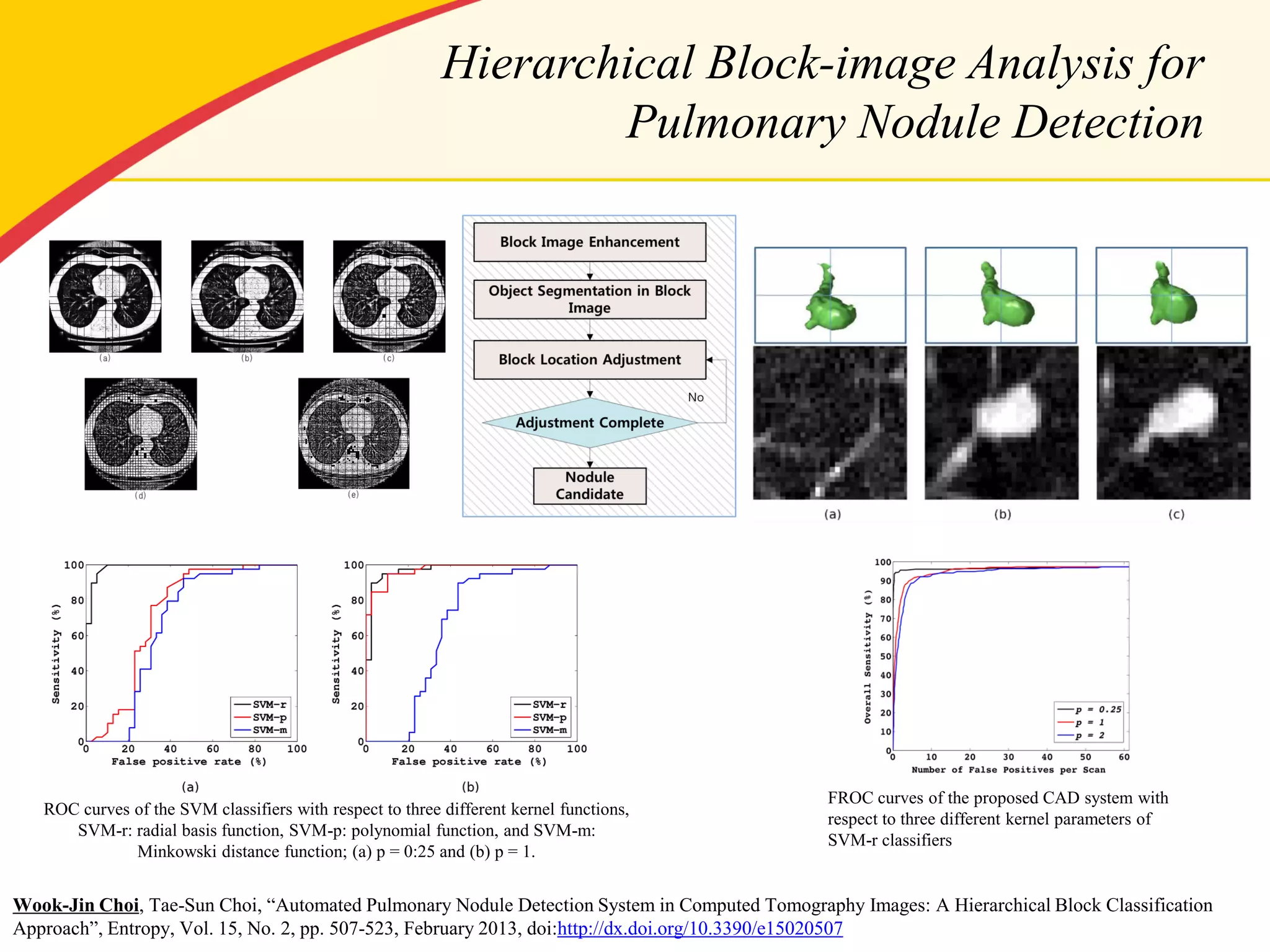
Hierarchical Block-image Analysis for Pulmonary Nodule Detection 
Wook-Jin Choi, Tae-Sun Choi, “Automated Pulmonary Nodule Detection System in Computed Tomography Images: A Hierarchical Block Classification Approach”, Entropy, Vol. 15, No. 2, pp. 507-523, February 2013, doi:http://dx.doi.org/10.3390/e15020507 
ROC curves of the SVM classifiers with respect to three different kernel functions, SVM-r: radial basis function, SVM-p: polynomial function, and SVM-m: Minkowski distance function; (a) p = 0:25 and (b) p = 1. 
FROC curves of the proposed CAD system with respect to three different kernel parameters of SVM-r classifiers
θ 
φ 
θ 
φ 
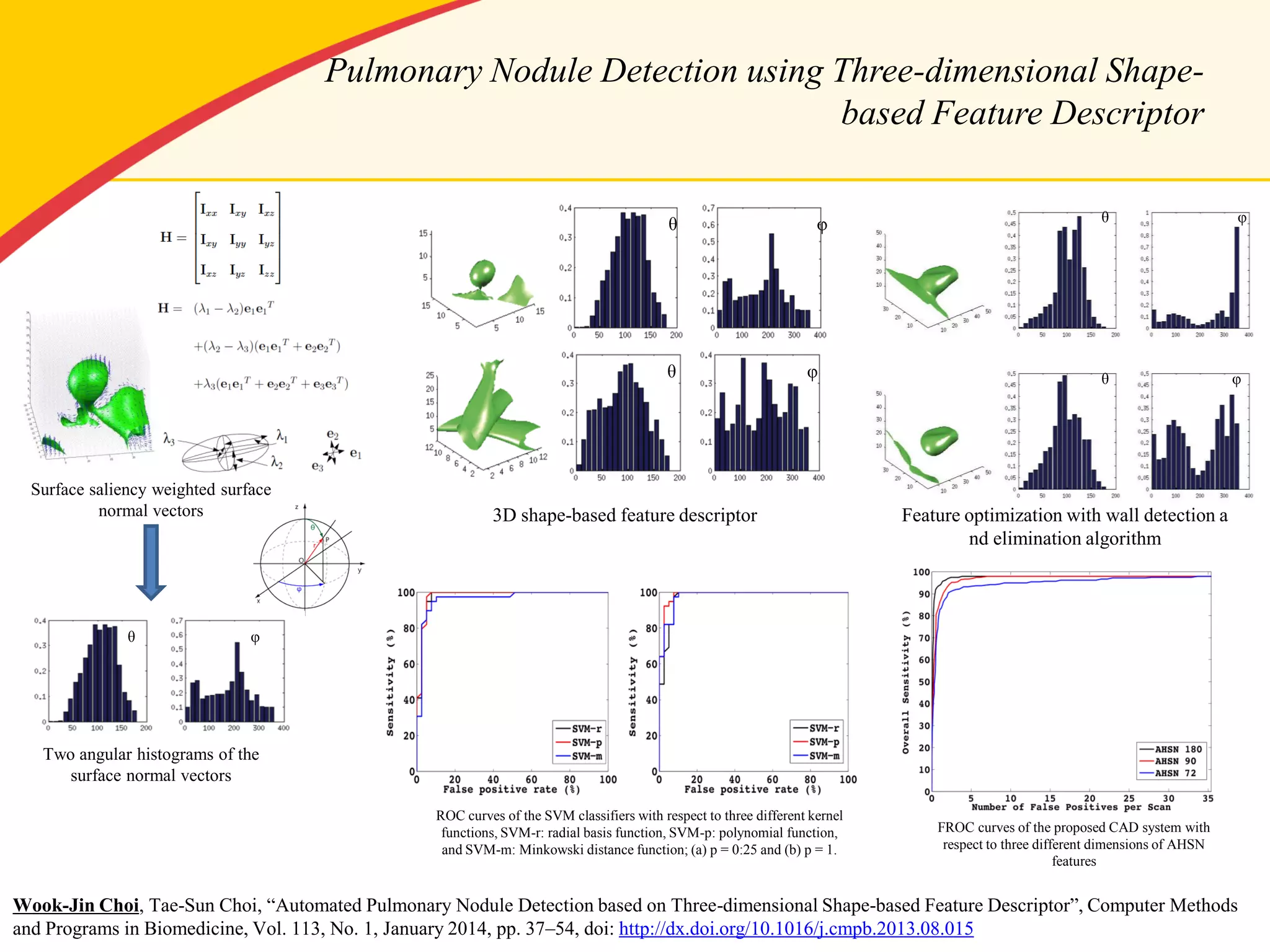
Pulmonary Nodule Detection using Three-dimensional Shape- based Feature Descriptor 
Wook-Jin Choi, Tae-Sun Choi, “Automated Pulmonary Nodule Detection based on Three-dimensional Shape-based Feature Descriptor”, Computer Methods and Programs in Biomedicine, Vol. 113, No. 1, January 2014, pp. 37–54, doi: http://dx.doi.org/10.1016/j.cmpb.2013.08.015 
Surface saliency weighted surface normal vectors 
Two angular histograms of the surface normal vectors 
θ 
φ 
ROC curves of the SVM classifiers with respect to three different kernel 
functions, SVM-r: radial basis function, SVM-p: polynomial function, and SVM-m: Minkowski distance function; (a) p = 0:25 and (b) p = 1. 
FROC curves of the proposed CAD system with respect to three different dimensions of AHSN features 
θ 
φ 
θ 
φ 
Feature optimization with wall detection and elimination algorithm 
3D shape-based feature descriptor
Comparative Analysis 
CAD systems 
Nodule size 
FPs per case 
Sensitivity 
Suzuki et al.(2003)[3] 
8 - 20 mm 
16.1 
80.3% 
Rubin et al.(2005)[4] 
>3 mm 
3 
76% 
Dehmeshki et al.(2007)[5] 
3 - 20 mm 
14.6 
90% 
Suarez-Cuenca et al.(2009)[6] 
4 - 27 mm 
7.7 
80% 
Golosio et al.(2009)[7] 
3 - 30 mm 
4.0 
79% 
Ye et al.(2009)[8] 
3 - 20 mm 
8.2 
90.2% 
Sousa et al.(2010)[9] 
3 - 40.93 mm 
- 
84.84% 
Messay et al.(2010)[10] 
3-30 mm 
3 
82.66% 
Riccardi et al.(2011)[11] 
>3 mm 
6.5 
71.% 
Cascio et al.(2012)[12] 
3-30 mm 
6.1 
97.66% 
Genetic Programming 
3-30 mm 
5.45 
90.9% 
Hierarchical Block Analysis 
3-30 mm 
2.27 
95.2% 
Shape-based Feature 
3-30 mm 
2.43 
95.4%
Conclusions 
Automated pulmonary nodule detection system is studied 
Pulmonary nodule detection CAD system is an effective solution for early detection of lung cancer 
The proposed systems are based on 
Genetic programming based classifier 
•Feature transform to classification space 
Hierarchical block-image analysis 
•Locally optimized nodule segmentation 
3-D shape-based feature descriptor 
•Shape feature without nodule segmentation 
The performance of the proposed CAD systems is evaluated on the LIDC database of NCI 
The proposed methods have significantly reduced the false positives in nodule candidates
Future work 
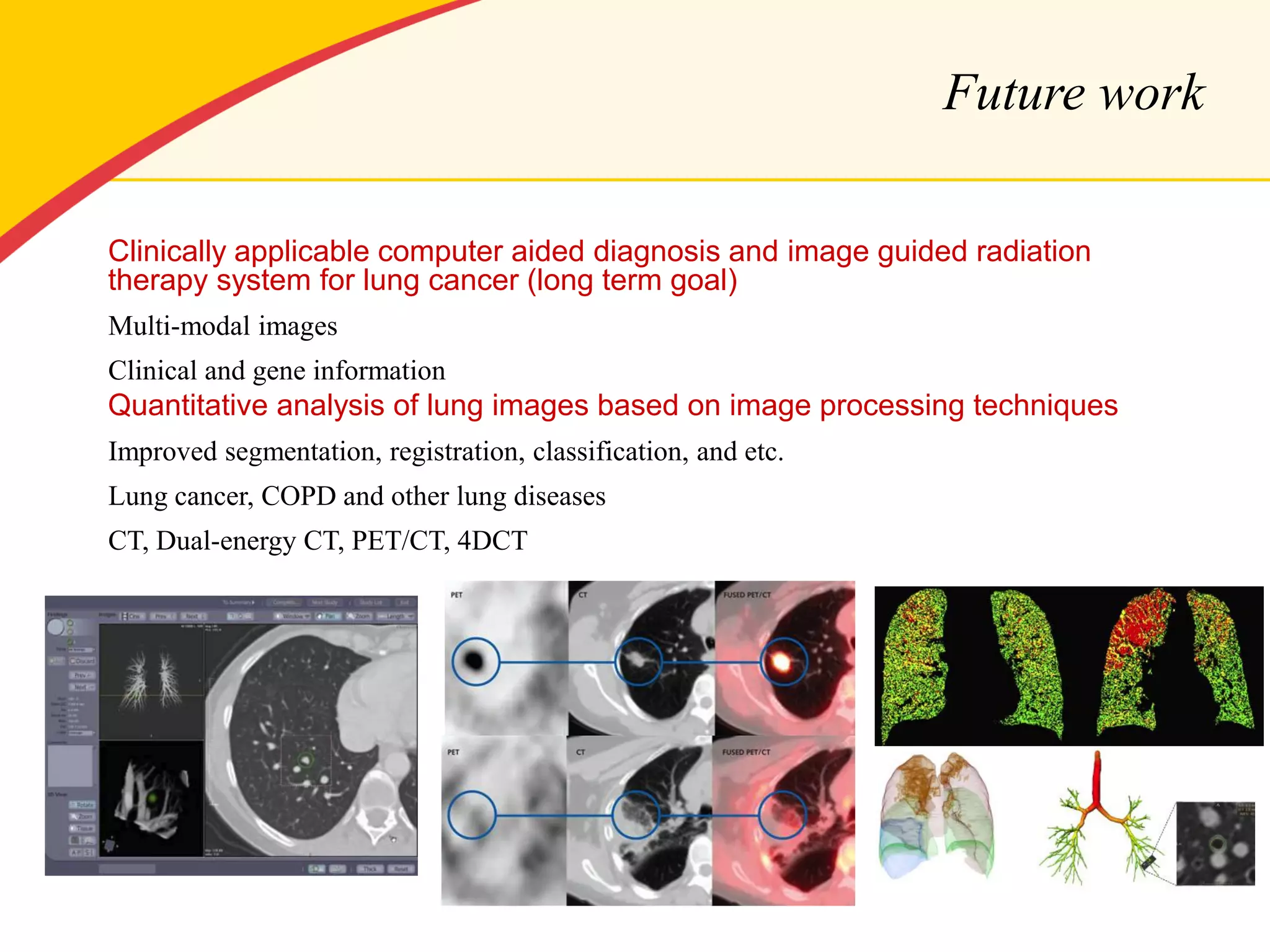
Clinically applicable computer aided diagnosis and image guided radiation therapy system for lung cancer (long term goal) 
Multi-modal images 
Clinical and gene information 
Quantitative analysis of lung images based on image processing techniques 
Improved segmentation, registration, classification, and etc. 
Lung cancer, COPD and other lung diseases 
CT, Dual-energy CT, PET/CT, 4DCT
References 
[1] Rebecca Siegel, Deepa Naishadham, and Ahmedin Jemal, “Cancer statistics, 2012,” CA: A Cancer Journal for Clinicians, vol. 62, no. 1, pp. 10–29, 2012. 
[2] M. F. McNitt-Gray, S. G. Armato, C. R. Meyer, A. P. Reeves, G. McLennan, R. C. Pais, J. Freymann, M. S. Brown, R. M. Engelmann, P. H. Bland, G. E. Laderach, C. Piker, J. Guo, Z. Towfic, D. P.-Y. Qing, D. F. Yankelevitz, D. R. Aberle, E. J. R. van Beek, H. MacMahon, E. A. Kazerooni, B. Y. Croft, L. P. Clarke, The Lung Image Database Consortium (LIDC) data collection process for nodule detection and annotation, Acad Radiol 14 (2007) 1464 – 1474. 
[3] K Suzuki, SG Armato III, F Li, S Sone, and K Doi, “Massive training artificial neural network (MTANN) for reduction of false positives in computerized detection of lung nodules in low-dose computed tomography,” Medical Physics, vol. 30, pp. 1602 – 1617, 2003. 
[4] G.D. Rubin, J.K. Lyo, D.S. Paik, A.J. Sherbondy, L.C. Chow, A.N. Leung, R. Mindelzun, P.K. Schraedley-Desmond, S.E. Zinck, D.P. Naidich, et al., “Pulmonary Nodules on Multi – Detector Row CT Scans: Performance Comparison of Radiologists and Computer-aided Detection,” Radiology, vol. 234, no. 1, pp. 274, 2005. 
[6] Jamshid Dehmeshki, Xujiong Ye, Xinyu Lin, Manlio Valdivieso, and Hamdan Amin, “Automated detection of lung nodules in CT images using shape-based genetic algorithm,” Computerized Medical Imaging and Graphics, vol. 31, no. 6, pp. 408 – 417, Sep 2007. 
[6] J.J. Suárez-Cuenca, P.G. Tahoces, M. Souto, M.J. Lado, M. Remy-Jardin, J. Remy, and J. José Vidal, “Application of the iris filter for automatic detection of pulmonary nodules on computed tomography images,” Computers in Biology and Medicine, vol. 39, no. 10, pp. 921 – 933, 2009.
References 
[7] Bruno Golosio, Giovanni Luca Masala, Alessio Piccioli, Piernicola Oliva, Massimo Carpinelli, Rosella Cataldo, Piergiorgio Cerello, Francesco De Carlo, Fabio Falaschi, Maria Evelina Fantacci, et al., “A novel multithreshold method for nodule detection in lung ct,” Medical physics, vol. 36, pp. 3607, 2009. 
[8] X. Ye, X. Lin, J. Dehmeshki, G. Slabaugh, and G. Beddoe, “Shape-based computer-aided detection of lung nodules in thoracic CT images,” IEEE Transactions on Biomedical Engineering, vol. 56, no. 7, pp. 1810 – 1820, 2009. 
[9] João Rodrigo Ferreira da Silva Sousa, Aristófanes Correa Silva, Anselmo Cardoso de Paiva, and Rodolfo Acatauassú Nunes, “Methodology for automatic detection of lung nodules in computerized tomography images.,” Computer methods and programs in biomedicine, vol. 98, no. 1, pp. 1–14, Apr. 2010. 
[10] T. Messay, R.C. Hardie, and S.K. Rogers, “A new computationally efficient CAD system for pulmonary nodule detection in CT imagery,” Medical Image Analysis, vol. 14, no. 3, pp. 390 – 406, 2010. 
[11] A Riccardi, TS Petkov, G Ferri, M Masotti, and R Campanini, “Computer-aided detection of lung nodules via 3D fast radial transform, scale space representation, and Zernike MIP classification,” Medical Physics, vol. 38, no. 4, pp. 1962–1971, 2011. 
[12] D. Cascio, R. Magro, F. Fauci, M. Iacomi, and G. Raso, “Automatic detection of lung nodules in ct datasets based on stable 3d mass-pring models,” Computers in Biology and Medicine, vol. 42, no. 11, pp. 1098 – 1109, 2012.

computer aided detection of pulmonary nodules in ct scans

  • 1.
    Computer Aided Detectionof Pulmonary Nodules in CT Scans Wookjin Choi, PhD
  • 2.
    Introduction Lung canceris the leading cause of cancer deaths. Most patients diagnosed with lung cancer already have advanced disease 40% are stage IV and 30% are III The current five-year survival rate is only 16% Defective nodules are detected at an early stage The survival rate can be increased (a) male (b) female Trends in death rates for selected cancers, United States, 1930-2008 [1]
  • 3.
    Pulmonary Nodule DetectionCAD system The use of pulmonary nodule detection CAD system can provide an effective solution CAD system can assist radiologists by increasing efficiency and potentially improving nodule detection General structure of pulmonary nodule detection system
  • 4.
    Pulmonary Nodule DetectionCAD system CAD systems Lung segmentation Nodule Candidate Detection False Positive Reduction Suzuki et al.(2003)[3] Thresholding Multiple thresholding MTANN Rubin et al.(2005)[4] Thresholding Surface normal overlap Lantern transform and rule- based classifier Dehmeshki et al.(2007)[5] Adaptive thresholding Shape-based GATM Rule-based filtering Suarez-Cuenca et al.(2009)[6] Thresholding and 3-D connected component labeling 3-D iris filtering Multiple rule-based LDA classifier Golosio et al.(2009)[7] Isosurface-triangulation Multiple thresholding Neural network Ye et al.(2009)[8] 3-D adaptive fuzzy segmentation Shape based detection Rule-based filtering and weighted SVM classifier Sousa et al.(2010)[9] Region growing Structure extraction SVM classifier Messay et al.(2010)[10] Thresholding and 3-D connected component labeling Multiple thresholding and morphological opening Fisher linear discriminant and quadratic classifier Riccardi et al.(2011)[11] Iterative thresholding 3-D fast radial filtering and scale space analysis Zernike MIP classification based on SVM Cascio et al.(2012)[12] Region growing Mass-spring model Double-threshold cut and neural network
  • 5.
    Experimental Data Set Lung Image Database Consortium (LIDC) database [2] is applied to evaluate the performance of the proposed method. LIDC database, National Cancer Institute (NCI), United States The LIDC is developing a publicly available database of thoracic computed tomography (CT) scans as a medical imaging research resource to promote the development of computer-aided detection or characterization of pulmonary nodules. The database consists of 84 CT scans (up to 2007) [2] 100-400 Digital Imaging and Communication (DICOM) images An XML data file containing the physician annotations of nodules 148 nodules The pixel size in the database ranged from 0.5 to 0.76 mm The reconstruction interval ranged from 1 to 3mm
  • 6.
    Genetic Programming basedClassifier for Detection of Pulmonary nodules Wook-Jin Choi, Tae-Sun Choi, “Genetic programming-based feature transform and classification for the automatic detection of pulmonary nodules on computed tomography images”, Information Sciences, Vol. 212, pp. 57-78, December 2012, doi: http://dx.doi.org/10.1016/j.ins.2012.05.008 Feature spaces for four types of features 2-D geometric feature 3-D geometric feature 2-D intensity-based statistical feature 3-D intensity-based statistical feature Genetic programming classifier learning Classification space GP based classification expression in tree shape
  • 7.
    Hierarchical Block-image Analysisfor Pulmonary Nodule Detection Wook-Jin Choi, Tae-Sun Choi, “Automated Pulmonary Nodule Detection System in Computed Tomography Images: A Hierarchical Block Classification Approach”, Entropy, Vol. 15, No. 2, pp. 507-523, February 2013, doi:http://dx.doi.org/10.3390/e15020507 ROC curves of the SVM classifiers with respect to three different kernel functions, SVM-r: radial basis function, SVM-p: polynomial function, and SVM-m: Minkowski distance function; (a) p = 0:25 and (b) p = 1. FROC curves of the proposed CAD system with respect to three different kernel parameters of SVM-r classifiers
  • 8.
    θ φ θ φ Pulmonary Nodule Detection using Three-dimensional Shape- based Feature Descriptor Wook-Jin Choi, Tae-Sun Choi, “Automated Pulmonary Nodule Detection based on Three-dimensional Shape-based Feature Descriptor”, Computer Methods and Programs in Biomedicine, Vol. 113, No. 1, January 2014, pp. 37–54, doi: http://dx.doi.org/10.1016/j.cmpb.2013.08.015 Surface saliency weighted surface normal vectors Two angular histograms of the surface normal vectors θ φ ROC curves of the SVM classifiers with respect to three different kernel functions, SVM-r: radial basis function, SVM-p: polynomial function, and SVM-m: Minkowski distance function; (a) p = 0:25 and (b) p = 1. FROC curves of the proposed CAD system with respect to three different dimensions of AHSN features θ φ θ φ Feature optimization with wall detection and elimination algorithm 3D shape-based feature descriptor
  • 9.
    Comparative Analysis CADsystems Nodule size FPs per case Sensitivity Suzuki et al.(2003)[3] 8 - 20 mm 16.1 80.3% Rubin et al.(2005)[4] >3 mm 3 76% Dehmeshki et al.(2007)[5] 3 - 20 mm 14.6 90% Suarez-Cuenca et al.(2009)[6] 4 - 27 mm 7.7 80% Golosio et al.(2009)[7] 3 - 30 mm 4.0 79% Ye et al.(2009)[8] 3 - 20 mm 8.2 90.2% Sousa et al.(2010)[9] 3 - 40.93 mm - 84.84% Messay et al.(2010)[10] 3-30 mm 3 82.66% Riccardi et al.(2011)[11] >3 mm 6.5 71.% Cascio et al.(2012)[12] 3-30 mm 6.1 97.66% Genetic Programming 3-30 mm 5.45 90.9% Hierarchical Block Analysis 3-30 mm 2.27 95.2% Shape-based Feature 3-30 mm 2.43 95.4%
  • 10.
    Conclusions Automated pulmonarynodule detection system is studied Pulmonary nodule detection CAD system is an effective solution for early detection of lung cancer The proposed systems are based on Genetic programming based classifier •Feature transform to classification space Hierarchical block-image analysis •Locally optimized nodule segmentation 3-D shape-based feature descriptor •Shape feature without nodule segmentation The performance of the proposed CAD systems is evaluated on the LIDC database of NCI The proposed methods have significantly reduced the false positives in nodule candidates
  • 11.
    Future work Clinicallyapplicable computer aided diagnosis and image guided radiation therapy system for lung cancer (long term goal) Multi-modal images Clinical and gene information Quantitative analysis of lung images based on image processing techniques Improved segmentation, registration, classification, and etc. Lung cancer, COPD and other lung diseases CT, Dual-energy CT, PET/CT, 4DCT
  • 12.
    References [1] RebeccaSiegel, Deepa Naishadham, and Ahmedin Jemal, “Cancer statistics, 2012,” CA: A Cancer Journal for Clinicians, vol. 62, no. 1, pp. 10–29, 2012. [2] M. F. McNitt-Gray, S. G. Armato, C. R. Meyer, A. P. Reeves, G. McLennan, R. C. Pais, J. Freymann, M. S. Brown, R. M. Engelmann, P. H. Bland, G. E. Laderach, C. Piker, J. Guo, Z. Towfic, D. P.-Y. Qing, D. F. Yankelevitz, D. R. Aberle, E. J. R. van Beek, H. MacMahon, E. A. Kazerooni, B. Y. Croft, L. P. Clarke, The Lung Image Database Consortium (LIDC) data collection process for nodule detection and annotation, Acad Radiol 14 (2007) 1464 – 1474. [3] K Suzuki, SG Armato III, F Li, S Sone, and K Doi, “Massive training artificial neural network (MTANN) for reduction of false positives in computerized detection of lung nodules in low-dose computed tomography,” Medical Physics, vol. 30, pp. 1602 – 1617, 2003. [4] G.D. Rubin, J.K. Lyo, D.S. Paik, A.J. Sherbondy, L.C. Chow, A.N. Leung, R. Mindelzun, P.K. Schraedley-Desmond, S.E. Zinck, D.P. Naidich, et al., “Pulmonary Nodules on Multi – Detector Row CT Scans: Performance Comparison of Radiologists and Computer-aided Detection,” Radiology, vol. 234, no. 1, pp. 274, 2005. [6] Jamshid Dehmeshki, Xujiong Ye, Xinyu Lin, Manlio Valdivieso, and Hamdan Amin, “Automated detection of lung nodules in CT images using shape-based genetic algorithm,” Computerized Medical Imaging and Graphics, vol. 31, no. 6, pp. 408 – 417, Sep 2007. [6] J.J. Suárez-Cuenca, P.G. Tahoces, M. Souto, M.J. Lado, M. Remy-Jardin, J. Remy, and J. José Vidal, “Application of the iris filter for automatic detection of pulmonary nodules on computed tomography images,” Computers in Biology and Medicine, vol. 39, no. 10, pp. 921 – 933, 2009.
  • 13.
    References [7] BrunoGolosio, Giovanni Luca Masala, Alessio Piccioli, Piernicola Oliva, Massimo Carpinelli, Rosella Cataldo, Piergiorgio Cerello, Francesco De Carlo, Fabio Falaschi, Maria Evelina Fantacci, et al., “A novel multithreshold method for nodule detection in lung ct,” Medical physics, vol. 36, pp. 3607, 2009. [8] X. Ye, X. Lin, J. Dehmeshki, G. Slabaugh, and G. Beddoe, “Shape-based computer-aided detection of lung nodules in thoracic CT images,” IEEE Transactions on Biomedical Engineering, vol. 56, no. 7, pp. 1810 – 1820, 2009. [9] João Rodrigo Ferreira da Silva Sousa, Aristófanes Correa Silva, Anselmo Cardoso de Paiva, and Rodolfo Acatauassú Nunes, “Methodology for automatic detection of lung nodules in computerized tomography images.,” Computer methods and programs in biomedicine, vol. 98, no. 1, pp. 1–14, Apr. 2010. [10] T. Messay, R.C. Hardie, and S.K. Rogers, “A new computationally efficient CAD system for pulmonary nodule detection in CT imagery,” Medical Image Analysis, vol. 14, no. 3, pp. 390 – 406, 2010. [11] A Riccardi, TS Petkov, G Ferri, M Masotti, and R Campanini, “Computer-aided detection of lung nodules via 3D fast radial transform, scale space representation, and Zernike MIP classification,” Medical Physics, vol. 38, no. 4, pp. 1962–1971, 2011. [12] D. Cascio, R. Magro, F. Fauci, M. Iacomi, and G. Raso, “Automatic detection of lung nodules in ct datasets based on stable 3d mass-pring models,” Computers in Biology and Medicine, vol. 42, no. 11, pp. 1098 – 1109, 2012.